Article

Population Structure of Todarodes pacificus (Cephalopoda: Ommastrephidae) in the Northwest Pacific: Insights from Integrated Genetic and Statolith Morphology Analyses


1
Key Laboratory of Mariculture, Ministry of Education, Ocean University of China, Qingdao 266003, China
2
MOE Key Laboratory of Evolution & Marine Biodiversity and Institute of Evolution and Marine Biodiversity, Ocean University of China, Qingdao 266003, China
3
Department of Marine Science, Faculty of Fisheries, Kasetsart University, Bangkok 10900, Thailand
4
Qingdao Municipal Ocean Management and Control Center, Qingdao 266071, China
*
Author to whom correspondence should be addressed.
Diversity 2026, 18(2), 123; https://doi.org/10.3390/d18020123
Submission received: 22 December 2025 / Revised: 9 February 2026 / Accepted: 12 February 2026 / Published: 14 February 2026
(This article belongs to the Special Issue Cephalopod Resilience in Changing Marine Ecosystems)

Abstract

Accurate identification of population structure is crucial for the sustainable management of cephalopod fisheries. This study integrated genetic and morphological approaches to investigate the population structure of Todarodes pacificus in the northwest Pacific. Specimens were collected from the northern Yellow Sea, northern East China Sea, and southern East China Sea between 2019 and 2024. Based on two mitochondrial genes (COI and 16S rRNA) and one nuclear gene (ODH), population genetic analyses revealed no significant genetic differentiation among geographical regions or between summer- and autumn-spawning cohorts, suggesting high gene flow and possible panmixia. In contrast, geometric morphometric analysis of statoliths revealed significant differentiation between spawning cohorts, particularly in the posterior indentation region. Random Forest classification achieved high discriminatory accuracy (85.0–94.8%), supporting the robustness of statolith shape as a phenotypic marker. Interannual variation in statolith morphology was also detected, potentially linked to climatic events. Although no winter-spawning cohort was identified in the commercial samples examined, the summer-spawning cohort appears to constitute a major component of the Western Pacific stock. These findings demonstrate that statolith morphology can serve as a reliable tool for cohort discrimination even in the absence of genetic differentiation, offering critical insights for the cohort-specific management and conservation of T. pacificus resources.

1. Introduction

The global expansion of cephalopod fisheries in recent decades has positioned them as viable alternatives to depleted traditional finfish stocks [1]. Increased cephalopod landings have helped maintain the overall stability and yield of global marine fisheries. However, this has led to intensified fishing pressure, with global catches leveling off at 3.6 million tons in 2018 after peaking at 4.9 million tons in 2014 [2]. Identifying the population structure of these commercial species is therefore critical as the population serves as the fundamental unit for ecosystem assessment and fishery management [3]. Cephalopods exhibit high species diversity and generally adopt a “fast-turnover” life history strategy, characterized by annual reproduction, rapid growth, and short life cycles [4,5]. This strategy renders them highly sensitive to environmental conditions, enabling swift responses to fluctuations in hydrology, temperature, and food resources across specific spatiotemporal scales. Moreover, their extensive geographic distribution, diverse reproductive strategies, and population replenishment dynamics, which are strongly influenced by environmental variability, often result in highly dynamic and complex population structures [6]. Effectively governing these populations thus necessitates integrating diverse stock identification methods, a challenge compounded by the vast oceanic migrations of nektonic squids across multiple ecosystems, which complicates the alignment of biological and operational management strategies.
Todarodes pacificus (Cephalopoda: Ommastrephidae) is distributed in the northwest Pacific, ranging from 20° N to 60° N [7]. It is one of the earliest developed and utilized species worldwide and largely exploited by Asia-Pacific countries including China, Japan, and Korea [8]. At present, research on T. pacificus mainly focuses on resource abundance and its assessment, basic biology, genetic diversity ofpopulations, and the spatiotemporal distribution of spawning ground [9]. The species has three cohorts with different peak spawning seasons: summer, autumn and winter. The three cohorts have different distribution, migration routes, spawning ground, and resource dynamics [9]. Although studies have evaluated long-term abundance variability and its relationship with environmental changes to support improved fisheries management [10], complex migration patterns cause cohorts to intermix in certain fishing grounds. This necessitates accurate assessment of stock composition, highlighting the need for effective cohort discrimination methods. Furthermore, while T. pacificus remains relatively abundant in the East China Sea and the Yellow Sea, biological knowledge of the stocks in these areas remains limited. The East China Sea serves as a key spawning and overwintering ground [11], whereas the Yellow Sea provides an important feeding area [12]. Given that these regions represent a substantial portion of the overall population, there is an urgent need to clarify cohort composition to advance a comprehensive understanding of the T. pacificus population structure.
The challenges associated with identifying squid stocks have led to the development of a wider range of investigative tools [13]. A multidisciplinary approach that integrates several methods is particularly beneficial. Molecular markers are essential for assessing genetic diversity and phylogenetic relationships in marine organisms [14]. Currently, two common types of markers (mitochondrial DNA (mtDNA) and nuclear DNA (nuDNA)) play critical roles in revealing population genetic structure and dynamics [15]. While mtDNA markers are widely applied in cephalopod population genetics [16], nuclear genes offer distinct advantages in molecular phylogenetic studies of animals, chiefly manifested in their more uniform substitution rates and consistent patterns of nucleotide replacement across different sites [17]. In addition, statolith is also an effective tool for studying population structure due to its stable morphology and its recording of important biological and ecological information [18]. Because its outline varies predictably with developmental temperature, diet and depth, geometric analysis of statolith outlines discriminates among conspecifics originating from disparate habitats and thereby illuminates both ecological behavior and demographic subdivision in oceanic squid [14].
Integrating molecular markers with statolith morphology provides a more robust approach for analyzing the life history traits, mechanisms underlying the spatial population structure, and patterns of genetic differentiation [19]. In this study, we adopted a strategy combining two mitochondrial genes (cytochrome c oxidase I (COI) and 16S ribosomal RNA (16S rRNA)) with a nuclear gene, octopine dehydrogenase (ODH). As a biparentally inherited nuclear marker with a moderate evolutionary rate, ODH has become an important tool in cephalopod population genetics and phylogeography [20]. For example, Muhammad et al. used two nuclear genes (rhodopsin and ODH) to characterize the population structure of Octopus minor in Chinese waters [20]. Similar integrated multi-marker approaches have been successfully applied in studies of various cephalopod species [21]. The above analysis is conducive to a better understanding of the migration patterns and gene flow of T. pacificus. Furthermore, by examining differences in statolith morphology between summer and autumn spawning cohorts, this study aims to establish more reliable classification criteria and enhance our knowledge of cephalopod resource dynamics in Chinese seas.

2. Materials and Methods

2.1. Population Sampling

Between 2019 and 2024, T. pacificus specimens were acquired across three sectors of the northwest Pacific: the northern Yellow Sea, the northern East China Sea, and the southern East China Sea (Table 1; Figure 1). Samples were collected by Chinese squid jigging vessels during production surveys, immediately placed on ice, and transferred to the laboratory.
Mantle muscle specimens were preserved in ethanol (100%) and maintained at −30 °C for genetic analysis. Mantle length and body weight were measured to the nearest 1 mm and 0.1 g, respectively. Gonadal maturity phases were determined through visual examination [14]. Squid statoliths were extracted and then cleaned in an ultrasonic bath, after which samples were dried and placed into centrifuge tubes.

2.2. Statolith Sample Collection and Processing

2.2.1. Analysis of Statolith Shape Sampling

To mitigate the potential impact of individual developmental variations on statolith morphology, a selection process was implemented, focusing solely on mature specimens (at Stages III, IV, and V) with body lengths falling within a specified, suitable range [22,23]. These were then earmarked for subsequent morphological examination of their statoliths [24]. Previous research has demonstrated a high degree of similarity in the microstructural morphology between left and right statoliths. Therefore, one statolith from each bilateral pair was chosen at random for subsequent imaging and analytical processing [25,26,27]. Analysis of statolith shape sampling detailed protocol is provided in Supplementary Material (Text S1).

2.2.2. Analysis of Statolith Age Identification

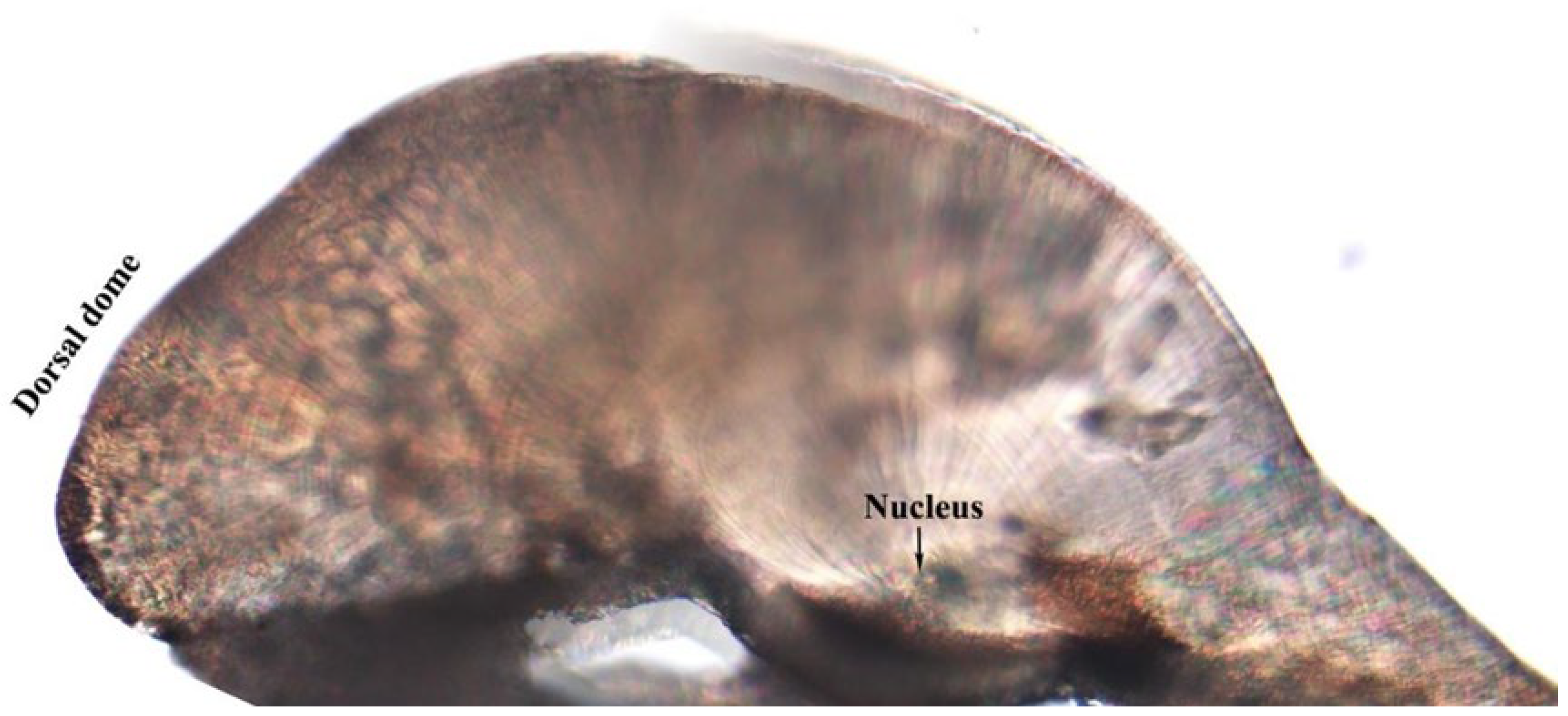
Statoliths were embedded in epoxy resin (Buehler, Epothin) on glass slides with their posterior side facing up. After the resin hardened, the posterior side was ground manually using progressively finer waterproof sandpaper (Buehler; 600 to 4000 grit) until the nucleus was fully exposed and then polished with 0.3 μm alumina powder [28]. For larger statoliths, the grinding direction was adjusted during the process to avoid over-grinding the dorsal dome. The polished statoliths were photographed at 200× magnification using an Olympus BX53 microscope equipped with a DP74 camera (Olympus Corporation, Tokyo, Japan) (Figure A1). The age of each specimen was estimated by enumerating all dark rings. For individual statoliths, increment counts were performed from the hatch check to the dorsal dome margin, representing the total number of growth increments. Increments were counted three times by an experienced reader, with a one-month interval between counts. If the variation between counts was less than 10%, the mean of the three readings was used to estimate daily age. The hatch date for each individual was calculated by subtracting the estimated age from the capture date, after which specimens were assigned to a cohort.

2.3. Methods of Population Genetics

Detailed protocols of DNA extraction and PCR amplification are provided in Supplementary Material (Text S2). The primers used for amplification are listed in Appendix A (Table A1). Detailed protocols of population genetics and the phylogenetic relationship are provided in Supplementary Material (Texts S3 and S4).

3. Results

3.1. Genetic Analysis

Sequence data were successfully generated for T. pacificus, yielding 117 COI, 110 16S rRNA, and 113 partial ODH sequences, as summarized in Table 2. Across all three genes, thymine consistently dominated the nucleotide profile, producing a pronounced AT skew (A + T > G + C). The ODH sequences exhibited the highest proportion of variable sites (20.58%), demonstrating the most substantial among all sequences analyzed, whereas mitochondrial 16S was the most conserved (0.88%), reflecting the overall pattern of lower sequence variation in mitochondrial genes compared to the nuclear gene.
In total, 18, 6, and 21 distinct haplotypes were identified for the COI, 16S rRNA, and ODH loci, respectively, across the two sampled cohorts of T. pacificus. Based on the ODH (Hd = 0.6010 ± 0.0025, π = 0.0053 (95% CI: 0.0050–0.0055)) and COI genes (Hd = 0.4560 ± 0.0032, π = 0.0013 (95% CI: 0.0011–0.0014)), haplotype diversity and nucleotide diversity across all individuals were generally high. In contrast, the 16S sequences exhibited low haplotype diversity (Hd = 0.1710 ± 0.0024) and low nucleotide diversity (π = 0.0004 (95% CI: 0.0002–0.0005)). Analysis across the three markers indicated that the autumn cohort generally had higher nucleotide diversity, while the summer cohort showed lower haplotype diversity (Table 3).
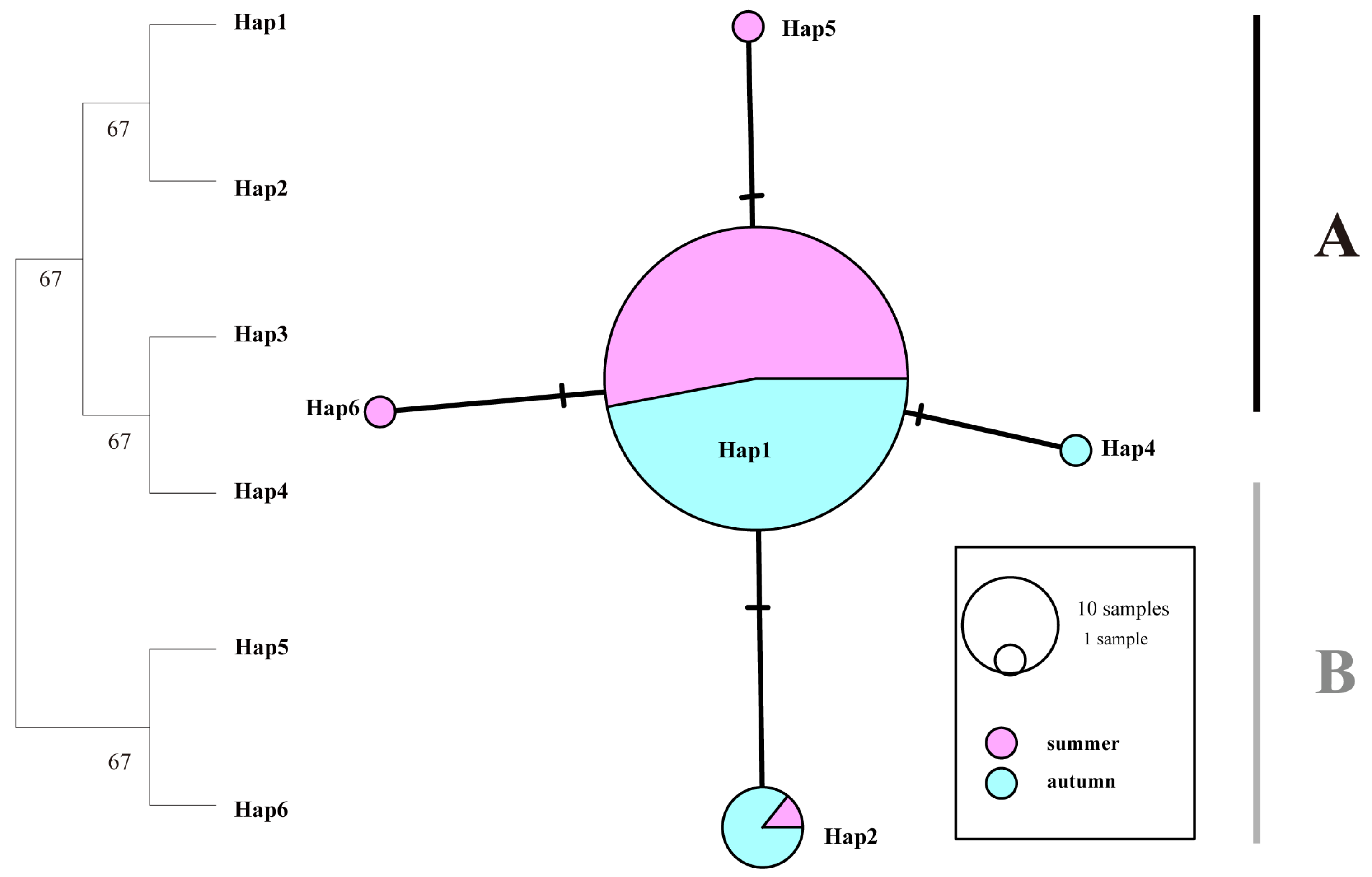
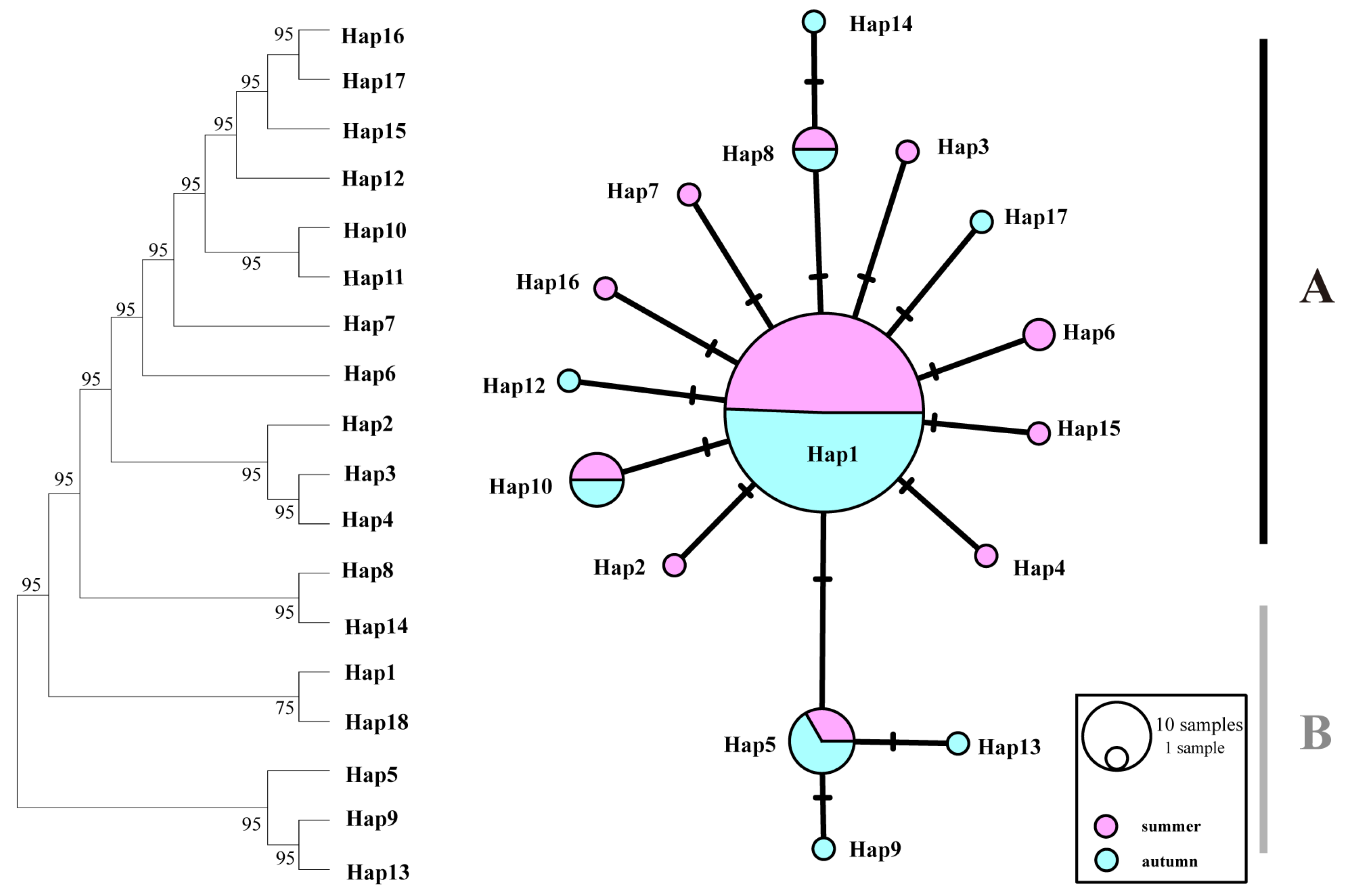
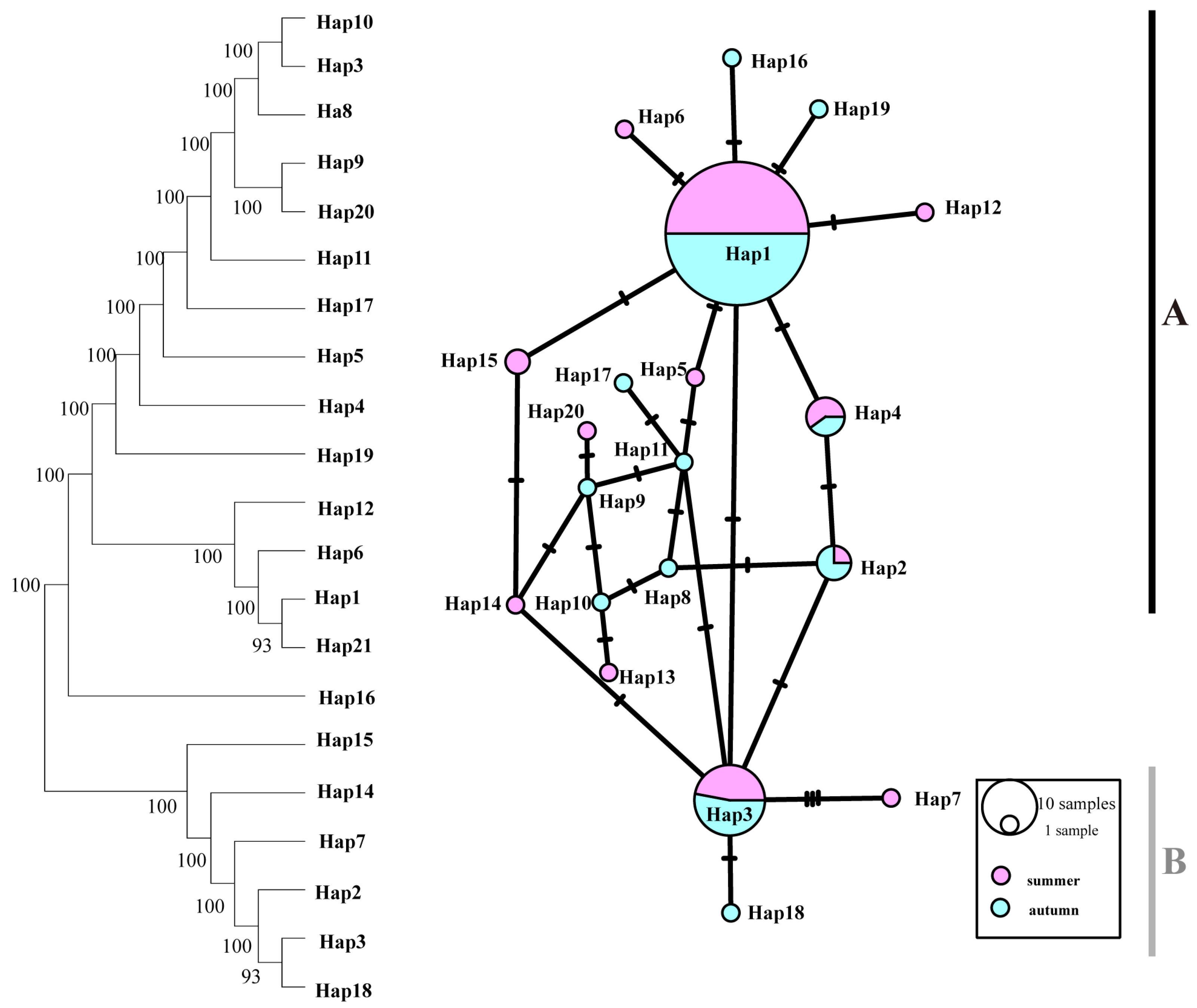
Among the 18 COI haplotypes, three were shared and 15 were unique. These formed a star-shaped network centered on Hap1, with Hap1, Hap5, Hap8, and Hap10 identified as shared haplotypes; deletion variants were also observed (Figure 2). The 16S gene displayed the lowest haplotype diversity (Figure 3). Analysis of the ODH gene revealed five shared haplotypes (Hap1, Hap2, Hap3, and Hap4), which exhibited a high-frequency distribution across populations (Figure 4). Both phylogenetic trees and haplotype networks of the three genes revealed no distinct branches, indicating an absence of clear genetic subdivision (Figure 2, Figure 3 and Figure 4).
The AMOVA results from all three genes were consistent, revealing no significant genetic differentiation among T. pacificus populations (p ≥ 0.1). Mitochondrial genes accounted for a higher proportion of variation than the nuclear genes (Table 4). Pairwise FST analyses for all markers indicated minimal differentiation between the autumn and summer cohorts, with genetic variation existing almost entirely within populations (0 < FST < 0.05) (Table 5).

3.2. Statolith Morphological Analysis

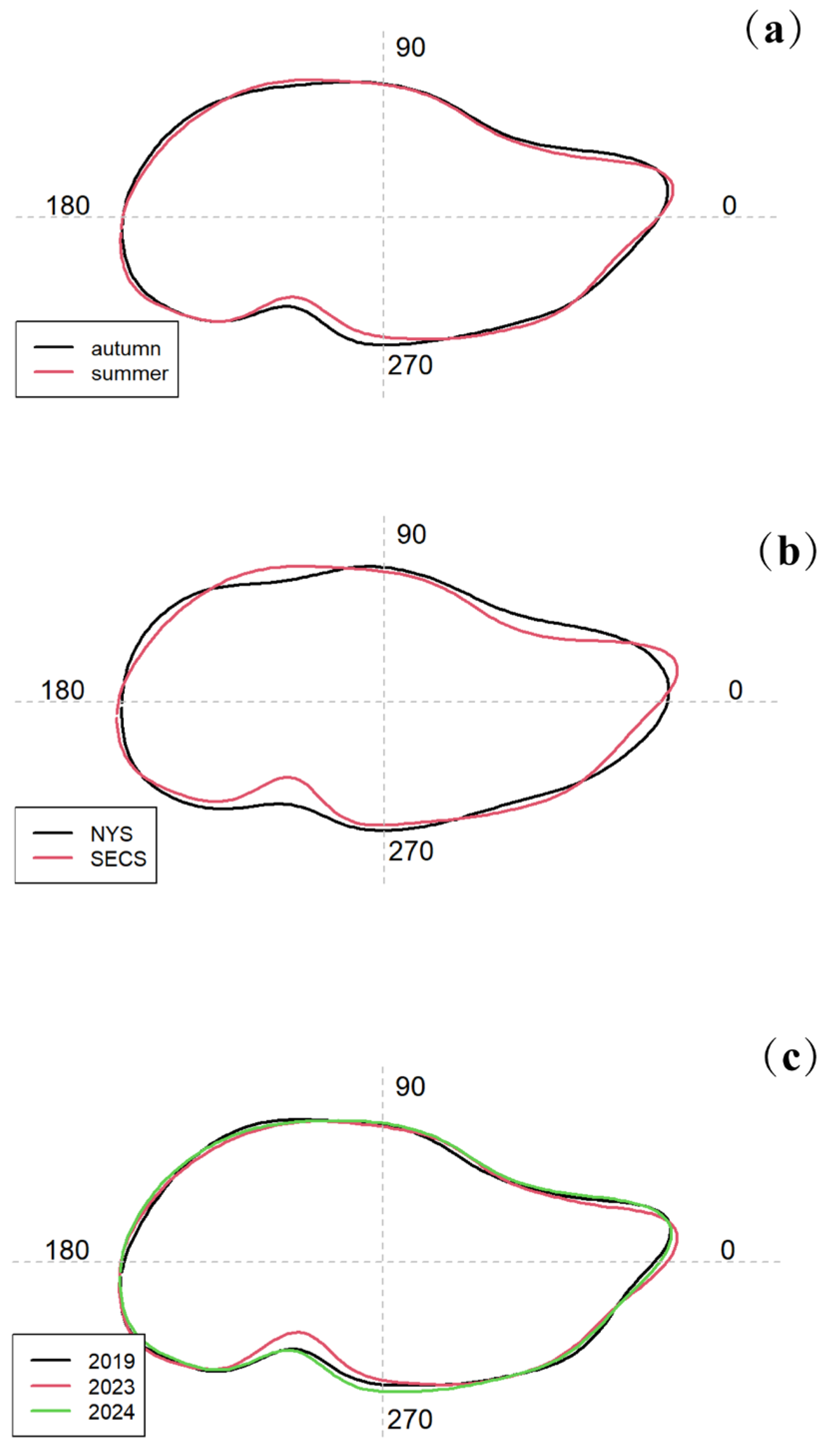
The statolith morphology coefficients differed significantly between summer and autumn cohorts (p < 0.01), with the greatest difference occurring in the posterior indentation (Figure 5). Random forest analysis revealed a high discrimination success rate between these cohorts (Table 6).
Within the autumn cohort, a significant spatial difference in statolith morphology was detected only between the northern Yellow Sea (NYS) and the southern East China Sea (SECS) (p < 0.01), primarily reflected in overall outline shape. Moreover, the average statolith outlines displayed significant annual variation in the rostrum and posterior indentation regions across years (Figure 5). Additionally, significant morphological differences in statolith morphology were found between cohorts (p < 0.01) (Table 7).

4. Discussion

The study combines statolith with genetic analysis in T. pacificus and provides a comprehensive insight into the population structure in the China Seas. The results of statolith microstructure analysis initially indicate that the cohort composition of T. pacificus in China consists of two spawning cohorts—summer and autumn. The winter cohort, a major component, was not detected in the commercially collected specimen, which is consistent with Guo et al. [29]. This phenomenon may be attributed to environmental suitability, as the sampling period of this study coincided with El Niño events [30], suggesting that population fluctuations in the T. pacificus winter cohort are closely linked to the extent of winter spawning grounds. Cold climatic conditions tend to contract the winter spawning areas in the East China Sea, subsequently reducing the adult population size [31]. Furthermore, studies by Rosa confirmed that the decline in fishery catches from Japan and South Korea also contributes to the spatial discontinuity of spawning grounds in the East China Sea during the winter spawning season, thereby affecting the overall scale of the winter cohort [32]. In contrast, despite lacking specific proportion, the summer cohort plays a more important role in China compared to Korea and Japan [33]. Such condition should be emphasized in future management processes since the summer cohort is a small-sized group that is more vulnerable to fishing pressure and local extinction [31].
The genetic analysis revealed low haplotype and nucleotide diversity in T. pacificus and an absence of significant population structure, consistent with the findings of Zhang et al. [9]. Furthermore, only six 16S haplotypes were identified in this species. This low haplotype number is likely because the 16S in cephalopods, including T. pacificus, is highly conserved with few variable sites, leading to reduced haplotype diversity [34].
The present study reveals relatively low genetic diversity in T. pacificus across Chinese coastal waters, with no significant genetic differentiation detected among the NECS, NYS, and SECS populations. This pattern may be closely linked to the species’ extensive migratory behavior and the distribution of its spawning grounds [35]. Throughout its life cycle, T. pacificus undertakes long-distance migrations between spawning, feeding, and nursery areas. These movements facilitate substantial gene flow among geographically separated populations, counteracting genetic divergence and maintaining genetic homogeneity across a wide geographical range [36]. The spawning grounds of T. pacificus in the Northwest Pacific Ocean serve as key hubs for genetic exchange [37]. During the spawning season, individuals from different regions aggregate, enhancing opportunities for genetic recombination and mixing. Subsequent larval dispersal by ocean currents further promotes the broad distribution of genetic material, reinforcing connectivity among coastal populations. Similar patterns have been reported in other ommastrephid squids. For example, Ommastrephes bartramii exhibited high gene flow among populations despite potential geographical separation of spawning areas, resulting in maintained genetic homogeneity across its range. In contrast, species with more restricted dispersal ability or isolated spawning grounds tend to show stronger genetic differentiation among populations [7].
Compared to genetic markers, significant differentiation was detected in the statolith shape, highlighting the fact that ecologically separated groups can be identified in T. pacificus. The difference in statolith shape further emphasizes the ecological difference between summer and autumn cohorts. The high discrimination success rate between cohorts provides an effective tool for evaluating cohort composition and supports effective management. Similar to fish otoliths, morphological variation in cephalopod statoliths is influenced by both environmental and genetic factors [38]. Since there is no significant genetic structure in T. pacificus, the observed statolith difference could mainly be a result of environmental factors. Consistently, major differences are observed in posterior indentation. Because of the strong swimming ability of T. pacificus, it is difficult to track its environmental factors in the long term [14]. However, only spatial differences were observed between NYS and SECS in the autumn cohort. Thus, the morphology differences could mainly be a result of environmental conditions during early life stages [39]. In addition, the interannual distribution in morphology showed differences among years. A study [29] has demonstrated that differences in marine environmental factors and climatic anomalies can influence the growth of the external morphology of cephalopod hard tissues. The years 2019 and 2023 were characterized by El Niño events, during which the sea surface temperature was relatively low. In contrast, 2024 was marked by a La Niña event, with higher sea surface temperatures observed in these regions. These variations may have contributed to the morphological differences observed in the statoliths of T. pacificus.

5. Conclusions

The study combines statolith analysis with genetic analysis in T. pacificus and provides comprehensive insights into the population structure in the China Seas. The statolith microstructure first reveals the cohort composition of T. pacificus that is commercially explored in China. Based on these findings, it is recommended to comprehensively investigate the proportion of the summer cohort, which may serve as a potential alternative to the winter cohort under extreme conditions. Currently, the winter cohort population of T. pacificus is highly sensitive to environmental fluctuations. It is essential to monitor the declining trend in biomass resulting from the combined effects of fishing pressure and environmental stressors to ensure the sustainable utilization of this resource. This study revealed that there is almost no significant genetic differentiation among summer and autumn cohorts based on the mtDNA (COI and 16S) and nuDNA (ODH) sequences. The overall shapes of statoliths in summer and autumn cohorts exhibit significant differences, and their high classification success enables them to serve as reliable classification markers. Given the absence of significant genetic differentiation, these morphological markers provide an important reference for subsequent cohort classification and a theoretical foundation for the rational development and utilization of T. pacificus fishery resources.

Supplementary Materials

The following supporting information can be downloaded at: https://www.mdpi.com/article/10.3390/d18020123/s1, references [40,41,42,43,44,45,46,47,48,49,50,51,52,53] are cited in the Supplementary Materials Texts S1–S4.

Author Contributions

X.Z., C.Z., and X.L. conceptualized and designed the research framework. C.Z. was responsible for sample collection. X.L. and S.P. conducted the experimental procedures and drafted the initial manuscript. X.Z., C.Z. and J.L. made revisions to the paper. All authors have read and agreed to the published version of the manuscript.

Funding

This work was supported by the National Natural Science Foundation of China (No.32170536).

Institutional Review Board Statement

All experiments were approved by the Institutional Animal Care and Use Committee of Ocean University of China.

Informed Consent Statement

Not applicable.

Data Availability Statement

The data that support the findings of this study are available upon request from the corresponding author. The data are not publicly available due to privacy or ethical restrictions.

Acknowledgments

The authors thank Junding Wang, Yanyu Chen and Jingrui Qu for their great assistance in sample collection.

Conflicts of Interest

The authors declare no conflicts of interest.

Appendix A

Figure A1. Age of statolith diagram.
Diversity 18 00123 g0a1
Table A1. The primers of mitochondrial (mt) and nuclear (nu) genes.
GeneMt/NuPrimersPCR ConfitionReference
COIMtCOI-F: 5′-CCTATCTCGGCAGCACTA-3′95 °C 5 min, (95° C 10 s, 55 °C 20 s,
72 °C 30 s) × 35, 72 °C 5 min
[9]
COI-R: 5′-CCAATAAAATCGCTCTAATA-3′
16SMt16S-F: 5′-GCCTCGCCTGTTTACCAAAAAC-3′[54]
16S-R: 5′-CGGTCTGAACTCAGATCACGT-3′
ODHNuODH-F: 5′-ATGAGGGTTACTTTAGAGCCA-3′[23]
ODH-R: 5′-GCAGGTCTTCATTGCCATAC-3′

References

  1. Caddy, J.F.; Rodhouse, P.G. Cephalopod and groundfish landings: Evidence for ecological change in global fisheries? Rev. Fish Biol. Fish. 1998, 8, 431–444. [Google Scholar] [CrossRef]
  2. FAO. The state of world fisheries and aquaculture 2020. In The State of World Fisheries and Aquaculture (SOFIA); FAO: Rome, Italy, 2020; p. 244. [Google Scholar]
  3. Hohenegger, J. Species as the basic units in evolution and biodiversity: Recognition of species in the recent and geological past as exemplified by larger foraminifera. Gondwana Res. 2014, 25, 707–728. [Google Scholar] [CrossRef]
  4. Zheng, X.D.; Lv, Y.H.; Lu, C.C. Species diversity of cephalopods in the China seas. J. Ocean Univ. China 2023, 53, 1–18. [Google Scholar]
  5. Arkhipkin, A.I.; Hendrickson, L.C.; Payá, I.; Pierce, G.J.; Roa-Ureta, R.H.; Robin, J.; Winter, A. Stock assessment and management of cephalopods: Advances and challenges for short-lived fishery resources. ICES J. Mar. Sci. 2020, 78, 714–730. [Google Scholar] [CrossRef]
  6. Guo, J.Z.; Zhang, C.; Li, Z.X.; Liu, D.; Tian, Y.J. Latitudinal difference in the condition factor of two loliginidae squid (Beka squid and Indian squid) in China seas. Diversity 2023, 15, 812. [Google Scholar] [CrossRef]
  7. Bower, J.R.; Ichii, T. The red flying squid (Ommastrephes bartramii): A review of recent research and the fishery in Japan. Fish. Res. 2005, 76, 39–55. [Google Scholar] [CrossRef]
  8. Komai, T.; Kawabata, C.; Amano, M.; Lee, B.R.; Ichishima, E. Todarepsin, a new cathepsin D from hepatopancreas of Japanese common squid (Todarodes pacificus). Comp. Biochem. Physiol. Part B Biochem. Mol. Biol. 2004, 137, 373–382. [Google Scholar] [CrossRef]
  9. Zhang, Q.; Cao, Y.M.; Lu, H.J.; Liu, Y.; Zhang, Z.; Fang, Z.; Wang, C.C. Genetic variation and genetic structure analysis of Todarodes pacificus based on mitochondrial DNA markers. J. Shanghai Ocean Univ. 2021, 30, 763–769. [Google Scholar]
  10. Xu, M.; Liu, S.H.; Zhang, H.; Li, Z.G.; Song, X.J.; Yang, L.L.; Tang, B.J. Seasonal Analysis of Spatial Distribution Patterns and Characteristics of Sepiella maindroni and Sepia kobiensis in the East China Sea Region. Animals 2024, 14, 2716. [Google Scholar] [CrossRef] [PubMed]
  11. Sakurai, Y.; Kiyofuji, H.; Saitoh, S.; Goto, T.; Hiyama, Y. Changes in inferred spawning areas of Todarodes pacificus (Cephalopoda: Ommastrephidae) due to changing environmental conditions. ICES J. Mar. Sci. 2000, 57, 24–30. [Google Scholar] [CrossRef]
  12. Yang, L.L.; Jiang, Y.Z.; Zhang, H.; Yuan, X.W.; Liu, Z.L. Seasonal variations and environmental drivers of suitable habitats of Todarodes pacificus in southern Yellow Sea and East China Sea. Chin. J. Ecol. 2023, 42, 685–693. [Google Scholar]
  13. Arkhipkin, A.I.; Rodhouse, P.G.K.; Pierce, G.J.; Sauer, W.; Sakai, M.; Allcock, L.; Arguelles, J.; Bower, J.R.; Castillo, G.; Ceriola, L.; et al. World squid fisheries. Rev. Fish. Sci. Aquac. 2015, 23, 92–252. [Google Scholar] [CrossRef]
  14. Ching, T.Y.; Chen, C.S.; Yagishita, N.; Yamaguchi, A.; Wang, C.H.; Shen, K.N. Variations in life-history traits and statolith shape for Sepioteuthis spp. in the waters off southwestern Japan. Rev. Fish Biol. Fish. 2021, 87, 173–185. [Google Scholar] [CrossRef]
  15. Raj, N.; Sukumaran, S.; Jose, A.; Nisha, K.; Roul, S.K.; Rahangdale, S.; Kizhakudan, S.J.; Gopalakrishnan, A. Population genetic structure of Randall’s threadfin bream Nemipterus randalli in Indian waters based on mitochondrial and nuclear gene sequences. Sci. Rep. 2024, 14, 7556. [Google Scholar] [CrossRef] [PubMed]
  16. Xu, R.; Bo, Q.K.; Zheng, X.D. A divergent lineage among Octopus minor (Sasaki, 1920) populations in the northwest Pacific supported by DNA barcoding. Mar. Biol. Res. 2018, 14, 335–344. [Google Scholar] [CrossRef]
  17. Wang, X.R.; Lv, Y.H.; Zhang, C.; Zheng, X.D. Population genetic structure and phylogenetic relationships reveal cryptic biodiversity in the Uroteuthis (Photololigo) duvaucelii (Cephalopoda: Loliginidae) species complex. Hydrobiologia 2025, 852, 2957–2970. [Google Scholar] [CrossRef]
  18. Graybeal, A. Evaluating the Phylogenetic Utility of Genes: A Search for Genes Informative About Deep Divergences among Vertebrates. Syst. Biol. 1994, 43, 174–193. [Google Scholar] [CrossRef]
  19. Arkhipkin, A. Statoliths as ‘black boxes’ (life recorders) in squid. Mar. Freshw. Res. 2005, 56, 573–583. [Google Scholar] [CrossRef]
  20. Muhammad, F.; Lü, Z.M.; Liu, L.; Gong, L.; Du, X.; Muhammad, S.; Kaleri, H.A. Genetic structure of Octopus minor around Chinese waters as indicated by nuclear DNA variations (Mollusca, Cephalopoda). Zookeys 2018, 775, 1–14. [Google Scholar] [CrossRef]
  21. Strugnell, J.; Norman, M.; Jackson, J.; Drummond, A.J.; Cooper, A. Molecular phylogeny of coleoid cephalopods (Mollusca: Cephalopoda) using a multigene approach; the effect of data partitioning on resolving phylogenies in a Bayesian framework. Mol. Phylogenet. Evol. 2005, 37, 426–441. [Google Scholar] [CrossRef]
  22. Arkhipkin, A.I.; Bizikov, V.A. Role of the statolith in functioning of the acceleration receptor system in squids and sepioids. J. Zool. 2000, 250, 31–55. [Google Scholar] [CrossRef]
  23. Wang, X.R.; Zhang, C.; Zheng, X.D. Integrated genetic and statolith shape analysis reveals the population structure of Loliolus (nipponololigo) uyii (Cephalopoda: Loliginidae) in the coastal waters of China. Diversity 2024, 16, 674. [Google Scholar] [CrossRef]
  24. Han, P.W.; Wang, Y.; Fang, Z.; Liu, B.L.; Chen, X.J. Review on cephalopoda migration characteristics based on the microchemistry technology of hard tissues. J. Guangdong Ocean Univ. 2021, 41, 142–152. [Google Scholar]
  25. Markaida, U.; Quiñónez-Velázquez, C.; Sosa-Nishizaki, O. Age, growth and maturation of jumbo squid Dosidicus gigas (Cephalopoda: Ommastrephidae) from the gulf of California, Mexico. Fish. Res. 2004, 66, 31–47. [Google Scholar] [CrossRef]
  26. Moustahfid, H. Age and growth of arrow squid Todarodes sagittatus (Cephalopoda: Ommastrephidae) sampled in summer in Atlantic Moroccan waters. Bull. Mar. Sci. 2002, 71, 535–543. [Google Scholar]
  27. Natsukari, Y.; Nakanose, T.; Oda, K. Age and growth of loliginid squid Photololigo edulis (Hoyle, 1885). J. Exp. Mar. Biol. Ecol. 1988, 116, 177–190. [Google Scholar] [CrossRef]
  28. Takagi, K.; Kitahara, T. Bias in age estimation of Japanese common squid due to grinding degree of statoliths. Nippon Suisan Gakkaishi 2002, 68, 351–355. [Google Scholar] [CrossRef]
  29. Shi, Z.; Guo, R.Y.; Lu, H.J.; Sun, T.Z.; Zhao, M.L.; Zhang, B.Q. Growth characteristic of statolith of Todarodes pacificus in the East China Sea in the La Nina year. Chin. J. Appl. Ecol. 2024, 35, 1716–1724. [Google Scholar]
  30. Sakurai, Y.; Kiyofuji, H.; Saitoh, S.I.; Yamamoto, J.; Goto, T.; Mori, K.; Kinoshita, T. Stock fluctuations of the Japanese common squid, Todarodes pacificus, related to recent climate changes. Fish. Sci. 2002, 68, 226–229. [Google Scholar] [CrossRef] [PubMed]
  31. Yu, W.; Zhang, Y.; Chen, X.J.; Yi, Q.; Qian, W.G. Response of winter cohort abundance of Japanese common squid Todarodes pacificus to the ENSO events. Acta Oceanol. Sin. 2018, 37, 61–71. [Google Scholar] [CrossRef]
  32. Rosa, A.L.; Yamamoto, J.; Sakurai, Y. Effects of environmental variability on the spawning areas, catch, and recruitment of the Japanese common squid, Todarodes pacificus (Cephalopoda: Ommastrephidae), from the 1970s to the 2000s. ICES J. Mar. Sci. 2011, 68, 1114–1121. [Google Scholar] [CrossRef]
  33. Yu, W.; Feng, Z.P.; Chen, B.J.; Wei, Z.H.; Feng, Y.Y. Climate-related variations in autumn cohort of Japanese common squid Todarodes pacificus. J. Ocean Univ. China 2023, 22, 490–500. [Google Scholar] [CrossRef]
  34. Martinez-Porchas, M.; Villalpando-Canchola, E.; Ortiz Suarez, L.E.; Vargas, A.F. How conserved are the conserved 16S-rRNA regions? PeerJ 2017, 5, e3036. [Google Scholar] [CrossRef]
  35. Arai, N.; Ikeda, Y.; Kidokoro, H.; Sakamoto, W. Strontium:calcium ratios in statoliths of Japanese common squid Todarodes pacificus (Cephalopoda: Ommastrephidae) as indicators of migratory behavior. Mar. Ecol. Prog. Ser. 2003, 251, 169–179. [Google Scholar] [CrossRef]
  36. Kidokoro, H.; Goto, T.; Nagasawa, T.; Nishida, H.; Akamine, T.; Sakurai, Y. Impact of a climate regime shift on the migration of Japanese common squid (Todarodes pacificus) in the sea of Japan. ICES J. Mar. Sci. 2010, 67, 1314–1322. [Google Scholar] [CrossRef]
  37. Liu, Y.; Hu, X.; Lu, H.; Liu, Y.; Wang, C.; Dai, X. Population genetics of Todarodes pacificus (Cephalopoda: Ommastrephidae) in the northwest Pacific Ocean via GBS sequencing. Open Life Sci. 2024, 19, 20220876. [Google Scholar] [CrossRef] [PubMed]
  38. Dommergues, J.L.; Neige, P.; Boletzky, S.V. Exploration of morphospace using procrustes analysis in statoliths of cuttlefish and squid (Cephalopoda: Decabrachia)—Evolutionary aspects of form disparity. Velige 2000, 43, 265–276. [Google Scholar]
  39. Yamaguchi, T.; Matsui, H.; Miyahara, H.; Kubota, H.; Hirose, N. Quantitative relationship of Sr:Ca of statoliths of the Japanese flying squid (Todarodes pacificus) with empirical water temperatures. J. Mar. Biol. Assoc. U. K. 2025, 105, e14. [Google Scholar] [CrossRef]
  40. Libungan, L.A.; Palsson, S. ShapeR: An R package to study otolith shape variation among fish populations. PLoS ONE 2015, 10, e0121102. [Google Scholar] [CrossRef] [PubMed]
  41. Breiman, L.; Last, M.; Rice, J. Random forests: Finding quasars. In Statistical Challenges in Astronomy; Springer: New York, NY, USA, 2003; pp. 243–254. [Google Scholar]
  42. Winnepenninckx, B.; Backeljau, T.; De Wachter, R. Extraction of high molecular weight DNA from molluscs. Trends Genet. 1993, 9, 407. [Google Scholar] [CrossRef]
  43. Swindell, S.R.; Plasterer, T.N. Seqman. In Sequence Data Analysis Guidebook; Springer: New York, NY, USA, 2003; pp. 75–89. [Google Scholar]
  44. Tamura, K.; Stecher, G.; Kumar, S. MEGA11: Molecular evolutionary genetics analysis version 11. Mol. Biol. Evol. 2021, 38, 3022–3027. [Google Scholar] [CrossRef]
  45. Rozas, J.; Ferrer-Mata, A.; Sánchez-DelBarrio, J.C.; Guirao-Rico, S.; Librado, P.; Ramos-Onsins, S.E.; Sánchez-Gracia, A. DnaSP 6: DNA sequence polymorphism analysis of large data sets. Mol. Biol. Evol. 2017, 34, 3299–3302. [Google Scholar] [CrossRef] [PubMed]
  46. Leigh, J.W.; Bryant, D. Popart: Full-feature software for haplotype network construction. Methods Ecol. Evol. 2015, 6, 1110–1116. [Google Scholar] [CrossRef]
  47. Lv, H.Y.; Wang, J.T.; Zhang, C. Stock assessment of the winter-born group of Todarodes pacificus based on sea surface temperature at spawning grounds. J. Shanghai Ocean Univ. 2022, 31, 650–657. [Google Scholar]
  48. Tajima, F. Statistical method for testing the neutral mutation hypothesis by DNA polymorphism. Genetics 1989, 123, 585–595. [Google Scholar] [CrossRef]
  49. Fu, Y.X. Statistical tests of neutrality of mutations against population growth, hitchhiking and background selection. Genetics 1997, 147, 915–925. [Google Scholar] [CrossRef]
  50. Excoffier, L.; Lischer, H.E. Arlequin suite ver 3.5: A new series of programs to perform population genetics analyses under linux and windows. Mol. Ecol Resour. 2010, 10, 564–567. [Google Scholar] [CrossRef]
  51. Kalyaanamoorthy, S.; Minh, B.Q.; Wong, T.K.F.; von Haeseler, A.; Jermiin, L.S. ModelFinder: Fast model selection for accurate phylogenetic estimates. Gondwana Res. 2017, 14, 587–589. [Google Scholar] [CrossRef]
  52. Nguyen, L.T.; Schmidt, H.A.; von Haeseler, A.; Minh, B.Q. IQ-TREE: A fast and effective stochastic algorithm for estimating maximum-likelihood phylogenies. Mol. Biol. Evol. 2015, 32, 268–274. [Google Scholar] [CrossRef]
  53. Ronquist, F.; Teslenko, M.; van der Mark, P.; Ayres, D.L.; Darling, A.; Höhna, S.; Larget, B.; Liu, L.; Suchard, M.A.; Huelsenbeck, J.P. MrBayes 3.2: Efficient bayesian phylogenetic inference and model choice across a large model space. Syst. Biol. 2012, 61, 539–542. [Google Scholar] [CrossRef]
  54. Palumbi, S.; Martin, A.; Romano, S.; McMillan, W.O.; Stice, L.; Grabowski, G. The Simple Fool’s Guide to PCR; Department of Zoology Special Publication; University of Hawaii: Honolulu, HI, USA, 1991. [Google Scholar]
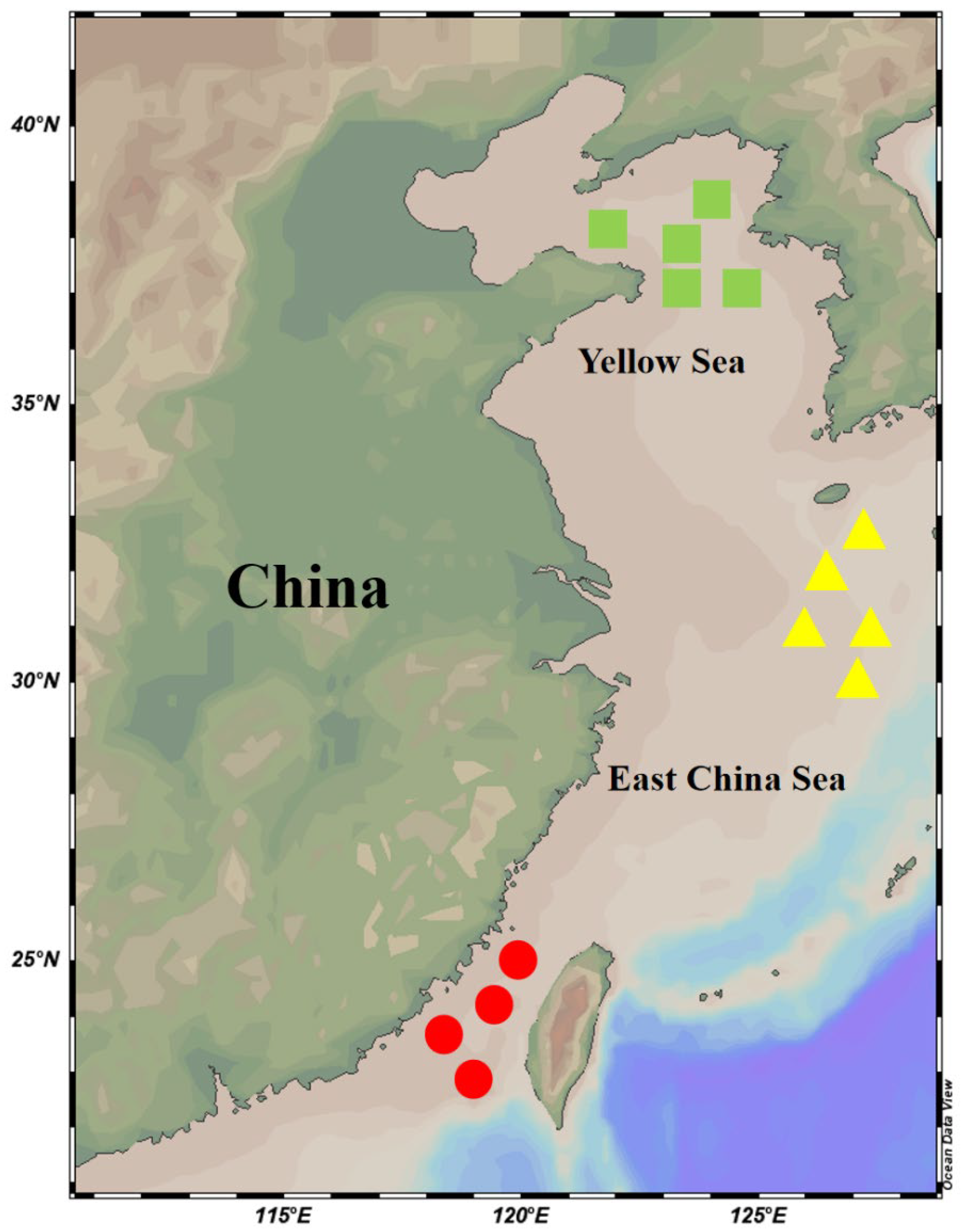
Figure 1. Locations of different sites of T. pacificus. The green squares represent the northern Yellow Sea, the yellow triangles represent the northern East China Sea, and the red circles represent the southern East China Sea.
Diversity 18 00123 g001
Figure 2. Maximum likelihood (ML) tree and haplotype network based on 18 COI haplotypes of T. pacificus. Branch numbers are bootstraps.
Diversity 18 00123 g002
Figure 3. Maximum likelihood (ML) tree and haplotype network based on 6 16S haplotypes of T. pacificus. Branch numbers are bootstraps.
Diversity 18 00123 g003
Figure 4. Maximum likelihood (ML) tree and haplotype network based on 21 ODH haplotypes of T. pacificus. Branch numbers are bootstraps.
Diversity 18 00123 g004
Figure 5. Reconstructed outlines of statoliths for different cohorts (a), different regions in autumn (b) and different years in summer (c).
Diversity 18 00123 g005
Table 1. Sample data of T. pacificus from the western Pacific.
RegionNumber of Analyzed IndividualsCohort Composition (Summer:Autumn)Sampling TimeMantle Length Range/mm
Statolith samplesNYS4848:0November 2019162~204
2626:0November 2023235~305
6868:0November 2024160~320
NECS510:51December 2024150~317
240:24March 2024205~280
4949:0November 2024215~296
SECS600:60March 2024165~283
Genetic samplesNYS2020:0November 2023235~305
2020:0November 2024160~320
200:22December 2024150~317
NECS200:20March 2024216~296
2020:0November 2024215~296
SECS200:20March 2024165~284
Table 2. Molecular analyses utilizing three gene sequences.
Mt/NuGeneLength/bpT/%C/%A/%G/%A + T/%G + C/%SProportion
of Variable
Sites/%
MtCOI43943.2020.8621.4915.3663.7936.22153.36
Mt16S45826.580.0048.4225.0075.0025.0040.88
NuODH51728.1331.3026.6313.9354.7645.2310620.58
Table 3. Genetic diversity metrics across seasonal cohorts of T. pacificus.
GroupCOI16SODH
NHapHdπNHapHdπNHapHdπ
summer5990.46100.00145530.23000.000557120.60200.0020
autumn58110.47400.00135540.10900.000256130.60700.0059
total117180.46500.001311060.17100.0004113210.60100.0053
Table 4. AMOVA of mtDNA and nuDNA gene sequences.
GeneSource of
Variation
dfSum of SquaresVariance
Component
Percentage of
Variation (%)
F Statistic
COIAmong populations20.463−0.00280 Va−0.85FST: −0.00853
(p-value = 0.83187 ± 0.01114)
Within populations11437.8110.33167 Vb100.85
Total11638.2740.32887100.00
16SAmong populations20.203−0.00066 Va−0.54FST: −0.00537
(p-value = 0.57478 ± 0.01351)
Within populations10713.2510.12385 Vb100.54
Total10913.4550.12385 Vb100.00
ODHAmong populations21.1330.00080 Va0.15FST: 0.00148
(p-value = 0.37634 ± 0.01613)
Within populations11159.8150.53887 Vb99.85
Total11360.9470.53967100.00
Table 5. FST between populations of T. pacificus based on three genes for different seasons.
GroupsAutumnSummer
COIautumn0.00000
summer0.002910.00000
16Sautumn0.00000
summer0.031910.00000
ODHautumn0.00000
summer0.000750.00000
* Significant at p < 0.01.
Table 6. Random forest out-of-bag (OOB) error estimation matrix for the two seasonal cohorts.
SeasonAutumnSummerClassification Success Rate (%)
autumn1192185.00
summer1018294.79
Table 7. Results of variance analysis on T. pacificus in different seasons based on the statolith shape coefficient.
GroupspSw/SlSsa
autumn 0.57101763.0060
summer 0.54831706.8217
summer vs. autumn1.351 × 10−10 *5.342 × 10−6 *0.09057
* Significant at p < 0.01.
Disclaimer/Publisher’s Note: The statements, opinions and data contained in all publications are solely those of the individual author(s) and contributor(s) and not of MDPI and/or the editor(s). MDPI and/or the editor(s) disclaim responsibility for any injury to people or property resulting from any ideas, methods, instructions or products referred to in the content.