
Insights into the Biodiversity of Native Rhizobia from Africa: Documented Novel Species, Valorization Status and Perspectives—A Review



Abstract
1. Introduction
2. Ecological and Economic Values of Rhizobia and Their Legume Hosts
3. Guidelines for the Description of New Genera and Species of Rhizobia and Their Evolutions
4. Taxonomy of Rhizobia Across the Globe—A Brief Overview
5. Biodiversity of Rhizobia in Africa and Its Main Features
5.1. About 9% of Rhizobia Species Are Native from Africa
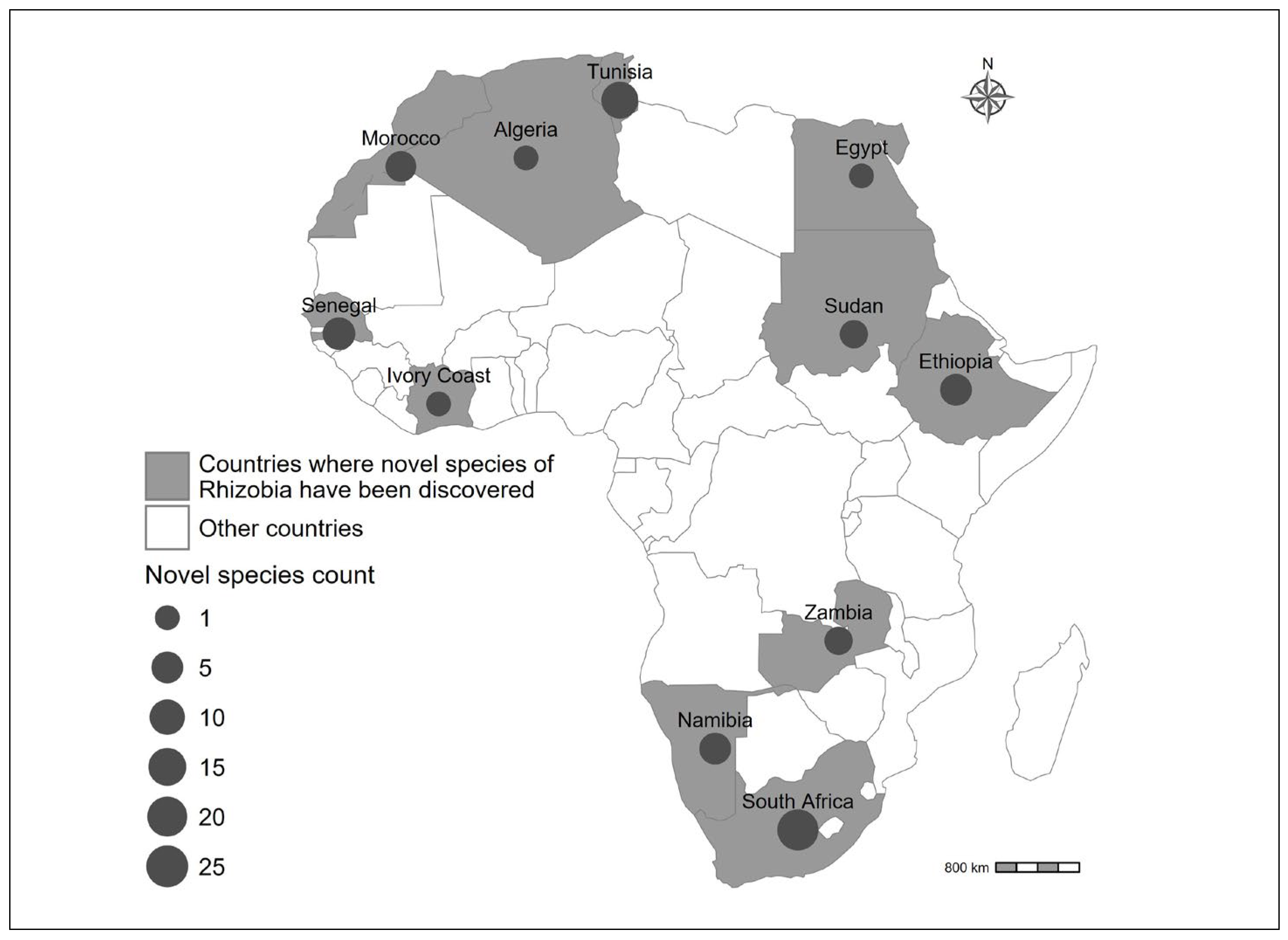
5.2. Geographical Origin of the New Taxa of Rhizobia Native from African Soils Showed a Domination of South Africa
- (i)
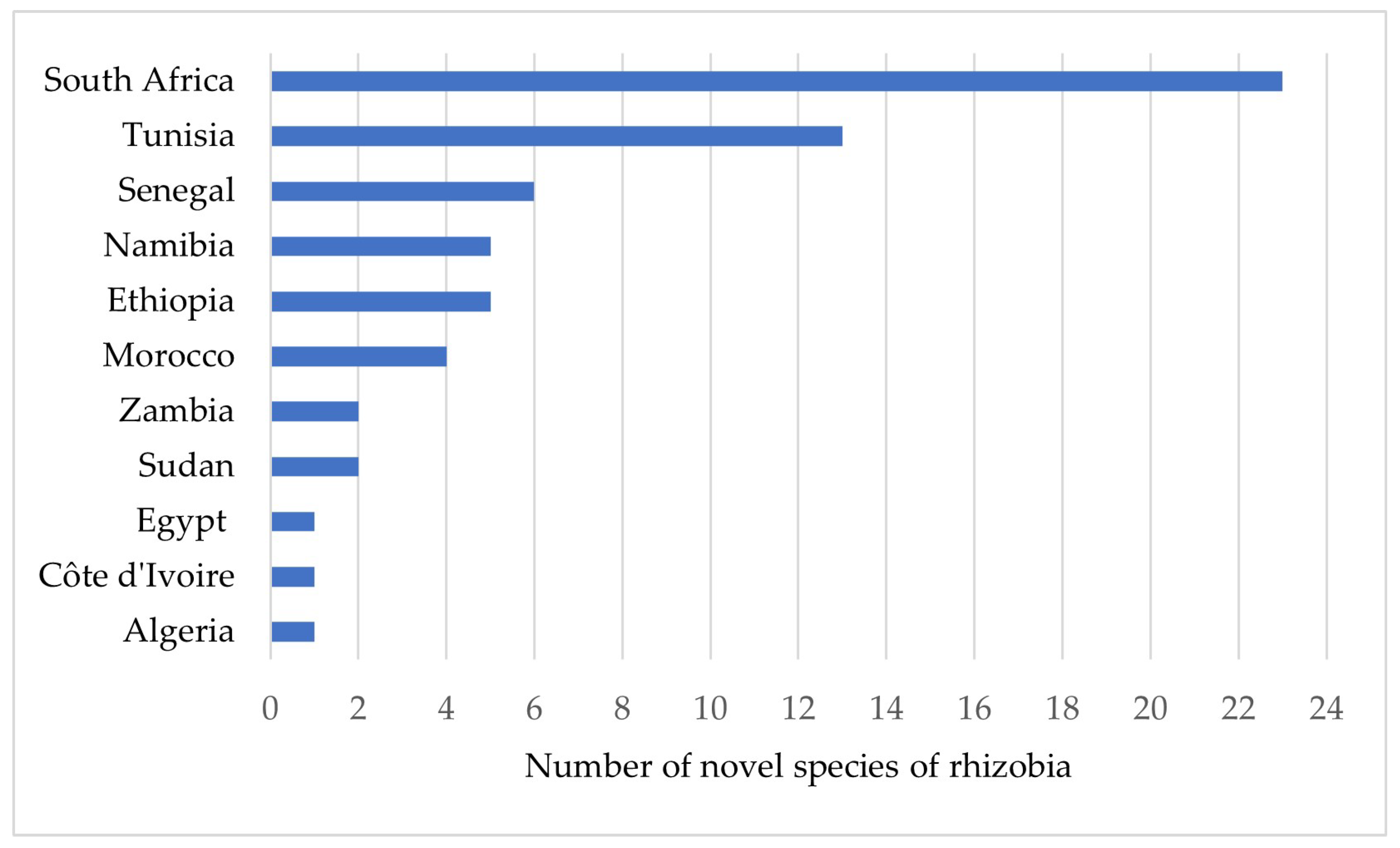
- There is a lack of DNA sequencing platforms and bioinformatic pipelines. Most African countries lack DNA sequencing capacity and local expertise in bioinformatics analyses [133]. This situation limits their ability to describe native rhizobial biodiversity. In some cases, strong expertise in microbial taxonomy is lacking. Thus, international collaborations and academic journeys outside of the African country have been required to perform the batch of phenotypic and molecular analyses required to fulfill the minimal standards for a novel species described, except for a few cases (e.g., South Africa). North and South African countries usually collaborate with laboratories from Spain and Australia, respectively, while West African countries, such as Senegal and Côte d’Ivoire, usually interact with French-speaking countries in Europe (e.g., France and Switzerland) for the taxonomic description of native rhizobial species. Laboratories from Finland and Germany also substantially contributed to the description of native rhizobia from East and Central African countries, such as Ethiopia and Namibia (Table 2).
- (ii)
- In recent years, there has been an intensive exploration of rich microbial niches in some African countries. This has opened the door for the description of several novel rhizobial species. For example, an exploratory study conducted in 2014 on a few legumes growing in the Okavango Delta in Namibia [28] described at least five Bradyrhizobium species, most of which were described by Dr. J. L. Grönemeyer (a former PhD student at the University of Bremen, Germany) (Table 2).
- (iii)
- There is a growing interest in studying “orphan” legumes in many African countries. Many orphan legumes and their symbiotic bacteria have been explored in the few past years, including pigeonpea (Cajanus cajan (L.) Huth, Papilionoideae) [31], Bambara or Voandzou pea (Vigna subterranea (L.) Verdc., Papilionoideae) [108], Kersting’s groundnut (Macrotyloma geocarpum (Harms) Maréchal & Baudet, Papilionoideae) [134], etc. For example, from an exploratory study on pigeon pea published in 2016 [24], one novel species of Bradyrhizobium, B. ivorense, has been published from Côte d’Ivoire. Moreover, approximately three additional putative novel species of rhizobia have been identified in the symbionts of local C. cajan genotypes growing in Ivorian soils [135].
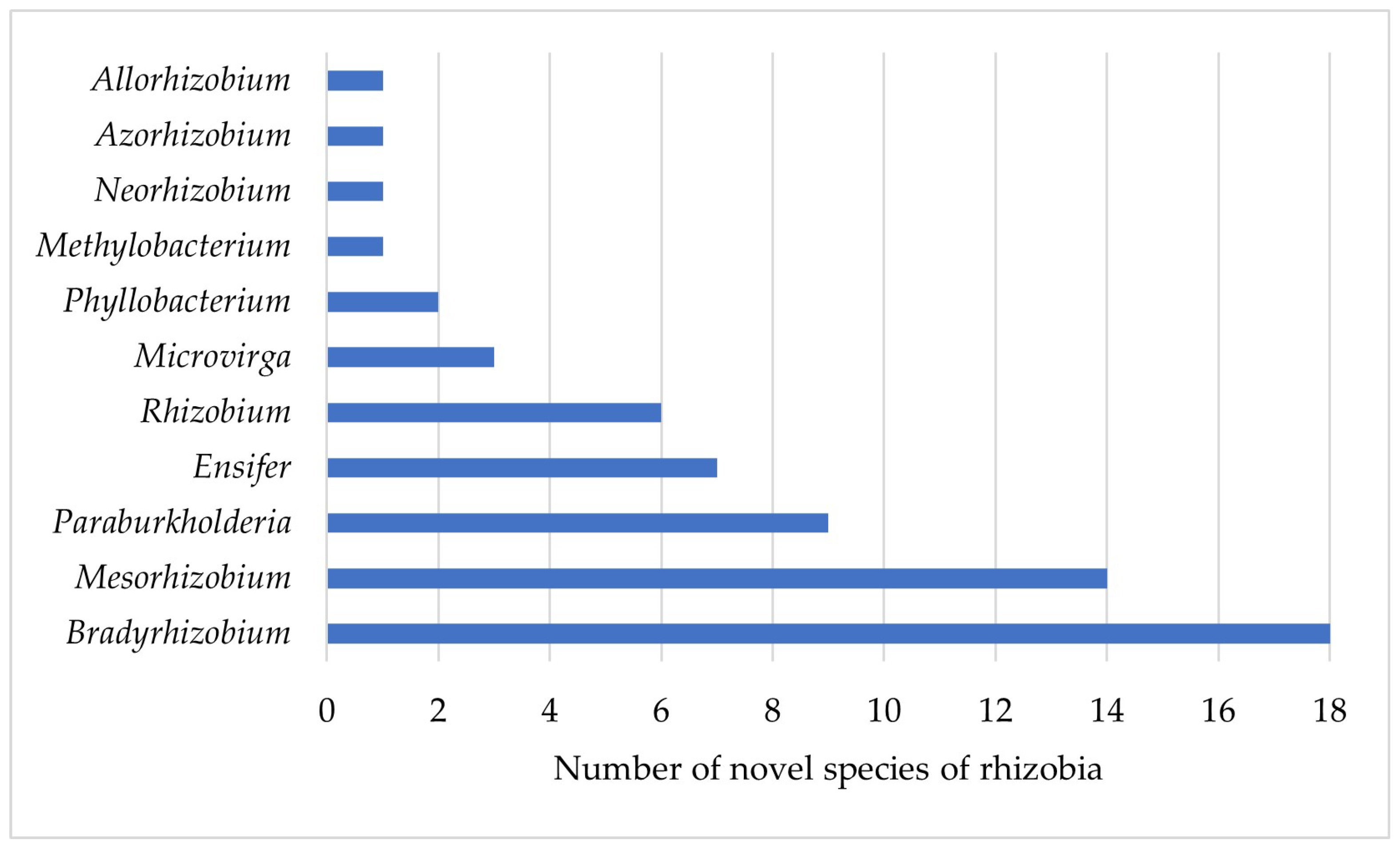
5.3. Bradyrhizobium and Mesorhizobium Cover About 51% of the Novel Species of Rhizobia Described from African Soils
5.4. Legume Hosts of Native Rhizobia Species from Africa
6. Valorization Status of Native Rhizobia from Africa as Biofertilizers
7. Breaking Point Discoveries Using Native Rhizobia Strains from Africa
8. Challenges and Future in Description of Novel Species of Rhizobia in Africa
- (i)
- Technical issues: An insufficient or limited access to DNA sequencing platforms and bioinformatic pipelines: Regional or hub bioinformatic platform developments have been proposed as possible solutions to address this limitation [133]. Capacity building is also required for African scientists lacking experience in using molecular techniques to explore microbial biodiversity. In general, molecular techniques complemented by traditional morpho-cultural analysis are used to characterize rhizobial strains [25]. Genome sequencing-based analysis supported by strong phylogenetic reconstructions (multiple gene (s) phylogeny, genome phylogeny, etc.) is also used to cluster new isolates with their closely related species. It is also used to identify putative new taxa that require further taxonomic description. Cut-off values of approximately 97% and 95–96% were used for species differentiation based on housekeeping genes (e.g., recA, glnII) and the average nucleotide identity (ANI) of genome sequences, respectively [53]. Moreover, metagenomic methods are currently used to decipher the composition of the African soil rhizobial microbiome [66]. Regional bioinformatic workshops promoted by the International Society of Microbial Ecology in Africa (ISME-Africa) and other microbial scientific societies could help train a new generation of African microbiologists [133].
- (ii)
- Legal issues: Several reports on rhizobia native to Africa have revealed several putative novel taxa waiting to be confirmed and/or published [35]. However, the slow pace at which new rhizobial taxa are described in some African countries is linked to their current restrictive national regulations [32]. Indeed, for a valid publication, the International Code of Nomenclature of Prokaryotes (ICNP) requires that an axenic culture of the proposed type strain for a novel species be deposited in two international culture collections and made available upon request without restrictions. Unfortunately, the application of this rule is not possible under several African countries’ national restrictive regulations related to access to biological resources in line with the Nagoya Protocol [32]. Under the ICNP, if deposits outside a country and the distribution of type strains are restricted, new microbial taxon names are not validly published [11,32]. In contrast, the rules of the recently published Code of Nomenclature of Prokaryotes described from Sequence Data (SeqCode) recognize genome data as nomenclature-type material [55]. Therefore, it represents a good alternative to ICNP rules and has the potential to facilitate the naming of new microbial taxa [55]. The seqCode is gaining interest among African countries for describing new rhizobial species, including in South Africa [32,58,59]. However, the validity of rhizobial naming under SeqCode rules is still debated. For example, a recent statement about the pioneering work of Van Lill et al. [32] under SeqCode by the ICNP subcommittee for rhizobia was formulated as follows: “Our Subcommittee found this article interesting as an example of the need for genome- based classifications (…) However, as a Subcommittee of the International Committee on Systematics of Prokaryotes, we cannot recognize the names proposed under SeqCode” [18]. Although the first cases of novel species described under SeqCode rules are not yet recognized, we believe that they represent more flexible rules for naming indigenous biological material in the African context. This could foster rapid progress in research on microbial biodiversity in Africa [32].
9. Summary and Conclusions
Author Contributions
Funding
Institutional Review Board Statement
Data Availability Statement
Conflicts of Interest
Abbreviations
| ANI | Average nucleotide identity |
| SeqCode | Code of Nomenclature of Prokaryotes described from Sequence Data |
| dDDH | Digital DNA-DNA hybridization |
| ITS | Internal Transcribed Spacer |
| ICNP | International Code of Nomenclature of Prokaryotes |
| ICSP | International Committee on Systematics of Prokaryotes |
| IJSEM | International Journal of Systematic and Evolutionary Microbiology |
| LPSN | List of Prokaryotic Names with Standing in Nomenclature |
| MLSA | Multilocus sequence analysis |
| OGRI | Overall genome-related indices |
| SDGs | Sustainable Development Goals |
Appendix A
Appendix A.1. Literature Survey Methodology
Appendix A.2. Data Analysis
References
- GBIF. Secretariat Parasponia andersonii (Planch.) Planch. Available online: https://doi.org/10.15468/39omei (accessed on 28 January 2026).
- ICSP. Taxonomy of Rhizobia & Agrobacteria Species with Standing in Nomenclature. Available online: https://sites.google.com/view/taxonomyagrorhizo/home/species-with-standing-in-nomenclature (accessed on 1 December 2025).
- Farquharson, E.A.; Ballard, R.A.; Herridge, D.F.; Ryder, M.H.; Denton, M.D.; Webster, A.; Yates, R.J.; Seymour, N.P.; Deaker, R.J.; Hartley, E.; et al. Inoculating Legumes: Practice and Science; Grains Research and Development Corporation: Barton, Australia, 2022.
- Stagnari, F.; Maggio, A.; Galieni, A.; Pisante, M. Multiple Benefits of Legumes for Agriculture Sustainability: An Overview. Chem. Biol. Technol. Agric. 2017, 4, 2. [Google Scholar] [CrossRef]
- FAO. Année Internationale Des Légumineuses|2016 International Year of Pulses. 2016. Available online: https://www.fao.org/pulses-2016/fr/ (accessed on 14 November 2023).
- Altobelli, F.; Amanullah; Benedetti, A.; Calles, T.; Caon, L.; Charrondiere, R.; Giri, S.P.; Grande, F.; Muthuraman, R.P.; Pisante, M.; et al. Soils and Pulses: Symbiosis for Life; Caon, L., Vargas, R., Wiese, L., Eds.; FAO: Rome, Italy, 2016. [Google Scholar]
- Ma, Y.; Xiao, C.; Liu, J.; Ren, G. Nutrient-Dependent Regulation of Symbiotic Nitrogen Fixation in Legumes. Hortic. Res. 2025, 12, uhae321. [Google Scholar] [CrossRef] [PubMed]
- Hungria, M.; Mendes, I.C. Nitrogen Fixation with Soybean: The Perfect Symbiosis? In Biological Nitrogen Fixation; John Wiley & Sons, Ltd.: Hoboken, NJ, USA, 2015; pp. 1009–1024. [Google Scholar]
- Vanlauwe, B.; Hungria, M.; Kanampiu, F.; Giller, K.E. The Role of Legumes in the Sustainable Intensification of African Smallholder Agriculture: Lessons Learnt and Challenges for the Future. Agric. Ecosyst. Environ. 2019, 284, 106583. [Google Scholar] [CrossRef] [PubMed]
- Mng’ong’o, M.E.; Ojija, F.; Aloo, B.N. The Role of Rhizobia toward Food Production, Food and Soil Security through Microbial Agro-Input Utilization in Developing Countries. Case Stud. Chem. Environ. Eng. 2023, 8, 100404. [Google Scholar] [CrossRef]
- de Lajudie, P.M.; Andrews, M.; Ardley, J.; Eardly, B.; Jumas-Bilak, E.; Kuzmanović, N.; Lassalle, F.; Lindström, K.; Mhamdi, R.; Martínez-Romero, E.; et al. Minimal Standards for the Description of New Genera and Species of Rhizobia and Agrobacteria. Int. J. Syst. Evol. Microbiol. 2019, 69, 1852–1863. [Google Scholar] [CrossRef]
- Frank, B. Ueber Die Pilzsymbiose Der Leguminosen. Berichte Dtsch. Bot. Ges. 1889, 7, 332–346. [Google Scholar] [CrossRef]
- Lindström, K.; Mousavi, S.A. Effectiveness of Nitrogen Fixation in Rhizobia. Microb. Biotechnol. 2020, 13, 1314–1335. [Google Scholar] [CrossRef]
- Jordan, D.C. Notes: Transfer of Rhizobium japonicum Buchanan 1980 to Bradyrhizobium Gen. Nov., a Genus of Slow-Growing, Root Nodule Bacteria from Leguminous Plants. Int. J. Syst. Evol. Microbiol. 1982, 32, 136–139. [Google Scholar] [CrossRef]
- Hungria, M.; Menna, P.; Delamuta, J.R.M. Bradyrhizobium, the Ancestor of All Rhizobia: Phylogeny of Housekeeping and Nitrogen-Fixation Genes. In Biological Nitrogen Fixation; de Bruijn, F.J., Ed.; John Wiley & Sons, Ltd.: Hoboken, NJ, USA, 2015; pp. 191–202. [Google Scholar]
- Wang, S.; Meade, A.; Lam, H.-M.; Luo, H. Evolutionary Timeline and Genomic Plasticity Underlying the Lifestyle Diversity in Rhizobiales. mSystems 2020, 5, e00438. [Google Scholar] [CrossRef]
- Stępkowski, T.; Banasiewicz, J.; Granada, C.E.; Andrews, M.; Passaglia, L.M.P. Phylogeny and Phylogeography of Rhizobial Symbionts Nodulating Legumes of the Tribe Genisteae. Genes 2018, 9, 163. [Google Scholar] [CrossRef]
- Mousavi, S.A.; Young, J.P.W. International Committee on Systematics of Prokaryotes Subcommittee on the Taxonomy of Rhizobia and Agrobacteria: Minutes of the 2024 Closed Annual Meeting. Int. J. Syst. Evol. Microbiol. 2025, 75, 006680. [Google Scholar] [CrossRef]
- Santos, M.S.; Nogueira, M.A.; Hungria, M. Microbial Inoculants: Reviewing the Past, Discussing the Present and Previewing an Outstanding Future for the Use of Beneficial Bacteria in Agriculture. AMB Express 2019, 9, 205. [Google Scholar] [CrossRef] [PubMed]
- de Oliveira, A.M.; da Costa, M.R.; Grazziotti, P.H.; de Abreu, C.M.; da Silva Bispo, N.; Roa, J.P.B.; Silva, D.M.; Miranda, J.M. Brazilian Scenario of Inoculant Production: A Look at Patents. Rev. Bras. Ciênc. Solo 2022, 46, e0210081. [Google Scholar] [CrossRef]
- Howieson, J.G.; Dilworth, M.J. Working with Rhizobia; Australian Centre for International Agricultural Research: Canberra, Australia, 2016.
- Murdoch University. Legume Rhizobium Sciences|Food Futures Institute. Available online: https://www.murdoch.edu.au/research/ffi/centres/centre-for-sustainable-farming-systems/legume-rhizobium-sciences (accessed on 1 December 2025).
- Raimi, A.; Roopnarain, A.; Adeleke, R. Biofertilizer Production in Africa: Current Status, Factors Impeding Adoption and Strategies for Success. Sci. Afr. 2021, 11, e00694. [Google Scholar] [CrossRef]
- Fossou, R.K.; Ziegler, D.; Zézé, A.; Barja, F.; Perret, X. Two Major Clades of Bradyrhizobia Dominate Symbiotic Interactions with Pigeonpea in Fields of Côte d’Ivoire. Front. Microbiol. 2016, 7, 1793. [Google Scholar] [CrossRef]
- Wekesa, C.; Jalloh, A.A.; Muoma, J.O.; Korir, H.; Omenge, K.M.; Maingi, J.M.; Furch, A.C.U.; Oelmüller, R. Distribution, Characterization and the Commercialization of Elite Rhizobia Strains in Africa. Int. J. Mol. Sci. 2022, 23, 6599. [Google Scholar] [CrossRef]
- Chun, J.; Rainey, F.A. Integrating Genomics into the Taxonomy and Systematics of the Bacteria and Archaea. Int. J. Syst. Evol. Microbiol. 2014, 64, 316–324. [Google Scholar] [CrossRef]
- Mavima, L.; Beukes, C.W.; Palmer, M.; De Meyer, S.E.; James, E.K.; Maluk, M.; Muasya, M.A.; Avontuur, J.R.; Chan, W.Y.; Venter, S.N.; et al. Delineation of Paraburkholderia tuberum Sensu Stricto and Description of Paraburkholderia podalyriae sp. nov. Nodulating the South African Legume Podalyria calyptrata. Syst. Appl. Microbiol. 2022, 45, 126316. [Google Scholar] [CrossRef]
- Grönemeyer, J.L.; Kulkarni, A.; Berkelmann, D.; Hurek, T.; Reinhold-Hurek, B. Rhizobia Indigenous to the Okavango Region in Sub-Saharan Africa: Diversity, Adaptations, and Host Specificity. Appl. Environ. Microbiol. 2014, 80, 7244–7257. [Google Scholar] [CrossRef]
- Grönemeyer, J.L.; Reinhold-Hurek, B. Diversity of Bradyrhizobia in Subsahara Africa: A Rich Resource. Front. Microbiol. 2018, 9, 2194. [Google Scholar] [CrossRef]
- Lajudie, P.D.; Willems, A.; Pot, B.; Dewettinck, D.; Maestrojuan, G.; Neyra, M.; Collins, M.D.; Dreyfus, B.; Kersters, K.; Gillis, M. Polyphasic Taxonomy of Rhizobia: Emendation of the Genus Sinorhizobium and Description of Sinorhizobium meliloti Comb, Nov., Sinorhizobium saheli sp. nov., and Sinorhizobium teranga sp. nov. Int. J. Syst. Evol. Microbiol. 1994, 44, 715–733. [Google Scholar] [CrossRef]
- Fossou, R.K.; Pothier, J.F.; Zézé, A.; Perret, X. Bradyrhizobium ivorense sp. nov. as a Potential Local Bioinoculant for Cajanus cajan Cultures in Côte d’Ivoire. Int. J. Syst. Evol. Microbiol. 2020, 70, 1421–1430. [Google Scholar] [CrossRef] [PubMed]
- van Lill, M.; Venter, S.N.; Muema, E.K.; Palmer, M.; Chan, W.Y.; Beukes, C.W.; Steenkamp, E.T. SeqCode Facilitates Naming of South African Rhizobia Left in Limbo. Syst. Appl. Microbiol. 2024, 47, 126504. [Google Scholar] [CrossRef] [PubMed]
- Rejili, M.; Off, K.; Brachmann, A.; Marín, M. Bradyrhizobium hipponense sp. nov., Isolated from Lupinus angustifolius Growing in the Northern Region of Tunisia. Int. J. Syst. Evol. Microbiol. 2020, 70, 5539–5550. [Google Scholar] [CrossRef]
- Hsouna, J.; Zouagui, H.; Gritli, T.; Ilahi, H.; Han, J.-C.; Sulman, M.; Ellouze, W.; Zhang, X.X.; Mansouri, M.; Missbah El Idrissi, M.; et al. Bradyrhizobium tunisiense sp. nov., a Novel Rhizobial Species Isolated from Acacia saligna Nodules. Int. J. Syst. Evol. Microbiol. 2025, 75, 006807. [Google Scholar] [CrossRef]
- Jaiswal, S.K.; Dakora, F.D. Widespread Distribution of Highly Adapted Bradyrhizobium Species Nodulating Diverse Legumes in Africa. Front. Microbiol. 2019, 10, 310. [Google Scholar] [CrossRef]
- Hughes, C.; Ringelberg, J.J.; Bruneau, A. Legumes. Curr. Biol. 2025, 35, R323–R328. [Google Scholar] [CrossRef]
- Alves, B.J.R.; Boddey, R.M.; Urquiaga, S. The Success of BNF in Soybean in Brazil. Plant Soil 2003, 252, 1–9. [Google Scholar] [CrossRef]
- Thilakarathna, M.S.; Raizada, M.N. A Meta-Analysis of the Effectiveness of Diverse Rhizobia Inoculants on Soybean Traits under Field Conditions. Soil Biol. Biochem. 2017, 105, 177–196. [Google Scholar] [CrossRef]
- FAOstats. FAOSTAT. Available online: https://www.fao.org/faostat/en/#data/QCL/visualize (accessed on 27 April 2025).
- Kohlmeier, M.G.; O’Hara, G.W.; Ramsay, J.P.; Terpolilli, J.J. Closed Genomes of Commercial Inoculant Rhizobia Provide a Blueprint for Management of Legume Inoculation. Appl. Environ. Microbiol. 2025, 91, e0221324. [Google Scholar] [CrossRef]
- Soumare, A.; Diedhiou, A.G.; Thuita, M.; Hafidi, M.; Ouhdouch, Y.; Gopalakrishnan, S.; Kouisni, L. Exploiting Biological Nitrogen Fixation: A Route Towards a Sustainable Agriculture. Plants 2020, 9, 1011. [Google Scholar] [CrossRef] [PubMed]
- Herridge, D.F.; Peoples, M.B.; Boddey, R.M. Global Inputs of Biological Nitrogen Fixation in Agricultural Systems. Plant Soil 2008, 311, 1–18. [Google Scholar] [CrossRef]
- Peoples, M.B.; Brockwell, J.; Herridge, D.F.; Rochester, I.J.; Alves, B.J.R.; Urquiaga, S.; Boddey, R.M.; Dakora, F.D.; Bhattarai, S.; Maskey, S.L.; et al. The Contributions of Nitrogen-Fixing Crop Legumes to the Productivity of Agricultural Systems. Symbiosis 2009, 48, 1–17. [Google Scholar] [CrossRef]
- Symanowicz, B.; Skorupka, W. Effect of Mineral Fertilization on Nitrogenase Activity, Yield, Nitrogen Content and Uptake with Alfalfa (Medicago sativa L.) Yield. J. Elem. 2019, 24, 181–191. [Google Scholar] [CrossRef]
- Adjei-Nsiah, S.; Alabi, B.U.; Ahiakpa, J.K.; Kanampiu, F. Response of Grain Legumes to Phosphorus Application in the Guinea Savanna Agro-Ecological Zones of Ghana. Agron. J. 2018, 110, 1089–1096. [Google Scholar] [CrossRef]
- Geremu, T.; Abera, G.; Lemma, B.; Rasche, F. Interplay of Phosphorus and Rhizobium Inoculation on Common Bean (Phaseolus vulgaris L.) Across Variable Indigenous Rhizobia Soils in Southern Ethiopia. Agronomy 2026, 16, 2. [Google Scholar] [CrossRef]
- IUSS Working Group WRB. World Reference Base for Soil Resources. In International Soil Classification System for Naming Soils and Creating Legends for Soil Maps, 4th ed.; International Union of Soil Sciences (IUSS): Rome, Italy, 2022. [Google Scholar]
- Giller, K.E. Nitrogen Fixation in Tropical Cropping Systems; CABI: Oxfordshire, UK, 2001. [Google Scholar]
- Graham, P.H.; Sadowsky, M.J.; Keyser, H.H.; Barnet, Y.M.; Bradley, R.S.; Cooper, J.E.; De Ley, D.J.; Jarvis, B.D.W.; Roslycky, E.B.; Strijdom, B.W.; et al. Proposed Minimal Standards for the Description of New Genera and Species of Root- and Stem-Nodulating Bacteria. Int. J. Syst. Evol. Microbiol. 1991, 41, 582–587. [Google Scholar] [CrossRef]
- Chun, J.; Oren, A.; Ventosa, A.; Christensen, H.; Arahal, D.R.; da Costa, M.S.; Rooney, A.P.; Yi, H.; Xu, X.-W.; De Meyer, S.; et al. Proposed Minimal Standards for the Use of Genome Data for the Taxonomy of Prokaryotes. Int. J. Syst. Evol. Microbiol. 2018, 68, 461–466. [Google Scholar] [CrossRef]
- Rogel, M.A.; Ormeño-Orrillo, E.; Martinez Romero, E. Symbiovars in Rhizobia Reflect Bacterial Adaptation to Legumes. Syst. Appl. Microbiol. 2011, 34, 96–104. [Google Scholar] [CrossRef]
- Martinez-Romero, E.; Peix, A.; Hungria, M.; Mousavi, S.A.; Martinez-Romero, J.; Young, P. Guidelines for the Description of Rhizobial Symbiovars. Int. J. Syst. Evol. Microbiol. 2024, 74, 006373. [Google Scholar] [CrossRef]
- Klepa, M.S.; Helene, L.C.F.; O’Hara, G.; Hungria, M. Bradyrhizobium cenepequi sp. nov., Bradyrhizobium semiaridum sp. nov., Bradyrhizobium hereditatis sp. nov. and Bradyrhizobium australafricanum sp. nov., Symbionts of Different Leguminous Plants of Western Australia and South Africa and Definition of Three Novel Symbiovars. Int. J. Syst. Evol. Microbiol. 2022, 72, 005446. [Google Scholar] [CrossRef] [PubMed]
- Hamer, M.; Behr, K.; Engelbrecht, I.; Richards, L. Permit Requirements, Associated Challenges and Recommendations for Biodiversity Collections and Research in South Africa. S. Afr. J. Sci. 2021, 117, 11765. [Google Scholar] [CrossRef] [PubMed]
- Hedlund, B.P.; Chuvochina, M.; Hugenholtz, P.; Konstantinidis, K.T.; Murray, A.E.; Palmer, M.; Parks, D.H.; Probst, A.J.; Reysenbach, A.-L.; Rodriguez-R, L.M.; et al. SeqCode: A Nomenclatural Code for Prokaryotes Described from Sequence Data. Nat. Microbiol. 2022, 7, 1702–1708. [Google Scholar] [CrossRef] [PubMed]
- Göker, M.; Moore, E.R.B.; Oren, A.; Trujillo, M.E. Status of the SeqCode in the International Journal of Systematic and Evolutionary Microbiology. Int. J. Syst. Evol. Microbiol. 2022, 72, 005754. [Google Scholar] [CrossRef]
- Venter, S.N.; Rodriguez-R, L.M.; Chuvochina, M.; Palmer, M.; Hugenholtz, P.; Steenkamp, E.T. Options and Considerations for Validation of Prokaryotic Names under the SeqCode. Syst. Appl. Microbiol. 2024, 47, 126554. [Google Scholar] [CrossRef]
- Muema, E.K.; van Lill, M.; Venter, S.N.; Chan, W.Y.; Claassens, R.; Steenkamp, E.T. Mesorhizobium salmacidum sp. nov. and Mesorhizobium argentiipisi sp. nov. Are Symbionts of the Dry-Land Forage Legumes Lessertia diffusa and Calobota sericea. Antonie Van Leeuwenhoek 2025, 118, 54. [Google Scholar] [CrossRef]
- Maake, M.M.; Beukes, C.W.; van der Nest, M.A.; Avontuur, J.R.; Muema, E.K.; Stępkowski, T.; Venter, S.N.; Steenkamp, E.T. Argyrolobium Legumes from an African Centre of Endemism Associate with Novel Bradyrhizobium Species Harbouring Unique Sets of Symbiosis Genes. Mol. Phylogenet. Evol. 2026, 214, 108471. [Google Scholar] [CrossRef]
- Parte, A.C. LPSN—List of Prokaryotic Names with Standing in Nomenclature (Bacterio.Net), 20 Years On. Int. J. Syst. Evol. Microbiol. 2018, 68, 1825–1829. [Google Scholar] [CrossRef]
- Parte, A.C.; Sardà Carbasse, J.; Meier-Kolthoff, J.P.; Reimer, L.C.; Göker, M. List of Prokaryotic Names with Standing in Nomenclature (LPSN) Moves to the DSMZ. Int. J. Syst. Evol. Microbiol. 2020, 70, 5607–5612. [Google Scholar] [CrossRef]
- Benhizia, Y.; Benhizia, H.; Benguedouar, A.; Muresu, R.; Giacomini, A.; Squartini, A. Gamma Proteobacteria Can Nodulate Legumes of the Genus Hedysarum. Syst. Appl. Microbiol. 2004, 27, 462–468. [Google Scholar] [CrossRef]
- Mazoyon, C.; Hirel, B.; Pecourt, A.; Catterou, M.; Gutierrez, L.; Sarazin, V.; Dubois, F.; Duclercq, J. Sphingomonas sediminicola Is an Endosymbiotic Bacterium Able to Induce the Formation of Root Nodules in Pea (Pisum sativum L.) and to Enhance Plant Biomass Production. Microorganisms 2023, 11, 199. [Google Scholar] [CrossRef] [PubMed]
- Muresu, R.; Polone, E.; Sulas, L.; Baldan, B.; Tondello, A.; Delogu, G.; Cappuccinelli, P.; Alberghini, S.; Benhizia, Y.; Benhizia, H.; et al. Coexistence of Predominantly Nonculturable Rhizobia with Diverse, Endophytic Bacterial Taxa within Nodules of Wild Legumes. FEMS Microbiol. Ecol. 2008, 63, 383–400. [Google Scholar] [CrossRef] [PubMed]
- diCenzo, G.C.; Gutmanis, S.M.; Esme, O.; Moulin, L. Re-Evaluation of the Nodulation Capacity of Sphingomonas sediminicola DSM 18106T Indicates That This Strain Is Not Capable of Inducing Root Nodule Formation on Pisum sativum (Pea). Can. J. Microbiol. 2025, 71, 1–9. [Google Scholar] [CrossRef] [PubMed]
- Gnangui, S.L.E.; Fossou, R.K.; Ebou, A.; Amon, C.E.R.; Koua, D.K.; Kouadjo, C.G.Z.; Cowan, D.A.; Zézé, A. The Rhizobial Microbiome from the Tropical Savannah Zones in Northern Côte d’Ivoire. Microorganisms 2021, 9, 1842. [Google Scholar] [CrossRef]
- de Lajudie, P.; Laurent-Fulele, E.; Willems, A.; Torck, U.; Coopman, R.; Collins, M.D.; Kersters, K.; Dreyfus, B.; Gillis, M. Allorhizobium undicola gen. nov., sp. nov., Nitrogen-Fixing Bacteria That Efficiently Nodulate Neptunia natans in Senegal. Int. J. Syst. Bacteriol. 1998, 48, 1277–1290. [Google Scholar] [CrossRef]
- Urakami, T.; Araki, H.; Oyanagi, H.; Suzuki, K.-I.; Komagata, K. Transfer of Pseudomonas aminovorans (Den Dooren de Jong 1926) to Aminobacter gen. nov. as Aminobacter aminovorans comb. nov. and Description of Aminobacter aganoensis sp. nov. and Aminobacter niigataensis sp. nov. Int. J. Syst. Bacteriol. 1992, 42, 84–92. [Google Scholar] [CrossRef]
- Dreyfus, B.; Garcia, J.L.; Gillis, M. Characterization of Azorhizobium caulinodans gen. nov., sp. nov., a Stem-Nodulating Nitrogen-Fixing Bacterium Isolated from Sesbania rostrata. Int. J. Syst. Evol. Microbiol. 1988, 38, 89–98. [Google Scholar] [CrossRef]
- Estrada-de Los Santos, P.; Palmer, M.; Chávez-Ramírez, B.; Beukes, C.; Steenkamp, E.T.; Briscoe, L.; Khan, N.; Maluk, M.; Lafos, M.; Humm, E. Whole Genome Analyses Suggests That Burkholderia Sensu Lato Contains Two Additional Novel Genera (Mycetohabitans gen. nov., and Trinickia gen. nov.): Implications for the Evolution of Diazotrophy and Nodulation in the Burkholderiaceae. Genes 2018, 9, 389. [Google Scholar] [CrossRef]
- Rivas, R.; Willems, A.; Subba-Rao, N.S.; Mateos, P.F.; Dazzo, F.B.; Kroppenstedt, R.M.; Martínez-Molina, E.; Gillis, M.; Velázquez, E. Description of Devosia neptuniae sp. nov. That Nodulates and Fixes Nitrogen in Symbiosis with Neptunia natans, an Aquatic Legume from India. Syst. Appl. Microbiol. 2003, 26, 47–53. [Google Scholar] [CrossRef]
- Willems, A.; Fernández-López, M.; Muñoz-Adelantado, E.; Goris, J.; De Vos, P.; Martínez-Romero, E.; Toro, N.; Gillis, M. Description of New Ensifer Strains from Nodules and Proposal to Transfer Ensifer adhaerens Casida 1982 to Sinorhizobium as Sinorhizobium adhaerens comb. nov. Request for an Opinion. Int. J. Syst. Evol. Microbiol. 2003, 53, 1207–1217. [Google Scholar] [CrossRef]
- Roca-Couso, R.; Flores-Felix, J.D.; Igual, J.M.; García-Fraile, P.; Velázquez, E.; Rivas, R. Ferranicluibacter rubi gen. nov., sp. nov., a New Member of Family Rhizobiaceae Isolated from Stems of Elmleaf Blackberry (Rubus ulmifolius Schott) in Northwest Spain. Int. J. Syst. Evol. Microbiol. 2023, 73, 005789. [Google Scholar] [CrossRef] [PubMed]
- Cao, J.; Wei, Y.; Lai, Q.; Wu, Y.; Deng, J.; Li, J.; Liu, R.; Wang, L.; Fang, J. Georhizobium profundi gen. nov., sp. nov., a Piezotolerant Bacterium Isolated from a Deep-Sea Sediment Sample of the New Britain Trench. Int. J. Syst. Evol. Microbiol. 2020, 70, 373–379. [Google Scholar] [CrossRef] [PubMed]
- Jarvis, B.D.W.; Pankhurst, C.E.; Patel, J.J. Rhizobium loti, a New Species of Legume Root Nodule Bacteria. Int. J. Syst. Bacteriol. 1982, 32, 378–380. [Google Scholar] [CrossRef]
- Jarvis, B.D.W.; Van Berkum, P.; Chen, W.X.; Nour, S.M.; Fernandez, M.P.; Cleyet-Marel, J.C.; Gillis, M. Transfer of Rhizobium loti, Rhizobium huakuii, Rhizobium ciceri, Rhizobium mediterraneum, and Rhizobium tianshanense to Mesorhizobium gen. nov. Int. J. Syst. Evol. Microbiol. 1997, 47, 895–898. [Google Scholar] [CrossRef]
- Patt, T.E. The Isolation and Characterization of the Facultative Methane-Oxidizing Bacterium Methylobacterium organophilum; The University of Wisconsin-Madison: Madison, WI, USA, 1976. [Google Scholar]
- Kanso, S.; Patel, B.K.C. Microvirga subterranea gen. nov., sp. nov., a Moderate Thermophile from a Deep Subsurface Australian Thermal Aquifer. Int. J. Syst. Evol. Microbiol. 2003, 53, 401–406. [Google Scholar] [CrossRef]
- Österman, J.; Mousavi, S.A.; Koskinen, P.; Paulin, L.; Lindström, K. Genomic Features Separating Ten Strains of Neorhizobium galegae with Different Symbiotic Phenotypes. BMC Genom. 2015, 16, 348. [Google Scholar] [CrossRef]
- Lindstrom, K. Rhizobium galegae, a New Species of Legume Root Nodule Bacteria. Int. J. Syst. Bacteriol. 1989, 39, 365–367. [Google Scholar] [CrossRef]
- Ashrafi, S.; Kuzmanović, N.; Patz, S.; Lohwasser, U.; Bunk, B.; Spröer, C.; Lorenz, M.; Elhady, A.; Frühling, A.; Neumann-Schaal, M.; et al. Two New Rhizobiales Species Isolated from Root Nodules of Common Sainfoin (Onobrychis viciifolia) Show Different Plant Colonization Strategies. Microbiol. Spectr. 2022, 10, e01099-22. [Google Scholar] [CrossRef]
- Holmes, B.; Popoff, M.; Kiredjian, M.; Kersters, K. Ochrobactrum Anthropi gen. nov., sp. nov. from Human Clinical Specimens and Previously Known as Group Vd. Int. J. Syst. Bacteriol. 1988, 38, 406–416. [Google Scholar] [CrossRef]
- Trujillo, M.E.; Willems, A.; Abril, A.; Planchuelo, A.-M.; Rivas, R.; Ludeña, D.; Mateos, P.F.; Martínez-Molina, E.; Velázquez, E. Nodulation of Lupinus albus by Strains of Ochrobactrum lupini sp. nov. Appl. Environ. Microbiol. 2005, 71, 1318–1327. [Google Scholar] [CrossRef]
- Viallard, V.; Poirier, I.; Cournoyer, B.; Haurat, J.; Wiebkin, S.; Ophel-Keller, K.; Balandreau, J. Burkholderia graminis sp. nov., a Rhizospheric Burkholderia Species, and Reassessment of [Pseudomonas] phenazinium, [Pseudomonas] pyrrocinia and [Pseudomonas] glathei as Burkholderia. Int. J. Syst. Bacteriol. 1998, 48, 549–563. [Google Scholar] [CrossRef]
- Sawana, A.; Adeolu, M.; Gupta, R.S. Molecular Signatures and Phylogenomic Analysis of the Genus Burkholderia: Proposal for Division of This Genus into the Emended Genus Burkholderia Containing Pathogenic Organisms and a New Genus Paraburkholderia gen. nov. Harboring Environmental Species. Front. Genet. 2014, 5, 429. [Google Scholar] [CrossRef]
- Amarger, N.; Macheret, V.; Laguerre, G. Rhizobium gallicum sp. nov. and Rhizobium giardinii sp. nov., from Phaseolus vulgaris Nodules. Int. J. Syst. Bacteriol. 1997, 47, 996–1006. [Google Scholar] [CrossRef] [PubMed]
- Mousavi, S.A. Revised Taxonomy of the Family Rhizobiaceae, and Phylogeny of Mesorhizobia Nodulating Glycyrrhiza spp. Ph.D. Thesis, University of Helsinki, Helsinki, Finland, 2016. [Google Scholar]
- Jiao, Y.S.; Yan, H.; Ji, Z.J.; Liu, Y.H.; Sui, X.H.; Zhang, X.X.; Wang, E.T.; Chen, W.X.; Chen, W.F. Phyllobacterium sophorae sp. nov., a Symbiotic Bacterium Isolated from Root Nodules of Sophora flavescens. Int. J. Syst. Evol. Microbiol. 2015, 65, 399–406. [Google Scholar] [CrossRef] [PubMed]
- An, D.-S.; Im, W.-T.; Yang, H.-C.; Lee, S.-T. Shinella Granuli gen. nov., sp. nov., and Proposal of the Reclassification of Zoogloea ramigera ATCC 19623 as Shinella zoogloeoides sp. nov. Int. J. Syst. Evol. Microbiol. 2006, 56, 443–448. [Google Scholar] [CrossRef] [PubMed]
- Hördt, A.; López, M.G.; Meier-Kolthoff, J.P.; Schleuning, M.; Weinhold, L.-M.; Tindall, B.J.; Gronow, S.; Kyrpides, N.C.; Woyke, T.; Göker, M. Analysis of 1000+ Type-Strain Genomes Substantially Improves Taxonomic Classification of Alphaproteobacteria. Front. Microbiol. 2020, 11, 468. [Google Scholar] [CrossRef]
- Oren, A.; Garrity, G.M. Emendation of Circumscriptions of Taxa in the Lists of Changes in Taxonomic Opinion. Int. J. Syst. Evol. Microbiol. 2020, 70, 2163–2164. [Google Scholar] [CrossRef]
- Paulitsch, F.; Delamuta, J.R.M.; Ribeiro, R.A.; da Silva Batista, J.S.; Hungria, M. Phylogeny of Symbiotic Genes Reveals Symbiovars within Legume-Nodulating Paraburkholderia Species. Syst. Appl. Microbiol. 2020, 43, 126151. [Google Scholar] [CrossRef]
- De Meyer, S.E.; Cnockaert, M.; Moulin, L.; Howieson, J.G.; Vandamme, P. Symbiotic and Non-Symbiotic Paraburkholderia Isolated from South African Lebeckia ambigua Root Nodules and the Description of Paraburkholderia fynbosensis sp. nov. Int. J. Syst. Evol. Microbiol. 2018, 68, 2607–2614. [Google Scholar] [CrossRef]
- Taulé, C.; Mareque, C.; Barlocco, C.; Hackembruch, F.; Reis, V.M.; Sicardi, M.; Battistoni, F. The Contribution of Nitrogen Fixation to Sugarcane (Saccharum officinarum L.), and the Identification and Characterization of Part of the Associated Diazotrophic Bacterial Community. Plant Soil 2012, 356, 35–49. [Google Scholar] [CrossRef]
- Ahnia, H.; Bourebaba, Y.; Durán, D.; Boulila, F.; Palacios, J.M.; Rey, L.; Ruiz-Argüeso, T.; Boulila, A.; Imperial, J. Bradyrhizobium algeriense sp. nov., a Novel Species Isolated from Effective Nodules of Retama sphaerocarpa from Northeastern Algeria. Syst. Appl. Microbiol. 2018, 41, 333–339. [Google Scholar] [CrossRef] [PubMed]
- Shamseldin, A.; Carro, L.; Peix, A.; Velázquez, E.; Moawad, H.; Sadowsky, M.J. The Symbiovar Trifolii of Rhizobium bangladeshense and Rhizobium aegyptiacum sp. nov. Nodulate Trifolium alexandrinum in Egypt. Syst. Appl. Microbiol. 2016, 39, 275–279. [Google Scholar] [CrossRef] [PubMed]
- Aserse, A.A.; Woyke, T.; Kyrpides, N.C.; Whitman, W.B.; Lindström, K. Draft Genome Sequences of Bradyrhizobium shewense sp. nov. ERR11T and Bradyrhizobium yuanmingense CCBAU 10071T. Stand. Genom. Sci. 2017, 12, 74. [Google Scholar] [CrossRef] [PubMed]
- Degefu, T.; Wolde-Meskel, E.; Liu, B.; Cleenwerck, I.; Willems, A.; Frostegård, Å. Mesorhizobium shonense sp. nov., Mesorhizobium hawassense sp. nov. and Mesorhizobium abyssinicae sp. nov., Isolated from Root Nodules of Different Agroforestry Legume Trees. Int. J. Syst. Evol. Microbiol. 2013, 63, 1746–1753. [Google Scholar] [CrossRef]
- Aserse, A.A.; Woyke, T.; Kyrpides, N.C.; Whitman, W.B.; Lindström, K. Draft Genome Sequence of Type Strain HBR26T and Description of Rhizobium aethiopicum sp. nov. Stand. Genom. Sci. 2017, 12, 14. [Google Scholar] [CrossRef]
- Chahboune, R.; Barrijal, S.; Moreno, S.; Bedmar, E.J. Characterization of Bradyrhizobium Species Isolated from Root Nodules of Cytisus villosus Grown in Morocco. Syst. Appl. Microbiol. 2011, 34, 440–445. [Google Scholar] [CrossRef]
- Guerrouj, K.; Ruíz-Díez, B.; Chahboune, R.; Ramírez-Bahena, M.-H.; Abdelmoumen, H.; Quiñones, M.A.; El Idrissi, M.M.; Velázquez, E.; Fernández-Pascual, M.; Bedmar, E.J.; et al. Definition of a Novel Symbiovar (Sv. Retamae) within Bradyrhizobium retamae sp. nov., Nodulating Retama sphaerocarpa and Retama monosperma. Syst. Appl. Microbiol. 2013, 36, 218–223. [Google Scholar] [CrossRef]
- Chahboune, R.; Carro, L.; Peix, A.; Ramírez-Bahena, M.-H.; Barrijal, S.; Velázquez, E.; Bedmar, E.J. Bradyrhizobium rifense sp. nov. Isolé à Partir de Nodules Efficaces de Cytisus villosus Cultivé Dans Le Rif Marocain. Syst. Appl. Microbiol. 2012, 35, 302–305. [Google Scholar] [CrossRef]
- Rocha, G.; Le Queré, A.; Medina, A.; Cuéllar, A.; Contreras, J.-L.; Carreño, R.; Bustillos, R.; Muñoz-Rojas, J.; Villegas, M.D.C.; Chaintreuil, C.; et al. Diversity and Phenotypic Analyses of Salt- and Heat-Tolerant Wild Bean Phaseolus filiformis Rhizobia Native of a Sand Beach in Baja California and Description of Ensifer aridi sp. nov. Arch. Microbiol. 2020, 202, 309–322. [Google Scholar] [CrossRef]
- Le Quéré, A.; Tak, N.; Gehlot, H.S.; Lavire, C.; Meyer, T.; Chapulliot, D.; Rathi, S.; Sakrouhi, I.; Rocha, G.; Rohmer, M.; et al. Genomic Characterization of Ensifer aridi, a Proposed New Species of Nitrogen-Fixing Rhizobium Recovered from Asian, African and American Deserts. BMC Genom. 2017, 18, 85. [Google Scholar] [CrossRef]
- Grönemeyer, L.J.; Hurek, T.; Reinhold-Hurek, B. Bradyrhizobium kavangense sp. nov., a Symbiotic Nitrogen-Fixing Bacterium from Root Nodules of Traditional Namibian Pulses. Int. J. Syst. Evol. Microbiol. 2015, 65, 4886–4894. [Google Scholar] [CrossRef]
- Grönemeyer, J.L.; Bünger, W.; Reinhold-Hurek, B. Bradyrhizobium namibiense sp. nov., a Symbiotic Nitrogen-Fixing Bacterium from Root Nodules of Lablab purpureus Hyacinth Bean, in Namibia. Int. J. Syst. Evol. Microbiol. 2017, 67, 4884–4891. [Google Scholar] [CrossRef] [PubMed]
- Bünger, W.; Grönemeyer, J.L.; Sarkar, A.; Reinhold-Hurek, B. Bradyrhizobium ripae sp. nov., a Nitrogen-Fixing Symbiont Isolated from Nodules of Wild Legumes in Namibia. Int. J. Syst. Evol. Microbiol. 2018, 68, 3688–3695. [Google Scholar] [CrossRef] [PubMed]
- Grönemeyer, J.L.; Chimwamurombe, P.; Reinhold-Hurek, B. Bradyrhizobium subterraneum sp. nov., a Symbiotic Nitrogen-Fixing Bacterium from Root Nodules of Groundnuts. Int. J. Syst. Evol. Microbiol. 2015, 65, 3241–3247. [Google Scholar] [CrossRef] [PubMed]
- Grönemeyer, J.L.; Hurek, T.; Bünger, W.; Reinhold-Hurek, B. Bradyrhizobium vignae sp. nov., a Nitrogen-Fixing Symbiont Isolated from Effective Nodules of Vigna and Arachis. Int. J. Syst. Evol. Microbiol. 2016, 66, 62–69. [Google Scholar] [CrossRef]
- de Lajudie, P.; Willems, A.; Nick, G.; Moreira, F.; Molouba, F.; Hoste, B.; Torck, U.; Neyra, M.; Collins, M.D.; Lindström, K.; et al. Characterization of Tropical Tree Rhizobia and Description of Mesorhizobium plurifarium sp. nov. Int. J. Syst. Bacteriol. 1998, 48, 369–382. [Google Scholar] [CrossRef]
- Jourand, P.; Giraud, E.; Béna, G.; Sy, A.; Willems, A.; Gillis, M.; Dreyfus, B.; de Lajudie, P. Methylobacterium nodulans sp. nov., for a Group of Aerobic, Facultatively Methylotrophic, Legume Root-Nodule-Forming and Nitrogen-Fixing Bacteria. Int. J. Syst. Evol. Microbiol. 2004, 54, 2269–2273. [Google Scholar] [CrossRef]
- Avontuur, J.R.; Palmer, M.; Beukes, C.W.; Chan, W.Y.; Tasiya, T.; van Zyl, E.; Coetzee, M.P.A.; Stepkowski, T.; Venter, S.N.; Steenkamp, E.T. Bradyrhizobium altum sp. nov., Bradyrhizobium oropedii sp. nov. and Bradyrhizobium acaciae sp. nov. from South Africa Show Locally Restricted and Pantropical nodA Phylogeographic Patterns. Mol. Phylogenet. Evol. 2022, 167, 107338. [Google Scholar] [CrossRef]
- Claassens, R.; Venter, S.N.; Beukes, C.W.; Stępkowski, T.; Chan, W.Y.; Steenkamp, E.T. Bradyrhizobium xenonodulans sp. nov. Isolated from Nodules of Australian Acacia Species Invasive to South Africa. Syst. Appl. Microbiol. 2023, 46, 126452. [Google Scholar] [CrossRef]
- Mavengere, N.R.; Ellis, A.G.; Le Roux, J.J. Burkholderia aspalathi sp. nov., Isolated from Root Nodules of the South African Legume Aspalathus Abietina Thunb. Int. J. Syst. Evol. Microbiol. 2014, 64, 1906–1912. [Google Scholar] [CrossRef]
- De Meyer, S.E.; Cnockaert, M.; Ardley, J.K.; Van Wyk, B.-E.; Vandamme, P.A.; Howieson, J.G. Burkholderia dilworthii sp. nov., Isolated from Lebeckia Ambigua Root Nodules. Int. J. Syst. Evol. Microbiol. 2014, 64, 1090–1095. [Google Scholar] [CrossRef] [PubMed]
- Steenkamp, E.T.; Van Zyl, E.; Beukes, C.W.; Avontuur, J.R.; Chan, W.Y.; Palmer, M.; Mthombeni, L.S.; Phalane, F.L.; Sereme, T.K.; Venter, S.N. Burkholderia Kirstenboschensis sp. nov. Nodulates Papilionoid Legumes Indigenous to South Africa. Syst. Appl. Microbiol. 2015, 38, 545–554. [Google Scholar] [CrossRef] [PubMed]
- De Meyer, S.E.; Cnockaert, M.; Ardley, J.K.; Trengove, R.D.; Garau, G.; Howieson, J.G.; Vandamme, P. Burkholderia rhynchosiae sp. nov., Isolated from Rhynchosia ferulifolia Root Nodules. Int. J. Syst. Evol. Microbiol. 2013, 63, 3944–3949. [Google Scholar] [CrossRef] [PubMed]
- De Meyer, S.E.; Cnockaert, M.; Ardley, J.K.; Maker, G.; Yates, R.; Howieson, J.G.; Vandamme, P. Burkholderia sprentiae sp. nov., Isolated from Lebeckia ambigua Root Nodules. Int. J. Syst. Evol. Microbiol. 2013, 63, 3950–3957. [Google Scholar] [CrossRef]
- Vandamme, P.; Goris, J.; Chen, W.-M.; de Vos, P.; Willems, A. Burkholderia tuberum sp. nov. and Burkholderia phymatum sp. nov., Nodulate the Roots of Tropical Legumes. Syst. Appl. Microbiol. 2002, 25, 507–512. [Google Scholar] [CrossRef]
- Beukes, C.W.; Steenkamp, E.T.; van Zyl, E.; Avontuur, J.; Chan, W.Y.; Hassen, A.I.; Palmer, M.; Mthombeni, L.S.; Phalane, F.L.; Sereme, T.K.; et al. Paraburkholderia strydomiana sp. nov. and Paraburkholderia steynii sp. nov.: Rhizobial Symbionts of the Fynbos Legume Hypocalyptus sophoroides. Antonie Van Leeuwenhoek 2019, 112, 1369–1385. [Google Scholar] [CrossRef]
- Nick, G.; De Lajudie, P.; Eardly, B.D.; Suomalainen, S.; Paulin, L.; Zhang, X.; Gillis, M.; Lindström, K. Sinorhizobium arboris sp. nov. and Sinorhizobium kostiense sp. nov., Isolated from Leguminous Trees in Sudan and Kenya. Int. J. Syst. Evol. Microbiol. 1999, 49, 1359–1368. [Google Scholar] [CrossRef]
- Merabet, C.; Martens, M.; Mahdhi, M.; Zakhia, F.; Sy, A.; Le Roux, C.; Domergue, O.; Coopman, R.; Bekki, A.; Mars, M.; et al. Multilocus Sequence Analysis of Root Nodule Isolates from Lotus arabicus (Senegal), Lotus creticus, Argyrolobium uniflorum and Medicago sativa (Tunisia) and Description of Ensifer numidicus sp. nov. and Ensifer garamanticus sp. nov. Int. J. Syst. Evol. Microbiol. 2010, 60, 664–674. [Google Scholar] [CrossRef]
- Ben Gaied, R.; Sbissi, I.; Tarhouni, M.; Huber, K.; Wolf, J.; Neumann-Schaal, M.; Nouioui, I.; Ghodhbane-Gtari, F.; Gtari, M. Mesorhizobium retamae sp. nov., a Novel Non-Nodulating and Non-Nitrogen-Fixing Species Isolated from the Root Nodules of Retama Raetam Sampled in Tunisia. Int. J. Syst. Evol. Microbiol. 2024, 74, 006478. [Google Scholar] [CrossRef]
- Msaddak, A.; Rejili, M.; Durán, D.; Mars, M.; Palacios, J.M.; Ruiz-Argüeso, T.; Rey, L.; Imperial, J. Microvirga tunisiensis sp. nov., a Root Nodule Symbiotic Bacterium Isolated from Lupinus micranthus and L. luteus Grown in Northern Tunisia. Syst. Appl. Microbiol. 2019, 42, 126015. [Google Scholar] [CrossRef]
- Sbissi, I.; Boussoufa, D.; Kammoun, I.; Hamra, R.; Dali, H.; Tarhouni, M.; Gtari, M. Description of Neorhizobium tunisiense sp. nov., Reclassification of Neorhizobium xiangyangii as Pseudorhizobium xiangyangii comb. nov. and Proposal of Terrirhizobium terrae gen. nov., comb. nov. to Accommodate the Divergent Species Aliirhizobium terrae. Int. J. Syst. Evol. Microbiol. 2025, 75, 006912. [Google Scholar] [CrossRef] [PubMed]
- Mantelin, S.; Saux, M.F.-L.; Zakhia, F.; Béna, G.; Bonneau, S.; Jeder, H.; de Lajudie, P.; Cleyet-Marel, J.-C. Emended Description of the Genus Phyllobacterium and Description of Four Novel Species Associated with Plant Roots: Phyllobacterium bourgognense sp. nov., Phyllobacterium ifriqiyense sp. nov., Phyllobacterium leguminum sp. nov. and Phyllobacterium brassicacearum sp. nov. Int. J. Syst. Evol. Microbiol. 2006, 56, 827–839. [Google Scholar] [CrossRef] [PubMed]
- Hsouna, J.; Ilahi, H.; Han, J.-C.; Gritli, T.; Ellouze, W.; Zhang, X.X.; Mansouri, M.; Rahi, P.; El Idrissi, M.M.; Lamrabet, M.; et al. Rhizobium acaciae sp. nov., a New Nitrogen-Fixing Symbiovar Isolated from Root Nodules of Acacia saligna in Tunisia. Int. J. Syst. Evol. Microbiol. 2023, 73, 005900. [Google Scholar] [CrossRef] [PubMed]
- Hsouna, J.; Gritli, T.; Ilahi, H.; Han, J.-C.; Ellouze, W.; Zhang, X.X.; Mansouri, M.; Rahi, P.; El Idrissi, M.M.; Lamrabet, M.; et al. Rhizobium aouanii sp. nov., Efficient Nodulating Rhizobia Isolated from Acacia saligna Roots in Tunisia. Int. J. Syst. Evol. Microbiol. 2024, 74, 006515. [Google Scholar] [CrossRef]
- Mnasri, B.; Liu, T.Y.; Saidi, S.; Chen, W.F.; Chen, W.X.; Zhang, X.X.; Mhamdi, R. Rhizobium azibense sp. nov., a Nitrogen Fixing Bacterium Isolated from Root-Nodules of Phaseolus vulgaris. Int. J. Syst. Evol. Microbiol. 2014, 64, 1501–1506. [Google Scholar] [CrossRef]
- Saïdi, S.; Ramírez-Bahena, M.-H.; Santillana, N.; Zúñiga, D.; Álvarez-Martínez, E.; Peix, A.; Mhamdi, R.; Velázquez, E. Rhizobium laguerreae sp. nov. Nodulates Vicia faba on Several Continents. Int. J. Syst. Evol. Microbiol. 2014, 64, 242–247. [Google Scholar] [CrossRef]
- Ardley, J.K.; Parker, M.A.; De Meyer, S.E.; Trengove, R.D.; O’Hara, G.W.; Reeve, W.G.; Yates, R.J.; Dilworth, M.J.; Willems, A.; Howieson, J.G. Microvirga lupini sp. nov., Microvirga lotononidis sp. nov. and Microvirga zambiensis sp. nov. Are Alphaproteobacterial Root-Nodule Bacteria That Specifically Nodulate and Fix Nitrogen with Geographically and Taxonomically Separate Legume Hosts. Int. J. Syst. Evol. Microbiol. 2012, 62, 2579–2588. [Google Scholar] [CrossRef]
- Ayeni, A.O.; Aborisade, A.G.; Onuminya, T.O.; Soneye, A.S.O.; Ogundipe, O.T. Urban Development in Africa and Impact on Biodiversity. Curr. Landsc. Ecol. Rep. 2023, 8, 73–89. [Google Scholar] [CrossRef]
- Makhalanyane, T.P.; Bezuidt, O.K.I.; Pierneef, R.E.; Mizrachi, E.; Zeze, A.; Fossou, R.K.; Kouadjo, C.G.; Duodu, S.; Chikere, C.B.; Babalola, O.O.; et al. African Microbiomes Matter. Nat. Rev. Microbiol. 2023, 21, 479–481. [Google Scholar] [CrossRef]
- Mohammed, M.; Jaiswal, S.K.; Dakora, F.D. Insights into the Phylogeny, Nodule Function, and Biogeographic Distribution of Microsymbionts Nodulating the Orphan Kersting’s Groundnut [Macrotyloma geocarpum (Harms) Marechal & Baudet] in African Soils. Appl. Environ. Microbiol. 2019, 85, e00342-19. [Google Scholar] [CrossRef]
- Fossou, R.K.; Ndungu, S.M.; Zézé, A. Biodiversity and Potential Applications in Sustainable Agriculture of the Symbiotic Rhizobia of Pigeonpea (Cajanus cajan)—A Multipurpose Legume Crop. J. Agric. Food Res. 2025, 24, 102328. [Google Scholar] [CrossRef]
- Beukes, C.W.; Boshoff, F.S.; Phalane, F.L.; Hassen, A.I.; le Roux, M.M.; Stȩpkowski, T.; Venter, S.N.; Steenkamp, E.T. Both Alpha- and Beta-Rhizobia Occupy the Root Nodules of Vachellia karroo in South Africa. Front. Microbiol. 2019, 10, 1195. [Google Scholar] [CrossRef] [PubMed]
- Maslin, B.R.; Seigler, D.S.; Ebinger, J. New Combinations in Senegalia and Vachellia (Leguminosae: Mimosoideae) for Southeast Asia and China. Blumea Biodivers. Evol. Biogeogr. Plants 2013, 58, 39–44. [Google Scholar] [CrossRef]
- Dingaan, M.; du Preez, P.J. Vachellia (Acacia) karroo Communities in South Africa: An Overview. In Pure and Applied Biogeography; IntechOpen: London, UK, 2017. [Google Scholar]
- Azani, N.; Babineau, M.; Bailey, C.D.; Banks, H.; Barbosa, A.R.; Pinto, R.B.; Boatwright, J.S.; Borges, L.M.; Brown, G.K.; Bruneau, A.; et al. A New Subfamily Classification of the Leguminosae Based on a Taxonomically Comprehensive Phylogeny: The Legume Phylogeny Working Group (LPWG). Taxon 2017, 66, 44–77. [Google Scholar] [CrossRef]
- Bala, A.; Karanja, N.; Murwira, M.; Lwimbi, L.; Abaidoo, R.; Giller, K. Production and Use of Rhizobial Inoculants in Africa. 2011, p. 21. Available online: https://www.n2africa.org/home (accessed on 15 December 2025).
- Chianu, J.N.; Nkonya, E.M.; Mairura, F.S.; Chianu, J.N.; Akinnifesi, F.K. Biological Nitrogen Fixation and Socioeconomic Factors for Legume Production in Sub-Saharan Africa: A Review. Agron. Sustain. Dev. 2011, 31, 139–154. [Google Scholar] [CrossRef]
- Kaneko, T.; Nakamura, Y.; Sato, S.; Minamisawa, K.; Uchiumi, T.; Sasamoto, S.; Watanabe, A.; Idesawa, K.; Iriguchi, M.; Kawashima, K.; et al. Complete Genomic Sequence of Nitrogen-Fixing Symbiotic Bacterium Bradyrhizobium japonicum USDA110. DNA Res. Int. J. Rapid Publ. Rep. Genes Genom. 2002, 9, 189–197. [Google Scholar] [CrossRef]
- Delamuta, J.R.M.; Ribeiro, R.A.; Ormeño-Orrillo, E.; Melo, I.S.; Martínez-Romero, E.; Hungria, M. Polyphasic Evidence Supporting the Reclassification of Bradyrhizobium japonicum Group Ia Strains as Bradyrhizobium diazoefficiens sp. nov. Int. J. Syst. Evol. Microbiol. 2013, 63, 3342–3351. [Google Scholar] [CrossRef]
- van Heerwaarden, J.; Baijukya, F.; Kyei-Boahen, S.; Adjei-Nsiah, S.; Ebanyat, P.; Kamai, N.; Wolde-meskel, E.; Kanampiu, F.; Vanlauwe, B.; Giller, K. Soyabean Response to Rhizobium Inoculation across Sub-Saharan Africa: Patterns of Variation and the Role of Promiscuity. Agric. Ecosyst. Environ. 2018, 261, 211. [Google Scholar] [CrossRef]
- Chibeba, A.M.; Kyei-Boahen, S.; de Fátima Guimarães, M.; Nogueira, M.A.; Hungria, M. Feasibility of Transference of Inoculation-Related Technologies: A Case Study of Evaluation of Soybean Rhizobial Strains under the Agro-Climatic Conditions of Brazil and Mozambique. Agric. Ecosyst. Environ. 2018, 261, 230–240. [Google Scholar] [CrossRef]
- Akaffou, M.A.; Fossou, R.K.; Ebou, A.E.T.; Kouadjo-Zézé, Z.G.C.; Amon, C.E.R.-E.; Chaintreuil, C.; Fall, S.; Zézé, A. Phylogenetic Diversity and Symbiotic Effectiveness of Bradyrhizobium Strains Nodulating Glycine max in Côte d’Ivoire. Agronomy 2025, 15, 1720. [Google Scholar] [CrossRef]
- Morgan, K.P.; Hachana, A.; Yiu, C.; Souissi, A.; Ziska, L. Locally Adapted Rhizobia Strains for Sahelian Nutritional Security. Sustain. Microbiol. 2025, 2, qvaf023. [Google Scholar] [CrossRef]
- Eagles, D.; Date, R.A. The CB Rhizobium/Bradyrhizobium Strain Collection; CSIRO Tropical Agriculture: St. Lucia, QLD, Australia, 1999.
- Msiza, L.J.; Ngmenzuma, T.Y.; Mohammed, M.; Jaiswal, S.K.; Dakora, F.D. Cross-Infectivity of 11 Different Legume Species by 15 Native Rhizobia Isolated from African Soils. Microorganisms 2025, 13, 2463. [Google Scholar] [CrossRef] [PubMed]
- Gachomo, E.W.; Kefela, T.; Houngnandan, P.; Baba-Moussa, L.; Kotchoni, S.O. Bradyrhizobium japonicum IRAT FA3 Increases Biomass, Yield and Drought Tolerance in Plants. J. Biol. Nat. 2014, 6, 12–23. [Google Scholar]
- Houngnandan, P.; Yemadje, R.G.H.; Oikeh, S.O.; Djidohokpin, C.F.; Boeckx, P.; Van Cleemput, O. Improved Estimation of Biological Nitrogen Fixation of Soybean Cultivars (Glycine max L. Merril) Using 15N Natural Abundance Technique. Biol. Fertil. Soils 2008, 45, 175–183. [Google Scholar] [CrossRef]
- Abdullahi, A.A.; Howieson, J.; O’Hara, G.; Terpolilli, J.; Tiwari, R.; Yusuf, A.A. History of Rhizobia Inoculants Use for Improving Performance of Grain Legumes Based on Experience from Nigeria. In Just Enough Nitrogen: Perspectives on How to Get There for Regions with Too Much and Too Little Nitrogen; Sutton, M.A., Mason, K.E., Bleeker, A., Hicks, W.K., Masso, C., Raghuram, N., Reis, S., Bekunda, M., Eds.; Springer International Publishing: Cham, Switzerland, 2020; pp. 101–113. [Google Scholar]
- Oloke, J.K.; Odeyemi, O. Effects of Some Nigerian Bradyrhizobium Inoculants on the Performance of Three Cowpea Cultivars (Vigna unguiculata) in Two Field Plots. Biol. Fertil. Soils 1988, 6, 178–182. [Google Scholar] [CrossRef]
- Kohlmeier, M.G.; O’Hara, G.W.; Ramsay, J.P.; Terpolilli, J.J. Rhizobial Genetic and Genomic Resources for Sustainable Agriculture. Microbiol. Aust. 2024, 45, 104–108. [Google Scholar] [CrossRef]
- Fabiano, E.; Platero, R.; Irisarri, P.; Azziz, G.; Morel, M.; Monza, J. Rhizobia Biodiversity in Uruguay: Preservation and Uses. Environ. Sustain. 2023, 6, 109–119. [Google Scholar] [CrossRef]
- Menna, P.; Hungria, M.; Barcellos, F.G.; Bangel, E.V.; Hess, P.N.; Martínez-Romero, E. Molecular Phylogeny Based on the 16S rRNA Gene of Elite Rhizobial Strains Used in Brazilian Commercial Inoculants. Syst. Appl. Microbiol. 2006, 29, 315–332. [Google Scholar] [CrossRef]
- Pudasaini, R.; Hewedy, O.A.; Raizada, M.N. Improving Field Legume Nodulation by Crushing Nodules onto Seeds: Implications for Small-Scale Farmers. Front. Agron. 2023, 5, 1161978. [Google Scholar] [CrossRef]
- Pudasaini, R.; Raizada, M.N. Nodule Crushing: A Novel Technique to Decentralize Rhizobia Inoculant Technology and Empower Small-Scale Farmers to Enhance Legume Production and Income. Front. Sustain. Food Syst. 2024, 8, 1423997. [Google Scholar] [CrossRef]
- Moulin, L.; Munive, A.; Dreyfus, B.; Boivin-Masson, C. Nodulation of Legumes by Members of the Beta-Subclass of Proteobacteria. Nature 2001, 411, 948–950. [Google Scholar] [CrossRef]
- Hassen, A.I.; Lamprecht, S.C.; Bopape, F.L. Emergence of β-Rhizobia as New Root Nodulating Bacteria in Legumes and Current Status of the Legume–Rhizobium Host Specificity Dogma. World J. Microbiol. Biotechnol. 2020, 36, 40. [Google Scholar] [CrossRef]
- Dakora, F.D. Nodulation Specificity of Aspalathus linearis Subsp. Linearis, a Shrub Tea Legume Indigenous to the Western Cape. In Biological Nitrogen Fixation for the 21st Century: Proceedings of the 11th International Congress on Nitrogen Fixation, Paris, France, 20–25 July 1997; Elmerich, C., Kondorosi, A., Newton, W.E., Eds.; Springer: Dordrecht, The Netherlands, 1998; pp. 671–672. [Google Scholar]
- Manantsoa, F.F.; Rakotoarisoa, M.F.; Chaintreuil, C.; Razakatiana, A.T.E.; Gressent, F.; Pervent, M.; Bourge, M.; Andrianandrasana, M.D.; Nouwen, N.; Randriambanona, H.; et al. Occurrence and Diversity of Stem Nodulation in Aeschynomene and Sesbania Legumes from Wetlands of Madagascar. Sci. Rep. 2024, 14, 5024. [Google Scholar] [CrossRef] [PubMed]
- Giraud, E.; Moulin, L.; Vallenet, D.; Barbe, V.; Cytryn, E.; Avarre, J.-C.; Jaubert, M.; Simon, D.; Cartieaux, F.; Prin, Y.; et al. Legumes Symbioses: Absence of Nod Genes in Photosynthetic Bradyrhizobia. Science 2007, 316, 1307–1312. [Google Scholar] [CrossRef] [PubMed]
- Giraud, E.; Xu, L.; Chaintreuil, C.; Gargani, D.; Gully, D.; Sadowsky, M.J. Photosynthetic Bradyrhizobium sp. Strain ORS285 Is Capable of Forming Nitrogen-Fixing Root Nodules on Soybeans (Glycine max). Appl. Environ. Microbiol. 2013, 79, 2459–2462. [Google Scholar] [CrossRef] [PubMed]
- Zhao, M.; Dong, J.; Zhang, Z.; Wang, E.; Wang, D.; Xie, H.; Wang, C.; Xie, Z. Nodulating Aeschynomene indica without Nod Factor Synthesis Genes: In Silico Analysis of Evolutionary Relationship. Agronomy 2024, 14, 1295. [Google Scholar] [CrossRef]
- Agbodjato, N.A.; Mikpon, T.; Babalola, O.O.; Dah-Nouvlessounon, D.; Amogou, O.; Lehmane, H.; Adoko, M.Y.; Adjanohoun, A.; Baba-Moussa, L. Use of Plant Growth Promoting Rhizobacteria in Combination with Chitosan on Maize Crop: Promising Prospects for Sustainable, Environmentally Friendly Agriculture and against Abiotic Stress. Agronomy 2021, 11, 2205. [Google Scholar] [CrossRef]
- Wickham, H. Ggplot2—Elegant Graphics for Data Analysis (2nd Edition). J. Stat. Softw. 2017, 77, 1–3. [Google Scholar] [CrossRef]



| Genus | Number of Species 3 | Symbiotic Species (Nod+/Fix+) 4 | Genus Type Species | Genome Accession | Symbiotic Capacity of the Genus Type Species |
|---|---|---|---|---|---|
| Allorhizobium | 10 | 1 | Allorhizobium undicola ORS 992T | NZ_JHXQ01000045 | Nod+/Fix+ [67] |
| Aminobacter | 6 | 1 | Aminobacter aminovorans DSM 7048T | NZ_SLZO01000023 | Not described [68] |
| Azorhizobium | 3 | 2 | Azorhizobium caulinodans ORS 571T | AP009384 | Nod+/Fix+ [69] |
| Bradyrhizobium | 94 | 84 | Bradyrhizobium japonicum USDA 6T | NC_017249 | Nod+/Fix+ [14] |
| Cupriavidus 1 | 23 | 3 | Cupriavidus necator N-1T 5 | CNE_1c16970 | Nod− [70] 5 |
| Devosia | 46 | 1 | Devosia riboflavina IFO13584T | NZ_JQGC01000043 | nod/fix genes not detected [71] |
| Ensifer | 24 | 17 | Ensifer adhaerens Casida AT | NZ_CP015880 | Nod−, nod genes not detected [72] |
| Ferranicluibacter | 1 | 0 | Ferranicluibacter rubi CRRU44T | JAANCM000000000 | nod/fix genes not found in genome [73] |
| Georhizobium | 1 | 0 | Georhizobium profundi WS11T | CP032509 | symbiotic status not described [74] |
| Mesorhizobium | 78 | 57 | Mesorhizobium loti DSM 2626T | NZ_QGGH01000001 | Nod+/Fix+ [75,76] |
| Methylobacterium | 64 | 1 | Methylobacterium organophilum NBRC 15689T | NZ_BPQV01000023 | Not described [77] |
| Microvirga | 38 | 9 | Microvirga subterranea DSM 14364T | NZ_QQBB01000028 | Not described [78] |
| Neorhizobium | 14 | 4 | Neorhizobium galegae HAMBI 540T | HG938353 | Nod+/Fix+ [79,80] |
| Onobrychidicola | 1 | 0 | Onobrychidicola muellerharveyae TH2T | CP062231 | Nod− on its original host plant [81] |
| Ochrobactrum 2 | 21 | 2 | Ochrobactrum anthropi ATCC 49188T | NC_009667 | Non-symbiotic bacterium [82,83] |
| Paraburkholderia 1 | 113 | 24 | Paraburkholderia graminis LMG 18924T | CADIK010000048 | Not described [84,85] |
| Pararhizobium | 9 | 2 | Pararhizobium giardinii H152T | NZ_KB902704 | Nod+/Fix+ [86,87] |
| Phyllobacterium | 18 | 3 | Phyllobacterium myrsinacearum DSM 5892T | NZ_SHLH01000013 | Nod− [88] |
| Rhizobium | 114 | 60 | Rhizobium leguminosarum USDA 2370T | GCA_003058385 | Nod+/Fix+ [12] |
| Shinella | 12 | 1 | Shinella granuli DSM 18401T | NZ_SLVX01000061 | Not described [89] |
| Trinickia 1 | 11 | 1 | Trinickia symbiotica JPY-345T | NZ_PTIR01000049 | Nod+/Fix+ [70] |
| Total number | 701 | 273 (~39%) | About 39% of the 701 species of rhizobia described to this date can nodulate and/or fix N2 in symbiosis with legume plants | ||
| Country of Origin | Species Name | Type Strain (T) or Type Sequence (Ts) | Legume Host | Symbiotic Capacity | Potential Use as Biofertilizer | Year of Description | Main References |
|---|---|---|---|---|---|---|---|
| Algeria | Bradyrhizobium algeriense | RST89T (=LMG 27618T and CECT 8363T) | Retama sphaerocarpa | Nod+/Fix+ on Retama raetam, Lupinus spp. and Genista numidica; Nod+/Fix− on V. unguiculata & Nod− on G. max | Not specified in the main publication | 2018 | [95] |
| Côte d’Ivoire | Bradyrhizobium ivorense | CI-1BT (=CCOS 1862T = CCMM B1296T) | Cajanus cajan (Pigeonpea) | Fix N2 with C. cajan, Vigna radiata, and V. unguiculata, but not with Glycine max & Leucaena leucocephala | Yes | 2020 | [31] |
| Egypt | Rhizobium aegyptiacum | 1010T (=USDA 7124T = LMG 29296T = CECT 9098T) | Trifolium alexandrinum | Forms effective nodules on the original host | Yes | 2016 | [96] |
| Ethiopia | Bradyrhizobium shewense | ERR11T (HAMBI 3532T = LMG 30162T) | Erythrina brucei | Forms effective nodules on the original host | Yes | 2017 | [97] |
| Ethiopia | Mesorhizobium abyssinicae | AC98cT (=LMG 26967T = HAMBI 3306T) | Acacia tortilis & A. abyssinica | Effective N2 fixation in symbiosis with A. abyssinica and A. tortilis | Yes | 2013 | [98] |
| Ethiopia | Mesorhizobium hawassense | AC99bT (=LMG 26968T = HAMBI 3301T | Sesbania sesban | Forms effective nitrogen-fixing nodules with Sesbania sesban | Yes | 2013 | [98] |
| Ethiopia | Mesorhizobium shonense | AC39aT (=LMG 26966T = HAMBI 3295T) | Acacia abyssinica | Forms effective nitrogen-fixing nodules with Acacia abyssinica | Yes | 2013 | [98] |
| Ethiopia | Rhizobium aethiopicum | HBR26T (=HAMBI 3550T = LMG 29711T) | Phaseolus vulgaris (common bean) | Fix N2 on P. vulgaris; no symbiosis with Vicia faba (faba bean), Pisum sativum and Lens culinaris (lentil) | Yes | 2017 | [99] |
| Morocco | Bradyrhizobium cytisi | CTAW11T (=LMG 25866T = CECT 7749T) | Cytisus villosus | Nodulates Cytisus but not Glycine max | Not specified | 2011 | [100] |
| Morocco | Bradyrhizobium retamae | Ro19T (LMG 27393T = CECT 8261T) | Retama monosperma | Nodulates Retama species but not Glycine max (soybean) | Not specified | 2013 | [101] |
| Morocco | Bradyrhizobium rifense | CTAW71T (=LMG 26781T = CECT 8066T) | Cytisus villosus | Nitrogen-fixing nodules on Cytisus villosus | Not specified | 2012 | [102] |
| Morocco | Ensifer aridi | LMR001T (=LMG 31426T = HAMBI 3707T) | Phaseolus fliform | Fix N2 with P. fliform, P. vulgaris; Nod- with M. pudica, M. sativa, C. arietinum, Erythrina americana, etc. | Not specified | 2020 | [103,104] |
| Namibia | Bradyrhizobium kavangense | 14-3T (=DSM 100299T = LMG 28790T) | Vigna unguiculata (Cowpea) | Forms effective nodules on Vigna unguiculata, V. subterranean, Arachis hypogaea, Lablab purpureus | Yes | 2015 | [105] |
| Namibia | Bradyrhizobium namibiense | 5-10T (=LMG 28789 T = DSM 100300T) | Lablab purpureus | Forms effective nodules on Lablab purpureus, Vigna subterranea, V. unguiculata and Arachis hypogaea | Yes | 2017 | [106] |
| Namibia | Bradyrhizobium ripae | WR4T (=LMG 30283T = DSM 105795T) | Indigofera rautanenii | Forms effective nodules on Indigofera rautanenii and V. unguiculata | Yes | 2018 | [107] |
| Namibia | Bradyrhizobium subterraneum | 58 2-1T (=DSM 100298T = LMG 28792T) | Vigna subterranea | Forms effective nitrogen-fixing nodules on Vigna subterranea, V. unguiculata and Arachis hypogaea | Yes | 2015 | [108] |
| Namibia | Bradyrhizobium vignae | 7-2T (=LMG 28791T = DSMZ 100297T) | Vigna unguiculata (Cowpea) | Forms effective nodules on V. unguiculata, V. subterranea, Arachis hypogaea & Lablab purpureus | Yes | 2016 | [109] |
| Senegal | Allorhizobium undicola (Description also of Allorhizobium gen. nov.) | ORS 992T (LMG 11875T) | Neptunia natans | Type strain is Nod- (but some strains fix N2 on their original host and are Nod+/Fix- with Acacia spp.) | No | 1998 | [67] |
| Senegal | Azorhizobium caulinodans (Description also of Azorhizobium gen. nov.) | ORS 571T (=LMG 6465T) | Sesbania rostrata | Forms root and stem nodules on Sesbania rostrata | Yes | 1988 | [69] |
| Senegal | Mesorhizobium plurifarium | ORS 1032T (=HAMBI 208T= LMG 11892T) | Acacia senegal | Forms root nodules with Acacia senegal, A. tortilis, A. nilotica, A. seya, and L. leucocephala | Not specified | 1998 | [110] |
| Senegal | Methylobacterium nodulans | ORS 2060T (CNCM I 2342T = LMG 21967T) | Crotalaria podocarpa | Forms nitrogen-fixing nodules with C rotalaria podocarpa, C. perrottetii and C. glaucoides | Yes | 2004 | [111] |
| Senegal | Sinorhizobium (Ensifer) saheli | ORS 609T (=LMG 7837T) | Sesbania cannabina | Forms root nodules with Sesbania cannabina | Yes | 1994 | [30] |
| Senegal | Sinorhizobium (Ensifer) terangae | ORS 1009T (=LMG 7834T) | Acacia laeta | Forms root nodules with Acacia laeta | Yes | 1994 | [30] |
| South Africa | Bradyrhizobium acaciae | 10BBT (SARCC 730T = LMG 31409T) | Acacia dealbata | Forms effective nodules on Vigna unguiculata and M. atropurpureum | Yes | 2022 | [112] |
| South Africa | Bradyrhizobium altum | Pear77T (SARCC 754T = LMG 31407T) | Pearsonia obovata | Forms effective nodules on Vigna unguiculata and M. atropurpureum | Yes | 2022 | [112] |
| South Africa | Bradyrhizobium australafricanum | WSM 4400T (=CNPSo 4015T = LMG 31648T) | Glycine sp. | Forms effective N2-fixing nodules in Macroptilium atropurpureum and less effective in Glycine max | Yes | 2022 | [53] |
| South Africa | Bradyrhizobium oropedii | Pear76T (SARCC 731T = LMG 31408T) | Pearsonia obovata | Forms effective nodules on Vigna unguiculata and M. atropurpureum | Yes | 2022 | [112] |
| South Africa | Bradyrhizobium xenonodulans | 14ABT (=LMG 31415T = SARCC-753T) | Acacia dealbata | Forms nodules on Acacia dealbata and Acacia mearnsii | Not specified | 2023 | [113] |
| South Africa | Burkholderia aspalathi | VG1CT (DSM 27239T = LMG 27731T) | Aspalathus abietina Thunb | No nodulation with Cyclopia genistoides & Psoralea pinnata (seeds of the original host were unavailable) | No | 2014 | [114] |
| South Africa | Burkholderia dilworthii | WSM3556T (=HAMBI 3353T = LMG 27173T) | Lebeckia ambigua | Forms nitrogen-fixing symbiosis with Lebeckia ambigua and L. sepiaria | Yes | 2014 | [115] |
| South Africa | Burkholderia kirstenboschensis | Kb15T (=LMG 28727T = SARC 695T) | Virgilia oroboides | Fix nitrogen with M. atropurpureum and V. unguiculata | Yes | 2015 | [116] |
| South Africa | Burkholderia rhynchosiae | WSM3937T (LMG 27174T= HAMBI 3354T) | Rhynchosia ferulifolia | Nitrogen fixation with R. ferulifolia | Yes | 2013 | [117] |
| South Africa | Burkholderia sprentiae | WSM5005T (=LMG 27175T= HAMBI 3357T) | Lebeckia ambigua | Forms nitrogen-fixing symbiosis with Lebeckia ambigua & L. sepiaria | Yes | 2013 | [118] |
| South Africa | Burkholderia tuberum | STM678T (=LMG 21444T = CCUG 47178T) | Aspalathus carnosa | Forms nitrogen-fixing symbiosis with M. atropurpureum | Not specified | 2002 | [119] |
| South Africa | Paraburkholderia fynbosensis | WSM4178T (LMG 27177T= HAMBI 3356T) | Lebeckia ambigua | The type strain is Nod-, but some strains from the species do it | No | 2018 | [93] |
| South Africa | Paraburkholderia steynii | HC1.1baT (=LMG 28730T = SARCC696T) | Hypocalyptus sophoroides ( rhizosphere) | Forms nitrogen-fixing symbiosis with M. atropurpureum | Yes | 2019 | [120] |
| South Africa | Paraburkholderia strydomiana | WK1.1fT (=LMG 28731T = SARCC1213T) | Hypocalyptus sophoroides (rhizosphere) | Forms nitrogen-fixing symbiosis with Macroptilium atropurpureum | Yes | 2019 | [120] |
| South Africa | Mesorhizobium album | VK24DTs | Vachellia karroo | Forms effective symbiosis with Vachellia karroo | Not specified | 2024 | [32] |
| South Africa | Mesorhizobium argentiipisi | Cs1330R2N1Ts | Calobta cericea | Forms root nodules with Calobta cericea | Not specified | 2025 | [58] |
| South Africa | Mesorhizobium australafricanum | VK9DTs | Vachellia karroo | Forms effective symbiosis with Vachellia karroo | Not specified | 2024 | [32] |
| South Africa | Mesorhizobium captivum | VK22ETs | Vachellia karroo | Forms effective symbiosis with Vachellia karroo | Not specified | 2024 | [32] |
| South Africa | Mesorhizobium dulcispinae | VK23DTs | Vachellia karroo | Forms effective symbiosis with Vachellia karroo | Not specified | 2024 | [32] |
| South Africa | Mesorhizobium humile | VK2BTs | Vachellia karroo | Forms effective symbiosis with Vachellia karroo | Not specified | 2024 | [32] |
| South Africa | Mesorhizobium montanum | MSK 1335Ts | Vachellia karroo | Forms effective symbiosis with Vachellia karroo | Not specified | 2024 | [32] |
| South Africa | Mesorhizobium salmacidum | Ld1326N3Ts | Lessertia diffusa | Forms root nodules with Lessertia diffusa | Not specified | 2025 | [58] |
| South Africa | Mesorhizobium vachelliae | VK25ATs | Vachellia karroo | Forms effective symbiosis with Vachellia karroo | Not specified | 2024 | [32] |
| Sudan | Sinorhizobium (Ensifer) arboris | TTR 38T (=HAMBI 1552T = LMG 14919T) | Prosopis chilensis | Strain can nodulate Acacia senegal and Prosopis chilensis | Yes | 1999 | [121] |
| Sudan | Sinorhizobium (Ensifer) kostiense | TTR 15T (=HAMBI 1489T = LMG 15613T) | Acacia senegal | Strain can nodulate Acacia senegal and Prosopis chilensis | Yes | 1999 | [121] |
| Tunisia | Bradyrhizobium hipponense | aSej3T (=DSM 108913T = LMG 31020T) | Lupinus angustifolius | Nodulate L. angustifolius plants under axenic conditions | Yes | 2020 | [33] |
| Tunisia | Bradyrhizobium tunisiense | 1AS2LT (=LMG 33170T = DSM 114401T) | Acacia saligna | Forms effective nodules on A. saligna, A. salicina, A. tortilis and L. leucocephala; ineffective on P. vulgaris; no nodulation with G. max | Not specified | 2025 | [33] |
| Tunisia | Ensifer garamanticus | ORS 1400T (=LMG 24692T = CIP 109916T) | Argyrolobium uniflorum | Forms effective nodules on A. uniflorum and Medicago sativa | Yes | 2010 | [122] |
| Tunisia | Ensifer numidicus | ORS 1407T (=LMG 24690T = CIP 109850T) | Argyrolobium uniflorum | Forms effective nodules on Argyrolobium uniflorum | Yes | 2010 | [122] |
| Tunisia | Mesorhizobium retamae | IRAMC:0171T (=DSM 112841T = CECT 30767T | Retama raetam | The type strain is Nod− | No | 2024 | [123] |
| Tunisia | Microvirga tunisiensis | LmiM8T (CECT 9163T, LMG 29689T) | Lupinus micranthus | Fix N2 with L. micranthus, L. luteus, L. angustifolius & M. atropurpureum but not with Vigna | Yes | 2019 | [124] |
| Tunisia | Neorhizobium tunisiense | RAMC 0178T (=HAMBI 3839T = CGMCC 1.65424T = DSM 119302T) | Retama raetam | The type strain is Nod− | No | 2025 | [125] |
| Tunisia | Phyllobacterium ifriqiyense | STM 370T (=LMG 22831T = CFBP 6742T) | Lathyrus numidicus | Non-nodulating (Nod−) | Not specified | 2006 | [126] |
| Tunisia | Phyllobacterium leguminum | ORS 1419T (=LMG 22833T = CFBP 6745T) | Astragalus algerianus | Non-nodulating (Nod−) | Not specified | 2006 | [126] |
| Tunisia | Rhizobium acaciae | 1AS11T (=DSM 113913T = ACCC 62388T) | Acacia saligna | Nodulate A. saligna, A. salicina, L. leucocephala, but not G.max, P. vulgaris or Retama raetam | Not specified | 2023 | [127] |
| Tunisia | Rhizobium aouanii | 1AS14IT (=DSM 113914T = LMG 33206T ) | Acacia saligna | Nodulate A. saligna, A. salicina, L. leucocephala, but not G.max, P. vulgaris or Retama raetam | Not specified | 2024 | [128] |
| Tunisia | Rhizobium azibense | 23C2T (=CCBAU 101087T = HAMBI3541T) | P. vulgaris (Common bean) | Nitrogen-fixing P. vulgaris | Yes | 2014 | [129] |
| Tunisia | Rhizobium laguerreae | FB206T (=LMG 27434T = CECT 8280T) | Vicia faba | Fix N2 on V. faba (faba bean) & Lens culinaris (lentil) | Yes, tested on field trial | 2013 | [130] |
| Zambia | Microvirga lotononidis | WSM3557T (LMG 26455T = HAMBI 3237T) | Listia angolensis | Fix N2 with the host plant; Nod+/Fix− on Phaseolus vulgaris | Yes | 2012 | [131] |
| Zambia | Microvirga zambiensis | WSM3693T (LMG 26454T = HAMBI 3238T) | Listia angolensis | Fix N2 with the host plant; Nod+/Fix− on Phaseolus vulgaris, Acacia saligna and Vigna unguiculata | Yes | 2012 | [131] |
| Key findings 1: The novel species of rhizobia have been discovered in 11 African countries. | A total of 60 novel species of rhizobia have been described in Africa. They are scattered into 11 genera of rhizobia out of the ca. 21 genera validly published. | The type strains of the novel species are deposited mainly in LMG culture collection in Gent/Belgium (n = 48), followed by HAMBI in Finland (n = 17) and by DSMZ in Germany (n = 12). | The type strains were isolated from 41 legume species, all of which were dominated by Vachellia karroo and Senegalia spp. | Only seven (07) type strains of the native African rhizobial species (out of 63) did not form nodules on their original hosts and related legume species tested so far. The other 56 (~89%) species were effective and/or infective on legumes. | The potential use as biofertilizers was suggested and/or reported for 36 infective type strains. | The 1st novel species of rhizobia from Africa was described in Senegal in 1988. | All the 63 native species of rhizobia from Africa were described by 32 different first authors. |
Disclaimer/Publisher’s Note: The statements, opinions and data contained in all publications are solely those of the individual author(s) and contributor(s) and not of MDPI and/or the editor(s). MDPI and/or the editor(s) disclaim responsibility for any injury to people or property resulting from any ideas, methods, instructions or products referred to in the content. |
© 2026 by the authors. Licensee MDPI, Basel, Switzerland. This article is an open access article distributed under the terms and conditions of the Creative Commons Attribution (CC BY) license.
Share and Cite
Fossou, R.K.; Rejili, M.; Ouattara, Y.A.; Zézé, A. Insights into the Biodiversity of Native Rhizobia from Africa: Documented Novel Species, Valorization Status and Perspectives—A Review. Diversity 2026, 18, 111. https://doi.org/10.3390/d18020111
Fossou RK, Rejili M, Ouattara YA, Zézé A. Insights into the Biodiversity of Native Rhizobia from Africa: Documented Novel Species, Valorization Status and Perspectives—A Review. Diversity. 2026; 18(2):111. https://doi.org/10.3390/d18020111
Chicago/Turabian StyleFossou, Romain Kouakou, Mokhtar Rejili, Yaya Anianhou Ouattara, and Adolphe Zézé. 2026. "Insights into the Biodiversity of Native Rhizobia from Africa: Documented Novel Species, Valorization Status and Perspectives—A Review" Diversity 18, no. 2: 111. https://doi.org/10.3390/d18020111
APA StyleFossou, R. K., Rejili, M., Ouattara, Y. A., & Zézé, A. (2026). Insights into the Biodiversity of Native Rhizobia from Africa: Documented Novel Species, Valorization Status and Perspectives—A Review. Diversity, 18(2), 111. https://doi.org/10.3390/d18020111