Communication

A New Northernmost Currently Confirmed Record of the Chinese Water Deer Hydropotes Inermis in Northeast Asia from an Urban Campus in Jiamusi, China


1
College of Wildlife and Protected Area, Northeast Forestry University, Harbin 150040, China
2
School of Foreign Languages, Jiamusi University, Jiamusi 154007, China
3
College of Economics and Management, Jiamusi University, Jiamusi 154007, China
*
Authors to whom correspondence should be addressed.
†
These authors contributed equally to this work.
Diversity 2026, 18(10), 602; https://doi.org/10.3390/d18100602
Submission received: 6 September 2026 / Revised: 25 September 2026 / Accepted: 30 September 2026 / Published: 1 October 2026
(This article belongs to the Section Biodiversity Loss & Dynamics)

Abstract

We report an adult male Chinese water deer Hydropotes inermis repeatedly observed at Jiamusi University, Heilongjiang Province, northeastern China (130°22′02″ E, 46°46′56″ N). Clear photographs documented diagnostic external characters, and fecal samples collected from the same campus area were independently assigned to H. inermis by mitochondrial 16S rRNA sequencing. The locality lies approximately 208 km north of the Wuchang record in terms of latitudinal displacement and represents the northernmost currently confirmed occurrence of the species in its native Northeast Asian range. Repeated use of a university campus with regular pedestrian and vehicle activity suggests apparent tolerance of routine human presence within a human-modified setting, although the observations do not demonstrate urban adaptation, local population establishment, or the provenance of the individual.

1. Introduction

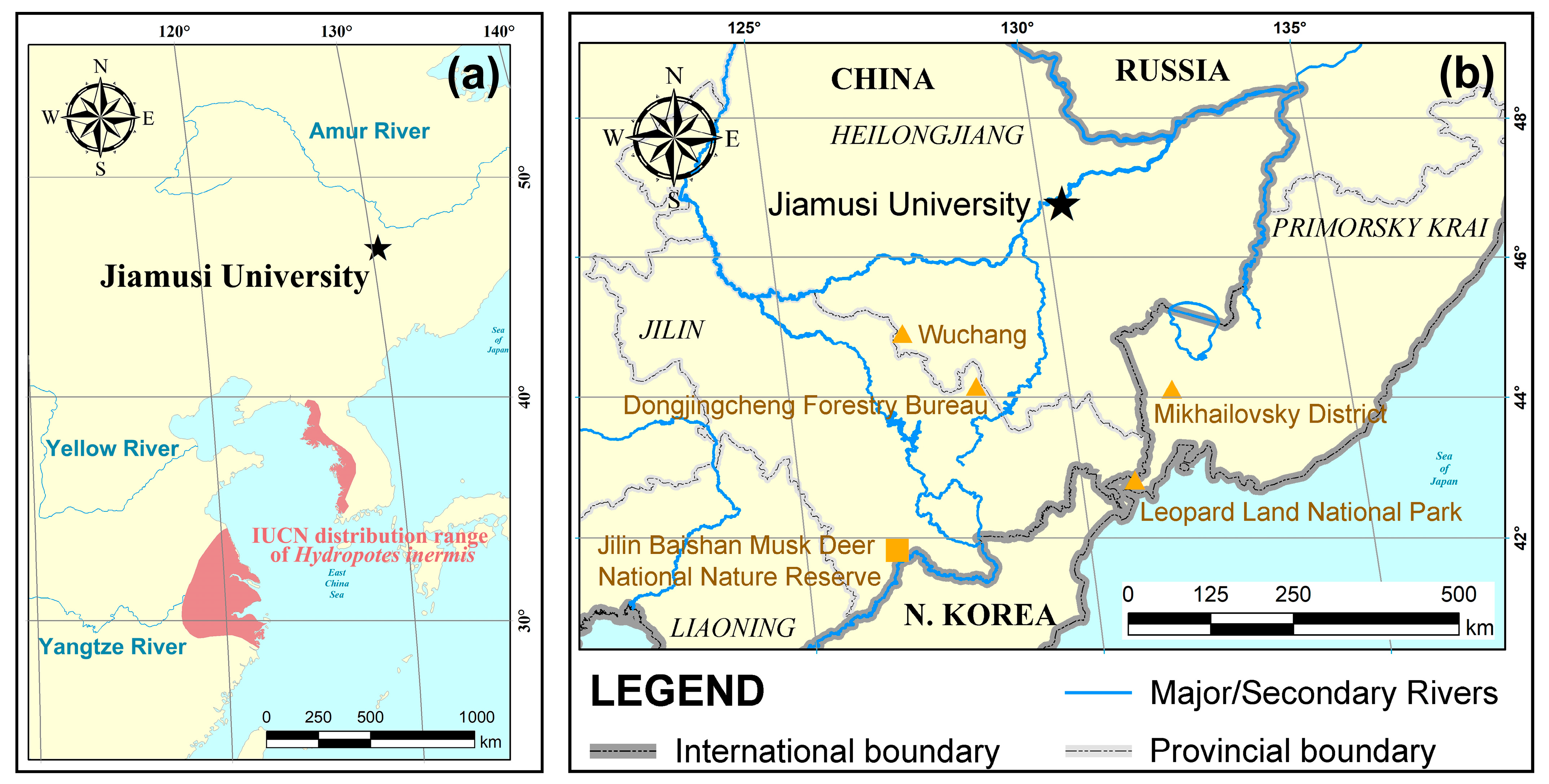
The Chinese water deer Hydropotes inermis Swinhoe, 1870 is an antlerless cervid native to East Asia. Current studies of habitat use indicate that the species has broad and diverse ecological adaptability, occupying lowland patches across a variety of habitats, including wetlands, river valleys, grasslands, forest edges and agricultural land [1,2,3]. Although its native distribution contracted during the twentieth century, recent records indicate a northward shift in its known occurrence in northeastern China and the Russian Far East [4,5,6]. Following its rediscovery in Jilin Province in 2017 [7], confirmed records were subsequently reported from the Russian Far East [8,9], Dongjingcheng Forestry Bureau [10], and Wuchang City, Heilongjiang Province [6] (Figure 1). Here, we report a photographically and genetically confirmed occurrence at Jiamusi University and evaluate its geographic position relative to these previous northern records.
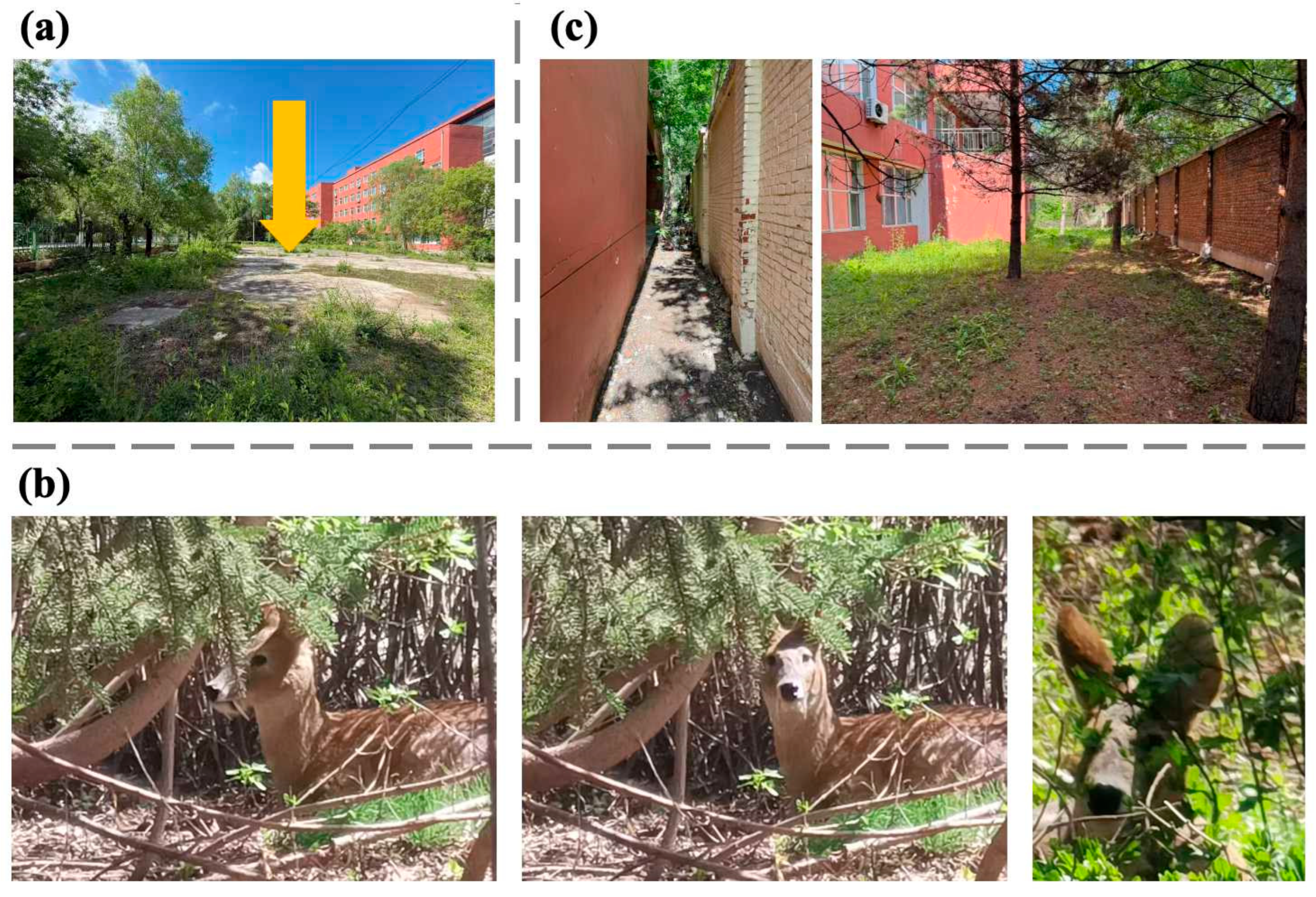
Beginning on 10 May 2026, an adult male H. inermis was repeatedly observed within the campus of Jiamusi University, Jiamusi City, Heilongjiang Province, China. The focal site was a fenced undeveloped area near Xuefu Street, with trees and shrubs adjacent to campus buildings (Figure 2a). During several encounters, the individual remained observable despite normal pedestrian and vehicle activity outside the fence. When an observer approached to approximately 20 m, the animal watched the observer, then lay down in the shrub cover (Figure 2b) and subsequently fled behind a nearby building (Figure 2c). No obvious external injuries or gross abnormalities were visible in the photographs or during direct observation, and the animal could move away rapidly when approached. However, no clinical examination was conducted, and its health status therefore could not be assessed directly. We found no evidence that its use of the fenced, shrub-covered area was associated with injury or poor physical condition.

2. Materials and Methods

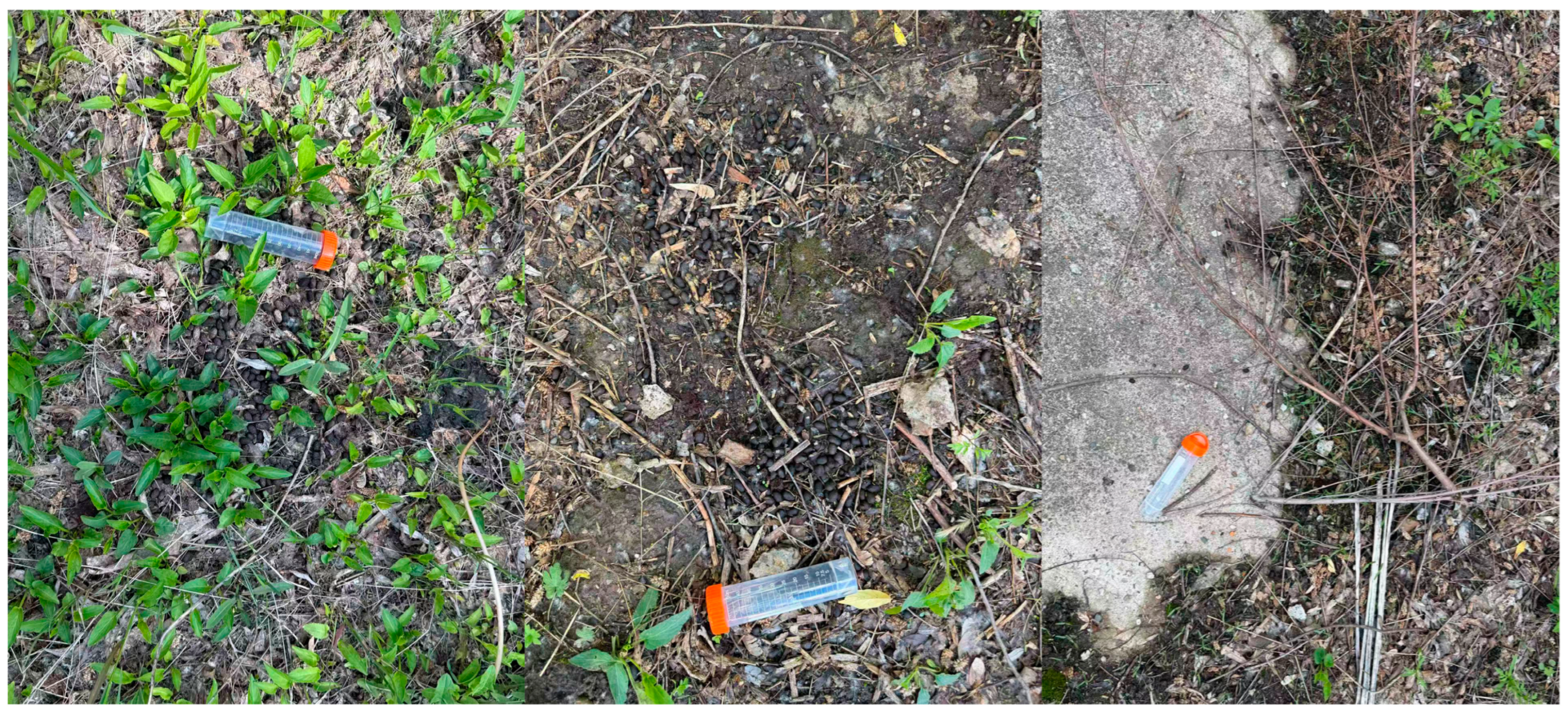
During the encounters, observers obtained clear smartphone photographs (Figure 2b). The individual was identified morphologically as a male H. inermis based on the absence of antlers, rounded ears, the lack of the conspicuous white rump patch characteristic of the Siberian roe deer Capreolus pygargus, and prominent upper canine tusks [4,12]. Observation events are summarized in Table S1. All photographed encounters involved an adult male of similar appearance within the same restricted campus area and were considered likely to represent the same individual, although this could not be confirmed conclusively. To further confirm the species identity genetically, we returned to the site to obtain independent molecular evidence. On 9 June 2026, nine fresh fecal samples were collected from the repeatedly used campus area. Samples were photographed in situ before collection (Figure 3), transferred with sterile disposable tools into individually labelled tubes, and stored and transported at −20 °C until DNA extraction. No animal was captured, handled or experimentally disturbed.

3. Results

The photographic identification and molecular results were concordant, and all three sequenced fecal samples were assigned to H. inermis (Supplementary Methods S1; Tables S2 and S3; Figure S1). Although the fecal samples were collected from the same campus area in which the photographed male had been repeatedly observed, the samples were collected after the photographic observation period and no individual-specific genotyping was performed. Therefore, the molecular data independently confirm the presence of H. inermis at the site but cannot demonstrate that the feces originated from the photographed male. Two subspecies, H. i. inermis and H. i. argyropus, have traditionally been recognized based on geographic distribution and pelage characteristics. The short 16S rRNA fragment used in the present study was designed for species-level identification, and its ability to discriminate between these subspecies has not been established. We therefore conservatively identify the Jiamusi record as H. inermis and do not assign it to either subspecies based on locality or the present molecular data [13,14]. The three mitochondrial 16S rRNA sequences generated in this study have been deposited in GenBank under accession numbers [QB050989; QB050990; QB050991].
To distinguish overall geographic separation from the magnitude of northward range displacement, we calculated both the geodesic distance between localities and the northward latitudinal displacement. Geodesic distances were calculated from WGS84 coordinates, whereas northward latitudinal displacement was calculated as the meridional surface distance corresponding to the difference in latitude between Jiamusi and each previous record. To the best of our knowledge, no published and independently verifiable modern occurrence was identified farther north in our search (Supplementary Methods S2). We therefore regard the Jiamusi occurrence as the northernmost currently confirmed record of H. inermis in its native Northeast Asian range (Figure 1, Table S4). The present evidence documents the occurrence of at least one individual at Jiamusi University but does not demonstrate the presence of a resident or breeding population.

4. Discussion

At Jiamusi University, the animal remained within an area exposed to routine pedestrian and vehicle activity and tolerated an approach to approximately 20 m before retreating. We interpret these observations only as apparent tolerance of routine human presence by this individual; they do not demonstrate urban adaptation at either the individual or species level. The provenance of the individual remains unknown. Although its occurrence is geographically consistent with the recent northward shift in documented records, a single-site observation cannot distinguish natural dispersal from escape, deliberate release, or other anthropogenic origins.
When a large mammal is detected well beyond its previously known distribution, both natural dispersal and anthropogenic origins must be considered. The present evidence confirms the species identity and repeated presence of Chinese water deer at Jiamusi University, but it does not identify the source of the individual. Natural dispersal is consistent with the regional expansion documented by camera traps, molecular data and landscape modelling [15], yet an escaped or deliberately released captive individual cannot be excluded solely from a single-site record. This uncertainty is best resolved through continued field monitoring rather than inference from appearance alone. Continued camera-trap and non-invasive genetic monitoring will be required to determine whether the Jiamusi occurrence was transient or reflects local persistence. The Jiamusi record represents the northernmost currently confirmed occurrence of H. inermis in Northeast Asia. The repeated observations are consistent with apparent tolerance of routine human presence by this individual, but whether such behaviour contributes to dispersal through human-modified landscapes remains untested.

Supplementary Materials

The following supporting information can be downloaded at: https://www.mdpi.com/article/10.3390/d18100602/s1. Supplementary Methods S1: Molecular identification; Supplementary Methods S2: Search and verification of previous northern occurrence records; Table S1: Summary of direct observation events of Hydropotes inermis at Jiamusi University, Jiamusi, Heilongjiang Province, China; Table S2: Mitochondrial 16S rRNA sequences and BLASTn-based species identification of fecal samples collected at Jiamusi University, Heilongjiang Province, China; Table S3: Summary of read lengths and base-call quality metrics for unidirectional mitochondrial 16S rRNA Sanger sequencing reads before and after 3′-end trimming; Table S4: Previously reported northern occurrences of Hydropotes inermis in Northeast China and the Russian Far East used to evaluate the geographic position of the Jiamusi record; Figure S1: Supplementary Sanger sequencing electropherograms. References [16,17] are cited in the Supplementary Materials.

Author Contributions

Conceptualization, investigation, data curation, molecular analysis, visualization, writing—original draft, J.-D.C.; investigation, data curation, molecular analysis, writing—original draft, M.-C.Y.; conceptualization, investigation, visualization, writing—original draft, X.Z.; conceptualization, investigation, G.-X.D.; writing—review and editing, molecular analysis, Z.-Z.L.; conceptualization, investigation, Y.W.; visualization, writing—original draft, Z.-L.Z.; supervision, writing—review and editing, J.-P.W.; conceptualization, supervision, writing—review and editing, Z.-S.L.; conceptualization, supervision, writing—review and editing, L.-W.T. All authors have read and agreed to the published version of the manuscript.

Funding

This research was funded by the National Natural Science Foundation of China, grant number 32070519.

Institutional Review Board Statement

Not applicable.

Data Availability Statement

The mitochondrial 16S rRNA sequences generated in this study have been deposited in GenBank under accession numbers [QB050989; QB050990; QB050991]. The raw Sanger chromatograms are provided in the Supplementary Materials.

Acknowledgments

We thank Jiamusi University for facilitating field observations on the campus.

Conflicts of Interest

The authors declare no conflicts of interest.

References

  1. Kim, B.-J.; Oh, D.-H.; Chun, S.-H.; Lee, S.-D. Distribution, density, and habitat use of the Korean water deer (Hydropotes inermis argyropus) in Korea. Landsc. Ecol. Eng. 2011, 7, 291–297. [Google Scholar] [CrossRef] [Scilit]
  2. Jung, J.; Shimizu, Y.; Omasa, K. Analysing habitat characteristics for Korean water deer (Hydropotes inermis argyropus) in Korea using remote sensing and landscape metrics. Eco-Engineering 2011, 23, 75–80. [Google Scholar] [CrossRef]
  3. Sun, Y.; Li, Z.; Chen, J.; Khattak, R.H.; Liu, Z.; Teng, L. Habitat selection: Autumn and winter behavioral preferences of water deer (Hydropotes inermis) in Northeast China. Sustainability 2023, 15, 12181. [Google Scholar] [CrossRef] [Scilit]
  4. Smith, A.T.; Xie, Y. (Eds.) A Guide to the Mammals of China; Princeton University Press: Princeton, NJ, USA, 2008. [Google Scholar]
  5. Omelko, V.; Darman, Y.; Sedash, G. Craniometric characteristics of the water deer Hydropotes inermis (Swinhoe 1870) from a new population in the southern Russian Far East. J. Asia-Pac. Biodivers. 2026, 19, 399–405. [Google Scholar] [CrossRef] [Scilit]
  6. Li, Z.; Khattak, R.H.; Han, X.; Zhang, N.; Wu, J.; Liu, Z.; Teng, L. Distribution update of water deer (Hydropotes inermis) and prediction of their potential distribution in Northeast China. Sci. Rep. 2023, 13, 5610. [Google Scholar] [CrossRef] [Scilit]
  7. Li, Z.-Z.; Wu, J.-P.; Teng, L.-W.; Liu, Z.-S.; Wang, B.-K.; Liu, Y.-C.; Xu, T. The Rediscovery of Water Deer (Hydropotes inermis) in Jilin Province. Chin. J. Zool. 2019, 54, 108–112. [Google Scholar] [CrossRef]
  8. Darman, Y.A.; Storozhuk, V.B.; Sedash, G.A. Hydropotes inermis (Cervidae), a new species for the Russian fauna registered in the Land of Leopard National Park (Russia). Nat. Conserv. Res. 2019, 4, 127–129. [Google Scholar] [CrossRef] [Scilit]
  9. Belyaev, D.A.; Jo, Y.-S. Northernmost finding and further information on water deer Hydropotes inermis in Primorskiy Krai, Russia. Mammalia 2021, 85, 71–73. [Google Scholar] [CrossRef] [Scilit]
  10. Li, Y.; Kim, J.H.; Li, H.; Peng, Y.; Chen, M.; Zhu, W.; Pandey, P.; Sedash, G.; Wang, T.; Darman, Y.; et al. Northward range expansion of water deer in Northeast Asia: Direct evidence and management implications. Animals 2022, 12, 1392. [Google Scholar] [CrossRef] [Scilit]
  11. Harris, R.B.; Duckworth, J.W. Hydropotes inermis. The IUCN Red List of Threatened Species. 2015; e.T10329A22163569. Available online: https://doi.org/10.2305/IUCN.UK.2015-2.RLTS.T10329A22163569.en (accessed on 1 September 2026). [CrossRef] [Scilit]
  12. Schilling, A.-M.; Rössner, G.E. The (Sleeping) Beauty in the Beast—A review on the water deer, Hydropotes inermis. Hystrix Ital. J. Mammal. 2017, 28, 121–133. [Google Scholar] [CrossRef] [Scilit]
  13. Koh, H.S.; Lee, B.K.; Wang, J.; Heo, S.W.; Jang, K.H. Two sympatric phylogroups of the Chinese water deer (Hydropotes inermis) identified by mitochondrial DNA control region and cytochrome b gene analyses. Biochem. Genet. 2009, 47, 860–867. [Google Scholar] [CrossRef] [Scilit]
  14. Kim, Y.K.; Koyabu, D.; Lee, H.; Kimura, J. Cranial morphological homogeneity in two subspecies of water deer in China and Korea. J. Vet. Med. Sci. 2015, 77, 1427–1435. [Google Scholar] [CrossRef] [Scilit]
  15. Li, Y.; Peng, Y.; Li, H.; Zhu, W.; Darman, Y.; Lee, D.K.; Wang, T.; Sedash, G.; Pandey, P.; Borzée, A.; et al. Prediction of range expansion and estimation of dispersal routes of water deer (Hydropotes inermis) in the transboundary region between China, the Russian Far East and the Korean Peninsula. PLoS ONE 2022, 17, e0264660. [Google Scholar] [CrossRef] [Scilit]
  16. Xiong, M.; Shao, X.; Long, Y.; Bu, H.; Zhang, D.; Wang, D.; Li, S.; Wang, R.; Yao, M. Molecular analysis of vertebrates and plants in scats of leopard cats (Prionailurus bengalensis) in southwest China. J. Mammal. 2016, 97, 1054–1064. [Google Scholar] [CrossRef] [Scilit]
  17. Xing, C.; Lin, Y.; Zhou, Z.; Zhao, L.; Jiang, S.; Lin, Z.; Xu, J.; Zhan, X. The establishment of terrestrial vertebrate genetic resource bank and species identification based on DNA barcoding in Wanglang National Nature Reserve. Biodivers. Sci. 2023, 31, 22661. [Google Scholar] [CrossRef] [Scilit]
Figure 1. Geographic location of the northernmost currently confirmed record of the Chinese water deer Hydropotes inermis in Jiamusi, northeastern China. (a) Location of Jiamusi University in relation to the distribution range of H. inermis mapped in the 2015 IUCN Red List assessment [11]. (b) Detailed location of the Jiamusi University record and previously published northern occurrence records of H. inermis in northeastern China and the Russian Far East, including Wuchang, Dongjingcheng Forestry Bureau, Jilin Baishan Musk Deer National Nature Reserve, Mikhailovsky District, and Land of the Leopard National Park. Major and secondary rivers, international boundaries, and provincial boundaries are shown to illustrate the regional geographic context.
Diversity 18 00602 g001
Figure 2. Habitat and photographic documentation of a male Chinese water deer Hydropotes inermis at Jiamusi University, Jiamusi, Heilongjiang Province, China. (a) The focal resting site within a fenced undeveloped area of the university campus; the yellow arrow indicates the location where the individual was repeatedly observed (9 June 2026, 13:40). (b) Smartphone photographs of the male H. inermis resting and remaining alert within shrub cover; the antlerless head, rounded ears, and prominent upper canine tusks are visible and support morphological identification of the individual (10 May 2026, 11:00). (c) Surrounding built and vegetated areas adjacent to the resting site, including the area behind a nearby building into which the individual retreated after being approached (9 June 2026. 14:30).
Diversity 18 00602 g002
Figure 3. Representative fresh fecal samples collected from the same campus area in which the photographed Chinese water deer (Hydropotes inermis) had previously been observed at Jiamusi University, Jiamusi, Heilongjiang Province, China, on 9 June 2026.
Diversity 18 00602 g003
Disclaimer/Publisher’s Note: The statements, opinions and data contained in all publications are solely those of the individual author(s) and contributor(s) and not of MDPI and/or the editor(s). MDPI and/or the editor(s) disclaim responsibility for any injury to people or property resulting from any ideas, methods, instructions or products referred to in the content.