
The Other Side of the Coin: Taxonomic Updates and Species Key of Herennia (Araneae: Nephilidae) †

 ,
,  , ,
, ,  , and
, and
Abstract
1. Introduction

2. Materials and Methods
2.1. Specimens Examined
2.2. Morphological Methods
2.3. Molecular Species Delimitation
2.4. Taxonomy, Classification, and Nomenclature
3. Results
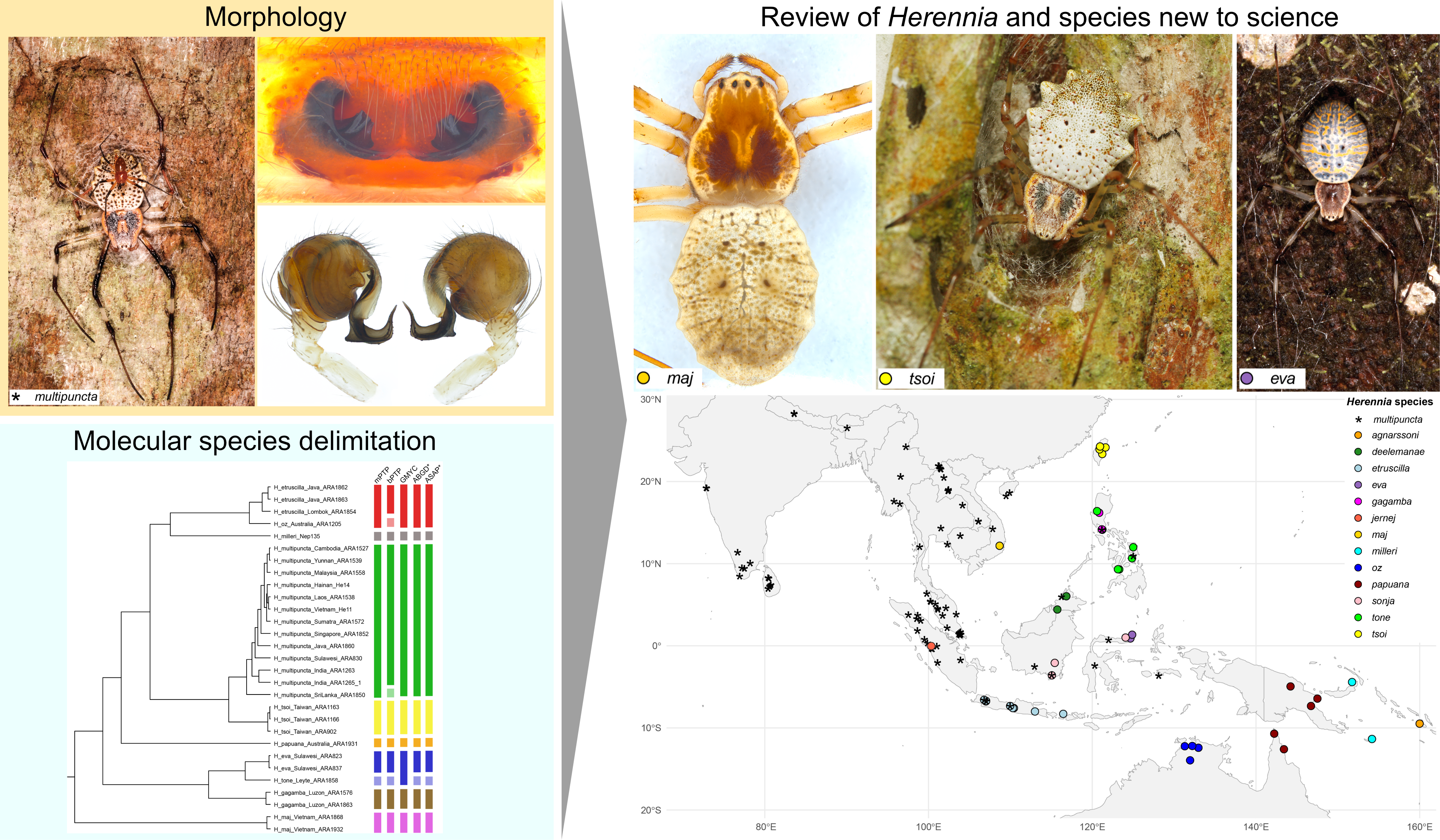
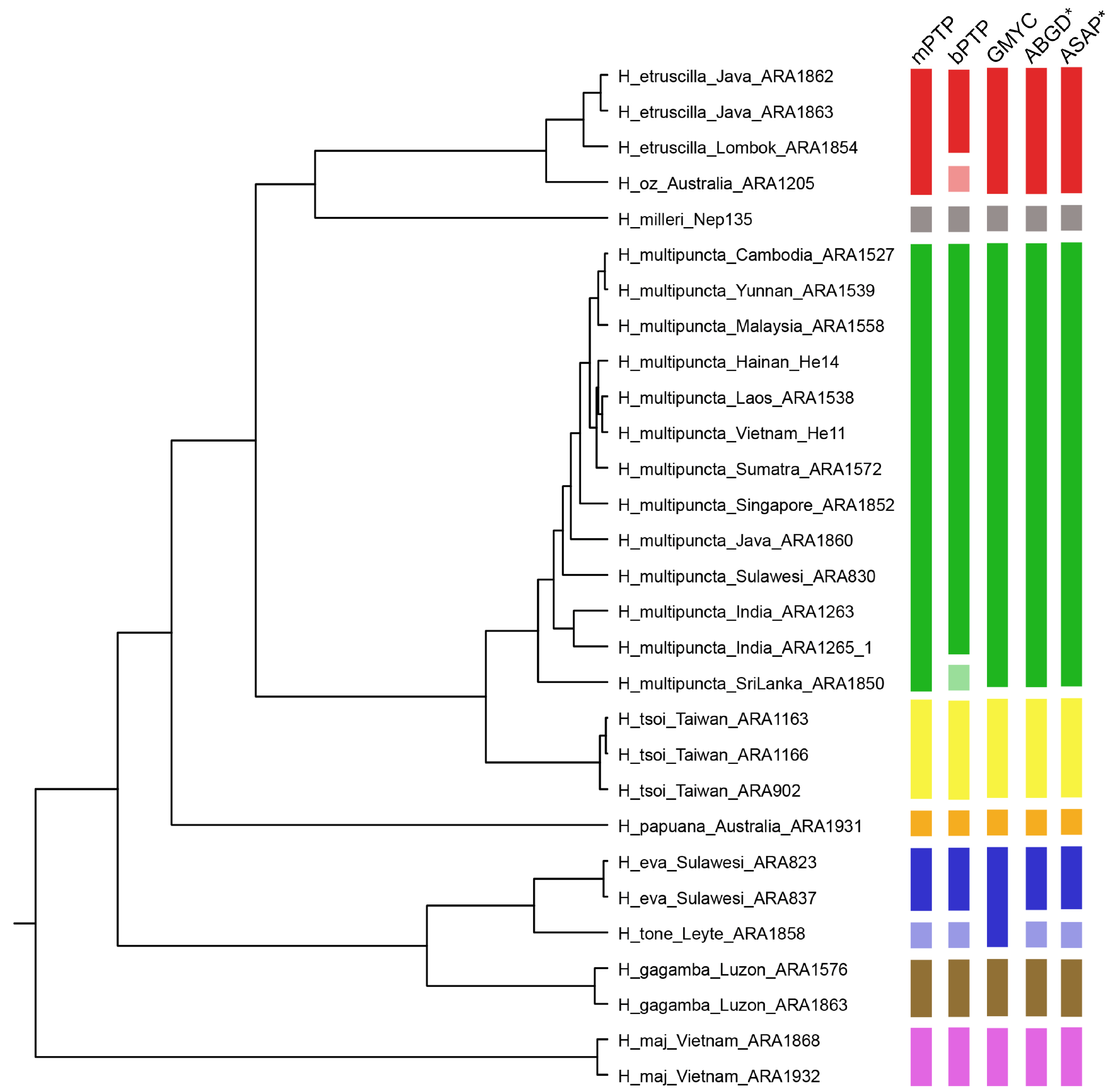
3.1. Molecular Species Delimitation

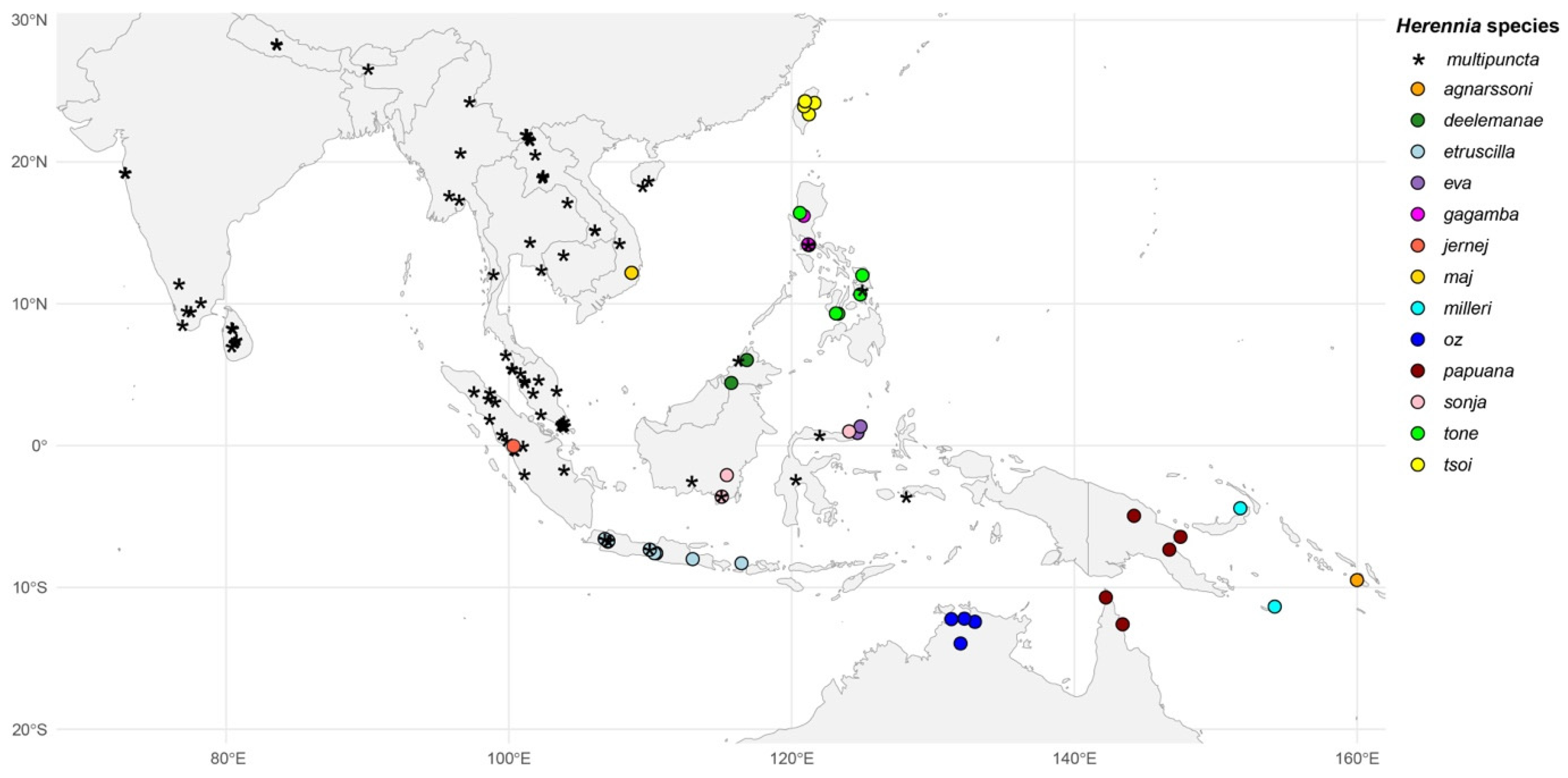
3.2. Classification

| Species Name | Author, Year | Comment | Known from | Range | Region |
|---|---|---|---|---|---|
| Herennia agnarssoni | Kuntner, 2005 | Valid species | female only | Solomon Islands | Solomon Islands |
| Herennia deelemanae | Kuntner, 2005 | Valid species | both sexes | Sabah | Borneo |
| Herennia etruscilla | Kuntner, 2005 | Valid species | both sexes | Java, Lombok | Java, Lesser Sundas |
| Herennia eva | Kuntner, this paper | New species | both sexes | Sulawesi | Sulawesi |
| Herennia gagamba | Kuntner, 2005 | Valid species | female only * | Luzon | Philippines |
| Herennia jernej | Kuntner, 2005 | Valid species | female only | Sumatra | Sumatra |
| Herennia maj | Kuntner, this paper | New species | female only | Vietnam | Mainland SE Asia |
| Herennia milleri | Kuntner, 2005 | Valid species | female only | Bismarck Archipelago | New Guinea |
| Herennia multipuncta | (Doleschall, 1859) | Valid species | both sexes | India to Maluku | Mainland Asia, Greater Sundas, to Maluku |
| Herennia papuana | Thorell, 1881 | Valid species | both sexes | New Guinea, Australia (Queensland) | Australasia |
| Herennia sonja | Kuntner, 2005 | Valid species | female only | Kalimantan, Sulawesi | Borneo, Sulawesi |
| Herennia tone | Kuntner, 2005 | Valid species | both sexes | Negros, Leyte | Philippines |
| Herennia tsoi | Kuntner et al., this paper | New species | both sexes | Taiwan | Taiwan |
| Herennia oz | Kuntner, 2005 | Valid species | both sexes | Northern Territory | Australia |
| Species | Female Body Length | Male Body Length | Body Length SSD |
|---|---|---|---|
| Clitaetra clathrata | 7.400 | 3.900 | 1.90 |
| Clitaetra episinoides | 7.452 | 4.489 | 1.66 |
| Clitaetra irenae | 6.893 | 2.660 | 2.59 |
| Clitaetra perroti | 4.551 | 2.900 | 1.57 |
| Herennia deelemanae | 7.952 | 3.000 | 2.65 |
| Herennia etruscilla | 10.325 | 3.665 | 2.82 |
| Herennia eva | 12.267 | 2.709 | 4.53 |
| Herennia gagamba | 12.950 | 3.500 | 3.70 |
| Herennia multipuncta | 12.668 | 2.856 | 4.43 |
| Herennia papuana | 13.600 | 3.652 | 3.72 |
| Herennia tone | 9.500 | 2.542 | 3.74 |
| Herennia tsoi | 15.957 | 3.167 | 5.04 |
| Herennia oz | 12.600 | 3.390 | 3.72 |
| Indoetra thisbe | 3.500 | 2.570 | 1.36 |
| Nephila constricta | 34.282 | 2.997 | 11.44 |
| Nephila pilipes | 30.357 | 4.396 | 6.91 |
| Nephilengys malabarensis | 14.833 | 2.876 | 5.16 |
| Nephilengys papuana | 14.487 | 4.193 | 3.46 |
| Nephilingis borbonica | 16.450 | 3.800 | 4.33 |
| Nephilingis cruentata | 22.328 | 3.635 | 6.14 |
| Nephilingis dodo | 20.771 | 6.600 | 3.15 |
| Nephilingis livida | 23.270 | 3.903 | 5.96 |
| Trichonephila antipodiana | 32.935 | 3.873 | 8.50 |
| Trichonephila clavata | 21.385 | 5.184 | 4.12 |
| Trichonephila clavipes | 24.984 | 3.975 | 6.28 |
| Trichonephila edulis | 18.037 | 7.108 | 2.54 |
| Trichonephila fenestrata | 21.095 | 4.129 | 5.11 |
| Trichonephila inaurata | 30.630 | 5.856 | 5.23 |
| Trichonephila komaci | 32.089 | 4.415 | 7.27 |
| Trichonephila plumipes | 20.516 | 4.743 | 4.33 |
| Trichonephila senegalensis | 25.929 | 7.022 | 3.69 |
| Trichonephila sexpunctata | 27.124 | 3.478 | 7.80 |
| Trichonephila sumptuosa | 34.863 | 4.400 | 7.92 |
| Trichonephila turneri | 36.129 | 4.334 | 8.34 |

3.3. A Key to Herennia Species


3.4. Taxonomic Updates

Molecular evidence: The species is supported by delimitation analyses, except for GMYC (Figure 2). |
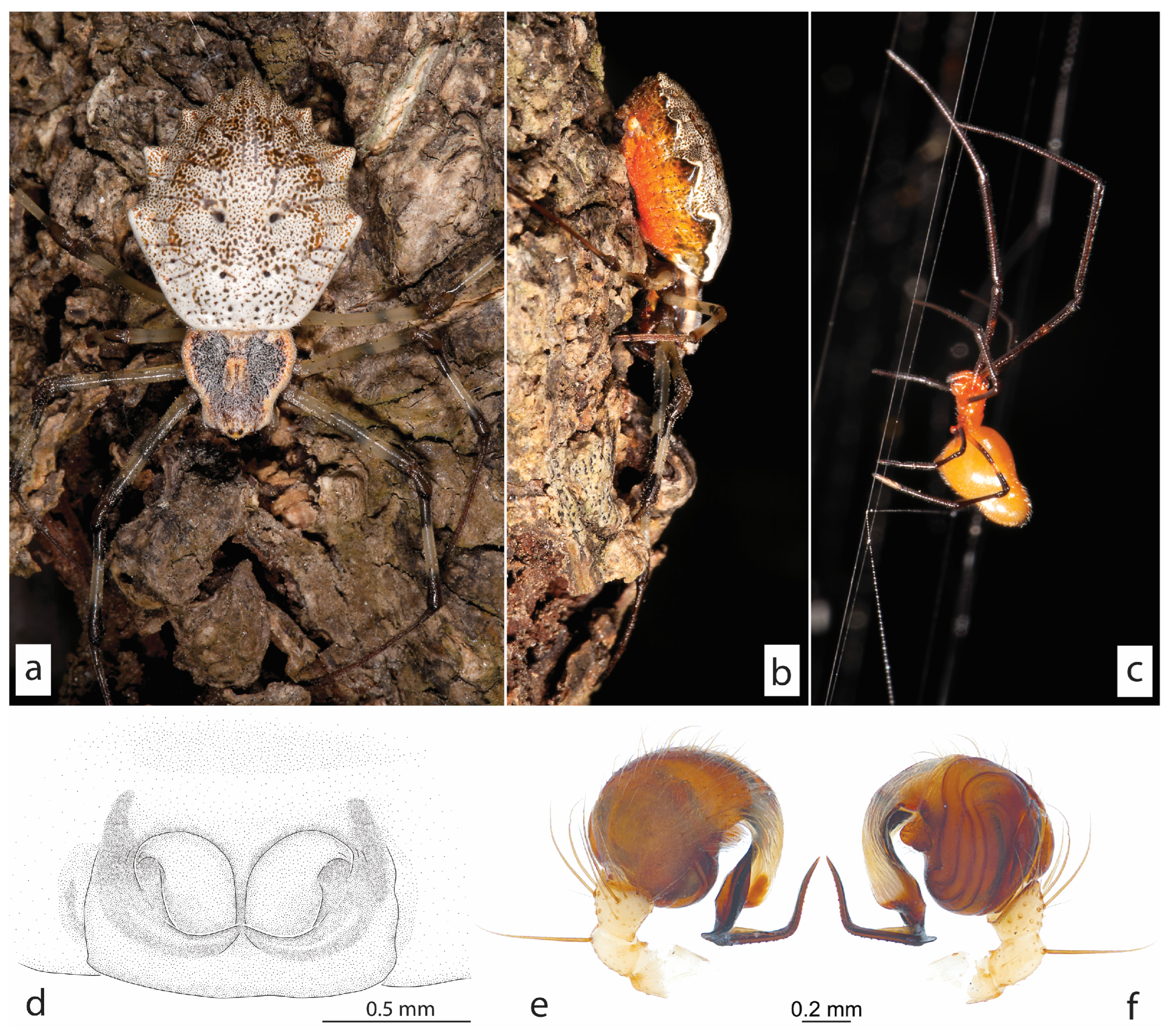
Description: Female (paratype; Figure 6a and Figure 9d). Total length 12.97. Prosoma 4.41 long, 4.04 wide. Sternum 2.11 long, 2.10 wide. AME diameter 0.24, ALE 0.14, PME 0.14, PLE 0.13. AME separation 0.22, PME separation 0.31, PME-PLE separation 0.35, AME-ALE separation 0.24, AME-PME separation 0.30, ALE-PLE separation 0.10. Clypeus height 0.34. Appendages Leg I length 21.53 (Fe 6.33, Pa 1.50, Ti 4.75, Me 6.92, Ta 2.02). Opisthosoma 6.68 long, 8.61 wide, 4.34 high. Male (holotype; Figure 8a and Figure 9e,f). Total length 2.54. Prosoma 1.35 long, 1.15 wide. Sternum 0.62 long, 0.56 wide. AME diameter 0.14, ALE 0.07, PME 0.10, PLE 0.08. AME separation 0.06, PME separation 0.08, PME-PLE separation 0.05, AME-ALE separation 0.04, AME-PME separation 0.06, ALE-PLE separation 0.04. Clypeus height 0.04. Appendages Leg I length 7.48 (Fe 1.67, Pa 0.48, Ti 1.46, Me 2.5, Ta 1.37). Opisthosoma 1.77 long, 1.35 wide, 0.76 high. |
Variation: Female total body length from 11.70 to 12.97 (N = 4), male total body length from 2.54 to 2.84 (N = 3) |
Natural History: The type locality, Mahawu Mt. Area near Tomahon, had appropriately sized trees for H. eva to construct their ladder webs (female web was 28 cm wide, 65 cm high, and 22 cm from top frame to the hub). At the other locality near Ratatok, H. eva inhabited trees in both rain forest as well as plantation. A female web with egg sac in the dense canopy forest was 35 cm wide, 70 cm high, and 45 cm from top frame to the hub. |
Distribution: The species is endemic to northern Sulawesi, Indonesia. |
Herennia tone Kuntner, 2005 |
Tone’s coin spider |
Remarks: No males have been available during prior revision [2], but one has since become available that was matched with the described H. tone female. |
For types and etymology, see [2]. |
Material examined since prior revision [2]: Female and male (ARA1858-9) deposited at SMF from “PHILIPPINES: Leyte, Visca, N Baybay, primary forest, 200–500 m, W. Schawaller et al. leg. 10.3.1991”. Very roughly, this locality lies at N10.66 and E124.85. |
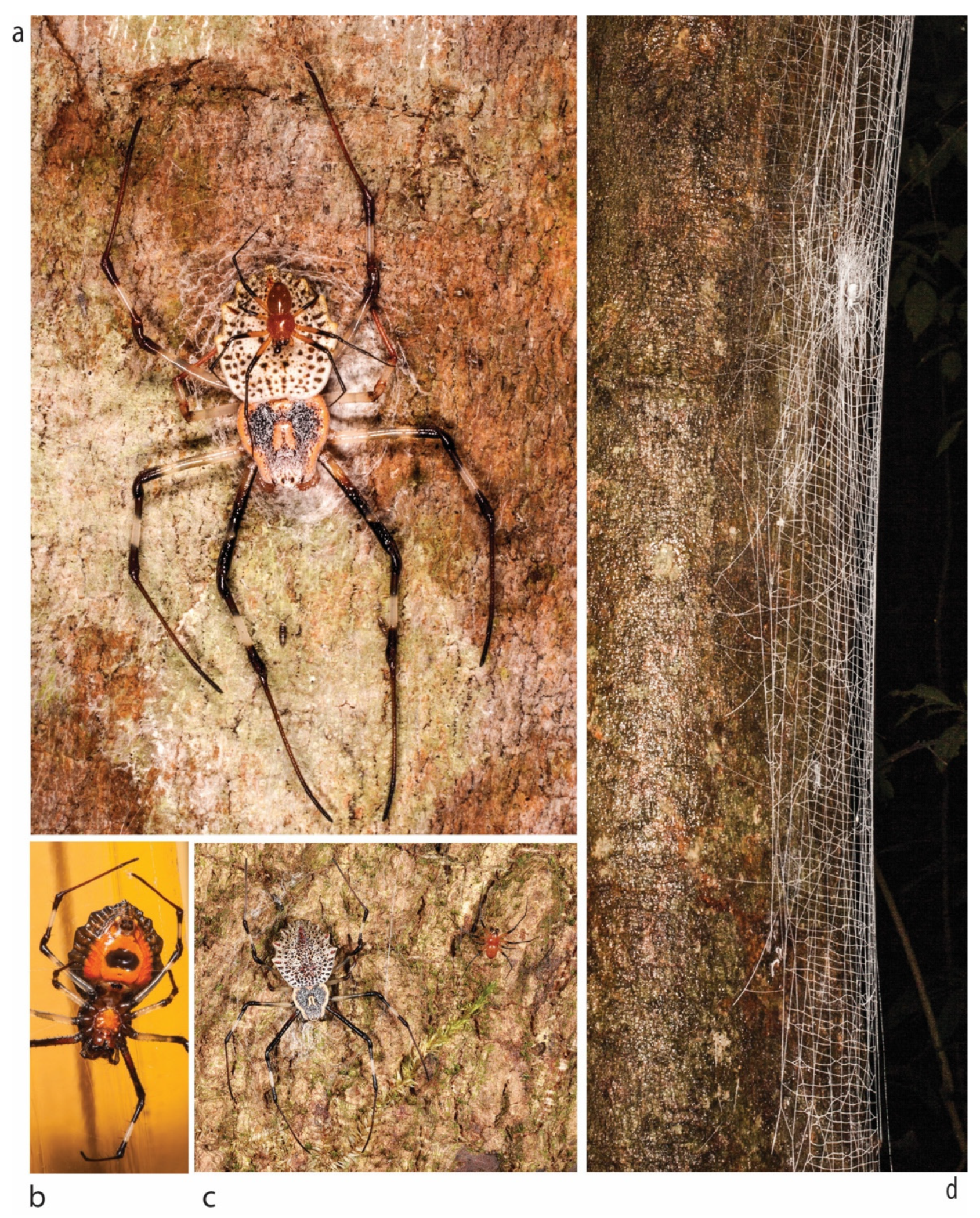
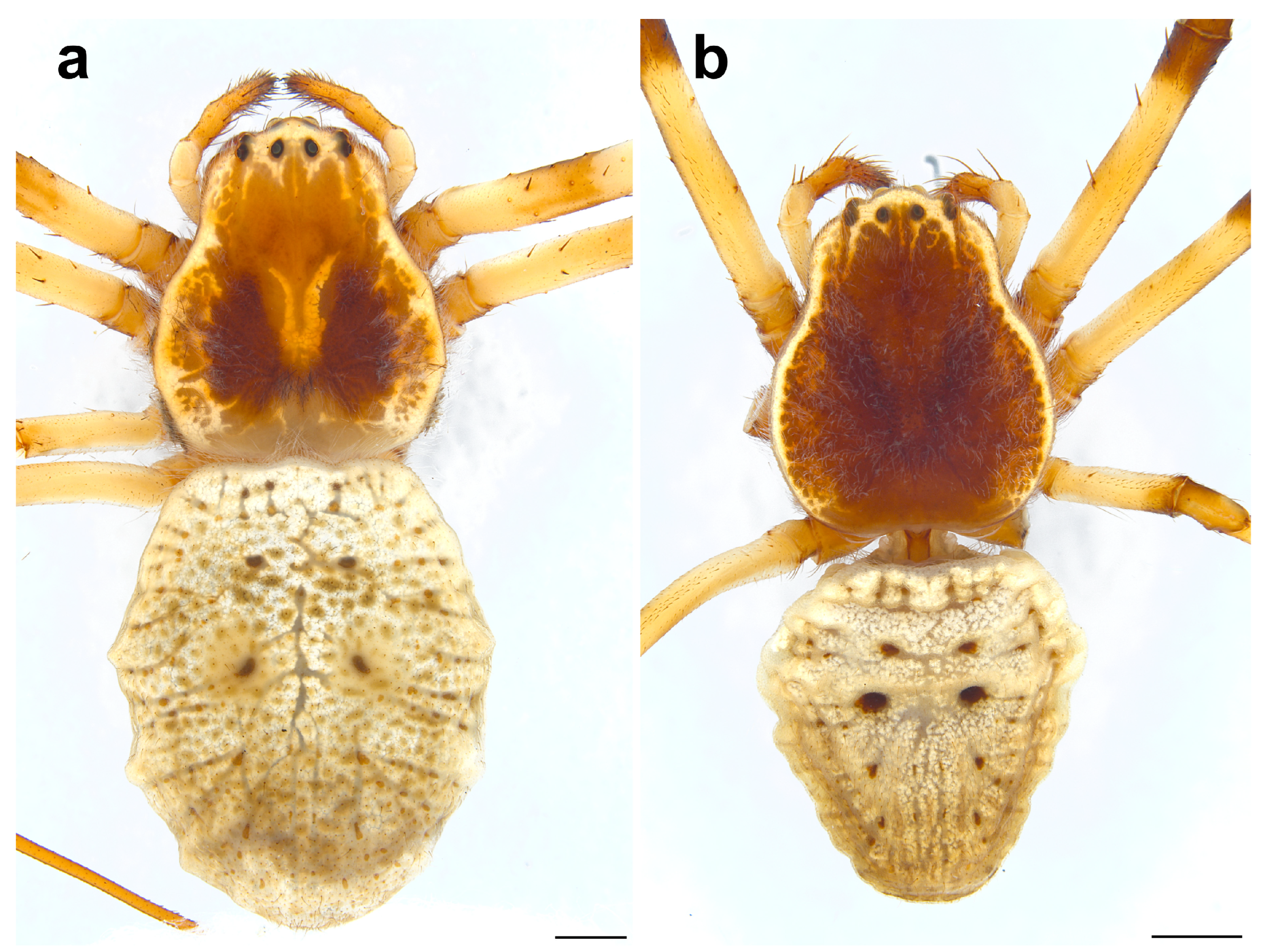
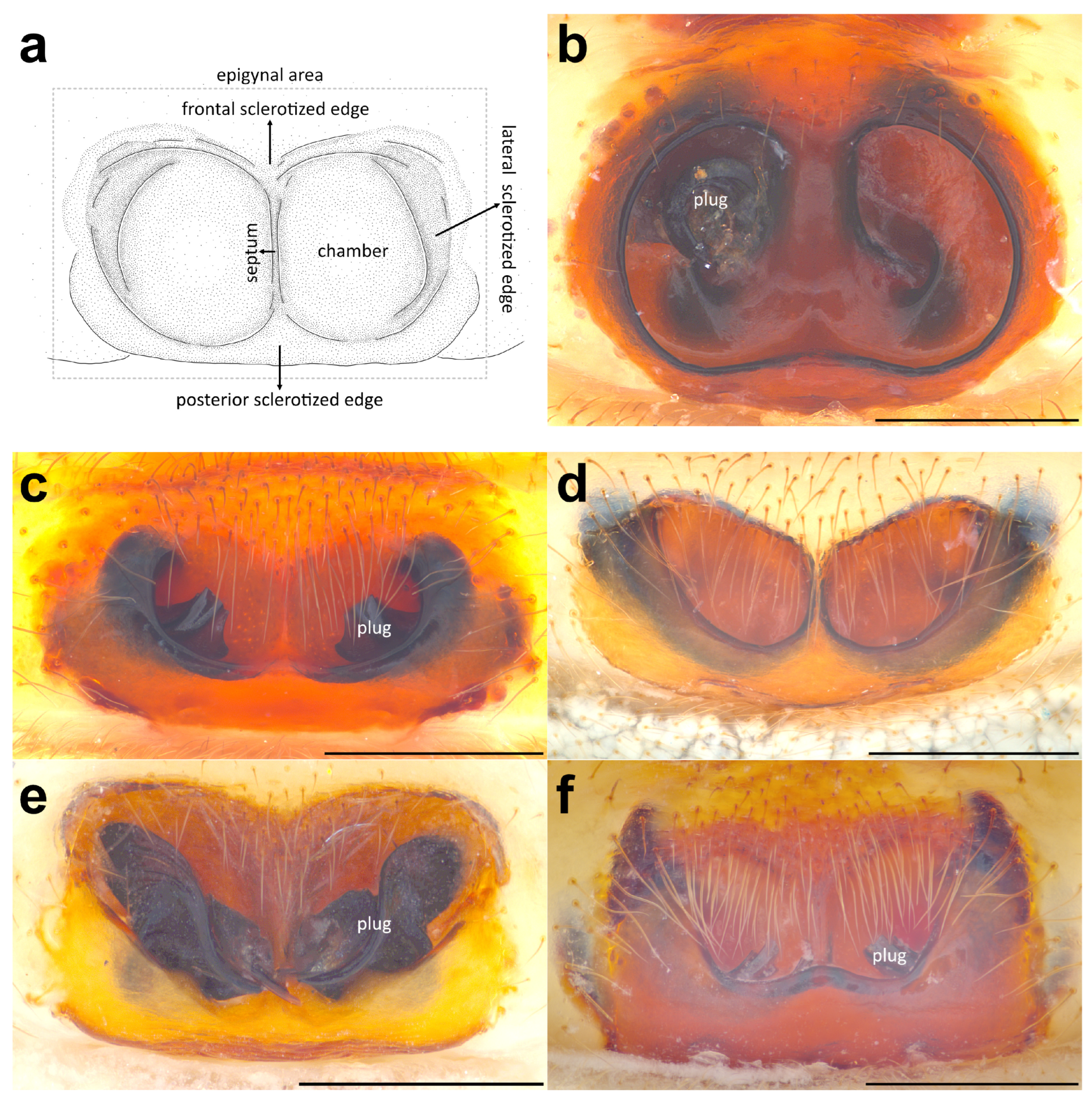
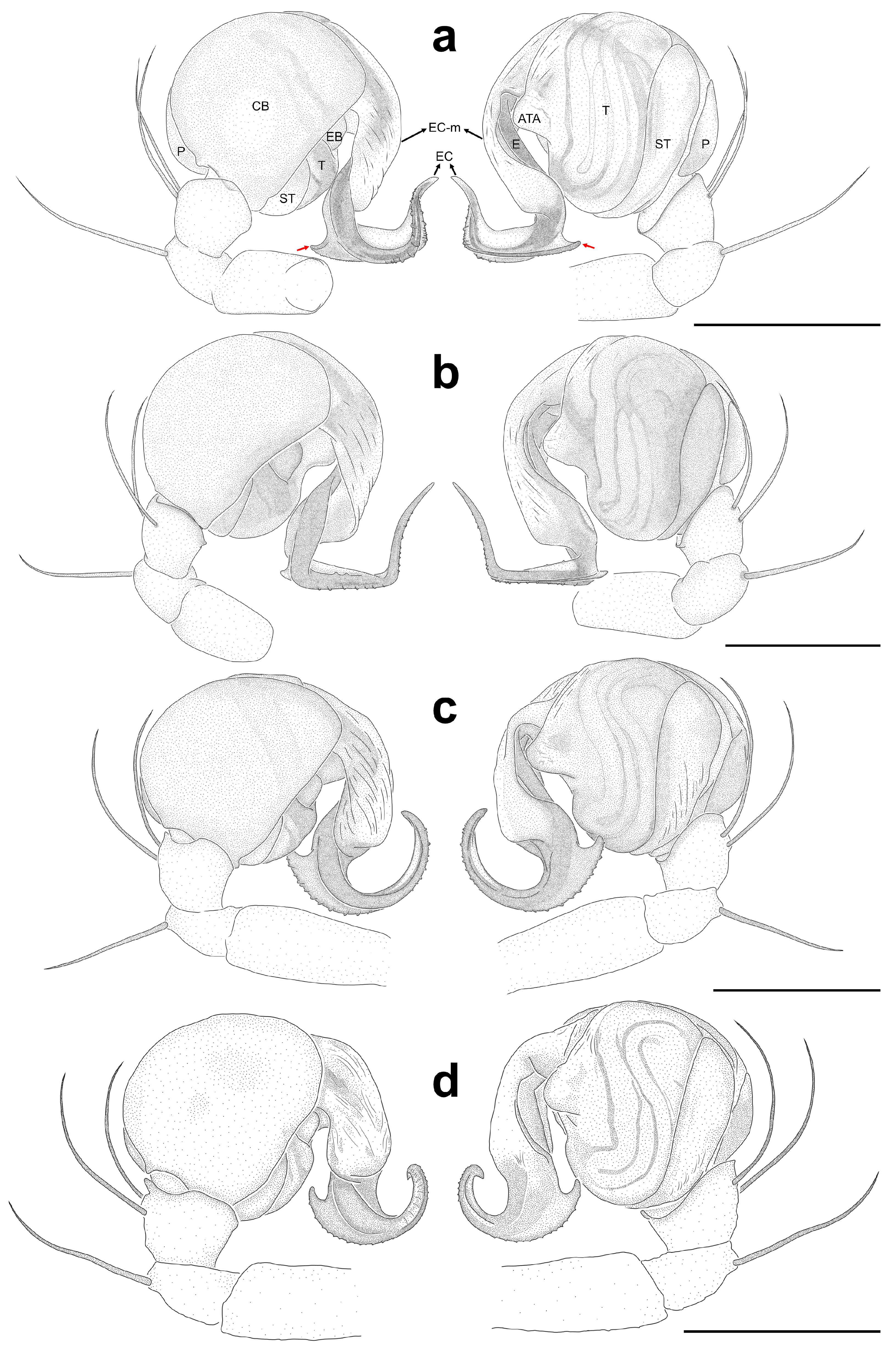
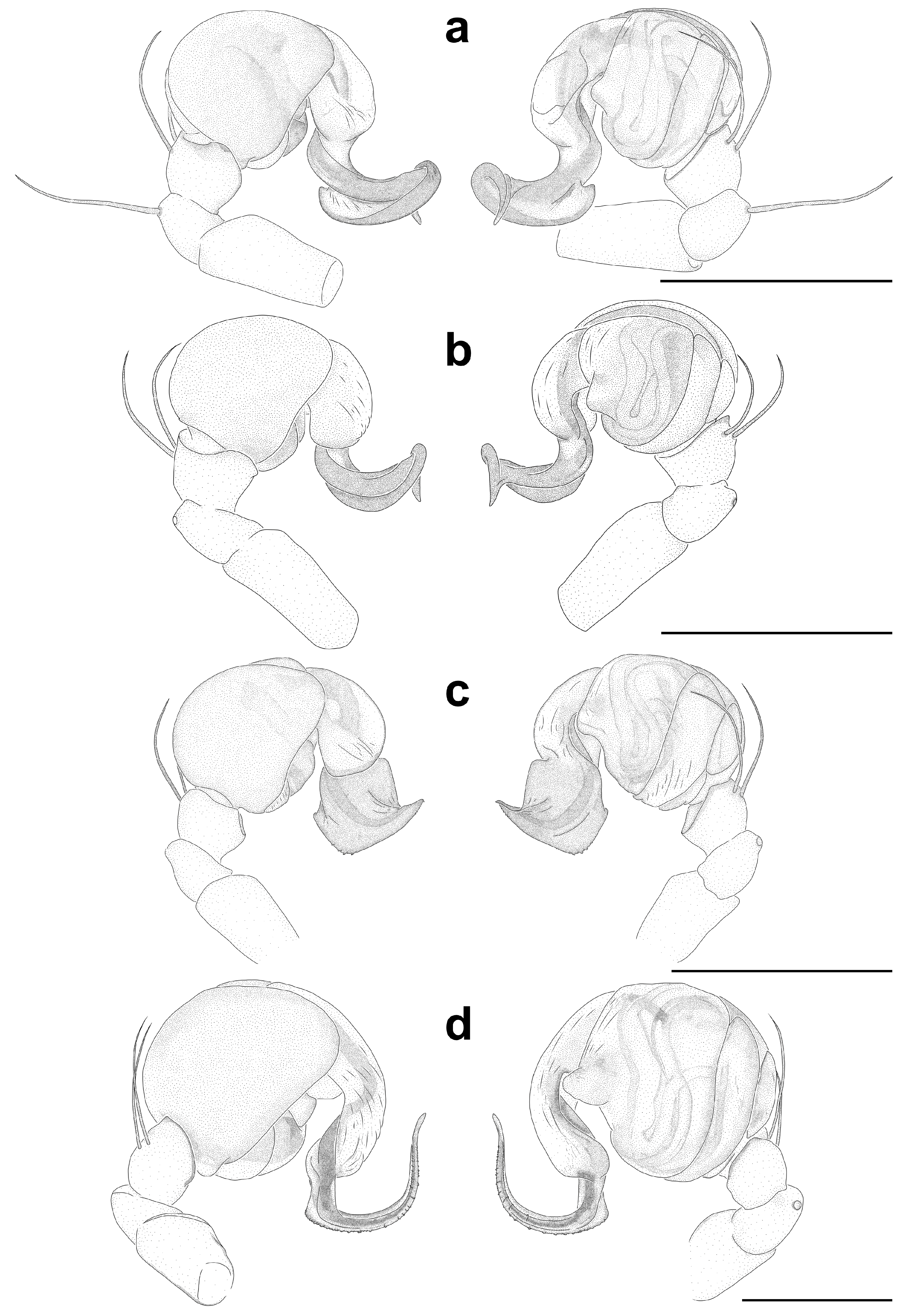
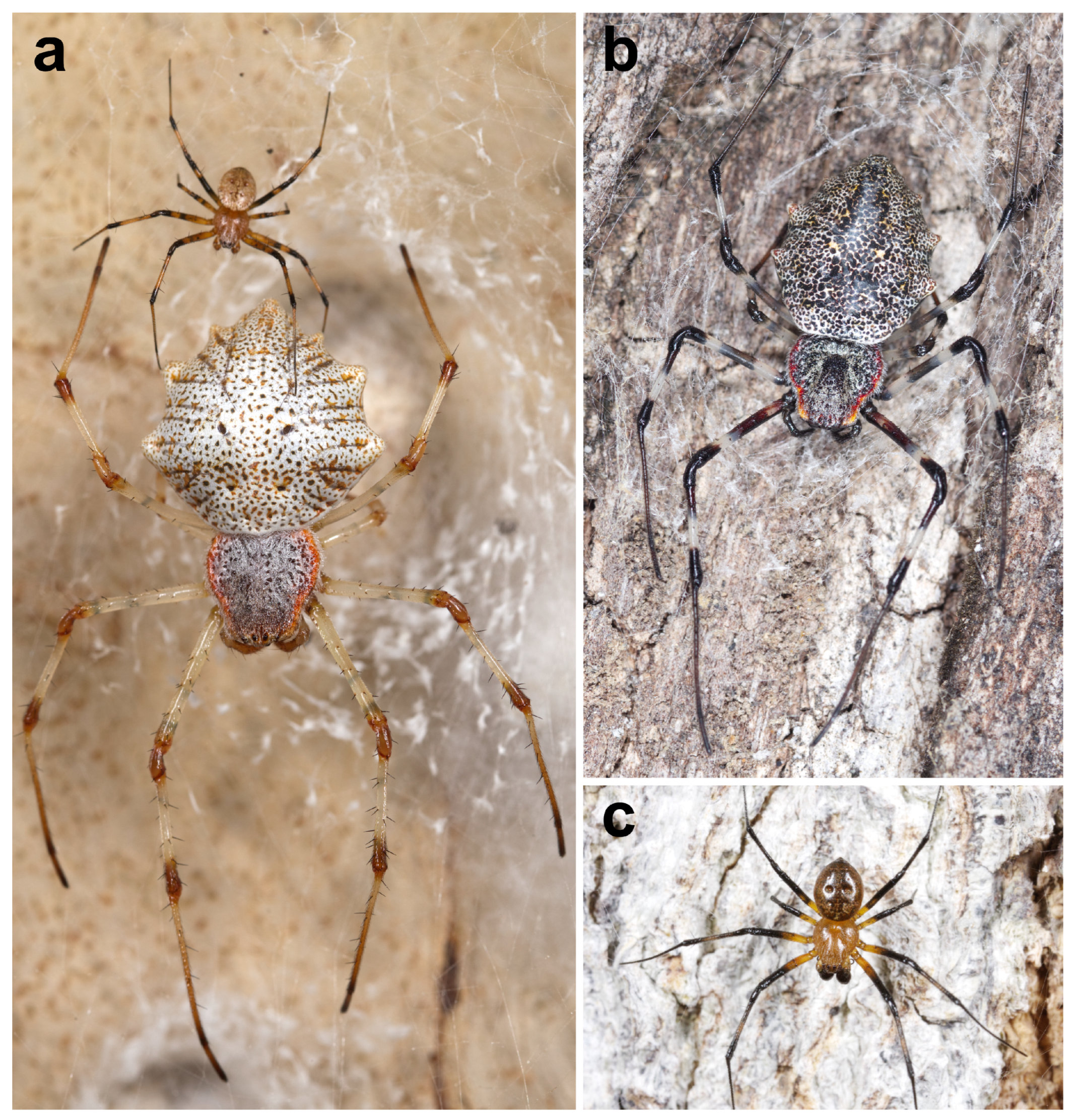
Diagnosis: In contrast to H. multipuncta, H. tsoi, H. maj (Figure 4a), H. jernej, H. sonja, and H. gagamba, the female carapace in H. tone lacks a distinct V-shaped mark. The female resembles that of H. eva, but their epigyna are diagnosable: the epigynal lateral sclerotized edge in H. tone is rounded (Figure 6c) and not ear-shaped. Male palp has a massive, twisting embolic conductor that resembles that of H. eva. However, unlike in that of H. eva, this embolic conductor is not as broad and lacks a distinct proximal bump (Figure 8b). |
Molecular evidence: The species is supported by delimitation analyses, except for GMYC (Figure 2). |
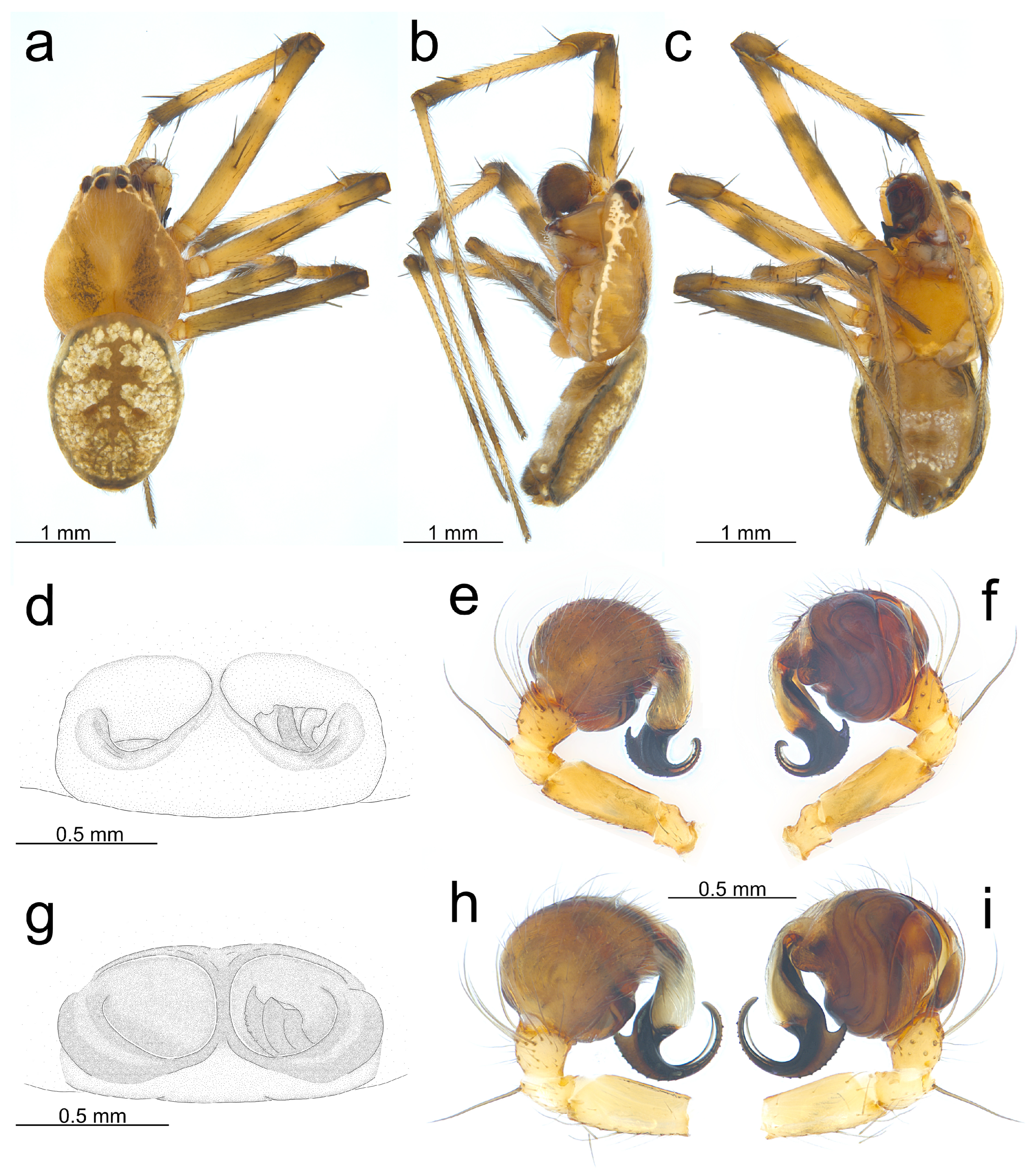
Description: Male (ARA1859; Figure 8b and Figure 9h,i). Total length 2.78. Prosoma 1.46 long, 1.18 wide. Sternum 0.71 long, 0.62 wide. AME diameter 0.16, ALE 0.10, PME 0.11, PLE 0.09. AME separation 0.08, PME separation 0.10, PME-PLE separation 0.05, AME-ALE separation 0.03, AME-PME separation 0.09, ALE-PLE separation. Clypeus height 0.63. Appendages Leg I length (Fe 1.87, Pa 0.40, Ti 1.44, Me 1.87, Ta 0.91). Opisthosoma 1.64 long, 1.38 wide, 0.77 high. |
Variation: Unknown male variation. |
Natural History: Unknown but presumed to be confined to primary forest as collection label suggests. |
Distribution: The species is endemic to Visayas group of islands in the Philippines with a questionable additional record from Luzon [2]. |
Herennia maj Kuntner, new species |
Maj’s coin spider |
ZooBank ID: urn:lsid:zoobank.org:act:2C5105E0-8313-490F-B19B-A453C8BFD504 |
Types: Holotype female, designated herein with a manuscript label code ARA1866 and originally labeled as “Vietnam, Lam Dong Province, Lac Duong Distr., 5 km NE of Long Lahn Vil. Bi Dup–Nui Ba Nature Reserve. 12d10′44″ N, 108d40′44″ E, 1400 m a.s.l. May 2009, A.V. Abramov (exp. of Russia-Vietnam Tropical Centre)”, deposited at ZMMU. Paratype female with a manuscript label code ARA1868 and originally labeled as holotype above, deposited at MMUE. |
Additional material examined: None. |
Etymology: The first author is naming this species to honor his son Maj. The species epithet is to be treated as a noun in apposition. |
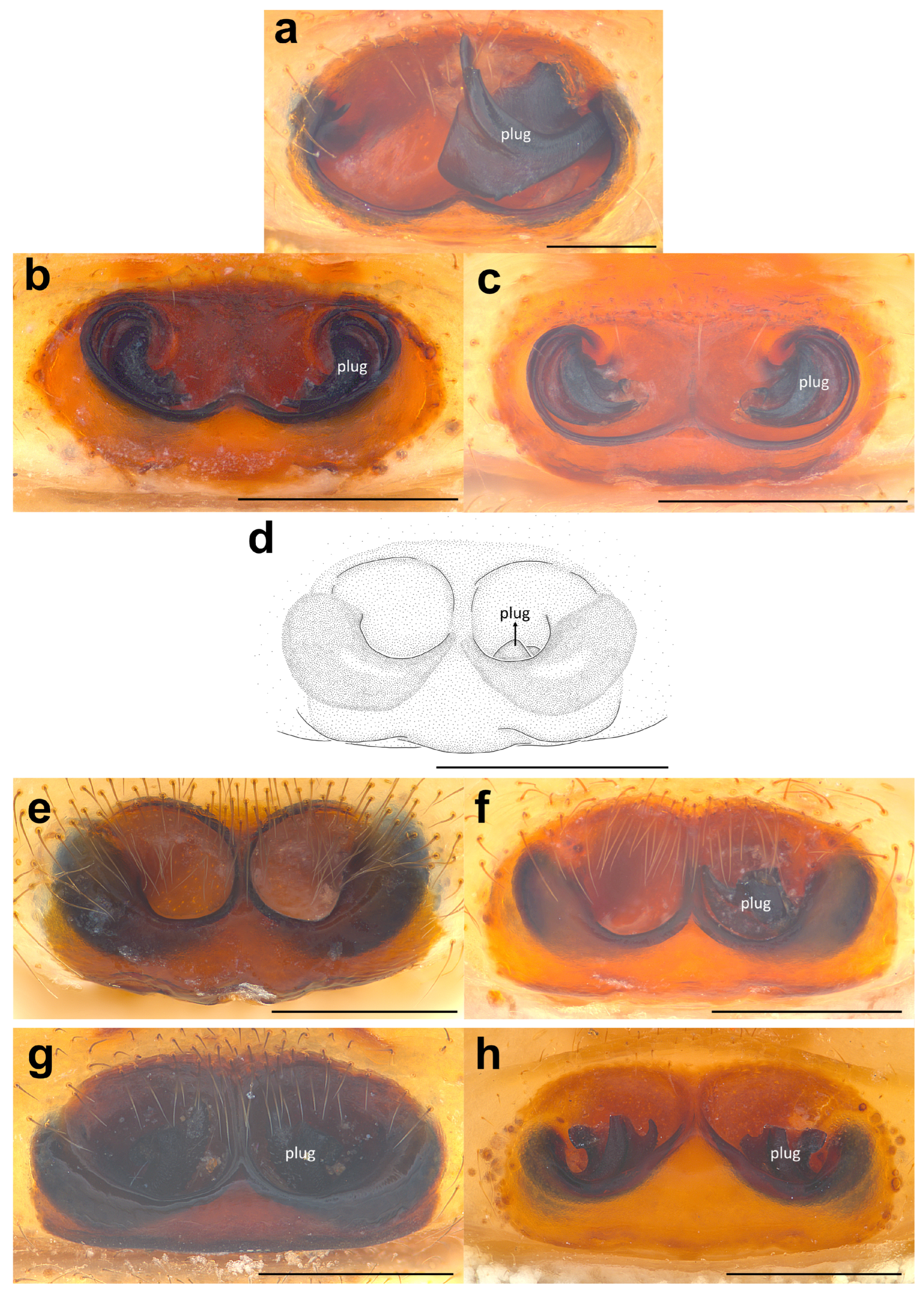
Diagnosis: Unlike in H. eva, H. tone, H. agnarssoni, H. papuana, H. milleri, H. etruscilla, H. oz, and H. deelemanae (Figure 4b), the female carapace in H. maj bears a distinct V-shaped mark (Figure 4a). Somatically, female H. maj resemble small specimens of H. multipuncta and H. tsoi. However, in H. maj the epigynal posterior sclerotized edge is broad and not massive, the lateral sclerotized edge is not sharply defined where curved around the chambers, and the chambers are massive and square shaped rather than circular (Figure 5e). |
Description: Female (holotype; Figure 4a, Figure 5e and Figure 9g). Total length 10.10. Prosoma 4.94 long, 3.76 wide. Sternum 1.76 long, 1.95 wide. AME diameter 0.23, ALE 0.13, PME 0.15, PLE 0.12. AME separation 0.25, PME separation 0.32, PME-PLE separation 0.30, AME-ALE separation 0.31, AME-PME separation 0.30, ALE-PLE separation 0.10. Clypeus height 0.32. Appendages Leg I length 20.83 (Fe 6.35, Pa 1.48, Ti 4.44, Me 6.19, Ta 1.92). Opisthosoma 5.88 long, 5.30 wide, 3.98 high. Male unknown. |
Variation: Female total body length from 8.89 to 10.10 (N = 2). |
Natural History: Unknown. |
Distribution: Only known from the type locality in southern Vietnam. |
Herennia tsoi Kuntner & al., new species |
Tso’s coin spider |
ZooBank ID: urn:lsid:zoobank.org:act:D56D3637-1F4B-4742-8FDF-FCA16AB14CB2 |
H. multipuncta, in part: [2] |
Remarks: No males from Taiwan have been available, and a single museum female was tentatively identified as H. multipuncta in the prior revision [2]. With the newly collected material treated here, the Taiwanese population of Herennia belongs to a distinct species, H. tsoi described herein. |
Types: Holotype male ARA1223 from Nantou County, Taiwan and paratype female ARA1222 from Nantou County, Taiwan, both deposited in USNM (Smithsonian Institution). |
Additional material examined: See Table S1. |
Etymology: Named to honor our colleague I-Min Tso of Taiwan who helped us to discover the uniqueness of this species;. The species epithet is a Latinized masculine adjective. |
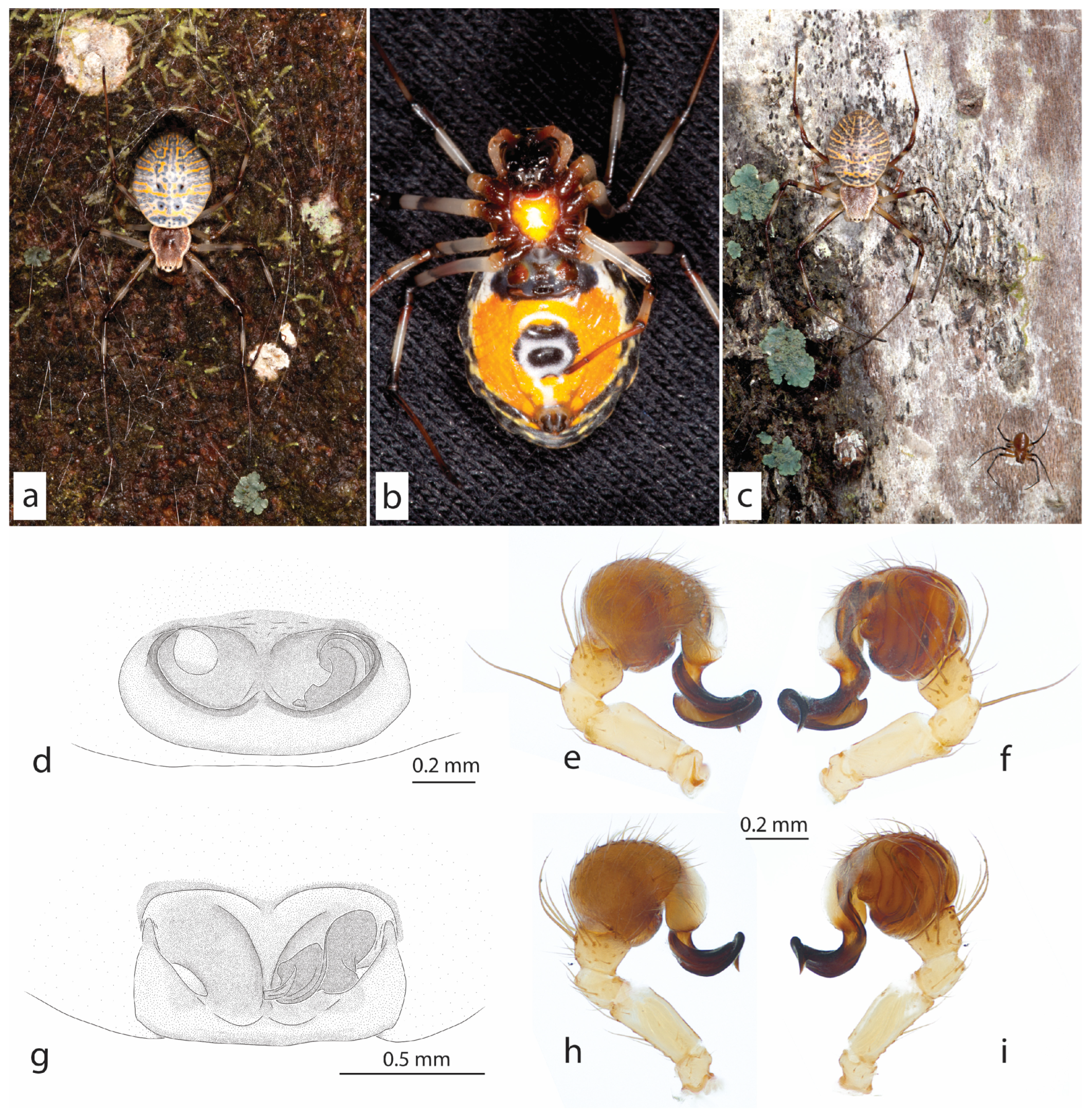
Diagnosis: Unlike in H. eva, H. tone, H. agnarssoni, H. papuana, H. milleri, H. etruscilla, H. oz, and H. deelemanae (Figure 4b), the female carapace in H. tsoi bears a distinct V-shaped mark (Figure 10a). Somatically, the females resemble H. multipuncta and H. maj. The male palp, however, has a distinctly shaped embolic conductor with a much narrower flap and a longer and more proximally bent tip (Figure 7b and Figure 10e,f) compared with H. multipuncta (male H. maj is unknown). The epigynum has distinct chambers that unlike in H. multipuncta are not fully circular but rather distorted in shape. Unlike in H. multipuncta, the epigynal edges are strongly sclerotized (Figure 5f and Figure 10d). Unlike in H. maj, the H. tsoi epigynum has medium-sized chambers and a massive posterior sclerotized edge (Figure 5f and Figure 10d). |
Description: Female (paratype; Figure 5f and Figure 10a,b,d). Total length 16.18. Prosoma 5.89 long, 5.75 wide. Sternum 2.45 long, 2.51 wide. AME diameter 0.23, ALE 0.21, PME 0.15, PLE 0.14. AME separation 0.32, PME separation 0.45, PME-PLE separation 0.54, AME-ALE separation 0.38, AME-PME separation 0.27, ALE-PLE separation 0.15. Clypeus height 0.25. Appendages Leg I length 24.51 (Fe 6.52, Pa 1.78, Ti 5.58, Me 8.32, Ta 2.31). Opisthosoma 11.42 long, 10.23 wide, 4.96 high. Male (holotype; Figure 7b and Figure 10e,f). Total length 3.17. Prosoma 2.00 long, 1.55 wide. Sternum 1.03 long, 0.81 wide. AME diameter 0.16, ALE 0.09, PME 0.73, PLE 0.08. AME separation 1.04, PME separation 0.17, PME-PLE separation 0.11, AME-ALE separation 0.05, AME-PME separation 0.12, ALE-PLE separation 0.07. Clypeus height 0.08. Appendages Leg I length 9.03 (Fe 2.35, Pa 0.63, Ti 1.99, Me 2.78, Ta 1.28). Opisthosoma 1.8 long, 1.37 wide, 0.94 high. |
Variation: Female total body length from 14.96 to 16.53 (N = 13). Male total body length from 3.17 to 3.71 (N = 2). |
Natural History: The natural history of H. tsoi is classical Herennia in the way juveniles and females inhabit ever larger trees to construct their arboricolous webs adhering to tree trunks. Webs can be very large: in Yushan NP we observed a web with the female and her egg sacs in it that was 30 cm wide, 160 cm high, and 27 cm from top frame to the hub. This massive web hosted seven coinhabiting kleptoparasitic theridiid spiders of the genus Famakytta Pett & Agnarsson, 2025 [29] (Figure 10c). |
Distribution: Endemic to Taiwan. |


4. Discussion

Supplementary Materials
Author Contributions
Funding
Data Availability Statement
Acknowledgments
Conflicts of Interest
References
- Thorell, T. Studi Sui Ragni Malesi e Papuani. I. Ragni Di Selebes Raccolti Nel 1874 Dal Dott. O. Beccari. Ann. Mus. Civ. Stor. Nat. Genova 1877, 10, 341–637. [Google Scholar]
- Kuntner, M. A Revision of Herennia (Araneae: Nephilidae: Nephilinae), the Australasian “Coin Spiders”. Invertebr. Syst. 2005, 19, 391–436. [Google Scholar] [CrossRef]
- Simon, E. Histoire Naturelle Des Araignées, 2nd, ed.; Tome Premier; Roret: Paris, France, 1894. [Google Scholar]
- Kuntner, M.; Kralj-Fišer, S.; Gregorič, M. Ladder Webs in Orb-Web Spiders: Ontogenetic and Evolutionary Patterns in Nephilidae. Biol. J. Linn. Soc. 2010, 99, 849–866. [Google Scholar] [CrossRef]
- Doleschall, L. Tweede Bijdrage Tot de Kennis Der Arachniden van Den Indischen Archipel. Acta Soc. Sci. Indica-Neerl. 1859, 5, 1–60. [Google Scholar]
- Thorell, T. Studi Sui Ragni Malesi e Papuani. III. Ragni Dell’Austro Malesia e Del Capo York, Conservati Nel Museo Civico Di Storia Naturale Di Genova. Ann. Mus. Civ. Stor. Nat. Genova 1881, 17, 1–720. [Google Scholar]
- IUCN. The IUCN Red List of Threatened Species. Version 2025-1. Available online: https://www.iucnredlist.org (accessed on 10 September 2025).
- Kuntner, M.; Hamilton, C.A.; Cheng, R.C.; Gregorič, M.; Lupše, N.; Lokovšek, T.; Lemmon, E.M.; Lemmon, A.R.; Agnarsson, I.; Coddington, J.A.; et al. Golden Orbweavers Ignore Biological Rules: Phylogenomic and Comparative Analyses Unravel a Complex Evolution of Sexual Size Dimorphism. Syst. Biol. 2019, 68, 555–572. [Google Scholar] [CrossRef]
- Kuntner, M.; Coddington, J.A. Sexual Size Dimorphism: Evolution and Perils of Extreme Phenotypes in Spiders. Annu. Rev. Entomol. 2020, 65, 57–80. [Google Scholar] [CrossRef]
- Kuntner, M.; Agnarsson, I.; Li, D. The Eunuch Phenomenon: Adaptive Evolution of Genital Emasculation in Sexually Dimorphic Spiders. Biol. Rev. Camb. Philos. Soc. 2015, 90, 279–296. [Google Scholar] [CrossRef]
- Kuntner, M.; Pristovšek, U.; Cheng, R.C.; Li, D.; Zhang, S.; Tso, I.M.; Liao, C.P.; Miller, J.A.; Kralj-Fišer, S. Eunuch Supremacy: Evolution of Post-Mating Spider Emasculation. Behav. Ecol. Sociobiol. 2015, 69, 117–126. [Google Scholar] [CrossRef]
- Uhl, G.; Nessler, S.H.; Schneider, J.M. Securing Paternity in Spiders? A Review on Occurrence and Effects of Mating Plugs and Male Genital Mutilation. Genetica 2010, 138, 75–104. [Google Scholar] [CrossRef]
- Schneider, J.; Fromhage, L. Monogynous Mating Strategies in Spiders. In Animal Behaviour: Evolution and Mechanisms; Springer: Berlin/Heidelberg, Germany, 2010; pp. 441–464. ISBN 9783642026232. [Google Scholar]
- Turk, E.; Bond, J.E.; Cheng, R.C.; Čandek, K.; Hamilton, C.A.; Gregorič, M.; Kralj-Fišer, S.; Kuntner, M. A Natural Colonization of Asia: Phylogenomic and Biogeographic History of Coin Spiders (Araneae: Nephilidae: Herennia). Diversity 2021, 13, 515. [Google Scholar] [CrossRef]
- Kuntner, M.; Coddington, J.A.; Hormiga, G. Phylogeny of Extant Nephilid Orb-Weaving Spiders (Araneae, Nephilidae): Testing Morphological and Ethological Homologies. Cladistics 2008, 24, 147–217. [Google Scholar] [CrossRef]
- Kuntner, M.; Yu, K.-P.; Bedjanič, M.; Gregorič, M.; Turk, E.; Čandek, K.; Coddington, J.A.; Agnarsson, I.; Starrett, J.; Bond, J.E. Osmooka, a New Spider Genus from Madagascar: A Surprising Relative of the Australian Fauna (Araneae: Paraplectanoididae). Insect Syst. Divers. 2025, 9, ixaf050. [Google Scholar] [CrossRef]
- Kapli, P.; Lutteropp, S.; Zhang, J.; Kobert, K.; Pavlidis, P.; Stamatakis, A.; Flouri, T. Multi-Rate Poisson Tree Processes for Single-Locus Species Delimitation under Maximum Likelihood and Markov Chain Monte Carlo. Bioinformatics 2017, 33, 1630–1638. [Google Scholar] [CrossRef]
- Zhang, J.; Kapli, P.; Pavlidis, P.; Stamatakis, A. A General Species Delimitation Method with Applications to Phylogenetic Placements. Bioinformatics 2013, 29, 2869–2876. [Google Scholar] [CrossRef]
- Fujisawa, T.; Barraclough, T.G. Delimiting Species Using Single-Locus Data and the Generalized Mixed Yule Coalescent Approach: A Revised Method and Evaluation on Simulated Data Sets. Syst. Biol. 2013, 62, 707–724. [Google Scholar] [CrossRef]
- Puillandre, N.; Lambert, A.; Brouillet, S.; Achaz, G. ABGD, Automatic Barcode Gap Discovery for Primary Species Delimitation. Mol. Ecol. 2012, 21, 1864–1877. [Google Scholar] [CrossRef] [PubMed]
- Puillandre, N.; Brouillet, S.; Achaz, G. ASAP: Assemble Species by Automatic Partitioning. Mol. Ecol. Resour. 2021, 21, 609–620. [Google Scholar] [CrossRef] [PubMed]
- Bouckaert, R.; Heled, J.; Kühnert, D.; Vaughan, T.; Wu, C.H.; Xie, D.; Suchard, M.A.; Rambaut, A.; Drummond, A.J. BEAST 2: A Software Platform for Bayesian Evolutionary Analysis. PLoS Comput. Biol. 2014, 10, e1003537. [Google Scholar] [CrossRef] [PubMed]
- Bouckaert, R.R.; Drummond, A.J. BModelTest: Bayesian Phylogenetic Site Model Averaging and Model Comparison. BMC Evol. Biol. 2017, 17, 42. [Google Scholar] [CrossRef]
- De Queiroz, K. A Unified Concept of Species and Its Consequences for the Future of Taxonomy. In Proceedings of the California Academy of Sciences; California Academy of Sciences: San Francisco, CA, USA, 2005; Volume 56, pp. 196–215. [Google Scholar]
- De Queiroz, K. Species Concepts and Species Delimitation. Syst. Biol. 2007, 56, 879–886. [Google Scholar] [CrossRef]
- Hedin, M.; Milne, M.A. New Species in Old Mountains: Integrative Taxonomy Reveals Ten New Species and Extensive Short-Range Endemism in Nesticus Spiders (Araneae, Nesticidae) from the Southern Appalachian Mountains. Zookeys 2023, 1145, 1–130. [Google Scholar] [CrossRef]
- Kallal, R.J.; Dimitrov, D.; Arnedo, M.A.; Giribet, G.; Hormiga, G. Monophyly, Taxon Sampling, and the Nature of Ranks in the Classification of Orb-Weaving Spiders (Araneae: Araneoidea). Syst. Biol. 2020, 69, 401–411. [Google Scholar] [CrossRef]
- Kuntner, M.; Čandek, K.; Gregorič, M.; Turk, E.; Hamilton, C.A.; Chamberland, L.; Starrett, J.; Cheng, R.C.; Coddington, J.A.; Agnarsson, I.; et al. Increasing Information Content and Diagnosability in Family-Level Classifications. Syst. Biol. 2023, 72, 964–971. [Google Scholar] [CrossRef] [PubMed]
- Pett, B.L.; Ferreira, E.; Agnarsson, I. Megadiverse Madagascar: New Species and Genera of Argyrodine Spiders (Araneae, Theridiidae, Argyrodinae) from the Eastern Rainforest Reserve Analamazaotra. Insect Syst. Divers. 2025, 9, ixaf047. [Google Scholar] [CrossRef]
- Goulpeau, A.; Penel, B.; Maggia, M.E.; Marchán, D.F.; Steinke, D.; Hedde, M.; Decaëns, T. OTU Delimitation with Earthworm DNA Barcodes: A Comparison of Methods. Diversity 2022, 14, 866. [Google Scholar] [CrossRef]
- Singhal, S.; Leaché, A.D.; Fujita, M.K.; Daniel Cadena, C.; Zapata, F. A Genomic Perspective on Species Delimitation. Annu. Rev. Ecol. Evol. Syst. 2026, 56, 467–489. [Google Scholar] [CrossRef]
- Miralles, A.; Puillandre, N.; Vences, M. DNA Barcoding in Species Delimitation: From Genetic Distances to Integrative Taxonomy. Methods Mol. Biol. 2024, 2744, 77–104. [Google Scholar] [PubMed]
- Ranasinghe, U.G.S.L.; Eberle, J.; Thormann, J.; Bohacz, C.; Benjamin, S.P.; Ahrens, D. Multiple Species Delimitation Approaches with COI Barcodes Poorly Fit Each Other and Morphospecies—An Integrative Taxonomy Case of Sri Lankan Sericini Chafers (Coleoptera: Scarabaeidae). Ecol. Evol. 2022, 12, e8942. [Google Scholar] [CrossRef]
- Bell, J.R.; Bohan, D.A.; Shaw, E.M.; Weyman, G.S. Ballooning Dispersal Using Silk: World Fauna, Phylogenies, Genetics and Models. Bull. Entomol. Res. 2005, 95, 69–114. [Google Scholar] [CrossRef]
- Turk, E.; Čandek, K.; Kralj-Fišer, S.; Kuntner, M. Biogeographical History of Golden Orbweavers: Chronology of a Global Conquest. J. Biogeogr. 2020, 47, 1333–1344. [Google Scholar] [CrossRef]
- Matzke, N.J. Probabilistic Historical Biogeography: New Models for Founder-Event Speciation, Imperfect Detection, and Fossils Allow Improved Accuracy and Model-Testing. Front. Biogeogr. 2013, 5, 242–248. [Google Scholar] [CrossRef]
- Kuntner, M.; Turk, E. Towards Better-Informed Dispersal Probabilities in Historical Biogeography: Arachnids as a Model Lineage. Front. Arachn. Sci. 2022, 1, 1058676. [Google Scholar] [CrossRef]
- Ali, J.R.; Heaney, L.R. Wallace’s Line, Wallacea, and Associated Divides and Areas: History of a Tortuous Tangle of Ideas and Labels. Biol. Rev. 2021, 96, 922–942. [Google Scholar] [CrossRef] [PubMed]
- Wallace, A.R. The Geographical Distribution of Animals; with a Study of the Relations of Living and Extinct Faunas as Elucidating the Past Changes of the Earth’s Surface; Harper & Brothers: New York, NY, USA, 1876; Volume 1. [Google Scholar]
- Cho, M.; Neubauer, P.; Fahrenson, C.; Rechenberg, I. An Observational Study of Ballooning in Large Spiders: Nanoscale Multifibers Enable Large Spiders’ Soaring Flight. PLoS Biol. 2018, 16, e2004405. [Google Scholar] [CrossRef] [PubMed]
- Montes, M.; Gleiser, R.M. Why Do Spiders Balloon? A Review of Recent Evidence. J. Insect Conserv. 2025, 29, 9. [Google Scholar] [CrossRef]
- Larrivée, M.; Buddle, C.M. Ballooning Propensity of Canopy and Understorey Spiders in a Mature Temperate Hardwood Forest. Ecol. Entomol. 2011, 36, 144–151. [Google Scholar] [CrossRef]
- Weyman, G.S.; Sunderland, K.D.; Jepson, P.C. A Review of the Evolution and Mechanisms of Ballooning by Spiders Inhabiting Arable Farmland. Ethol. Ecol. Evol. 2002, 14, 307–326. [Google Scholar] [CrossRef]
- Guerra, C.B.; Bidegaray-Batista, L.; Ferretti, N.; Aisenberg, A. Wingless Flight: An Update on Spider Ballooning and an Analysis of the Terminology. Arachnology 2025, 20, 150–172. [Google Scholar] [CrossRef]
- Gillespie, R.G.; Baldwin, B.G.; Waters, J.M.; Fraser, C.I.; Nikula, R.; Roderick, G.K. Long-Distance Dispersal: A Framework for Hypothesis Testing. Trends Ecol. Evol. 2012, 27, 47–56. [Google Scholar] [CrossRef] [PubMed]
- Chao, A. Nonparametric Estimation of the Number of Classes in a Population. Scand. J. Stat. 1984, 11, 265–270. [Google Scholar]
- Cazzolla Gatti, R.; Reich, P.B.; Gamarra, J.G.P.; Crowther, T.; Hui, C.; Morera, A.; Bastin, J.-F.; de-Miguel, S.; Nabuurs, G.-J.; Svenning, J.-C.; et al. The Number of Tree Species on Earth. Proc. Natl. Acad. Sci. USA 2022, 119, e2115329119. [Google Scholar] [CrossRef] [PubMed]
- Budka, A.; Łacka, A.; Szoszkiewicz, K. Estimation of River Ecosystem Biodiversity Based on the Chao Estimator. Biodivers. Conserv. 2018, 27, 205–216. [Google Scholar] [CrossRef]
- R Core Team. R: A Language and Environment for Statistical Computing; R Foundation for Statistical Computing: Vienna, Austria, 2025. [Google Scholar]
- Hsieh, T.C.; Ma, K.H.; Chao, A. INEXT: An R Package for Rarefaction and Extrapolation of Species Diversity (Hill Numbers). Methods Ecol. Evol. 2016, 7, 1451–1456. [Google Scholar] [CrossRef]
Disclaimer/Publisher’s Note: The statements, opinions and data contained in all publications are solely those of the individual author(s) and contributor(s) and not of MDPI and/or the editor(s). MDPI and/or the editor(s) disclaim responsibility for any injury to people or property resulting from any ideas, methods, instructions or products referred to in the content. |
© 2026 by the authors. Licensee MDPI, Basel, Switzerland. This article is an open access article distributed under the terms and conditions of the Creative Commons Attribution (CC BY) license.
Share and Cite
Kuntner, M.; Yu, K.-P.; Turk, E.; Čandek, K.; Gregorič, M.; Anderson, G.J.; Coddington, J.A.; Cheng, R.-C. The Other Side of the Coin: Taxonomic Updates and Species Key of Herennia (Araneae: Nephilidae). Diversity 2026, 18, 54. https://doi.org/10.3390/d18010054
Kuntner M, Yu K-P, Turk E, Čandek K, Gregorič M, Anderson GJ, Coddington JA, Cheng R-C. The Other Side of the Coin: Taxonomic Updates and Species Key of Herennia (Araneae: Nephilidae). Diversity. 2026; 18(1):54. https://doi.org/10.3390/d18010054
Chicago/Turabian StyleKuntner, Matjaž, Kuang-Ping Yu, Eva Turk, Klemen Čandek, Matjaž Gregorič, Gregory J. Anderson, Jonathan A. Coddington, and Ren-Chung Cheng. 2026. "The Other Side of the Coin: Taxonomic Updates and Species Key of Herennia (Araneae: Nephilidae)" Diversity 18, no. 1: 54. https://doi.org/10.3390/d18010054
APA StyleKuntner, M., Yu, K.-P., Turk, E., Čandek, K., Gregorič, M., Anderson, G. J., Coddington, J. A., & Cheng, R.-C. (2026). The Other Side of the Coin: Taxonomic Updates and Species Key of Herennia (Araneae: Nephilidae). Diversity, 18(1), 54. https://doi.org/10.3390/d18010054