Article

Evolutionary Relationships and Genetic Diversity in the Southern Siberian Populations of the Saker Falcon (Falco cherrug), a Young and Endangered Species


by
Daria Nikolaevna Rozhkova
1,*,
Elena Pavlovna Shnayder
2,
Valentina Georgievna Tambovtseva
1,
Igor Vyacheslavovich Karyakin
2,
Alla Veniaminovna Blekhman
1,
Oleg Evgenievich Lazebny
1,
Svetlana Yuryevna Sorokina
1,
Ludmila Sergeevna Zinevich
1,3 and
Alexey Mikhailovich Kulikov
1
1
Koltzov Institute of Developmental Biology, Russian Academy of Sciences, 119334 Moscow, Russia
2
Sibecocenter LLC, 633009 Novosibirsk, Russia
3
All-Russian Research Institute for Environmental Protection, 117628 Moscow, Russia
*
Author to whom correspondence should be addressed.
Diversity 2026, 18(1), 50; https://doi.org/10.3390/d18010050
Submission received: 26 November 2025 / Revised: 13 January 2026 / Accepted: 15 January 2026 / Published: 18 January 2026
(This article belongs to the Special Issue Avian Genetic Diversity)

Abstract

Studying intraspecific differentiation in closely related species is essential to clarify the phylogenetic relationships and mechanisms of early stage speciation, particularly in evolutionarily young lineages affected by human-driven population declines. The endangered saker falcon (Falco cherrug), with its ambiguous phylogenetic links to the gyrfalcon (F. rusticolus), exemplifies this scenario. This study presents a comprehensive genetic analysis of F. cherrug and F. rusticolus using mtDNA markers and microsatellite loci, focusing on the diversity of southern Siberian saker falcon populations. The genotyping results for these populations were correlated with phenotypic data obtained from long-term monitoring (1999–2021). Our findings provide novel insights into the current subspecific differentiation and the remnants of a nascent subspecies structure that existed before the recent demographic collapse. Furthermore, our results support the hypothesis of the gyrfalcon’s origin as a descendant species of the Asian saker falcon, i.e., an evolutionarily young lineage undergoing divergence. Our data contribute to the understanding of the Hierofalco evolutionary history, particularly through the analysis of heterogeneous mutation rates among mitochondrial haplogroups. This study underscores the critical importance of conservation efforts for wild endangered populations through long-term monitoring integrated with combined genetic approaches.

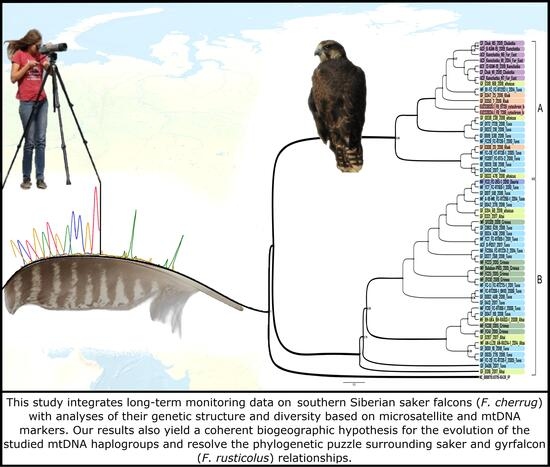
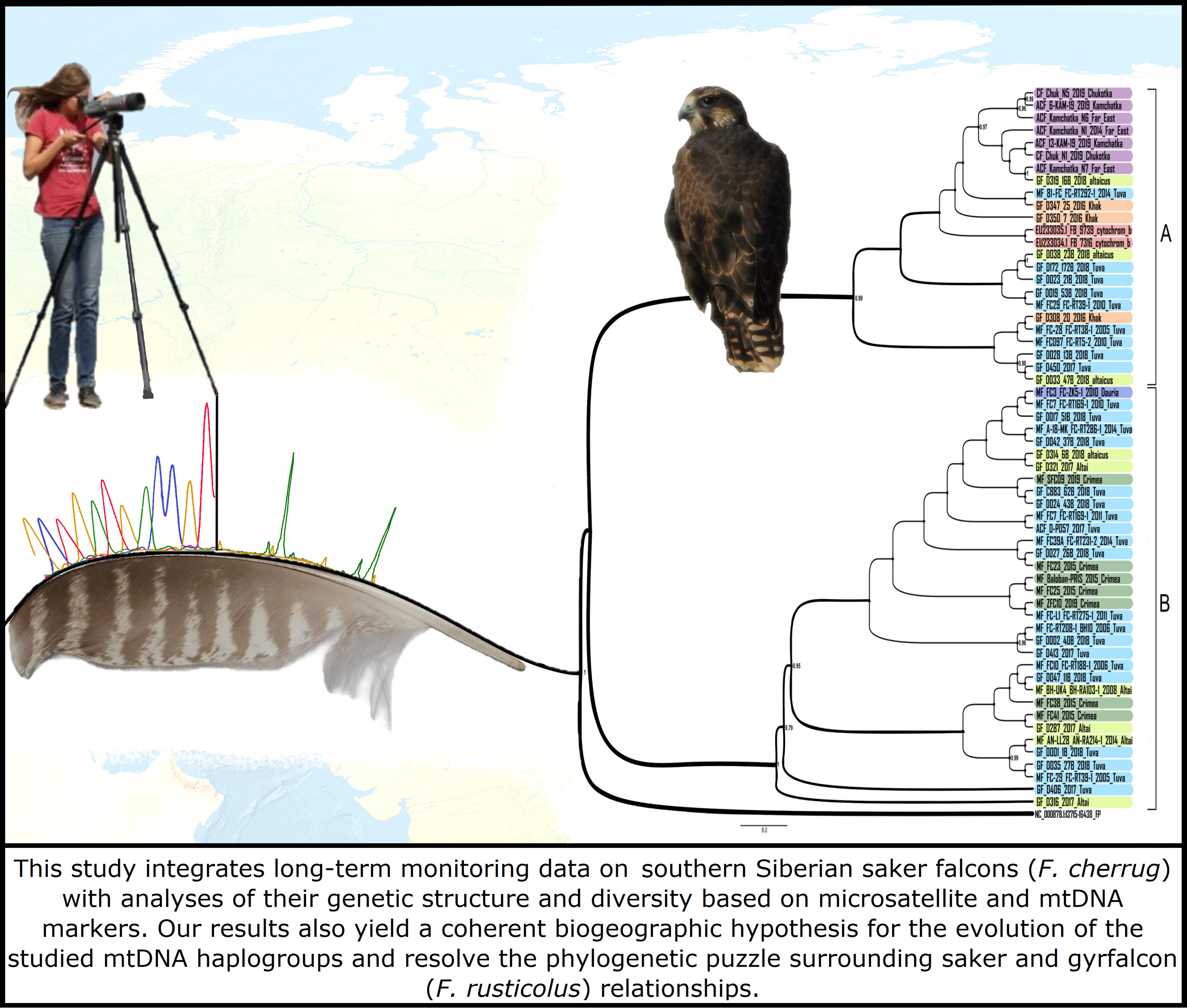
Graphical Abstract

1. Introduction

Intraspecific diversity in recently diverged (i.e., young) species is important for understanding their evolutionary history and underlying patterns of speciation [1]. At the same time, investigating phenotypic and genetic diversity in endangered populations or species is crucial for applied conservation efforts [2].
Here, we focus on the saker falcon, Falco cherrug (Gray, 1834), a young and threatened species. It belongs to the Hierofalco group, which also includes four closely related species: the lanner falcon Falco biarmicus (Temminck, 1825), the laggar falcon Falco jugger (Gray, 1834), the black falcon Falco subniger (Gray, 1843), and the gyrfalcon Falco rusticolus (Linnaeus, 1758) [3]. The saker falcon is classified as an endangered species [4] and protected at both international (e.g., CITES, 1973 [5]) and national (e.g., the Red Data Book of Russia, 2021 [6]) levels. Historically, it was widely distributed from central Europe to the Far East, inhabiting diverse open landscapes that ranged from northern forest-steppes to southern deserts [7]. However, from the mid-20th century onwards, the saker falcon population decreased dramatically due to various anthropogenic factors, particularly their use in falconry [8]. Currently, there are two separate population groups: a western group (in central and eastern Europe) and an eastern group (in Asia, from Turkey and the Aral-Caspian region to Dauria) [9,10,11]. The latter also includes southern Siberia in Russia, where the ranges of different subpopulations of Asian saker falcon overlap (Supplementary Figures S1 and S2) [12].
The subspecies classification of the saker falcon has been revised repeatedly. Ornithologists have proposed multiple subspecies of the saker falcon based on distribution, reproductive behavior, and phenotype [12,13,14,15]. However, only four are currently widely recognized: the nominate F. c. cherrug from the western group, and the three subspecies—F. c. coatsi, hendersoni, and milvipes from the eastern one [16,17]. Meanwhile, the eastern (Asian) saker falcon exhibits more phenotypic and ecological diversity, which has formed the basis for one of the hypotheses concerning the subspecies structure of this species [12]. Nonetheless, during long-term monitoring and conservation measures across southern Siberia and adjacent regions between 1999 and 2021, extensive field data reflecting the dynamics of intraspecific diversity of these understudied populations were collected [18,19,20,21,22,23,24,25,26].
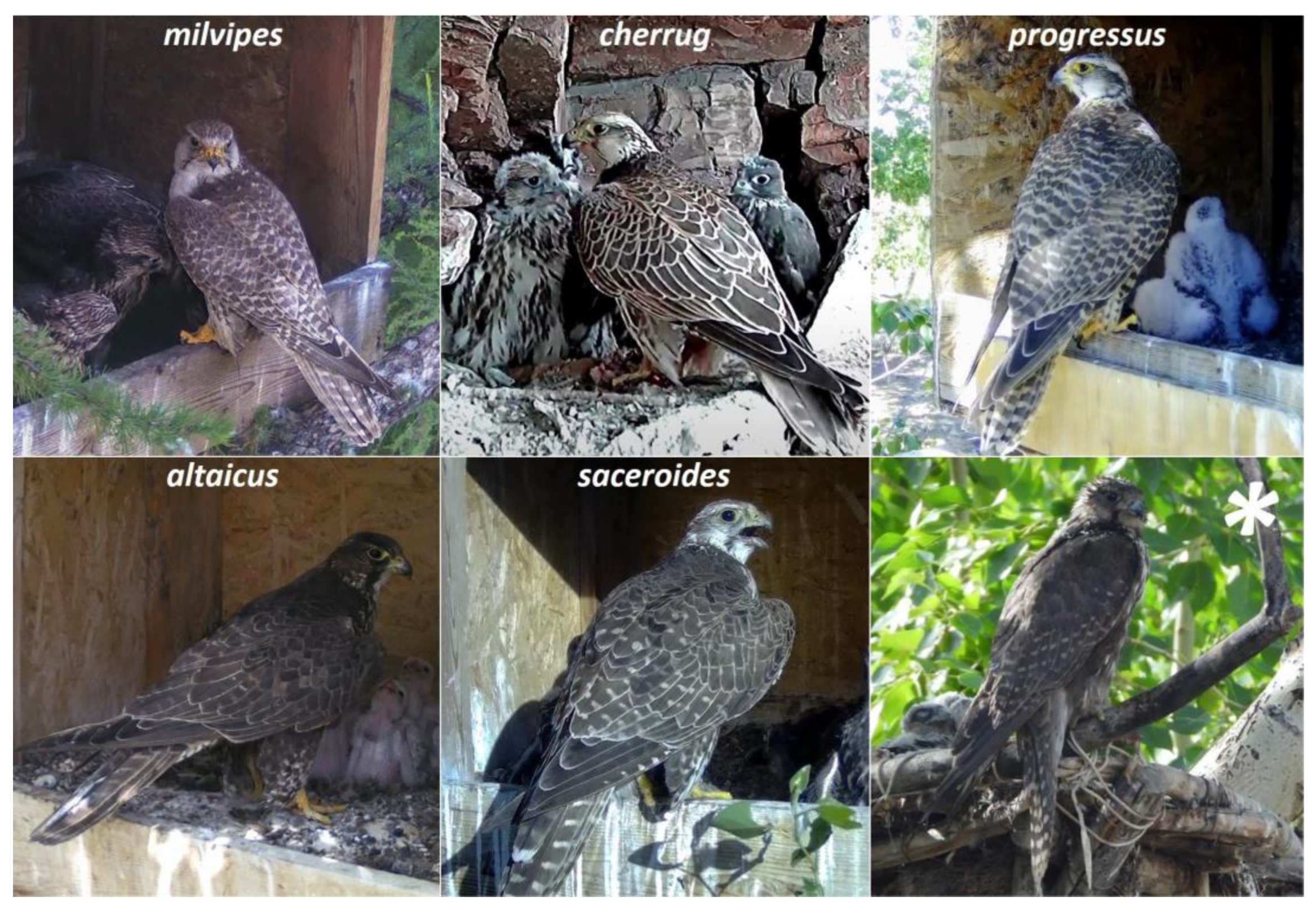
The monitoring dataset showed that, despite evidence of reduced species diversity and declining population sizes since the mid-1990s, these local populations remained demographically viable and maintained a clear subspecific identity until the early 2000s. Based on appearance (specific plumage coloration) and distribution, these populations could be delineated into three phenotypic groups: one phenotypically similar to the western saker falcon F. c. cherrug (hereinafter cherrug), the central Asian F. c. milvipes (hereinafter milvipes), and the Mongolian F. c. progressus (hereinafter progressus). In addition, two distinct geographic morphs—saceroides and altaicus—occurred among them (Figure 1).
However, the subsequent critical population decline, which culminated in 2005–2007, eradicated the pre-existing subspecific structure of southern Siberian populations. Nevertheless, a small population of exclusively cherrug phenotype falcons has persisted on cliffs in the Minusinsky Basin (Karyakin I.V., pers. obs.). In other local populations, the cherrug and altaicus phenotypes have nearly disappeared, while the progressus and saceroides morphs have expanded their distribution, alongside a rise in individuals with intermediate or ambiguous appearance. These shifts were apparently driven by compensatory breeding with individuals from adjacent populations possessing different subspecific identities, against a background of the critically low density or even extinction of many subpopulations [8,12]. With respect to nesting behavior, the dominant pattern among southern Siberian saker falcon populations remains cliff-nesting, though a shift to tree-nesting has occurred in the Tuva Depression [24,26].
Despite the disruption of the native subspecific structure among southern Siberian saker falcons, its traces are likely still detectable in the contemporary molecular-genetic variability of these populations. Moreover, evidence of genetic differentiation has been revealed among recognized subspecies [27] and other Asian populations [28,29], yet the genetic structure of southern Siberian saker falcon populations has not been studied.
Furthermore, the phylogenetic relationships between Asian saker falcon populations and gyrfalcons remain controversial. Analysis of the mitochondrial DNA (mtDNA) cytochrome b gene (cytb) has placed gyrfalcons in a monophyletic group at the base of the saker falcon clade [30]. In contrast, a study of the control region fragment (412 bp, including conservative central domain) has positioned F. rusticolus within the genetic diversity of F. cherrug [31]. Moreover, an analysis of approximately 1540 bp, including a cytb fragment (298 bp) and domains I and II of the control region, has revealed a star-like topology in the parsimony network of gyrfalcon haplotypes [32]. In the mentioned study, the most common gyrfalcon haplotype differed from those of the saker falcons by only a single nucleotide position [32]. Thus, mtDNA analyses have presented conflicting phylogenetic topologies.
Genomic studies have indicated that the gyrfalcon is either the sister [29] or a descendant lineage [33] of the saker falcon. Similarly, microsatellite analyses revealed varying levels of genetic differentiation between the studied species [31,32,34,35,36].
In the present study, we address the historical and contemporary population structure of the saker falcon in southern Siberia and aim to resolve contradictions in its evolutionary relationships with gyrfalcons. To this end, we employ an integrative genetic approach that combines analysis of mitochondrial and nuclear DNA variability.

2. Materials and Methods

2.1. Original Sampling

For this study, we collected various sample types of wild hierofalcons: skin fragments from museum specimens, molted feathers, dry contour feathers, alcohol-preserved contour feathers, and growing feathers preserved in ethanol (Supplementary Table S1). In total, the dataset comprised samples from 215 individuals, including 30 gyrfalcons from the Russian Far East—primarily the Kamchatka Peninsula and Chukotka. Southern Siberian saker falcons from the Khakassia and Tuva populations were particularly well represented, while individuals from other regions—eastern Europe, Dauria, and Altai—were included for comparative purposes (Supplementary Figure S1). The dataset also included four captive-bred saker falcons exhibiting the Altai phenotype (altaicus geographic morph, Figure 1), whose wild ancestors were legally captured in the Altai Mountains during the 1990s [37]. All animal procedures were carried out in accordance with the National Strategy for the Conservation of Biodiversity in Russia [38] and the Guidelines to the Use of Wild Birds in Research [39].

2.2. DNA Extraction

DNA extraction methods varied depending on the type of biological material (Supplementary Table S1) and were performed according to the manufacturer’s protocols (Supplementary Table S2). The quality and approximate concentration of the extracted DNA were assessed using agarose gel (1%) electrophoresis.

2.3. Molecular Analysis

2.3.1. Analysis of Mitochondrial DNA

We designed 23 primers for the amplification and sequencing of overlapping mitochondrial sequences (Supplementary Table S3) using Primer-BLAST [40] and PrimerSelect v11.2.1 (DNASTAR, Inc., Madison, WI, USA).
PCR was performed using the HS Taq kit (Evrogen, Moscow, Russia) on Veriti and SimpliAmp thermal cyclers (Thermo Fisher Scientific, Waltham, MA, USA) according to the following protocol: 5 min denaturation at 95 °C, and 35 cycles of 95 °C for 30 s, 1 min at a locus-specific annealing temperature (Supplementary Table S3), and 1 min 30 s extension at 72 °C, followed by a final extension at 72 °C for 5 min. PCR products were visualized on 2% agarose gels and purified for Sanger sequencing in both directions by ethanol precipitation with ammonium acetate. Sequencing reactions and capillary electrophoresis were performed using the BigDye Terminator v3.1 Cycle Sequencing Kit (Thermo Fisher Scientific, Waltham, MA, USA) on a 3500 Genetic Analyzer (Applied Biosystems, Thermo Fisher Scientific, Waltham, MA, USA), according to the manufacturer’s protocols. All molecular procedures were conducted at the Core Centrum “Genomic Technologies Group“ of the Koltzov Institute of Developmental Biology, Russian Academy of Sciences.
The obtained sequences were assembled, edited, and visually inspected for ambiguities using SeqMan v11.2.1 (DNASTAR, Inc., Madison, WI, USA). Consensus sequences were manually aligned in MEGA X v10.1.7 [41]. In total, we obtained 56 mitochondrial DNA fragments, 21 of which (2595–2920 bp) comprised complete cytochrome b (1143 bp), tRNA-Thr (71 bp), and the control region (up to 1706 bp). Variability analysis of these mitogenome fragments was performed using DnaSP v6.12.03 [42] and MEGA v12.0.14 [43]. An additional 35 samples contained shorter control region fragments (1075–1299 bp), due to natural length variation caused by repetitive elements. All unmodified sequences were deposited in GenBank [44] under accession numbers: PX511647-PX511702.

2.3.2. Phylogenetic Inference

To account for all evolutionary events across lineages—including nucleotide substitutions, insertion-deletion polymorphisms, and variation in the number of repeats in the control region’s third domain—we optimized variability of the original sequences (Supplementary Table S4).
For comparison, we conducted phylogenetic analyses using both modified and original sequences. The latter, comprising 21 mitogenome fragments (from cytb to the control region), were used for (1) the reconstruction of a phylogenetic tree via the Maximum Likelihood (ML) method and the Hasegawa-Kishino-Yano (HKY) [45] model of nucleotide substitution with 161 bootstrap replicates (an adaptive number) using MEGA v12.0.14 [43], and (2) the construction of a haplotype network in PopArt v1.7, which excluded gaps and was based on the integer neighbor-joining method (INJ) (with reticulation set to 0) [46,47]. Additionally, these modified mitogenome fragments were also used to create a median-joining (MJ) haplotype network (epsilon = 0) treating indels as a 5th state, in HaplowebMaker v1.0 [48]. We also performed Bayesian inference (BI) phylogenetic reconstruction using the full set of modified sequences (see the detailed description below).
To enhance the phylogenetic resolution and ensure robust tree rooting, we included two outgroup taxa: (1) F. biarmicus—a basal species relative to F. cherrug and F. rusticolus [33,49], represented by two cytb sequences (GenBank accessions: EU233034.1 and EU233035.1), and (2) the peregrine falcon F. peregrinus—a sister species to the Hierofalco group [30], for which all three target mitochondrial regions were available (mitogenome positions 13715–16438, NC_000878.1). Both outgroup sequences were retrieved from GenBank [44], and the control region sequence of F. peregrinus was additionally modified in accordance with the procedure applied to the original sequences (Supplementary Table S4).
The original set of specimens (see bold entries in Supplementary Table S1) included geographically distinct saker falcon populations: eastern European individuals from the Crimean Peninsula (n = 7) and Asian individuals from Tuva (n = 29), the Altai Mountains (n = 9, including captive-bred altaicus falcons, n = 4), Khakassia (n = 3), and Dauria (n = 1). To address phylogenetic uncertainty, we also included gyrfalcons (n = 7) from the Russian Far East.
The final dataset comprised 59 modified and aligned sequences (56 original and three from outgroup taxa) of varying marker types and lengths: two complete cytb sequences (EU233034.1, EU233035.1), 22 sequences of complete cytb, tRNA-Thr, and modified control regions (including NC_000878.1: 13715–16438), and 35 partial control region sequences. These data were analyzed using a BI framework implemented in BEAST v10.5.0 [50,51]. The dataset was partitioned by “locus” in BEAUti: (1) 24 cytb sequences, (2) 22 tRNA-Thr sequences, and (3) 57 control region sequences: 21 complete ones and 35 partial ones, spanning both the central and second hypervariable domains. The following substitution models were applied: GTR [52] + Gamma distribution (4 categories) for cytb, HKY [45] + Gamma distribution (4 categories) for tRNA-Thr, GTR + Gamma distribution (4 categories) + invariant sites (I = 0.5) for the control region. A relaxed molecular clock model (uncorrelated lognormal distribution) and the Birth-Death incomplete sampling tree prior [53] were used. Some priors and operators were optimized to reflect sequence parameters (Supplementary Table S5). To clarify the phylogenetic history of mitochondrial haplogroups [31], we performed preliminary runs to determine haplotype assignment, resulting in the following partitioning of taxa: haplogroup A (“eastern”), haplogroup B (“western”), and an outgroup (F. peregrinus). The final MCMC run was conducted for 100 million generations with sampling every 10,000 generations. Convergence and effective sample sizes (ESS > 200) were assessed in Tracer v1.7.2 [54], discarding the first 10% of generations as burn-in. A maximum clade credibility (MCC) tree was generated using TreeAnnotator v10.5.0 with a 10% burn-in, a 90% posterior probability limit, mean node heights, and 95% highest posterior density (HPD) intervals. The resulting MCC tree was visualized in FigTree v1.4.4 [55] using the “transform branches proportionally” option.

2.3.3. Microsatellite Loci Analysis

For genotyping saker and gyrfalcon samples, we used ten nuclear microsatellite loci (SSR05, SSR48, SSR53, SSR63, SSR82, SSR11, SSR15, SSR45, SSR57, and SSR73) originally developed and validated for the saker falcon [56]. Multiplex PCR was carried out following the published protocol [56], using fluorescently labeled forward primers (FAM (F), TAMRA (T), or R6G (R)) in two optimized primer panels (A—05 T, 48 R, 53 F, 63 T, 82 R; B—11 F, 15 T, 45 R, 57 T, 73 R). Reactions were performed using the SynTaq DNA polymerase kit (Syntol, Moscow, Russia) with optimized MgCl2 concentration in a GeneExplorer thermal cycler (Bioer, Hangzhou, China). The touchdown PCR protocol comprised: initial denaturation at 94 °C for 15 min; 20 cycles of 94 °C for 30 s, annealing starting at 64 °C and decreasing by 0.5 °C per cycle to a final 54 °C for 90 s, followed by extension at 72 °C for 90 s; then 15 additional cycles at 94 °C for 30 s, 54 °C for 90 s, and 72 °C for 90 s; and a final extension at 72 °C for 10 min. PCR products were separated by capillary electrophoresis using a Nanophor 05 Genetic Analyzer (Syntol, Russia) with SS-450 internal size standard (Syntol, Russia). Fragment sizing was performed using GeneMarker software v3.0.1 (SoftGenetics, State College, PA, USA), with all allele calls manually verified. Any genotyping errors were resolved by re-amplification and re-analysis, or the corresponding data points were excluded from further analysis. All genotyping procedures were conducted using the facilities of the All-Russian Research Institute for Environmental Protection.
For degraded DNA samples (e.g., museum specimens or molted feathers), we retained individuals with successful genotyping at a minimum of 8 out of 10 loci. This yielded a final dataset of 198 individuals: 168 saker falcons and 30 gyrfalcons. To assess genotyping quality by checking for potential stuttering, large allele dropout and null alleles, we used Micro-Checker v2.2.3 [57]. The analysis suggested the possible presence of null alleles in loci SSR48, SSR63, SSR57, SSR45, SSR11, and SSR82. However, we applied the analysis without null allele corrections to avoid overadjustment, considering most incomplete genotypes likely resulted from DNA degradation rather than true null alleles. Since our sampling included siblings (nestlings from the same parent pair), we additionally assessed genotyping accuracy and kinship using Gimlet v1.3.3 [58], confirming reliable allele calls and identifying siblings. The latter were accounted for in further analyses.

2.3.4. Assessment of Population Structure

Although the total sample size was sufficient for analyzing intraspecific diversity, certain populations—notably Daurian (n = 3) and eastern European (n = 15) sakers—were underrepresented due to their rarity or extinction in the wild. The inclusion of historical specimens introduced significant temporal stratification, reflecting pre- and post-decline genetic diversity. In some cases, individuals were separated by over a century, as in eastern European sakers and gyrfalcons (Table 1).
In subsequent analyses, we accounted for both sampling constraints and the recent evolutionary divergence (and consequently weak intraspecific structure) of saker and gyrfalcon populations [3,33].
Based on preliminary runs, we performed Bayesian clustering using STRUCTURE v2.3.4 [59] with an admixture model, correlated allele frequencies, and the LOCPRIOR model with STARTATPOPINFO initialization to improve clustering accuracy [60]. Each run consisted of 150,000 burn-in iterations followed by 1,350,000 MCMC replicates. We tested K values ranging from 1 to 7, with 10 independent replicates per K to assess consistency. The optimal K was determined using the Puechmaille method [61], implemented via the StructureSelector server [62]. Results were visualized with the CLUMPAK server [63] (Supplementary Figure S3).
To cross-validate these results, we conducted Bayesian spatial clustering analysis using Geneland v4.0.6 [64,65] implemented in R 3.6.0 (2019) [66] via RStudio v2024.12.1.563 [67]. The analysis incorporated geographic coordinates with spatial uncertainty parameter [68] and was carried out using an uncorrelated allele frequency model [69] with 1,000,000 MCMC iterations and thinning every 1000 steps. The number of genetic clusters (K) was evaluated from 1 to 5 across 10 independent runs. The final K value was selected based on maximum posterior probability (Supplementary Table S6).
We further performed genetic clustering using Discriminant Analysis of Principal Components (DAPC) in R v4.4.3 (2025) [66] via RStudio v2024.12.1.563 [67] with the adegenet v2.1.10 [70], ggplot2 v3.5.2 [71] and viridis v0.6.5 [72] packages. To avoid sample size bias, we predefined four populations, grouping the Daurian samples (n = 3) with Khakassian samples based on STRUCTURE results. The dataset contained minimal missing data (1.57%). We identified four optimal clusters (Supplementary Figure S4) using find.clusters (based on BIC minimization) across 100 replicates (max K = 15), retained 50 principal components (PCs) that explained >80% of the variance. To avoid overfitting, we retained three discriminant functions and six PCs using optim.a.score (Supplementary Figure S5). Final cluster assignments were compared with predefined populations for downstream interpretation (Supplementary Tables S7 and S8).
Using sampling balanced for DAPC, genetic polymorphism within and among populations was assessed in terms of standard metrics (Supplementary Tables S9–S11) by GenAlex v6.51b2 [73,74,75] and HP-Rare v1.0 [76].

3. Results

3.1. Phylogenetic Analysis

3.1.1. Variability Analysis

To estimate the genetic differentiation among the original 21 mitogenome fragments (comprising 14 F. cherrug and 7 F. rusticolus), with F. peregrinus (NC_000878.1: 13715–16438) as an outgroup, we conducted a preliminary phylogenetic analysis using the ML method (Supplementary Figure S6). This analysis confirmed the presence of two major clades, consistent with previous findings [31], and further identified a well-differentiated subclade comprising all gyrfalcons. To characterize the variability within and between the identified haplogroups, different mtDNA markers, and species, we analyzed the original sequence polymorphisms. Summary statistics for the identified genetic variations are presented in Supplementary Table S12.
In summary, the analysis of the original mitogenome fragments from cytb to the control region yielded the following values for within- and between-haplogroup divergence. Despite similarly low values for the average genetic distance within Clade A (0.00204 ± 0.00051) and Clade B (0.00201 ± 0.00052), both haplogroups exhibited high haplotype diversity (>0.9). The average genetic distance between the studied haplogroups was approximately 0.011, while the distance between these clades and the F. peregrinus outgroup was about 0.04. At the species level, the lowest value (0.0029 ± 0.0008) reflected the differentiation of the gyrfalcon lineage within Clade A.

3.1.2. Haplotype Network Analyses

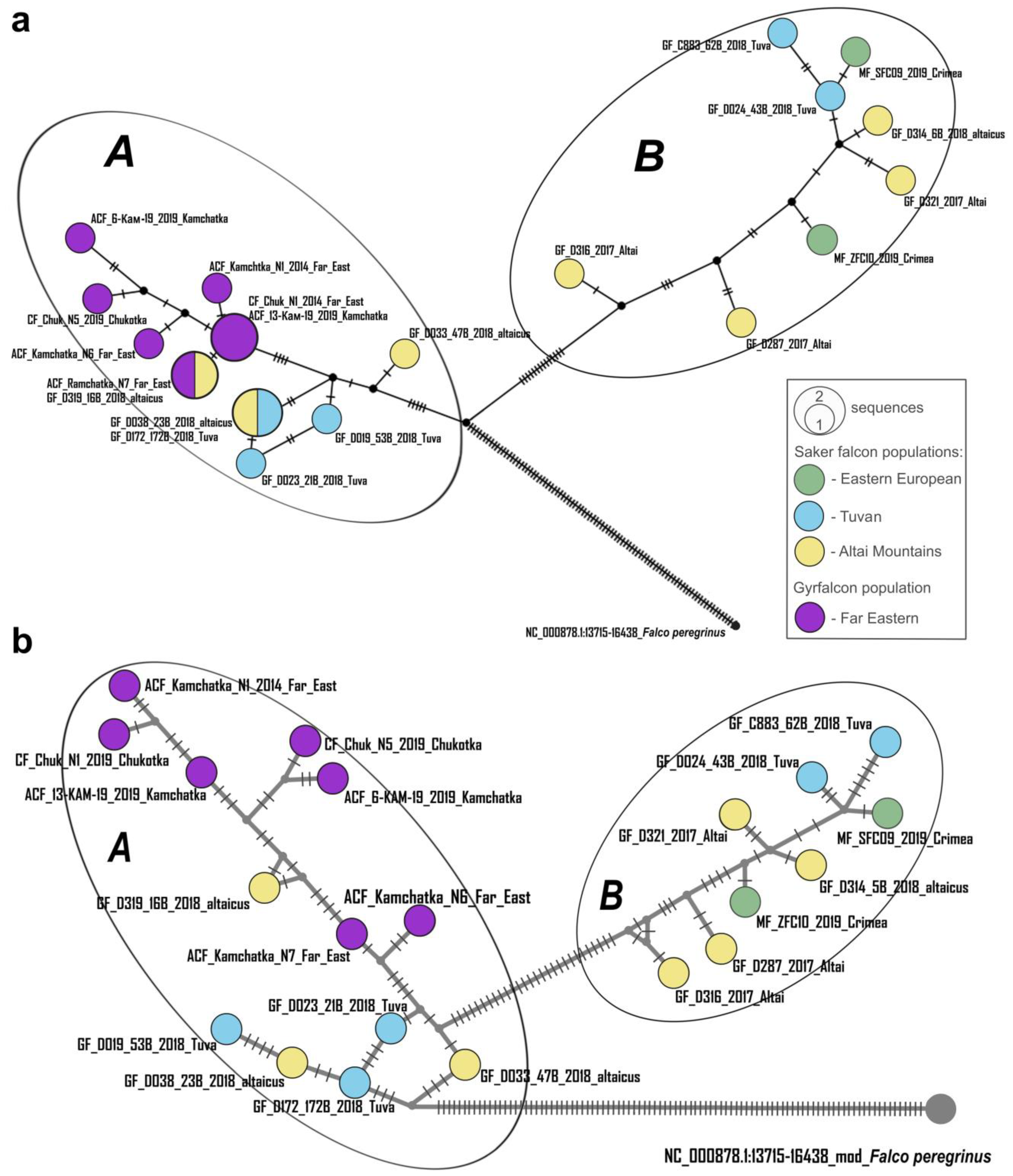
To visualize relationships among the identified haplotypes, we reconstructed haplotype networks using two different approaches to sequence analysis (Figure 2).
The Median-Joining network (Figure 2b) revealed that haplogroup A occupied the ancestral position relative to Clade B and the gyrfalcon subclade and, therefore, was the closest to the outgroup (F. peregrinus). In contrast, phylogenetic relationships within Clade A remained unresolved. Similarly, the Integer Neighbor-Joining network (Figure 2a) indicated that haplogroup A was closer to the common ancestor. However, all haplotypes within this clade shared five synapomorphies, suggesting a period of independent evolution for this lineage following its divergence from the common ancestor.

3.1.3. Bayesian Analysis

To reconstruct the phylogeny of the studied populations while accounting for the different evolutionary rates of mtDNA sequences [77], we conducted a Bayesian inference analysis. This approach, implemented in BEAST v10.5.0, allowed us to use datasets of varying size for different markers. This strategy increased the sampling and accounted for both deeper evolutionary history—using coding sequences (cytb, tRNA-Thr)—and recent divergence events—using non-coding ones (particularly the hypervariable domains of the control region).
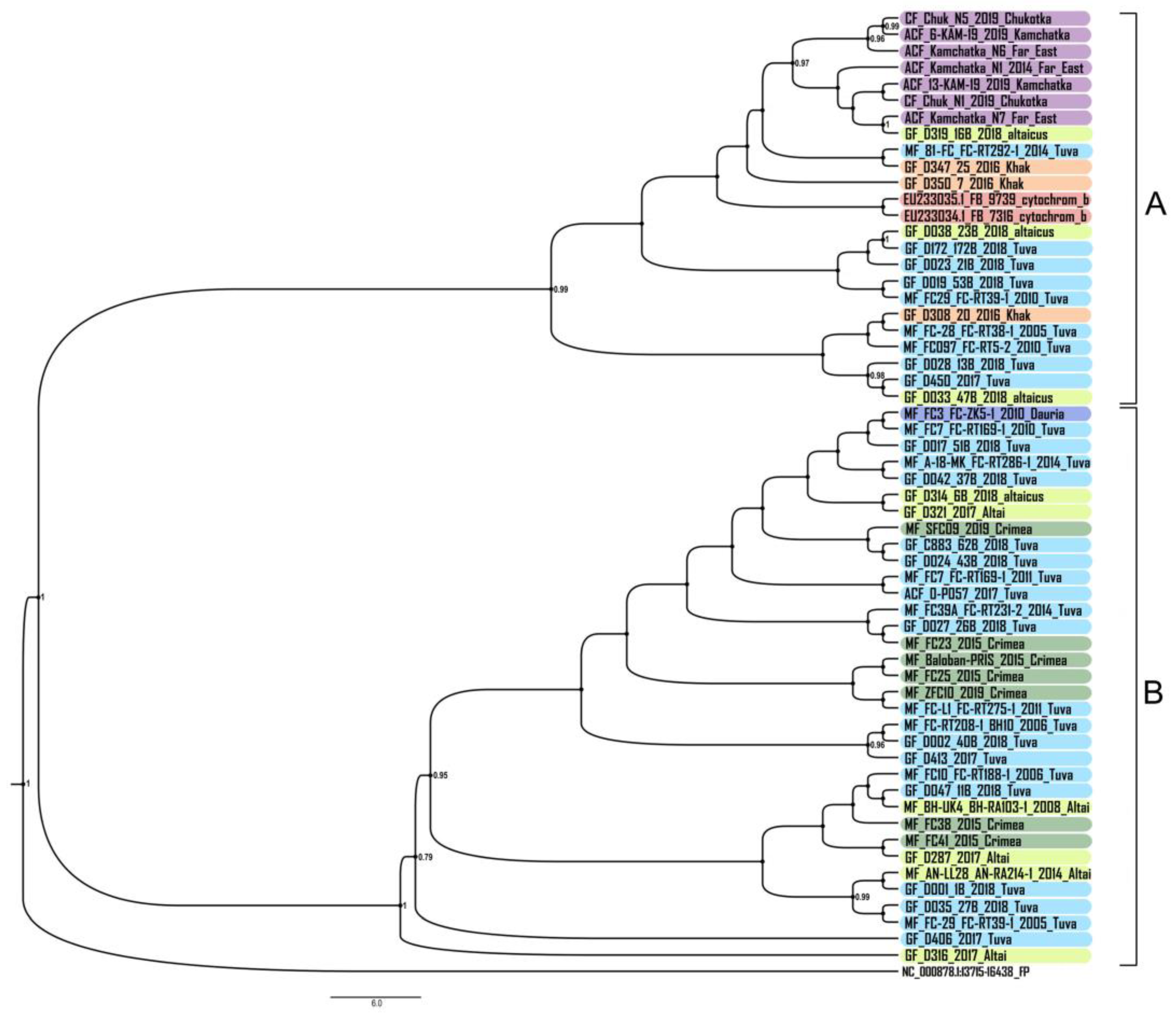
The analysis produced a well-resolved tree (Figure 3) with two main clades (A and B) (PP = 1.0). Clade A (“eastern” haplogroup) included haplotypes of Asian saker falcons from Tuva, the Altai Mountains (including captive-bred altaicus falcons), and all Khakassian individuals. This clade also contained haplotypes of gyrfalcons, forming monophyletic subclades (PP = 0.97), and the branch of the lanner falcon, recognized as the basal species of the Hierofalco group. Notably, one saker falcon haplotype (sample GF_D319_16B_2018_altaicus_AF) clustered within the gyrfalcon subclade.
Clade B (“western” haplogroup) comprised haplotypes of all eastern European saker falcons, a subset of individuals from Tuva and the Altai Mountains, and the single representative from Dauria. Thus, southern Siberian saker falcons possessed haplotypes of both clades, in contrast with Crimean individuals (Clade B) and gyrfalcons (subclade within Clade A).

3.2. Population Structure Analysis

3.2.1. Bayesian Clustering Analyses

To infer the genetic structure of the studied populations (Supplementary Figures S1 and S2), we genotyped ten microsatellites in 198 samples collected from the late 19th century to 2021, including 15 eastern European saker falcons, 153 Asian sakers (with 125 from Tuva, 25 from Khakassia, and 3 from Dauria), and 30 Far Eastern gyrfalcons (Table 1).
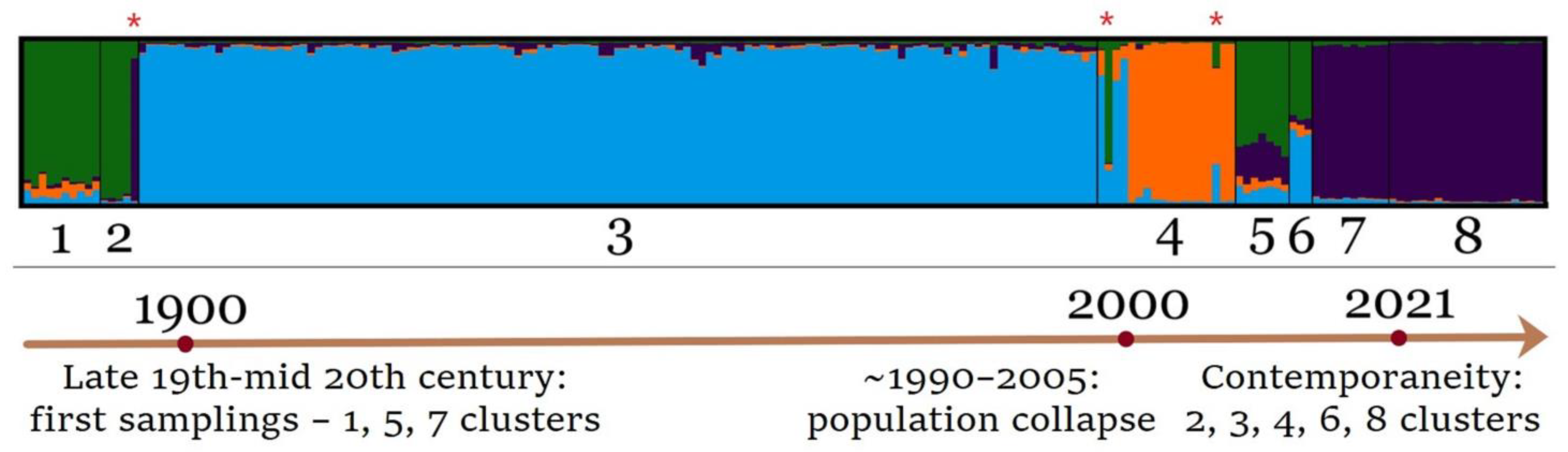
Bayesian clustering in STRUCTURE was performed for eight predefined groups: (1) eastern European saker falcons from extinct populations, (2) contemporary eastern European saker falcons from the Crimean Peninsula, (3) contemporary saker falcons from the post-decline population of Tuva, (4) contemporary saker falcons from Khakassia, including the small cliff-nesting group of exclusively cherrug-phenotype individuals, (5) historical saker falcons from the pre-decline population of Khakassia, (6) Daurian saker falcons, (7) Far Eastern gyrfalcons from historical population, and (8) contemporary Far Eastern gyrfalcons. The Puechmaille method [61] identified K = 4 as the optimal number of genetic clusters (Supplementary Figure S3), and CLUMPP analysis [78] revealed a high mean similarity score (H′ = 0.956), confirming robust and reliable clustering.
The analysis identified distinct genetic clusters (Figure 4) showing strong differentiation (membership probabilities (Qi) ≥ 0.76): (1) eastern European saker falcons (sampling groups “1“ and “2“); (2) Asian saker falcons from Tuva (sampling group “3“); (3) exclusively cherrug-phenotype Asian saker falcons inhabiting Khakassia (part of sampling group “4“); and (4) gyrfalcons (sampling groups “7“ and “8“). In contrast, sampling groups “5“ and “6“ were identified as admixed (Qi ≤ 0.71) [27] (Supplementary Table S7). The former shared significant ancestry from cluster 1 (Qi ranging from 0.57 to 0.71) and cluster 4 (Qi = 0.17–0.30). The latter also showed significant ancestry from cluster 1 (Qi = 0.45–0.48) and cluster 2 (Qi = 0.41–0.46).
Among contemporary saker falcons from the Crimean Peninsula, one individual (MF_ZFC10_2019_Crimea) showed admixture with the gyrfalcon genetic cluster. Contemporary saker falcons from Khakassia clustered with the Tuva birds, except for one individual (MF_AH-09_FC-RH30-1_2014_Khak) which had a significant proportion of eastern European ancestry. A Khakassian cherrug-phenotype individual (GF_D459_FC82_2021_Khak) also showed mixed ancestry from clusters 1 and 2. Admixture was also detected in saker falcons from Dauria and the pre-decline population of Khakassia. Notably, the latter displayed a significant gyrfalcon ancestry.
To cross-validate these results, we applied Bayesian spatial clustering analysis (GENELAND) using geographic coordinates of the studied samples. Despite slight variations in individual assignments, the posterior mode for K converged to the same value (Supplementary Table S6) as identified by the Bayesian clustering analysis.

3.2.2. Multivariate Analysis

To assess genetic clustering without any prior population or spatial information, we performed DAPC (using the “adegenet“ package in R). First, we balanced sampling across four predefined populations, which were used for comparison with cluster assignments (membership probabilities ≥ 0.52) (Supplementary Tables S7 and S8). The obtained sampling dataset was also analyzed to estimate standard genetic metrics of the studied populations (Supplementary Tables S9–S11).
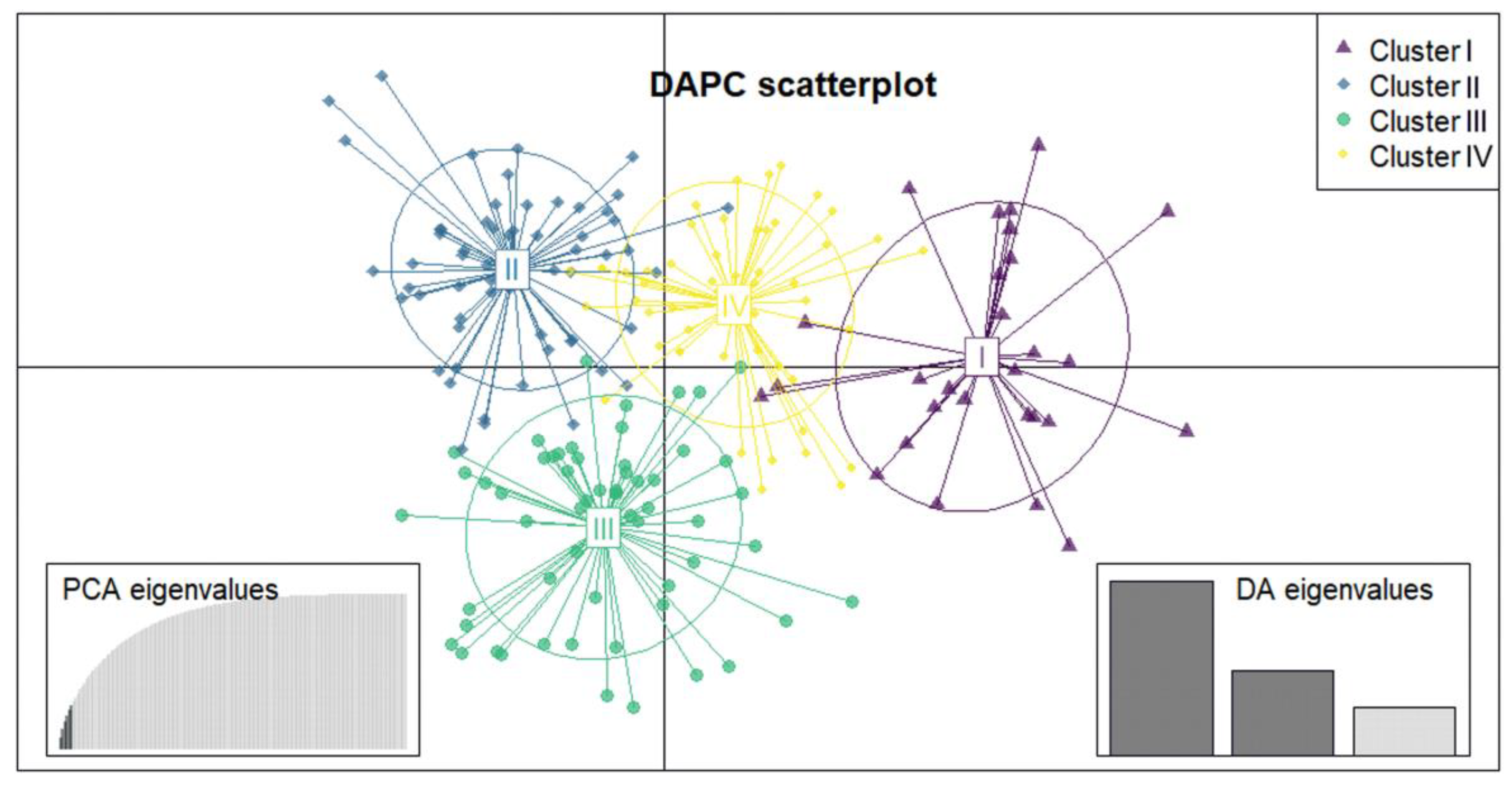
Following optimization (as detailed in Materials and Methods), we retained six principal components to capture the most significant variation and three discriminant eigenvalues to explain inter-group variance. The analysis identified four genetic clusters (Figure 5), representing the following core groups (>50% of predefined populations): (I) gyrfalcons (median (mdn) = 1, membership probabilities range from 0.52 to 1); (II) saker falcons from the eastern European population along with contemporary saker falcons from Khakassia (mdn = 0.98, 0.54–1); and two clusters, (III) (mdn = 0.94, 0.57–1) and (IV) (mdn = 0.95, 0.5–1), that lacked pronounced cores and comprised individuals from all predefined populations (Supplementary Tables S7 and S8).
Clusters I, II, and III were well-separated, while Cluster IV occupied a central position in the genetic space and shared polymorphisms with all other clusters. However, Cluster III showed no overlap in its 95% confidence ellipses, displaying only individual-level overlap. The most significant differentiation was observed between Clusters I and II, with Clusters I and III also exhibiting strong separation. All clusters showed high scattering of individuals from their centroids, leading to individual overlap among Clusters II, III, and IV, as well as between Clusters I and IV. Thus, although Clusters I, II, and III exhibited strong differentiation, they shared notable allelic variation with Cluster IV, with all groups displaying high within-cluster diversity.

4. Discussion

4.1. Pre-Decline Population Structure of Southern Siberian Saker Falcons

To assess the population structure of the saker falcon, as a polytypic species [7], we applied a “phylogeographic subspecies” concept [79] as refined by contemporary methodological approaches [80], integrating geographic, phenotypic, and genetic criteria. A similar approach was validated for the related lanner falcon [81], the basal member of the Hierofalco group [82], with recent support from thorough genetic analysis [83].
A catastrophic and relatively rapid population decline since the mid-20th century fragmented the saker falcon’s range, isolating eastern European populations [84], e.g., on the Crimean Peninsula [85]. Asian populations sustained severe declines until 2008 [20,24], hence both gene flow (particularly between European and Asian populations) and the clinal phenotypic variation [86] have been disrupted.
The long-term monitoring data (1999–2021) of the saker falcon populations across southern Siberia documented these processes, accompanied by shifts in intraspecific diversity [8,12,24,26]. Our perspective on the subspecies affinity among pre-decline populations (see Introduction) found partial support in genetic data. Through species-specific microsatellite [56] analysis of museum specimens (representing demographically stable populations), we detected significant eastern European ancestry in historical Khakassian and Daurian (MS_MO58_R-110648_1988_Dauria) individuals. This suggests pre-decline gene flow likely maintained a “western” genetic component.
Notably, these Asian saker falcon populations predominantly exhibited the cherrug phenotype, resembling that of Western saker falcons [12]. It is now largely restricted to a small cliff-nesting population in the Minusinsky Basin of Khakassia (Karyakin I.V., pers. obs.). Both the historical and contemporary eastern European specimens formed a single genetic cluster, while a comprehensive study of museum collections is required to fully characterize other pre-decline differentiation [87].

4.2. Post-Decline Population Structure of Southern Siberian Saker Falcons

To reveal the structure of the studied saker falcon populations after shifts in intraspecific diversity, we used the aforementioned species-specific set of microsatellite loci [56]. Bayesian analyses of the dataset revealed three distinct clusters: (1) an eastern European population, represented by both historical and contemporary Western saker falcons; (2) contemporary Asian saker falcons from the post-decline population of Tuva; and (3) contemporary Asian saker falcons with the cherrug phenotype from the small population exclusively inhabiting the Minusinsky Basin (Khakassia).
These clusters (Figure 4) likely formed through distinct evolutionary processes: isolation after unidirectional gene flow from eastern European to Asian populations [29] (Cluster 1), demographic collapse and admixture [18,19,20,21,22,23,24] (Cluster 2), and potential prezygotic isolation [88,89,90] (Cluster 3).
STRUCTURE analysis revealed complex ancestry patterns (Figure 4, Supplementary Table S7). While most contemporary Khakassian saker falcons (except Cluster 3) showed predominant Tuvan ancestry, one individual (MF_AH-09_FC-RH30-1_2014_Khak) retained eastern European alleles (Qi = 0.75), reflecting pre-decline diversity. Similar to the museum specimen MS_MO58_R-110648_1988_Dauria, contemporary Daurian individuals exhibited mixed ancestry with contributions from both eastern European and Tuvan populations (Qi ≈ 0.45 for each), indicating historical gene flow. These contributions (eastern European (Qi = 0.16) and Tuvan (Qi = 0.24)) were also found in individual GF_D459_FC82_2021_Khak from Cluster 3. One contemporary Crimean individual (MF_ZFC10_2019_Crimea) showed gyrfalcon-associated alleles (Qi = 0.88), suggesting either recent hybridization (possibly involving escaped captive-bred falcons) or retained ancestral polymorphism.
To confirm the observed genetic differentiation among saker falcons, we performed a multivariate analysis (DAPC), which identified four clusters in total (Supplementary Tables S7 and S8), of which three (I, II, and III) were well-separated. However, Cluster I, comprising the gyrfalcon-specific core, was treated separately in the analysis. Cluster II comprised eastern European and contemporary Khakassian saker falcons, including cherrug phenotype falcons from the Minusinsky Basin. Notably, some individuals from these populations were also present in Cluster III. Clusters III and IV showed substantial admixture, containing individuals from all predefined populations without forming clear population-specific cores (Supplementary Table S8).
Thus, DAPC clustering differed from Bayesian (STRUCTURE) analysis results, underscoring the challenge of delineating young species genetically. Nonetheless, results of both analyses (Supplementary Tables S7 and S8) supported the following findings: (1) shared polymorphisms between eastern European and Khakassian populations resulting from historical gene flow [29] between Western and Asian lineages; (2) a specific core-forming allelic diversity in the contemporary Khakassian population of the cherrug phenotype; (3) significant genetic heterogeneity among southern Siberian saker falcons with evidence of ongoing gene flow between the studied populations; and (4) the mixed post-decline ancestry of the Tuvan population [26]. The population metrics (Supplementary Tables S9–S11) further supported the proposed formation of the discussed clusters, evidenced by low differentiation (FST = 0.015–0.024), a predominance of within-population variance (92%), comparable rarefaction-corrected A’ and Apr diversity, and contrasting inbreeding values for Tuvan (F = 0.002 ± 0.018) and Khakassian with Daurian (F = 0.059 ± 0.037) individuals. While stable pre-decline populations showed signs of incipient subspeciation driven by assortative mating [91], demographic collapse disrupted this differentiation, leaving residual genetic and phenotypic patterns only in small isolated populations, like the Minusinsky Basin cherrug ecotype.

4.3. Phylogeny of Mitochondrial Haplogroups

4.3.1. Data Analyses

Analysis of mtDNA confirmed two haplogroups (Figure 3, Supplementary Figure S6), which is consistent with previous findings [31], and revealed differential variability accumulation [77] between coding and non-coding regions, with the latter evolving ~1.75 times faster (Supplementary Table S12). The “western” haplogroup (Clade B) showed approximately ten percent greater genetic distance from the common ancestor than the “eastern” haplogroup (Clade A). Overall, the average genetic divergence between these clades was approximately four times lower than that observed relative to the sister species outgroup (F. peregrinus), which is consistent with the recent origin of the Hierofalco group [3].
Haplotype network analyses clarified within- and between-haplogroup relationships (Figure 2). The network constructed using the MJ algorithm (Figure 2b) did not fully correspond to the ML-tree topology (Supplementary Figure S6). In contrast, the network created by the INJ method (Figure 2a) was more similar to this character-based topology and revealed five synapomorphic sites, which arose during the divergent evolution of the “eastern” haplogroup. These results can be explained as follows: the MJ algorithm does not always reflect topology accurately [92]. In our case, this discrepancy is probably due to two homoplasies (1430 G/A, and 2374 T/C) in the haplotype GF_D033_47B_2018_altaicus of Clade A, which increased its similarity to F. peregrinus. Both networks indicated a higher number of mutation events from the common ancestor to the “western” haplogroup, supporting differential evolutionary rates (Supplementary Table S12).
Bayesian phylogenetic reconstruction, consistent with prior studies [31,32,82,93], strongly supported two major clades (PP = 1) with well-resolved subclades (PP ≥ 0.79) and placed the gyrfalcon (PP = 0.97) and lanner falcon haplotypes within the mtDNA diversity of Asian saker falcons.

4.3.2. Biogeographic Hypothesis

Our findings indicated the influence of different factors on the evolution [94,95] of the studied mitochondrial haplogroups, reflecting their specific phylogeographic histories. For the “eastern” haplogroup, the lower diversity coupled with a lower mutation rate suggested an origin in a population with large effective size under infrequent large-scale bottlenecks, which provided relatively stable conditions and a reduced impact of genetic drift. Conversely, the higher diversity and mutation rate of the “western” haplogroup indicated its evolution within a population with a small effective size affected by historical narrow bottlenecks and subsequent strong genetic drift. Furthermore, the presence of both mtDNA haplogroups in Asian saker falcon populations contrasts with the single-haplogroup diversity reported in eastern European saker falcons [93] and gyrfalcons [32]. Although our study showed only “eastern” haplotypes in the lanner falcon, the occurrence of both haplogroups has been reported for this basal Hierofalco species [81,83].
These conclusions about the formation of mtDNA haplogroups in the context of the African origin hypothesis of the Hierofalco species group [82] allowed us to propose a coherent biogeographic hypothesis. We propose that the forces shaping these two haplogroups persisted within isolated refugia in Africa during the last interglacial period (~127–116 kya), when a very dense coast-to-coast central African forest formed a barrier to gene flow [96]. We suggest that the “eastern” haplogroup evolved in the relatively stable refugium of southern Africa, while the “western” haplogroup likely originated in the more heterogeneous refugia of East Africa. It cannot be ruled out that this haplotype variability was non-neutral, i.e., that it conferred adaptive benefits to refugial conditions [97]. Subsequent admixture likely occurred during the Last Glacial Maximum (~26–19 kya), as has been reported for other species adapted to arid conditions and open habitats [98]. A similar phylogeographic structure has been reported for other African species such as the common eland and fiscal shrike [99,100]. Interestingly, the current distribution of two F. biarmicus subspecies aligns with this pattern: F. b. biarmicus inhabits southern and eastern Africa, while F. b. abyssinicus is found in Tropical East and West Africa [81].
Regarding the mtDNA diversity of southern Siberia saker falcons, it has been clearly demonstrated that they originated from an eastward expansion from the western population [29]. Furthermore, we obtained mtDNA haplotypes from museum specimens of the pre-declined Crimean and Khakassian populations (not included in the present study), which represent haplotypes from both haplogroups. Therefore, we suppose that the presence of haplotypes from only the “western” haplogroup in the contemporary eastern European population could be the result of a series of bottlenecks, including a catastrophic decline in the last century [84]. In contrast, the Asian saker falcon populations have retained both haplogroups due to their historically large effective population size, broad distribution, and, consequently, the absence of large-scale bottlenecks. In addition, our phylogenetic reconstructions indicate previously underappreciated haplotypic variation within southern Siberia saker falcon populations.

4.4. Resolving the Phylogenetic Puzzle

Combined mtDNA and nuclear microsatellite analyses resolved the controversial saker-gyrfalcon relationships. The Bayesian phylogeny revealed a strongly supported (PP = 0.97), monophyletic gyrfalcon subclade nested within the “eastern” haplogroup, including one altaicus saker haplotype (GF_D319_16B_2018_altaicus_AF). The presence of exclusively “eastern” haplotypes within gyrfalcon diversity confirmed the earlier hypothesis of its origin via a founder effect, which involved a severe loss of genetic diversity [32]. These findings indicated the mtDNA inheritance of gyrfalcons from the Asian saker falcon diversity and corroborated that haplotypes of the studied young species can differ by only a single nucleotide position [32]. The observed phylogenetic ambiguities may reflect either incomplete lineage sorting (ILS) or introgression, processes widespread among recently diverged species, as reported in the northern goshawk Accipiter [gentilis] superspecies [101] and in wagtails of the genus Motacilla [102].
Nuclear microsatellite data independently confirmed strong genetic differentiation between gyrfalcons and saker falcons. Bayesian clustering identified gyrfalcons as a distinct Cluster 4, which also shared ancestry (Qi = 0.17–0.30) with historical Khakassian saker falcons (Figure 4), a pattern likely due to ancestral polymorphisms resulting from ILS. Multivariate analysis revealed a distinct Cluster I (mdn = 1, membership probabilities 0.52–1), primarily comprising the gyrfalcon core (Figure 5, Supplementary Table S8). The lack of broad population structure in gyrfalcons [32] further supports these results, confirming F. rusticolus as a direct daughter species of the Asian saker falcon [33]. This conclusion is supported by our population genetic metrics: gyrfalcons showed low intraspecific diversity (Supplementary Table S9) and the highest differentiation (FST = 0.069) from eastern European saker falcons (Supplementary Table S11).
We propose that the gyrfalcon descended from a saker subgroup adapted to periglacial steppe-tundra. Available data indicate that during the second half of the Late Pleistocene (~40 kya), the Siberian mainland maintained the most stable and favorable climatic conditions for sustaining such communities [103]. The Altai-Sayan region, in particular, constituted a boundary between the European-Siberian and central Asian zoogeographic subregions, with the Minusinsky Basin serving as a key territory due to its high habitat diversity [104].
Consistent with our original hypothesis [33], prezygotic barriers (e.g., prey specialization) [105] may have driven the initial sympatric divergence [106] of an ancestral saker falcon group. The subsequent disappearance of the periglacial tundra–steppe ecotopes in the Holocene, caused by warming and increased humidity [107], likely led to the division of these habitats and the allopatric divergence of the populations that had developed prezygotic isolation mechanisms [108]. This resulted in the steppe-adapted Asian saker falcon and the tundra-adapted gyrfalcon, with highly limited or absent subsequent gene flow [33].

4.5. Conservation Perspectives

Combining mitochondrial and nuclear DNA data proved: mtDNA markers reflected deeper evolutionary events, while microsatellite loci revealed recent demographic patterns. We demonstrated that all ten designed loci [56] are applicable not only to other wild saker falcon populations besides the Mongolian but also to the very closely related gyrfalcon. This set of species-specific markers is therefore highly suitable for forensic efforts aimed at protecting these endangered species.
We conclude that the pre-decline genetic differentiation of saker falcons has largely disappeared. This appears to be due more to the selective removal of individuals (especially females) with specific phenotypes than to a general decrease in the population of Asian saker falcons [24]. Current diversity is merely an “echo” of past variation. Nevertheless, conservation efforts should be prioritized for populations that have retained inherited differentiation. A key example is the cliff-nesting population in the Minusinsky Basin, which exhibits an exclusively cherrug phenotype and retains genetic ancestry from extinct eastern European saker falcons. Additionally, populations where new diversity is emerging, such as the Tuva population under a long-term protection project [25,26], have the potential to become unique speciation units, warranting focused conservation efforts [79].
Our findings, together with previous results [33], clearly demonstrated the gyrfalcon’s genetic differentiation at all levels (mtDNA, microsatellite, and single nucleotide polymorphisms). Taxonomically, we posit that the gyrfalcon is an allopatric incipient species.
We consider it necessary to expand conservation efforts to all local southern Siberian populations, alongside continuing the investigation of their genetic diversity. This approach is more effective for maintaining the species’ overall genetic and phenotypic diversity [80]. In conclusion, fundamental evolutionary studies of Hierofalco species are crucial for identifying their intra- and interspecific diversity as well as for the implementation of targeted protection measures.

5. Conclusions

This study, for the first time, integrates long-term monitoring data on phenotypic, ecological, behavioral, and distributional traits with analyses of the genetic structure and diversity of southern Siberian saker falcons. Additionally, it resolves ambiguities in saker-gyrfalcon phylogenetic relationships by analysing different types of DNA.
We applied an integrative genetic approach to analyse both deep (by coding and non-coding mtDNA fragments) and more recent (by microsatellite loci) evolutionary events [77]. Future analyses of mtDNA are needed to test its potential adaptive role [97] in Hierofalco evolution, while broader genomic studies could reveal “genomic islands“ associated with phenotypic trait differentiation [109] and other genomic variation under selection [29] related to ongoing adaptation [110].
Our work underscores the importance of non-invasive sampling (e.g., moulted feathers) during monitoring activities, as has been reported previously [56,111]. Furthermore, utilizing museum collections for research on young and endangered species remains invaluable [31,112] for reconstructing the pre-decline population structure of Asian saker falcons.
The revealed pre- and post-decline differentiation among the studied populations reinforces the need for their conservation as well as the importance of rare species research in near “real-time“ in the wild. Further annual monitoring of the local populations combined with genetic studies is essential for the effective conservation [79] of the young and endangered saker falcon.

Supplementary Materials

The following supporting information can be downloaded at https://www.mdpi.com/article/10.3390/d18010050/s1. Figure S1: Sampling localities; Figure S2: Sampling localities of saker falcons from southern Siberia; Table S1: Sample details; Table S2: DNA extraction methods; Table S3: Set of primers designed for mitochondrial DNA amplification; Table S4: Implemented modifications of two hypervariable repeat regions of the control region; Table S5: Optimized BEAUti parameter settings; Figure S3: Estimation of optimal K using the Puechmaille method implemented in the StructureSelector server; Table S6: Estimated posterior probabilities for numbers of genetic clusters (K) across 10 independent Geneland runs; Figure S4: BIC-based cluster estimation (find.clusters, adegenet) in R v4.4.3 with visualization in RStudio v2024.12.1.563; Figure S5: Estimation of the optimal number of PCs (optim.a.score, adegenet) in R v4.4.3 with visualization in RStudio v2024.12.1.563; Table S7: Cross-validation of STRUCTURE and DAPC outputs; Table S8: Summary of individual assignments from predefined populations (prior information) to DAPC clusters; Figure S6: Maximum Likelihood phylogenetic tree based on the original 21 mitochondrial DNA sequences; Table S9: Summary of intrapopulation genetic diversity metrics across ten microsatellite loci for the studied populations; Table S10: Results of the analysis of molecular variance (AMOVA); Table S11: Pairwise population differentiation (FST); Table S12: Summary statistics of genetic variability across 22 mitochondrial DNA sequences, covering the region from cytb to the control region (CR).

Author Contributions

Conceptualization, D.N.R., L.S.Z. and A.M.K.; Methodology, D.N.R. and L.S.Z.; Validation: D.N.R., L.S.Z. and S.Y.S.; Formal Analysis, D.N.R. and V.G.T.; Investigation, D.N.R. and L.S.Z.; Resources, D.N.R., L.S.Z., E.P.S., I.V.K. and A.M.K.; Writing—Original Draft Preparation, D.N.R.; Writing—Review and Editing, D.N.R., L.S.Z., V.G.T., A.V.B., E.P.S., I.V.K., S.Y.S., O.E.L. and A.M.K.; Visualization, D.N.R., E.P.S., I.V.K., V.G.T. and A.V.B.; Project Administration, D.N.R., Funding Acquisition, L.S.Z. and A.M.K. All authors have read and agreed to the published version of the manuscript.

Funding

The work of D.N.R., L.S.Z., V.G.T., A.V.B., S.Y.S., O.E.L. and A.M.K. was conducted under the IDB RAS Government basic research program in 2025 No. 0088-2024-0011. The work of L.S.Z. was conducted under All-Russian Research Institute for Environmental Protection Government basic research program No. 051-00139-24-02. The fieldwork was carried out within the framework of the Russian Raptor Research and Conservation Network program for the conservation of the Saker Falcon, with the support of Sibecocenter LLC and funds from the “World Around You” Foundation of the Siberian Wellness Corporation, Rufford Foundation, Global Greengrants Fund, Earth Island Institute, Alliance “Ecodelo” and Herman Ottó Institute.

Institutional Review Board Statement

The animal study protocol was approved by the Ethics Committee for Animal Research of the Koltzov Institute of Developmental Biology, Russian Academy of Sciences (approval No. 96, dated 11 September 2025).

Data Availability Statement

The original data presented in the study are openly available in at accession number PX511647-PX511702. The microsatellite genotype dataset is available in the Supplementary Materials File S1.

Acknowledgments

We thank the Core Centre “Genomic Technologies Group“ of the Koltzov Institute of Developmental Biology RAS for providing equipment. We express our deep gratitude to the “World Around You” Foundation of the Siberian Wellness Corporation for financial support of the field work; to the staff of the State Nature Reserve “Khakasskiy” for their assistance with fieldwork in the Republic of Khakassia; to the team of the State Nature Reserve “Ubsunurskaya Kotlovina” for their help with research in the Republic of Tuva; and to the team of the “Saylugem” National Park for their support during fieldwork in the Altai Republic. We sincerely thank the staff of various organizations who contributed to the implementation of the saker falcon conservation program in the Altai-Sayan region, namely Oleg Andreenkov, Natalya Andreenkova, Diinmei Balban-ool, Irina Beme, Robert Kazi, Vladislav Kanzai, Aleksandr Kuksin, Denis Malikov, Alexander Milezhik, Alexander Mokerov, Viktor Nepomnyaschiy, Elvira Nikolenko, Viktor Plotnikov, Matyas Prommer, Eugene Sarychev, Oleg Shiryaev, Erkin Tadyrov, and Viktoria Shurkina, for their comprehensive assistance and participation in expeditions. We would also like to thank all volunteers who participated in the fieldwork from 2015 to 2021, namely Olga Zaitseva, Sofia Bogatyrenko, Snezhana Barykina, Maxim Zasulevitch, Dmitry Shtol, Kristina Petrova, and Anastasia Fedorovskaya, as well as all others who contributed to this work but are not mentioned here. We are grateful to all expedition participants over the years for collecting molted feathers and to the staff of the Zoological Museum for their assistance in collecting museum specimens. We acknowledge the staff of the «Biodiversity» laboratory of the All-Russian Research Institute of Ecology, in particular Alexander G. Sorokin and Dmitry S. Dorofeev for providing samples, and Mikhail I. Ilyin for his contribution to obtaining the raw microsatellite data. Finally, we are indebted to all who assisted with the manuscript, including Nina A. Kim and others.

Conflicts of Interest

Authors Elena Pavlovna Shnayder and Igor Vyacheslavovich Karyakin were employed by Sibecocenter LLC. All authors declare that the research was conducted in the absence of any commercial or financial relationships that could be construed as a potential conflict of interest.

References

  1. Ronce, O. Geographic Variation, Population Structure, and Migration. In The Princeton Guide to Evolution; Losos, J.B., Ed.; Princeton University Press: Princeton, NJ, USA, 2014; pp. 321–327. [Google Scholar]
  2. Shaffer, B. Evolution and Conservation. In The Princeton Guide to Evolution; Losos, J.B., Ed.; Princeton University Press: Princeton, NJ, USA, 2014; pp. 766–773. [Google Scholar]
  3. Fuchs, J.; Johnson, J.A.; Mindell, D.P. Rapid diversification of falcons (Aves: Falconidae) due to expansion of open habitats in the Late Miocene. Mol. Phylogenetics Evol. 2015, 82, 166–182. [Google Scholar] [CrossRef] [PubMed]
  4. BirdLife International.  Falco cherrug. In The IUCN Red List of Threatened Species; BirdLife International: Cambridge, UK, 2021. [Google Scholar] [CrossRef]
  5. Convention on International Trade in Endangered Species of Wild Fauna and Flora; CITES Secretariat: Geneva, Switzerland; Available online: https://cites.org/sites/default/files/eng/disc/CITES-Convention-EN.pdf (accessed on 12 May 2025).
  6. Red Book of the Russian Federation, volume Animals, 2nd ed.; Vseross. Nauchno-Issled. Inst. Ekol.: Moscow, Russia, 2021; 1128p.
  7. Kovács, A.; Williams, N.P.; Galbraith, C.A. Saker Falcon Falco cherrug Global Action Plan (SakerGAP), Including a Management and Monitoring System, to Conserve the Species; CMS Raptors MoU Coordinating Unit: Abu Dhabi, United Arab Emirates, 2014. [Google Scholar]
  8. Nikolenko, E.G.; Karyakin, I.V.; Levin, A.S. Root causes of the decreasing in numbers of the saker falcon and ways of its decision within the saker falcon Global Action Plan in Russia and Kazakhstan. Raptors Conserv. 2014, 29, 18–38. [Google Scholar] [CrossRef]
  9. Karyakin, I.V.; Nikolenko, E.G.; Shnayder, E.P. Current status of the saker falcon in Russia and Kazakhstan. Raptors Conserv. 2023, S2, 450–458. [Google Scholar] [CrossRef]
  10. Convention on Migratory Species (CMS). Governance and Management Module for the Saker Falcon (Falco cherrug) Adaptive Management Framework [Annex to STF13/3]. Available online: https://www.cms.int/lions/sites/default/files/document/STF13_3_Annex1_GovernanceManagement_Module_23052024/ (accessed on 12 May 2025).
  11. Prommer, M.; Bagyura, L.; Chavko, J.; Škorpíková, V.; Milobog, Y.; Zink, R.; Kmetova-Biro, E.; Ajder, V.; Gavrilyuk, M.; Nagy, A.; et al. Beyond borders: A decade of change in Europe’s Saker Falcon (Falco cherrug Gray, 1834) population (2012–2022). Ornis Hung 2025, 33, 26–48. [Google Scholar] [CrossRef]
  12. Karyakin, I.V. Subspecies population structure of the saker falcon range. Raptors Conserv. 2011, 21, 116–171. [Google Scholar]
  13. Sushkin, P.P. Birds of the Soviet Altai and Adjacent Parts of Northwestern Mongolia, Volume 1; USSR Academy of Sciences: Moscow-Leningrad, Russia, 1938; 316p. [Google Scholar]
  14. Dementiev, G. Birds of the Soviet Union, Volume 1; Sovetskaya Nauka: Moscow, Russia, 1951; pp. 70–341. [Google Scholar]
  15. Pfeffer, R. About geographic variances of the saker falcon. Raptors Conserv. 2009, 16, 68–95. [Google Scholar]
  16. Clements, J.F.; Rasmussen, P.C.; Schulenberg, T.S.; Iliff, M.J.; Fredericks, T.A.; Gerbracht, J.A.; Lepage, D.; Spencer, A.; Billerman, S.M.; Sullivan, B.L.; et al. The eBird/Clements Checklist of Birds of the World: V2024. Available online: https://www.birds.cornell.edu/clementschecklist/download/ (accessed on 15 May 2025).
  17. Gill, F.; Donsker, D.; Rasmussen, P. (Eds.) IOC World Bird List (v15.1). Available online: https://www.worldbirdnames.org/new/ioc-lists/master-list-2/ (accessed on 15 May 2025).
  18. Karyakin, I.; Konovalov, L.; Moshkin, A.; Pazhenkov, A.; Smelyanskiy, I.; Rybenko, A. Saker falcon (Falco cherrug) in Russia. Falco 2004, 23, 3–9. [Google Scholar]
  19. Karyakin, I.V. Saker falcon in the Altai-Sayan Region: Results of monitoring during last seven years. Steppe Bull. 2006, 20, 54–60. [Google Scholar]
  20. Karyakin, I.V.; Nikolenko, E.G. Monitoring results on the saker falcon population in the Altai-Sayan Region in 2008, Russia. Raptors Conserv. 2008, 14, 63–84. [Google Scholar]
  21. Karyakin, I.V.; Nikolenko, E.G.; Vazhov, S.V.; Mitrofanov, O.B. Results of monitoring of the saker falcon population in the Altai-Sayan region in 2009–2010. Raptors Conserv. 2010, 19, 136–151. [Google Scholar]
  22. Karyakin, I.V.; Nikolenko, E.G. Results of monitoring of the saker falcon population in the Altai-Sayan region in 2011, Russia. Raptors Conserv. 2011, 23, 152–167. [Google Scholar]
  23. Karyakin, I.V.; Nikolenko, E.G.; Shnayder, E.P. Results of monitoring of the saker falcon population in the Altai-Sayan region in 2014, Russia. Raptors Conserv. 2014, 29, 58–76. [Google Scholar] [CrossRef]
  24. Karyakin, I.V.; Nikolenko, E.G.; Shnayder, E.P. Saker falcon in the Altai-Sayan Region: Results of monitoring in 2016–2018. Raptor Conserv. 2018, 37, 95–165. [Google Scholar] [CrossRef]
  25. Shnayder, E.P.; Nikolenko, E.G.; Karyakin, I.V.; Prommer, M.; Sarychev, E.I.; Rozhkova, D.N.; Zinevich, L.S. The results implementation of a foster parents adoption method for restoration of the saker falcon population in Russia (with the results of GPS/GSM tracking of fledglings). Raptors Conserv. 2018, 37, 66–94. [Google Scholar] [CrossRef]
  26. Karyakin, I.V.; Nikolenko, E.G.; Shnayder, E.P.; Shiriaev, O.V. Artificial nests for the saker falcon in mountainous steppes of southern Siberia—Platforms or nestboxes? Raptors Conserv. 2022, 44, 68–95. [Google Scholar] [CrossRef]
  27. Petrov, R.; Yarkov, D.; Chakarov, N. Genetic analysis of saker falcon (Falco cherrug) subspecies. Biodivers. Data J. 2024, 12, e116889. [Google Scholar] [CrossRef] [PubMed]
  28. Pan, S.; Zhang, T.; Rong, Z.; Hu, L.; Gu, Z.; Wu, Q.; Dong, S.; Liu, Q.; Lin, Z.; Deutschova, L.; et al. Population transcriptomes reveal synergistic responses of DNA polymorphism and RNA expression to extreme environments on the Qinghai-Tibetan Plateau in a predatory bird. Mol. Ecol. 2017, 26, 2993–3010. [Google Scholar] [CrossRef] [PubMed]
  29. Hu, L.; Long, J.; Lin, Y.; Gu, Z.; Su, H.; Dong, X.; Zhenzhen Lin, Z.; Xiao, Q.; Batbayar, N.; Bold, B.; et al. Arctic introgression and chromatin regulation facilitated rapid Qinghai-Tibet Plateau colonization by an avian predator. Nat. Commun. 2022, 13, 6413, Erratum in Nat. Commun. 2022, 13, 7409. https://doi.org/10.1038/s41467-022-35205-5.. [Google Scholar] [CrossRef] [PubMed]
  30. Wink, M.; Sauer-Gürth, H.; Ellis, D.; Kenward, R. Phylogenetic relationships in the Hierofalco complex (saker-, gyr-, lanner-, laggar falcon). In Raptors Worldwide; Chancellor, R.D., Meyburg, B.U., Eds.; MME/WWGBP: Budapest, Hungary; Berlin, Germany, 2004; pp. 499–504. [Google Scholar]
  31. Nittinger, F.; Gamauf, A.; Pinsker, W.; Wink, M.; Haring, E. Phylogeography and population structure of the saker falcon (Falco cherrug) and the influence of hybridization: Mitochondrial and microsatellite data. Mol. Ecol. 2007, 16, 1497–1517. [Google Scholar] [CrossRef]
  32. Johnson, J.A.; Burnham, K.K.; Burnham, W.A.; Mindell, D.P. Genetic structure among continental and island populations of gyrfalcons. Mol. Ecol. 2007, 16, 3145–3160. [Google Scholar] [CrossRef]
  33. Zinevich, L.; Prommer, M.; Laczkó, L.; Rozhkova, D.; Sorokin, A.; Karyakin, I.; Bagyura, J.; Cserkész, T.; Sramkó, G. Phylogenomic insights into the polyphyletic nature of Altai falcons within eastern sakers (Falco cherrug) and the origins of gyrfalcons (Falco rusticolus). Sci. Rep. 2023, 13, 17800. [Google Scholar] [CrossRef]
  34. Dawnay, N.; McEwing, R.; Thorpe, R.S.; Ogden, R. Preliminary data suggests genetic distinctiveness of gyr and saker falcons. Conserv. Genet. 2008, 9, 703–707. [Google Scholar] [CrossRef]
  35. Dawnay, N.; Ogden, R.; Wetton, J.H.; Thorpe, R.S.; McEwing, R. Genetic data from 28 STR loci for forensic individual identification and parentage analyses in 6 bird of prey species. Forensic Sci. Int. Genet. 2009, 3, 63–69. [Google Scholar] [CrossRef]
  36. Belokon, M.M.; Belokon, Y.S.; Nechaeva, A.V.; Sylvestrov, N.A.; Sarychev, E.I.; Beme, I.R. Genetic identification and relationship analysis of captive breeding falcons. Russ. J. Genet. 2022, 58, 705–717. [Google Scholar] [CrossRef]
  37. Karyakin, I.V.; Zinevich, L.S.; Rozhkova, D.N.; Nikolenko, E.G.; Shnayder, E.P.; Sarychev, E.I.; Beme, I.R. The first results of the project on restoration of genetic diversity of the saker falcon populations in the Altai-Sayan region, Russia. Raptors Conserv. 2017, 35, 176–192. [Google Scholar] [CrossRef]
  38. National Strategy for the Conservation of Biodiversity in Russia. Available online: https://www.cbd.int/doc/world/ru/ru-nbsap-01-p1-en.pdf (accessed on 20 January 2025).
  39. Fair, J.; Paul, E.; Jones, J. (Eds.) Guidelines to the Use of Wild Birds in Research; Ornithological Council: Washington, DC, USA, 2010; Available online: https://birdnet.org/wp-content/uploads/2022/09/guidelines_august2010.pdf (accessed on 20 January 2025).
  40. Ye, J.; Coulouris, G.; Zaretskaya, I.; Cutcutache, I.; Rozen, S.; Madden, T.L. Primer-BLAST: A tool to design target-specific primers for polymerase chain reaction. BMC Bioinform. 2012, 13, 134. [Google Scholar] [CrossRef]
  41. Kumar, S.; Stecher, G.; Li, M.; Knyaz, C.; Tamura, K. MEGA X: Molecular Evolutionary Genetics Analysis across computing platforms. Mol. Biol. Evol. 2018, 35, 1547–1549. [Google Scholar] [CrossRef] [PubMed]
  42. Rozas, J.; Ferrer-Mata, A.; Sánchez-DelBarrio, J.C.; Guirao-Rico, S.; Librado, P.; Ramos-Onsins, S.E.; Sánchez-Gracia, A. DnaSP 6: DNA sequence polymorphism analysis of large data sets. Mol. Biol. Evol. 2017, 34, 3299–3302. [Google Scholar] [CrossRef] [PubMed]
  43. Kumar, S.; Stecher, G.; Suleski, M.; Sanderford, M.; Sharma, S.; Tamura, K. MEGA12: Molecular Evolutionary Genetic Analysis version 12 for adaptive and green computing. Mol. Biol. Evol. 2024, 41, msae263. [Google Scholar] [CrossRef] [PubMed]
  44. Benson, D.A.; Cavanaugh, M.; Clark, K.; Karsch-Mizrachi, I.; Lipman, D.J.; Ostell, J.; Sayers, E.W. GenBank. Nucleic Acids Res. 2012, 41, D36–D42. [Google Scholar] [CrossRef]
  45. Hasegawa, M.; Kishino, H.; Yano, T. Dating the human-ape split by a molecular clock of mitochondrial DNA. J. Mol. Evol. 1985, 22, 160–174. [Google Scholar] [CrossRef]
  46. Bandelt, H.J.; Forster, P.; Röhl, A. Median-joining networks for inferring intraspecific phylogenies. Mol. Biol. Evol. 1999, 16, 37–48. [Google Scholar] [CrossRef]
  47. Leigh, J.W.; Bryant, D. PopART: Full-feature software for haplotype network construction. Meth. Ecol. Evol. 2015, 6, 1110–1116. [Google Scholar] [CrossRef]
  48. Spöri, Y.; Flot, J.-F. HaplowebMaker and CoMa: Two web tools to delimit species using haplowebs and conspecificity matrices. Meth. Ecol. Evol. 2020, 11, 1434–1438. [Google Scholar] [CrossRef]
  49. Wilcox, J.J.S.; Arca-Ruibal, B.; Samour, J.; Mateuta, V.; Idaghdour, Y.; Boissinot, S. Linked-read sequencing of eight falcons reveals a unique genomic architecture in flux. Genome Biol. Evol. 2022, 14, evac090. [Google Scholar] [CrossRef]
  50. Drummond, A.J.; Rambaut, A. BEAST: Bayesian evolutionary analysis by sampling trees. BMC Evol. Biol. 2007, 7, 214. [Google Scholar] [CrossRef] [PubMed]
  51. Suchard, M.A.; Lemey, P.; Baele, G.; Ayres, D.L.; Drummond, A.J.; Rambaut, A. Bayesian phylogenetic and phylodynamic data integration using BEAST 1.10. Virus Evol. 2018, 4, vey016. [Google Scholar] [CrossRef]
  52. Tavaré, S. Some probabilistic and statistical problems in the analysis of DNA sequences. In Lectures on Mathematics in the Life Sciences; Miura, R.M., Ed.; American Mathematical Society: Providence, RI, USA, 1986; Volume 17, pp. 57–86. [Google Scholar]
  53. Stadler, T. On incomplete sampling under birth-death models and connections to the sampling-based coalescent. J. Theor. Biol. 2009, 261, 58–66. [Google Scholar] [CrossRef]
  54. Rambaut, A.; Drummond, A.J.; Xie, D.; Baele, G.; Suchard, M.A. Posterior summarization in Bayesian phylogenetics using Tracer 1.7. Syst. Biol. 2018, 67, 901–904. [Google Scholar] [CrossRef]
  55. Rambaut, A. FigTree, version 1.4.4; University of Edinburgh: Edinburgh, UK, 2018; Available online: http://tree.bio.ed.ac.uk/software/figtree/ (accessed on 7 March 2025).
  56. Hou, X.; Xu, P.; Lin, Z.; D’urban-Jackson, J.; Dixon, A.; Bold, B.; Xu, J.; Zhan, X. Integrated tool for microsatellite isolation and validation from the reference genome and their application in the study of breeding turnover in an endangered avian population. Integr. Zool. 2018, 13, 553–568. [Google Scholar] [CrossRef]
  57. Van Oosterhout, C.; Hutchinson, W.F.; Wills, D.P.M.; Shipley, P. MICRO-CHECKER: Software for identifying and correcting genotyping errors in microsatellite data. Mol. Ecol. Notes 2004, 4, 535–538. [Google Scholar] [CrossRef]
  58. Valière, N. Gimlet: A computer program for analysing genetic individual identification data. Mol. Ecol. Notes 2002, 2, 377–379. [Google Scholar] [CrossRef]
  59. Pritchard, J.K.; Stephens, M.; Donnelly, P. Inference of population structure using multilocus genotype data. Genetics 2000, 155, 945–959. [Google Scholar] [CrossRef] [PubMed]
  60. Hubisz, M.J.; Falush, D.; Stephens, M.; Pritchard, J.K. Inferring weak population structure with the assistance of sample group information. Mol. Ecol. Resour. 2009, 9, 1322–1332. [Google Scholar] [CrossRef]
  61. Puechmaille, S.J. The program structure does not reliably recover the correct population structure when sampling is uneven: Subsampling and new estimators alleviate the problem. Mol. Ecol. Resour. 2016, 16, 608–627. [Google Scholar] [CrossRef] [PubMed]
  62. Li, Y.L.; Liu, J.X. StructureSelector: A web based software to select and visualize the optimal number of clusters using multiple methods. Mol. Ecol. Resour. 2018, 18, 176–177. [Google Scholar] [CrossRef] [PubMed]
  63. Kopelman, N.M.; Mayzel, J.; Jakobsson, M.; Rosenberg, N.A.; Mayrose, I. CLUMPAK: A program for identifying clustering modes and packaging population structure inferences across K. Mol. Ecol. Resour. 2015, 15, 1179–1191. [Google Scholar] [CrossRef]
  64. Guillot, G.; Mortier, F.; Estoup, A. Geneland: A computer package for landscape genetics. Mol. Ecol. Notes 2005, 5, 708–711. [Google Scholar] [CrossRef]
  65. Guillot, G.; Renaud, S.; Ledevin, R.; Michaux, J.; Claude, J. A unifying model for the analysis of phenotypic, genetic and geographic data. Syst. Biol. 2012, 61, 897–911. [Google Scholar] [CrossRef]
  66. R Core Team. R: A Language and Environment for Statistical Computing; R Foundation for Statistical Computing: Vienna, Austria, 2025; Available online: https://www.R-project.org/ (accessed on 10 February 2025).
  67. Posit Team. RStudio: Integrated Development Environment for R; Posit Software; PBC: Boston, MA, USA, 2025; Available online: http://www.posit.co/ (accessed on 10 February 2025).
  68. Guillot, G. On the inference of spatial structure from population genetics data. Bioinformatics 2009, 25, 1796–1801. [Google Scholar] [CrossRef]
  69. Guillot, G. Inference of structure in subdivided populations at low levels of genetic differentiation: The correlated allele frequencies model revisited. Bioinformatics 2008, 24, 2222–2228. [Google Scholar] [CrossRef] [PubMed]
  70. Jombart, T. adegenet: A R package for the multivariate analysis of genetic markers. Bioinformatics 2008, 24, 1403–1405. [Google Scholar] [CrossRef]
  71. Wickham, H. ggplot2: Elegant Graphics for Data Analysis, 2nd ed.; Springer: New York, NY, USA, 2016; p. 260. [Google Scholar]
  72. Garnier, S.; Ross, N.; Rudis, R.; Camargo, P.A.; Sciaini, M.; Scherer, C. Viridis (Lite): Colorblind-Friendly Color Maps for R, version 0.6.5. 2024. Available online: https://sjmgarnier.github.io/viridis/index.html (accessed on 13 February 2025).
  73. Peakall, R.; Smouse, P.E. GENALEX 6: Genetic analysis in Excel. Population genetic software for teaching and research. Mol. Ecol. Notes 2006, 6, 288–295. [Google Scholar] [CrossRef]
  74. Peakall, R.; Smouse, P.E. GenAlEx 6.5: Genetic analysis in Excel. Population genetic software for teaching and research—An update. Bioinformatics 2012, 28, 2537–2539. [Google Scholar] [CrossRef]
  75. Smouse, P.E.; Banks, S.C.; Peakall, R. Converting quadratic entropy to diversity: Both animals and alleles are diverse, but some are more diverse than others. PLoS ONE 2017, 12, e0185499. [Google Scholar] [CrossRef]
  76. Kalinowski, S.T. HP-Rare: A computer program for performing rarefaction on measures of allelic diversity. Mol. Ecol. Notes 2005, 5, 187–189. [Google Scholar] [CrossRef]
  77. Wan, Q.H.; Wu, H.; Fujihara, T.; Fang, S.G. Which genetic marker for which conservation genetics issue? Electrophoresis 2004, 25, 2165–2176. [Google Scholar] [CrossRef]
  78. Jakobsson, M.; Rosenberg, N.A. CLUMPP: A cluster matching and permutation program for dealing with label switching and multimodality in analysis of population structure. Bioinformatics 2007, 23, 1801–1806. [Google Scholar] [CrossRef] [PubMed]
  79. O’Brien, S.J.; Mayr, E. Bureaucratic mischief: Recognizing endangered species and subspecies. Science 1991, 251, 1187–1188. [Google Scholar] [CrossRef]
  80. Dufresnes, C.; Poyarkov, N.; Jablonski, D. Acknowledging more biodiversity without more species. Proc. Natl. Acad. Sci. USA 2023, 120, e2302424120. [Google Scholar] [CrossRef]
  81. Leonardi, G. The Lanner Falcon, 2nd ed.; Giovanni Leonardi (privately published): Catania, Italy, 2017; 324p. [Google Scholar]
  82. Nittinger, F.; Haring, E.; Pinsker, W.; Wink, M.; Gamauf, A. Out of Africa? Phylogenetic relationships between Falco biarmicus and the other hierofalcons (Aves: Falconidae). J. Zool. Syst. Evol. Res. 2005, 43, 321–331. [Google Scholar] [CrossRef]
  83. Attili, L.; Garofalo, L.; Puddu, G.; Tirone, G.; Pizzarelli, A.; Barbara, N.; Haring, E.; Lorenzini, R. Genetic distinctiveness of an endangered falcon: Implications for conservation in Europe. PLoS ONE 2023, 18, e0295424. [Google Scholar] [CrossRef]
  84. Galushin, V.M. Conservation of the saker falcon and other large falcons in Russia. In Yearbook: Birds of Prey and Owls in Zoos and Breeding Stations, Issue 14; Moscow Zoo: Moscow, Russia, 2005; pp. 9–22. [Google Scholar]
  85. Karyakin, I.V.; Nikolenko, E.G. Saker falcon on the Crimean peninsula. Raptors Conserv. 2015, 31, 103–129. [Google Scholar] [CrossRef]
  86. Vaurie, C. Systematic Notes on Palearctic Birds. No. 45, Falconidae, the Genus Falco (Part 2); American Museum of Natural History: New York, NY, USA, 1961; 24p. [Google Scholar]
  87. Furness, L.H.; Kersten, O.; Boilard, A.; Keith-Diagne, L.; Brito, C.; Barrett, J.H.; Kitchener, A.; Sabin, R.; Lavery, S.; Plön, S.; et al. Population structure of Dugong dugon across the Indo-Pacific revealed by historical mitogenomes. R. Soc. Open Sci. 2024, 11, 240599. [Google Scholar] [CrossRef]
  88. Edwards, S.V.; Kingan, S.B.; Calkins, J.D.; Balakrishnan, C.N.; Jennings, W.B.; Swanson, W.J.; Sorenson, M.D. Speciation in birds: Genes, geography, and sexual selection. Proc. Natl. Acad. Sci. USA 2005, 102, 6550–6557. [Google Scholar] [CrossRef] [PubMed]
  89. Kryukov, A.P.; Goroshko, O.A.; Arkhipov, V.Y.; Red’kin, Y.A.; Lee, S.; Dorda, B.A.; Kryukov, K.A.; Kapun, M.; Haring, E. Introgression at the emerging secondary contact zone of magpie Pica pica subspecies (Aves: Corvidae): Integrating data on nuclear and mitochondrial markers, vocalizations, and field observations. Org. Divers. Evol. 2022, 22, 1037–1064. [Google Scholar] [CrossRef]
  90. Tambovtseva, V.G.; Samusenok, V.P.; Yur’ev, A.L.; Korostelev, N.B.; Khlystov, V.S.; Matveev, A.N.; Alekseyev, S.S. Contrasting levels of sympatric divergence within lacustrine Arctic charr Salvelinus alpinus forms flock: High differentiation between size forms, low differentiation between seasonal races. Hydrobiologia 2025, 852, 3523–3540. [Google Scholar] [CrossRef]
  91. Poelstra, J.W.; Vijay, N.; Bossu, C.M.; Lantz, H.; Ryll, B.; Müller, I.; Baglione, V.; Unneberg, P.; Wikelski, M.; Grabherr, M.G.; et al. The genomic landscape underlying phenotypic integrity in the face of gene flow in crows. Science 2014, 344, 1410–1414. [Google Scholar] [CrossRef] [PubMed]
  92. Kong, S.; Sánchez-Pacheco, S.J.; Murphy, R. Median-Joining Networks and Bayesian phylogenies often do not tell the same story. Bull. Soc. Syst. Biol. 2023, 2, 1–13. [Google Scholar] [CrossRef]
  93. Rozhkova, D.N.; Zinevich, L.S.; Karyakin, I.V.; Sorokin, A.G.; Tambovtseva, V.G.; Kulikov, A.M. Non-neutral cytochrome b variability in the saker Falco cherrug Grey, 1834 and gyrfalcon Falco rusticolus L. Russ. J. Genet. 2021, 57, 468–476. [Google Scholar] [CrossRef]
  94. Nei, M.; Maruyama, T.; Chakraborty, R. The bottleneck effect and genetic variability in populations. Evolution 1975, 29, 1–10. [Google Scholar] [CrossRef] [PubMed]
  95. Yamaguchi, R.; Kubo, H.; Ogawa, T.; Omura, H. Speciation through the lens of population dynamics: A theoretical primer on how small and large populations diverge. Popul. Ecol. 2026, 68, e70008. [Google Scholar] [CrossRef]
  96. Cowling, S.A.; Cox, P.M.; Jones, C.D.; Maslin, M.A.; Peros, M.; Spall, S.A. Simulated glacial and interglacial vegetation across Africa: Implications for species phylogenies and trans-African migration of plants and animals. Glob. Change Biol. 2008, 14, 827–840. [Google Scholar] [CrossRef]
  97. Boratyński, Z.; Melo-Ferreira, J.; Alves, P.; Berto, S.; Koskela, E.; Pentikäinen, O.T.; Tarroso, P.; Ylilauri, M.; Mappes, T. Molecular and ecological signs of mitochondrial adaptation: Consequences for introgression? Heredity 2014, 113, 277–286. [Google Scholar] [CrossRef]
  98. Congrains, C.; Carvalho, A.F.; Miranda, E.A.; Cumming, G.S.; Henry, D.A.; Manu, S.A.; Abalaka, J.; Rocha, C.D.; Diop, M.S.; Sá, J.; et al. Genetic and paleomodelling evidence of the population expansion of the cattle egret Bubulcus ibis in Africa during the climatic oscillations of the Late Pleistocene. J. Avian Biol. 2016, 47, 846–857. [Google Scholar] [CrossRef]
  99. Lorenzen, E.D.; Masembe, C.; Arctander, P.; Siegismund, H.R. A long-standing Pleistocene refugium in southern Africa and a mosaic of refugia in East Africa: Insights from mtDNA and the common eland antelope. J. Biogeogr. 2010, 37, 571–581. [Google Scholar] [CrossRef]
  100. Fuchs, J.; Crowe, T.M.; Bowie, R.C.K. Phylogeography of the fiscal shrike (Lanius collaris): A novel pattern of genetic structure across the arid zones and savannas of Africa. J. Biogeogr. 2011, 38, 2210–2222. [Google Scholar] [CrossRef]
  101. Kunz, F.; Gamauf, A.; Zachos, F.E.; Haring, E. Mitochondrial phylogenetics of the goshawk Accipiter [gentilis] superspecies. J. Zool. Syst. Evol. Res. 2019, 57, 942–958. [Google Scholar] [CrossRef]
  102. Harris, R.B.; Alström, P.; Ödeen, A.; Leaché, A.D. Discordance between genomic divergence and phenotypic variation in a rapidly evolving avian genus (Motacilla). Mol. Phylogenetics Evol. 2018, 120, 183–195. [Google Scholar] [CrossRef] [PubMed]
  103. Astakhov, V. The postglacial Pleistocene of the northern Russian mainland. Quat. Sci. Rev. 2014, 92, 388–408. [Google Scholar] [CrossRef]
  104. Malikov, D.G. Zoogeographical features of mammoth fauna of the south of Siberia. Tomsk. State Univ. J. 2015, 398, 233–242. [Google Scholar] [CrossRef]
  105. Potapov, E.; Sale, R. The Gyrfalcon; Yale University Press: New Haven, CT, USA, 2005; 288p. [Google Scholar]
  106. Tobias, J.A.; Ottenburghs, J.; Pigot, A.L. Avian diversity: Speciation, Macroevolution, and Ecological function. Annu. Rev. Ecol. Evol. Syst. 2020, 51, 533–560. [Google Scholar] [CrossRef]
  107. Dupal, T.A.; Andrenko, O.V.; Vinogradov, V.V. Mammals of the periglacial hyperzone of the end of the Pleistocene and formation of the modern rodent fauna in the mountains of western and middle Siberia. Contemp. Probl. Ecol. 2013, 6, 94–104. [Google Scholar] [CrossRef]
  108. König, K.; Zundel, P.; Krimmer, E.; König, C.; Pollmann, M.; Gottlieb, Y.; Steidle, J.L.M. Reproductive isolation due to prezygotic isolation and postzygotic cytoplasmic incompatibility in parasitoid wasps. Ecol. Evol. 2019, 9, 10694–10706. [Google Scholar] [CrossRef]
  109. Hejase, H.A.; Salman-Minkov, A.; Campagna, L.; Hubisz, M.J.; Lovette, I.J.; Gronau, I.; Siepel, A. Genomic islands of differentiation in a rapid avian radiation have been driven by recent selective sweeps. Proc. Natl. Acad. Sci. USA 2020, 117, 30554–30565. [Google Scholar] [CrossRef] [PubMed]
  110. Jones, M.R.; Mills, L.S.; Alves, P.C.; Callahan, C.M.; Alves, J.M.; Lafferty, D.J.R.; Jiggins, F.M.; Jensen, J.D.; Melo-Ferreira, J.; Good, J.M. Adaptive introgression underlies polymorphic seasonal camouflage in snowshoe hares. Science 2018, 360, 1355–1358. [Google Scholar] [CrossRef] [PubMed]
  111. Horváth, M.B.; Martínez-Cruz, B.; Negro, J.J.; Kalmár, L.; Godoy, J.A. An overlooked DNA source for non-invasive genetic analysis in birds. J. Avian Biol. 2005, 36, 84–88. [Google Scholar] [CrossRef]
  112. Burrell, A.S.; Disotell, T.R.; Bergey, C.M. The use of museum specimens with high-throughput DNA sequencers. J. Hum. Evol. 2015, 79, 35–44. [Google Scholar] [CrossRef]
Figure 1. Phenotypic variation in saker falcons. The image marked with an asterisk (*) depicts an intermediate/ambiguous phenotype and was photographed by Daria Rozhkova. The remaining photos were taken from camera traps installed on nests.
Diversity 18 00050 g001
Figure 2. Haplotype networks based on 21 original and modified as well as one reference (NC_000878.1:13715–16438, F. peregrinus) mitogenome fragments (2595–2920 bp). (a) Network constructed from original sequences using the INJ method in PopArt v1.7, which excluded indels from the analysis. (b) Network constructed from modified sequences (see Materials and Methods) using the MJ algorithm in HaplowebMaker v1.0, treating indels as a fifth character state. Circles are scaled proportionally to the number of individuals and represent haplotypes. Evolutionary events are indicated by dashes. Haplogroups A and B (delineated by ellipses) correspond to clades identified in the ML phylogenetic tree (Supplementary Figure S6).
Diversity 18 00050 g002
Figure 3. Bayesian phylogenetic tree based on 59 mitochondrial sequences (partitioned by “locus”). Branch lengths were proportionally transformed for optimal visualization. Posterior probability values are indicated at nodes (≥0.79). Clades (A and B) are labeled by square brackets. The color codes are: white, peregrine falcon; light red, lanner falcons; light purple, gyrfalcons; light blue, saker falcons (SF) from Tuva; light green, eastern European SF; yellow, SF from the Altai Mountains; orange, SF from Khakassia; and dark purple, SF from Dauria.
Diversity 18 00050 g003
Figure 4. STRUCTURE bar plot for K = 4. Color-coding of identified clusters is as follows: eastern European saker falcons (green), saker falcons from Tuva (blue), the small cliff-nesting group of exclusively cherrug-phenotype birds from Khakassia (orange), and gyrfalcons (purple). Each vertical bar represents an individual, showing cluster membership proportions. Predefined populations (Supplementary Table S7) are separated by black lines and labeled (1–8) below (see the text above). Admixed individuals are marked by asterisks. Below the bar plot, the studied time intervals and sample representation from the respective populations (Table 1) are displayed.
Diversity 18 00050 g004
Figure 5. DAPC scatterplot visualizing genetic variation across clusters. Cluster color codes and symbols are shown in the legend (top right). The 95% confidence intervals around centroids are represented by ellipses. Principal component analysis (PCA) eigenvalues (bottom left) indicate the number of retained principal components and their proportion of explained variance. Discriminant analysis (DA) eigenvalues (bottom right) show the relative importance of discriminant functions in cluster separation.
Diversity 18 00050 g005
Table 1. Sampling details, grouped by population and time period.
No.SpeciesPopulationTotal Samples (n)Samples (n) per Time Period (Years)
1F. cherrugEastern European1510 (1910–1938)
5 (2015, 2019)
2F. cherrugKhakassian257 (1966, 1968)
18 (2014–2021)
3F. cherrugTuvan1252005–2021
4F. cherrugDaurian31 (1988)
2 (2010)
5F. rusticolusFar Eastern3010 (late 19th century-1973)
20 (2006–2019)
Disclaimer/Publisher’s Note: The statements, opinions and data contained in all publications are solely those of the individual author(s) and contributor(s) and not of MDPI and/or the editor(s). MDPI and/or the editor(s) disclaim responsibility for any injury to people or property resulting from any ideas, methods, instructions or products referred to in the content.