1. Introduction
Podocnemididae is one of the three lineages of pleurodiran turtles that contribute to the extant biodiversity [
1,
2]. Its modern geographical distribution range is restricted to the Southern Hemisphere, with its greatest diversity located in northern South America, and a single species in Madagascar [
3]. Although Podocnemididae do not currently inhabit continental Africa, their record is abundant and diverse for the Paleogene of that continent [
4,
5,
6]. In fact, podocnemidids reached Europe via Africa, thanks to the rise in global temperatures as a consequence of the Paleocene-Eocene Thermal Maximum, which facilitated the dispersal of this lineage of turtles to the northern hemisphere [
1,
7,
8]. European podocnemidids were thus relatively abundant throughout the Eocene [
9,
10], and were especially well represented by the freshwater form
Neochelys [
11,
12,
13]. The oldest species described for this genus is the French early Ypresian (earliest Eocene, MP7)
Neochelys arenarum [
14]. Seven other species are recognized in the Eocene record of several European countries [
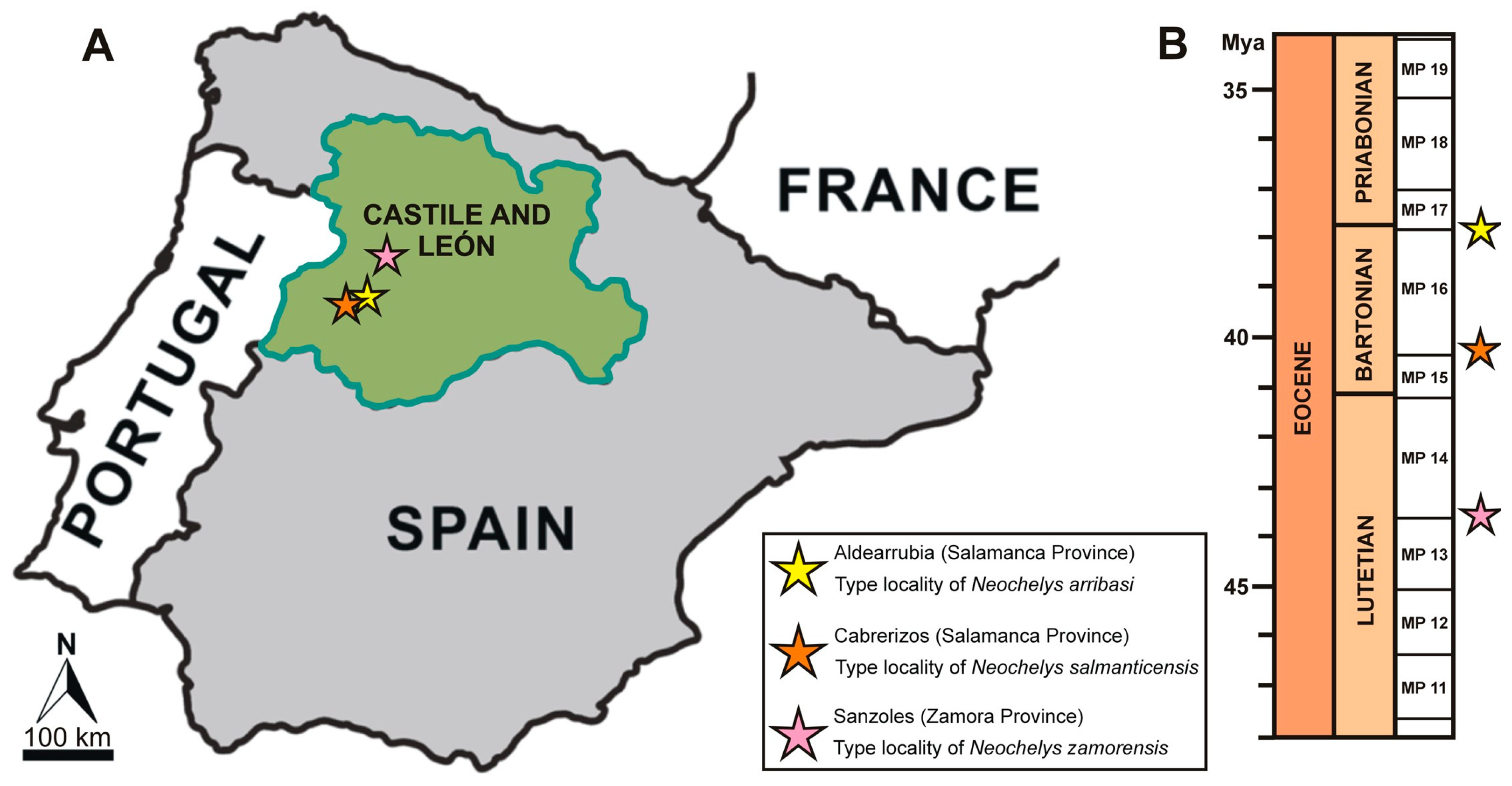
15]. The youngest are two Spanish representatives, from the Duero Basin (northwestern Spain,
Figure 1): the Lutetian (MP 13 or MP 14, middle Eocene)
Neochelys zamorensis and the Bartonian (MP 15 or MP 16, middle Eocene)
Neochelys salmanticensis (see [
16]; and references therein).
Shell remains of podocnemidid turtles have been identified in younger levels of the Duero Basin than those in which
Neochelys salmanticensis is recognized (see [
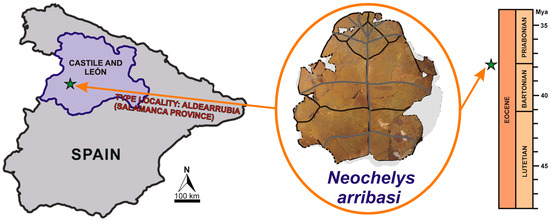
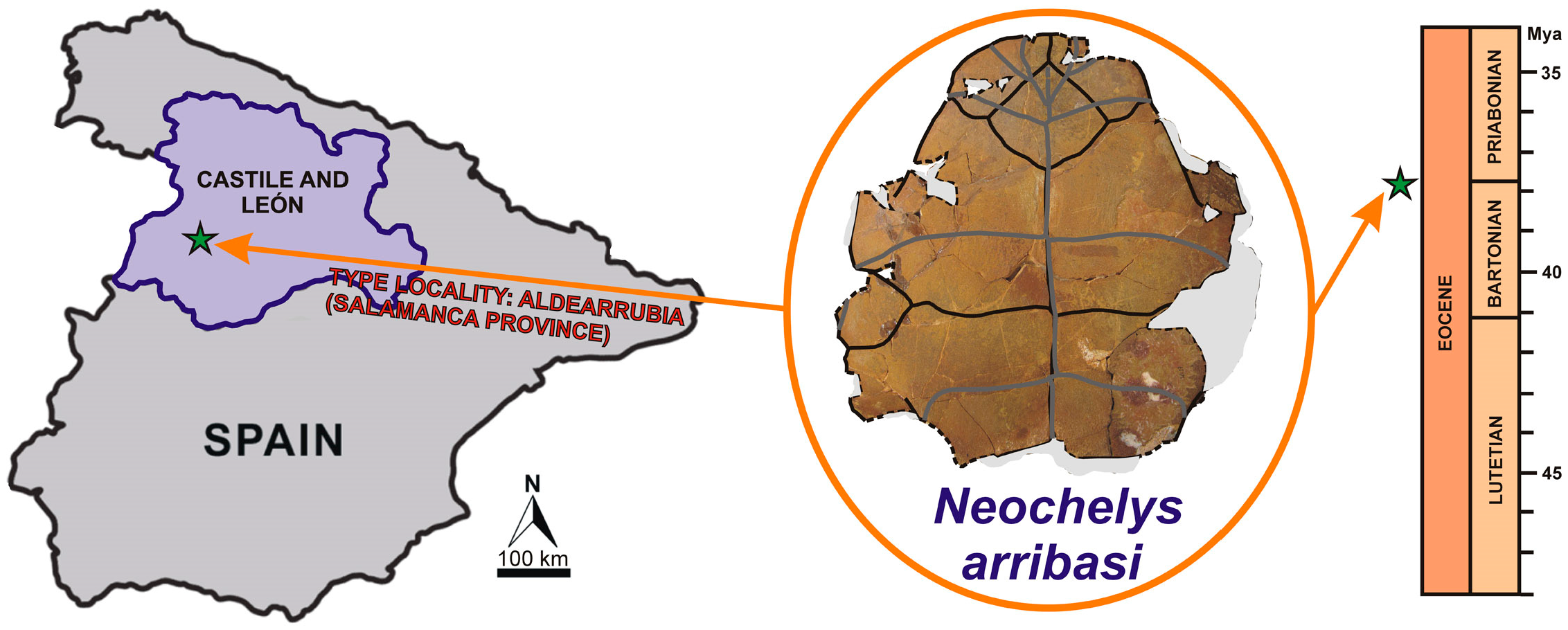
16]). Accordingly, its presence has been referred to at the Bartonian or Priabonian levels (MP 16 or MP 17, middle or late Eocene) of the municipality of Aldearrubia (Salamanca Province;
Figure 1), where the problematic ‘
Duerochelys arribasi’ was defined [
17]. Ortega et al. (2022) [
16] indicated that the material referred to the species by Jiménez Fuentes [
17]—specifically the partial plastron STUS 12157 and the entoplastron STUS 226—is confidently attributable to
Neochelys. This constitutes the youngest confirmed occurrence of the genus and the youngest unequivocal record of freshwater Erymnochelyine in Europe. However, they noted that a specific identification could not be established, given limited knowledge of shell morphology for the two other species known from the Duero Basin—
Neochelys salmanticensis and
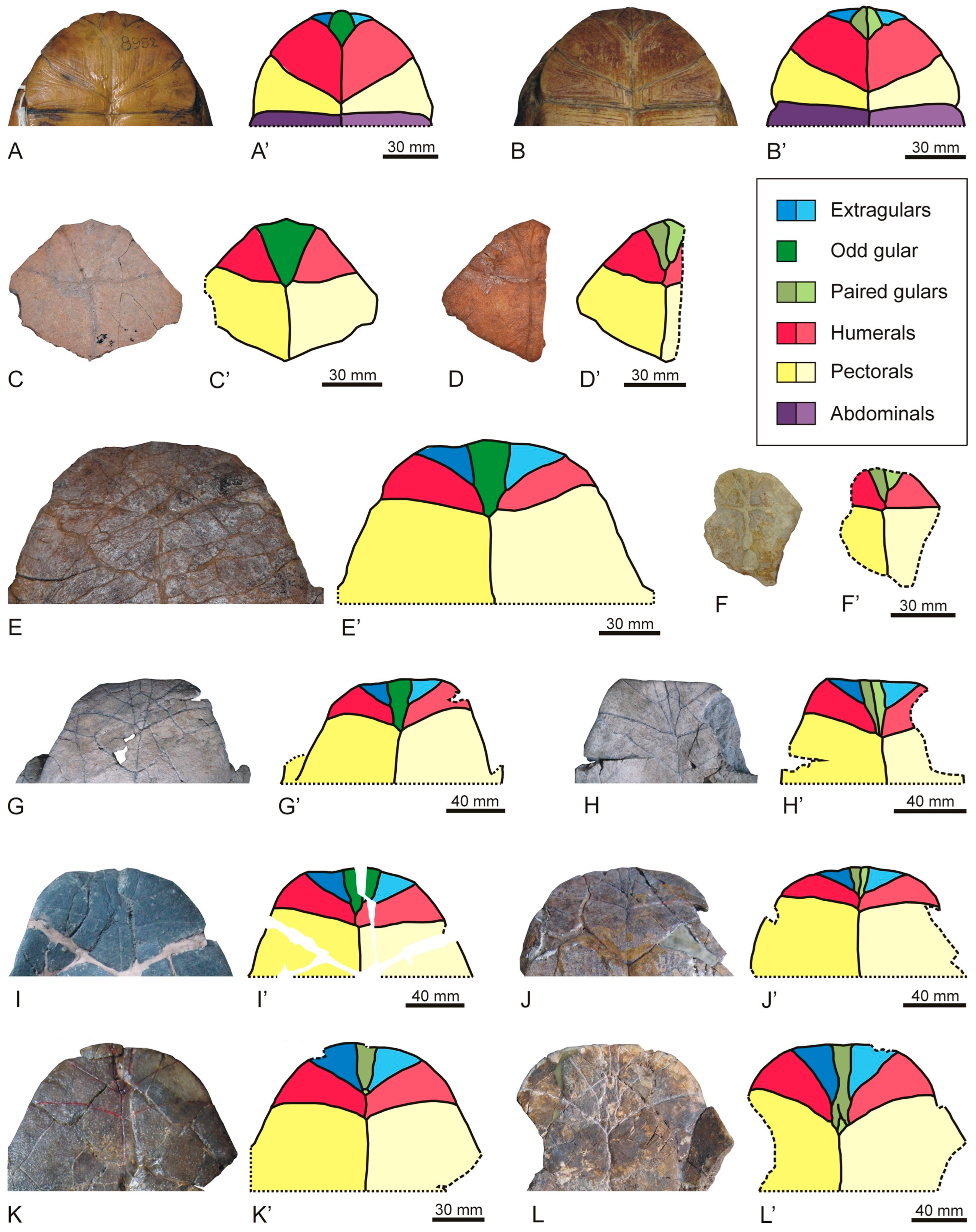
Neochelys zamorensis. In recent studies, both species were identified on the basis of the largest sample of shells and shell fragments known for the genus, and their morphology and intraspecific variability have been analyzed in detail [
18,
19]. This well-established framework makes it possible to reassess ‘
Duerochelys arribasi’.
The first evaluation of turtle remains from Aldearrubia was published by Jiménez Fuentes (1975b [
20]; Figures 1–3), in which a partial anterior plastral lobe (STUS 325) was referred to
Podocnemis sp. In this context, podocnemidid material from various portions and stratigraphic levels of the Duero Basin was initially assigned to
Podocnemis (e.g., [
21]), which is part of the extant biodiversity [
2]. Subsequent work identified
Neochelys as the sole representative of this lineage in the basin (see [
18] and references therein). Jiménez Fuentes and Martín de Jesús (1991) [
22] later verified that determination as
Neochelys sp. Prior to these publications, Jiménez Fuentes had referred to STUS 325, in his unpublished doctoral thesis [
23], as a putative member of a new species,
Podocnemis armuniensis, which is now considered an invalid taxon.
Jiménez Fuentes (1975a) [
17] defined ‘
Duerochelys arribasi’ from two specimens, the holotype corresponding to a plastron without the xiphiplastra (STUS 12157, see Figures 1 and 2 in [
17]), and the paratype represented by an isolated entoplastron (STUS 226, see Figures 3 and 4 in [
17]). He justified the attribution to a new genus by recognizing the presence of two gular scutes instead of a single medial gular. After that publication, new remains from podocnemidids have been found in Aldearrubia, allowing more robust comparisons of the anterior plastral lobe. They have not been studied so far. In addition, the presence of two gular scutes was erroneously interpreted by Jiménez Fuentes (1992) [
24] for a specimen found in the same geological formation, in the adjacent municipality of Babilafuente (STUS 618, see Figure 3 in [
24]), lending additional support for the putative autapomorphy of the taxon. The study of unpublished remains from the Aldearrubia Formation, combined with a reassessment of the specimens already documented from this unit and the substantial advances in our understanding of
Neochelys—particularly
Neochelys salmanticensis and
Neochelys zamorensis [
18,
19]—now permits a critical evaluation of the specific validity of the youngest European representative of Erymnochelyinae, ‘
Duerochelys arribasi’.
Institutional Abbreviations: MNHN.F, Palaeontology Collection, Muséum national d’Histoire naturelle, Paris, France. MNHN.ZR, Zoologie des Reptiles, Muséum national d’Histoire naturelle, Paris, France. STUS, Collection of Fossil Vertebrates of the Duero Basin (“Sala de las Tortugas”) of the University of Salamanca, Salamanca, Spain.
2. Materials and Methods
The material analyzed in this study consists exclusively of fossil plastral remains of pleurodiran turtles collected from the Aldearrubia Formation (Bartonian or Priabonian; MP 16 or MP 17, middle to late Eocene) of the Duero Basin (northwestern Spain). The specimens come from the municipalities of Aldearrubia and Babilafuente (Salamanca Province, Autonomous Community of Castile and León), as detailed in the Systematic Palaeontology section.
All the studied specimens are housed in the Collection of Fossil Vertebrates of the Duero Basin (“Sala de las Tortugas”) of the University of Salamanca (STUS collection, Salamanca, Spain). The analyzed material includes both previously described specimens (including the holotype and paratype of ‘Duerochelys arribasi’) and unpublished material recovered from the same geological formation.
The material was examined through detailed direct observation. Each specimen was mechanically prepared when necessary, described anatomically, and documented using high-resolution photography under controlled lighting conditions. Comparative analyses were carried out through direct examination of fossil material and specimens of extant members of Pleurodira housed in the collections of the Muséum national d’Histoire naturelle, Paris, France (MNHN.F and MNHN.ZR), and published descriptions and figures of European Eocene podocnemidids. Special emphasis was placed on the other
Neochelys representatives from the Duero Basin (
Neochelys salmanticensis and
Neochelys zamorensis), whose shell anatomy and intraspecific variability have been comprehensively documented in recent studies [
18,
19]. Additional comparisons were made with other European species of
Neochelys based on the literature (e.g., [
11,
12,
14,
15]).
3. Systematic Paleontology
Pleurodira Cope, 1864 [
25]
Pelomedusoides Broin, 1988 [
7]
Podocnemididae Cope, 1868 [
26]
Erymnochelyinae Broin, 1988 [
7]
Neochelys Bergounioux, 1954 [
27]
Neochelys arribasi (Jiménez Fuentes, 1975a) [
17]
Synonymy. Duerochelys arribasi Jiménez Fuentes (1975a [
17], 1982 [
28], 2003 [
29]), Jiménez Fuentes and Martín de Jesús (1991) [
22];
Neochelys arribasi Broin (1988) [
7]; ‘
Duerochelys’
arribasi Jiménez Fuentes (1992) [
24];
Neochelys salmanticensis Pérez-García (2017) [
10];
Neochelys sp. Ortega et al. (2022) [
16].
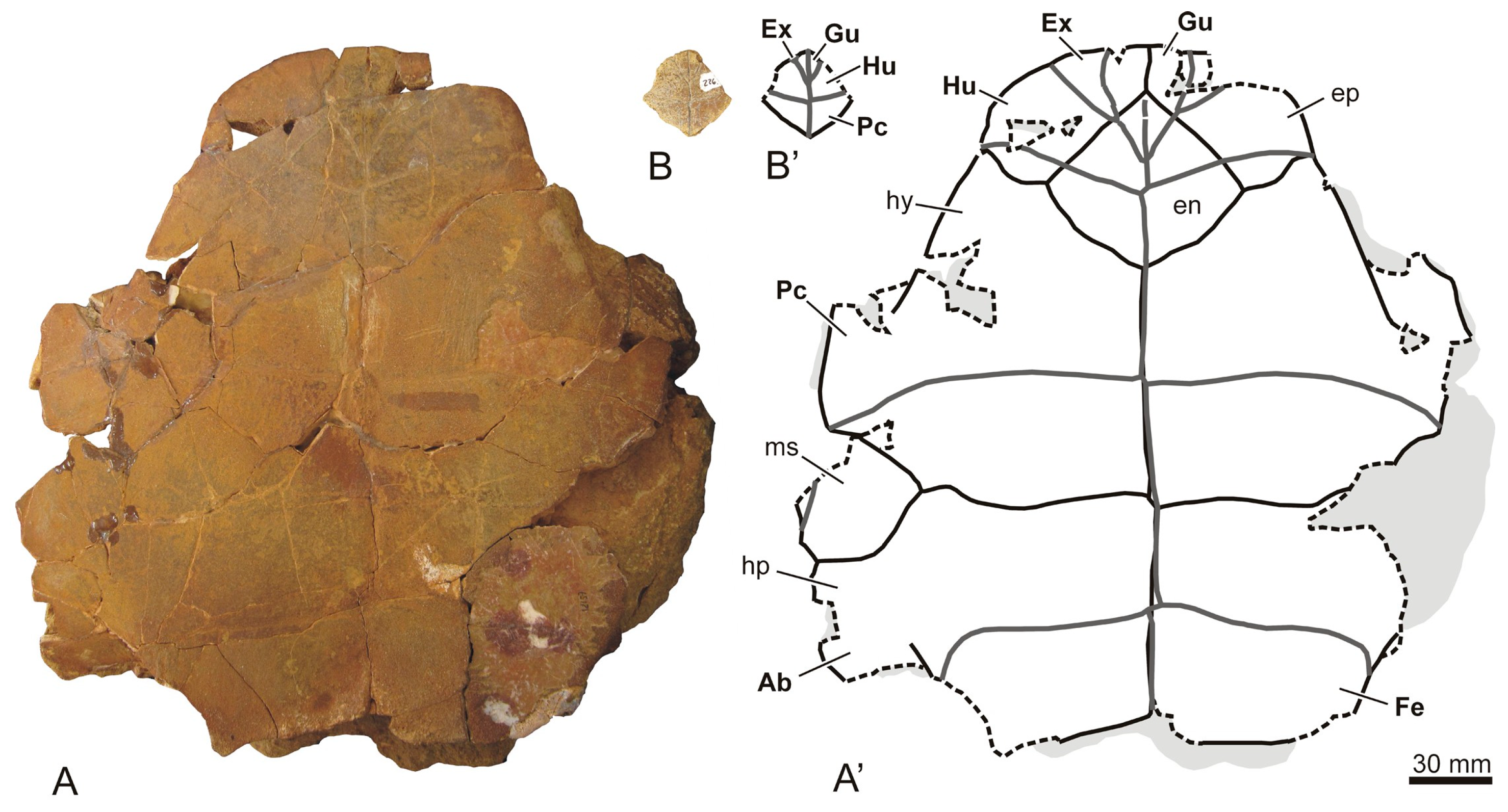
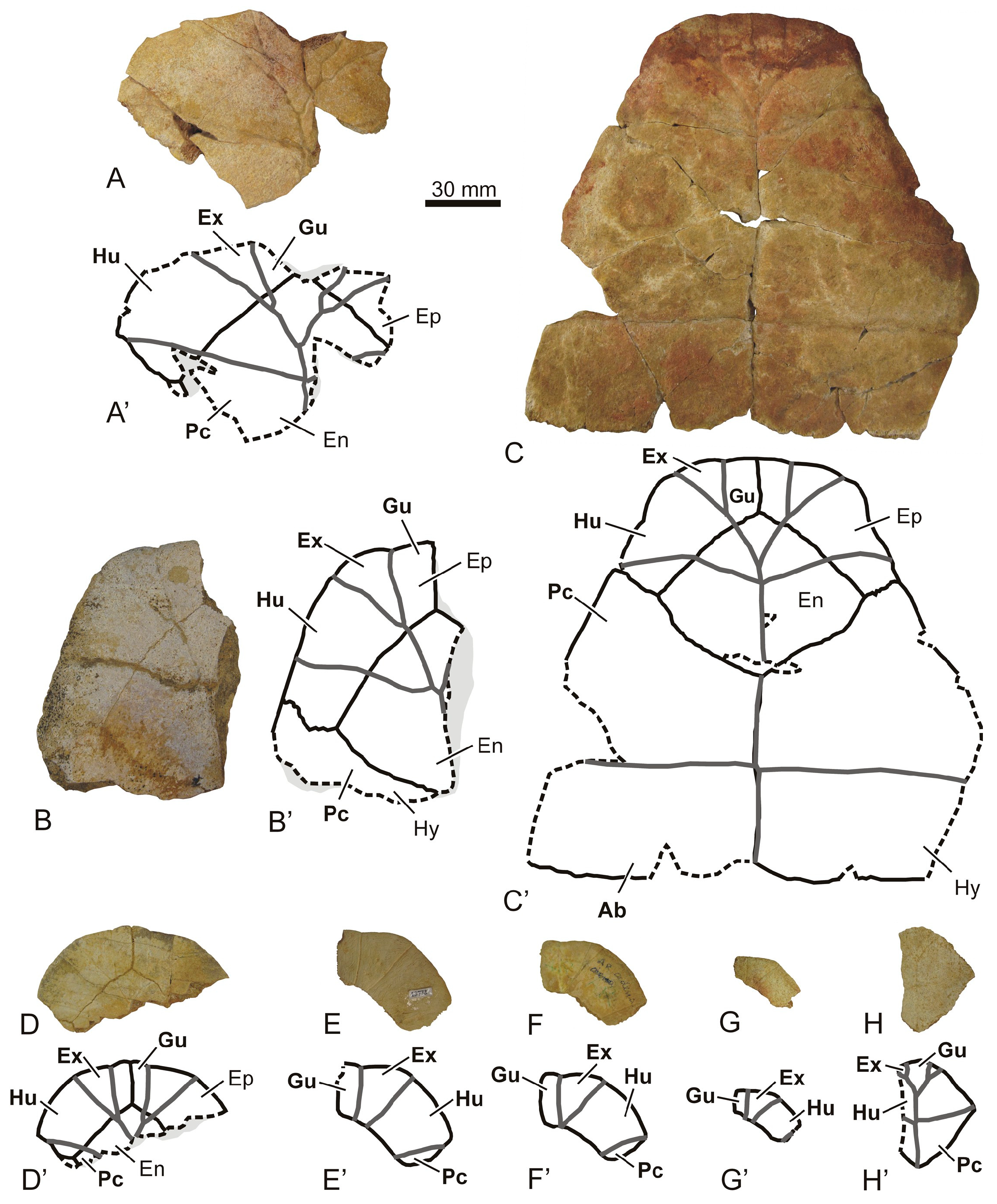
Holotype. STUS 12157, an almost complete plastron, lacking the xiphiplastra (
Figure 2A).
Referred material. STUS 653, a partial anterior plastral lobe (
Figure 3B); STUS 618, the anterior half of a plastron (
Figure 3C).
Locality and horizon. The type locality is the Aldearrubia Municipality (Salamanca Province, Autonomous Community of Castile and León, northwestern Spain), and the specimens STUS 12157 and STUS 653 come from there (
Figure 1). STUS 618 comes from the adjacent municipality of Babilafuente. Aldearrubia Formation, Duero Basin. Bartonian or Priabonian (MP 16 or MP 17, middle or late Eocene) [
16].
Emended diagnosis. Member of Neochelys characterized by a large shell, its anterior plastral lobe width exceeding 170 mm and its anterior plastral lobe length exceeding 100 mm (only shared with Neochelys salmanticensis); and a markedly trapezoidal anterior plastral lobe (only shared with Neochelys zamorensis and Neochelys arenarum).
Description. The holotype of
Neochelys arribasi, STUS 12157, consists of an almost complete articulated plastron, lacking the xiphiplastra (
Figure 2A). The anterior plastral lobe of this specimen measures 105 mm in anteroposterior length (i.e., from the anterior margin of the lobe to the level of the hyoplastral notch) and 175 mm in maximum transverse width (i.e., the distance between the notches of both hyoplastra). Despite being trapezoidal, the morphology of the anterior lobe in this specimen is more rounded than in the other individuals here attributed to this taxon, a condition related to the shape of the epiplastra. In STUS 12157, the epiplastra are approximately twice as long as wide, and their posterior margin is about one and a half times wider than the anterior margin. The entoplastron of the holotype of
Neochelys arribasi exhibits a trapezoidal morphology and is slightly wider than long. The distance from the posterior end of the entoplastron to the pectoro-abdominal sulcus is about 1.5 times the length of the anteroposterior length of the entoplastron. STUS 12157 shows only a weakly developed gular protrusion. The gular scute is slightly longer than wide and presents gently curved lateral margins. As observed in
Figure 2A, the posterior end of this scute is divided into two parts by a shallow sulcus that fades anteriorly. In this specimen, the gular scute is slightly wider than the extragular scute, and the extragulars do not overlap the entoplastron. Additionally, the humero–pectoral sulcus is anteriorly convex at the posterolateral ends of the epiplastron. In this individual, the gular scute does not contact the pectoral scute.
Another specimen attributed to
Neochelys arribasi, STUS 653 (
Figure 3B), consists of a partially preserved anterior plastral lobe. This specimen preserves the complete right epiplastron, part of the entoplastron, and a portion of the right hyoplastron. The morphology of the epiplastron indicates that it corresponds to an anterior lobe with a trapezoidal outline and a substraight anterior margin. In STUS 653, the epiplastron is more than twice as long as its maximum width, and its anterior margin is slightly longer than the posterior one. As in other specimens attributed to this taxon, the entoplastron exhibits a trapezoidal morphology, being slightly wider than long and showing concave posterior margins. STUS 653 displays relatively well-developed gular protrusions. The gular scute is approximately one and a half times longer than wide and shows gently curved lateral margins. In this specimen, the gular scute is larger than the extragular scute, the former being about 1.5 times longer. The extragular scute does not overlap the entoplastron. In STUS 653, the gular is in contact with the humeral scute. Additionally, the humero–pectoral sulcus laterally terminates at the lateral margin of the epiplastron, where it displays a slightly sinuous outline.
STUS 618 (
Figure 3C) corresponds to a relatively complete anterior plastral lobe, preserving both epiplastra, the entoplastron, and most of the hyoplastra. As in the other specimens attributed to
Neochelys arribasi, the anterior lobe exhibits a distinctly trapezoidal morphology with a substraight anterior margin. Because the notch formed by the hyoplastral processes is not preserved, the anterior plastral lobe can be estimated to be at least 88 mm in anteroposterior length and no less than 165 mm in maximum width. In this specimen, the epiplastra are more than twice as long as wide, with the anterior margin being nearly 1.5 times wider than the posterior margin. The entoplastron is again rhomboidal in outline, slightly wider than long, and displays curved posterior margins. Its anteroposterior length is nearly twice the distance between the posterior point of the entoplastron and the pectoro-abdominal sulcus. The gular scute is approximately 1.5 times longer than wide and exhibits straight lateral margins in this specimen. The gular protrusion is only weakly developed. The gular scute is also nearly 1.5 times wider than the extragular scutes, neither of which overlaps the entoplastron. The humero–pectoral sulcus in STUS 618 is slightly concave posteriorly, and its lateral termination contacts the vertex of the posterior margin of the epiplastron.
Neochelys cf. arribasi
Material. STUS 325, a partial anterior plastral lobe (
Figure 3A), corresponding to a specimen originally designated as the holotype of ‘
Podocnemis armuniensis’ [
23].
Locality and horizon. Aldearrubia Municipality (Salamanca Province, Autonomous Community of Castile and León, northwestern Spain;
Figure 1). Aldearrubia Formation, Duero Basin. Bartonian or Priabonian (MP 16 or MP 17, middle or late Eocene) [
16].
Description. STUS 325 comprises several partially preserved but articulated plates belonging to the anterior lobe of the plastron (
Figure 3A). In this specimen, the plates and scutes of the anterior plastral lobe are not sufficiently well preserved to provide detailed information on their morphology. Nevertheless, it is noteworthy that the extragular scutes of STUS 325 overlap onto the entoplastron. In addition, the humero–pectoral sulcus is slightly convex and laterally terminates at the posterior margin of the epiplastron. In this specimen, the gular scutes do not contact the pectorals.
Neochelys sp.
Material. STUS 226, an entoplastron (
Figure 2B), designated as the paratype of ‘
Duerochelys arribasi’ by Jiménez Fuentes (1975a) [
17]; STUS 651, a partial anterior plastral lobe (
Figure 3D); three epiplastra, STUS 13773 (
Figure 3E), STUS 654 (
Figure 3F), and STUS 10634 (
Figure 3G); STUS 650, a partial entoplastron (
Figure 3H).
Localities and horizon. All of these specimens come from the contiguous municipalities of Aldearrubia (specimens STUS 226, STUS 13773, and STUS 654) and Babilafuente (specimens STUS 651, STUS 10634, and STUS 650), located at the Salamanca Province (Autonomous Community of Castile and León, northwestern Spain;
Figure 1). Aldearrubia Formation, Duero Basin. Bartonian or Priabonian (MP 16 or MP 17, middle or late Eocene) [
16].
Description. The specimen previously designated as the paratype of ‘
Duerochelys arribasi’, STUS 226, corresponds to an incomplete entoplastron (
Figure 2B). Although this plate is not completely preserved, its overall morphology can be assessed as rhomboidal, with substraight posterior margins. This specimen is also notable for exhibiting a gular scute divided medially by a sulcus. In STUS 226, the gular scute does not contact the pectoral scute.
STUS 651 (
Figure 3D) corresponds to a partially preserved anterior plastral lobe, restricted to its most anterior region. Despite the incomplete preservation, the overall morphology of the lobe appears to be subrounded rather than trapezoidal. The epiplastra are nearly twice as long as wide, with anterior and posterior margins of approximately equal width. The gular scute is about twice as long as wide and exhibits substraight lateral margins. In this specimen, the gular protrusion is relatively well developed. STUS 651 displays extragular scutes that are wider than the gular scute. As shown in
Figure 3D, the left extragular scute overlaps the entoplastron, whereas the right does not. The humero–pectoral sulcus terminates laterally at the posterior margin of the epiplastron.
STUS 13773 (
Figure 3E) corresponds to an almost complete epiplastron. This element is approximately twice as long as wide, with anterior and posterior margins that are subequal in width. The morphology of the extragular scute indicates that it overlaps the entoplastron. The humero–pectoral sulcus terminates at the posterior margin of the epiplastron.
STUS 654 (
Figure 3F) corresponds to a complete epiplastron that is approximately twice as long as wide. In this specimen, the anterior margin is slightly wider than the posterior one. The extragular scute does not overlap the entoplastron. The humero–pectoral sulcus terminates at the posterolateral corner of the epiplastron.
STUS 10634 (
Figure 3G) corresponds to a complete epiplastron that is approximately twice as long as wide, with a posterior margin wider than the anterior one. In this specimen, the extragular scute overlaps the entoplastron. The humero–pectoral sulcus terminates at the midpoint of the posterior margin of the epiplastron.
STUS 650 (
Figure 3H) corresponds to a partially preserved entoplastron with a rhomboidal outline, slightly wider than long, and exhibiting subrectangular posterior margins. The gular scute appears to have subrectangular lateral margins. Both extragular scutes overlap the entoplastron. In this specimen, the gular does not contact the pectoral scute.
5. Discussion
Neochelys arribasi is compared here with the other representatives of the genus. It exhibits one of the largest body sizes within the genus
Neochelys, with adult specimens showing a minimum transverse width of the anterior plastral lobe of at least 175 mm (
Figure 2A). In most other species of
Neochelys, the maximum documented width of the anterior plastral lobe does not exceed 150 mm. The only exception is
Neochelys salmanticensis, in which a few isolated specimens reach a comparable width of 180 mm, although such cases are rare [
18]. A similar pattern is observed for the relative length of the anterior plastral lobe. Among its congenerics,
Neochelys arribasi exhibits a large anteroposterior length of the anterior plastral lobe (i.e., 105 mm), although it is slightly shorter than for
Neochelys salmanticensis (i.e., exceeds 110 mm), the only species in which greater dimensions have been documented [
18]. The markedly trapezoidal shape of the anterior plastral lobe in
Neochelys arribasi (
Figure 3B) corresponds closely with that observed in some specimens of
Neochelys zamorensis and
Neochelys arenarum, whereas the other species of
Neochelys exhibit a more rounded lobe (see [
19], and references therein). Most of the variation observed in the relative dimensions of the posterior margin of the epiplastra in relation to the anteromedial margin in
Neochelys arribasi falls within the range documented for other species of
Neochelys [
12]. Specimens in which the posterior margin is slightly wider (e.g.,
Figure 2A) align with
Neochelys eocaenica and certain specimens of
Neochelys arenarum,
Neochelys capellinii, and
Neochelys salmanticensis. In this case, the condition in which the anterior epiplastral margin is slightly longer than the posterior one (e.g.,
Figure 3C) has not been reported in any other species of
Neochelys. In this regard,
Neochelys arribasi appears unique in exhibiting this character among the currently recognized species of the genus. However, because these proportions are not shared with other specimens, it should be interpreted cautiously and may reflect individual variation rather than a taxonomically significant feature. The presence of a rhomboidal entoplastron that is slightly wider than long (e.g.,
Figure 2A), is consistent with that observed in other species of
Neochelys. Similarly, the outline of the posterior entoplastral margin, which is slightly convex in
Neochelys arribasi (e.g.,
Figure 2B), corresponds with the condition documented in
Neochelys capellinii, some specimens of
Neochelys laurenti and
Neochelys salmanticensis,
Neochelys zamorensis, and certain
Neochelys sp. from the Bartonian (middle Eocene) of Mazaterón (Soria Province, Spain), and also in the Duero Basin (i.e., [
30]). Finally, the relative proportions of the entoplastron in relation to the pectoro-abdominal sulcus in
Neochelys arribasi align with those observed in other species of the genus. In specimens where this distance is approximately 1.5 times the entoplastral length (
Figure 2A), the condition is shared with
Neochelys eocaenica,
Neochelys franzeni,
Neochelys salmanticensis, and
Neochelys sp. from Mazaterón. In specimens where the distance is approximately twice the entoplastral length (
Figure 3C), the condition corresponds to that seen in
Neochelys arenarum,
Neochelys liriae,
Neochelys capellinii,
Neochelys laurenti, and some individuals of
Neochelys zamorensis.
In
Neochelys arribasi, the gular scute is slightly larger than the extragular, a condition that falls within the range of variation observed in many other species of
Neochelys. Specifically, this condition corresponds to that seen in
Neochelys capellinii,
Neochelys. franzeni,
Neochelys liriae, and in some specimens of
Neochelys eocaenica,
Neochelys salmanticensis, and
Neochelys zamorensis. The length of the entoplastron in relation to the overlap with the gular scute also conforms to patterns documented in other
Neochelys species. In specimens where the entoplastral length is approximately two and a half times the gular overlap (
Figure 2A), the condition is consistent with
Neochelys franzeni and certain individuals of
Neochelys zamorensis. In specimens where the entoplastral length is approximately three times the overlap (
Figure 3C),
Neochelys arribasi aligns with
Neochelys capellinii,
Neochelys liriae, and some specimens of
Neochelys arenarum,
Neochelys salmanticensis,
Neochelys zamorensis, as well as certain individuals previously identified as
Neochelys sp. from Mazaterón. Furthermore, the current specimens of
Neochelys arribasi lack a gular-pectoral contact, as in
Neochelys capellinii,
Neochelys eocaenica,
Neochelys franzeni,
Neochelys liriae, some specimens of
Neochelys salmanticensis,
Neochelys zamorensis, and some
Neochelys sp. from of Mazaterón. Conversely, in one of the examined individuals of
Neochelys arribasi (
Figure 3B), a well-developed contact between the gular and pectoral scutes is observed, a condition that also occurs in
Neochelys eocaenica and in certain specimens of
Neochelys arenarum,
Neochelys salmanticensis, and
Neochelys zamorensis.
Taking all of this into account, the large dimensions of the preserved plastral regions in the specimens attributed to Neochelys arribasi indicate that adult individuals of this species attained a size that differentiates them from other members of the genus. While some measurements of the anterior plastral lobe, such as transverse width, may approach those observed in Neochelys salmanticensis (i.e., the species temporally closest to Neochelys arribasi), the two taxa are readily distinguishable based on their plastral morphology. Specifically, Neochelys arribasi exhibits a markedly trapezoidal shape of the anterior plastral lobe, in contrast to the typically rounded anterior lobe observed in Neochelys salmanticensis. Neochelys arribasi can be clearly differentiated from all other species of Neochelys, by the combination of its large adult size and distinctive trapezoidal morphology. A trend towards increasing body size of the podocnemidid Neochelys is evident in the Eocene record of the Duero Basin. The Lutetian (MP 13 or MP 14, middle Eocene) Neochelys zamorensis represents the smallest form, whereas the Bartonian or Priabonian (MP 16 or MP 17, middle or late Eocene) Neochelys arribasi and the Bartonian (MP 15 or MP 16, middle Eocene) Neochelys salmanticensis are the largest.
6. Conclusions
This study examines the validity of the temporally youngest representative of Neochelys described to date, which represents the last freshwater member of Erymnochelyinae identified in Europe. The material analyzed here includes the holotype and the paratype of ‘Duerochelys arribasi’ (i.e., Neochelys arribasi), as well as additional articulated and disarticulated shell remains recovered from the type locality (i.e., the Aldearrubia Municipality, Salamanca Province, Autonomous Community of Castile and León, northwestern Spain) and from the adjacent municipality of Babilafuente. All these specimens are exclusively represented by plastral elements that are preserved as articulated and disarticulated fossils. They come from the Bartonian or Priabonian (MP 16 or MP 17, middle or late Eocene) Aldearrubia Formation.
The main character used to define this taxon was the presence of two gular scutes. However, this is interpreted here as an anomalous condition—one documented in several pleurodiran lineages and shown to be relatively common in Neochelys, where it is recorded in many representatives of the genus. Despite this, its distinctly trapezoidal anterior plastral lobe—clearly different from that of Neochelys salmanticensis, being the species temporally closest to it—, together with its large body size, greater than that of most other representatives of the genus—notably larger than that of many of them, Neochelys salmanticensis being the only form with a length close to that of it—supports the recognition of Neochelys arribasi as a valid species.