Article

Climate Zones Modulate Deep Chlorophyll Maxima in Middle-Latitude Lakes via Thermocline Development


1
Honghu Laboratory, College of Animal Science and Technology, Yangtze University, Jingzhou 434100, China
2
Institute for Ecological Research and Pollution Control of Plateau Lakes, School of Ecology and Environmental Sciences, Yunnan University, Kunming 650500, China
3
State Key Laboratory of Hydraulics and Mountain River Engineering, Sichuan University, Chengdu 610065, China
4
College of Fisheries, Huazhong Agricultural University, Wuhan 430070, China
*
Authors to whom correspondence should be addressed.
Diversity 2026, 18(1), 46; https://doi.org/10.3390/d18010046
Submission received: 15 December 2025 / Revised: 9 January 2026 / Accepted: 9 January 2026 / Published: 15 January 2026

Abstract

Thermal stability is a key factor in determining the phenomena of deep chlorophyll maxima (DCM) in stratified lakes, as it mediates the vertical balance between light and nutrients required by phytoplankton. While it is well established that lake stratification is sensitive to latitude gradients, the ways in which thermal stability modulates DCM characteristics (i.e., depth, thickness, and concentration) and nutrient–chlorophyll relationships across different latitude classifications remain unclear. In this study, data on thermocline depth, DCM feature, and water quality parameters were collected from 88 globally distributed stratified lakes. Our findings indicate that (1) higher-latitude lakes exhibit strong thermoclines, with light and nitrogen serving as the primary drivers of thermal stratification; (2) in high-latitude lakes, surface chlorophyll a concentrations are more tightly linked to total phosphorus than that at DCM depth in low-latitude lakes; and (3) structural equation modeling (SEM) results demonstrate that higher-latitude lakes form shallower and thinner DCM structures, where low light levels contribute to reduced peaks in algal biomass. These findings provide valuable insights for the management of stratified lakes facing the dual pressures of climate change and eutrophication.

1. Introduction

Deep (or subsurface) chlorophyll maxima (DCM) are a common phenomenon in stratified lakes [1], determined by the maximum total chlorophyll concentration, depths, and thickness. Globally, temperature, light, and nutrients are the main driving forces behind the rapid growth of phytoplankton. Among them, light penetration usually determines the DCM depth; nutrients usually determine the DCM concentration; and thermal stratification largely determines the thickness of DCM [2,3]. However, the relative importance of light, temperature, and nutrients in determining algal biomass is strongly mediated by the stability of the water column [4]. Under strong stratification conditions, phytoplankton often remain within the euphotic zone, promoting algal growth [5]. If the water column is mixed, algae can reach deep and nutrient-rich waters; however, this potentially leads algal communities away from the euphotic zone, thus restricting their growth [2].
In recent decades, extensive research has focused on the patterns of thermocline characteristics across latitude gradients [6,7]. The sensitivity of lake stratification to latitude gradients arises from the nonlinear relationship between water temperature and density, influencing thermocline depth and stability [8]. Tropical lakes often have higher light availability [9] and greater mixing depths due to narrower temperature ranges, smaller density gradients, strong storms or wind speeds, and decreased water viscosity [10,11]. In addition, lakes located at high latitudes generally exhibit less alkalinity, higher pH, and lower conductivity, while at the same time, they are lower in nitrogen and phosphorus, but contain more organic matter [12]. Thus, lake morphology or location and nutrient-inducing light limitation will influence lake stratification degree [13]; ultimately, light penetration and thermocline structure together shape the properties of DCM [1,14]. In this study, we quantified the degree of thermal stratification using the ratio of the epilimnion depth to the lake maximum depth (“Zmin/Zmax”), following Patalas (1984) [15], with a lower ratio indicating a stronger stratification. For deep chlorophyll maximum (DCM) characteristics, we focused on its depth, standardized as the ratio of DCM depth to lake maximum depth (“DCM/Zmax”), and chlorophyll maximum concentration. Based on these definitions, our research aims to investigate: how does the thermocline degree (the Zmin/Zmax ratio) modulate DCM features (i.e., depth, thickness, and concentration) under the influence of different latitude classifications?
Since DCM itself represents a concentration of phytoplankton photosynthetic activity and biomass, with chlorophyll a (Chl a) serving as its most common proxy, understanding the factors controlling DCM characteristics hinges on analyzing the relationship between its Chl a distribution and key environmental drivers. Among these, nutrient availability constitutes a fundamental biogeochemical constraint on phytoplankton growth and Chl a accumulation. However, this nutrient–Chl a relationship may vary with time and place [16], and the depth of the lake and its trophic level are two important factors affecting this change [17]. Phillips et al. (2008) [18] revealed that shallow lakes produce more Chl a per unit of phosphorus and nitrogen nutrients than deep lakes. In addition, the ratio of total nitrogen (TN)/total phosphorus (TP) decreased with increasing Chl a concentration and lake depth [17]. The ratio of TN/TP increases as the distance from the equator increases, which is not directly related to the depth of the water body or trophic state [19]. This reveals the alteration of nutrient cycling with latitude gradients. Notably, due to thermal stratification, biogeochemical processes in the upper and lower layers of the water body are significantly influenced, which can further impact the nutrient–Chl a relationships. In addition, recent studies suggest that Chl a/(TP or TN) production may be more prominent in colder regions due to lower rates of fish predation on plankton [16,20]. Therefore, classifying lakes across latitude gradients to improve the precision of nutrient–chlorophyll relationships is necessary. At the same time, the surface water quality can indirectly affect the DCM characteristics through the adjustment of water transparency and the mixing column [3]. Thus, the second question is how the relationship between nutrients and Chl a varies across surface versus DCM depth, in the context of different latitude classifications?
To unravel the mechanism by which light and heat regulate the characteristics of DCM under the influence of different latitude classifications, we conducted a global synthesis. We specifically focus on the mediating role of lake thermal stratification, a key physical process driven by climate. This leads to three sequential analytical tasks: (1) to quantify how the thermocline degree varies across a latitudinal transect; (2) to examine the relationships between nutrient availability (N, P) and Chl a at the surface or DCM depths; and (3) to integrate the findings by evaluating the observed patterns in DCM depth and magnitude under different latitude classifications, using structural equation modeling to test the proposed pathways. Building on this foundation, we hypothesize the following: (H1) thermocline depth will increase and its strength will decrease with increasing latitude, primarily driven by solar radiation and surface water temperature; (H2) the relationship between nutrient concentrations and Chl a will be stronger and more predictive in the metalimnion/hypolimnion than in the epilimnion, reflecting the nutrient-limited nature of DCM communities; and (H3) lower-latitude lakes form a shallower and thinner DCM structure. This study aims to provide a thorough understanding of DCM features, which will serve for the management of deep lakes.

2. Methods

2.1. Study Selection and Literature Search

This study synthesizes global lake data using a meta-analytical approach. The foundational unit of analysis is a “lake-estimate,” defined as a unique combination of a specific lake and a reported observational period (e.g., a single sampling date, a seasonal mean, or an annual mean). Multiple estimates from the same lake, whether from different studies or time periods, were retained to capture spatial and temporal variability. Our synthesis aimed to compile these individual estimates into a global dataset while accounting for potential non-independence among estimates from the same lake in subsequent statistical analyses.
A systematic literature search was conducted in January 2024 using the Web of Science Core Collection database to identify studies on thermally stratified lakes and reservoirs with a DCM. The search covered the period from January 1970 to December 2023, using the query: TS = (“thermal stratification” OR “thermocline”) AND TS = (“deep chlorophyll maximum” OR “DCM”) AND TS = (lake* OR reservoir*). No language restrictions were applied, yielding an initial total of 1547 records.
The study selection process involved two stages: First, titles and abstracts were screened for relevance, including studies that (i) explicitly investigated a freshwater lake or reservoir, (ii) confirmed the presence of thermal stratification during the sampling period, and (iii) reported in situ vertical profiles of Chl a indicating a DCM. In the second stage, full texts of potentially eligible studies were retrieved and reviewed. Studies were excluded if (i) they were conducted in marine, brackish, or saline systems, (ii) they presented only modeled or remotely sensed data without in situ validation, (iii) the reported data were insufficient to extract key parameters, or (iv) they were reviews or meta-analyses without original data. This process resulted in the selection of 82 studies for data extraction.

2.2. Data Extraction and Harmonization

For each lake or reservoir meeting the inclusion criteria, the following data were extracted from the selected studies:
Lake Characteristics: Lake name, geographic coordinates (latitude, longitude), surface area, maximum depth (Zmax), and mean depth.
Physical Parameters: Depth of the thermocline (Zmin, defined as the depth of maximum temperature gradient or epilimnion depth), euphotic depth (Zeu), and Secchi disk depth (SD). If Zeu was not reported, it was estimated from SD using the conversion: Zeu ≈ 2.7081 × SD. For 71.71% of the lake estimates, Zeu was calculated from photosynthetically active radiation (PAR) profiles and was equal to the 1% PAR level. For the remaining 28.29%, it was estimated as 2.7 times SD. In a subset of 14.67% of lake estimates where both PAR and SD data were available, the two estimation methods showed strong agreement (R2 = 0.967), supporting the use of SD as a reliable proxy. For 20.39% of lake estimates, Zmin/Zmax was directly reported; for the remaining 79.61%, Zmin/Zmax was estimated from textual descriptions of the mixed layer depth and Zmax.
DCM Parameters: Depth of the DCM (ZDCM), thickness of the DCM layer, and the maximum Chl a concentration within the DCM. DCM metrics were taken directly from published summaries or tables, or estimated from reported ratios of the maximum Chl a concentration to mean surface chlorophyll.
Water Quality Parameters: Surface water concentrations of TP, TN, and surface Chl a during the DCM sampling period. All data were extracted for the period of peak seasonal stratification (typically summer in the Northern Hemisphere). When data were presented only in figures, the WebPlotDigitizer software (version 4.6) was used for digital extraction.
A standardized calculation was applied where possible. The ratio of mixing depth to lake depth was calculated as Zmin/Zmax, and the ratio of euphotic depth to mixing depth as Zeu/Zmax. DCM depth was normalized as ZDCM/Zmax.

2.3. Final Dataset and Lake Classification

Following quality control, the initial compilation of 402 lake estimates from 82 studies was consolidated into a final dataset. Data for 13 tropical lakes were supplemented from the harmonized dataset of Li et al. (2022) [1]. To ensure spatial interpretability, we note that these 402 lakes are distributed across North America (20.1%), Europe (48.9%), Asia (24.8%), South America (0.4%), Africa (0.2%), and Oceania (0.2%), spanning boreal to tropical climate zones, though with underrepresentation in the Southern Hemisphere (≈0.8% of lakes). From this set, a subsample of 88 lakes, drawn from 43 published papers (refer to Table S1), was selected for detailed statistical analyses aimed at exploring the driver–DCM relationships. This subsample exhibits a broadly similar geographic distribution (see Table S2).driver–DCM relationships The term ‘lake estimates’ refers to individual observational records aggregated to the lake level by averaging multiple estimates from the same lake, ensuring each lake appears once in the final database. Lakes were classified into two broad latitudinal zones for comparative analysis: low-latitude lakes (≤35° N) and middle-latitude lakes (>35° N). This classification follows ecological zonation concepts related to solar forcing and mixing regimes. The core analysis dataset included 18 low-latitude and 70 middle-latitude lakes, providing a broad geographic and climatic gradient. Lakes were primarily sampled in August due to its significance as a period of peak stratification in the Northern Hemisphere. For Southern Hemisphere lakes, similar seasonal patterns were assumed based on available literature, although this approach may introduce geographic biases and may not universally represent peak stratification in all regions.

2.4. Derived Parameters and Definitions

Key derived parameters used in the analysis included:
Stratification Intensity Index: Represented by Zmin/Zmax; lower values indicate stronger stratification relative to lake depth.
Light Availability in Mixed Layer: Represented by Zeu/Zmin; lower values suggest light limitation within the surface mixed layer.
Normalized DCM Depth: Represented by ZDCM/Zmax, allowing comparison of DCM position across lakes of different depths.
DCM Thickness: Defined as the vertical distance (in meters) between the depths above and below the Chl a peak.

2.5. Statistical Analysis

We utilized the entire dataset to conduct a qualitative analysis of the differences in three DCM parameters and water quality parameters across two latitudinal gradients. The non-parametric Mann–Whitney U test was employed to assess the differences in median values of limnological variables between the two latitudinal lake groups, as most variables did not meet the normality assumption (Shapiro–Wilk test).
To visualize and quantify the linear relationships between the three DCM parameters and the ratios Zeu/Zmax, Zmin/Zmax, and TP, we explored the linear relationships between TP and Chl a concentration at both the surface and DCM depth. The regression models were executed using the “lm” function from the “ggplot2” package in the R environment v.4.0.2 (R Core Team 2020). Logarithmic transformations were applied to Zeu/Zmax, Zmin/Zmax, and TP to avoid issues with zero values.
Finally, we selected significant linear relationships for further analysis. Two structural equation model (SEM) analyses were conducted to compare the relationships in low-latitude and middle-latitude regions, aiming to explore how latitude affects the thermocline and regulates the vertical distribution of chlorophyll a (represented by DCM depth/thickness and DCM concentration/surface). A subset of 88 lakes with available data for Area/Depth, Zeu/Zmin, and DCM parameters was used for the SEM analysis using the “lavaan” package in the R environment v.4.0.2. Significance levels were considered significant if p < 0.05. All statistical analyses were performed using R software (version 4.0.2).

3. Results

3.1. Relationships Between Environmental Variables and Thermocline

Table 1 summarizes the limnologic characteristics of the study lakes across various latitude groups, revealing significant differences in nutrient concentrations and light availability, thermocline degree. Zmin/Zmax in middle-latitude lakes was significantly higher than that in low-latitude lakes. A significant negative relationship between latitude and Zmin/Zmax was observed (p < 0.001) (Figure 1a). The mean TN and TP were notably higher in low-latitude lakes compared to middle-latitude lakes, indicating a higher level of nutrient enrichment in warmer climates. Conversely, the Chl a concentration at the surface and DCM depth and the light penetration, measured as Zeu Zmax, in middle-latitude lakes were significantly higher than that in low-latitude lakes (p < 0.05) (Table 1). However, DCM thickness was significantly lower in low-latitude lakes compared to middle-latitude lakes (Table 1). These findings highlight the significant role latitude gradients play in the vertical distribution of Chl a. Both TP and TN were significantly positive for surface Chl a concentration in middle-latitude lakes, but not for low-latitude lakes (p < 0.001) (Figure 1b–c), indicating that nutrient concentration, not light, is a limiting factor for algal growth in middle-latitude lakes. Moreover, the slopes of TP and surface Chl a concentration in the low-latitude lakes were flatter than those in the middle-latitude lakes. The slope of TN/TP was steeper in low-latitude lakes than that in middle-latitude lakes (Figure 1d).

3.2. Relationships Between Environmental Variables and Deep Chlorophyll Maxima (DCM) Features

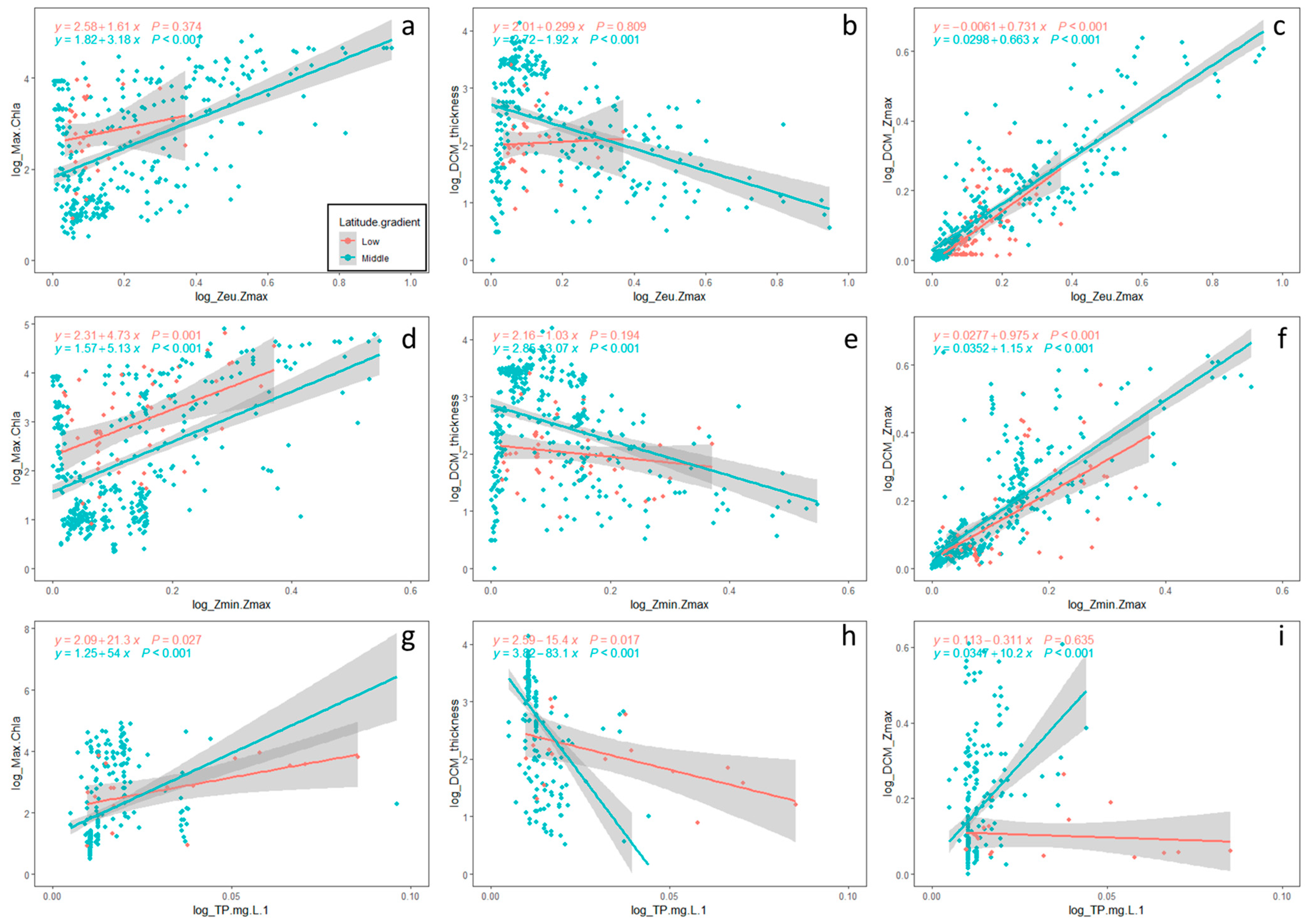
Figure 2 explores the relationships between light availability, thermocline degree, and three DCM parameters. In both low- and middle-latitude lakes, euphotic depth is positive to DCM concentration and depth, but is negative to DCM thickness (p < 0.001) (Figure 2a–c). There were almost the same change trends between the three DCM parameters and thermocline depth (Figure 2d–f) and TP (Figure 2g–i). Interestingly, the slopes of these relationships were generally flatter in the low-latitude lakes than in middle-latitude lakes.

3.3. The Influence of Latitude on DCM Structures

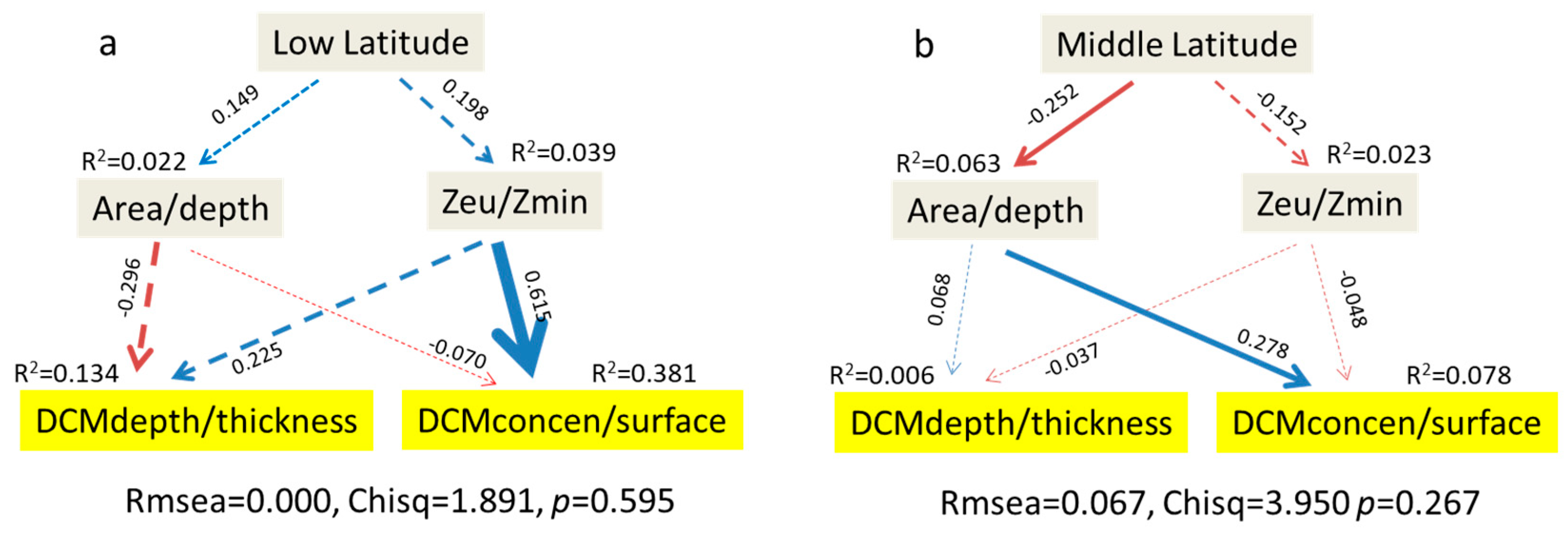
Figure 3 summarizes the results of the structural equation modeling (SEM) for low- and middle-latitude lakes. In low-latitude lakes (Figure 3a), Zeu/Zmin has a significant positive influence on DCM concentration/surface, indicating that greater euphotic depths enhance chlorophyll accumulation. In contrast, in middle-latitude lakes (Figure 3b), Area/depth has a significant positive influence on DCM concentration/surface, suggesting that larger lakes support chlorophyll accumulation at DCM layers. This indicates that more extensive lakes are better equipped to maintain robust DCM layers. The stronger stratification observed in low-latitude lakes results in a more pronounced shallow and thin DCM pattern (Figure 3a–b). Overall, light limitation emerges as the dominant driver affecting the vertical distribution of Chl a in middle-latitude lakes.

4. Discussions

Studies have shown a link between water quality, thermal stratification degree, and DCM features across various lakes along latitude gradients [2,3,4], though their potential cascading effects are still unclear. The objective of this study was to determine how thermocline regulates the vertical distribution feature of Chl a under the influence of different latitude classifications. The results indicated that light is the primary driver of thermal stratification degrees. Euphotic depth, thermocline depth, and TP were positively related to DCM concentration and depth, but negatively correlated with DCM thickness. In low-latitude lakes, Area/depth had a greater influence on DCM depth/thickness, while Zeu/Zmin and Area/depth affected DCM concentration/surface. These findings suggest that as latitude increases, stronger thermal stratification leads to shallow and thin DCM patterns. Additionally, light limitation was the dominant driver of the vertical distribution feature of Chl a in middle-latitude lakes, while nitrogen limitation was more pronounced in low-latitude lakes. Importantly, no high-latitude lakes were included in this study. These high-latitude lakes are typically found in polar and subpolar regions, experiencing significant seasonal variations in temperature and light. A limitation of our analysis comprised a dataset covering a narrow latitudinal band, which may not provide more general insight into the role of latitude in determining the relationship. We acknowledge this limitation regarding the geographical regions of the lakes studied in the Section 4. Nevertheless, this study provides a scientific basis for deep lake management under the dual pressure of climate change and eutrophication.

4.1. Strong TP–Chl a Relationship in Higher Latitude Lakes

Our study found significant increases in thermal stratification with higher latitudes, consistent with previous studies [21,22] due to the seasonal temperature changes in tropical lakes being smaller than those in higher latitudes [11]. The change in latitude may regulate the thermal stratification of lakes by changing the incident solar radiation and temperature [23]. In our study, low-latitude lakes (≤35°) are located in subtropical and tropical regions, while middle-latitude lakes (>35°) are found in subtropical and temperate regions. We focused on middle-latitude lakes due to their distinct ecological dynamics influenced by seasonal climate variations. These lakes often experience notable thermal stratification and nutrient cycling, which are critical for understanding DCM dynamics. However, we acknowledge that classifying climatic zones by their climatic characteristics may be more informative than relying solely on latitude.
Similar to many other studies [24], we observed a positive linear relationship between TP and Chl a across lakes. Interestingly, significant positive correlations and high slopes were found in higher latitude lakes, while low-latitude lakes showed no significant relationships and lower slopes. This indicates that the influence of TP on Chl a is less pronounced in low-latitude lakes. This aligns with previous research suggesting that Chl a is more closely correlated with TP than TN in temperate lake ecosystems [19]. Possible explanations include low Secchi disk depth due to high concentrations of organic matter and nutrients in low-latitude lakes, leading to light limitation [25]. Additionally, nitrogen limitation may increase in tropical lakes due to higher rates of N loss from denitrification [25,26]. The study area exhibited high TN content, while changes in TP were relatively weak. According to N/P thresholds [27], low-latitude lakes are nitrogen-limited, while high-latitude lakes experience co-limitation by phosphorus and nitrogen. Furthermore, we found that the influence of TP on surface Chl a is greater than at DCM depth, as surface Chl a may be limited by nutrient depletion, while Chl a at deeper layers may face light limitation [28].

4.2. Shallower and Thinner DCM Structures in Higher-Latitude Lakes

Our linear regression analysis showed that both euphotic depth and thermocline depth are positively related to DCM concentration and depth, but negatively related to DCM thickness; notably, the slopes for low-latitude lakes were generally flatter than those for middle-latitude lakes. This supports the notion that lakes at higher latitudes exhibit stronger thermoclines and tend to develop shallower and thinner DCM structures, which aligns with previous studies. In individual lakes, light penetration is critical for DCM depth, while thermocline depth significantly influences DCM thickness. This phenomenon may be closely related to the vertical niche distribution of phytoplankton [29,30]. At a multi-lake scale, deeper and larger lakes typically have deeper thermoclines, which can expand the niche space for phytoplankton, thereby increasing DCM depth and thickness ([2], in this study). The effects of lake location on DCM features are mainly due to the indirect impacts of surface water quality, which cascade to affect light penetration and thermocline structure [1]. To further elucidate the relative importance of lake morphology, light availability, and trophic states on Chl a’s vertical distribution across latitude gradients, two structural equation models (SEMs) were conducted to compare low- and middle-latitude lakes. Our SEM results indicated that Zeu/Zmix and Area/Depth significantly influence the concentration ratio of DCM to surface levels in high-latitude lakes, while Area/Depth plays a crucial role in DCM depth and width in low-latitude lakes.
The balance between light and nutrients is critical for maintaining phytoplankton growth in DCM [31]. We further explored the limiting factors for phytoplankton growth across latitude gradients. The ratio of Zeu/Zmix indicates conditions of nutrient or light limitation [32]. In our study, the ratio was higher in middle-latitude lakes, suggesting that deeper euphotic zones allow better light penetration, while nutrients from the sediment may become locked, indicating that phytoplankton may face nutrient limitations in these lakes. Conversely, in lower stratification lakes in the low-latitude region, nutrients may remain available in the hypolimnion even when depleted in the epilimnion. Consequently, algal biomass maxima can occur at the intersection of light from above and nutrients from below, where light limitation on phytoplankton growth is expected [4]. In the low-latitude lakes examined, neither phosphorus nor nitrogen significantly predicted Chl a levels, likely due to the aforementioned light limitations. Our findings suggest that lakes at higher latitudes typically have greater depths and more stable characteristics, which may assist phytoplankton in DCM depth in capturing more light. Additionally, deep lakes in higher latitudes tend to have longer residence times and exhibit higher transparency and lower concentrations of Chl a and nutrients compared to shallower lakes [17,31]. Thus, the concentration ratio of DCM to surface levels in middle-latitude lakes is lower than in low-latitude lakes.

5. Conclusions

In conclusion, higher latitude lakes exhibit stronger thermoclines, with light being the main driver of thermal stratification. In middle-latitude lakes, characterized by phosphorus limitation, there is a lower concentration ratio of DCM to surface levels and a higher DCM depth and width compared to low-latitude lakes, which face light limitations. SEM results indicate that Zeu/Zmix and Area/Depth significantly influence the concentration ratio of DCM to surface levels in middle-latitude lakes, while Area/Depth is a vital factor in DCM depth and width in low-latitude lakes. This implies that higher latitude lakes are characterized by stronger thermoclines and tend to develop shallower and thinner DCM structures. Furthermore, surface Chl a levels are more closely linked to phosphorus than to DCM depth, especially in middle-latitude lakes. However, most studies have focused on smaller lakes in tropical and high-latitude regions. Given the significant differences in climate and the diversity of inland water characteristics, further exploration of thermal stratification patterns in subtropical lakes is warranted.

Supplementary Materials

The following supporting information can be downloaded at: https://www.mdpi.com/article/10.3390/d18010046/s1, Table S1: The selective references and their paper numbers; Table S2: The limnologic characteristics of the examined 88 world lakes and their paper numbers.

Author Contributions

Conceptualization, L.W.; resources, Q.Z.; data curation, Q.Z.; writing—original draft, L.W.; writing—review & editing, Y.L.; visualization, L.W.; supervision, X.M.; project administration, X.M.; funding acquisition, Q.Z. All authors have read and agreed to the published version of the manuscript.

Funding

The project was supported by National Key Laboratory of Mountain River Protection and Governance, Sichuan University Open Project 2024 (SKHL2426); Hubei Provincial Key Laboratory of Waterlogging and Wetland Agriculture Open Project Funded for 2025 (KFG202515); the National Natural Science Foundation of China (32301357, 42071131).

Institutional Review Board Statement

Not applicable.

Data Availability Statement

The original contributions presented in this study are included in the article and Supplementary Materials. Further inquiries can be directed to the corresponding author.

Acknowledgments

Li Wang conceived the study, ran the simulations, and wrote the paper. We thank Xufa Ma, Yong Li, and Qichao Zhou for statistical advice and anonymous referees for detailed comments that improved this manuscript. We would like to express our gratitude to Huan Zhang for providing valuable feedback during the initial drafting of the manuscript. Many thanks were given to Yanyi Li, Jinlei Tian, Yuhui Tong, Xiaoheng Pan, and Xing Gan for collecting the data from previous papers.

Conflicts of Interest

The authors declare that they have no known competing financial interests or personal relationships that could have appeared to influence the work reported in this paper.

References

  1. Li, J.; Li, Y.; Liu, M.; Yu, Z.; Song, D.; Jeppesen, E.; Zhou, Q. Patterns of thermocline structure and the deep chlorophyll maxima feature in multiple stratified lakes related to environmental drivers. Sci. Total Environ. 2022, 851, 158431. [Google Scholar] [CrossRef]
  2. Leach, T.H.; Beisner, B.E.; Carey, C.C.; Pernica, P.; Rose, K.C.; Huot, Y.; Brentrup, J.A.; Domaizon, I.; Grossart, H.P.; Ibelings, B.W.; et al. Patterns and drivers of deep chlorophyll maxima structure in 100 lakes: The relative importance of light and thermal stratification. Limnol. Oceanogr. 2018, 63, 628–646. [Google Scholar] [CrossRef]
  3. Scofield, A.E.; Watkins, J.M.; Osantowski, E.; Rudstam, L.G. Deep chlorophyll maxima across a trophic state gradient: A case study in the Laurentian Great Lakes. Limnol. Oceanogr. 2020, 65, 2460–2484. [Google Scholar] [CrossRef]
  4. Donis, D.; Mantzouki, E.; McGinnis, D.F.; Vachon, D.; Gallego, I.; Grossart, P.; Domis, S.; Teurlincx, S.; Seelen, L.; Lürling, M.; et al. Stratification strength and light climate explain variation in chlorophyll a at the continental scale in a European multilake survey in a heatwave summer. Limnol. Oceanogr. 2021, 66, 4314–4333. [Google Scholar] [CrossRef]
  5. Antonio, C. On the occurrence and ecological features of deep chlorophyll maxima (DCM) in Spanish stratified lakes. Limnetica 2006, 25, 453–478. [Google Scholar] [CrossRef]
  6. Fee, E.J.; Hecky, R.E.; Kasian, S.E.M.; Cruikshank, D.R. Effects of lake size, water clarity, and climatic variability on mixing depths in Canadian Shield lakes. Limnol. Oceanogr. 1996, 41, 912–920. [Google Scholar] [CrossRef]
  7. Hongve, D. Summer mixing depths in small lakes in Southeast Norway depend on surface area and water colour. Int. Ver. Für Theor. Und Angew. Limnol. Verhandlungen 2006, 29, 1935–1939. [Google Scholar] [CrossRef]
  8. Kraemer, B.M.; Anneville, O.; Chandra, S.; Dix, M.; Kuusisto, E.; Livingstone, D.M.; Rimmer, A.; Schladow, S.G.; Silow, E.; Sitoki, L.M.; et al. Morphometry and average temperature affect lake stratification responses to climate change. Geophys. Res. Lett. 2015, 42, 4981–4988. [Google Scholar] [CrossRef]
  9. Gardner, W.S.; Cavaletto, J.F.; Bootsma, H.A.; Lavrentyev, P.J.; Troncone, F. Nitrogen cycling rates and light effects in tropical Lake Maracaibo, Venezuela. Limnol. Oceanogr. 1998, 43, 1814–1825. [Google Scholar] [CrossRef]
  10. Kling, G.W. Comparative transparency, depth of mixing, and stability of stratification in lakes of Cameroon, West Africa 1. Limnol. Oceanogr. 1988, 33, 27–40. [Google Scholar] [CrossRef]
  11. Kirillin, G.; Shatwell, T. Generalized scaling of seasonal thermal stratification in lakes. Earth-Sci. Rev. 2016, 161, 179–190. [Google Scholar] [CrossRef]
  12. Nõges, P.; Nõge, T.; Ghiani, M.; Paracchini, B.; Pinto Grande, J.; Sena, F. Morphometry and trophic state modify the thermal response of lakes to meteorological forcing. Hydrobiologia 2011, 667, 241–254. [Google Scholar] [CrossRef]
  13. Magee, M.R.; Wu, C.H. Responses of water temperature and stratification to changing climate in three lakes with different morphometry. Hydrol. Earth Syst. Sci. 2017, 21, 6253–6274. [Google Scholar] [CrossRef]
  14. Liu, M.; Zhang, Y.; Zhou, Y.; Shi, K.; Zhu, G.; Sun, X. Thermal structure controlled by morphometry and light attenuation across subtropical reservoirs. Hydrol. Process. 2022, 36, e14502. [Google Scholar] [CrossRef]
  15. Patalas, K. Mid-summer mixing depths of lakes of different latitudes: With 5 figures in the text. Int. Ver. Für Theor. Und Angew. Limnol. Verhandlungen 1984, 22, 97–102. [Google Scholar] [CrossRef]
  16. Jeppesen, E.; Beklioğlu, M.; Özkan, K.; Akyürek, Z. Salinization increase due to climate change will have substantial negative effects on inland waters: A call for multifaceted research at the local and global scale. Innovation 2020, 1, 100030. [Google Scholar] [CrossRef]
  17. Zhao, L.; Zhu, R.; Zhou, Q.; Jeppesen, E.; Yang, K. Trophic status and lake depth play important roles in determining the nutrient-chlorophyll a relationship: Evidence from thousands of lakes globally. Water Res. 2023, 242, 120182. [Google Scholar] [CrossRef] [PubMed]
  18. Phillips, G.; Pietiläinen, O.P.; Carvalho, L.; Solimini, A.; Lyche Solheim, A.; Cardoso, A.C. Chlorophyll–nutrient relationships of different lake types using a large European dataset. Aquat. Ecol. 2008, 42, 213–226. [Google Scholar] [CrossRef]
  19. Abell, J.M.; Özkundakci, D.; Hamilton, D.P.; Jones, J.R. Latitudinal variation in nutrient stoichiometry and chlorophyll-nutrient relationships in lakes: A global study. Fundam. Appl. Limnol 2012, 181, 1–14. [Google Scholar] [CrossRef]
  20. Graeber, D.; McCarthy, M.J.; Shatwell, T.; Borchardt, D.; Jeppesen, E.; Søndergaard, M.; Lauridsen, T.L.; Davidson, T.A. Consistent stoichiometric long-term relationships between nutrients and chlorophyll-a across lakes. Nat. Commun. 2024, 15, 809. [Google Scholar] [CrossRef]
  21. Boehrer, B.; Schultze, M. Stratification of lakes. Rev. Geophys. 2008, 46, 2. [Google Scholar] [CrossRef]
  22. Briddon, C.L.; Metcalfe, S.; Taylor, D.; Bannister, W.; Cunanan, M.; Santos-Borja, A.C.; Papa, R.D.; McGowan, S. Changing water quality and thermocline depth along an aquaculture gradient in six tropical crater lakes. Hydrobiologia 2023, 850, 283–299. [Google Scholar] [CrossRef]
  23. Edmundson, J.A.; Mazumder, A. Regional and hierarchical perspectives of thermal regimes in subarctic, Alaskan lakes. Freshw. Biol. 2002, 47, 1–17. [Google Scholar] [CrossRef]
  24. Quinlan, R.; Filazzola, A.; Mahdiyan, O.; Shuvo, A.; Blagrave, K.; Ewins, C.; Moslenko, L.; Gray, D.K.; O’Reilly, C.M.; Sharma, S. Relationships of total phosphorus and chlorophyll in lakes worldwide. Limnol. Oceanogr. 2021, 66, 392–404. [Google Scholar] [CrossRef]
  25. Lewis, W.M., Jr. Basis for the protection and management of tropical lakes. Lakes Reserv. Res. Manag. 2000, 5, 35–48. [Google Scholar] [CrossRef]
  26. May, L.; Aura, C.M.; Becker, V.; Briddon, C.L.; Carvalho, L.R.; Dobel, A.J.; Jamwal, P.; Kamphuis, B.; Marinho, M.M.; McGowan, S.; et al. Getting into hot water: Water quality in tropical lakes in relation to their utilisation. In IOP Conference Series: Earth and Environmental Science; IOP Publishing: Bristol, UK, 2021; Volume 789, p. 012021. [Google Scholar]
  27. Liang, Z.; Soranno, P.A.; Wagner, T. The role of phosphorus and nitrogen on chlorophyll a: Evidence from hundreds of lakes. Water Res. 2020, 185, 116236. [Google Scholar] [CrossRef] [PubMed]
  28. Lepori, F.; Bartosiewicz, M.; Simona, M.; Veronesi, M. Effects of winter weather and mixing regime on the restoration of a deep perialpine lake (Lake Lugano, Switzerland and Italy). Hydrobiologia 2018, 824, 229–242. [Google Scholar] [CrossRef]
  29. Hamilton, D.P.; O’Brien, K.R.; Burford, M.A.; Brookes, J.D.; McBride, C.G. Vertical distributions of chlorophyll in deep, warm monomictic lakes. Aquat. Sci. 2010, 72, 295–307. [Google Scholar] [CrossRef]
  30. Liu, M.; Zhang, Y.; Shi, K.; Melack, J.; Zhang, Y.; Zhou, Y.; Zhu, M.; Zhu, G.; Wu, Z.; Liu, M. Spatial variations of subsurface chlorophyll maxima during thermal stratification in a large, deep subtropical reservoir. J. Geophys. Res. Biogeosciences 2020, 125, e2019JG005480. [Google Scholar] [CrossRef]
  31. Qin, B.; Zhou, J.; Elser, J.J.; Gardner, W.S.; Deng, J.; Brookes, J.D. Water depth underpins the relative roles and fates of nitrogen and phosphorus in lakes. Environ. Sci. Technol. 2020, 54, 3191–3198. [Google Scholar] [CrossRef] [PubMed]
  32. Shatwell, T.; Nicklisch, A.; Köhler, J. Temperature and photoperiod effects on phytoplankton growing under simulated mixed layer light fluctuations. Limnol. Oceanogr. 2012, 57, 541–553. [Google Scholar] [CrossRef]
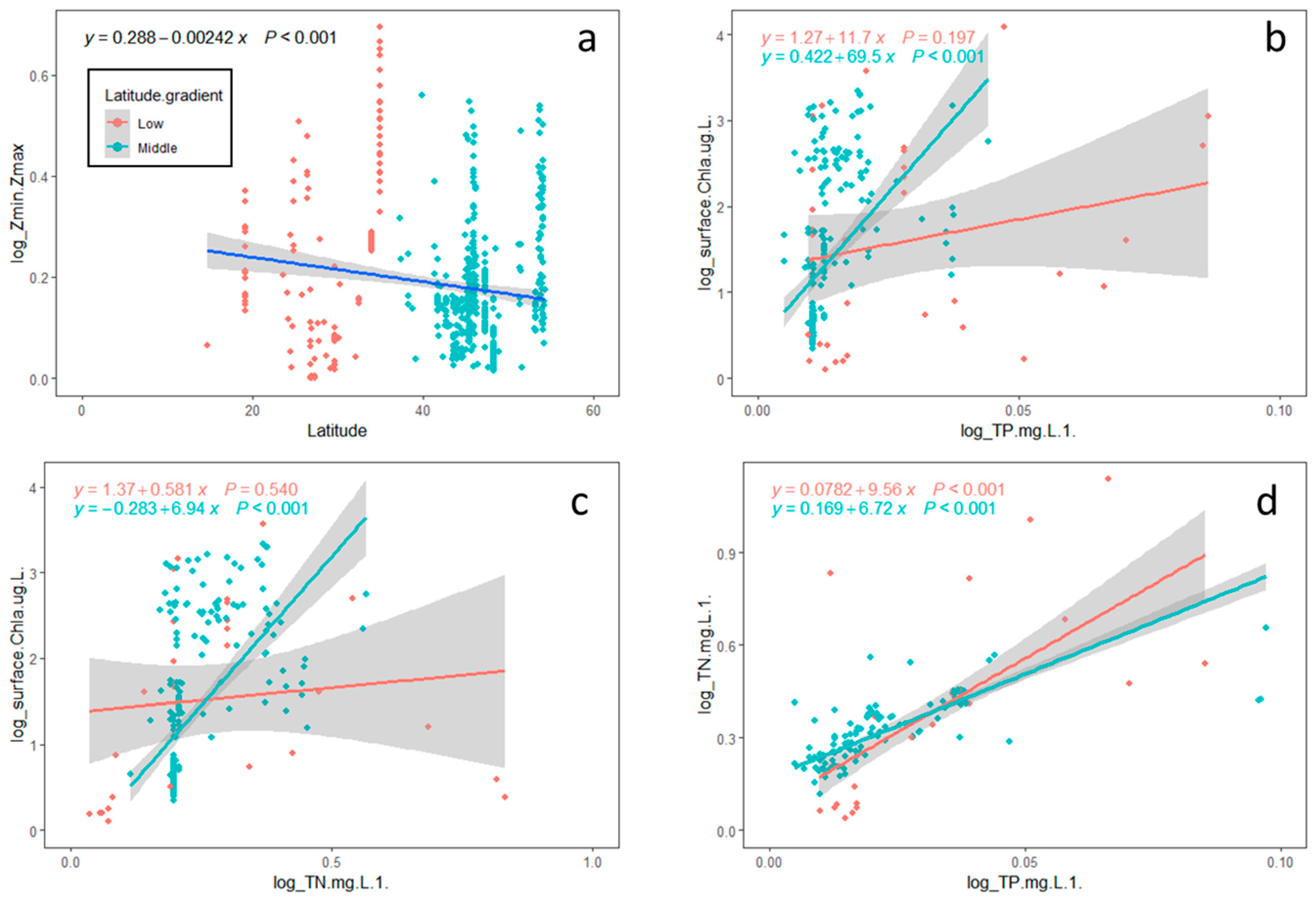
Figure 1. The linear relationship between latitude and Zmin/Zmax (a). The linear relationships between TN, TP, and surface Chl a concentration (bd). TP: total phosphorus; TN: total nitrogen; Chl a: chlorophyll a; Zmax: maxima lake depth; Zmin: thermocline depth.
Diversity 18 00046 g001
Figure 2. The relationships approximated using linear regression between Zeu/Zmax and DCM parameters (ac), between Zmin/Zmax and DCM parameters (df), and between TP and DCM parameters (gi). TP: total phosphorus; Max.Chl a: deep chlorophyll maxima concentration; ZDCM/Zmax: deep chlorophyll maxima depth/maxima lake depth; Zmin/Zmax: thermocline depth/maxima lake depth; Zeu/Zmax: euphotic depth/maxima lake depth.
Diversity 18 00046 g002
Figure 3. Path diagrams of the SEM based on the interactions between Zeu/Zmin, Area/depth, DCM depth/thickness and DCM concentration/surface for low-latitude lakes (a) and middle-latitude lakes (b). Boxes represent observed variables. The directions of the arrows go from independent to dependent variables. The numbers on the arrows correspond to the standardized path coefficients, and the relative strength of the relationship is indicated by the standardized path coefficient. R2 indicates the variance in the biomarkers explained by the model. Blue and red arrows indicate positive and negative flows of causality, respectively. Significant and nonsignificant path coefficients are indicated by solid and dotted lines, respectively (p < 0.05). Goodness-of-fit statistics for the model are shown below the model. Zeu/Zmin: euphotic depth/thermocline depth; DCM depth/thickness: deep chlorophyll maxima depth/deep chlorophyll maxima thickness; DCM concentration/surface: deep chlorophyll maxima concentration/surface chlorophyll a concentration.
Diversity 18 00046 g003
Table 1. Comparison of the limnologic characteristics between low-latitude lakes and middle-latitude lakes.
Low-Latitude Lakes (n = 18)Middle-Latitude Lakes (n = 70)U Test
Latitude (decimal degrees)26.6 (14.7–32.1)47.5 (42.1–54.1)——
Mean depth (m)33.5 (7.6–106.3)28.3 (2.3–169.0)ns
Lake area (km2)59.9 (0.2–560.0)3522.7 (0.0–82,097)ns
TN (mg/L)0.62 (0.04–2.12)0.33 (0.17–0.75)***
TP (mg/L)0.031 (0.001–0.089)0.016 (0.005–0.038)***
Surface Chl a (μg/L)2.3 (0.1–13.9)10.1 (0.1–27.1)***
Zeu/Zmax0.2 (0.1–0.4)0.5 (0.0–1.5)***
Zmin/Zmax0.1 (0.0–0.3)0.2 (0.0–0.7)**
DCM concentration (μg/L)22.7 (1.5–51.3)33.3 (1.8–109)*
DCM/Zmax0.1 (0.0–0.2)1.1 (0.0–22.5)ns
DCM thickness (m)8.6 (1.4–29.0)7.9 (0.7–29.3)***
Area/depth60.9 (0.0–1068.9)30.7 (0.00–726.4)ns
Zeu/Zmin1.98 (0.33–5.18)2.51 (0.69–15.00)ns
TN/TP20.92 (2.47–108.13)22.25 (13.33–102.00)ns
DCMdepth/thickness1.56 (0.36–7.90)1.76 (0.06–7.00)ns
DCM concentration/surface49.10 (0.70–446.52)3.72 (1.11–20.02)***
Note: table shows the mean value and the range of minimum and maximum values is in parentheses. *: p< 0.05, **: p< 0.01, ***: p< 0.00l, ns: not significant. TP: total phosphorus; TN: total nitrogen; Chl a: chlorophyll a; DCM: deep chlorophyll maxima; Zmax: maxima lake depth; Zeu: euphotic depth; Zmin: thermocline depth; DCMdepth/thickness: the ratio of deep and thickness for deep chlorophyll maxima; DCM concentration/surface: the concentration ratio of chlorophyll a between subsurface and surface.
Disclaimer/Publisher’s Note: The statements, opinions and data contained in all publications are solely those of the individual author(s) and contributor(s) and not of MDPI and/or the editor(s). MDPI and/or the editor(s) disclaim responsibility for any injury to people or property resulting from any ideas, methods, instructions or products referred to in the content.