Review

Nature-Based Solutions for Resilience: A Global Review of Ecosystem Services from Urban Forests and Cover Crops

by
Anastasia Ivanova
1,
Reena Randhir
2 and
Timothy O. Randhir
1,*
1
Department of Environmental Conservation, University of Massachusetts, Amherst, MA 01003, USA
2
Springfield Technical Community College, Springfield, MA 01105, USA
*
Author to whom correspondence should be addressed.
Diversity 2026, 18(1), 47; https://doi.org/10.3390/d18010047
Submission received: 14 December 2025 / Revised: 9 January 2026 / Accepted: 13 January 2026 / Published: 15 January 2026
(This article belongs to the Special Issue 2026 Feature Papers by Diversity's Editorial Board Members)

Abstract

Climate change and land-use intensification are speeding up the loss of ecosystem services that support human health, food security, and environmental stability. Vegetative interventions—such as urban forests in cities and cover crops in farming systems—are increasingly seen as nature-based solutions for climate adaptation. However, their benefits are often viewed separately. This review combines 20 years of research to explore how these strategies, together, improve provisioning, regulating, supporting, and cultural ecosystem services across various landscapes. Urban forests help reduce urban heat islands, improve air quality, manage stormwater, and offer cultural and health benefits. Cover crops increase soil fertility, regulate water, support nutrient cycling, and enhance crop yields, with potential for carbon sequestration and biofuel production. We identify opportunities and challenges, highlight barriers to adopting these strategies, and suggest integrated frameworks—including spatial decision-support tools, incentive programs, and education—to encourage broader use. By connecting urban and rural systems, this review underscores vegetation as a versatile tool for resilience, essential for reaching global sustainability goals.

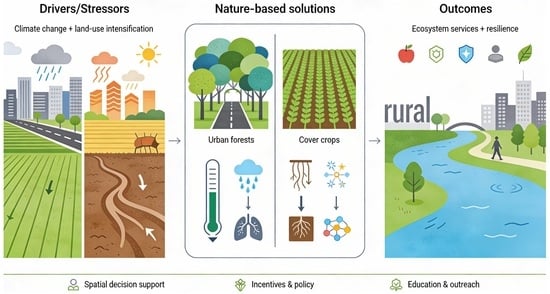
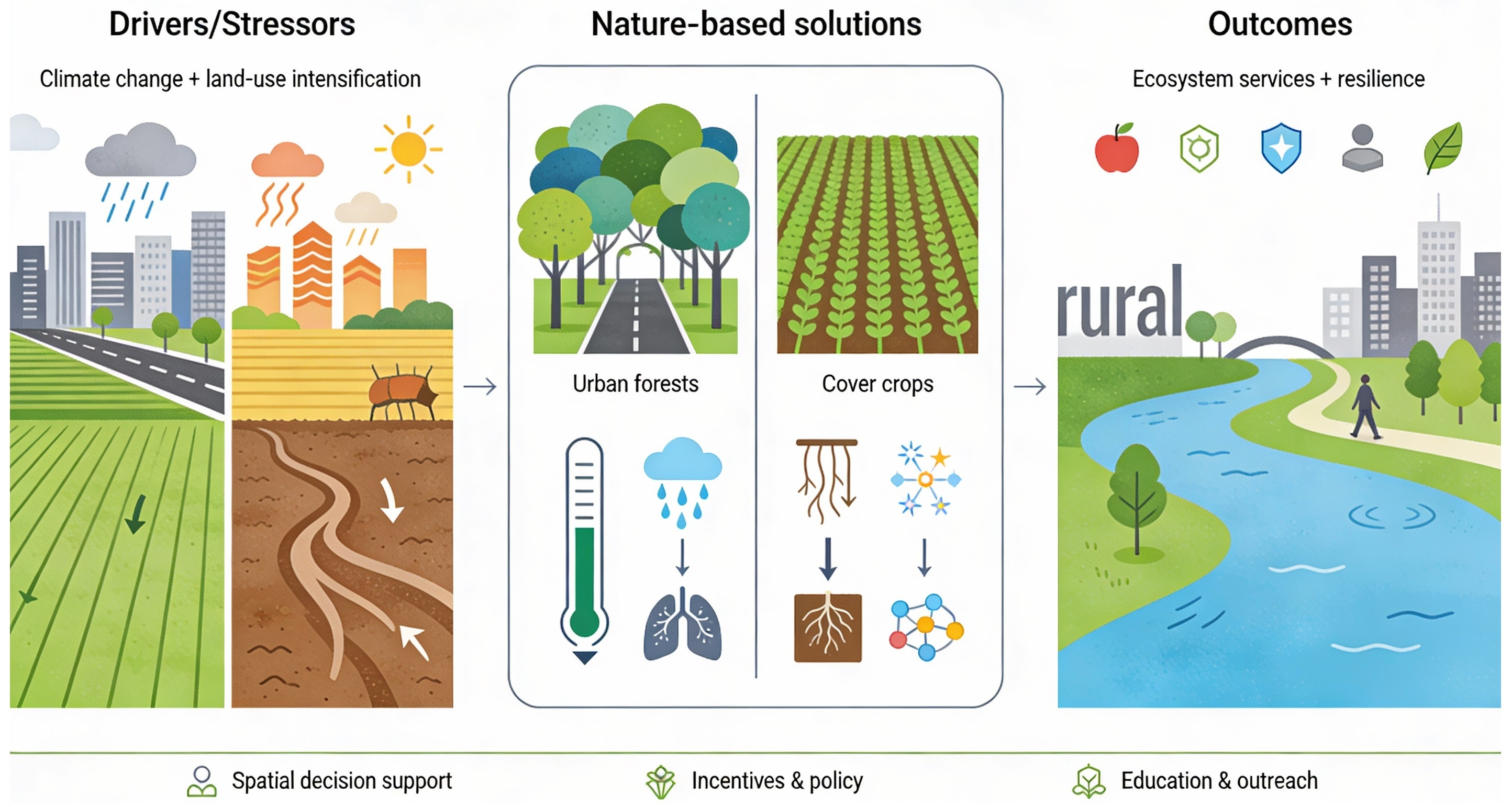
Graphical Abstract

1. Introduction

Global climate change and land-use intensification disrupt ecosystems, threatening health, food security, and stability. Rising temperatures, altered precipitation, and extreme weather worsen urban heat islands, degrade air and water quality, and accelerate soil erosion. Urban expansion and intensive farming fragment landscapes and reduce resilience, challenging global sustainability goals such as the SDGs and the Paris Agreement. UNEP Resolution 5 (UNEA-5) established “Nature-based Solutions” (NbS) as vital for tackling crises and defined them as actions in ecosystems to address challenges, providing a foundation for integrating nature into climate and development goals [1]. The resolution calls for guidelines, a process continued at later COPs, such as COP27 (climate) and COP15 (biodiversity). The Intergovernmental Science-Policy Platform on Biodiversity and Ecosystem Services (IPBES) recognizes NbS as a means to promote healthy ecosystems and address challenges such as climate change and biodiversity loss, thereby benefiting human well-being [2]. The Intergovernmental Panel on Climate Change (IPCC) recognizes NbS strategies, such as forest cover and improved management of working land, as among the top five strategies to mitigate carbon emissions. The European Union recognizes NbS as inspired and supported by nature and simultaneously provides environmental, social, and economic benefits to build sustainable and resilient societies [3]. The EU has funded diverse NbS projects to tackle the climate and biodiversity crisis in cities, landscapes, and seascapes [3].
Nature-based solutions (NbS) offer cost-effective ways to restore ecosystem services and support climate adaptation. Urban forests and agricultural cover crops regulate microclimates, improve air and water quality, sequester carbon, and enhance biodiversity. However, research often remains isolated—urban forestry mainly addresses heat and pollution, while cover crop studies focus on soil health, limiting integrated strategies across landscapes.
This review combines evidence on ecosystem services from urban forests and cover crops, assesses their joint potential for climate resilience, and explores tradeoffs and barriers to adoption. Viewing vegetation as a multifunctional tool can guide policies and investments toward sustainable land management and climate adaptation.

1.1. Ecosystems and Their Stressors

Human-driven land-use change and accelerating climate shifts are disrupting ecosystems and reducing essential services for health and stability. Stressors such as altered rainfall, rising temperatures, urban growth, and intensive agriculture degrade air, water, and soil quality, underscoring the need for cost-effective strategies across urban and rural areas.
Global trends illustrate the scale: since the late 19th century, temperatures have risen by 1.1 °C, increasing the frequency of heat waves [4], while precipitation has increased by 2%, with stronger storms [5]. These changes drive soil erosion, nutrient loss, and pollution, harming ecosystems and human well-being [6,7].
Land-use intensification compounds the impact. In 2025, cities are home to 45 per cent of the world’s population of 8.2 billion [8]. Urbanization affects 55% of people [9] and is expected to reach 70% by 2050 [10], creating more impacts from heat islands and disrupting hydrology. Agriculture occupies 4781 million ha, which is more than one-third of the global land area [11]. Land-use change is geographically divergent, with afforestation and cropland abandonment in the Global North and deforestation and agricultural expansion in the South [12]. These pressures demand resilience strategies addressing both climate and land-use stressors.
While measures like urban forests and cover crops reduce heat, slow runoff, and improve soil and water quality, research often isolates them by land-use type. This review integrates evidence from urban and agricultural systems to assess how NbS enhance ecosystem services and resilience, guiding policy and adaptation for sustainable landscapes.

1.2. Impacts on Urban and Rural Communities

The decline of natural processes is evident in urban heat islands, air pollution, health risks, runoff, droughts, and contaminated water in cities, and soil erosion, nutrient loss, and degraded water in rural areas [13,14,15,16]. Urban areas dominated by impervious surfaces—buildings, malls, schools, and industries—have low albedo, intensifying heat islands and raising temperatures by 3–4 °C, increasing heat stress and energy demand [9,17,18]. Higher temperatures also increase volatile organic compound levels, worsening air quality and health risks [19].
Extreme rainfall causes stormwater runoff from impervious surfaces, carrying contaminants into freshwater sources [20]. This contamination exposes communities to carcinogens, pharmaceuticals, and pesticides [7,20]. Nutrient leaching from erosion further degrades watersheds [21]. Conversely, prolonged drought limits water supply and groundwater recharge [22].
In rural areas, intense rainfall increases runoff and erosion—1% more rainfall can raise erosion by 1.7% [23]. Runoff carries pesticides and chemicals, harming water quality and farmers [20]. Rising temperatures reduce groundwater recharge, challenging irrigation for crop production [14,23].

1.3. Cover Crops and Urban Forests as Resilience Tools

Accelerating climate change and land-use intensification threaten ecosystems and human well-being, requiring affordable resilience strategies. Vegetation-based NbS restores ecological functions, buffers climate extremes, and reduces human impacts. Urban forests and agricultural cover crops provide complementary benefits across landscapes. Urban forests cool microclimates, mitigate heat islands, intercept stormwater, and remove pollutants while sequestering carbon [24,25]. Cover crops improve soil health and water management, reducing erosion and nutrient loss and enhancing fertility [23,26,27]. Mechanisms include canopy shading, root systems that enhance infiltration and nutrient flow, and foliage that filters pollutants [28,29]. Together, these strategies deliver, regulate, and support services, thereby strengthening resilience. Integrating them into planning offers cost-effective solutions for climate adaptation, biodiversity protection, and sustainable resource use.

2. Methodology

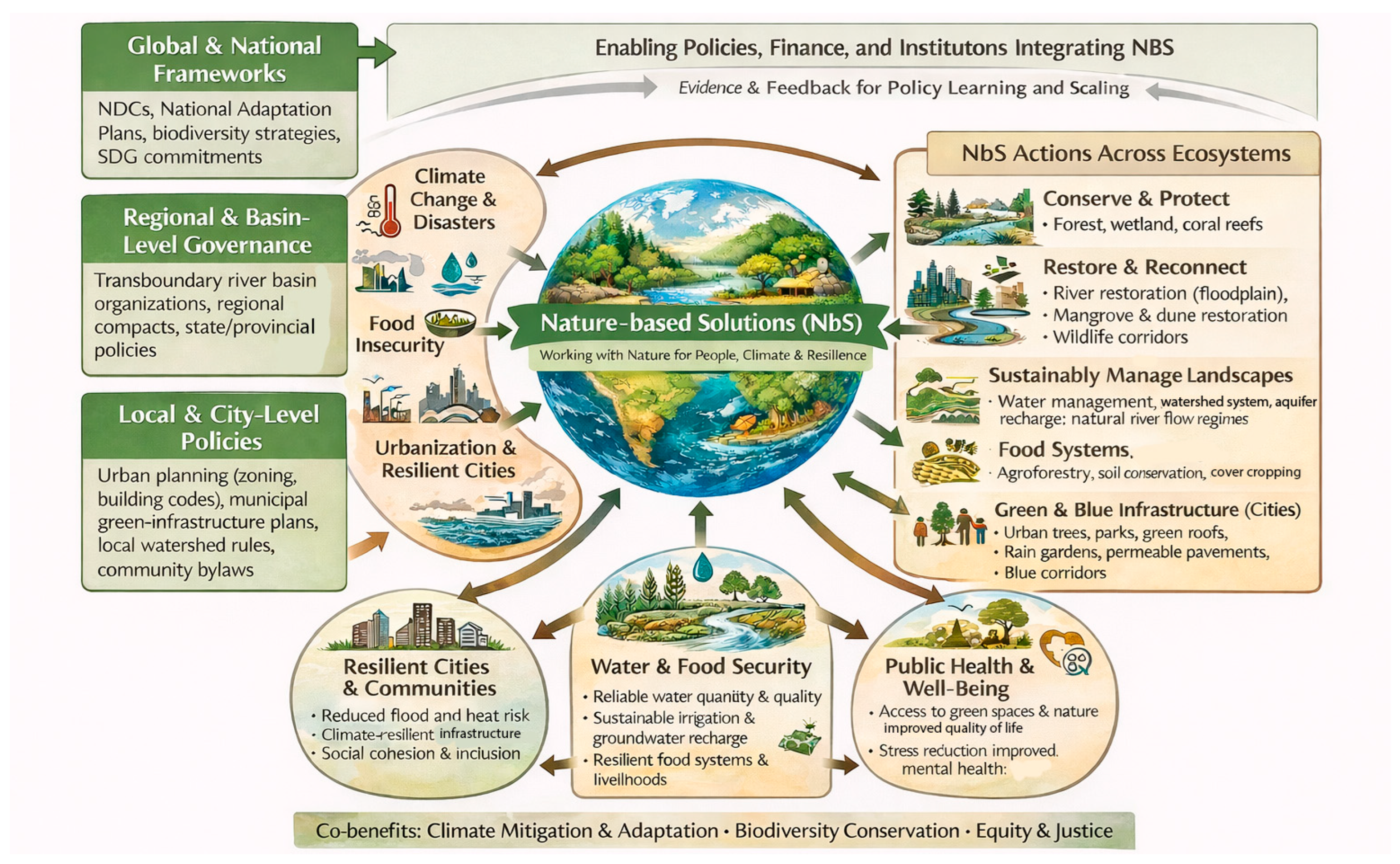
Figure 1 illustrates how climate change and land-use transformation drive ecosystem service loss, impacting community well-being in urban and rural areas. Rising temperatures, shifting precipitation, urbanization, and agricultural expansion degrade water quality, increase runoff and erosion, and create heat islands. These changes reduce ecosystem services, disproportionately affecting communities. The framework highlights vegetation-based strategies—urban forests and cover crops—as effective NbS delivering provisioning, regulating, supporting, and cultural services. Tools such as spatial planning, education, incentives, and policy reforms can enhance their adoption, thereby improving ecosystem functions and public health.
Vegetative cover strengthens climate resilience by providing diverse services, yet research often isolates urban and agricultural systems. This fragmented approach limits the development of integrated strategies for interconnected landscapes. Because planning and resource decisions occur at watershed scales, a comprehensive view is essential. To address this gap, we review empirical studies on ecosystem services from urban forests and cover crops.
Our goal was to identify co-benefits, guide resource allocation, and support the development of nature-based solutions that improve landscape-scale resilience to climate change. Specifically, this review had three objectives: (i) Assess the role of urban forests in reducing climate-related stressors through ecosystem services; (ii) Evaluate how cover crops contribute to climate adaptation and soil–water conservation in farming systems; and (iii) Find strategies to encourage community adoption of these interventions, highlighting their potential to improve human well-being and ecological health.
Ecosystem services discussed in this review include provisioning (such as food and raw materials), regulating (such as temperature regulation and improvements in air and water quality), supporting (such as nutrient cycling and soil formation), and cultural (such as recreation and aesthetic value). Each service directly affects public health, safety, and quality of life—ranging from improved air quality and lowered disease risk to increased food security and recreational opportunities [30,31,32,33,34,35,36].
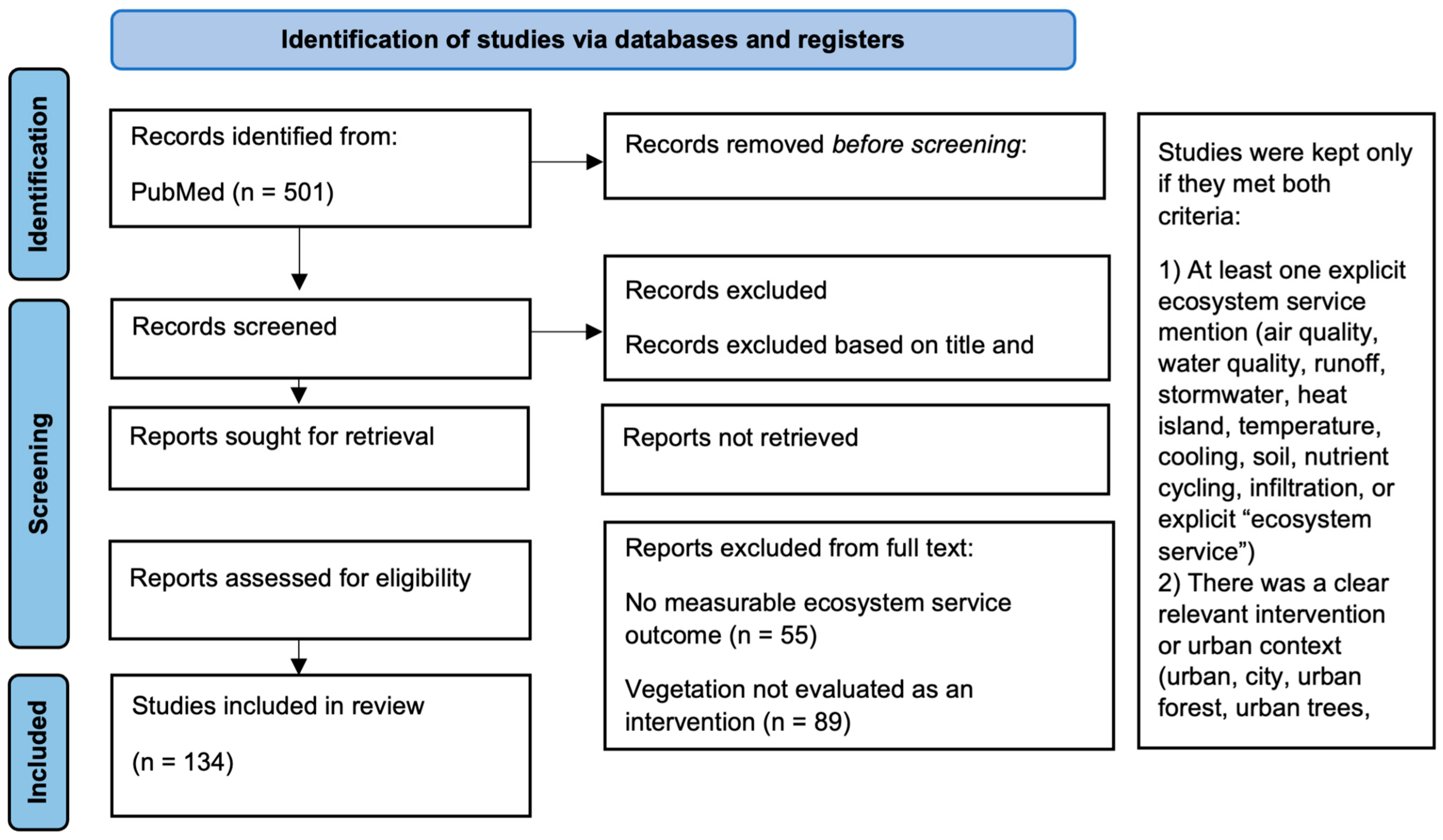
To identify relevant literature, we searched PubMed and Web of Science databases for empirical studies published over the past twenty years. The 20-year timeframe was selected to capture the period during which the ecosystem services framework became widely used, reflecting advances in methodology and the growth of urban greening and cover-crop research. Due to feasibility constraints, we included only English-language peer-reviewed studies. Records were retrieved and de-duplicated. Titles and abstracts were screened for relevance to vegetative interventions and measurable ecosystem service outcomes. Full texts were then assessed against the eligibility criteria. Reasons for exclusion at the full-text stage were recorded and are summarized in the PRISMA (Preferred Reporting Items for Systematic reviews and Meta-Analyses) flow diagram (Figure 2). Search terms included combinations of keywords such as ecosystem services, urban forests, cover crops, air quality, water quality, runoff, heat island, nutrient cycling, and soil properties. Boolean operators were used to create comprehensive queries (e.g., “ecosystem services AND urban forests,” “cover crops AND nutrient cycling,” “urban trees AND air quality”). Additional keywords used include ecosystem services, urban forests, urban trees, cover crops, soils, benefits, air quality, water quality, runoff, ambient temperature, nutrients, education, recreation, regulation, and soil properties. Studies were screened for relevance based on their focus on vegetative interventions and measurable ecosystem service outcomes.

3. Restorative Potential of Urban Forests

The restoration potential of urban forests is a critical NbS for enhancing city resilience and reintegrating ecological functions into the built environment to buffer against climate, environmental, and social shocks. By strategically restoring tree canopies, cities can leverage potent regulating services—lowering ambient temperatures by 2 °C to 8 °C to mitigate heat islands and absorbing up to 150 L of stormwater per tree per day to prevent flooding—thereby protecting critical infrastructure from extreme weather. Beyond physical protection, this restoration provides vital services and infrastructure that build resilient cities. Urban orchards and green spaces not only address food security by providing nutrition for vulnerable residents but also bolster social resilience by reducing stress, contributing to public health, improving mental health, and creating cohesive community spaces. Table 1 summarizes the ecosystem services of urban forests to assess their restorative potential.

3.1. Provisional Services of Urban Forests

Nutritional Value: Urban forests can boost food security by providing accessible, affordable nutrition and supporting sustainable city development. Initiatives such as planting fruit trees in public spaces or along bike paths have shown promise. For instance, modeling in Burlington, Vermont, revealed that planting 5% of available open space with apple trees could supply 7–20% of local calorie needs, while covering 50% could fully meet these needs [31]. Urban trees can contribute to nutrition, food sovereignty, and dietary diversity in cities [37,38,39]. Similar projects in Montreal and South Africa demonstrate additional benefits, including cultural importance and extra income [40,55]. However, adoption remains limited due to low public awareness and concerns about contamination or pests [40,56].
Raw Materials: Urban forests also provide valuable raw materials, such as firewood, lumber, and leaf litter, that enhance soil health and biofuel production. US urban trees produce about 28 million tons of leaf litter and 33 million tons of wood each year, valued at $551 million and between $86 million and $786 million, respectively [41]. In South Africa, 90% of households depend on firewood, and 20% rely on income from non-timber forest products [42]. Expanding these services requires systematic evaluation of urban food forest programs, public education, and better infrastructure for processing tree products [31,41].

3.2. Regulating Services of Urban Forests

Urban forests regulate microclimates, air quality, and water flow, providing essential health and environmental benefits.
Heat Regulation: Tree cover significantly reduces urban heat island effects. Studies show that a 1% increase in canopy cover can lower air temperature by approximately 0.14 °C, while coverage exceeding 40% provides the highest cooling [43]. Design also plays a role: layouts with a high sky-view factor (SVF) can cut surface temperatures by as much as 18.7 °C, whereas wind-corridor designs decrease air temperature by 0.6–0.8 °C [57]. Tree crown volume also affects cooling—adding 60,000 m3 within a 40 m radius can reduce temperature by 1 °C [58]. Species choice is critical: Liquidambar styraciflua achieves a 2 °C reduction with 24 trees per hectare, compared to 63 Eucalyptus camaldulensis, which achieves a 1 °C reduction. The cooling impact can extend up to 450 m from parks, equivalent to 2600 air conditioners [59].
Economic Benefits: Heat mitigation results in notable energy savings. In California, 9.1 million trees save 684 GWh annually, valued at $101 million [46]. Across the country, reducing heat islands could cut air conditioning use by 20%, saving $10 billion each year [60]. A 3% to 15% increase in property value compared to non-greened counterparts. In most cases, the benefits of urban trees outweigh the costs [61]. Trees in urban areas of the USA can provide a total value of $18.3 billion from air pollution removal ($5.4 billion), reduced building energy use ($5.4 billion), carbon sequestration ($4.8 billion), and avoided pollutant emissions ($2.7 billion) [62]. The annual benefits of urban green infrastructure for households within an 800 m range from 10,305,275 USD for nature areas to 59.7 million USD for city parks and 74 million USD for regional parks as amenity values [63].
Air Quality Regulation by Urban Forests: Urban forests play a vital role in reducing air pollution, including carbon monoxide (CO), sulfur dioxide (SO2), particulate matter (PM2.5 and PM10), ozone (O3), and nitrogen dioxide (NO2). These pollutants are associated with cardiovascular, neurological, and respiratory diseases, making their reduction essential for public health [62]. Climate change exacerbates atmospheric chemistry and pollutant formation, highlighting the need for effective mitigation strategies [64].
Natural area forests in New York City store a mean of 263.04 (95% CI 256.61, 270.40) Mg C ha−1 [65]. Trees remove approximately 25.6 tons of pollutants annually, saving $5.40 per tree and sequestering 1861 tons of CO2 worth $13,701 in Lisbon, Portugal [33]. Urban forests in Canada store roughly 27,297.8 kt C (−37%, +45%) in above and belowground biomass and sequester around 1497.7 kt C year−1 (−26%, +28%) [66]. Species such as Platanus spp., C. australis, and F. angustifolia provide the highest benefits. In cities, a higher forest patch connectivity and lower patch density lead to greater carbon sequestration capacity [67]. In Baltimore, Maryland, existing tree cover removes 211 tons of pollutants each year, delivering health benefits valued at $8.2 million; expanding canopy cover to 44.4% could add 173 tons of removal and another $6.3 million in benefits [30]. Similarly, projections for the Bronx, New York, estimate annual pollutant removal of 5.6–6.2 tons under different tree mortality scenarios [68]. On a broader scale, California’s 9.1 million urban trees store 7.78 million metric tons of CO2 and eliminate 2558 tons of pollutants each year [46].
Carbon sequestration is another important regulating service provided by urban forests. Atmospheric CO2 levels exceeded 400 ppm in 2013 [69], emphasizing the growing significance of carbon storage. Trees are significantly more effective than shrubs, storing up to 1000 times more carbon, with large trees exhibiting sequestration rates 90% higher than those of smaller trees [70]. The average amount of carbon stored per tree is approximately 238 kg, but this can range from 103 kg to over 3400 kg depending on the size and species [71]. Variation in sequestration rates can be attributed to tree type, size, traits, and their interactions [72], as well as tree health, growth rate, and site conditions [45]. In Hangzhou, China, urban forests offset 18.6% of industrial emissions, sequestering an average of 1.66 tons of carbon per hectare annually [73]. Across the United States, urban trees collectively store around 643 million tons of carbon, valued at $50.5 billion, and sequester 25.6 million tons each year, worth roughly $2 billion [45]. These benefits can vary over time, as shown by Landsat imagery in Syracuse, where carbon storage ranged from 146,800 to 149,430 tons over 14 years [74]. Studies in Florida also reveal that urban trees offset 1.8–3.4% of local CO2 emissions, with larger trees contributing disproportionately to carbon storage [75].
Stormwater Runoff Regulation by Urban Forests: Urban forests are vital for reducing stormwater runoff, especially as heavy rainfall events become more frequent due to climate change. Vegetation intercepts rainwater, reducing the amount that reaches the ground and runs off. For example, studies in Raleigh, North Carolina, show that urban forests can cut runoff by 9.1–21.4% [24], while estimates for the Bronx, New York, suggest annual reductions of about 2 million cubic feet [68]. On a larger scale, California’s 929,823 street trees intercept 26.19 million cubic meters of rain each year, valued at over $41 million [46]. Similarly, Lisbon’s urban trees prevent 186,773 cubic meters of stormwater, saving roughly $47.80 per tree [33]. In Beijing, green spaces captured 97.9 million cubic meters of runoff in 2012, and increasing canopy cover by 11% could boost retention by 30%, resulting in an economic benefit of $0.14 billion [76]. Urban forests can increase baseflows, benefiting streams in urban areas [77]. Forest cover in watersheds improves water quality [78] and enhances hydrologic ecosystem services [79].
Species-specific traits greatly influence interception and storage capacity. Deciduous trees intercept up to 22.7% of rainfall, compared to 16.7% for evergreens, with Albizia species performing best during low-intensity storms [80]. Conifers show the highest surface water storage, while broadleaf species store less [81]. Structural features such as branch angles and canopy density enhance stemflow and infiltration, and species with finer root biomass and faster growth, like Robinia pseudoacacia, excel in infiltration capacity [82]. Experimental studies confirm that interception varies widely: Ulmus procera reduced runoff by 26% under simulated rainfall, compared to 20% for Platanus × acerifolia and 5% for Corymbia maculata [83]. These findings highlight the importance of species selection and canopy design in optimizing stormwater management. Urban forests can benefit watershed systems by reducing stormwater runoff and water-quality impacts [84].
Health Benefits of Urban Forests: Urban forests reduce climate-related stressors and improve environmental quality. Extreme events like heatwaves and heavy rainfall worsen asthma, heart disease, stress, and mortality [69]. Vegetation mitigates these risks through shading, cooling, pollutant filtration, and calming green spaces that reduce noise and visual stress [25,85,86].
Tree canopy strongly correlates with mental health: living within 1000 m of greater canopy improves overall health [87]. Higher tree density lowers antidepressant prescriptions. A high density of street trees at 100 m around the home significantly reduced the probability of being prescribed antidepressants, especially for individuals with low socio-economic status [88]. Stress recovery rises 60% when canopy density increases from 2% to 62% [47]. Physiological data confirm less stress in natural settings [89].
Urban forests also support respiratory health by removing pollutants, preventing 850,000 acute cases, and saving $6.8 billion annually [25]. Urban forests can also contribute to biogenic volatile organic compounds (bVOC) and allergenic pollen [90]. About 76% of the street trees in the USA produce pollen allergens, and 24% emit potent allergens [91]. Still, higher canopy density reduces childhood asthma prevalence by 29% per standard deviation increase [92]. These findings emphasize health benefits and the importance of species selection to limit allergens. Tradeoffs between ecosystem services and disservices to maximize the benefits of urban vegetation are an essential aspect of NbS design to achieve resilient cities [90].
Cardiovascular and Chronic Disease Benefits of Urban Forests: Cardiovascular diseases remain the leading cause of death worldwide [93], and emerging evidence suggests that urban forests can help reduce related risks. Exposure to forest environments has been linked to decreases in systolic and diastolic blood pressure, improvements in cardiovascular biomarkers (including endothelin-1, homocysteine, and angiotensin levels), and better mood states compared to urban settings [49]. Similarly, visits to urban green spaces are associated with lower heart rates and increased heart rate variability, with more pronounced effects in forested areas than in urban parks [85]. Viewing greenery also correlates with lower blood pressure. However, these benefits decrease when air pollution and noise are taken into account, as PM10 and environmental noise are associated with higher blood pressure and reduced heart rate variability [85].
Urban forests also affect metabolic health. Analysis of California Health Interview Survey data showed that a 10% increase in tree cover was linked to a 29% improvement in overall health scores, a 19% reduction in obesity and type 2 diabetes, and a 7.4% decrease in hypertension [34]. Similarly, people living in areas with more than 30% canopy cover had significantly lower odds of heart disease (OR = 0.78), hypertension (OR = 0.83), and diabetes (OR = 0.69) than those living in areas with little canopy cover [94]. These findings highlight the potential for urban forestry as an affordable way to prevent and manage chronic diseases alongside traditional medical treatments. Future research should explore long-term impacts and help develop strategies to incorporate green infrastructure into public health planning.

3.3. Supporting Services of Urban Forests

Urban forests provide crucial supporting services that sustain ecosystem functions, including nutrient cycling, improved soil quality, and reduced nutrient leaching, all of which enhance water quality and ecological resilience [95].
Nutrient Cycling: Tree canopies serve as sinks for atmospheric pollutants and store essential nutrients across various components. Bark accumulates calcium, phosphorus, sulfur, and iron, while trunks contain magnesium, potassium, zinc, nitrogen, and manganese. The forest floor has elevated levels of zinc and copper, and understory plants supply nitrogen, potassium, and phosphorus. Soils beneath trees have higher carbon and nitrogen contents and higher carbon-to-nitrogen ratios, thereby boosting their nutrient-buffering capacity [51].
Nutrient Leaching: Urban forests help reduce nutrient leaching, which can contaminate groundwater and surface water. Studies show that trees generally have lower phosphorus leaching compared to turfgrass, with deciduous species performing better than evergreens [52]. In the Capitol Region Watershed, trees cut phosphorus leaching by 533 kg in 2012 and 1201 kg in 2013, worth $2.2 million and $5 million, respectively [52]. Experimental work in Australia demonstrated that species such as Eucalyptus polyanthemos, Platanus orientalis, Lophostemon confertus, and Callistemon salignus reduced oxidized nitrogen leaching by 2–78% and phosphorus leaching by 70–96%, with slight variation among species [96]. These results show how urban trees can help control nutrient flow and protect water quality when paired with proper management practices.

3.4. Cultural Services of Urban Forests

Urban forests provide a variety of cultural ecosystem services that boost social well-being, property values, education, and recreation [95]. Property Value: Trees increase urban property values, although the degree varies by location and species. In Florida, property values increase by about $1586 per tree, while replacing trees with grass reduces value [54]. In 50 cities in California, street trees added an extra $838.94 million to property values [46]. In Lisbon, Portugal, benefits averaged $145 per tree, totaling $5.97 million, with species such as Platanus spp., C. australis, and Tilia spp. offering the highest gains [33].
Heritage and Education: Trees frequently serve as cultural symbols and educational tools. In South African townships, residents appreciate trees for their historical and aesthetic value [55]. Exposure to tree canopies is associated with better academic performance; third graders in schools with more canopy cover tend to score higher in reading, signaling long-term educational achievement [97]. Urban fruit tree programs also encourage environmental learning and foster community connections. For example, users of Montreal’s bike-path orchards reported learning about food systems and species diversity while enjoying recreational and cultural activities [40].
Aesthetics and Recreation: Urban trees improve visual appeal and encourage outdoor activities. Surveys in China showed that 99% of respondents valued tree-covered areas, citing clean air (57%) and scenic beauty (53%) as main benefits [35]. Aesthetic preferences are closely linked to recreational activities like walking, exercising, and socializing [98]. Managing understory vegetation—such as maintaining low to medium-height plants and adding flowering species—can attract more visitors and boost health benefits [35]. People with a stronger connection to nature also travel farther to visit vegetated parks, highlighting the importance of urban forests in promoting well-being [99].

4. Restoration Potential of Cover Crops

Cover crops are a powerful NbS for restoring ecosystem services in agriculture [100,101]. They enhance yields, improve land health, and transform vulnerable, bare soil into resilient living ecosystems that withstand extreme weather. By maintaining a “living root” in the ground year-round, these crops—ranging from rye to clover—restore soil structure and porosity, significantly improving water infiltration and buffering against both severe flooding and drought. This restoration potential extends beyond physical protection; cover crops actively rebuild the soil microbiome and increase organic matter, sequestering approximately 0.4 to 0.9 metric tons of carbon per hectare annually. Ultimately, they serve as a critical restoration mechanism, reintegrating biodiversity into agricultural landscapes and providing essential habitat for pollinators and wildlife while reversing degradation caused by intensive tillage. Table 2 summarizes the ecosystem services of agricultural cover crops to assess their restorative potential.

4.1. Provisional Services of Cover Crops

Cover crops offer essential provisioning services that boost agricultural productivity and sustainability amid changing climate and land-use patterns. Research from regions such as the United States, Brazil, Turkey, and the United Kingdom shows their roles in increasing crop yields and as potential biofuel feedstocks.
Yield Improvement: Numerous cover crop species and mixtures significantly boost crop yields by improving soil structure, organic matter, and nutrient availability. Mixtures including oats, radish, vetch, phacelia, legumes, and buckwheat consistently deliver yield benefits, partly due to increased earthworm activity and weed suppression [114]. In Turkey, winter and summer cover crops increased apricot yields, with Vicia pannonica + triticale treatments raising fruit weight by 10.7% [32]. Similar results were observed in Florida tomato systems, where sunn hemp and velvet bean improved marketable yields across seasons [115]. In Colorado, sorghum-sudan grass boosted potato yields by 12–30% under limited irrigation [103]. Intercropping with palisade grass in Brazil raised soybean yields by up to 14%, oat yields by 24%, and corn yields by 12.7%, while also enhancing soil organic matter and fertility [102]. These results highlight the versatility of cover crops in increasing food production across diverse climates and soils. Factors influencing yield improvement include cover crop type, climate, field conditions, soil properties, and cover crop season [116].
Biofuel Potential: Beyond food production, cover crops such as winter rye offer bioenergy opportunities. Modeling studies indicate that adding winter rye to US corn-soybean systems could produce 112–151 Tg of biomass annually, with an energy potential of 2.0–2.6 EJ—enough to help meet part of the country’s building and transportation energy needs [104]. Cover crops produce 3.37 ± 2.96 Mg ha−1 (mean ± SD) of aboveground biomass and 1.33 ± 0.98 Mg ha−1 of belowground (root) biomass [26]. The amount of harvestable biomass ranges from 1–3 Mg ha−1 in semiarid regions and from 1–6 Mg ha−1 in the humid areas for high-biomass-producing cover crops [26]. This dual role in food and energy systems makes cover crops a vital part of sustainable agricultural landscapes.

4.2. Regulating Services of Cover Crops

Cover crops provide essential regulating services that improve soil–water interactions, decrease runoff, and control weeds, helping agricultural systems stay resilient in the face of changing climate conditions [26].
Water Regulation: Including cover crops improves soil hydraulic properties such as saturated hydraulic conductivity, sorptivity, and water retention. Studies in Turkey found a 16–19% increase in available water content with winter and summer cover crops, enhancing soil moisture for crops [32]. In corn systems, cover crops increased hydraulic conductivity by 75–85% and sorptivity by 82–90% compared to bare soil, with larger gains under tilled conditions [105]. Biomass-rich cover crops further boosted soil water retention [103]. Integrated practices such as reduced tillage and mulching increased water capture and storage by 20% during dry seasons in Uruguay [106]. These improvements also reduce irrigation needs for water-intensive crops such as potatoes and wheat, cutting reliance on pumped water by up to 50% [103].
Stormwater Runoff and Soil Loss: Cover crops help decrease runoff and soil erosion, especially when combined with conservation tillage. In tomato systems, runoff dropped from 54% to 6% with cover crops, and soil loss was reduced by over 98% [106]. The most significant improvement occurred when cover crops were used alongside reduced tillage, resulting in a 50% reduction in runoff [106]. Root traits play a key role: species with coarse roots (Melilotus officinalis, Lathyrus sativus) and dense roots (Linum usitatissimum) boosted infiltration and cut runoff by 17% during heavy rainfall [29]. These results emphasize the importance of choosing the right species and integrated management for optimal hydrological benefits. Cover crops also improve water quality by capturing nutrients in runoff and enabling water to infiltrate into agricultural fields [110].
Biological Control Services of Cover Crops: Cover crops provide effective biological control by suppressing soilborne pathogens and weeds. Species such as canola, mustard, rapeseed, and cereal rye have demonstrated benefits in reducing disease, with cereal rye offering the most potent effects against Rhizoctonia solani and Fusarium virgulifore [36]. Rapeseed and rye also lower root rot severity and soybean cyst nematode egg counts, resulting in higher soybean yields. However, their effectiveness can be influenced by seed germination rates, weather conditions, and glucosinolate levels [36].
Weed suppression is a crucial service. Cover crops decrease weed biomass, diversity, and density in mowed, soil-incorporated, and living forms [108]. Among the species tested, lacy phacelia achieved the highest suppression at 75%, followed by buckwheat at 73%, and hairy vetch at 63%. Successful weed control relies on biomass production, soil fertility, seeding rate, and the timing of sowing and termination [117]. For cereal rye, a biomass threshold of 8000 kg/ha is required for consistent weed suppression, and high-residue cultivation can further enhance weed control [117].

4.3. Supporting Services of Cover Crops

Cover crops improve soil health by enhancing nutrient cycling, nutrient retention, and soil properties. Simulations indicate that cover crops can offset soil carbon loss by 3%, reduce erosion by 11–29%, and lower nitrous oxide emissions by up to 34% [27]. Adding cover crops increases soil organic matter, nitrogen, and potassium, which boosts soil respiration and fertility [32]. Legumes are especially effective at storing soil organic carbon, converting 1 kg of residue into 0.15 kg of carbon—twice as efficiently as non-legumes [118]. No-tillage combined with legume cover crops and nitrogen fertilization yields the highest carbon gains [118]. Cover crops also help reduce nutrient losses: mustard, vetch, and vetch-oat mixes decrease soil organic carbon and nitrogen depletion by up to 88% under conventional tillage.
Species such as palisade grass improve nutrient cycling by increasing calcium, magnesium, potassium, and sulfur levels across soil layers [102]. Legume cover crops also fix nitrogen, supporting the growth of subsequent crops. For example, Vicia faba produced 6.86 t/ha of biomass and accumulated 186 kg/ha of nitrogen, while other legumes such as V. sativa and P. sativum exceeded 100 kg/ha [109]. Additionally, summer cover crops such as sorghum-sudan grass effectively cycle macronutrients, including zinc, copper, and manganese [103]. These processes decrease fertilizer needs and enhance long-term soil productivity.
Management Practices and Nutrient Leaching: The effectiveness of cover crops depends not only on species selection but also on management practices such as tillage and crop rotation. A study in Missouri showed that no-till farming increased soil organic matter by 4%, while adding cover crops boosted it by 8%, improving soil health and crop yield. Crop rotation also enhanced soil chemistry more than continuous cropping systems [105].
Cover crops also play a crucial role in reducing nitrate-nitrogen leaching, a leading cause of water pollution and hypoxia in downstream ecosystems. Winter cover crops can capture 100–300 lb of nitrogen per acre and reduce nitrate leaching by up to 184 lb. per acre in Colorado [103]. Rye cover crops decreased subsurface drainage by 9% annually and up to 21% during peak months [119]. In the Midwest, winter rye cut nitrogen loss by 42.5% (20.1 kg N/ha), with effectiveness affected by planting time and temperature [111]. Large-scale adoption could reduce nitrate losses by roughly 20% across 34–81% of cropland in states like Ohio, Indiana, and Iowa [120]. Field trials in Illinois showed that cereal rye and tillage radish absorbed 60–100% of applied nitrogen, lowering soil nitrate levels by up to 13% at depths of 20–80 cm [120]. These findings highlight the potential of cover crops as an affordable way to improve water quality and decrease nutrient pollution.

4.4. Cultural Services of Cover Crops

Cover crops provide critical cultural ecosystem services that extend beyond their agronomic and environmental benefits. By cover-cropping fields during otherwise bare, fallow periods, they enhance the aesthetic and scenic value of agricultural landscapes, contributing to a sense of place and landscape aesthetics [112]. They support cultural heritage and stewardship traditions, reinforcing farmer knowledge systems that emphasize soil care, seasonal cycles, and intergenerational learning. Cover crops also create opportunities for education, demonstration, and citizen science, serving as visible examples of sustainable agriculture in practice [113]. In many regions, they are tied to spiritual, ethical, and relational values associated with caring for the land, biodiversity, and future generations [121]. Their presence can improve psychological well-being by providing visual greenery and a connection to living landscapes during winter or dry seasons. Together, these cultural services shape how communities value, learn from, and relate to agricultural ecosystems, strengthening the social foundations for sustainable land management.

5. Discussion

5.1. Adoption Challenges and Educational Strategies

Despite the many benefits of vegetative cover, the adoption of cover crops and urban forests remains low [122]. Barriers include limited awareness among landowners, planners, and policymakers, as well as misconceptions about costs, crop yield effects, and long-term benefits [114,122,123]. Farmers often focus on short-term economic concerns rather than environmental resilience, while urban tree adoption is slowed by worries about allergens and volatile organic compounds [60,87]. Overcoming these challenges requires targeted education, incentives, policy support, and decision-making tools.
Educational Practices: Training programs and outreach can significantly improve adoption rates. In Spain, 62% of surveyed farmers expressed interest in agricultural training [124]. Small-group sessions led by experts can demonstrate how cover crops reduce fertilizer use, boost profitability, and conserve water [103]. Practical advice on biomass management—such as removal or sale after harvest—can further enhance benefits and decrease nitrogen leaching. Additional tools, such as newsletters and planting calendars, can reinforce best practices [125]. For urban forestry, educational programs that connect communities with nature—such as outdoor school activities and workplace events—can foster appreciation and encourage tree planting [99]. These strategies collectively support climate adaptation and sustainable land management.

5.2. Research Gaps and Future Directions

The existing evidence clearly indicates the restorative potential of vegetative cover, but several knowledge gaps remain. First, interactions between urban forests and cover crops across shared watersheds are seldom studied, despite their interconnected hydrological and biogeochemical effects. Long-term, multi-scalar research that links urban and rural interventions is necessary to clarify overall benefits and tradeoffs. Second, the significance of species selection requires closer investigation. Both urban forests and cover crops exhibit wide variation in ecosystem services based on traits, phenology, canopy features, and rooting depth. Future studies should focus on trait-based approaches to optimize vegetation design in both systems. Third, more research is needed on equity and environmental justice to ensure that the benefits of vegetation solutions are accessible to marginalized communities most impacted by climate risks, pollution, and degraded landscapes. Finally, integrated modeling frameworks capable of simulating effects across landscapes—linking air quality, water management, nutrient cycling, health outcomes, and economic impacts—will be essential for guiding policy and assessing long-term return on investment.

5.3. Incentives, Policy, and Decision Support Tools

Financial support from federal, state, and local governments can increase the adoption of vegetative cover. Methods such as tax credits, cost-sharing programs, and subsidies reduce implementation costs and encourage landowners to incorporate cover crops and urban forests into their landscapes. Collaboration between government agencies and communities can shift perceptions and encourage widespread adoption [60]. Protecting existing trees is crucial, as mature trees provide more ecosystem services than newly planted ones [68]. Policies should focus on tree maintenance and understory management to enhance visual appeal and promote recreational use, which boosts public health and climate resilience [35]. Spatial decision-support systems help communities evaluate multiple ecosystem services simultaneously and optimize vegetation cover strategies. These tools should be user-friendly, adaptable to local contexts, and accessible to planners, researchers, health professionals, and the public. Uses include urban design, watershed planning, and preventive health programs like urban forestry therapy. Developing such tools requires interdisciplinary collaboration to integrate ecological, economic, and social data to improve decision-making [30,58].

5.4. Limitations and Caveats

Nature-based solutions such as urban forests and cover crops are not universally effective; their performance depends on economic, ecological, climatic, social, and institutional contexts. Existing literature does not always capture these interacting factors, and significant geographic gaps persist, with most evidence coming from Europe and North America. At the same time, data from the Global South remains limited despite high vulnerability. Evidence-based implementation is therefore essential, drawing on local monitoring and evaluation across diverse social–ecological settings, and on the inclusion of Indigenous and community knowledge to guide adaptive, scalable planning and policy [126,127].
Implementation also faces biophysical and management limitations, and it involves trade-offs among ecosystem services. Benefits depend on species selection, soils, hydrology, and climate, as well as sustained investment in maintenance; time lags between action and benefits can weaken stakeholder support. Urban trees may create disservices such as pollen allergies, infrastructure damage, or maintenance burdens. At the same time, cover crops may compete for water or nutrients, complicate planting schedules, or reduce yields in dry years. Because outcomes are highly context-dependent, locally informed design, adaptive management, and participatory planning are crucial to maximize co-benefits and minimize risks.

6. Conclusions

This review synthesizes twenty years of evidence to show that urban forests and agricultural cover crops, though often managed separately, operate as complementary nature-based solutions that strengthen landscape-scale resilience. Urban forests mitigate heat islands, filter air pollution, and intercept stormwater, directly benefiting public health. Cover crops restore rural systems by increasing soil organic matter, improving water infiltration, reducing erosion, and limiting nutrient leaching that degrades watersheds. Together, these vegetative strategies address shared stressors such as climate extremes and land degradation across the urban–rural continuum.
To scale these benefits, management must shift from fragmented approaches to integrated policy frameworks that incentivize adoption and education. Priorities include financial incentives such as tax credits and cost-sharing, policies that protect mature tree canopies and support sustainable crop rotations, and accessible spatial decision-support tools to guide planning and maximize co-benefits. Integrating these strategies into climate adaptation, public health, and land-use planning will help translate scientific potential into on-the-ground implementation, supporting resilient and sustainable communities.

6.1. Vegetation as a Cross-Landscape Climate Adaptation Strategy

Together, urban forests and cover crops strengthen climate resilience and environmental health. Urban forests cool cities, reduce air pollution, manage stormwater, and store carbon, providing direct public-health benefits and mitigating urban heat and flooding. Cover crops improve soil health by enhancing soil–water interactions, increasing organic matter, suppressing weeds and diseases, reducing erosion and nutrient leaching, and supporting microbial activity, which boosts fertility and yields. Working at different scales—urban and agricultural—these vegetation strategies complement one another by improving water quality, stabilizing microclimates, and increasing carbon storage across entire watersheds.

6.2. Societal Co-Benefits and Human Health Outcomes

A key discovery of this synthesis is the broad range of co-benefits for human health and societal well-being. Urban forests reduce the risk of chronic diseases, support mental health, provide cultural and educational resources, and improve neighborhood aesthetics—factors closely connected to physical activity, social cohesion, and reduced stress levels. Cover crops indirectly support health by enhancing water quality and lowering nitrate contamination, a significant public health concern in agricultural areas. Together, these benefits result in cleaner air, safer water supplies, improved thermal comfort, and decreased exposure to environmental hazards. These co-benefits reinforce the idea that investments in nature-based solutions should be seen not only as ecological or agricultural strategies but as comprehensive public health, climate adaptation, and economic development initiatives.

6.3. Overcoming Barriers Through Policy, Incentives, and Decision-Support Tools

Adoption of cover crops and urban forests remains limited despite clear benefits, primarily due to economic uncertainty, limited technical knowledge, weak institutional support, and misconceptions about costs and risks. The main barriers are system-level rather than ecological. Expanding adoption will require tailored incentive programs, supportive policies that protect mature urban trees and encourage sustainable farming rotations, accessible decision-support tools that integrate environmental and socio-economic data, and education and outreach demonstrating long-term resilience, cost savings, and health benefits. Successful implementation must be adapted to local ecological, climatic, and social conditions.

6.4. Toward Integrated, Multiscale Vegetation Strategies

Vegetation is a powerful, cost-effective strategy for building resilient, healthy, and sustainable communities. Urban forests and cover crops provide essential ecosystem services that help address climate extremes, soil and water degradation, biodiversity loss, and public health risks, showing that urban and agricultural landscapes are interconnected parts of a broader social–ecological system [127]. Widespread adoption depends on coordinated action among science, policy, and communities, including integration into climate adaptation, land-use planning, and public-health strategies. Restoring ecosystem services through vegetation offers a practical pathway to climate resilience and human well-being, contingent on aligning incentives, bridging disciplines, and empowering communities to implement nature-based solutions at meaningful scales.

Author Contributions

Conceptualization, A.I. and T.O.R.; methodology, A.I., and T.O.R.; software, A.I.; validation, A.I., R.R. and T.O.R.; formal analysis, A.I., and T.O.R.; investigation, A.I., and T.O.R.; resources, R.R., and T.O.R.; data curation, A.I.; writing—original draft preparation, A.I., and T.O.R.; writing—review and editing, A.I., R.R., and T.O.R.; visualization, T.O.R.; supervision, T.O.R.; project administration, T.O.R.; funding acquisition, T.O.R. All authors have read and agreed to the published version of the manuscript.

Funding

This research was funded by the National Institute of Food and Agriculture, CSREES, US Department of Agriculture, and the Massachusetts Agricultural Experiment Station (MAES) grant numbers MAS00036, MAS00035, and MAS00045.

Institutional Review Board Statement

Not applicable.

Data Availability Statement

No new data were created or analyzed in this study. Data sharing is not applicable to this article.

Conflicts of Interest

The authors declare no conflict of interest.

References

  1. UNEP. Nature-Based Solutions for Supporting Sustainable Development (English Version)—Resolution Adopted by the United Nations Environment Assembly on 2 March 2022 [UNEP/EA.5/Res.5]. 2022. Available online: https://wedocs.unep.org/handle/20.500.11822/39864 (accessed on 25 November 2025).
  2. IPBES. Global Assessment Report on Biodiversity and Ecosystem Services of the Intergovernmental Science-Policy Platform on Biodiversity and Ecosystem Services; Brondizio, E.S., Settele, J., Díaz, S., Ngo, H.T., Eds.; IPBES Secretariat: Bonn, Germany, 2019; 1148p. [Google Scholar] [CrossRef]
  3. European Commission. Nature-Based Solutions—EU-Funded NBS Research Projects Tackle the Climate and Biodiversity Crisis, European Research Executive Agency, Publications Office of the European Union. 2024. Available online: https://data.europa.eu/doi/10.2848/8542246 (accessed on 1 December 2025).
  4. National Aeronautics and Space Administration [NASA]. Global Climate Change: Evidence. How Do We Know Climate Change Is Real? 2022. Available online: https://climate.nasa.gov/evidence/ (accessed on 1 November 2024).
  5. O’Gorman, P.A. Precipitation extremes under climate change. Curr. Clim. Chang. Rep. 2015, 1, 49–59. [Google Scholar] [CrossRef]
  6. Balser, T.C.; Liang, C.; Gutknecht, J.L.M. How will climate change impact soil microbial communities? In Soil Microbiology and Sustainable Crop Production; Springer: Dordrecht, The Netherlands, 2010; pp. 373–397. [Google Scholar]
  7. Talib, A.; Randhir, T.O. Managing emerging contaminants in watersheds: Need for comprehensive, systems-based strategies. Sustain. Water Qual. Ecol. 2017, 9–10, 1–8. [Google Scholar] [CrossRef]
  8. UN. World Urbanization Prospects 2025 Summary of Results. United Nations Department of Economic and Social Affairs, NY, USA. 2025. Available online: https://www.un.org/development/desa/pd/ (accessed on 2 January 2026).
  9. McDonald, R.I.; Marcotullio, P.J.; Güneralp, B. Urbanization and global trends in biodiversity and ecosystem services. In Urbanization, Biodiversity and Ecosystem Services: Challenges and Opportunities; Elmqvist, T., Fragkias, M., Goodness, J., Güneralp, B., Marcotullio, P.J., McDonald, R.I., Parnell, S., Schewenius, M., Sendstad, M., Seto, K.C., et al., Eds.; Springer: Dordrecht, The Netherlands, 2013. [Google Scholar] [CrossRef]
  10. Li, X.S. Rapid Global Urbanization. In Building Digital Twin Metaverse Cities: Revolutionizing Cities with Emerging Technologies; Apress: Berkeley, CA, USA, 2024; pp. 3–6. [Google Scholar]
  11. FAO. Land Statistics 2001–2022—Global, Regional and Country Trends; FAOSTAT Analytical Briefs, No. 88; FAO: Rome, Italy, 2024. [Google Scholar]
  12. Winkler, K.; Fuchs, R.; Rounsevell, M.; Herold, M. Global land use changes are four times greater than previously estimated. Nat. Commun. 2021, 12, 2501. [Google Scholar] [CrossRef]
  13. Corburn, J. Cities, climate change and urban heat island mitigation: Localizing global environmental science. Urban Stud. 2009, 46, 413–427. [Google Scholar] [CrossRef]
  14. Dettinger, M.D.; Earman, S. Western ground water and climate change—Pivotal to supply sustainability or vulnerable in its own right? Assoc. Ground Water Sci. Eng. 2007, 1, 4–5. [Google Scholar]
  15. Luber, G.; McCeehin, M. Climate change and extreme heat events. Am. J. Prev. Med. 2008, 35, 429–435. [Google Scholar] [CrossRef]
  16. McDonald, A.; Bealey, W.; Fowler, D.; Dragosits, U.; Skiba, U.; Smith, R.; Donovan, R.; Brett, H.; Hewitt, C.; Nemitz, E. Quantifying the effect of urban tree planting on concentrations and depositions of PM10 in two UK conurbations. Atmos. Environ. 2007, 41, 8455–8467. [Google Scholar] [CrossRef]
  17. McDonnell, M.J.; Pickett, S.T.; Groffman, P.; Bohlen, P.; Pouyat, R.V.; Zipperer, W.C.; Parmelee, R.W.; Carreiro, M.M.; Medley, K. Ecosystem processes along an urban-to-rural gradient. In Urban Ecology; Springer: Boston, MA, USA, 2008; pp. 299–313. [Google Scholar]
  18. Solecki, W.; Marcotullio, P.J. Climate change and urban biodiversity vulnerability. In Urbanization, Biodiversity and Ecosystem Services: Challenges and Opportunities; Springer: Dordrecht, The Netherlands, 2013; pp. 485–504. [Google Scholar]
  19. Ramírez, O.; Mura, I.; Franco, J.F. How do people understand urban air pollution? Exploring citizens’ perception on air quality, its causes and impacts in Colombian cities. Open J. Air Pollut. 2017, 6, 1–17. [Google Scholar] [CrossRef]
  20. Talib, A.; Randhir, T.O. Managing emerging contaminants: Status, impacts, and watershed-wide strategies. Expo. Health 2016, 8, 143–158. [Google Scholar] [CrossRef]
  21. Dosskey, M.G.; Vidon, P.; Gurwick, N.P.; Allan, C.J.; Duval, T.P.; Lowrance, R. The role of riparian vegetation in protecting and improving chemical water quality in streams. JAWRA J. Am. Water Resour. Assoc. 2010, 46, 261–277. [Google Scholar] [CrossRef]
  22. Rachunok, B.; Fletcher, S. Socio-hydrological drought impacts on urban water affordability. Nat. Water 2023, 1, 83–94. [Google Scholar] [CrossRef]
  23. Walthall, C.L.; Hatfield, J.; Backlund, P.; Lengnick, L.; Marshall, E.; Walsh, M.; Adkins, S.; Aillery, M.; Ainsworth, E.A.; Ammann, C.; et al. Climate Change and Agriculture in the United States: Effects and Adaptation. USDA Technical Bulletin 1935. Washington, DC, USA, 2012; 186p. Available online: https://www.usda.gov/sites/default/files/documents/CC%20and%20Agriculture%20Report%20(02-04-2013)b.pdf (accessed on 2 November 2020).
  24. Inkiläinen, E.N.; McHale, M.R.; Blank, G.B.; James, A.L.; Nikinmaa, E. The role of the residential urban forest in regulating throughfall: A case study in Raleigh, North Carolina, USA. Landsc. Urban Plan. 2013, 119, 91–103. [Google Scholar] [CrossRef]
  25. Nowak, D.J.; Hirabayashi, S.; Bodine, A.; Greenfield, E. Tree and forest effects on air quality and human health in the United States. Environ. Pollut. 2014, 193, 119–129. [Google Scholar] [CrossRef]
  26. Blanco-Canqui, H.; Shaver, T.M.; Lindquist, J.L.; Shapiro, C.A.; Elmore, R.W.; Francis, C.A.; Hergert, G.W. Cover crops and ecosystem services: Insights from studies in temperate soils. Agron. J. 2015, 107, 2449–2474. [Google Scholar] [CrossRef]
  27. Basche, A.D.; Archontoulis, S.V.; Kaspar, T.C.; Jaynes, D.B.; Parkin, T.B.; Miguez, F.E. Simulating long-term impacts of cover crops and climate change on crop production and environmental outcomes in the Midwestern United States. Agric. Ecosyst. Environ. 2016, 218, 95–106. [Google Scholar] [CrossRef]
  28. Hirabayashi, S.; Nowak, D.J. Comprehensive national database of tree effects on air quality and human health in the United States. Environ. Pollut. 2016, 215, 48–57. [Google Scholar] [CrossRef] [PubMed]
  29. Yu, Y.; Loiskandl, W.; Kaul, H.-P.; Himmelbauer, M.; Wei, W.; Chen, L.; Bodner, G. Estimation of runoff mitigation by morphologically different cover crop root systems. J. Hydrol. 2016, 538, 667–676. [Google Scholar] [CrossRef]
  30. Bodnaruk, E.; Kroll, C.; Yang, Y.; Hirabayashi, S.; Nowak, D.; Endreny, T. Where to plant urban trees? A spatially explicit methodology to explore ecosystem service tradeoffs. Landsc. Urban Plan. 2017, 157, 457–467. [Google Scholar] [CrossRef]
  31. Clark, K.H.; Nicholas, K.A. Introducing urban food forestry: A multifunctional approach to increase food security and provide ecosystem services. Landsc. Ecol. 2013, 28, 1649–1669. [Google Scholar] [CrossRef]
  32. Demir, Z.; Tursun, N.; Işık, D. Effects of different cover crops on soil quality parameters and yield in an apricot orchard. Int. J. Agric. Biol. 2019, 21, 399–408. [Google Scholar]
  33. Soares, A.L.; Rego, F.C.; McPherson, E.G.; Simpson, J.R.; Peper, P.J.; Xiao, Q. Benefits and costs of street trees in Lisbon, Portugal. Urban For. Urban Green. 2011, 10, 69–78. [Google Scholar] [CrossRef]
  34. Ulmer, J.M.; Wolf, K.L.; Backman, D.R.; Tretheway, R.L.; Blain, C.J.; O’Neil-Dunne, J.P.; Frank, L.D. Multiple health benefits of urban tree canopy: The mounting evidence for a green prescription. Health Place 2016, 42, 54–62. [Google Scholar] [CrossRef]
  35. Wang, R.; Zhao, J.; Meitner, M.J. Urban woodland understory characteristics in relation to aesthetic and recreational preference. Urban For. Urban Green. 2017, 24, 55–61. [Google Scholar] [CrossRef]
  36. Wen, L.; Lee-Marzano, S.; Ortiz-Ribbing, L.M.; Gruver, J.; Hartman, G.L.; Eastburn, D.M. Suppression of soilborne diseases of soybean with cover crops. Plant Dis. 2017, 101, 1918–1928. [Google Scholar] [CrossRef]
  37. Bunge, A.; Diemont, S.A.W.; Bunge, J.A.; Harris, S. Urban foraging for food security and sovereignty: Quantifying edible forest yield in Syracuse, New York using four common fruit-and nut-producing street tree species. J. Urban Ecol. 2019, 5, juy028. [Google Scholar] [CrossRef]
  38. Shackleton, C.M.; Hurley, P.T.; Dahlberg, A.C.; Emery, M.R.; Nagendra, H. Urban foraging: A ubiquitous human practice overlooked by urban planners, policy, and research. Sustainability 2017, 9, 1884. [Google Scholar] [CrossRef]
  39. Junbeck, A.L.; Proud, M.M.; Parihar, P.V. Utilizing Urban Food Forests to Improve Nutrition, UN Science-Policy Brief for the Multistakeholder Forum on Science, Technology and Innovation for the SDGs, May 2022. Available online: https://sdgs.un.org/sites/default/files/2022-05/2.4.13-21-Urban%20food%20forests%20improve%20nutrition.pdf (accessed on 6 June 2023).
  40. Colinas, J.; Bush, P.; Manaugh, K. The socio-environmental impacts of public urban fruit trees: A Montreal case-study. Urban For. Urban Green. 2019, 45, 126132. [Google Scholar] [CrossRef]
  41. Nowak, D.J.; Greenfield, E.J.; Ash, R.M. Annual biomass loss and potential value of urban tree waste in the United States. Urban For. Urban Green. 2019, 46, 126469. [Google Scholar] [CrossRef]
  42. Kaoma, H.; Shackleton, C.M. The direct-use value of urban tree non-timber forest products to household income in poorer suburbs in South African towns. For. Policy Econ. 2015, 61, 104–112. [Google Scholar] [CrossRef]
  43. Ziter, C.D.; Pedersen, E.J.; Kucharik, C.J.; Turner, M.G. Scale-dependent interactions between tree canopy cover and impervious surfaces reduce daytime urban heat during summer. Proc. Natl. Acad. Sci. USA 2019, 116, 7575–7580. [Google Scholar] [CrossRef]
  44. Duncan, J.M.A.; Boruff, B.; Saunders, A.; Sun, Q.; Hurley, J.; Amati, M. Turning down the heat: An enhanced understanding of the relationship between urban vegetation and surface temperature at the city scale. Sci. Total Environ. 2019, 656, 118–128. [Google Scholar] [CrossRef]
  45. Nowak, D.J.; Greenfield, E.J.; Hoehn, R.E.; Lapoint, E. Carbon storage and sequestration by trees in urban and community areas of the United States. Environ. Pollut. 2013, 178, 229–236. [Google Scholar] [CrossRef]
  46. McPherson, E.G.; van Doorn, N.; de Goede, J. Structure, function and value of street trees in California, USA. Urban For. Urban Green. 2016, 17, 104–115. [Google Scholar] [CrossRef]
  47. Jiang, B.; Li, D.; Larsen, L.; Sullivan, W.C. A dose-response curve describing the relationship between urban tree cover density and self-reported stress recovery. Environ. Behav. 2016, 48, 607–629. [Google Scholar] [CrossRef]
  48. Taylor, M.S.; Wheeler, B.W.; White, M.P.; Economou, T.; Osborne, N.J. Research note: Urban street tree density and antidepressant prescription rates—A cross-sectional study in London, UK. Landsc. Urban Plan. 2015, 136, 174–179. [Google Scholar] [CrossRef]
  49. Mao, G.-X.; Cao, Y.-B.; Lan, X.-G.; He, Z.-H.; Chen, Z.-M.; Wang, Y.-Z.; Hu, X.-L.; Lv, Y.-D.; Wang, G.-F.; Yan, J. Therapeutic effect of forest bathing on human hypertension in the elderly. J. Cardiol. 2012, 60, 495–502. [Google Scholar] [CrossRef]
  50. Bratman, G.N.; Anderson, C.B.; Berman, M.G.; Cochran, B.; de Vries, S.; Flanders, J.; Folke, C.; Frumkin, H.; Gross, J.J.; Hartig, T.; et al. Nature and mental health: An ecosystem service perspective. Sci. Adv. 2019, 5, eaax0903. [Google Scholar] [CrossRef]
  51. Livesley, S.J.; Ossola, A.; Threlfall, C.G.; Hahs, A.K.; Williams, N.S.G. Soil carbon and carbon/nitrogen ratio change under tree canopy, tall grass, and turf grass areas of urban green space. J. Environ. Qual. 2016, 45, 215–223. [Google Scholar] [CrossRef] [PubMed]
  52. Nidzgorski, D.A.; Hobbie, S.E. Urban trees reduce nutrient leaching to groundwater. Ecol. Appl. 2016, 26, 1566–1580. [Google Scholar] [CrossRef]
  53. Yu, J.; Zhang, H.; Dong, X.; Shen, J. The impact of street greenery on active travel: A narrative systematic review. Front. Public Health 2024, 12, 1337804. [Google Scholar] [CrossRef] [PubMed]
  54. Escobedo, F.J.; Adams, D.C.; Timilsina, N. Urban Forest structure effects on property value. Ecosyst. Serv. 2015, 12, 209–217. [Google Scholar] [CrossRef]
  55. Shackleton, S.; Chinyimba, A.; Hebinck, P.; Shackleton, C.; Kaoma, H. Multiple benefits and values of trees in urban landscapes in two towns in northern South Africa. Landsc. Urban Plan. 2015, 136, 76–86. [Google Scholar] [CrossRef]
  56. McLain, R.; Poe, M.; Hurley, P.T.; Lecompte-Mastenbrook, J.; Emery, M.R. Producing edible landscapes in Seattle’s urban forest. Urban For. Urban Green. 2012, 11, 187–194. [Google Scholar] [CrossRef]
  57. Tan, Z.; Lau, K.K.-L.; Ng, E. Urban tree design approaches for mitigating daytime urban heat island effects in a high-density urban environment. Energy Build. 2016, 114, 265–274. [Google Scholar] [CrossRef]
  58. Rafiee, A.; Dias, E.; Koomen, E. Local impact of tree volume on nocturnal urban heat island: A case study in Amsterdam. Urban For. Urban Green. 2016, 16, 50–61. [Google Scholar] [CrossRef]
  59. Sugawara, H.; Shimizu, S.; Takahashi, H.; Hagiwara, S.; Narita, K.-I.; Mikami, T.; Hirano, T. Thermal influence of a large green space on a hot urban environment. J. Environ. Qual. 2016, 45, 125–133. [Google Scholar] [CrossRef]
  60. Sabrin, S.; Karimi, M.; Nazari, R.; Pratt, J.; Bryk, J. Effects of different urban-vegetation morphology on the canopy-level thermal comfort and the cooling benefits of shade trees: Case-study in Philadelphia. Sustain. Cities Soc. 2021, 66, 102684. [Google Scholar] [CrossRef]
  61. Song, X.P.; Tan, P.Y.; Edwards, P.; Richards, D. The economic benefits and costs of trees in urban forest stewardship: A systematic review. Urban For. Urban Green. 2018, 29, 162–170. [Google Scholar] [CrossRef]
  62. Nowak, D.J.; Hirabayashi, S.; Doyle, M.; McGovern, M.; Pasher, J. Air pollution removal by urban forests in Canada and its effect on air quality and human health. Urban For. Urban Green. 2018, 29, 40–48. [Google Scholar] [CrossRef]
  63. Dell’Anna, F.; Bravi, M.; Bottero, M. Urban Green infrastructures: How much did they affect property prices in Singapore? Urban For. Urban Green. 2022, 68, 127475. [Google Scholar] [CrossRef]
  64. Portier, C.; Tart, K.T.; Carter, S.; Dilworth, C.; Grambsch, A.; Gohlke, J.; Hess, J.; Howard, S.; Luber, G.; Lutz, J.; et al. A Human Health Perspective on Climate Change: A Report Outlining the Research Needs on the Human Health Effects of Climate Change. Report Published by Environ. Health Perspectives. 2013. Available online: https://www.cdc.gov/climate-health/media/pdfs/HHCC_Final_508.pdf (accessed on 6 April 2020).
  65. Pregitzer, C.C.; Hanna, C.; Charlop-Powers, S.; Bradford, M.A. Estimating carbon storage in urban forests of New York City. Urban Ecosyst. 2022, 25, 617–631, Erratum in Urban Ecosyst. 2022, 25, 1027. [Google Scholar] [CrossRef]
  66. Steenberg, J.W.N.; Ristow, M.; Duinker, P.N.; Lapointe-Elmrabti, L.; MacDonald, J.D.; Nowak, D.J.; Pasher, J.; Flemming, C.; Samson, C. A national assessment of urban forest carbon storage and sequestration in Canada. Carbon Balance Manag. 2023, 18, 11. [Google Scholar] [CrossRef]
  67. Guo, Y.; Ren, Z.; Wang, C.; Zhang, P.; Ma, Z.; Hong, S.; Hong, W.; He, X. Spatiotemporal patterns of urban forest carbon sequestration capacity: Implications for urban CO2 emission mitigation during China’s rapid urbanization. Sci. Total Environ. 2024, 912, 168781. [Google Scholar] [CrossRef]
  68. Nyelele, C.; Kroll, C.N.; Nowak, D.J. Present and future ecosystem services of trees in the Bronx, NY. Urban For. Urban Green. 2019, 42, 10–20. [Google Scholar] [CrossRef]
  69. National Aeronautics and Space Administration. Graphic: The Relentless Rise of Carbon Dioxide. 2020. Available online: https://climate.nasa.gov/climate_resources/24/graphic-the-relentless-rise-of-carbon-dioxide/ (accessed on 15 September 2020).
  70. Nowak, D.J. Improved air quality and other services from urban trees and forests. In Engineering and Ecosystems: Seeking Synergies Toward a Nature-Positive World; Springer International Publishing: Cham, Switzerland, 2023; pp. 215–245. [Google Scholar]
  71. Zhao, C.; Sander, H.A. Quantifying and mapping the supply of and demand for carbon storage and sequestration service from urban trees. PLoS ONE 2015, 10, e0136392. [Google Scholar] [CrossRef] [PubMed]
  72. Simovic, M.; Mueller, K.E.; McMahon, S.M.; Medeiros, J.S. Functional traits and size interact to influence growth and carbon sequestration among trees in urban greenspaces. Funct. Ecol. 2024, 38, 967–983. [Google Scholar] [CrossRef]
  73. Zhao, M.; Kong, Z.-H.; Escobedo, F.J.; Gao, J. Impacts of urban forests on offsetting carbon emissions from industrial energy use in Hangzhou, China. J. Environ. Manag. 2010, 91, 807–813. [Google Scholar] [CrossRef]
  74. Myeong, S.; Nowak, D.J.; Duggin, M.J. A temporal analysis of urban forest carbon storage using remote sensing. Remote. Sens. Environ. 2006, 101, 277–282. [Google Scholar] [CrossRef]
  75. Escobedo, F.; Varela, S.; Zhao, M.; Wagner, J.E.; Zipperer, W. Analyzing the efficacy of subtropical urban forests in offsetting carbon emissions from cities. Environ. Sci. Policy. 2010, 13, 362–372, Erratum in Environ. Sci. Policy. 2011, 14, 1219. [Google Scholar] [CrossRef]
  76. Yao, L.; Chen, L.; Wei, W.; Sun, R. Potential reduction in urban runoff by green spaces in Beijing: A scenario analysis. Urban For. Urban Green. 2015, 14, 300–308. [Google Scholar] [CrossRef]
  77. Randhir, T.O.; Klosterman, K.B. Modeling Landscape Influence on Stream Baseflows for Watershed Conservation. Land 2024, 13, 324. [Google Scholar] [CrossRef]
  78. De Mello, K.; Valente, R.A.; Ribeiro, M.P.; Randhir, T. Effects of forest cover pattern on water quality of low-order streams in an agricultural landscape in the Pirapora river basin. Environ. Monit. Assess. 2022, 194, 189. [Google Scholar] [CrossRef]
  79. Valente, R.A.; Randhir, T.O.; Morales, M.V.; da Silva Soares, F.; Delfino Germano, A.; Machava, C.D.A.; Vanderley-Silva, I. Forest Conservation Strategies to Enhance Hydrologic Ecosystem Services; SSRN (Social Science Research Network); Elsevier Inc.: Amsterdam, The Netherlands, 2025. [Google Scholar] [CrossRef]
  80. Nytch, C.J.; Meléndez-Ackerman, E.J.; Pérez, M.-E.; Ortiz-Zayas, J.R. Rainfall interception by six urban trees in San Juan, Puerto Rico. Urban Ecosyst. 2019, 22, 103–115. [Google Scholar] [CrossRef]
  81. Xiao, Q.; McPherson, E.G. Surface water storage capacity of twenty tree species in Davis, California. J. Environ. Qual. 2016, 45, 188–198. [Google Scholar] [CrossRef] [PubMed]
  82. Rahman, M.A.; Moser, A.; Anderson, M.; Zhang, C.; Rötzer, T.; Pauleit, S. Comparing the infiltration potentials of soils beneath the canopies of two contrasting urban tree species. Urban For. Urban Green. 2019, 38, 22–32. [Google Scholar] [CrossRef]
  83. Baptista, M.D.; Livesley, S.J.; Parmehr, E.G.; Neave, M.; Amati, M. Variation in leaf area density drives the rainfall storage capacity of individual urban tree species. Hydrol. Process. 2018, 32, 3729–3740. [Google Scholar] [CrossRef]
  84. Matteo, M.; Randhir, T.O.; Bloniarz, D. Watershed-scale impacts of forest buffers on water quality and runoff in urbanizing environment. J. Water Resour. Plan. Manag. 2006, 132, 144–152. [Google Scholar] [CrossRef]
  85. Lanki, T.; Siponen, T.; Ojala, A.; Korpela, K.; Pennanen, A.; Tiittanen, P.; Tsunetsugu, Y.; Kagawa, T.; Tyrväinen, L. Acute effects of visits to urban green environments on cardiovascular physiology in women: A field experiment. Environ. Res. 2017, 159, 176–185. [Google Scholar] [CrossRef]
  86. Wolf, K.L.; Lam, S.T.; McKeen, J.K.; Richardson, G.R.; Bosch, M.v.D.; Bardekjian, A.C. Urban trees and human health: A scoping review. Int. J. Environ. Res. Public Health 2020, 17, 4371. [Google Scholar] [CrossRef]
  87. Reid, C.E.; Clougherty, J.E.; Shmool, J.L.; Kubzansky, L.D. Is all urban green space the same? A comparison of the health benefits of trees and grass in New York City. Int. J. Environ. Res. Public Health 2017, 14, 1411. [Google Scholar] [CrossRef]
  88. Marselle, M.R.; Bowler, D.E.; Watzema, J.; Eichenberg, D.; Kirsten, T.; Bonn, A. Urban street tree biodiversity and antidepressant prescriptions. Sci. Rep. 2020, 10, 22445. [Google Scholar] [CrossRef]
  89. Beil, K.; Hanes, D. The influence of urban natural and built environments on physiological and psychological measures of stress—A pilot study. Int. J. Environ. Res. Public Health 2013, 10, 1250–1267. [Google Scholar] [CrossRef]
  90. Calatayud, V.; Cariñanos, P. Mapping pollen allergenicity from urban trees in Valencia: A tool for green infrastructure planning. Environ. Res. 2024, 252, 118823. [Google Scholar] [CrossRef]
  91. Lai, Y.; Kontokosta, C.E. The impact of urban street tree species on air quality and respiratory illness: A spatial analysis of large-scale, high-resolution urban data. Health Place 2019, 56, 80–87. [Google Scholar] [CrossRef] [PubMed]
  92. Lovasi, G.S.; Quinn, J.W.; Neckerman, K.M.; Perzanowski, M.S.; Rundle, A. Children living in areas with more street trees have lower prevalence of asthma. J. Epidemiol. Community Health 2008, 62, 647–649. [Google Scholar] [CrossRef]
  93. World Health Organization [WHO]. Cardiovascular Diseases (CVDs). 2017. Available online: https://www.who.int/en/news-room/fact-sheets/detail/cardiovascular-diseases-(cvds) (accessed on 4 March 2020).
  94. Astell-Burt, T.; Feng, X. Urban green space, tree canopy, and prevention of heart disease, hypertension and diabetes: A longitudinal study. Lancet Planet. Health 2019, 3, S16. [Google Scholar] [CrossRef]
  95. Center for Sustainable Systems. Biodiversity Factsheet [Fact Sheet]. 2020, Pub. No. CSS09-08. Available online: https://css.umich.edu/publications/factsheets/sustainability-indicators/biodiversity-factsheet (accessed on 8 February 2025).
  96. Denman, E.C.; May, P.B.; Moore, G.M. The potential role of urban forests in removing nutrients from stormwater. J. Environ. Qual. 2016, 45, 207–214. [Google Scholar] [CrossRef]
  97. Hodson, C.B.; Sander, H.A. Green urban landscapes and school-level academic performance. Landsc. Urban Plan. 2017, 160, 16–27. [Google Scholar] [CrossRef]
  98. Voigt, A.; Kabisch, N.; Wurster, D.; Haase, D.; Breuste, J. Structural diversity: A multi-dimensional approach to assess recreational services in urban parks. AMBIO 2014, 43, 480–491. [Google Scholar] [CrossRef]
  99. Shanahan, D.F.; Lin, B.B.; Gaston, K.J.; Bush, R.; Fuller, R.A. What is the role of trees and remnant vegetation in attracting people to urban parks? Landsc. Ecol. 2015, 30, 153–165, Erratum in Landsc. Ecol. 2015, 30, 761–762. [Google Scholar] [CrossRef]
  100. Miralles-Wilhelm, F. Nature-based solutions in agricultural landscapes for reducing tradeoffs between food production, climate change, and conservation objectives. Front. Water 2023, 5, 1247322. [Google Scholar] [CrossRef]
  101. Yousefi, M.; Dray, A.; Ghazoul, J. Assessing the effectiveness of cover crops on ecosystem services: A review of the benefits, challenges, and tradeoffs. Int. J. Agric. Sustain. 2024, 22, 2335106. [Google Scholar] [CrossRef]
  102. Crusciol, C.A.; Nascente, A.S.; Borghi, E.; Soratto, R.P.; Martins, P.O. Improving soil fertility and crop yield in a tropical region with palisadegrass cover crops. Agron. J. 2015, 107, 2271–2280. [Google Scholar] [CrossRef]
  103. Delgado, J.A.; Dillon, M.A.; Sparks, R.T.; Essah, S.Y. A decade of advances in cover crops. J. Soil Water Conserv. 2007, 62, 110A–117A. [Google Scholar] [CrossRef]
  104. Feyereisen, G.W.; Camargo, G.G.T.; Baxter, R.E.; Baker, J.M.; Richard, T.L. Cellulosic biofuel potential of a winter rye double crop across the US corn–soybean belt. Agron. J. 2013, 105, 631–642. [Google Scholar] [CrossRef]
  105. Haruna, S.; Nkongolo, N.; Anderson, S.; Eivazi, F.; Zaibon, S. In situ infiltration as influenced by cover crop and tillage management. J. Soil Water Conserv. 2018, 73, 164–172. [Google Scholar] [CrossRef]
  106. Alliaume, F.W.A.H.; Rossing, W.A.H.; Tittonell, P.; Jorge, G.; Dogliotti, S. Reduced tillage and cover crops improve water capture and reduce erosion of fine textured soils in raised bed tomato systems. Agric. Ecosyst. Environ. 2014, 183, 127–137. [Google Scholar] [CrossRef]
  107. Blanco-Canqui, H. Cover crops and water quality. Agron. J. 2018, 110, 1633–1647. [Google Scholar] [CrossRef]
  108. Tursun, N.; Işık, D.; Demir, Z.; Jabran, K. Use of living, mowed, and soil-incorporated cover crops for weed control in apricot orchards. Agronomy 2018, 8, 150. [Google Scholar] [CrossRef]
  109. Büchi, L.; Gebhard, C.-A.; Liebisch, F.; Sinaj, S.; Ramseier, H.; Charles, R. Accumulation of biologically fixed nitrogen by legumes cultivated as cover crops in Switzerland. Plant Soil 2015, 393, 163–175. [Google Scholar] [CrossRef]
  110. Farsad, A.; Randhir, T.O.; Herbert, S.J.; Hashemi, M. Spatial modeling of critical planting date for winter rye cover crop to enhance nutrient recovery. Agron. J. 2011, 103, 1252–1257. [Google Scholar] [CrossRef]
  111. Malone, R.; Jaynes, D.; Kaspar, T.; Thorp, K.; Kladivko, E.; Ma, L.; James, D.; Singer, J.; Morin, X.; Searchinger, T. Cover crops in the upper midwestern United States: Simulated effect on nitrate leaching with artificial drainage. J. Soil Water Conserv. 2014, 69, 292–305. [Google Scholar] [CrossRef]
  112. Serée, L.; Legras, S.; Chiron, F.; Valantin-Morison, M.; Gardarin, A. People prefer arable fields and flower strips with continuous soil cover and diversified vegetation. Ecol. Soc. 2023, 28, 9. [Google Scholar] [CrossRef]
  113. Vannoppen, A.; Degerickx, J.; Gobin, A. Evaluating landscape attractiveness with geospatial data, a case study in Flanders. Land 2021, 10, 703. [Google Scholar] [CrossRef]
  114. Crotty, F.V.; Stoate, C. The legacy of cover crops on the soil habitat and ecosystem services in a heavy clay, minimum tillage rotation. Food Energy Secur. 2019, 8, e00169. [Google Scholar] [CrossRef]
  115. Wang, Q.; Klassen, W.; Li, Y.; Codallo, M. Cover crops and organic mulch to improve tomato yields and soil fertility. Agron. J. 2009, 101, 345–351. [Google Scholar] [CrossRef]
  116. Fan, F.; van der Werf, W.; Makowski, D.; Lamichhane, J.R.; Huang, W.; Li, C.; Zhang, C.; Cong, W.-F.; Zhang, F. Cover crops promote primary crop yield in China: A meta-regression of factors affecting yield gain. Field Crop. Res. 2021, 271, 108237. [Google Scholar] [CrossRef]
  117. Mirsky, S.B.; Ryan, M.R.; Teasdale, J.R.; Curran, W.S.; Reberg-Horton, C.S.; Spargo, J.T.; Wells, M.S.; Keene, C.L.; Moyer, J.W. Overcoming weed management challenges in cover crop–based organic rotational no-till soybean production in the eastern United States. Weed Technol. 2013, 27, 193–203. [Google Scholar] [CrossRef]
  118. Veloso, M.G.; Angers, D.A.; Tiecher, T.; Giacomini, S.; Dieckow, J.; Bayer, C. High carbon storage in a previously degraded subtropical soil under no-tillage with legume cover crops. Agric. Ecosyst. Environ. 2018, 268, 15–23. [Google Scholar] [CrossRef]
  119. Qi, Z.; Helmers, M.J. Soil water dynamics under winter rye cover crop in central Iowa. Vadose Zone J. 2010, 9, 53–60. [Google Scholar] [CrossRef]
  120. Kladivko, E.; Kaspar, T.; Jaynes, D.; Malone, R.; Singer, J.; Morin, X.; Searchinger, T. Cover crops in the upper midwestern United States: Potential adoption and reduction of nitrate leaching in the Mississippi River Basin. J. Soil Water Conserv. 2014, 69, 279–291. [Google Scholar] [CrossRef]
  121. Van Wieren, G. The new sacred farm. Worldviews 2017, 21, 113–133. [Google Scholar] [CrossRef]
  122. Bergtold, J.S.; Duffy, P.A.; Hite, D.; Raper, R.L. Demographic and management factors affecting the adoption and perceived yield benefit of winter cover crops in the southeast. J. Agric. Appl. Econ. 2012, 44, 99–116. [Google Scholar] [CrossRef]
  123. Seifert, C.A.; Azzari, G.; Lobell, D.B. Satellite detection of cover crops and their effects on crop yield in the Midwestern United States. Environ. Res. Let. 2018, 13, 064033, Erratum in Environ. Res. Lett. 2019, 14, 039501. [Google Scholar] [CrossRef]
  124. Sastre, B.; Barbero-Sierra, C.; Bienes, R.; Marques, M.J.; García-Díaz, A. Soil loss in an olive grove in Central Spain under cover crops and tillage treatments, and farmer perceptions. J. Soils Sediments 2017, 17, 873–888. [Google Scholar] [CrossRef]
  125. Haruna, S.I.; Nkongolo, N.V. Tillage, Cover Crop and Crop Rotation Effects on Selected Soil Chemical Properties. Sustainability 2019, 11, 2770. [Google Scholar] [CrossRef]
  126. Asmara, B.; Randhir, T.O. A mixed-methods assessment of the influence of palm plantations on water resources of indigenous communities of Indonesian Papua. Glob. Environ. Chang. Adv. 2025, 5, 100018. [Google Scholar] [CrossRef]
  127. Randhir, T.O. Globalization impacts on local commons: Multiscale strategies for socio-economic and ecological resilience. Int. J. Commons 2016, 10, 387. [Google Scholar] [CrossRef]
Figure 1. Conceptual Model of the restorative potential of Nature-based Solutions.
Diversity 18 00047 g001
Figure 2. PRISMA flow diagram of systematic review.
Diversity 18 00047 g002
Table 1. Ecosystem Services Provided by Urban Forests.
Ecosystem Service ClassTypeValues/Key FindingsCitations
ProvisioningNutritionalPlanting 5% of open space with apple trees meets 7–20% of calorie deficits; 50% open space could fully meet needs.[31]
NutritionalUrban trees can contribute to nutrition, food sovereignty, and dietary diversity.[37,38,39]
NutritionalCommunity use of fruit along bike paths; local food uses (eating, jams).[40]
Raw Materials28M tons leaf litter, 33M tons wood/yr in the US; valued $551M and $86–786M.[41]
Raw Materials20% of households rely on income from non-timber products.[42]
RegulatingHeat Regulation1% tree cover → 0.14 °C temp reduction; >40% cover yields strongest effect.[43,44]
Air Quality25.6 t pollutants removed/yr in Lisbon; 211 t/yr in Baltimore; CO2 storage up to 643M tons in U.S.[30,33,45]
Stormwater RunoffTrees intercept 9.1–21.4% rainfall; 26.19M m3 of rainfall is intercepted in California.[24,46]
Disease/HealthUrban forests are linked to reduced stress, lower antidepressant prescriptions, and lower cardiovascular risk.[47,48,49,50]
SupportingNutrient CyclingSoils under trees store more N and C; bark and trunks store key minerals.[51]
Reduced Nutrient LeachingTrees reduce phosphorus leaching by 533–1201 kg/yr.[52]
CulturalAesthetics & RecreationHigh aesthetic value; 57% enjoy fresh air, 53% scenic beauty.[35,53]
Property ValueTrees add $1586 per tree; $838.9M total property value increase in California.[46,54]
Table 2. Ecosystem Services Provided by Agricultural Cover Crops.
Ecosystem Service ClassTypeValues/Key FindingsCitations
ProvisioningYield IncreaseApricot orchard yields increase up to 10.7%; soybean 14% increase; oats 24% increase; potatoes 12–30% increase.[32]
[102,103]
Biofuel112–151 Tg winter rye biomass with 2.0–2.6 EJ energy.[104]
RegulatingWater flow regulationAvailable water increased by 16–19%; hydraulic conductivity increased by 75–85%.[32,105]
Water flow regulationRunoff reduced to 6% with cover crops + reduced tillage (not statistically significant alone). 10 to 98% reduction in runoff volume [106,107]
Biological ControlCereal rye reduces soilborne disease; phacelia suppresses 75% weeds.[36,108]
SupportingNutrient CyclingCover crops offset soil C loss by 3%; reduce erosion by 11–29%; increase soil N & K.[27,32]
Nitrogen FixationLegumes fix up to 186 kg N/ha (V. faba).[109]
Nutrient Leaching ReductionRye reduces nitrate loss 20–42%; up to 184 lb/ac reduction.[103,110,111]
CulturalLandscape aesthetics
Stewardship
Perceived as desirable for aesthetic preference
Demonstrate care for the landscape
[112,113]
Disclaimer/Publisher’s Note: The statements, opinions and data contained in all publications are solely those of the individual author(s) and contributor(s) and not of MDPI and/or the editor(s). MDPI and/or the editor(s) disclaim responsibility for any injury to people or property resulting from any ideas, methods, instructions or products referred to in the content.