Article

Diversity of Plant-Parasitic Nematodes of the Genus Pratylenchus (Nematoda: Pratylenchidae) in California: Descriptions of Two New Species and Insights from Phylogenetic Analyses †

by
Sergio Álvarez-Ortega
1,2,
Amy Michaud
3 and
Sergei A. Subbotin
3,4,*
1
Departamento de Biología y Geología, Física y Química Inorgánica, Universidad Rey Juan Carlos, Campus de Móstoles, 28933 Madrid, Spain
2
Instituto de Investigación en Cambio Global (IICG-URJC), Universidad Rey Juan Carlos, C/Tulipán s/n, 28933 Móstoles, Spain
3
Plant Pest Diagnostic Center, California Department of Food and Agriculture, 3294 Meadowview Road, Sacramento, CA 95832, USA
4
A.N. Severtsov Institute of Ecology and Evolution of the Russian Academy of Sciences, Leninskii Prospect 33, 117071 Moscow, Russia
*
Author to whom correspondence should be addressed.
LSID: urn:lsid:zoobank.org:act:4AA351A5-9315-4CDA-B571-B8D6678DC76D; urn:lsid:zoobank.org:act:13AF158A-2FE5-4173-A3C5-6A34D5F15EA9.
Diversity 2026, 18(1), 45; https://doi.org/10.3390/d18010045
Submission received: 17 December 2025 / Revised: 9 January 2026 / Accepted: 10 January 2026 / Published: 14 January 2026
(This article belongs to the Section Phylogeny and Evolution)

Abstract

Root-lesion nematodes of the genus Pratylenchus are among the most economically significant plant-parasitic nematodes worldwide. During nematological surveys conducted in natural and agricultural ecosystems in California, several known species, P. bolivianus, P. hippeastri, P. pinguicaudatus, P. scribneri, P. thornei, and P. vulnus, as well as two undescribed species, P. chizhovi sp. n. and P. gracilis sp. n., were recovered. Pratylenchus chizhovi sp. n. is characterized by a slightly offset lip region with three annuli narrowing anteriorly, a short stylet (14.5–17.0 µm) with rounded knobs, a lateral field with four incisures, a spherical spermatheca lacking sperm, a vulva with somewhat prominent lips, a subcylindrical tail with a truncate-rounded, smooth terminus, and unknown males. Pratylenchus gracilis sp. n. is characterized by a lip region offset with three annuli narrowing anteriorly, a short stylet (15–18 µm) with rounded knobs, a lateral field with four incisures, an oval to rounded spermatheca containing some sperm cells, a vulva with somewhat prominent lips, a subcylindrical tail with a rounded, smooth terminus, and males present. Phylogenetic relationships of California Pratylenchus species and other members of the genus were inferred using 18S rRNA, D2–D3 of 28S rRNA, and the mitochondrial COI gene sequences. This study provides an updated assessment of Pratylenchus species diversity in California, highlighting both previously described taxa and newly discovered species.

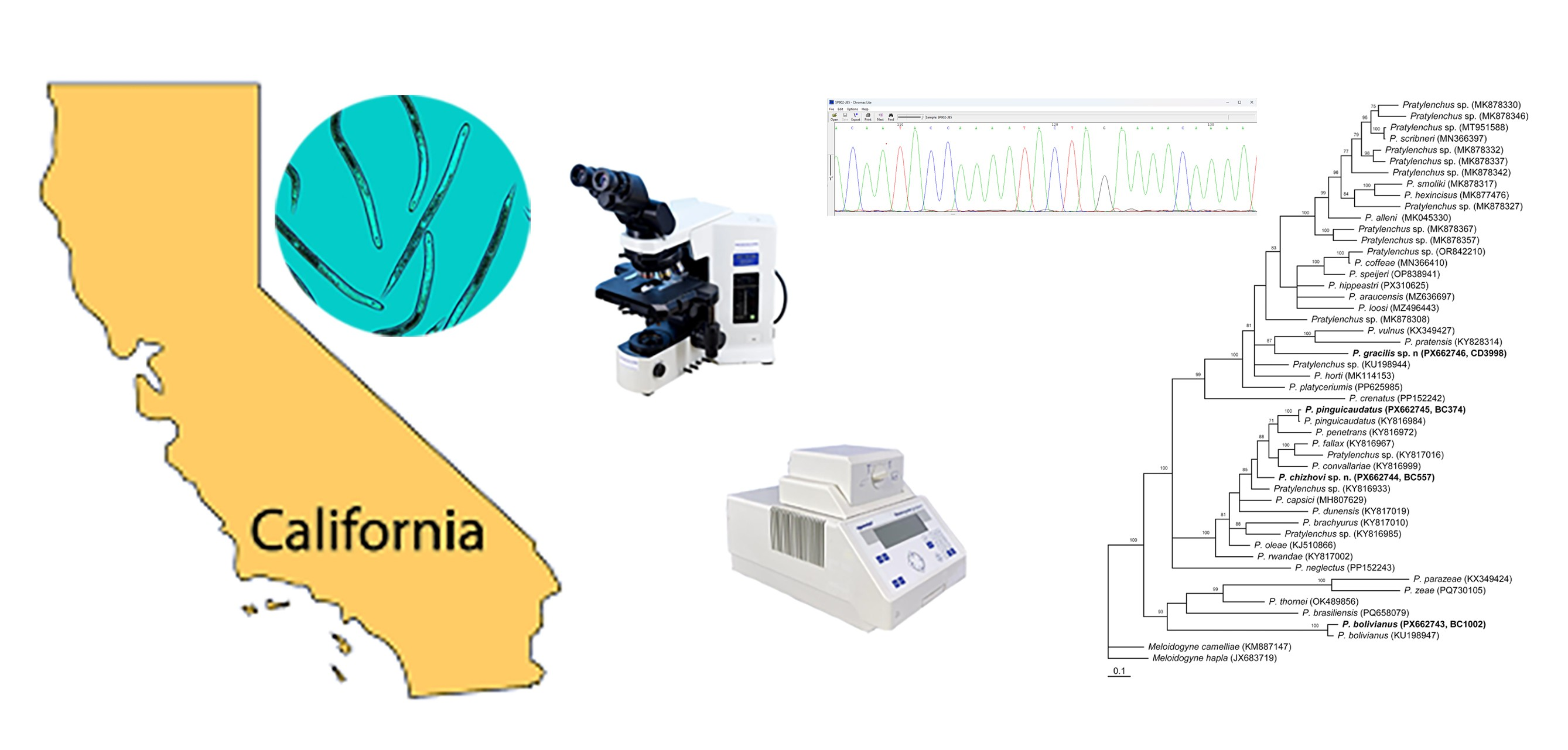
Graphical Abstract

1. Introduction

The root-lesion nematode, genus Pratylenchus Filipjev, 1936, is among the most economically significant genera of plant-parasitic nematodes worldwide [1]. Its importance derives from its exceptionally broad host range across both natural and agricultural ecosystems, as well as its cosmopolitan distribution, with reported occurrences even in Antarctic soils [2]. Species of Pratylenchus are migratory endoparasites that penetrate and move through the root cortex, where their feeding activity results in reduced root growth, cortical lesions, necrosis, tissue browning, and ultimately cell death [1]. The mechanical and physiological damage caused by these nematodes also predisposes plants to secondary infections by soil-borne pathogens, including fungi and bacteria [3], thereby exacerbating their overall impact on plant health.
In their monography of the genus, Castillo and Vovlas [1] recognized 68 valid species of Pratylenchus. Subsequent taxonomic studies increased this number to 98 [4], and current assessments indicate that the genus now comprises more than 100 described species. Despite this documented diversity, several new species have been described within the last six years [5,6,7,8,9,10,11,12,13,14], underscoring the continued need for integrative taxonomic approaches combining morphology and molecular data.
Up to now, the diversity of Pratylenchus reported from California included 15 valid species occurring in both natural ecosystems and agroecosystems: P. alleni Ferris, 1961; P. brachyurus (Godfrey, 1929) Filipjev and Schuurmans Stekhoven, 1941, P. coffeae (Zimmermann, 1898) Filipjev and Schuurmans Stekhoven, 1941, P. crenatus Loof, 1960, P. hexincisus Taylor and Jenkins, 1957, P. hippeastri Inserra, Troccoli, Gozel, Bernard, Dunn and Duncan, 2007, P. morettoi Luc, Baldwin and Bell, 1986, P. macrostylus Wu, 1971, P. neglectus (Rensch, 1924) Filipjev and Schuurmans Stekhoven, 1941, P. penetrans (Cobb, 1917) Filipjev and Schuurmans Stekhoven, 1941, P. pseudopratensis Seinhorst, 1968 (reported as P. sefaensis), P. scribneri Steiner in Sherbakoff and Stanley, 1943, P. thornei Sher and Allen, 1953, P. vulnus Allen and Jensen, 1951, and P. zeae Graham, 1951 (Table 1). Among these, P. brachyurus, P. penetrans, P. vulnus, P. scribneri, and P. hexincisus are recognized as root-lesion nematodes of major economic importance on almond, beet, citrus, corn, cotton, grape, onion, strawberry, tomato, walnut, and others in California [15]. Pratylenchus vulnus, P. neglectus, and P. thornei are considered the most common and widely distributed species in the region. It is also noteworthy that P. morettoi, P. thornei, and P. vulnus were originally described from California.
During nematological surveys carried out in California, in natural ecosystems and agroecosystems, several known and two undescribed species of Pratylenchus were recovered. The main objective of this study is to describe these two new species using an integrative taxonomic framework and characterize them molecularly based on sequences of the 18S rRNA gene, D2–D3 expansion segments of the 28S rRNA gene, and a partial fragment of the mitochondrial COI gene. These datasets are also used to infer the phylogenetic relationships of the newly described species within the genus Pratylenchus.

2. Materials and Methods

2.1. Nematode Samples and Extraction

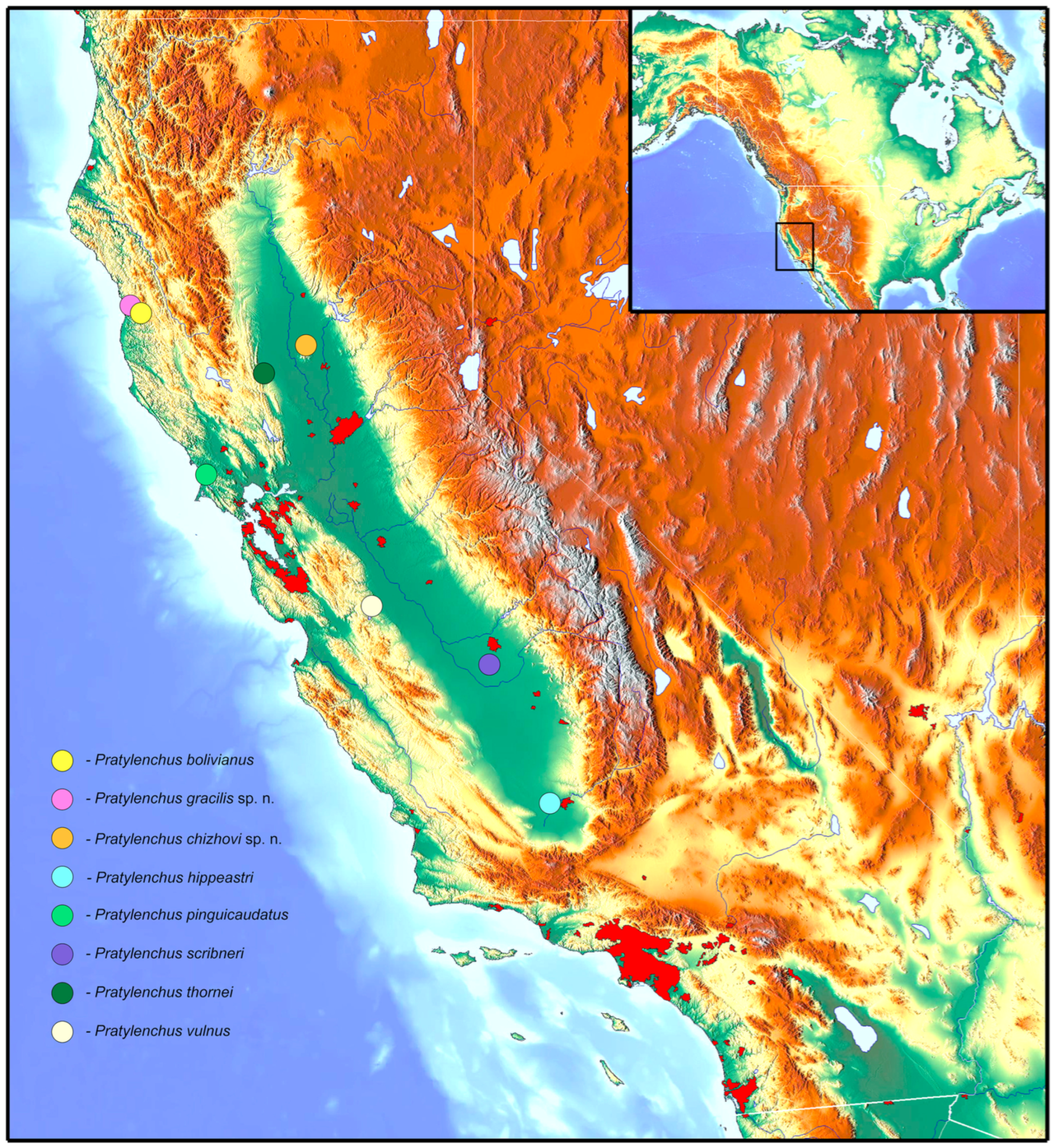
The nematodes examined in this study were recovered from soil and root samples collected during 2010–2024. Nematodes were extracted from soil using the centrifugal flotation method [31]. The list of species and populations studied, including their locations, is provided in Table 2 and Figure 1.

2.2. Morphological Study

Nematodes were relaxed and killed by heat, fixed in 4% formaldehyde, and processed to anhydrous glycerin following Siddiqi’s [32] method. Specimens were mounted on permanent glass slides for light microscopic (LM) observation. Specimens were examined and measured using a Nikon Eclipse NiU light microscope (Nikon, Tokyo, Japan) equipped with differential interference contrast (DIC). Morphometrics included de Man’s indices and standard measurements. Several preserved specimens were photographed with an Olympus DP23 digital camera (Olympus, Tokyo, Japan). The images were edited using Adobe® Photoshop® CS (Adobe Systems, San Jose, CA, USA). Line drawings were prepared with the aid of a camera lucida attached to the microscope.

2.3. Molecular Study

DNA was extracted from several specimens of the new species and single individuals from other Pratylenchus species using a standard protocol with proteinase K as described by Subbotin [33]. Nematodes were placed in drops of distilled water and dissected using a stainless-steel dental needle under a stereomicroscope. The resulting nematode fragments, suspended in 25 μL of water, were transferred to a 0.2 mL Eppendorf tube containing 3 μL of proteinase K (600 μg/mL; Promega, Madison, WI, USA) and 2 μL of 10× PCR buffer (Taq PCR Core Kit, Qiagen, Venlo, The Netherlands). The samples were incubated at 65 °C for 1 h, followed by 95 °C for 15 min. After incubation, the tubes were centrifuged and stored at −20 °C until further use. PCR amplification and sequencing were carried out as described by Subbotin [33]. Several primer sets were used in the present study: (i) D2A (5′-ACA AGT ACC GTG AGG GAA AGT TG-3′) and D3B (5′-TCG GAA GGA ACC AGC TAC TA-3′) primers for amplifying the D2–D3 expansion segments of 28S rRNA gene; (ii) G18SU (5′-GCT TGT CTC AAA GAT TAA GCC-3′) and R18Tyl1 (5′-GGT CCA AGA ATT TCA CCT CTC-3′) primers for amplifying the partial 18S rRNA gene; (iii) JB3 (5′-TTT TTT GGG CAT CCT GAG GTT TAT-3′) and JB5 (5′-AGC ACC TAA ACT TAA AAC ATA ATG AAA ATG-3′) primers for amplifying the partial COI gene. Amplicons were purified and directly sequenced using forward and reverse primers by Azenta (La Jolla, CA, USA). The newly obtained sequences were deposited in GenBank under the accession numbers listed in Table 2 and shown in the phylogenetic trees.
New sequences of the 18S rRNA, the D2–D3 of 28S rRNA, the ITS rRNA, and COI genes were aligned with corresponding published sequences of representatives of Pratylenchus [5,6,7,9,12,13,14,21,34,35,36,37,38] using ClustalX 1.83 [39] with default parameters for 18S rRNA, ITS, and COI gene datasets and with modified parameters (gap opening—5, gap extension—3) for the 28S rRNA gene dataset. Alignments were analyzed with Bayesian inference (BI) using MrBayes 3.1.2 [40]. BI analyses for each gene were initiated from a random starting tree and conducted using four Metropolis-coupled Markov chain Monte Carlo (MCMC) chains for 1.0 × 10⁶ generations. Trees were sampled every 100 generations, and two independent runs were performed for each analysis. After discarding burn-in samples and assessing convergence, the remaining samples were retained for further analyses. The resulting topologies were used to construct a 50% majority-rule consensus tree as described by Subbotin [41]. Posterior probabilities (PPs) are provided for the appropriate clades. Pairwise divergence between sequences was calculated using PAUP*4a [42].

3. Results

3.1. Species Identification and Delimitation

Across the examined materials (Table 2), the combined use of traditional morphological taxonomic characters and complementary molecular evidence enabled us to reliably delimit and identify six known species present in the sampled localities in California: P. bolivianus Corbett, 1983, P. hippeastri, P. pinguicaudatus Corbett, 1969, P. scribneri, P. thornei, P. vulnus, and two species recognized here as new to science: P. chizhovi sp. n. and P. gracilis sp. n. Additionally, one unidentified Pratylenchus sp. was found in a sample from Mexico.

3.2. Taxonomic Studies

The morphological characteristics and morphometric data of the two new root-lesion nematode species are provided herein.

3.2.1. Pratylenchus chizhovi sp. n.

Nineteen specimens collected in one location (Table 2) were available for morphological study.
Description
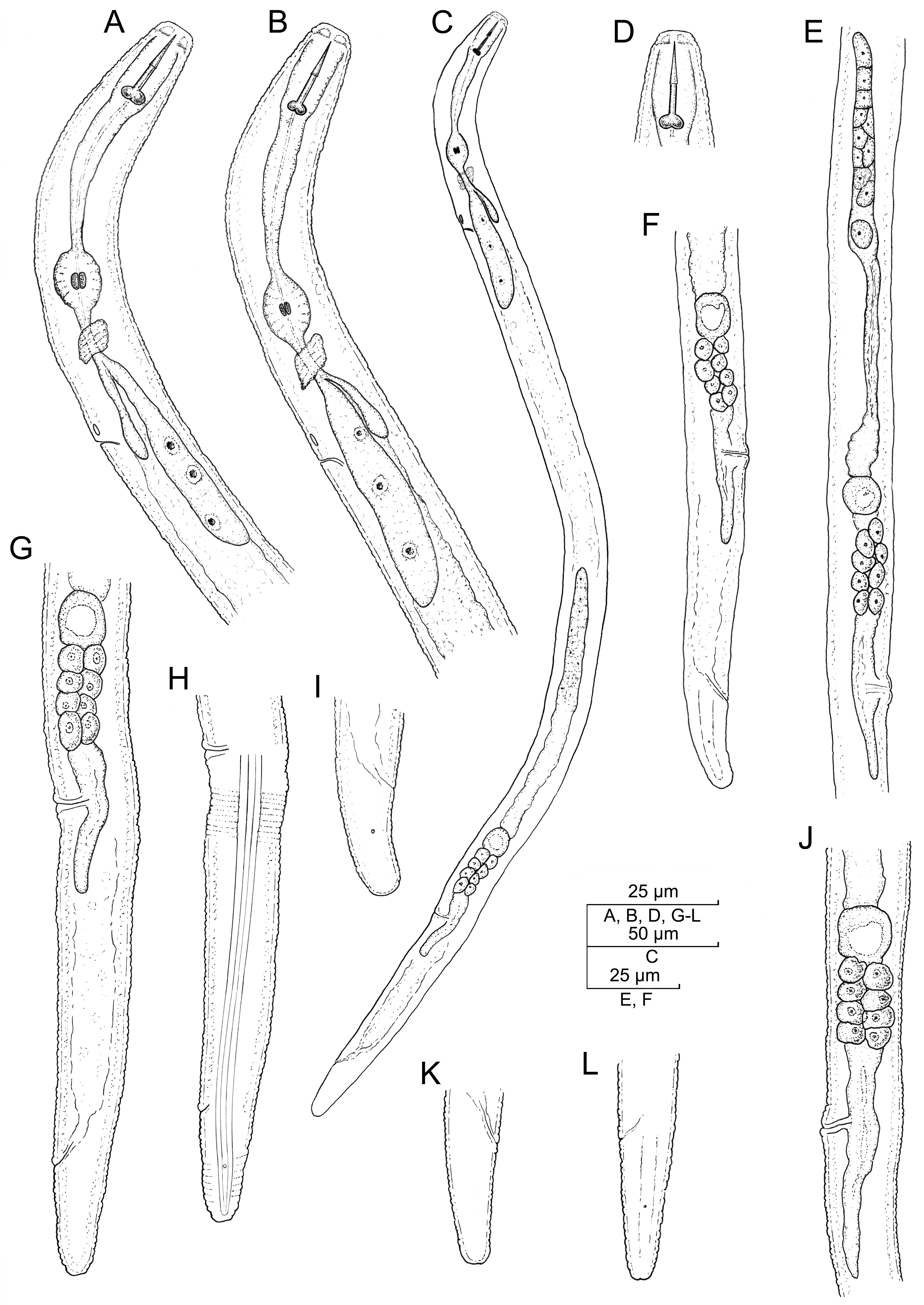
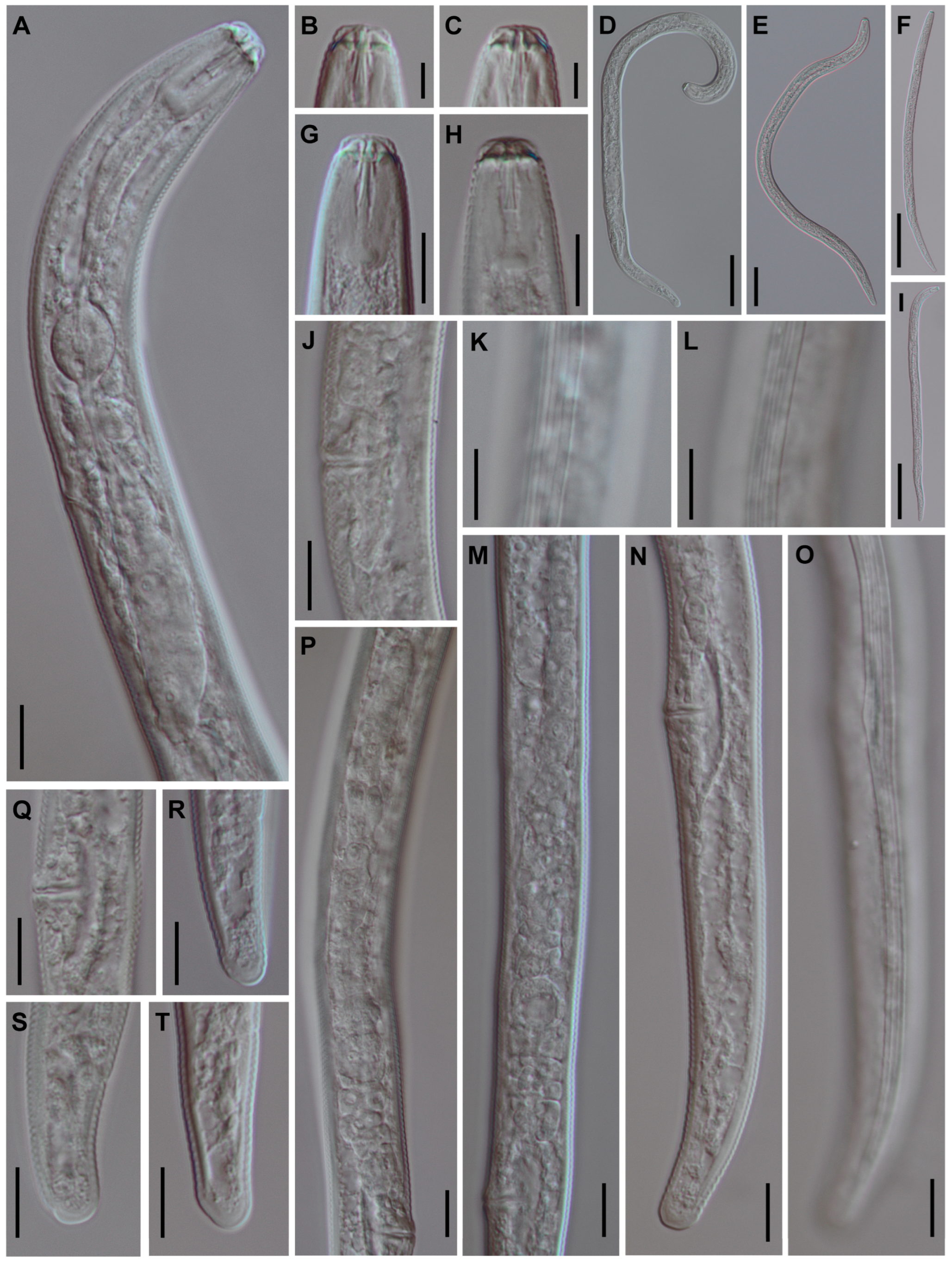
Female: Body showing various postures when heat-killed, from almost straight, slightly curved ventrally, C-shaped to irregular. The lip region is flattened, offset from the body contour, and bears three annuli, which narrow in diameter towards the anterior end. Stylet is relatively small and robust, with a conus about 48.0 ± 1.7% (45–51) of the entire stylet length. The stylet shaft is slender and terminates in rounded basal knobs. The pharyngeal procorpus narrows slightly just anterior to the small, oval metacorpus, which bears a conspicuous median bulb valve. The isthmus is short and surrounded by the nerve ring, expanding posteriorly into a pharyngeal lobe. This lobe contains a dorsal nucleus located just posterior to the cardia and ventro-sublateral nuclei positioned near its tip, overlapping the intestine ventro-laterally. The secretory–excretory pore is located at the level of the cardia, just posterior to the hemizonid. Body annulation is distinct. Lateral field occupying about 28.4 ± 2.2% (24–32) of body diameter, usually with four smooth incisures (Figure 3L,O), sometimes with a few oblique striae in the middle of the central band (Figure 3L). Outer ridges are broader than inner ridges, and some specimens have several finer ridges close to the vulval region (Figure 2K). The outline of the outer bands becomes indented towards the tail end. The genital tract is well-developed with oocytes arranged in a single row. Spermatheca is small and spherical, empty of sperm. Vulval lips are slightly prominent. The post-uterine sac (PUS) is about 1.1 ± 0.3 (0.8–1.8) vulval body diameter long. Phasmids are located in the mid-tail, 13.6 ± 1.2 (12–16) µm from the tail tip. The tail has 16–24 annuli, typically subcylindrical, tapering towards the tip with a rounded or truncated terminus.
Male: Not found.
  • Type Host and Locality
Pratylenchus chizhovi sp. n. was found in a sample collected from rhizospheres of unknown plants growing at Sutter Buttes State Park, Sutter County, CA, USA. GPS: 39°14.683′, −121°48.877′.
  • Type material
Holotype female and 11 female paratypes (16.904–16.906), mounted on glass slides, were deposited in the nematode collection of the National Museum of Natural Sciences, Madrid, Spain. An additional four female paratypes (T-8306p) were deposited in the United States Department of Agriculture Nematode Collection, Beltsville, MD, USA.
  • Etymology
The specific epithet commemorates the late Dr. Vladimir N. Chizhov (Russia) for his distinguished scientific contributions to nematology.
  • Diagnosis and Relationships
The new species is characterized by a lip region offset with three annuli narrowing towards the anterior end; a small stylet (14.5–17.0 µm long) with rounded knobs; a short pharyngeal overlap; a lateral field with four incisures in most specimens; a spherical spermatheca without sperm; a vulva with somewhat prominent lips; a subcylindrical tail with a truncate-rounded and smooth terminus; and males unknown. The matrix code of the new species according to Castillo and Vovlas [1] is A2, B1, C2(3), D2, E3(2), F2(1,3,4,5), G2, H1, I3(2,4), J1, K1 (variation in characters is given in brackets).
In having a lip region with three annuli, a stylet longer than 13 µm, an empty spermatheca, and male absent, the new species resembles P. andinus Lordello, Zamith and Boock, 1961, P. arlingtoni Handoo, Carta and Skantar, 2001, P. elamini Zeidan and Geraert, 1991, P. rwandae Singh, Nyiragatare, Janssen, Couvreur, Decraemer and Bert, 2018, and P. yassini Zeidan and Geraert, 1991. Pratylenchus chizhovi sp. n. can be distinguished from P. andinus in its shorter (0.43–0.53 vs. 0.56 0.54–0.56 mm) and more slender body (a = 24.3–30.3 vs. a = 21.5–22.0), shorter stylet (14.5–17.0 vs. 17.0–18.0 μm), and lower b and c ratios (b = 5.1–6.4 vs. b = 7.0–7.4 and c = 15.8–22.5 vs. c = 27.0–28.3). From P. arlingtoni in its lateral fields (4 vs. 6–8 lines in the lateral fields from the pharyngeal to the vulval region, tail tip (smooth vs. crenate), spermatheca (rounded vs. oval), and molecular data of 28S rRNA gene. From P. elamini in its shorter stylet (15.7 (14.5–17.0) vs. 14.0 (13.0–14.5) μm), spermatheca (rounded vs. oval), more posterior vulva position (V = 80 (76–83) vs. V = 75 (72–77)), and tail shape (subcylindrical vs. conical). From P. rwandae in its narrower (7.7 (7.5–8.0) vs. 9.4 (8.5–10.4) μm wide) and more flattened (vs. rounded) lip region, longer stylet (15.7 (14.5–17.0) vs. 13.6 (13.0–14.6) μm), and molecular data of 18S, 28S rRNA, and COI genes. Finally, from P. yassini in its more posterior vulva position (V = 80 (76–83) vs. V = 74 (71–76), tail shape (subcylindrical vs. conoid), and tail tip (smooth vs. crenate).
The new species, in having a lip region with three annuli and males absent, also resembles P. bolivianus, P. delattrei Luc, 1958, P. kumaoensis Lal and Khan, 1990, and P. japonicus Ryss, 1988. It is easy to distinguish from P. bolivianus and P. japonicus in its shorter stylet (15.7 (14.5–17.0) vs. 19.0 (17.0–20.0) and 19.8 (18.5–21.5) μm, respectively), and molecular data of 28S rRNA and COI genes. From P. delattrei in the tail shape (subcylindrical with a truncate-rounded tip vs. subcylindrical with conical to rounded tip), and molecular data of 28S rRNA genes. Finally, from P. kumaoensis in its lip region offset (vs. almost continuous), spermatheca present (vs. inconspicuous), tail shape (subcylindrical vs. conoid-rounded), and tail tip (smooth vs. crenate).

3.2.2. Pratylenchus gracilis sp. n.

Ten specimens collected in one location (Table 2) were available for morphological study.
Description
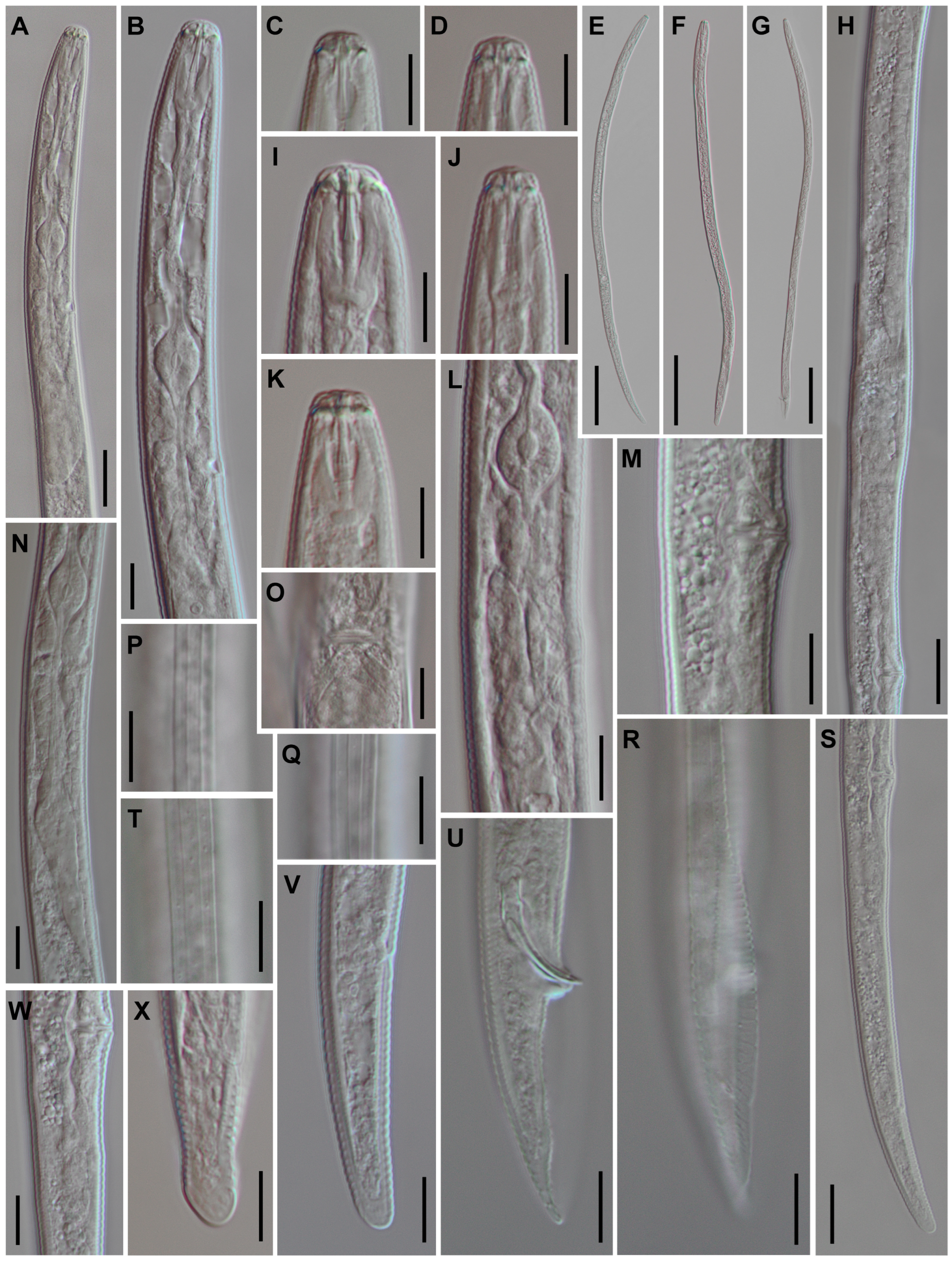
Female: Body showing various postures when heat-killed, from almost straight, slightly curved ventrally, C-shaped to irregular. The lip region is flattened to slightly rounded, offset from the body contour, and bears three annuli, which narrow in diameter towards the anterior end. The stylet is relatively small and robust, with the conus comprising about 50.2 ± 2.4 (47.8–53.4)% of the entire stylet length. The stylet shaft is slender, ending with rounded basal knobs. The pharyngeal procorpus narrows just anterior to the small, oval metacorpus. The valve of the median bulb is conspicuous. The isthmus is short, encircled by a nerve ring and widened to a pharyngeal lobe with a dorsal nucleus just posterior to the cardia and ventro-sublateral nuclei near the tip of the pharyngeal lobe and overlapping the intestine ventrolaterally. The secretory–excretory pore is located at the level of the cardia, just posterior to the hemizonid. Body annulation is distinct. The lateral field occupies about one-third of the body diameter, usually with four smooth incisures (Figure 5Q). Outer ridges are broader than inner ridges. The outline of the outer bands becomes indented towards the tail end. The genital tract is well-developed with oocytes arranged in a single row. The spermatheca is oval to rounded, with some sperm cells inside. The vulval lips are slightly prominent. The post-uterine sac (PUS) measures about 1.9 ± 0.5 (1.3–2.4) vulval body diameters in length. The phasmids are located in the mid-tail or anteriorly, 18–21 µm from the tail tip. The tail has 12–25 annuli, typically subcylindrical, tapering towards the tip with a rounded terminus.
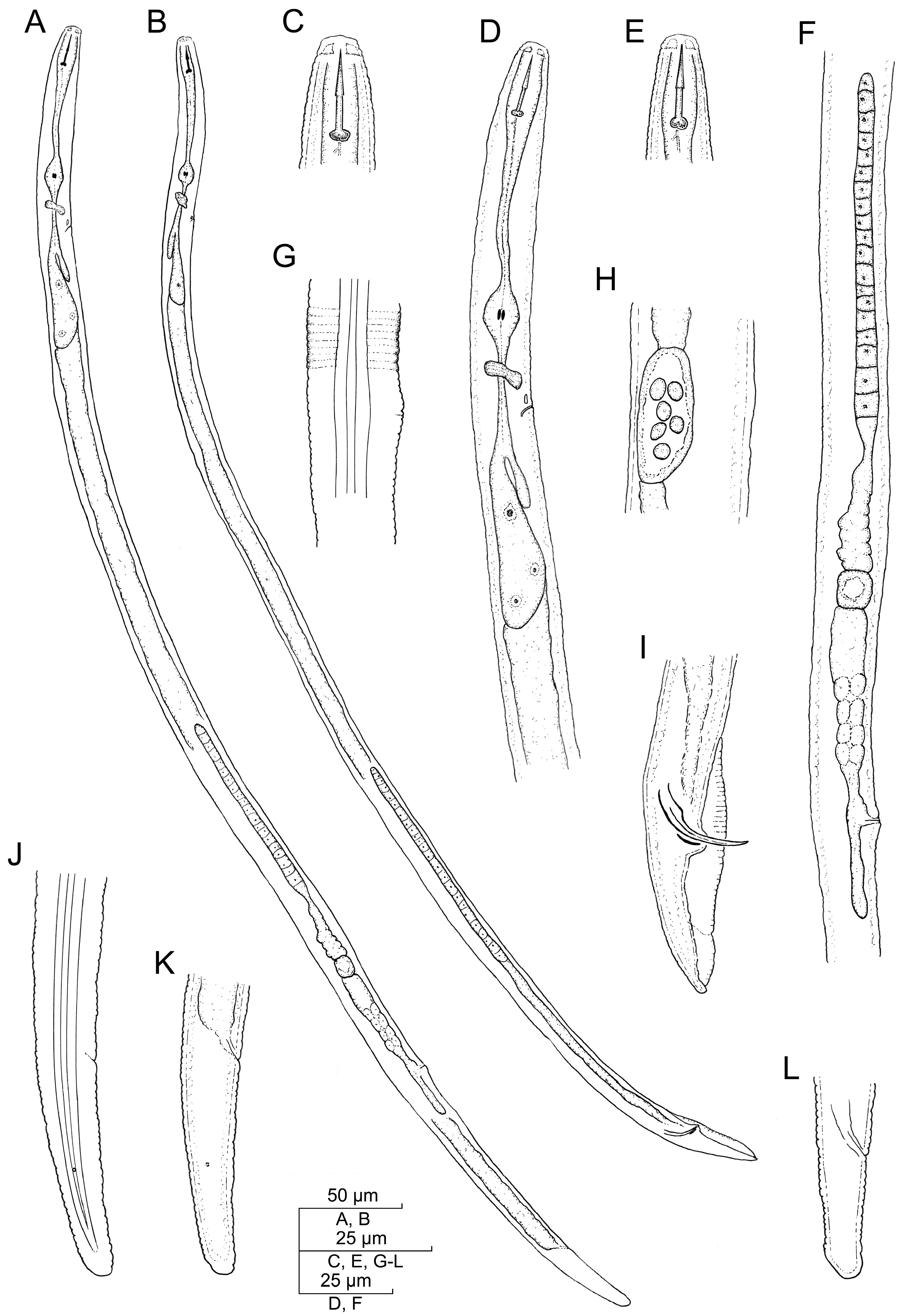
Male: Generally similar to the female, differing mainly in the posterior body region and typically exhibiting a slimmer body. The lip region is usually higher and narrower than in females (Figure 5J). The stylet is slightly shorter than that of the female and bears smaller knobs. The metacorpus is small and rounded. The isthmus is slender and relatively short, terminating in a long, narrow glandular lobe. The testis is outstretched and contains round spermatozoa within the vas deferens. Spicules are paired, weakly cephalated, and ventrally arcuate. The gubernaculum is simple and slightly curved. The tail is conical, ventrally bent, and bears a prominent, crenate bursa.
  • Type Host and Locality
Pratylenchus gracilis sp. n. was found in a sample collected from rhizospheres of unknown plants growing at Van Damme State Park, Mendocino County, CA, USA. GPS: 39°16.528′, −123°47.319′.
  • Type Material
A holotype female, as well as two female and five male paratypes (16.907–16.910), mounted on glass slides, were deposited in the nematode collection of the National Museum of Natural Sciences, Madrid, Spain. An additional female and one male paratype (T-8307p) were deposited in the United States Department of Agriculture Nematode Collection, Beltsville, MD, USA.
  • Etymology
The species epithet gracilis is derived from the Latin word gracilis (slender), referring to the notably slender body of the new species, which distinguishes it from many other members of the genus Pratylenchus.
  • Diagnosis and Relationships
The new species is characterized by a lip region offset with three annuli narrowing towards the anterior end; a small stylet (15–18 µm long) with rounded knobs; a short pharyngeal overlap; a lateral field with four incisures, oval to rounded spermatheca with some sperm cells inside; a vulva with somewhat prominent lips; a subcylindrical tail with a rounded and smooth terminus; and males with spicules 19.0–19.5 µm long and a well-developed bursa. The matrix code of the new species according to Castillo and Vovlas [1] is A2, B2, C3(2), D3(2), E3(2), F5(3,4,6), G2, H1, I4(3), J1, K1 (variation in characters is given in brackets).
In having a lip region with three annuli, a stylet longer than 13 µm, generally common males, and spermatheca filled with sperm, the new species resembles P. mediterraneus Corbett, 1983, P. morettoi, P. mulchandi Nandakumar and Khera, 1970, P. unzenensis Mizukubo, 1992, and P. vulnus. Pratylenchus gracilis sp. n. can be distinguished from P. goodeyi in its longer (0.59–0.73 vs. 0.43–0.58 and 0.57–0.74 vs. 0.43–0.54 mm long, in females and males, respectively) and more slender body (a = 34–39 vs. a = 24–31 and a = 35–49 vs. a = 27–35, in females and males, respectively), and longer male spicules (19.0–19.5 vs. 16–18 µm long). From P. morettoi, in its lip region offset (vs. not separated from the rest of the body), and tail shape (tail lacking vs. always with a terminal projection and a terminal thickening of the cuticle). From P. mulchandi in its slender body (a = 37 (34–39) vs. a = 30 (26–32) and a = 35–49 vs. a = 33, in females and males, respectively), more posterior vulva position (V = 80 (78–82) vs. V = 75 (72–77)), and longer male spicules (19.0–19.5 vs. 14 µm long). From P. unzenensis in its longer (0.67 (0.59–0.73) vs. 0.42 (0.37–0.47) and 0.57–0.74 vs. 0.37–0.40 mm long, in females and males, respectively) and more slender body (a = 37.2 (34.5–39.1) vs. a = 25.8 (21.9–28.5) and a = 35.2–49.3 vs. a = 29.2–30.0, in females and males, respectively), longer stylet (17.1 (16.5–18.0) vs. 15.0 (14.5–15.5) μm and 15.0–17.0 vs. 14.0–14.5 μm, in females and males, respectively), and longer male spicules (19.0–19.5 vs. 13.0–13.5 µm long). Finally, from P. vulnus in its lip region offset (vs. almost continuous with body contour), female tail with a rounded tip (vs. narrowly rounded to subacute tip), and molecular data of 18S, 28S rRNA, and COI genes.
The new species, in having a lip region with three annuli and males being generally common also resembles P. bhattii Siddiqi, Dabur and Bajaj, 1991, P. brasilensis Diniz, Mizubuti, Valadares, Moreira, Santos and Santiago, 2025, P. capsici Qing, Bert, Gamliel, Bucki, Duvrinin, Alon and Braun Miyara, 2019, P. convallariae Seinhorst, 1959, P. dakotaensis Handoo, Yan, Kantor, Huang, Chowdhury, Plaisance, Bauchan and Mowery, 2021, P. ekrami Bajaj and Bhatti, 1984, P. globulicola Romániko, 1960, P. kralli Ryss, 1982, P. mahindii Maosa, Karuri, Gitonga, Nguyen, Couvreur, Coyne and Bert, 2025, P. penetrans, P. pseudofallax Café-Filho and Huang, 1989, and P. thornei. Pratylenchus gracilis sp. n. can be distinguished from P. bhattii in its longer male body (0.65 (0.57–0.74) vs. 0.42 (0.35–0.48) mm long), more slender body (a = 37 (34–39) vs. a = 28 (25–31) and a = 43 (35–49) vs. a = 28 (25–29), in females and males, respectively), and longer stylet (17.1 (16.5–18.0) vs. 13.5 (13–14.0) μm and 16.5 (15.0–17.0) vs. 13.0 (12.0–13.5) μm, in females and males, respectively). From P. brasilensis in its longer male body (0.57–074 vs. 0.44–0.56 mm long), more slender female body (a = 34.5–39.1 vs. a = 24.5–30.4), and female tail shape (subcylindrical with rounded terminus vs. conical shape). From P. capsici in its slender male body (a = 35–49 vs. a = 22–30, in females and males, respectively), and longer female stylet (16.5–18.0 vs. 13.0–15.0 μm), and longer male spicules (19.0–19.5 vs. 15.1–17.3 µm long). From P. convallariae in its slender female body (a = 34–39 vs. a = 23–31), and female tail tip (smooth vs. crenate). From P. dakotaensis in its longer (0.67 (0.59–0.73) vs. 0.48 (0.39–0.55) and 0.65 (0.57–0.74) vs. 0.45 (0.37–0.40) mm long, in females and males, respectively) and more slender body (a = 37.2 (34.5–39.1) vs. a = 23.4 (20.8–29.8) and a = 43.2 (35.2–49.3) vs. a = 23.7 (20.8–25.2), in females and males, respectively), and female tail tip (smooth vs. crenate). From P. ekrami in its longer (0.57–0.74 vs. 0.40–0.54 mm long) and more slender male body (a = 35–49 vs. a = 29–34), and longer stylet (17.1 (16.5–18.0) vs. 12.0 (11.0–13.0) μm and 15–17 vs. 12 μm, in females and males, respectively). From P. kralli in its longer (0.59–0.73 vs. 0.40–0.50 and 0.57–0.74 vs. 0.38–0.45 mm long, in females and males, respectively) and more slender body (a = 34–39 vs. a = 20–33 and a = 35–49 vs. a = 21–34, in females and males, respectively), and longer stylet (16.5–18.0 vs. 14.0–15.0 μm and 15.0–17.0 vs. 12.5–14.0 μm, in females and males, respectively). From P. globulicola in its longer (0.59–0.73 vs. 0.29–0.57 and 0.57–0.74 vs. 0.38–0.52 mm long, in females and males, respectively) and more slender body (a = 34.5–39.1 vs. a = 15.9–29.0 and a = 35.2–49.3 vs. a = 16.9–31.9, in females and males, respectively), and longer stylet (16.5–18.0 vs. 12.5–16.3 μm and 15.0–17.0 vs. 12.0–15.0) μm, in females and males, respectively). From P. mahindii in its slender body (a = 34–39 vs. a = 21–30 and a = 35–49 vs. a = 26–28, in females and males, respectively), longer stylet (16.5–18.0 vs. 13.5–16.0 μm and 15–17 vs. 12.5–13.0 μm, in females and males, respectively), more posterior vulva position (V = 78–82 vs. V = 70–77%), and longer male spicules (19.0–19.5 vs. 15.0–16.2 µm long). From P. penetrans in its slender body (a = 34–39 vs. a = 19–32 and a = 35–49 vs. a = 23–34, in females and males, respectively), and longer male spicules (19.0–19.5 vs. 14.0–17.0 µm long). P. pseudofallax in its longer (0.67 (0.59–0.73) vs. 0.47 (0.42–0.53) and 0.65 (0.57–0.74) vs. 0.42 (0.37–0.48) mm long, in females and males, respectively) and more slender body (a = 37.2 (34.5–39.1) vs. a = 29.0 (24.7–36.3) and a = 43.2 (35.2–49.3) vs. a = 28.3 (24.7–31.5), in females and males, respectively), and longer male stylet (16.5 (15.0–17.0) vs. 14.0 (13.5–15.0) μm). And finally, from P. thornei in its lip region offset (vs. not offset from body), spermatheca filled with some sperm cells (vs. not containing spermatozoa), and males as frequent as females (vs. males very rare).

3.3. Molecular Characterization and Phylogenetic Relationships

3.3.1. Partial 18S rRNA Gene

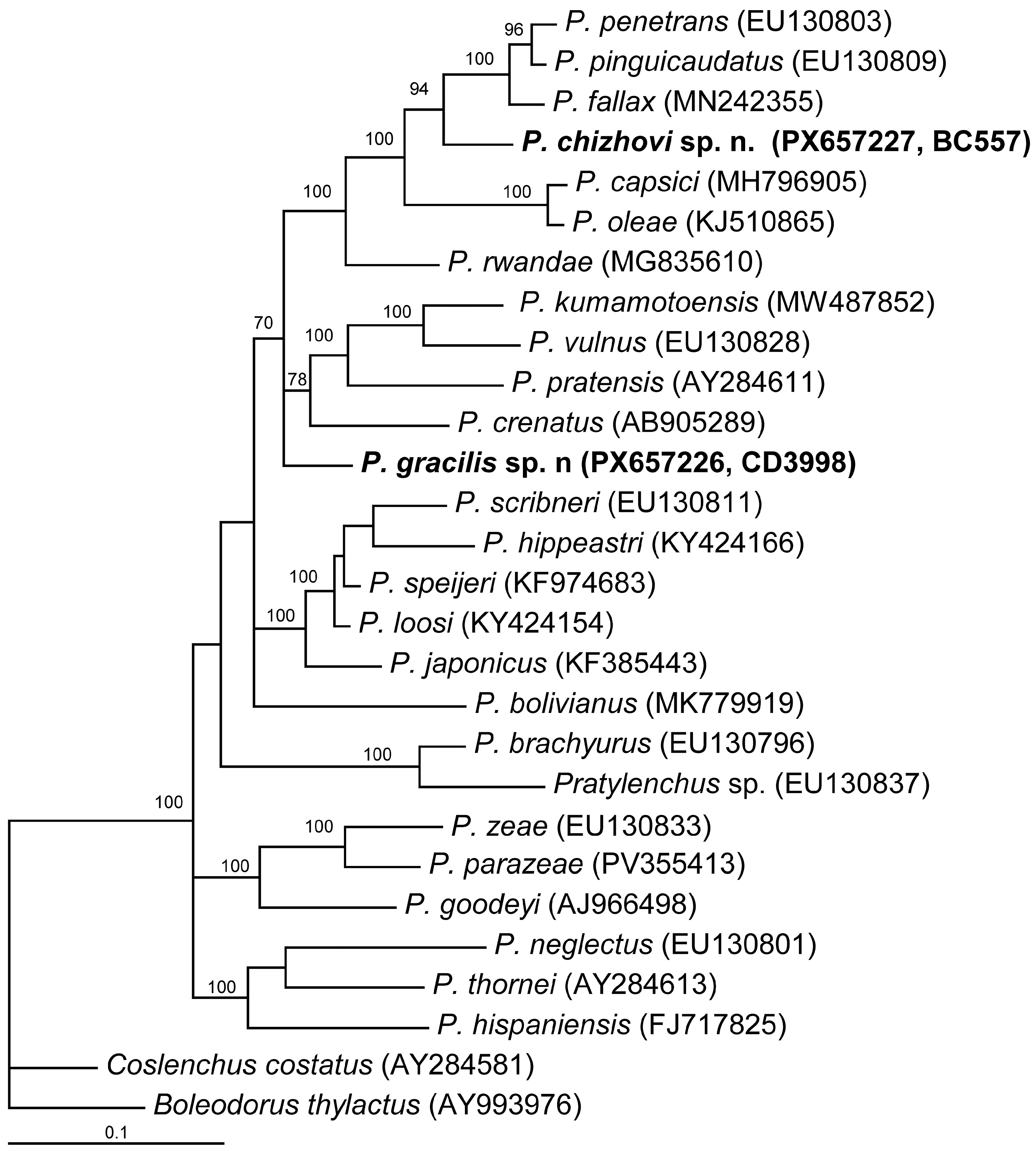
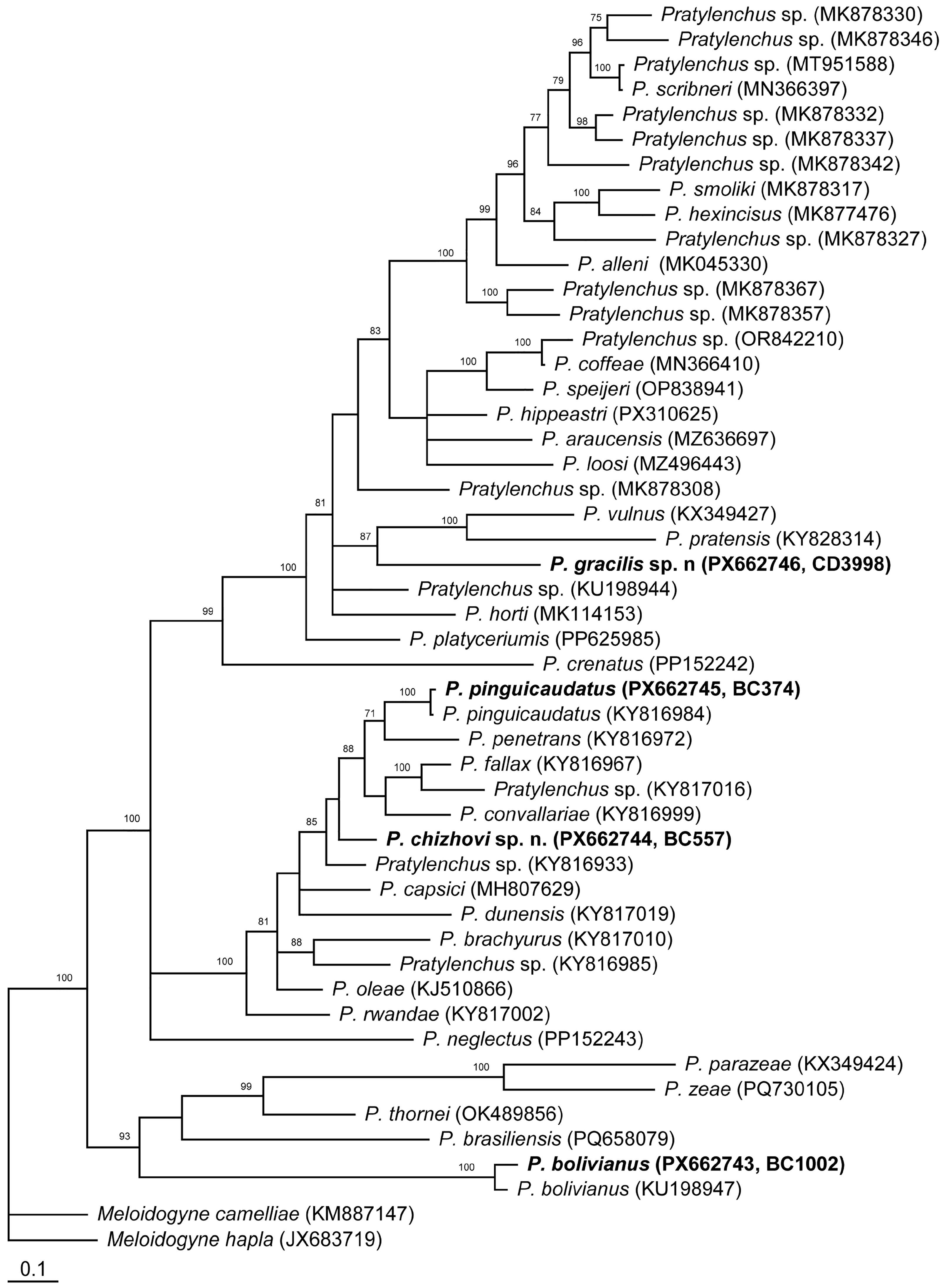
The alignment included 26 sequences of Pratylenchus species and two sequences of outgroup taxa and was 885 bp in length. One sequence of P. chizhovi sp. n. and one sequence of P. gracilis sp. n. were obtained in this study. Phylogenetic relationships of new species with other representatives of Pratylenchus as inferred from analysis of the 18S rRNA gene sequence alignment are given in Figure 6. The Pratylenchus chizhovi sp. n. sequence clustered with representatives of the Penetrans clade. The P. chizhovi sp. n. sequence differed from those of P. fallax by 4.7% and P. capsici by 7.0%. The sequence of P. gracilis sp. n. formed a separate lineage, and it differed from that of P. crenatus by 5.6%.

3.3.2. D2–D3 Expansion Segments of 28S rRNA Gene

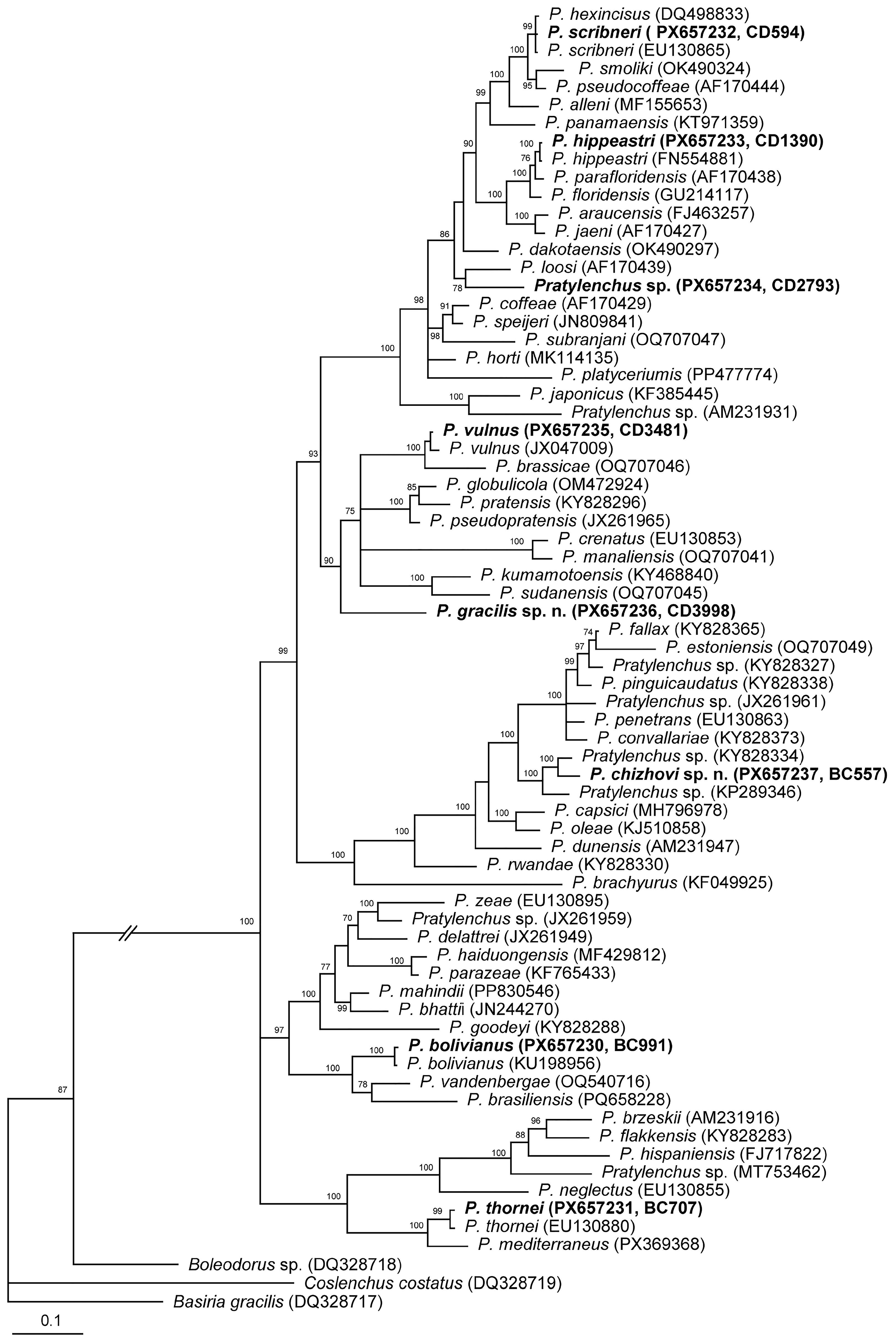
The alignment included 69 sequences of Pratylenchus species and three sequences of outgroup taxa and was 862 bp in length. In this study, we obtained one sequence each of P. bolivianus, P. chizhovi sp. n., P. gracilis sp. n., P. hippeastri, P. scribneri, P. thornei, and Pratylenchus sp. from Mexico. Phylogenetic relationships of new species with other representatives of Pratylenchus as inferred from analysis of the D2–D3 of 28S rRNA gene sequence alignment are given in Figure 7. Pratylenchus chizhovi sp. n. clustered with representatives of the Penetrans clade, and it is different from that of Pratylenchus sp. (KY828334) by 3.3%. The sequence of P. gracilis sp. n. and Pratylenchus sp. from Mexico formed separate lineages. The sequence of P. gracilis sp. n. was different from that of P. vulnus by 12.0%. Sequences of Californian P. bolivianus, P. hippeastri, P. scribneri, P. thornei, and P. vulnus clustered with corresponding sequences of these species from other regions.

3.3.3. Partial COI Gene

The alignment included 48 sequences of Pratylenchus species and two sequences of outgroup taxa and was 415 bp in length. In this study, we obtained one sequence each of P. bolivianus, P. chizhovi sp. n., P. gracilis sp. n., and P. pinguicaudatus. Phylogenetic relationships of new species with other representatives of Pratylenchus as inferred from analysis of the COI gene sequence alignment are given in Figure 8. Pratylenchus chizhovi sp. n. clustered with representatives of the Penetrans clade, and it is different from that of P. oleae by 14.3%. The sequence of P. gracilis sp. n. formed a separate lineage, and it differed from those of other Pratylenchus by more than 21%. Sequences of Californian P. bolivianus and P. pinguicaudatus clustered with corresponding sequences of these species from other regions, differing by 5.8% and 0.8%, respectively.

4. Discussion

Based on the present study and a synthesis of previous records, a total of nineteen valid Pratylenchus species could be considered as occurring in California (Table 1). However, molecular confirmation is currently available for only twelve of these species. Several nominal records, including P. alleni, P. crenatus, P. hexincisus, P. macrostylus, and P. zeae, lack accompanying morphological descriptions or diagnostic details, making their identification impossible to verify. Furthermore, the true status of P. coffeae sensu stricto in California agriculture remains uncertain, as early reports were based exclusively on morphology and may represent misidentifications of other Pratylenchus species.
Within this context, the results of the present study are particularly significant. We report the detection of two Pratylenchus species, P. bolivianus and P. pinguicaudatus, as noteworthy additions to the nematode fauna of California. Both species are important root-lesion nematodes with expanding global distributions.
The Andean root-lesion nematode P. bolivianus was originally described from soil around oat and potato roots in the Bolivian Andes [43]. Since its description, the species has been reported in several regions worldwide, including Chile, China, Colombia, Costa Rica, South Africa, North America, and Europe [1,34,44,45,46,47]. Its agricultural importance as a parasite of ornamentals and fruit crops has been demonstrated in Florida, Colombia, and Brazil. To our knowledge, the present finding represents the second report of P. bolivianus in the USA and the first confirmed occurrence in California. The detection of this species across multiple continents, a wide range of host plants, and diverse climatic conditions reflects a high degree of ecological adaptability and a significant potential for global dispersal, thereby increasing its invasive risk in non-native regions.
Pratylenchus pinguicaudatus was originally described by Corbett [48] from a population collected in wheat fields at Rothamsted Research, UK. Subsequent reports of this species from Bulgaria, France, Poland, Spain, Tunisia, and Australia [1,49,50,51,52] substantially expanded its presumed geographic distribution. However, these records were based exclusively on morphological data and remain in need of molecular confirmation [35]. To date, only the topotype population from Rothamsted has been reliably characterized using molecular markers [21,35]. Recent phylogenetic analyses have suggested that some non-UK populations previously identified as P. pinguicaudatus may represent distinct or undescribed species. Our detection, therefore, constitutes the first molecularly confirmed record of P. pinguicaudatus in both the USA and California. At present, there is limited evidence that P. pinguicaudatus is of major economic importance relative to more widespread root-lesion nematodes such as P. penetrans, P. neglectus, or P. thornei. Its host range, ecological preferences, and potential impact on crops remain poorly understood, partly due to the rarity of confirmed populations and the difficulty of distinguishing it from closely related species without molecular data.
The amaryllis lesion nematode P. hippeastri was previously reported from grapevine in Delano, Kern County, California by Handoo et al. [23]. Our finding represents the second report of this species from this county. Pratylenchus hippeastri is of considerable agricultural and horticultural concern, particularly for ornamental bulbs (amaryllis), and potentially for grapevine in both California and Florida [23,53,54,55], apple in China, South Africa, India [56,57,58], and strawberry in Costa Rica [59]. Additional records include its recovery from the rhizosphere and roots of Acer palmatum in Japan [60], Salix mucronata in Africa [61], and Salix chaenomeloides in Korea [62]. From a taxonomic perspective, P. hippeastri appears to represent a species complex. Sequence and phylogenetic analyses have revealed that a complex of cryptic species genetically similar to P. hippeastri occurs in Florida, USA, South Africa, and Russia [54].
Three Pratylenchus species, including the two newly described species P. chizhovi sp. n. and P. gracilis sp. n., as well as P. morettoi, are currently known only from California. These species appear to have highly restricted geographic distributions. Their apparent endemism may reflect unique ecological niches or host associations within California’s diverse environments. Alternatively, their limited detection outside the state may result from the difficulty of distinguishing closely related Pratylenchus species without molecular diagnostic tools.
Overall, the findings of this study underscore the critical need for continued molecular-based surveys of root-lesion nematodes in California. The historical reliance on morphology alone has likely contributed to under-recognition, misidentification, and incomplete documentation of Pratylenchus diversity within the state.

Author Contributions

Conceptualization, S.Á.-O. and S.A.S.; methodology, S.Á.-O., A.M., and S.A.S.; software, S.Á.-O., and S.A.S.; analysis, S.Á.-O., A.M., and S.A.S.; resources, S.Á.-O., A.M., and S.A.S.; writing, S.Á.-O. and S.A.S. All authors have read and agreed to the published version of the manuscript.

Funding

This work was partly sponsored by the California Nematode Biodiversity project and USDA APHIS Farm Bill grant AP24PPQS&T00C163/24-0401-000-FR.

Institutional Review Board Statement

Not applicable.

Informed Consent Statement

Not applicable.

Data Availability Statement

The datasets generated during and/or analyzed during the current study are available NCBI and from the corresponding author upon reasonable request.

Conflicts of Interest

The authors declare no conflicts of interest. The funders had no role in the design of the study; in the collection, analyses, or interpretation of data; in the writing of the manuscript, or in the decision to publish the results.

Abbreviations

The following abbreviations of de Man’s indices and standard measurements are used in this manuscript:
nNumber of measured specimens
LOverall body length
aBody length/greatest body diameter
bBody length/pharynx length
b′Body length/distance from anterior to base of pharyngeal gland
cBody length/tail length
c′Tail length/body diameter at anus or cloaca
V% Distance of anterior body end from the vulva/body length
G% Genital tract length/body length
m% Conus of stylet/stylet length
o% Distance of dorsal pharyngeal gland opening from stylet knobs x 100/body length
MB% Distance from anterior to median bulb relative to the length of the pharynx
St/L% Stylet length/body length
Ep/L% Distance from anterior to excretory pore/body length
PUS/VA% Post-vulval uterine sac/distance from vulva to anus

References

  1. Castillo, P.; Vovlas, N. Pratylenchus (Nematoda: Pratylenchidae): Diagnosis, Biology, Pathogenicity and Management; Nematology Monographs and Perspectives; Brill: Leiden, The Netherlands, 2007; Volume 6, 530p. [Google Scholar] [CrossRef]
  2. Ryss, A.; Boström, S.; Sohlenius, B. Tylenchid nematodes found on the Nunatak Base, East Antarctica. Ann. Zool. 2005, 55, 315–324. [Google Scholar]
  3. Jones, J.T.; Haegeman, A.; Danchin, E.G.; Gaur, H.S.; Helder, J.; Jones, M.G.; Kikuchi, T.; Manzanilla-Lopez, R.; Palomares-Rius, J.E.; Wesemael, W.M.; et al. Top 10 plant-parasitic nematodes in molecular plant pathology. Mol. Plant Pathol. 2013, 14, 946–961. [Google Scholar] [CrossRef]
  4. Geraert, E. The Pratylenchidae of the World: Identification of the Family Pratylenchidae (Nematoda: Tylenchida); Academia Press: Ghent, Belgium, 2013; 430p. [Google Scholar]
  5. Qing, X.; Bert, W.; Gamliel, A.; Bucki, P.; Duvrinin, S.; Alon, T.; Braun Miyara, S. Phylogeography and molecular species delimitation of Pratylenchus capsici n. sp., a new root-lesion nematode in Israel on pepper (Capsicum annuum). Phytopathology 2019, 109, 847–858. [Google Scholar] [CrossRef]
  6. Nguyen, H.T.; Trinh, Q.P.; Couvreur, M.; Singh, P.R.; Decraemer, W.; Bert, W. Molecular and morphological characterisation of a new root-lesion nematode, Pratylenchus horti n. sp. (Tylenchomorpha: Pratylenchidae), from Ghent University Botanical Garden. Nematology 2019, 21, 739–752. [Google Scholar] [CrossRef]
  7. Mehmood, N.; Khanum, T.A. Description of Pratylenchus siddiqi n. sp. from banana (Musa acuminata L.) Malir Cantt, Karachi, Sindh, Pakistan. Plant Prot. 2021, 5, 89–93. [Google Scholar] [CrossRef]
  8. Handoo, Z.A.; Carta, L.K.; Skantar, A.M. Morphological and molecular characterisation of Pratylenchus arlingtoni n. sp., P. convallariae and P. fallax (Nematoda: Pratylenchidae). Nematology 2001, 3, 607–618. [Google Scholar] [CrossRef]
  9. Powers, T.; Todd, T.; Harris, T.; Higgins, R.; MacGuidwin, A.; Mullin, P.; Ozbayrak, M.; Powers, K.; Sakai, K. Pratylenchus smoliki, a new nematode species (Pratylenchidae: Tylenchomorpha) from the Great Plains region of North America. J. Nematol. 2021, 53, e2021-100. [Google Scholar] [CrossRef] [PubMed]
  10. Troccoli, A.; Fanelli, E.; Castillo, P.; Liébanas, G.; Cotroneo, A.; De Luca, F. Pratylenchus vovlasi sp. nov. (Nematoda: Pratylenchidae) on raspberries in north Italy with a morphometrical and molecular characterization. Plants 2021, 10, 1068. [Google Scholar] [CrossRef]
  11. Du, Y.; Li, M.; Zhou, J.; Yang, Y.; Zhong, J.; Yang, J.; Gu, J. Description of Pratylenchus platyceriumis sp. n. from the root and rhizosphere of Platycerium seedlings from Thailand. Nematology 2024, 26, 909–927. [Google Scholar] [CrossRef]
  12. Wanjau, C.N.; Knoetze, R.; Girgan, C.; Pili, N.N.; Engelbrecht, G.; Couvreur, M.; Bert, W. Characterization and pathogenicity of Pratylenchus vandenbergae stat. nov. (Tylenchina: Pratylenchidae), a highly pathogenic root-lesion nematode parasitizing crops in Kenya and South Africa. Plant Pathol. 2024, 73, 706–723. [Google Scholar] [CrossRef]
  13. Maosa, J.; Karuri, H.; Gitonga, D.; Nguyen, H.; Couvreur, M.; Coyne, D.; Bert, W. Pratylenchus mahindii n. sp. from coffee and maize in Kenya. Nematology 2025, 27, 549–560. [Google Scholar] [CrossRef]
  14. Diniz, F.A.D.S.; Mizubuti, E.S.G.; Valadares, J.I.A.; Moreira, S.I.; Santos, P.S.; Santiago, T.R. Pratylenchus brasiliensis sp. nov. (Nematoda: Pratylenchidae)—An emerging threat to soybean in an important new agricultural frontier in Brazil. Plant Dis. 2025, in press. [Google Scholar] [CrossRef]
  15. Chitambar, J.J.; Westerdahl, B.B.; Subbotin, S.A. Plant parasitic nematodes in California agriculture. In Plant Parasitic Nematodes in Sustainable Agriculture of North America: Volume 1—Canada, Mexico and Western USA; Springer International Publishing: Cham, Switzerland, 2018; pp. 131–192. [Google Scholar] [CrossRef]
  16. Luc, M.; Baldwin, J.G.; Bell, A.H. Pratylenchus morettoi n. sp. (Nemata: Pratylenchidae). Rev. Nématol. 1986, 9, 119–123. [Google Scholar]
  17. Siddiqui, I.A.; Sher, S.A.; French, A.M. Distribution of Plant-Parasitic Nematodes in California; State of California Department of Food and Agriculture: Sacramento, CA, USA, 1973; 324p.
  18. McKenry, M.V.; Roberts, P.A. Phytonematology Study Guide; Publication 4045; Cooperative Extension University of California, Division of Agriculture and Natural Resources: Oakland, CA, USA, 1985; 56p. [Google Scholar]
  19. Al-Banna, L.; Ploeg, A.T.; Williamson, V.M.; Kaloshian, I. Discrimination of six Pratylenchus species using PCR and species-specific primers. J. Nematol. 2004, 36, 142. [Google Scholar]
  20. Dong, K.; Chitambar, J.; Subbotin, S.; Alzubaidy, M.; Luque-Williams, M.; Romero, J.; Kosta, K.; Luna, R. Significant records in Nematology: California statewide nematode survey project for 2006. Calif. Plant Pest Damage Rep. 2007, 23, 45–71. [Google Scholar]
  21. Subbotin, S.A.; Ragsdale, E.J.; Mullens, T.; Roberts, P.A.; Mundo-Ocampo, M.; Baldwin, J.G. A phylogenetic framework for root lesion nematodes of the genus Pratylenchus (Nematoda): Evidence from 18S and D2-D3 expansion segments of 28S ribosomal RNA genes and morphological characters. Mol. Phylogenet. Evol. 2008, 48, 491–505. [Google Scholar] [CrossRef] [PubMed]
  22. Duncan, R.A.; Stapleton, J.J.; McKenry, M.V. Establishment of orchards with black polyethylene film mulching: Effect on nematode and fungal pathogens, water conservation, and tree growth. J. Nematol. 1992, 24, 681–687. [Google Scholar]
  23. Handoo, Z.A.; Skantar, A.M.; Kantor, M.R.; Hafez, S.L.; Hult, M.N. Molecular and morphological characterization of the amaryllis lesion nematode, Pratylenchus hippeastri (Inserra et al., 2007), from California. J. Nematol. 2020, 52, e2020-58. [Google Scholar] [CrossRef]
  24. Lownsbery, J.W.; Lownsbery, B.F. Plant-parasitic nematodes associated with forest trees in California. Hilgardia 1985, 53, 1–16. [Google Scholar] [CrossRef]
  25. Al-Banna, L.; Williamson, V.; Gardner, S.L. Phylogenetic analysis of nematodes of the genus Pratylenchus using nuclear 26S rDNA. Mol. Phylogenet. Evol. 1997, 7, 94–102. [Google Scholar] [CrossRef]
  26. Sher, S.A.; Allen, M.W. Revision of the genus Pratylenchus (Nematoda: Tylenchidae). Univ. Calif. Publ. Zool. 1953, 57, 441–447. [Google Scholar]
  27. Allen, M.W.; Jensen, H.J. Pratylenchus vulnus, new species (Nematoda: Pratylenchidae), a parasite of trees and vines in California. Proc. Helminthol. Soc. Wash. 1951, 18, 47–50. [Google Scholar]
  28. Hart, W.H. Root-lesion nematodes in California. Bull. Dep. Agric. State Calif. 1951, 40, 85–92. [Google Scholar]
  29. Lownsbery, B.F. Pratylenchus vulnus, primary cause of the root lesion disease of walnuts. Phytopathology 1956, 46, 375–379. [Google Scholar]
  30. Ayoub, S.M. Pratylenchus zeae found on corn, milo, and three suspected new hosts in California. Plant Dis. Rep. 1961, 45, 940. [Google Scholar]
  31. Jenkins, W.R. A rapid centrifugal-flotation method for separating nematodes from soil. Plant Dis. Rep. 1964, 48, 692. [Google Scholar]
  32. Siddiqi, M.R. Studies on Discolaimus spp. (Nematoda: Dorylaimidae) from India. Z. Zool. Syst. Evolutionsforsch. 1964, 2, 174–184. [Google Scholar] [CrossRef]
  33. Subbotin, S.A. Molecular identification of nematodes using Polymerase Chain Reaction (PCR). In Techniques for Work with Plant and Soil Nematodes; Perry, R.N., Hunt, D., Subbotin, S.A., Eds.; CABI: Wallingford, UK, 2021; pp. 218–239. [Google Scholar] [CrossRef]
  34. Troccoli, A.; Subbotin, S.A.; Chitambar, J.J.; Janssen, T.; Waeyenberge, L.; Stanley, J.D.; Duncan, L.W.; Agudelo, P.; Munera Uribe, G.; Franco, J.; et al. Characterisation of amphimictic and parthenogenetic populations of Pratylenchus bolivianus Corbett, 1983 (Nematoda: Pratylenchidae) and their phylogenetic relationships with closely related species. Nematology 2016, 18, 651–678. [Google Scholar] [CrossRef]
  35. Janssen, T.; Karssen, G.; Orlando, V.; Subbotin, S.A.; Bert, W. Molecular characterization and species delimiting of plant-parasitic nematodes of the genus Pratylenchus from the Penetrans group (Nematoda: Pratylenchidae). Mol. Phylogenet. Evol. 2017, 117, 30–48. [Google Scholar] [CrossRef]
  36. Meldal, B.H.; Debenham, N.J.; De Ley, P.; De Ley, I.T.; Vanfleteren, J.R.; Vierstraete, A.R.; Bert, W.; Borgonie, G.; Moens, T.; Tyler, P.A.; et al. An improved molecular phylogeny of the Nematoda with special emphasis on marine taxa. Mol. Phylogenet. Evol. 2007, 42, 622–636. [Google Scholar] [CrossRef] [PubMed]
  37. Handoo, Z.A.; Yan, G.; Kantor, M.R.; Huang, D.; Chowdhury, I.A.; Plaisance, A.; Bauchan, G.R.; Mowery, J.D. Morphological and molecular characterization of Pratylenchus dakotaensis n. sp. (Nematoda: Pratylenchidae), a new root-lesion nematode species on soybean in North Dakota, USA. Plants 2021, 10, 168. [Google Scholar] [CrossRef] [PubMed]
  38. Ozbayrak, M.; Todd, T.; Harris, T.; Higgins, R.; Powers, K.; Mullin, P.; Sutton, L.; Powers, T. A COI DNA barcoding survey of Pratylenchus species in the Great Plains Region of North America. J. Nematol. 2019, 51, 1–21. [Google Scholar] [CrossRef]
  39. Chenna, R.; Sugawara, H.; Koike, T.; Lopez, R.; Gibson, T.J.; Higgins, D.G.; Thompson, J.D. Multiple sequence alignment with the clustal series of programs. Nucleic Acids Res. 2003, 31, 3497–3500. [Google Scholar] [CrossRef] [PubMed]
  40. Ronquist, F.; Huelsenbeck, J.P. MRBAYES 3: Bayesian phylogenetic inference under mixed models. Bioinformatics 2003, 19, 1572–1574. [Google Scholar] [CrossRef]
  41. Subbotin, S.A. Phylogenetic analysis of DNA sequence data. In Techniques for Work with Plant and Soil Nematodes; Perry, R.N., Hunt, D., Subbotin, S.A., Eds.; CABI: Wallingford, UK, 2021; pp. 265–282. [Google Scholar] [CrossRef]
  42. Swofford, D.L. PAUP: Phylogenetic Analysis Using Parsimony (And Other Methods); Version 4.0b10; Sinauer Associates: Sunderland, MA, USA, 2003. [Google Scholar]
  43. Corbett, D.C.M. Three new species of Pratylenchus with a redescription of P. andinus Lordello, Zamith & Boock, 1961 (Nematoda: Pratylenchidae). Nematologica 1983, 29, 390–403. [Google Scholar] [CrossRef]
  44. Cotten, J.; Bartlett, P.W.; Webb, R.M. A first record of the root lesion nematode, Pratylenchus bolivianus Corbett in England and Wales. Plant Pathol. 1991, 40, 311–312. [Google Scholar] [CrossRef]
  45. Daramola, F.Y.; Lewu, F.B.; Malan, A.P. Distribution and characterization of Pratylenchus bolivianus (Nematoda, Pratylenchidae) on rooibos (Aspalathus linearis) tea from South Africa. J. Plant Dis. Prot. 2021, 128, 1291–1301. [Google Scholar] [CrossRef]
  46. Riascos-Ortiz, D.; Arboleda-Riascos, C.E.; Mosquera-Espinosa, A.T.; Calderón, F.V.; de Agudelo, F.V. A survey of two root-lesion nematodes associated with commercial cut flower crops in Colombia, with notes on their morpho-molecular characters and phylogenetic relationships. Russ. J. Nematol. 2024, 32, 121–131. [Google Scholar]
  47. Oliveira, C.M.G.; Eulálio, J.; Caixeta, L.B. First report of Pratylenchus bolivianus infecting Alstroemeria sp. in Brazil. New Dis. Rep. 2025, 52, e70083. [Google Scholar] [CrossRef]
  48. Corbett, D.C.M. Pratylenchus pinguicaudatus n. sp. (Pratylenchinae: Nematoda) with a key to the genus Pratylenchus. Nematologica 1969, 15, 550–556. [Google Scholar] [CrossRef]
  49. Brzeski, M.W.; Szczygiel, A. Materialy do poznania krajowich nicieni (Nematoda) pazozytow roslin. 1. Rodzaj Pratylenchus Fi1. (Tyienchida: Pratylenchidae). Fragm. Faun. 1977, 25, 1–11. [Google Scholar] [CrossRef]
  50. Loof, P.A.A. The genus Pratylenchus Filipjev, 1936 (Nematoda: Pratylenchidae): A Review of Its Anatomy, Morphology, Distribution, Systematics and Identification; Swedish University of Agricultural Sciences, Research Information Centre: Uppsala, Sweden, 1978; Volume 5, pp. 1–50. [Google Scholar]
  51. Ryss, A.; Baicheva, O.; Stoyanov, D. A new for Bulgaria phytonematode Pratylenchus pinguicaudatus Corbett, 1969 and morphological description of Pratylenchus thornei Sher & Allen, 1953 and Zygotylenchus guevarai Tobar Jimenez, 1963. Helminthology 1991, 30, 3–7. [Google Scholar]
  52. Di Vito, M.; Catalano, F.; Zaccheo, G. Reproduction of six populations of Pratylenchus spp. from the Mediterranean region on selected plant species. Nematol. Mediterr. 2002, 30, 103–105. [Google Scholar]
  53. Inserra, R.N.; Troccoli, A.; Gozel, U.; Bernard, E.C.; Dunn, D.; Duncan, L.W. Pratylenchus hippeastri n. sp. (Nematoda: Pratylenchidae) from amaryllis in Florida with notes on P. scribneri and P. hexincisus. Nematology 2007, 9, 25–42. [Google Scholar] [CrossRef]
  54. De Luca, F.; Troccoli, A.; Duncan, L.W.; Subbotin, S.A.; Waeyenberge, L.; Moens, M.; Inserra, R.N. Characterization of a population of Pratylenchus hippeastri from bromeliads and description of two related new species, P. floridensis n. sp. and P. parafloridensis n. sp. from grasses in Florida. Nematology 2010, 12, 847–868. [Google Scholar] [CrossRef]
  55. Habteweld, A.; Bania, C.; Crow, W.T. Morphological and molecular characterization of a population of Pratylenchus hippeastri (Nematoda-Pratylenchidae) parasitizing muscadine grape in Florida. Nematropica 2021, 51, 56–66. [Google Scholar]
  56. Wang, H.; Zhuo, K.; Liao, J. Morphological and molecular characterization of Pratylenchus hippeastri, a new record of root-lesion nematode associated with apple in China. J. Zool. 2016, 48, 665–671. [Google Scholar]
  57. Knoetze, R.; van den Berg, E.; Girgan, C.; van der Walt, L. First report of the root lesion nematode, Pratylenchus hippeastri, on apple in South Africa. J. Plant Dis. Prot. 2019, 126, 607–609. [Google Scholar] [CrossRef]
  58. Hussain Sheikh, A.; Vyshali, G.; Somvanshi, V.S.; Rahaman Khan, M. Morphological and molecular characterisation of Pratylenchus hippeastri Inserra, Troccoli, Gozel, Bernard, Dunn & Duncan, 2007 (Tylenchomorpha: Pratylenchidae) from India. Nematology 2025, 27, 425–433. [Google Scholar] [CrossRef]
  59. Brenes-Campos, R.; Núñez-Rodríguez, L.A.; Flores-Chaves, L.; Humphreys-Pereira, D.A. New record of the amaryllis lesion nematode, Pratylenchus hippeastri, associated with strawberry in the Central Region of Costa Rica. Nematropica 2021, 51, 131–136. [Google Scholar]
  60. Chen, W.J.; Bian, Y.; Wu, R.; Lin, X.J.; Zhang, M.Z.; Wu, Z.Y.; Wu, Y.; Wu, X.Y.; Chen, X. Root-lesion nematode, Pratylenchus hippeastri, on Acer palmatum imported from Japan. Acta Agric. Zhejiangensis 2014, 26, 708–713. [Google Scholar]
  61. Shokoohi, E.; Abolafia, J.; Mashela, P.W.; Divsalar, N. New data on known species of Hirschmanniella and Pratylenchus (Rhabditida, Pratylenchidae) from Iran and Africa. J. Nematol. 2019, 51, e2019-41. [Google Scholar] [CrossRef]
  62. Huh, S.; Park, N.; Kang, H.; Bae, C.; Choi, I. Morphological and molecular characterization of root-lesion nematode Pratylenchus hippeastri from Korea. Korean J. Environ. Biol. 2023, 41, 657–665. [Google Scholar] [CrossRef]
Figure 1. Geographic locations of Pratylenchus species characterized in this study across California.
Diversity 18 00045 g001
Figure 2. Camera lucida drawings of Pratylenchus chizhovi sp. n. female from Sutter Buttes State Park, California (BC557). (A,B): Anterior body region. (C): Entire body. (D): Lip region and stylet. (E): Genital system. (F,G): Posterior body region. (H): Posterior body region, showing the lateral field marked by four incisures. (I,K,L): Tail. (J): Vulval region, with detail of spermatheca and PUS.
Diversity 18 00045 g002
Figure 3. Light microscopic photos of Pratylenchus chizhovi sp. n. female from Sutter Buttes State Park, California (BC557). (A): Anterior body region. (B,C): Lip region. (G,H): Lip region and stylet. (DF,I): Entire body, showing different body shapes. (J): Vulval region and PUS. (K,L): Lateral field marked by four incisures. (M,P): Genital system. (N): Posterior body region. (O): Posterior body region showing lateral field. (Q): Vulval region. (RT): Tail. (Scale bars: (A,G,H,JT) = 10 μm; (B,C) = 5 μm; (D,E) = 50 μm; (F,I) = 100 μm).
Diversity 18 00045 g003
Figure 4. Camera lucida drawings of Pratylenchus gracilis sp. n. female and male from Van Damme State Park, California (CD3998). (Female: (A,C,D,FH,JL). Male: (B,E,I)). (A,B): Entire body. (C,E): Lip region and stylet. (D): Anterior body region. (F): Genital system. (G): Vulval region, showing the lateral field marked by four incisures. (H): Detail of spermatheca with sperm cells. (I): Posterior body region, with detail of the spicule and bursa. (J): Posterior body region, showing the lateral field marked by four incisures. (K,L): Tail.
Diversity 18 00045 g004
Figure 5. Light microscopic photos of Pratylenchus gracilis sp. n. female and male from Van Damme State Park, California (CD3998). (Female: (A,B,E,F,H,I,KM,O,S,VX). Male: (C,D,G,J,N,PR,T,U)). (A,B): Anterior body region. (C,D): Lip region. (EG): Entire body. (H): Genital system. (IK): Lip region and stylet. (L): Details of the metacorpus bulb and excretory pore. (M): Vulval region. (N): Details of the metacorpus and pharyngeal lobe. (O): Vulva in frontal view. (P,Q,T): Lateral field marked by four incisures. (R): Posterior body region showing the bursa. (S): Posterior body region. (U): Tail and spicule. (V,X): Tail. (W): Vulval region and PUS. (Scale bars: (A,S) = 20 μm; (BD,HR,TX) = 10 μm; (EG) = 100 μm).
Diversity 18 00045 g005
Figure 6. Phylogenetic relationships of Pratylenchus from California with other representatives of the genus: Bayesian 50% majority rule consensus tree from two runs as inferred from analysis of the 18S rRNA gene sequence alignment under the GTR + I + G model. Posterior probabilities equal to, or more than 70%, are given for appropriate clades. The new sequences are indicated in bold.
Diversity 18 00045 g006
Figure 7. Phylogenetic relationships of Pratylenchus from California and Mexico with other representatives of the genus: Bayesian 50% majority rule consensus tree from two runs as inferred from analysis of the D2–D3 of 28S rRNA gene sequence alignment under the GTR + I + G model. Posterior probabilities equal to, or more than 70%, are given for appropriate clades. The new sequences are indicated in bold.
Diversity 18 00045 g007
Figure 8. Phylogenetic relationships of Pratylenchus from California with other representatives of the genus: Bayesian 50% majority rule consensus tree from two runs as inferred from analysis of the COI gene sequence alignment under the GTR + I + G model. Posterior probabilities equal to, or more than 70%, are given for appropriate clades. The new sequences are indicated in bold.
Diversity 18 00045 g008
Table 1. Pratylenchus species that have been reported in California.
Pratylenchus SpeciesReferences
P. alleni[16]
P. chizhovi sp. n. *This study
P. bolivianus *This study
P. brachyurus *[15,17,18,19,20,21]
P. coffeae[17]
P. crenatus[15,17]
P. gracilis sp. n. *This study
P. hexincisus[15,20,22]
P. hippeastri * [23], this study
P. morettoi[16]
P. macrostylus[24]
P. neglectus * [15,21,25]
P. penetrans * [15,17,18,20,21,25]
P. pinguicaudatus *This study
P. pseudopratensis[24]
P. scribneri * [15,17,18,19,20,21,25], this study
P. thornei * [15,17,18,19,20,21,25,26], this study
P. vulnus * [15,17,18,19,20,21,25,27,28,29], this study
P. zeae[30]
Pratylenchus sp. 2 *[21]
*—species identified using molecular methods.
Table 2. Pratylenchus species from California and Mexico were sequenced and analyzed in this study.
SpeciesLocation, GPS Coordinates, PlantSample CodeGenBank Accession Number
18S rRNA GeneD2–D3 of 28S rRNA GeneCOI Gene
P. bolivianusCalifornia, Mendocino County, Van Damme State Park; 39°16.528′, −123°46.242′, unknown plants.BC991, BC1002-PX657230PX662743
P. chizhovi sp. n. California, Sutter County, Sutter Buttes State Park; 39°14.683′, −121°48.877′, unknown plants.BC557PX657227PX657237PX662744
P. gracilis sp. n.California, Mendocino County, Van Damme State Park; 39°16.528′, −123°47.319′, unknown plants.CD3998PX657226PX657236PX662746
P. hippeastriCalifornia, Kern County, grapevineCD1390-PX657233-
P. pinguicaudatusCalifornia, Marin County, Dillon Beach; 38°13.932′, −122°54.792′, unknown plants.BC374--PX662745
P. scribneriCalifornia, Fresno County, tomatoCD594-PX657232-
P. thorneiCalifornia, Colusa County, Calvin’s Creek; 39°08.282′, −122°20.695′, unknown plants.BC707-PX657231-
P. vulnusCalifornia, Stanislaus County, walnutCD3481-PX657235-
Pratylenchus sp.Mexico, State of Mexico, Amecameca, San Diego Huehuecalco, Solanum sp.; 19°.0.0′, −98°44.734′, unknown plants.CD2793-PX657234-
Table 3. Morphometrics of female Pratylenchus chizhovi sp. n. from Sutter Buttes State Park, California. All measurements are in μm and in the form: mean ± s.d. (range).
CharacterHolotypeParatypes
n118
L469474 ± 30 (428–532)
a28.727.3 ± 1.8 (24.3–30.3)
b6.35.7 ± 0.4 (5.1–6.4)
b′3.93.6 ± 0.3 (3.1–4.3)
c21.718.8 ± 2.0 (15.8–22.5)
c′2.02.3 ± 0.2 (1.9–2.7)
V (%)8080 ± 1.4 (76–83)
G (%)35.034.5 ± 3.8 (28–44)
o (%)18.323.0 ± 3.7 (16–31)
m (%)48.348.0 ± 1.7 (45–51)
MB (%)7667 ± 4.9 (61–76)
Lip region diameter8.07.7 ± 0.2 (7.5–8.0)
Lip region height2.02.2 ± 0.2 (2.0–3.0)
Stylet length (St)15.515.7 ± 0.7 (14.5–17.0)
St/L (%)3.33.3 ± 0.1 (3.0–3.5)
Conus length7.57.5 ± 0.5 (6.5–8.5)
Stylet shaft + knob height8.08.1 ± 0.4 (7.5–8.5)
Knob width4.54.5 ± 0.2 (4.0–5.0)
Knob height2.02.4 ± 0.2 (2.0–2.5)
Stylet base to DGO3.03.6 ± 0.5 (3.0–4.5)
Anterior end to center of metacorpus5755 ± 2.6 (51–60)
Metacorpus length11.512.2 ± 0.5 (11.5–13.5)
Metacorpus width9.510.1 ± 0.6 (9.5–11.0)
Body width at metacorpus17.016.9 ± 0.8 (15.0–18.5)
Anterior end to excretory pore (Ep)8686 ± 3.7 (80–94)
Ep/L (%)18.318.2 ± 0.8 (16.4–19.4)
Pharynx length7483 ± 4.7 (74–92)
Pharyngeal overlap length4847 ± 6.4 (37–60)
Anterior end to end of pharyngeal lobe120132 ± 13 (113–172)
Max. body width16.517.4 ± 1.1 (15.5–19.5)
Lateral field width4.05.0 ± 0.5 (4.0–5.5)
Genital tract length164165 ± 24 (124–220)
Spermatheca length 10.010.6 ± 1.0 (9.0–12.5)
Post-vulval uterine sac (PUS)18.019.9 ± 5.1 (13.5–31.5)
PUS/VA (%)25.529.0 ± 8.0 (18–44)
Distance anterior end to vulva375378 ± 26 (338–437)
Distance from vulva to anus (VA)7169 ± 5.2 (61–82)
Distance from vulva to tail terminus9394 ± 5.2 (84–106)
Body width at anus10.511.0 ± 0.8 (9.5–12.5)
Number of tail annuli17.019 ± 3 (16–24)
Tail length21.525.6 ± 2.2 (20.5–29.0)
Table 4. Morphometrics of females of Pratylenchus gracilis sp. n. from Van Damme State Park, California. All measurements are in μm and in the form: mean ± s.d. (range).
CharacterHolotypeParatypes
FemaleFemaleMale
n136
L728590–691 (n = 2)653.0 ± 71.1 (566–739)
a39.134.5–38.0 (n = 2)43.2 ± 5.4 (35.2–49.3)
b6.35.4–6.4 (n = 2)6.4 ± 0.7 (5.7–7.2)
b′4.53.5–4.5 (n = 2)4.3 ± 0.4 (3.8–4.8)
c17.325.2–39.8 (n = 2)19.8 ± 2.1 (17.5–23.2)
c′3.81.5–2.2 (n = 2)2.5 ± 0.4 (1.8–2.7)
V (%)7881–82 (n = 2)-
G27.926.8–30.5 (n = 2)43.3 ± 2.8 (41–48)
m (%)5349.2 ± 1.3 (48–50)53.2 ± 2.8 (49–56)
o (%)18.219.3 ± 1.4 (18.3–20.9)18.8 ± 1.5 (17–21)
MB (%)6559–68 (n = 2)71.0 ± 4.3 (66–76)
Lip region diameter8.58.4 ± 0.5 (8.0–9.0)7.5 ± 0.3 (7.0–8.0)
Lip region height2.52.7 ± 0.0 (2.5–2.5)2.3 ± 0.1 (2.0–2.5)
Stylet length17.517.0 ± 0.8 (16.5–18.0)16.5 ± 0.9 (15.0–17.0)
St/L (%)2.42.4–3.0 (n = 2)2.6 ± 0.3 (2.3–3.0)
Conus length9.58.4 ± 0.5 (8.0–9.0)8.8 ± 0.8 (7.5–9.5)
Stylet shaft + knob height8.58.8 ± 0.2 (8.5–9.0)7.9 ± 0.3 (7.5–8.5)
Knob width4.54.6 ± 0.6 (4.0–5.0)3.5 ± 0.3 (3.0–3.5)
Knob height2.02.2 ± 0.1 (2.0–2.5)2.0 ± 0.0 (2.0–2.0)
Stylet base to DGO3.03.3 ± 0.2 (3.0–3.5)3.1 ± 0.2 (3.0–3.5)
Anterior end to center of metacorpus7564–74 (n = 2)68.8 ± 6.0 (64–79)
Metacorpus length14.012.2 ± 0.7 (12.0–13.0)11.6 ± 0.8 (10.5–13.0)
Metacorpus width10.010.0 ± 0.4 (9.5–10.5)9.1 ± 1.0 (8.0–10.5)
Body width at metacorpus17.517.9 ± 0.6 (17.5–18.5)15.5 ± 1.1 (14.0–17.5)
Anterior end to excretory pore (Ep)100100.0 ± 2.8 (97–102)90.5 ± 4.6 (85–98)
Ep/L (%)13.714.8–16.4 (n = 2)13.9 ± 1.0 (13.2–15.5)
Pharynx length115109 (n = 2)97.9 ± 13.1 (84–115)
Pharyngeal overlap length5446–62 (n = 2)45.9 ± 3.0 (42–48)
Anterior end to end of pharyngeal lobe161154–167 (n = 2)147.6 ± 12.0 (129–162)
Max. body width18.517.0–18.0 (n = 2)15.0 ± 1.1 (13.5–16.0)
Lateral field width5.5-5.7 ± 0.6 (5.0–6.5)
Genital tract length203216.8 ± 62.1 (158–282)274.7 ± 25.3 (233–299)
Spermatheca length 14.011.7 ± 4.0 (7.0–14.5)-
Post-vulval uterine sac (PUS)3823–43 (n = 2)-
PUS/VA (%)33.528.3–37.4 (n = 2)-
Distance anterior end to vulva567530.4 ± 40.0 (484–557)-
Distance from vulva to anus (VA)11481–115 (n = 2)-
Distance from vulva to tail terminus160107–131 (n = 2)-
Body width at anus/cloaca11.010.5–11.5 (n = 2)13.5 ± 2.1 (12.0–16.5)
Number of tail annuli2512 (n = 2)-
Tail length4217.5–23.5 (n = 2)32.9 ± 1.9 (30–35)
Spicule arc--17.6 ± 0.6 (16.5–18.0)
Spicule chord--19.4 ± 0.3 (19.0–19.5)
Gubernaculum length--5.6 ± 0.1 (5.5–6.0)
Disclaimer/Publisher’s Note: The statements, opinions and data contained in all publications are solely those of the individual author(s) and contributor(s) and not of MDPI and/or the editor(s). MDPI and/or the editor(s) disclaim responsibility for any injury to people or property resulting from any ideas, methods, instructions or products referred to in the content.