Article

Ecological Effects of Seaweed Restoration on Benthic Macrofauna in Marine Forest Development Areas Along the Eastern Coast of Korea


1
Department of Ecological Restoration, Marine Eco-Technology Institute, Busan 48520, Republic of Korea
2
Department of Fishery Innovation, Korea Fisheries Resources Agency, Busan 46041, Republic of Korea
3
Ulleungdo-Dokdo Ocean Science Station, Korea Institute of Ocean Science and Technology, Ulleung 40205, Republic of Korea
4
Department of Marine Biology, Kunsan National University, Gunsan 54150, Republic of Korea
*
Author to whom correspondence should be addressed.
Diversity 2026, 18(1), 27; https://doi.org/10.3390/d18010027
Submission received: 19 November 2025 / Revised: 30 December 2025 / Accepted: 30 December 2025 / Published: 2 January 2026
(This article belongs to the Special Issue Dynamics of Marine Communities—Second Edition)

Abstract

Although marine forest restoration projects have been widely implemented along the Korean coast, most evaluations have relied on simple structural indicators such as seaweed coverage or biomass, leaving functional responses of benthic macrofaunal communities largely unexplored. This study examined the effects of marine forest restoration on the functional structure of macrozoobenthic communities at development sites along Korea’s eastern coast in 2021 and 2024. Seaweed biomass increased significantly in 2024 compared to that in 2021, and this increase in seaweed biomass showed a clear positive correlation with increases in species number, density, and biomass of macrozoobenthos. Changes in feeding types of macrozoobenthic communities were remarkable, with grazer density increasing most sharply, followed by carnivores, omnivores, and suspension feeders. Red algal biomass was also positively correlated with suspension feeders and grazers, suggesting that seaweed mediated habitat and secondary food-web structures beyond providing simple food resources. These results indicate that seaweed habitat restoration plays an important role in recovering the functional diversity and feeding guild composition of macrozoobenthic communities and demonstrates the potential of using both species and functional diversity indicators to evaluate the effectiveness of marine forest restoration projects in Korea.

1. Introduction

Seaweed (or macroalgae) is a major primary producer in marine ecosystems and plays a key role in maintaining coastal biodiversity and stabilizing ecosystem functions. In particular, large seaweeds provide habitats for marine organisms through various ecosystem services, such as food provision, oxygen production, water purification, and habitat provision. Their structural complexity underpins the stability and diversity of biological communities [1,2]. Globally, seaweed communities in coastal habitats are gradually declining owing to a combination of physical and biological factors, including rising water temperature and increasing herbivory, resulting in sea desertification [3,4,5]. In coastal marine habitats, marine pollution, global warming, and grazing by herbivorous invertebrates (e.g., sea urchins and abalones) are the primary drivers of barren grounds in the waters around the Korean Peninsula [6,7,8,9]. Declines in the species diversity and biomass of seaweed communities, which serve as foundation species, are directly linked to reductions in overall coastal diversity. This raises concerns regarding the reduced productivity and stability of the ecosystem or community [10,11].
On the Korean Peninsula, the mid-eastern coastal region lies within the subpolar front (SPF) zone, where changes in seawater temperature have been reported to weaken the density and cover rate of macroalgae [12]. In particular, excessive grazing by herbivorous invertebrates (e.g., sea urchins) on macroalgae induces mass mortality of seaweed communities, including coralline algae, leading to whitening of rocky substrate surfaces and loss of habitat function in marine ecosystems [13,14]. As a result, the major spawning grounds and food sources for fisheries species are gradually being eliminated, destabilizing marine ecosystem balance.
The South Korean government is promoting a marine forest project aimed at restoring marine biodiversity and ecosystem functions through habitat restoration as a major strategy to address these issues. However, most analyses of the effects of marine forest restoration have focused on simple indicators such as seaweed coverage, density, or biomass of marine organisms. Quantitative and functional evaluations to verify the settlement of various benthic organisms and the restoration of ecosystem functions remain limited [14]. To assess the effectiveness of marine forest establishment, a study that systematically analyzes the interrelationship between seaweeds and benthic macrofauna at restoration sites is necessary, as macrozoobenthos are closely related to seaweed biomass, composition, and structural complexity [15,16].
Recent assessments of marine ecosystem health and restoration outcomes have increasingly emphasized functional diversity indicators along with conventional structural diversity metrics [17]. Functional diversity encompasses variation in the ecological roles that species play, extending beyond species richness alone. It serves as an important approach for analyzing community structure and energy flow based on the physiological, morphological, and behavioral traits (e.g., motility, feeding type, and reproductive strategy) of each species or individual [18]. This approach complements traditional indicators of species diversity, which primarily focus on taxonomic aspects, such as “the number of species,” by examining the functional roles that these species perform. This can reveal functional redundancies or gaps in ecosystem processes, enabling more precise and predictive assessments of ecosystem health and restoration outcomes [19]. Among the above key traits, feeding guild analysis offers a functionally explicit perspective on ecosystem structure, enhancing the sensitivity and ecological relevance of functional diversity indicators in marine ecosystem health assessments by clarifying how species partition resources and respond to environmental pressures [20].
In this study, we aimed to analyze interannual variations in seaweed and macrozoobenthic community structures from 2021 to 2024 at marine forest restoration sites along the East Sea coastline in Korea. In particular, we compared and evaluated changes in the functional structure of macrozoobenthic communities with a focus on feeding type. The findings of this study are anticipated to advance our understanding of how seaweed restoration shapes the functional diversity and feeding guild composition of macrozoobenthic communities and provide a theoretical basis for developing ecosystem-based strategies to evaluate and enhance the effectiveness of marine forest restoration projects.

2. Materials and Methods

2.1. Study Area

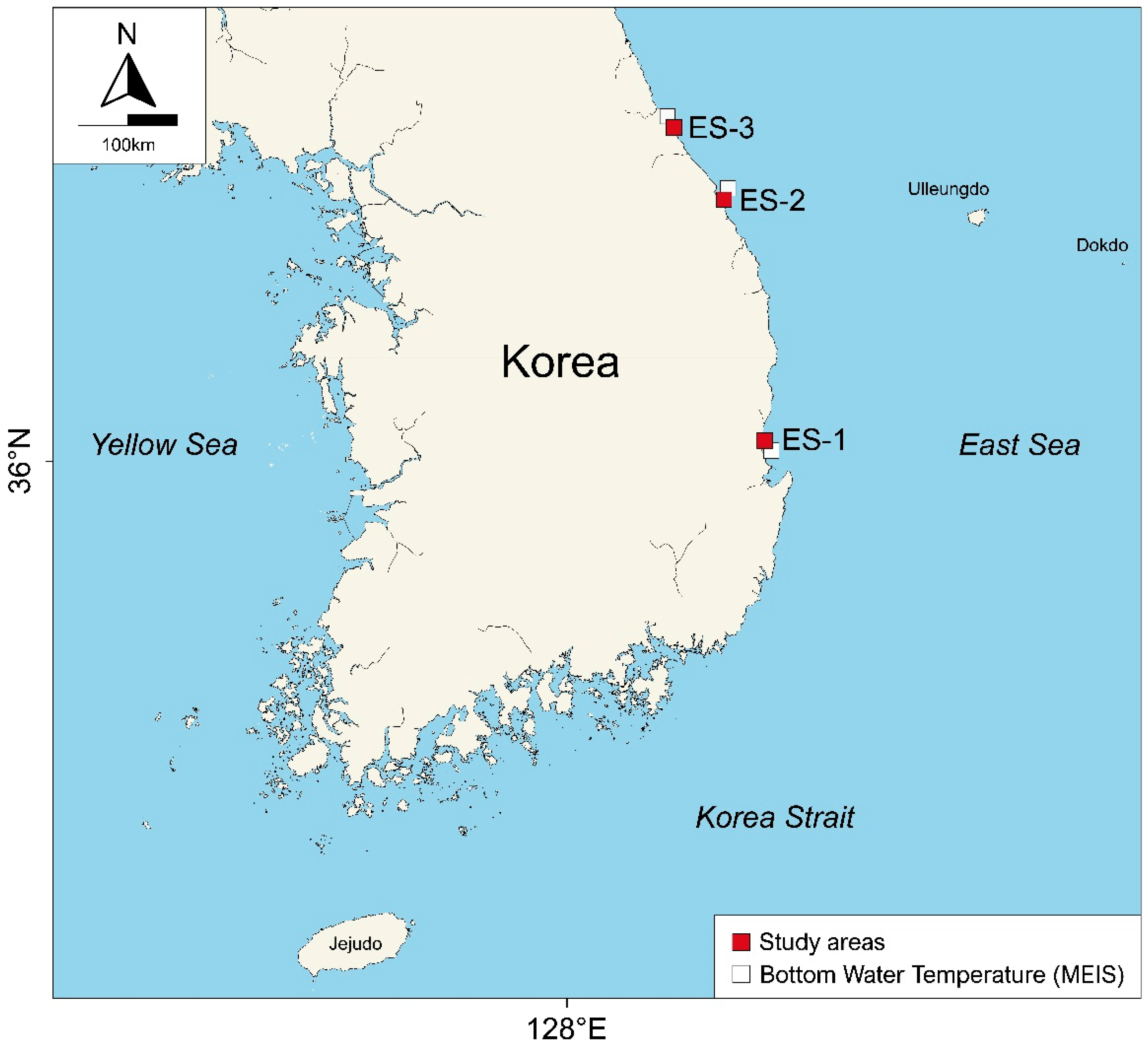
The eastern coast of Korea is facing substantial ecological challenges, including a persistent decline in seaweed populations and proliferation of barren ground, thereby resulting in coralline-covered seafloors (the so-called “whitening” phenomenon). In response, the Korean government has implemented several marine forest restoration projects using canopy-forming brown algae, including Ecklonia cava, E. stolonifera, and Sargassum spp. across 101 sites covering a total of 133.80 km2 from 2009 to 2024. Hwajin-ri in Pohang (ES-1), Geumjin-ri in Gangneung (ES-2), and Dongsan-ri in Yangyang (ES-3) constituted the major sites where marine forest restoration projects were actively implemented between 2021 and 2024, involving the planting and seeding of these seaweed species (Figure 1, Table 1). These sites collectively represent the southern, central, and northern sections of the East Sea coast of South Korea. Therefore, this study selected these three sites to investigate variations in seaweed and macrozoobenthic communities between 2021 and 2024.

2.2. Field Sampling and Sample Analysis

Seasonal field sampling was performed in 2021 and 2024 (February, May, August, and November) across the three sites using SCUBA-diving surveys. Seaweed and macrozoobenthos samples were collected using a 50 cm × 50 cm underwater stainless-steel quadrat specifically designed to minimize depth-related distortion of the community structure and prevent the loss of small samples measuring less than 2 mm [21]. At each sampling event, eight replicates of the quadrat samplings were conducted and all collected samples within the quadrat were packed in a 1 mm mesh sample bag to prevent sample loss during underwater handling. The samples were subsequently fixed in a 10% neutralized seawater–formaldehyde solution for preservation.
Formalin-preserved seaweed and macrozoobenthos samples were washed with fresh water for 24 h, identified to the species level using a stereomicroscope (Olympus SZX7, Tokyo, Japan), and measured for biomass (wet weight, gWWt/m2) to the nearest 0.01 g using an electronic balance (CAS-MWP, Seoul, Korea). The identified macrozoobenthos were classified into the following groups: Annelida, Mollusca, Arthropoda, Echinodermata, and others (e.g., Cnidaria, Platyhelminthes, Bryozoa, and Sipuncula). Species names and their corresponding taxonomic orders were derived from AlgaeBase (https://www.algaebase.org; accessed on 31 July 2025) and WoRMS (https://www.marinespecies.org; accessed on 31 July 2025). Accordingly, seaweed was classified into three groups, namely red algae (Rhodophyta), brown algae (Ochrophyta), and green algae (Chlorophyta), and subjected to subsequent analyses.
The feeding types of macrozoobenthos were classified based on previous studies (e.g., Barnes and Hughes [22]; Shimeta and Jumars [23]; Jumars et al. [24]) and supplemented with personal observations from laboratory experiments. Species exhibiting multiple feeding types were assigned to their main subtypes based on classifications outlined in the relevant literature. Accordingly, seven feeding types (grazer, carnivore, suspension feeder, deposit feeder, omnivore, scavenger, and parasite) were considered for classification.
Water temperature data were obtained from the Marine Environmental Information System (MEIS, http://www.meis.go.kr). The closest monitoring sites were selected for each study area: CE2504 for ES-1, CE2530 for ES-2, and CE2538 for ES-3 (Figure 1 and Table 1).

2.3. Data Analysis

To analyze the structural changes in seaweed and macrozoobenthic communities, diversity index (H′) [25] and species richness (R) [26] were calculated using Plymouth Routines Multivariate Ecological Research 7 (Primer 7) [27] based on the biomass data, and natural logarithm with base e was used for the calculation. Two-way analysis of variance (ANOVA) was used to assess spatial and temporal differences in diversity and richness indices. Study site (three levels) and year (two levels) were considered fixed factors, and Tukey’s multiple comparisons test was used for post hoc comparisons after ANOVA. In addition, a Spearman correlation coefficient was employed to analyze the relationships between the seaweed group, macrozoobenthic feeding type, and water temperature via SPSS (version 31; SPSS IBM, Armonk, NY, USA).
Inferential and descriptive analyses were performed to examine biomass trends of seaweed and macrozoobenthic communities with the year, season (month) and study site. Permutation multivariate analyses of variance (PERMANOVA) based on Bray–Curtis similarity matrices were conducted using log-transformed [log10(x + 1)] biomass data [28]. PERMANOVA is a non-parametric method that uses permutation procedures to test hypotheses and provides a robust and flexible method for assessing differences between groups while accounting for the multivariate nature of the data and the complex experimental designs often encountered in ecology [29,30]. Prior to PERMANOVA, a one-way analysis of similarity (ANOSIM) was conducted to assess whether each factor significantly influenced the multivariate structure. Because season factor did not significantly affect the community structures of both seaweed and macrozoobenthos, the analysis included only year (two levels) and site (three levels). The similarity matrices were then subjected to a two-way PERMANOVA to test for factor effects. PERMANOVA assigns components of variation (COVs) of differing magnitudes to the main factors and any two-way or three-way interactions between combinations of main factors included in the chosen comparison. The larger is the COV, the greater is the influence of a particular factor or interaction term on the structure of the data [31,32]. Non-metric multidimensional scaling (NMDS) ordination was used to visualize the factor effects. Multivariate analyses were performed using routines in the PRIMER v7 multivariate statistics package (www.primer-e.com) and the PERMANOVA+ add-on module [27,31]. Statistical significance was set at p < 0.05.

3. Results

3.1. Water Temperature

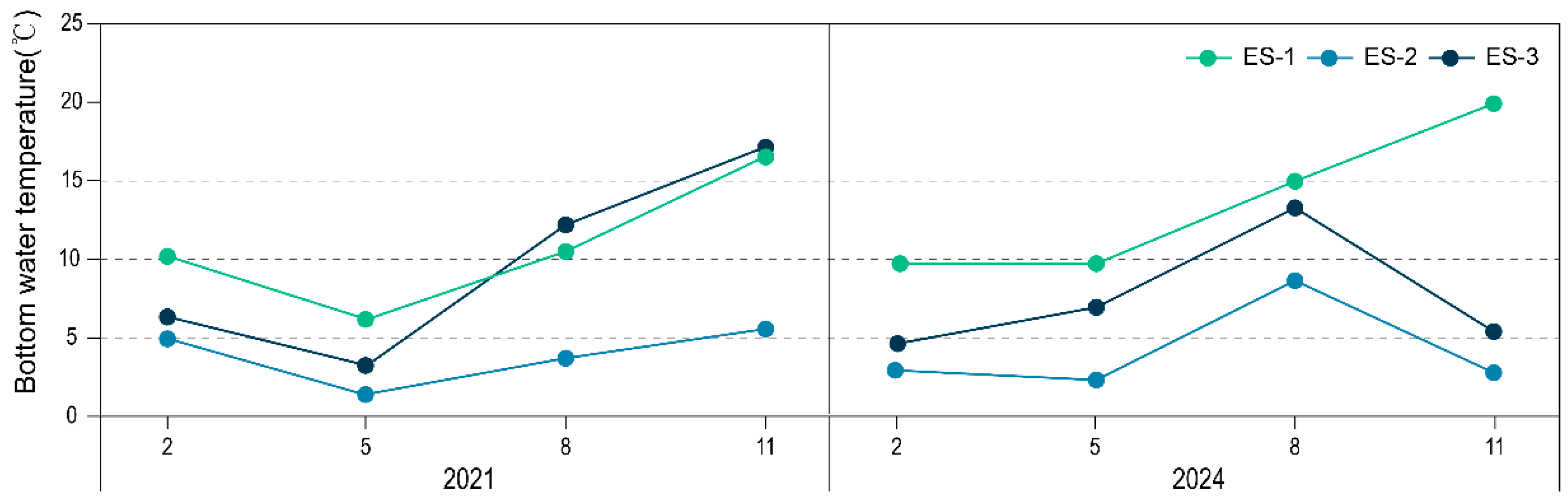
During study period, the bottom-water temperatures varied among study sites, seasons, and years (Figure 2). In 2021, the bottom-water temperature at Pohang (ES-1) decreased from 10.2 °C in winter (February) to 6.3 °C in spring (May); it subsequently increased to 10.6 °C in summer (August) and to 16.5 °C in autumn (November). The lowest water temperatures at Gangneung (ES-2) and Yangyang (ES-3) were recorded at 1.4 °C (May) and 3.3 °C (May), respectively, whereas the highest values were observed in November, achieving 5.7 °C at Gangneung (ES-2) and 17.2 °C at Yangyang (ES-3). In 2024, the bottom-water temperatures at Pohang (ES-1) were relatively stable between winter (9.9 °C in February) and spring (9.7 °C in May). This was followed by gradual increases to 14.9 °C in summer (August) and 19.9 °C in autumn (November). At Gangneung (ES-2), the temperatures were 3.0 °C in winter and 2.3 °C in spring, rising to 8.6 °C in summer before decreasing again to 2.7 °C in autumn. Bottom-water temperatures in Yangyang (ES-3) increased progressively from 4.6 °C in winter to 7.0 °C in spring and 13.3 °C in summer, followed by a decline to 5.4 °C in autumn.
In 2021, all three sites demonstrated decreased water temperatures during winter (February) and spring (May), followed by a gradual increase during summer (August) and autumn (November). In 2024, water temperatures at all sites generally increased from winter to summer, followed by a decrease in autumn, except at Pohang (ES-1), where temperatures continued to rise. Among the three sites, Gangneung (ES-2) consistently maintained the lowest temperature range across 2021 and 2024 (Figure 2).

3.2. Seaweed and Macrozoobenthic Communities

During the survey period, 118 seaweed species were identified, including 87 red (Rhodophyta), 20 brown (Ochrophyta), and 11 green algae (Chlorophyta) (Table S1). In 2024, seaweed biomass significantly increased relative to that in 2021 at all study sites, whereas the species numbers showed slight increases in ES-2 and ES-3. Notably, ES-3 exhibited the greatest increases in both species number (from 33 to 51 species) and biomass (from 18.86 to 1022.32 g wt/m2) relative to those of the other sites (Table 2). Seasonally, the lowest seaweed biomass at each station was recorded in summer 2021 (August) for ES-1 and ES-2 and in autumn 2021 (November) for ES-3 (Table S3). Overall, the highest mean biomass (2268.21 g wt/m2) recorded in summer 2024 was across all sites, whereas the lowest value (8.44 g wt/m2) presented in summer 2021, representing considerable increases in seaweed biomass during summer season between 2021 and 2024 (Table S3).
A total of 433 macrozoobenthic species were identified, with a mean density of 1636 ind./m2 and mean biomass of 1255.58 gWt/m2. Arthropods (161 species) were the dominant macrozoobenthic taxon, followed by mollusks (109 species), annelids (72 species), and echinoderms (21 species) (Table S2). Overall, the species number, density, and biomass increased at all sites in 2024 relative to those in 2021. The most substantial increase in species number occurred at ES-2 (from 105 to 226 species), while the largest rise in biomass occurred at ES-3 (from 97.30 to 508.09 gWt/m2) (Table 2). Seasonally, densities were lowest in November 2021 at all sites, with substantial increases in May and August 2024. In particular, ES-3 exhibited the highest seasonal variation, with density increasing from 49 ind./m2 (November 2021) to 3608 ind./m2 (August 2024) and biomass rising from 69.59 gWt/m2 (February 2021) to 661.98 gWt/m2 (May 2024) (Table S3).
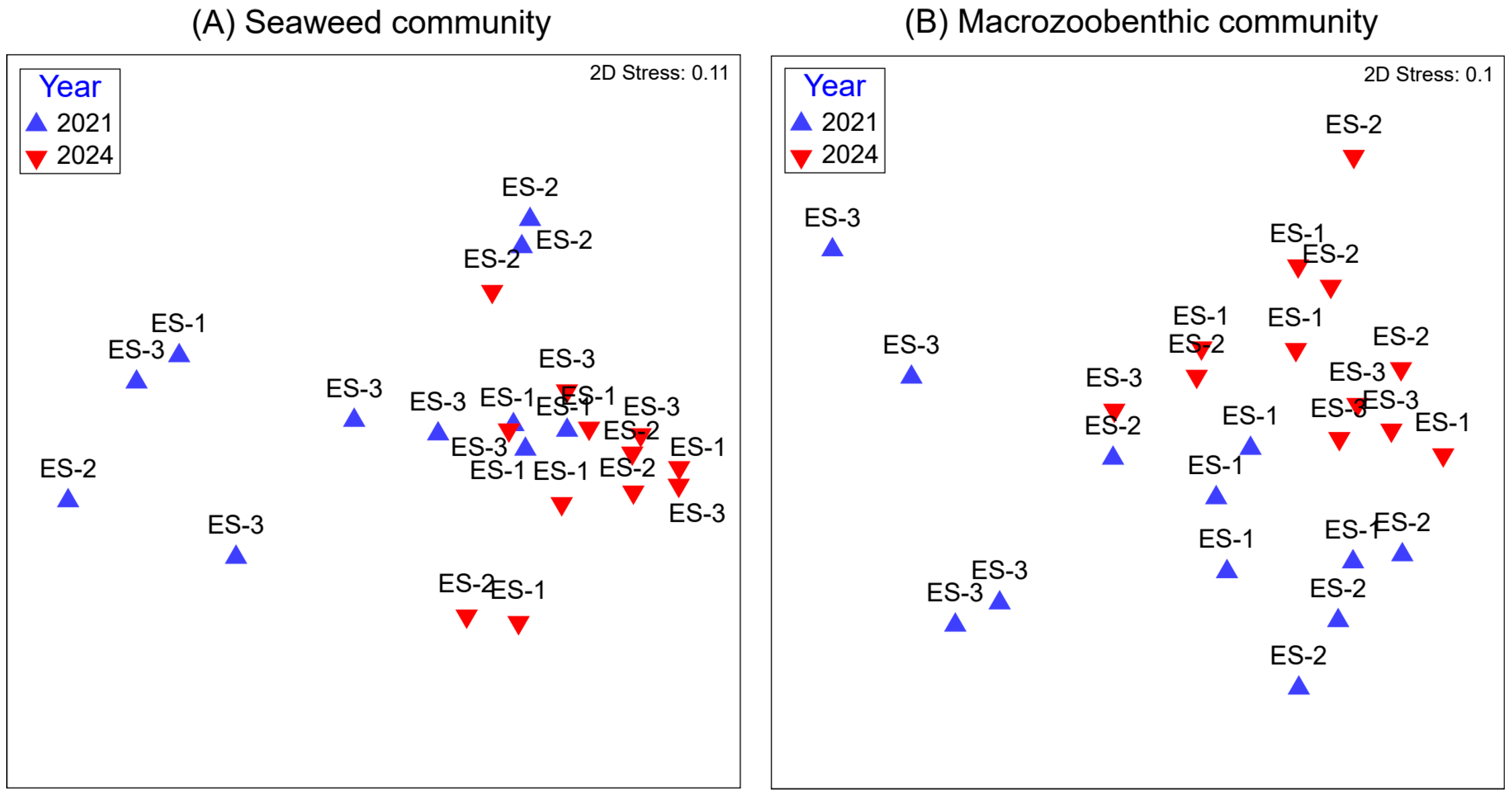
A two-way PERMANOVA revealed that seaweed community was significantly associated with year (p < 0.05), but site and two-way interaction was not significant in spatio-temporal seaweed community (p > 0.05; Table 3). While all factors as well as two-way interaction significantly influenced the macrozoobenthic community (p < 0.05; Table 3). The COVs were the greatest for year, followed by two-way interaction and site in PERMANOVA results for both seaweed and macrozoobenthic communities (Table 3) The NMDS ordination depicted a clear difference in seaweed and macrozoobenthic communities by study site and year (Figure 3). Sampling from different years showed distinct clustering patterns along the x-axis (seaweed community) or y-axis (macrozoobenthic community). In addition, samples of spatial macrozoobenthic communities with each year were clearly divided into two regions, i.e., northernmost site (ES-3) and the lower latitude sites (ES-1 and ES-2) (Figure 3).

3.3. Feeding Guild Structure of the Macrozoobenthic Community

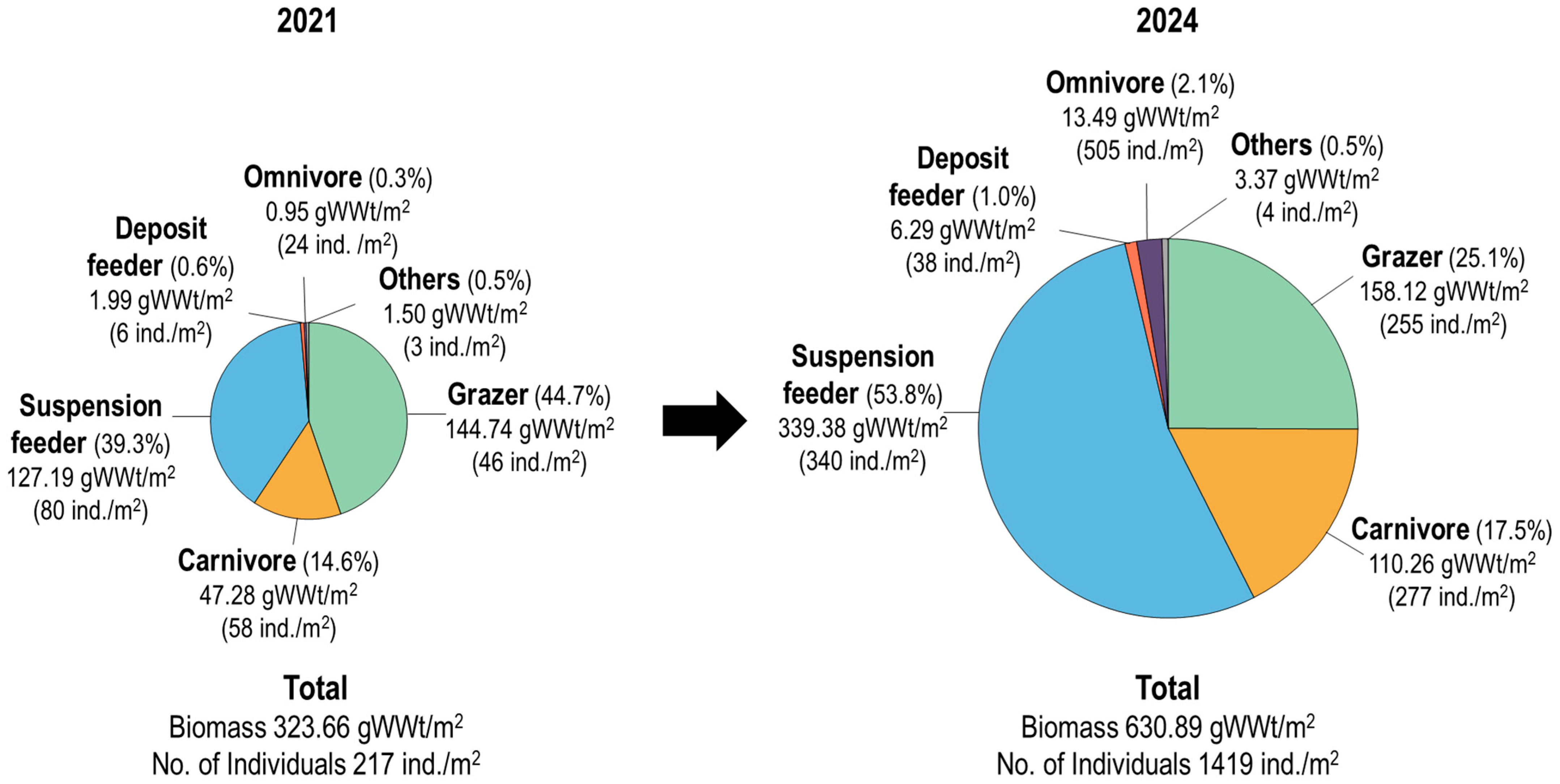
The species number, density, and biomass of macrozoobenthic feeding guilds greatly increased in 2024 relative to those in 2021 across all study sites (Figure 4). In terms of density, omnivore density exhibited the largest increase in 2024 relative to that in 2021, with increases of 3466.7% at Yangyang (ES-3), 2011.5% at Gangneung (ES-2), and 366.7% at Pohang (ES-1) (Table 4). Carnivore density increased by 119.8% at Pohang to 990.0% at Yangyang, while grazer density increased by 146.0% at Gangneung to 769.0% at Yangyang. Suspension and deposit feeders also increased in 2024 compared with those in 2021 (Table 4).
Overall, the species number and density of macrozoobenthic feeding guilds increased from 2021 to 2024 across all sites, with omnivores demonstrating the highest mean proportional increase compared to other feeding guilds (i.e., deposit feeders, carnivores, grazers, and suspension feeders). In terms of macrozoobenthic density, Cymodoce japonica (Grazer) was the most abundant at ES-1, whereas Caprella equilibra (Omnivore) was the most dominant species at both ES-2 and ES-3 (Table S4). In particular, the increases in Caprella equilibra density at Gangneung (ES-2; 81,000.0%) and Yangyang (ES-3; 105,100.0%) contributed to the overall increase in omnivore density (Table S4). Moreover, the site-specific increases in omnivore and carnivore densities (366.7 to 3466.7% for omnivores and 119.8 to 990.0% for carnivores) coincided with the increase in seaweed biomass (Table 2 and Table 4).

3.4. Species Diversity and Richness

The mean diversity index of the seaweed community remained relatively stable between 2021 and 2024 (1.19 vs. 1.32), whereas the species richness declined from 4.43 in 2021 to 2.96 in 2024. In particular, considerable decrease in species richness in ES-1 is due to decrease in species number of green algae (Table 2). The average species number and biomass increased across the three sites; however, the ratios of dominant species in the community increased from 22.09% (Gelidium elegans) in 2021 to 46.19% (Undaria pinnatifida) in 2024, resulting in reduced species richness. While, the macrozoobenthic community exhibited similar species diversity values in 2021 and 2024 (1.94 and 2.43, respectively), whereas the species richness increased substantially from 9.39 to 17.18 over the same period (Table 5).
The two-way ANOVA confirmed the observed diversity patterns, indicating no significant effects of study site or year on seaweed community, and of study site on macrozoobenthos community (p > 0.05). However, a significant difference between 2021 and 2024 was observed for macrozoobenthic community (p < 0.05). Similar patterns were found for species richness in both groups, with no significant effect of study site (p > 0.05), but a significant effect of year (p < 0.05). The two-way interactions of diversity and species richness were not significant for both seaweed and macrozoobenthos communities (p > 0.05). Tukey’s post hoc comparisons showed that seaweed species richness was significantly higher in 2021, while both diversity and species richness of macrozoobenthic community were higher in 2024 than 2021.

3.5. Relationships Between Water Temperature, Seaweed, and Macrozoobenthic Communities

A strong positive correlation was observed between seaweed and macrozoobenthic biomass across all study sites (Spearman’s ρ = 0.86, p < 0.05). In particular, the red algal biomass showed a highly significant positive correlation (p < 0.01) with grazer and suspension feeder biomass, as categorized by macrozoobenthic feeding types (Table 6). Site-specific analyses revealed that suspension feeders were significantly correlated with grazers at Pohang (ES-1), whereas red algal biomass was positively correlated (p < 0.05) with suspension feeder biomass at Gangneung (ES-2). Red algae exhibited strong positive correlations with grazers and brown algae at Yangyang (ES-3). Bottom-water temperature demonstrated a significant negative correlation with carnivores at Gangneung (ES-2). Although most seaweed taxa and macrozoobenthic feeding guilds showed negative correlations with bottom-water temperature, these relationships were not statistically significant (Table 7). Overall, the strong associations between seaweed and macrozoobenthic feeding guilds highlight the trophic linkages within the benthic community, suggesting that seaweed growth positively influences macrozoobenthic biomass. Conversely, elevated bottom-water temperatures negatively affected both seaweed and macrozoobenthic community biomass.

4. Discussion

Marine forest development provides habitats for marine organisms, enhances species diversity, and improves fishery productivity. Additionally, marine forests mitigate coastal environmental degradation by decreasing eutrophication and their roles in carbon sequestration and climate change mitigation have recently gained increased attention [6,33,34,35]. The most direct and substantial positive outcome of marine forest development is coastal ecosystem restoration, which is facilitated by enhanced species diversity and by the beneficial role of seaweed in maintaining ecosystem health. For example, in the Western English Channel, Saccorhiza polyschides (brown algae) flourishes from summer to autumn, providing extensive habitat for marine organisms and greatly increasing macrozoobenthic abundance and diversity [36]. Globally, brown algae have been extensively used as key target macroalgae in seaweed forest restoration initiatives [15]. Consistent with these findings, this study confirmed that macrozoobenthic abundance and diversity increased in response to marine forest development via seaweed planting.
In artificial marine habitats, naturally occurring biofilms on submerged surfaces are essential mediators of larval settlement processes in various benthic invertebrates [37,38]. Brown algal communities can enhance the growth and recruitment of specific red algal species by providing suitable substrate and habitat conditions [39]. The structurally complex thalli of red algae form microhabitats that support various secondary consumers (i.e., grazers), including amphipods and isopods, which are essential prey for predatory macrozoobenthic fauna. This interaction connects algal habitats to higher trophic levels within benthic food webs [40,41]. This finding reinforces the positive correlation identified in this study between seaweed and macrozoobenthic abundances, specifically the increased red algal proportion, and corresponding increases in grazer and suspension-feeder abundances. The results suggest that seaweed not only serves as a direct food source but also plays an indirect ecological role in supporting higher trophic-level predators by enhancing habitat structural complexity and providing secondary food resources.
To accurately evaluate the ecological impact of marine forest development (i.e., canopy-forming macroalgal assemblages), it is essential to consider both structural and functional dimensions. These include habitat provisioning, local physical condition modifications, and trophic linkages that mediate energy flow [17,42,43]. In this study, total seaweed biomass was positively correlated with total macrozoobenthic biomass, consistent with the hypothesis that seaweed communities would enhance macrozoobenthic production by increasing structural complexity and providing secondary food resources (e.g., via epiphytic/adherent organisms and detrital subsidies) [44,45,46]. In contrast, bottom-water temperature was negatively correlated with most seaweed and macrozoobenthic groups across all study sites. These patterns are consistent with warming-associated declines in canopy-forming brown algae and concomitant alterations in associated benthic communities or transitions to warm-tolerant assemblages in regions experiencing sustained temperature increases, such as the East Sea coast [47,48,49]. These results are consistent with the broader evidence indicating that climate-driven warming and marine heatwaves can restructure temperate macroalgal habitats and their associated food webs [50,51]. This context demonstrates that seaweed–macrozoobenthos relationships function through interactions with multiple environmental factors, extending beyond simple food resource utilization.
The findings of this study suggest that the series of changes are more influenced by habitat provision than by food provision when evaluating marine forest development [52]. From the perspective of functional diversity, the correlation between seaweed and macrozoobenthos serves as a critical basis for assessing ecosystem function restoration. Ecosystem function is maintained by the interplay of various natural processes and can be evaluated through functional diversity indicators [53]. The correlations observed between seaweed and macrozoobenthos in this study can also be interpreted in terms of functional diversity, offering important implications for ecosystem restoration and management. In particular, species within the same functional feeding group or guild, regardless of taxonomic differences, exhibit similar feeding behaviors [54]. Their feeding strategies can be interpreted as outcomes of evolutionary adaptation [55]. Therefore, this study highlights that assessing the effects of marine habitat restoration is more effective when approached from a functional perspective rather than relying exclusively on taxonomic classifications of species.
The increased foundation species biomass resulting from artificial marine forest development demonstrates a positive short-term effect; however, a lengthy time frame is anticipated to restore the functional aspects of an ecosystem [56]. Even if the abundance of marine organisms at the consumer level increases, an increase in the number of carnivorous predators (e.g., Mitrella bicincta and Sunampitoe beigeongensis) may cause a strong top-down predation effect on the food-web structure of the community, potentially undermining the structural stability of the community [57]. Therefore, this study emphasizes the importance of continuous management and monitoring.
In conclusion, this study demonstrated an increasing trend in macrozoobenthic community biomass associated with seaweed growth from 2021 to 2024 in three regions (Pohang, Gangneung, and Yangyang) of the East Sea off Korea. The positive relationship observed between seaweed and macrozoobenthic biomass underscores its value as an important indicator for assessing the health and restoration potential of coastal marine ecosystems. This study is constrained by the absence of unrestored control sites and key environmental covariates and reliance on broad functional classifications and correlative analyses, which collectively limit the generalizability and causal interpretation of the findings. Nonetheless, the findings of this study provide foundational data to inform the development of more advanced ecosystem-based restoration strategies and establish indicators for evaluating the effectiveness of marine forest restoration initiatives at both local and global scales.

Supplementary Materials

The following supporting information can be downloaded at: https://www.mdpi.com/article/10.3390/d18010027/s1, Table S1. Seasonal biomass (g WWt/m2) of seaweed species at different study sites in 2021 and 2024; Table S2. Seasonal biomass (g WWt/m2) of macrozoobenthic species at different study sites in 2021 and 2024; Table S3. Seasonal density (ind./m2) and biomass (gWWt/m2) of (A) seaweed and (B) macrozoobenthic communities by study area; Table S4. Three dominant macrozoobenthic species showing the highest rate of increase in population density (ind./m2) at each station.

Author Contributions

C.-H.H.: Conceptualization, Data curation, Formal analysis, Investigation, Methodology, Visualization, Writing—Original draft. G.J. and D.Y.K.: Formal analysis, Visualization, Writing—Original draft. J.-G.J.: Data curation, Formal analysis, Investigation. J.C.O.: Funding acquisition, Supervision, Project administration. C.S.B.: Methodology, Investigation. J.M.P.: Methodology, Software, Visualization, Writing—Review and editing. All authors have read and agreed to the published version of the manuscript.

Funding

This research was supported by the “Assessment of the effects of the Marine Forest Project” funded by the Ministry of Oceans and Fisheries, the Korea Fisheries Resources Agency, and the Korea Institute of Ocean Science and Technology project (grant number PEA0305).

Institutional Review Board Statement

Not applicable.

Data Availability Statement

Dataset available on request from the authors.

Acknowledgments

We thank all the individuals who contributed to the progress of this research.

Conflicts of Interest

The authors declare no conflicts of interest.

Abbreviations

The following abbreviations are used in this manuscript:
ES-1Pohang study site (southern East Sea coast)
ES-2Gangneung study site (central East Sea coast)
ES-3Yangyang study site (northern East Sea coast)
SPFSubpolar Front
MEISMarine Environmental Information System
PRIMER 7Plymouth Routines in Multivariate Ecological Research, version 7
H′Shannon–Wiener Diversity Index
RSpecies Richness

References

  1. Whitaker, S.G.; Smith, J.R.; Murray, S.N. Reestablishment of the Southern California Rocky Intertidal Brown Alga, Silvetia compressa: An Experimental Investigation of Techniques and Abiotic and Biotic Factors That Affect Restoration Success. Restor. Ecol. 2010, 18, 18–26. [Google Scholar] [CrossRef]
  2. Liang, Z.; Wang, F.; Sun, X.; Wang, W.; Liu, F. Reproductive biology of Sargassum thunbergii (Fucales, Phaeophyceae). Am. J. Plant Sci. 2014, 5, 2574–2581. [Google Scholar] [CrossRef]
  3. Traiger, S.B. Effects of elevated temperature and sedimentation on grazing rates of the green sea urchin: Implications for kelp forests exposed to increased sedimentation with climate change. Helgol. Mar. Res. 2019, 73, 5. [Google Scholar] [CrossRef]
  4. Wernberg, T. Marine Heatwave Drives Collapse of Kelp Forests in Western Australia. In Ecosystem Collapse and Climate Change; Canadell, J.G., Jackson, R.B., Eds.; Springer International Publishing: Cham, Switzerland, 2021; pp. 325–343. [Google Scholar]
  5. Jung, S.W.; Rho, H.S.; Choi, C.G. Seaweed Beds and Community Structure in the East and South Coast of Korea. J. Mar. Sci. Eng. 2022, 10, 689. [Google Scholar] [CrossRef]
  6. Steneck, R.S.; Graham, M.H.; Bourque, B.J.; Corbett, D.; Erlandson, J.M.; Estes, J.A.; Tegner, M.J. Kelp forest ecosystems: Biodiversity, stability, resilience and future. Environ. Conserv. 2002, 29, 436–459. [Google Scholar] [CrossRef]
  7. Filbee-Dexter, K.; Scheibling, R.E. Sea urchin barrens as alternative stable states of collapsed kelp ecosystems. Mar. Ecol. Prog. Ser. 2014, 495, 1–25. [Google Scholar] [CrossRef]
  8. Ling, S.D.; Scheibling, R.E.; Rassweiler, A.; Johnson, C.R.; Shears, N.; Connell, S.D.; Salomon, A.K.; Norderhaug, K.M.; Pérez-Matus, A.; Hernández, J.C.; et al. Global regime shift dynamics of catastrophic sea urchin overgrazing. Philos. Trans. R. Soc. B Biol. Sci. 2015, 370, 20130269. [Google Scholar] [CrossRef]
  9. Yiu, D.S.; Elliott Smith, E.A.; Farrell, S.P.; Rasher, D.B. Kelp forest loss and emergence of turf algae reshapes energy flow to predators in a rapidly warming ecosystem. Sci. Adv. 2025, 11, eadw7396. [Google Scholar] [CrossRef] [PubMed]
  10. Cardinale, B.J.; Duffy, J.E.; Gonzalez, A.; Hooper, D.U.; Perrings, C.; Venail, P.; Narwani, A.; Mace, G.M.; Tilman, D.; Wardle, D.A.; et al. Biodiversity loss and its impact on humanity. Nature 2012, 486, 59–67. [Google Scholar] [CrossRef]
  11. Hooper, D.U.; Adair, E.C.; Cardinale, B.J.; Byrnes, J.E.K.; Hungate, B.A.; Matulich, K.L.; Gonzalez, A.; Duffy, J.E.; Gamfeldt, L.; O’Connor, M.I. A global synthesis reveals biodiversity loss as a major driver of ecosystem change. Nature 2012, 486, 105–108. [Google Scholar] [CrossRef]
  12. Han, P.I.; Rho, H.S.; Park, J.M.; Kim, B.-S.; Park, J.W.; Kim, D.; Lee, D.Y.; Lee, C.I. Seasonal Dynamics of Algal Communities and Key Environmental Drivers in the Subpolar Front Zone off Eastern Korea. Biology 2025, 14, 738. [Google Scholar] [CrossRef] [PubMed]
  13. Kim, Y.-D.; Park, M.-S.; Yoo, H.-I.; Min, B.-H.; Jin, H.-J. Seasonal variations of seaweed community structure at the subtidal zone of Bihwa on the East coast of Korea. Korean J. Fish. Aquat. Sci. 2012, 45, 262–270. [Google Scholar] [CrossRef]
  14. Park, S.; Lee, J. Current status and ecological, policy proposals on barren ground management in Korea. Ocean. Polar Res. 2023, 45, 173–183–173–183. [Google Scholar] [CrossRef]
  15. Eger, A.M.; Marzinelli, E.M.; Christie, H.; Fagerli, C.W.; Fujita, D.; Gonzalez, A.P.; Hong, S.W.; Kim, J.H.; Lee, L.C.; McHugh, T.A.; et al. Global kelp forest restoration: Past lessons, present status, and future directions. Biol. Rev. 2022, 97, 1449–1475. [Google Scholar] [CrossRef]
  16. Kim, M.J.; Yun, H.Y.; Shin, K.-H.; Kim, J.H. Evaluation of Food Web Structure and Complexity in the Process of Kelp Bed Recovery Using Stable Isotope Analysis. Front. Mar. Sci. 2022, 9, 885676. [Google Scholar] [CrossRef]
  17. Menezes, S.; Baird, D.J.; Soares, A.M.V.M. Beyond taxonomy: A review of macroinvertebrate trait-based community descriptors as tools for freshwater biomonitoring. J. Appl. Ecol. 2010, 47, 711–719. [Google Scholar] [CrossRef]
  18. Nemani, S.; Misiuk, B.; Cote, D.; Edinger, E.; Mackin-McLaughlin, J.; Templeton, A.; Robert, K. Incorporating functional traits with habitat maps: Patterns of diversity in coastal benthic assemblages. Front. Mar. Sci. 2024, 11, 1141737. [Google Scholar] [CrossRef]
  19. Galobart, C.; Ballesteros, E.; Golo, R.; Cebrian, E. Addressing marine restoration success: Evidence of species and functional diversity recovery in a ten-year restored macroalgal forest. Front. Mar. Sci. 2023, 10, 1176655. [Google Scholar] [CrossRef]
  20. Thompson, M.S.A.; Pontalier, H.; Spence, M.A.; Pinnegar, J.K.; Greenstreet, S.P.R.; Moriarty, M.; Hélaouët, P.; Lynam, C.P. A feeding guild indicator to assess environmental change impacts on marine ecosystem structure and functioning. J. Appl. Ecol. 2020, 57, 1769–1781. [Google Scholar] [CrossRef]
  21. Son, M.-H.; Lee, J.-W.; Moon, C.-H.; Kim, S.; Chun, C.-K. Latitudinal variation of the number of species and species diversity in shelled gastropods of eastern coast of Korea. Korean J. Malacol. 2004, 20, 159–164. [Google Scholar]
  22. Barnes, R.S.K.; Hughes, R.N. An Introduction to Marine Ecology; Blackwell Scientific Publications: London, UK, 1988. [Google Scholar]
  23. Shimeta, J.; Jumars, P.A. Physical mechanisms and rates of particle capture by suspension feeders. Oceanogr. Mar. Biol. Annu. Rev. 1991, 29, 191–257. [Google Scholar]
  24. Jumars, P.A.; Dorgan, K.M.; Lindsay, S.M. Diet of Worms Emended: An Update of Polychaete Feeding Guilds. Annu. Rev. Mar. Sci. 2015, 7, 497–520. [Google Scholar] [CrossRef]
  25. Shannon, C.; Weaver, W. The Mathematical Theory of Communication; Illinois University Press: Champaign, IL, USA, 1949. [Google Scholar]
  26. Margalef, R. Information theory in ecology. Int. J. Gen. Syst. 1958, 3, 36–71. [Google Scholar]
  27. Clarke, K.; Gorley, R. PRIMER v7: User Manual/Tutorial; PRIMER-E: Plymouth, UK, 2015. [Google Scholar]
  28. Clarke, K.R.; Somerfield, P.J.; Chapman, M.G. On resemblance measures for ecological studies, including taxonomic dissimilarities and a zero-adjusted Bray-Curtis coefficient for denuded assemblages. J. Exp. Mar. Biol. Ecol. 2006, 330, 55–80. [Google Scholar] [CrossRef]
  29. Anderson, M.J.; Walsh, D.C.I. PERMANOVA, ANOSIM, and the Mantel test in the face of heterogeneous dispersions: What null hypothesis are you testing? Ecol. Monogr. 2013, 83, 557–574. [Google Scholar] [CrossRef]
  30. Anderson, M.J. A new method for non-parametric multivariate analysis of variance. Austral Ecol. 2001, 26, 32–46. [Google Scholar] [CrossRef]
  31. Anderson, M.; Gorley, R.; Clarke, K. PERMANOVA+ for PRIMER: Guide to Software and Statistical Methods; PRIMER-E Plymouth Marine Laboratory: Plymouth, UK, 2008. [Google Scholar]
  32. Linke, T. Trophic Interactions Among Abundant Members of the Fish Fauna in a Permanently-Open and a Seasonally-Open Estuary in South-Western Australia; Murdoch University: Perth, Australia, 2011. [Google Scholar]
  33. Krause-Jensen, D.; Duarte, C.M. Substantial role of macroalgae in marine carbon sequestration. Nat. Geosci. 2016, 9, 737–742. [Google Scholar] [CrossRef]
  34. Teagle, H.; Hawkins, S.J.; Moore, P.J.; Smale, D.A. The role of kelp species as biogenic habitat formers in coastal marine ecosystems. J. Exp. Mar. Biol. Ecol. 2017, 492, 81–98. [Google Scholar] [CrossRef]
  35. Eger, A.M.; Marzinelli, E.M.; Beas-Luna, R.; Blain, C.O.; Blamey, L.K.; Byrnes, J.E.K.; Carnell, P.E.; Choi, C.G.; Hessing-Lewis, M.; Kim, K.Y.; et al. The value of ecosystem services in global marine kelp forests. Nat. Commun. 2023, 14, 1894. [Google Scholar] [CrossRef]
  36. Salland, N.; Jensen, A.; Smale, D.A. The structure and diversity of macroinvertebrate assemblages associated with the understudied pseudo-kelp Saccorhiza polyschides in the Western English Channel (UK). Mar. Environ. Res. 2024, 198, 106519. [Google Scholar] [CrossRef]
  37. Salta, M.; Wharton, J.A.; Blache, Y.; Stokes, K.R.; Briand, J.-F. Marine biofilms on artificial surfaces: Structure and dynamics. Environ. Microbiol. 2013, 15, 2879–2893. [Google Scholar] [CrossRef]
  38. Mohamed, H.F.; Abd-Elgawad, A.; Cai, R.; Luo, Z.; Pie, L.; Xu, C. Microbial community shift on artificial biological reef structures (ABRs) deployed in the South China Sea. Sci. Rep. 2023, 13, 3456. [Google Scholar] [CrossRef]
  39. Uji, T.; Mizuta, H. The role of plant hormones on the reproductive success of red and brown algae. Front. Plant Sci. 2022, 13, 1019334. [Google Scholar] [CrossRef]
  40. Benes, K.M.; Carpenter, R.C. Kelp canopy facilitates understory algal assemblage via competitive release during early stages of secondary succession. Ecology 2015, 96, 241–251. [Google Scholar] [CrossRef] [PubMed]
  41. Bué, M.; Smale, D.A.; Natanni, G.; Marshall, H.; Moore, P.J. Multiple-scale interactions structure macroinvertebrate assemblages associated with kelp understory algae. Divers. Distrib. 2020, 26, 1551–1565. [Google Scholar] [CrossRef]
  42. Graham, M.H. Effects of Local Deforestation on the Diversity and Structure of Southern California Giant Kelp Forest Food Webs. Ecosystems 2004, 7, 341–357. [Google Scholar] [CrossRef]
  43. Leclerc, J.-C.; Riera, P.; Laurans, M.; Leroux, C.; Lévêque, L.; Davoult, D. Community, trophic structure and functioning in two contrasting Laminaria hyperborea forests. Estuar. Coast. Shelf Sci. 2015, 152, 11–22. [Google Scholar] [CrossRef]
  44. Schultze, K.; Janke, K.; Krüß, A.; Weidemann, W. The macrofauna and macroflora associated with Laminaria digitata and L. hyperborea at the island of Helgoland (German Bight, North Sea). Helgoländer Meeresunters 1990, 44, 39–51. [Google Scholar] [CrossRef]
  45. Wright, J.T.; Byers, J.E.; DeVore, J.L.; Sotka, E.E. Engineering or food? Mechanisms of facilitation by a habitat-forming invasive seaweed. Ecology 2014, 95, 2699–2706. [Google Scholar] [CrossRef]
  46. Ørberg, S.B.; Krause-Jensen, D.; Mouritsen, K.N.; Olesen, B.; Marbà, N.; Larsen, M.H.; Blicher, M.E.; Sejr, M.K. Canopy-Forming Macroalgae Facilitate Recolonization of Sub-Arctic Intertidal Fauna and Reduce Temperature Extremes. Front. Mar. Sci. 2018, 5, 332. [Google Scholar] [CrossRef]
  47. Arafeh-Dalmau, N.; Montaño-Moctezuma, G.; Martínez, J.A.; Beas-Luna, R.; Schoeman, D.S.; Torres-Moye, G. Extreme Marine Heatwaves Alter Kelp Forest Community Near Its Equatorward Distribution Limit. Front. Mar. Sci. 2019, 6, 499. [Google Scholar] [CrossRef]
  48. Smale, D.A. Impacts of ocean warming on kelp forest ecosystems. New Phytol. 2020, 225, 1447–1454. [Google Scholar] [CrossRef]
  49. Michaud, K.M.; Reed, D.C.; Miller, R.J. The Blob marine heatwave transforms California kelp forest ecosystems. Commun. Biol. 2022, 5, 1143. [Google Scholar] [CrossRef]
  50. Harley, C.D.G.; Anderson, K.M.; Demes, K.W.; Jorve, J.P.; Kordas, R.L.; Coyle, T.A.; Graham, M.H. Effects of climate change on global seaweed communities. J. Phycol. 2012, 48, 1064–1078. [Google Scholar] [CrossRef]
  51. Vergés, A.; Doropoulos, C.; Malcolm, H.A.; Skye, M.; Garcia-Pizá, M.; Marzinelli, E.M.; Campbell, A.H.; Ballesteros, E.; Hoey, A.S.; Vila-Concejo, A.; et al. Long-term empirical evidence of ocean warming leading to tropicalization of fish communities, increased herbivory, and loss of kelp. Proc. Natl. Acad. Sci. USA 2016, 113, 13791–13796. [Google Scholar] [CrossRef]
  52. Miller, R.J.; Lafferty, K.D.; Lamy, T.; Kui, L.; Rassweiler, A.; Reed, D.C. Giant kelp, Macrocystis pyrifera, increases faunal diversity through physical engineering. Proc. R. Soc. B Biol. Sci. 2018, 285, 20172571. [Google Scholar] [CrossRef]
  53. Gladstone-Gallagher, R.V.; Needham, H.R.; Lohrer, A.M.; Lundquist, C.J.; Pilditch, C.A. Site-dependent effects of bioturbator-detritus interactions alter soft-sediment ecosystem function. Mar. Ecol. Prog. Ser. 2017, 569, 145–161. [Google Scholar] [CrossRef]
  54. Root, R.B. Organization of a Plant-Arthropod Association in Simple and Diverse Habitats: The Fauna of Collards (Brassica Oleracea). Ecol. Monogr. 1973, 43, 95–124. [Google Scholar] [CrossRef]
  55. Statzner, B.; Dolédec, S.; Hugueny, B. Biological trait composition of European stream invertebrate communities: Assessing the effects of various trait filter types. Ecography 2004, 27, 470–488. [Google Scholar] [CrossRef]
  56. Bianchelli, S.; Fraschetti, S.; Martini, F.; Lo Martire, M.; Nepote, E.; Ippoliti, D.; Rindi, F.; Danovaro, R. Macroalgal forest restoration: The effect of the foundation species. Front. Mar. Sci. 2023, 10, 1213184. [Google Scholar] [CrossRef]
  57. Winnie, J.; Creel, S. The many effects of carnivores on their prey and their implications for trophic cascades, and ecosystem structure and function. Food Webs 2017, 12, 88–94. [Google Scholar] [CrossRef]
Figure 1. Location of the study areas investigated in this research.
Diversity 18 00027 g001
Figure 2. Seasonal variations in bottom-water temperature at the study areas between 2021 and 2024.
Diversity 18 00027 g002
Figure 3. NMDS ordination of fish assemblages constructed from Bray–Curtis similarity matrices of the two habitats and four seasons at two study sites.
Diversity 18 00027 g003
Figure 4. Temporal changes in macrozoobenthic composition based on the biomass of each feeding guild between 2021 and 2024.
Diversity 18 00027 g004
Table 1. Geographic coordinates and water depths of the study areas.
Sampling StationsBottom-Water Temperature (MEIS)
StationsLocal NameLatitude (N)Longitude (E)Water Depth (m)StationsLatitude (N)Longitude (E)
ES-1Pohang36°14′43.62″129°23′6.51″12.50CE250436°12′6.00″129°24′1.00″
ES-2Gangneung37°38′37.58″129°03′2.74″7.80CE253037°39′52.00″129°04′51.00″
ES-3Yangyangi37°58′49.34″128°45′57.02″11.50CE253838°00′45.00″128°45′1.00″
Table 2. Species number and biomass (gWWt/m2) of seaweed and macrozoobenthic communities sampled in 2021 and 2024.
Study Area and Year
Classification
ES-1ES-2ES-3
202120242021202420212024
SeaweedTotalSpecies number514833463351
Biomass104.41816.0852.90732.5418.861022.32
RhodophytaSpecies number313122292139
Biomass62.21465.162.57216.2310.91151.45
OchrophytaSpecies number1212101379
Biomass36.49331.4850.21506.906.81841.89
ChlorophytaSpecies number851453
Biomass5.7119.440.129.411.1428.99
MacrozoobenthosTotalSpecies number131239105226103216
Biomass537.99717.59335.68667.0097.30508.09
AnnelidaSpecies number224618432240
Biomass4.5024.652.5315.090.875.41
ArthropodaSpecies number388747783283
Biomass6.4615.7111.2485.350.5320.37
EchinodermataSpecies number11125749
Biomass85.7953.5340.7133.1643.7248.39
MolluscaSpecies number526130543751
Biomass1.434.860.032.350.297.25
OthersSpecies number833544833
Biomass7.1267.9659.1630.530.2915.07
Table 3. Mean squares (MS), pseudo-F ratios, significance levels (p), and component of variation (COV) for a series of PERMANOVA tests employing Bray–Curtis similarity matrices derived from the biomass of seaweed and macrozoobenthic communities for differences in response to year and study site, and interactions of the two factors. Bold letters indicate significance at p < 0.05.
SourcedfSeaweedMacrozoobenthos
MSPseudo-FpCOVMSPseudo-FpCOV
Site2829.41.1030.3763.192788.34.2200.0018.671
Year15441.27.1970.00220.2451944.310.4070.00112.102
Site × Year2891.81.1860.3396.068735.43.9360.01011.711
Residual17751.9 27.421186.8 13.668
Total22
Table 4. Species number, density and biomass of macrozoobenthic feeding guilds sampled in 2021 and 2024 across different study sites.
Study Area and YearES-1ES-2ES-3
Macrozoobenthic Feeding Guild 202120242021202420212024
GrazerSpecies number283515352135
Density (ind./m2)593915012329252
Biomass (gWWt/m2)163.20203.70220.25157.0050.77113.65
Ratio of increase in density (%)562.7%146.0%769.0%
CarnivoreSpecies number427236713266
Density (ind./m2)1012224228130327
Biomass (gWWt/m2)77.7795.8552.51200.0211.5734.90
Ratio of increase in density (%)119.8%569.0%990.0%
Suspension feederSpecies number315322552042
Density (ind./m2)11033410353228155
Biomass (gWWt/m2)287.18374.7261.53296.6532.87346.75
Ratio of increase in density (%)203.6%416.5%453.6%
OthersDeposit
feeder
Species number622820619
Density (ind./m2)642441630
Biomass (gWWt/m2)4.9712.720.224.220.801.92
Ratio of increase in density (%)600.0%925.0%400.0%
OmnivoreSpecies number225121422449
Density (ind./m2)241122654924856
Biomass (gWWt/m2)0.7821.120.798.621.2910.72
Ratio of increase in density (%)366.7%2011.5%3466.7%
ScavengerSpecies number2633-4
Density (ind./m2)3378-1
Biomass (gWWt/m2)4.109.480.390.49-0.12
Ratio of increase in density (%)0%14.3%-
ParasiteSpecies number-----1
Density (ind./m2)-----<1
Biomass (gWWt/m2)-----0.01
Ratio of increase in density (%)---
Table 5. Species diversity and richness of seaweed and benthic macrofauna in each study area. Two-way ANOVA results: n.s., not significant; * p < 0.05; ** p < 0.01. The letters A, B, and C indicate groups identified by Tukey’s post hoc test.
Study Area and Year ClassificationES-1ES-2ES-3Avg.Two-Way ANOVA
20212024202120242021202420212024FactorSig.
SeaweedDiversity (H′)1.61 A1.18 A0.78 A1.16 A1.18 A1.62 A1.191.32Siten.s.
Yearn.s.
Richness (R)5.11 A2.94 B,C3.19 A,C2.71 C4.99 A,B3.22 B,C4.432.96Siten.s.
Year**
MacrozoobenthosDiversity (H′)2.18 A,B2.69 A2.07 A,B2.61 A1.59 B1.99 A,B1.942.43Siten.s.
Year*
Richness (R)10.47 A,C17.59 A8.29 C17.44 A9.40 B,C16.51 A,B9.3917.18Siten.s.
Year**
Table 6. Spearman’s correlation coefficients (ρ) among seaweed and benthic macrofauna across all study areas. ** p < 0.01.
Rho.Och.Chl.Gra.Car.Sus.
SeaweedRhodophyta
Ochrophyta0.643
Chlorophyta0.0240.571
Benthic MacrofaunaGrazer0.905 **0.5480.143
Carnivore−0.0950.1670.405−0.214
Suspension feeder0.905 **0.5480.1431.000 **−0.214
Table 7. Spearman’s correlation coefficients (ρ) among an environmental factor, seaweed, and benthic macrofauna across all study areas: (A) ES-1, (B) ES-2, and (C) ES-3. * p < 0.05, ** p < 0.01.
(A) Temp.Rho.Och.Chl.Gra.Car.Sus.
Environmental variableWater temperature-
SeaweedRhodophyta−0.071-
Ochrophyta−0.3100.357-
Chlorophyta−0.500−0.3330.357-
Benthic MacrofaunaGrazer−0.2620.476−0.024−0.119-
Carnivore−0.4050.0710.2380.643−0.310-
Suspension feeder−0.2140.619−0.167−0.2380.714 *0.119-
(B) Temp.Rho.Och.Chl.Gra.Car.Sus.
Environmental variableWater temperature-
SeaweedRhodophyta0.048-
Ochrophyta0.0240.599-
Chlorophyta−0.2160.5450.855 **-
Benthic MacrofaunaGrazer−0.4050.5480.4550.507-
Carnivore−0.762 *−0.238−0.503−0.2030.000-
Suspension feeder−0.2860.714 *0.3470.5200.6900.048-
(C) Temp.Rho.Och.Chl.Gra.Car.Sus.
Environmental variableWater temperature-
SeaweedRhodophyta−0.119-
Ochrophyta−0.2620.905 **-
Chlorophyta0.1800.4670.611-
Benthic MacrofaunaGrazer0.2380.810 *0.6430.371-
Carnivore−0.0240.5480.6190.5630.500-
Suspension feeder0.3330.5000.3330.2870.429−0.095-
Disclaimer/Publisher’s Note: The statements, opinions and data contained in all publications are solely those of the individual author(s) and contributor(s) and not of MDPI and/or the editor(s). MDPI and/or the editor(s) disclaim responsibility for any injury to people or property resulting from any ideas, methods, instructions or products referred to in the content.