
Species Composition and New Records of Epiphytic Diatoms on Seagrass Zostera marina from Qingdao Bay, China


Abstract
1. Introduction
2. Materials and Methods
3. Results

| Season | Autumn | Winter | |
|---|---|---|---|
| Taxon | |||
| Division Heterokontophyta Moestrup, Andersen & Guiry | |||
| Class Mediophyceae Medlin & Kaczmarska | |||
| Order Thalassiosirales Glezer & Makarova | |||
| Family Thalassiosiraceae Lebour | |||
| Genus Cymatotheca Hendey | |||
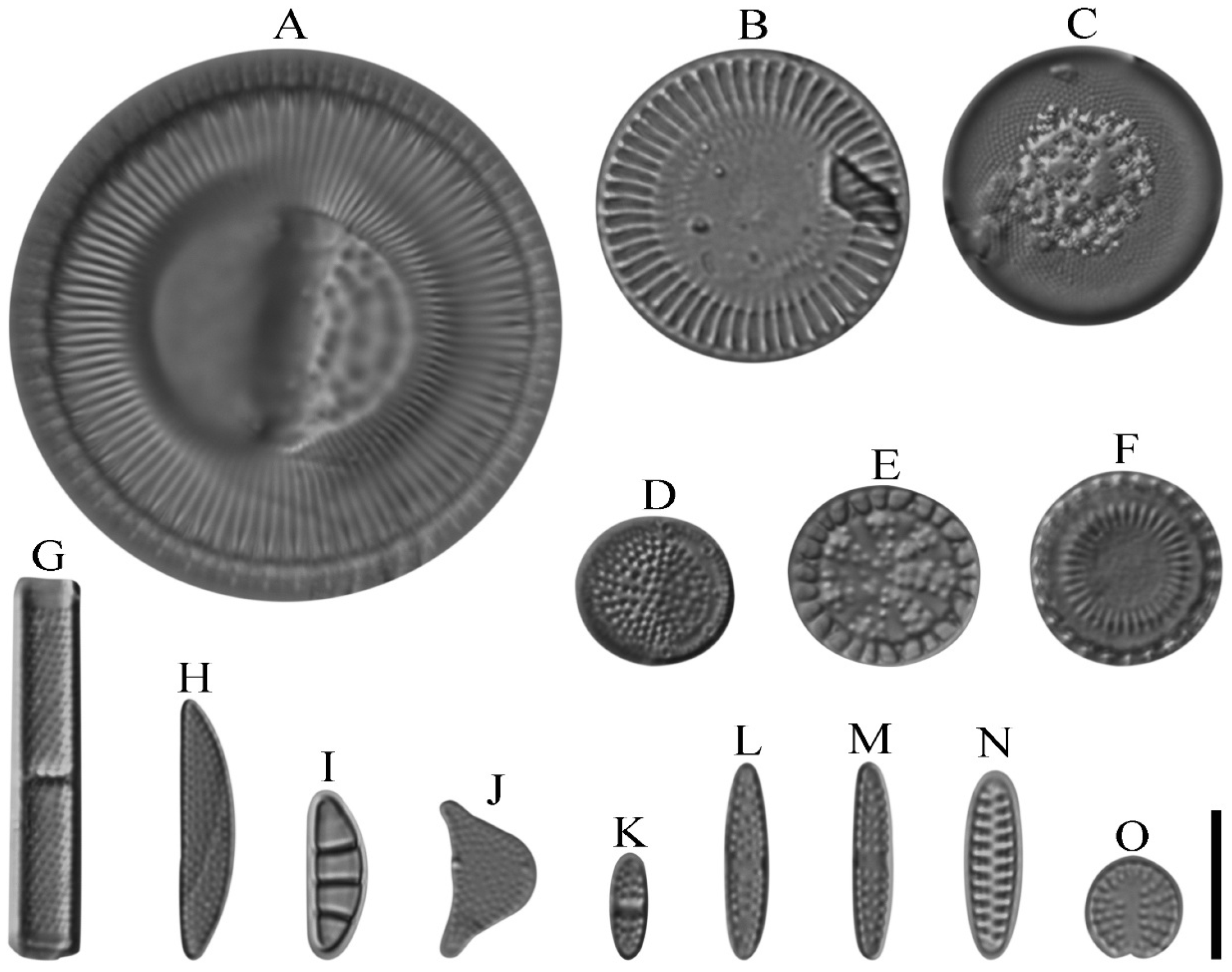
| Cymatotheca minima Voigt (Figure 1D) | + | + | |
| Genus Tryblioptychus Hendey | |||
| Tryblioptychus cocconeiformis (Grunow) Hendey (Figure 1E) | + | + | |
| Order Stephanodiscales Nikolaev & Harwood | |||
| Family Stephanodiscaceae Makarova | |||
| Genus Cyclotella (Kützing) Brébisson | |||
| Cyclotella litoralis Lange & Syvertsen * (Figure 1A) | + | ||
| Order Anaulales Round & Crawford | |||
| Family Anaulaceae (Schütt) Lemmermann | |||
| Genus Eunotogramma Weisse | |||
| Eunotogramma debile Grunow (Figure 1I) | + | + | |
| Order Cymatosirales Round & Crawford | |||
| Family Cymatosiraceae Hasle, von Stosch & Syvertsen | |||
| Genus Cymatosira Grunow | |||
| Cymatosira gibberula Cheng & Gao (Figure 1J) | + | ||
| Genus Pierrecomperia Sabbe, Vyverman & Ribero | |||
| Pierrecomperia catenuloides Sabbe, Vyverman & Ribero * (Figure 1H) | + | ||
| Genus Plagiogrammopsis Hasle, Stosch & Syvertsen | |||
| Plagiogrammopsis crawfordii Witkowski, Lange-Bertalot & Metzeltin * (Figure 1K) | + | + | |
| Plagiogrammopsis mediaequata Gardner & Crawford (Figure 1L) | + | ||
| Plagiogrammopsis sp. (Figure 1M) | + | ||
| Class Coscinodiscophyceae Round & Crawford | |||
| Order Melosirales Crawford | |||
| Family Hyalodiscaceae Crawford | |||
| Genus Podosira Ehrenberg | |||
| Podosira stelligera (Bailey) Mann (Figure 1C) | + | ||
| Order Paraliales Crawford | |||
| Family Paraliaceae Crawford | |||
| Genus Paralia Heiberg | |||
| Paralia sulcata (Ehrenberg) Cleve (Figure 1F) | + | ||
| Family Radialiplicataceae Gleser & Moisseeva | |||
| Genus Ellerbeckia Crawford | |||
| Ellerbeckia sol (Ehrenberg) Crawford & Sims * (Figure 1B) | + | ||
| Order Aulacoseirales Crawford | |||
| Family Aulacoseiraceae Crawford | |||
| Genus Aulacoseira Thwaites | |||
| Aulacoseira granulata var. angustissima (Müller) Simonsen (Figure 1G) | + | ||
| Class Bacillariophyceae Haeckel | |||
| Order Fragilariales Silva | |||
| Family Staurosiraceae Medlin | |||
| Genus Staurosirella Wiliams & Round | |||
| Staurosirella martyi (Héribaud) Morales & Manoylov (Figure 1N) | + | ||
| Genus Nanofrustulum Round, Hallsteinsen & Paasche | |||
| Nanofrustulum sopotense (Witkowski & Lange-Bertalot) Morales, Wetzel & Ector (Figure 1O) | + | ||
| Order Licmophorales Round | |||
| Family Ulnariaceae Cox | |||
| Genus Tabularia (Kützing) Williams & Round | |||
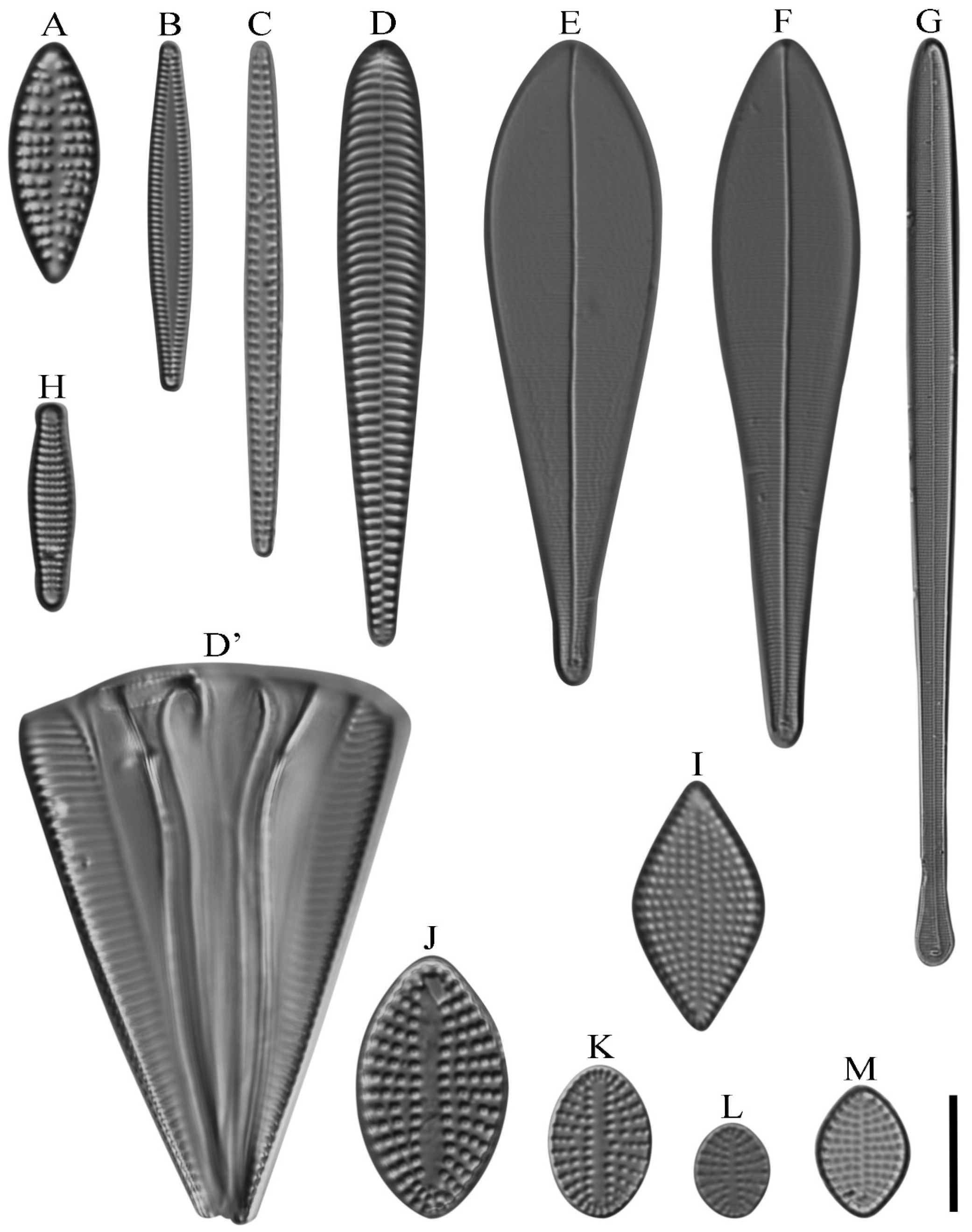
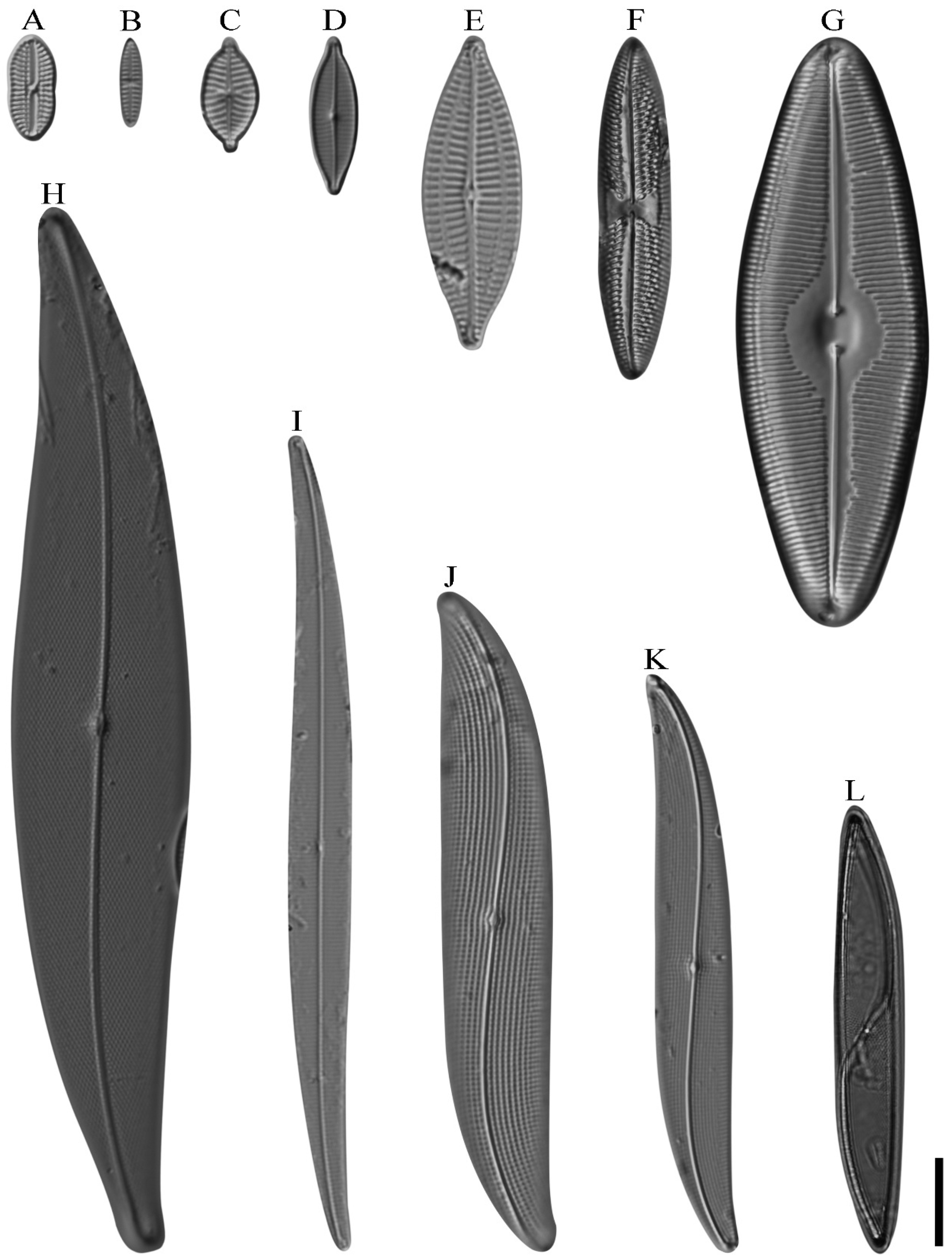
| Tabularia fasciculata (Agardh) Williams & Round (Figure 2C) | + | ||
| Tabularia parva (Kützing) Williams & Round (Figure 2B) | + | + | |
| Genus Trachysphenia Petit | |||
| Trachysphenia australis Petit (Figure 2A) | + | ||
| Family Licmophoraceae Kützing | |||
| Genus Licmophora Agardh | |||
| Licmophora californica Grunow (Figure 2D,D’) | + | + | |
| Licmophora ehrenbergii (Kützing) Grunow (Figure 2F) | + | ||
| Licmophora flabellata (Greville) Agardh (Figure 2G) | + | ||
| Licmophora paradoxa (Lyngbye) Agardh (Figure 2E) | + | + | |
| Order Rhaphoneidales Round | |||
| Family Rhaphoneidaceae Forti | |||
| Genus Rhaphoneis Ehrenberg | |||
| Rhaphoneis rhomboides Hendey (Figure 2I) | + | ||
| Genus Delphineis Andrews | |||
| Delphineis australis (Petit) Watanabe, Tanaka, Reid, Kumada & Nagumo (Figure 2J) | + | + | |
| Delphineis minutissima (Hustedt) Simonsen (Figure 2L) | + | ||
| Delphineis sp. (Figure 2K) | + | + | |
| Genus Neodelphineis Takano | |||
| Neodelphineis silenda (Hohn & Hellerman) Desianti & Potapova (Figure 2M) | + | ||
| Order Rhabdonematales Round & Crawford | |||
| Family Grammatophoraceae Lobban & Ashworth | |||
| Genus Grammatophora Ehrenberg | |||
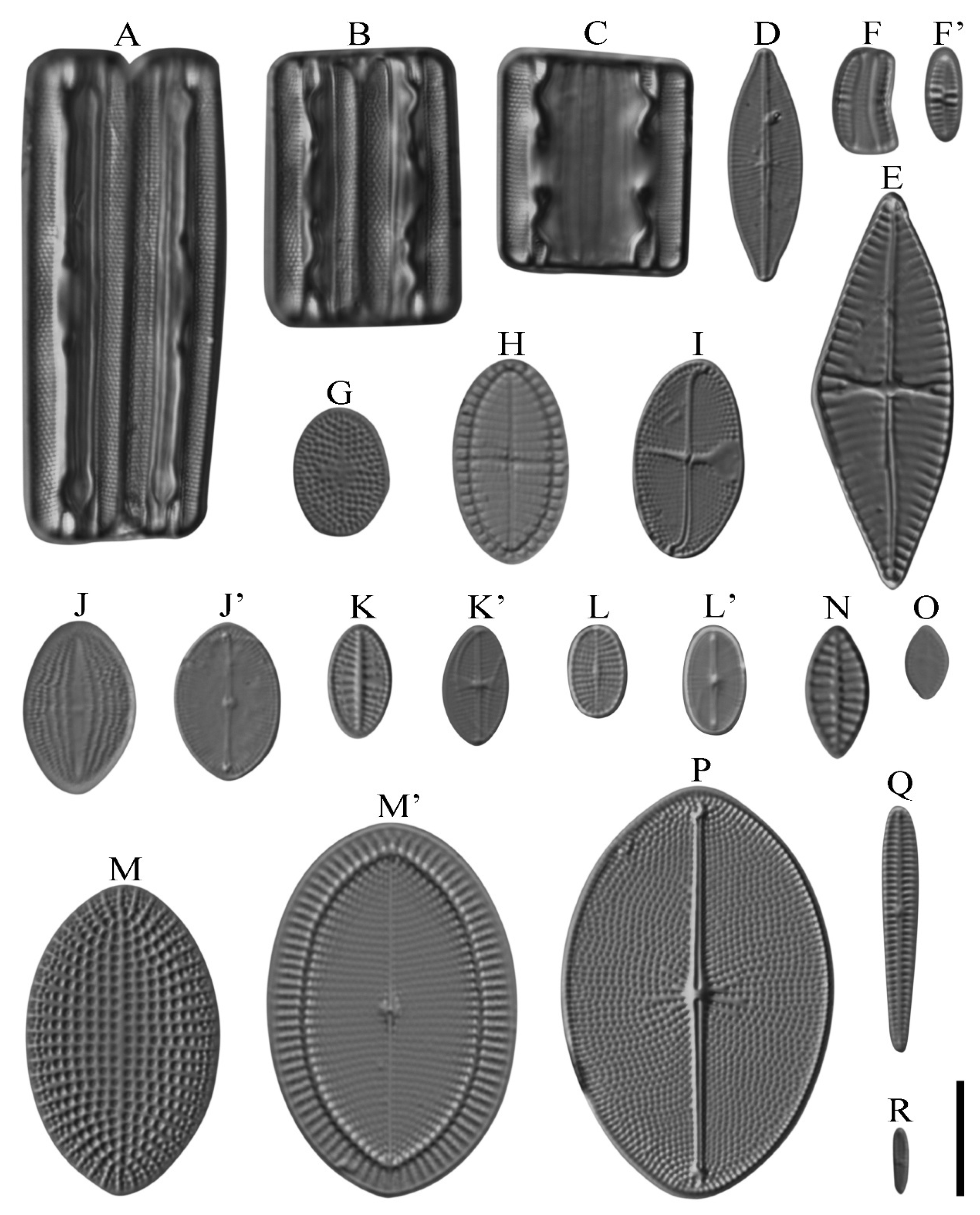
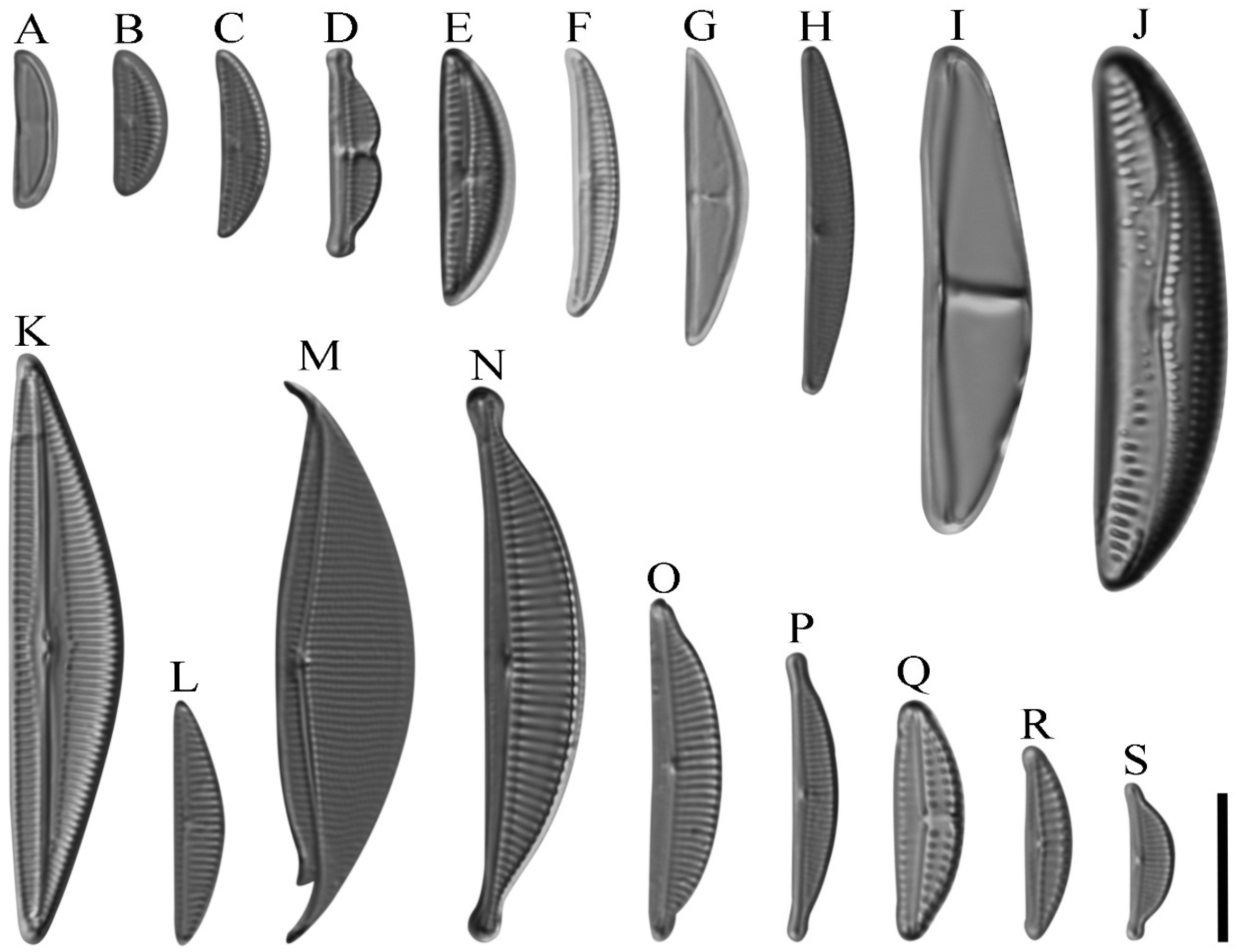
| Grammatophora marina (Lyngbye) Kützing (Figure 3C) | + | ||
| Grammatophora oceanica Ehrenberg (Figure 3A) | + | ||
| Grammatophora undulata Ehrenberg (Figure 3B) | + | ||
| Genus Hyalosira Kützing | |||
| Hyalosira delicatula Kützing (Figure 2H) | + | ||
| Order Lyrellales Mann | |||
| Family Lyrellaceae Mann | |||
| Genus Moreneis Park, Koh & Witkowski | |||
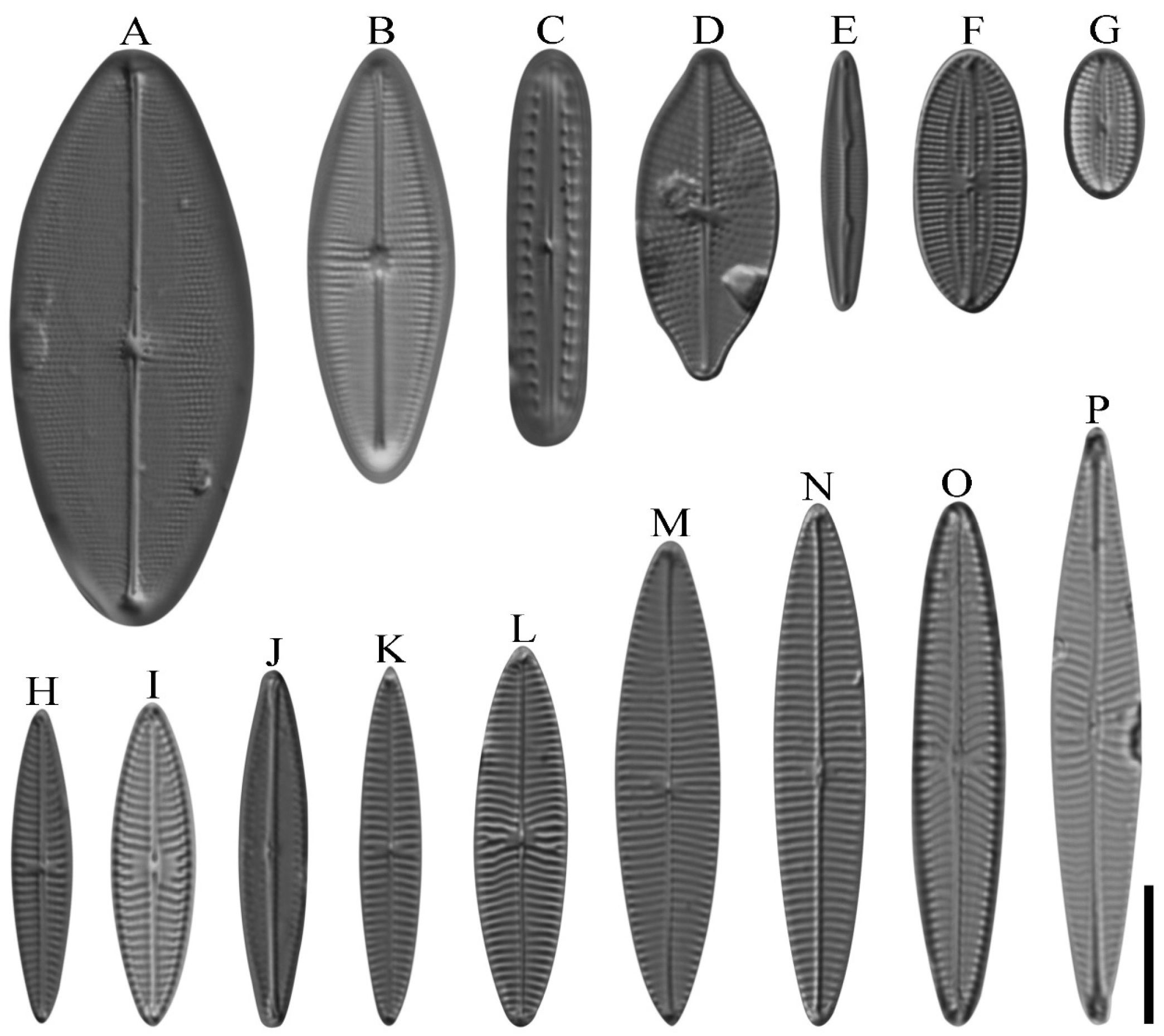
| Moreneis coreana Park, Koh & Witkowski (Figure 4D) | + | ||
| Order Mastogloiales Mann | |||
| Family Mastogloiaceae Mereschkowsky | |||
| Genus Tetramphora Mereschkowsky | |||
| Tetramphora lineolata (Ehrenberg) Mereschkowsky (Figure 6M) | + | ||
| Order Cymbellales Mann | |||
| Family Rhoicospheniaceae Chen & Zhu | |||
| Genus Rhoicosphenia Grunow | |||
| Rhoicosphenia genuflexa (Kützing) Medlin (Figure 3F,F’) | + | + | |
| Genus Gomphonemopsis Medlin | |||
| Gomphonemopsis exigua (Kützing) Medlin (Figure 3Q) | + | + | |
| Gomphonemopsis nana Li, Li & Lai (Figure 3R) | + | ||
| Order Achnanthales Silva | |||
| Family Achnanthaceae Kützing | |||
| Genus Achnanthes Bory | |||
| Achnanthes fimbriata (Grunow) Ross * (Figure 3D) | + | ||
| Achnanthes sp. (Figure 3E) | + | ||
| Family Cocconeidaceae Kützing | |||
| Genus Cocconeis Ehrenberg | |||
| Cocconeis costata Gregory (Figure 3H) | + | ||
| Cocconeis notata Petit (Figure 3I) | + | ||
| Cocconeis scutellum Ehrenberg (Figure 3M,M’) | + | + | |
| Cocconeis sp. 1 (Figure 3K,K’) | + | ||
| Cocconeis sp. 2 (Figure 3L,L’) | + | ||
| Genus Monoalveoneis Yurchak, Gogorev, Kezlya & Kulikovskiy | |||
| Monoalveoneis convexa (Giffen) Yurchak, Gogorev, Kezlya & Kulikovskiy * (Figure 3J,J’) | + | ||
| Genus Cocconeiopsis Witkowski, Lange-Bertalot & Metzeltin | |||
| Cocconeiopsis kantsiensis (Giffen) Witkowski, Lange-Bertalot & Metzeltin (Figure 3P) | + | ||
| Genus Anorthoneis Grunow | |||
| Anorthoneis excentrica (Donkin) Grunow (Figure 3G) | + | ||
| Family Achnanthidiaceae Mann | |||
| Genus Achnanthidium Kützing | |||
| Achnanthidium glyphos Riaux-Gobin, Compère & Witkowski (Figure 3O) | + | ||
| Genus Pseudoplanothidium Tseplik, Glushchenko, Genkal, Maltsev & Kulikovskiy | |||
| Pseudoplanothidium delicatulum (Kützing) Tseplik, Glushchenko, Genkal, Maltsev & Kulikovskiy (Figure 3N) | + | + | |
| Order Naviculales Bessey | |||
| Family Berkeleyaceae Mann | |||
| Genus Parlibellus Cox | |||
| Parlibellus delognei (Van Heurck) Cox * (Figure 4B) | + | ||
| Parlibellus rhombicus (Gregory) Cox (Figure 4A) | + | ||
| Genus Berkeleya Greville | |||
| Berkeleya rutilans (Trentepohl ex Roth) Grunow (Figure 4E) | + | + | |
| Family Scoliotropidaceae Mereschkowsky | |||
| Genus Biremis Mann & Cox | |||
| Biremis ambigua (Cleve) Mann (Figure 4C) | + | ||
| Family Sellaphoraceae Mereschkowsky | |||
| Genus Fallacia Stickle & Mann | |||
| Fallacia forcipata (Greville) Stickle & Mann (Figure 4F) | + | + | |
| Family Naviculales incertae sedis | |||
| Genus Pseudofallacia Liu, Kociolek & Wang | |||
| Pseudofallacia tenera (Hustedt) Liu, Kociolek & Wang (Figure 4G) | + | + | |
| Genus Fogedia Witkowski, Lange-Bertalot, Metzeltin & Bafana | |||
| Fogedia lyra Park, Khim, Koh & Witkowski (Figure 5E) | + | ||
| Family Diploneidaceae Mann | |||
| Genus Diploneis (Ehrenberg) Cleve | |||
| Diploneis aestuarii Hustedt (Figure 5A) | + | + | |
| Family Naviculaceae Kützing | |||
| Genus Navicula Bory | |||
| Navicula arenaria var. rostellata Lange-Bertalot * (Figure 4I) | + | ||
| Navicula digitoradiata (Gregory) Ralfs (Figure 4L) | + | ||
| Navicula eidrigiana Carter * (Figure 4O) | + | ||
| Navicula flanatica Grunow (Figure 4P) | + | ||
| Navicula flebilis Cholnoky * (Figure 4N) | + | ||
| Navicula gregaria Donkin (Figure 5D) | + | ||
| Navicula pavillardii Hustedt (Figure 4M) | + | ||
| Navicula perminuta Grunow (Figure 5B) | + | + | |
| Navicula platyventris Meister (Figure 5C) | + | ||
| Navicula salinicola Hustedt (Figure 4K) | + | ||
| Navicula sp. 1 (Figure 4H) | + | ||
| Navicula sp. 2 (Figure 4J) | + | ||
| Genus Trachyneis Cleve | |||
| Trachyneis aspera (Ehrenberg) Cleve (Figure 5F) | + | ||
| Genus Seminavis Mann | |||
| Seminavis exigua Chen, Zhuo & Gao (Figure 6L) | + | + | |
| Seminavis robusta Danielidis & Mann (Figure 6K) | + | + | |
| Genus Caloneis Cleve | |||
| Caloneis brevis var. distoma (Grunow) Cleve (Figure 5G) | + | ||
| Genus Gyrosigma Hassall | |||
| Gyrosigma cf. tenuissimum (Smith) Griffith & Henfrey (Figure 5I) | + | ||
| Gyrosigma sp. 1 (Figure 5J) | + | + | |
| Gyrosigma sp. 2 (Figure 5K) | + | ||
| Family Amphipleuraceae Grunow | |||
| Genus Halamphora (Cleve) Mereschkowsky | |||
| Halamphora aponina (Kützing) Levkov (Figure 6P) | + | + | |
| Halamphora coffeiformis (Agardh) Levkov (Figure 6O) | + | + | |
| Halamphora tenerrima (Aleem & Hustedt) Levkov (Figure 6S) | + | ||
| Halamphora sp. 1 (Figure 6Q) | + | ||
| Halamphora sp. 2 (Figure 6R) | + | ||
| Family Pleurosigmataceae Mereschowsky | |||
| Genus Pleurosigma Smith | |||
| Pleurosigma stuxbergii Cleve & Grunow (Figure 5H) | + | ||
| Genus Donkinia Ralfs | |||
| Donkinia carinata (Donkin) Ralfs * (Figure 5L) | + | + | |
| Order Thalassiophysales Mann | |||
| Family Catenulaceae Mereschkowsky | |||
| Genus Catenula Mereschkowsky | |||
| Catenula adhaerens (Mereschkowsky) Mereschkowsky (Figure 6A) | + | + | |
| Genus Amphora (Ehrenberg) Kützing | |||
| Amphora abludens Simonsen * (Figure 6G) | + | + | |
| Amphora americana Wachnicka & Gaiser * (Figure 6H) | + | ||
| Amphora cf. marina Smith (Figure 6C) | + | ||
| Amphora eximia Carter * (Figure 6B) | + | ||
| Amphora holsaticoides Nagumo & Kobayasi (Figure 6N) | + | ||
| Amphora incrassata Giffen (Figure 6D) | + | ||
| Amphora laevissima Gregory (Figure 6I) | + | ||
| Amphora proteoides f. varians Proshkina-Lavrenko * (Figure 6J) | + | ||
| Amphora sp. 1 (Figure 6E) | + | ||
| Amphora sp. 2 (Figure 6F) | + | ||
| Order Bacillariales Hendey | |||
| Family Bacillariaceae Ehrenberg | |||
| Genus Bacillaria Gmelin | |||
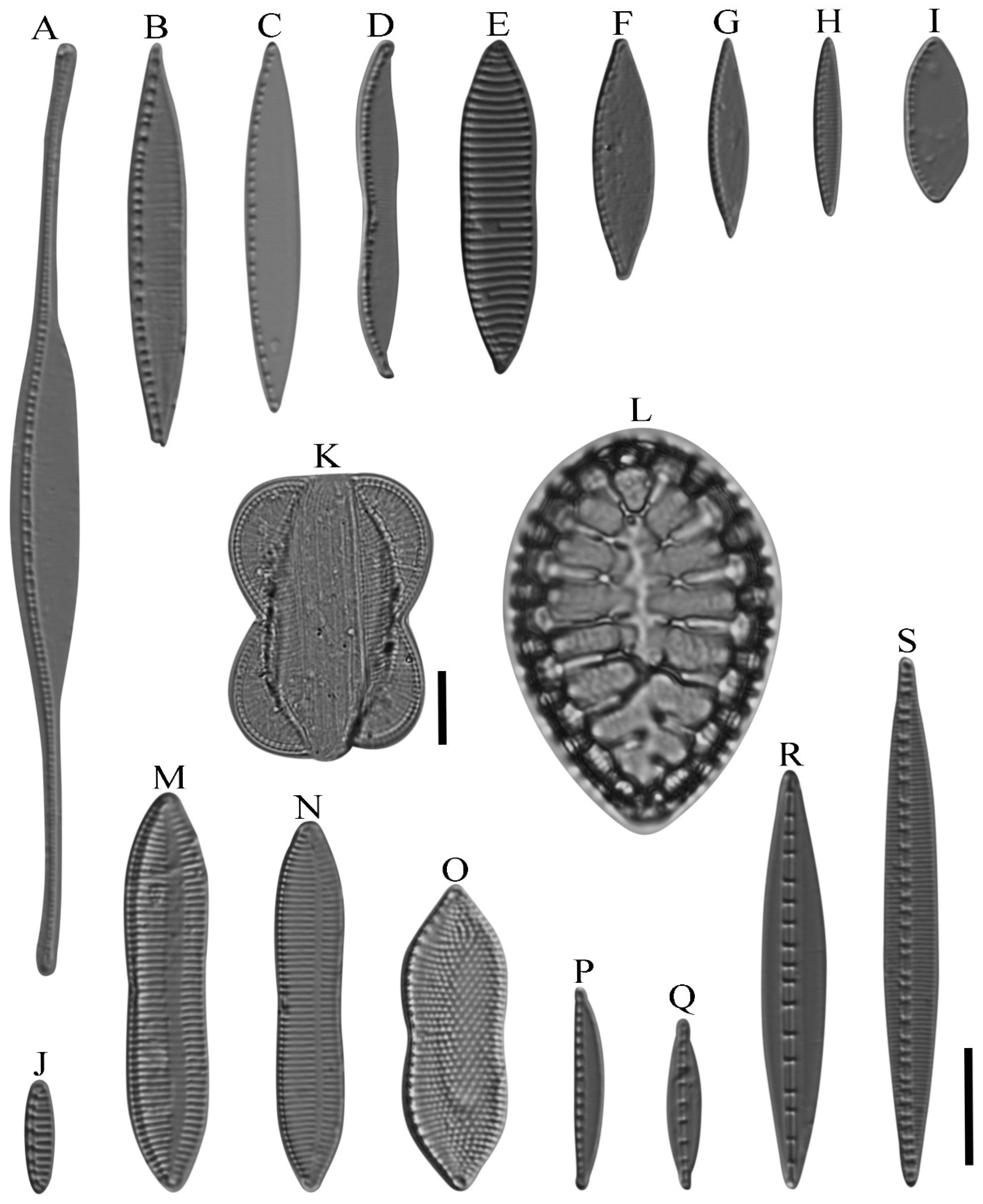
| Bacillaria socialis (Gregory) Ralfs (Figure 7S) | + | + | |
| Genus Psammodictyon Mann | |||
| Psammodictyon constrictum (Gregory) Mann (Figure 7O) | + | + | |
| Genus Tryblionella Smith | |||
| Tryblionella apiculata Gregory (Figure 7N) | + | ||
| Tryblionella hungarica (Grunow) Frenguelli (Figure 7M) | + | ||
| Genus Cymbellonitzschia Hustedt | |||
| Cymbellonitzschia szulczewskii Witkowski, Lange-Bertalot & Metzeltin (Figure 7P) | + | ||
| Genus Nitzschia Hassall | |||
| Nitzschia aequorea Hustedt * (Figure 7G) | + | ||
| Nitzschia amabilis Suzuki (Figure 7I) | + | ||
| Nitzschia bicapitata Cleve (Figure 7F) | + | ||
| Nitzschia capitellata Hustedt (Figure 7B) | + | ||
| Nitzschia cf. sicula (Castracane) Hustedt (Figure 7E) | + | ||
| Nitzschia frustulum (Kützing) Grunow (Figure 7H) | + | + | |
| Nitzschia hybrida Grunow (Figure 7D) | + | + | |
| Nitzschia palea (Kützing) Smith (Figure 7C) | + | ||
| Nitzschia reversa Smith (Figure 7A) | + | ||
| Nitzschia valdestriata Aleem & Hustedt (Figure 7J) | + | + | |
| Genus Homoeocladia Agardh | |||
| Homoeocladia distans (Gregory) Kuntze (Figure 7R) | + | + | |
| Homoeocladia volvendirostrata (Ashworth, Dᶏbek & Witkowski) Lobban & Ashworth (Figure 7Q) | + | ||
| Order Surirellales Mann | |||
| Family Entomoneidaceae Reimer | |||
| Genus Entomoneis Ehrenberg | |||
| Entomoneis paludosa (Smith) Reimer (Figure 7K) | + | ||
| Family Surirellaceae Kützing | |||
| Genus Campylodiscus (Ehrenberg) Kützing | |||
| Campylodiscus neofastuosus Ruck & Nakov (Figure 7L) | + | + | |


4. Discussion
5. Conclusions
Author Contributions
Funding
Institutional Review Board Statement
Data Availability Statement
Acknowledgments
Conflicts of Interest
References
- Sullivan, M.J. Epiphytic diatoms of three seagrass species in Mississippi Sound. Bull. Mar. Sci. 1979, 29, 459–464. [Google Scholar]
- Huang, X.P.; Jiang, Z.J.; Zhang, J.P.; Yu, S.; Liu, S.L.; Wu, Y.C. The Chinese nomenclature of the global seagrasses. Haiyang Xuebao 2018, 40, 127–133. (In Chinese) [Google Scholar]
- Borowitzka, M.A.; Lavery, P.S.; van Keulen, M. Epiphytes of seagrasses. In Seagrasses: Biology, Ecology and Conservation; Larkum, A.W.D., Orth, R.J., Duarte, C.M., Eds.; Springer: Dordrecht, The Netherlands, 2006; pp. 441–461. [Google Scholar]
- Hartati, R.; Zainuri, M.; Ambariyanto, A.; Widianingsih, W.; Trianto, A.; Mahendrajaya, R.T. Similarity microalgal epiphyte composition on seagrass of Enhalus acoroides and Thalasia hemprichii from different waters. IOP Conf. Ser. Earth Environ. Sci. 2018, 139, 012011. [Google Scholar] [CrossRef]
- Atmaja, P.S.P.; Bengen, D.G.; Madduppa, H.H. The second skin of seagrass leaves: A comparison of microalgae epiphytic communities between two different species across two seagrass meadows in Lesser Sunda islands. Trop. Life Sci. Res. 2021, 32, 97–119. [Google Scholar] [CrossRef]
- Trevizan Segovia, B.; Sanders-Smith, R.; Adamczyk, E.M.; Forbes, C.; Hessing-Lewis, M.; O’Connor, M.I.; Parfrey, L.W. Microeukaryotic communities associated with the seagrass Zostera marina are spatially structured. J. Eukaryot. Microbiol. 2021, 68, e12827. [Google Scholar] [CrossRef]
- Hinode, K.; Kamisaki, H.; Nishihara, G.N.; Terada, R. The phenology of epiphytic diatoms and epifauna observed on Zostera marina of Arikawa Bay, Nagasaki Prefecture, Japan. Plankt. Benthos. Res. 2021, 16, 179–190. [Google Scholar] [CrossRef]
- Moncreiff, C.A.; Sullivan, M.J.; Daehnick, A.E. Primary production dynamics in seagrass beds of Mississippi Sound: The contributions of seagrass, epiphytic algae, sand microflora, and phytoplankton. Mar. Ecol. Prog. Ser. 1992, 87, 161–171. [Google Scholar] [CrossRef]
- Prazukin, A.V.; Lee, R.I.; Firsov, Y.K.; Kapranov, S.V. Vertical distribution of epiphytic diatoms in relation to the eelgrass Zostera noltii canopy biomass and height. Aquat. Bot. 2022, 176, 103466. [Google Scholar] [CrossRef]
- Lebreton, B.; Richard, P.; Radenac, G.; Bordes, M.; Bréret, M.; Arnaud, C.; Mornet, F.; Blanchard, G.F. Are epiphytes a significant component of intertidal Zostera noltii beds? Aquat. Bot. 2009, 91, 82–90. [Google Scholar] [CrossRef]
- Yap-Dejeto, L.G.; Baqueros, A.R.S. Epiphytic diatom composition on the leaf blades of Enhalus acoroides in Almeria, Biliran, Philippines during the Northeast Monsoon of 2012–2013. Philipp. Sci. 2015, 52, 56–72. [Google Scholar]
- Jacobs, R.P.W.M.; Noten, T.M.P.A. The annual pattern of the diatoms in the epiphyton of eelgrass (Zostera marina L.) at Roscoff, France. Aquat. Bot. 1980, 8, 355–370. [Google Scholar] [CrossRef]
- Cox, T.E.; Cebrian, J.; Tabor, M.; West, L.; Krause, J.W. Do diatoms dominate benthic production in shallow systems? A case study from a mixed seagrass bed. Limnol. Oceanogr. Lett. 2020, 5, 425–434. [Google Scholar] [CrossRef]
- Gao, Y.P.; Fang, J.G.; Zhang, J.H.; Li, F.; Mao, Y.Z.; Du, M.R. Seasonal variation of fouling organisms on eelgrass Zostera marina L. in Sanggou Bay. Prog. Fish. Sci. 2010, 31, 59–64. (In Chinese) [Google Scholar]
- Romero, O.E.; López-Fuerte, F.O. Cocconeis thalassiana sp. nov., a new alveolate diatom (Bacillariophyta) from the Mexican Caribbean. Diatom Res. 2013, 28, 295–302. [Google Scholar] [CrossRef]
- Majewska, R.; Van de Vijver, B. Nagumoea serrata, a new diatom species (Bacillariophyceae) found on seagrass from the south-eastern coast of Africa (Indian Ocean). Fottea 2020, 20, 98–103. [Google Scholar] [CrossRef]
- Li, L.; Nong, Q.Z.; Chen, C.P.; Li, Y.H.; Lai, J.X. Two new diatom species of the genus Gomphonemopsis (Bacillariophyceae) from the coast of China and two new combinations for the genus. PhytoKeys 2024, 239, 255–266. [Google Scholar] [CrossRef]
- Majewska, R.; D’Alelio, D.; De Stefano, M. Cocconeis Ehrenberg (Bacillariophyta), a genus dominating diatom communities associated with Posidonia oceanica Delile (monocotyledons) in the Mediterranean Sea. Aquat. Bot. 2014, 112, 48–56. [Google Scholar] [CrossRef]
- Corlett, H.; Jones, B. Epiphyte communities on Thalassia testudinum from Grand Cayman, British West Indies: Their composition, structure, and contribution to lagoonal sediments. Sediment. Geol. 2007, 194, 245–262. [Google Scholar] [CrossRef]
- Chung, M.H.; Lee, K.S. Species composition of the epiphytic diatoms on the leaf tissues of three Zostera species distributed on the southern coast of Korea. Algae 2008, 23, 75–81. [Google Scholar] [CrossRef]
- da Rosa, V.C.; Copertino, M. Diversity and variation of epiphytic diatoms on Ruppia maritima L., related to anthropogenic impact in an estuary in Southern Brazil. Diversity 2022, 14, 787. [Google Scholar] [CrossRef]
- Zhou, Y.; Jiang, Z.J.; Qiu, G.L.; Zhang, P.D.; Xu, S.C.; Zhang, X.M.; Liu, S.L.; Li, W.T.; Wu, Y.C.; Yue, S.D.; et al. Distribution status, degradation reasons and protection countermeasures of seagrass resources in China. Oceanol. Limnol. Sin. 2023, 54, 1248–1257. (In Chinese) [Google Scholar]
- Li, Y.Z. The Annual Changes of Epiphytes and Their Effects on the Physiological and Biochemical Characteristics of Halophila ovalis at Liusha Bay. Master’s Thesis, Guangdong Ocean University, Zhanjiang, China, 2016. (In Chinese) [Google Scholar]
- Xu, S.C.; Zhang, Y.; Zhou, Y.; Xu, S.; Yue, S.D.; Liu, M.J.; Zhang, X.M. Warming northward shifting southern limits of the iconic temperate seagrass (Zostera marina). iScience 2022, 25, 104755. [Google Scholar] [CrossRef] [PubMed]
- Liu, D.Y.; Bai, J.; Song, S.Q.; Zhang, J.; Sun, P.; Li, Y.; Han, G. The impact of sewage discharge on the macroalgae community in the Yellow Sea coastal area around Qingdao, China. Water Air Soil Poll. 2007, 7, 683–692. [Google Scholar] [CrossRef]
- Witkowski, A.; Lange-Bertalot, H.; Metzeltin, D. Diatom flora of marine coasts I. In Iconographia Diatomologica. Annotated Diatom Micrographs; Lange-Bertalot, H., Ed.; A.R.G. Gantner Verlag K.G.: Ruggell, Liechtenstein, 2000; Volume 7, pp. 1–925. [Google Scholar]
- Chin, T.G.; Cheng, Z.D.; Lin, J.M.; Liu, S.C. Marine Benthic Diatoms in China (Volume 1); China Ocean Press: Beijing, China, 1982; pp. 1–323. (In Chinese) [Google Scholar]
- Chin, T.G.; Cheng, Z.D.; Liu, S.C.; Ma, J.X. Marine Benthic Diatoms in China (Volume 2); China Ocean Press: Beijing, China, 1991; pp. 1–437. (In Chinese) [Google Scholar]
- Guiry, M.D. How many species of algae are there? A reprise. Four kingdoms, 14 phyla, 63 classes and still growing. J. Phycol. 2024, 60, 214–228. [Google Scholar] [CrossRef]
- Siqueiros-Beltrones, D.A.; Ibarra-Obando, S.E. Floristic list of epiphytic diatoms of Zostera Marina in Bahia Falsa, San Quintin. Cienc. Mar. 1985, 11, 21–67. [Google Scholar] [CrossRef]
- Sterrenburg, F.A.S.; Erftemeijer, P.L.A.; Nienhuis, P.H. Diatoms as epiphytes on seagrasses in South Sulawesi (Indonesia) comparison with growth on inert substrata. Bot. Mar. 1995, 38, 1–7. [Google Scholar] [CrossRef]
- Sullivan, M.J. Structural characteristics of a diatom community epiphytic on Ruppia maritima. Hydrobiologia 1977, 53, 81–86. [Google Scholar] [CrossRef]
- Wu, W.W. Studies on Taxonomy and Diversity of Epiphytic Diatoms on Common Seaweeds in Coastal Waters of China. Ph.D. Thesis, Xiamen University, Xiamen, China, 2022. (In Chinese) [Google Scholar]
- Round, F.E.; Crawford, R.M.; Mann, D.G. The Diatoms: Biology and Morphology of the Genera; Cambridge University Press: New York, NY, USA, 1990; pp. 1–774. [Google Scholar]
- Romero, O.E. Ultrastructure of four species of the diatom genus Cocconeis Ehr., with the description of C. pseudocostata sp. nov. Nova Hedwigia 1996, 63, 361–396. [Google Scholar] [CrossRef]
- Car, A.; Witkowski, A.; Dobosz, S.; Burfeind, D.D.; Meinesz, A.; Jasprica, N.; Ruppel, M.; Kurzydłowski, K.J.; Płociński, T. Description of a new marine diatom, Cocconeis caulerpacola sp. nov. (Bacillariophyceae), epiphytic on invasive Caulerpa species. Eur. J. Phycol. 2012, 47, 433–448. [Google Scholar] [CrossRef][Green Version]
- López-Fuerte, F.O.; Siqueiros-Beltrones, D.A.; Hernández-Almeida, O.U. Epiphytic diatoms of Thalassia testudinum (Hydrocharitaceae) from the Mexican Caribbean. Mar. Biodivers. Rec. 2013, 6, e107. [Google Scholar] [CrossRef]
- Kanjer, L.; Mucko, M.; Car, A.; Bosak, S. Epiphytic diatoms on Posidonia oceanica (L.) Delile leaves from eastern Adriatic Sea. Nat. Croat. 2019, 28, 1–20. [Google Scholar]
- Jacobs, R.P.W.M.; Hermelink, P.M.; Van Geel, G. Epiphytic algae on eelgrass at Roscoff, France. Aquat. Bot. 1983, 15, 157–173. [Google Scholar] [CrossRef]
- Angsupanich, S. Seagrasses and epiphytes in Thale Sap Songkhla, Southern Thailand. La mer 1996, 34, 67–73. [Google Scholar]
- Haworth, E.Y. Some problems of diatom taxonomy in Scottish lake sediments. Brit. Phycol. J. 1974, 9, 47–55. [Google Scholar] [CrossRef]
- Lange, C.B.; Syvertsen, E.E. Cyclotella litoralis sp. nov. (Bacillariophyceae), and its relationships to C. striata and C. stylorum. Nova Hedwigia 1989, 48, 341–356. [Google Scholar]
- Suzuki, H.; Nagumo, T.; Tanaka, J. Morphology of the marine epiphytic diatom Cocconeis convexa Giffen (Bacillariophyceae). Diatom 2001, 17, 59–68. [Google Scholar]
- Matsuoka, T.; Ozawa, T.; Tanaka, J.; Nagumo, T. Epiphytic diatoms on a green alga Avrainvillea amadelpha (Montagne) A. et E. S. Gepp from Irabu Island, Miyako Islands, Okinawa, Japan. B. Nippon Dent. Univ. Gen. Educ. 2012, 41, 49–55, (In Japanese with English abstract). [Google Scholar]
- Sabbe, K.; Vanelslander, B.; Ribeiro, L.; Witkowski, A.; Muylaert, K.; Vyverman, W. A new genus, Pierrecomperia gen. nov., a new species and two new combinations in the marine diatom family Cymatosiraceae. Vie Milieu 2010, 60, 243–256. [Google Scholar]
- Joh, G. Species diversity of the old genus Navicula Bory (Bacillariophyta) on intertidal sand-flats in the Nakdong River estuary, Korea. J. Ecol. Environ. 2013, 36, 371–390. [Google Scholar] [CrossRef]
- Hafner, D.; Car, A.; Jasprica, N.; Kapetanović, T.; Dupčić Radić, I. Relationship between marine epilithic diatoms and environmental variables in oligotrophic bay, NE Mediterranean. Mediterr. Mar. Sci. 2018, 19, 223–239. [Google Scholar] [CrossRef]
- Kawamura, T.; Hirano, R. Seasonal changes in benthic diatom communities colonizing glass slides in Aburatsubo Bay, Japan. Diatom Res. 1992, 7, 227–239. [Google Scholar] [CrossRef]
- Wachnicka, A.H.; Gaiser, E.E. Characterization of Amphora and Seminavis from south Florida, U.S.A. Diatom Res. 2007, 22, 387–455. [Google Scholar] [CrossRef]
- Ohtsuka, T. Epipelic diatoms blooming in Isahaya Tidal Flat in the Ariake Sea, Japan, before the drainage following the Isahaya-Bay Reclamation Project. Phycol. Res. 2005, 53, 138–148. [Google Scholar] [CrossRef]
- Ognjanova-Rumenova, N.; Zaprjanova, D. Siliceous microfossil stratigraphy of sediment profile ‘F’ connected with archaeological excavations in coastal wetlands in the Bay of Sozopol (Bulgarian Black Sea coast). Part 1: Taxonomical documentation, diatom biostratigraphy and ecological analysis of the diatom flora. Phytologia Balcanica 1998, 4, 65–80. [Google Scholar]
- Robinson, N.J.; Majewska, R.; Lazo-Wasem, E.A.; Nel, R.; Paladino, F.V.; Rojas, L.; Zardus, J.D.; Pinou, T. Epibiotic diatoms are universally present on all sea turtle species. PLoS ONE 2016, 11, e0157011. [Google Scholar] [CrossRef]
- Ryabushko, L.; Miroshnichenko, E.; Blaginina, A.; Shiroyan, A.; Lishaev, D. Diatom and cyanobacteria communities on artificial polymer substrates in the Crimean coastal waters of the Black Sea. Mar. Pollut. Bull. 2021, 169, 2521. [Google Scholar] [CrossRef]
Disclaimer/Publisher’s Note: The statements, opinions and data contained in all publications are solely those of the individual author(s) and contributor(s) and not of MDPI and/or the editor(s). MDPI and/or the editor(s) disclaim responsibility for any injury to people or property resulting from any ideas, methods, instructions or products referred to in the content. |
© 2025 by the authors. Licensee MDPI, Basel, Switzerland. This article is an open access article distributed under the terms and conditions of the Creative Commons Attribution (CC BY) license.
Share and Cite
Li, L.; Lu, J.; Qin, X.; Li, Y.; Lai, J. Species Composition and New Records of Epiphytic Diatoms on Seagrass Zostera marina from Qingdao Bay, China. Diversity 2026, 18, 22. https://doi.org/10.3390/d18010022
Li L, Lu J, Qin X, Li Y, Lai J. Species Composition and New Records of Epiphytic Diatoms on Seagrass Zostera marina from Qingdao Bay, China. Diversity. 2026; 18(1):22. https://doi.org/10.3390/d18010022
Chicago/Turabian StyleLi, Lang, Jiachang Lu, Xianling Qin, Yuhang Li, and Junxiang Lai. 2026. "Species Composition and New Records of Epiphytic Diatoms on Seagrass Zostera marina from Qingdao Bay, China" Diversity 18, no. 1: 22. https://doi.org/10.3390/d18010022
APA StyleLi, L., Lu, J., Qin, X., Li, Y., & Lai, J. (2026). Species Composition and New Records of Epiphytic Diatoms on Seagrass Zostera marina from Qingdao Bay, China. Diversity, 18(1), 22. https://doi.org/10.3390/d18010022