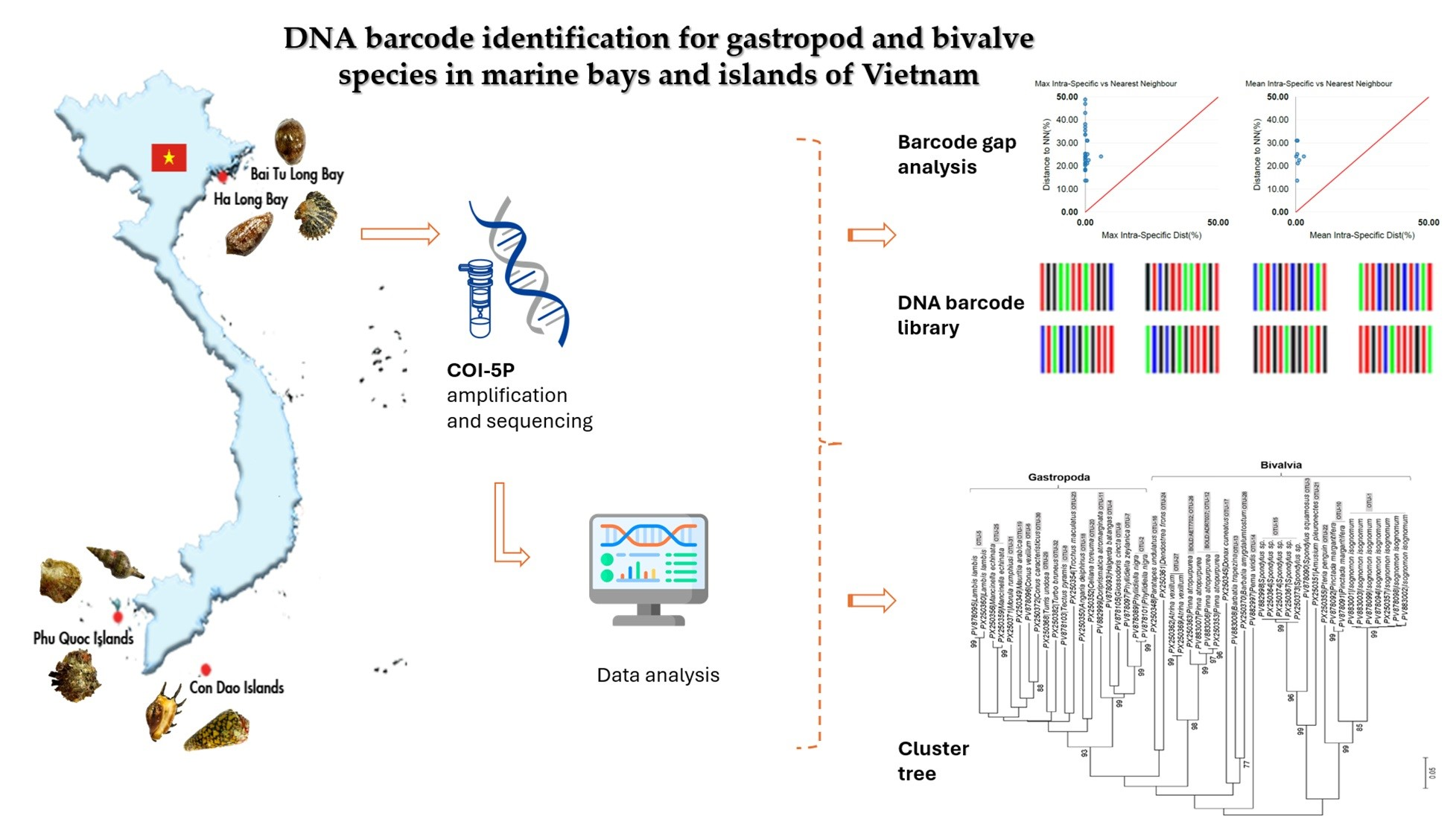

DNA Barcode Identification for Gastropod and Bivalve Species in Coastal Bays and Islands of Vietnam

 , , , ,
Abstract
1. Introduction
2. Materials and Methods
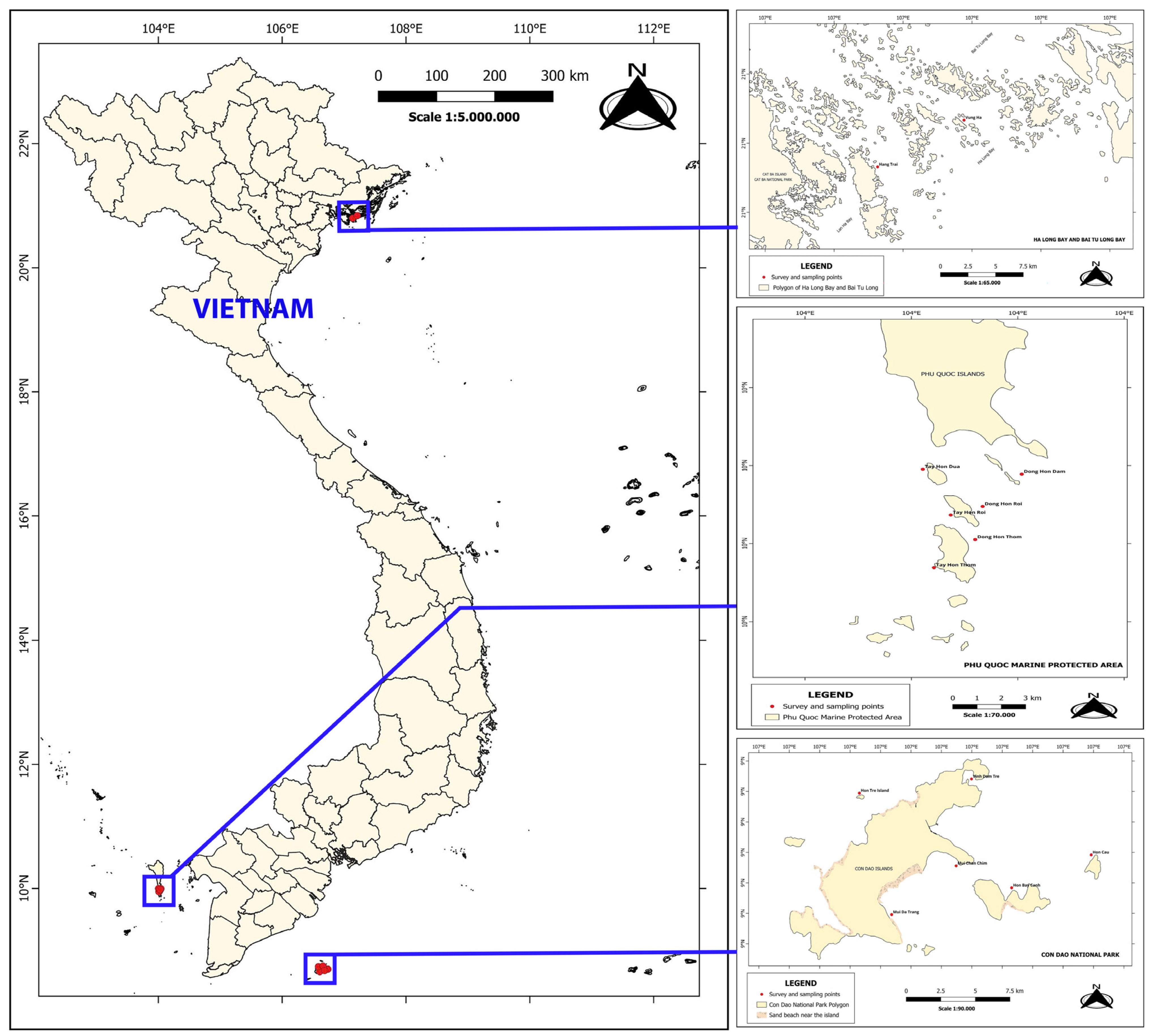
2.1. Sample Collection
2.2. DNA Extraction, PCR, and Sequencing
2.3. Sequence Analysis for Species Identification
3. Results
3.1. Similarity-Based Identifications
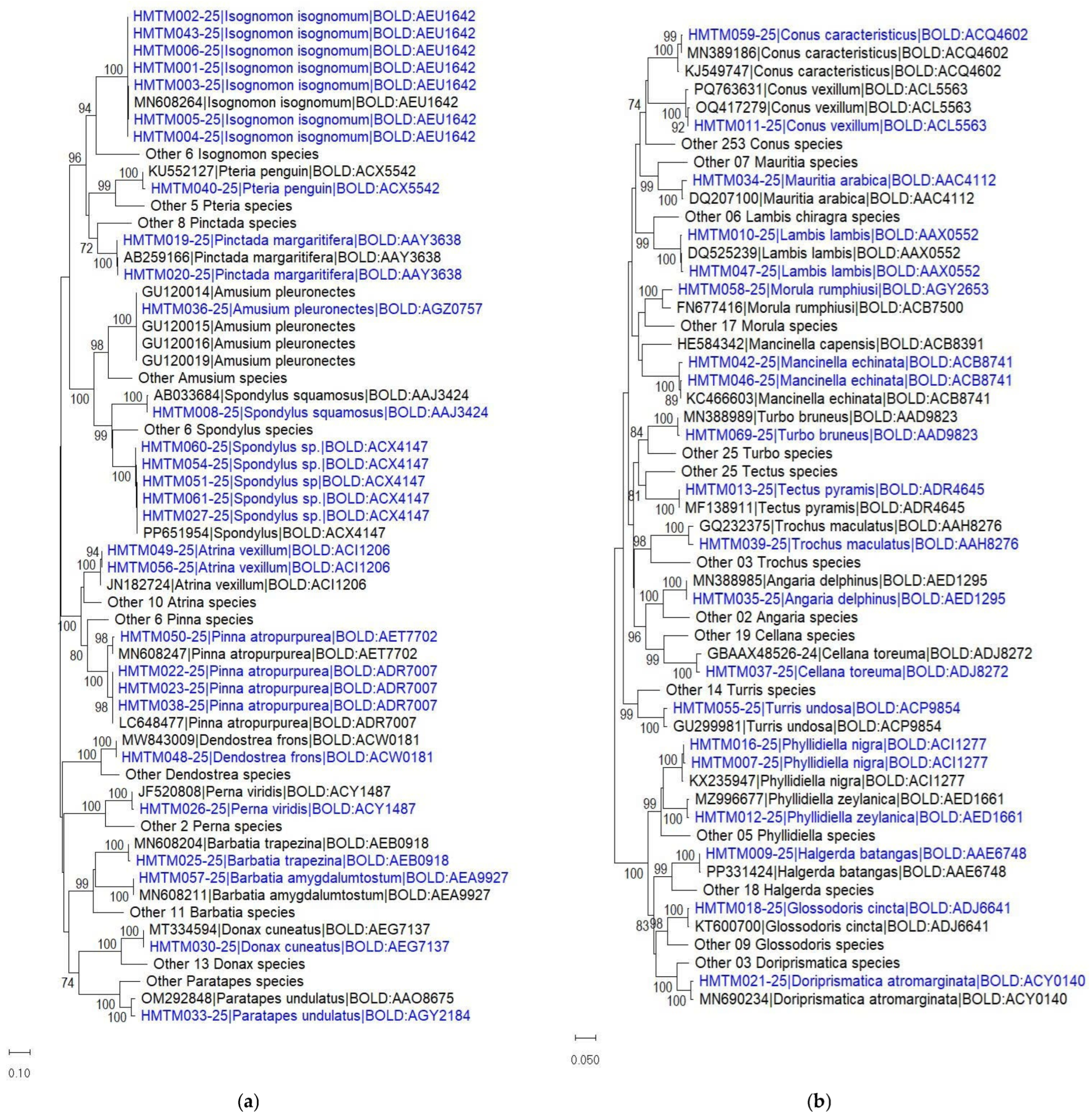
3.2. Tree-Based Analysis
3.3. DNA Barcode Gap Analysis
4. Discussion
5. Conclusions
Supplementary Materials
Author Contributions
Funding
Institutional Review Board Statement
Informed Consent Statement
Data Availability Statement
Conflicts of Interest
References
- MolluscaBase (Ed.) MolluscaBase. Available online: https://www.molluscabase.org (accessed on 25 September 2025).
- Boss, K.J. Critical estimate of the number of recent Mollusca. Occas. Pap. Mollusks 1971, 3, 81–135. [Google Scholar]
- Benkendorff, K. Molluscan biological and chemical diversity: Secondary metabolites and medicinal resources produced by marine molluscs. Biol. Rev. 2010, 85, 757–775. [Google Scholar] [CrossRef] [PubMed]
- Rosenberg, G. A New Critical Estimate of Named Species-Level Diversity of the Recent Mollusca. Am. Malacol. Bull. 2014, 32, 308–322. [Google Scholar] [CrossRef]
- Geiger, D.L. Marine Gastropoda. In The Mollusks: A Guide to Their Study, Collection, and Preservation; Sturm, C.F., Pearce, T.A., Valdés, A., Eds.; American Malacological Society: Pittsburgh, PA, USA, 2006; pp. 295–312. [Google Scholar]
- Mitra, B.; Ghosh, J. A Synoptic review on the traditional uses of gastropods and bivalves (Mollusca) as food and medicines in India. In The Basic Handbook of Indian Ethnobotany and Traditional Medicine; Sarkar, B.S., Biswas, J., Samalr, A.C., Pandey, A., Eds.; International Academic Publishing House (IAPH): Online, 2023; Volume 2, pp. 89–97. [Google Scholar] [CrossRef]
- Simone, L. New species, misidentifications and problematic taxonomy of some Atlantic South American marine mollusks: A review. Papéis Avulsos Zool. 2024, 64, e202464031. [Google Scholar] [CrossRef]
- Xu, B.; Kong, L.; Sun, J.; Zhang, J.; Zhang, Y.; Song, H.; Li, Q.; Uribe, J.E.; Halanych, K.M.; Cai, C.; et al. Molluscan systematics: Historical perspectives and the way ahead. Biol. Rev. 2025, 100, 672–697. [Google Scholar] [CrossRef]
- Monti, M.M.; Nappo, A.G.; Giorgini, M. Molecular characterization of closely related species in the parasitic genus Encarsia (Hymenoptera: Aphelinidae) based on the mitochondrial cytochrome oxidase subunit I gene. Bull. Entomol. Res. 2005, 95, 401–408. [Google Scholar] [CrossRef]
- Whelan, N. Phenotypic plasticity and the endless forms of freshwater gastropod shells. Freshw. Mollusk Biol. Conserv. 2021, 24, 87–103. [Google Scholar] [CrossRef]
- Idris, M.H.; Hamli, H.; Kamal, A.H.; Ab Lah, R.; Jaafa, N.M.S.N. Study of diversity and morphometry in edible bivalves and gastropods from a coastal wetland in Sarawak. Songklanakarin J. Sci. Technol. 2021, 43, 889–896. [Google Scholar] [CrossRef]
- Gefaell, J.; Galindo, J.; Rolán-Alvarez, E. Shell color polymorphism in marine gastropods. Evol. Appl. 2023, 16, 202–222. [Google Scholar] [CrossRef]
- Baerwald, M.R.; Goodbla, A.M.; Nagarajan, R.P.; Gootenberg, J.S.; Abudayyeh, O.O.; Zhang, F.; Schreier, A.D. Rapid and accurate species identification for ecological studies and monitoring using CRISPR-based SHERLOCK. Mol. Ecol. Resour. 2020, 20, 961–970. [Google Scholar] [CrossRef]
- Kürzel, K.; Kaiser, S.; Lörz, A.N.; Rossel, S.; Paulus, E.; Peters, J.; Schwentner, M.; Martinez Arbizu, P.; Coleman, C.O.; Svavarsson, J.; et al. Correct species identification and its Implications for conservation using Haploniscidae (Crustacea, Isopoda) in Icelandic waters as a proxy. Front. Mar. Sci. 2022, 8, 795196. [Google Scholar] [CrossRef]
- Hebert, P.D.; Cywinska, A.; Ball, S.L.; deWaard, J.R. Biological identifications through DNA barcodes. Proc. Biol. Sci. 2003, 270, 313–321. [Google Scholar] [CrossRef] [PubMed]
- Ladoukakis, E.D.; Zouros, E. Evolution and inheritance of animal mitochondrial DNA: Rules and exceptions. J. Biol. Res. Thessalon. 2017, 24, 2. [Google Scholar] [CrossRef]
- Zhang, D.X.; Hewitt, G.M. Assessment of the universality and utility of a set of conserved mitochondrial COI primers in insects. Insect Mol. Biol. 1997, 6, 143–150. [Google Scholar] [CrossRef]
- Liu, J.; Zhang, H. DNA barcoding for species identification in deep-sea clams (Mollusca: Bivalvia: Vesicomyidae). Mitochondrial DNA A DNA Mapp. Seq. Anal. 2018, 29, 1165–1173. [Google Scholar] [CrossRef] [PubMed]
- Ran, K.; Li, Q.; Qi, L.; Li, W.; Kong, L. DNA barcoding for identification of marine gastropod species from Hainan island, China. Fish. Res. 2020, 225, 105504. [Google Scholar] [CrossRef]
- Buršić, M.; Iveša, L.; Jaklin, A.; Arko Pijevac, M.; Kučinić, M.; Štifanić, M.; Neal, L.; Bruvo Mađarić, B. DNA barcoding of marine mollusks associated with Corallina officinalis Turfs in Southern Istria (Adriatic Sea). Diversity 2021, 13, 196. [Google Scholar] [CrossRef]
- de Araújo, A.D.; Carvalho, O.D.S.; Gava, S.G.; Caldeira, R.L. DNA barcoding as a valuable tool for delimiting mollusk species of the genus Biomphalaria Preston, 1910 (Gastropoda: Planorbidae). Front. Cell. Infect. Microbiol. 2023, 13, 1167787. [Google Scholar] [CrossRef]
- Nguyen, T.D.; Van Nguyen, Q.; Van Pham, C.; Nguyen, M.T.; Tran, L.X.; Pham, H.M.; Vu, T.Q.; Do, T.D. Application of DNA barcoding for the identification of cephalopod species in the Gulf of Tonkin, Vietnam. Mar. Biodivers. 2025, 55, 59. [Google Scholar] [CrossRef]
- Setiamarga, D.H.E.; Shimizu, M.; Nakashima, S.; Osaki, C.; Hirota, K.; Anggraeni, L.; Van Tu, D.; Sasaki, T. DNA barcoding of museum-vouchered samples collected from fish markets reveals an unexpected diversity of consumed gastropods in Vietnam. Future Foods 2025, 12, 100689. [Google Scholar] [CrossRef]
- Giang, P.Q.; Khanal, R. What next for marine ecosystem management in Vietnam: Assessment of coastal economy, climate change, and policy implication. Environ. Res. Commun. 2024, 6, 025002. [Google Scholar] [CrossRef]
- Do Cong, T. Research results of biological resources and biodiversity of Vietnam sea: Current status, treats, proposed solutions to use lasting. Vietnam J. Mar. Sci. Technol. 2022, 22, 1–20. [Google Scholar] [CrossRef]
- Hylleberg, J.; Kilburn, R. Marine molluscs of Vietnam: Annotations, voucher material, and species in need of verification. Phuket Mar. Biol. Cent. Spec. Publ. 2003, 28, 1–299. [Google Scholar]
- Carpenter, K.E.; Niem, V.H. FAO Species Identification Guide for Fishery Purposes. The Living Marine Resources of the Western Central Pacific. Volume 2. Seaweeds, Corals, Bivalves and Gastropods; FAO: Rome, Italy, 1998; p. 700. [Google Scholar]
- Okutani, T. Marine Mollusks in Japan; Tokai University Press: Tokyo, Japan, 2000; p. 1173. [Google Scholar]
- Jela, C.; Monteclaro, H.; Añasco, N.; Quinitio, G.; Babaran, R. Identification of pen shells (Bivalvia: Ostreida: Pinnidae) collected off northern Iloilo, Philippines using their morphological characters. Acta Ichthyol. Piscat. 2024, 54, 49–61. [Google Scholar] [CrossRef]
- Doyle, J.J.; Doyle, J.L. A Rapid DNA isolation procedure for small quantities of fresh leaf tissue. Phytochem. Bull. 1987, 19, 11–15. [Google Scholar]
- Meyer, C.P.; Paulay, G. DNA Barcoding: Error rates based on comprehensive sampling. PLoS Biol. 2005, 3, e422. [Google Scholar] [CrossRef]
- Audzijonyte, A.; Krylova, E.M.; Sahling, H.; Vrijenhoek, R.C. Molecular taxonomy reveals broad trans-oceanic distributions and high species diversity of deep-sea clams (Bivalvia: Vesicomyidae: Pliocardiinae) in chemosynthetic environments. Syst. Biodivers. 2012, 10, 403–415. [Google Scholar] [CrossRef]
- Breure, A.S.H. Caribbean Bulimulus revisited: Physical moves and molecular traces (Mollusca, Gastropoda, Bulimulidae). PeerJ 2016, 4, e1836. [Google Scholar] [CrossRef]
- Kumar, S.; Stecher, G.; Li, M.; Knyaz, C.; Tamura, K. MEGA X: Molecular Evolutionary Genetics Analysis across Computing Platforms. Mol. Biol. Evol. 2018, 35, 1547–1549. [Google Scholar] [CrossRef]
- Kimura, M.A. Simple method for estimating evolutionary rates of base substitutions through comparative studies of nucleotide sequences. J. Mol. Evol. 1980, 16, 111–120. [Google Scholar] [CrossRef]
- Tamura, K.; Peterson, D.; Peterson, N.; Stecher, G.; Nei, M.; Kumar, S. MEGA5: Molecular evolutionary genetics analysis using maximum likelihood, evolutionary distance, and maximum parsimony methods. Mol. Biol. Evol. 2011, 28, 2731–2739. [Google Scholar] [CrossRef] [PubMed]
- Ratnasingham, S.; Hebert, P.D. BOLD: The Barcode of Life Data System. Mol. Ecol. Notes 2007, 7, 355–364. [Google Scholar] [CrossRef] [PubMed]
- Sun, S.E.; Li, Q.; Kong, L.; Yu, H.; Zheng, X.; Yu, R.; Dai, L.; Sun, Y.; Chen, J.; Liu, J.; et al. DNA barcoding reveal patterns of species diversity among northwestern Pacific molluscs. Sci. Rep. 2016, 6, 33367. [Google Scholar] [CrossRef] [PubMed][Green Version]
- Barco, A.; Raupach, M.; Laakmann, S.; Neumann, H.; Knebelsberger, T. Identification of North Sea molluscs with DNA barcoding. Mol. Ecol. Resour. 2016, 16, 288–297. [Google Scholar] [CrossRef]
- Lis, J.A.; Lis, B.; Ziaja, D.J. In BOLD we trust? A commentary on the reliability of specimen identification for DNA barcoding: A case study on burrower bugs (Hemiptera: Heteroptera: Cydnidae). Zootaxa 2016, 4114, 83–86. [Google Scholar] [CrossRef]
- Pentinsaari, M.; Ratnasingham, S.; Miller, S.E.; Hebert, P.D.N. BOLD and GenBank revisited—Do identification errors arise in the lab or in the sequence libraries? PLoS ONE 2020, 15, e0231814. [Google Scholar] [CrossRef]
- Thessen, A.E.; Patterson, D.J.; Murray, S.A. The Taxonomic Significance of Species That Have Only Been Observed Once: The Genus Gymnodinium (Dinoflagellata) as an Example. PLoS ONE 2012, 7, e44015. [Google Scholar] [CrossRef]
- Padial, J.M.; De la Riva, I. A paradigm shift in our view of species drives current trends in biological classification. Biol. Rev. 2021, 96, 731–751. [Google Scholar] [CrossRef]
- Bayne, B.; Ahrens, M.; Allen, S.; Anglès d’Auriac, M.; Backeljau, T.; Beninger, P.; Bohn, R.; Boudry, P.; Davis, J.; Green, T.; et al. The Proposed Dropping of the Genus Crassostrea for All Pacific Cupped Oysters and Its Replacement by a New Genus Magallana: A Dissenting View. J. Shellfish Res. 2017, 36, 545–547. [Google Scholar] [CrossRef]
- Backeljau, T. Crassostrea gigas or Magallana gigas: A Community-based Scientific Response. NSA Newslet. 2018, 1, 3. [Google Scholar]
- Radulovici, A.; Vieira, P.; Duarte, S.; Teixeira, M.; Borges, L.; Deagle, B.; Majaneva, S.; Redmond, N.; Schultz, J.; Costa, F. Revision and annotation of DNA barcode records for marine invertebrates: Report of the 8th iBOL conference hackathon. Metabarcoding Metagenomics 2021, 5, e67862. [Google Scholar] [CrossRef]
- Lopes, E.P.; Santos, S.; Xavier, R.; Santos, J.L.; Cabezas, M.P.; Sequeira, F.; Santos, A.M. Genetic analysis of Pinna rudis L 1758 (Mollusca, Bivalvia, Pinnidae) in the Northwest Cabo Verde Islands (Central-East Atlantic). PeerJ 2025, 13, e18328. [Google Scholar] [CrossRef]
- Katsares, V.; Tsiora, A.; Galinou-Mitsoudi, S.; Imsiridou, A. Genetic structure of the endangered species Pinna nobilis (Mollusca: Bivalvia) inferred from mtDNA sequences. Biologia 2008, 63, 412–417. [Google Scholar] [CrossRef]
- Kartavtsev, Y.P. Sequence divergence at mitochondrial genes in animals: Applicability of DNA data in genetics of speciation and molecular phylogenetics. Mar. Genom. 2011, 4, 71–81. [Google Scholar] [CrossRef] [PubMed]
- Kartavtsev, Y.P.; Masalkova, N.A. Structure, Evolution, and Mitochondrial Genome Analysis of Mussel Species (Bivalvia, Mytilidae). Int. J. Mol. Sci. 2024, 25, 6902. [Google Scholar] [CrossRef] [PubMed]
- Layton, K.K.S.; Martel, A.L.; Hebert, P.D.N. Patterns of DNA Barcode Variation in Canadian Marine Molluscs. PLoS ONE 2014, 9, e95003. [Google Scholar] [CrossRef]
- Pejovic, I.; Ardura, A.; Miralles, L.; Arias, A.; Borrell, Y.J.; Garcia-Vazquez, E. DNA barcoding for assessment of exotic molluscs associated with maritime ports in northern Iberia. Mar. Biol. Res. 2016, 12, 168–176. [Google Scholar] [CrossRef]
- Affenzeller, S.; Haar, N.; Steiner, G. Revision of the genus complex Gibbula: An integrative approach to delineating the Eastern Mediterranean genera Gibbula Risso, 1826, Steromphala Gray, 1847, and Phorcus Risso, 1826 using DNA-barcoding and geometric morphometrics (Vetigastropoda, Trochoidea). Org. Divers. Evol. 2017, 17, 789–812. [Google Scholar] [CrossRef]
- Barco, A.; Evans, J.; Schembri, P.J.; Taviani, M.; Oliverio, M. Testing the applicability of DNA barcoding for Mediterranean species of top-shells (Gastropoda, Trochidae, Gibbula s.l.). Mar. Biol. Res. 2013, 9, 785–793. [Google Scholar] [CrossRef]



| # | Sample ID | GenBank Acc. No | Morphological Identification | Species Names on GenBank and BOLD | GenBank BLAST Similarity (%) | BOLD BLAST Similarity (%) |
|---|---|---|---|---|---|---|
| 1 | TM6TD-66 | PX250351 | Amusium pleuronectes (Linnaeus, 1758) | Amusium pleuronectes (Linnaeus, 1758) | 98.81–99.05 | 98.80–99.04 |
| 2 | TM2TD-49 | PX250350 | Angaria delphinus (Linnaeus, 1758) | Angaria delphinus (Linnaeus, 1758) | 96.40–99.84 | 99.84 |
| 3 | TM6DR-216 TM01HT-22 | PX250362, PX250369 | Atrina exillum (Born, 1778) | Atrina vexillum (Born, 1778) | 98.89–100 | 98.69–100 |
| 4 | TM1B-172 | PX250370 | Barbatia fusca (Bruguière, 1789) | Barbatia amygdalumtostum (Röding, 1798) (synonym) | 99.35–100 | 99.26–100 |
| 5 | TMBTL27N-159 | PV883008 | Barbatia trapezina (Lamarck, 1819) | Barbatia trapezina (Lamarck, 1819) | 99.16–99.27 | 99.09–99.39 |
| 6 | TM9TD-216 | PX250352 | Lottia sp. | Cellana toreuma (Reeve, 1855) | 99.36 | 98.02–99.35 |
| 7 | TM11C-249 | PX250372 | Conus planorbis Born, 1778 | Conus caracteristicus Fischer von Waldheim, 1807 | 97.87–99.70 | 97.69–99.69 |
| 8 | TM05DT-23 | PV878096 | Conus sp. | Conus vexillum Gmelin, 1791 | 97.20–99.70 | 97.08–99.70 |
| 9 | TM10DTh-91 | PX250361 | Saccostrea mordax (A. A. Gould, 1850) | Dendostrea frons (Linnaeus, 1758) | 99.04–99.57 | 99.35–99.57 |
| 10 | TM11DD-64 | PX250345 | Donax trunculus Linnaeus, 1758 | Donax cuneatus Linnaeus, 1758 | 99.71 | 99.71 |
| 11 | TM08-54 | PV882999 | Doriprismatica atromarginata Cuvier, 1804 | Doriprismatica atromarginata Cuvier, 1804 | 97.72–99.10 | 97.71–99.10 |
| 12 | TM19Da-7 | PV878105 | Glossodoris sp. | Glossodoris cincta Bergh, 1888 | 98.62–99.24 | 98.59–99.36 |
| 13 | TM02HC-7 | PV878093 | Halgerda batangas Carlson & Hoff, 2000 | Halgerda batangas Carlson & Hoff, 2000 | 98.54–99.85 | 98.99–100 |
| 14 | TM06HT-51 | PV878098 | Isognomon sp. | Isognomon isognomum Linnaeus, 1758 | 99.32–100 | 98.80–100 |
| 15 | TM08HT-17 | PV878099 | Isognomon sp. | |||
| 16 | TM02HT-18 | PV878094 | Isognomon sp. | |||
| 17 | TM40-1 | PV883001 | Isognomon isognomum Linnaeus, 1758 | |||
| 18 | TM50-17 | PV883002 | Isognomon isognomum Linnaeus, 1758 | |||
| 19 | TMBLT30-147 | PV883003 | Isognomon isognomum Linnaeus, 1758 | |||
| 20 | TM10TT-166 | PX250357 | Isognomon isognomum Linnaeus, 1758 | |||
| 21 | TM03Ta-7 | PV878095 | Lambis lambis Linnaeus, 1758 | Lambis lambis Linnaeus, 1758 | 99.16–100 | 99.31–100 |
| 22 | TM05HT-128 | PX250360 | Lambis lambis Linnaeus, 1758 | |||
| 23 | TM7TT-56 | PX250356 | Mancinella echinata (Blainville, 1832) | Mancinella echinata (Blainville, 1832) | 98.60–99.69 | 97.95–99.69 |
| 24 | M02TR-71 | PX250359 | Mancinella echinata (Blainville, 1832) | |||
| 25 | TM10DD-102 | PX250349 | Mauritia rabica (Linnaeus, 1758) | Mauritia arabica (Linnaeus, 1758) | 98.69–99.43 | 98.32–99.23 |
| 26 | TM4C-131 | PX250371 | Tenguella granulata (Duclos, 1832) | Morula rumphiusi Houart, 1996 | 94.98–95.52 | 94.98–95.52 |
| 27 | TM8DD-49 | PX250348 | Paratapes undulatus (Born, 1778) | Paratapes undulatus (Born, 1778) | 95.38 | 95.38–96.15 |
| 28 | TM83-12(L) | PV882997 | Perna viridis (Linnaeus, 1758) | Perna viridis (Linnaeus, 1758) | 98.38-99.42 | 97.48–99.54 |
| 29 | TM01C-7 | PV878089 | Phyllidiella nigra (van Hasselt, 1824 | Phyllidiella nigra (van Hasselt, 1824) | 98.00–99.67 | 98.30–99.89 |
| 30 | TM20Da-7 | PV878101 | Phyllidiella nigra (van Hasselt, 1824) | |||
| 31 | TM06DT-11 | PV878097 | Phyllidiella sp. | Phyllidiella zeylanica (Kelaart, 1858) | 98.33–99.00 | 98.17–99.00 |
| 32 | TM02C-7 | PV878091 | Pinctada margaritifera (Linnaeus, 1758) | Pinctada margaritifera (Linnaeus, 1758) | 98.21–99.57 | 98.70–100 |
| 33 | TM02Da-1 | PV878092 | Pinctada margaritifera (Linnaeus, 1758) | |||
| 34 | TM26-13 | PV883006 | Pinna atropurpurea G. B. Sowerby I, 1825 | Pinna atropurpurea G. B. Sowerby I, 1825 | 94.84–99.79 | 94.45–100 |
| 35 | TM82-13 | PV883007 | Pinna atropurpurea G. B. Sowerby I, 1825 | |||
| 37 | TM7TD-173 | PX250363 | Pinna atropurpurea G. B. Sowerby I, 1825 | |||
| 38 | TM4DHD-60 | PX250353 | Pteria peasei (Dunker, 1872) | |||
| 39 | TM1DTh-148 | PX250355 | Pteria penguin (Röding, 1798) | Pteria penguin (Röding, 1798) | 98.25–99.10 | 98.25–99.10 |
| 40 | TM02DHD-79 | PX250364 | Spondylus sp. | Spondylus sp. | 99.39–100 | 99.20–99.70 |
| 41 | TM122-39(L) | PV882998 | Spondylus nicobaricus Schreibers, 1793 | |||
| 42 | TM115-145 | PX250374 | Spondylus nicobaricus Schreibers, 1793 | |||
| 43 | TM9TT-4 | PX250367 | Spondylus echinatus A. d’Orbigny, 1853 | |||
| 44 | TM35-75 | PX250373 | Spondylus squamosus Schreibers, 1793 | |||
| 45 | TM01Da-124 | PV878090 | Spondylus sp. | Spondylus squamosus Schreibers, 1793 | 99.14 | 99.14 |
| 46 | TM08DT-63 | PV878103 | Tectus pyramis (Born, 1778) | Tectus pyramis (Born, 1778) | 99.69–100 | 99.59–100 |
| 47 | TM2THD-24 | PX250354 | Trochus maculatus (Linnaeus, 1758) | Trochus maculatus (Linnaeus, 1758) | 98.78–99.56 | 98.18–99.54 |
| 48 | TM7DR-30 | PX250382 | Turbo stenogyrus (P. Fischer, 1873) | Turbo bruneus (Röding, 1798) | 99.04–99.55 | 99.14–99.65 |
| 49 | TM11TT-127 | PX250368 | Crassispira sp. | Turris undosa (Lamarck, 1816) | 97.87–98.54 | 97.79–98.53 |
| No | Species | BIN 1 | Max. Intra Sp. 2 (%) | Min Inter Sp. 3 (%) |
|---|---|---|---|---|
| 1 | Amusium pleuronectes | BOLD:AGZ0757 | 1.45 | 23.32 |
| 2 | Angaria delphinus | BOLD:AED1295 | 0.16 | 4.46 |
| 3 | Atrina vexillum | BOLD:ACI1206 | 1.81 | 14.36 |
| 4 | Barbatia amygdalumtostum | BOLD:AEA9927 | 0.77 | 27.05 |
| 5 | Barbatia trapezina | BOLD:AEB0918 | 0.86 | 19.57 |
| 6 | Cellana toreuma | BOLD:ADJ8272 | 0.98 | 6.92 |
| 7 | Conus caracteristicus | BOLD:ACQ4602 | 2.35 | 13.90 |
| 8 | Conus vexillum | BOLD:ACL5563 | 2.19 | 15.79 |
| 9 | Dendostrea frons | BOLD:ACW0181 | 0.70 | 1.60 |
| 10 | Donax cuneatus | BOLD:AEG7137 | 0.29 | 17.94 |
| 11 | Doriprismatica atromarginata | BOLD:ACY0140 | 2.34 | 7.99 |
| 12 | Glossodoris cincta | BOLD:ADJ6641 | 1.60 | 6.55 |
| 13 | Halgerda batangas | BOLD:AAE6748 | 1.35 | 2.11 |
| 14 | Isognomon isognomum | BOLD:AEU1642 | 1.04 | 24.08 |
| 15 | Lambis lambis | BOLD:AAX0552 | 0.66 | 11.72 |
| 16 | Mancinella echinata | BOLD:ACB8741 | 2.10 | 15.08 |
| 17 | Mauritia arabica | BOLD:AAC4112 | 1.66 | 10.42 |
| 18 | Morula rumphiusi | BOLD:AGY2653 | 5.29 | 11.91 |
| 19 | Paratapes undulatus | BOLD:AGY2184 | 6.04 | 16.11 |
| 20 | Perna viridis | BOLD:ACY1487 | 2.46 | 20.05 |
| 21 | Phyllidiella nigra | BOLD:ACI1277 | 1.70 | 13.01 |
| 22 | Phyllidiella zeylanica | BOLD:AED1661 | 1.86 | 12.38 |
| 23 | Pinctada margaritifera | BOLD:AAY3638 | 1.74 | 19.43 |
| 24 | Pinna atropurpurea | BOLD:ADR7007 BOLD:AET7702 | 5.95 | 10.95 |
| 25 | Pteria penguin | BOLD:ACX5542 | 1.79 | 21.97 |
| 26 | Spondylus sp. | BOLD:ACX4147 | 0.86 | 21.03 |
| 27 | Spondylus squamosus | BOLD:AAJ3424 | 0.87 | 20.26 |
| 28 | Tectus pyramis | BOLD:ADR4645 | 0.48 | 16.45 |
| 29 | Trochus maculatus | BOLD:AAH8276 | 2.03 | 18.68 |
| 30 | Turbo bruneus | BOLD:AAD9823 | 0.88 | 8.77 |
| 31 | Turris undosa | BOLD:ACP9854 | 2.25 | 7.63 |
Disclaimer/Publisher’s Note: The statements, opinions and data contained in all publications are solely those of the individual author(s) and contributor(s) and not of MDPI and/or the editor(s). MDPI and/or the editor(s) disclaim responsibility for any injury to people or property resulting from any ideas, methods, instructions or products referred to in the content. |
© 2025 by the authors. Licensee MDPI, Basel, Switzerland. This article is an open access article distributed under the terms and conditions of the Creative Commons Attribution (CC BY) license (https://creativecommons.org/licenses/by/4.0/).
Share and Cite
Mai, N.C.; Hoe, P.T.; Trung, L.Q.; Van, N.T.; Hoa, L.X.; Chieu, H.D.; Thung, D.C.; Tuan, B.M.; Nho, P.T.D.; Lien, L.Q.; et al. DNA Barcode Identification for Gastropod and Bivalve Species in Coastal Bays and Islands of Vietnam. Diversity 2025, 17, 863. https://doi.org/10.3390/d17120863
Mai NC, Hoe PT, Trung LQ, Van NT, Hoa LX, Chieu HD, Thung DC, Tuan BM, Nho PTD, Lien LQ, et al. DNA Barcode Identification for Gastropod and Bivalve Species in Coastal Bays and Islands of Vietnam. Diversity. 2025; 17(12):863. https://doi.org/10.3390/d17120863
Chicago/Turabian StyleMai, Nguyen Chi, Pham Thi Hoe, Le Quang Trung, Nguyen Tuong Van, Luu Xuan Hoa, Hoang Dinh Chieu, Do Cong Thung, Bui Minh Tuan, Pham Tran Dinh Nho, Le Quynh Lien, and et al. 2025. "DNA Barcode Identification for Gastropod and Bivalve Species in Coastal Bays and Islands of Vietnam" Diversity 17, no. 12: 863. https://doi.org/10.3390/d17120863
APA StyleMai, N. C., Hoe, P. T., Trung, L. Q., Van, N. T., Hoa, L. X., Chieu, H. D., Thung, D. C., Tuan, B. M., Nho, P. T. D., Lien, L. Q., & Linh, T. M. (2025). DNA Barcode Identification for Gastropod and Bivalve Species in Coastal Bays and Islands of Vietnam. Diversity, 17(12), 863. https://doi.org/10.3390/d17120863