Article

Characteristics of Microbial Communities in Sediments from Culture Areas of Meretrix meretrix

1
East China Sea Fisheries Research Institute, Chinese Academy of Fishery Sciences, Yangpu District, Shanghai 200090, China
2
Dalian Blue Carbon Engineering Technology Co., Ltd., Dalian 116000, China
*
Authors to whom correspondence should be addressed.
These authors contributed equally to this work.
Diversity 2025, 17(12), 848; https://doi.org/10.3390/d17120848 (registering DOI)
Submission received: 2 October 2025 / Revised: 8 November 2025 / Accepted: 8 December 2025 / Published: 10 December 2025
(This article belongs to the Special Issue Aquatic Biodiversity and Habitat Restoration)

Abstract

This study examined the sediment microbial communities at 12 stations within the Meretrix meretrix farming area in Rudong, Jiangsu Province, utilising high-throughput sequencing. It elucidates the ecological relationships between the sediment microbial communities and the primary physical and chemical factors influencing the farming water and sediment. The results indicated that the microbial communities comprised 55 phyla. The Shannon index ranged from a minimum of 8.97 to a maximum of 9.96, while the Simpson index varied from 0.996 to 0.997, indicating a uniform species distribution. β diversity analysis revealed significant spatial diversity among the communities. Dominant bacterial groups included Proteobacteria (25.2–38%) and Desulfobacterota (10.4–14.4%), with Desulfobacterota reaching a peak of 14.4% at tidal creek station S2, reflecting the sulphate reduction process associated with organic pollution input. At the genus level, Woesia (9.15–17.16%), Desulfobacterota, and Subgroup_22 were identified as core functional bacteria. Redundancy analysis indicated that phosphate and nitrate were the primary drivers of community variation, accounting for a cumulative interpretation rate of 43.2%. Spearman correlation analysis confirmed that fine-grained sediments were more likely to store organic matter, significantly promoting the colonisation of AQS1 (p < 0.05) and Cohaesibacter (p < 0.05), while inhibiting Puniceispirillales (p < 0.01). An alkaline environment positively selects for sulphur-cycling bacteria, such as Desulfatiglans (p < 0.05). This study provides technical support for the regulation of sediment environments and the promotion of healthy clam culture practices.

1. Introduction

Rudong County, situated in Jiangsu Province, boasts an extensive and intricate coastline, characterised by exceptional beach resources that span an area of 69,300 hectares. This region is home to the largest clam breeding area in China. The species Meretrix meretrix (a marine bivalve), valued for its economic significance, thrives best in the tidal flat sediments found in the mid- to low-tide zones. These sediments are prevalent in the intertidal zone along the Chinese coast, with substantial reserves located in Bohai Bay, Laizhou Bay, the Jiangsu coast, and the Fujian coast. Intertidal sediments, which form a crucial component of tidal flat sediments, are positioned at the interface of land and sea, serving as vital sites for material circulation. This area encompasses regions that are submerged during high tide and exposed to the sea during low tide [1]. The sediment, characterised by its richness in organic matter and nutrients, serves as a fundamental resource for the growth of Meretrix meretrix. This ecosystem is not only home to various animals and plants but also harbours substantial microbial communities [2]. As primary producers and decomposers, these microbial communities in sediments are integral to global biogeochemical processes, material transformation, physiological metabolism, and immune function in Meretrix meretrix. Furthermore, they exhibit significant inductive activity within the intestines of attached shellfish, thereby playing a crucial role in regulating biogeochemical processes and the mineralisation of organic pollutants in coastal ecosystems [3]. Concurrently, the structure of microbial communities is influenced by numerous environmental factors, including physical and chemical conditions, seasonal variations, and the diversity of animal and plant species present in the sediments [4]. The microbial community within the clam culture area is influenced by the distance from the shore, the density of the culture, and the characteristics of the habitat. These factors impact the chemical cycling processes of microorganisms in the sediment, subsequently affecting the physical and chemical indicators of the water.
The rapid advancement of industry and agriculture has exacerbated various pollution issues, thereby heightening the risk of detrimental effects on beach culture. Consequently, it is essential to investigate the distribution characteristics of microbial communities and their correlation with environmental factors, particularly in relation to clam culture, pollution management, and ecological restoration. The findings indicate that temperature exhibits a significant positive correlation with bacterial abundance in intertidal sediments within a specific range; however, its impact on microbial community composition remains unclear. Additionally, other studies have demonstrated that salinity [5], as a critical environmental factor, plays a significant role in regulating the structure of microbial communities in estuarine ecosystems.

2. Materials and Methods

2.1. Study Area and Sample Collection

In September 2023, in Rudong City, Jiangsu Province, we conducted a sampling survey in the clam farming area located between 121°30′ and 121°33′ east longitude and 32°21′ and 32°24′ north latitude. Figure 1 illustrates that in this study, researchers selected 12 sampling stations within the designated pure razor clam farming area using the random point generation tool of the Geographic Information System (GIS 3.5.4) to obtain representative samples of the target area. Surface sediment samples, ranging from 0 to 15 centimetres, along with water samples from the upper layer at each sampling point, were collected. The sediment samples were placed in sterile polyethylene sealed bags, while the water samples were stored and transported in glass bottles at 4 °C. The samples were returned to the laboratory promptly. The sediment samples were divided into two portions. One portion was stored at −80 °C for microbial community analysis, while the other was designated for the detection of physical and chemical indicators. The subsequent experiments were completed within one week. The specific procedures for DNA extraction, amplicon sequencing, and bioinformatics processing are outlined in Section 2.3., and another portion of the sediment samples was used for the determination of total nitrogen (TN), Total Phosphorus (TP), and Total Organic Carbon (TOC) concentrations. We also determined the concentrations of ammonium nitrogen (NH4+-N), nitrate nitrogen ( NO 3 -N ), nitrite nitrogen ( NO 2 -N ), phosphate, and chemical oxygen demand (COD) in the upper water samples.

2.2. Determination of Water and Sediment Sample Indexes

Sediment samples were pretreated as follows. Initially, they were air-dried at room temperature. Subsequently, impurities and coarse particles were removed, and the samples were ground with a mortar and passed through a 160-mesh sieve to obtain a homogeneous powder. The processed samples were then placed in polyethylene self-sealing bags and stored at 4 °C for no more than one week prior to analysis. TN content was determined by using the Kjeldahl method, following the national standard “Soil Quality—Determination of Total Nitrogen” (HJ 717-2014) [6]. TP content was determined using the alkali fusion-molybdenum antimony anti-spectrophotometric method according to “Soil—Determination of Total Phosphorus” (HJ 632-2011) [7]; measurements were conducted with a Hach DR3900 visible spectrophotometer. TOC content was measured by using the potassium dichromate oxidation–external heating method, in accordance with the procedures in Soil Agricultural Chemical Analysis [8]. Following the Marine Monitoring Specifications [9], the following parameters were determined: pH was measured with a pH metre; ammonium nitrogen( NH 4 + -N ) was measured by using the indophenol blue spectrophotometric method; nitrate nitrogen( NO 3 -N ) was analysed by using the cadmium-column reduction method; nitrite nitrogen ( NO 2 -N ) was determined using the N-(1-naphthyl)-ethylenediamine spectrophotometric method; and phosphate was quantified by using the ammonium molybdate spectrophotometric method. Chemical oxygen demand (COD) was measured using the potassium dichromate method as described in Water and Wastewater Monitoring and Analysis Methods (Fourth Edition).

2.3. Microorganism High-Throughput Sequencing

Genomic DNA from the samples intended for microbial analysis was extracted using the MagPureSoil DNA LQ Kit (Magan, Guangzhou, China), following the provided instructions. The specific procedural steps outlined in the kit were adhered to meticulously. The concentration and purity of the extracted DNA were assessed using a NanoDrop 2000 (Thermo Fisher Scientific, Waltham, MA, USA) and evaluated through 1% agarose gel electrophoresis, which was stained with SYBR Safe. Extracted DNA was stored at −20 °C until further processing. Using the extracted genomic DNA as a template, PCR amplification of the true ITS gene was performed with specific primers containing barcodes and the Takara Ex Taq high-fidelity enzyme. The PCR amplification procedure consisted of an initial denaturation at 98 °C for 1 min, followed by 30 cycles comprising denaturation at 98 °C for 10 s, annealing at 50 °C for 30 s, and extension at 72 °C for 30 s. A final extension at 72 °C was conducted for 5 min. The ITS1 variable region of the ITS gene was amplified using the universal primers ITS1F (5′-CTTGGTCATTTAGAGGAAGTAA-3′) and ITS2 (5′-GCTGCGTTCTTCATCGATGC-3′) for the analysis of fungal diversity. The Amplicon quality was visualised using agarose gel electrophoresis. The PCR products purified with 0.8 × AMPure XP beads (Agencourt, CA, USA) and amplified for another round of PCR. After purified with the AMPure XP beads again, the final amplicon was quantified using Qubit dsDNA Assay Kit (Thermo Fisher Scientific, San Francisco, MA, USA). The concentrations were then adjusted for sequencing. Sequencing was performed on an Illumina NovaSeq 6000 with 250 bp paired-end reads. (Illumina Inc., San Diego, CA, USA; OE Biotech Company, Shanghai, China).

2.4. Data Analysis

Raw sequencing data were processed with the utilisation of Cutadapt v5.2 software to remove primer sequences from the original data. Subsequently, DADA2v1.26 (Madison, WI, USA) was employed to conduct quality control analyses, including quality filtering, noise reduction, splicing, and chimaera removal, on the qualified paired-end raw data from the previous step, adhering to the default parameters of QIIME 2 2024.10. This process yielded an abundance table of representative sequences and amplicon sequence variants (ASV). The QIIME 2 software package was then utilised to select representative sequences of ASV, which were subsequently compared with the Unite database for annotation. Species alignment notes were analysed using the default parameters of the q2-feature-classifier 2023.7.0-1 software.
QIIME 2 2 2024.10 software was employed to analyse both α and β diversity. The Observed Species Index and Chao1 Index were utilised to characterise richness, while the Shannon–Wiener Index [10] and Simpson Index [11] were applied to assess the uniformity and diversity of flora distribution. The Origin 2024 tool facilitated the plotting and generation of a column diagram representing the microbial community structure across different classification levels. Redundancy analysis (RDA) was conducted using the R language 4.5.0. tool to produce a redundancy analysis map. The RDA ranking diagram illustrates the correlation among environmental factors, where acute angles signify a positive correlation and obtuse angles denote a negative correlation. Additionally, the relative positions of the sample points and the rays representing environmental factors indicate the strength of their correlation [12]. Additionally, an inter-sample distance heat map was created with R language, and the Spearman correlation coefficient between environmental factors and selected bacterial genera was calculated, resulting in a correlation heat map generated using R language.
The pollution degree of nutrient salt was evaluated by using the pollution evaluation method of the single-factor pollution index [13], calculated as follows:
S i = C i C s
In the formula, Si is the evaluation index or standard index of a single factor; Si greater than 1 indicates that the pollution of factor i is serious; Ci is the measured value of factor i; Cs is the evaluation standard value of factor i, the standard value of TN is 1000 mg/kg, and the standard value of TP is 420 mg/kg.

3. Results and Analysis

3.1. Physical and Chemical Properties of Sediments in the Culture Area of Meretrix meretrix

According to the physical and chemical indicators of the sediment (Table 1), the concentration of TN in the surface air-dried sediment from the cultivation area of the eastern clam ranges from 0.865 to 1.659 mg/g, with an average concentration of 1.25 mg/g, indicating a mild pollution level (1.0 ≤ Si ≤ 1.5). TP exhibits a concentration range of 0.265 to 0.533 mg/g, with an average of 0.42 mg/g, categorising it within the moderate pollution level (0.5 ≤ Si ≤ 1.0) [14]. Additionally, TOC ranges from 3.4 to 9.8 mg/g, with an average concentration of 6.08 mg/g. These findings indicate a notable presence of organic and phosphorus pollution within the sediments of the clam culture area, resulting in a heightened risk of endogenous phosphorus release. Furthermore, the elevated organic matter content facilitated nitrogen release through mineralisation. The average concentrations of TN, TP, and TOC in the sediments were greater in the central region compared to the northern and southern areas, suggesting that nutrient pollution in the middle of the sampling area was relatively severe. The higher nutrient concentrations were associated with the intensive shellfish farming in the central region. Organic particles rich in carbon, nitrogen, and phosphorus within the aquatic environment are propelled to migrate and accumulate in the sedimentary context, thereby directly contributing to the enhancement of nutrient levels in the sediment [15].
Inorganic nitrogen analysis (Table 2) revealed the nutritional status of the environment in the clam farming area. The concentrations of NH4+-N and NO2-N were both relatively low, with NO2-N being particularly toxic to aquatic organisms. This indicated that the water quality in this area was suitable for benthic clams. The dominance of the less toxic NO3-N suggested that the nitrogen cycle dynamics within the system were likely regulated by active microbial processes, which contributed to the maintenance of environmental stability. Nutrient concentrations are predominantly attributed to NO 3 -N , with the highest content observed at S5. Comprehensive analysis indicates that NH 4 + -N concentrations are predominantly concentrated in central regions, specifically sampling points S1, S2, S3, S9, and S10. As a key indicator of organic pollution in aquatic environments, the concentration of chemical oxygen demand (COD) directly reflects the intensity of pollution load [15]. In accordance with the Class II standard for seawater quality, the COD in the aquaculture functional area was required to be ≤3.00 mg/L. The environmental physical and chemical indicators of the water body in this study demonstrated that the COD parameters met the standard limits, indicating that the prevailing water quality conditions posed no significant stress risk to aquaculture activities. The average phosphate concentration in water is 0.008 mg/L, with fluctuations ranging from 0.006 to 0.015 mg/L, which aligns with the first-class seawater standard of 0.015 mg/L. The phosphate concentration in the sampling area, measured at below 0.018 mg/L, was sufficiently low to inhibit phytoplankton growth. This suggests that the phosphate levels may limit shellfish production.

3.2. Analysis of Microbial Community Diversity in Sediments

3.2.1. Alpha Diversity Index Analysis Results

A total of 19,214 amplicon sequence variants (ASVs) were identified from 12 surface sediment samples, encompassing 55 phyla, 128 classes, 310 orders, 451 families, 712 genera, and 1236 species.
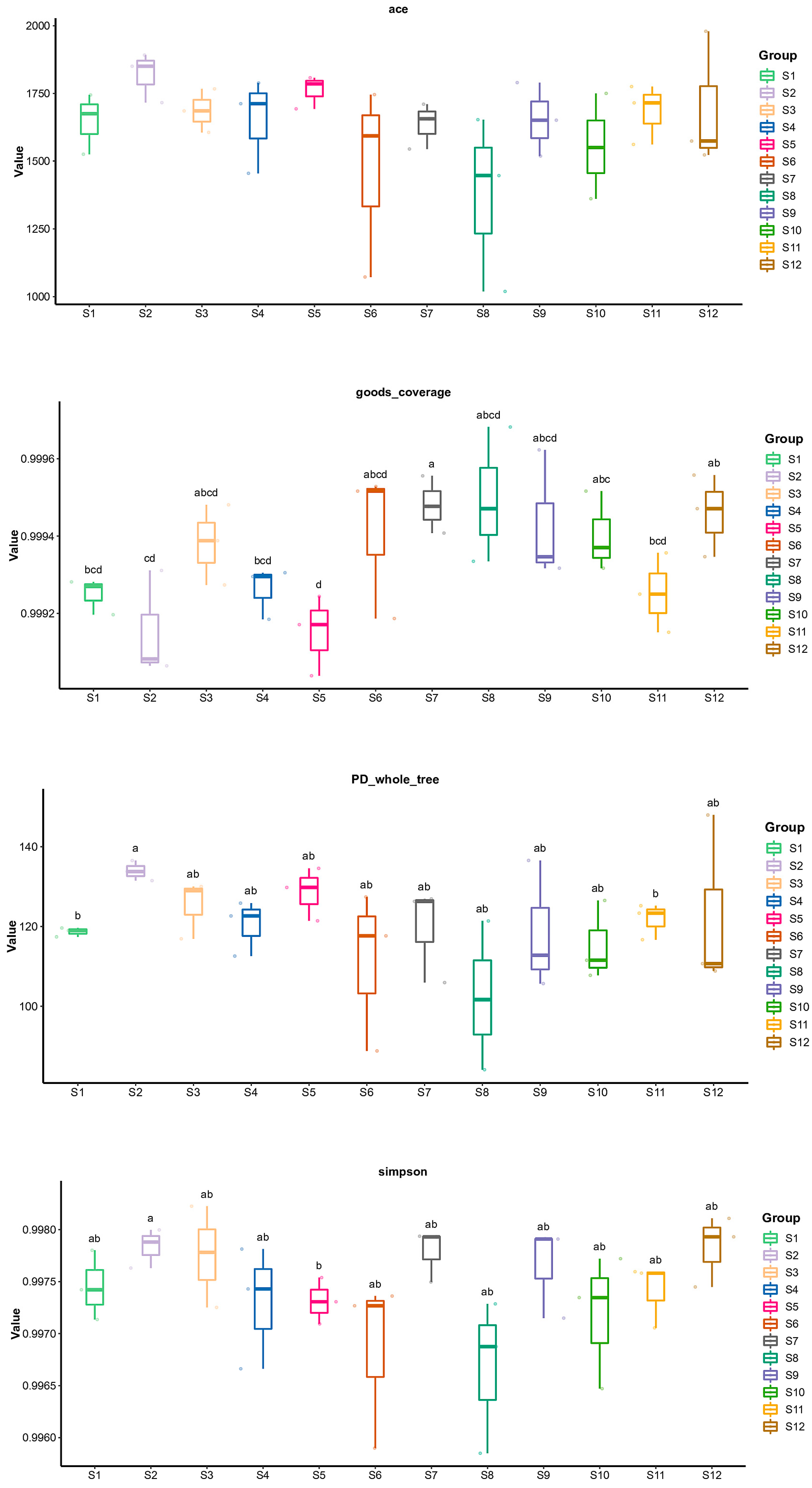
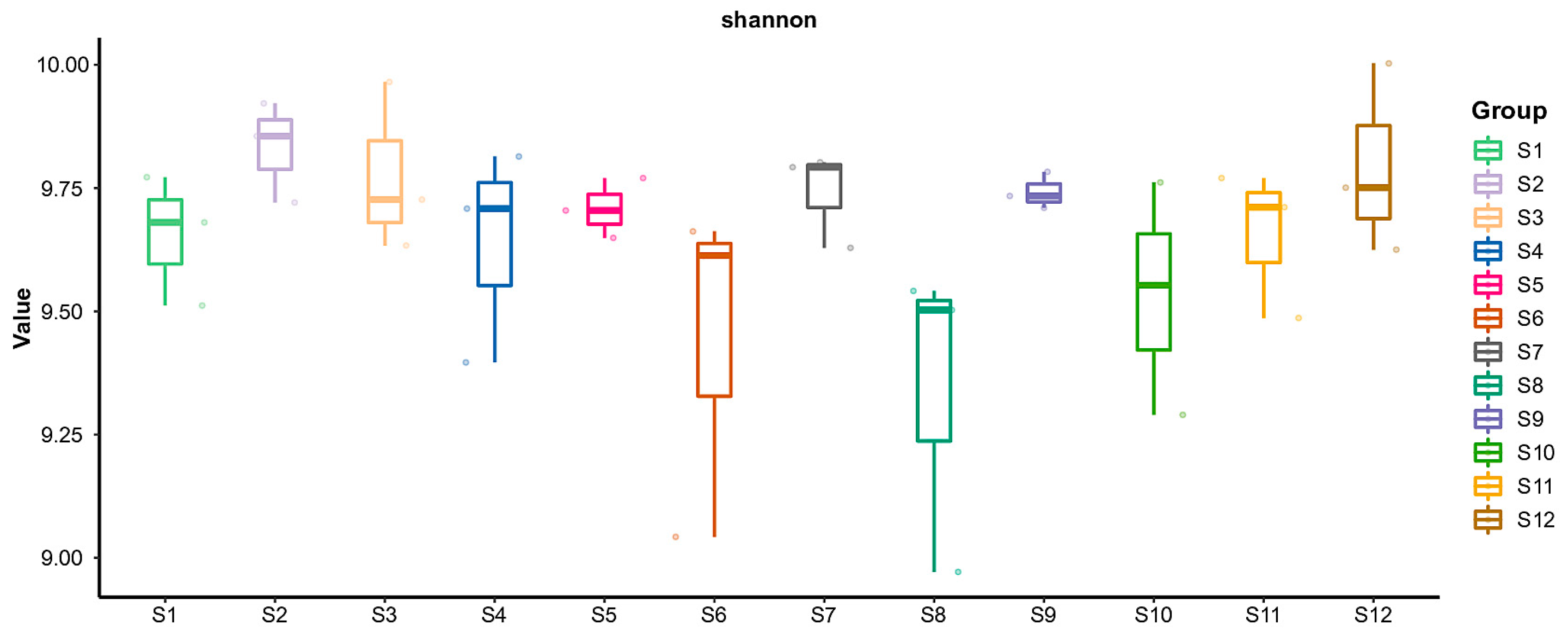
The alpha diversity indices of microbial communities in sediments from various sampling locations were calculated and illustrated in a plot of microbial community alpha diversity indices (Figure 2). Good’s Coverage Index indicates that each sample possesses an index exceeding 0.999, suggesting that the sequencing depth has effectively encompassed all species present in the samples. The ace diagram reveals that S2 exhibits the highest species count, whereas S8 displays the lowest. Figure 3 illustrates that the Shannon index provides a comprehensive assessment of both species richness and evenness. The sampling point exhibiting the highest Shannon index is S2 (9.83), while the point with the lowest index is S11 (9.33). The Simpson index, which quantifies community dominance, reveals that the maximum value is found at sampling point S3 (0.9978), whereas the minimum value is recorded at S11 (0.9967). The Chao1 and ACE indices serve primarily to estimate the total species count within a community; a higher Chao1 index indicates a greater total number of species. The maximum value is observed at sampling point S2 (1837.61), in contrast to the minimum value at S8 (1702.60). Notably, the differences among these points are not statistically significant.

3.2.2. Beta Diversity Analysis Results

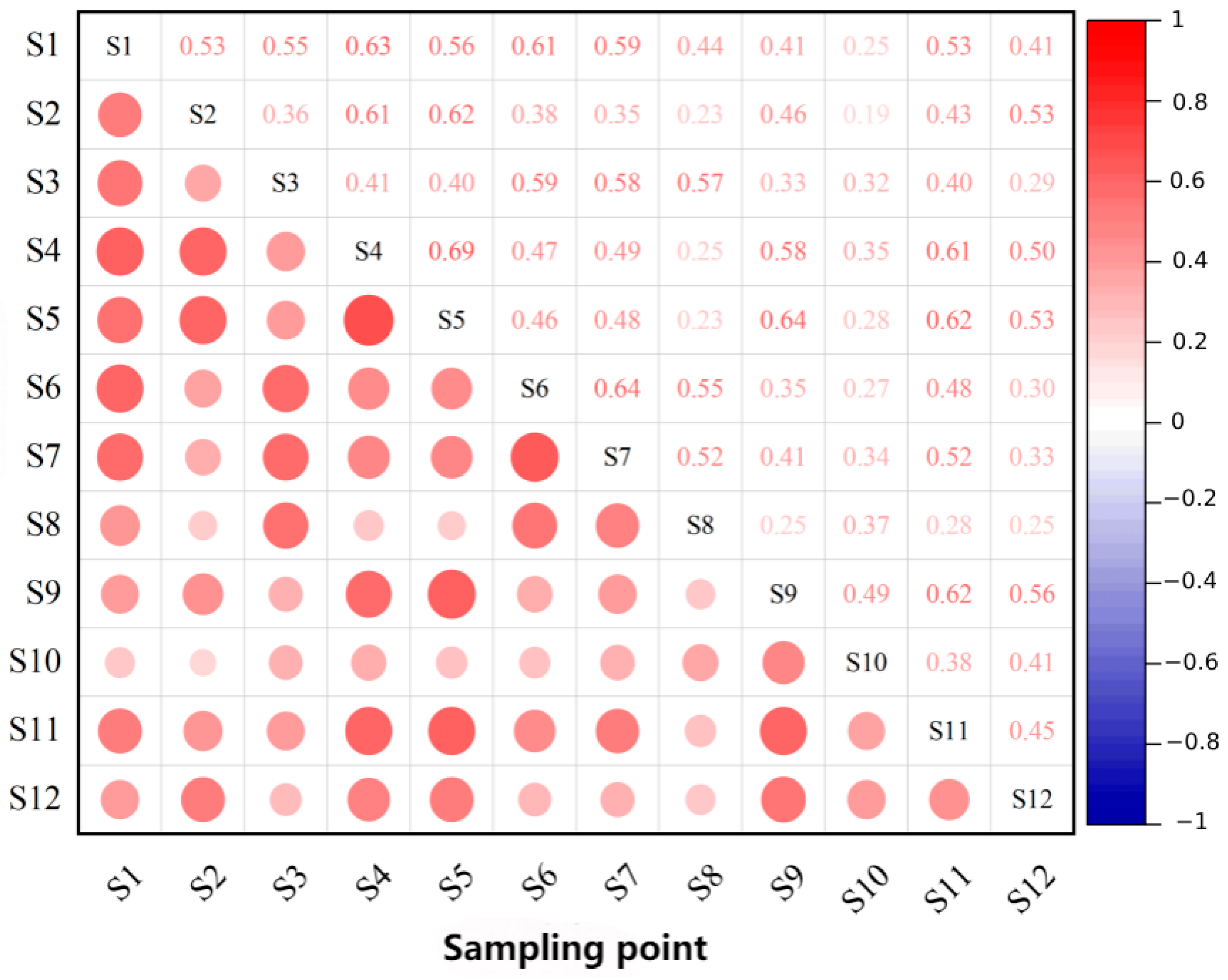
The sample correlation distance heat map at the ASV level illustrates that the dark blocks represent significant differences in microbial community structure across sampling points. Furthermore, the spatial arrangement of the microbial community structure exhibits a notable correlation with environmental gradients, including nutrients and water depth. The correlation distance heat map of samples collected at various sampling points (Figure 3) reveals distinct colours for each point, suggesting significant differences in microbial community structure within the clam breeding area. The distance coefficient between sampling points S10 and S2 is the lowest, at 0.19, indicating a high similarity in the biological communities of these two locations. Conversely, the distance coefficient for sampling points S4 and S5 is the highest, at 0.69, signifying considerable differences in the microbial communities present at these sites.

3.3. Composition of Microbial Community Structure in Sediments

3.3.1. Phylum-Level Microbial Community Structure

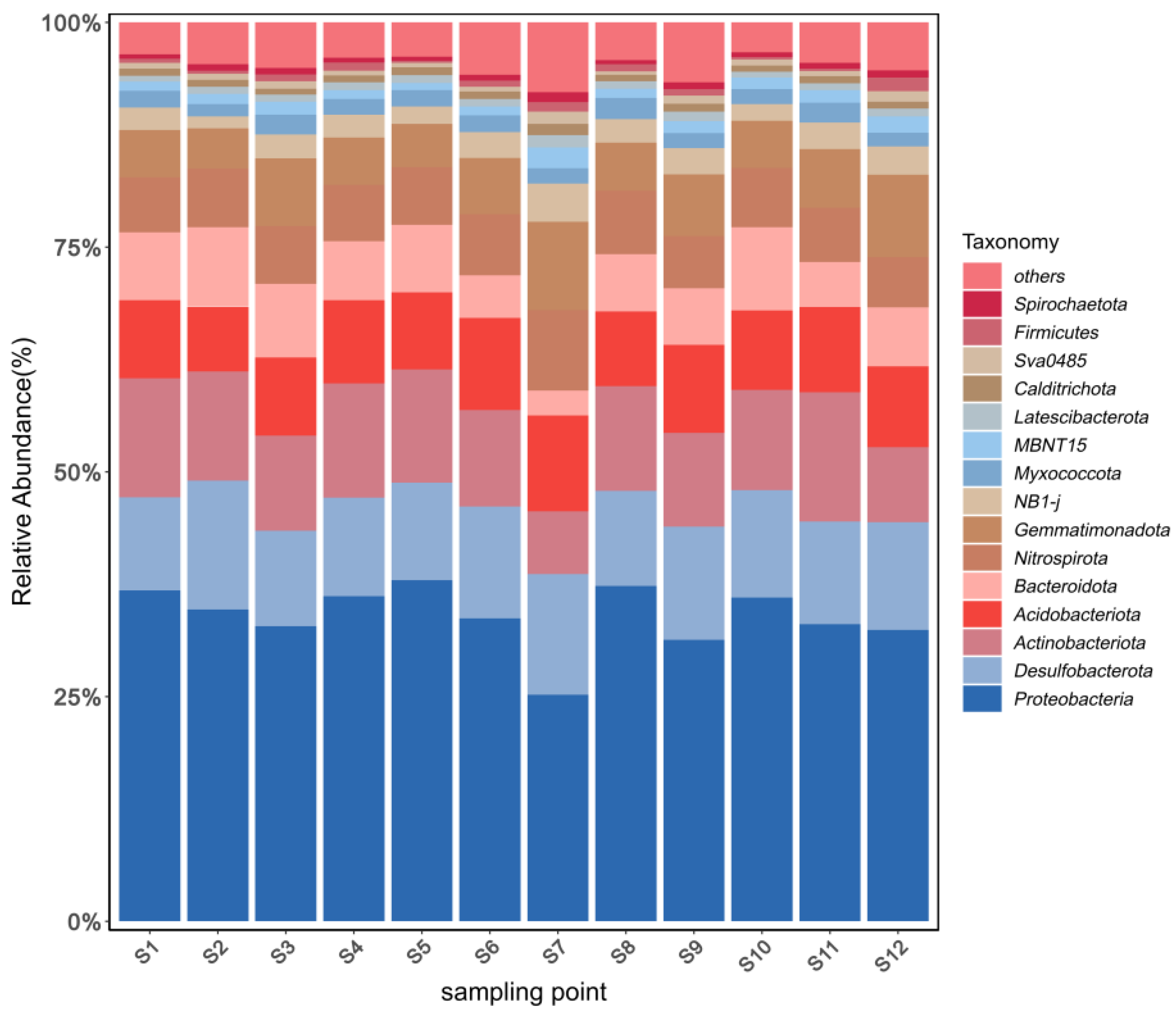
The microbial community in sediments exhibits a highly diverse lineage structure. In terms of abundance (as shown in Figure 4), the top 15 phyla are dominated by Proteobacteria (25.2–38.0%), the most abundant bacterial phylum, followed by Desulfobacterota (10.4–14.4%), Actinobacteriota (7.0–14.4%), Acidobacteriota (7.2–10.6%), Bacteroidota (2.8–9.3%), Nitrospirota (5.6–8.9%), and Gemmatimonadota (4.5–9.8%).The relative abundance proportion of these seven dominant groups in I sediment is as high as 77.8% to 89%. The Kruskal–Wallis test revealed significant differences in the relative abundance of only Spirochaetota (1.09–0.47%) among the top 15 genera across the groups (p < 0.05). The other bacterial phyla that demonstrated a significant difference in relative abundance (p < 0.05) included Spirochaetota, Chloroflexi, and Deferribacterota.

3.3.2. Horizontal Microbial Community Structure

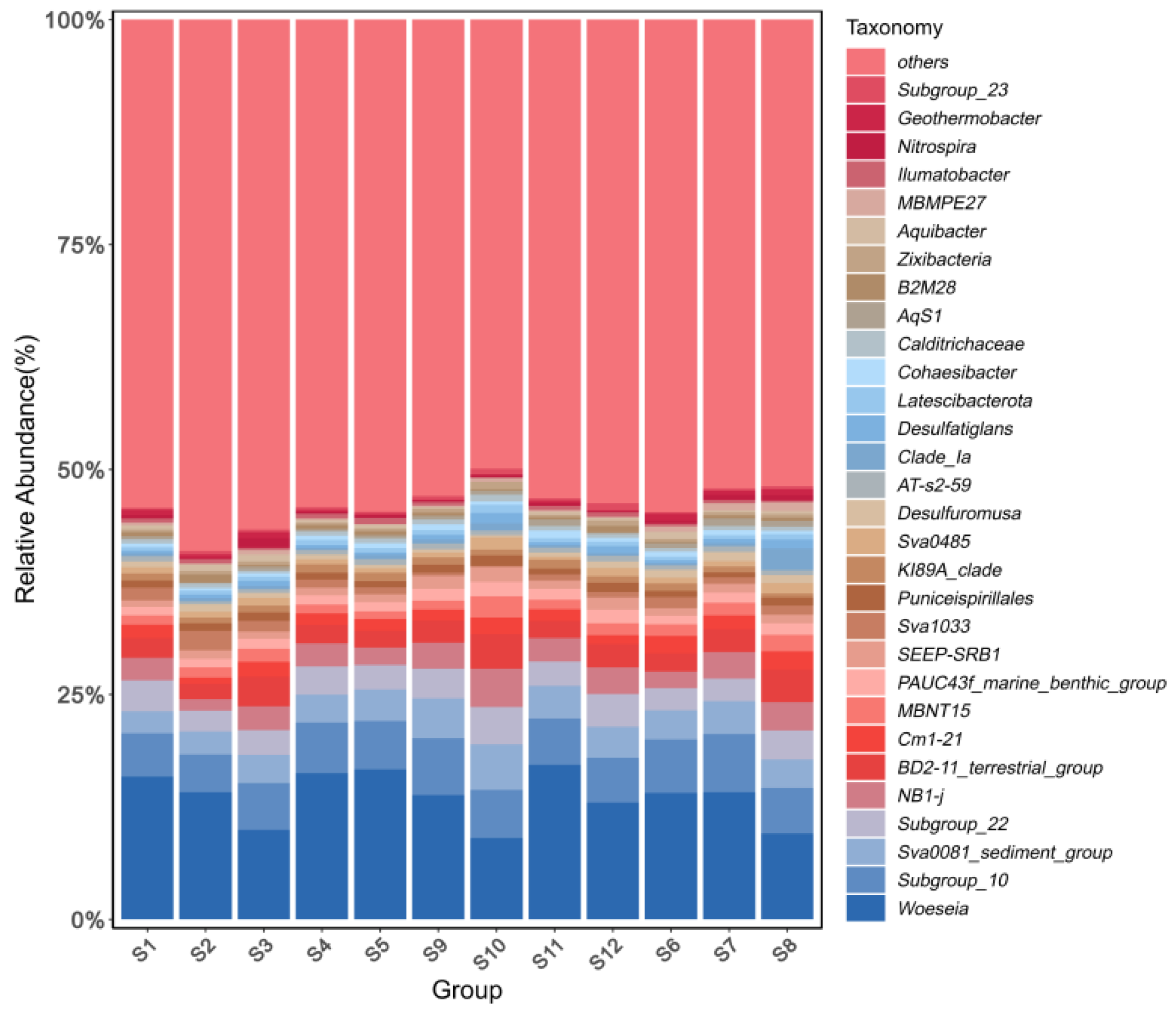
The horizontal microbial community structure of sediments from various sampling points is illustrated in Figure 5. At the genus classification level, the cumulative proportion of dominant bacterial genera (the top 30 by relative abundance) at each sampling point within the clam farming area varies between 41.0% and 50.1%. It indicates that the microbial community of the surface sediment is dominated by the core groups with the top 30 abundance rankings. Although the dominant genera were consistent across all sampling sites, the relative abundance of common groups varied due to differing environmental factors, such as nutrient availability. The predominant bacterial flora in the surface sediment of the clam farming area comprises Marine Woeseia, which exhibit a relative abundance ranging from 9.15% to 17.16%. This includes members of the genus Subgroup_22 within the family Thermoanaerobaculaceae, accounting for 4.20% to 6.49%; members of the genus Sva0081_sediment_group from the family Desulfosarcinaceae, representing 2.45% to 5.04%; and Subgroup_22 from the Acidobacteria phylum, contributing 2.31% to 4.19%. Furthermore, the uncultured genus NB1-j (1.65% to 3.82%) and the genus BD2-11_terrestrial_group (1.65% to 3.82%) within Gemmatimonadetes also constitute a significant proportion of the bacterial community.

3.4. Correlation Between Microbial Community Structure and Environmental Factors

3.4.1. Redundancy Analysis Results and Their Interpretation

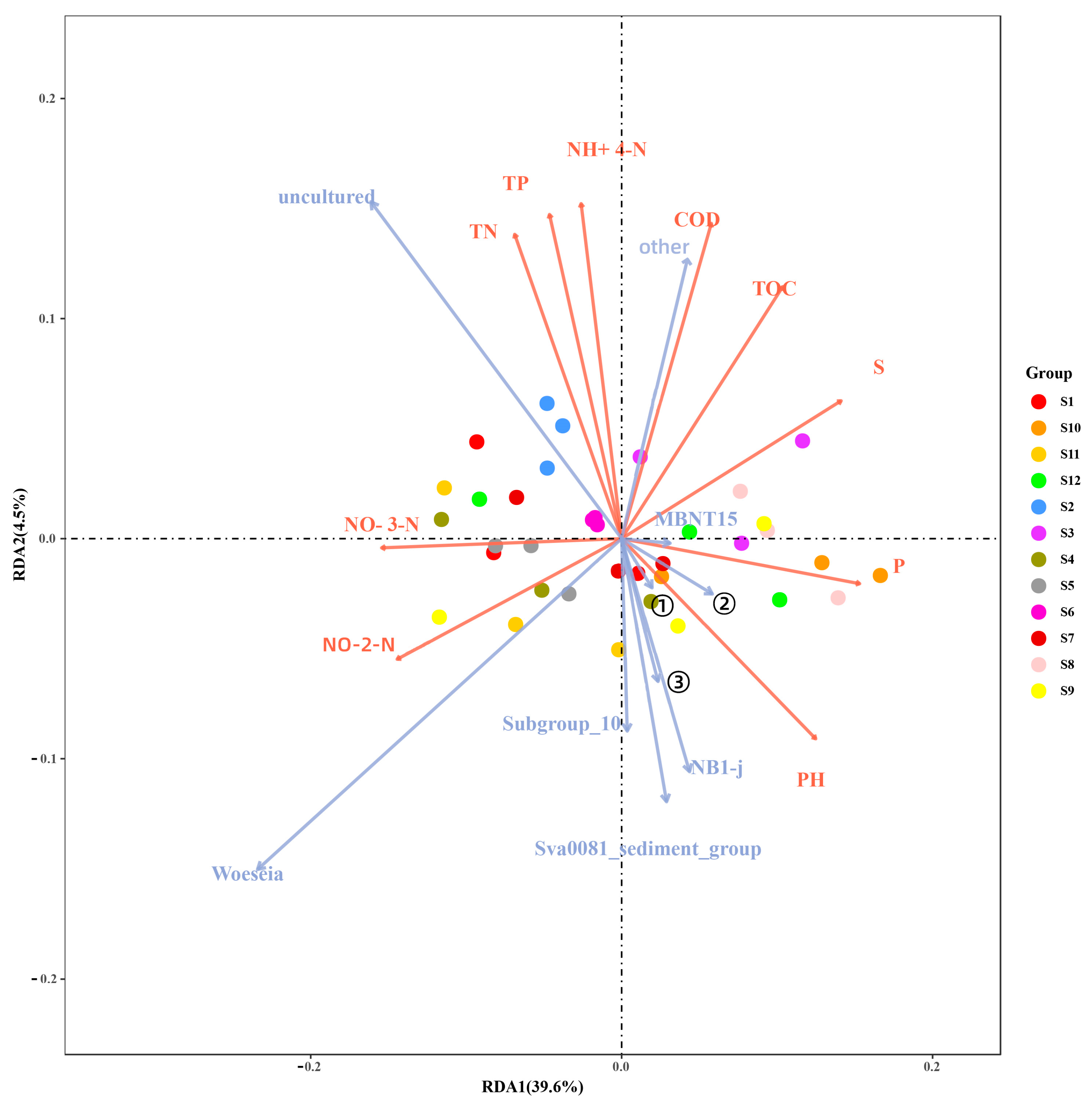
A redundancy analysis (RDA) plot of microbial communities in sediments, alongside sediment physicochemical properties, was constructed at the genus level, as shown in Figure 6. RDA1 and RDA2 together account for 43.2% of the total variation, with the first sorting axis explaining 38.2% and the second sorting axis accounting for 5%. The correlation between bacterial community structure and environmental factors in surface sediments is ranked as follows: Phosphate (p = 0.01) > NO 3 -N (p = 1.00) > NO 2 -N (p = 0.59) > S (p = 0.17) > PH (p = 0.23) > TOC (p = 1.00) > TN (p = 1.00) > COD (p = 0.05) > TP (p = 1.00) > NH 4 + -N (p = 1.00). This ranking indicates that phosphate, NO 3 -N , and N are the primary factors influencing microbial community structure. Notably, phosphate, TOC, S, pH, and COD exhibit positive correlations with the first sorting axis, while NH 4 + -N , TP, TN, NO 3 -N , and NO 2 -N display negative correlations with these factors.

3.4.2. Correlation Analysis Results

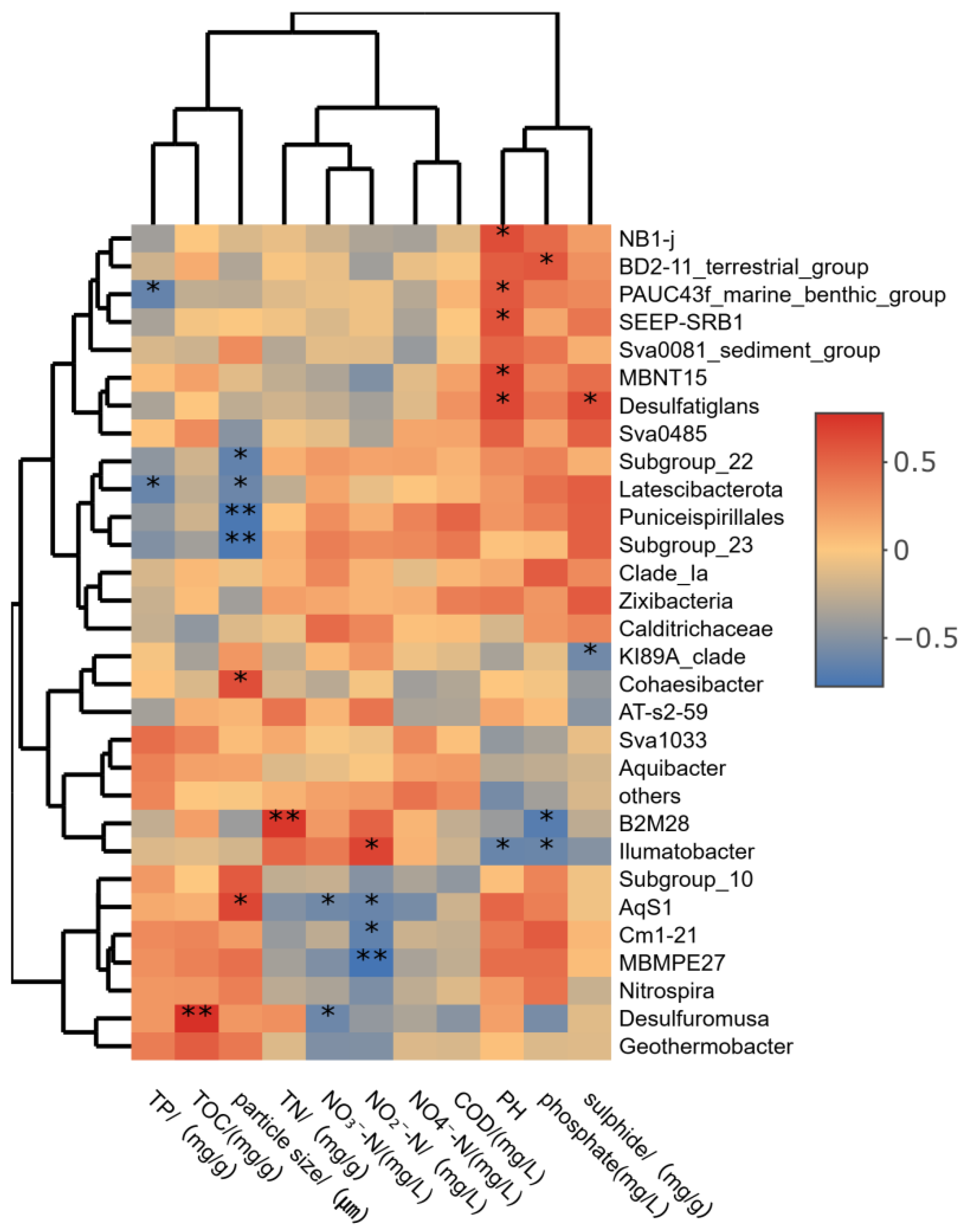
To elucidate the relationship between microbial genera and environmental factors in the sediments, redundancy analysis was employed, providing a general reflection of the correlations at the community level. To further delineate the specific associations, Spearman correlation analysis was performed on the dominant microbial genera, defined as the top 30 in terms of genus-level abundance, alongside the environmental factors. The resulting correlation analysis heat map (Figure 7) reveals that pH and particle size exhibited significant correlations with various bacterial genera, suggesting that these two environmental factors are pivotal in shaping species communities. Additionally, other environmental factors, such as phosphate, NO 3 -N and NO 2 -N , were found to correlate with several bacterial genera, indicating their auxiliary role in the regulation of bacterial genera.
Redundancy analysis (RDA) and correlation analysis heat maps reveal that dominant bacterial taxa, including NB1-j, PAUC43f_marine_benthic_group, MBNT15, SEEP-SRB1, and Desulfatiglans, exhibited significant positive correlations with pH (p < 0.05). This suggests that these bacteria possess strong adaptability and a competitive advantage in weak alkaline environments. Conversely, Ilumatobacter demonstrated a significant negative correlation with pH, indicating a greater adaptability to acidic conditions. In this study, AQS1 and Cohaesibacter exhibited a significant positive correlation with particle size (p < 0.05). Similarly, Subgroup_22, Latescibacterota, Puniceispirillales, and Subgroup_23 also demonstrated significant correlations with particle size (p < 0.05). Furthermore, phosphate was significantly negatively correlated with B2M28, which belongs to the Proteobacteria class, and with Ilumatobacter from the Ilumatobacteraceae family (p < 0.05). Conversely, it showed a significant positive correlation with the BD2-11 terrestrial group of Gemmatimonadota (p < 0.05). NO 3 -N was significantly negatively correlated with AqS1 from the Nitrosococcaceae family and Desulfuromusa from the Geopsychrobacteraceae family (p < 0.05). Additionally, NO 2 -N was significantly correlated with various bacterial genera, including AqS1, MBMPE27, Ilumatobacter, and Cm1-21 (p < 0.05), indicating the impact of nutrient salt concentration on the structure of the microbial community.

4. Discussion

4.1. Characteristics of Nutrient Pollution and Microbial Community Diversity in Sediments and Water of Meretrix meretrix Culture Area in Rudong

The surface sediments in the Rudong clam farming area exhibit pronounced characteristics of nutrient enrichment, primarily linked to intensive shellfish farming activities. Data indicate that TN, averaging 1.25 mg/g, and TP, averaging 0.42 mg/g, have reached mild and moderate pollution levels, respectively. Furthermore, the significant enrichment of TOC, with an average of 6.08 mg/g, underscores that organic pollution constitutes the principal environmental concern in this region [16]. This pattern of enrichment can be ascribed to the high-intensity filter feeding and excretion behaviours of shellfish, which facilitate the rapid sedimentation and accumulation of particulate organic matter, containing elements such as C, N, and P, from the water column into the sediments.
It is noteworthy that the concentrations of TN, TP, and TOC at the central sampling point exceed those observed on the northern and southern sides. This spatial distribution directly indicates enhanced biological sedimentation within the intensive breeding centre, thereby facilitating the migration flux of organic matter to the sediment [17]. The elevated organic matter content in the sediment, through subsequent mineralisation, will perpetually drive the endogenous release of nitrogen and phosphorus, posing a potential risk of internal nutrient loading that may adversely affect the water quality of the overlying water body.
Furthermore, the parameters of the sedimentary environment indicate that the sulphide content is remarkably low, averaging 0.00055 mg/g. The pH values, ranging from 7.26 to 7.70, and the particle size, between 94 and 150 µm, both fall within a stable range. While such an environment promotes microbial activity, it simultaneously hinders the diffusion and migration of nutrients, thereby facilitating the prolonged retention and accumulation of pollutants within the sediments.
Analysis reveals that an active nitrogen cycle is a notable characteristic of this aquatic environment. Inorganic nitrogen predominantly exists as NO 3 -N , with an average concentration of 0.34 mg/L, while NH 4 + -N exhibits a peak concentration in the central region, where aquaculture is particularly dense, reaching 0.121 mg/L. This spatial distribution pattern strongly indicates that aquaculture activities enhance the ammonification of organic nitrogen in the sediment. Although the chemical oxygen demand (COD) averages 0.99 mg/L, which is below the Class II water quality standard (≤3.00 mg/L), suggesting that the water body has not been significantly impacted by organic pollution [18], the active nitrogen conversion processes may increase the risk of eutrophication in the region. This phenomenon aligns with findings reported in typical shellfish farming areas, such as the Bohai Sea [19].
The phosphate concentration was found to be exceedingly low, averaging 0.008 mg/L. Although this level complies with the Class I seawater standard (≤0.015 mg/L), it approaches the critical threshold for phytoplankton growth (<0.018 mg/L) [20,21]. This potential phosphorus-limiting condition may constrain the primary productivity of the phytoplankton community, subsequently affecting the food chain and limiting the natural feed supply for clams. Ultimately, this situation poses a challenge to the sustainable output of the aquaculture system.
High-throughput sequencing analysis revealed the presence of 19,214 amplicon sequence variants (ASVs) across 55 phyla in 12 sediment samples, indicating substantial microbial diversity. The α diversity index demonstrated that the Shannon index ranged from 9.33 to 9.83, with a mean of 9.62, surpassing values recorded in other shellfish culture regions, such as Rizhao, where the Shannon index is approximately 7 to 8. The high alpha diversity (e.g., Simpson: 0.9967–0.9978) and richness (Chao1: 1702.60–1837.61) observed in Rudong sediments delineate a microbial community with remarkable evenness and functional potential [22]. This pattern contrasts with the often-reported decline in microbial diversity resulting from severe eutrophication. For instance, studies conducted in heavily polluted lakes and estuaries within eutrophic regions, such as Taihu Lake and the Yangtze River Basin in China, consistently demonstrated that excessive nutrient loading simplified community structure, reduced species homogeneity, and typically favoured a few competitive heterotrophic groups [23,24]. Despite the increase in nutrient levels, Rudong still maintains high diversity, which may indicate an intermediate or moderate state of eutrophication, where resource availability supports high productivity but has not yet triggered a collapse driven by dominant species. This places our research site in a crucial transitional zone, aligning with the “intermediate perturbation hypothesis”, which predicts that diversity peaks at moderate environmental stress levels [25].
The spatial heterogeneity of community structure (Bray–Curtis distance: 0.19–0.69) underscores the significant influence of local environmental screening mechanisms. The high similarity between the S2 and S10 sampling points, characterised by comparable concentrations of total nitrogen, total phosphorus, and inorganic nitrogen, further confirmed the established paradigm that nutrient gradients served as the primary driving factor for the biogeographic distribution of microorganisms. This finding aligns with observational results from various aquatic systems globally. The zonation phenomenon driven by nutrient gradients in the Amazon River plume [26] and the structured microbial community distributed along salinity and nitrate gradients in the Chesapeake Bay [27] both corroborated this principle. The magnitude of variation observed in this study, characterised by a nearly fourfold difference in the Bray–Curtis distance, proved particularly significant. It was speculated that the central area of Rudong functioned as a “nutritional hotspot,” which selectively enriched heterotrophic nitrate-reducing bacteria and sulphate-reducing bacteria, including Desulfuricaceae and Geobacteraceae. This community assembly process resembled the enrichment phenomenon of specific functional communities found in organic-rich sediments of Italy’s Venice Lagoon [28]. Consequently, this resulted in differences between the community in the central area and the peripheral community that adapted to the oligotrophic environment.
The coexistence of high abundance, in comparison with the Nansha Islands [29], and high diversity constitutes an intriguing phenomenon. This observation challenges the simplistic assumption that high productivity inevitably diminishes the diversity of microbial systems. Conversely, it supports a more nuanced perspective observed in certain coastal sediments, such as the Wadden Sea in Germany [30], where dynamic sediment suspension and complex organic matter input fostered heterogeneous microhabitats that sustain high biomass while preserving significant taxonomic diversity. This finding indicates that, beyond the mere concentration of nutrients, the physical dynamics and mass of organic carbon played a crucial role in shaping the microbial ecosystem in Rudong, warranting further investigation in future studies.

4.2. Characteristics of Microbial Community Structure in Sediments

The sediment microbial community is primarily influenced by local environmental conditions, resulting in a highly diverse and functionally complex ecosystem. At the phylum level, Proteobacteria exhibits a significant dominance, with relative abundances ranging from 25.2% to 38.0%. This observation aligns with the findings of Tan et al. (2025) [31] and Cheng (2023) [32] regarding coastal and intertidal zone sediments, thereby reinforcing its essential role in organic matter decomposition and nutrient cycling within eutrophic sediments. Concurrently, the Desulfobacterota phylum has emerged as another pivotal group at sites such as S2, facilitating the sulphur cycle through sulphate disulfurization and reduction, which underscores its critical ecological function in sediment decomposition [33].
The spatial heterogeneity of the community structure is further reflected in the abundance differences of specific bacterial phyla. Statistical analysis indicated that there were significant differences (p < 0.05) among sampling sites for phyla such as Spirochaetota, Chloroflexi, and Deferribacterota. This pattern was likely due to local fluctuations in environmental factors such as salinity and nutrients. For instance, similar studies have confirmed that environmental factors have a significant regulatory effect on the abundance of groups such as Vibrio [34,35], supporting the important “fine-tuning” mechanism of environmental factors on community composition.
The Woeseia genus was the dominant bacterial community in sediments, with a relative abundance ranging from 9.15% to 17.16%. Its high abundance and wide distribution indicate that it plays a key role in the carbon cycle and organic matter degradation within the ecosystem. The relative abundance of this genus and other common groups is regulated by the spatial heterogeneity of environmental factors such as nutrients. For instance, the uneven distribution of nitrogen and phosphorus caused by differences in aquaculture intensity, sediment characteristics and hydrodynamic conditions is the main environmental driving factor for the abundance fluctuations of core bacterial communities such as Woeseia.
The extensive distribution of high-abundance groups, alongside the increase in α diversity, indicates that this microbial community possesses a significant degree of functional redundancy and ecological stability. The Woeseia, Desulfosarcinaceae, and Acidobacteriota groups functionally complement and coordinate with one another: Woeseia primarily facilitates the decomposition of organic matter, Desulfosarcinaceae is involved in sulphate reduction, and the Acidobacteriota group enhances the degradation of complex organic matter. This division of metabolic labour and collaboration effectively sustains the overall efficiency of material cycling and energy flow within sediments, thereby augmenting the adaptability of the microbial community to environmental disturbances.

4.3. Correlation Analysis Between Microbial Population and Environmental Factors

To elucidate the relationship between microbial genera and environmental factors in sediments from the Rudong clam culture area, redundancy analysis (RDA) and Spearman correlation analysis were employed to assess correlations at the community level. The correlation analysis heat map (Figure 7) indicates that pH and particle size exhibit significant correlations (p < 0.05) with various dominant microbial genera (the top 30 in terms of genus-level abundance). This suggests that these factors are instrumental in regulating the structure of the species community. In contrast, nutrients such as phosphate, NO 2 -N and NO 3 -N are associated with specific bacterial genera and serve a supplementary regulatory function.
pH significantly affects the metabolic functions of sediment microorganisms by modulating intracellular enzyme activity and reaction rates, serving as a critical environmental factor that shapes community structure. When the environmental pH falls within the optimal growth range for a particular bacterial community, the activity of its essential metabolic enzymes peaks. This physiological response arises from the long-term adaptation of microorganisms to their external environment [36]. Such a mechanism supports the stability of microbial ecological functions within the sediment of clam farming areas.
Further research has indicated that several bacterial genera, including NB1-j, PAUC43f_marine_benthic_group, MBNT15, SEEP-SRB1, Desulfatiglans, and Ilumatobacter, exhibited significant correlations with pH. Similar observations have been documented in marine sedimentary environments, such as the intertidal zone, thereby confirming that the pH gradient exerts a substantial influence on the composition and functional diversity of bacterial communities [37]. This collectively underscores the central role of pH in the microbial ecology of sediments.
Sediment particle size serves as a crucial environmental factor influencing the spatial distribution of microbial communities. Fine-grained sediments, characterised by their extensive specific surface area and high adsorption capacity, are more conducive to the accumulation of organic matter and nutrients. This enrichment significantly enhances the availability of nutrient substrates for microorganisms, thereby facilitating the colonisation of microbial communities. In contrast, the relatively low nutritional content of coarse-grained sediments limits bacterial growth and aggregation, leading to a marked decline in both the abundance and diversity of their microbiota [38]. This particle-driven differentiation pattern is particularly evident in clam farming areas and may be closely associated with sediment disturbances resulting from farming activities. Research by Beer [36] in the sandy intertidal zone of the North Sea further corroborates this mechanism, revealing that silt–clay sediments possess higher organic matter content, greater pollutant enrichment intensity, and more microbial attachment sites, which collectively shape bacterial community composition and enhance α diversity.
In addition to particle size, nutrients such as phosphate, NO 3 -N , and NO 2 -N significantly influence community structure by regulating nutrient availability. Phosphate exhibits a notable correlation with various bacterial genera. The concentration gradient may suppress the growth of certain heterotrophic bacterial genera while facilitating the proliferation of phosphorus-tolerant bacterial genera, thereby reflecting the ecological adaptation strategies of bacterial communities in phosphorus-limited environments [32]. Furthermore, NO 3 -N and NO 2 -N are significantly associated with bacterial genera such as AqS1 and Ilumatobacter, suggesting that elevated concentrations of nitrate nitrogen may inhibit bacterial communities involved in nitrification or reduction processes, while underscoring the potential role of nitrogen cycle intermediates in fostering community differentiation.
The structure of the microbial community in sediment is influenced by pH, particle size, total nitrogen, total phosphorus concentration, and various other environmental factors [12]. These physical and chemical environmental factors play a significant role in shaping the ecological distribution pattern of microbial communities in the sediments of the Rudong clam culture area by regulating nutrient availability and metabolic conditions.

5. Conclusions

This study demonstrated that the moderate nutrient enrichment (TN 1.25 mg/g, TP 0.42 mg/g, TOC 6.08 mg/g) in the sediment of the Rudong Clam farming area resulted from the organic input of shellfish, which formed a highly diverse microbial community (Shannon index 9.62) exhibiting strong functional redundancy. This finding challenged the traditional perception that eutrophication simplifies communities. Moderate pollution, alongside stable pH levels (7.26–7.70) and variations in particle size, created heterogeneous microhabitats that supported nitrogen ammonification and sulphate reduction.
The dual effects of eutrophication manifested in the promotion of mineralisation and the alleviation of pollutant release through organic carbon and nitrogen (NO3-N 0.34 mg/L). Conversely, phosphorus restriction (PO43−-P 0.008 mg/L) inhibited plankton blooms and stabilised water quality. This dynamic ensured the ongoing suitability of aquaculture, as microorganisms enhanced organic degradation and nutrient retention, thereby reducing the risk of hypoxia. However, the central hotspot amplified β diversity (Bray–Curtis 0.69), intensified aquaculture, led to community dominance, and compromised quality.
Phosphate and nitrate accounted for 43.2% of the variation, while pH and particle size influenced the sulphur cycle and heterotrophic genera. Management recommendations included optimising density, enhancing ventilation, and monitoring phosphorus thresholds. Integrated microbial monitoring transformed eutrophication into assets, supported resilient production, and provided implications for global intertidal zone management. Future efforts should focus on spatiotemporal dynamics and functional metagenomic verification.

Author Contributions

Conceptualization, L.L. (Lei Li) and M.J.; methodology, X.Z.; software, Y.Z.; validation, S.H.; investigation, S.H. and H.H.; resources, L.L. (Longyu Liu); data curation, J.B.; writing—original draft preparation, F.W.; writing—review and editing, F.W.; visualization, C.X.; supervision, M.J.; project administration, X.Z. All authors have read and agreed to the published version of the manuscript.

Funding

This research was partly supported by China Agriculture Research System (CARS), grant numbers No. CARS-49.

Institutional Review Board Statement

This study was exempted from ethical review and approval because all samples were only sequenced.

Data Availability Statement

The original contributions presented in this study are included in the article. Further inquiries can be directed to the corresponding authors.

Conflicts of Interest

Author Chaozhong Xin was employed by the company Dalian Blue Carbon Engineering Technology Co., Ltd. The remaining authors declare that the research was conducted in the absence of any commercial or financial relationships that could be construed as a potential conflict of interest.

References

  1. Yu, K.; Jianfeng, T.; Zaiyang, Z.; Stefan, A.; Bing, W.Z. Sediment Characteristics and Intertidal Beach Slopes along the Jiangsu Coast, China. J. Mar. Sci. Eng. 2021, 9, 347. [Google Scholar] [CrossRef]
  2. Falkowski, P.G.; Fenchel, T.; Delong, E.F. The Microbial Engines That Drive Earth’s Biogeochemical Cycles. Science 2008, 320, 1034–1039. [Google Scholar] [CrossRef]
  3. Shinichi, S.; Pedro, C.L.; Samuel, C.; Roat, K.J.; Karine, L.; Guillem, S.; Bardya, D.; Georg, Z.; Mende, D.R.; Adriana, A.; et al. Structure and function of the global ocean microbiome. Science 2015, 348, 1261359. [Google Scholar] [CrossRef]
  4. Di, F.; Han, D.; Wang, G.; Zhao, W.; Zhou, D.; Rong, N.; Yang, S. Characteristics of bacterial community structure in the sediment of Chishui River (China) and the response to environmental factors. J. Contam. Hydrol. 2024, 263, 104335. [Google Scholar] [CrossRef]
  5. Jia, J.; Bai, J.; Gao, H.; Wen, X.; Zhang, G.; Cui, B.; Liu, X. In situ soil net nitrogen mineralization in coastal salt marshes (Suaeda salsa) with different flooding periods in a Chinese estuary. Ecol. Indic. 2017, 73, 559–565. [Google Scholar] [CrossRef]
  6. HJ 717-2014; Soil Quality-Determination of Total Nitrogen-Kjeldahl Method. Department of Science and Technology Standards. Ministry of Environmental Protection: Beijing, China, 2011.
  7. HJ 632-2011; Soil-Determination of Total Phosphorus-Alkali Fusion-Molybdenum Antimony Anti-Spectrophotometric Method. Department of Science and Technology Standards. Ministry of Environmental Protection: Beijing, China, 2011.
  8. GB 17378.5-2007; Specifications for Marine Monitoring-Part 5: Sediment Analysis. National Marine Environmental Monitoring Center: Dalian, China, 2007.
  9. GB 17378.4-2007; Specifications for Marine Monitoring-Part 4: Analysis of Seawater. National Marine Environmental Monitoring Center: Dalian, China, 2007.
  10. Magurran, A.E. Ecological Diversity and Its Measurement; Springer: Dordrecht, The Netherlands, 2013. [Google Scholar]
  11. Simpson, E.H. Measurement of Diversity. Nature 1949, 163, 688. [Google Scholar] [CrossRef]
  12. Habib, O.A.; Tippett, R.; Murphy, K.J. Seasonal changes in phytoplankton community structure in relation to physico-chemical factors in Loch Lomond, Scotland. Hydrobiologia 1997, 350, 63–79. [Google Scholar] [CrossRef]
  13. Reta, G.; Dong, X.; Li, Z.; Bo, H.; Yu, D.; Wan, H.; Su, B. Application of Single Factor and Multi-Factor Pollution Indices Assessment for Human-Impacted River Basins: Water Quality Classification and Pollution Indicators. Nat. Environ. Polution Technol. 2019, 18, 1063–1072. [Google Scholar]
  14. Bao, Y.; Hu, M.; Wang, D.; Wu, X.; Wang, Y.; Li, S.; Wang, Q.; Wen, J. Distribution characteristics and pollution assessment of nutrients and heavy metals in sediments of huangbai river cascade reservoirs. J. Ecol. Environ. 2021, 30, 1005–1016. [Google Scholar] [CrossRef]
  15. Minkyu, C.; Chul, K.H.; Woon, H.D.; Seok, L.I.; Sook, K.Y.; Jung, K.Y.; Gu, C.H. Organic Enrichment and Pollution in Surface Sediments from Shellfish Farming in Yeoja Bay and Gangjin Bay, Korea. Korean J. Fish. Aquat. Sci. 2013, 46, 424–436. [Google Scholar] [CrossRef]
  16. Cranford, P.J.; Strain, P.M.; Dowd, M.; Hargrave, B.T.; Grant, J.; Archambault, M. Influence of mussel aquaculture on nitrogen dynamics in a nutrient enriched coastal embayment. Mar. Ecol. Prog. Ser. 2007, 347, 61–78. [Google Scholar] [CrossRef]
  17. Giles, H.; Pilditch, C.A.; Bell, D.G. Sedimentation from mussel (Perna canaliculus) culture in the Firth of Thames, New Zealand: Impacts on sediment oxygen and nutrient fluxes. Aquaculture 2006, 261, 125–140. [Google Scholar] [CrossRef]
  18. Holmer, M.; Wildish, D.; Hargrave, B. Organic Enrichment from Marine Finfish Aquaculture and Effects on Sediment Biogeochemical Processes. In Environmental Effects of Marine Finfish Aquaculture; Handbook of Environmental Chemistry; Springer: Berlin/Heidelberg, Germany, 2005; pp. 181–206. [Google Scholar]
  19. Ferreira, J.G.; Hawkins, A.J.S.; Bricker, S.B. Management of productivity, environmental effects and profitability of shellfish aquaculture—The Farm Aquaculture Resource Management (FARM) model. Aquaculture 2007, 264, 160–174. [Google Scholar] [CrossRef]
  20. Wang, J. Study on the Species Composition and Quantitative Variation of Phytoplankton in the Nearshore Waters of the Bohai Sea. Mar. Fish. Res. 2003, 44–50. [Google Scholar]
  21. Liu, J.; Lu, Y.; Yu, X.; Cui, L. Investigation and Evaluation of Water Quality in Shellfish Farming Areas of Laizhou Bay. Anhui Agric. Sci. 2020, 48, 76–79+122. [Google Scholar]
  22. Huang, W.; Liu, T.; Zheng, M.; Gao, P.; Du, G.; Qu, L. Structural Characteristics of Marine Microbial Communities in Rizhao Shellfish Farming Areas and Their Influencing Factors. Adv. Mar. Sci. 2023, 41, 295–308. [Google Scholar]
  23. Wu, L. Microbial Community in Eutrophic Taihu Lake Sediments and Its Response to Environmental Factors. J. Appl. Environ. Biol. 2019, 25, 1470−1476. [Google Scholar] [CrossRef]
  24. Mengdie, G.; Weizhen, Z.; Ting, H.; Rong, W.; Jianjun, W.; Xiaoying, C. Eutrophication causes microbial community homogenization via modulating generalist species. Water Res. 2022, 210, 118003. [Google Scholar] [CrossRef] [PubMed]
  25. Pulsford, S.A.; Lindenmayer, D.B.; Driscoll, D.A. A succession of theories: Purging redundancy from disturbance theory. Biol. Rev. Camb. Philos. Soc. 2016, 91, 148−167. [Google Scholar] [CrossRef] [PubMed]
  26. Sophie, C.; Eunsoo, K.; Ajit, S.; Joseph, M.; Solange, D. Small pigmented eukaryote assemblages of the western tropical North Atlantic around the Amazon River plume during spring discharge. Sci. Rep. 2021, 11, 16200−16200. [Google Scholar] [CrossRef]
  27. Cram, J.A.; Hollins, A.; McCarty, A.J.; Martinez, G.; Cui, M.; Gomes, M.L.; Fuchsman, C.A. Microbial diversity and abundance vary along salinity, oxygen, and particle size gradients in the Chesapeake Bay. Environ. Microbiol. 2024, 26, e16557. [Google Scholar] [CrossRef] [PubMed]
  28. Elisa, B.; Paola, D.N.; Mauro, C.; Francesca, M. Sediment Features and Human Activities Structure the Surface Microbial Communities of the Venice Lagoon 13. Front. Mar. Sci. 2021, 8. [Google Scholar] [CrossRef]
  29. Sun, C.; Zhu, L.; Mao, Y.; Fan, Y.; Zhou, C.; Yang, A.; Zhu, W.; Zhuang, Z. Analysis of Sediment Microbial Community Structure under Different Aquaculture Models in Nansha Islands, Xiangshan Port. Adv. Fish. Sci. 2014, 35, 13–21. [Google Scholar]
  30. Niculina, M.; Ursula, W.; Katrin, K.; Steffen, K.; Tanja, D.; van Beusekom, J.E.; Dirk, d.B.; Nicole, D.; Rudolf, A. Microbial community structure of sandy intertidal sediments in the North Sea, Sylt-Rømø Basin, Wadden Sea. Syst. Appl. Microbiol. 2006, 29, 333−348. [Google Scholar] [CrossRef]
  31. Tan, S.; Zhang, T.; Zou, Z.; Yang, Z. Vertical distribution characteristics and influencing factors of bacterial communities in a sediment profile of Bohai Sea. Sci. Nat. 2025, 112, 37. [Google Scholar] [CrossRef]
  32. Cheng, Y.; Su, Q.; Yang, S.; Xu, H.; Wang, C.; Liao, N.; Li, N.; Kang, B.; Huang, L. Sedimentary bacterial communities in subtropical Beibu Gulf: Assembly process and functional profile. Ecol. Indic. 2023, 154. [Google Scholar] [CrossRef]
  33. de Sousa Pires, A.; Dias, G.M.; de Oliveira Mariano, D.C.; Akamine, R.N.; de Albuquerque, A.C.C.; Groposo, C.; de Figueiredo Vilela, L.; Neves, B.C. Molecular diversity and abundance of the microbial community associated to an offshore oil field on the southeast of Brazil. Int. Biodeterior. Biodegrad. 2021, 160, 105215. [Google Scholar] [CrossRef]
  34. Takemura, A.F.; Chien, D.M.; Polz, M.F. Associations and dynamics of Vibrionaceae in the environment, from the genus to the population level. Front. Microbiol. 2014, 5, 38. [Google Scholar] [CrossRef] [PubMed]
  35. Johnson, C.N.; Flowers, A.R.; Noriea, N.F., III; Zimmerman, A.M.; Bowers, J.C.; DePaola, A.; Grimes, D. Relationships between environmental factors and pathogenic Vibrios in the Northern Gulf of Mexico. Appl. Environ. Microbiol. 2010, 76, 7076–7084. [Google Scholar] [CrossRef]
  36. de Beer, D.; Wenzhöfer, F.; Ferdelman, T.G.; Boehme, S.E.; Huettel, M.; van Beusekom, J.E.E.; Böttcher, M.E.; Musat, N.; Dubilier, N. Transport and mineralization rates in North Sea sandy intertidal sediments, Sylt-Rømø Basin, Wadden Sea. Limnol. Oceanogr. 2005, 50, 113–127. [Google Scholar] [CrossRef]
  37. Wan, W.; Tan, J.; Wang, Y.; Qin, Y.; He, H.; Wu, H.; Zuo, W.; He, D. Responses of the rhizosphere bacterial community in acidic crop soil to pH: Changes in diversity, composition, interaction, and function. Sci. Total Environ. 2020, 700, 134418. [Google Scholar] [CrossRef] [PubMed]
  38. Sessitsch, A.; Weilharter, A.; Gerzabek, M.H.; Kirchmann, H.; Kandeler, E. Microbial Population Structures in Soil Particle Size Fractions of a Long-Term Fertilizer Field Experiment. Appl. Environ. Microbiol. 2001, 67, 4215–4224. [Google Scholar] [CrossRef] [PubMed]
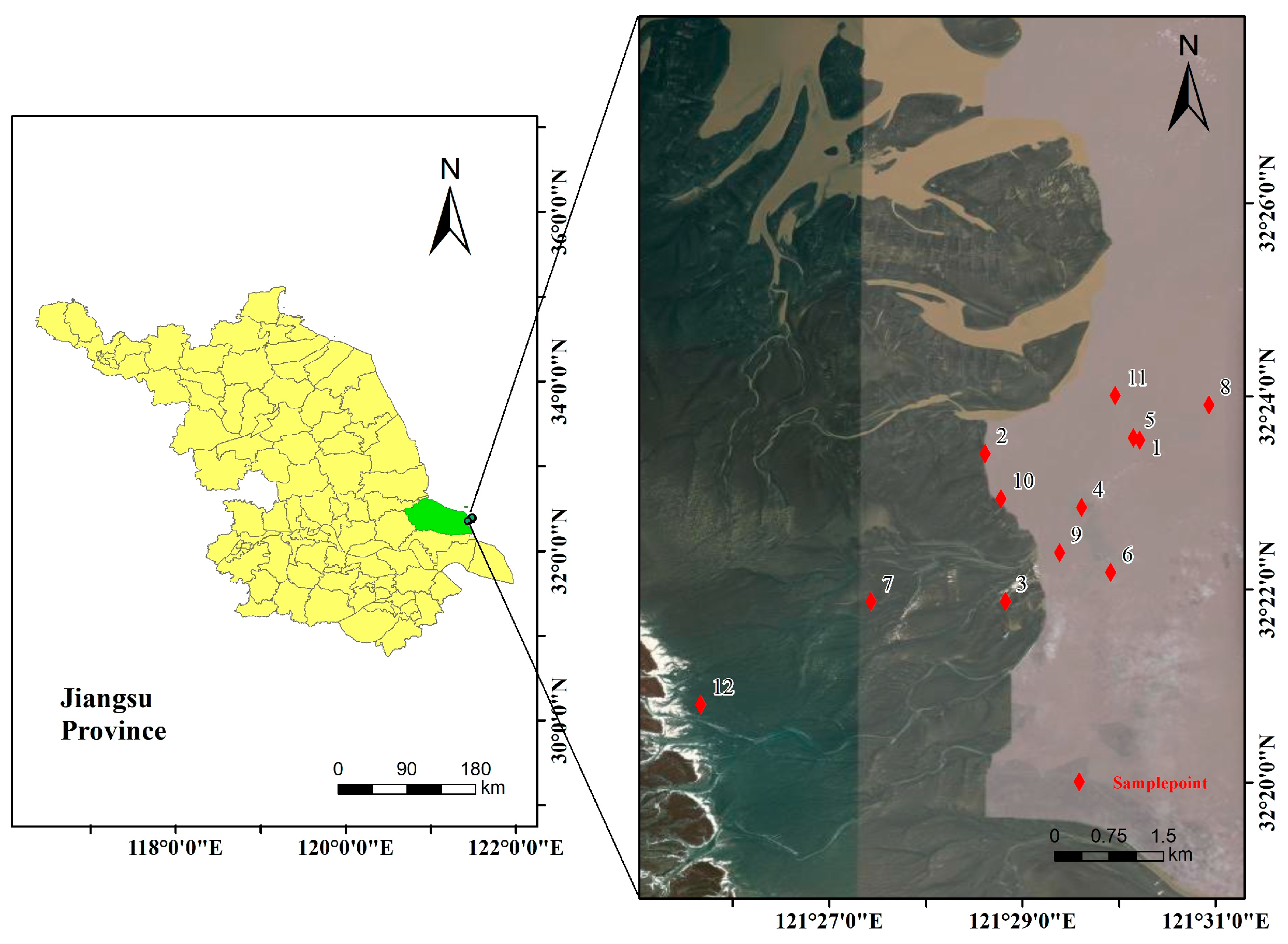
Figure 1. Location of sampling stations. Yellow indicates the province where the sampling point is located, green indicates the specific city where the sampling point is located, and the number represents the sampling point number.
Diversity 17 00848 g001
Figure 2. Alpha diversity indices of microbial communities in sediments from different sampling points. Note: Two sets sharing one or more letters indicate no ‘significant’ difference.
Diversity 17 00848 g002aDiversity 17 00848 g002b
Figure 3. Heat maps of sample correlation distances at different sampling points.
Diversity 17 00848 g003
Figure 4. Community structure of sedimentary door-level taxa at different sampling points.
Diversity 17 00848 g004
Figure 5. Community structure of sedimentary genus-level communities at different sampling points.
Diversity 17 00848 g005
Figure 6. Redundancy analysis of microbial genera in intertidal zone sediment samples with sediment and seawater physicochemical indicators. The orange arrows represent environmental factors, and the blue arrows represent bacterial strains. Dots of different colors represent different stations, and dots of the same color represent three parallel dots at the same station. ① represents cm1-21, ② represents BD2-11_terrestrial_group, and ③ represents Subgroup_22.
Diversity 17 00848 g006
Figure 7. Heat Map Analysis of Correlations Between Microbial Genera and Physicochemical Indicators of Seawater and Sediments. Note: PH, TP, TOC, TN, particle size, and sulphide are sediment-related indicators; NH 4 + -N , NO 3 -N , NO 2 -N , COD, and phosphate are seawater-related indicators. * p < 0.05 and ** p < 0.01.
Diversity 17 00848 g007
Table 1. Environmental physicochemical indicators of surface sediments in different habitats within the aquaculture zone.
Sampling PointPHTP
Concentration
(mg/g)
TOC
Concentration
(mg/g)
TN
Concentration
(mg/g)
Particle Size
(µm)
Sulphide
(mg/g)
S17.340.506 6.51.659 1180.00028
S27.30.489 5.6 1.414 1200.00092
S37.380.448 4.8 1.120 1230.00047
S47.260.393 4.7 1.182 1160.00045
S57.360.425 6.0 1.261 1270.00011
S67.680.533 9.60.974 1350.00079
S77.640.529 6.9 1.458 1500.00029
S87.70.347 9.8 1.168 1250.00086
S97.630.3585.0 1.1871300.00091
S107.680.453 4.0 1.095 1100.00099
S117.640.349 3.4 0.865 1330.00032
S127.70.265 6.7 1.631 940.00041
Table 2. Environmental physicochemical indicators of water bodies in different habitats within the aquaculture zone.
Sampling Point NH 4 + -N
Concentration (mg/L)
NO 3 -N Concentration (mg/L) NO 2 -N Concentration
(mg/L)
COD
(mg/L)
Phosphate
(mg/L)
S10.1206 0.412 0.0069 1.01 0.007
S20.1150 0.398 0.0059 1.31 0.006
S30.0935 0.363 0.0035 1.34 0.011
S40.0834 0.395 0.0045 0.82 0.007
S50.0569 0.454 0.0105 0.87 0.008
S60.0627 0.195 0.0020 0.91 0.007
S70.0318 0.301 0.0029 0.79 0.007
S80.0183 0.220 0.0023 0.85 0.009
S90.0802 0.343 0.0050 1.02 0.01
S100.0950 0.413 0.0050 1.05 0.015
S110.0359 0.301 0.0055 1.04 0.007
S120.0613 0.305 0.0059 0.97 0.006
Disclaimer/Publisher’s Note: The statements, opinions and data contained in all publications are solely those of the individual author(s) and contributor(s) and not of MDPI and/or the editor(s). MDPI and/or the editor(s) disclaim responsibility for any injury to people or property resulting from any ideas, methods, instructions or products referred to in the content.