


Abstract
Orchids play an important role in nature conservation and are often used for monitoring purposes. However, interpreting orchid monitoring data can be challenging for several reasons. We present here the first monitoring data of Orchis mascula subsp. speciosa from the Bohemian Waldviertel region in Austria, where this taxon is ‘endangered’. The data show a successful spread into mesotrophic grassland, which was historically arable land, and afterwards strong population fluctuations. Within ten years, the population has grown from 50 flowering individuals to more than 800. Over the next 20 years, the population fluctuated between fewer than 200 and more than 1800 flowering individuals. We discuss these observations against the background of land use changes and different management measures (i.e., ploughing, grazing, mowing, and sowing of grassland species). Furthermore, we more generally discuss the potential of European terrestrial orchids to act as ‘pioneers’ and to successfully establish in fallow land. Finally, monitoring data for Orchis mascula from six countries was compiled and interpreted, given the various biological characteristics of orchid species. Reviewed data showed complex, multifaceted patterns, which still do not allow generalized conclusions explaining population dynamics.
1. Introduction
Orchids are important symbols and indicators of threatened and declining biodiversity in grasslands. This significance is even reflected in the naming of certain priority habitats recognized internationally under the European Habitats Directive. For example, one such habitat is called ‘6210 Semi-natural dry grasslands and scrubland facies on calcareous substrates (Festuco-Brometalia) (* important orchid sites)’ (Council Directive 92/43/EEC, Annex I). Moreover, several threatened and rare orchid species represent priority species listed in the Annexes of the European Habitats Directive, namely, Cypripedium calceolus, Himantoglossum adriaticum, Liparis loeselii, and Spiranthes aestivalis.
However, many native orchids are synanthropic species, meaning they thrive in environments shaped by human activity. Specifically, the opening of the Central European landscape and traditional grassland farming have, at a large-scale, created habitats for orchids. Since around the middle of the last century (cf. [1]), living conditions for orchids have deteriorated, either due to the abandonment of low-yield sites followed by fallow land or reforestation, or due to more intensive cultivation where the soil conditions allow it. As a result, orchids are in decline in many places (e.g., [2,3,4]). Generally, not only are orchids affected by these changes in land use, but there are also numerous other organisms that have adapted to extensive land use. Typically, these species are weak competitors. On a larger scale, this problem cannot be solved by landscape management through voluntary nature conservation work. The preservation of extensive agricultural use is, therefore, essential for maintaining diversity in the cultural landscape. However, since the cultivation of marginal land is unprofitable from an economic point of view, continued cultivation depends on subsidies or compensation payments. This poses major challenges for applied nature conservation research, like influencing subsidy programmes and monitoring the success of nature conservation measures.
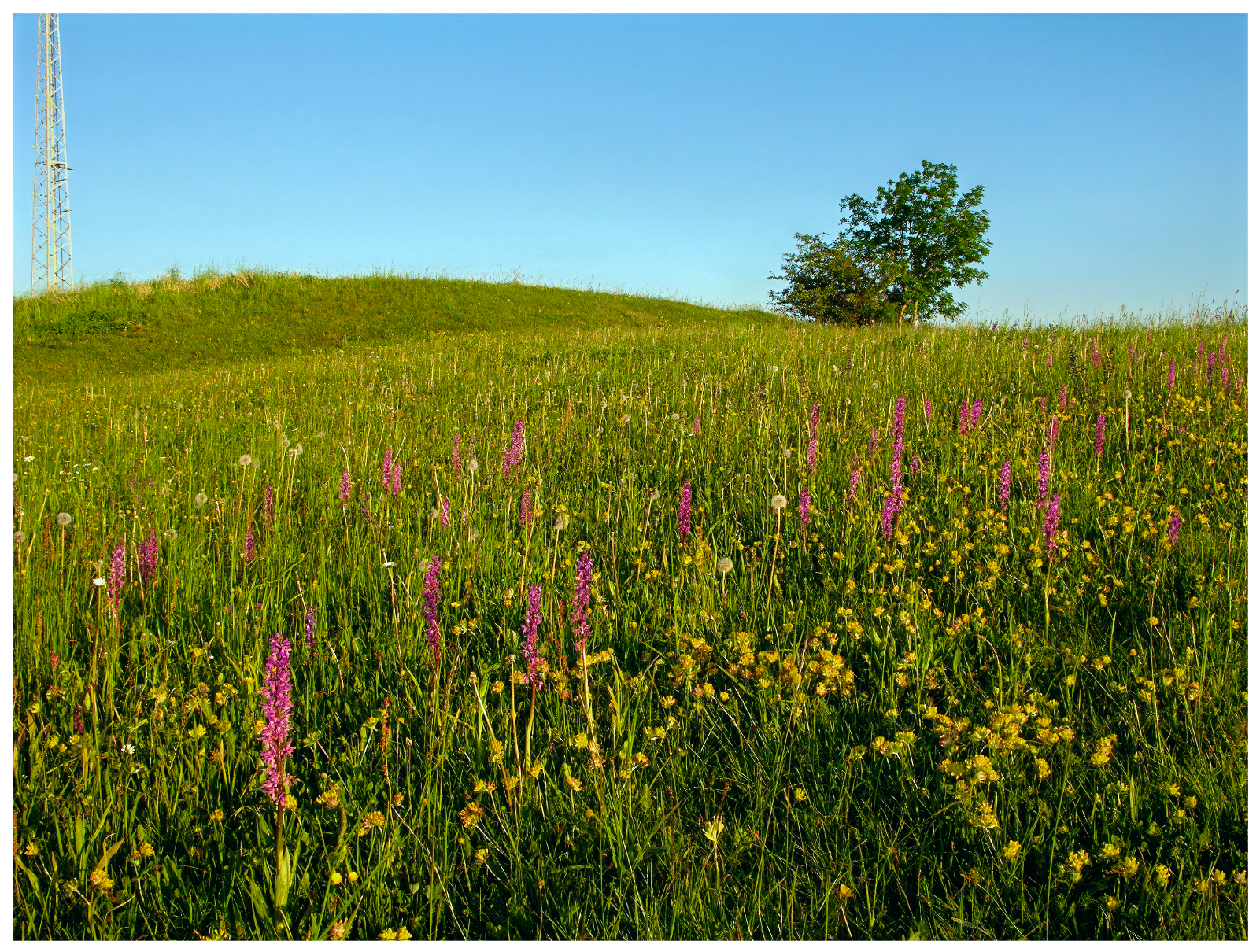
In addition to reports of negative orchid population developments due to habitat alteration or destruction, there have also been reports of positive developments within the context of contractual nature conservation (e.g., [5,6]) or more generally (e.g., [7]). The starting point for this study was the spread of an O. mascula population from an old traditionally grazed grassland embankment to a newly established meadow area sown with cocksfoot grass (Dactylis glomerata) [8]. The expansion was possible because this area was included in the Austrian Agri-environmental Programme despite its species poverty. Due to the poor soil conditions, the nature conservation potential had been correctly assessed, and the population of O. mascula was able to multiply and spread explosively from a few plants to over 800 flowering individuals into the adjacent areas in just a few years.
With respect to monitoring, orchid species represent a charismatic species group, which is often reported and counted in the context of nature conservation measures, especially by amateurs. Although the identification of several European species is not so straightforward, and orchids have some ecological characteristics (like irregular flowering [9] and often occurring ‘vegetative dormancy’ [10]), the high number of monitoring projects allows interpretations, at least in a comparative way. We were, therefore, also interested in other O. mascula [11] studies, especially in those relating nature conservation measures and/or land use changes to its population growth or decline.
Regarding the population dynamics of O. mascula over 30 years at the study site, we address the following research questions:
- (1)
- How has land use changed over time at the study site?
- (2)
- How does the population develop with constant management, also in comparison with other long-term census studies of O. mascula?
- (3)
- In addition, we will discuss whether orchids are suitable as target species for monitoring the success of nature conservation measures.
2. Materials and Methods
2.1. Study Species
Orchis mascula (L.) L. is widespread throughout Europe with several subspecies [11,12,13,14,15]. It is one of the more long-lived orchid species, as it already takes at least four years from first appearance to flower for the first time [16]. The maximum recorded lifetime after first appearance is 13 years [17]. Dormancy [10] was observed in O. mascula but appears not to last longer than one year [17]. The species is not autogamous, and pollinators are required for successful fruit set. Under natural conditions, c. 50% of individuals do not set fruit each year [18,19,20]. In terms of its total distribution range, O. mascula is one of the less endangered orchid species, as it has a relatively broad ecological amplitude and is also able to colonize—aside from grasslands—light forests, forest edges, and shrubbery [11,12]. But also, the range of O. mascula has declined in most western European countries during the 20th century [1,21,22].
In Austria, two subspecies are native, i.e., the nominate subsp. mascula restricted to the two westernmost federal states (Vorarlberg, Tyrol), and the more widespread subsp. speciosa (Mutel) Hegi, originally known in all federal states [2,12]. The latter is mainly found in mountain meadows in the limestone foothills of the Alps, but more rarely, it also populates eastern Austrian lowland areas. In two eastern federal states (i.e., Burgenland, Vienna), this subspecies is currently categorized as ‘extinct’ [2]. Specifically, it is rare in Austria north of the Danube, and its populations in the southern Waldviertel region and on the Jauerling have been severely decimated by intensive agricultural use and reforestation with Christmas tree plantations. Therefore, O. mascula subsp. speciosa was recently classified as ‘endangered’ in the Bohemian Massif region of Austria [2], where our study population is located.
2.2. Study Site
The study site is in the Bohemian Massif in the Waldviertel region of Lower Austria on a hilltop near the village of Voitsau within the municipality of Kottes-Purk, altitude c. 750–757 m a.s.l. (Figure 1).
Figure 1.
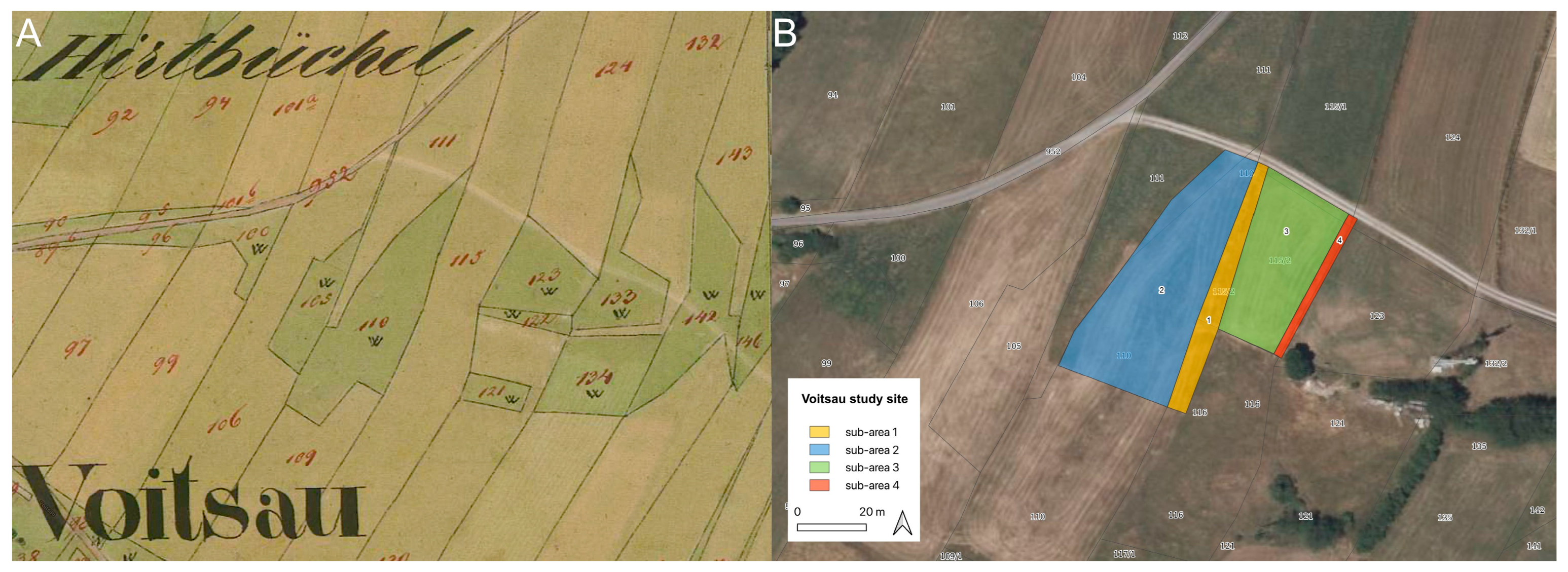
The study site in Voitsau. (A) Section from the Franziscean Cadastre (Arcanum Maps; 1823 [23]), slightly transparent over a recent orthophoto, to make the path created later visible and to make the fields easier to compare; green with letter W = pasture (‘Weiden’), yellowish green = arable land. (B) Recent aerial map from Bing Maps ©, colours of the sub-areas correspond with the colours in Figure 2.
As this municipality has not yet undergone any land consolidation procedures, the current arrangement of fields and landscape structures still reflects the medieval plots and their strip fields (‘Streifenflur’ in German; Figure 1A). The embankments (‘Stufenraine’ in German) between the narrow plots are remarkable. Nowadays, some of those embankments represent species-rich grassland vegetation, while others have become overgrown due to abandonment. The central old grassland embankment under study (sub-area 1) is characterized by nutrient-poor grassland vegetation that is traditionally mown once, later in the vegetation period. Co-occurring plant species of this old embankment, reflecting the nutrient-poor conditions, are, for instance, Anthoxanthum odoratum, Briza media, Carex caryophyllea, Euphorbia cyparissias, Festuca guestfalica, Genista tinctoria, Luzula campestris, Plantago lanceolata, Potentilla erecta, Primula veris, Sanguisorba minor, and Seseli annuum.
Figure 2.
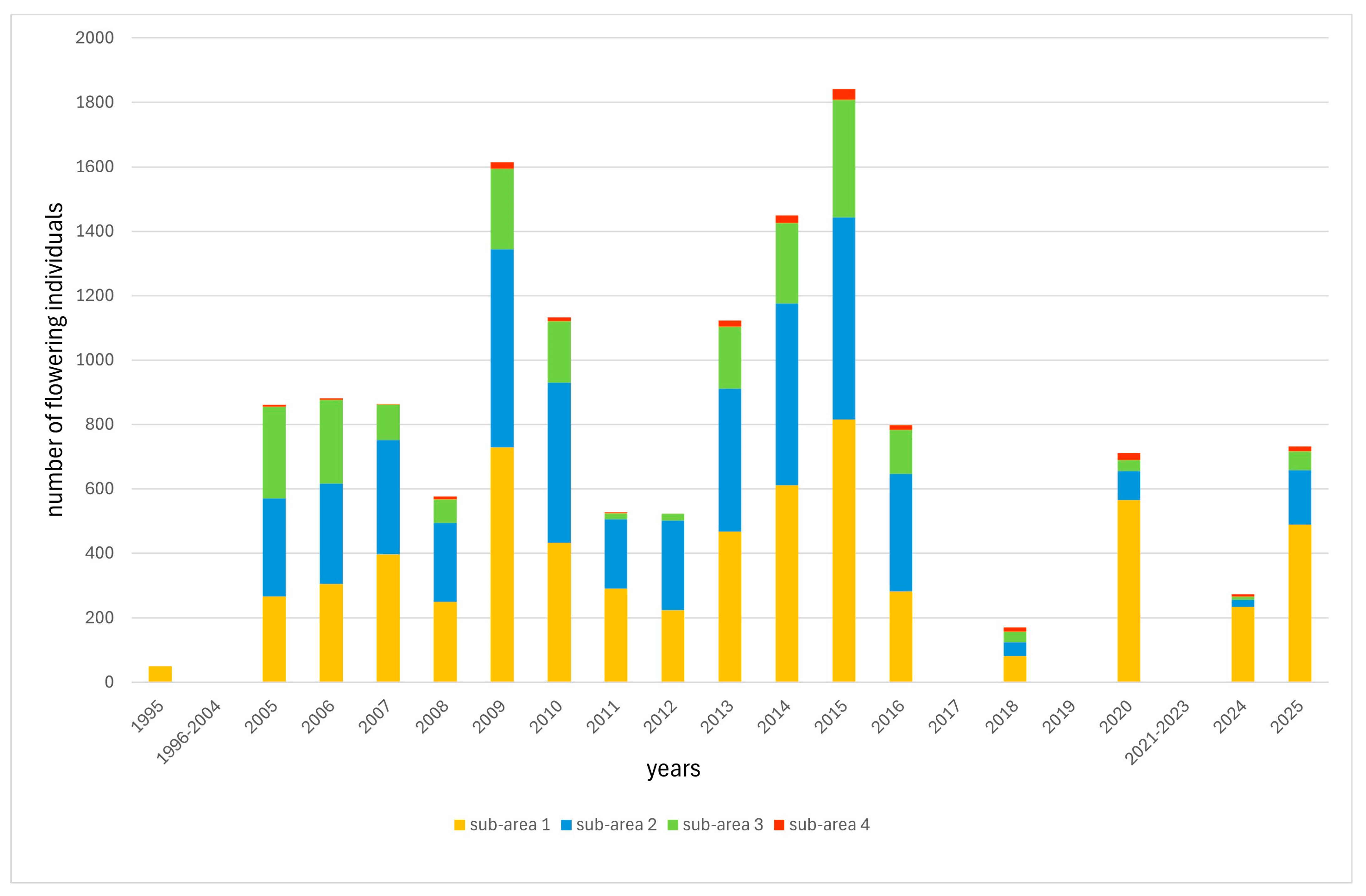
Census data of the studied Orchis mascula subsp. speciosa population at the Voitsau study site. Data is provided by the sub-area. The year 1995 is an estimate, but the population was restricted to sub-area 1. There is no data available for the following years: 1996–2004, 2017, 2019, and 2021–23.
The study site has repeatedly been visited since 2005 by one or the other author or by both authors together (see also [24]). The first figure of the old grassland embankment from 1995 is an estimate. All counts were based on a single visit each year around mid-May. The total number of flowering plant individuals was counted on four sub-areas representing unequally old grasslands by site inspection using transect walks (see Figure 1). Counting flowering individuals, therefore, represents minimum census sizes, as not all plants will flower each year [9]. Also possibly, single flowering plants might have been overlooked. The four sub-areas differ in size and with respect to land use, i.e., grassland management over time (Table 1). To test for population growth or decline, we used linear and exponential curve fitting running SPSS (IBM SPSS Statistics 30.0.0.0) and visually inspected census data in different graphs.
Table 1.
Characteristics of the four sub-areas populated by Orchis mascula subsp. speciosa at the Voitsau study site. See Figure 1B for their locations.
2.3. Land Use Changes
To characterize land use changes over time, various sources from the literature [25,26], as well as maps, such as the digitized map of the Franziscean Cadastre [23], aerial photos, and orthophotos [27], were used.
2.4. Compilation of Orchis mascula Monitoring Data
The basis for compiling the monitoring data was the table characterizing the literature on serial observations on the size of European orchid populations by Vanhecke [28], which included studies before 1992. We, therefore, follow the concept of this compilation work, which aimed at bringing together as many populations dealing with fluctuations as possible and standardizing the information in these publications to make it possible to compare the data. Populations, therefore, were screened on characteristics of their data concerning population dynamics, such as the number of populations, total number of observation years, longest uninterrupted observation period, total length of observation period, and maximal and minimal recorded individuals.
3. Results
3.1. Land Use History of the Study Site
Voitsau is one of the oldest villages within this part of the Waldviertel region (e.g., [29]) and was first mentioned in documents at the beginning of the 12th century [30]. Like most villages, Voitsau was created according to a plan. This can still be seen today in the strip fields (‘Streifenflur’ in German; Figure 1A). Every village had three fields (‘Gewanne’ in German) of approximately equal size. As a result of the three-field crop rotation system, each farmer received three strips. Each strip in a field (‘Gewanne’) was cultivated with the same crop, with rye serving as the winter crop and oat as the summer crop; the third field was fallow land.
The Projektgruppe Umweltgeschichte [25] linked the data from historical maps and related sources (e.g., Operate) with data from aerial image analysis of recent landscape change, allowing conclusions about changes in landscape structure and land use over more than a century. Generally, the study site is characterized by mixed grassland and arable farming, but the analysis showed a trend towards more grassland with an increase in total agricultural area. Moreover, there was a clear increase in forest area, which can be attributed to the afforestation of pastureland and wet extensive meadows. The decline in small structures is mainly due to a decrease in field margins and hedges, as well as individual trees.
Considering our census areas, sub-areas 1 and 4 are old embankments (terraced slopes; Figure 1B), probably used as pastures in the 19th century. A reference to the historical use of pastureland could be the respective field name, i.e., ‘Hirtbüchel’ in German (see Figure 1A)—meaning ‘the small hill with the shepherd’. However, there is also another interpretation of this field name [31], which refers to stony ground (“hiaten” local name; “hart” in German). Sub-area 2 was also recorded as pastureland in 1823, while sub-area 3 was arable land at that time (Table 1). One hundred and thirty years later, sub-area 3 was no longer used as farmland but as pasture. Over the next twenty years, all sub-areas were converted to mowing.
3.2. Population Dynamics of O. mascula from Early 1990s to 2025
In the 1990s, the population of O. mascula was rather small and restricted to an old meadow embankment above the Voitsau village. At that time, the second author estimated no more than 50 flowering individuals of O. mascula there (Figure 2). Other nearby occurring orchid species were Orchis (Anacamptis) morio and Dactylorhiza sambucina (see also [24]), i.e., representative orchid species of nutrient-poor grasslands with weakly acidic soil conditions [18]. The latter species, being the most frequent orchid species still today in respective species-rich, traditionally managed grasslands in this region.
Ten years later, the remarkably increased number of flowering O. mascula individuals caught the attention of the authors, and regular monitoring was initiated for twelve consecutive years. At that time (i.e., 2005), more than 800 flowering individuals were counted, and the population was no longer restricted to the original embankment (sub-area 1) but has spread to adjacent areas (Figure 2). With respect to the embankment itself, the flowering individual number was sixfold higher than in 1995. While over the subsequent years, around 800 flowering individuals were counted in four years, in three years, censuses were just around 550 flowering individuals, and in five years, considerably more than 1000 flowering individuals were observed, reaching a peak with more than 1800 flowering individuals in 2015 (Figure 2). At this time, the density of flowering O. mascula plants reached more than two flowering individuals per square metre (Table 1), dropping in the adjacent meadows, reflecting the spatial distance from the old embankment (sub-area 1) as the source area. Thereby, the density of flowering individuals was identical in the nutrient-poor adjacent meadow (sub-area 2), as compared to the adjacent more mesotrophic field, which underwent land use changes in the past (sub-area 3; Table 1; Figure 3). Therefore, being used as an arable field in the past, and given the still more nutrient-rich soil today, did not prevent O. mascula from equally successfully spreading into this field.
Figure 3.
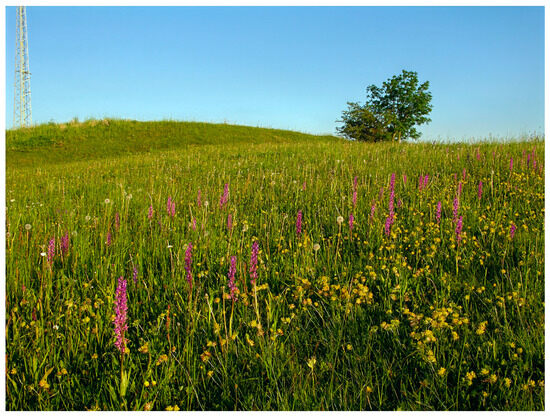
Population of Orchis mascula subsp. speciosa on sub-area 3 in the study year 2005. In addition to flowering O. mascula individuals, the kidney vetch, Anthyllis vulneraria, is dominant. The latter species was sown there. Photo credit: Wolfgang Holzner (†), to whom we dedicate this article.
During the last decade, counts are only available for half of the years, and during this time, at least in two monitoring years (i.e., 2018, 2024), the smallest flowering individual numbers were counted since 1995 (Figure 2). However, even these numbers still indicate the original embankment as the prominent centre of the studied O. mascula population. This year (2025), the final count is again close to 800 flowering individuals, which were already observed at the beginning of the continuous monitoring period (2005). An intermediate population peak (here 2015) with at least double the individual numbers seems to be a typical part of the fluctuating population dynamics of this species when studied over decades (see also [32,33]). Interestingly, the second old embankment (sub-area 4) was reached by the first spreading of O. mascula by a low number of plants (Figure 2); however, it could never achieve the same population status as sub-area 1.
When analyzing the population development statistically, linear and exponential curve fittings were positive when including the first estimate from 1995, albeit non-significant (F = 0.027, p = 0.871 and F = 0.910, p = 0.355). Excluding this first estimate, the development was still positive for the old embankment (linear: F = 0.040, p = 0.844), but not for the adjacent sub-areas 2 and 3. Both sub-areas showed a significant exponential decrease (F = 8.737, p = 0.010 and F = 5.341, p = 0.037), indicating that the main spreading period into these sub-areas was before 2005. However, analyzing all data collectively, respective regressions were non-significant, i.e., demonstrating no clear trend.
3.3. Orchis mascula Census Data from the Literature
Interestingly, our literature survey revealed no O. mascula subsp. speciosa-specific monitoring data. Thus, we provide here, to the best of our knowledge, the first population census for this taxon. However, we will hereinafter compile and discuss data from the species O. mascula, irrespective of the different subspecies.
Altogether, we found data (see also [28]) about O. mascula population development from six different countries (Table 2) representing 30 populational time series. The observation periods range between five and forty years, with at least four years of uninterrupted observations. Studies’ backgrounds differ strongly, representing orchid culture, population monitoring after translocation, or in the context of nature conservation measures (i.e., control of success), as well as long-term biological studies. Thereby, population sizes also differ from newly established single individuals to populations, like our study population, with more than 1000 individuals, at least in some study years (see also [33,34,35]). Consequently, the documented trends of all these O. mascula populations varied, showing most often fluctuating (40%), negative (27%), or constant (23%) patterns. Only three populations (10%) indicated a clearly positive population trend, with (continuously) increasing individual numbers (Table 2).
Table 2.
Compilation of Orchis mascula monitoring studies. Based on the given references, numbers of populations studied (POP), time periods studied (TOY, total number of observation years; LUP, longest uninterrupted observation period in years; TLO, total length of the observation period in years), the maximal (MAX) and minimal (MIN) recorded census sizes with FV, i.e., flowering (F) and/or vegetative (V) individuals, the study country (CO: AT, Austria; CH, Switzerland; DK, Denmark; GE, Germany; NL, the Netherlands; RO, Romania; and S, Sweden), links in the text (REL: N, nature management; E, ecology; C, climate; and M, morphology), the presentation of the data (PRE: g, graph; t, table; and x, text), and the population trend observed (TRE: + positive, − negative, c constant, f fluctuating) are provided.
In long time series, it can be difficult to make a classification if there is a positive trend over several years but strong fluctuations overall. This was also the case in our study (see Figure 2), where we ultimately decided on fluctuating.
4. Discussion
4.1. Orchids as Colonizers
One interesting aspect regarding the use of orchids for nature conservation monitoring is the repeatedly observed fact that orchids are not typically among the first species re-colonizing restored grasslands (but see [47]). As an example, the study by Prach and colleagues [48] investigated huge restored dry grasslands in the White Carpathian Mts. (Czech Republic), analyzing the success of colonization of target species. Thereby, some target species were sown (here, typically orchid species are not included, given the difficulty of handling their seeds fine as dust), while others established spontaneously. However, two orchid species identified as target species for this White Carpathian study region, i.e., Anacamptis pyramidalis and Orchis (Neotinea) ustulata, were not among the species that managed to establish spontaneously. Consequently, “full restoration probably takes decades or more” ([48], p. 181). Moreover, Gijbels and colleagues [49] found several orchids missing from suitable, restored calcareous grassland habitats in southern Belgium. Thereby, they could not identify the spatial isolation or size of these grasslands as being related to the absence, but pollinators.
Otherwise, at least some orchid species have been characterized by a more dynamic ecology, potentially acting as colonizers, but associated with a shorter individual life span. This seems to be the case with Orchis militaris, which has been reported as a short-lived colonizing species [50,51], for instance, emerging individual-rich populations shortly after revival of grassland management or colonizing new areas well over 100 km outside its previously known range in England [52]. Another example might be Ophrys sphegodes, which, more generally, already Hutchings [53] characterized as a ‘weedy species’. In our study system, O. mascula subsp. speciosa indicated a moderate situation in which only adjacent sub-areas are populated, which have developed into suitable grassland habitats due to land use changes. Thereby, the high number of orchid seeds [11] may lead to a short-term boost in the number of flowering individuals (i.e., 2012–15; Figure 2), mainly reflecting the general potential of orchids to produce and spread such high seed numbers [18,54,55] and, therefore, typically showing strong population fluctuations. Parentage analyses [56] revealed that offspring dispersal distances in the case of O. mascula were relatively small within a radius of less than 2 m, which might indicate that seed dispersal may be limited. However, they conclude that clustering of recruits around adults was not primarily caused by limited seed dispersal but may suggest a decline in abundance of mycorrhiza at a greater distance from the mother plants. As a nectar-deceptive orchid species, O. mascula strongly depends on pollination success, which is, on average, not high (e.g., [19,57]) and mainly occurs randomly. Also, according to Helsen and colleagues [58], the deceptive habit likely affects the reproduction rate because of pollen limitation. This uneven reproduction may also be due to differences in how many adult plants flower each year. Consequently, strong fluctuations of its reproductive success are also reflected in strong population fluctuations.
4.2. Orchids in Abandoned Arable Fields
Orchids have very rarely been reported as weeds in arable land. The only record we found is the occurrence of Epipactis helleborine in wheat and soya bean fields in South Moravia, observed by Rydlo [59]. However, given their wind-dispersed dusty seeds [18,54,55], abrupt appearance within the vegetational succession of abandoned arable land seems basically feasible. Jacquemyn & Hutchings [60], for instance, stated that Spiranthes spiralis ‘can colonize abandoned arable land’ ([60], p.1254). Sprunger [47] documented two ecological compensation measures for highway construction in Switzerland, where on former corn fields meadows were established. In these meadows, two orchid species, namely Anacamptis pyramidalis and Ophrys apifera, were detected flowering only six years after the last corn farming. For the same two orchid species, Steinfeld [61] also stated that in the Saarland region in Germany, these two taxa ‘appear’ in fallow fields after only a few years. Even typical forest orchids were reported from fallow land, like Cephalanthera damasonium or Epipactis helleborine [62]; of course, they appeared in late successional stages after a canopy of woody species had been formed.
Here, we can add Orchis mascula subsp. speciosa to the list of European orchid taxa, which obviously could also spread into former arable land, although the conversion of arable land to grassland had already started much earlier than the spreading of O. mascula. However, given the sowing of different grassland plant species, like Dactylis glomerata or Anthyllis vulneraria (Figure 3), in the 1990s and the higher nutrient supply, this historical arable land is still characterized by a mesotrophic vegetation today.
4.3. Orchids in Monitoring
In principle, it is essential that the type and scope of monitoring and success control studies are precisely tailored to the objectives or specific issues [51,63,64]. In practice, a balance must be struck between scientific standards and feasibility or financial and temporal viability. In addition to this balance, motivation differs, as can be seen in the O. mascula monitoring data compiled in the present study (Table 2).
However, orchids are not without problems as target species for monitoring and evaluating the success of nature conservation measures. In addition to the factors related to land use (changes), as already mentioned in the Introduction, there are natural population fluctuations, for example depending on climatic and microclimatic factors, site conditions, pollinator status, or availability of fungi. Since many of these factors influence each other, causal relationships are rarely clear-cut (e.g., [24,65]). To make matters more difficult, it is usually difficult to record the entire population because, in many species, only part of the population flowers [9], or part of the population can even survive underground for several years (i.e., so-called ‘vegetative dormancy’ [10]).
An irregular sequence of flowering, dormant, and sterile stages during the life of individuals is characteristic of many orchid species. In a review of alternative hypotheses aiming to explain this phenomenon of irregular flowering regimes, Kindelmann [9] concluded that irregular flowering patterns in orchids are caused by a complex of biotic and abiotic factors, such as weather; grazing by animals, by insects, and underground grazing of storage organs; leaf diseases; cost of reproduction in species; and habitat management and deterioration. Therefore, only in ‘favourable’ years, when large proportions of the total population flower, counts provide a comparatively rapid (and ‘precise’) overview of the size of the orchid population in an area. Otherwise, in unfavourable years, the population size is underestimated, like in our study years, 2018 and 2024 (Figure 2). The same applies, of course, to species in which only small proportions of the population generally flower.
When orchids are used for monitoring and success control in nature conservation, knowledge of the phenomena outlined above is crucial for interpreting the results. However, a major advantage of orchids is their popularity and the opportunity they provide to inspire land managers and those responsible for their care.
In a review about the challenges to orchid conservation in the twenty-first century, Fay [66] concluded that it is necessary to understand their biology, which requires further research into different areas, including pollination, mycorrhizal associations, population genetics, and demographics, to conserve orchids effectively. Moreover, there is a need for long-term monitoring data to support decision-making in nature conservation and restoration, as well as the evaluation of conservation and restoration measures. The importance of long-term monitoring of orchid species for nature management is impressively demonstrated in the study of Damgaard and colleagues [45].
5. Conclusions
Given short spatial distance, comparatively fast colonization of abandoned arable land seems possible for several European terrestrial orchid species. In addition to ecological prerequisites like rather low competition by other plant species on the newly occupied plots, mycorrhizal fungi need to be available on site (cf. [54,55]). Unfortunately, up to date, no such data is available from the respective orchid monitoring studies, as compiled here (Table 2). However, based on the quick establishment of some orchid species as described above, we hypothesize that at least in these cases, the mycorrhiza fungi are not the limiting factor. However, to fully understand factors positively affecting the establishment of orchids in new sites after land use changes, further studies are needed. In addition to a comprehensive documentation of land use and respective nature conservation measures [45], such studies should also include reproductive success of orchids in the new and neighbouring populated sites, as well as more detailed vegetation and soil analyses. Moreover, standardization, consistency, and especially the duration of monitoring are important (cf. [28,45,63]). Long-term observation data is the basic requirement for uncovering population trends, and this is particularly relevant for orchids, where irregular growth and flowering patterns occur regularly [9,10]. As Kindelmann [9] stated, only ‘favourable’ years could indicate reasonable orchid population sizes, and therefore, only long-term monitoring data could cover a sufficient large number of such favourable years. Finally, a better understanding of the population dynamics of orchids is also important from a practical nature conservation perspective with regard to conservation strategies and management.
Author Contributions
Conceptualization, M.K. (Monika Kriechbaum); methodology, M.K. (Matthias Kropf) and M.K. (Monika Kriechbaum); investigation, M.K. (Matthias Kropf) and M.K. (Monika Kriechbaum); data curation, M.K. (Matthias Kropf) and M.K. (Monika Kriechbaum); writing—original draft preparation, M.K. (Matthias Kropf); writing—review and editing, M.K. (Monika Kriechbaum). All authors have read and agreed to the published version of the manuscript.
Funding
This research received no external funding.
Institutional Review Board Statement
Not applicable.
Data Availability Statement
Data is contained within the article.
Acknowledgments
We would like to thank Karin Böhmer (Voitsau) for providing us information about the recent management of our monitoring areas. We also thank Josef Pennerstorfer (BOKU University, Vienna) for his help with the aerial photos and for preparing Figure 1. Moreover, we thank three reviewers for the valuable comments on our previous manuscript.
Conflicts of Interest
The authors declare no conflicts of interest.
References
- Kretzschmar, H.; Blatt, H. Statistische Auswertung der Orchideenkartierung. In Die Orchideen Deutschlands; Arbeitskreise Heimische Orchideen: Uhlstädt-Kirchhasel, Germany, 2005; pp. 686–692. [Google Scholar]
- Schratt-Ehrendorfer, L.; Niklfeld, H.; Schröck, C.; Stöhr, O.; Gilli, C.; Sonnleitner, M.; Adler, W.; Barta, T.; Beiser, A.; Berg, C.; et al. Rote Liste der Farn- und Blütenpflanzen Österreichs; Stapfia 114; Land Oberösterreich: Linz, Austria, 2022; 357p. [Google Scholar]
- Schrautzer, J.; Fichtner, A.; Huckauf, A.; Rasran, L.; Jensen, K. Long-term population dynamics of Dactylorhiza incarnata (L.) Soó after abandonment and re-introduction of mowing. Flora 2011, 206, 622–630. [Google Scholar] [CrossRef] [Scilit]
- Shefferson, R.P.; Jaquemyn, H.; Kull, T.; Hutchings, M.J. The demography of terrestrial orchids: Life history, population dynamics and conservation. Bot. J. Linn. Soc. 2020, 192, 315–332. [Google Scholar] [CrossRef] [Scilit]
- Weis, J. Naturschutzfachliche Erfolgskontrolle des Vertragsnaturschutzes am Beispiel der nördlichen Eifel. Ph.D. Thesis, Bonn University, Berichte aus der Agrarwissenschaft, Shaker Verlag, Aachen, Germany, 2001. [Google Scholar]
- Maas, S. Entwicklung von Orchideenbeständen in Kalkmagerrasen des Naturschutzgebietes “Wolferskopf” (1992–2003). In Erfolgskontrolle in Naturschutzvorhaben des Bundes; Teil 1: Ökologische Bewertung; Niclas, G., Scherfose, V., Eds.; Naturschutz und Biologische Vielfalt H. 22; Bundesamt für Naturschutz (BfN): Bonn, Germany, 2005; pp. 7–22. [Google Scholar]
- Charitonidou, M.; Mouratidis, S.; Stara, K.; Kougioumoutzis, K.; Bateman, R.M.; Walker, K.J.; Halley, J.M. Analyzing patterns of change in the orchid flora of Britain and Ireland with correlated environmental variability. Front. Ecol. Evol. 2025, 13, 1646994. [Google Scholar] [CrossRef] [Scilit]
- Kriechbaum, M.; Holzner, W. Orchis mascula im südlichen Waldviertel–Populationsentwicklung auf im Rahmen des Agrarumweltprogrammes geförderten Flächen. Sauteria 2008, 16, 219–221. [Google Scholar]
- Kindlmann, P. Irregular flowering regimes in orchids. Lankesteriana 2003, 7, 77–80. [Google Scholar]
- Shefferson, R.P. The evolutionary ecology of vegetative dormancy in mature herbaceous perennial plants. J. Ecol. 2009, 97, 1000–1009. [Google Scholar] [CrossRef] [Scilit]
- Jacquemyn, H.; Brys, R.; Honnay, O.; Hutchings, M.J. Biological Flora of the British Isles: Orchis mascula (L.) L. J. Ecol. 2009, 97, 360–377. [Google Scholar] [CrossRef] [Scilit]
- Griebl, N. Die Orchideen Österreichs mit Orchideenwanderungen; Freya: Linz, Austria, 2013; 480p. [Google Scholar]
- van Bruggen, H.W.E. De orchideeën van Europa (26): Orchis mascula L.–Mannetjes orchis. Orchideeën 1984, 46, 207–209. [Google Scholar]
- Kretzschmar, H.; Eccarius, W.; Dietrich, H. Die Orchideengattungen Anacamptis, Orchis, Neotinea; Echino Media Verlag: Bad Hersfeld, Germany, 2007; 544p. [Google Scholar]
- Kurbel, R.; Hirse, T. Die nördlichsten Fundorte von Orchis mascula subsp. speciosa liegen in Estland. Ber. Arbeitskrs. Heim. Orchid. 2017, 34, 133–143. [Google Scholar]
- Möller, O. Vom Samenkorn bis zur ersten echten Knolle: Das Protocormstadium von Orchis mascula. Die Orchid. 1987, 38, 297–303. [Google Scholar]
- Inghe, O.; Tamm, C.O. Survival and flowering of perennial herbs. V. Patterns of flowering. Oikos 1988, 51, 203–219. [Google Scholar] [CrossRef] [Scilit]
- Ziegenspeck, H. Orchidaceae. In Lebensgeschichte der Blütenpflanzen Mitteleuropas In Band I, Abt. 4; von Kirchner, O., Loew, E., Schröter, C., Eds.; Verlagsbuchhandlung Eugen Ulmer: Stuttgart, Germany, 1936; 844p. [Google Scholar]
- Nilsson, L.A. Anthecology of Orchis mascula (Orchidaceae). Nord. J. Bot. 1983, 3, 157–179. [Google Scholar] [CrossRef] [Scilit]
- Johnson, S.D.; Nilsson, L.A. Pollen carryover, geitonogamy, and the evolution of deceptive pollination systems in orchids. Ecology 1999, 80, 2607–2619. [Google Scholar] [CrossRef]
- Jacquemyn, H.; Brys, R.; Hermy, M.; Willems, J.H. Does nectar reward affect rarity and extinction probabilities of orchid species? An assessment using historical records from Belgium and the Netherlands. Biol. Conserv. 2005, 121, 257–263. [Google Scholar] [CrossRef] [Scilit]
- Kull, T.; Hutchings, M.J. A comparative analysis of decline in the distribution ranges of orchid species in Estonia and the United Kingdom. Biol. Conserv. 2006, 129, 31–39. [Google Scholar] [CrossRef] [Scilit]
- Arcanum Maps. Available online: https://maps.arcanum.com/en/ (accessed on 28 October 2025).
- Kropf, M.; Kriechbaum, M. Monitoring of Dactylorhiza sambucina (L.) Soó (Orchidaceae)–Variation in flowering, flower colour morph frequencies, and erratic population census trends. Diversity 2023, 15, 179. [Google Scholar] [CrossRef] [Scilit]
- Ecker, K.; Grünweis, F.M.; Müllner, A.; Sonnlechner, C.; Wilfing, H.; Winiwarter, V.; Wrbka-Fuchsig, E.; Wrbka, T. Projektgruppe Umweltgeschichte. Historische Entwicklung von Wechselwirkungen zwischen Gesellschaft und Natur. In Schriftenreihe Forschungsschwerpunkt Kulturlandschaft; Bundesministerium für Wissenschaft und Verkehr: Vienna, Austria, 2000; Band 7, CD-Rom. [Google Scholar]
- Böhmer, K. Vegetation und Nutzungsgeschichte der Gemeinde Kottes-Purk. Ein Beitrag zur Bäuerlichen Kulturgeschichte des Südlichen Waldviertels. Diploma Thesis, BOKU University, Vienna, Austria, 1990. [Google Scholar]
- Niederösterreich Atlas. Available online: https://atlas.noe.gv.at/ (accessed on 28 October 2025).
- Vanhecke, L. Serial observations on the size of orchid populations in Europe: A characterization of the literature. Scr. Bot. Belg. 1992, 3, 20. [Google Scholar]
- Steinius, J.W.E.v. Topographischer Land-Schematismus oder Verzeichniß aller im Erzherzogthume Oesterreich unter der Enns Befindlichen Ortschaften Zweiter Band, M-Z; Verlag Anton Strauß: Vienna, Austria, 1822. [Google Scholar]
- Lechner, K. Geschichte der Besiedlung und der ursprünglichen Grundbesitzverteilung des Waldviertels. Jb. Landeskde. Niederösterreich 1924, 19, 10–210. [Google Scholar]
- Hengstberger, H. Unsere Flurnamen und ihre Deutung. Das Wald. 1952, 1, 15–20. [Google Scholar]
- Ulrich, T. Ergänzungen zu Orchis mascula (L.) L. Eine Zusammenfassung aktueller Literaturstellen. Orchis 2018, 1, 15–22. [Google Scholar]
- Ziegenfuß, G.; Stratmann, B. Geht es noch männlicher? Orchis mascula im NSG Paterholz. Die Orchid. 2021, 72, 104–107. [Google Scholar]
- Wegener, U.; Eberspach, W. Die Populationsdynamik einiger Orchideenarten von Waldökotonen nach Pflegeeingriffen. Artenschutzreport 2001, 11, 20–25. [Google Scholar]
- Boie, K. Biotoppflege und Orchideenzählungen in Göttingen. In 25 Jahre AHO-Niedersachsen–25 Jahre Orchideenschutz; Arbeitskreis Heimische Orchideen Niedersachsen e.V.: Hannover, Germany, 2006; pp. 78–83. [Google Scholar]
- Diemont, W.H. Zehn Jahre Freilandkultur einiger heimischer Orchideen im “Gerendal”, Niederl. Limburg. Vegetatio 1969, 18, 330–347. [Google Scholar] [CrossRef] [Scilit]
- Tamm, C.O. Survival and flowering of some perennial herbs. II. The behaviour of some orchids on permanent plots. Oikos 1972, 23, 23–28. [Google Scholar] [CrossRef] [Scilit]
- Tamm, C.O. Behaviour of Some Orchid Populations in a Changing Environment. Observations on Permanent Plots, 1943–1990. In Population Ecology of Terrestrial Orchids; Wells, T.C.E., Willems, J.H., Eds.; SPB Academic Publishing: The Hague, The Netherlands, 1991. [Google Scholar]
- Willems, J.H. Populatiebiologisch onderzoek aan Orchis mascula (L.) L. op enkele groeiplaatsen in Zuid-Limburg. Gorteria 1978, 9, 71–80. [Google Scholar]
- Wegener, U. Schutz von Waldorchideen durch Biotoppflege. Veröffentl. Mus. Stadt Gera 1988, 15, 36–39. [Google Scholar]
- Kastl, C.; Hachmöller, B. 25jährige Dokumentation der Blühaktivität ausgewählter Bergwiesenpflanzen im Naturschutzgebiet “Ölsen” im Osterzgebirge. Artenschutzreport 1999, 9, 21–27. [Google Scholar]
- Mohrmann, W. Entwicklung der Grundstücke im Hesstal bei Pegestorf. In 25 Jahre AHO-Niedersachsen–25 Jahre Orchideenschutz; Arbeitskreis Heimische Orchideen Niedersachsen e.V.: Hannover, Germany, 2006; pp. 91–98. [Google Scholar]
- Neumann, H. Langzeitbeobachtungen einer Umpflanzaktion von Orchis mascula. Ber. Arbeitskrs. Heim. Orchid. Beih. 2006, 6, 323–333. [Google Scholar]
- Milanovici, S.; Orchidaceae, L. family in the “Iron Gates” Park (Romania). Transylv. Rev. Syst. Ecol. Res. 2014, 16, 65–86. [Google Scholar] [CrossRef] [Scilit]
- Damgaard, C.; Moeslund, J.E.; Wind, P. Changes in the Abundance of Danish Orchids over the Past 30 Years. Diversity 2020, 12, 244. [Google Scholar] [CrossRef] [Scilit]
- Heinrich, W. Heimische Orchideen in urbanen Biotopen der Stadt Jena, in weiteren Orten Thüringens und anderer Bundesländer sowie im Ausland. Ber. Arbeitskrs. Heim. Orchid. Beih. 2023, 9, 3–556. [Google Scholar]
- Sprunger, S. Neue Blumenwiesen in dem schweizerischen Jura–vom Maisfeld zur Orchideenwiese. J. Eur. Orch. 2010, 42, 525–533. [Google Scholar]
- Prach, K.; Fajmon, K.; Jongepierová, I.; Rehounková, K. Landscape context in colonization of restored dry grasslands by target species. Appl. Veg. Sci. 2015, 18, 181–189. [Google Scholar] [CrossRef] [Scilit]
- Gijbels, P.; Adriaens, D.; Honnay, O. An orchid colonization credit in restored calcareous grasslands. Ecoscience 2012, 19, 21–28. [Google Scholar] [CrossRef] [Scilit]
- Holzner, W.; Kriechbaum, M. Überlebensstrategien von Grünlandorchideen–ein Entwurf. In Natural Heritage: Heimische Orchideen in Österreich und Deutschland, Fachtagung in Österreich Über Heimische Orchideen (23–24 November 2007): Ausgewählte Vorträge, Österreichisches Orchideenschutz-Netzwerk (ÖON); Das Österreichisches Orchideenschutz-Netzwerk (ÖON): Höflein an der Donau, Austria, 2008; pp. 46–54. [Google Scholar]
- Laubhann, D.; Kropf, M.; Bernhardt, K.-G. Target species as a conservation tool–a critical review. Nat. Landsch. 2010, 85, 61–66. [Google Scholar]
- Willems, J.H. Establishment and development of a population of Orchis simia Lamk. in the Netherlands, 1972 to 1981. New Phytol. 1982, 91, 757–765. [Google Scholar] [CrossRef] [Scilit]
- Hutchings, M.J. Population biology and conservation of Ophrys sphegodes. In Modern Methods in Orchid Conservation–The Role of Physiology, Ecology and Management; Pritchard, H.W., Ed.; Cambridge University Press: Cambridge, UK, 1989; pp. 101–115. [Google Scholar]
- Rasmussen, H.N. Terrestrial Orchids from Seed to Mycotrophic Plant; Cambridge University Press: Cambridge, UK, 1995; 460p. [Google Scholar]
- Arditti, J.; Ghani, A.K.A. Tansley Review No. 110 Numerical and physical properties of orchid seeds and their biological implications. New Phytol. 2000, 145, 367–421. [Google Scholar] [CrossRef] [Scilit]
- Jacquemyn, H.; Wiegand, T.; Vandepitte, K.; Brys, R.; Roldán-Ruiz, I.; Honnay, O. Multigenerational analysis of spatial structure in the terrestrial, food-deceptive orchid Orchis mascula. J. Ecol. 2009, 97, 360–377. [Google Scholar] [CrossRef] [Scilit]
- Meekers, T.; Honnay, O. Effects of habitat fragmentation on the reproductive success of the nectar-producing orchid Gymnadenia conopsea and the nectarless Orchis mascula. Plant Ecol. 2011, 212, 1791–1801. [Google Scholar] [CrossRef] [Scilit]
- Helsen, K.; Meekers, T.; Vranckx, G.; Roldán-Ruiz, I.; Vandepitte, K.; Honnay, O. A direct assessment of realized seed and pollen flow within and between two isolated populations of the food-deceptive orchid Orchis mascula. Plant Biol. 2016, 18, 139–146. [Google Scholar] [CrossRef] [Scilit]
- Rydlo, J. Epipactis helleborine jako polni plevel. Epipactis helleborine as a weed of arable land (South Moravia). Muz. Současnost Roztoky Ser. Nat. 2008, 23, 211–218. [Google Scholar]
- Jacquemyn, H.; Hutchings, M.J. Biological Flora of the British Isles: Spiranthes spiralis (L.) Chevall. J. Ecol. 2010, 98, 1253–1267. [Google Scholar] [CrossRef] [Scilit]
- Steinfeld, P. Die A8–eine Heimstätte für seltene Orchideen? POLLICHIA-Kurier 2008, 24, 5–6. [Google Scholar]
- Schmidt, W. Dynamik und Konstanz zweier Orchideen-Arten in der Ackerbrachen-Sukzession und im Kalk-Buchenwald–Cephalanthera damasonium (Mill.) Druce und Epipactis helleborine (L.) Crantz. Tuexenia 2020, 40, 269–289. [Google Scholar]
- Zehlius-Eckert, W. Arten als Indikatoren in der Naturschutz- und Landschaftsplanung. Laufener Semin. 1998, 8, 9–32. [Google Scholar]
- Xu, Y.; Dong, S.; Gao, X.; Wu, S.; Yang, M.; Li, S.; Shen, H.; Xiao, J.; Zhi, Y.; Zhao, X.; et al. Target species rather than plant community tell the success of ecological restoration for degraded alpine meadows. Ecol. Indic. 2022, 135, 108487. [Google Scholar] [CrossRef] [Scilit]
- Hartmann, L.J.; Metz, J. Long-term data indicates positive effects of habitat size and ambiguous climate effects on population growth of the endangered wetland orchid Dactylorhiza majalis. Glob. Ecol. Conserv. 2023, 44, e02483. [Google Scholar] [CrossRef] [Scilit]
- Fay, M.F. Orchid conservation: How can we meet the challenges in the twenty-first century? Bot. Stud. 2018, 59, 16. [Google Scholar] [CrossRef] [Scilit] [PubMed]

Disclaimer/Publisher’s Note: The statements, opinions and data contained in all publications are solely those of the individual author(s) and contributor(s) and not of MDPI and/or the editor(s). MDPI and/or the editor(s) disclaim responsibility for any injury to people or property resulting from any ideas, methods, instructions or products referred to in the content. |
© 2025 by the authors. Licensee MDPI, Basel, Switzerland. This article is an open access article distributed under the terms and conditions of the Creative Commons Attribution (CC BY) license (https://creativecommons.org/licenses/by/4.0/).