Article

Plant Diversity Patterns and Their Determinants Across a North-Edge Tropical Area in Southwest China


1
College of Life Sciences, Fujian Agriculture and Forestry University, Fuzhou 350002, China
2
Plant Phylogenetics and Conservation Group, Center for Integrative Conservation & Yunnan Key Laboratory for Conservation of Tropical Rainforests and Asian Elephants, Xishuangbanna Tropical Botanical Garden, Chinese Academy of Sciences, Kunming 650223, China
3
Institute of International Rivers and Eco-Security, Yunnan University, Kunming 650500, China
4
Southwest United Graduate Schools, Kunming 650092, China
5
Institute of Biomedical Research, Yunnan University, Kunming 650500, China
6
Engineering Research Center for Valorization of Unique Bio-Resources in Yunnan, Ministry of Education, School of Life Sciences, Yunnan Normal University, Kunming 650500, China
*
Authors to whom correspondence should be addressed.
Diversity 2025, 17(12), 833; https://doi.org/10.3390/d17120833 (registering DOI)
Submission received: 21 October 2025 / Revised: 1 December 2025 / Accepted: 1 December 2025 / Published: 3 December 2025
(This article belongs to the Section Plant Diversity)

Abstract

Understanding the diversity patterns within a region is helpful for the implementation of conservation management. Xishuangbanna, located in southwestern China, is notable for its diverse plant species and belongs to a tropical–subtropical transition area. This study investigated the biodiversity patterns for four types of primary forests in Xishuangbanna, namely tropical rainforests, tropical monsoon forests, tropical low-montane evergreen broadleaf forests, and tropical seasonal moist forests. The difference in the forests alongside a set of environments was assessed using non-metric dimensional scaling and partial least-squares discriminant analysis. And, we calculated and compared four diversity metrics for each forest, including species richness, phylogenetic diversity, standardized phylogenetic diversity, and standardized mean phylogenetic distance, and calculated their correlation with 22 environments using multiple stepwise regressions. The results showed that tropical rainforests had the highest biodiversity on account of species richness (with an average of about 40 species) and phylogenetic diversity (with an average of about 3000). Although the values of standardized mean phylogenetic distance were lower than zero for all forests, the tropical seasonal moist forests ranked first. Not only species composition and environments’ differences, especially the temperature seasonality, minimum temperature of the coldest month, latitude, and precipitation of the driest quarter, primarily influenced the forest groupings. The variance in species richness (R2 = 0.57) and phylogenetic diversity (R2 = 0.54) was best explained by a model integrating forest type, soil, climate, and geographic factors. In contrast, the variance in standardized phylogenetic diversity (R2 = 0.48) and standardized mean phylogenetic distance (R2 = 0.39) was primarily influenced by soil and climate factors. We suggest that tropical rainforests and tropical seasonal moist forests should be conservation priorities in conservation management. This study provides insights into community assembly mechanisms and the enhancement of biodiversity conservation management in transitional areas.

1. Introduction

Biodiversity is vital and provides various ecosystem services and resources to human society, with plants playing an irreplaceable role [1,2]. Intensifying human impacts and unprecedented environmental changes are increasingly threatening biodiversity. The rate of biodiversity loss is currently higher than that at any time in human history [3,4]. To avoid further biodiversity loss, recognizing and protecting priority areas are regarded as useful measures in biodiversity conservation with limited resources [5,6]. Understanding biodiversity patterns is helpful for policymakers and managers to carry out biodiversity conservation [7]. Traditional biodiversity assessment strategies primarily consider species-level diversity; however, recently, phylogenetic-based diversity measures have been suggested to assess biodiversity in the context of evolutionary history [8,9,10]. Phylogenetic structures can also provide valuable insights into the ecological processes shaping community assembly [11,12,13,14]. Understanding different dimensional biodiversity patterns and their environmental influences plays an important role in biodiversity studies [15,16].
Forest types are often used as units for studying the diversity patterns and selecting priority areas in conservation management because of their value in ecological processes, ecosystem services, and resilience, especially in regions where species data are scarce [17,18]. The difference in the phylogenetic-based diversity across communities is suggested to be investigated to comprehensively understand the biodiversity patterns and provide a basis for the management of forest ecosystems, including conservation, restoration, and sustainable use [19,20]. The communities showing obvious differences in phylogenetic-based diversity are often recognized as important conservation priority units in conservation planning and management. For example, Li et al. [21] explored biodiversity variations across six vegetation communities in southeastern Tibet, China, and found that evergreen broadleaf forests have the highest species richness and diverse phylogenetic lineages, making them a key priority for maximizing biodiversity conservation. A study on Mount Kenya observed differences in biodiversity across vegetation zones, suggesting that conservation should prioritize communities with high phylogenetic diversity and species richness [22]. One study found that there were great differences in tree phylogenetic diversity among the vegetation types in South America and highlighted the importance of conservation of different vegetation types [23]. Therefore, analyzing the variation in the biodiversity of forest types is crucial to further implementing protection measures.
A transition zone usually preserves species with various adaptations and hosts complex biological interactions [24,25]. Therefore, transition areas are of increasing interest to ecologists and conservationists, and they can be regarded as hotspots for conservation priorities as they may enhance conservation sustainability [26,27]. Globally, vegetation flora and forest types have undergone significant changes along the latitude gradient, while typical tropical forests usually occur around the equator, and then extend between the Tropic of Cancer and the Tropic of Capricorn [28]. The tropical forests in Xishuangbanna occur around the Tropic of Cancer; thus, the location is recognized at the northern edge of the tropical zone [29]. Xishuangbanna lies within one of the most important biodiversity hotspots: its forest represents one of the tropical–subtropical forest transitions in East Asia, and it hosts various forest types and numerous important plant species [30]. Although Xishuangbanna is located on the northern edge of tropical Southeast Asia, cold air from the north is blocked by the Hengduan Mountains. Fog often supplements moisture from precipitation and maintains areal warming, thus supporting tropical climatic conditions [31]. Forest diversification is associated with local climatic diversity, which supports the rich biodiversity at this latitude [29]. The mechanisms underlying the biodiversity patterns of different communities in these transition areas are suggested to be comprehensively understood for conservation management.
In this study, we analyzed the differences in species- and phylogenetic-based diversity across different forest types in Xishuangbanna. We addressed the following questions: (1) What is the difference in the species-based and phylogenetic-based diversity among distinct forests in Xishuangbanna? (2) Which forest should be a conservation priority in Xishuangbanna? Understanding biodiversity patterns informs the development of effective management and conservation strategies for forest communities.

2. Materials and Methods

2.1. Study Objects

We targeted the tropical forest vegetation of Xishuangbanna, a hotspot for biodiversity conservation in the tropical area of southwestern China. Tropical rainforests (TRs), tropical monsoon forests (TMFs) on river banks, tropical low-montane evergreen broadleaf forests (TLEBFs) on mountain slopes, and tropical seasonal moist forests (TSMFs) over limestone are the four main primary forest types in Xishuangbanna [31,32].
According to a flora investigation in the Xishuangbanna region [31,32,33], we conducted our study by tracking the species composition of forest sample plots [31]. However, it is necessary to clarify that the species composition lists recorded in our study were merely composed of woody plants, as we believe that focusing on woody plants is achievable and sufficient to explain the diversity and community structure of forests. Gymnosperms were excluded from our study. We collected species composition data from 47 square sample plots in total [31], as follows: 29 plots for TRs, 7 plots for TSMFs, 6 plots for TMFs, and 5 plots for TLEBFs (the longitude, latitude, elevation, and plot size are shown in Table S1, species composition information is shown in Table S2, and a distribution map is visualized in Figure 1). To compare the disparity among the four forest types in a straightforward manner and avoid the quantitative influence of plots, we utilized bootstrap sampling in our further analysis.

2.2. Environment Data Source and Pre-Treatment

We extracted contemporary climate data from WorldClim version 1.4 (http://www.worldclim.org/, accessed on 22 July 2024) with a spatial resolution of 30 arc-seconds. To further test the effects of climatic stability, we extracted the mean temperature and precipitation during the last glacial maximum (LGM) from a paleoclimatic dataset (http://www.paleoclim.org/, accessed on 24 July 2024). We then calculated the climatic anomalies as the difference between the present and LGM (MATano = MATpresent − MATLGM; APano = APpresent − APLGM) [34]. The elevation, slope, and aspect of the slope were extracted from digital elevation model data obtained from the Geospatial Data Cloud (http://www.gscloud.cn, accessed on 22 July 2024) at a 90 m resolution. The soil organic matter variables were extracted from a dataset of soil properties for land surface modeling over China (http://data.tpdc.ac.cn, accessed on 1 September 2024) with a 30-arc-second resolution. We used the human footprint index as a measure of human impact, which was obtained from the Global Human Footprint Dataset version 2 (1995–2004; https://earthdata.nasa.gov, accessed on 13 September 2024) with a 30-arc-second resolution. All environmental data from each forest plot were extracted using Spatial Analyst Tool in ArcGIS 10.7.
To minimize the influence of multicollinearity and overfitting of models, we performed a correlation coefficient analysis for all 62 environmental variables (Supplementary Materials, Tables S3–S6). When Pearson’s |r| was >0.70, one of the two variables was excluded [35,36]. Table 1 lists 22 environmental variables that were retained for further analysis, including contemporary climate, paleoclimate, human impact, soil, and geographical variables.

2.3. Data Analysis

2.3.1. Difference in Biodiversity Across Forest Types

For diversity of forest types, we calculated four diversity metrics including species- and phylogenetic-based metrics, such as species richness (SR), phylogenetic diversity (PD), standardized phylogenetic diversity (PDses), and standardized mean phylogenetic distance (ses.MPD). Species richness was calculated as the total number of species in each unit, which is the simplest and most commonly used measure of species-based diversity.
For the phylogenetic-based metric analysis, we reconstructed the phylogenetic tree for angiosperm plants in Xishuangbanna (a total of 3963 species) using the V.phylomaker R package 4.4.0 and selecting the Scenario 3 tree (see the tree file in Supplement Materials, “File S1-tree.tre”) [37]; the tree can over all the species involved in this study. The calculation of biodiversity metrics below was performed with the “picante” package in R 4.1.1 [38]. PD was calculated as the sum of the phylogenetic branch lengths connecting all species in each unit [10]. As PD was highly correlated with SR (R2 > 0.90 and p < 0.05 in this study), we calculated the standardized PD (PDses) by comparing the observed PD with the expected PD under null models to avoid the impact of SR [39]. The ses.MPD was calculated as the standardized effect size of the mean phylogenetic distance, which estimates the average phylogenetic relatedness between all pairs of species in each area [40]. Therefore, ses.MPD can provide information about the phylogenetic structure of assemblages, with ses.MPD < 0 indicating that the structure tends to be phylogenetically clustered and ses.MPD > 0 indicating that the structure tends to be phylogenetically overdispersed [40]. Based on the above calculations, we obtained data on the diversity index of the 47 sample plots for the four forest types (Table S1).
To investigate the differences in biodiversity across the four forest types and avoid the quantitative influence of plots, we calculated the probability density distribution and conducted an analysis of variance. Because of the disparity among forest plot numbers across the four forest types, we decided to use bootstrap sampling to carry out data processing when we compared the biodiversity among the four primary forests. The bootstrap sampling process was as follows: We used bootstrap sampling to randomly select three sample plots from each forest type, and then calculated mean values of biodiversity indices for the three randomly selected samples according to Table S5. The process was then repeated 1000 times; thus, we obtained probability density distribution for the 1000 means (of each random three samples) of forest biodiversity metrics. Finally, the probability density was mapped using the R package “ggplot2” [41], and then we compared the diversity across four forest types.
To verify the credibility of bootstrap sampling results, we utilized the following data processing method to calculate the diversity for the four forest types: The calculation for the diversity metric utilized the species composition information simply for each forest type regardless of whether the species actually existed in every plot sample (the validation data are provided in Table S7).

2.3.2. Discriminant Analysis of Environmental Determinants

To further determine which factors may lead to disparities in the distribution patterns of the four forest types, partial least-squares discriminant analysis (PLS-DA) was performed to cluster, classify, and compare the environmental characteristics where the forest plots were located [42]. Variable importance in the projection (VIP) was used to rank the contribution of potential variables that were likely to result in the separation of forest types. This analysis was performed using the R packages “mixOmics” and “RVAideMemoire” [43].

2.3.3. Difference in the Plant Species Composition Across Four Forest Types

To further explore the difference in the plant species composition across the forest types, we used non-metric multidimensional scaling ordination (NMDS) to visualize the clusters of sample plot grouping. We created the NMDS ordination using the Bray–Curtis dissimilarity with the function “metaMDS” in the R package “vegan” [44]. Then, we determined the plant species importance contributions for the dissimilarity among groups using the function “simper” in “vegan”. To test for significant differences between clusters, we conducted permutational multivariate analysis of variance (PERMANOVA) using the function “adonis2” in the R package “vegan” with the calculated Bray–Curtis dissimilarity [44]. The quality of the NMDS ordination was evaluated based on the stress coefficient (stress ≤ 0.2 indicates an acceptable fit, whereas stress > 0.2 indicates a relatively poor fit) [45].
To assess the relationship between environment variables and the results of the NMDS ordination, we projected the variables in Table 1 onto our NMDS ordination with the function “envfit” in the R package “vegan”, but only significant environmental vectors (p < 0.05) were plotted onto the NMDS ordination.

2.3.4. Influence of Environmental Variables on Diversity for Forests

We used the multiple stepwise regression analysis to explore the relationships between environmental variables and biodiversity metrics (i.e., SR, PD, PDses, NRI) across four forest types. Then, we calculated the relative importance of contemporary climate, paleoclimate, human impact, soil, forest types, and geographical variables using hierarchical and variation partitioning for canonical analysis. The statistical analyses and visualization were performed with the packages “MUMIN” [46], “rdacca.hp” [47], and “ggplot2” [41] in R.

3. Results

3.1. Differences in Biodiversity Across Four Forest Types

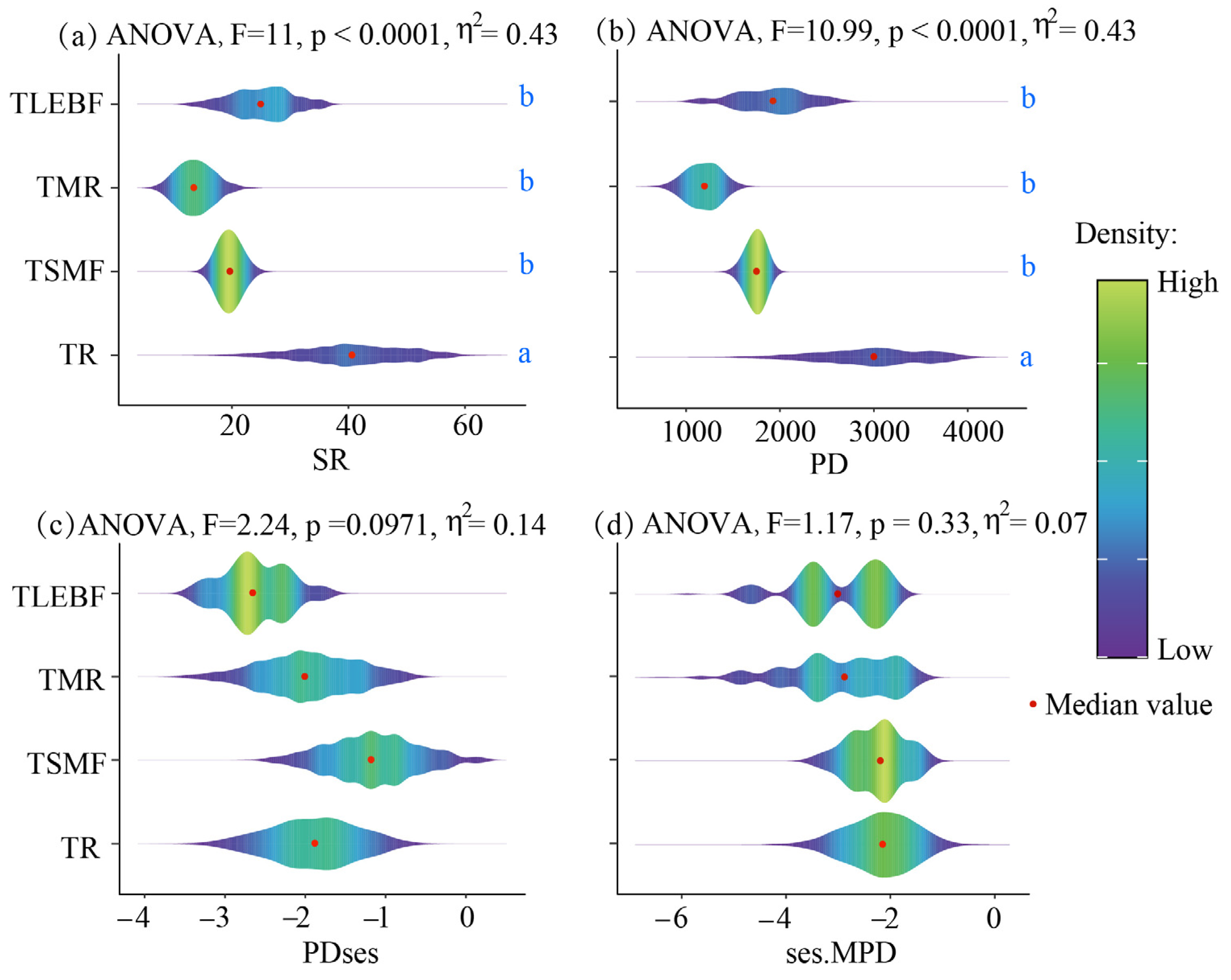
SR was ranked from high to low as follows: TR, TLEBF, TSMF, and TMR (Figure 2a). The results from analysis of variance and multiple comparison showed that TR had the highest SR and significant differences compared with the other three forest types (ANOVA, η2 = 0.43, p < 0.05). No significant difference was observed in SR among the other three forests (Figure 2a).
The ranking of PD was the same as that of SR: TR, TLEBF, TSMF, and TMR (Figure 2b). TR had the highest PD, which was significantly different from that of the others, whereas no significant difference was observed in PD among the other three forest types (ANOVA, η2 = 0.43, p < 0.05, Figure 2b).
Regarding the two standardized phylogenetic-based metrics, the PDses was ranked from high to low as follows: TSMF, TR, TMR, and TLEBF. There were no significant differences among the forests (ANOVA, η2 = 0.14, p > 0.05). The PDses values of all four forest types were negative, indicating that the observed PD values of the assemblages were, on average, lower than the null expectation (Figure 2c).
The ses.MPD was ranked from high to low as follows: TR, TSMF, TMR, and TLEBF. There were no significant differences among the forests (ANOVA, η2 = 0.07, p > 0.05). The ses.MPD values were all negative, which indicated that the assemblages were, on average, more phylogenetically clustered than the null expectation (Figure 2d).
Overall, TR had the highest value of SR and PD, while TR and/or TSMF had the highest value regarding the standardized metrics such as PDses and ses.MPD. The validation data (Table S7) revealed similar rank results as above, which were calculated by another method, thus verifying the credibility of the bootstrap sampling results above.

3.2. Difference in Environmental Determinants Across Four Forest Types

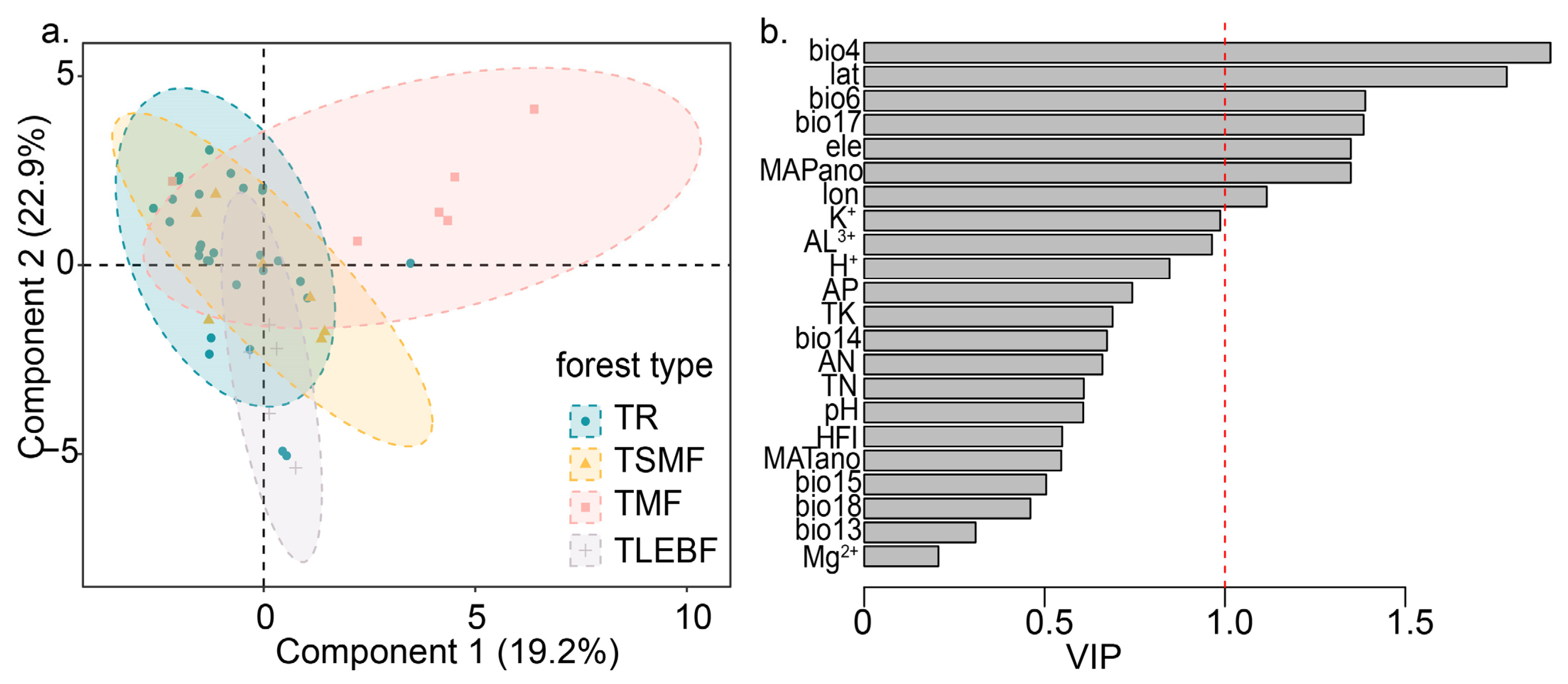
We utilized the PLS-DA model and VIP method to distinguish different vegetation types and identify their discriminant factors. However, no significant differences were observed between the sample groups (Figure 3a), suggesting that the environmental variables could not clearly differentiate the four vegetation types. Seven factors had VIP values greater than 1 in the PLS-DA procedure (Figure 3b), indicating that these seven factors made the most significant contribution to the potential differences in distribution across the four forest types. These factors included temperature (bio4—temperature seasonality; bio6—minimum temperature of the coldest month), geography (ele—elevation; lat—latitude; lon—longitude), precipitation (bio17—precipitation of the driest quarter), and climate change since the LGM (MAPano—annual precipitation anomaly between the present and LGM) (Figure 3b).

3.3. Difference in Community Composition

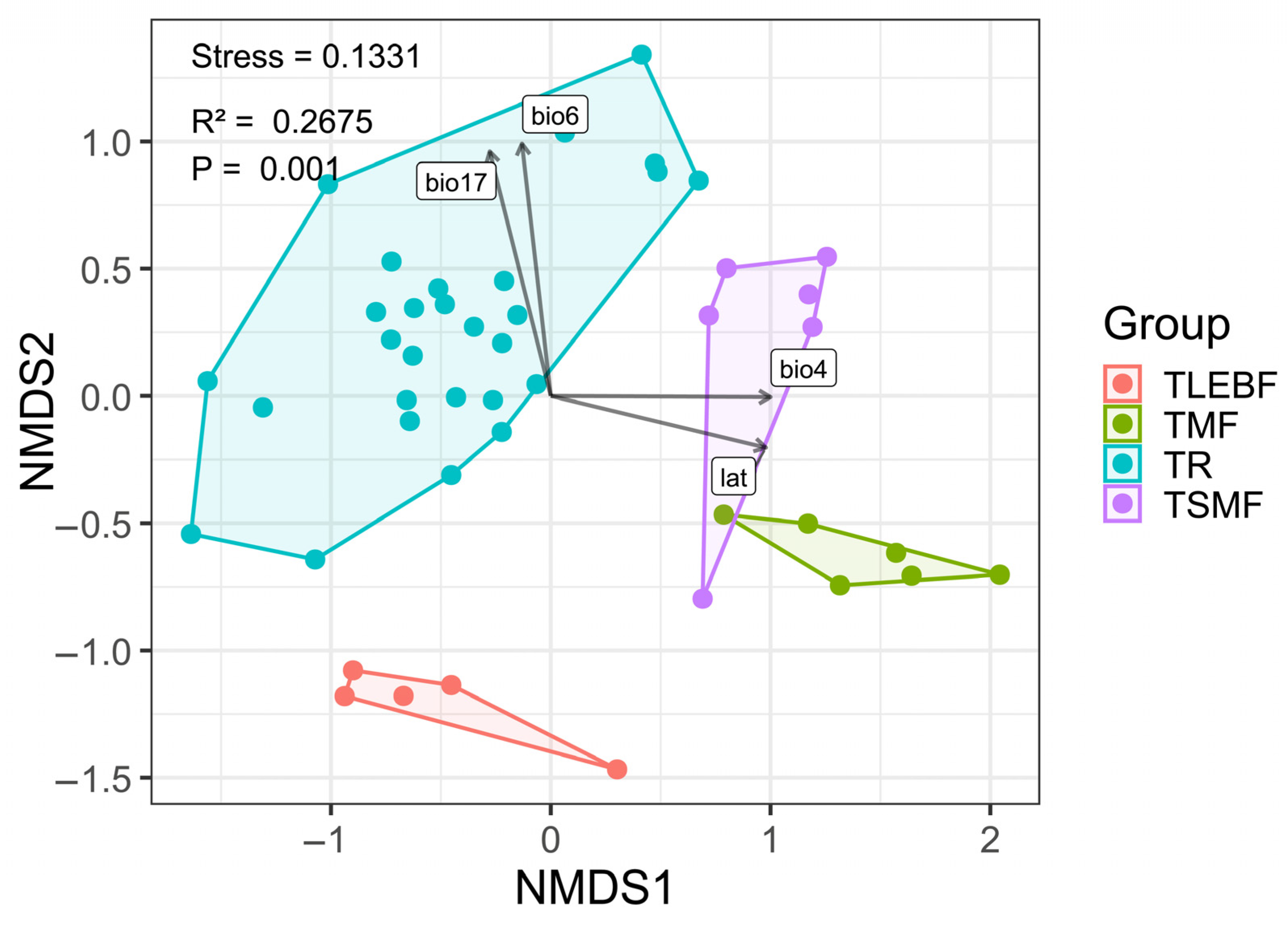
The NMDS provided an acceptable fit under a low stress value (stress = 0.1331). The clusters are clearly separated in the NMDS ordination (Figure 4). Results showed that there were significant differences in the composition between the four forest groups (supported by PERMANOVA, R2 = 0.2675, p < 0.05, Figure 4). The SIMPER similarity analysis provided the important contributions of species to the forest grouping (we can see the rank in descending order in Table S8).
NMDS ordinations were strongly associated with differences in environments (R2 = 0.66, p < 0.05); significant impacts (all p < 0.05, Figure 4, Table S9) were shown by the following: bio4—temperature seasonality (R2 = 0.36); bio6—minimum temperature of the coldest month (R2 = 0.35); lat—latitude (R2 = 0.48); bio17—precipitation of the driest quarter (R2 = 0.29). The bio6 (minimum temperature of the coldest month) and bio17 (precipitation of the driest quarter) have great relations with the species composition of TR (Figure 4), while bio4 (temperature seasonality) and lat (latitude) have great relations with the species composition of TSMF (Figure 4).

3.4. Factors Influencing the Diversity of Forests

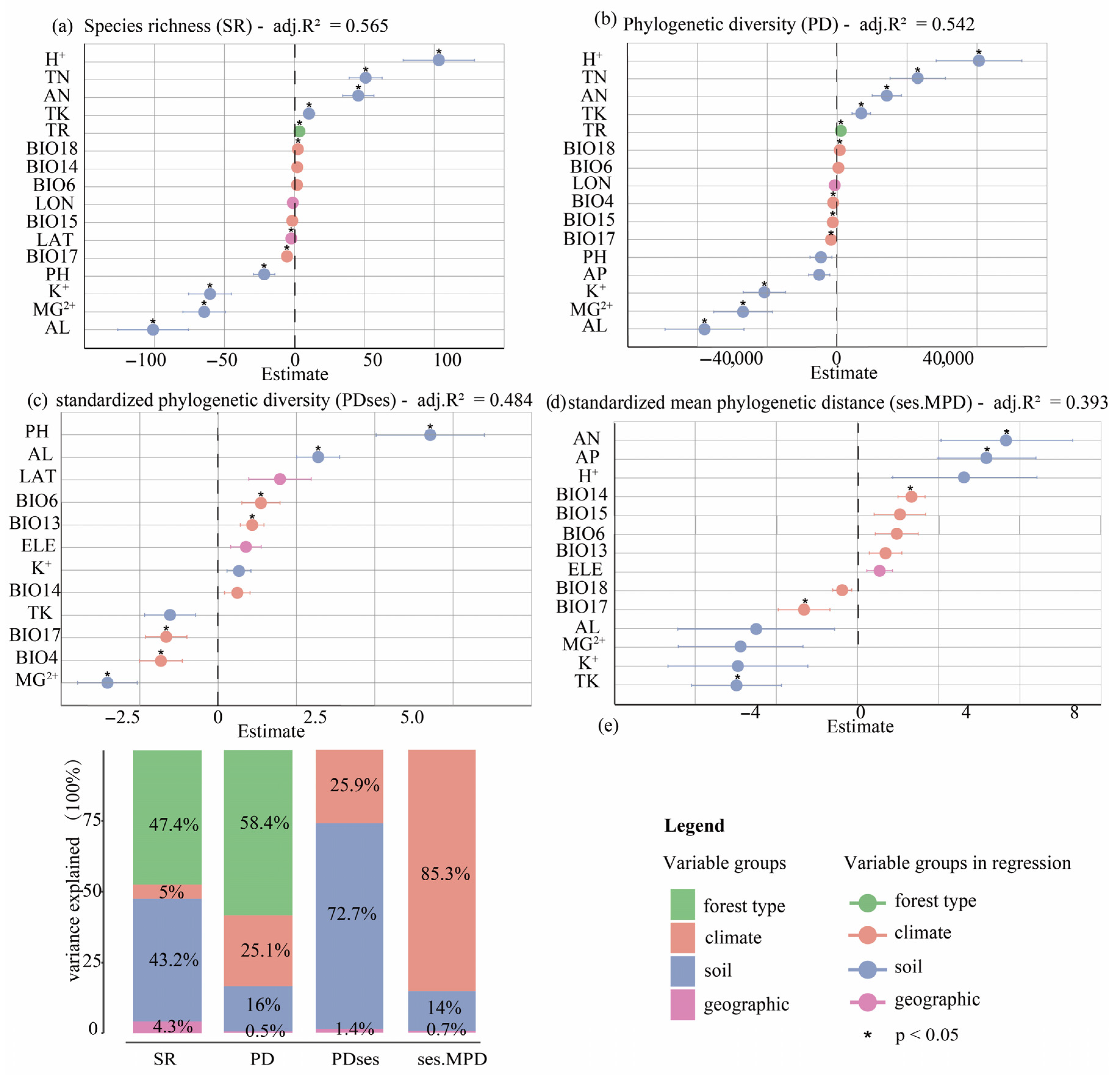
The results showed that the diversity metrics for SR, PD, PDses, and ses.MPD were significantly influenced by different environmental factors, including contemporary climate, soil, forest types, and geographical variables (Figure 5).
The results in Section 3.1 showed that there were significant differences for the SR and PD metrics across the forests (ANOVA, η2 = 0.43, p < 0.05). The results of multiple regression showed that forest type (factor-TR) could explain relatively large parts of the variance in regression for SR (47.4%) and PD (58.4%) (Figure 5a,b), which confirmed the particularity of TR. Besides the forest types, soil factors could explain another 43.2% of the variance of the total adjusted R2 (0.57) in the regression for SR (Figure 5a). In the regression for PD, climates could explain another 25.1% of the variance of the total adjusted R2 (0.54) (Figure 5b,e); thereinto, temperature seasonality had the highest importance contribution (7.45%), followed by precipitation of the driest quarter (5.3%), precipitation of the driest quarter (4%), and precipitation seasonality (3.4%) (all p < 0.05, Figure 5b, Table S10).
Patterns of PDses were significantly related to the environmental factors (R2 = 0.48, p < 0.05, Figure 5c). The soil factors contributed the most important proportion (72.7%), then the climates (25.9%) (Figure 5e), including the min temperature of the coldest month (9.4%), precipitation of the driest quarter (5.7%), precipitation of the wettest month (4.5%), and temperature seasonality (4.3%) (all p < 0.05, Figure 5c, Table S10).
Patterns of ses.MPD were significantly related to the environmental factors (R2 = 0.39, p < 0.05, Figure 5d). The climates contributed the most important proportion (85.3%) (Figure 5e), including the precipitation of the driest month (14.7%) and precipitation of the driest quarter (5.4%) (all p < 0.05, Figure 5d, Table S10).
Overall, in terms of the continuous environmental variables, results showed that the soil factors played important roles in influencing the diversity of SR, PD, PDses, and ses.MPD. Meanwhile, climate also had a considerable influence on the standardized metrics (PDses and ses.MPD), especially the precipitation of the driest month/quarter.

4. Discussion

4.1. Distribution, Diversity and Environmental Influences of the Forest Types in Xishuangbanna

The results indicated that the temperature seasonality, minimum temperature of the coldest month, latitude, and precipitation of the driest quarter all play significant roles in influencing the forest groupings, which implies the importance of environmental filtering. In particular, the pronounced influence of the minimum temperature of the coldest month and precipitation of the driest quarter further indicates that the tolerance for coldness and drought is greatly related to the species composition of TR, which is consistent with the tropical niche conservatism hypothesis (TCH) [48,49]. Although TRs of Xishuangbanna are located on such a northern-edge tropical area, actual observations have found that they are mostly restricted to valley areas, which can form local microclimates that effectively buffer extreme low temperatures and reduce water stress, enabling them to maintain survival and development even in the marginal area [29]. The TR is doubtlessly distributed in areas that have strong relationships with winter coldness and climatic stability, which may promote the phylogenetic clustering trend of community structure (PDses < 0, ses.MPD < 0), consistent with the tropical niche conservatism hypothesis (TCH) [49]. We found that SR and PD for the TR showed the highest value among the four forest types; in addition, the diversity for SR in Xishuangbanna was significantly positively related to the existence of TR. Conventional wisdom states that conditions within a tropical climate, with lush vegetation and high biomass, offer unparalleled levels of biodiversity and support greater SR and PD of plant species than other climates [50].
Biodiversity is not evenly distributed within an area, which can be reflected in the different diversities of forest communities. While forests serve as the natural units for species distribution and assemblage, from another perspective, our study also showed that forest type would be one of the important facets in understanding regional biodiversity patterns and managing biodiversity conservation. The results showed that all the forests have potential phylogenetic clustering and are assembled by closely related species, which may be because these forests lie in the transitional zone.
Climate and soil factors accounted for a substantial proportion of the variance in standardized phylogenetic-based diversity, indicating that local environmental heterogeneity leads to the differentiation of communities in this region. This pattern can be explained by habitat filtering; habitat filters are abiotic constraints that allow the selection of specific species with suitable trait adaptations and their survival in a given locality [51,52]. Habitat filtering reflects niche conservatism in lineages from an evolutionary perspective, and closely related species may possess similar adaptations to environmental challenges [23,51,52]. For example, TR has accumulated abundant species, which develop under extreme tropical conditions in Xishuangbanna, but are still restricted by winter coldness and climatic stability. The TSMF is restricted to limestone areas, where harsher edaphic and microclimatic conditions impose a strong environmental filter. Species that lack the trait adaptations necessary to persist in the harsher habitats may be filtered out by the conditions on limestone mountains [53], leading to the observed phylogenetic clustering trends of TSMF on average.

4.2. Implications for Biodiversity Conservation in Xishuangbanna Area

4.2.1. Conservation Priority in Xishuangbanna

The Xishuangbanna Nature Reserve was established in 1958 and is one of the earliest protected areas in China. Tropical forest ecosystems were regarded as one of the key objects in biodiversity conservation initially, on account of the scarcity of tropical forests in mainland China and the particularity of their location in the northern edge of the tropical zone of Xishuangbanna [54]. Conservation assessments incorporating phylogenetic information are helpful for obtaining more detailed biodiversity pattern information [55,56]. Existing reserves usually prioritize species-rich forests for conservation, and areas with the highest phylogenetic and/or species diversity have recently been suggested as priority conservation targets [56,57,58,59].
The distribution of forest types can serve as natural units and shortcuts for biodiversity conservation. Indeed, the quantifiable value in our results confirms the particularity of TR in the local area, which is specifically manifested in higher diversity either by species-based or phylogenetic-based diversity indicators. According to the principle of conservation priority, TR deserves to be regarded as one of the most important priority objects for protection. In addition, we found that TSMF, which also has a relatively higher phylogenetic-based biodiversity value, is another priority object in conservation management in Xishuangbanna.

4.2.2. TR and TSMF Under Climate Change in Xishuangbanna

Different species compositions of forests show different responses to environments in the results; for example, TR grouping is much more sensitive to the minimum temperature of the coldest month and precipitation of the driest quarter, while TMF and TSMF are much more sensitive to the temperature seasonality and latitude; these climatic factors reflect the influences of climatic stability on forest types. Additionally, we could see that soil factors and precipitation disparity have great impacts on the diversity of PDses and ses.MPD (Figure 4 and Figure 5). Climate change always has a particularly strong influence on species range shifts and changes in vegetation composition and structure [60]. Out of the tropics, this hypothesis suggests that clades originate from the tropics, and the clades adapted to present-day temperature and/or subtropical zones have higher climatic variability, broader environmental tolerances, and larger geographic ranges [61]. The Climatic Variability Hypothesis suggests that taxa from environmentally variable habitats should evolve wider environmental tolerances and greater dispersal capacity, and consequently may be less impacted by climatic change than taxa originating from relatively stable habitats [60,62]. This suggests that species with wide climatic niches and large range sizes may be less affected by climatic change than those with narrower niches and smaller range sizes.
Both TR and TSMF survive in relatively stable habitats and/or narrower niches; thus, we speculate that they will be greatly affected by environmental changes. For instance, TR is mainly distributed in valley areas influenced by tropical climates, and TSMF is located in karst hillsides. Species with different environmental amplitudes and species-specific tolerances respond differently to climate gradients [62]. Therefore, species dispersal capacity and niche adaptation should be considered in the face of climate change; for example, dipterocarp species in TR usually survive in tropical forests and have poor long-distance wind dispersal [63,64]. Results show that soil factors play very important parts in influencing the diversity metrics of forests in Xishuangbanna. Edaphically extreme habitats, such as the TSMF on limestone mountains in Xishuangbanna, should also be a key focus. Such extreme edaphic sites display strong selective forces for many species and are distributed by specialist edaphic species. Geographic isolation may lead to local species having more unique evolutionary histories than those in other regions [53]. During the migration process caused by climate change, only a few species from other regions can adapt to the karst habitat for survival and growth, and many edaphic specialists are less adaptive when moving to the surrounding habitat [53].
Furthermore, the results showed that precipitation plays an important role in shaping the distribution and diversity metrics of forest types in Xishuangbanna. Climate warming is conducive to the accumulation of energy and heat in local areas. However, some studies have shown that it is becoming much drier in the Xishuangbanna area during climate change, which is a threat to local biodiversity [65,66]. Continued climate warming and more frequent droughts will induce higher mortality rates and impede growth, thus reducing forest productivity in Xishuangbanna [67]. In particular, it means that the TR and TSMF, which have narrow environmental tolerances, would be highly vulnerable to the decrease in moisture. The species to be migrated should also consider the biotic interactions, such as the competitive relationships of the original species in the destination area.
In our opinion, we predict that TR and TSMF may suffer greatly from threats of climate change due to their narrow tolerances in such special tropical–subtropical transitional areas. Therefore, we suggest that TR and TSMF should be considered priorities for conservation optimization in local areas in the face of climate change.

4.2.3. Conservation Suggestion

Biodiversity is threatened by snowballing due to ongoing global warming and human activity. Since 2003, rubber and tea plantations have been the main sources of local economic income, which lifts ethnic-minority farmers from poverty [68], but such matters may increase the risk of local habitat loss. Although Xishuangbanna Nature Reserve plays an important role in maintaining biodiversity, these economic crop plantations even covered 10% of the protected areas in 2010 [69,70]. The existing forest canopy has a considerable effect on understory plant species and the growth and establishment of seedlings, which, in turn, enhances forest regeneration [71,72]. Thus, the protection of existing vegetation is vital for minimizing costs and improving the chances of successful natural restoration [71,73].
Therefore, we put forward our suggestions for conservation efforts in Xishuangbanna:
First, we suggest that policymakers and forest managers should prioritize TR and TSMF for conservation efforts due to their high value of biodiversity as well as their higher vulnerability to climate change. This does not mean ignoring the protection of other forest types; other types are also indispensable in biodiversity conservation in Xishuangbanna, as they all have considerable value in providing habitats for large mammals, including elephants and other rare wildlife species [74,75].
Second, conservation managers can incorporate local cultural forests into habitat corridors to enhance the connectivity of the scattered protected areas in Xishuangbanna. Xishuangbanna is an area where multiple ethnic minorities coexist; cultural forests serve as one of the inviolable religious beliefs in the local area, and these cultural forests are important components of the existing forests in Xishuangbanna. To date, the cultural forests in Xishuangbanna have been protected primarily by the community, but not by government-led conservation [76]. We suggest that conservation management should be set in accordance with local conditions, such as the landscape and culture.
Third, we believe that the government could strengthen its support for the local tourism industry to enhance residents’ income. Due to the continuous low price of natural rubber since 2010, as well as ecological environment protection by the government, the area growth of rubber forest has gradually slowed down [77]. While the tourism industry in Xishuangbanna has been developing year by year, the unique tropical landscape, ecological environment, and biodiversity are the main reasons that attract tourists from all over China. The development of tourism can not only enhance economic income but also serve as an opportunity to conduct environmental education and strengthen the public’s awareness of protection. The locals realized that they could make profits without engaging in rubber cultivation or destroying natural forests.

5. Conclusions

Natural forest units are convenient for implementing conservation management, but the key point is to determine priorities in further efforts. Therefore, by comparing the species- and phylogenetic-based biodiversity of the four primary forest types in Xishuangbanna, we found differences in biodiversity patterns among different forests. Results reveal that TR and TSMF are conservation priorities. TR has significantly higher SR and PD compared to other forests, and TSMF has considerably higher PDses compared to others. Crucially, through PLS-DA and NMDS analyses, results showed that the grouping for species composition of forests was mainly influenced by key environmental factors, such as temperature seasonality, minimum temperature of the coldest month, latitude, and precipitation of the driest quarter. Meanwhile, under multiple analyses of diversity metrics and environmental factors, results showed that contemporary climate, soil, forest types, and geographical variables would have impacts on diversity, especially climate and soil for standardized phylogenetic-based diversity, which implies the importance of environmental filtering across the study area. Given the important influence of environments in shaping forest communities and their biodiversity, the strategies for biodiversity conservation of the forests across Xishuangbanna should also consider their vulnerability under a changing climate. This is particularly urgent for TR and TSMF, which are projected to face high threats under climate warming. We suggest strengthening the protection of existing vegetation, especially for TR and TSMF. Besides tough measures by setting reserves, we believe that enhancing the responsibility and initiative of residents (by relating to their culture and quality of life) could help comprehensive conservation.
However, there are some limitations to our study. Although we believe that focusing on woody plants is achievable and sufficient to explain the diversity and community structure of forests, it is better to supplement field investigations and add information on herbaceous species to community assemblages in future research. In addition, this study discusses species- and phylogenetic-based diversity, without evaluating the functional traits of forests.

Supplementary Materials

The following supporting information can be downloaded at: https://www.mdpi.com/article/10.3390/d17120833/s1. Table S1: Data of forty-seven sample plots in Xishuangbanna; biodiversity indexes were calculated by Method I; Table S2: Species composition in each plot; Table S3: The Pearson relationship between soil properties; Table S4: The p values of Pearson relationships between soil properties; Table S5: The Pearson relationships between 19 climate variables; Table S6: The p values of Pearson relationships between 19 climate variables; Table S7: Biodiversity of four vegetations based on species objects using Method II; Table S8: The importance contribution of species to the forest grouping in descending order; Table S9: Correlation coefficient of NMDS ordination axes and environmental variables; Table S10: The important contribution of factors in multiple stepwise regression between diversity and environmental factors. File S1-tree: Phylogenetic tree of angiosperm species in Xishuangbanna.

Author Contributions

Conceptualization, X.-Q.C. and J.L.; methodology, all authors; formal analysis, X.-Y.Z. and L.H.; data curation, X.-Y.Z.; writing—original draft preparation, X.-Y.Z.; writing—review and editing, all authors; supervision, J.L.; funding acquisition, J.L. All authors have read and agreed to the published version of the manuscript.

Funding

This work was supported by the Science and Technology Basic Resources Investigation Program of China (Grant/Award Number: 2017FY100100; 2017FY100102); Biodiversity Conservation Program of the Chinese Academy of Sciences (Grant/Award Number: ZSSD-013); National Natural Science Foundation of China (Grant/Award Number: 31770569; 31500454); Yunnan Fundamental Research Projects (Grant/Award Number: 202201AS070055).

Institutional Review Board Statement

Not applicable.

Data Availability Statement

The original contributions presented in this study are included in the article/Supplementary Material. Further inquiries can be directed to the corresponding authors.

Acknowledgments

We are grateful to Hua Zhu from the Xishuangbanna Tropical Botanical Garden for providing the photographs of forest types presented in Figure 1b–e.

Conflicts of Interest

The authors declare no conflicts of interest.

Abbreviations

The following abbreviations are used in this manuscript:
TRTropical forests
TLBEFTropical lower-montane evergreen broadleaf forests
TSMFTropical seasonal moist forests
TMRTropical monsoon forests
SRSpecies richness
PDPhylogenetic diversity
PDsesStandardized phylogenetic diversity
ses.MPDStandardized mean phylogenetic distance
VIPVariable importance in the projection
PLS-DAPartial least-squares discriminant analysis
NMDSNon-metric multidimensional scaling ordination
PERMANOVApermutational multivariate analysis of variance
TCHTropical niche conservatism hypothesis

References

  1. Yan, P.; Fernandez-Martinez, M.; Van Meerbeek, K.; Yu, G.; Migliavacca, M.; He, N. The essential role of biodiversity in the key axes of ecosystem function. Glob. Change Biol. 2023, 29, 4569–4585. [Google Scholar] [CrossRef] [PubMed]
  2. Ma, S.; Qiao, Y.P.; Wang, L.J.; Zhang, J.C. Terrain gradient variations in ecosystem services of different vegetation types in mountainous regions: Vegetation resource conservation and sustainable development. For. Ecol. Manag. 2021, 482, 118856. [Google Scholar] [CrossRef]
  3. IPCC. AR6 Synthesis Report: Climate Change 2023. Available online: https://www.ipcc.ch/assessment-report/ar6/ (accessed on 14 February 2025).
  4. IPBES. Global Assessment Report on Biodiversity and Ecosystem Services; Intergovernmental Science-Policy Platform on Biodiversity and Ecosystem Services: Bonn, Germany, 2019; Available online: https://www.ipbes.net/global-assessment (accessed on 14 February 2025).
  5. Myers, N.; Mittermeier, R.A.; Mittermeier, C.G.; da Fonseca, G.A.B.; Kent, J. Biodiversity hotspots for conservation priorities. Nature 2000, 403, 853–858. [Google Scholar] [CrossRef]
  6. Wilson, K.A.; McBride, M.F.; Bode, M.; Possingham, H.P. Prioritizing global conservation efforts. Nature 2006, 440, 337–340. [Google Scholar] [CrossRef] [PubMed]
  7. Margules, C.R.; Pressey, R.L. Systematic conservation planning. Nature 2000, 405, 243–253. [Google Scholar] [CrossRef]
  8. Cardillo, M. Phylogenetic diversity in conservation: A brief history, critical overview, and challenges to progress. Camb. Prism. Extinction 2023, 1, e11. [Google Scholar] [CrossRef]
  9. Forest, F.; Grenyer, R.; Rouget, M.; Davies, T.J.; Cowling, R.M.; Faith, D.P.; Balmford, A.; Manning, J.C.; Proches, S.; van der Bank, M.; et al. Preserving the evolutionary potential of floras in biodiversity hotspots. Nature 2007, 445, 757–760. [Google Scholar] [CrossRef]
  10. Faith, D.P. Conservation evaluation and phylogenetic diversity. Biol. Conserv. 1992, 61, 1–10. [Google Scholar] [CrossRef]
  11. Grant, K.R.; Davies, T.; Harish, S.M.; Dar, J.A.; Kothandaraman, S.; Ray, T.; Malasiya, D.; Dayanandan, S.; Khan, M.L. Phylogenetic community patterns suggest Central Indian tropical dry forests are structured by montane climate refuges. Divers. Distrib. 2023, 29, 946–958. [Google Scholar] [CrossRef]
  12. Qian, H.; Qian, S.; Zhang, J.; Kessler, M. Effects of climate and environmental heterogeneity on the phylogenetic structure of regional angiosperm floras worldwide. Nat. Commun. 2024, 15, 1079. [Google Scholar] [CrossRef]
  13. Qian, H.; Jiang, L. Phylogenetic community ecology: Integrating community ecology and evolutionary biology. J. Plant Ecol. 2014, 7, 97–100. [Google Scholar] [CrossRef]
  14. Webb, C.O.; Ackerly, D.D.; McPeek, M.A.; Donoghue, M.J. Phylogenies and community ecology. Annu. Rev. Ecol. Syst. 2002, 33, 475–505. [Google Scholar] [CrossRef]
  15. Martín-Regalado, C.N.; Lavariega, M.C.; Briones-Salas, M. Spatial Patterns of Taxonomic, Functional, and Phylogenetic Diversity of Mammals in Southern Mexico. Ecol. Evol. 2025, 15, e70814. [Google Scholar] [CrossRef]
  16. Hockridge, E.G.; Bradford, E.; Angier, K.I.W.; Youd, B.H.; McGill, E.B.M.; Ngouma, S.Y.; Ognangue, R.L.; Gibbon, G.E.M.; Davies, A.B. Spatial ecology, biodiversity, and abiotic determinants of Congo’s bai ecosystem. Ecol. Evol. 2024, 105, e4419. [Google Scholar] [CrossRef]
  17. Kassum, B.W.; Kallio, A.; Tromborg, E.; Rannestad, M.M. Vegetation density and altitude determine the supply of dry Afromotane forest ecosystem sevices: Evidence from Ehiopia. For. Ecol. Manag. 2024, 552, 121561. [Google Scholar] [CrossRef]
  18. Jewitt, D. Vegetation type conservation targets, status and level of protection in KwaZulu-Natal in 2016. Bothalia 2018, 48, a2294. [Google Scholar] [CrossRef]
  19. Rees, M.; Fayolle, A.; Godlee, J.L.; Gorel, A.P.; Harris, D.J.; Dexter, K.G. Patterns and drivers of phylogenetic beta diversity in the forests and savannas of Africa. J. Biogeogr. 2025, 52, e15140. [Google Scholar] [CrossRef]
  20. Pinto, A.S.; Monteiro, F.K.; Rodrigues, E.; Gomes, D.R.F.L.; Medeiros, M.C.; Lopes, S.F. Phylogenetic diversity and conservation challenges in Brejos de Altitude: Assessing threatened areas of the Brazilian Atlantic Forest. Reg. Environ. Change 2024, 25, 25. [Google Scholar] [CrossRef]
  21. Li, R.; Kraft, N.J.; Yu, H.; Li, H. Seed plant phylogenetic diversity and species richness in conservation planning within a global biodiversity hotspot in eastern Asia. Conserv. Biol. 2015, 29, 1552–1562. [Google Scholar] [CrossRef] [PubMed]
  22. Zhou, Y.D.; Chen, S.C.; Hu, G.W.; Mwachala, G.; Yan, X.; Wang, Q.F. Species richness and phylogenetic diversity of seed plants across vegetation zones of Mount Kenya, East Africa. Ecol. Evol. 2018, 8, 8930–8939. [Google Scholar] [CrossRef] [PubMed]
  23. Rezende, V.L.; Pontara, V.; Bueno, M.L.; van den Berg, E.; de Oliveira-Filho, A.T. Climate and evolutionary history define the phylogenetic diversity of vegetation types in the central region of South America. Oecologia 2020, 192, 191–200. [Google Scholar] [CrossRef]
  24. Althaus, K.N.G.-E.M.; González-Rodríguez, A.; Correa, H.A.; Hipp, A.L. Phylogenetic niche conservatism drives floristic assembly across Mexico’s Temperate-Tropical divide. Glob. Ecol. Biogeogr. 2025, 34, e70017. [Google Scholar] [CrossRef]
  25. Smith, T.B.; Kark, S.; Schneider, C.J.; Wayne, R.K.; Moritz, C. Biodiversity hotspots and beyond: The need for preserving environmental transitions. Trends Ecol. Evol. 2001, 16, 431. [Google Scholar] [CrossRef]
  26. Silva-Pereira, I.; Meira-Neto, J.A.A.; Rezende, V.L.; Eisenlohr, P.V. Biogeographic transitions as a source of high biological diversity: Phylogenetic lessons from a comprehensive ecotone of South America. Perspect. Plant Ecol. 2020, 44, 125528. [Google Scholar] [CrossRef]
  27. Lemessa, D.; Mewded, B.; Alemu, S. Vegetation ecotones are rich in unique and endemic woody species and can be a focus of community-based conservation areas. Bot. Lett. 2023, 170, 507–517. [Google Scholar] [CrossRef]
  28. FAO. Global Forest Resources Assessment 2020: Main Report; FAO: Rome, Italy, 2020. [Google Scholar] [CrossRef]
  29. Ashton, P.; Zhu, H. The tropical-subtropical evergreen forest transition in East Asia: An exploration. Plant Divers. 2020, 42, 255–280. [Google Scholar] [CrossRef]
  30. Huang, Q.; Kuang, Y.; Zhou, H.; Li, X.; Yin, L. Biodiversity conservation in Xishuangbanna, China: Diversity analysis of traditional knowledge related to biodiversity and conservation progress and achievement evaluation. Diversity 2024, 16, 260. [Google Scholar] [CrossRef]
  31. Zhu, H.; Wang, H.; Li, B.G.; Zhou, S.S.; Zhang, J.H. Studies on the Forest Vegetation of Xishuangbanna. Plant Sci. J. 2015, 33, 641–726. [Google Scholar]
  32. Zhu, H.; Cao, M.; Hu, H. Geological history, flora, and vegetation of Xishuangbanna, southern Yunnan, China. Biotropica 2006, 38, 310–317. [Google Scholar] [CrossRef]
  33. Zhang, J.H.; Cao, M. Tropical forest vegetation of Xishuangbanna, SW China and its secondary changes, with special reference to some problems in local nature conservation. Biol. Conserv. 1995, 73, 229–238. [Google Scholar] [CrossRef]
  34. Sandel, B.; Arge, L.; Dalsgaard, B.; Davies, R.G.; Gaston, K.J.; Sutherland, W.J.; Svenning, J.C. The Influence of Late Quaternary Climate-Change Velocity on Species Endemism. Science 2011, 334, 660–664. [Google Scholar] [CrossRef]
  35. Taylor, A.; Weigelt, P.; Denelle, P.; Cai, L.; Kreft, H. The contribution of plant life and growth forms to global gradients of vascular plant diversity. New Phytol. 2023, 240, 1548–1560. [Google Scholar] [CrossRef]
  36. Hurtado, P.; Prieto, M.; Aragon, G.; Escudero, A.; Martinez, I. Critical predictors of functional, phylogenetic and taxonomic diversity are geographically structured in lichen epiphytic communities. J. Ecol. 2019, 107, 2303–2316. [Google Scholar] [CrossRef]
  37. Zhang, X.Y.; Ci, X.Q.; Zhu, R.B.; Conran, J.G.; Li, J. Spatial phylogenetic patterns and conservation of threatened woody species in a transition zone of southwest China. Biodivers. Conserv. 2022, 31, 2205–2225. [Google Scholar] [CrossRef]
  38. Kembel, S.W.; Cowan, P.D.; Helmus, M.R.; Cornwell, W.K.; Morlon, H.; Ackerly, D.D.; Blomberg, S.P.; Webb, C.O. Picante: R tools for integrating phylogenies and ecology. Bioinformatics 2010, 26, 1463. [Google Scholar] [CrossRef]
  39. Webb, C.O.; Ackerly, D.D.; Kembel, S.W. Phylocom: Software for the analysis of phylogenetic community structure and trait evolution. Bioinformatics 2008, 24, 2098–2100. [Google Scholar] [CrossRef] [PubMed]
  40. Webb, C.O. Exploring the Phylogenetic Structure of Ecological Communities_ An Example for Rain Forest Trees. Am. Nat. 2000, 156, 145–155. [Google Scholar] [CrossRef]
  41. Wickham, H. ggplot2: Elegant Graphics for Data Analysis; Springer: New York, NY, USA, 2016; Available online: https://ggplot2.tidyverse.org (accessed on 23 April 2024).
  42. Barker, M.; Rayens, W. Partial least squares for discrimination. J. Chemom. 2003, 17, 166–173. [Google Scholar] [CrossRef]
  43. Rohart, F.; Gautier, B.; Singh, A.; Cao, K.A.L. MixOmics: An R package for omics feature selection and multiple data integration. PLoS Comput. Biol. 2017, 13, e100575. [Google Scholar] [CrossRef]
  44. Oksanen, J.; Simpson, G.; Blanchet, F.; Kindt, R.; Legendre, P.; Minchin, P.R.; O’Hara, R.B.; Solymos, P.; Steven, M.H.H.; Szoecs, E.; et al. Vegan: Community Ecology Package. 2024. R Package Version 2.6-6.1. Available online: https://CRAN.R-project.org/package=vegan (accessed on 24 April 2025).
  45. Hu, G.; Pang, Q.; Hu, C.; Xu, C.; Zhang, Z.; Zhong, C. Beta diversity patterns and determinants among vertical layers of Tropical Seasonal Rainforest in Karst Peak-Cluster Depressions. Forests 2024, 15, 365. [Google Scholar] [CrossRef]
  46. Barton, K. MUMIN: Multi-Modelinference. 2023. Available online: https://CRAN.R-project.org/package=MuMIn (accessed on 12 April 2024).
  47. Lai, J.; Zou, Y.; Zhang, J.; Peres-Neto, P. Generalizing hierarchical and variation partitioning in multiple regression and canonical analyses using the rdacca.hp R package. Methods Ecol. Evol. 2022, 13, 782–788. [Google Scholar] [CrossRef]
  48. Wiens, J.J.; Donoghue, M.J. The origins of the latitudinal diversity gradient: Revisiting the tropical conservatism hypothesis. J. Biogeogr. 2025, 52, e15172. [Google Scholar] [CrossRef]
  49. Qian, H.; Field, R.; Zhang, J.L.; Zhang, J.; Chen, S.B. Phylogenetic structure and ecological and evolutionary determinants of species richness for angiosperm trees in forest communities in China. J. Biogeogr. 2016, 43, 603–615. [Google Scholar] [CrossRef]
  50. Mittelbach, G.G.; Schemske, D.W.; Cornell, H.V.; Allen, A.P.; Brown, J.M.; Bush, M.B.; Harrison, S.P.; Hurlbert, A.H.; Knowlton, N.; Lessios, H.A.; et al. Evolution and the latitudinal diversity gradient: Speciation, extinction and biogeography. Ecol. Lett. 2007, 10, 315–331. [Google Scholar] [CrossRef] [PubMed]
  51. Kraft, N.J.B.; Cornwell, W.K.; Webb, C.O.; Ackerly, D.D. Trait Evolution, Community Assembly, and the Phylogenetic Structure of Ecological Communities. Am. Nat. 2007, 170, 271–283. [Google Scholar] [CrossRef] [PubMed]
  52. Kraft, N.J.B.; Adler, P.B.; Godoy, O.; James, E.C.; Fuller, S.; Levine, J.M. Community assembly, coexistence and the environmental filtering metaphor. Funct. Ecol. 2014, 29, 592–599. [Google Scholar] [CrossRef]
  53. Corlett, R.T.; Tomlinson, K.W. Climate Change and Edaphic Specialists: Irresistible Force Meets Immovable Object? Trends Ecol. Evol. 2020, 35, 367–376. [Google Scholar] [CrossRef] [PubMed]
  54. Xishuangbanna National Nature Reserve Management Bureau; Yunnan Institute of Forest Inventory and Planning. Xishuangbanna National Nature Reserve; Yunnan Education Publishing House: Kunming, China, 2005. (In Chinese) [Google Scholar]
  55. Cadotte, M.W.; Davie, J. Phylogenies in Ecology: A Guide to Concepts and Methods; Princeton University Press: Princeton, NJ, USA, 2016. [Google Scholar]
  56. Pollock, L.J.; Thuiller, W.; Jetz, W. Large conservation gains possible for global biodiversity facets. Nature 2017, 546, 141–144. [Google Scholar] [CrossRef]
  57. Marulanda, B.B.; Salinas, F.; Arias, V.M.; Buitrago-Torres, D.L. What is essential is invisible to the eyes: A conservation approach for poison frogs (Dendrobatidae) based on evolutionary distinctiveness and threat status. Biodivers. Conserv. 2025, 34, 1965–1984. [Google Scholar] [CrossRef]
  58. Mollina, R.J.; Patino, J.; de la Cruz, S.; Olangua-Corral, M.; Marrero, A.; Garcia-Verdugo, C.; Caujape-Castells, J. Integrating a phylogenetic framework for mapping biodiversity patterns to set conservation priorities for an oceanic island flora. Conserv. Sci. Pract. 2025, 7, e70023. [Google Scholar] [CrossRef]
  59. Zhu, Z.X.; Chelli, S.; Tsakalos, J.L.; Bricca, A.; Canullo, R.; Cervellini, M.; Pennesi, R.; de Benedictis, L.L.M.; Cesaroni, V.; Bottacci, A.; et al. How effective are different protection strategies in promoting the plant diversity of temperate forests in national parks? For. Ecol. Manag. 2025, 584, 122602. [Google Scholar] [CrossRef]
  60. Thang, T.H.; Thu, A.M.; Chen, J. Tree species of tropical and temperate lineages in a tropical Asian montane forest show different range dynamics in response to climate change. Glob. Ecol. Conserv. 2020, 22, e00973. [Google Scholar] [CrossRef]
  61. Morueta-Holme, N.; Enquist, B.; Mcgill, B.J.; Boyle, B.; Jørgensen, P.M.; Ott, J.E.; Peet, R.; Šímová, I.; Sloat, L.L.; Thiers, B.; et al. Habitat area and climate stability determine geographical variation in plant species range sizes. Ecol. Lett. 2013, 16, 1446–1454. [Google Scholar] [CrossRef]
  62. Pintor, A.F.V.; Schwarzkopf, L.; Krockenberger, A.K. Rapoport’s Rule: Do climatic variability gradients shape range extent? Ecol. Monogr. 2015, 85, 643–659. [Google Scholar] [CrossRef]
  63. Smith, J.R.; Bagchi, R.; Ellens, J.; Kettle, C.J.; Burslem, D.F.R.P.; Maycock, C.R.; Khoo, E.; Ghazoul, J. Predicting dispersal of auto-gyrating fruit in tropical trees: A case study from the Dipterocarpaceae. Ecol. Evol. 2015, 5, 1794–1801. [Google Scholar] [CrossRef]
  64. Zhang, X.; Ci, X.; Hu, J.; Bai, Y.; Thornhill, A.H.; Conran, J.G.; Li, J. Riparian areas as a conservation priority under climate change. Sci. Total Environ. 2023, 858, 159879. [Google Scholar] [CrossRef]
  65. Zhou, L.G.; Zhang, X.; Zhang, Y.P.; Song, Q.H.; Myo, S.T.Z.; Zhou, R.W.; Lin, Y.X.; Liu, Y.T.; Bai, K.C.; Gnanamoorthy, P.; et al. The cumulative drought exert disruptive effects on tropical rainforests in the northern edge of Asia—Based on decadal dendrometric measurements and eddy covariance method. Agric. For. Meteorol. 2022, 316, 108858. [Google Scholar] [CrossRef]
  66. Yin, Y.L.; Zaw, Z.; Peng, X.H.; Zhang, H.; Fu, P.L.; Wang, W.L.; Bräuning, A.; Fan, Z.X. Tree rings in Tsuga dumosa reveal increasing drought variability in subtropical southwest China over the past two centuries. Palaeogeogr. Palaeoclimatol. Palaeoecol. 2023, 628, 111757. [Google Scholar] [CrossRef]
  67. Oo, S.T.T.; Panthi, S.; Fan, Z.X.; Song, X.Y.; Zhang-Zheng, H.Y.; Zaw, Z.; Lu, H.Z.; Chen, H.; Deng, Y.; Zhao, R.; et al. Demographic and net primary productivity dynamics of primary and secondary tropical forests in Southwest China under a changing climate. Integr. Conserv. 2024, 3, 230–243. [Google Scholar] [CrossRef]
  68. Sturgeon, J.C. The cultural politics of ethnic identity in Xishuangbanna, China: Tea and rubber as “Cash Crops” and “Commodities”. J. Curr. Chin. Aff. 2012, 41, 109–131. [Google Scholar] [CrossRef]
  69. Chen, H.F.; Yi, Z.F.; Schmidt-Vogt, D.; Ahrends, A.; Beckschäfer, P.; Kleinn, C.; Ranjitkar, S.; Xu, J.C. Pushing the Limits: The Pattern and Dynamics of Rubber Monoculture Expansion in Xishuangbanna, SW China. PLoS ONE 2016, 11, e0150062. [Google Scholar] [CrossRef] [PubMed]
  70. Sarathchandra, C.; Dossa, G.G.O.; Ranjitkar, N.B.; Chen, H.F.; Deli, Z.; Ranjitkar, S.; de Silva, K.H.W.L.; Wickramasinghe, S.; Xu, J.C.; Harrison, R.D. Effectiveness of protected areas in preventing rubber expansion and deforestation in Xishuangbanna, Southwest China. Land Degrad. Dev. 2018, 29, 2417–2427. [Google Scholar] [CrossRef]
  71. Damtew, A.; Birhane, E.; Messier, C.; Paquette, A.; Muys, B. Shading and species diversity act as safety nets for seedling survival and vitality of native trees in dryland forests: Implications for restoration. For. Ecol. Manag. 2024, 552, 121559. [Google Scholar] [CrossRef]
  72. Salemaa, M.; Hotanen, J.; Oksanen, J.; Tonteri, T.; Merila, P. Broadleaved trees enhance biodiversity of the understorey vegetation in boreal forests. For. Ecol. Manag. 2023, 546, 121357. [Google Scholar] [CrossRef]
  73. Lewis, K.; Barros, F.V.; Moonlight, P.W.; Hill, T.C.; Oliveira, R.S.; Schmidt, I.B.; Sampaio, A.B.; Pennington, R.T.; Rowland, L. Identifying hotspots for ecosystem restoration across heterogeneous tropical savannah-dominated regions. Philos. Trans. R. Soc. Lond. B Biol. Sci. 2023, 378, 20210075. [Google Scholar] [CrossRef]
  74. Lin, L.; Jin, Y.; Yang, H.; Luo, A.D.; Guo, X.M.; Wang, L.F.; Zhang, L. Evaluation of habitat for Asian elephants (Elephasmaximus) in Xishuangbanna, Yunnan, China. Acta Theriol. Sin. 2015, 35, 1–13. [Google Scholar]
  75. Li, W.W.; Liu, P.; Yang, N.; Pan, H.; Chen, S.; Zhang, L. Spatial-temporal trend and mitigation of human-elephant conflict in Xishuangbanna, China. J. Wildl. Manag. 2023, 87, e22485. [Google Scholar] [CrossRef]
  76. Liu, P.; Li, W.; Li, Q.P.; Guo, X.M.; Wang, B.; Zhang, L.D.; Shen, Q.Z.; Fu, R.F.; Peng, J.Y.; Deng, Z.Y.; et al. Can tropical nature reserves provide and protect cultural ecosystem services? A case study in Xishuangbanna, China. Intergrative Conserv. 2023, 2, 119–132. [Google Scholar] [CrossRef]
  77. Zhai, J.H.; Liu, Y.; Xiao, C.W. Spatio-temporal changes and linear characteristics of rubber plantations in Xishuangbanna, Southwest China from 1987 to 2018. Trop. Trop. Geogr. 2022, 42, 1376–1385. [Google Scholar] [CrossRef]
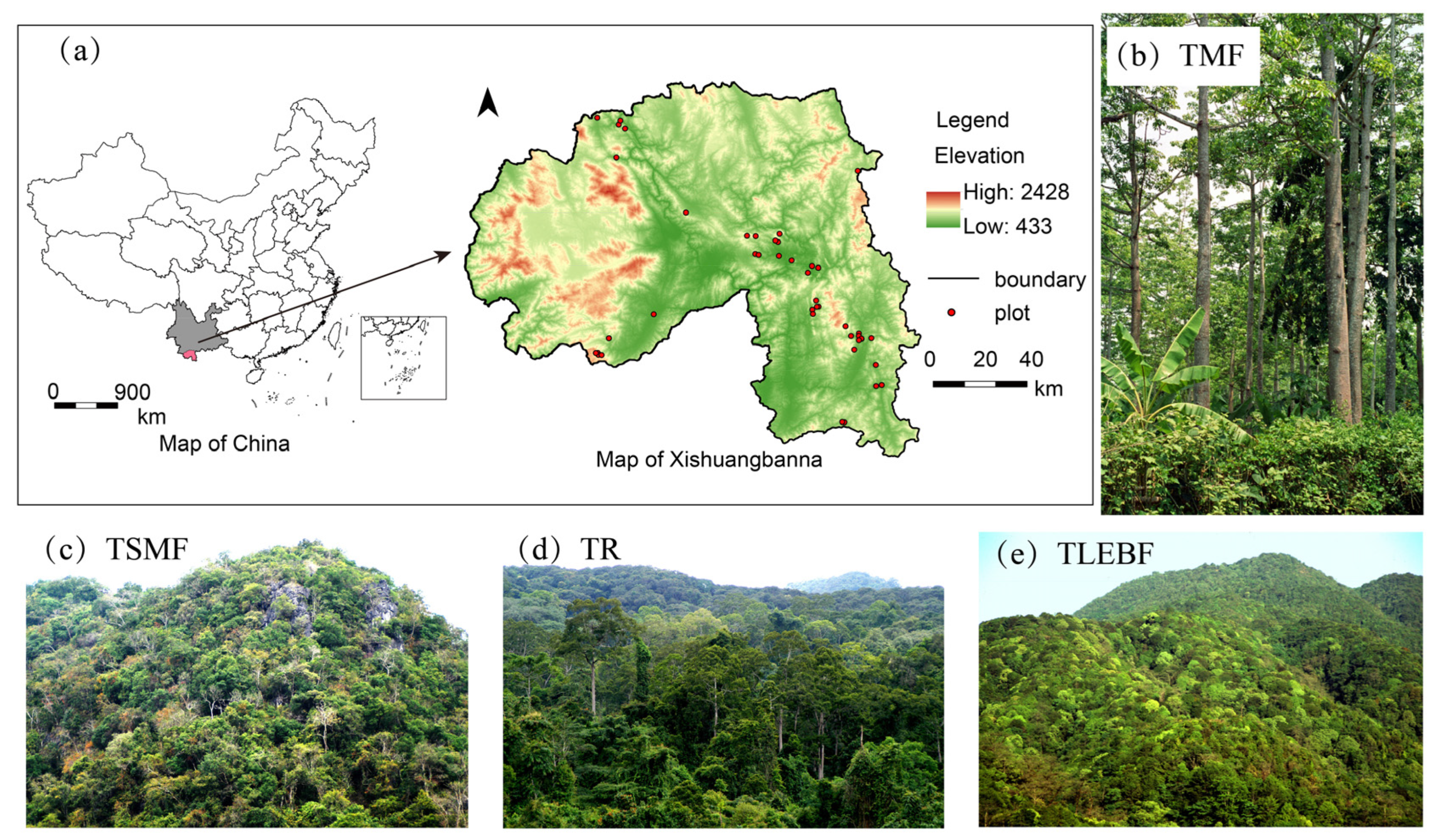
Figure 1. (a) Map of the study area, and photos of the landscape of forest types: (b) tropical monsoon forests (TMF), (c) tropical seasonal moist forests (TSMF), (d) tropical rainforest (TR), and (e) tropical low-montane evergreen broadleaf forests (TLEBF). Photographs in panels (be) were provided by Hua Zhu.
Diversity 17 00833 g001
Figure 2. Probability density estimations of biodiversity by vegetation type using bootstrap sampling. Red dots represent the median value of the probability density for 1000 measurements. Results of ANOVA are listed above each panel, and η2 indicates the effect size. The different letters on the right indicate significant differences at the p < 0.05 level. The x-axis in panels represents the following: (a) SR—species richness; (b) PD—phylogenetic diversity; (c) PDses—standardized phylogenetic diversity; (d) ses.MPD—standardized mean phylogenetic distance. The y-axis represents the following: TR—tropical rainforest; TSMF—tropical seasonal moist forest; TMF—tropical monsoon forest; TLEBF—tropical lower-montane evergreen broadleaf forest.
Diversity 17 00833 g002
Figure 3. (a) Scatterplot for discriminant analysis of the forest plots. The 95% confidence intervals are represented by ellipses. (b) VIP values showing the contribution of variables for potential difference in the PLS-DA model.
Diversity 17 00833 g003
Figure 4. NMDS ordination of 47 forest plots, arrows indicate the variables which were significantly correlated with the ordination plotted. TR—tropical rainforest; TSMF—tropical seasonal moist forest; TMF—tropical monsoon forest; TLEBF—tropical lower-montane evergreen broadleaf forest.
Diversity 17 00833 g004
Figure 5. Coefficient plots for multiple regressions between environmental variables and biodiversity metrics: (a) species richness; (b) PD—phylogenetic diversity; (c) PDses—standardized phylogenetic diversity; (d) ses.MPD—standardized mean phylogenetic distance; (e) variable important for variance explained. The circle represents the coefficient estimates for each predictor, and horizontal lines show their 95% confidence intervals. Asterisks above each circle denote significance levels of the factor.
Diversity 17 00833 g005
Table 1. Environmental variables for analysis.
Abbr.VariablesUnit
Bio4Temperature Seasonality (Standard Deviation × 100)%
Bio6Min Temperature of Coldest Month
Bio13Precipitation of Wettest Monthmm
Bio14Precipitation of Driest Monthmm
Bio15Precipitation Seasonality (Coefficient of Variation)%
Bio17Precipitation of Driest Quartermm
Bio18Precipitation of Warmest Quartermm
MAPanoAnnual Precipitation Anomaly since LGMmm
MATanoAnnual Mean Temperature Anomaly since LGM°C
LonLongitude°
LatLatitude°
TKSoil Total Potassiumg/100 g
TNSoil Total Nitrogeng/100 g
ANSoil Available Nitrogenmg/kg
APSoil Available Phosphorusmg/kg
H+Soil Exchangeable Hydrogen Ionme/100 g
Mg2+Soil Exchangeable Magnesium Ionme/100 g
Al3+Soil Exchangeable Aluminum Ionme/100 g
K+Soil Exchangeable Potassium Ionme/100 g
PHPH Soil PH (H2O)pH units
HFIHuman Footprint Index-
ELEElevationm
Disclaimer/Publisher’s Note: The statements, opinions and data contained in all publications are solely those of the individual author(s) and contributor(s) and not of MDPI and/or the editor(s). MDPI and/or the editor(s) disclaim responsibility for any injury to people or property resulting from any ideas, methods, instructions or products referred to in the content.