
Article

Cordyceps biarmica sp. nov., an Entomopathogenic Fungus from Boreal Forests of North European Russia

Laboratory of Mycology and Phytopathology and Laboratory of Microbiological Plant Protection, All-Russian Institute of Plant Protection (FSBSI VIZR), Pushkin, St. Petersburg 196608, Russia
*
Author to whom correspondence should be addressed.
Diversity 2025, 17(11), 762; https://doi.org/10.3390/d17110762
Submission received: 15 September 2025 / Revised: 20 October 2025 / Accepted: 28 October 2025 / Published: 1 November 2025
(This article belongs to the Special Issue Fungal Diversity)

Abstract

The European part of Russia has been characterized by a remarkably low documented diversity of entomopathogenic fungi, particularly when compared to the high species richness recorded in the Russian Far East. This pattern has persisted through decades of primarily morphology-based studies, which require critical reassessment using modern molecular methods. Here, we introduce a new species, Cordyceps biarmica, described from its asexual stage collected in the taiga of Arkhangelsk Oblast, representing a notable addition to the known diversity of the genus Cordyceps in the region. The fungus was isolated from a poorly preserved lepidopteran cocoon with pulvinate, unbranched conidiomata. Morphological features of its pure culture revealed an Isaria-like asexual morph characterized by solitary or verticillate phialides on a subspherical to subcylindrical base, bearing conidia in imbricate chains twisted in spirals. Multilocus phylogenetic analysis of a five-locus dataset (ITS, nrLSU, rpb1, rpb2, and tef1-α) was conducted using Maximum Likelihood and Bayesian Inference. The isolate was robustly placed within Cordyceps s.s., forming a distinct monophyletic lineage separate from other closely related well-supported taxa, including Cordyceps cateniannulata, C. exasperata, C. locastrae, C. polyarthra, C. sandindaengensis, and C. spegazzinii.

1. Introduction

The clavicipitoid fungi, a diverse and paraphyletic assemblage within the order Hypocreales (Sordariomycetes, Ascomycota), comprise specialized pathogens of arthropod, plant and fungal hosts. Their taxonomy, which has undergone substantial revision in past decades [1,2], is now organized into four distinct families, including Clavicipitaceae, Cordycipitaceae, Ophiocordycipitaceae, and Polycephalomycetaceae [3]. One of the earliest and most comprehensive studies on the biology and distribution of clavicipitoid entomopathogenic fungi in the former Soviet Union was conducted by Koval [4]. Although carried out prior to the widespread application of molecular methods and the subsequent global taxonomic revision of this group, it remains a foundational survey of species diversity and distribution in the country. In this study, Cordyceps Fr. s.l. (according to Kobayasi [5,6], Koval [7] and Mains [8]) exhibited the greatest species richness among entomopathogenic clavicipitoid fungi, with 64 species recorded. Particularly high diversity was observed in Primorsky Krai (e.g., Kedrovaya Pad Nature Reserve, Lazovsky Nature Reserve), where up to 60 species were documented. In contrast, only 17 species were reported from the European part of the country, 13 of which were also common in the eastern regions.
This pattern of distribution, with comparatively low species richness in European Russia, has largely persisted in subsequent decades. According to Borisov, the number of Cordyceps s.l. species reported from European Russia may be increased to 25, although these proposed additions, like the earlier records, were based solely on morphological traits [9,10,11,12,13]. In recent years, molecular-genetic approaches have substantially reshaped the taxonomy of clavicipitoid fungi: some taxa have been reclassified into related genera, others synonymized or invalidated, while several remain enigmatic [1,2,14]. Consequently, earlier records require careful reassessment, ideally using integrative approaches that combine morphological and molecular data.
Specifically, for the modern concept of Cordyceps s.s., the following species have been documented in the European part of Russia to date: Cordyceps bifusispora O.E. Erikss., C. coleopterorum (Samson & H.C. Evans) Kepler, B. Shrestha & Spatafora, C. farinosa (Holmsk.) Kepler, B. Shrestha & Spatafora, C. fumosorosea (Wize) Kepler, B. Shrestha & Spatafora, C. javanica (Bally) Kepler, B. Shrestha & Spatafora, C. militaris (L.) Fr., and C. tenuipes (Peck) Kepler, B. Shrestha & Spatafora. Other species, including C. deflectens Penz. & Sacc., C. doassansii Pat., C. erotyli Petch, C. thaxteri Mains, and C. variegata Moureau have also been reported from this region; however, their placement within the modern classification remains uncertain. These taxa were either not assigned to any genus in recent revisions, excluded from molecular phylogenetic analyses, or insufficiently characterized morphologically and ecologically. Thus, their taxonomic status remains unresolved.
Currently, taxonomic revisions of clavicipitoid fungi in Russia and neighboring countries that integrate contemporary phylogenetic approaches, remain sporadic [9,10,11,12,13,15,16]. In this study, we report the discovery of a new entomopathogenic fungus, which we assign to the genus Cordyceps s.s. based on combined molecular phylogenetic and morphological analyses. This finding provides a significant contribution to our understanding of the diversity and distribution of this group in the European part of Russia.

2. Materials and Methods

2.1. Sample Collection and Fungal Isolation

The entomopathogenic fungus characterized in this study was isolated from a single, fungus-infected lepidopteran pupa within its cocoon (Figure 1b,c). The specimen was collected in 2019 from a boreal forest in the Kargopolsky District (Arkhangelsk Oblast, Russia) and has been deposited in the Mycological Herbarium of the A.A. Jaczewskii Laboratory of Mycology and Phytopathology at the All-Russian Institute of Plant Protection (LEP; VIZR, Saint Petersburg, Russia). Fungal isolation was performed by transferring the conidial mass from the specimen onto Sabouraud dextrose agar (SDA; Difco, Detroit, MI, USA) using a sterile inoculating needle. Identification of the fungus was conducted based on the examination of macro- and micromorphological characteristics. For long-term preservation, the isolated pure culture is maintained on SDA in a microtube at 4 °C in the Mycological Collection of Pure Cultures at the A.A. Jaczewskii Laboratory of Mycology and Phytopathology (MF; VIZR, Saint Petersburg, Russia).

2.2. DNA Extraction, PCR and Sequencing

For DNA isolation, isolate was grown on SDA at 24 °C for 2 weeks. Mycelium was scraped from the surface of the medium to process using CTAB DNA extraction protocol [17]. Fragments of the internal transcribed spacer region (ITS), nuclear ribosomal large subunit (nrLSU), RNA polymerase II subunits 1 and 2 (rpb1, rpb2), and translation elongation factor 1-alpha (tef1-α) were amplified with primers ITS1/ITS4 [18], LR0R/LR5 [19,20], CRPB1A/RPB1Cr [21], fRPB2-5f/fRPB2-7cr [22], and EF1-983/EF1-2218 [23], respectively.
PCR reactions were conducted in a final volume of 20 µL, containing 2.0 µL of 10× PCR buffer, 0.5 µL of dNTP mix (10 mM), 0.5 µL of each primer (10 µM), 0.2 µL of Taq DNA polymerase (5 U/µL; Qiagen, Hilden, Germany), 1 µL of genomic DNA, and 15.3 µL of distilled water (diH2O). DNA amplification was carried out under conditions specific to each primer pair. Following amplification, the PCR products were separated by agarose gel electrophoresis, and target bands were excised and purified using silica particles [24]. Sanger sequencing was performed using a capillary DNA sequencer (ABI 3500; Applied Biosystems, Foster City, CA, USA).

2.3. Phylogenetic Studies

Nucleotide sequences were verified and manually edited using Vector NTI Advance 11.5.1 software (Life Technologies, Carlsbad, CA, USA). Consensus sequences of the target isolates were compared against the GenBank database (https://blast.ncbi.nlm.nih.gov/Blast.cgi (accessed on 1 August 2025)) using BLAST to identify the closest species complex [25]. Sequences generated in this study, along with reference sequences retrieved from GenBank (Table S1), were aligned using the MUSCLE algorithm [26]. Loci were concatenated using SequenceMatrix 1.7.3 [27] to construct a dataset for multilocus phylogenetic analysis. Phylogenetic reconstruction was performed using both Maximum Likelihood (ML) and Bayesian Inference (BI) methods.
ML analysis of the concatenated dataset was performed in IQ-TREE v. 2 employing 10,000 ultrafast bootstrap replicates (-bb) and 10,000 SH-aLRT replicates (-alrt) [28,29,30,31]. Model selection for each locus was performed automatically with the -m test option, restricting candidate models to those compatible with BI using the -mset mrbayes option. Branch lengths were optimized during bootstrapping using nearest-neighbor interchange (-bnni). BI analysis was performed in MrBayes v. 3.2.6 [32,33] using four independent runs of 107 generations, with sampling every 1000 generations. The first 25% of generations were discarded as burn-in, and posterior probabilities (PP) were calculated from the remaining trees. A 50% majority-rule consensus tree was generated and visualized using FigTree 1.4.4. Phylogenetic data were further analyzed and visualized in MEGA X [34]. Sequences obtained in this study were deposited in GenBank (https://www.ncbi.nlm.nih.gov/genbank (accessed on 1 August 2025)).

2.4. Morphology

Pure culture of studied isolate was incubated on Potato Sucrose Agar (PSA) and Synthetic Nutrient-Deficient Agar (SNA) [35]. Petri dishes were incubated (1 wk in darkness and then for 1 wk under 12 h near-ultraviolet light/12 h dark to stimulate sporulation). Colony diameter was measured and colony morphology was examined after 14 d. Conidia were observed and measured with an Olympus SZX16 stereomicroscope (Olympus, Tokyo, Japan) and an Olympus BX53 microscope. Images were captured with a Prokyon camera (Jenoptik, Jena, Germany) with Nomarski differential interference contrast.

2.5. Artificial Infection

To obtain fresh material and gain a clearer understanding of the morphological features, an artificial infection assay was performed. The conidial suspension was obtained from fungal cultures maintained on SDA for three weeks at 24 °C. The conidial mass was then carefully washed with sterile phosphate-buffered saline (PBS). The concentration of the resulting suspension was determined using a hemocytometer, and it was subsequently diluted with PBS to a final concentration of 1 × 10⁶ conidia/mL. Five tobacco hornworm (Manduca sexta) larvae were artificially infected via intrahemocoelic injection of 10 µL of this conidial suspension. The inoculated larvae were then transferred to plastic polypropylene containers lined with sterile, moist sphagnum moss and incubated at 20 °C under a 12: 12 h (light: dark) photoperiod.

3. Results

3.1. Phylogeny

Alignments were performed using a total of 131 strains, including Cordyceps cateniannulata (Z.Q. Liang) Kepler, B. Shrestha & Spatafora genome-derived sequences from isolates MBC 771 and MBC 895. These specific sequences were used to define the genetic boundaries between C. cateniannulata and studied strain. Sequences from Beauveria bassiana (Bals.-Criv.) Vuill. strain ARSEF 1564 were used as an outgroup to root the phylogenetic tree. A final dataset consisted of 3969 positions, 540 from the ITS alignment, 806 from the nrLSU, 682 from the rpb1, 976 from the rpb2 and 965 from the tef1-α. The best-fit substitution model for the concatenated dataset according to the BIC was GTR+F.
Phylogenetic tree inferred from the concatenated ITS, nrLSU, rpb1, rpb2, and tef1-α sequences of Cordyceps spp., showing the distinct position of our isolate within the genus Cordyceps therefore, described below as a new species Cordyceps biarmica sp. nov. (Figure 1a).

3.2. Taxonomy

Cordyceps biarmica Kazartsev & Gomzhina sp. nov. MycoBank 861013 (Figure 1b,c and Figure 2).
Typification: Holotype LEP 97188 represents poorly preserved, fragile lepidopteran cocoon with pulvinate, unbranched conidiomata, collected in Russia, Arkhangelsk Oblast, Kargopolsky District, 61°50′05.4″ N 39°05′57.0″ E, 105 m a.s.l., 10 August 2019, Igor Kazartsev. Ex-holotype living culture CIn318Ak19; ITS, nrLSU, rpb1, rpb2, and tef1-α sequences GenBank PV267363, PV267362, PV288856, PV288857 and PV288855, respectively.
Additional material examined: not available.
Etymology: Named after the region of ‘Biarmia’ (eng. Bjarmia, Bjarmaland), the Latin name for the ancient region mentioned in Norse sagas, generally thought to encompass the southern shores of the White Sea and the basin of the Northern Dvina River, areas that are now part of Arkhangelsk Oblast in Russia, where the species was first discovered.
Sexual morph: not observed.
Asexual morph: Isaria-like.
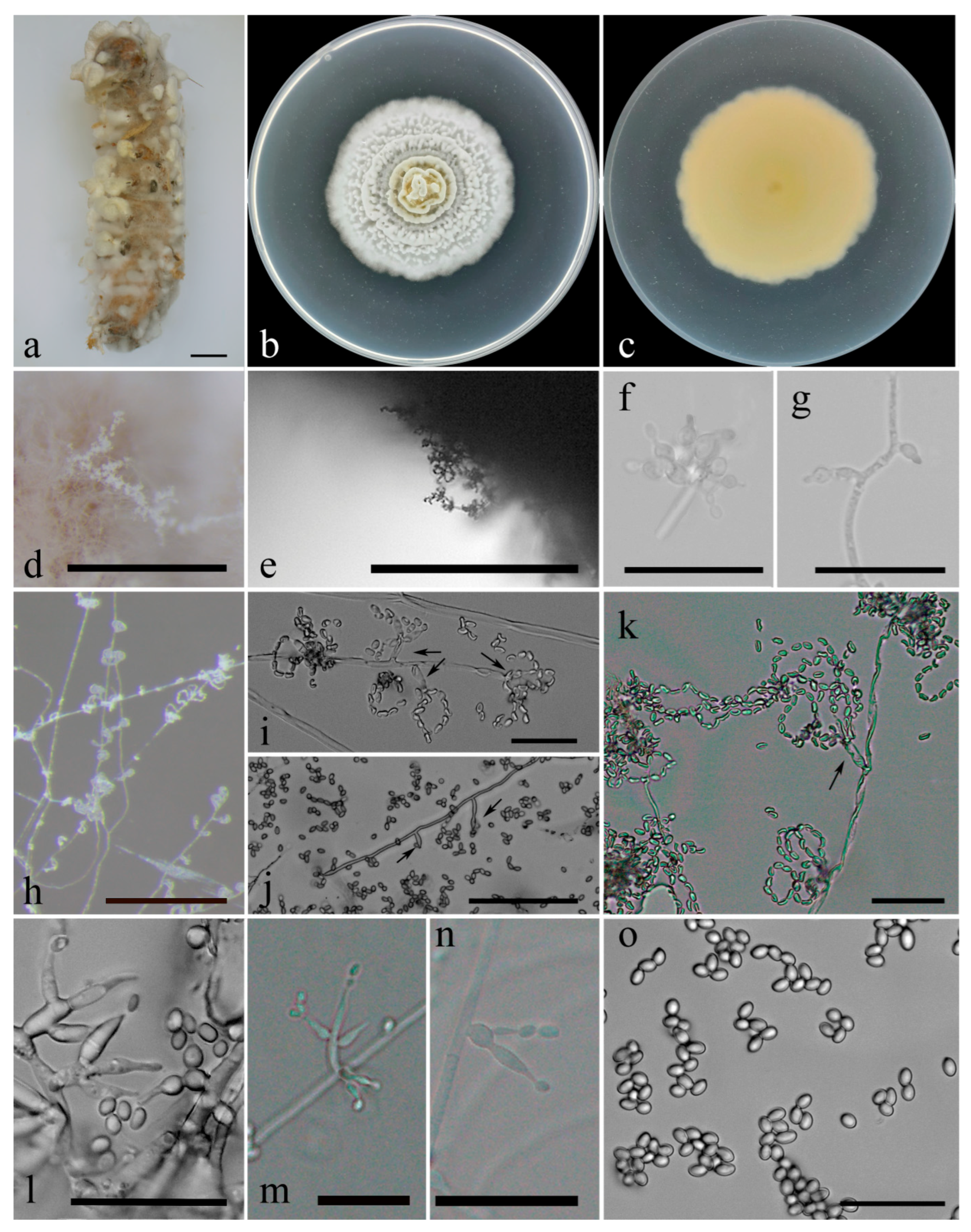
On Insecta: Conidiomata pulvinate, unbranched, covered with numerous joined conidiophores bearing white, powdery conidia. Hyphae smooth-walled, branched, septate, hyaline 1.05–2.16 (1.49 ± 0.07) μm width. Conidiophores erect, hyaline, and smooth-walled, simple or rarely branched, with phialides solitary or in whorls of two to five on a subspherical to subcylindrical base. Phialides 3.75–5.52 (4.59 ± 0.14) × 1.75–2.93 (2.35 ± 0.08) μm, with a subglobose to flask-shaped basal portion, tapering into a distinct neck. Conidia in chains, often twisted in spirals, hyaline, 1-celled, mostly obovoid with one end slightly acuate, 2.26–3.44 (2.72 ± 0.03) × 1.6–2.5 (1.97 ± 0.02) μm.
On PSA: Hyphae smooth-walled, branched, septate, hyaline 1.25–2.81 (1.87 ± 0.09) μm. Conidiophores erect, hyaline, and smooth-walled, simple or rarely branching, with phialides solitary or in whorls of two to five on a subspherical to subcylindrical base. Phialides 3.98–10.79 (6.82 ± 0.3) × 1.83–2.89 (2.33 ± 0.06) μm, with a subglobose to flask-shaped basal portion, tapering into a distinct neck. Conidia in long chains branched (from 20 and more conidia) or unbranched, often twisted in spirals, hyaline, 1-celled, mostly obovoid with one end slightly acuate, 2.39–3.82 (3.1 ± 0.02) × 1.53–2.35 (1.92 ± 0.02) μm.
On SNA: Hyphae smooth-walled, branched, septate, hyaline 1.5–2.99 (2.26 ± 0.08) μm width. Conidiophores erect, hyaline, and smooth-walled, simple or rarely branching, with phialides solitary or in whorls of two to five on a subspherical to subcylindrical base. Phialides 5.4–9.43 (7.2 ± 0.2) × 2.02–3.58 (2.62 ± 0.07) μm, with a subglobose to flask-shaped basal portion, tapering into a distinct neck. Conidia in long chains, often twisted in spirals, hyaline, 1-celled, mostly obovoid with one end slightly acuate, 2.2–3.95 (3.24 ± 0.04) × 1.6–2.35 (1.84 ± 0.02) μm.
Culture characteristics: On PSA colonies moderately fast-growing, 45–47 mm in diameter after 14 days, the surface is cottony, textured by numerous dense mycelial tufts, merging into concentric rings near the center and labyrinthine at the periphery, margin slightly lobate, whole colony whitish, dark yellow-brown in the center, reverse sandy yellow. On SNA growth appears sparse, with scattered, radially spreading hyphae.
Habit, Habitat & Distribution: The specimen is known from a single locality in a taiga forest dominated by small-leaved trees. This area was also noted for an abundance of C. militaris on lepidopteran pupae.
Notes: Cordyceps biarmica sp. nov. forms cushion-like, non-branching synnemata on the host, contrasting with elongated and sometimes branching synnemata of species like Cordyceps cateniannulata, C. locastrae W.Y. Chuang & Ariy., C. polyarthra Möller, and C. sandindaengensis Mongkols., Noisrip. & Luangsa-ard. Morphologically, C. biarmica is highly similar to C. cateniannulata, in which conidial chains typically lie broadside to each other and stick together to form rings or irregular masses. The conidia of C. cateniannulata are somewhat narrower, measuring 2–3.5 × 1–1.5 μm [36,37], though larger dimensions are also reported [38,39]. Other closely related species with described asexual stage like C. locastrae, C. polyarthra, C. sandindaengensis, and C. spegazzinii M.S. Torres, J.F. White & J.F. Bisch. (Figure 1a), typically produce zipper-like conidial chains. A direct morphological comparison between C. biarmica and C. exasperata A.F. Vital is problematic, as the anamorph of the latter species remains undescribed. Similarly to the majority of species, except for C. spegazzinii, C. biarmica has been recorded on a lepidopteran host.

4. Discussion

The genus Cordyceps s.s. has a cosmopolitan distribution, with its highest known species diversity concentrated in the subtropical and tropical regions of East and Southeast Asia [1]. It is therefore particularly noteworthy that a previously undocumented lineage within this genus, C. biarmica sp. nov., has been discovered in the boreal ecosystem of the European part of Russia. This finding, confirmed through a combined morphological and phylogenetic approach, represents a significant addition to the regional mycobiota, which is characterized by a relatively low known diversity of cordycipitoid fungi.
The new species was isolated from a poorly preserved lepidopteran cocoon, which limited the initial morphological characterization. To overcome this, we successfully established a pure culture and conducted an artificial infection assay on M. sexta larvae. Larval mortality was observed on the 5th day post-inoculation. This material provided robust, fresh material for a comprehensive morphological description, confirming an Isaria-like asexual morph. A single larval specimen representing the studied material was deposited under accession number LEP 97189.
The definitive distinction of C. biarmica from its closest relatives was achieved through a five-locus (ITS, nrLSU, rpb1, rpb2, tef1-α) phylogenetic analysis. Our results robustly place C. biarmica in a distinct monophyletic lineage, clearly separated from the well-supported C. cateniannulata and other genetically related taxa such as C. exasperata, C. locastrae, C. polyarthra, C. sandindaengensis, and C. spegazzinii. The inclusion of genome-derived sequences from key C. cateniannulata isolates (MBC 771, MBC 895) was critical for precisely defining the genetic boundaries between these species, eliminating any ambiguity regarding its status as a novel taxon. The fact that a new species was found in a single locality within the European taiga suggests that the diversity of entomopathogenic fungi in this area is greater than historically documented and is likely still underestimated. The generally low diversity in this region can be explained by the Pleistocene glaciation events, which profoundly reshaped the landscapes of Northern Eurasia and caused widespread extinction of local biotas. Against this backdrop, the discovery of a new species in the European taiga raises the possibility that its origin could be linked to one of two scenarios: survival in a glacial microrefugium, which would designate it as a relict lineage, or post-glacial recolonization followed by rapid speciation in isolation.

Supplementary Materials

The following supporting information can be downloaded at: https://www.mdpi.com/article/10.3390/d17110762/s1, Table S1: Isolates and GenBank accession numbers used in the phylogenetic analyses of Cordyceps sensu stricto.

Author Contributions

Conceptualization, I.K.; methodology, M.L. and M.G.; validation, I.K., M.G. and G.L.; formal analysis, I.K. and M.G.; investigation, I.K., M.G. and G.L.; data curation, I.K.; writing—original draft preparation, I.K. and M.G.; writing—review and editing, I.K. and M.G.; visualization, I.K. and M.G.; supervision, I.K.; project administration, I.K.; funding acquisition, I.K. All authors have read and agreed to the published version of the manuscript.

Funding

I.A. Kazartsev and colleagues are grateful to Russian Science Foundation (RSF) for providing the funds for this research (grant number 25-24-00287).

Institutional Review Board Statement

Not applicable.

Data Availability Statement

The datasets generated during the current study (ITS, nrLSU, rpb1, rpb2, tef1-α) are available in the GenBank repository.

Acknowledgments

We extend our gratitude to Oksana G. Tomilova for her guidance in methodologies for the artificial infection of insects and to Boris A. Borisov for his valuable insights into the biodiversity of entomopathogenic fungi in Russia. The study was conducted using the equipment of the Shared Research Facility “Innovative Plant Protection Technologies” at the All-Russian Institute of Plant Protection (VIZR).

Conflicts of Interest

The authors declare no conflict of interest.

References

  1. Sung, G.-H.; Hywel-Jones, N.L.; Sung, J.-M.; Luangsa-Ard, J.J.; Shrestha, B.; Spatafora, J.W. Phylogenetic classification of Cordyceps and the clavicipitaceous fungi. Stud. Mycol. 2007, 57, 5–59. [Google Scholar] [CrossRef] [PubMed]
  2. Kepler, R.M.; Luangsa-Ard, J.J.; Hywel-Jones, N.L.; Quandt, C.A.; Sung, G.-H.; Rehner, S.A.; Aime, M.C.; Henkel, T.W.; Sanjuan, T.; Zare, R.; et al. A phylogenetically-based nomenclature for Cordycipitaceae (Hypocreales). IMA Fungus 2017, 8, 335–353. [Google Scholar] [CrossRef]
  3. Xiao, Y.-P.; Wang, Y.B.; Hyde, K.D.; Eleni, G.; Sun, J.-Z.; Yang, Y.; Meng, J.; Yu, H.; Wen, T.-C. Polycephalomycetaceae, a new family of clavicipitoid fungi segregates from Ophiocordycipitaceae. Fungal Divers. 2023, 120, 1–76. [Google Scholar] [CrossRef]
  4. Koval, E.Z. Klavitsipitalnye Griby SSSR [Clavicipitalean Fungi of the USSR]; Naukova Dumka: Kiev, Russia, 1984; 288p. [Google Scholar]
  5. Kobayasi, Y. The genus Cordyceps and its allies. Sci. Rep. Tokyo Bunrika Daigaku Sect. B 1941, 84, 53–260. [Google Scholar]
  6. Kobayasi, Y. Keys to the taxa of the genera Cordyceps and Torrubiella. Trans. Mycol. Soc. Jpn. 1982, 23, 329–364. [Google Scholar]
  7. Koval, E.Z. Opredelitel Entomofilnych Gribov SSSR [Key to the Entomophilous Fungi of the USSR]; Naukova Dumka: Kiev, Russia, 1974; 260p. [Google Scholar]
  8. Mains, E.B. North American entomogenous species of Cordyceps. Mycologia 1958, 50, 169–222. [Google Scholar] [CrossRef]
  9. Borisov, B.A. Pathogens of fungal diseases of invertebrates in the “Kaluzhskiye Zaseki” Nature Reserve: Study results from the southern tract and adjacent areas. In Trudy Gosudarstvennogo prirodnogo zapovednika «Kaluzhskie zaseki» [State Nature Reserve “Kaluzhskiye Zaseki”]; Alekseev, S.K., Ed.; Ejdos: Kaluga, Russia, 2012; Volume 2, pp. 29–73. [Google Scholar]
  10. Borisov, B.A.; Alexandrova, A.V. Zooparazitic Cordycipitoid Fungi of the Moscow Region. In Proceedings of the Sovremennaya Mikologiya v Rossii, Materialy Tretego Sjezda Mikologov Rossii [Modern Mycology in Russia, Third Congress of Russian Mycologists], Moscow, Russia, 10–12 October 2012; Volume 3. [Google Scholar]
  11. Borisov, B.A. Zooparazitic Cordycipitoid Fungi (Ascomycota: Hypocreales) of the Sochi National Park and Adjacent Territory. In Proceedings of the Bioraznoobrazie i Ekologiya Gribov i Gribopodobnyh Organizmov Severnoj Evrazii, Materialy Vserossijskoj Konferencii s Mezhdunarodnym Uchastiem [Biodiversity and Ecology of Fungi and Fungus-like Organisms of Northern Eurasia, Proceedings of the All-Russian Conference with International Participation], Ekaterinburg, Russia, 20–24 April 2015. [Google Scholar]
  12. Prokhorov, V.P.; Borisov, B.A.; Voronina, E.Y.; Alexandrova, A.V. New data on Sordariomycetes and Dothideomycetes at the territory of Moscow State University Zvenigorod biological station and Sima open pit wildlife refuge. Mikol. Fitopatol. 2015, 49, 359–365. [Google Scholar]
  13. Borisov, B.A. Detection of tropical arthropod-pathogenic fungi Conoideocrella luteorostrata and Cordyceps thaxteri in the Moscow Region—New examples of the biota’s response to climate warming? In Proceedings of the Sovremennaya Mikologiya v Rossii, Materialy Chetvyortogo Sjezda Mikologov Rossii [Modern Mycology in Russia, Proceedings of the Fourth Congress of Russian mycologists], Moscow, Russia, 12–14 April 2017; Volume 6. [Google Scholar]
  14. Shrestha, B.; Tanaka, E.; Han, J.G.; Oh, J.; Han, S.K.; Lee, K.H.; Sung, G.H. A brief chronicle of the genus Cordyceps Fr., the oldest valid genus in Cordycipitaceae (Hypocreales, Ascomycota). Mycobiology 2014, 42, 93–99. [Google Scholar] [CrossRef]
  15. Borisov, B.A.; Alexandrova, A.V.; Antonov, E.A. An unusual discovery on the Kola Peninsula: The Cordyceps militaris fungi as an aphid parasite. In Proceedings of the Sovremennaya Mikologiya v Rossii, Materialy Mezhdunarodnogo Mikologicheskogo Foruma [Modern Mycology in Russia, Proceedings of the International Mycological Forum], Moscow, Russia, 22–23 May 2024; Volume 10. [Google Scholar]
  16. Zha, L.-S.; Kryukov, V.Y.; Ding, J.-H.; Jeewon, R.; Chomnunti, P. Novel taxa and species diversity of Cordyceps sensu lato (Hypocreales, Ascomycota) developing on wireworms (Elateroidea and Tenebrionoidea, Coleoptera). MycoKeys 2021, 78, 79–117. [Google Scholar] [CrossRef]
  17. Doyle, J.J.; Doyle, J.L. A rapid DNA isolation procedure for small quantities of fresh leaf tissue. Phytochem. Bull. 1987, 19, 11–15. [Google Scholar]
  18. White, T.J.; Bruns, T.D.; Lee, S.B.; Taylor, J.W. Amplification and direct sequencing of fungal ribosomal RNA genes for phylogenetics. In PCR Protocols: A Guide to Methods and Applications; Academic Press: San Diego, CA, USA, 1990; pp. 315–322. [Google Scholar]
  19. Vilgalys, R.; Hester, M. Rapid genetic identification and mapping of enzymatically amplified ribosomal DNA from several Cryptococcus species. J. Bacteriol. 1990, 172, 4238–4246. [Google Scholar] [CrossRef]
  20. Rehner, S.A.; Samuels, G.J. Molecular systematics of the Hypocreales: A teleomorph gene phylogeny and the status of the anamorphs. Can. J. Bot. 1995, 73, 816–823. [Google Scholar] [CrossRef]
  21. Castlebury, L.A.; Rossman, A.Y.; Sung, G.-H.; Hyten, A.S.; Spatafora, J.W. Multigene phylogeny reveals new lineage for Stachybotrys chartarum, the indoor air fungus. Mycol. Res. 2004, 108, 864–872. [Google Scholar] [CrossRef]
  22. Liu, Y.J.; Whelen, S.; Hall, B.D. Phylogenetic relationships among ascomycetes: Evidence from an RNA polymerase II subunit. Mol. Biol. Evol. 1999, 16, 1799–1808. [Google Scholar] [CrossRef]
  23. Rehner, S.A.; Buckley, E. A Beauveria phylogeny inferred from nuclear ITS and EF1-α sequences: Evidence for cryptic diversification and links to Cordyceps teleomorph. Mycologia 2005, 97, 84–98. [Google Scholar] [CrossRef] [PubMed]
  24. Vogelstein, B.; Gillespie, D. Preparative and analytical purification of DNA from agarose. Proc. Natl. Acad. Sci. USA 1979, 76, 615–619. [Google Scholar] [CrossRef] [PubMed]
  25. Altschul, S.F.; Gish, W.; Miller, W.; Myers, E.W.; Lipman, D.J. Basic local alignment search tool. J. Mol. Biol. 1990, 215, 403–410. [Google Scholar] [CrossRef] [PubMed]
  26. Edgar, R.C. MUSCLE: A multiple sequence alignment method with reduced time and space complexity. BMC Bioinform. 2004, 5, 113. [Google Scholar] [CrossRef]
  27. Vaidya, G.; Lohman, D.J.; Meier, R. SequenceMatrix: Concatenation software for the fast assembly of multi-gene datasets with character set and codon information. Cladistics 2011, 27, 171–180. [Google Scholar] [CrossRef] [PubMed]
  28. Minh, B.Q.; Nguyen, M.A.; von Haeseler, A. Ultrafast approximation for phylogenetic bootstrap. Mol. Biol. Evol. 2013, 30, 1188–1195. [Google Scholar] [CrossRef]
  29. Chernomor, O.; von Haeseler, A.; Minh, B.Q. Terrace aware data structure for phylogenomic inference from supermatrices. Syst. Biol. 2016, 65, 997–1008. [Google Scholar] [CrossRef]
  30. Hoang, D.T.; Chernomor, O.; Von Haeseler, A.; Minh, B.Q.; Vinh, L.S. UFBoot2: Improving the ultrafast bootstrap approximation. Mol. Biol. Evol. 2018, 35, 518–522. [Google Scholar] [CrossRef]
  31. Minh, B.Q.; Schmidt, H.A.; Chernomor, O.; Schrempf, D.; Woodhams, M.D.; von Haeseler, A.; Lanfear, R. IQ-TREE 2: New models and efficient methods for phylogenetic inference in the genomic era. Mol. Biol. Evol. 2020, 37, 1530–1534. [Google Scholar] [CrossRef]
  32. Ronquist, F.; Huelsenbeck, J.P. MrBayes 3: Bayesian phylogenetic inference under mixed models. Bioinformatics 2003, 19, 1572–1574. [Google Scholar] [CrossRef]
  33. Ronquist, F.; Teslenko, M.; van der Mark, P.; Ayres, D.L.; Darling, A.; Höhna, S.; Larget, B.; Liu, L.; Suchard, M.A.; Huelsenbeck, J.P. MrBayes 3.2: Efficient Bayesian phylogenetic inference and model choice across a large model space. Syst. Biol. 2012, 61, 539–542. [Google Scholar] [CrossRef]
  34. Kumar, S.; Stecher, G.; Li, M.; Knyaz, C.; Tamura, K. MegaX: Molecular evolutionary genetics analysis across computing platforms. Mol. Biol. Evol. 2018, 35, 1547–1549. [Google Scholar] [CrossRef]
  35. Samson, R.A.; Hoekstra, E.S.; Frisvad, J.C. Introduction to Food- and Airborne Fungi, 3rd ed.; Centraalbureau voor Schimmelcultures: Utrecht, The Netherlands, 2004; p. 389. [Google Scholar]
  36. Liang, Z.Q. Two new species of Paecilomyces from insects. Acta Microbiol. Sin. 1981, 21, 31–34. [Google Scholar]
  37. Liang, Z.Q.; Han, Y.F.; Chu, H.L.; Liu, A.Y. Studies on the genus Paecilomyces in China. I. Fungal Divers. 2005, 20, 83–101. [Google Scholar]
  38. Shimazu, M. Paecilomyces cateniannulatus Liang, a commonly found, but an unrecorded entomogenous fungus in Japan. Appl. Entomol. Zool. 2001, 36, 283–288. [Google Scholar] [CrossRef]
  39. Wei, D.P.; Gentekaki, E.; Wanasinghe, D.N.; Tang, S.M.; Hyde, K.D. Diversity, molecular dating and ancestral characters state reconstruction of entomopathogenic fungi in Hypocreales. Mycosphere 2022, 13, 281–351. [Google Scholar] [CrossRef]
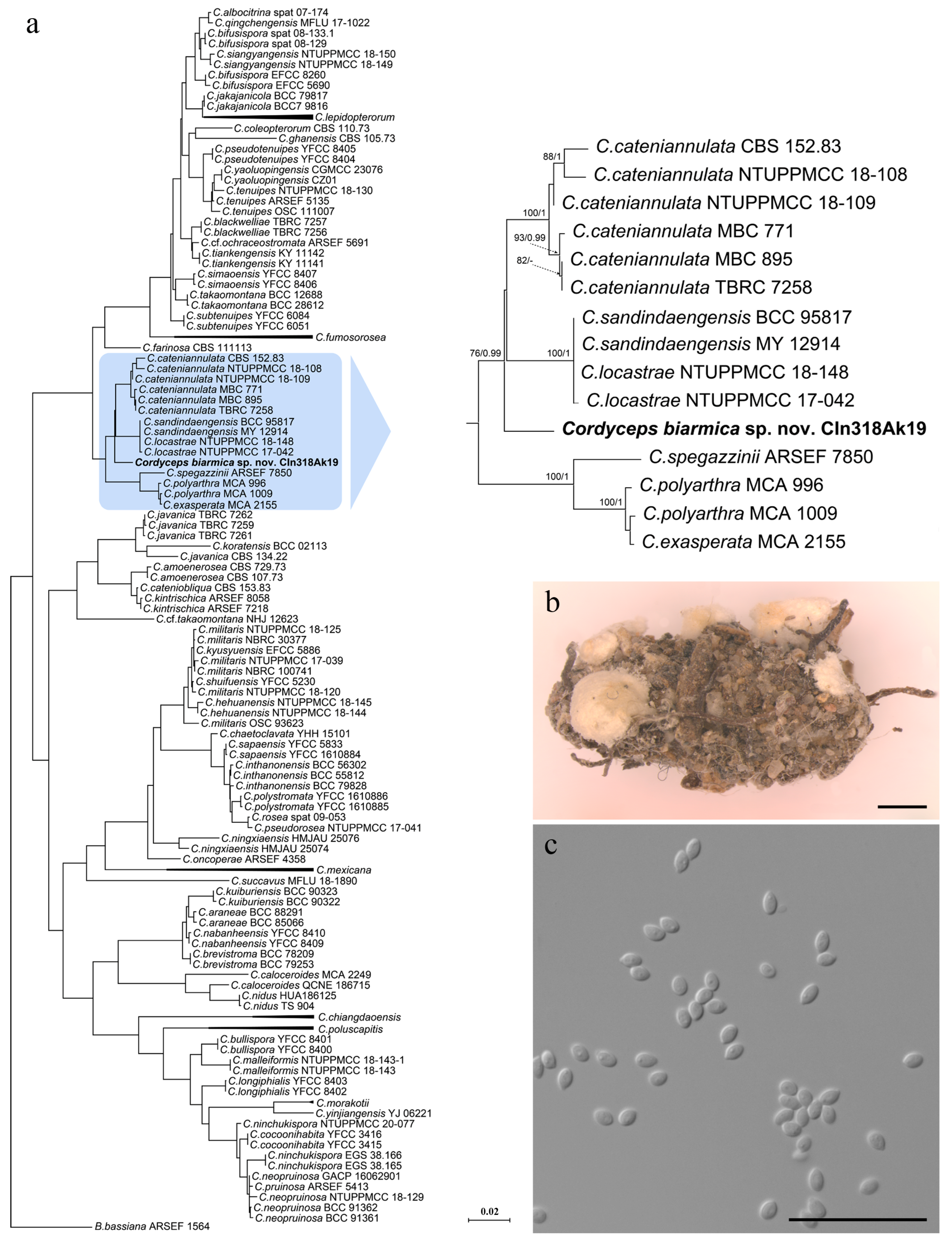
Figure 1. (a) Phylogenetic tree of Cordyceps spp. based on a maximum likelihood analysis of concatenated ITS, nrLSU, rpb1, rpb2, and tef1-α sequences, showing the position of Cordyceps biarmica sp. nov. within the genus. Bootstrap support values ≥ 75% and Bayesian posterior probabilities ≥ 0.95 are shown at the nodes of an enlarged tree fragment. Beauveria bassiana ARSEF 1564 was used as the outgroup. The ex-type strain of Cordyceps biarmica sp. nov. is highlighted in bold. Some well-supported clades were collapsed for layout clarity. (b) Holotype LEP 97188, a poorly preserved and fragile lepidopteran cocoon with pulvinate, unbranched conidiomata. (c) Conidia from its conidiomata. Scale bars: (b) = 1 mm and (c) = 20 μm, respectively.
Diversity 17 00762 g001
Figure 2. Cordyceps biarmica sp. nov. (ex-holotype culture CIn318Ak19). (a) Artificially inoculated tobacco hornworm (Manduca sexta) larva exhibiting conidiomata development; (b,c) Fungal culture on PSA after 14 d of growth (front and reverse); (d,e) Conidiophores bearing spiral conidial chains emerging from conidiomata on larval surface (reflected and transmitted light, respectively); (f) Whorls of phialides from the surface of artificially inoculated larva; (g) Single phialides from the surface of artificially inoculated larva; (h,k) Spiral chains of conidia from PSA after 14 d of growth (reflected and transmitted light, respectively); (j,l) Phialides from PSA after 14 d of growth; (i,m,n) Phialides from SNA after 14 d of growth; (o) Conidia from PSA after 14 d of growth. Scale bars: (a) = 2 mm, (d) = 500 μm, (e,h) = 200 μm, (j) = 50 μm, (f,g,i,ko) = 20 μm. Arrows indicate phialides.
Diversity 17 00762 g002
Disclaimer/Publisher’s Note: The statements, opinions and data contained in all publications are solely those of the individual author(s) and contributor(s) and not of MDPI and/or the editor(s). MDPI and/or the editor(s) disclaim responsibility for any injury to people or property resulting from any ideas, methods, instructions or products referred to in the content.