
Comparison of Gut Microbial Ecology of Captive and Wild Water Deer for Understanding Mammalian Ecology and Conservation



Abstract
1. Introduction
2. Materials and Methods
2.1. Fecal Sample Collection
2.2. Bioinformatics Analysis
3. Results
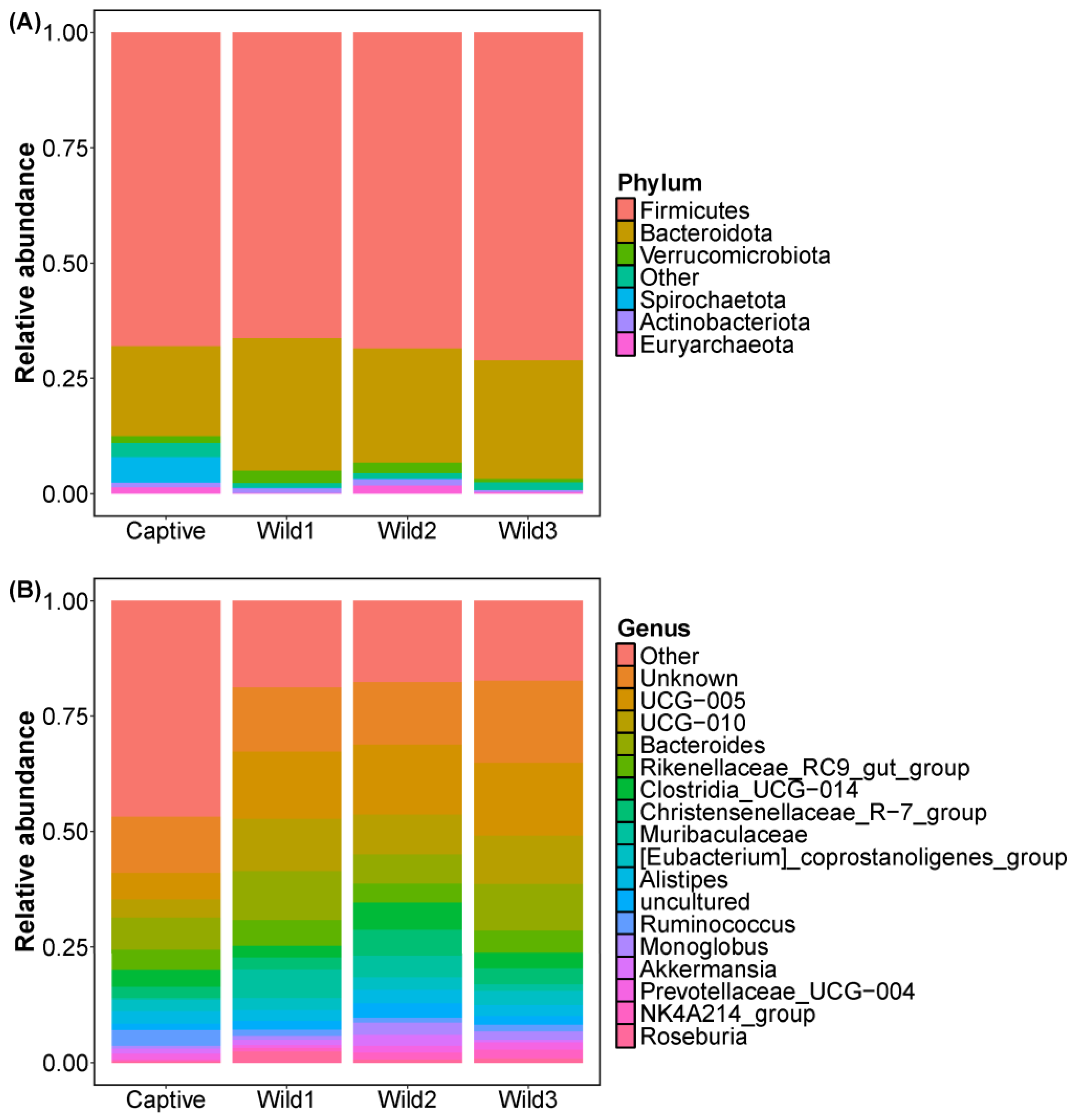
3.1. Relative Abundance
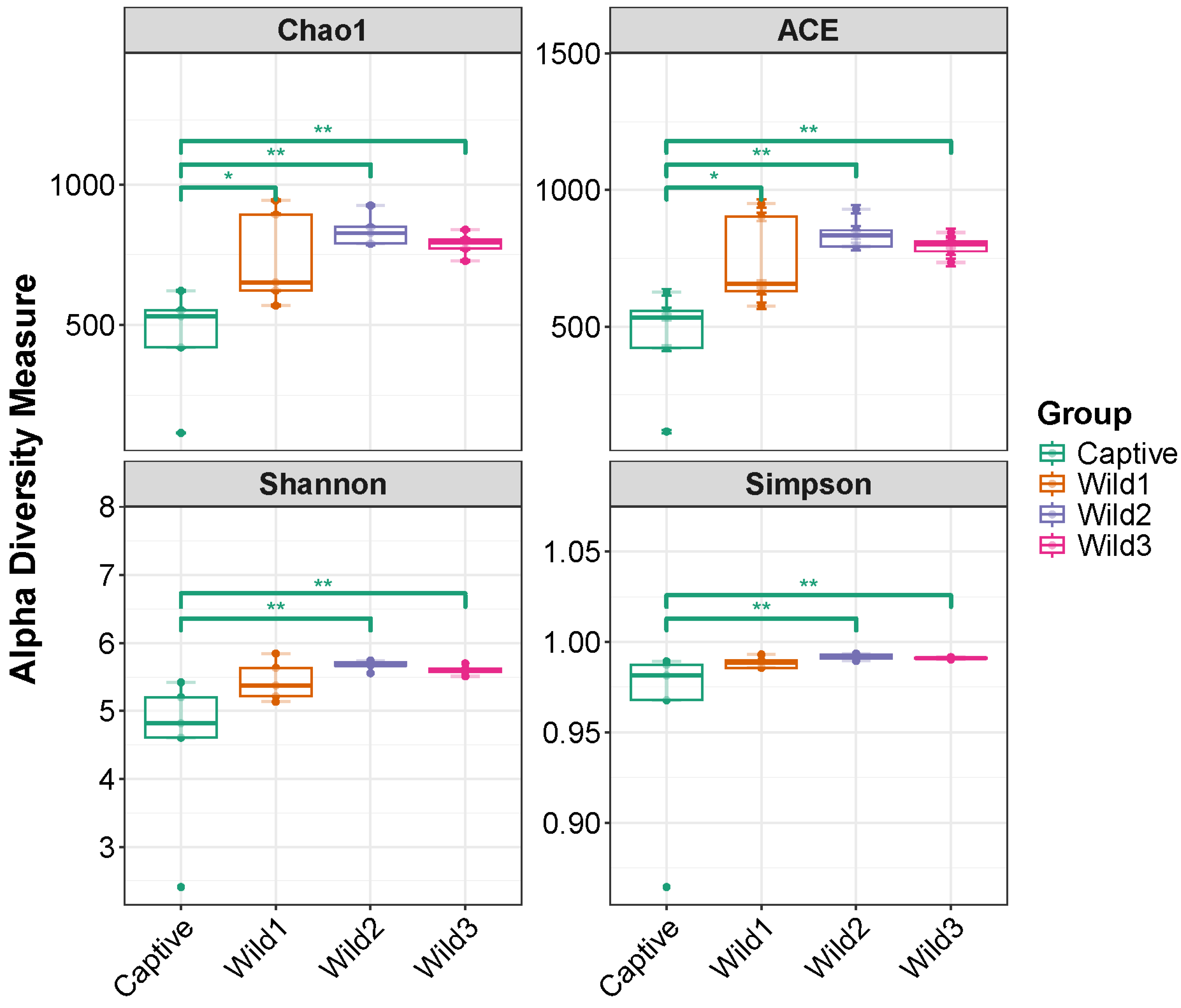
3.2. Alpha Diversity
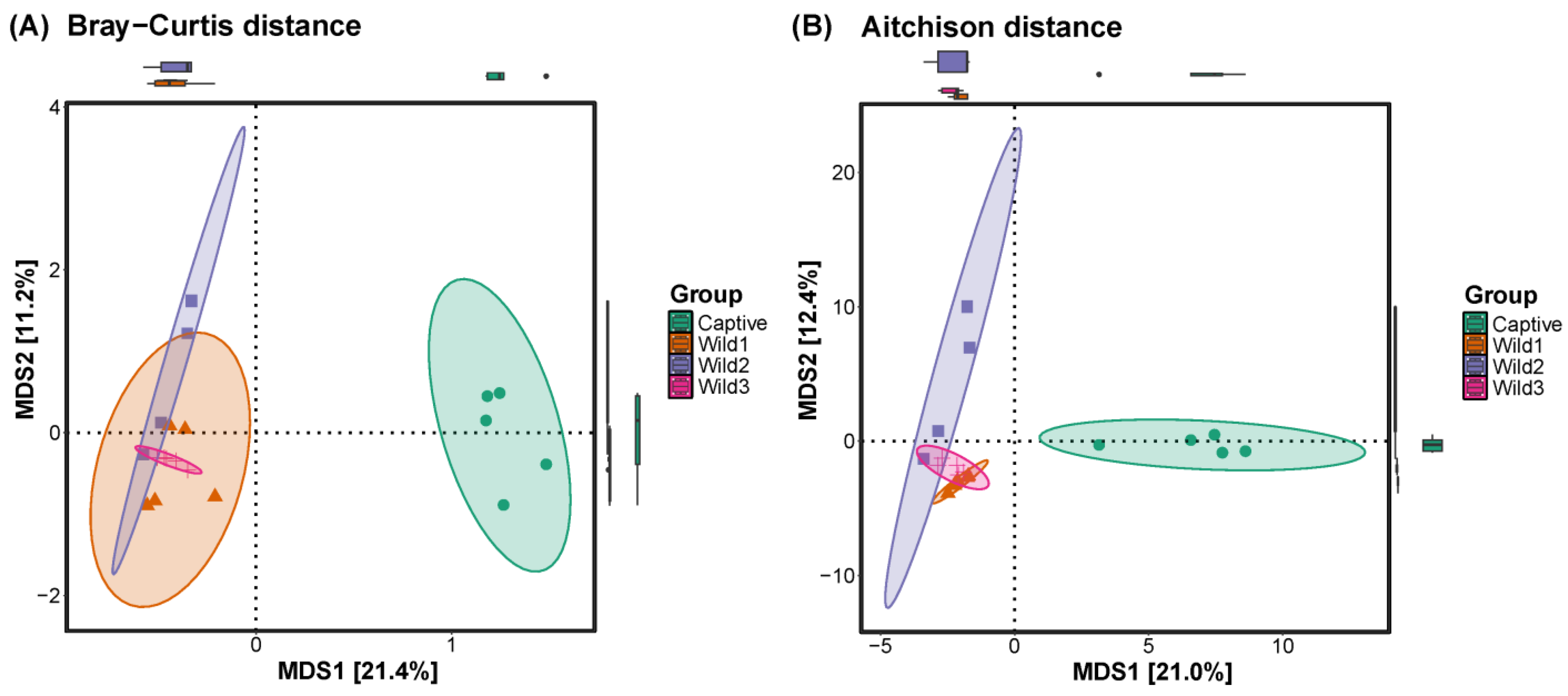
3.3. Beta Diversity
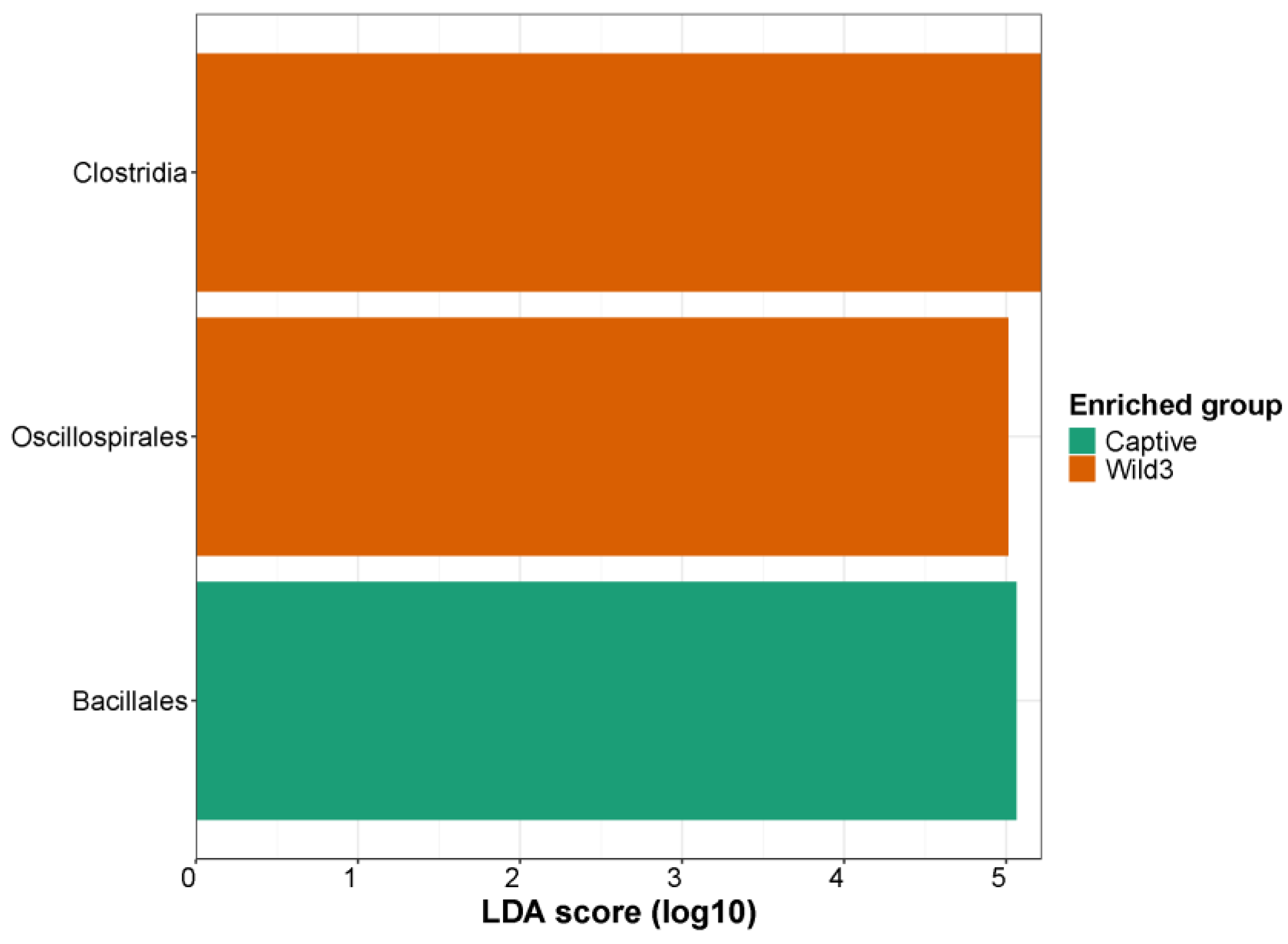
3.4. LEfSe
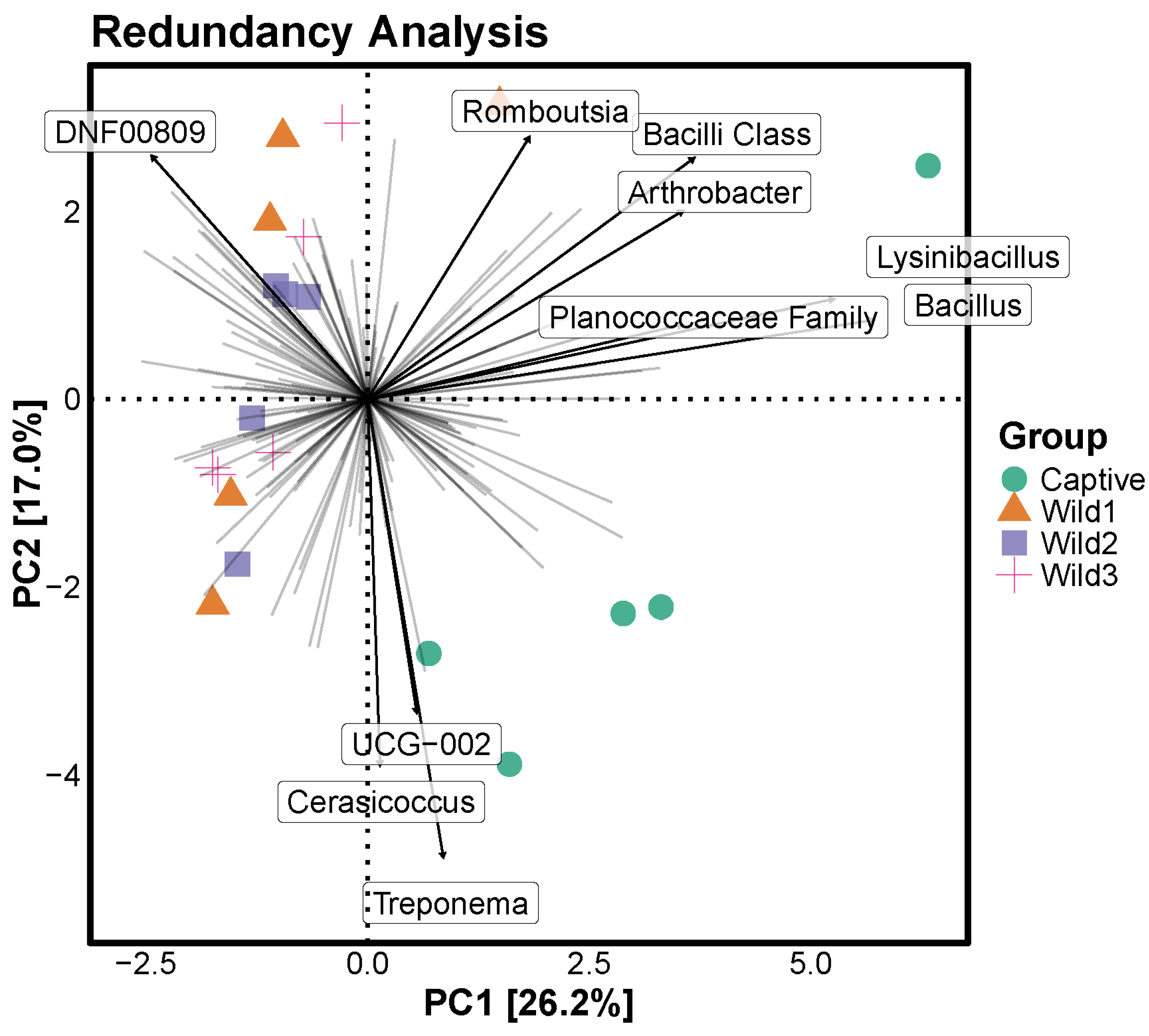
3.5. Redundancy Analysis
4. Discussion
4.1. The Importance of Diversity and Conservation of the Gut Microbiome
4.2. Gut Microbiome for Animal Conservation
5. Conclusions
Author Contributions
Funding
Institutional Review Board Statement
Data Availability Statement
Conflicts of Interest
References
- Harris, R.B.; Duckworth, J.W. Hydropotes inermis. The IUCN Red List of Threatened Species 2015. 2015, e.T10329A22163569. Available online: https://www.iucnredlist.org/species/10329/22163569 (accessed on 11 August 2025).
- Schilling, A.M.; Rössner, G.E. The (sleeping) Beauty in the Beast—A review on the water deer, Hydropotes inermis. Hystrix 2017, 28, 121. [Google Scholar]
- Chen, Y.J.; Liu, K.H.; Chu, W.L. New record of water deer (Hydropotes inermis) from Iron Age archeological sites in central Taiwan. Collect. Res. 2016, 29, 31–39. [Google Scholar]
- Kim, B.; Chae, S.J.; Lee, Y.J.; Shin, H.; Kwak, S.; Jeong, H.; Lee, S.; Kwak, D.; Seo, M.G. Nationwide Geographical and Temporal Distribution of Tick-Borne Diseases in Korean Water Deer (Hydropotes inermis argyropus). Animals 2025, 15, 1499. [Google Scholar] [CrossRef] [PubMed]
- Fletcher, R.J., Jr.; Reichert, B.E.; Holmes, K. The negative effects of habitat fragmentation operate at the scale of dispersal. Ecology 2018, 99, 2176–2186. [Google Scholar] [CrossRef]
- Fahrig, L.; Arroyo-Rodríguez, V.; Bennett, J.R.; Boucher-Lalonde, V.; Cazetta, E.; Currie, D.J.; Eigenbrod, F.; Ford, A.T.; Harrison, S.P.; Jaeger, J.A.G.; et al. Is habitat fragmentation bad for biodiversity? Biol. Conserv. 2019, 230, 179–186. [Google Scholar] [CrossRef]
- Saura, S. The Habitat Amount Hypothesis implies negative effects of habitat fragmentation on species richness. J. Biogeogr. 2021, 48, 11–22. [Google Scholar] [CrossRef]
- Fahrig, L. Ecological responses to habitat fragmentation per se. Annu. Rev. Ecol. Evol. Syst. 2017, 48, 1–23. [Google Scholar] [CrossRef]
- Islam, O.; Matsuyama, R.; Min, K.D. Deforestation and predator species richness as potential environmental drivers for roadkill of wild water deer in South Korea. Front. Vet. Sci. 2025, 12, 1483563. [Google Scholar] [CrossRef]
- Kim, M.; Park, H.; Lee, S. Analysis of Roadkill on the Korean Expressways from 2004 to 2019. Int. J. Environ. Res. Public Health 2021, 18, 10252. [Google Scholar] [CrossRef]
- Choi, T.Y. Estimation of the water deer (Hydropotes inermis) roadkill frequency in South Korea. Ecol. Resilient Infrastruct. 2016, 3, 162–168. [Google Scholar] [CrossRef]
- Jang, W.; Kim, B.; Chung, O.S.; Lee, J.K. Analysis of water deer roadkills using point process modeling in Chungcheongnamdo, South Korea. Forests 2022, 13, 209. [Google Scholar] [CrossRef]
- Kim, W.; Hong, S.H. An empirical analysis on factors affecting water deer roadkills in Korea. KSCE J. Civ. Eng. 2021, 25, 3533–3539. [Google Scholar] [CrossRef]
- Kim, K.; Seo, H.; Woo, D.; Park, T.; Song, E. The water deer on a road: Road-kill characteristics of a nationally abundant but internationally threatened species. J. For. Environ. Sci. 2021, 37, 62–68. [Google Scholar]
- Wang, L.; Ding, J.; Yang, Z.; Chen, H.; Yao, R.; Dai, Q.; Zhu, L. Père David’s deer gut microbiome changes across captive and translocated populations: Implications for conservation. Evol. Appl. 2019, 12, 622–635. [Google Scholar] [CrossRef]
- De Jonge, N.; Carlsen, B.; Christensen, M.H.; Pertoldi, C.; Nielsen, J.L. The gut microbiome of 54 mammalian species. Front. Microbiol. 2022, 13, 886252. [Google Scholar] [CrossRef]
- Park, C.E.; Jo, Y.J.; Jung, D.R.; Park, H.C.; Shin, J.H. Comparative Analysis of Gut Microbiota between Captive and Wild Long-Tailed Gorals for Ex Situ Conservation. Microorganisms 2024, 12, 1419. [Google Scholar] [CrossRef] [PubMed]
- Park, C.E.; Cho, B.J.; Kim, M.J.; Park, H.C.; Shin, J.H. Geographical relationships between long-tailed goral (Naemorhedus caudatus) populations based on gut microbiome analysis. Microorganisms 2021, 9, 2002. [Google Scholar] [CrossRef]
- Lim, S.; Banjade, M.; Ahn, J.; Song, D.; Son, J.; Park, Y. Seasonal Variations and Sexual Differences in Home Range Sizes and Activity Patterns of Endangered Long-Tailed Gorals in South Korea. Animals 2024, 15, 27. [Google Scholar] [CrossRef]
- Yin, Y.; Tang, S.; Teng, Y.; Han, Z.; Wu, L.; Gao, F.; Bao, W. A pilot study on home range of female Chinese goral (Naemorhedus griseus): Exploring GPS tracking data in a cliff landscape. J. For. Res. 2024, 29, 123–129. [Google Scholar] [CrossRef]
- Park, H.B.; Hong, S. Habitat characteristics coincidence of dead and living long-tailed gorals (Naemorhedus caudatus) according to extreme snowfall. Animals 2021, 11, 997. [Google Scholar] [CrossRef]
- Lim, S.; Banjade, M.; Pandey, P.; Park, Y. Genetic Structure and Conservation Implications of Long-Tailed Gorals (Naemorhedus caudatus) in South Korea: Phylogenetic Analysis and Haplotype Networks. J. For. Environ. Sci. 2025, 41, 209–216. [Google Scholar]
- Teng, Y.; Shupei, T.A.N.G.; Menghe, D.; Wu, L.; Zhiqing, H.A.N.; Yingying, H.A.N.; Weidong, B.A.O. A pilot study on home range and habitat use of Chinese goral (Naemorhedus griseus): Exploring GPS tracking data in cliff landscape by three estimation methods. Res. Sq. 2021, preprint. [Google Scholar]
- Kim, H.R.; Lee, J.B.; Jeong, S.M.; Kim, T.W.; Son, J.I.; Youn, J.J.; Han, S.H. Molecular evidence for occurrence of endangered long-tailed goral in Seoul metropolitan city, South Korea. J. Anim. Breed. Genom. 2023, 7, 85–93. [Google Scholar] [CrossRef]
- Choi, K.R.; Yu, H.E.; Lee, S.Y. Microbial food: Microorganisms repurposed for our food. Microb. Biotechnol. 2022, 15, 18–25. [Google Scholar] [CrossRef]
- Rocha, J.M.; Kovacevik, B.; Veličkovska, S.K.; Tamame, M.; Teixeira, J.A. Diversity of microorganisms and their metabolites in food. Microorganisms 2024, 12, 205. [Google Scholar] [CrossRef]
- Van Hul, M.; Cani, P.D. The gut microbiota in obesity and weight management: Microbes as friends or foe? Nat. Rev. Endocrinol. 2023, 19, 258–271. [Google Scholar] [CrossRef]
- de Wouters d’Oplinter, A.; Huwart, S.J.; Cani, P.D.; Everard, A. Gut microbes and food reward: From the gut to the brain. Front. Neurosci. 2022, 16, 947240. [Google Scholar] [CrossRef]
- Colella, M.; Charitos, I.A.; Ballini, A.; Cafiero, C.; Topi, S.; Palmirotta, R.; Santacroce, L. Microbiota revolution: How gut microbes regulate our lives. World J. Gastroenterol. 2023, 29, 4368. [Google Scholar] [CrossRef]
- Cantu-Jungles, T.M.; Bulut, N.; Chambry, E.; Ruthes, A.; Iacomini, M.; Keshavarzian, A.; Johnson, T.A.; Hamaker, B.R. Dietary fiber hierarchical specificity: The missing link for predictable and strong shifts in gut bacterial communities. MBio 2021, 12, 10–1128. [Google Scholar] [CrossRef]
- Wang, F.; Wang, Z.; Tang, J. The interactions of Candida albicans with gut bacteria: A new strategy to prevent and treat invasive intestinal candidiasis. Gut Pathog. 2023, 15, 30. [Google Scholar] [CrossRef]
- Puschhof, J.; Pleguezuelos-Manzano, C.; Clevers, H. Organoids and organs-on-chips: Insights into human gut-microbe interactions. Cell Host Microbe 2021, 29, 867–878. [Google Scholar] [CrossRef]
- Singer, M.; Codron, D.; Lechner, I.; Rudnik, R.; Barboza, P.; Hummel, J.; Clauss, M. The effect of size and density on the mean retention time of particles in reindeer (Rangifer tarandus). Comp. Biochem. Physiol. Part A Mol. Integr. Physiol. 2024, 292, 111621. [Google Scholar] [CrossRef] [PubMed]
- Hummel, J.; Clauss, M.; Zimmermann, W.; Johanson, K.; Nørgaard, C.; Pfeffer, E. Fluid and particle retention in captive okapi (Okapia johnstoni). Comp. Biochem. Physiol. Part A Mol. Integr. Physiol. 2005, 140, 436–444. [Google Scholar] [CrossRef]
- Braverman, I. Conservation without nature: The trouble with in situ versus ex situ conservation. Geoforum 2014, 51, 47–57. [Google Scholar] [CrossRef]
- Mahanayak, B. Ex-situ and in-situ conservation of wild life. World J. Biol. Pharm. Health Sci. 2024, 18, 277–282. [Google Scholar] [CrossRef]
- Clark, F.E.; Greggor, A.L.; Montgomery, S.H.; Plotnik, J.M. The endangered brain: Actively preserving ex-situ animal behaviour and cognition will benefit in-situ conservation. R. Soc. Open Sci. 2023, 10, 230707. [Google Scholar] [CrossRef] [PubMed]
- Kasso, M.; Balakrishnan, M. Ex situ conservation of biodiversity with particular emphasis to Ethiopia. Int. Sch. Res. Not. 2013, 2013, 985037. [Google Scholar] [CrossRef]



| Region | No. of Samples | Sample Type |
|---|---|---|
| Gumi Haepyeong Wetland | 5 | Wild1 |
| Daegu Dalseong Wetland | 5 | Wild2 |
| Busan Eulsukdo Wetland | 5 | Wild3 |
| National Institute of Ecology | 5 | Captive |
| Total | 20 |
Disclaimer/Publisher’s Note: The statements, opinions and data contained in all publications are solely those of the individual author(s) and contributor(s) and not of MDPI and/or the editor(s). MDPI and/or the editor(s) disclaim responsibility for any injury to people or property resulting from any ideas, methods, instructions or products referred to in the content. |
© 2025 by the authors. Licensee MDPI, Basel, Switzerland. This article is an open access article distributed under the terms and conditions of the Creative Commons Attribution (CC BY) license (https://creativecommons.org/licenses/by/4.0/).
Share and Cite
Park, C.-E.; Park, H.-C. Comparison of Gut Microbial Ecology of Captive and Wild Water Deer for Understanding Mammalian Ecology and Conservation. Diversity 2025, 17, 742. https://doi.org/10.3390/d17110742
Park C-E, Park H-C. Comparison of Gut Microbial Ecology of Captive and Wild Water Deer for Understanding Mammalian Ecology and Conservation. Diversity. 2025; 17(11):742. https://doi.org/10.3390/d17110742
Chicago/Turabian StylePark, Chang-Eon, and Hee-Cheon Park. 2025. "Comparison of Gut Microbial Ecology of Captive and Wild Water Deer for Understanding Mammalian Ecology and Conservation" Diversity 17, no. 11: 742. https://doi.org/10.3390/d17110742
APA StylePark, C.-E., & Park, H.-C. (2025). Comparison of Gut Microbial Ecology of Captive and Wild Water Deer for Understanding Mammalian Ecology and Conservation. Diversity, 17(11), 742. https://doi.org/10.3390/d17110742