
The Diversity of Edible Flowers and Its Biocultural Role in Local Food System in Dali, Southwest China




Abstract
1. Introduction
2. Materials and Methods
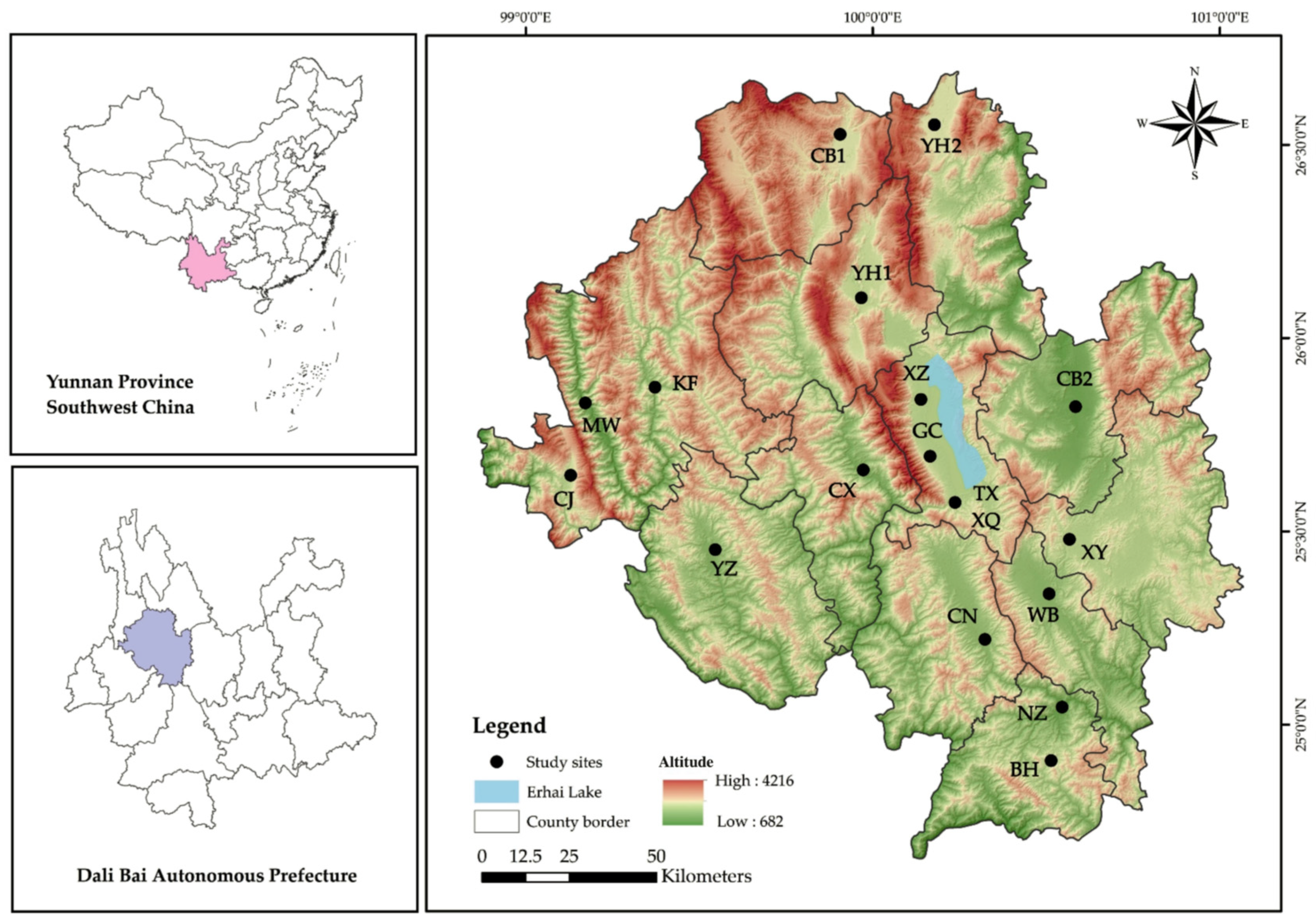
2.1. Study Area and Sites
2.2. Ethnobotanical Survey
2.3. Data Statistics and Quantitative Evaluation
2.3.1. Data Statistics
2.3.2. Quantitative Evaluation
ROF
CFSI
JI
3. Results and Discussion
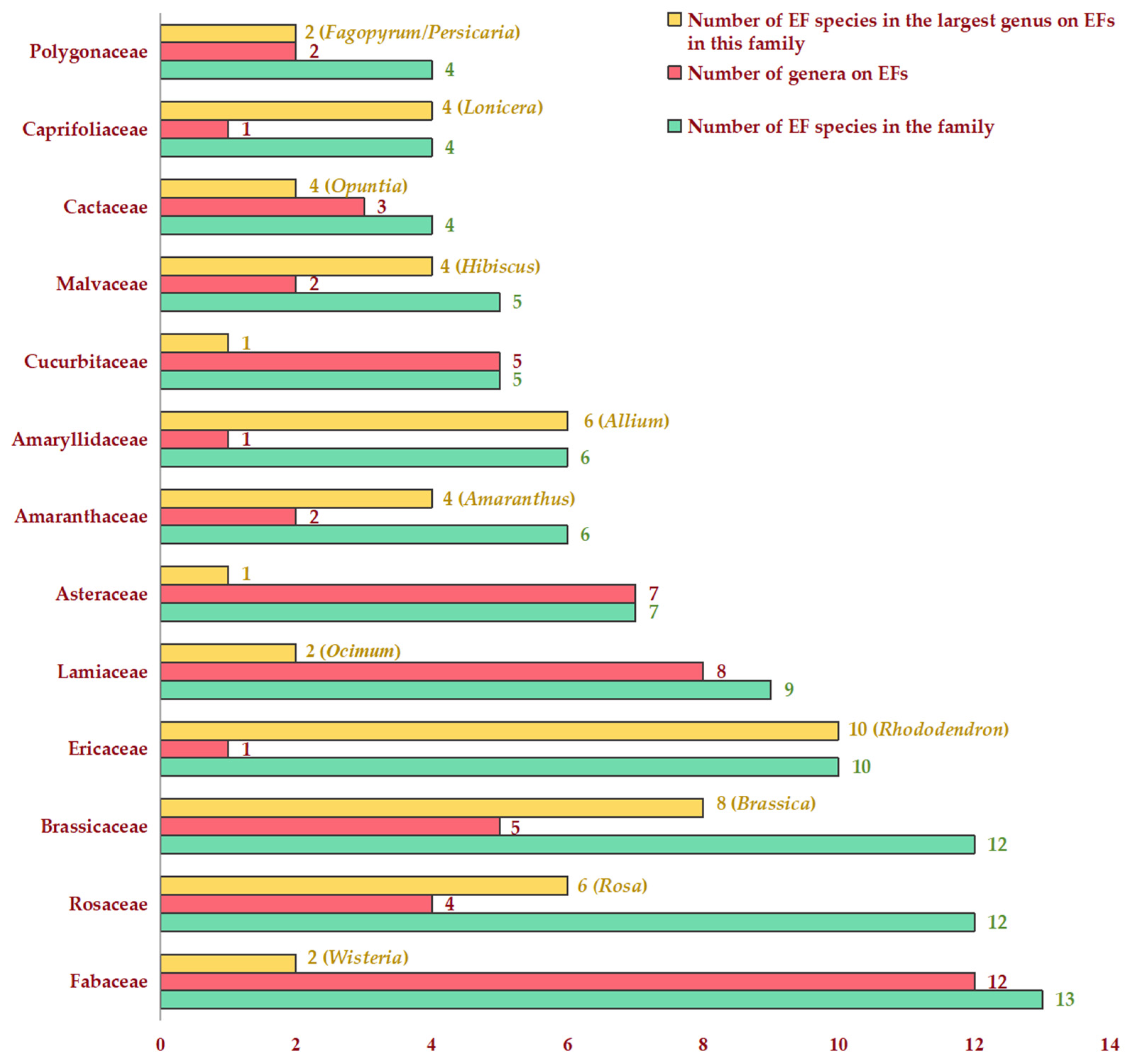
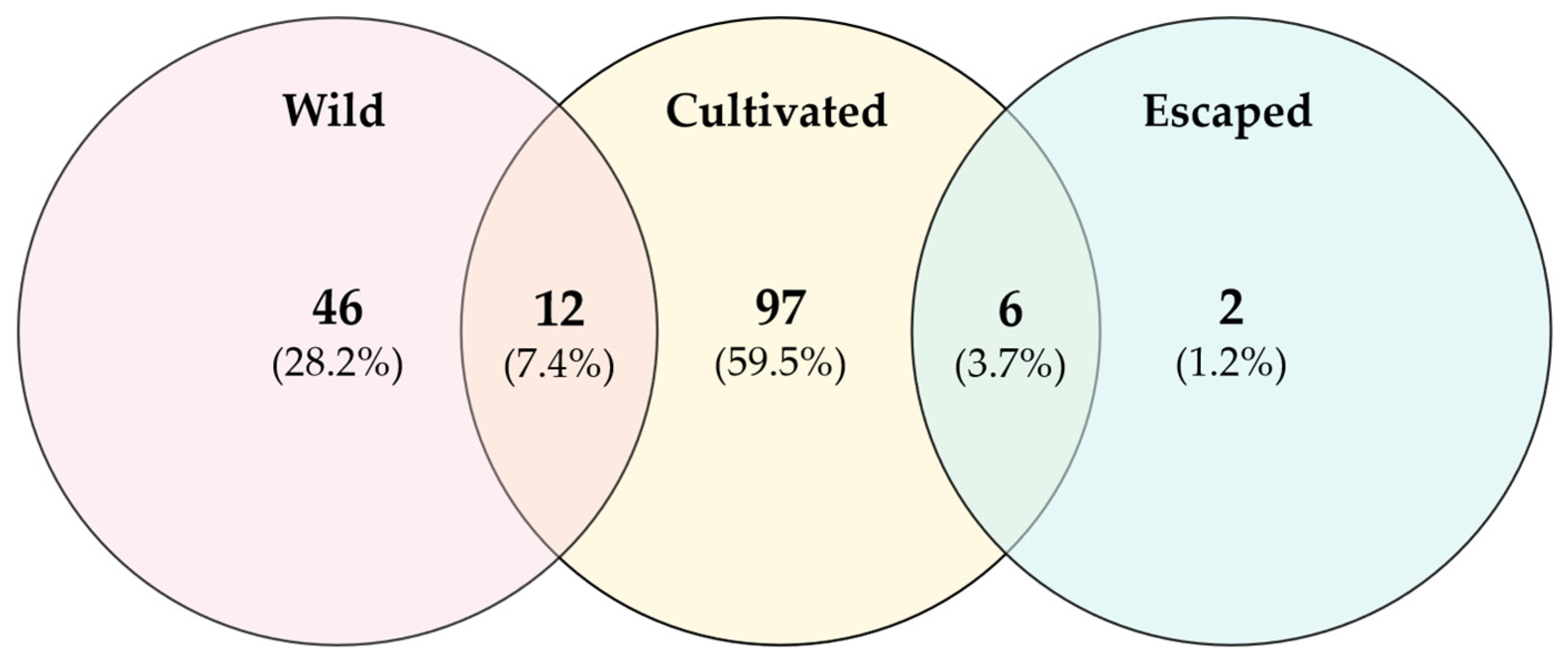
3.1. Species Diversity of Edible Flowers
3.2. Cultural Diversity of Edible Flowers
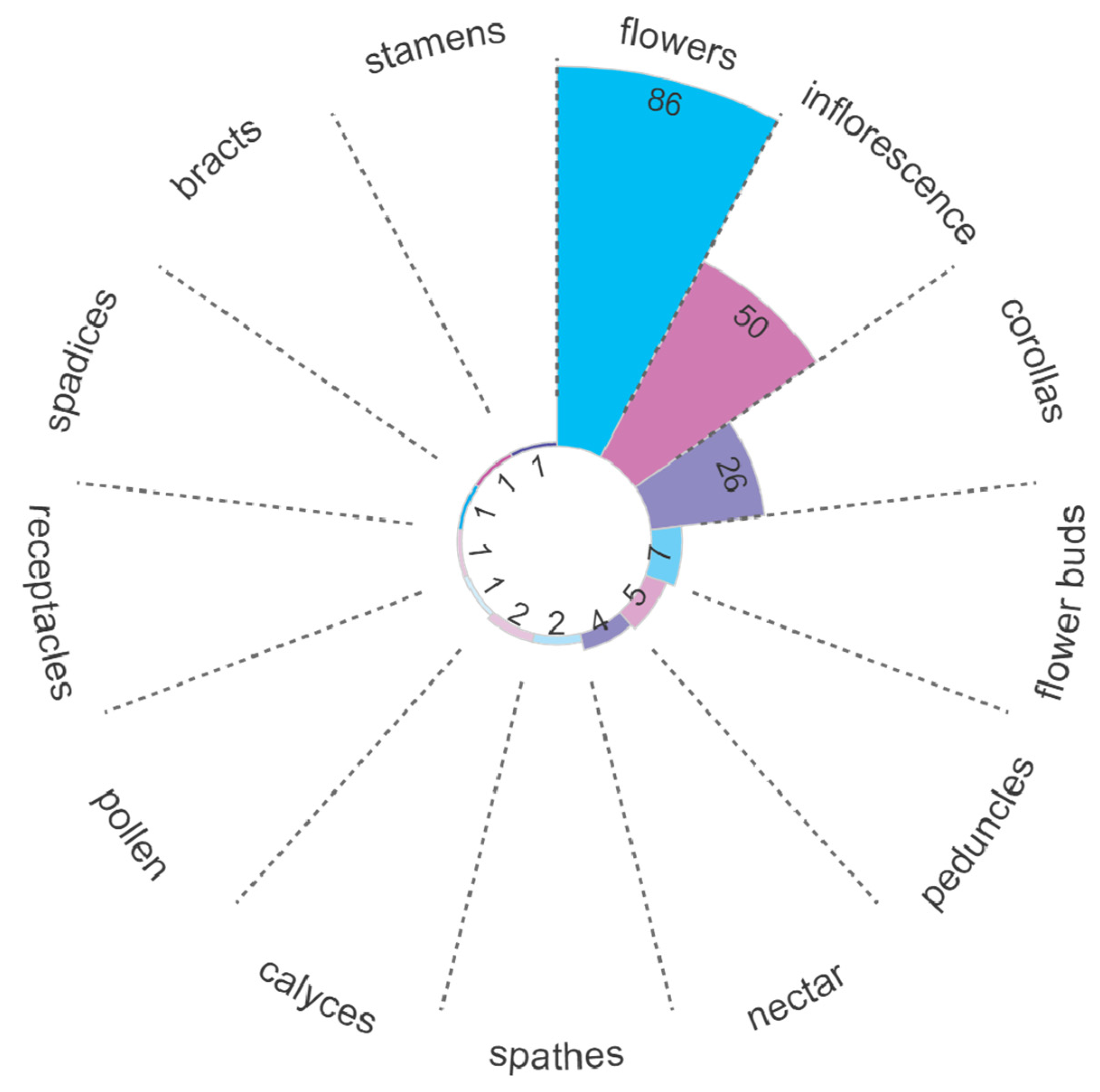
3.2.1. The Edible Parts of EFs
3.2.2. The Consume Type and Methods
3.2.3. The Additional Use(s)
3.3. Biocultural Characteristics of EFs
3.3.1. The ROF and CFSI Value of EFs
3.3.2. Representative Edible Flowers
3.4. Comparison with EFs in Xishuangbanna
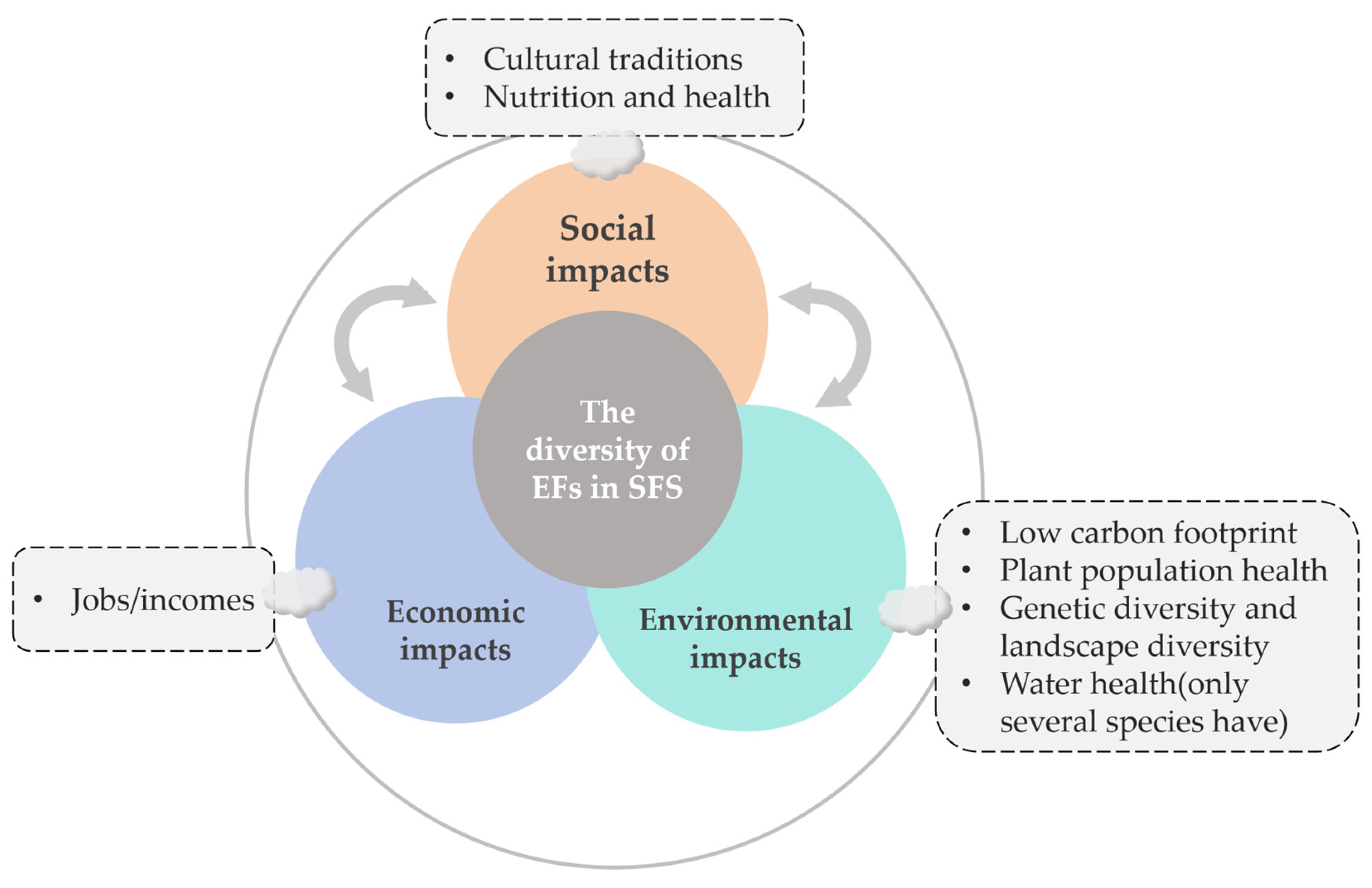
3.5. Contribution to the Sustainable Food System
3.5.1. Economic Impacts
3.5.2. Environmental Impacts
3.5.3. Social Impacts
4. Conclusions
Supplementary Materials
Author Contributions
Funding
Institutional Review Board Statement
Data Availability Statement
Acknowledgments
Conflicts of Interest
References
- Lachat, C.; Raneri, J.E.; Smith, K.W.; Kolsteren, P.; Van Damme, P.; Verzelen, K.; Penafiel, D.; Vanhove, W.; Kennedy, G.; Hunter, D.; et al. Dietary Species Richness as a Measure of Food Biodiversity and Nutritional Quality of Diets. Proc. Nat. Acad. Sci. USA 2018, 115, 127–132. [Google Scholar] [CrossRef] [Scilit]
- Willett, W.; Rockström, J.; Loken, B.; Springmann, M.; Lang, T.; Vermeulen, S.; Garnett, T.; Tilman, D.; DeClerck, F.; Wood, A.; et al. Food in the Anthropocene: The EAT–Lancet Commission on Healthy Diets from Sustainable Food Systems. Lancet 2019, 393, 447–492. [Google Scholar] [CrossRef] [Scilit] [PubMed]
- Pironon, S.; Soto Gomez, M. Plant Agrodiversity to the Rescue. Nat. Clim. Chang. 2021, 11, 6–8. [Google Scholar] [CrossRef] [Scilit]
- Iannotti, L.; Randrianarivony, T.; Randrianasolo, A.; Rakotoarivony, F.; Andriamihajarivo, T.; LaBrier, M.; Gyimah, E.; Vie, S.; Nunez-Garcia, A.; Hart, R. Wild Foods Are Positively Associated with Diet Diversity and Child Growth in a Protected Forest Area of Madagascar. Curr. Dev. Nutr. 2024, 8, 102101. [Google Scholar] [CrossRef] [Scilit]
- Khoury, C.K.; Bjorkman, A.D.; Dempewolf, H.; Ramirez-Villegas, J.; Guarino, L.; Jarvis, A.; Rieseberg, L.H.; Struik, P.C. Increasing Homogeneity in Global Food Supplies and the Implications for Food Security. Proc. Nat. Acad. Sci. USA 2014, 111, 4001–4006. [Google Scholar] [CrossRef] [Scilit]
- Motti, R. Wild Edible Plants: A Challenge for Future Diet and Health. Plants 2022, 11, 344. [Google Scholar] [CrossRef] [Scilit] [PubMed]
- Powell, B.; Thilsted, S.H.; Ickowitz, A.; Termote, C.; Sunderland, T.; Herforth, A. Improving Diets with Wild and Cultivated Biodiversity from across the Landscape. Food Sec. 2015, 7, 535–554. [Google Scholar] [CrossRef] [Scilit]
- Turner, N.J.; Łuczaj, Ł.J.; Migliorini, P.; Pieroni, A.; Dreon, A.L.; Sacchetti, L.E.; Paoletti, M.G. Edible and Tended Wild Plants, Traditional Ecological Knowledge and Agroecology. Crit. Rev. Plant Sci. 2011, 30, 198–225. [Google Scholar] [CrossRef] [Scilit]
- FAO. The State of the World’s Biodiversity for Food and Agriculture; FAO Commission on Genetic Resources for Food and Agriculture Assessments; FAO Commission: Rome, Italy, 2019. [Google Scholar]
- Liu, X.; Wang, S.; Cui, L.; Zhou, H.; Liu, Y.; Meng, L.; Chen, S.; Xi, X.; Zhang, Y.; Kang, W. Flowers: Precious Food and Medicine Resources. Food Sci. Hum. Well 2023, 12, 1020–1052. [Google Scholar] [CrossRef] [Scilit]
- Zhang, Q.; Cheng, Z.; Fan, Y.; Zhang, D.; Wang, M.; Zhang, J.; Sommano, S.; Wu, X.; Long, C. Ethnobotanical Study on Edible Flowers in Xishuangbanna, China. J. Ethnobiol. Ethnomed. 2023, 19, 43. [Google Scholar] [CrossRef] [Scilit] [PubMed]
- Chen, H.; Shen, J.; Xuan, J.; Zhu, A.; Ji, J.S.; Liu, X.; Cao, Y.; Zong, G.; Zeng, Y.; Wang, X.; et al. Plant-Based Dietary Patterns in Relation to Mortality among Older Adults in China. Nat. Aging 2022, 2, 224–230. [Google Scholar] [CrossRef] [Scilit] [PubMed]
- Lu, B.; Li, M.; Yin, R. Phytochemical Content, Health Benefits, and Toxicology of Common Edible Flowers: A Review (2000–2015). Crit. Rev. Food Sci. Nutr. 2016, 56, S130–S148. [Google Scholar] [CrossRef] [Scilit]
- Liu, Y.; Long, C. Cultural Dimension in Edible Flowers among Ethnic Groups in Yunnan. Nat. J. 2001, 23, 292–297+246–310. [Google Scholar]
- Khomdram, S.; Fanai, L.; Yumkham, S. Local Knowledge of Edible Flowers Used in Mizoram. Indian. J. Tradit. Know 2019, 18, 714–723. [Google Scholar]
- Motti, R.; Paura, B.; Cozzolino, A.; Falco, B. de Edible Flowers Used in Some Countries of the Mediterranean Basin: An Ethnobotanical Overview. Plants 2022, 11, 3272. [Google Scholar] [CrossRef] [Scilit]
- Mulík, S.; Ozuna, C. Mexican Edible Flowers: Cultural Background, Traditional Culinary Uses, and Potential Health Benefits. Int. J. Gastron. Food Sci. 2020, 21, 100235. [Google Scholar] [CrossRef] [Scilit]
- Liu, Y.; Long, C. Studies on Edible Flowers Consumed by Ethnic Groups in Yunnan. Acta Bot. Yunnan 2001, 23, 41–56. [Google Scholar]
- Yang, Y.; Ma, J.; Chen, W.; Li, W.; Sun, Y.; Xu, M. Investigation on Vegetable-Edible Flower Plant Resources and Anthophagy Culture in Yunnan Province. J. Plant Genet. Resour. 2017, 18, 1125–1136. [Google Scholar] [CrossRef]
- Liu, P.; Zhang, C. Resources Diversity of Edible Spice Plant of Dali Bai Nationality. Chin. Wild Pl. Resour. 2023, 42, 103–106, 112. [Google Scholar]
- Xie, Y.; Zhang, J.; Huang, Y.; Li, Y.; Yang, M. The Yunnan Bai People’s Flower Eating Customs. Yunnan. J. Tradit. Chin. Med. Mater. Med. 2016, 37, 76–78. [Google Scholar] [CrossRef]
- Zhang, L.; Zhuang, H.; Zhang, Y.; Wang, L.; Zhang, Y.; Geng, Y.; Gou, Y.; Pei, S.; Wang, Y. Plants for Health: An Ethnobotanical 25-Year Repeat Survey of Traditional Medicine Sold in a Major Marketplace in North-West Yunnan, China. J. Ethnopharmacol. 2018, 224, 119–125. [Google Scholar] [CrossRef] [Scilit] [PubMed]
- Fan, Y.; Zhao, Y.; Liu, A.; Hamilton, A.; Wang, C.; Li, L.; Yang, Y.; Yang, L. Indigenous Knowledge of Dye-Yielding Plants among Bai Communities in Dali, Northwest Yunnan, China. J. Ethnobiol. Ethnomed. 2018, 14, 74. [Google Scholar] [CrossRef] [Scilit]
- Fan, Y.; Cheng, Z.; Zhang, Q.; Xiong, Y.; Li, B.; Lu, X.; He, L.; Jiang, X.; Tan, Q.; Long, C. Meizi-Consuming Culture That Fostered the Sustainable Use of Plum Resources in Dali of China: An Ethnobotanical Study. Biology 2022, 11, 832. [Google Scholar] [CrossRef] [Scilit] [PubMed]
- Zocchi, D.M.; Mattalia, G.; Aziz, M.A.; Kalle, R.; Fontefrancesco, M.F.; Sõukand, R.; Pieroni, A. Searching for Germane Questions in the Ethnobiology of Food Scouting. J. Ethnobiol. 2023, 43, 19–30. [Google Scholar] [CrossRef] [Scilit]
- Shi, Y.; Zhou, M.; Zhang, Y.; Fu, Y.; Li, J.; Yang, X. Poisonous Delicacy: Market-Oriented Surveys of the Consumption of Rhododendron Flowers in Yunnan, China. J. Ethnopharmacol. 2021, 265, 113320. [Google Scholar] [CrossRef] [Scilit]
- Cook, F. International Working Group on Taxonomic Databases for Plant Science. In Economic Botany Data Collection Standard; Royal Botanic Gardens, Kew: London, UK, 1995; p. 33. [Google Scholar]
- Łuczaj, Ł. Descriptive Ethnobotanical Studies Are Needed for the Rescue Operation of Documenting Traditional Knowledge. J. Ethnobiol. Ethnomed. 2023, 19, 37. [Google Scholar] [CrossRef] [Scilit] [PubMed]
- Cheng, Z.; Lin, S.; Wu, Z.; Lin, C.; Zhang, Q.; Xu, C.; Li, J.; Long, C. Study on Medicinal Food Plants in the Gaoligongshan Biosphere Reserve, the Richest Biocultural Diversity Center in China. J. Ethnobiol. Ethnomed. 2024, 20, 10. [Google Scholar] [CrossRef] [Scilit]
- Pieroni, A. Evaluation of the Cultural Significance of Wild Food Botanicals Traditionally Consumed in Northwestern Tuscany, Italy. J. Ethnobiol. 2001, 21, 89–104. [Google Scholar]
- Cheng, Z.; Lu, X.; Lin, F.; Naeem, A.; Long, C. Ethnobotanical Study on Wild Edible Plants Used by Dulong People in Northwestern Yunnan, China. J. Ethnobiol. Ethnomed. 2022, 18, 3. [Google Scholar] [CrossRef] [Scilit]
- Faruque, M.O.; Feng, G.; Khan, M.N.A.; Barlow, J.W.; Ankhi, U.R.; Hu, S.; Kamaruzzaman, M.; Uddin, S.B.; Hu, X. Qualitative and Quantitative Ethnobotanical Study of the Pangkhua Community in Bilaichari Upazilla, Rangamati District, Bangladesh. J. Ethnobiol. Ethnomed. 2019, 15, 8. [Google Scholar] [CrossRef] [Scilit]
- Georgiadis, P. Ethnobotanical Knowledge against the Combined Biodiversity, Poverty and Climate Crisis: A Case Study from a Karen Community in Northern Thailand. Plants People Planet 2022, 4, 382–391. [Google Scholar] [CrossRef] [Scilit]
- Broegaard, R.B.; Rasmussen, L.V.; Dawson, N.; Mertz, O.; Vongvisouk, T.; Grogan, K. Wild Food Collection and Nutrition under Commercial Agriculture Expansion in Agriculture-Forest Landscapes. For. Policy Econ. 2017, 84, 92–101. [Google Scholar] [CrossRef] [Scilit]
- Li, W.; Zhang, Q.; Fan, Y.; Cheng, Z.; Lu, X.; Luo, B.; Long, C. Traditional Management of Ancient Pu’er Teagardens in Jingmai Mountains in Yunnan of China, a Designated Globally Important Agricultural Heritage Systems Site. J. Ethnobiol. Ethnomed. 2023, 19, 26. [Google Scholar] [CrossRef] [Scilit]
- Ning, G.; Chen, L.; Kang, G.; Hei, L.; Liu, B.; Rao, B.; Zhao, Y.; Zhang, M. Research on Countermeasures of High-Quality Development of Tea Industry in Dali prefecture of Yunnan Province under the Background of Rural Revitalization. J. Tea Commun. 2024, 03, 423–430. [Google Scholar] [CrossRef]
- Zhang, L.; Zhang, Y.; Pei, S.; Geng, Y.; Wang, C.; Yuhua, W. Ethnobotanical Survey of Medicinal Dietary Plants Used by the Naxi People in Lijiang Area, Northwest Yunnan, China. J. Ethnobiol. Ethnomed. 2015, 11, 40. [Google Scholar] [CrossRef] [Scilit]
- Ma, A.; Zou, F.; Zhang, R.; Zhao, X. The Effects and Underlying Mechanisms of Medicine and Food Homologous Flowers on the Prevention and Treatment of Related Diseases. J. Food Biochem. 2022, 46, e14430. [Google Scholar] [CrossRef] [Scilit]
- Jiang, Z.; Li, H.; Dao, Z.; Long, C. Ethnobotanical Study on Ottelia acuminata, an Aquatic Edible Plant Occurring in Yunnan. J. Inn. Mong. Norm. Univ. (Nat. Sci. Ed) 2010, 39, 163–168. [Google Scholar]
- Li, H. The Flourishing and Declining of Ottelia acuminata in the Lake Dianchi. J. Yunnan Univ. (Nat. Sci. Ed.) 1985, 7, 138–142. [Google Scholar]
- Dai, N. Study on the Response Mechanism of Ottelia acuminata to Different Level of Nutrition and Heavy Metal Stress. Master’s Thesis, Yunnan University, Yunnan, China, 2022; 9p. [Google Scholar]
- Guo, J.; Li, G.; Li, X.; Jin, Z.; Lu, N. Ottelia acuminata at the Source of Erhai Lake. J. Changjiang Veg. 2024, 12, 28–30. [Google Scholar]
- Tian, Y.; Zhang, Z.; Zheng, C.; Wang, Q. Study on the Distribution about Rhododendron Landscape Resources in Yunnan. J. Southwest For. Univ. (Nat. Sci.) 2024, 44, 195–201. [Google Scholar]
- Liu, Y.; Long, C. Ethnobotanical Studies on the Edible Flowers in Lahu Societies. Guihaia 2007, 27, 203–210. [Google Scholar]
- Pei, S. Traditional Culture of Flower Eating on Rhododendrom and Bauhinia in Yunnan, China. In Proceedings of the International Symposium on Flower-Eating Culture in Asia; Seibundo Shinkosha Publishing Co., Ltd: Tokyo, Japan, 1990. [Google Scholar]
- Wang, X.; Huang, Y.; Long, C. Assessing the Genetic Consequences of Flower-Harvesting in Rhododendron decorum Franchet (Ericaceae) Using Microsatellite Markers. Biochem. Syst. Ecol. 2013, 50, 296–303. [Google Scholar] [CrossRef] [Scilit]
- Yu, F.; Wang, T.; Groen, T.A.; Skidmore, A.K.; Yang, X.; Ma, K.; Wu, Z. Climate and Land Use Changes Will Degrade the Distribution of Rhododendrons in China. Sci. Total Environ. 2019, 659, 515–528. [Google Scholar] [CrossRef] [Scilit] [PubMed]
- Xie, L.; Yan, H.; Tang, K.; Zhang, H.; Qiu, X.; Jian, H.; Li, S.; Wang, Q. Evaluation of Yield and Analysis on Nutrient Compositions of Four Edible Rose Varieties in Yunnan Province. Southwest China J. Agric. Sci. 2022, 35, 2627–2632. [Google Scholar] [CrossRef]
- Luo, X.; Yuan, Y. Food Tension-History and Modernity of Folk, Regional Market, Country and Flower Cakes. J. Chuxiong Norm. Univ. 2019, 34, 12–18. [Google Scholar]
- Zhao, J.; Li, Y.; Bao, Y.; Yang, M.; Tian, Y.; Lin, Q. Overview of Edible Flowers in Yunnan. Food Ferment. Sci. Tech. 2017, 53, 104–108. [Google Scholar]
- Yin, C.; Yu, J.; Tang, D.; Li, H.; Li, Y.; Li, G.; Liu, S.; Li, X.; Mou, Y. Investigation on the Medicinal and Edible Plant Resources of Dai Nationality in Xishuangbanna. Biot. Resour. 2021, 43, 341–356. [Google Scholar] [CrossRef]
- Nguyen, H. Sustainable Food Systems: Concept and Framework; Introduction to Sustainable Food Systems and Value Chains; FAO: Rome, Italy, 2018. [Google Scholar]
- Li, M.; Jia, N.; Lenzen, M.; Malik, A.; Wei, L.; Jin, Y.; Raubenheimer, D. Global Food-Miles Account for Nearly 20% of Total Food-Systems Emissions. Nat. Food 2022, 3, 445–453. [Google Scholar] [CrossRef] [Scilit]
- Lucas, E.; Guo, M.; Guillén-Gosálbez, G. Low-Carbon Diets Can Reduce Global Ecological and Health Costs. Nat. Food 2023, 4, 394–406. [Google Scholar] [CrossRef] [Scilit] [PubMed]
- Webb, P.; Benton, T.G.; Beddington, J.; Flynn, D.; Kelly, N.M.; Thomas, S.M. The Urgency of Food System Transformation Is Now Irrefutable. Nat. Food 2020, 1, 584–585. [Google Scholar] [CrossRef] [Scilit]
- Utter, J.; Mole, F.; Johnston, H.; McCray, S. Quantifying the Locality of the Food Supply in a Large Healthcare Organization. Nutr. Diet. 2024, 1–7. [Google Scholar] [CrossRef] [Scilit]
- Kumari, P.; Ujala; Bhargava, B. Phytochemicals from Edible Flowers: Opening a New Arena for Healthy Lifestyle. J. Funct. Foods 2021, 78, 104375. [Google Scholar] [CrossRef] [Scilit]
- He, J.; Peng, L.; Li, W.; Luo, J.; Li, Q.; Zeng, H.; Ali, M.; Long, C. Traditional Knowledge of Edible Plants Used as Flavoring for Fish-Grilling in Southeast Guizhou, China. J. Ethnobiol. Ethnomed. 2022, 18, 19. [Google Scholar] [CrossRef] [Scilit] [PubMed]
- Ye, B.; Xiong, Q.; Yang, J.; Huang, Z.; Huang, J.; He, J.; Liu, L.; Xia, M.; Liu, Y. Adoption of Region-Specific Diets in China Can Help Achieve Gains in Health and Environmental Sustainability. Nat. Food 2024, 5, 764–774. [Google Scholar] [CrossRef] [Scilit]



| Name | Abbreviation | Types | Subordinate County or City | Linguistic Group * | Number of Informants |
|---|---|---|---|---|---|
| Taixing market | TX | stable | Dali City | Multiple groups | 34 |
| Xinqiao market | XQ | stable | Dali City | Multiple groups | 15 |
| Gucheng market | GC | stable | Dali City | Multiple groups | 19 |
| Xizhou market | XZ | periodic | Dali City | Multiple groups | 11 |
| Yuhu market | YH1 | stable | Eryuan County | Multiple groups | 10 |
| Cangshanxizhen market | CX | stable | Yangbi County | Mainly Yi | 11 |
| Yunhe market | YH2 | stable | Heqing County | Multiple groups | 20 |
| Chengbei market | CB1 | stable | Jianchuan County | Mainly Bai | 8 |
| Chengbei market | CB2 | stable | Binchuan County | Multiple groups | 5 |
| Chengnan market | CN | stable | Weishan County | Mainly Yi and Hui | 10 |
| Nanjian Zonghe market | NZ | stable | Nanjian County | Mainly Han and Yi | 15 |
| Baohua market | BH | periodic | Nanjian County | Mainly Han and Yi | 13 |
| Wenbi market | WB | stable | Midu County | Multiple groups | 14 |
| Xiangyun market | XY | stable | Xiangyun County | Multiple groups | 16 |
| Yongping Zonghe market | YZ | stable | Yongping County | Mainly Han and Yi | 15 |
| Caojian market | CJ | periodic | Yunlong County | Mainly Bai | 26 |
| Miaowei market | MW | periodic | Yunlong County | Mainly Lisu | 16 |
| Kaifaqu market | KF | stable | Yunlong County | Mainly Bai | 19 |
| No. | Questions/Topics |
|---|---|
| 1 | What flowers have you consumed? |
| 2 | What is the local name of the flower? How to pronounce it in your ethnic language? |
| 3 | Where do you collect the flowers? |
| 4 | Do you consume them regularly or only during festivals and special occasions? |
| 5 | How do you consume them? |
| 6 | What do they taste like? Are they delicious? Do you like consuming them? |
| 7 | What are the health benefits of consuming these flowers? Do they have any medicinal function? |
| 8 | What else are these flowers/plants used for? |
| Index | Classification | Value |
|---|---|---|
| AI | Very common | 4.0 |
| Common | 3.0 | |
| Middle | 2.0 | |
| Rare | 1.0 | |
| AI correction index | Ubiquity | 0 |
| Localized | −0.5 | |
| Very localized | −1.0 | |
| FUI | More than once per week | 5.0 |
| Once per week | 4.0 | |
| Once per month | 3.0 | |
| More than once per year but less than once per month | 2.0 | |
| Once per year | 1.0 | |
| Unused during the past 30 years | 0.5 | |
| MFFI | Eaten raw | 0.5 |
| As cold dish | 1.5 | |
| Stir-fried/Fried | 1.0 | |
| Cooked in water | 1.0 | |
| Cooked with other food | 1.0 | |
| Stewed/ Roasted/Steamed | 1.0 | |
| Pickled/Making cakes/Coloring something | 1.0 | |
| As tea substitute/Scenting tea | 1.0 | |
| Brewed/Infused in alcohol | 1.0 | |
| TSAI | Best | 10.0 |
| Very good | 9.0 | |
| Good | 7.5 | |
| Fair | 6.5 | |
| Poor | 5.5 | |
| Terrible | 4.0 | |
| FMRI | Food is a medicine | 5.0 |
| Food is quite a medicine with clear specifications of the treated affections | 4.0 | |
| Food is very healthy | 3.0 | |
| Food is healthy without specification of a particular therapeutic action | 2.0 | |
| Not recognized | 1.0 |
| No. | Species | Family | Vernacular Name | Chinese Name | Type | Edible Parts of the Floral Organ | With Other Parts When Consuming Flowers | Categories of Use Type | Methods of Preparation for Food | Additional Use(s) | ROF | CFSI | Voucher Number |
|---|---|---|---|---|---|---|---|---|---|---|---|---|---|
| 1 | Agastache rugosa (Fisch. et Mey.) O. Ktze. | Lamiaceae | 藿香 | c | flower buds | stems and leaves | v | stir-fried; cooked in water for soup | 0.73 | 11.88 | DL015 | ||
| 2 | Albizia julibrissin Durazz. | Fabaceae | xi hei xin (YN) | 合欢 | w, c | flowers, flower buds | v | stir-fried | Flowers are used for resolving stagnation for tranquilization. Bark is used for resolving stagnation for tranquilization, promoting blood circulation and detumescence. | 0.13 | 0.16 | ||
| 3 | Allium chinense G. Don | Amaryllidaceae | xie tai hua (YN) | 藠头 | c | inflorescence | leaves | v | stir-fried; pickled | Common vegetable and also for medicinal purposes; invigorating the stomach. | 0.20 | 1.35 | DL021 |
| 4 | Allium fistulosum L. | Amaryllidaceae | 葱 | c | inflorescence | leaves | v, se | stir-fried; cooked in water for soup; as cold dish; pickled; cooked with other food as a flavoring | Flowers for dispelling cold. Common vegetable, seasoning, and also for medicinal purposes; inducing resuscitation. | 0.60 | 46.80 | DL033 | |
| 5 | Allium hookeri Thwaites | Amaryllidaceae | luo wo mo (YI); pie cai (YN) | 宽叶韭 | w | inflorescence | v | stir-fried with pork or eggs; cooked in water for soup; pickled | Common vegetable. For dispelling blood stasis and promoting blood circulation, promoting qi circulation, and promoting stagnation. | 1.00 | 194.40 | DL066 | |
| 6 | Allium prattii C. H. Wright ex Hemsl. | Amaryllidaceae | ye jiu cai (YN) | 太白山葱 | w | inflorescence | young leaves | v | stir-fried; pickled | For dispelling cold and invigorating stomach. | 0.13 | 2.16 | |
| 7 | Allium sativum L. | Amaryllidaceae | dun bie (YI) | 蒜 | c | inflorescence | v, se | stir-fried; pickled; cooked with other food as a flavoring | Common vegetable, seasoning, and also for medicinal purposes; bulbs for anti-inflammation and rheumatism. | 1.00 | 129.60 | DL010 | |
| 8 | Allium tuberosum Rottler ex Sprengle | Amaryllidaceae | dong bu lai (YI) | 韭 | c | inflorescence | v | stir-fried; cooked in water for soup; as cold dish; pickled as sauce; as fillings | Flowers for diminishing inflammation, arresting cough, expelling phlegm, and nourishing liver and kidney. Common vegetable, seasoning, and also for medicinal purposes; diminishing inflammation, relieving cough, expelling phlegm, and nourishing liver and kidney. | 0.87 | 249.60 | DL003 | |
| 9 | Amaranthus caudatus L. | Amaranthaceae | 尾穗苋 | c, e | young peduncles | young stems and leaves | v | stir-fried | Common vegetable. | 0.27 | 1.04 | ||
| 10 | Amaranthus cruentus L. | Amaranthaceae | tian xue mi (YN) | 老鸦谷 | w, c | inflorescence | always young shoots and tender leaves | v | stir-fried; cooked in water for soup; as cold dish | Flowers for clearing heat toxins. Wild leafy vegetable. Seeds are edible after brewing. | 0.20 | 10.92 | DL043 |
| 11 | Amaranthus hypochondriacus L. | Amaranthaceae | zi li xian (YN) | 千穗谷 | c | flowers | young stems and leaves | v | stir-fried | Ornamental plant plants; seeds used as food substitute or fodder. | 0.20 | 0.78 | |
| 12 | Amaranthus tricolor L. | Amaranthaceae | hong yu mi cai (YN) | 苋 | c | inflorescence | always young shoots and tender leaves | v | stir-fried; cooked in water for soup; as cold dish | Common leafy vegetable. Improving eyesight. | 0.67 | 70.88 | |
| 13 | Apium graveolens L. | Apiaceae | chuan qin (YN) | 旱芹 | c | inflorescence | always young stems and leaves | v | stir-fried; as cold dish after blanching; pickled | Wild leafy vegetable. Whole plant for medicine to clear heat toxins, cool blood, and lower blood pressure; Antihypertension. | 0.53 | 25.20 | DL204 |
| 14 | Aster indicus L. | Asteraceae | 马兰 | w | flowers | young stems and leaves | v | stir-fried | Greening plant for Ornamental plant; young stems and leaves for vegetable | 0.60 | 2.34 | ||
| 15 | Astragalus sinicus L. | Fabaceae | hong hua cai (YN) | 紫云英 | c | flowers | young stems and leaves | v | stir-fried | The whole plant is used as green manure; the young stems and leaves are used as vegetables; for treating poison and sore throat | 0.33 | 4.95 | |
| 16 | Basella alba L. | Basellaceae | 落葵 | c, e | flowers | young stems and leaves | v | stir-fried | Bulbel for medicinal purposes | 0.73 | 26.40 | DL006 | |
| 17 | Begonia cucullata Willd. | Begoniaceae | hai tang hua (YN) | 四季海棠 | c | flowers | sometimes leaves | v | stir-fried with other food; as a cold dish | Flowers for hemostasis and removing blood stasis. Ornamental plant | 0.13 | 5.20 | |
| 18 | Benincasa hispida (Thunb.) Cogn. | Cucurbitaceae | 冬瓜 | c | flowers | v | stir-fried | Fruit is a common vegetable. The decoction of fruit for fever, cold, menstrual disorder, and diuresis. Seeds and melon skin for medicine. | 0.13 | 0.66 | DL350 | ||
| 19 | Berberis pruinosa Franch. | Berberidaceae | san ke zhen (YN) | 粉叶小檗 | w | inflorescence | v | stir-fried | Roots and branches for clearing heat toxins and diminishing inflammation. | 0.07 | 0.12 | ||
| 20 | Bombax ceiba L. | Malvaceae | pan zhi hua (YN) | 木棉 | w, c | corollas, stamens, occasionally flowers | v, b | after blanching in hot water, stir-fried; cooked in water for soup; as cold dish after blanching; as tea substitute; stewed | Whole plant for medicine to clear heat toxins, and promote diuresis and hemostasis. Seed fibers for beddings. | 0.13 | 9.90 | DL053 | |
| 21 | Brassica campestris var. purpuraria L.H. Bariley | Brassicaceae | hong cai hua (YN) | 紫菜薹 | c(imported) | inflorescence | sometimes stems and leaves | v | stir-fried; cooked in water for soup | Leafy vegetable. | 0.47 | 4.20 | |
| 22 | Brassica juncea (L.) Czernajew | Brassicaceae | chong cai, ku cai (YN) | 芥菜 | c | inflorescence | always young stems and leaves | v | stir-fried; cooked in water for soup; pickled | Common leafy vegetable. Seeds for suppressing hyperactive liver and hemostasis. | 0.87 | 140.40 | DL026 |
| 23 | Brassica oleracea L. | Brassicaceae | gai lan (YN) | 野甘蓝 | c | inflorescence | always stems and leaves | v, b | stir-fried; cooked in water for soup; as tea substitute | Many cultivators are common leafy vegetables and famous oil-bearing crops. Also used as medicine for detoxifying and expelling wind, and relieving summer heat | 0.93 | 189.00 | |
| 24 | Brassica oleracea var. botrytis L. | Brassicaceae | cai hua (YN) | 花椰菜 | c | inflorescence | v | stir-fried; cooked in water for soup; pickled | Common vegetable | 1.00 | 67.50 | DL011 | |
| 25 | Brassica oleracea var. italica Plenck | Brassicaceae | qing hua cai (YN) | 西蓝花 | c | inflorescence | v | stir-fried; cooked in water for soup | Common vegetable | 1.00 | 45.00 | DL040 | |
| 26 | Brassica rapa var. chinensis (L.) Kitamura | Brassicaceae | jian gan bai, cai tai (YN) | 青菜 | c | peduncles | always young stems and leaves | v | stir-fried; cooked in water for soup; pickled | Common leafy vegetable. Also used for expectorant and tourniquet relieving, detoxifying, and swelling-reducing | 1.00 | 162.00 | DL028 |
| 27 | Brassica rapa var. glabra Regel | Brassicaceae | 白菜 | c | inflorescence | always young stems and leaves | v | stir-fried; cooked in water for soup; pickled | Common vegetable | 1.00 | 67.50 | ||
| 28 | Brassica rapa var. oleifera de Candolle | Brassicaceae | you cai hua (YN) | 芸薹 | c | inflorescence | always stems and leaves | v | stir-fried; cooked in water for soup; pickled; fried | Many cultivators are common leafy vegetables and famous oil-bearing crops. Also used as medicine for cooling blood, dispersing blood, detoxifying, and reducing swelling | 0.87 | 140.40 | DL047 |
| 29 | Buddleja officinalis Maxim. | Scrophulariaceae | ba ba hua (YN) | 密蒙花 | w | inflorescence, nectar | b, fd, sn | coloring rice; as tea substitute; (nectar) eaten raw | Common edible flower. Flowers for extracting perfume oils. Clearing heat and promoting diuresis; improving eyesight | 0.20 | 9.00 | DL123 | |
| 30 | Calystegia hederacea Wall. | Convolvulaceae | lao mu zhu cao (YN) | 打碗花 | w | flowers | v | stir-fried | Roots for irregular menstruation | 0.07 | 0.12 | DL092 | |
| 31 | Calystegia sepium (L.) R. Br. | Convolvulaceae | da po wan hua (YN) | 旋花 | w | flowers | v | stir-fried | 0.07 | 0.04 | |||
| 32 | Camellia pitardii Coh. St. | Theaceae | ye shan cha (YN) | 西南红山茶 | w | flowers | v, b | stir-fried; cooked in water for soup; as tea substitute | Clearing heat toxins. Ornamental plant. | 0.07 | 0.96 | ||
| 33 | Camellia reticulata Lindl. | Theaceae | hong hua you cha (YN) | 滇山茶 | c | flowers | v, b | stir-fried; cooked in water for soup; as tea substitute; fried | Clearing heat toxins, detumescence, and cooling blood for hemostasis. Ornamental plant. Seed oil is edible and medicinal. | 0.13 | 9.60 | DL263 | |
| 34 | Camellia sinensis var. assamica (J. W. Masters) Kitamura | Theaceae | 普洱茶 | c | flowers | young leaves | b | as tea substitute; cooked in water for congee; brewed | Clearing heat toxins and cooling blood for hemostasis. Famous tea. Young leaves and stems can be cooked. Leaves for medicine. Cultural plant. | 0.07 | 8.10 | DL054 | |
| 35 | Campsis grandiflora (Thunb.) Schum. | Bignoniaceae | zi wei hua, duo tai hua (YN) | 凌霄 | c | flowers | v, b | cooked in water for soup; infused with alcohol | Brewed or decocted for activating qi-flowing, removing obstruction in collaterals, cooling blood, and dispelling pathogenic wind; Ornamental plant. | 0.13 | 1.92 | ||
| 36 | Canna indica L. | Cannaceae | ba jiao yu (YN) | 芭蕉芋 | c | nectar | sn | eaten raw as a sweetener | Many horticultural cultivars for ornamental. Canna indica ‘Edulis’ is a common forage crop and for extracting starch as well | 0.07 | 0.17 | DL130 | |
| 37 | Capsella bursa-pastoris (L.) Medic. | Brassicaceae | ge (NX) | 荠 | w, c | flowers | always leaves | v | stir-fried; cooked in water; as cold dish | Wild vegetable. Used as medicine for treating dysentery, gonorrhea, edema, chyluria, hematemesis, bloody stools, blood avalanche, excessive menstruation, and eye pain | 0.67 | 94.50 | |
| 38 | Caragana sinica (Buc’hoz) Rehd. | Fabaceae | jin que hua (YN); ha wu ren ba (NX) | 锦鸡儿 | w | flower buds | v | stir-fried or steamed with eggs; stewed with pork; cooked in water for congee or soup | Flowers for clearing heat and freeing strangury, nourishing kidney yin, dispelling pathogenic wind, promoting blood circulation, relieving rigidity of muscles, and activating collaterals. Roots for medicinal purposes. | 0.67 | 129.60 | DL115 | |
| 39 | Carthamus tinctorius L. | Asteraceae | 红花 | c | flowers | b | as tea substitute | Promoting blood circulation for removing obstruction in collaterals, removing blood stasis, and relieving pain; cloth dyeing | 0.07 | 1.30 | |||
| 40 | Celosia argentea L. | Amaranthaceae | hong niu xi (YN) | 青葙 | c | flowers, flower buds | v, b | stir-fried; cooked in water for congee or soup; as tea substitute; stewed | Flowers for promoting blood circulation. Young stems, leaves, and seeds for food. Whole plant for eliminating dampness, clearing heat, destroying parasites, and hemostasis. Roots for promoting blood circulation. Ornamental plant | 0.13 | 3.52 | DL183 | |
| 41 | Celosia cristata L. | Amaranthaceae | 鸡冠花 | c | inflorescence | v | stir-fried with pork; cooked in water; stewed with pork | Flowers are used for treating functional uterine bleeding and angina pectoris. Cooling blood for hemostasis and nourishing blood. Ornamental plant. | 0.20 | 14.04 | DL221 | ||
| 42 | Cercis chinensis Bunge | Fabaceae | luo guang sang (YN) | 紫荆 | c | flowers | v | after blanching in hot water, stir-fried; cooked in water; as a cold dish | The bark is used to cure poisons. Ornamental plant. | 0.07 | 3.47 | ||
| 43 | Chrysanthemum morifolium Ramat. | Asteraceae | 菊花 | c | flowers | v, b, sn | stir-fried; cooked in water; as cold dish; steamed; fried; stewed with eggs; as tea substitute; making cakes or bread | Clearing heat-fire, suppressing hyperactive liver, and improving eyesight. Ornamental plant. Cultural plant. | 0.87 | 636.48 | DL029 | ||
| 44 | Clerodendrum lindleyi Decne. ex Planch. | Lamiaceae | 尖齿臭茉莉 | w | flowers, nectar | young leaves | v, sn | stir-fried; (nectar) eaten raw | For medicinal purposes. | 0.07 | 2.70 | ||
| 45 | Colocasia antiquorum Schott | Araceae | mi tuo ho wei (BA) | 野芋 | w | flowers, spathes | v | stir-fried | Root tuber is used externally to treat unidentified swelling and toxins. | 0.20 | 0.99 | ||
| 46 | Colocasia esculenta (L.) Schott. | Araceae | mi tuo huo wei (BA) | 芋 | c | peduncles, spathes, flowers, spadices | v | after removing the spadices and the peel of peduncles, stir-fried, stewed, steamed with eggplants, and pickled; fried spadices stir-fried or stewed with pork and peppers | Common food crop. Leaves and corm are edible. Leaves can be used as fodder. Cultural plant. | 1.00 | 108.00 | DL035 | |
| 47 | Crassocephalum crepidioides (Benth.) S. Moore | Asteraceae | ge ming cai (YN) | 野茼蒿 | w | flowers | young leaves | v | stir-fried; cooked in water; fried; as a cold dish after blanching in hot water | Whole plants for clearing heat arresting cough and strengthening the stomach | 0.80 | 145.80 | DL142 |
| 48 | Crocus sativus L. | Iridaceae | zang hong hua (YN) | 番红花 | c | flowers | v, b, sn | cooked in water for congee; making cakes; as tea substitute; stewed with sea cucumber; infused in alcohol | Flowers for cooling blood to clear toxins. Precious Chinese medicine. | 0.07 | 0.69 | ||
| 49 | Cucurbita moschata (Duch. ex Lam.) Duch. ex Poiret | Cucurbitaceae | 南瓜 | c | peduncles, mostly male flowers, occasionally female flowers | v | removing the peel of peduncle, receptacles, and pistils, stir-fried; cooked in water for soup; fried | Flowers for clearing heat and promoting diuresis, detumescence, eliminating blood stasis, and anti-cancer. Young stems, leaves, flowers, and fruit are edible. Seeds for snacks. Cultural plant. | 1.00 | 324.00 | DL056 | ||
| 50 | Cymbidium goeringii (Rchb. f.) Rchb. F. | Orchidaceae | lan cao (YN) | 春兰 | c | flowers | v, b | stir-fried; as tea substitute; cooked with other food; stewed after mashed | Flowers for strengthening stomach, sweating, and diuretic. Treating pulmonary tuberculosis with hemoptysis, chronic cough, chest tightness, dizziness, lower back pain, and urinary tract infections; Using flower-infused oil to comb the hair can make it dark and shiny. Ornamental plant. Cultural plant. | 0.07 | 0.88 | ||
| 51 | Cynara scolymus L. | Asteraceae | yang ji (YN) | 菜蓟 | c | receptacles | v | after boiling in hot water, as a cold dish or stir-fried | Assisting treatment of cardiovascular diseases | 0.07 | 0.56 | DL286 | |
| 52 | Cynoglossum amabile Stapf et Drumm. | Boraginaceae | 倒提壶 | w | inflorescence | young stems and leaves | v | stir-fried | As medicine | 0.13 | 0.50 | DL002 | |
| 53 | Dendrobium nobile Lindl. | Orchidaceae | 石斛 | c | flowers | v, b | stir-fried; cooked in water; as tea substitute; stewed with pork; steamed with eggs | Flowers for moistening lung invigorating and benefiting Qi. Stems for antidote. Promoting stomach intestine motility. Ornamental plant | 0.40 | 81.00 | DL105 | ||
| 54 | Dendrobium officinale Kimura et Migo | Orchidaceae | 铁皮石斛 | w, c | flowers | v, b | stir-fried with eggs; cooked in water; as tea substitute; steamed with eggs | Stem used as medicine for a long history to treat many ailments and improve immunity | 0.60 | 72.90 | DL042 | ||
| 55 | Dianthus superbus L. | Caryophyllaceae | shi zhu zi hua (YN) | 瞿麦 | w | flowers | young shoots | v | cooked in water for soup | Clearing heat and diuresis. | 0.07 | 0.12 | |
| 56 | Dregea sinensis Hemsl. | Apocynaceae | ga ga be (NX); nai jiang hua, gu gong hua (YN) | 苦绳 | w, c(imported) | inflorescence | sometimes a few young leaves | v | stir-fried; cooked in water; fried with pork or ham | Flowers for promoting lactation, relieving cough, dispelling pathogenic wind, and removing dampness. The whole plant is used for dispelling wind and dampness, relieving cough and asthma, relieving inflammation and lactation, reducing swelling and pain, and diuresis. | 0.53 | 64.80 | DL188 |
| 57 | Eichhornia crassipes (Mart.) Solme | Pontederiaceae | shui hu lu (YN) | 凤眼莲 | e | inflorescence | young stems | v | stir-fried; as cold dish after blanching in hot water | Flowers for nourishing intestine for relaxing bowels. Whole plant as fodder for pigs or medicine. | 0.53 | 8.80 | |
| 58 | Elsholtzia bodinieri Vaniot | Lamiaceae | xiang su cha (YN) | 东紫苏 | w | inflorescence | leaves | b | as tea substitute | Clearing heat toxins | 0.13 | 2.08 | DL201 |
| 59 | Epiphyllum oxypetalum (DC.) Haw. | Cactaceae | 昙花 | c | flowers, occasionally only corollas | v | stewed with eggs or pork | Clearing lung heat for arresting cough, cooling blood for hemostasis, and tranquilizing by nourishing the heart. Ornamental plant. Cultural plant. | 0.13 | 0.22 | DL293 | ||
| 60 | Erigeron breviscapus (Vant.) Hand.-Mazz. | Asteraceae | deng zhan hua (YN); ba wei, dong ba wei, shi weng bo chi (YI) | 短葶飞蓬 | w, c | inflorescence | v | stir-fried | The whole plant is used for treating infantile malnutrition and toothache. | 0.40 | 2.16 | ||
| 61 | Eruca vesicaria subsp. sativa (Miller) Thellung | Brassicaceae | 芝麻菜 | c | flowers | stems and leaves | v | stir-fried; cooked in water for soup | 0.33 | 1.50 | |||
| 62 | Fagopyrum esculentum Moench | Polygonaceae | 荞麦 | c | inflorescence | always young leaves | v | stir-fried; cooked in water for soup | Seeds and leaves for food. Roots and stems for medicine. | 0.67 | 10.40 | ||
| 63 | Fagopyrum tataricum (L.) Gaertn. | Polygonaceae | 苦荞 | c | inflorescence | always young leaves | v | stir-fried; cooked in water for soup | Seeds and leaves for food. Roots and stems for medicine. | 0.60 | 7.92 | DL249 | |
| 64 | Ficus tikoua Bur. | Moraceae | di shi liu (YN) | 地果 | w | inflorescence(hypanthium) | young fruits | v, sn | eaten raw | Ground cover plants | 0.67 | 2.60 | |
| 65 | Foeniculum vulgare Mill. | Apiaceae | 茴香 | c | inflorescence | always leaves | v, se | stir-fried; cooked in water for soup; cooked with other food as a flavoring | Flowers for relieving pains, expelling phlegm, anti-inflammatory and diuresis. The powder of leaves and roots for epilepsy and dyspepsia. | 0.93 | 151.20 | DL088 | |
| 66 | Gardenia jasminoides Ellis | Rubiaceae | zhi zi hua (YN) | 栀子 | w, c | corollas | v, b | stir-fried; cooked in water for soup; as tea substitute | Ornamental plant. Aromatic and dye crop. Used as a medicine for treating jaundice, gonorrhea syndrome, and other diseases | 0.40 | 19.44 | DL147 | |
| 67 | Hedychium flavum Roxb. | Zingiberaceae | 黄姜花 | c | flowers | v | stir-fried | Ornamental plant. As medicine | 0.40 | 5.40 | |||
| 68 | Helianthus annuus L. | Asteraceae | 向日葵 | c | corollas | v | stir-fried with pork belly | Flowers as medicine. Seeds are used to make vegetable oil. Whole plant for medicine and ornamental. | 0.33 | 0.90 | DL175 | ||
| 69 | Hemerocallis citrina Baroni | Asphodelaceae | jin zhen cai (YN) | 黄花菜 | c, e | flowers | v | stir-fried; cooked in water for soup; fried | Flowers for clearing heat and cooling blood, invigorating stomach and detumescence. Ornamental plant. Whole plants are used for nourishing, cooling blood, calming the mind and improving eyesight, brain strengthening, and anti-aging | 0.87 | 126.36 | DL059 | |
| 70 | Hemerocallis forrestii Diels | Asphodelaceae | huang hua huo pe (NX) | 西南萱草 | c | flowers | v | stir-fried | Ornamental plant. | 0.67 | 2.25 | ||
| 71 | Hemerocallis fulva var. aurantiaca (Baker) M. Hotta | Asphodelaceae | jin zhen cai, huang hua cai (YN) | 常绿萱草 | c, e | flowers | v | stir-fried after steamed sometimes | Ornamental plant. | 0.20 | 0.45 | ||
| 72 | Hibiscus mutabilis L. | Malvaceae | fu rong hua (YN) | 木芙蓉 | c | flowers, mostly corollas | v | cooked in water for congee | Flowers for clearing lung heat and cooling blood. Ornamental plant. Cultural plant. | 0.13 | 1.20 | ||
| 73 | Hibiscus sabdariffa L. | Malvaceae | 玫瑰茄 | c | calyces | b, fd, sn | coloring beverages, jams, yogurts, etc.; as tea substitute; pickled | Decoction of flower for cough and low blood pressure. The whole plant is edible and used as medicine for clearing heat toxins, lubricating the intestines, and relieving the cough. The fibers of the stem bark can be used as a substitute for hemp. | 0.80 | 116.64 | DL124 | ||
| 74 | Hibiscus syriacus L. | Malvaceae | mu fu rong (YN) | 木槿 | c | corollas | v | stir-fried | Ornamental plant. Cultural plant. | 0.53 | 2.16 | ||
| 75 | Hibiscus syriacus f. amplissimus Gagnep.f. | Malvaceae | 重瓣木槿 | c | corollas | v | stir-fried | Ornamental plant. | 0.13 | 0.30 | |||
| 76 | Houpoea officinalis (Rehder and E. H. Wilson) N. H. Xia and C. Y. Wu | Magnoliaceae | pa zei (YI); tiao geng hua (YN) | 厚朴 | c | flower buds | v, b | cooked in water for congee or soup; as a tea substitute | Flowers for treating ailments of spleen and stomach, and inappetence. | 0.33 | 3.25 | DL381 | |
| 77 | Imperata cylindrica (L.) Beauv. | Gramineae | gang (YI) | 白茅 | w | inflorescence | v, b | cooked with other food as a flavoring; as a tea substitute | Flowers for treating gastric bleeding and nephritis | 0.67 | 96.00 | DL116 | |
| 78 | Jasminum grandiflorum L. | Oleaceae | 素馨花 | w, c | flowers | b | as tea substitute; infused with alcohol | Ornamental plant. As medicine and spice. | 0.33 | 9.00 | |||
| 79 | Jasminum sambac (L.) Aiton | Oleaceae | no qi ba (NX) | 茉莉花 | c | flowers | v, b, sn | scenting tea; stir-fried; make cakes; as tea substitute | Flowers for clearing heat toxins. Leaves and roots for analgesic, soothing, antibacterial, detoxifying, and detumescent. | 0.67 | 129.60 | DL139 | |
| 80 | Juglans regia L. | Juglandaceae | san mai zai (YI); he tao (YN) | 胡桃 | c(imported) | male inflorescence | v | after blanching in hot water, stir-fried with pork or others | Walnut is a famous nut. Kernel and bark are used as medicine. Timber for sculpture | 0.53 | 6.24 | ||
| 81 | Juglans sigillata Dode | Juglandaceae | 泡核桃 | c | male inflorescence | v | after blanching in hot water, stir-fried | A famous nut. | 0.13 | 0.52 | |||
| 82 | Lablab purpureus (L.) Sweet | Fabaceae | e mei dou hua (YN) | 扁豆 | c | flowers | v | fried; steamed; cooked in water for soup | Flowers for relieving summer heat and removing dampness to regulate the stomach. Young fruit pods and seeds are edible. | 0.20 | 5.94 | DL203 | |
| 83 | Lagenaria siceraria (Molina) Standl. | Cucurbitaceae | 葫芦 | c | flowers | v | fried; steamed; cooked in water for soup | Fruit is a common vegetable. Anti-inflammatory and resolving static blood. Cultural plant. | 0.67 | 23.40 | DL336 | ||
| 84 | Lepidium apetalum Willd. | Brassicaceae | la la cai (YN) | 独行菜 | w | inflorescence | v | Flowers for clearing heat and stopping bleeding. Whole plant as medicine. | 0.53 | 5.12 | |||
| 85 | Lilium taliense Franch. | Liliaceae | ye bai he (YN) | 大理百合 | w | flowers | v | Ornamental plant. Bulbs are edible. | 0.07 | 0.55 | |||
| 86 | Litsea cubeba (Lour.) Pers. | Lauraceae | mu jiang zi (YN) | 山鸡椒 | w, c | flowers, flower buds | se | cooked with other food as a flavoring | Young fruit is a common seasoning. Flower, leaf, and fruit peel for perfume oil. Whole plant for dispelling pathogenic wind and cold and regulating qi-flowing for relieving pain | 0.67 | 36.00 | DL187 | |
| 87 | Lonicera acuminata Wall. | Caprifoliaceae | jin yin hua (YN) | 淡红忍冬 | w | flowers | v, b | cooked in water for congee; as tea substitute; cooked with other food | Flowers for clearing heat and diminishing inflammation. | 0.07 | 0.30 | ||
| 88 | Lonicera japonica Thunb. | Caprifoliaceae | jin yin hua (YN) | 忍冬 | c | flowers | v, b | cooked in water for congee; as tea substitute; cooked with other food | Flowers for clearing heat toxins. Ornamental plant. Cultural plant. | 0.80 | 89.10 | DL125 | |
| 89 | Lonicera maackii (Rupr.) Maxim. | Caprifoliaceae | jin yin mu (YN) | 金银忍冬 | c | flowers | b | as tea substitute | Flowers for clearing heat and diminishing inflammation. Ornamental plant | 0.20 | 0.60 | ||
| 90 | Lonicera similis Hemsl. | Caprifoliaceae | shan jin yin hua (YN) | 细毡毛忍冬 | w | flowers | b | as tea substitute | Flowers for clearing heat and diminishing inflammation. | 0.07 | 0.20 | ||
| 91 | Luffa aegyptiaca Miller | Cucurbitaceae | 丝瓜 | c | male flowers | v | stir-fried; cooked in water; stewed | Flowers boiled with eggs to relieve the dizziness. Decoction for throat pain and rhinitis. Fruit is a common vegetable. Whole plant for medicine. | 0.67 | 36.00 | DL127 | ||
| 92 | Melastoma malabathricum L. | Melastomataceae | 印度野牡丹 | w | flowers | v, sn | cooked in water; eaten raw | Ornamental plant | 0.07 | 0.10 | |||
| 93 | Momordica charantia L. | Cucurbitaceae | 苦瓜 | c | flowers | v | stir-fried; cooked in water for soup | Fruit is a common vegetable. Whole plant for clearing heat toxin. Fruit for treating diabetes. | 0.13 | 0.72 | DL103 | ||
| 94 | Monochoria vaginalis (Burm. F.) Presl ex Kunth | Pontederiaceae | 鸭舌草 | w | flowers | young stems and leaves | v | stir-fried | Flowers for clearing heat toxins and diuresis. | 0.40 | 18.72 | DL176 | |
| 95 | Morus alba L. | Moraceae | ma sang hua (YN) | 桑 | c | male inflorescence | v | stir-fried; fried with eggs; brewed | Flowers for clearing lung heat, relieving rheumatism, and nourishing the liver and kidneys. | 0.73 | 158.40 | DL118 | |
| 96 | Mucuna sempervirens Hemsl. | Fabaceae | lao gua hua (YN) | 油麻藤 | w, c | corollas | v | after blanching in hot water and soaking, stir-fried, or cooked in water for soup | Vines as medicine. Ornamental plant | 0.07 | 1.04 | ||
| 97 | Musa acuminata Colla | Musaceae | ye ba jiao hua (YN) | 小果野蕉 | w | inflorescence, bracts, corollas | v | after blanching in hot water and rubbing and rinsing with salt to remove bitterness, stir-fried; cooked in water for soup; roasted; steamed; fried | Fruits and pseudo stems for food or fodder. For bronchitis and dysentery. Moistening lung for removing phlegm, calming liver wind, warming lung for relieving cough, dispersing blood stasis, and clearing menstruation. | 0.27 | 24.00 | DL004 | |
| 98 | Musella lasiocarpa (Franch.) C. Y. Wu ex H. W. Li | Musaceae | nga dou (YI); di lian hua; qian ban lian hua (YN) | 地涌金莲 | c | inflorescence | v | after blanching in hot water, stir-fried; cooked in water for soup; as cold dish; stewed with pork heart; pickled | Flowers and bracts are applied externally to stop bleeding and reduce inflammation. Boiled inflorescences for intestinal infections, constipation, and genopathy. Flowers as pig feed. Ornamental plant. Cultural plant. | 0.40 | 89.10 | DL179 | |
| 99 | Nelumbo nucifera Gaertn. | Nelumbonaceae | 莲 | c | corollas | v | stir-fried; cooked in water for soup; fried; cooked with other food | Flowers for clearing heat toxins, eliminating dampness, and promoting blood circulation and hemostasis. Rhizome, seeds, and leaves are food and medicine. Ornamental plant. Cultural plant. | 0.67 | 48.00 | DL119 | ||
| 100 | Nepeta cataria L. | Lamiaceae | me u ma, mei ya mang (YI); jing gai (YN) | 荆芥 | c(imported) | flowers | always tender stems and leaves | v, se | stir-fried; cooked in water for soup; as cold dish; cooked with other food as a flavoring | Whole plants are used for treating colds, headaches, measles, rubella, and early sores | 0.53 | 86.40 | DL169 |
| 101 | Nopalxochia ackermannii BR. et Rose. | Cactaceae | kong que lan (YN) | 令箭荷花 | c | flowers | v | stir-fried after blanching; cooked in water for soup | Whole plant for ornamental. | 0.07 | 0.11 | DL273 | |
| 102 | Nymphaea tetragona Georgi | Nymphaeaceae | ci bi hua (YN) | 睡莲 | c | corollas | v, b | stir-fried; cooked in water for soup; as tea substitute | Flowers for clear heat and dissipating the effects of alcoholism, also for purifying the air. Ornamental plant. Cultural plant. | 0.13 | 0.88 | ||
| 103 | Ocimum basilicum L. | Lamiaceae | 罗勒 | c, e | inflorescence | always tender stems and leaves | v, se | stir-fried; cooked with other food as a flavoring | Whole plant for medicine to reduce fevers and expel intestinal parasites | 0.13 | 3.60 | DL109 | |
| 104 | Ocimum basilicum var. pilosum (Willd.) Benth. | Lamiaceae | 疏柔毛罗勒 | c, e | inflorescence | always tender stems and leaves | v, se | cooked with other food as a flavoring | Whole plant as medicine. | 0.07 | 0.30 | DL166 | |
| 105 | Oenanthe javanica (Bl.) DC. | Apiaceae | 水芹 | w | inflorescence | always tender stems and leaves | v | stir-fried | Young aerial part used as a vegetable. Whole plants for treating rheumatism, neuralgia, hypertension | 0.67 | 27.00 | DL038 | |
| 106 | Opuntia ficus-indica (L.) Mill. | Cactaceae | 梨果仙人掌 | c | flowers | v | stir-fried | 0.07 | 0.03 | ||||
| 107 | Opuntia monacantha (Willd.) Haw. | Cactaceae | xian tao xian ba zhang (YN) | 单刺仙人掌 | e | flowers | v | stir-fried | Fruit is edible. | 0.07 | 0.03 | ||
| 108 | Origanum vulgare L. | Lamiaceae | dian xiang ru, su zi cao, xiang ru (YN) | 牛至 | w | inflorescence | v, se | cooked with other food as a flavoring | Preventing the flu. | 0.07 | 0.30 | ||
| 109 | Osmanthus fragrans Lour. | Oleaceae | gui hua (YN); ji wei long zai (YI) | 木樨 | c | flowers | v, b, sn | stir-fried; scenting tea; making cakes | Flowers for expelling phlegm, eliminating blood stasis, invigorating spleen and kidney; decoction to moisten the lungs and reduce fever. Roots and fruits are used as medicine | 0.33 | 54.00 | ||
| 110 | Ottelia acuminata (Lévl. et Vant.) Dandy | Hydrocharitaceae | shui xing yang hua (YN) | 海菜花 | c | flowers, peduncles | sometimes young stems and leaves | v | stir-fried; cooked in water for soup | Flowers for treating hemoptysis, asthma, and constipation. Ornamental plant. Indicator plants for environmental conditions. Used as fish feed and pig feed | 0.93 | 224.00 | DL062 |
| 111 | Oxalis corniculata L. | Oxalidaceae | 酢浆草 | w | flowers | leaves | v | eaten raw | Flowers for stomachache. Leaves and fruits are eaten raw. | 0.73 | 19.80 | DL223 | |
| 112 | Paeonia lactiflora Pall. | Paeoniaceae | 芍药 | c | flowers | v, b, sn | stir-fried; cooked in water for congee or soup; making cakes or beverages; cooked with other food | Flowers for nourishing blood, astringing yin, softening liver, and relieving pain. The bark of root as medicine. Ornamental plant. Cultural plant. | 0.13 | 0.66 | |||
| 113 | Paeonia × suffruticosa Andr. | Paeoniaceae | dan pi (YN) | 牡丹 | c | flowers | v | stir-fried | Flowers promote blood flow for regulating menstruation. Ornamental plant. Cultural plant. | 0.07 | 3.60 | ||
| 114 | Perilla frutescens (L.) Britt. | Lamiaceae | 紫苏 | c | flowers | young leaves | se | cooked with other food as a flavoring | Flower buds stems, and leaves are used for treating blood deficiency and cold | 0.73 | 33.00 | DL174 | |
| 115 | Persicaria odorata (Lour.) Sojak | Polygonaceae | 香辣蓼 | c | inflorescence | stems and leaves | v, se | cooked with other food as a flavoring | Whole plant as seasoning. | 0.33 | 1.13 | ||
| 116 | Persicaria runcinata var. sinensis (Hemsl.) Bo Li | Polygonaceae | xue dang gui (YN) | 赤胫散 | w | flowers | leaves | v | eaten raw with condiments | Rhizome as medicine for arresting sweating regulating menstruation and relieving pain. | 0.20 | 0.36 | |
| 117 | Pinus yunnanensis Franch. | Pinaceae | chang mao song (YN) | 云南松 | w | pollen | sn | making cakes; brewed | Flowers for moistening heat and lung, benefiting qi, dispelling pathogenic wind for hemostasis. As timber. | 0.67 | 48.00 | DL320 | |
| 118 | Prinsepia utilis Royle | Rosaceae | qing ci guo (YN) | 扁核木 | w | flowers | young leaves | v | stir-fried | Stems and leaves as medicine. Seed oil for food, skin care, and medicinal purposes | 0.27 | 1.32 | |
| 119 | Prunus armeniaca L. | Rosaceae | xing hua (YN) | 杏 | c | flowers | v | after blanching in hot water, a cold dish with cucumber | Flowers for activating blood circulation and for skin care. | 0.33 | 4.39 | DL236 | |
| 120 | Prunus cerasoides (D. Don) Sok. | Rosaceae | ying hua (YN) | 高盆樱桃 | c | inflorescence | v | as cold dish | Ornamental plants, decorating dishes. | 0.13 | 0.39 | ||
| 121 | Prunus mume Siebold and Zucc. | Rosaceae | mei zi (YN) | 梅 | w, c | flowers | v | cooked in water for soup | Flowers for regulating qi-flowing for strengthening the spleen. Ornamental plant. Cultural plant. | 0.40 | 8.10 | DL129 | |
| 122 | Prunus persica L. | Rosaceae | 桃 | c | flowers, mostly corollas | v | cooked with other food; as tea substitute; brewed | Flowers promote blood circulation for nourishing the heart and lubricating the intestines. For skin care. Ornamental plant. Cultural plant. | 0.67 | 81.00 | DL312 | ||
| 123 | Psidium guajava L. | Myrtaceae | 番石榴 | c | flowers | v, se | stir-fried; cooked with other food | Flowers for strengthening spleen and nourishing lung, strengthening and nourishing marrow and essence. Fruit is edible. Leaves and stem skins for medicine. | 0.07 | 0.52 | DL031 | ||
| 124 | Punica granatum L. | Lythraceae | 石榴 | c | flowers; calyces | v, b | stir-fried; cooked in water; as tea substitute | Astringing for hemostasis, removing blood stasis, relieving pain, and removing toxic substances. Ornamental plant. Cultural plant. | 0.27 | 19.44 | DL081 | ||
| 125 | Pyrus pashia Buch.-Ham. ex D. Don | Rosaceae | geng gai fang (YI); tang li hua (YN) | 川梨 | w | flower buds | v | stir-fried; cooked in water for soup; as cold dish; infused in alcohol | Flowers are used to treat cough, emesis, and diarrhea. As stock. | 0.67 | 105.30 | DL022 | |
| 126 | Raphanus sativus L. | Brassicaceae | bai luo bo (YN) | 萝卜 | c | inflorescence | young stems and leaves | v | stir-fried | For treating urinary system stones, and indigestion ailments. A common vegetable. | 0.73 | 19.80 | DL270 |
| 127 | Rhododendron ciliicalyx Franch. | Ericaceae | xiao ma le (YN) | 睫毛萼杜鹃 | w | corollas | v | after blanching, rinsing to remove bitterness, and soaking to eliminate mild toxicity, stir-fried; cooked in water for soup; as a cold dish | Ornamental plant. | 0.13 | 1.05 | ||
| 128 | Rhododendron ciliipes Hutch. | Ericaceae | 香花白杜鹃 | w | corollas | v | after blanching and rinsing to remove bitterness, stir-fried | Ornamental plant. | 0.13 | 0.30 | |||
| 129 | Rhododendron decorum Franch. | Ericaceae | bo hua (YN) | 大白杜鹃 | c(imported) | corollas | v | after blanching, rinsing to remove bitterness, and soaking to eliminate mild toxicity, stir-fried; cooked in water for soup; as a cold dish | Roots and leaves are used for activating blood circulation to relieve pain, rheumatic pain, and injuries caused by falls. Ornamental plant. | 0.67 | 94.50 | ||
| 130 | Rhododendron maddenii subsp. crassum (Franch.) Cullen | Ericaceae | 滇隐脉杜鹃 | w | corollas | v | after blanching and rinsing to remove bitterness, stir-fried | Ornamental plant. | 0.13 | 0.30 | |||
| 131 | Rhododendron mucronatum (Blume) G. Don | Ericaceae | cai gu mi luo tong zai (YI) | 白花杜鹃 | w | corollas | v | after blanching and rinsing to remove bitterness, stir-fried; and cooked in water for soup | Decoction of the roots for treating cystitis and hepatitis. Ornamental plant | 0.13 | 1.80 | ||
| 132 | Rhododendron pachypodum Balf. F et W. W. Smith | Ericaceae | bai dou hua (YN); bai du hu (BA) | 云上杜鹃 | w | corollas | v | after blanching and rinsing to remove bitterness, it is stir-fried; cooked in water for soup; as a cold dish | Ornamental plant. | 0.53 | 25.20 | ||
| 133 | Rhododendron roseatum Hutch. | Ericaceae | 红晕杜鹃 | w | corollas | v | after blanching and rinsing to remove bitterness, stir-fried | Ornamental plant. | 0.07 | 0.03 | |||
| 134 | Rhododendron siderophyllum Franch. | Ericaceae | 锈叶杜鹃 | w | corollas | v | after blanching and rinsing to remove bitterness, stir-fried | Ornamental plant. | 0.20 | 1.20 | |||
| 135 | Rhododendron taronense Hutch. | Ericaceae | 薄皮杜鹃 | w | flowers | v | after blanching and rinsing to remove bitterness, stir-fried | Ornamental plant | 0.13 | 0.06 | |||
| 136 | Rhododendron yungchangense Cullen | Ericaceae | 少鳞杜鹃 | w | flowers | v | after blanching and rinsing to remove bitterness, stir-fried | Ornamental plant | 0.07 | 0.06 | |||
| 137 | Robinia pseudoacacia L. | Fabaceae | huai hua (YN) | 刺槐 | c(imported) | inflorescence | v, b, sn | eaten raw; stir-fried; cooked in water for soup; brewed; fried; steamed; as tea substitute; making cakes | Decoction of inflorescence for spasm, clearing heat, expelling phlegm, lowering blood pressure, and diuresis. Ornamental plant for greening. | 0.53 | 345.60 | DL339 | |
| 138 | Rosa banksiae Ait. | Rosaceae | bai ci hua (YN) | 木香花 | c | flowers | v, b, sn | stir-fried with eggs; scenting tea | Relieving pain and hemostasis | 0.13 | 1.80 | DL363 | |
| 139 | Rosa centifolia L. | Rosaceae | 千叶蔷薇 | c | flowers, mostly corollas | b, sn | scenting tea; as fillings of cakes; infused in alcohol | Ornamental plant | 0.07 | 0.15 | |||
| 140 | Rosa chinensis ’Crimson Glory’ | Rosaceae | 墨红玫瑰 | c | flowers, mostly corollas | v, b, sn, fd | stir-fried; cooked in water for congee or soup; fried; as tea substitute; scenting tea; coloring; brewed; as fillings of cakes; pickled as jam | Flowers for activating qi-flowing, resolving stagnation, reconciling bleed, and relieving pain. Ornamental plant. Cultural plant. | 0.80 | 864.00 | DL168 | ||
| 141 | Rosa damascena Mill. | Rosaceae | 大马士革玫瑰 | c(imported) | flowers, mostly corollas | b, sn | scenting tea; as fillings of cakes; infused in alcohol | Ornamental plant | 0.07 | 0.15 | |||
| 142 | Rosa gallica ’Dianhong’ | Rosaceae | 滇红玫瑰 | c | flowers, mostly corollas | v, b, sn | stir-fried; cooked in water for congee or soup; fried; as cold dish; cooked with other food; brewed; as fillings of cakes; as tea substitute; scenting tea; pickled as jam | Ornamental plants, decorating dishes. Cultural plant. | 0.33 | 9.00 | DL291 | ||
| 143 | Rosa multiflora Thunb. | Rosaceae | yue ji hua (YN) | 野蔷薇 | c | flowers | v | stir-fried; stewed with pork, ham, or tofu | Flowers strengthen the stomach, invigorating kidneys, clearing heat, and removing dampness. Ornamental plant. Young shoots are edible. Used as medicine to treat thirst, diarrhea, malaria, wound bleeding | 0.07 | 1.20 | ||
| 144 | Sagittaria trifolia subsp. leucopetala (Miq.) Q. F. Wang | Alismataceae | ci gu (YN) | 慈姑 | c | flowers | v | cooked in water for congee | Flowers for clearing heat toxins and anti-tumor. | 0.20 | 1.80 | ||
| 145 | Salvia splendens Ker-Gawler | Lamiaceae | 一串红 | c | nectar | sn | eaten raw; as a sweetener in a cold dish | Flowers for clearing heat toxins, cooling bleed, and detumescence. Whole plant for medicine. | 0.27 | 7.20 | DL255 | ||
| 146 | Smilax riparia A. DC. | Smilacaceae | 牛尾菜 | w | inflorescence | always young leaves | v | stir-fried | Roots and rhizomes for rheumatic arthritis syndrome, low back pain caused by fatigue, injuries caused by falls, coughing, and wheezing. | 0.27 | 1.80 | DL093 | |
| 147 | Sophora davidii (Franch.) Skeels | Fabaceae | ku ci hua (YN); luo ci zai (YI) | 白刺花 | w | flowers | v | after rinsing to remove bitterness, stir-fried; cooked in water for soup | Flowers for treating throat swelling and pain, and urinary tract stones. Roots and pods for digestion ailments. | 0.27 | 9.60 | DL084 | |
| 148 | Styphnolobium japonicum (L.) Schott | Fabaceae | mi long wu jie zai (YI) | 槐 | c | flowers | v, b, sn | drying, or after burning to ash, stir-fried; cooked in water for soup; infused in alcohol; as tea substitute; as fillings of cakes | Flowers for hemostasis and removing liver fire for improving eyesight. Ornamental plant for greening. Cultural plant. Leaves and root bark for clearing heat toxins; wood for construction | 0.13 | 6.60 | DL009 | |
| 149 | Tamarindus indica L. | Fabaceae | suan jiao (YN) | 酸豆 | w | flowers | v | stir-fried; cooked in water | Common fruit in the tropics. Used as medicine to treat heat stroke, loss of appetite, infantile malnutrition, pregnancy vomiting, and constipation. Tender stems and leaves are edible. Cultural plant. | 0.07 | 0.45 | ||
| 150 | Telosma cordata (Burm. f.) Merr. | Apocynaceae | ye xiang teng (YN) | 夜来香 | c | flowers | v | after blanching in hot water, stir-fried | Leaves for medicine. Ornamental plant. | 0.20 | 0.48 | DL379 | |
| 151 | Thysanolaena latifolia (Roxburgh ex Hornemann) Honda | Poaceae | 粽叶芦 | w | young inflorescence | v | stir-fried; cooked in water; eaten raw | Leaves for ripping food; Infructescence used to make brooms. Roots for treating diarrhea, thirst, cough, and asthma | 0.07 | 0.56 | DL048 | ||
| 152 | Trachycarpus fortunei (Hook.) H. Wendl. | Palmae | zong bao hua (YN) | 棕榈 | c | young inflorescence | v | after blanching in hot water, stir-fried or cooked in water for soup | Flowers soaking in boiling water can be used to cure stomach problems. Roots, leaves, and fruits for medicine. Relieving diarrhea, resolving masses and hemostasis. Cultural plant. | 0.27 | 15.84 | DL354 | |
| 153 | Tulipa gesneriana L. | Liliaceae | hong lan hua (YN) | 郁金香 | c | flowers | v | stir-fried; cooked with other food | Ornamental plant | 0.13 | 0.16 | ||
| 154 | Ulmus pumila L. | Ulmaceae | yu qian hua (YN) | 榆树 | w | flowers | v | stir-fried | Flowers for invigorating kidney qi. Young fruit is edible. | 0.20 | 0.96 | ||
| 155 | Urtica thunbergiana Sieb. et Zucc. | Urticaceae | huo ma (YN) | 咬人荨麻 | w | inflorescence | v | stir-fried | As medicine. | 0.33 | 2.60 | ||
| 156 | Vicia faba L. | Fabaceae | 蚕豆 | c | flowers | v | stir-fried | Common edible legume | 0.33 | 0.98 | DL230 | ||
| 157 | Wisteria brevidentata Rehd. | Fabaceae | 短梗紫藤 | c | inflorescence | v | stir-fried | Ornamental plant | 0.20 | 0.33 | |||
| 158 | Wisteria sinensis (Sims) DC. | Fabaceae | teng hua cai (YN) | 紫藤 | c | flowers | v, sn | stir-fried; cooked in water for congee or soup; stir-fried or fried with eggs; as fillings of cakes | Stem bark, flowers, and seeds can be used as medicine to treat muscle and bone pain, meridian wind and energy, and rheumatic pain | 0.20 | 17.55 | DL294 | |
| 159 | Yulania denudata (Desr.) D. L. Fu | Magnoliaceae | ying chun hua (YN) | 玉兰 | c | flowers, mostly corollas | v | stewed with eggs; cooked with other food | Flowers for dispelling pathogenic wind, dispelling cold for resuscitation, and dispersing lung qi. Ornamental plant. Cultural plant. | 0.67 | 48.00 | DL113 | |
| 160 | Yulania liliiflora (Desr.) D. L. Fu | Magnoliaceae | xin yi hua (YN) | 紫玉兰 | c | flowers, mostly corollas | v | cooked with other food | Flowers for dispelling pathogenic wind, dispelling cold for resuscitation, and dispersing lung qi. Ornamental plant. Cultural plant. | 0.60 | 18.72 | ||
| 161 | Zanthoxylum bungeanum Maxim. | Rutaceae | 花椒 | c | flowers | v | stir-fried; cooked with other food | Flowers for strengthening the stomach and relieving pain. Fruit is used as seasoning and medicine. | 0.73 | 105.60 | |||
| 162 | Zea mays L. | Gramineae | mai (YI) | 玉蜀黍 | c | inflorescence | v | stir-fired; as cold dish after blanching | Worldwide food crop, also for forage and medicine | 0.80 | 31.20 | ||
| 163 | Zingiber officinale Roscoe | Zingiberaceae | 姜 | c | inflorescence | v, se | stir-fired; cooked with other food as a flavoring | Common spice crop | 0.80 | 57.60 | DL122 |
Disclaimer/Publisher’s Note: The statements, opinions and data contained in all publications are solely those of the individual author(s) and contributor(s) and not of MDPI and/or the editor(s). MDPI and/or the editor(s) disclaim responsibility for any injury to people or property resulting from any ideas, methods, instructions or products referred to in the content. |
© 2025 by the authors. Licensee MDPI, Basel, Switzerland. This article is an open access article distributed under the terms and conditions of the Creative Commons Attribution (CC BY) license (https://creativecommons.org/licenses/by/4.0/).
Share and Cite
Zhang, Q.; Zhang, J.; Xu, C.; Wu, X.; Long, C. The Diversity of Edible Flowers and Its Biocultural Role in Local Food System in Dali, Southwest China. Diversity 2025, 17, 70. https://doi.org/10.3390/d17010070
Zhang Q, Zhang J, Xu C, Wu X, Long C. The Diversity of Edible Flowers and Its Biocultural Role in Local Food System in Dali, Southwest China. Diversity. 2025; 17(1):70. https://doi.org/10.3390/d17010070
Chicago/Turabian StyleZhang, Qing, Jihai Zhang, Congli Xu, Xianjin Wu, and Chunlin Long. 2025. "The Diversity of Edible Flowers and Its Biocultural Role in Local Food System in Dali, Southwest China" Diversity 17, no. 1: 70. https://doi.org/10.3390/d17010070
APA StyleZhang, Q., Zhang, J., Xu, C., Wu, X., & Long, C. (2025). The Diversity of Edible Flowers and Its Biocultural Role in Local Food System in Dali, Southwest China. Diversity, 17(1), 70. https://doi.org/10.3390/d17010070