Short Note

(5S)-5-[(2-(5-Bromo-2-methoxyphenyl)quinazolin-4-yl Amino)methyl]-3-(3-fluoro-4-morpholinophenyl)oxazolidin-2-one

1
School of Pharmacology, Jiangsu Medicinal College, Yancheng 224005, China
2
Jiangsu Yabang Johnson Pharmaceutical Co., Ltd., Changzhou 213200, China
3
School of Preclinical Medicine, Jiangsu Medicinal College, Yancheng 224005, China
*
Author to whom correspondence should be addressed.
Molbank 2026, 2026(4), M2202; https://doi.org/10.3390/M2202
Submission received: 28 May 2026 / Revised: 7 July 2026 / Accepted: 8 July 2026 / Published: 10 July 2026
(This article belongs to the Section Organic Synthesis and Biosynthesis)

Abstract

4-aminoquinazoline derivatives exhibit unique physiological activities, including antitumor, anti-inflammatory, and antibacterial biological activities. Afatinib (BIBW-2992), the representative tyrosine kinase inhibitor, has been developed for the treatment of non-small cell lung cancer. Following our expanded medical chemistry research program, we report a novel 4-aminoquinazoline derivative named JSLN-P (1), (5S)-5-[(2-(5-bromo-2-methoxyphenyl) quinazolin-4-ylamino)methyl]-3-(3-fluoro-4-morpholino phenyl) oxazolidin-2-one, aimed for developing new drugs with antiglioma properties. The title compound JSLN-P (1) was successfully synthesized by amination approaches following benzylamination and oxazolone cyclization, further condensation with 4-(4-bromo-2-fluorophenyl) morpholine, reduction in debenzylation and halogenated amination of quinazolin. The structure of JSLN-P (1) was confirmed by 1H and 13C nuclear magnetic resonance (NMR) and high-resolution mass spectrometry (HRMS).

1. Introduction

Quinazoline derivatives exhibit diverse pharmacological activities, primarily including antitumor [1,2,3], antibacterial [4], anti-inflammatory [5], antimalarial [6] and antiviral [7,8] effects. Among them, antitumor properties have been extensively studied in the pharmaceutical field. Studies have shown that this class of compounds demonstrate antiproliferative activity by inducing apoptosis and cell cycle arrest [9,10]. The representative compound Afatinib (BIBW-2992), a vital tyrosine kinase inhibitor, has become the primary drug for the treatment of non-small cell lung cancer.
In particular, 2-aryl-4-aminoquinazoline derivatives showed promising development prospects for drug discovery due to their unique antitumor effects [11]. Based on a structural design strategy, modifying the aryl substituent at the 2-position and amino group at the 4-position, more and more novel compounds based on the aminoquinazoline structure with high anticancer activity both against selected glioma cell lines and other cancers have been reported [12].
In a previous study, we found that 2-aryl-4-aminoquinazolin derivatives showed promising antitumor activities [11]. Oxazolidinones are a class of important organic compounds with a wide range of applications, particularly in the pharmaceutical industry; they are characterized by a five-membered ring containing oxygen, which includes one oxygen atom and one nitrogen atom, typically connected to a carbonyl (C=O) group. This unique cyclic structure extends the activity of oxazolidinones to Gram-negative bacteria (GNB), antitumor effects, and coagulation factors [13].
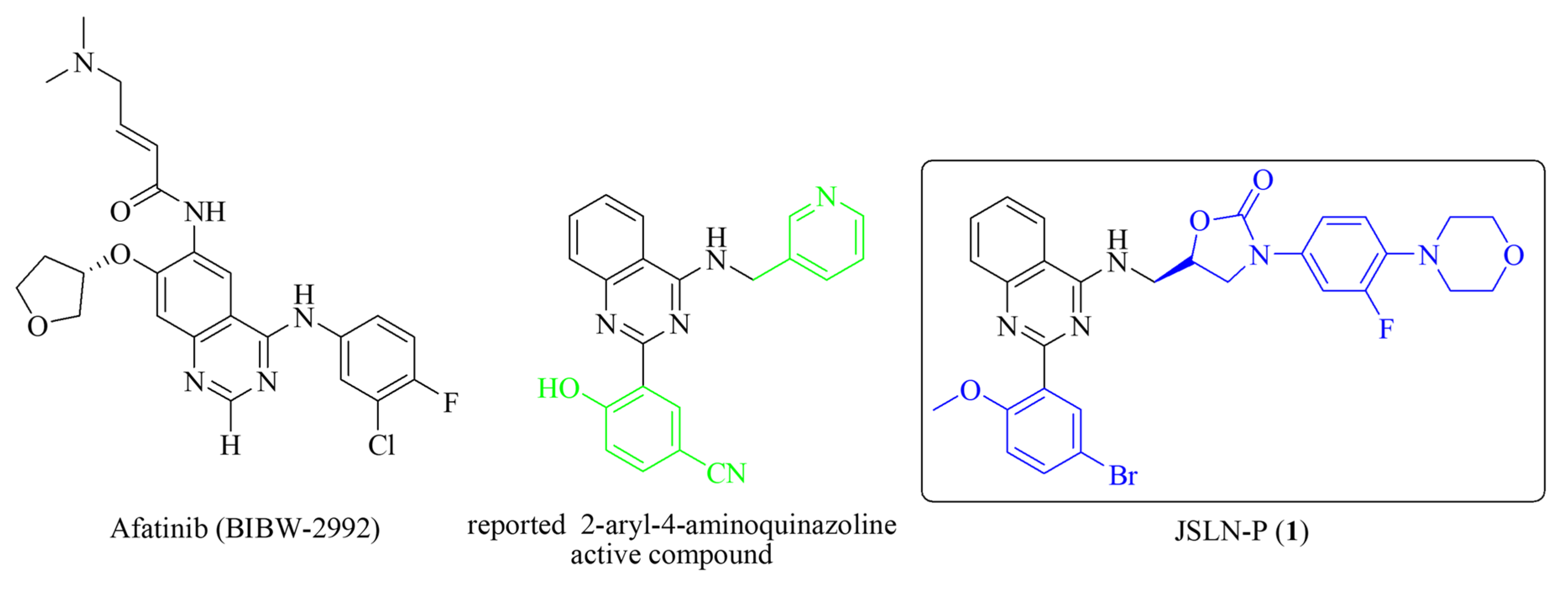
Inspired by these results, to explore the potential use of aminoquinazoline derivatives in the treatment of cancer, as well as the unexplained role of antiglioma activity, in this study, we further conducted a new medicinal chemistry program based on the 2-aryl-4-aminoquinazolin structure to investigate antiglioma activity, and the cytotoxic activity in U251 cells was evaluated. Herein, the title compound JSLN-P (1) was designed based on oxazolidinones, motivated by the well-documented success of amination substituents in medicinal chemistry, which was used for antiglioma bioactivity evaluation. The structures of Afatinib, the reported 2-aryl-4-aminoquininazoline active compound and JSLN-P (1) are shown in Figure 1.

2. Results and Discussion

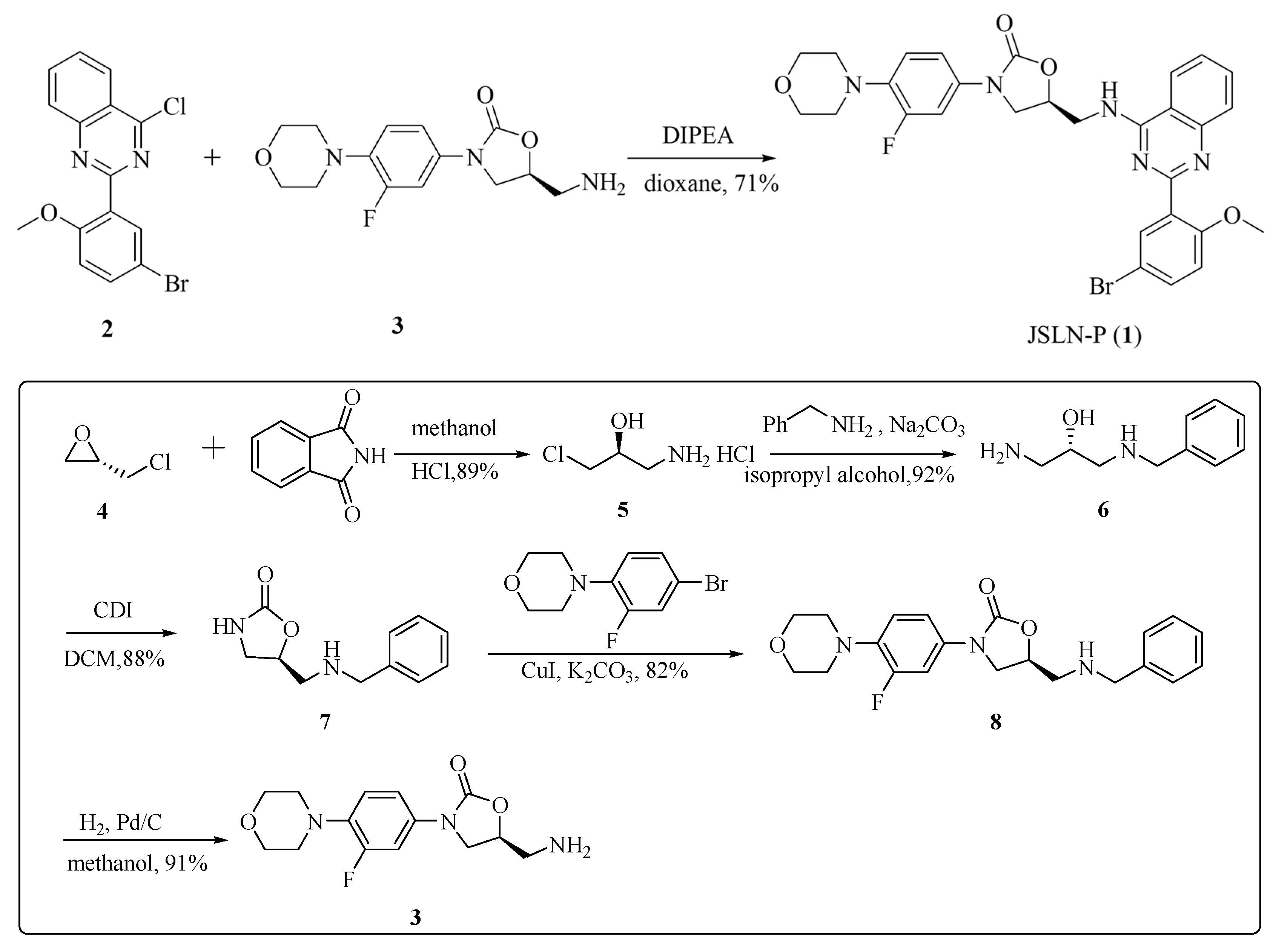
To synthesize JSLN-P (1), quinazoline 2 was first prepared from commercially available starting materials according to our previously reported method [11]. The key intermediate oxazolidinone 3, currently best known as a chiral fragment for linezolid, was derived from epichlorohydrin derivatives via azido reaction. Typical synthetic approaches employ (R)-glycidyl butyrate or (S)-3-chloropropane-1,2-diol as chiral reagents to introduce chiral centers through azido intermediates [14,15]. However, there are problems such as long reaction steps, using dangerous sodium azide as the nucleophile and the strict reaction conditions for cryogenic and high temperature.
Herein, we disclose a novel and efficient route for the synthesis of oxazolidinone 3 from (S)-2-epichlorohydrin via amination with a phthalimide, benzylamination and oxazolone cyclization protocol. Having obtained the key intermediates 2 and 3, JSLN-P (1) was afforded by a nucleophilic aromatic substitution reaction under reflux conditions employing N, N-diisopropylethylamine in tetrahydrofuran with the yield of 71% on the gram scale. The synthetic method provides an efficient choice for the synthesis of oxazolidinones and its derivatives.
The structures of the synthesized compounds were determined by nuclear magnetic resonance (NMR) and high-resolution mass spectrometry (HRMS) (electrospray ionization (ESI). The synthesis of the targeted molecules is illustrated in Scheme 1.
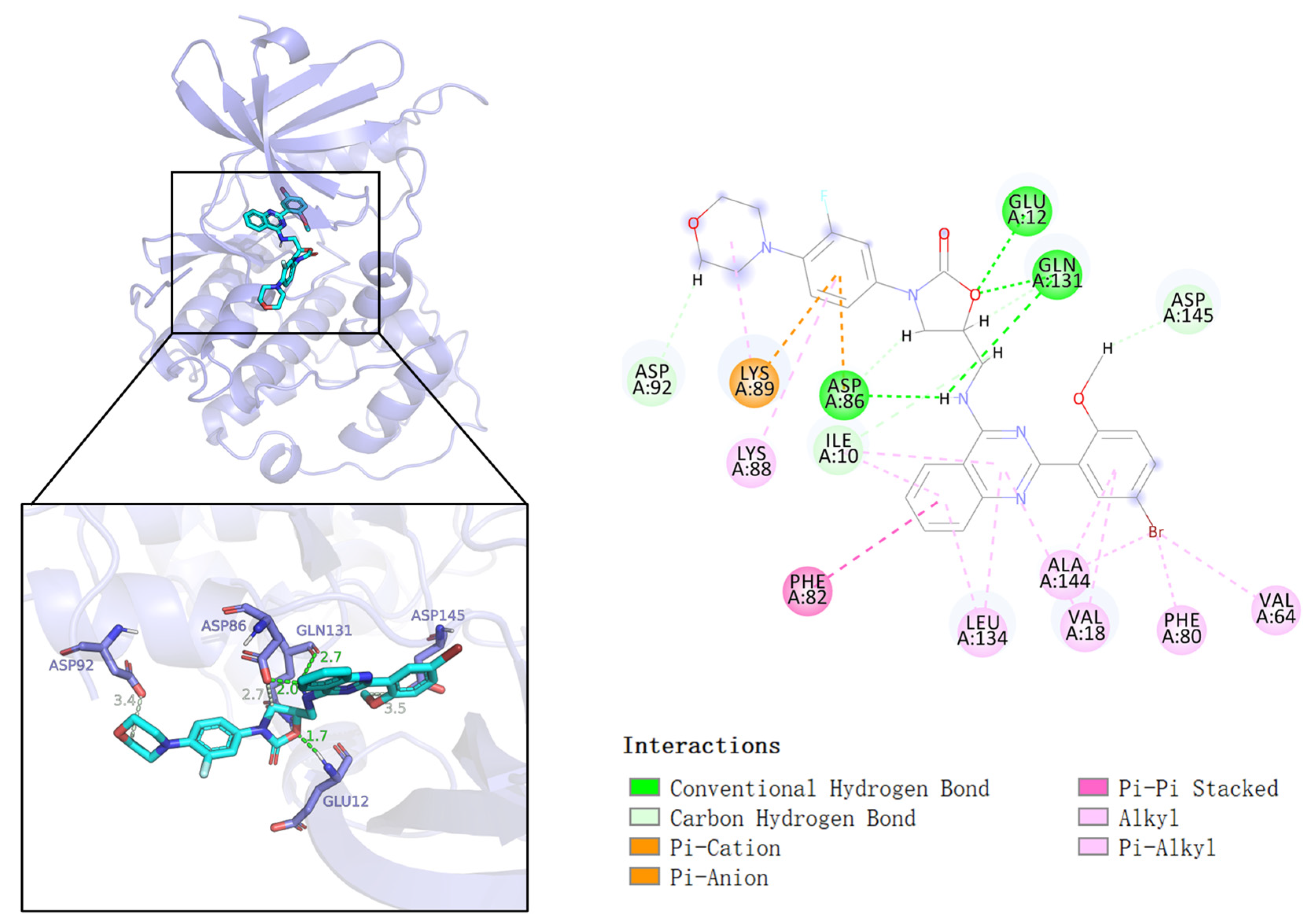
Encouraged by these promising results, using AutoDock Vina software 2.0, we investigated the structural modeling of JSLN-P (1) in complex with the CDK2 protein (PDB: 3PY1). As shown in Figure 2, four hydrogen bonds were identified with the CDK2 protein, indicating its potential for good receptor affinity.

3. Materials and Methods

Unless otherwise specified, all reactions were performed in air or a moisture site. All reagents and chemicals were sourced from commercial suppliers (Sigma Aldrich, Shanghai, China, TCI Chemicals, Shanghai, China) and utilized directly without further purification. Reaction processes were monitored by thin-layer chromatography with silica gel aluminum plates (60F254), and spots were visualized with UV light at 254 nm or iodine. Silica gel column chromatography was performed using silica gel with a particle size of 300~400 mesh. 1H NMR and 13C NMR spectra were recorded in CH3OH-d4, CHCl3-d3 or DMSO-d6 at room temperature on Bruker Avance spectrometers with TMS as the internal standard. Data of 1H NMR are reported as follows: chemical shift, multiplicity (s = singlet; br = broad; d = doublet; t = triplet; m = multiple), coupling constants and integration. High-resolution mass spectra were analyzed by Agilent Technologies 6540 UHD Accurate-Mass Q-TOF LC/MS (Santa Clara, CA, USA).

3.1. Synthesis of (S)-1-Amino-3-chloropropane-2-ol Hydrochloride (5)

Molbank 2026 m2202 i001
(S)-2-epichlorohydrin 4 (12.5 g, 133.1 mmol) and methanol (25 mL) were added dropwise to a solution of phthalimide (14.7 g, 100.0 mmol) in methanol (80 mL) and water (40 mL) with intense stirring at room temperature for 30 min. After the addition was completed, the reaction mixture was stirred constantly at 25 °C for 6 h, followed by the addition of hydrochloric acid (25.0 g, 246.5 mmol) and subsequent mixing for 30 min at the same temperature; the system was then brought to 80 °C and stirred for another 7 h. After cooling to room temperature, the solvent was evaporated to dryness under reduced pressure at 45 °C, methanol (25 mL) was added and heated to reflux, and then the mixture was cooled to 0 °C and stirred for 3 h. The mixture was filtered through celite, and the resulting colorless solid 5 was obtained at an 89% yield (14.8 g). 1H NMR (400 MHz, DMSO-d6, ppm) δ 8.23 (s, 2H), 5.99 (d, J = 5.1 Hz, 1H), 3.97 (dd, J = 5.4, 3.7 Hz, 1H), 3.65 (m, 2H), 2.95 (dd, J = 12.8, 3.5 Hz, 1H), 2.73 (dd, J = 12.8, 8.7 Hz, 1H). 13C NMR (100 MHz, DMSO-d6, ppm) δ 67.45, 47.22, 42.21. HRMS (ESI) m/z 110.0369 (calcd for C3H9ClNO [M + H]+ 110.0373). The HRMS, 1H NMR and 13C NMR spectra of compound 5 are shown in Figures S1, S2 and S3, respectively.

3.2. Synthesis of (S)-1-Amino-3-(benzylamino) Propane-2-ol (6)

Molbank 2026 m2202 i002
To a solution of (S)-1-amino-3-chloropropane-2-ol hydrochloride 4 (11.6 g, 80.0 mmol), 2-methyltetrahydrofuran (40 mL), N,N-diisopropylethylamine (DIPEA, 10.3 g, 80.0 mmol), and benzylamine (10.0 g, 92.7 mmol) in 2-methyltetrahydrofuran (20 mL) were added slowly under constant stirring at a temperature of 20 °C. The system was then brought to 45 °C, and after 4 h additional water (30 mL) was added, followed by cooling to 15 °C. The mixture was stirred for 20 min; the product was extracted from the organic layer, and additional 2-methyltetrahydrofuran (30 mL) was added to the water phase for repeated extraction. After combining with the organic layer and washing with saturated aqueous NH4Cl solution (30 mL), the resulting organic phases were dried with Na2SO4 and the solvents removed under vacuum; ethanol (20 mL) was added and stirred for 10 min at room temperature; the mixture was filtered through celite, and the reaction product 6 was obtained as a white solid at a yield of 92% (13.4 g). 1H NMR (400 MHz, DMSO-d6, ppm) δ 9.64 (s, 1H), 8.30 (s, 2H), 7.74–7.54 (m, 2H), 7.49–7.29 (m, 3H), 6.18 (d, J = 5.2 Hz, 1H), 4.27–4.07 (m, 3H), 3.14–2.73 (m, 4H). 13C NMR (100 MHz, DMSO-d6, ppm) δ 132.10, 130.80, 129.33, 129.00, 63.96, 50.63, 49.78, 42.56. HRMS (ESI) m/z 181.1338 (calcd for C10H16N2O [M + H]+ 181.1341). The HRMS, 1H NMR and 13C NMR spectra of compound 5 are shown in Figures S4, S5 and S6, respectively.

3.3. Synthesis of (S)-5-((Benzylamino) Methyl) Oxazolidine-2-one (7)

Molbank 2026 m2202 i003
An amount of (S)-1-amino-3- (benzylamino) propane-2-ol 6 (12.0 g, 66.7 mmol) was dissolved in dichloromethane (DCM, 70 mL). Additionally, N,N-carbonyldiimidazole (CDI, 16.0 g, 98.7 mmol) was added slowly and triethylamine (6.7 g, 66.7 mmol) was added dropwise to the solution while keeping the flask in an ice bath under 5 °C. The reaction was allowed to proceed for 4 h at the same temperature. After this time, the reaction mixture was quenched with 40 mL of saturated aqueous NH4Cl solution and stirred for 20 min. The product was extracted from the organic layer, and additional dichloromethane 30 mL was added to the water phase for repeated extraction. It was then combined with the organic layer and washed twice with water (30.0 g × 2). The resulting organic phases were dried with Na2SO4 and the solvents removed using rotavapor. The residue was purified by column chromatography (DCM/petroleum = 1/4), and the aimed product 7 was obtained as a white solid at an 88% yield (12.1 g). 1H NMR (400 MHz, DMSO-d6, ppm) δ 9.91 (s, br, 1H), 7.79 (s, 1H), 7.60 (dq, J = 8.2, 2.9 Hz, 2H), 7.50–7.35 (m, 3H), 5.03 (m, 1H), 4.16 (s, 2H), 3.58 (t, J = 9.0 Hz, 1H), 3.28 (dd, J = 9.3, 6.5 Hz, 1H), 3.16 (dd, J = 8.6, 8.0 Hz, 2H). 13C NMR (100 MHz, DMSO-d6, ppm) δ 158.35, 132.06, 130.82, 129.39, 129.03, 71.64, 50.72, 49.19, 43.34. HRMS (ESI) m/z 207.1128 (calcd for C11H14N2O2 [M + H]+ 207.1134). The HRMS, 1H NMR and 13C NMR spectra of compound 7 are shown in Figures S7, S8 and S9, respectively.

3.4. Synthesis of (S)-5-((Benzylamino)methyl)-3-(3-fluoro-4-morpholinophenyl) Oxazolidin-2-one (8)

Molbank 2026 m2202 i004
A sealable Schlenk flask was charged with (S)-5-((benzylamino) methyl) oxazolidine-2-one 7 (10.3 g, 50.0 mmol), CuI (0.66 g, 3.5 mmol), anhydrous K2CO3 (13.8 g, 0.10 mol) and 4-(4-bromo-2-fluorophenyl) morpholine (12.9 g, 50.0 mmol). The flask was then evacuated and filled with nitrogen; N,N-dimethylformamide (2 mL) and toluene (80 mL) were added under a nitrogen stream, and the mixture was sealed and stirred at 115 °C for 24 h. After cooling at room temperature, the reaction mixture was filtered through celite and washed with CH2Cl2 twice (2 × 100 mL). After combining with the organic layers and concentrating in vacuo, the resulting residue was purified by flash column chromatography (acetate/petroleum = 1/6), and the aimed product 8 was obtained as a white solid at an 82% yield (15.8 g). 1H NMR (400 MHz, CH3OH-d4, ppm) δ 7.51–7.31 (m, 6H), 7.19–7.16 (m, 1H), 7.05 (t, J = 9.2 Hz, 1H), 4.87–4.92 (m, 1H), 4.15 (t, J = 9.0 Hz, 1H), 4.02 (s, 2H), 3.84–3.78 (m, 5H), 3.12 (d, J = 5.8 Hz, 2H), 3.05–3.02 (m, 4H). 13C NMR (100 MHz, CH3OH-d4, ppm) δ 156.66, 155.17, 154.20, 137.21, 136.39, 133.52 (d, J = 11.0), 128.48 (d, J = 22.0), 127.55, 118.89, 114.33, 107.25 (d, J = 27.0), 71.94, 66.65, 52.70, 50.97. HRMS (ESI) m/z 386.1874 (calcd for C21H24FN3O3 [M + H]+ 386.1879). The HRMS, 1H NMR and 13C NMR spectra of the compound 8 are shown in Figures S10, S11 and S12, respectively.

3.5. Synthesis of (S)-5-(Aminomethyl)-3-(3-fluoro-4-morpholinophenyl)oxazolidin-2-one (3)

Molbank 2026 m2202 i005
(S)-5-((benzylamino)methyl)-3-(3-fluoro-4-morpholinophenyl) oxazolidin-2-one 8 (7.7 g, 20.0 mmol), Pd/C (10%, 0.38 g), and methanol (150 mL) were placed in an autoclave (250 mL). The mixture was then evacuated and filled with H2 three times, and the reaction mixture was stirred at 30 °C for 12 h under a pressure between 1.2 and 1.5 MPa. After the reaction was finished, the resultant mixture was filtered to recover the catalyst. The solvent was removed under reduced pressure to afford compound 3 at a 91% yield (5.4 g). 1H NMR (400 MHz, CH3OH-d4, ppm) δ 7.50 (dd, J = 14.7, 2.6 Hz, 1H), 7.21–7.18 (m, 1H), 7.05 (t, J = 9.2 Hz, 1H), 4.82–4.79 (m, 1H), 4.17 (t, J = 9.1 Hz, 1H), 3.84–3.80 (m, 5H), 3.20–3.10 (m, 2H), 3.05–3.02 (m, 4H). 13C NMR (100 MHz, CH3OH-d4, ppm) δ 156.62, 154.86, 154.18, 136.41 (d, J = 9.0), 133.48, 118.85, 114.29, 107.25 (d, J = 27.0), 72.06, 66.63, 50.94, 43.19. HRMS (ESI) m/z 296.1403 (calcd for C14H18FN3O3 [M + H]+ 296.1410). The HRMS, 1H NMR and 13C NMR spectra of compound 3 are shown in Figures S13, S14 and S15, respectively.

3.6. Synthesis of (5S)-5-[(2-(5-Bromo-2-methoxyphenyl)quinazolin-4-ylamino)methyl]-3-(3-fluoro-4-morpholino Phenyl)oxazolidin-2-one (JSLN-P(1))

Molbank 2026 m2202 i006
(5-bromo-2-methoxyphenyl)-4-chloroquinazoline 2 (5.9 g, 17.0 mmol), (S)-5-(aminomethyl)-3-(3-fluoro-4-morpholinophenyl)oxazolidin-2-one 3 (5.0 g, 17.0 mmol) and N,N-diisopropylethylamine (DIPEA, 4.8 g, 37.2 mmol) were added to dioxane (100 mL) with strong stirring; then, the reaction mixture was refluxed for 20 h, and the reaction solvent was concentrated in vacuo. The crude product was purified by flash column chromatography (acetate/petroleum = 1/3), and the title product JSLN-P(1) was obtained as a white solid at a 71% yield (7.3 g). 1H NMR (400 MHz, CH3Cl-d3, ppm) δ 8.09 (s, 1H), 7.96 (s, 1H), 7.89 (d, J = 8.5 Hz, 1H), 7.78 (t, J = 7.7 Hz, 1H), 7.54 (q, J = 7.6 Hz, 2H), 7.46–7.37 (m, 1H), 7.04 (d, J = 8.7 Hz, 1H), 6.98–6.83 (m, 2H), 5.09 (s, 1H), 4.27–4.08 (m, 3H), 4.03 (d, J = 7.2 Hz, 1H), 3.91 (s, 3H), 3.86 (t, J = 4.7 Hz, 4H), 3.03 (t, J = 4.7 Hz, 4H), 1.26 (s, 1H), 0.84 (d, J = 7.6 Hz, 1H). 13C NMR (100 MHz, CH3Cl-d3, ppm) δ 159.76, 156.91, 154.48, 133.95, 133.25 (d, J = 18.0), 128.48, 126.67, 120.90, 118.85, 113.97, 113.02, 107.74, 107.47, 71.85, 66.99, 56.33, 51.02, 48.21, 44.03. HRMS (ESI) m/z 608.1303 (calcd for C29H27BrFN5O4 [M + H]+ 608.1308). The HRMS, 1H NMR and 13C NMR spectra of the compound JSLN-P(1) are shown in Figures S16, S17 and S18, respectively.

4. Conclusions

In summary, a novel compound, (5S)-5-((2-(5-bromo-2-methoxyphenyl)quinazolin-4-ylamino)methyl)-3-(3-fluoro-4-morpholino phenyl)oxazolidin -2-one (JSLN-P (1)), was synthesized by amination approaches following benzylamination and oxazolone cyclization, further condensation with 4-(4-bromo-2-fluorophenyl) morpholine, reduction in debenzylation and halogenated amination with mild reaction conditions. The structures of the target compounds were confirmed by 1H and 13C nuclear magnetic resonance (NMR) and high-resolution mass spectrometry (HRMS). The novel compound was employed for antiglioma biological activity evaluation, and further structural modifications are underway.

Supplementary Materials

The following supporting information can be downloaded online, 1H, 13C NMR, and HRMS spectra for compounds 5 (Figures S1–S3), 1H, 13C NMR, and HRMS spectra for compound 6 (Figures S4–S6), 1H, 13C NMR, and HRMS spectra for compound 7 (Figures S7–S9), 1H, 13C NMR, and HRMS spectra for compound 8 (Figures S10, S11, S12), 1H, 13C NMR, and HRMS spectra for compound 3 (Figures S13–S15) and JSLN-P (1) (Figures S16–S18).

Author Contributions

Conceptualization, M.Z.; synthesis, M.Z. and S.H.; analysis, Y.P. and B.M.; writing—original draft preparation, writing—M.Z.; review and editing, Y.P.; funding acquisition, M.Z.; project administration, Y.P. All authors have read and agreed to the published version of the manuscript.

Funding

This project was sponsored by the Medical Research Project of Yancheng Health Commission (No. YK2024182) and the Scientific Research Start-up Fund of Jiangsu Medical College (No. 20216108).

Data Availability Statement

The original contributions presented in this study are included in the article/Supplementary Materials. Further inquiries can be directed to the corresponding author.

Conflicts of Interest

Author Baiyang Mao was employed by the company Jiangsu Yabang Johnson Pharmaceutical Co., Ltd. All the authors declare that the research was conducted in the absence of any commercial or financial relationships that could be construed as a potential conflict of interest.

References

  1. Lin, R.; Xie, L.; Gao, T.; Yang, Y.; Huang, L.; Cheng, K.; Chen, Z. Design, synthesis and anti-tumor evaluation of novel pyrimidine and quinazoline analogues. Eur. J. Med. Chem. 2025, 282, 117057. [Google Scholar] [CrossRef] [PubMed]
  2. Zhao, M.; Wu, D.; Qiu, W.; Zhang, H.; Chen, M.; Zhou, H.; Ye, X.; Han, Z.; Shi, X. A novel Quinazoline derivative exerts anti-tumor effects in non-small cell lung cancer through Wnt/β-catenin pathway inhibition. Bioorg. Chem. 2025, 160, 108481. [Google Scholar] [CrossRef] [PubMed]
  3. Wang, S.; Yang, Z.; Gu, D.; Han, J.; Chen, H.; Wang, H.; Zheng, J.; Liu, H.; Ke, Y.; Zhang, Q. Design, synthesis, and evaluation of antitumor activity of quinazoline derivatives containing different terminal segments of basic amine groups. Med. Chem. Res. 2025, 34, 134. [Google Scholar]
  4. Dai, H.; Si, X.; Wang, L.; Chi, H.; Gao, C.; Wang, Z.; Liu, L.; Qian, Z.; Ke, Y.; Zhang, Q.; et al. Design, synthesis and anti-tumor activity evaluation of 4,6,7-substitute quinazoline derivatives. Med. Chem. Res. 2022, 31, 1351. [Google Scholar] [CrossRef]
  5. Garduño-Villavicencio, L.; Martínez-Ortega, U.; Ortiz-Sánchez, E.; Tinajero-Rodríguez, J.; Hernández-Luis, F. Compounds Consisting of Quinazoline, Ibuprofen, and Amino Acids with Cytotoxic and Anti-Inflammatory Effects. ChemMedChem 2024, 17, e202300651. [Google Scholar] [CrossRef]
  6. Charoensutthivarakul, S.; Lohawittayanan, D.; Kanjanasirirat, P.; Jearawuttanakul, K.; Seemakhan, S.; Chabang, N.; Schlaeppi, P.; Tantivess, V.; Limboonreung, T.; Phanchana, M. Rational design and lead optimisation of potent antimalarial quinazolinediones and their cytotoxicity against MCF-7. Molecules 2023, 28, 2999. [Google Scholar] [CrossRef] [PubMed]
  7. Ashraf-Uz-Zaman, M.; Li, X.; Yao, Y.; Mishra, C.; Moku, B.; Song, Y. Quinazolinone compounds have potent antiviral activity against zika and dengue virus. J. Med. Chem. 2023, 66, 10746. [Google Scholar] [CrossRef] [PubMed]
  8. Kohlbauer, S.; Xia, H.; Grau, B.; Wangen, C.; Hahn, F.; Nenajdenko, V.; Marschal, M. Facile synthesis of new antiviral fluoro-quinazolines enabled by merging domino reactions. Synthesis 2025, 57, 389. [Google Scholar] [CrossRef]
  9. Tawaraishi, T.; Ochida, A.; Akao, Y.; Itono, S.; Kamaura, M.; Akther, T.; Shimada, M.; Canan, S.; Chowdhury, S.; Cao, Y.; et al. Collaborative virtual screening identifies a 2-aryl-4-aminoquinazoline series with efficacy in an in vivo model of trypanosoma cruzi infection. J. Med. Chem. 2023, 26, 1221. [Google Scholar] [CrossRef]
  10. Ramadan, S.K.; Abd-Rabboh, H.; Abou-Elmagd, W. Antiproliferative activity and molecular docking of some pyrazole-based quinazolinone, benzimidazole, and tetrazinethione derivatives. J. Biochem. Mol. Toxicol. 2025, 39, e70131. [Google Scholar] [CrossRef] [PubMed]
  11. Zhang, M.; Wang, Y.; Wang, J.; Liu, Z.; Wang, S. Design, synthesis and biological evaluation of the quinazoline derivatives as L858R/T790M/C797S triple mutant EGFR tyrosine kinase inhibitors. Chem. Pharm. Bull. 2020, 68, 971–980. [Google Scholar] [CrossRef]
  12. Park, H.; Jung, H.-Y.; Mah, S.; Hong, S. Discovery of EGF receptor inhibitors that are selective for the d746-750 /T790M/C797S mutant through structure-based de novo design. Angew. Chem. Int. Ed. 2017, 56, 634–638. [Google Scholar] [CrossRef]
  13. Zarba, P.; Drabczyk, A.; Wnorowski, A.; Wnorowski, A.; Maj, M.; Rurka, P.; Malarz, A.; Latacz, G.; Nędza, K.; Ciura, K.; et al. Long-chain cyclic arylguanidines as multifunctional serotonin receptor ligands with antiproliferative activity. ACS Omega 2025, 10, 6446. [Google Scholar] [CrossRef] [PubMed]
  14. Madhusudhan Reddy, G.; Ramulu, A.; Pratap Reddy, P. A new practical synthesis of linezolid: An antibacterial drug. Lett. Org. Chem. 2010, 7, 45–49. [Google Scholar] [CrossRef]
  15. Roy, T.; Mondal, K.; Halder, P.; Sengupta, A.; Das, P. CuF2/DTBP-Catalyzed Chan-Lam coupling of oxazolidinones with arylboronic acid pinacol ester: Scope and application. J. Org. Chem. 2025, 90, 6219–6232. [Google Scholar] [CrossRef] [PubMed]
Figure 1. Structures of Afatinib and JSLN-P (1).
Molbank 2026 m2202 g001
Scheme 1. Synthesis route for obtaining JSLN-P (1) from compounds 2 and 3.
Molbank 2026 m2202 sch001
Figure 2. Molecular modeling of the JSLN-P (1) and CDK2 complex.
Molbank 2026 m2202 g002
Disclaimer/Publisher’s Note: The statements, opinions and data contained in all publications are solely those of the individual author(s) and contributor(s) and not of MDPI and/or the editor(s). MDPI and/or the editor(s) disclaim responsibility for any injury to people or property resulting from any ideas, methods, instructions or products referred to in the content.