
Short Note

(E)-4-(3-Oxo-3-(2-oxo-2,3-dihydrobenzo[d]oxazol-6-yl)prop-1-en-1-yl)benzaldehyde
by
Yordanka B. Ivanova
1,*,
Daniel Y. Yordanov
2 and
Ognyan I. Petrov
2,*
1
Department of Plant Pathology and Chemistry, Faculty of Ecology and Landscape Architecture, University of Forestry, 10 Kliment Ohridsky Blvd., 1756 Sofia, Bulgaria
2
Department of Pharmaceutical and Applied Organic Chemistry, Faculty of Chemistry and Pharmacy, Sofia University St. Kliment Ohridski, 1 James Bourchier Blvd., 1164 Sofia, Bulgaria
*
Authors to whom correspondence should be addressed.
Molbank 2026, 2026(4), M2201; https://doi.org/10.3390/M2201
Submission received: 13 June 2026 / Revised: 5 July 2026 / Accepted: 8 July 2026 / Published: 9 July 2026

Abstract

In the present study, (E)-4-(3-oxo-3-(2-oxo-2,3-dihydrobenzo[d]oxazol-6-yl)prop-1-en-1-yl)benzaldehyde (2) was synthesized via a base-catalyzed Claisen–Schmidt condensation of 6-acetylbenzo[d]oxazol-2(3H)-one (1) and terephthalaldehyde and characterized by spectroscopic methods.

1. Introduction

Chalcones are α,β-unsaturated carbonyl compounds widely recognized for their diverse biological properties, including antimicrobial, antifungal, anti-inflammatory, and anticancer activities [1,2,3]. In addition to their biological relevance, chalcones serve as important intermediates in organic synthesis and in the preparation of various heterocyclic systems [2,4]. Incorporation of heterocyclic fragments such as benzoxazolone moieties into chalcone frameworks has been reported to enhance their physicochemical and pharmacological properties [4,5]. In this work, we report the synthesis of a benzoxazolone-containing chalcone derivative as a useful intermediate for further functionalization and preparation of hybrid chalcone derivatives, owing to the presence of a free aldehyde group, which provides a reactive site for further structural modification.

2. Results

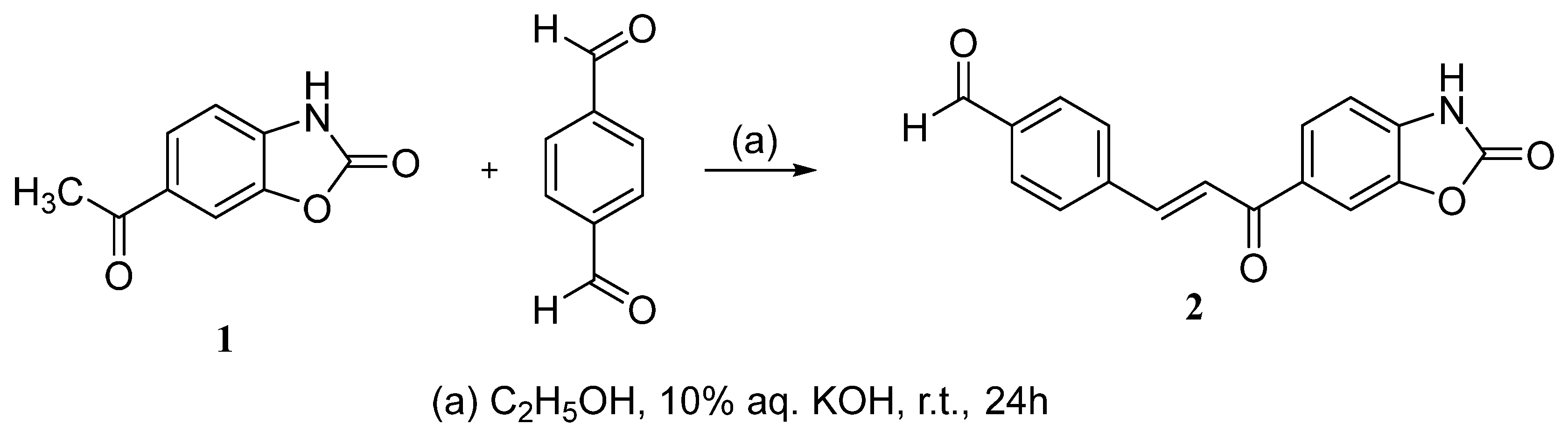
The target compound (E)-4-(3-oxo-3-(2-oxo-2,3-dihydrobenzo[d]oxazol-6-yl)prop-1-en-1-yl)benzaldehyde (2) was obtained from 6-acetylbenzo[d]oxazol-2(3H)-one (1) [6] and terephthalaldehyde via a base-catalyzed Claisen–Schmidt condensation (Scheme 1). The reaction was carried out in an ethanolic potassium hydroxide solution at room temperature for 24 h. After completion of the reaction, as monitored by thin-layer chromatography (TLC), the product was isolated and purified by recrystallization.
The reaction was additionally carried out using different molar ratios of terephthalaldehyde to ketone (1:1, 1:2, and 2:1). In all examined cases, the isolated product corresponded to the mono-condensation product, while one aldehyde group remained unreacted. The selective formation of compound 2 was confirmed by the presence of the aldehyde proton signal at δ 10.04 ppm in the 1H NMR spectrum and the aldehyde carbon resonance at δ 193.1 ppm in the 13C NMR spectrum. Furthermore, no signals attributable to a symmetrical bis-chalcone derivative were detected in the isolated product. Although terephthalaldehyde is commonly employed for the synthesis of symmetrical bis-chalcones under Claisen–Schmidt conditions [7,8], preservation of one aldehyde group has also been reported for terephthalaldehyde or phthalaldehyde-derived chalcone intermediates [9,10].
The observed selectivity may be associated with electronic factors that decrease the reactivity of the second aldehyde group after the initial condensation. Initially, terephthalaldehyde is highly reactive because its two aldehyde groups mutually withdraw electron density from each other through strong inductive (–I) and mesomeric (–M) effects. Following the first condensation, the reacted group transforms into an extended conjugated system (chalcone), which stabilizes the benzene ring via resonance and sharply decreases the electrophilicity of the remaining aldehyde carbon atom.
The structure of compound 2 was established by elemental analysis, FTIR spectroscopy, 1H and 13C NMR spectroscopy, and HRMS. In the 1H NMR spectrum, the two vinyl protons of the α,β-unsaturated carbonyl system appeared at δ 7.77 and 8.13 ppm with a large coupling constant (J = 15.6 Hz), confirming the E-configuration of the double bond. The aldehyde proton was observed as a singlet at δ 10.04 ppm, indicating that one aldehyde group remained unreacted. The aromatic protons resonated in the expected region between δ 7.23 and 8.14 ppm. The 13C NMR spectrum further supported the proposed structure, showing characteristic signals for the aldehyde and conjugated carbonyl carbons at δ 193.1 and 187.6 ppm, respectively, together with the expected aromatic and vinylic carbon resonances. The IR spectrum displayed characteristic absorption bands corresponding to carbonyl functional groups. High-resolution mass spectrometric analysis provided additional support for the proposed structure. HPLC analysis indicated the formation of a single major product with high purity.

3. Materials and Methods

3.1. General

All chemicals were purchased from Acros Organics (Geel, Belgium) and Fluorochem (Hadfield, UK). Reactions and purity of the final compound were monitored by thin-layer chromatography (TLC) on silica gel plates (Kieselgel 60 F254) (Merck, Darmstadt, Germany) using toluene/chloroform/methanol (3.5:1.5:0.5, v/v) as eluent.
Melting points were determined on a Kruss KSN I N melting point apparatus (Hamburg, Germany). NMR spectra were recorded in DMSO-d6 on a Bruker Avance III HD 500 spectrometer (Billerica, MA, USA) operating at 500 MHz for 1H and 125.8 MHz for 13C. Chemical shifts are reported in parts per million (δ) relative to the solvent peak, and coupling constants (J) are given in hertz (Hz). High-resolution mass spectra (HRMS) were obtained with an Orbitrap Exploris 120 Mass Spectrometer, Thermo Fisher Scientific (Waltham, Massachusetts, USA). Analytical HPLC was carried out on an Agilent 1100 HPLC system (Santa Clara, CA, USA) equipped with a binary pump and diode array detector. The column used is Agilent Eclipse Plus C18 (Santa Clara, CA, USA) (75 mm × 4.6 mm, 3.5 µm). The mobile phase is AcN:H2O, using a linear gradient of the binary solvent system (AcN:H2O from 30:70 to 90:10 v/v% for 7.5 min, with a final time of 5 min) with a flow rate of 0.500 mL⁄min.

3.2. Synthesis

(E)-4-(3-Oxo-3-(2-oxo-2,3-dihydrobenzo[d]oxazol-6-yl)prop-1-en-1-yl)benzaldehyde (2)

To a solution of 6-acetylbenzo[d]oxazol-2(3H)-one (1) (354 mg, 2 mmol) in 10% aqueous KOH (4 mL), a solution of terephthalaldehyde (536 mg, 4 mmol) in ethanol (6 mL) was added. The reaction mixture was stirred at room temperature for 24 h, during which a precipitate formed. The reaction was monitored to completion by thin-layer chromatography (TLC). The mixture was then poured into water (30 mL) and acidified with 10% hydrochloric acid. The resulting crystalline product was filtered, washed with water until neutral, dried, and recrystallized from ethanol to afford compound 2. Yield: 97% (569 mg).
Light yellow crystals; m.p. 276–278 °C (EtOH). IR (nujol): 1574, 1594, 1655, 1770, 3472 cm−1. 1H NMR (500 MHz, DMSO-d6): δ 7.24 (d, 1H, ArH, J = 8.2 Hz), 7.77 (d, 1H, CH=, J = 15.6 Hz), 7.97 (d, 1H, ArH, J = 8.2 Hz), 8.08 (dd, 1H, ArH), 8.11 (d, 1H, ArH, J = 8.2 Hz), 8.13 (d, 1H, CH=, J = 15.6 Hz), 10.04 (s, 1H, CHO). 13C NMR (126 MHz, DMSO-d6): δ 193.12, 187.64, 154.92, 143.95, 142.50, 140.82, 137.42, 135.67, 132.02, 130.30, 129.87, 126.39, 125.12, 110.09, 110.05. HRMS (ESI): Found 294.0759. Calcd. for C17H12NO4: 294.0766 [M + H]+.

Supplementary Materials

FT-IR, 1H- and 13C-NMR, HRMS for compounds 2. Figure S1: FT-IR spectrum of compound 2, Figure S2: 1H-NMR spectrum of compound 2; Figure S3: 13C-NMR spectrum of compound 2, Figure S4: HRMS of compound 2, Figure S5: HPLC of compound 2.

Author Contributions

Conceptualization, O.I.P. and Y.B.I.; methodology, Y.B.I., D.Y.Y., and O.I.P.; writing—original draft preparation, Y.B.I. and O.I.P.; writing—review and editing, Y.B.I. and O.I.P. All authors have read and agreed to the published version of the manuscript.

Funding

Financing provided by the University of Forestry, Sofia, Bulgaria, Project NIS-B 1395/08.05.2025, Synthesis of new hybrid molecules and study of their biological potential.

Data Availability Statement

Data are contained within the article and Supplementary Materials.

Acknowledgments

The authors are grateful for the financing provided by the University of Forestry, Sofia, Bulgaria, Project NIS-B 1395/08.05.2025, Synthesis of new hybrid molecules and study of their biological potential.

Conflicts of Interest

The authors declare no conflicts of interest.

References

  1. Zhuang, C.; Zhang, W.; Sheng, C.; Zhang, W.; Xing, C.; Miao, Z. Chalcone: A privileged structure in medicinal chemistry. Chem. Rev. 2017, 117, 7762–7810. [Google Scholar] [CrossRef] [PubMed]
  2. Nowakowska, Z. A review of anti-infective and anti-inflammatory chalcones. Eur. J. Med. Chem. 2007, 42, 125–137. [Google Scholar] [CrossRef] [PubMed]
  3. Singh, P.; Anand, A.; Kumar, V. Recent developments in biological activities of chalcones: A mini review. Eur. J. Med. Chem. 2014, 85, 758–777. [Google Scholar] [CrossRef] [PubMed]
  4. Zhang, N.; Zeng, W.; Zhou, Q.; Sun, Z.; Meng, K.; Qin, Y.; Hu, Y.; Xue, W. Design, synthesis, antibacterial and antiviral evaluation of chalcone derivatives containing benzoxazole. Arab. J. Chem. 2024, 17, 105368. [Google Scholar] [CrossRef]
  5. Alsayari, A.; Tasqeeruddin, S.; Shaheen Sultana, S.; Eppakayala, A. Design, synthesis and biological evaluation of aryl chalcone derivatives of pyridine-benzoxazole-pyimidine-oxazole as anticancer agents. Results Chem. 2025, 16, 102359. [Google Scholar] [CrossRef]
  6. Ivanova, Y.; Momekov, G.; Petrov, O.; Karaivanova, M.; Kalcheva, V. Cytotoxic Mannich bases of 6-(3-aryl-2-propenoyl)-2(3H)-benzoxazolones. Eur. J. Med. Chem. 2007, 42, 1382–1387. [Google Scholar] [CrossRef] [PubMed]
  7. Olender, D.; Pawełczyk, A.; Leśków, A.; Sowa-Kasprzak, K.; Zaprutko, L.; Diakowska, D. Synthesis of bis-chalcones based on green chemistry strategies and their cytotoxicity toward human MeWo and A375 melanoma cell lines. Molecules 2024, 29, 5171. [Google Scholar] [CrossRef] [PubMed]
  8. Pereira, R.; Silva, A.M.; Ribeiro, D.; Silva, V.L.; Fernandes, E. Bis-chalcones: A review of synthetic methodologies and anti-inflammatory effects. Eur. J. Med. Chem. 2023, 252, 115280. [Google Scholar] [CrossRef] [PubMed]
  9. Shen, B.Y.; Wang, M.M.; Xu, S.M.; Gao, C.; Wang, M.; Li, S.; Ampomah-Wireko, M.; Chen, S.C.; Yan, D.C.; Qin, S.; et al. Antibacterial efficacy evaluation and mechanism probe of small lysine chalcone peptide mimics. Eur. J. Med. Chem. 2022, 244, 114885. [Google Scholar] [CrossRef] [PubMed]
  10. Kankala, S.; Edulla, R.; Modem, S.; Vadde, R.; Vasam, C.S. N-Heterocyclic carbene catalyzed intramolecular crossed aldehyde–ketone benzoin condensation in the chalcone of o-phthalaldehyde: A facile synthesis of naphthalenones. Tetrahedron Lett. 2011, 52, 3828–3831. [Google Scholar] [CrossRef]
Scheme 1. Synthesis of (E)-4-(3-oxo-3-(2-oxo-2,3-dihydrobenzo[d]oxazol-6-yl)prop-1-en-1-yl)benzaldehyde (2).
Molbank 2026 m2201 sch001
Disclaimer/Publisher’s Note: The statements, opinions and data contained in all publications are solely those of the individual author(s) and contributor(s) and not of MDPI and/or the editor(s). MDPI and/or the editor(s) disclaim responsibility for any injury to people or property resulting from any ideas, methods, instructions or products referred to in the content.