Short Note

2-Chloro-4,5,6,7-tetrafluoro-2-(methylthio)-1H-indene-1,3(2H)-dione

by
Anastasia R. Kovrizhina
* and
Andrei I. Khlebnikov
Kizhner Research Center, Tomsk Polytechnic University, 634050 Tomsk, Russia
*
Author to whom correspondence should be addressed.
Molbank 2026, 2026(3), M2189; https://doi.org/10.3390/M2189
Submission received: 9 May 2026 / Revised: 4 June 2026 / Accepted: 5 June 2026 / Published: 8 June 2026
(This article belongs to the Section Organic Synthesis and Biosynthesis)

Abstract

We report the synthesis of the new compound 2-chloro-4,5,6,7-tetrafluoro-2-(methylthio)-1H-indene-1,3(2H)-dione (Compound 3), which presents an important type of fluoro-containing heterocycles and is a useful intermediate product in organic synthesis. The structure of the compound was confirmed by the NMR and elemental analysis. A quantum-chemical comparison (DFT) of 2-chloro-2-(methylthio)-1H-indene-1,3(2H)-dione (with C-H bonds, compound 4) and its 4,5,6,7-tetrafluoro derivative (with C-F bonds, compound 3) at the M06-2X/6-311++G(d,p) level in THF showed that the introduction of four fluorine atoms into the benzene ring causes a systematic shortening of the C=O, C-Cl, and C-C bonds of the five-membered ring, as well as an almost twofold decrease in the dipole moment. Replacing hydrogen with fluorine leads to a simultaneous stabilization of the frontier orbitals and a narrowing of the HOMO–LUMO energy gap, while the electron affinity increases by 0.39 eV and the electrophilicity index increases from 2.77 to 3.24 eV, making compound 3 a strong electrophile. Analysis of donor–acceptor interactions (NBOs) and condensed Fukui indices confirms that perfluorination selectively increases the electrophilicity of the sp3-carbon center of C-Cl, making it more susceptible to nucleophilic attack. At the same time, the isodesmic reaction with 1,2,4,5-tetrafluorobenzene yields a positive free energy change (ΔG = +13.4 kcal/mol), indicating that the increased reactivity of compound 3 is kinetic rather than thermodynamic in nature. The synthesized 1,3-indandione derivative thus represents a promising precursor for tetrafluoroninhydrin and can be considered a biologically active compound. Thus, perfluorination of the indandione skeleton is an effective tool for targeted enhancement of electrophilic properties without fundamentally changing the geometry of the molecule, which opens up prospects for the design of new highly reactive reagents.

1. Introduction

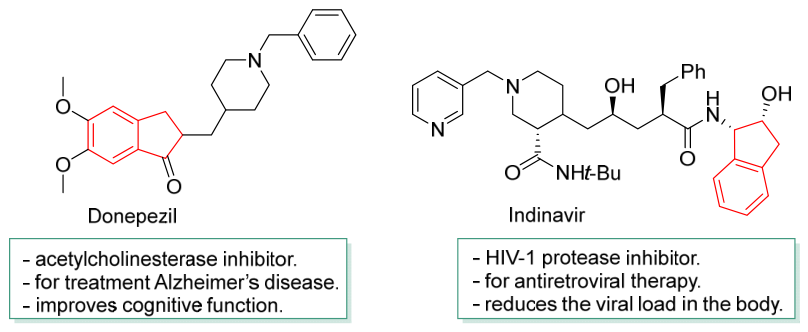
Indandione, specifically the 1,3-indandione scaffold, represents one of the most versatile building blocks in organic chemistry. Classified as a bicyclic β-diketone, this structure has applications, ranging from medicinal chemistry to materials science [1]. The core interest in indan-1,3-dione derivatives stems from their unique electronic properties, particularly the presence of an active methylene group and conjugated ketone moieties, which make them excellent electron acceptors and reactive partners in various chemical transformations [1]. Their significance is underscored by their presence in numerous biologically active compounds, drawing a parallel to the related indanone scaffold found in drugs like Donepezil for Alzheimer’s disease and Indinavir for HIV treatment (Figure 1) [1]. These compounds exhibit the broad biological potential, including anticancer, anticoagulant, anti-inflammatory, and antimicrobial activities [2].
Fluoroorganic chemistry, in turn, is one of the most significant and dynamically developing fields of modern science. The incorporation of fluorine into organic molecules is modification that alters physicochemical and biological properties [3,4].
The creation of fluoro-containing indandione derivatives is a particularly perspective area of research. The strategic introduction of a fluorine atom or a fluoroalkyl group onto the indandione core can amplify its inherent properties or bestow new ones. For instance, in medicinal chemistry, fluorinated indandiones are explored for their potential as radiofluorinated ligands for positron emission tomography (PET) imaging, as demonstrated in studies targeting the α2-adrenoreceptor ligand atipamezole [5].
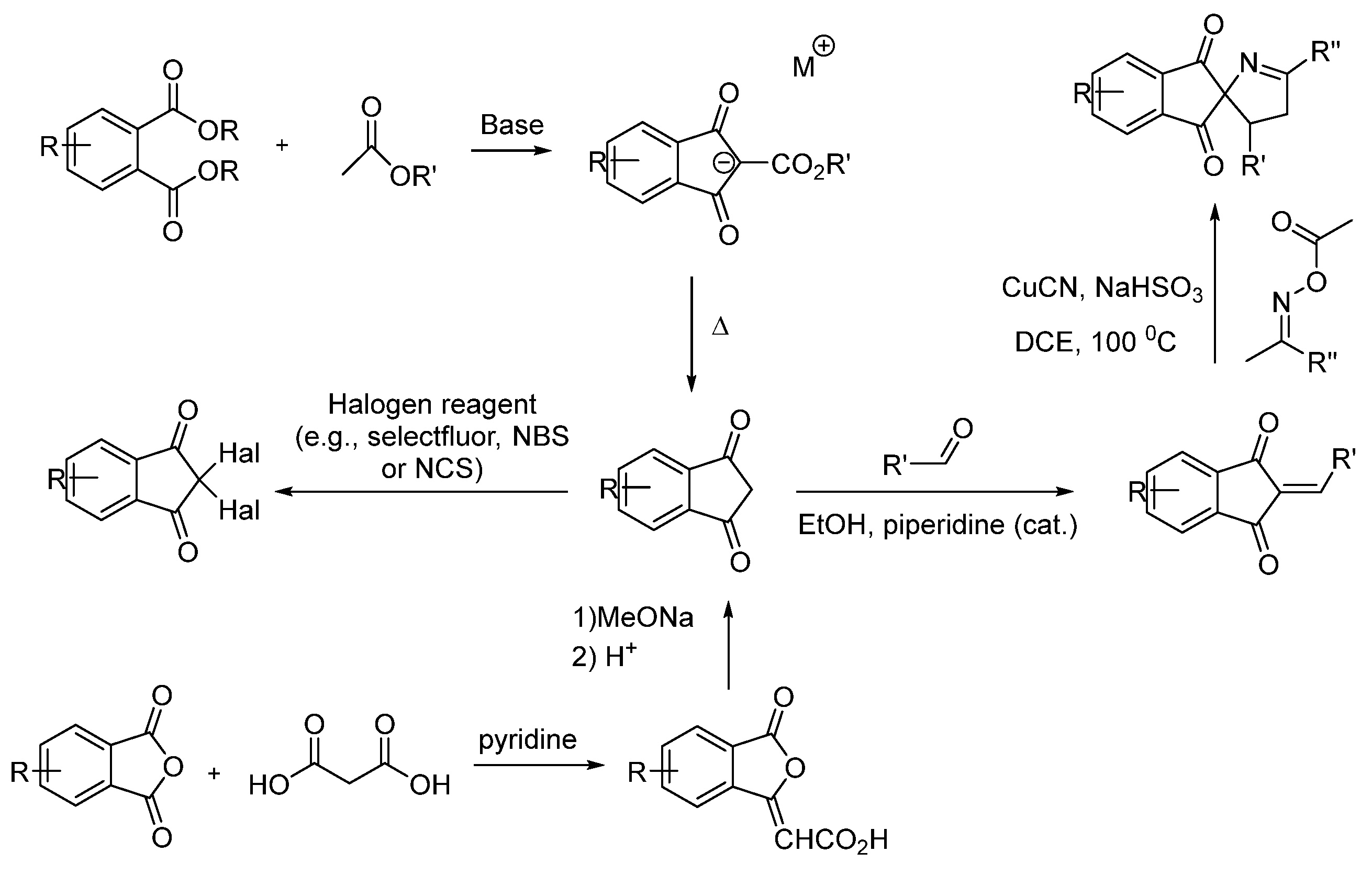
The classic synthesis of indane-1,3-dione involves the nucleophilic addition of an alkyl acetate to a dialkyl phthalate, followed by hydrolysis and decarboxylation [1,6] (Scheme 1). From this core, a multitude of transformations are possible. The ketone groups can be functionalized via Knoevenagel reactions with malononitrile to create dicyanomethylene derivatives, with the regioselectivity of the reaction being controllable through temperature, electronic effects of substituents, or steric hindrance [7,8]. The active methylene allows for condensation reactions, and the diketone moiety can participate in the formation of complex heterocycles like bis-thiazoles [9]. For fluorinated variants specifically, these building blocks can be used in further annulation or cross-coupling reactions to construct larger, more complex polyaromatic systems with potential electronic applications [10,11,12].
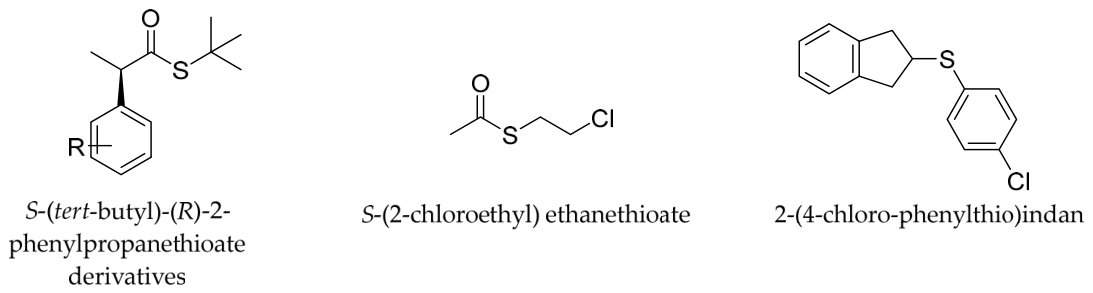
In addition to fluorinated and chlorinated indandione derivatives, the organosulfur compounds, particularly chloro thioesters, are valuable intermediates in organic synthesis, often serving as activated acyl groups for transformations like the formation of amides and carbon–carbon bonds [13,14]. The introduction of a chloro substituent, especially at the alpha position relative to the thioester carbonyl, creates a versatile electrophilic building block (Figure 2) [15]. Recent advances have demonstrated powerful new methods for functionalizing these compounds. For instance, the first dual nickel/photoredox-catalyzed enantioselective reductive cross-coupling of racemic α-chloro thioesters with aryl iodides has been developed [15]. This innovative strategy allows for the construction of chiral α-aryl thioesters with high enantioselectivity (up to 91% ee) under mild conditions, avoiding the need for organometallic reagents or stoichiometric metal reductants. Such methodologies highlight the growing importance of α-chloro thioesters as precursors to enantioenriched molecules of interest in pharmaceutical discovery.
Other chloro-containing thioesters, such as S-(2-chloroethyl) ethanethioate (Figure 2), are also noteworthy [16]. This compound, bearing a chloroalkyl group, functions as an alkylating agent and serves as a building block in medicinal and agricultural chemistry for introducing both a thioester and a reactive chloroethyl moiety. The interest in such structures is further underscored by research into their biological interactions, with studies suggesting potential cytotoxic effects related to their ability to form adducts with cellular macromolecules like DNA. Furthermore, the intersection of indandione and thioether chemistry is evident in molecules like 2-(4-chloro-phenylthio)indan (Figure 2), a compound that combines a chlorinated phenyl group linked via sulfur to an indan core, representing a hybrid structure explored for various applications [17].
Thus, fluorine-containing indandione derivatives, as well as related chloro- and sulfur-containing analogs (e.g., chloro thioesters), represent a striking example of the convergence of several key areas of organic chemistry. These compounds successfully combine synthetic availability and high reactivity of privileged scaffolds with the unique property-modifying capabilities provided by halogen and sulfur atoms. This combination determines their high value as tools for the development of new drugs, diagnostic agents, and functional materials, where synthesis relies on both classical methods and modern advances in organic chemistry.

2. Results and Discussion

2.1. Chemistry

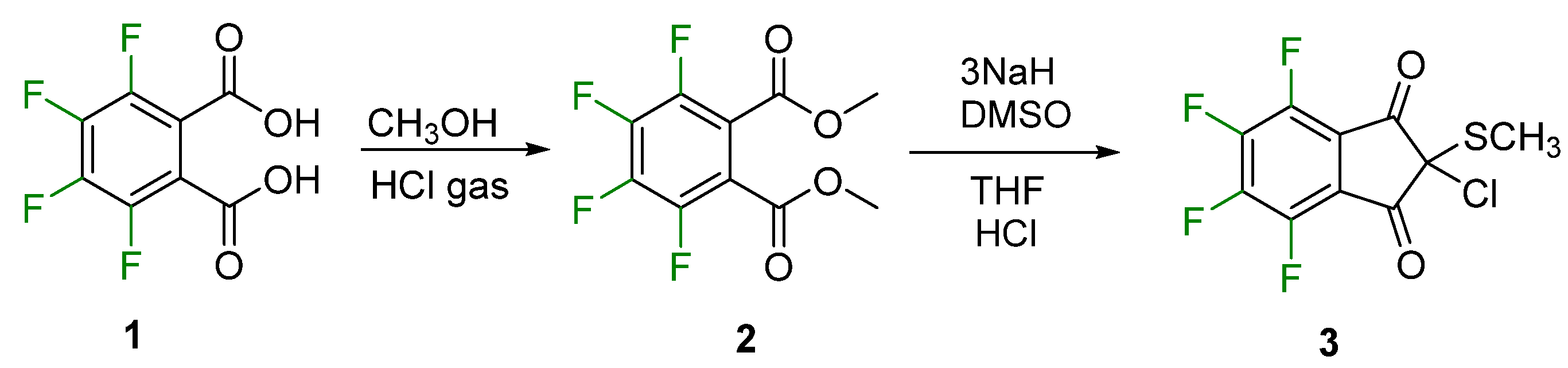
Our attempt to carry out the reaction of 3,4,5,6-tetrafluorophthalic acid (Scheme 2, Compound 1) in dry methanol under HCl gas at room temperature, following protocols from [18], led to a complete conversion of the starting materials and obtaining previously known dimethyl 3,4,5,6-tetrafluorophthalate (Scheme 2, Compound 2) [19]. The next step was a cyclization by the mixing of Compound 2 (1 eq.), sodium hydride (3 eq.) and hydrochloric acid in anhydrous tetrahydrofuran (THF)/dimethylsulfoxide (DMSO) in inert atmosphere. DMSO under the reaction conditions serves as a source of the methylthio group in situ. During isolation of the product, the mixture was acidified with 6N hydrochloric acid as a chlorinating agent. We obtained the target 2-chloro-4,5,6,7-tetrafluoro-2-(methylthio)-1H-indene-1,3(2H)-dione (Scheme 2, Compound 3, yield 33%).
The cyclization method is based on a variant of the classic Claisen reaction for producing indanediones. Using a THF/DMSO mixture, we attempted to achieve both solubility and reactivity. However, Compound 2 may not have sufficient time to adsorb onto the NaH surface and become activated prior to the reaction. This results in a significant portion of the compound remaining in solution, where it is completely unreactive and likely removed during subsequent processing, which may explain the low yield. Both the starting ester 2 and the target product 3 can undergo undesired reactions—either with unreacted starting material or via self-condensation. Such side processes (Claisen-type reactions) are common for β-diketones and can “divert” a large portion of the active intermediate, reducing the yield of the target product.
The reaction mechanism includes 5 steps:
Step 1. Formation of the methylthiomethylene anion.
NaH acts as a strong base and reducing agent. Under the reaction conditions, DMSO can act as a source of the methylthio group, forming the methylthiomethylene anion (CH2SMe).
Step 2. Nucleophilic addition to an ester.
Compound 2 contains two ester groups. The CH2SMe anion attacks one of the electrophilic carbon atoms of the carbonyl group of the ester fragment, forming a tetrahedral intermediate.
Step 3. Elimination of the methoxide anion.
The methoxide anion (MeO) is eliminated from the tetrahedral intermediate, the carbonyl group is recovered, and the product becomes a ketone with a methylthiomethyl group attached to the carbonyl carbon atom.
Step 4. Intramolecular cyclization.
The resulting ketone with an active methylene group (next to the carbonyl) participates in an intramolecular Claisen condensation with another ester fragment.
Step 5. Chlorination.
During the product isolation step, hydrochloric acid is added, which serves as a source of chorine to form Compound 3.
The structure of Compound 3 was confirmed by the NMR spectroscopy (Figures S1–S3) and elemental analysis. The main characteristics of the title Compound 3: white crystals, m.p. 92–95 °C, soluble in acetone and chloroform.
Previously, this method had only been used to obtain naphtho[f]ninhydrin [18], where a chloro thioether served as the intermediate compound. Here, we applied this method for the first time to synthesize the chloro thioether of tetrafluoronaphthalic acid, which can be considered a precursor of tetrafluoroninhydrin. These compounds represent promising biologically active agents.

2.2. Effect of Fluorine on Physicochemical Characteristics: A DFT Study

2.2.1. Comparative Analysis of Geometric Parameters

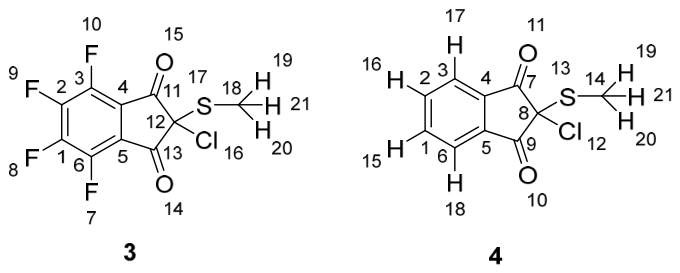
Geometry optimization of compound 3 and its non-fluorinated analogue 4 in THF solution (CPCM) at the M06-2X/6-311++G(d,p) level revealed no imaginary frequencies, confirming that both structures correspond to true minima. The main geometric parameters are summarized in Table 1.
Table 1. Comparison of key bond lengths (Å) and bond angles (°) in compound 3 and non-fluorinated analog 4 with C-H bonds (Figure 3).
Bond Lengths
Compound34Changes
C-Cl (C8-Cl12/C12-Cl16)1.77841.7758−0.0026
C-S (C8-S13/C12-S17)1.82141.8204−0.0010
S-CH3 (S13-C14/S17-C18)1.81801.8181+0.0001
C=O (C7=O11/C11=O15)1.19951.1958−0.0037
C=O (C9=O10/C13=O14)1.19951.1958−0.0037
C-C five-membered ring (C7-C8/C11-C12)1.54601.5438−0.0022
C-C five-membered ring (C8-C9/C12-C13)1.54591.5437−0.0022
C-Ar (average)1.39291.3901−0.0028
C-F (average)-1.3197-
Bond angles
∠C7-C8-C9/C11-C12-C13104.15104.72+0.57
∠C8-S13-C14/C12-S17-C1899.4399.49+0.06
Torsion angle (C-C-C-C in five-membered ring)±5.4±5.00
Data analysis shows that perfluorination of the aromatic ring results in a slight but systematic shortening of most chemical bonds. The most noticeable shortening was observed for the C=O double bonds (by ~0.0037 Å) and the C-C bonds in the five-membered ring (by 0.0022 Å). The C-Cl bond also shortens by 0.0026 Å, while the C-S bond length remains virtually unchanged. The aromatic C-C bonds shorten by an average of 0.0028 Å, reflecting ring strengthening due to the −I effect of the four fluorine atoms. The introduction of fluorine only slightly alters the bond angles: the angle at the sp3-hybridized C12 atom (C-F) opens by 0.6°, while the C-S-C angle remains almost unchanged. The observed shortening of the C=O bonds points to their enhanced double-bonding character, accompanied by increased positive charge on the carbonyl carbon atoms. The concurrent shortening of the C-Cl bond, on the other hand, is attributed to a higher s-character of the carbon hybrid orbital involved in the C-Cl bond (Bent’s rule), caused by the electron-withdrawing effect of the four fluorine atoms. This makes the C-Cl bond more ionic and more susceptible to heterolytic cleavage upon nucleophilic attack. This is consistent with the electron-withdrawing nature of fluorine, which lowers the electron density in the aromatic system and shifts it from the five-membered ring to the benzene ring, making the carbonyl carbon atoms more electrophilic.

2.2.2. Dipole Moment

The sharp decrease in the dipole moment upon moving from Compound 4 (8.28 D) to Compound 3 (4.47 D) indicates a significant redistribution of electron density. In Compound 4, a significant dipole is created by the polar C=O and C-Cl bonds against the background of the relatively electron-donating (due to the hydrogen atoms) benzene ring. In Compound 3, the fluorine atoms, with their strong −I effect, effectively draw electron density from the ring and indirectly from the carbonyl groups, partially compensating for the dipole moments of individual polar bonds. The vector sum results in a nearly twofold decrease in the overall dipole moment, indicating a substantial reduction in the overall polarity of the molecule.

2.2.3. Frontier Orbital Energies, Ionization Potential, and Electron Affinity

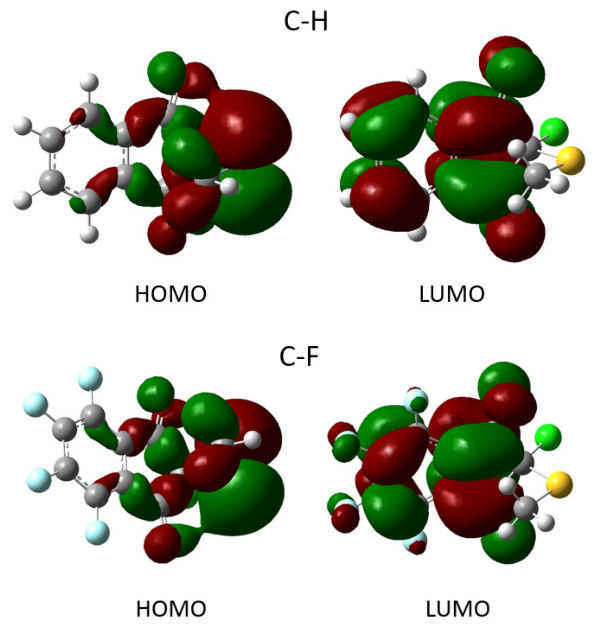
To obtain the vertical ionization potential (IP) and electron affinity (EA), single-point calculations of the cation and anion doublet states were performed on the DFT-optimized geometry of the neutral molecule using the same functional, basis and the CPCM solvation. The HOMO and LUMO energies (Figure 4) were taken from the neutral molecule calculation. The results are summarized in Table 2.
As can be seen from Table 2, the introduction of four fluorine atoms into the aromatic ring leads to a decrease in the energies of both the HOMO and LUMO, with the LUMO being stabilized more strongly (by 0.42 eV) than the HOMO (by 0.20 eV). This causes a narrowing of the energy gap from 6.38 to 6.16 eV (by approximately 0.22 eV), which makes Compound 3 softer and more polarizable. The ionization potential increases by 0.19 eV, and the electron affinity increases by 0.39 eV. An increase in both values is typical for electron-withdrawing substituents, which lower the overall energy of the system and facilitate electron attachment. A more significant increase in EA compared to IP reflects the preferential stabilization of the lowest unoccupied orbital. These changes are quantitatively described by the electrophilicity index ω = (IP + EA)2/(8·(IP − EA)) [20], which increases from 2.77 eV in Compound 4 to 3.24 eV in Compound 3. According to the electrophilicity scale of Domingo et al. [21], this value (ω > 1.5 eV) classifies both compounds as strong electrophiles, but the perfluorinated analogue is an even more powerful electron acceptor. This is entirely consistent with the enhancement of donor–acceptor interactions involving π* (C=O) in Compound 3 as noted in Section 2.2.4.

2.2.4. Charge Distribution and Bond Order Analysis (NBO)

Despite significant geometric changes, the Wiberg indices for the polar C-Cl, C-S, and C=O bonds in Compound 3 and Compound 4 are virtually identical (Table 3). This indicates that the covalent component of these bonds remains unchanged, and the observed shortening of the bond lengths in Compound 3 is primarily attributed to an increase in the ionic contribution caused by the redistribution of charge density. Indeed, shortening with a constant Wiberg index is characteristic of bonds with an increased proportion of electrostatic attraction. The constancy of the C=O indices (≈1.83) confirms the high double bonding of the carbonyl groups in both compounds.
The most informative interactions are those involving the antibonding orbitals π(C=O) and σ(C-Cl). In Compound 3, compared to Compound 4, a small but systematic increase in interaction energies is observed: the transfer from the sulfur lone pair to π*(C=O) increases from ~3.5 to 3.6 kcal/mol, and the transfer from σ(C-Cl) to π*(C=O) increases from 2.14 to 2.26 kcal/mol. This directly indicates the increased acceptor capacity of the carbonyl groups in the perfluorinated compound. On the other hand, the back transfer from the π-system of the aromatic ring to π*(C=O) in Compound 3 decreases (18.0 versus 22.9 kcal/mol in Compound 4), which is explained by the deficiency of π-electron density in the ring due to the presence of fluorine atoms. Instead, new channels are activated: the lone pairs of fluorine actively interact with the π* orbitals of the same ring (23–24 kcal/mol), further stabilizing the system and changing its reactivity.

2.2.5. Condensed Fukui Functions on NPA Charges

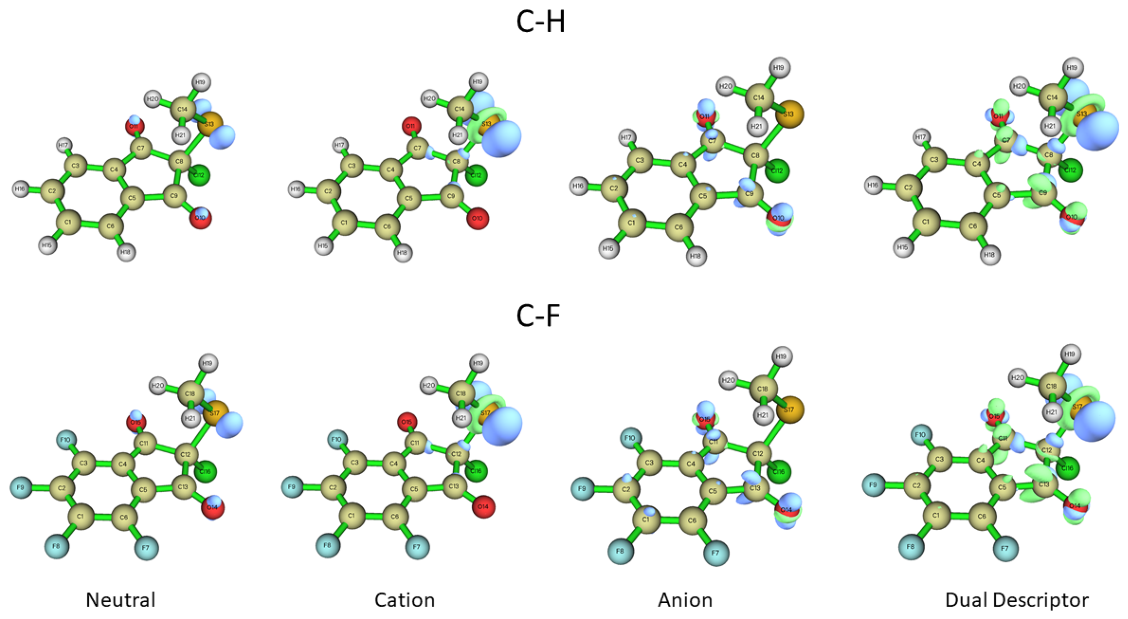
The condensed Fukui indices f+ and f characterize the local electrophilicity and nucleophilicity of an atom, respectively. The NPA charges for key atoms in a neutral molecule, cation, and anion, as well as the Fukui indices calculated from them, are summarized in Table 4 and Figure 5.
The dual descriptor (Figure 4) Δf is positive for both carbonyl carbons (C7/C9 in Compound 4 and C11/C13 in Compound 3) and for the sp3-center of C-Cl (C8 in Compound 4, C12 in Compound 3), which unambiguously identifies these atoms as electrophilic centers in both molecules. At the same time, the chlorine atom and the sulfur atom have negative Δf, which characterizes them as nucleophilic positions. The key change during perfluorination is observed at the C12 (C-Cl) atom in Compound 3 compared to C8 in Compound 4. The f+ index (for electrophilic attack) increases from +0.0525 to +0.0874, that is, by almost 67%. Even more revealing is the dual descriptor Δf: it increases from +0.0214 in Compound 4 to +0.0903 in Compound 3. This is clear quantitative evidence that the sp3-carbon center becomes significantly more electrophilic on perfluorination, and therefore, more susceptible to nucleophilic attack in the SN2 substitution reaction of chlorine. It is also important that the f index for C12 in Compound 3 becomes negative (−0.0029), while in Compound 4 for C8 it is positive (+0.0311). This means that in Compound 3, when an electron is added to the molecule, the charge on C12 remains virtually unchanged (the additional electron goes to the aromatic system), further emphasizing its purely electrophilic nature. For carbonyl carbons (C=O), the following pattern is observed: f+ in Compound 4 is approximately +0.005, while in Compound 3 it becomes negative (−0.019), which seems counterintuitive. However, this is due to the fact that in Compound 3, due to the strong −I effect of fluorine, the neutral molecule already has a significant positive charge on the carbonyl carbon atom (approximately +0.54), and the removal of an electron slightly increases this charge, while the addition of an electron somewhat decreases it. As a result, f+ formally becomes negative. However, the dual descriptor Δf remains positive (approximately +0.046), confirming the overall electrophilic character. In any case, our focus is on the carbon atom of the C-Cl bond, for which the perfluorination effect is most pronounced. The sulfur atom in both compounds exhibits very large negative Δf values (−0.64 in Compound 4 and −0.68 in Compound 3), which characterizes it as a strong nucleophilic center. The sulfur lone pair, as we have already seen from NBO analysis, actively donates electron density to the antibonding orbitals of C-Cl and C=O, which is consistent with its f value.

2.2.6. Thermodynamic Stability: Isodesmic Reaction Analysis

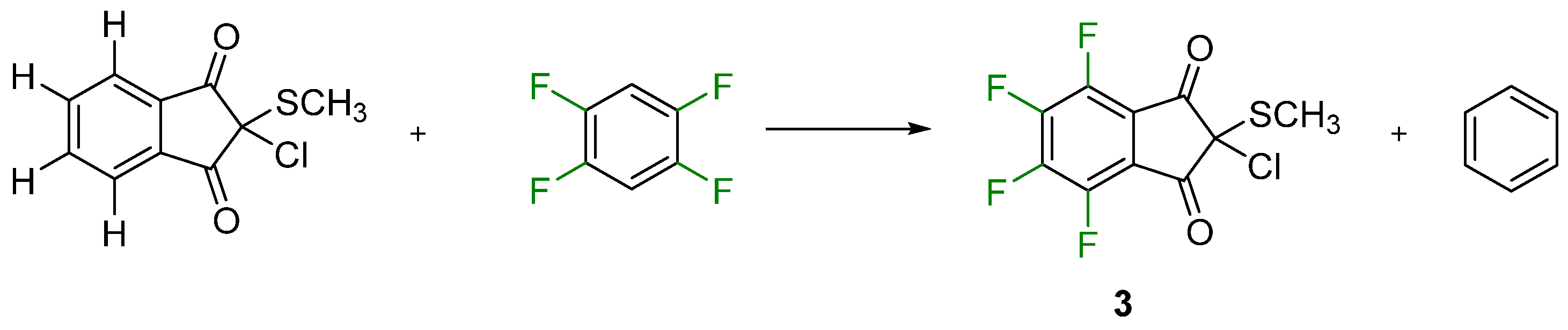
To quantify the relative thermodynamic stability of the perfluorinated derivative 3 compared to the non-fluorinated derivative 4 (Scheme 3), an isodesmic reaction was used [22,23,24], strictly preserving the number of chemical bonds of each type. The reaction equation involves the exchange of aromatic fragments involving 1,2,4,5-tetrafluorobenzene, which contains exactly four fluorine atoms, as in Compound 3 (Scheme 3). The key requirement of an isodesmic reaction is the preservation of not only the number but also the formal types of all chemical bonds [23].
A Gibbs energy change (ΔG value approximately +13.4 kcal/mol) in the chosen isodesmic reaction indicates that the replacement of the aromatic moiety in Compound 4 with a tetrafluorophenylene moiety to form Compound 3 and benzene is thermodynamically unfavorable. In other words, from a free energy standpoint, the perfluorinated derivative 3 in this isodesmic scheme is somewhat less stable than its non-fluorinated counterpart Compound 4 when 1,2,4,5-tetrafluorobenzene is the exchange partner. The isodesmic reaction used correctly accounts for the bond balance, and its positive ΔG indicates that the thermodynamic contribution of the four C-F bonds in indenedione is slightly less favorable than their contribution in model tetrafluorobenzene if four C-H bonds in benzene are simultaneously released. In practice, this means that perfluorination of indenedione itself does not provide additional thermodynamic stabilization compared to the situation where the same fluorine atoms are present in a separate tetrafluorobenzene molecule. However, this in no way contradicts the previously made conclusions about the kinetic activation of Compound 3.

3. Materials and Methods

3.1. General Information and Compound 3 Synthesis

The 1H (400 MHz), 13C (100 MHz), and 19F (376 MHz) NMR spectra were collected using a Bruker AVANCE III HD spectrometer (Bruker corporation, Billerica, CA, USA). The melting point of the obtained compound was measured using a Melting Point Apparatus SMP30, with heating rate 1.5 °C/min. The elemental analysis was made using a Carlo Erba analyzer (Thermo Fisher Scientific, Waltham, MA, USA). The reaction was monitored by a thin layer chromatography (TLC) on Merck plates (Merck KGaA, Darmstadt, Germany), silica gel 60, F254.
2-Chloro-4,5,6,7-tetrafluoro-2-(methylthio)-1H-indene-1,3(2H)-dione (3): Under argon, a solution of diester 2 (1 mmol) in 1.4 mL of dry DMSO and 1.7 mL of dry THF was added dropwise during a 15 min period to a stirred mixture of 0.12 g (3 mmol) of sodium hydride (60% dispersion in mineral oil) in 1.4 mL of dry DMSO and 0.7 mL of dry THF, and the mixture was stirred at room temperature overnight. The THF was removed under reduced pressure, and the remaining DMSO was eliminated by simple high-vacuum distillation. To the white solid residue, 10 mL of water was added, and the mixture was extracted with CH2Cl2 (10 mL). The aqueous layer was added dropwise to 10 mL of 6 N HCl during a 45 min period. The white precipitate was filtered and stirred for 3 h in 200 mL of CH2Cl2. The mixture was filtered, and the filtrate was washed with water (2 × 100 mL), dried with MgSO4, and evaporated in vacuum (33% yield). The residue was chromatographed on silica gel with CH2Cl2 as eluent to give white crystals.

1H NMR (400 MHz, CDCl3), δ, ppm: 2.82 (s, CH3). 13C NMR (100 MHz, CDCl3), δ, ppm: 173.88, 163.52, 117.03, 115.54, 109.10. 19F NMR (376 MHz, CDCl3), δ, ppm: 141.08 (2F, F-7, F-10), 152.53 (2F, F-8, F-9) (atom numbering is shown in Figure 3). Found, %: C 40.31, H 1.03. C10H3ClF4O2S, Calculated, %: C 40.22, H 1.01.

3.2. DFT Calculations

The DFT calculations were performed with Gaussian 9 program (Gaussian, Inc., Wallingford, CT, USA). The hybrid M06-2X functional [25] and 6-311++G(d,p) basis set [26] were used with CPCM solvation. Vibrational frequency analysis was done for all the optimized geometries in order to ensure attaining energy minima for the molecules and to calculate thermodynamic properties.

4. Conclusions

In this work, we present the synthesis of the previously unknown Compound 3 (2-chloro-4,5,6,7-tetrafluoro-2-(methylthio)-1H-indene-1,3(2H)-dione). The compound structure was confirmed by NMR data and elemental analysis. A quantum-chemical comparison of 2-chloro-2-(methylthio)-1H-indene-1,3(2H)-dione (4) and its 4,5,6,7-tetrafluoro derivative (3) at the M06-2X/6-311++G(d,p) level in THF showed that the introduction of four fluorine atoms into the benzene ring causes a systematic shortening of the C=O, C-Cl, and C-C bonds of the five-membered ring, as well as an almost twofold decrease in the dipole moment. Replacing hydrogen with fluorine leads to a stabilization of the frontier molecular orbitals and a narrowing of the HOMO/LUMO energy gap. The electron affinity increases by 0.39 eV, and the electrophilicity index increases from 2.77 to 3.24 eV, making Compound 3 a strong electrophile. Analysis of donor–acceptor interactions (NBO) and condensed Fukui indices confirms that perfluorination selectively increases the electrophilicity of the sp3-carbon center of C-Cl, making it more susceptible to nucleophilic attack. The isodesmic reaction with 1,2,4,5-tetrafluorobenzene (ΔG = +13.4 kcal/mol) further indicates that the increased reactivity of Compound 3 is kinetic rather than thermodynamic in nature. The investigated 4,5,6,7-tetrafluoro derivative 3 opens access to a wide range of compounds with practical value. For example, substitution of the chlorine atom with various N-, O-, and S-nucleophiles allows for the preparation of the corresponding 2-amino-, 2-alkoxy(aryloxy)-, and 2-alkyl(aryl)thio derivatives. These derivatives can serve as key intermediates in the synthesis of biologically active compounds, in particular, new anticoagulant rodenticides based on 1,3-indandione, which include fluorine-containing acute toxicophore groups [27]. The introduction of amino acid or peptide residues through chlorine substitution enables the synthesis of fluorinated analogs of natural compounds with improved metabolic stability, a highly desirable property in medicinal chemistry. No less important is the fact that donor and acceptor materials for highly efficient organic solar cells and LEDs can be synthesized on the basis of 4,5,6,7-tetrafluoro-1H-indene-1,3(2H)-dione itself: the presence of four fluorine atoms lowers the HOMO/LUMO levels and increases the electron affinity, which is a critical requirement for acceptor components of photovoltaic devices [28,29,30]. We also plan to use the obtained perfluorinated derivative for the synthesis of tetrafluoroninhydrin, a compound with potential as a biologically active agent.

Supplementary Materials

The following supporting information is available online. Figure S1. The 1H NMR spectrum of recrystallized Compound 3. Figure S2. The 13C NMR spectrum of Compound 3. Figure S3. The 19F NMR spectrum of Compound 3.

Author Contributions

Conceptualization was conducted by A.R.K.; experiments were carried out by A.R.K.; data analysis and the writing of the initial manuscript were performed by A.R.K. and A.I.K.; editing of the final version of the manuscript was performed by A.R.K. and A.I.K.; project administration and supervision were conducted by A.I.K. All authors have read and agreed to the published version of the manuscript.

Funding

This research was supported by the Russian Science Foundation (project no. 24-73-00202).

Data Availability Statement

The original contributions presented in this study are included in the article/Supplementary Materials. Further inquiries can be directed to the corresponding author.

Conflicts of Interest

The authors declare no conflicts of interest.

References

  1. Pigot, C.; Brunel, D.; Dumur, F. Indane-1,3-Dione: From Synthetic Strategies to Applications. Molecules 2022, 27, 5976. [Google Scholar] [CrossRef] [Scilit]
  2. Pluskota, R.; Koba, M. Indandione and Its Derivatives—Chemical Compounds with High Biological Potential. Mini Rev. Med. Chem. 2018, 18, 1321–1330. [Google Scholar] [CrossRef] [Scilit]
  3. Kirsch, P. Modern Fluoroorganic Chemistry: Synthesis, Reactivity, Applications; Wiley-VCH: Weinheim, Germany, 2004. [Google Scholar] [CrossRef] [Scilit]
  4. Slaw, B.R.; Tanski, J.M. 6-Fluoro-indan-1-one. Acta Crystallogr. Sect. Struct. Rep. Online 2014, 70, o841. [Google Scholar] [CrossRef] [Scilit]
  5. Enas, J.D.; Garcia, J.G.; Mathis, C.A.; Gerdes, J.M. Nucleophilic aromatic substitution reactions with the fluoride ion: Formation of 5-fluoro-indanones and indandiones related to atipamezole. J. Fluor. Chem. 1993, 63, 233–241. [Google Scholar] [CrossRef] [Scilit]
  6. End, N.; Bold, G.; Caravatti, G.; Wartmann, M.; Altmann, K.H. Synthetic Epothilone Analogs with Modifications in the Northern Hemisphere and the Heterocyclic Side-Chain. Synthesis and Biological Evaluation. In Proceedings of the Fourth International Electronic Conference on Synthetic Organic Chemistry (ECSOC-4), Online, 1–30 September 2000. [Google Scholar]
  7. Asiri, M. Synthesis and characterization of dyes exemplified by 2-arylidene-1-dicyanomethyleneindane. Dye. Pigm. 1999, 42, 209–213. [Google Scholar] [CrossRef] [Scilit]
  8. Bi, H.P.; Guo, L.N.; Duan, X.H.; Gou, F.R.; Huang, S.H.; Liu, X.Y.; Liang, Y.M. Highly regio- and stereoselective synthesis of indene derivatives via electrophilic cyclization. Org. Lett. 2007, 9, 397–400. [Google Scholar] [CrossRef] [Scilit] [PubMed]
  9. Muhammad, Z.A.; Masaret, G.S.; Amin, M.M.; Abdallah, M.A.; Farghaly, T.A. Anti-inflammatory, Analgesic and Anti-ulcerogenic Activities of Novel bis-thiadiazoles, bis-thiazoles and bis-formazanes. Med. Chem. 2017, 13, 226–238. [Google Scholar] [CrossRef] [Scilit]
  10. Chao, P.; Liao, Y.; Mo, D.; Li, L. Novel donor-acceptor-donor type electrochromic polymers based on 1,3-indandione modified triphenylamine derivatives as new acceptor units. Polymer 2024, 312, 127633. [Google Scholar] [CrossRef] [Scilit]
  11. Merlet, S.; Birau, M.; Wang, Z.Y. Synthesis and characterization of highly fluorescent indenofluorenes. Org. Lett. 2002, 4, 2157–2159. [Google Scholar] [CrossRef] [Scilit] [PubMed]
  12. Thirion, D.; Poriel, C.; Rault-Berthelot, J.; Barrière, F.; Jeannin, O. (2,1-a)-Indenofluorene Derivatives: Syntheses, X-ray Structures, Optical and Electrochemical Properties. Chem. Eur. J. 2010, 16, 13646–13658. [Google Scholar] [CrossRef] [Scilit] [PubMed]
  13. Patel, R.I.; Saxena, B.; Sharma, A. General electron–donor–acceptor complex mediated thioesterification reaction via site-selective C-H functionalization using aryl sulfonium Salts. Green Chem. 2024, 26, 10265–10274. [Google Scholar] [CrossRef] [Scilit]
  14. Miki, S.; Kato, K.; Ishida, N. Light-Driven Dehydrogenative Construction of Thioester Linkages from Thiols and Aldehydes. Org. Lett. 2025, 27, 7476–7481. [Google Scholar] [CrossRef] [Scilit]
  15. Xing, F.; Lin, T.; Ye, Y.; Wang, Y.E.; Cao, X.; Gao, X.; Zhang, D.; Kong, L.; Zhu, X.; Xiong, D.; et al. Nickel/photoredox-catalyzed enantioselective arylation of α-chloro thioesters. Chem. Commun. 2023, 59, 13355–13358. [Google Scholar] [CrossRef] [Scilit] [PubMed]
  16. National Center for Biotechnology Information. PubChem Compound Summary for CID 230659, S-{2-[(2-Chloroethyl)sulfanyl]ethyl} Ethanethioate. 2026. Available online: https://pubchem.ncbi.nlm.nih.gov/compound/S-_2-_2-chloroethylsulfanyl_ethyl_-ethanethioate (accessed on 30 April 2026).
  17. Yadav, J.S.; Reddy, B.V.S.; Reddy, Y.J.; Praneeth, K. Iron(III) chloride: A versatile catalyst for the practical synthesis of 3-sulfenylindoles. Synthesis 2009, 2009, 1520–1524. [Google Scholar] [CrossRef] [Scilit]
  18. Hallman, J.L.; Bartsch, R.A. Synthesis of naphtho[f]ninhydrin. J. Org. Chem. 1991, 56, 6243–6245. [Google Scholar] [CrossRef] [Scilit]
  19. Russell, P.C.; Colin, T.J. Tetrafluorophthalic Acids and Derivatives. U.S. Patent 3,240,792, 15 March 1966. [Google Scholar]
  20. Parr, R.G.; Szentpály, L.V.; Liu, S. Electrophilicity index. J. Am. Chem. Soc. 1999, 121, 1922–1924. [Google Scholar] [CrossRef] [Scilit]
  21. Domingo, L.R.; Aurell, M.J.; Pérez, P.; Contreras, R. Quantitative Characterization of the Global Electrophilicity Power of Common Diene/Dienophile Pairs in Diels-Alder Reactions. Tetrahedron 2002, 58, 4417–4423. [Google Scholar] [CrossRef] [Scilit]
  22. Hehre, W.J.; Ditchfield, R.; Radom, L.; Pople, J.A. Molecular orbital theory of the electronic structure of organic compounds. V. Molecular theory of bond separation. J. Am. Chem. Soc. 1970, 92, 4796–4801. [Google Scholar] [CrossRef] [Scilit]
  23. Ponomarev, D.A.; Takhistov, V.V. What are isodesmic reactions? J. Chem. Educ. 1997, 74, 201. [Google Scholar] [CrossRef] [Scilit]
  24. Caramori, G.F.; Galembeck, S.E. A computational study of tetrafluoro-[2.2]cyclophanes. J. Phys. Chem. A 2008, 112, 11784–11800. [Google Scholar] [CrossRef] [Scilit]
  25. Zhao, Y.; Truhlar, D.G. The M06 suite of density functionals for main group thermochemistry, thermochemical kinetics, non-covalent interactions, excited states, and transition elements: Two new functionals and systematic testing of four M06-class functionals and 12 other functionals. Theor. Chem. Acc. 2008, 120, 215–241. [Google Scholar] [CrossRef] [Scilit]
  26. Wachters, A.J.H. Gaussian basis set for molecular wavefunctions containing third-row atoms. J. Chem. Phys. 1970, 52, 1033. [Google Scholar] [CrossRef] [Scilit]
  27. Chen, F.; Liu, L.; Bai, Z.; Zhang, T.; Zhao, K. Synthesis and biological activity of the novel indanedione anticoagulant rodenticides containing fluorine. Bioengineere 2017, 8, 92–98. [Google Scholar] [CrossRef] [Scilit]
  28. Nielsen, C.B.; Holliday, S.; Chen, H.-Y.; Cryer, S.J.; McCulloch, I. Non-Fullerene Electron Acceptors for Use in Organic Solar Cells. Acc. Chem. Res. 2015, 48, 2803–2812. [Google Scholar] [CrossRef] [Scilit] [PubMed]
  29. Duan, T.; Babics, M.; Seitkhan, A.; Firdaus, Y.; Liang, R.-Z.; Cruciani, F.; Liu, S.; Lopatin, S.; Beaujuge, P.M. F-Substituted Oligothiophenes Serve as Nonfullerene Acceptors in Polymer Solar Cells with Open-Circuit Voltages > 1 V. Mater. Chem. A 2018, 6, 9368–9372. [Google Scholar] [CrossRef] [Scilit]
  30. Mumyatov, A.V.; Troshin, P.A. A Review on Fullerene Derivatives with Reduced Electron Affinity as Acceptor Materials for Organic Solar Cells. Energies 2023, 16, 1924. [Google Scholar] [CrossRef] [Scilit]
Figure 1. Some biologically active indanone analogs.
Molbank 2026 m2189 g001
Scheme 1. Synthetic strategies for indandione derivatives.
Molbank 2026 m2189 sch001
Figure 2. Some chloro- and sulfur-containing compounds [15,16,17].
Molbank 2026 m2189 g002
Scheme 2. Synthesis of 2-chloro-4,5,6,7-tetrafluoro-2-(methylthio)-1H-indene-1,3(2H)-dione (Compound 3).
Molbank 2026 m2189 sch002
Figure 3. Atom numbering in tetrafluoro derivative 3 and in non-fluorinated compound 4.
Molbank 2026 m2189 g003
Figure 4. Visualization of frontier orbitals for Compound 4 with C-H and Compound 3 with C-F bonds.
Molbank 2026 m2189 g004
Figure 5. Visualization of NPA charges and dual descriptor.
Molbank 2026 m2189 g005
Scheme 3. Isodesmic reaction equation.
Molbank 2026 m2189 sch003
Table 2. Frontier orbital energies, IP, EA, and electrophilicity indices [20] for Compounds 3 and 4.
ParameterCompound 4Compound 3
E(HOMO), eV−8.29−8.49
E(LUMO), eV−1.91−2.33
ΔE(LUMO-HOMO), eV6.386.16
IP, eV7.377.56
EA, eV2.753.14
Electrophilicity index ω, eV2.773.24
Table 3. The most significant donor–acceptor interactions (energy of the second-order perturbation En(2), kcal/mol).
Donor → AcceptorEn(2), kcal/mol
Compound 4Compound 3
LP(2)Cl → σ*(C-S)6.316.31
LP(3)Cl → σ*(C-S)6.316.31
LP(2)S → σ*(C-Cl)5.395.53
LP(2)S → π*(C=O) (to C7/C11)3.513.59
LP(2)S → π*(C=O) (to C9/C13)3.503.59
σ(C-Cl) → π*(C=O) (C7/C11)2.142.26
σ(C-Cl) → π*(C=O) (C9/C13)2.142.26
LP(2)Cl → π*(C=O)<0.50.71
LP(2)O → π*(rings C-C)23–3026–30
π(C=C)Ar → π*(C=O)22.918.0
LP(2)F → π*(C=C)Ar-23–24
Table 4. NPA charges, Fukui indices and dual descriptor for key atoms in Compound 3 and Compound 4.
Atomq(N − 1) Cationq(N) Neutralq(N + 1) Anionf+fΔf
Compound 4
C7 (C=O)0.562210.567430.471320.0052−0.0961+0.1013
C9 (C=O)0.562080.567410.469630.0053−0.0978+0.1031
C8 (C-Cl)−0.42433−0.37185−0.340720.0525+0.0311+0.0214
Cl120.104090.03683−0.01027−0.0673−0.0471−0.0202
S130.959150.273780.22741−0.6854−0.0464−0.6390
Compound 3
C11 (C=O)0.560780.541760.47737−0.0190−0.0644+0.0454
C13 (C=O)0.560650.542070.47673−0.0186−0.0653+0.0467
C12 (C-Cl)−0.43063−0.34324−0.34613+0.0874−0.0029+0.0903
Cl160.118480.043130.00399−0.0754−0.0391−0.0363
S170.991670.276160.23998−0.7155−0.0362−0.6793
Disclaimer/Publisher’s Note: The statements, opinions and data contained in all publications are solely those of the individual author(s) and contributor(s) and not of MDPI and/or the editor(s). MDPI and/or the editor(s) disclaim responsibility for any injury to people or property resulting from any ideas, methods, instructions or products referred to in the content.