Short Note

2-((((R)-3-(((9E,17Z)-18-Bromooctadeca-9,17-dien-7,15-diynoyl)oxy)-2-hydroxypropoxy)(hydroxy)phosphoryl)oxy)-N,N,N-trimethylethan-1-aminium


1
Marine Biodiscovery Centre, Department of Chemistry, University of Aberdeen, Aberdeen AB24 3UE, Scotland, UK
2
Department of Chemistry, University College in Al-Qunfudhah, Umm Al-Qura University, Makkah Al-Mukarramah 1109, Saudi Arabia
3
Escuela Nacional de Estudos Superiores Unidad Mérida (ENES Mérida), Universidad Nacional Autónoma de México (UNAM), Carretera Mérida-Tetiz km 4.5, Tablaje, Catastral No. 6998, Municipio de Ucú, Ucú CP 97357, Mexico
4
CICA—Centro Interdisciplinar de Química e Bioloxía (CICA), Facultade de Ciencias, Universidade da Coruña, 15071 Coruña, Spain
*
Author to whom correspondence should be addressed.
Molbank 2026, 2026(3), M2188; https://doi.org/10.3390/M2188
Submission received: 29 April 2026 / Revised: 21 May 2026 / Accepted: 29 May 2026 / Published: 5 June 2026

Abstract

The Saudi Arabian Red Sea has been a focus of ongoing scientific exploration due to its extensive, largely untapped marine biodiversity, particularly marine sponges. Marine sponges have long been recognised as a valuable source of unique compounds. In this study, we isolated a new brominated compound (1) from the marine sponge Aiolochroia crassa, collected from the Saudi Arabian Sea, using chromatographic analyses. Molecular networking analysis revealed the presence of brominated molecules in the extract. The identified compound belongs to a class of phosphatidylcholine derivatives. The structure of compound 1 was elucidated using 1D and 2D NMR spectroscopy and high-resolution ESI-Q-TOF mass spectrometry. Further structure confirmation studies were performed using MS/MS fragmentation analysis and DFT calculations for the 1H and 13C NMR chemical shifts. This is the first report of 1 from this species of marine sponges.

1. Introduction

Globally, the number of studies focusing on sponges (Porifera) has expanded, highlighting their significant relevance and scientific value [1]. Marine sponges are a rich source of unique compounds, producing hundreds of new molecules each year for natural product research [2]. They are an ecologically significant and varied component of marine natural products from benthic habitats, having an estimated 25,000 species [3]. To date, approximately 10,818 secondary metabolites have been identified from marine sponges according to the current MarinLit databases [4].
There are four major classes of marine sponge, including Demospongiae, Calcarea, Hexactinellida, and Homoscleromorpha [5]. Demospongiae is the biggest class, with almost 8000 recognised species divided into three subclasses: Verongimorpha, Heteroscleromorpha, and Keratosa [6,7].
The Red Sea is a semi-enclosed, extended warm water body of 2000 km in length, with a maximum width of 355 km, a surface area of around 458,620 km2, and a volume of 250,000 km3 [8]. It is the youngest ocean zone on the planet, and, in general, it has been the subject of numerous studies, including chemical characterisation of its organisms. The Red Sea is one of the most diverse coral reefs, with marine biodiversity niches owing to its high species richness and endemism [9]. Surprisingly, the coastline of Saudi Arabia’s Red Sea seems to have remained mostly unexplored until now. It harbours more than 300 sponge species [10]. One of these species is Aiolochroia crassa, a marine sponge in the Verongida class, previously named Pseudoceratina crassa, [11]. The metazoan has the ability to biosynthesise interesting, brominated compounds possibly for defensive and signalling purposes [12].
To date, fifteen brominated metabolites, mainly belonging to the alkaloid class of organic compounds, have been isolated and characterised from the marine sponge Aiolochroia crassa [13,14]. The first brominated polyunsaturated fatty acid was isolated from the sea sponge Xestospongia testudinaria, collected from Pandora Reef near Townsville, Queensland, Australia [15], and later from the Red Sea, the Gulf of Eilat [16].
The sponge sample Aiolochroia crassa was collected from the Red Sea coral reefs near Alqunfudah City, Kingdom of Saudi Arabia. The collection process involves permissions from the National Centre for Wildlife (Supplementary Information S1). The sponge material was subjected to sequential extraction, fractionation, and purification, leading to the isolation of one new brominated acetylenic fatty acid derivative. Herein, we report for the first time on the marine-derived brominated acetylenic fatty acids.

2. Results and Discussion

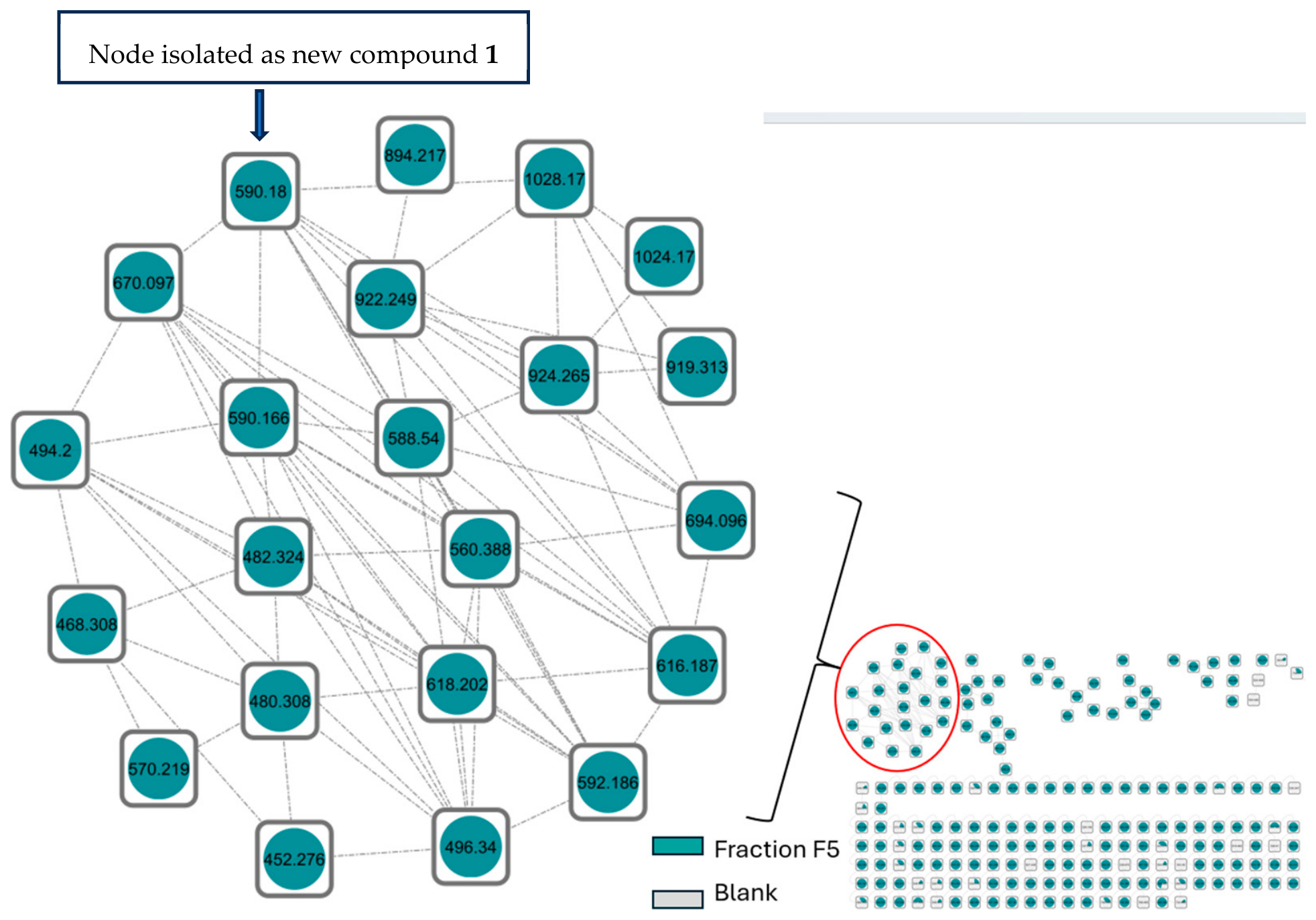
The marine sponge Aiolochroia crassa was extracted with 500 mL methanol (100%) and dichloromethane (100%), yielding a crude extract of 1.4 g. Following the extraction process, a 0.1 mg/mL concentration of the extract was prepared in 50% methanol and subjected to LC-MS/MS analysis to determine the chemical profile of the extract. Interestingly, many brominated compounds were dereplicated, which displayed isotope patterns consistent with the presence of one Br. The crude extract was fractionated by solid phase extraction (SPE), yielding fractions F1–5 (449.0 mg, 179.0 mg, 83.0 mg, 98.0 mg, 235.0 mg, respectively). Fraction F5 (0.235 g) showed an interesting chemical profile (Table S1), indicating the presence of the targeted brominated compounds. LC-MS/MS data of the fraction was further analysed by molecular networking using the Global Natural Products Social Networking (GNPS) platform (Figure 1) [17]. The result shows many brominated compounds in a cluster of phosphatidylcholines consisting of 22 compounds including potentially brominated metabolites, as shown in Figure 1 and the Supplementary Information (Table S1).
Subsequently, the fraction was subjected to purification by C-18 reversed-phase HPLC, yielding a new brominated lysophosphatidylcholine, 1 (Figures S1–S7).

2.1. Structure Elucidation

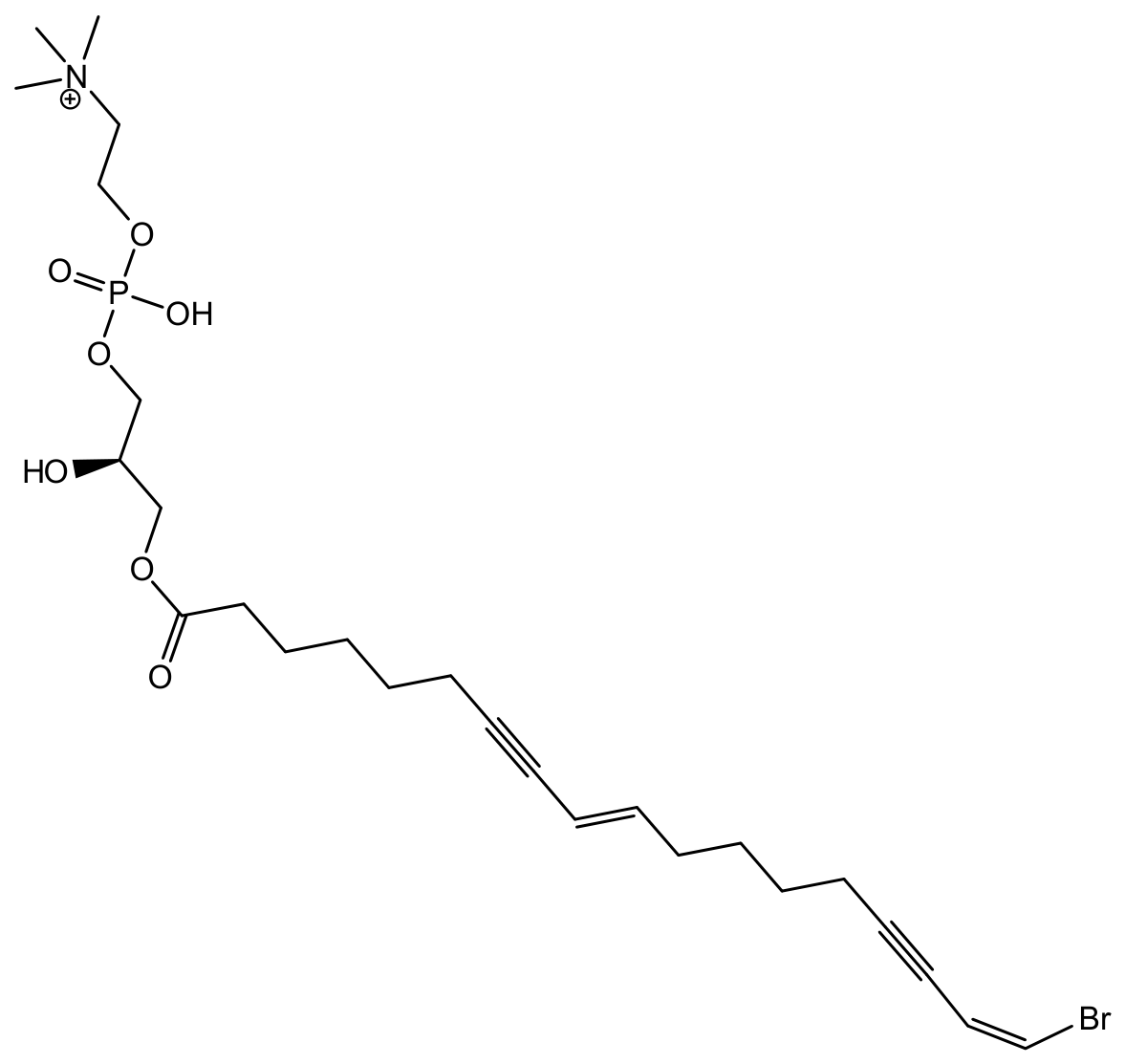
Compound 1 is an oily brown colour. The molecular formula was confirmed as C26H42BrNO7P+ at m/z (590.1885 and 592.1868) [M + H]+ (Δ −1.3 ppm), requiring 8 degrees of unsaturation, based on HRESI-MS (Figure S1). The full structure as it shows in Figure 2 was confirmed by detailed analysis of 1D and 2D NMR data which showed four olefinic protons, nine methylene protons, three oxygenated methylene protons, one N-methylene proton, three N-methyl protons, one hydroxy proton, four acetylenic quaternary carbon signals (C-3,   δ C 78.7; C-4, δ C 94.0; C-11, δ C 79.0 and C-12 δ C 95.5) and one quaternary carbon signal (C-18, δ C 176.0) (Table 1 and Figures S3–S7).
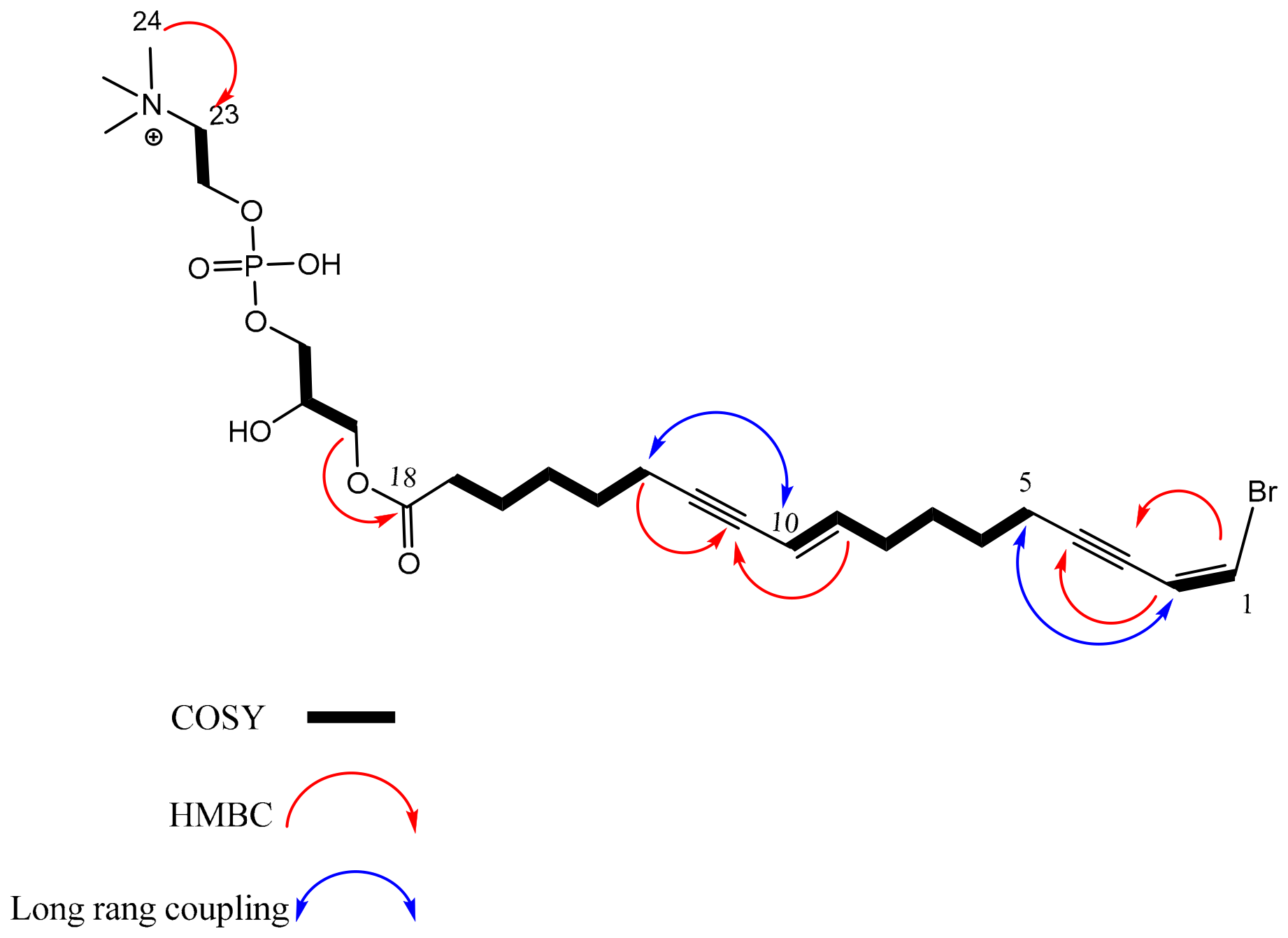
1H NMR data show four downfield signals (H-1, δ H 6.7; H-2, δ H 6.2; H-9, δ H 5.8; H-10, δ H 5.45). Each signal integrates for one proton, consistent with two olefinic pairs, with COSY correlations between H-1/H-2 and H-9/H-10, with J-constants of 10.9 and 14.5 Hz, corresponding to Z (cis) and E (trans) geometry, respectively. HMBC data indicated the presence of an enyne system through cross-peaks from respective olefinic protons (H-1 and H-2) to acetylenic quaternary carbons C-3 ( δ C 79.0) and C-4 ( δ C 94.0). The position of the second enyne system is confirmed by the HMBC correlation from H-9 to C-11 ( δ C 79.0), and from H-10 to C-12 ( δ C 95.5).
A four-methylene spin system (H-5, δH 2.3; H-6, δH 1.44; H-7, δH 1.52; and H-8, δH 2.26) connected two acetylenic units (Figure S6). Another methylene chain (H-13, δH 2.33; H-14, δH 1.55; H-15, δH 1.46; H-16, δH 1.64; H-17, δH 2.4) joined the second acetylenic carbon (C-12) to carbonyl group C-18 ( δ C 176), supported by HMBC correlation from H-13 to C-11 and from H-16 to C-18.
An ABX spin system composed of oxygenated diastereotopic methylenes and a methine (H-19, δH 4.12, 4.18; H-20, δH 4.0; H-21, δH 3.9), characteristic of a glycerol moiety, also showed an HMBC correlation from H-19 to the carbonyl carbon C-18 (see Figure 3).
Long-range 4J coupling across the triple bond was observed between the H-2 and H-5 (2.4 Hz) and between H-10 and H-13 (2.1 Hz). Long-range proton coupling across a carbon–carbon triple bond occurs via four-bond (4J) coupling, typically 2–3 Hz, due to efficient transmission through the linear π-system, and weaker five-bond (5J) coupling with coupling constants generally below 2 Hz [18,19]. A systematic review of 20 articles from 1985 to the present found that the 4J range is 1.7–2.4 Hz. At the same time, for about 5J, only 4 studies mentioned the range, which is between 0.6 and 0.7 Hz (see Table S2).
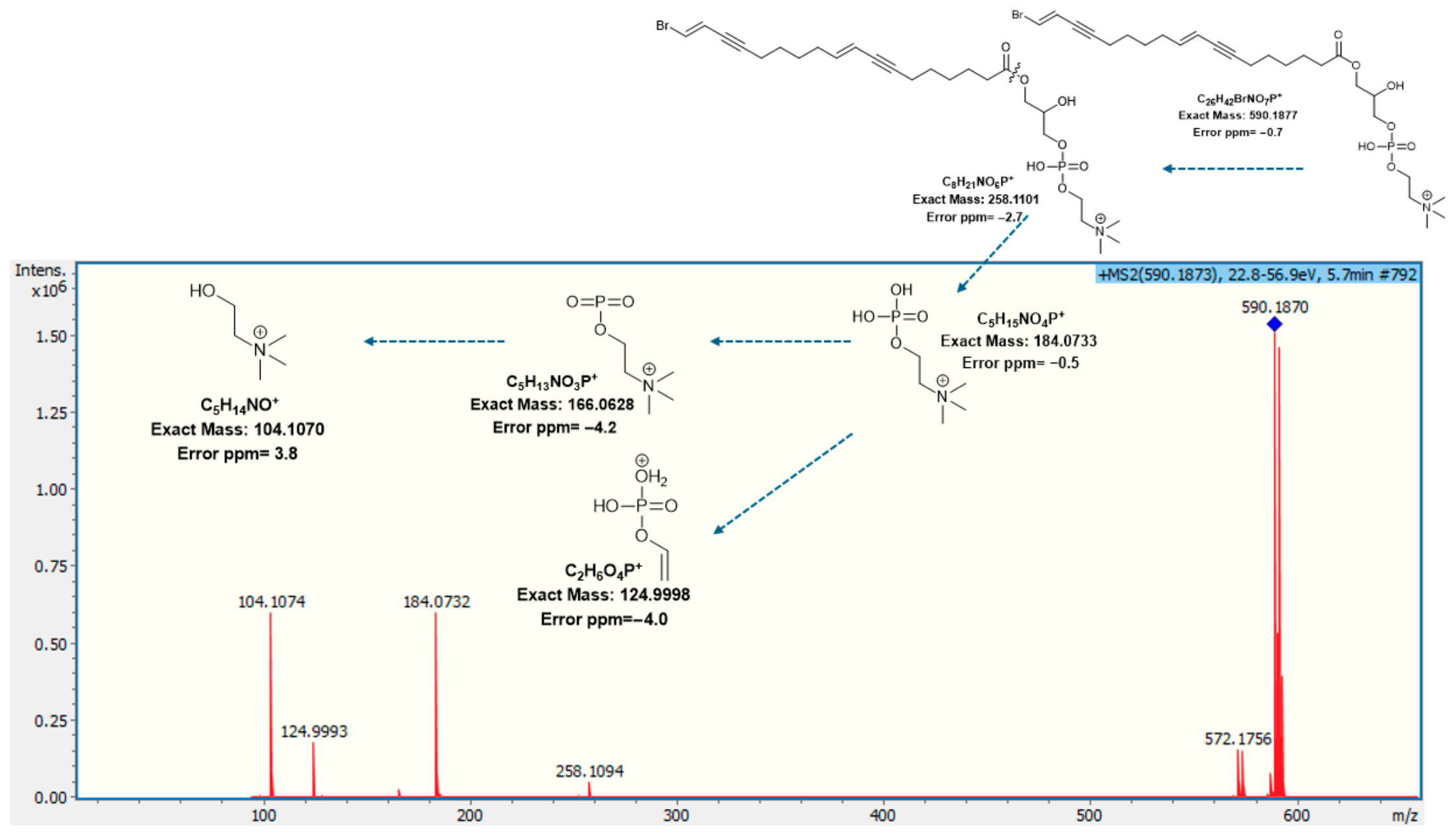
The A2B2 spin system of the two methylene groups (H2-22, δH 4.12; H2-23, δH 4.18) together with the HMBC cross-peak from the symmetrical trimethylammonium group H3-24 (δCH; 54/3.22) to C-23 (δC 60.0), and the presence of the phosphorus atom and two additional oxygens indicated by the molecular formula (C26H42BrNO7P) collectively confirmed the presence of the phosphocholine substituent in compound 1. Detailed MS2 analysis of 3 yielded fragment ions at m/z 258.1094, 184.0732, 124.9993, and 104.1074, thereby corroborating the proposed structure (Figure 4).
The specific rotation of 1 was observed as negative, with a specific rotation −24.6°. And the stereochemistry of the glycerol unit of 1 was tentatively assigned as an R configuration at C-20 analogous to reported natural products containing glycerol units from marine sponges [20].
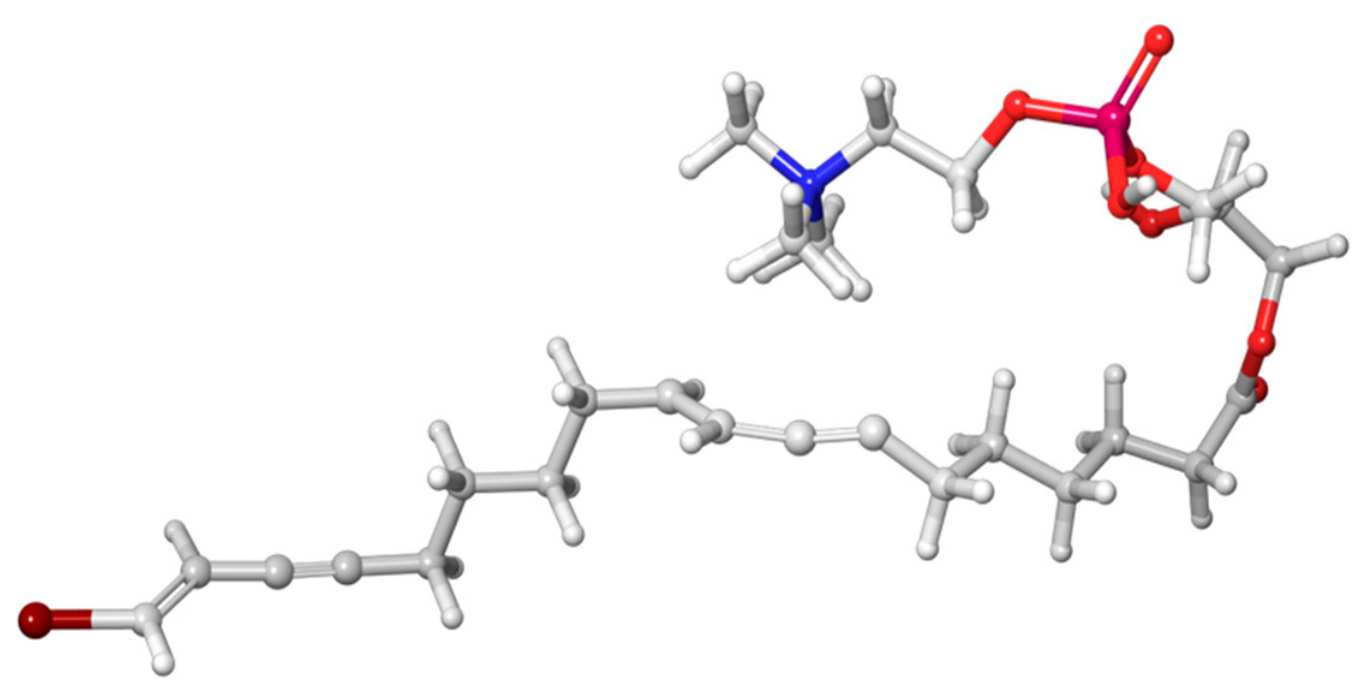
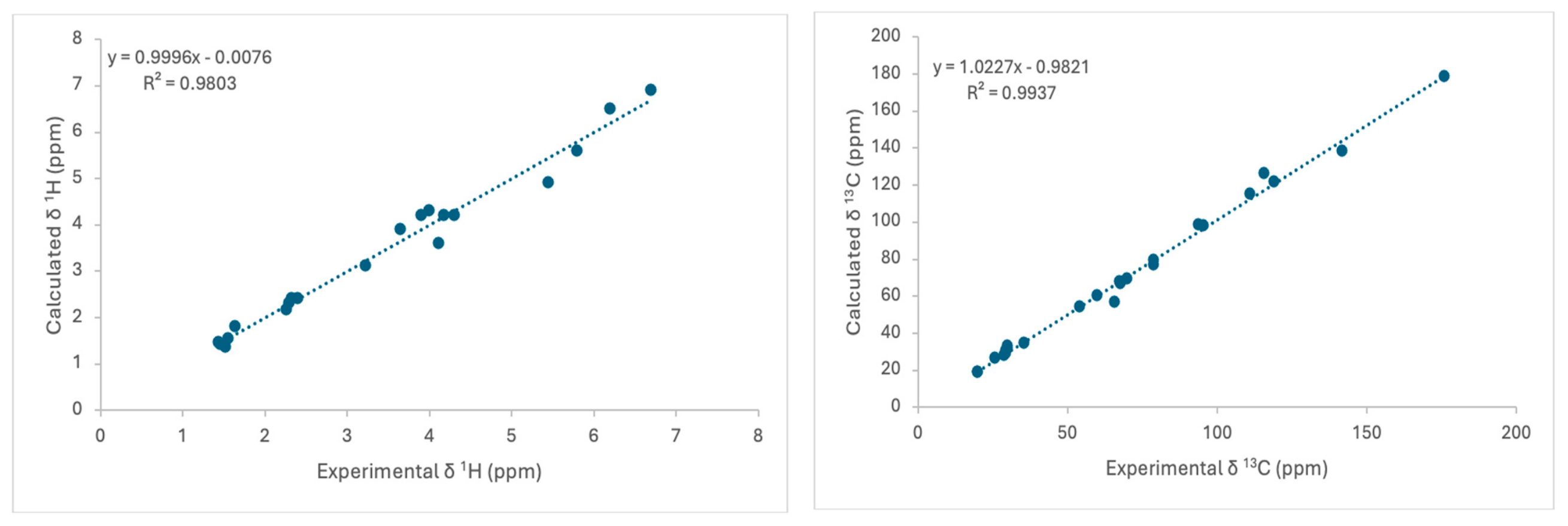
1H and 13C NMR chemical shifts were calculated using DFT calculations. Compound 1 was initially subjected to a conformational search using the Merck molecular force field. Thirty conformers were found within a 5 kcal/mol energy threshold from a global minimum. All these conformers were geometrically optimised, and frequency calculations were performed using density functional theory (DFT) at the B3LYP/6-31G(d) level with PCM (see computational details in Section 3.5. Calculated 1H and 13C NMR chemical shifts were compared with the experimental NMR data using statistical correlation (R2: 0.9803 and R2: 0.9937, respectively); finally, we obtained a result in perfect agreement with the experimental data (Figure 5 and Figure 6).

2.2. Conclusions

In this study, we isolated a new brominated compound from the marine sponge Aiolochroia crassa, collected from the Saudi Arabian Sea, using a combination of metabolomic and chromatographic analyses. This study highlights the continued potential of marine sponges as a reservoir of unexplored compounds.

3. Materials and Methods

3.1. General Experimental Procedures

Optical rotation was measured on an ADP 410 digital polarimeter (Bellingham + Stanley Ltd., Tunbridge Wells, Kent, UK). NMR spectra were recorded on Bruker AVANCE III spectrometers at 600 MHz (Bruker Corporation, Billerica, MA, USA). Solid Phase Extraction (SPE) with reverse-phase Phenomenex Strata® C18-E (55 μm, 70 Å) (Phenomenex LTD, Torrance, CA, USA) cartridges, and 2 g/12 mL Giga Tubes cartridges were used to fractionate the sample. The isolation and purification of the sample were performed using High-Pressure Liquid Chromatography (HPLC) connected to a Sunfire semipreparative C18 column (5 μm, 100 Å, 10 × 250 mm). The Bruker MAXIS II mass spectrometer (Bruker Corporation, Billerica, MA, USA)equipped with a Quadrupole-Time-of-Flight mass analyser joined to an HPLC (Agilent 1290 Infinity equipped with a diode array detector) (Agilent Technologies, Santa Clara, CA, USA) on a Kinetex EVO l C18 column (2.6 µm, 100 Å, 2.1 × 100 mm) was used to analyse the sample. A mobile phase gradient of 0.1% formic acid in LC-MS-grade H2O:acetonitrile from 5 to 95% in 10 min, and isocratic elution at 95% for 2 min at a flow rate of 1 µL/min with MS acquisition for 12 min were employed in the UPLC-MS system.

3.2. Collection and Identification

The sponge Aiolochroia crassa was collected from the Red Sea, near the city of Alqunfudh in the southwest of the Kingdom of Saudi Arabia. The GPS coordinates for the sample collection are 19°10′40.5″ N 41°02′22.9″ E.

3.3. Extraction and Isolation

The sample was collected from the Red Sea in a mixture of 50% seawater and 50% ethanol. The preservation was changed in the lab to methanol for two days; then three extractions were conducted using 500 mL of 100% methanol and 100% dichloromethane, resulting in a total mass of 1.4 g. It was chromatographed on SPE. It was equilibrated with 3 × 40 mL of the starting 100% water as a solvent. The sample was dissolved in 80% water/20% methanol. After the sample was inserted, five solutions of mobile phases (100% H2O, 25% MeOH, 50% MeOH, 75% MeOH, and 100% MeOH) were employed to elute the components of the extract. Subsequently, F5 (235.4 mg) was selected for purification upon LC-MS/MS analysis that suggested it was an interesting fraction. A reversed-phase HPLC connected to a Sunfire C18 OBD prep column (100 Å, 5 µm, 10 × 250 mm) was used with a gradient starting with 15% H2O to 100% MeOH over 50 min, ending with 100% MeOH isocratic elution for 20 min at a flow rate of 1 mL/min, yielding compound 1 (3.4 mg, tR 28 min).
Compound 1: oily brown colour; [α]D25 −24.6 (c 0.65, MeOH). HRESIMS at m/z (590.1873) [M + H]+ (Δ −1.3 ppm) (calcd. for C26H42BrNO7P+, 590.1877); NMR data, see Table 1 and Supporting Information; Figures S1–S7.

3.4. Data Pre-Processing and Feature-Based Molecular Networking

LC-MS data of the fraction and the blank were converted to mzML format using MS Convert software, followed by creating a quantitative MS1 file and MGF file using MZmine version 4.8.0 [21]. Using the GNPS platform, the MZmine files were submitted to create molecular networking clusters and to search the GNPS natural product database for the presence of known compound clusters.
The mzML data underwent pre-processing, with mass ion detection facilitated by the elimination of MS1 and MS2 baseline noise levels established at 1.0 × 10⁴ and 1.0 × 10², respectively. The construction of chromatograms was executed for each centroided MS1 detected using the ADAP chromatogram builder, with parameters set for minimum consecutive scans, minimum intensity for consecutive scans, minimum absolute height, and m/z mass tolerance at 4, 1.0 × 10², 1.0 × 10⁴, and 5 ppm, respectively. The peak detection employed a local minimum resolver as a deconvolution algorithm to generate a chromatogram for each mass ion. The chromatographic threshold for this approach was established at 85%, the minimum search range in the RT absolute range at 0.05 min, the minimum relative height at 0.0%, the minimum absolute height at 2.8 × 10⁴, and the minimum peak top/edge ratio at 1.70. The detected peaks were deisotoped utilising the isotopic peak grouper, with an m/z tolerance (intra-sample) established at 5 ppm, an RT tolerance of 0.02 absolute minutes, a maximum charge of 3 absolute minutes, and the most intense isotope designated as the representative isotope. The deisotoped peaks were subsequently aligned utilising a join aligner to rectify any discrepancies in the retention time of each mass peak: the ion m/z tolerance for alignment was established at 10 ppm, the retention time tolerance at 0.06 absolute minutes, with weights for m/z and RT assigned as 75 and 25, respectively, and the mobility weight set to 1. The peak list generated post-alignment was refined using a feature list row filter to exclude mass ions within the specified range of 100 to 2000 m/z, retaining only peak rows that satisfy all criteria. The GNPS result was visualised using Cytoscape software version 3.10.1.

3.5. Computational Calculations

Computational calculations were performed in the Gaussian 16 program package. Conformational searches for all possible isomers were conducted via molecular mechanics using the Merck molecular force field (MMFF) with a 5 kcal/mol threshold. After this, the B3LYP/6-31 G(d) PCM level in the respective solvent was used to optimise the most abundant conformers. Then, the NMR shielding tensors of all optimised conformers were computed at the wb97xd/6-311+g(2d,p) (IEFPCM=CD3OD) and then averaged based on the Boltzmann distribution.

Supplementary Materials

The following supporting information can be downloaded online. Supplementary Information S1. Sample collection permit. Figure S1. (+)-HRESIMS spectra of 1. Figure S2. UV spectrum of 1 Figure S3. 1H NMR spectra (CD3OD, 600 MHz) of 1. Figure S4. HSQC spectra (CD3OD, 600 MHz) of 1. Figure S5. COSY spectrum (CD3OD, 600 MHz) of 1. Figure S6. HMBC spectrum (CD3OD, 600 MHz) of 1. Figure S7. 13C-NMR spectrum (CD3OD) for 1. Table S1. Chemical dereplication of GNPS cluster of SPE fraction 5. Table S2. Systematic review about long-range coupling 4J and 5J. References [22,23,24,25,26,27,28,29,30,31,32,33,34,35,36] are cited in the Supplementary Materials.

Author Contributions

A.A.N.: conceptualization; investigation; formal analysis; data curation; methodology; visualisation; writing—original draft. E.T.O.: investigation; formal analysis; data curation; methodology; visualisation; writing— review and editing. H.D.A.: taxonomy; writing—review and editing. G.P.: methodology; writing—review and editing. D.P.-P.: writing—review and editing; computational calculations; formal analysis. A.M.F.: computational calculations and formal analysis. J.R.: computational calculations and formal analysis. R.E.: conceptualization; investigation; supervision; writing—review and editing. M.J.: conceptualization; funding acquisition; project administration; supervision; writing—review and editing. All authors have read and agreed to the published version of the manuscript.

Funding

This project has received funding from the Saudi Culture and the Ministry of Education in Riyadh under the Grant Agreement Number RG17261-10. This research was funded by the Saudi Cultural Bureau in London and the Ministry of Education in Saudi Arabia. Computational calculation was supported by a grant from the Programa de Apoyo a Proyectos de Investigación e Innovación Tecnológica (PAPIIT-DGAPA-UNAM IA202526).

Institutional Review Board Statement

Not applicable.

Data Availability Statement

Data available on request from the corresponding author. The paper and Supplementary Materials include the unique research contributions provided in this study. Further queries should be made to the relevant author.

Acknowledgments

We would like to thank Russell Gray and Jason Donald of the Marine Biodiscovery Centre, Aberdeen, for facilitating the acquisition of NMR spectra.

Conflicts of Interest

The authors declare no conflicts of interest.

References

  1. Yuan, Y.; Lei, Y.; Xu, M.; Zhao, B.; Xu, S. Bioactive Terpenes from Marine Sponges and Their Associated Organisms. Mar. Drugs 2025, 23, 96. [Google Scholar] [CrossRef]
  2. Raymond, M.J.F.; Rakotondraibe, H.L. Recent Updates on Terpenoids and Other Bioactive Constituents of Marine Sponges. Molecules 2025, 30, 1112. [Google Scholar] [CrossRef]
  3. Xavier, J.; Samaai, T.; Böhm, M.; Palmer, C. IUCN Species Survival Commission Sponge Specialist Group. Oryx 2024, 58, 690. [Google Scholar] [CrossRef]
  4. Hughes, T.; Potter, H.; Robinson, A.; Rogers, S.; Tillett, V. MarinLit Database. Available online: https://marinlit.rsc.org/compounds (accessed on 14 September 2025).
  5. Gazave, E.; Lapébie, P.; Ereskovsky, A.V.; Vacelet, J.; Renard, E.; Cárdenas, P.; Borchiellini, C. No Longer Demospongiae: Homoscleromorpha Formal Nomination as a Fourth Class of Porifera. Hydrobiologia 2011, 687, 3–10. [Google Scholar] [CrossRef]
  6. Lavrov, D.V.; Diaz, M.C.; Maldonado, M.; Morrow, C.C.; Perez, T.; Pomponi, S.A.; Thacker, R.W. Phylomitogenomics Bolsters the High-Level Classification of Demospongiae (Phylum Porifera). PLoS ONE 2023, 18, e0287281. [Google Scholar] [CrossRef] [PubMed]
  7. Morrow, C.; Cárdenas, P. Proposal for a Revised Classification of the Demospongiae (Porifera). Front. Zool. 2015, 12, 7. [Google Scholar] [CrossRef]
  8. Rasul, N.M.A.; Stewart, I.C.F.; Nawab, Z.A. Introduction to the Red Sea: Its Origin, Structure, and Environment. In The Red Sea; Springer: Berlin/Heidelberg, Germany, 2015; pp. 1–28. [Google Scholar] [CrossRef]
  9. Wooster, M.K.; Voigt, O.; Erpenbeck, D.; Wörheide, G.; Berumen, M.L. Sponges of the Red Sea; Voolstra, C.R., Berumen, M.L., Eds.; Springer International Publishing: Cham, Switzerland, 2019. [Google Scholar] [CrossRef]
  10. Raijman-Nagar, L.; Goren, L.; Shefer, S.; Ilan, M. Sponge Abundance and Diversity Patterns in the Shallow and Mesophotic Reefs of the Northern Red Sea. Front. Mar. Sci. 2024, 11, 1370089. [Google Scholar] [CrossRef]
  11. Hyatt, A. Revision of the North American Poriferae; with Remarks upon Foreign Species. Part I. Mem. Boston Soc. Nat. Hist. 1875, 2, 399–408. [Google Scholar]
  12. Galeano, E.; Martínez, A.; Thomas, O.P.; Robledo, S.; Munoz, D. Antiparasitic Bromotyrosine Derivatives from the Caribbean Marine Sponge Aiolochroia crassa. Quim. Nova 2012, 35, 1189–1193. [Google Scholar] [CrossRef]
  13. Salib, M.N.; Hendra, R.; Molinski, T.F. Bioactive Bromotyrosine Alkaloids from the Bahamian Marine Sponge Aiolochroia Crassa. Dimerization and Oxidative Motifs. J. Org. Chem. 2022, 87, 12831–12843. [Google Scholar] [CrossRef]
  14. Assmann, M.; Rayb, V.W.; Van Soestc, R.W.M.; Proksch, P. A New Bromotyrosine Alkaloid from the Caribbean Sponge Aiolochroia crassa. Z. Für Naturforschung C 1998, 53, 398–401. [Google Scholar] [CrossRef][Green Version]
  15. Quinn, R.J.; Tucker, D.J. A Brominated Bisacetylenic Acid from the Marine Sponge Xestospongia lestudinaria. Tetrahedron Lett. 1985, 26, 1671–1672. [Google Scholar] [CrossRef]
  16. Hirsh, S.; Carmely, S.; Kashman, Y. Brominated Unsaturated Acids from the Marine Sponge Xestospongia sp. Tetrahedron 1987, 43, 3257–3261. [Google Scholar] [CrossRef]
  17. Nothias, L.F.; Petras, D.; Schmid, R.; Dührkop, K.; Rainer, J.; Sarvepalli, A.; Protsyuk, I.; Ernst, M.; Tsugawa, H.; Fleischauer, M.; et al. Feature-Based Molecular Networking in the GNPS Analysis Environment. Nat. Methods 2020, 17, 905–908. [Google Scholar] [CrossRef] [PubMed]
  18. Elsadek, L.A.; Ellis, E.K.; Seabra, G.; Paul, V.J.; Luesch, H. Chlorinated Enyne Fatty Acid Amides from a Marine Cyanobacterium: Discovery of Taveuniamides L-M and Pharmacological Characterization of Taveuniamide F as a GPCR Antagonist with CNR1 Selectivity. Mar. Drugs 2024, 22, 28. [Google Scholar] [CrossRef]
  19. Williamson, R.T.; Singh, I.P.; Gerwick, W.H. Taveuniamides: New Chlorinated Toxins from a Mixed Assemblage of Marine Cyanobacteria. Tetrahedron 2004, 60, 7025–7033. [Google Scholar] [CrossRef]
  20. Tamzi, N.N.; Rahman, M.M.; Das, S. Recent Advances in Marine-Derived Bioactives Towards Cancer Therapy. Int. J. Transl. Med. 2024, 4, 740–781. [Google Scholar] [CrossRef]
  21. Schmid, R.; Heuckeroth, S.; Korf, A.; Smirnov, A.; Myers, O.; Dyrlund, T.S.; Bushuiev, R.; Murray, K.J.; Hoffmann, N.; Lu, M.; et al. Integrative Analysis of Multimodal Mass Spectrometry Data in MZmine 3. Nat. Biotechnol. 2023, 41, 447–449. [Google Scholar] [CrossRef]
  22. Bourguet-Kondracki, M.L.; Rakotoarieoa, M.T.; Martin, M.T.; Guyot, M. Bioactive bromopolyacetylenes from the marine sponge Xestospongia testudinaria. Tetrahedron Lett. 1992, 33, 225–226. [Google Scholar] [CrossRef]
  23. Fusetani, N.; Li, H.-Y.; Tamura, K.; Matsunaga, S. Antifungal Brominated C18 Acetylenic Acids from the Marine Sponge, Petrosia volcano Hoshino. Tetrahedron 1993, 49, 1203–1210. [Google Scholar] [CrossRef]
  24. Liang, L.F.; Wang, T.; Cai, Y.S.; He, W.F.; Sun, P.; Li, Y.F.; Huang, Q.; Taglialatela-Scafati, O.; Wang, H.Y.; Guo, Y.W. Brominated Polyunsaturated Lipids from the Chinese Sponge Xestospongia testudinaria as a New Class of Pancreatic Lipase Inhibitors. Eur. J. Med. Chem. 2014, 79, 290–297. [Google Scholar] [CrossRef]
  25. Yang, M.; Liang, L.F.; Wang, T.; Wang, H.Y.; Liu, H.L.; Guo, Y.W. Further Brominated Polyacetylenes with Pancreatic Lipase Inhibitory Activity from Chinese Marine Sponge Xestospongia testudinaria. J. Asian Nat. Prod. Res. 2017, 19, 732–737. [Google Scholar] [CrossRef]
  26. Brantley, S.E.; Molinski, T.F.; Preston, C.M.; Delong, E.F. Brominated Acetylenic Fatty Acids from Xestospongia sp., a Marine Sponge-Bacteria Association. Tetrahedron 1995, 51, 7667–7672. [Google Scholar] [CrossRef]
  27. Lerch, M.L.; Harper, M.K.; Faulkner, D.J. Brominated Polyacetylenes from the Philippines Sponge Diplastrella sp. J. Nat. Prod. 2003, 66, 16. [Google Scholar] [CrossRef] [PubMed]
  28. Kong, C.J.; Li, L.; Chen, M.; Cao, F.; Wang, C.Y. Brominated Polyunsaturated Lipids and Steroids From the South China Sea Sponge Haliclona Subarmigera. Chem. Nat. Compd. 2016, 52, 883–885. [Google Scholar] [CrossRef]
  29. Gong, J.X.; Wang, H.Y.; He, W.F.; Wang, Z.Z.; Xiao, W.; Guo, Y.W. A Concise Synthesis of Xestospongic Acid Methyl Ester with Pancreatic Lipase Inhibitory Activity. J. Asian Nat. Prod. Res. 2013, 15, 916–919. [Google Scholar] [CrossRef]
  30. Taniguchi, M.; Uchio, Y.; Yasumoto, K.; Kusumi, T.; Ooi, T. Brominated Unsaturated Fatty Acids from Marine Sponge Collected in Papua New Guinea. Chem. Pharm. Bull. 2008, 56, 378–382. [Google Scholar] [CrossRef]
  31. Řezanka, T.; Dembitsky, V. Brominated Fatty Acids from Lichen Acorospora Gobiensis. Phytochemistry 1999, 50, 97–99. [Google Scholar] [CrossRef]
  32. Negishi, E.I.; Hata, M.; Xu, C. A Strictly “Pair”-Selective Synthesis of Conjugated Diynes via Pd-Catalyzed Cross Coupling of 1,3-Diynylzincs: A Superior Alternative to the Cadiot-Chodkiewicz Reaction. Org. Lett. 2000, 2, 3687–3689. [Google Scholar] [CrossRef]
  33. Řezanka, T.; Dembitsky, V. Novel Brominated Lipidic Compounds from Lichens of Central Asia. Phytochemistry 1999, 51, 963–968. [Google Scholar] [CrossRef]
  34. Pham, N.B.; Butler, M.S.; Hooper, J.N.A.; Moni, R.W.; Quinn, R.J. Isolation of Xestosterol Esters of Brominated Acetylenic Fatty Acids from the Marine Sponge Xestospongia testudinaria. J. Nat. Prod. 1999, 62, 1439–1442. [Google Scholar] [CrossRef] [PubMed]
  35. Gung, B.W.; Gibeau, C.; Jones, A. First Total Synthesis of the Brominated Polyacetylenes (+)-Diplyne A and D: Proof of Absolute Configuration. Tetrahedron Asymmetry 2004, 15, 3973–3977. [Google Scholar] [CrossRef]
  36. Gong, J.X.; He, W.F.; Liu, H.L.; Jiang, C.S.; Wang, T.; Wang, H.Y.; Guo, Y.W. Synthesis and Evaluation of Pancreatic Lipase Inhibitory Effects Halogenated Polyunsaturated Lipids from Marine Natural Products: Methyl Xestospongoate and Analogs. Helv. Chim. Acta 2016, 99, 78–82. [Google Scholar] [CrossRef]
Figure 1. GNPS cluster consisting of new brominated lysophosphatidylcholine derivatives.
Molbank 2026 m2188 g001
Figure 2. The structure of compound 1.
Molbank 2026 m2188 g002
Figure 3. COSY, Key HMBC and long-range coupling of compound 1.
Molbank 2026 m2188 g003
Figure 4. MS2 fragment ions of compound 1.
Molbank 2026 m2188 g004
Figure 5. Optimised conformer of compound 1 that represents 80% of the population.
Molbank 2026 m2188 g005
Figure 6. Correlation between experimental and calculated 1H and 13C NMR chemical shifts for compound 1 (CD3OD).
Molbank 2026 m2188 g006
Table 1. Experimental NMR data (600/150 MHz, CD3OD) for compound 1.
ExperimentDFT Calculation
AtomMult δ C δ HMult., J in HzCOSYHMBC
H → C
δ C δ H
1CH116.06.70d (14.5) 22, 3126.56.9
2CH119.06.20dt (14.5, 2.4)1, 51, 4121.66.5
3C78.7 76.8
4C94.0 98.6
5CH220.02.30dd (6.9, 2.4)2, 62, 3, 418.92.3
6CH229.01.44m5, 75, 728.11.45
7CH229.61.52m6, 8830.31.36
8CH230.02.26dd (7.1)7, 910332.16
9CH142.05.81dt (10.9, 7.1)8, 108, 11138.35.6
10CH111.05.45dq (10.9, 2.1)9, 1312115.24.9
11C79.0 79.6
12C95.5 98.2
13CH220.02.33dd (7.0, 2.1)10, 1410, 11, 1218.92.4
14CH230.01.55m13, 1513, 15, 1631.81.55
15CH229.31.46m14, 1613, 14, 1629.031.42
16CH225.81.64q (7.5)15, 1714, 17, 1826.31.8
17CH235.52.38t (7.5)1614, 15, 16, 1834.72.4
18C176.0 178.3
19OCH266.0a 4.11
b 4.18
dd (11.5, 6.2)
dd (11.5, 4.4)
2018, 2056.43.6
4.2
20OCH69.84.00q (5.3)19a, 19b, 212169.34.3
21OCH267.43.91m222267.84.2
22OCH267.83.65m2323, 2466.93.9
23N-CH260.04.30d (6)22 60.14.2
24(CH3)354.03.23s 2354.53.1
Disclaimer/Publisher’s Note: The statements, opinions and data contained in all publications are solely those of the individual author(s) and contributor(s) and not of MDPI and/or the editor(s). MDPI and/or the editor(s) disclaim responsibility for any injury to people or property resulting from any ideas, methods, instructions or products referred to in the content.