Communication

New Pyridinium Salt Bioconjugates of Cholesterol and Methylpyridine Derivatives: Synthesis and Characterization


by
José María Peña-Martínez
1,
Jesús Alberto Rojas Morales
2,
Luis Ramiro Caso-Vargas
3,
Elizabeth Bautista-Rodríguez
2,
Joel L. Terán
4 and
Alan Carrasco-Carballo
1,2,5,*
1
Laboratorio de Elucidación y Síntesis en Química Orgánica, Herbario y Jardín Botánico Universitario, Vicerrectoría de Investigación y Estudios de Posgrado, Benemérita Universidad Autónoma de Puebla, Puebla 72570, Mexico
2
Laboratorio Multidisciplinario de Biomedicina, Biotecnología y Bioinformática Integrativa Aplicada a la Salud, Facultad de Ciencias de la Salud, Universidad Autónoma de Tlaxcala, Tlaxcala 90750, Mexico
3
Biotecnología, Facultad de Ciencias Biológicas, Benemérita Universidad Autónoma de Puebla, Puebla 72570, Mexico
4
Centro de Química, Instituto de Ciencias, Benemérita Universidad Autónoma de Puebla, Puebla 72570, Mexico
5
Secretaria de Ciencia, Humanidades y Tecnología, LESQO, HJB, VIEP, Benemérita Universidad Autónoma de Puebla, Puebla 72570, Mexico
*
Author to whom correspondence should be addressed.
Molbank 2026, 2026(3), M2169; https://doi.org/10.3390/M2169
Submission received: 1 April 2026 / Revised: 23 April 2026 / Accepted: 29 April 2026 / Published: 2 May 2026
(This article belongs to the Section Organic Synthesis and Biosynthesis)

Abstract

The synthesis of three novel, valuable bioconjugates obtained by coupling cholesterol bromoacetate with pyridine derivatives via an SN2 reaction was successfully carried out. Each of the products was fully characterized by magnetic nuclear resonance (1H, 13C, APT, 1H−1H COSY, 1H–13C HMBC, 1H–13C HSQC), infrared spectroscopy (IR), and high-resolution mass spectrometry (HRMS).

1. Introduction

Pyridinium salts are quaternary nitrogen salts that have attracted considerable attention due to their multiple biological activities, which include anti-cancer, antimicrobial and anti-neurodegenerative, attributed in part to the positive charge on the nitrogen atom which facilitates interactions with negatively charged biological targets [1,2,3,4]. Similarly, steroids have a wide range of biological activities, including anti-cancer, hormonal regulation, and acting against cardiac, infectious, and neurodegenerative diseases [5,6,7,8,9,10]. Given their complementary bioactivity, the bioconjugation of steroids with positive-nitrogen-containing heterocycles has emerged as a promising strategy for the development of novel hybrid molecules with enhanced or synergistic pharmacological properties.
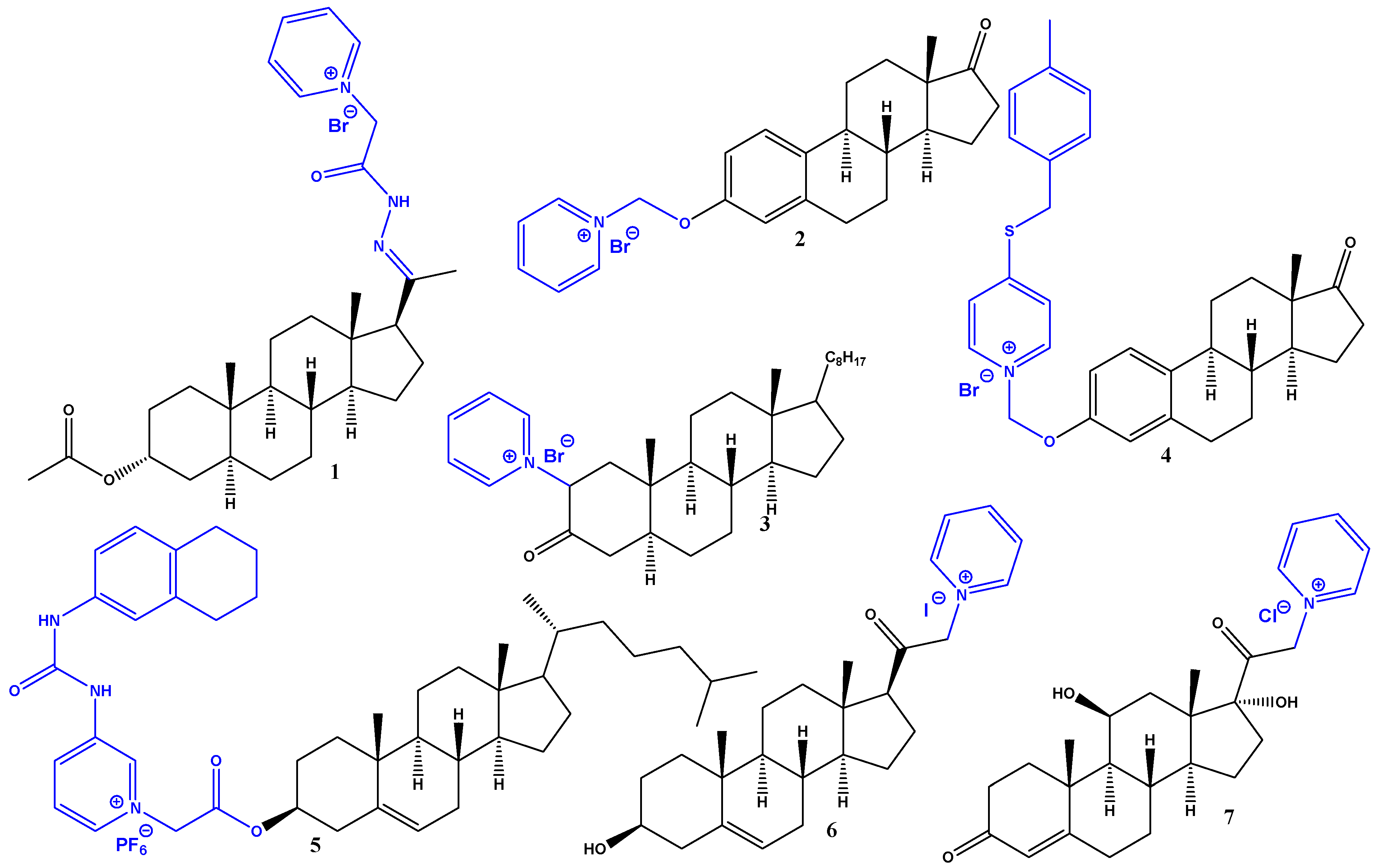
Specifically, bioconjugated steroidal quaternary nitrogen salts have mainly been obtained using nitrogen-containing aromatic systems (see Figure 1) such as pyridines (17), indoles, and indoxazoles as nitrogen sources, highlighting their potential anti-cancer and antimicrobial properties [11,12,13,14,15,16]. Some strategies for the introduction of quaternary nitrogen salts onto the steroidal framework involves the direct functionalization of the nitrogen-containing aromatic ring, generating an alkyl halide-bearing intermediate that subsequently undergoes N-alkylation with the steroidal substrate (6 and 7). The second and more widely applied strategy consists of introducing a halogen-bearing linker onto the steroidal scaffold (typically via esterification of a hydroxyl group with a haloacid or haloacyl halide) followed by intermolecular SN2 nucleophilic substitution (2 and 4) with a pyridine or pyridine derivative to yield the corresponding pyridinium salts; in steroids, this has been done in cholesterol (3 and 5) and with a hydrazone derived mainly from allopregnanolone (1) [17,18,19,20].
Specifically, the polarity of the 3-hydroxy group in the cholesterol structure constitutes an active site for hydrogen bond interactions or substituted derivative preparation with a myriad of biological molecules (e.g., phospholipids in membrane, etc.). Therefore, the biological activities of cholesterol bioconjugate derivatives have gained considerable importance in cholesterol 3-hydroxy modification structures [21,22,23,24,25,26]. In this regard, a pyridinium salt derived from cholesterol has been previously reported [27]; the synthesis of cholesterol-derived pyridinium salts by esterifying their 3-hydroxyl group with bromoacetyl bromide, forming an acetate linker, and subsequent N-alkylation with pyridine derivatives represents a remarkable approach to obtaining novel steroidal bioconjugates. Building on this precedent, this study outlines the synthesis and complete spectroscopic characterization of novel bioconjugate cholesterol-derived pyridinium salts.

2. Results and Discussion

The addition of the linker to cholesterol was carried out from 2-bromoacyl bromide to generate the esterification at the C-3 hydroxyl of cholesterol (Scheme 1), using K2CO3 as a base, according to what has been reported in the literature [18]. Then, condensation was performed in a biphasic system, since the steroid was dissolved in DCM and the base in water, giving the desired compound 9 in high chemical yield after its purification in a Combiflash apparatus (Teledyne ISCO, Lincoln, NE, USA).
With the linker properly added, the SN2 reaction conditions were investigated to obtain the respective bioconjugate pyridinium salts from the selected substituted pyridines. This reaction proved to be sensitive to the substituted pyridine derivative, as when the optimized reaction conditions were employed [3,18,27], the desired salt was not obtained. Where the reported methodology for the case of the salt derived from pyridine and cholesterol was employed, the yield was low; the results of reproducing three modified methodologies according to literature reports [28,29,30,31] are shown in Table 1.
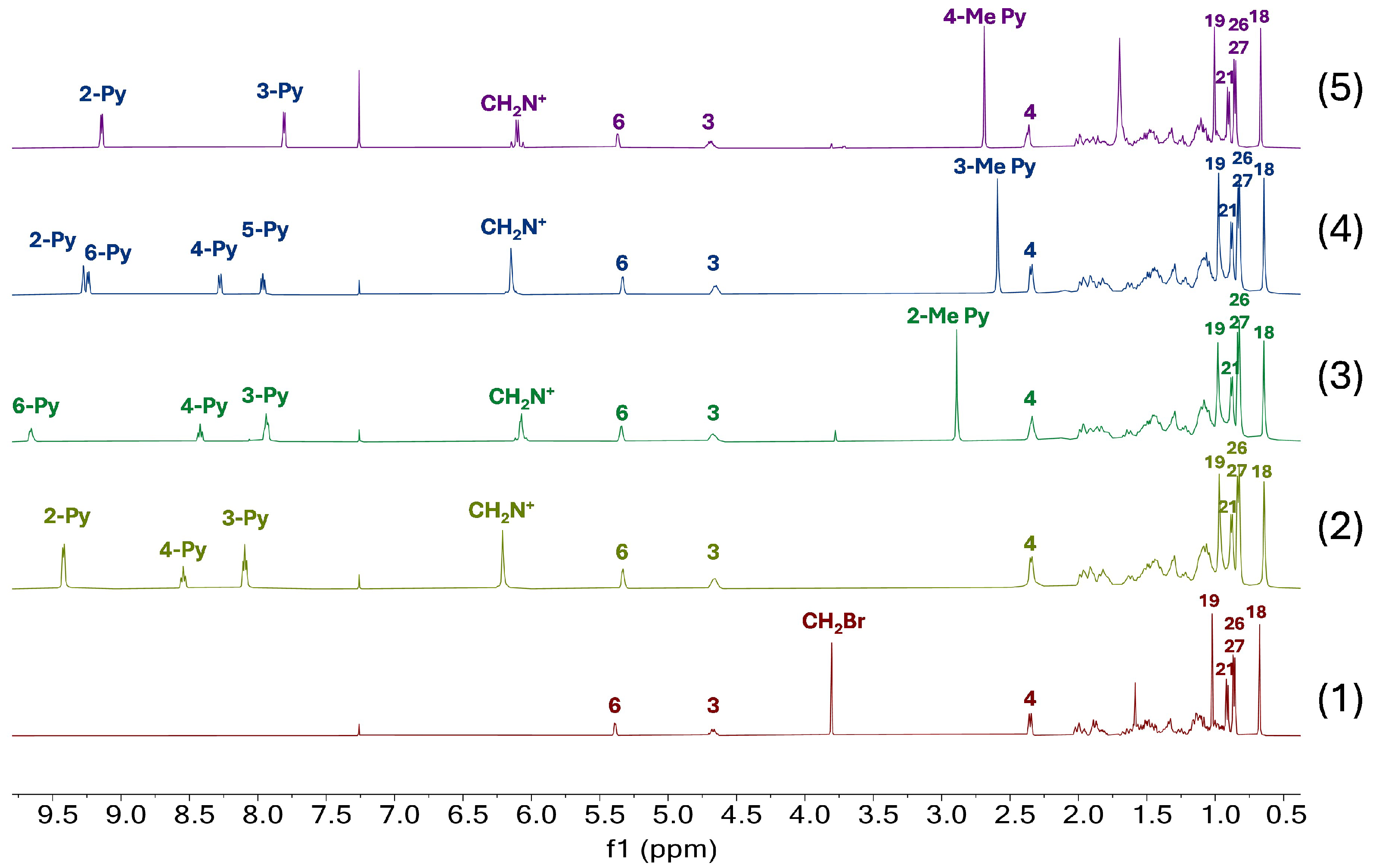
1H-NMR spectra confirmed the obtention of the desired bioconjugate pyridinium salt. Based on the previously reported and characterized cholesterol bromoacetate structure, new signals were assigned to the four obtained pyridinium compounds. The most notable shift, which confirmed the obtention of the pyridinium salt in the cholesterol bromoacetate, was the methylene protons attached to the carbon connected with the pyridine moiety, which resonated around 6.11 ppm and 6.40 ppm depending on the pyridinium salt derivative due to the positive charge on the nitrogen atom (Figure 2). The signals at positions 2 and 6 showed the same effect, shifting to values between 9.4 ppm and 9.7 ppm, due to the lack of protection generated around the positive charge of nitrogen. The shifts in the signals at positions 3, 4, and 5 on the pyridine ring correspond to free pyridine, assigned using the COSY experiment. For the methylpyridines, the salts exhibit a methyl signal between 2.5 ppm and 3.0 ppm, with those affected by resonance due to the positive charge being more pronounced. The carbon signals introduced by the new substituents were assigned by HSQC experiments (see Supplementary Materials), and the connectivity of adjacent positions was subsequently established through HMBC analysis.
The IR spectra show characteristic absorption bands; while the bands around 3600–3400 cm−1 are characteristic of the steroid, the presence of bands around 1600 is diagnostic for the presence of C=N+, corroborating the structure. The HRMS data show, in the case of salt, only the presence of the protonated cation, indicative of the loss of the anion prior to detection by the equipment. The physical properties and the specific optical rotation do not change significantly since no new asymmetric centers are formed. At the melting point, the salts rise to 200 °C, consistent with the formation of an ionic compound.

3. Materials and Methods

3.1. Characterization Equipment, Solvents and Reagents

One-dimensional and two-dimensional NMR spectra were measured using a Bruker AscendTM 500 (1H 500 MHz, 13C 125 MHz) spectrometer (Bruker, Billerica, MA, USA) at 298 K; chemical shifts are reported in ppm and the coupling constants in Hz with TMS (0.0 for 1H) and residual solvent peak of CDCl3 (δ = 7.26 ppm for 1H, δ = 77.16 ppm for 13C) are used as references. Mass spectra (FABMS and EI) and high-resolution mass spectra (HRMS-FAB, HRMS-EI) were obtained on a JEOL mass spectrometer, the MStation JMS-700, at 70 eV (JEOL, Tokyo, Japan). Infrared spectra were obtained using a Bruker Tensor 27 spectrophotometer (Bruker Corporation, Billerica, MA, USA). Specific rotation was obtained using an Autopol III Polarimeter (Rudolph Research Analytical, Hackettstown, NJ, USA), with a 1 dm cell holding a total volume of 1.0 mL at 25 °C with CHCl3 as the solvent. The melting point was obtained using a Guoming RY-2 Melting Point Tester (NANBEI, Zhengzhou, Henan, China) city, state abbrev. if USA, country) with the open capillary method. Chromatography column purification was performed on silica gel (60, 0.063-0.2 mm/70–230 mesh ASTM). Combiflash purification was performed on a Combiflash Rf (Teledyne ISCO, Lincoln, NE, USA) All reagents and solvents used in the reaction were Sigma-Aldrich (Sigma-Aldrich, St. Louis, MO, USA) reagent-grade.

3.2. Cholesteryl 2′BrAcetate (9)

Cholesterol (1 mmol, 386 mg) was dissolved in 5.0 mL of DCM and 10.0 mL (2 eq) of a 1.0 N K2CO3 solution was added and placed under vigorous stirring. Subsequently, 160.0 µL of BrAcBr (1.8 eq) were added and stirred at room temperature for 10 min. Afterward, it was extracted with DCM (2 × 10.0 mL), and washes were performed with water (2 × 10.0 mL). The organic phases were combined and dried with anhydrous Na2SO4, reduced-pressure distillation was used to remove the solvent, and the mixture was subsequently purified by column chromatography, using silica as the stationary phase and hexane-ethyl acetate (10:0 to 8.5:1.5) as the mobile phase, to obtain 482 mg of a white solid (95%), m.p. 198–199 °C, [αD] = −43.2° (c = 0.1 mg/mL). FTIR: 686, 802, 1000, 1172, 1285, 1403, 1746, 2935 1H NMR (500 MHz, CDCl3): 5.39 (m, H-6, 1H), 4.67 (dddd, J2β-3 = 12.2 Hz, J4α3 = 8.4 Hz, J2α3 = 8.3 Hz, J4β−3 = 4.27 Hz, H-3, 1H), 3.80 (s, CH2-Br, 2H), 2.36 (m, H-4, 2H), 2.04–1.93 (m, 2H), 1.92–1.75 (m, 2H), 1.70–1.04 (m, 16H), 1.02 (s, CH3-19, 3H), 0.97 (m, 2H), 0.91 (d, J21−20 = 6.5 Hz CH3-21, 3H), 0.87 (d, J26−25 = 2.4 Hz, CH3-26, 3H), 0.85 (d, J = 2.2 Hz, CH3-27, 3H), 0.68 (s, CH3-18, 3H) 13C NMR: 166.82 (COO), 139.34 (C-5), 123.23 (C-6), 76.29 (C-3), 56.82 (C-14), 56.28 (C-17), 50.14 (C-9), 42.46 (C-13), 39.85, 39.66, 37.92 (C-4), 37.02, 36.71, 36.33, 35.93 (C-20), 32.04, 31.98, 28.37, 28.16, 27.65 26.53 (CH2Br), 24.42, 23.97, 22.97 (C-26), 22.71 (C-27), 21.18, 19.44 (C-19), 18.86 (C-21), 12.00 (C-18); HRMS (EI+) m/z calcd for C29H47BrO2+ [M+]•+; 506.2759/508.2739, found 506.2761/508.2738.

3.3. Pyridinium Salt Procedures

3.3.1. Methodology 1

Cholesteryl 2′BrAcetate (0.1 mmol, 50.0 mg) was mixed with the corresponding pyridine (Py (6.2 mmol, 491 mg, 500 μL), 2-methyl-Py (5.07 mmol, 472 mg, 500 μL), 3-methylpyridine (5.14 mmol, 478 mg, 500 μL) and 4-methyl-Py (5.12 mmol, 477 mg, 500 μL)) and stirred for 5.0 min at room temperature; after this time, 5.0 mL of diethyl ether was added to precipitate the corresponding salt and dissolve the remaining unreacted starting material. The mixture was then filtered, and the solid obtained was washed with diethyl ether (5 × 5.0 mL) to obtain a white solid.

3.3.2. Methodology 2

Cholesteryl 2′BrAcetate (0.1 mmol, 50 mg) was dissolved in 1.0 mL of diethyl ether and R-pyridine was added (Py (1.241 mmol, 98.2 mg, 100 μL), 2-methyl-Py (1.014 mmol, 94.4 mg, 100 μL), 3-methyl-Py (1.028 mmol, 95.7 mg, 100 μL) and 4-methyl-Py (1.024 mmol, 95.4 mg, 100 μL)) and stirred at room temperature for 30.0 min. After this time, the formation of a white powder was observed, and solids were filtered and washed with diethyl ether (5 × 5.0 mL) to remove the remains of residual unreacted pyridine to obtain a white solid.

3.3.3. Methodology 3

Cholesteryl 2′BrAcetate (0.1 mmol, 50 mg) was dissolved in 5.0 mL of acetonitrile and R-pyridine was added (Py (1.241 mmol, 98.2 mg, 100 μL), 2-methyl-Py (1.014 mmol, 94.4 mg, 100 μL), 3-methyl-Py (1.028 mmol, 95.7 mg, 100 μL) and 4-methyl-Py (1.024 mmol, 95.4 mg, 100 μL)), and heated at reflux for 1.0 h. The solvent was removed under reduced pressure and resuspended in 15.0 mL of ethyl ether, and solids were filtered and washed with diethyl ether (5 × 5.0 mL) to remove the remains of residual unreacted pyridine to obtain a white solid.

3.4. 3-(Cholest-5-en-3β-yloxy)-2-oxoethyl-pyridin-1-ium bromide (10a)

The best yield was obtained by methodology 1, obtaining 54 mg of a white solid (92%), m.p. 215–217 °C, [αD] = −129.6° (c = 0.1 mg/mL). FTIR: 716, 1068, 1237, 1375, 1492, 1624, 1746, 2936, 3094, 3562. 1H NMR (500 MHz, CDCl3): 9.42 (d, JPy-H2Py-H3 = 5.9 Hz, Py-H2, Py-H-6, 2H), 8.55 (t, JPy-H4Py-H3 = JPy-H4Py-H5 = 7.8 Hz, Py-H4, 1H), 8.10 (d, JPy-H2Py-H3 = 6.9 Hz, Py-H3, Py-H5, 2H), 6.21 (s, CH2-N+, 2H), 5.33 (m, H-6, 1H), 4.67 (m, H-3, 1H), 2.35 (m, H2-4, 2H), 2.01–0.98 (m, 27H), 0.97 (s, CH3-19, 3H), 0.88 (d, J21−20 = 6.4 Hz, CH3-21, 3H), 0.83 (m, CH3-26, CH3-27, 6H), 0.64 (s, CH3-18, 3H). 13C NMR: 165.32 (COO), 146.78 (2-Py, 6-Py), 146.25 (4-Py), 138.99 (C-5), 127.86 (3-Py, 5-Py), 123.46 (C-6), 77.84 (C-3), 61.35 (CH2-N+), 56.75 (C-14), 56.25 (C-17), 50.04 (C-9), 42.38 (C-13), 39.78, 39.58, 37.99 (C-4), 36.93, 36.59, 36.26, 35.87 (C-20), 31.97, 31.86, 28.29, 28.07, 27.75, 24.34, 23.94, 22.89 (C-26), 22.63 (C-27), 21.11, 19.38 (C-19), 18.80 (C-21), 11.94 (C-18); HRMS (FAB) m/z calcd for C34H53NO2 [M + H+] +; 507.4065, found 507.4069.

3.5. 1-[3-(Cholest-5-en-3β-yloxy)-2-oxoethyl]-2-methylpyridin-1-ium bromide (10b)

The best yield was obtained by methodology 3, obtaining 45 mg of a white solid (87%), m.p. 214–215 °C, [αD] = −86.4° (c = 0.1 mg/mL). FTIR: 571, 728, 996, 1222, 1375, 1466, 1633, 1745, 2413, 2934, 3416. 1H NMR: 9.67 (m, Py-H6, 1H), 8.39 (dd, JPy-H3Py-H4 = JPy-H3−Py-H2 = 7.84 Hz, 1H, 7.90 (m, Py-H5, Py-H3), 6.04 (m, CH2-N+, 2H) 5.21 (m, H-6, 1H), 4.64 (m, H-3, 1H), 2.85 (s, CH3-Py, 3H), 2.31 (m, H2-4, 2H), 2.20–0.98 (m, 27H), 0.95 (s, CH3-19, 3H), 0.84 (d, J = 6.5 Hz, CH3-21, 3H), 0.79 (m, CH3-26, CH3-27, 6H), 0.61 (s, CH3-18, 3H) 13C NMR: 165.00 (COO), 156.24 (2-Py), 148.05 (6-Py), 146.23 (4-Py), 138.89 (C-5), 129.93 (3-Py), 125.98 (5-Py), 123.52 (C-6), 77.76 (C-3), 59.48 (CH2-N+), 56.74 (C-14), 56.19 (C-17), 50.05 (C-9), 42.38 (C-13), 39.76, 39.57, 37.94 (C-4), 36.88, 36.60, 36.25, 35.85 (C-20), 31.96, 31.86, 28.28, 28.07, 27.72, 24.34, 23.90, 22.89 (C-26), 22.63 (C-27), 21.27 (Me-Py), 21.09, 19.36 (C-19), 18.79 (C-21), 11.93 (C-18); HRMS (FAB) m/z calcd for C35H55NO2 [M + H+] +; 521.4222, found 521.4227.

3.6. 1-[3-(Cholest-5-en-3β-yloxy)-2-oxoethyl]-3-methylpyridin-1-ium bromide (10c)

The best yield was obtained by methodology 2, obtaining 44 mg of a white solid (85%), m.p. 204–206 °C, [αD] = −87.1° (c = 0.1 mg/mL). FTIR: 500, 720, 995, 1216, 1341, 1465, 1640, 1745, 2934, 3388. 1H NMR: 9.24 (m, 2H-Py, 1H), 9.20 (d, J = 6.2 Hz, 6H-Py, 1H), 8.24 (d, J = 8.1 Hz, 4H-Py, 1H), 7.93 (dd, J1 = 8.0, J2 = 6.0 Hz, 5H-Py, 1H), 6.11 (s, CH2-N+, 2H), 5.30 (m, H-6, 1H), 4.62 (m, H-3, 1H), 2.55 (s, CH3-Py, 3H), 2.05–0.95 (m, 27H), 0.94 (s, CH3-18, 3H), 0.84 (d, J = 6.6 Hz, CH3-21, 3H), 0.79 (m, CH3-26, CH3-27, 6H), 0.61 (s, CH3-19, 3H) 13C NMR: 165.43 (COO), 146.56 (4-Py), 146.34 (2-Py), 143.97 (6-Py), 139.02 (3-Py), 138.95 (C-5), 127.16 (5-Py), 123.42 (C-6), 77.77 (C-3), 61.04 (CH2-N+), 56.75 (C-14), 56.22 (C-17), 50.04 (C-9), 42.37 (C-13), 39.76, 39.57, 37.99 (C-4), 36.92, 36.59, 36.25, 35.85 (C-20), 31.96, 31.86, 28.28, 28.07, 27.74, 24.33, 23.91, 22.88 (C-26), 22.63 (C-27), 21.09, 19.37 (C-19), 18.78 (C-21, Me-Py), 11.93 (C-18); HRMS (FAB) m/z calcd for C35H55NO2 [M + H+] +; 521.4222, found 521.4216.

3.7. 1-[3-(Cholest-5-en-3β-yloxy)-2-oxoethyl]-4-methylpyridin-1-ium bromide (10d)

The best yield was obtained by methodology 2, obtaining 47 mg of a white solid (90%), m.p. 204–205 °C, [αD] = −74.2° (c = 0.1 mg/mL). FTIR: 829, 995, 1199, 1375, 1468, 1643, 1742, 2076, 2935, 3388. 1H NMR: 9.17 (d, J = 6.2 Hz, 6H-Py, 2H-Py), 7.83 (d, J = 6.2 Hz, 5H-Py, 3H-Py, 2H), 6.14 (JAB = 13Hz, CH2-N+, 2H), 5.39 ppm (m, H-6, 1H), 4.72 (m, H-3, 1H), 2.71 (s, CH3-Py, 3H), 2.39 (m, H2-4, 2H), 2.06–1.05 (m, 27H), 1.03 (s, CH3-19, 3H), 0.93 (d, J = 6.5 Hz, CH3-21, 3H), 0.88 (d, J26−25 = 2.2 Hz, CH3-26, 3H), 0.87 (d, J27−25 = 2.2 Hz, CH3-27, 3H), 0.69 (s, CH3-18, 3H) 13C: 165.59 (COO), 160.17 (4-Py), 145.76 (2-Py, 6-Py), 139.04 (C-5), 128.22 (3-Py, 5-Py), 123.54 (C-6), 77.91 (C-3), 60.77 (CH2-N+), 56.80 (C-14), 56.24 (C-17), 50.08 (C-9), 42.43 (C-13), 39.81, 39.63, 38.03 (C-4), 36.96, 36.65, 36.30, 35.91 (C-20), 28.35, 28.15, 27.78, 24.40, 23.95, 22.96 (C-26), 22.70 (C-27), 22.66 (Me-Py), 21.14, 19.42 (C-19), 18.84 (C-21), 11.99 (C-18); HRMS (FAB) m/z calcd for C35H55NO2 [M + H+] +; 521.4222, found 521.4217.

4. Conclusions

Four cholesterol-derived pyridinium salts were synthesized and characterized, demonstrating high-yield reactions depending on the position of the methyl group in the pyridine ring, highlighting NMR as the main method of characterization. In particular, for 1H, the signals at positions 2 and 6 of the pyridine ring appear up to 9.5 ppm and the signal of the methylene hydrogens attached to the positive nitrogen up to 6.3 ppm as an AB signal.

Supplementary Materials

The following supporting information can be downloaded online: NMR Figure S1: 1H NMR spectrum (500 MHz, CDCl3) of Cholesteryl 2′BrAcetate (9); Figure S2: 13C NMR spectrum (125 MHz, CDCl3) of Cholesteryl 2′BrAcetate (9); Figure S3: APT NMR Spectrum (125 MHz, CDCl3) of Cholesteryl 2′BrAcetate (9); Figure S4: HSQC NMR Spectrum of Cholesteryl 2′BrAcetate (9); Figure S5: HMBC NMR spectrum of Cholesteryl 2′BrAcetate (9); Figure S6: COSY NMR Spectrum of Cholesteryl 2′BrAcetate (9); Figure S7: IR Spectrum of Cholesteryl 2′BrAcetate (9); Figure S8: 1H NMR spectrum (500 MHz, CDCl3) of 3-(Cholest-5-en-3β-yloxy)-2-oxoethyl-pyridin-1-ium bromide (10a); Figure S9: 13C NMR spectrum (125 MHz, CDCl3) of 3-(Cholest-5-en-3β-yloxy)-2-oxoethyl-pyridin-1-ium bromide (10a); Figure S10: APT NMR Spectrum (125 MHz, CDCl3) of 3-(Cholest-5-en-3β-yloxy)-2-oxoethyl-pyridin-1-ium bromide (10a); Figure S11: HSQC NMR Spectrum of 3-(Cholest-5-en-3β-yloxy)-2-oxoethyl-pyridin-1-ium bromide (10a); Figure S12: HMBC NMR Spectrum of 3-(Cholest-5-en-3β-yloxy)-2-oxoethyl-pyridin-1-ium bromide (10a); Figure S13: COSY NMR Spectrum of 3-(Cholest-5-en-3β-yloxy)-2-oxoethyl-pyridin-1-ium bromide (10a); Figure S14: IR Spectrum of 3-(Cholest-5-en-3β-yloxy)-2-oxoethyl-pyridin-1-ium bromide (10a); Figure S15: 1H NMR spectrum (500 MHz, CDCl3) of 1-[3-(Cholest-5-en-3β-yloxy)-2-oxoethyl]-2-methylpyridin-1-ium bromide (10b); Figure S16: 13C NMR spectrum (125 MHz, CDCl3) of 1-[3-(Cholest-5-en-3β-yloxy)-2-oxoethyl]-2-methylpyridin-1-ium bromide (10b); Figure S17: APT NMR Spectrum (125 MHz, CDCl3) of 1-[3-(Cholest-5-en-3β-yloxy)-2-oxoethyl]-2-methylpyridin-1-ium bromide (10b); Figure S18: HSQC NMR Spectrum of 1-[3-(Cholest-5-en-3β-yloxy)-2-oxoethyl]-2-methylpyridin-1-ium bromide (10b); Figure S19: HMBC NMR Spectrum of 1-[3-(Cholest-5-en-3β-yloxy)-2-oxoethyl]-2-methylpyridin-1-ium bromide (10b); Figure S20: COSY NMR Spectrum of 1-[3-(Cholest-5-en-3β-yloxy)-2-oxoethyl]-2-methylpyridin-1-ium bromide (10b); Figure S21: IR Spectrum of 1-[3-(Cholest-5-en-3β-yloxy)-2-oxoethyl]-2-methylpyridin-1-ium bromide (10b); Figure S22: 1H NMR spectrum (500 MHz, CDCl3) of 1-[3-(Cholest-5-en-3β-yloxy)-2-oxoethyl]-3-methylpyridin-1-ium bromide (10c); Figure S23: 13C NMR spectrum (125 MHz, CDCl3) of 1-[3-(Cholest-5-en-3β-yloxy)-2-oxoethyl]-3 methylpyridin-1-ium bromide (10c); Figure S24: APT NMR Spectrum (125 MHz, CDCl3) of 1-[3-(Cholest-5-en-3β-yloxy)-2-oxoethyl]-3-methylpyridin-1-ium bromide (10c); Figure S25: HSQC NMR Spectrum of 1-[3-(Cholest-5-en-3β-yloxy)-2-oxoethyl]-3-methylpyridin-1-ium bromide (10c); Figure S26: HMBC NMR Spectrum of 1-[3-(Cholest-5-en-3β-yloxy)-2-oxoethyl]-3-methylpyridin-1-ium bromide (10c); Figure S27: COSY NMR Spectrum of 1-[3-(Cholest-5-en-3β-yloxy)-2-oxoethyl]-3-methylpyridin-1-ium bromide (10c); Figure S28: IR Spectrum of 1-[3-(Cholest-5-en-3β-yloxy)-2-oxoethyl]-3-methylpyridin-1-ium bromide (10c); Figure S29: 1H NMR spectrum (500 MHz, CDCl3) of 1-[3-(Cholest-5-en-3β-yloxy)-2-oxoethyl]-3-methylpyridin-1-ium bromide (10d); Figure S30: 13C NMR spectrum (125 MHz, CDCl3) of 1-[3-(Cholest-5-en-3β-yloxy)-2-oxoethyl]-4-methylpyridin-1-ium bromide (10d); Figure S31: APT NMR Spectrum (125 MHz, CDCl3) of 1-[3-(Cholest-5-en-3β-yloxy)-2-oxoethyl]-4-methylpyridin-1-ium bromide (10d); Figure S32: HSQC NMR Spectrum of 1-[3-(Cholest-5-en-3β-yloxy)-2-oxoethyl]-4-methylpyridin-1-ium bromide (10d); Figure S33: HMBC NMR Spectrum of Cholest-5-en-3-yl (3β)-4-methyl-pyridinioacetate bromide (10d); Figure S34: COSY NMR Spectrum of Cholest-5-en-3-yl (3β)-4-methyl-pyridinioacetate bromide (10d); Figure S35: IR Spectrum of 1-[3-(Cholest-5-en-3β-yloxy)-2-oxoethyl]-3-methylpyridin-1-ium bromide (10d).

Author Contributions

Conceptualization, A.C.-C. and J.L.T.; methodology, J.M.P.-M., E.B.-R. and J.A.R.M.; validation, A.C.-C., E.B.-R. and J.A.R.M.; formal analysis, A.C.-C., L.R.C.-V. and J.A.R.M.; investigation, J.M.P.-M., L.R.C.-V. and A.C.-C.; resources, A.C.-C. and J.L.T.; data curation, J.A.R.M., E.B.-R. and A.C.-C.; writing—original draft preparation, J.A.R.M. and J.M.P.-M.; writing—review and editing, J.L.T., E.B.-R. and A.C.-C.; visualization, J.A.R.M., L.R.C.-V. and A.C.-C.; supervision, A.C.-C. and J.L.T.; project administration, A.C.-C. and J.L.T.; funding acquisition, J.L.T. All authors have read and agreed to the published version of the manuscript.

Funding

This research was funded by the Secretariat of Science, Humanities, Technology, and Innovation (SECIHTI, Mexico) through the Basic and Frontier Science Projects (Proyectos de Ciencia Básica y de Frontera) under grant numbers CBF-2025-I-1805 and CBF-2025-I-3072.

Data Availability Statement

Data presented in this study are included in the Supplementary Materials.

Conflicts of Interest

The authors declare no conflicts of interest.

Abbreviations

The following abbreviations are used in this manuscript:
DCMDichloromethane
NMRNuclear Magnetic Resonance
FTIRFourier Transform Infrared Spectroscopy
HRMSHigh-Resolution Mass Spectroscopy

References

  1. Govindaraj, S.; Ganesan, K.; Elumalai, P.; Jeevitha, R.; Subramani, A.; Amanullah, M.; Al-Samghan, A.S. 2-Chloro-3-Cyano-4-Nitrobenzyl Pyridinium Bromide as a Potent Anti-Lung Cancer Molecule Prepared Using a Single-Step Solvent-Free Method. RSC Adv. 2024, 14, 24898–24909. [Google Scholar] [CrossRef] [PubMed]
  2. Wang, X.; Liu, T.; Wang, R.; Yang, T.; Liu, Q.; Song, B. Design, Synthesis and Bactericidal Activity of Novel Coumarin Derivatives Containing Pyridinium Salts. Pestic. Biochem. Physiol. 2024, 202, 105967. [Google Scholar] [CrossRef] [PubMed]
  3. Polo-Cuadrado, E.; Rojas-Peña, C.; Acosta-Quiroga, K.; Camargo-Ayala, L.; Rodríguez-Núñez, Y.A.; Osorio, E.; López, J.J.; Brid-Cuadrado, R.; Gutierrez, M. Exploring Pyridinium-Based Inhibitors of Cholinesterases: A Review of Synthesis, Efficacy, and Structural Insights. Eur. J. Med. Chem. Rep. 2025, 14, 100270. [Google Scholar] [CrossRef]
  4. Fathi, A.; Mostafa, M.E.; Abdel-Tawab, A.M.; Dawidar, A.-A.M.; Abdel-Mogib, M. New Pyridinium Salt and Cembranoid Diterpenes Derived from Sarcophyton Gracile with in Vitro Anti-Proliferation, Antimicrobial and in Silico Assessments. Egypt. J. Aquat. Res. 2025, 51, 469–478. [Google Scholar] [CrossRef]
  5. Gan, C.; Gan, B.; Li, Y.; Huang, Y.; Liu, Z.; Gu, Y.; Chen, H.; Lin, Q. Design, Synthesis, and Biological Evaluation of Novel Steroidal Selenosemicarbazone Derivatives as Potent Antitumor Agents. J. Steroid Biochem. Mol. Biol. 2026, 257, 106931. [Google Scholar] [CrossRef]
  6. Gomes, A.R.; Tavares-da-Silva, E.J.; Roleira, F.M.F.; Pires, A.S. Steroidal Derivatives in Pancreatic Cancer: Paving the Way to New Anticancer Drugs. Biochim. Biophys. Acta BBA Rev. Cancer 2025, 1880, 189468. [Google Scholar] [CrossRef]
  7. Reyad, M.; El-Kholany, M.R.; Khan, S.U.; Rengasamy, K.R.R.; Dawidar, A.M.; Afsah, E.M.; El-Desoky, S.I.; Abozeid, M.A. Towards Designing Steroidal Alkaloids: Synthesis of Anabolic-Androgenic Methyltestosterone Analogues, Biological Evaluation, and Computational Analysis. J. Mol. Struct. 2026, 1353, 144753. [Google Scholar] [CrossRef]
  8. Pinna, G.; Bortolato, M. The Role of Neuroactive Steroids in Psychiatric and Neurological Disorders: Neurobiology and Therapeutic Perspectives. Neurosci. Biobehav. Rev. 2025, 179, 106438. [Google Scholar] [CrossRef]
  9. De Sousa, D.S.; Ferreira Da Silva, M.V.; Da Fonseca, A.M.; Paiva, M.M.P.C.; Salmito Vanderley, C.S.B.; Marinho, G.S. Selectivity, Stability, and Pharmacokinetic Profiling of Spongia-Derived Steroids Targeting AChE and BuChE for Alzheimer’s Therapy. Steroids 2025, 224, 109705. [Google Scholar] [CrossRef]
  10. Hou, Y.; Shang, C.; Meng, T.; Lou, W. Anticancer Potential of Cardiac Glycosides and Steroid-Azole Hybrids. Steroids 2021, 171, 108852. [Google Scholar] [CrossRef]
  11. Brycki, B.; Koenig, H.; Pospieszny, T. Quaternary Alkylammonium Conjugates of Steroids: Synthesis, Molecular Structure, and Biological Studies. Molecules 2015, 20, 20887–20900. [Google Scholar] [CrossRef] [PubMed]
  12. Bansal, R.; Guleria, S.; Young, L.C.; Harvey, A.L. Synthesis of Quaternary Ammonium Salts of 16E-[4-(2-Alkylaminoethoxy)-3-Methoxybenzylidene]Androstene Derivatives as Skeletal Muscle Relaxants. Steroids 2011, 76, 254–260. [Google Scholar] [CrossRef] [PubMed]
  13. Adamec, J.; Beckert, R.; Weiß, D.; Klimešová, V.; Waisser, K.; Möllmann, U.; Kaustová, J.; Buchta, V. Hybrid Molecules of Estrone: New Compounds with Potential Antibacterial, Antifungal, and Antiproliferative Activities. Bioorg. Med. Chem. 2007, 15, 2898–2906. [Google Scholar] [CrossRef]
  14. Xia, X.; Chen, Y.; Wang, L.; Yang, Z.-G.; Ma, X.-D.; Zhao, Z.-G.; Yang, H.-J. Synthesis of Diosgenyl Quaternary Ammonium Derivatives and Their Antitumor Activity. Steroids 2021, 166, 108774. [Google Scholar] [CrossRef] [PubMed]
  15. Hu, H.; Rao, Z.; Feng, M.; Wu, Z.; Xu, J.; Chen, H.; Liu, P.; Xiao, Y.; Hong, X.; Hu, X.; et al. 3,16-Bisquaternary Ammonium Steroid Derivatives as Neuromuscular Blocking Agents: Synthesis and Biological Evaluation. Steroids 2015, 96, 103–114. [Google Scholar] [CrossRef]
  16. Zhou, L.; Li, Y.; Li, S.; Shen, X.; Wang, C. Cholic Acid-Derived Facial Surfactants with Long Side-Chain Quaternary Ammonium: Synthesis and Antimicrobial Activity Study. J. Surfactants Deterg. 2016, 19, 803–811. [Google Scholar] [CrossRef]
  17. Ghosh, K.; Kar, D. Cholesterol Appended Pyridinium Ureas: A Case of Gel Making and Breaking for Selective Visual Readout of F. Org. Biomol. Chem. 2012, 10, 8800. [Google Scholar] [CrossRef]
  18. Rodríguez-Matsui, H.; Sánchez-Juárez, J.L.; Carranza-Téllez, V.; Terán, J.L.; Sandoval-Ramirez, J.; Carrasco-Carballo, A. Synthesis of a New Bioconjugate Steroid Pyridinium Salt Derived from Allopregnanolone Acetate. Molbank 2025, 2025, M2050. [Google Scholar] [CrossRef]
  19. Lange, C.; Holzhey, N.; Schönecker, B.; Beckert, R.; Möllmann, U.; Dahse, H.-M. ω-Pyridiniumalkylethers of Steroidal Phenols: New Compounds with Potent Antibacterial and Antiproliferative Activities. Bioorg. Med. Chem. 2004, 12, 3357–3362. [Google Scholar] [CrossRef]
  20. Hryniewicka, A.; Malinowska, M.; Hauschild, T.; Pieczul, K.; Morzycki, J.W. Synthesis and Antimicrobial Properties of Steroid-Based Imidazolium Salts. J. Steroid Biochem. Mol. Biol. 2019, 189, 65–72. [Google Scholar] [CrossRef]
  21. Cui, D.; Yu, X.; Guan, Q.; Shen, Y.; Liao, J.; Liu, Y.; Su, Z. Cholesterol Metabolism: Molecular Mechanisms, Biological Functions, Diseases, and Therapeutic Targets. Mol. Biomed. 2025, 6, 72. [Google Scholar] [CrossRef]
  22. Lehmann, M.; Halder, S.; Reinholdt, P.; Bashawat, M.; Scheidt, H.A.; Leopold, J.; Schiller, J.; Di Prima, D.; Akkerman, V.; Szomek, M.; et al. Synthesis and Characterization of a Novel Intrinsically Fluorescent Analog of Cholesterol with Improved Photophysical Properties. Anal. Chem. 2024, 96, 18596–18604. [Google Scholar] [CrossRef] [PubMed]
  23. Chernikov, I.V.; Ponomareva, U.A.; Meschaninova, M.I.; Bachkova, I.K.; Vlassov, V.V.; Zenkova, M.A.; Chernolovskaya, E.L. Cholesterol Conjugates of Small Interfering RNA: Linkers and Patterns of Modification. Molecules 2024, 29, 786. [Google Scholar] [CrossRef]
  24. Bairwa, S.K.; Sonera, S.A.; Chavda, N.D.; Tandel, R.C. Cholesterol-Based Mesogenic Schiff’s Base Derivatives: Biological Evaluation, Photoluminescence and DFT Studies. J. Mol. Liq. 2024, 410, 125649. [Google Scholar] [CrossRef]
  25. V, R.J.; Malecki, J.G.; Thangamuthu, M.D. Photo-Responsive Organogelator Based on Cholesterol Incorporated Sugar-Azobenzene Derivatives. Carbohydr. Res. 2025, 549, 109356. [Google Scholar] [CrossRef]
  26. Albuquerque, H.M.T.; Santos, C.M.M.; Silva, A.M.S. Cholesterol-Based Compounds: Recent Advances in Synthesis and Applications. Molecules 2018, 24, 116. [Google Scholar] [CrossRef]
  27. Maarouf Mesli, N.; Chaurand, P.; Lubell, W.D. Cholesterol-Supported Liquid-Phase Synthesis of Betaines and Organic Cations without Chromatography. Org. Lett. 2024, 26, 9233–9236. [Google Scholar] [CrossRef]
  28. Marek, J.; Stodulka, P.; Cabal, J.; Soukup, O.; Pohanka, M.; Korabecny, J.; Musilek, K.; Kuca, K. Preparation of the Pyridinium Salts Differing in the Length of the N-Alkyl Substituent. Molecules 2010, 15, 1967–1972. [Google Scholar] [CrossRef]
  29. Furdui, B.; Parfene, G.; Ghinea, I.; Dinica, R.; Bahrim, G.; Demeunynck, M. Synthesis and in Vitro Antimicrobial Evaluation of New N-Heterocyclic Diquaternary Pyridinium Compounds. Molecules 2014, 19, 11572–11585. [Google Scholar] [CrossRef] [PubMed]
  30. Duan, D.-H.; Wei, Y.-F.; Li, T.-Y.; Gong, Q.; Shen, M.; Zhu, F.; Liu, S.-L.; Ye, D.-N.; Peng, X.-J. Base-Mediated Chemodivergent [4 + 1] and [2 + 1] Cycloadditions of N-Alkylpyridiniums and Enones. J. Org. Chem. 2024, 89, 11959–11974. [Google Scholar] [CrossRef]
  31. Mlahi, M.R.; Negm, A.; Azhari, S.J.; Mostafa, M.M. Synthesis, Characterization, Molecular Modelling and Biological Activity of 2-(Pyridin-1-ium-1-yl) Acetate and Its Cu2+, Pt4+, Pd2+, Au3+ and Nd3+ Complexes. Appl. Organomet. Chem. 2014, 28, 712–719. [Google Scholar] [CrossRef]
Figure 1. Previously reported steroid pyridinium salts.
Molbank 2026 m2169 g001
Scheme 1. Scheme of pyridinium steroidal salt 10a10d formation at the C-3 position of the cholesterol skeleton.
Molbank 2026 m2169 sch001
Figure 2. 1H NMR at 500 MHz in CDCl3 of (1) 9, (2) 10a, (3) 10b, (4) 10c, and (5) 10d.
Molbank 2026 m2169 g002
Table 1. Yield of pyridinium salt of cholesterol (10ad) formation for each methodology.
PyridineMethodology 1
w/o Solvent, rt, 5 min
Methodology 2
Et2O, rt, 30 min
Methodology 3
AcCN, Reflux, 60 min
Pyridinium Salt
Pyridine92%86%89%10a
2-methyl-Pyridine52%51%87%10b
3-methyl-Pyridine80%85%83%10c
4-methyl-Pyridine77%90%82%10d
Disclaimer/Publisher’s Note: The statements, opinions and data contained in all publications are solely those of the individual author(s) and contributor(s) and not of MDPI and/or the editor(s). MDPI and/or the editor(s) disclaim responsibility for any injury to people or property resulting from any ideas, methods, instructions or products referred to in the content.