Short Note

N-(3,6-Dimethoxy-2-nitrophenyl)acetamide

by
Lina A. Al-Dulaimi
1,
Joseph C. Bear
1,
Jeremy K. Cockcroft
2,
Giuseppe Trigiante
1 and
Fawaz Aldabbagh
1,*
1
Health, Education and Society, Knowledge Exchange and Research Institute (HES KERI) and School of Life Sciences, Pharmacy and Chemistry, Kingston University, Penrhyn Road, Kingston upon Thames KT1 2EE, UK
2
Department of Chemistry, University College London, 20 Gordon Street, London WC1H 0AJ, UK
*
Author to whom correspondence should be addressed.
Molbank 2026, 2026(2), M2147; https://doi.org/10.3390/M2147
Submission received: 24 February 2026 / Revised: 3 March 2026 / Accepted: 6 March 2026 / Published: 10 March 2026
(This article belongs to the Collection Heterocycle Reactions)

Abstract

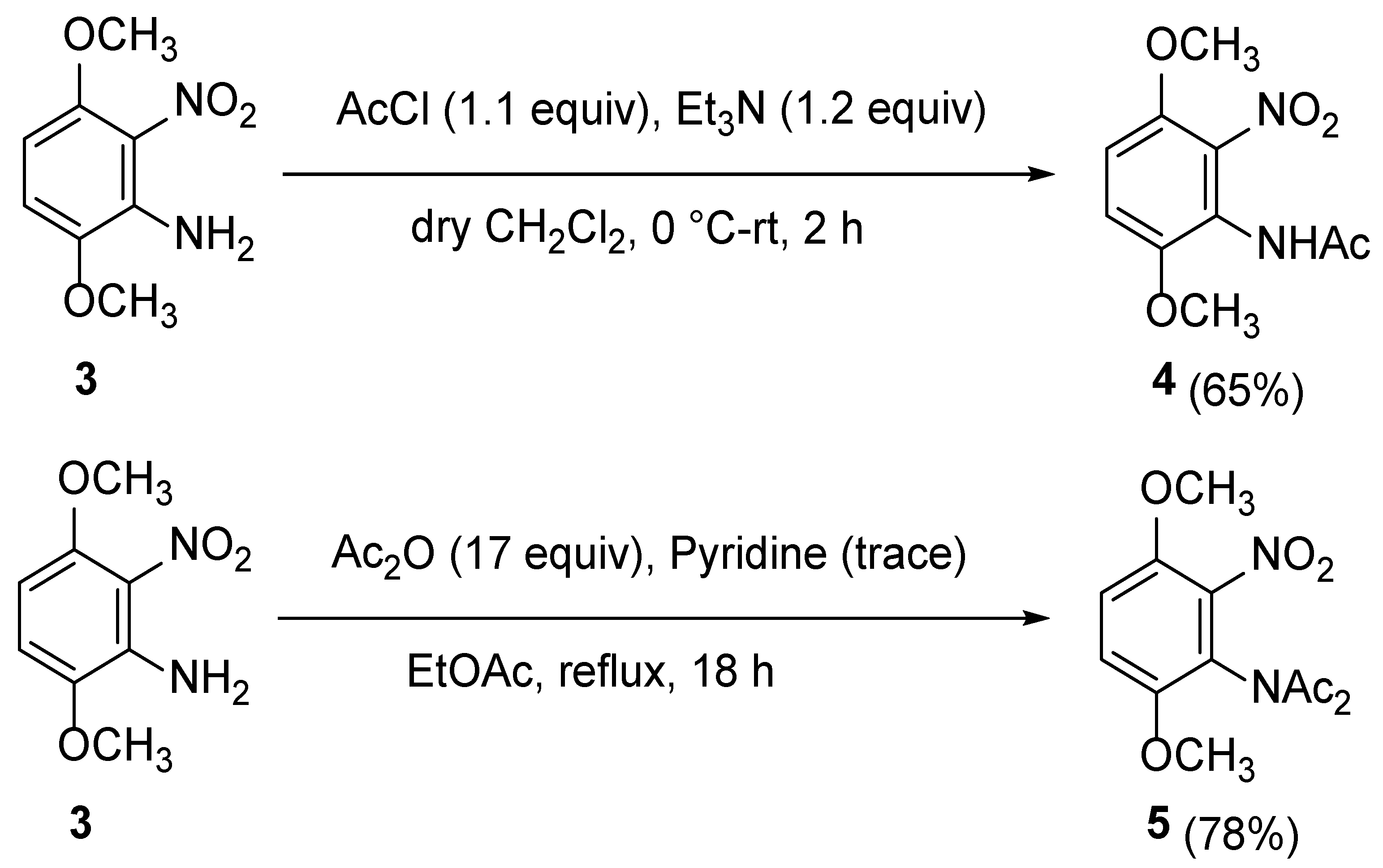
1,4-Dimethoxy-2,3-dinitrobenzene (1) reduction using sodium hydrosulfite resulted in 3,6-dimethoxybenzene-1,2-diamine (2) and 3,6-dimethoxy-2-nitroaniline (3) in 24% and 59% yields, respectively. Nitroaniline 3 was acetylated with acetyl chloride to give N-(3,6-dimethoxy-2-nitrophenyl)acetamide (4) in a 65% yield and with acetic anhydride to give N-acetyl-N-(3,6-dimethoxy-2-nitrophenyl)acetamide (5) in 78% yield. Novel compounds 4 and 5 were characterized by FT-IR, 1H and 13C-NMR, and HRMS. The X-ray crystal structure of acetamide 4 is also presented.

Graphical Abstract

1. Introduction

1,4-Dimethoxy-2,3-dinitrobenzene (1) is privileged as a precursor of electro-reducible para-benzoquinones [1,2,3], including benzimidazolequinones [4,5,6,7], and quinoxalinediones [8], with potent anti-cancer and anti-microbial activities. The first transformative step towards para-benzoquinone targets is a reduction to 3,6-dimethoxybenzene-1,2-diamine (2), which occurs in high yields using hydrogenation with Pd catalysts [1,8,9], and Sn in HCl [4,5,6,10].

2. Results and Discussion

2.1. Synthesis

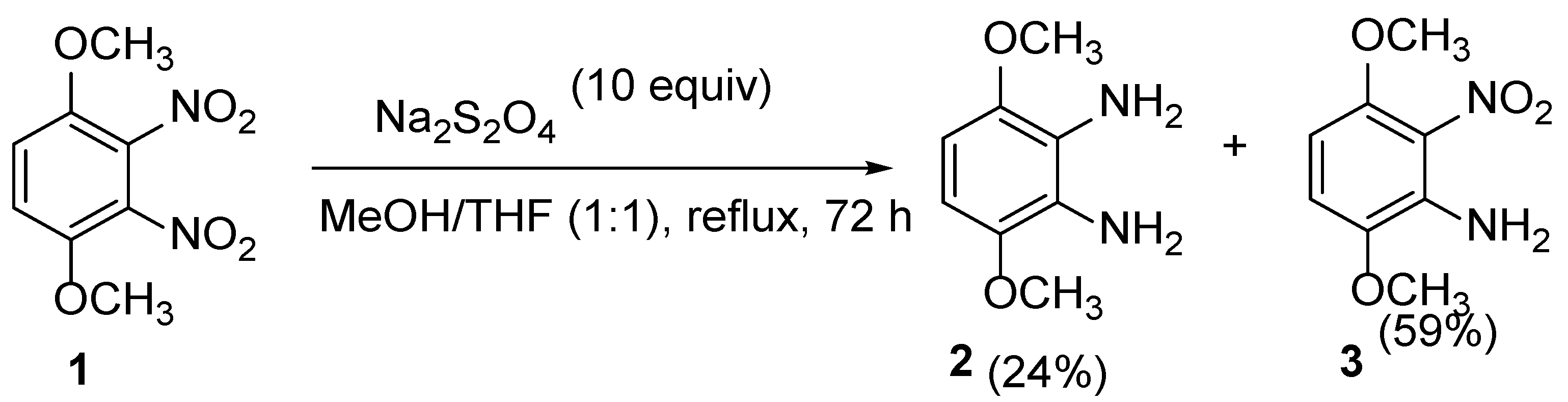
Herein, dinitrobenzene 1 was reduced with sodium hydrosulfite (also known as sodium dithionite, Na2S2O4) to give diamine 2 in a 24% yield, and an unexpected adduct of incomplete reduction, 3,6-dimethoxy-2-nitroaniline (3) in a 59% yield (Scheme 1). The selective reduction of 1,4-dimethoxy-2,3-dinitrobenzene (1) was previously reported using hydrazine hydrate in the presence of iron trichloride and charcoal to give o-nitroaniline 3 in an excellent yield [6].
Acetylation of 3, was inspired by the recent exploitation of 2-nitroacetanilides as substrates for the synthesis of benzimidazoles [11,12]. A novel compound, N-(3,6-dimethoxy-2-nitrophenyl)acetamide (4) was prepared in a 65% yield using acetyl chloride and triethylamine (Scheme 2). The 2-nitroacetanilide 4 in CDCl3 exhibited broadening of the acetamide-methyl signal to give diminutive singlet peaks at 2.13 and 23.2 ppm in the respective 1H and 13C NMR spectra (Figures S1 and S2), presumably due to amide-iminol tautomerism [13]. This is exacerbated by the adjacent nitro-group increasing the acidity of the N-H in 4. Tautomerism was eliminated by preparation of the novel diacetamide 5 in a 78% yield using acetic anhydride and catalytic pyridine (Scheme 2). For N-acetyl-N-(3,6-dimethoxy-2-nitrophenyl)acetamide (5) in CDCl3 the acetamide-methyl at 2.28 and 25.7 ppm in the respective 1H and 13C NMR spectra appeared as one sharp singlet peak (Figures S3 and S4).

2.2. X-Ray Crystallography

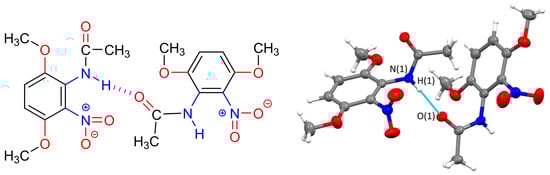
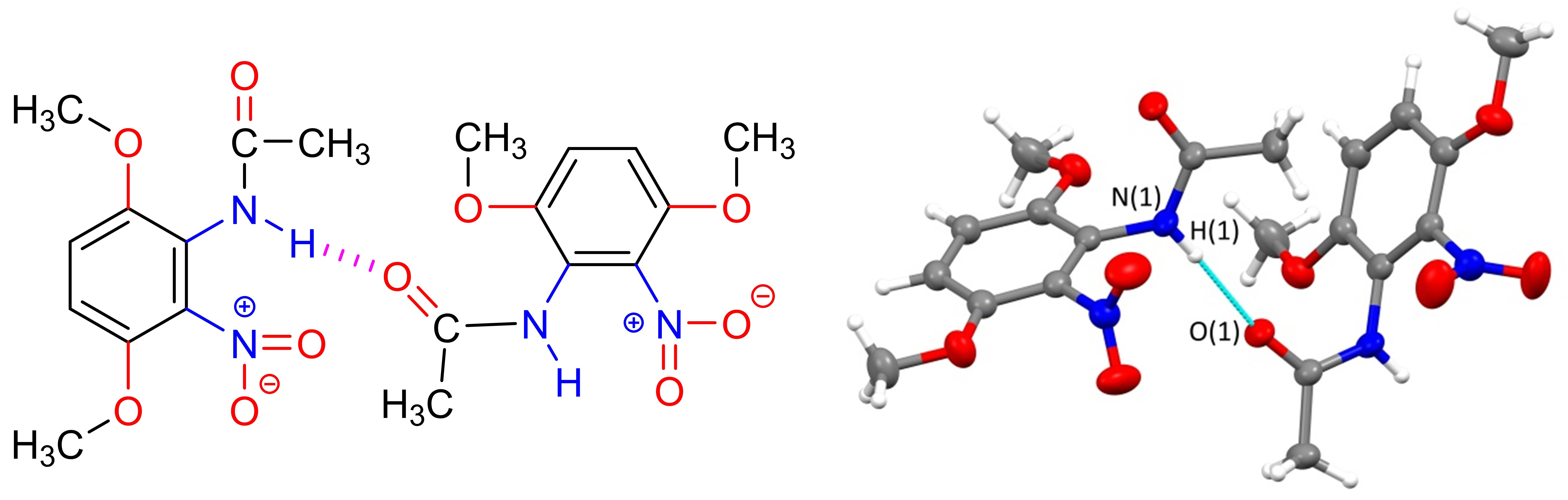
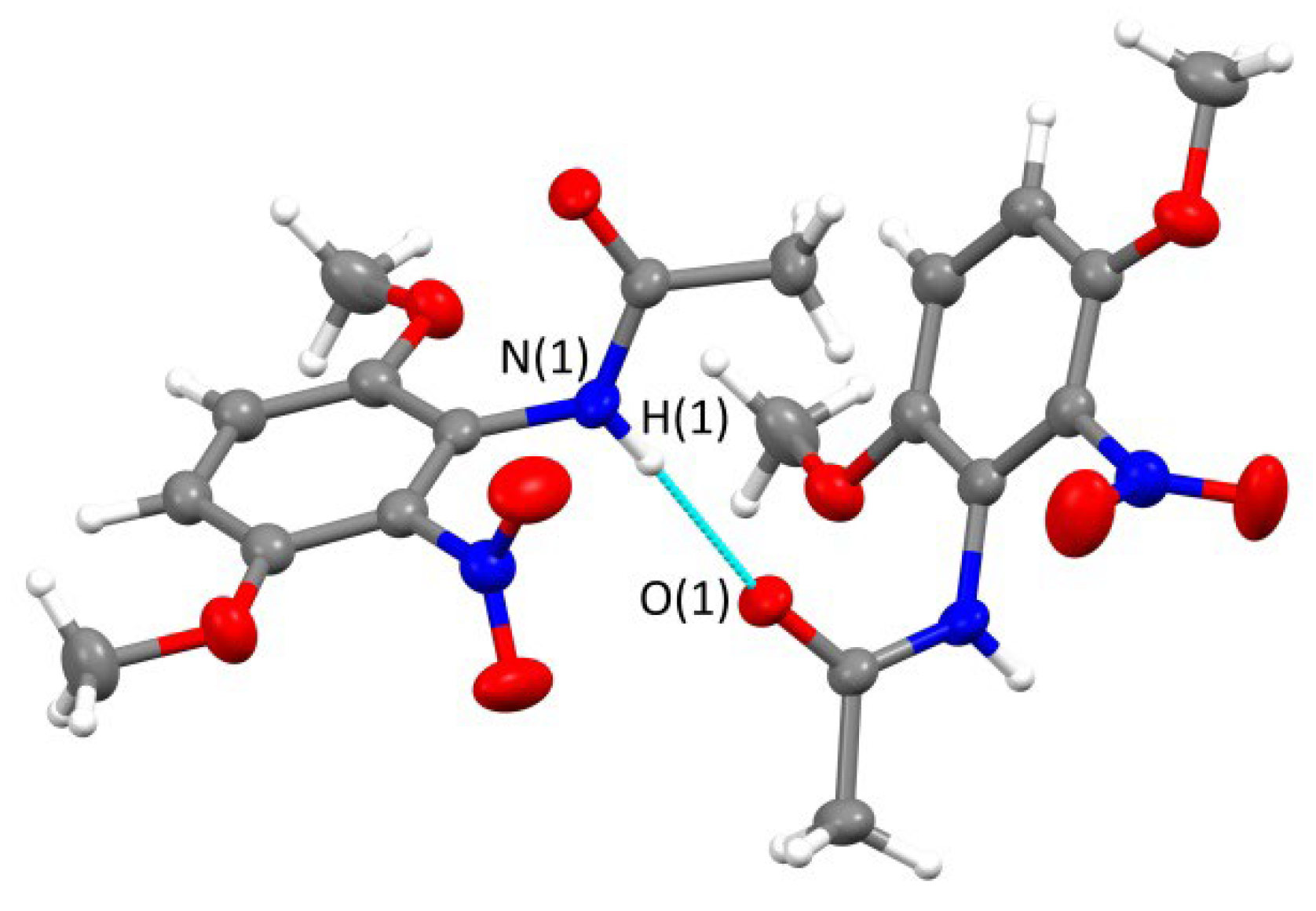
Recrystallization of N-(3,6-dimethoxy-2-nitrophenyl)acetamide (4) from chloroform in the NMR tube gave two polymorphs of compound (4), both of which were observable by optical microscopy (Figure S11). Crystals of each form were analyzed by single/crystal X-ray diffraction (SXD) crystallography to confirm molecular structure and tautomer (Figure 1).
The thermodynamic form I with a single conformer of (4) has a monoclinic crystal structure with the positions of all H atoms unambiguously determined (Table S1a–e, Figure S14). In the solid state, only the amide tautomer (as opposed to iminol or aminol tautomers) is observed. The kinetic form II exhibits two conformers in the triclinic crystal structure with the positions of all non-methyl group H atoms equally determined and refined as for form I (Table S2a–e, Figure S15). Both conformers in form II are amide tautomers, the difference between them being in the torsion angles formed by the nitro and amide groups with the phenyl ring. The polymorphism of (4) results from multiple conformations of these two groups (Figure S16), and not from any molecular disorder. In both polymorphs, hydrogen bonding leads to a one-dimensional network (Figure S17).

3. Materials and Methods

3.1. Materials and Measurements

All chemicals were sourced from commercial suppliers and used without purification, including sodium hydrosulfite (Na2S2O4, CAS Number: 7775-14-6, ≥82.5%, Sigma-Aldrich, Merck KGaA, Darmstadt, Germany), NaHCO3 (99%, EMSURE®, Supelco, Sigma-Aldrich, Merck KGaA, Darmstadt, Germany), acetyl chloride (AcCl, 98%, Sigma-Aldrich), triethylamine (Et3N, ≥99.5%, Sigma-Aldrich), acetic anhydride (Ac2O, 99.5%, Sigma-Aldrich), and pyridine (ACS reagent, ≥99%, Merck KGaA, Darmstadt, Germany). HCl (37%, Fisher Scientific, Waltham, MA, USA), NH4OH (ammonia solution, 35%, Fisher Scientific), CHCl3 (>99.8%, Fisher Scientific), ethyl acetate (EtOAc, ≥99%, Fisher Scientific), hexane (Fischer Scientific, bp 40–60 °C), methanol (MeOH, 99.9%, VWR Chemicals, Radnor, PA, USA), and tetrahydrofuran (THF, ≥99%, Fisher Scientific), were used as received. Water is Milli-Q deionised and CH2Cl2 (>99.8%, Fisher Scientific) was freshly distilled over P2O5 (+99%, ACROS Organics, Bvba, Belgium). 1,4-Dimethoxy-2,3-dinitrobenzene (1) was prepared by the reaction of nitric acid (69%, EMSURE®, Merck) with 1,4-dimethoxybenzene (ReagentPlus® 99%, Sigma-Aldrich), according to the literature procedure [1]. Thin layer chromatography (TLC) was performed on Merck TLC silica gel 60 F254 plates using a UV lamp (254 nm) for visualization. Column chromatography was performed using Fluka (Honeywell Research Chemicals, Seeize, Germany) silica gel 60 (particle size 35–70 µm) using gradient elution of EtOAc and hexanes as eluent. The organic extract was dried using MgSO4 (anhydrous, Extra Pure, Fisher Scientific). Melting point was measured on a Stuart Scientific melting point apparatus (Cole-Parmer/Stuart Equipment, Staffordshire, UK), SMP3. Infrared spectrum (IR) was recorded on the solid samples using a Perkin-Elmer Spec 1 with ATR (Shelton, CT, USA) attached, where s, m, and w are strong, medium, and weak signals, respectively. All NMR spectra were recorded in CDCl3 (Eurisotop®, Saint-Aubin, France, 99.8% atom D) using a Bruker Avance III 400 MHz spectrometer equipped with a 5 mm BBFO+. Apart from compound 3, which was analysed using Bruker Avance NEO 600 MHz spectrometer (Bruker Corporation, Billerica, MA, USA) with broadband autotune probe. NMR spectra were processed using TopSpin 3.3.0 acquisition software. NMR tubes used were 5 mm, Ultrathin Wall Precision NMR Sample Tubes 7′′ L, 600 MHz, (545-PPT-7), from GPE-Scientific (Leighton Buzzard, Bedfordshire, UK). 13C NMR spectra were acquired at 100 MHz using the 400 MHz spectrometer with complete proton decoupling (Bruker Corporation, Billerica, MA, USA). HRMS spectra of compounds 4 and 5 were obtained at the National Mass Spectrometry Facility at Swansea University using a Waters Xevo G2-S mass spectrometer (Milford, MA, USA) with an Atmospheric Solids Analysis Probe (ASAP). The precision of accurate mass measurements has a tolerance of 6 and 5 ppm for compounds 4 and 5, respectively.

3.2. Synthesis of 3,6-Dimethoxy-2-nitroaniline (3)

Sodium hydrosulfite (45.30 g, 0.26 mol) was added in three equal portions over 45 min to dintrobenzene 1 (6.00 g, 26 mmol) in MeOH/THF (1:1, 200 mL) at reflux. The stirred mixture was heated at reflux for 72 h. Water was added and the organic solvents evaporated, and the aqueous mixture acidified with conc. HCl (50 mL). The mixture was filtered and basified with conc. NH4OH until pH 9. The solution was extracted with CHCl3 (4 × 200 mL), and the combined organic extracts were dried (MgSO4) and evaporated to dryness. The orange-brown residue was purified by column chromatography on silica gel using gradient elution of hexane and EtOAc (page S11) to yield the title compound (3.03 g, 59%), as orange crystals; mp 77–78 °C (mp 76–77 °C) [14]; Rf 0.65 (1:4 hexane:EtOAc:); δH (600 MHz, CDCl3) 3.84 (s, 3H, Me), 3.85 (s, 3H, Me), 5.39 (bs, 2H, NH2), 6.18 (d, J = 8.8 Hz, 1H), 6.76 (d, J = 8.8 Hz, 1H); δC (100 MHz, CDCl3) 56.5, 56.8 (both Me), 98.4, 112.8 (both CH), 127.5, 135.2, 141.7, 148.6 (all C), and 3,6-dimethoxybenzene-1,2-diamine (2) (1.03 g, 24%), mp 87–89 °C (mp 86–87 °C) [1]; Rf 0.55 (1:4 hexane:EtOAc).

3.3. Synthesis of N-(3,6-Dimethoxy-2-nitrophenyl)acetamide (4)

AcCl (0.25 mL, 3.5 mmol) was added over 5 min to nitroaniline 3 (0.65 g, 3.3 mmol) and Et3N (0.54 mL, 3.9 mmol) in dried CH2Cl2 (20 mL) at 0 °C and stirred at room temperature for 2 h. The solution was evaporated, EtOAc (50 mL) added, and washed with water (50 mL). The organic extract was dried (MgSO4) evaporated to dryness, and purified by column chromatography on silica gel using gradient elution of hexane and EtOAc to yield the title compound (0.52 g, 65%), as yellow crystals; m.p. 167–170 °C; Rf 0.48 (EtOAc); νmax (neat, cm−1) 3169 (w), 2944 (w) 2842 (w), 1663 (C=O, m), 1590 (w), 1527 (NO2, m), 1503 (m), 1466 (w) 1434 (w), 1368 (NO2, m), 1261 (s), 1181 (w), 1098 (m), 1058 (m), 976 (w), 904 (s); δH (400 MHz, CDCl3) 2.13 (bs, 3H), 3.85 (s, 6H), 6.89 (d, J = 9.2 Hz, 1H), 7.00 (d, J = 9.2 Hz, 1H), 7.14 (bs, 1H, N-H); δC (100 MHz, CDCl3) 23.2, 56.7, 57.1 (all Me), 110.8, 113.7, 120.0, 127.7, 145.7, 147.3, 168.6 (C=O). HRMS (API+) m/z [M]+, C10H13N2O5 calcd. 241.0824, observed 241.0827.

3.4. Synthesis of N-acetyl-N-(3,6-dimethoxy-2-nitrophenyl)acetamide (5)

Ac2O (4 mL, 42 mmol) and pyridine (3 drops) were added to nitroaniline 3 (0.50 g, 2.5 mmol) in EtOAc (5 mL) and stirred at reflux for 18 h. CHCl3 (25 mL) was added and the organic layer washed with 1 M HCl (2 × 25 mL), dilute NaHCO3 (3 × 25 mL), and water (25 mL). The organic extract was dried (MgSO4) and evaporated to dryness to yield the title compound (0.55 g, 78%) as a yellow solid; m.p. 139–140 °C; Rf 0.65 (1:1 EtOAc:hexane); νmax (neat, cm−1) 1731 (m, C=O), 1710 (s, C=O), 1545 (NO2, m), 1496 (s), 1457 (m), 1417 (w), 1364 (NO2, s), 1270 (s), 1220 (s), 1206 (s), 1185 (s), 1164 (w), 1107 (m), 1062 (s), 1021 (s); δH (400 MHz, CDCl3) 2.28 (s, 6H), 3.83 (s, 3H), 3.87 (s, 3H), 7.09 (AB-q, J = 9.3 Hz, 2H); δC (100 MHz, CDCl3) 25.7 (2 × Me), 56.7, 57.0 (both OMe), 114.3, 114.5 (both CH), 121.5, 139.9, 145.2, 149.2 (all C), 171.9 (2 × C=O); HRMS (API+) m/z [M + H]+, C12H15N2O6 calcd. 283.0930, observed 283.0929.

3.5. X-Ray Crystallography of N-(3,6-Dimethoxy-2-nitro-phenyl)acetamide (4)

The crystal structures of two polymorphs from compound (4) were determined by laboratory single-crystal X-ray diffraction [15,16,17]. The full experiment details and crystallographic tables are available in the supporting information.

Supplementary Materials

The following are available online. Figure S1: 1H NMR spectrum of (4); Figure S2: 13C NMR spectrum of (4); Figure S3: 1H NMR spectrum of (5); Figure S4: 13C NMR spectrum of (5); Figure S5: 1H NMR spectrum of (3); Figure S6: 13C NMR spectrum of (3); Figure S7: IR spectrum of (4); Figure S8: IR spectrum of (5); Figure S9: High Resolution Mass Spectrum (4); Figure S10: High Resolution Mass Spectrum (5); Table S1a. Crystal data and structure refinement for (4) form I; Table S1b. Fractional atomic coordinates and U(eq) for all atoms; Table S1c. Anisotropic displacement parameters; Table S1d. Selected bond lengths; Table S1e. Selected bond angles; Table S2a. Crystal data and structure refinement for (4) form II; Table S2b. Fractional atomic coordinates and U(eq) for all atoms; Table S2c. Anisotropic displacement parameters; Table S2d. Selected bond lengths; Table S2e. Selected bond angles; Figure S11: Optical microscope photographs of (4); Figure S12: Photograph of monoclinic crystal used in SXD study; Figure S13: Photograph of triclinic crystal used in SXD study; Figure S14: Labelling of the atoms for the monoclinic form I structure; Figure S15: Labelling of the atoms for the triclinic form II structure; Figure S16: Comparison of molecular conformations in forms I and II of (4); Figure S17: Comparison of H-bonding in forms I and II of (4).

Author Contributions

Investigation: L.A.A.-D.; Investigation (X-Ray) and Writing: J.C.B. and J.K.C.; Supervision: G.T.; Conceptualization, Supervision, Writing—review and editing: F.A. All authors have read and agreed to the published version of the manuscript.

Funding

F.A. thanks Kingston University for HSSCE starting bursary for L.A.A. and the Royal Society of Chemistry, for Research Fund Grant no: R24-7014081694.

Data Availability Statement

CIF files have been deposited at the Cambridge Crystallographic Data Centre (CCDC) with deposition numbers: 2531842-3. These data can be obtained free of charge via http://www.ccdc.cam.ac.uk/conts/retrieving.html (or from the CCDC, 12 Union Road, Cambridge CB2 1EZ, UK); Fax: +44-1223-336033; E-mail: deposit@ccdc.cam.ac.uk. Additional data are contained within this article and its Supplementary Materials.

Acknowledgments

We thank Kingston University for laboratory and analytical facilities, and NMSF, Swansea University for mass spectra.

Conflicts of Interest

The authors declare no conflicts of interest.

References

  1. Hammershøj, P.; Reenberg, T.K.; Pittelkow, M.; Nielsen, C.B.; Hammerich, O.; Christensen, J.B. Synthesis and properties of 2,3-dialkynyl-1,4-benzoquinones. Eur. J. Org. Chem. 2006, 2006, 2786–2794. [Google Scholar] [CrossRef]
  2. Joyce, E.; Kavanagh, P.; Leech, D.; Karpinska, J.; McArdle, P.; Aldabbagh, F. Acetic anhydride mediated condensation of aromatic o-diacid dichlorides with benzimidazoles to provide electro-reducible p-dione adducts. Tetrahedron Lett. 2012, 53, 3788–3791. [Google Scholar] [CrossRef]
  3. Kielty, P.; Farràs, P.; McArdle, P.; Smith, D.A.; Aldabbagh, F. Visible-light unmasking of heterocyclic quinone methide radicals from alkoxyamines. Chem. Commun. 2019, 55, 14665–14668. [Google Scholar] [CrossRef] [PubMed]
  4. Alvarez, F.; Ghérardi, A.; Nebois, P.; Sarciron, M.-E.; Pétavy, A.-F.; Walchshofer, N. Benzimidazole-4,7-diones as inhibitors of protozoal (Toxoplasma gondii) purine nucleoside phosphorylase. Bioorgan. Med. Chem. Lett. 2002, 12, 977–979. [Google Scholar] [CrossRef]
  5. Gellis, A.; Kovacic, H.; Boufatah, N.; Vanelle, P. Synthesis and cytotoxicity evaluation of some benzimidazole-4,7-diones as bioreductive anticancer agents. Eur. J. Med. Chem. 2008, 43, 1858–1864. [Google Scholar] [CrossRef]
  6. López-Lira, C.; Tapia, R.A.; Herrera, A.; Lapier, M.; Maya, J.D.; Soto-Delgado, J.; Oliver, A.G.; Lappin, A.G.; Uriarte, E. New benzimidazolequinones as trypanosomicidal agents. Bioorg. Chem. 2021, 111, 104823. [Google Scholar] [CrossRef] [PubMed]
  7. Sweeney, M.; Conboy, D.; Mirallai, S.I.; Aldabbagh, F. Advances in the synthesis of ring-fused benzimidazoles and imidazobenzimidazoles. Molecules 2021, 26, 2684. [Google Scholar] [CrossRef] [PubMed]
  8. Morin, C.; Besset, T.; Moutet, J.-C.; Fayolle, M.; Brückner, M.; Limosin, D.; Becker, K.; Davioud-Charvet, E. The aza-analogues of 1,4-naphthoquinones are potent substrates and inhibitors of plasmodial thioredoxin and glutathione reductases and of human erythrocyte glutathione reductase. Org. Biomol. Chem. 2008, 6, 2731–2742. [Google Scholar] [CrossRef] [PubMed]
  9. Weinberger, L.; Day, A.R. Syntheses of dimethoxybenzimidazoles, dihydroxybenzimidazoles and imidazo-p-benzoquinones. J. Org. Chem. 1959, 24, 1451–1455. [Google Scholar] [CrossRef]
  10. Flader, C.; Liu, J.; Borch, R.F. Development of novel quinone phosphorodiamidate prodrugs targeted to DT-diaphorase. J. Med. Chem. 2000, 43, 3157–3167. [Google Scholar] [CrossRef] [PubMed]
  11. Wan, Y.; Zhang, Z.; Ma, N.; Bi, J.; Zhang, G. Acylamino-directed specific sequential difunctionalizations of anilides via metal-free relay reactions for p-oxygen and o-nitrogen incorporation. J. Org. Chem. 2019, 84, 780−791. [Google Scholar] [CrossRef] [PubMed]
  12. Ma, Z.; Zhang, B.; He, Z.; Xu, T.; Cheng, Y.; Cui, Y.; Chen, Z. Atomically dispersed Fe−N−C-catalyzed intermolecular reductive coupling toward the synthesis of benzimidazoles. ACS Catal. 2025, 15, 11875−11885. [Google Scholar] [CrossRef]
  13. Fischer, G. Chemical aspects of peptide bond isomerization. Chem. Soc. Rev. 2000, 29, 119–127. [Google Scholar] [CrossRef]
  14. Entwistle, I.D.; Johnstone, R.A.W.; Povall, T.J. Selective rapid transfer-hydrogenation of aromatic nitro-compounds. J. Chem. Soc. Perkin Trans. 1 1975, 1300–1301. [Google Scholar] [CrossRef]
  15. Sheldrick, G.M. SHELXT—Integrated space-group and crystal-structure determination. Acta Crystallogr. Sect. A Found. Adv. 2015, 71, 3–8. [Google Scholar] [CrossRef] [PubMed]
  16. Sheldrick, G.M. Crystal structure refinement with SHELXL. Acta Crystallogr. Sect. C Struct. Chem. 2015, 71, 3–8. [Google Scholar] [CrossRef] [PubMed]
  17. Dolomanov, O.V.; Bourhis, L.J.; Gildea, R.J.; Howard, J.A.K.; Puschmann, H. OLEX2: A complete structure solution, refinement and analysis program. J. Appl. Crystallogr. 2009, 42, 339–341. [Google Scholar] [CrossRef]
Scheme 1. Reduction of 1,4-dimethoxy-2,3-dinitrobenzene (1) using sodium dithionite.
Molbank 2026 m2147 sch001
Scheme 2. Synthesis of N-(3,6-dimethoxy-2-nitrophenyl)acetamide (4) and N-acetyl-N-(3,6-dimethoxy-2-nitrophenyl)acetamide (5).
Molbank 2026 m2147 sch002
Figure 1. Molecular structure of N-(3,6-dimethoxy-2-nitrophenyl)acetamide (4) determined by SXD showing the hydrogen bond (N(1)—H(1)…O(1)) between two molecules in form I.
Molbank 2026 m2147 g001
Disclaimer/Publisher’s Note: The statements, opinions and data contained in all publications are solely those of the individual author(s) and contributor(s) and not of MDPI and/or the editor(s). MDPI and/or the editor(s) disclaim responsibility for any injury to people or property resulting from any ideas, methods, instructions or products referred to in the content.