
Communication

Synthesis of 2-Methylcamalexin

by
Yordan Stremski
1,2,*,
Maria Bachvarova
2,
Stela Statkova-Abeghe
2 and
Plamen Angelov
1,2,*
1
University Centre on Tautomeric Research and Education in Science and Technology (ERA Chair UCTREST), University of Plovdiv Paisii Hilendarski, 24 Tsar Asen Str., 4000 Plovdiv, Bulgaria
2
Faculty of Chemistry, Department of Organic Chemistry, University of Plovdiv Paisii Hilendarski, 24 Tsar Asen Str., 4000 Plovdiv, Bulgaria
*
Authors to whom correspondence should be addressed.
Molbank 2026, 2026(2), M2163; https://doi.org/10.3390/M2163
Submission received: 18 March 2026 / Revised: 3 April 2026 / Accepted: 9 April 2026 / Published: 13 April 2026
(This article belongs to the Section Organic Synthesis and Biosynthesis)

Abstract

2-methylcamalexin, a novel derivative of the phytoalexin Camalexin, was synthesized for the first time, using a convenient two-step approach. The approach realizes coupling of two aromatic heterocyclic moieties (2-methylindole and thiazole) by sequential α-amidoalkylation/oxidative re-aromatization. The target product was obtained in a cost-effective manner, with 88% yield over two steps. The structure of the synthesized product was unequivocally determined on the basis of NMR, HRMS and FTIR spectral measurments.

1. Introduction

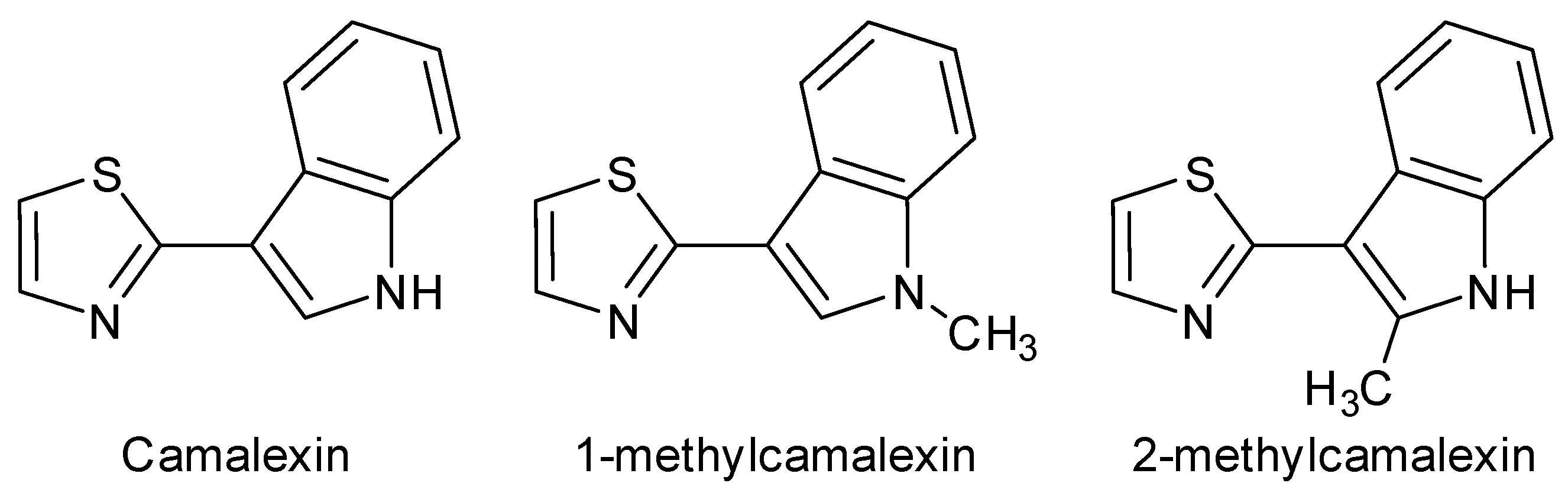
Phytoalexins are low-molecular-weight molecules synthesised by plants in reaction to infection or stress. They are part of the active defence mechanisms in plants. A metabolite must demonstrate an antimicrobial effect to be designated as a phytoalexin [1]. The prospective use of phytoalexins to enhance plant resistance to several diseases is attracting significant attention [2,3]. Camalexin and 1-methylcamalexin for example are notable for their antimicrobial activities [4,5,6,7,8,9,10,11,12] (Figure 1). Furthermore, some authors highlight Camalexin’s remarkable antiproliferative profile against various cancer cell lines, motivating its potential application as a chemotherapeutic agent [13,14,15,16,17]. 1-methylcalamexin also exhibits potent cytotoxic activity against the human breast cancer cell line SKBr3 with IC50—3.8 µM [18].
In nature, phytoalexins are generally biosynthesised in small quantities (e.g., 1–5 mg per kilogramme of fresh plant tissue), rendering their extraction from stressed plant material difficult when greater quantities are necessary. Chemical synthesis can provide the quantities of phytoalexins required for extensive screening and assessment of their biological action. Chinese researchers have recently synthesised a range of camalexin derivatives to explore their antiviral and fungicidal effects. Included among the synthesised compounds is the methylated phytoalexin 1-methylcamalexin, isolated in a modest yield of 43%, which demonstrates significant phytotoxic and antiviral properties [19].
Despite the apparent structural simplicity of the 1- and 2-methylated analogues, their synthesis has posed considerable difficulties, and all published procedures of 1-methylcamalexin are limited with regard to yield, scalability, or the accessibility of necessary reagents [11,19]. 2-methylcamalexin has not been synthesized so far by any published method, although it is of considerable interest.
One-pot, three-component α-amidoalkylation reactions involving thiazole, benzothiazole, and imidazole are the basis of a novel method, developed by us, for the synthesis of the phytoalexin Camalexin and its analogues—benzocamalexin, azacamalexin, and various oxy-camalexins [20,21,22]. The scale-up potential of this two-step approach makes it particularly interesting for the synthesis of novel analogues in larger quantities for bioassays and field studies of possible agrochemical applications. In this note we describe the application of our method to the preparation of 2-methylcamalexin.

2. Results

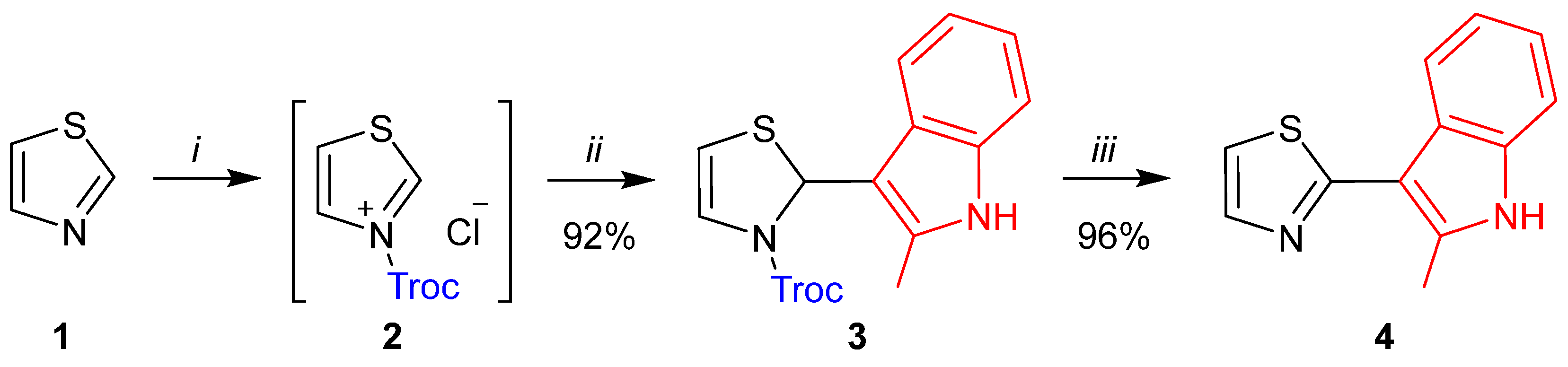
Thiazole and 2,2,2-trichloroethyl chloroformate (Troc-Cl) were used as the starting materials. These compounds readily reacted at 0 °C in dichloromethane as the solvent to provide the active acyliminium electrophilic species 2. Without isolation of 2, 2-methylindole and triethylamine were immediately added to the same reaction vessel. The ensuing electrophilic substitution at position 3 of the indole ring furnished the intermediate 3, which was isolated in 92% yield (Scheme 1).
In the next stage, the thiazole moiety in compound 3 was re-aromatised by oxidation with equimolar amount of o-chloranil (3,4,5,6-tetrachloro-1,2-benzoquinone). This oxidative rearomatisation proceeded quickly in acetonitrile at room temperature, providing the targeted 2-methylcamalexin (4) with a quantitative 96% yield in only 15 min. Thus, the achieved overall yield of the final product 4 is 88% over two steps.
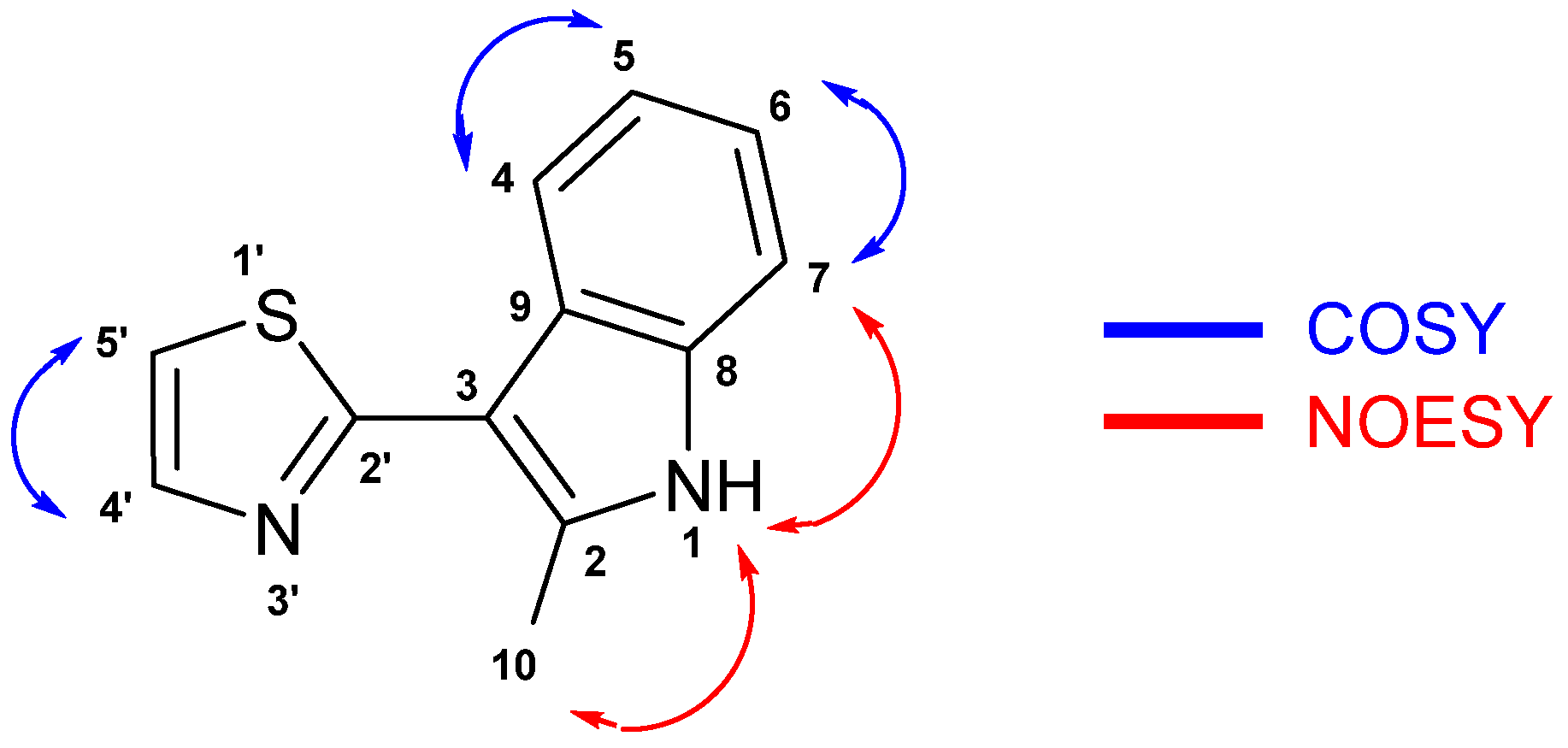
The structure of the obtained intermediate 3 and that of the final product 4 were determined on the basis of their NMR, FTIR, and HRMS spectra. A notable feature in the NMR spectra of 3 at 25 °C is the significant broadening of some signals (particularly those of the Troc CH2 protons) due to slow rotameric interconversion with rotation around the N-CO bond of the Troc carbamate group. To resolve this, the NMR spectra were measured at 80 °C in DMSO-d6, which helped to reveal a clearer signal for the AB spin system of the diastereotopic Troc CH2 protons. The obtained data were in full agreement with the proposed structure of 3, with the sp3 C-2′ thiazole signal appearing at δ = 6.99/60.0 ppm (1H/13C), as indicated by HSQC. The NMR spectra of the final product 4 were measured at 25 °C in two different solvents (CDCl3 and DMSO-d6) and indicated only aromatic sp2 13C and 1H signals, except for those corresponding to the NH and CH3 groups in the indole moiety. Full NMR spectral assignment of 4 was done in DMSO-d6, using 2D correlations (NOESY, COSY, HSQC, HMBC) and the data is presented in Table 1 and Figure 2 (for full spectra see Supplementary Materials S1).

3. Materials and Methods

All reagents and solvents were obtained from commercial suppliers (Merck, Darmstadt, Germany) and used as supplied, with no additional purification. Melting points were determined on a Krüss M5000 device (A.Krüss Optronic GmbH, Hamburg, Germany). FTIR spectra were measured on an Alpha II FTIR spectrometer (Bruker Optics GmbH, Ettlingen, Germany) with an attenuated total reflection (ATR) accessory, with absorption frequencies given in inverse centimetres (cm−1). HRMS measurements were performed on a Thermo Scientific Q Exactive hybrid quadrupole-orbitrap mass spectrometer (Thermo Fisher Scientific, Waltham, MA, USA). NMR spectra were measured on a Bruker Avance NEO AV600 spectrometer (Bruker, Billerica, MA, USA) chemical shifts (δ, ppm) are reported downfield from tetramethylsilane (TMS) and J-constants are given in Hz. Thin-layer chromatography was done on Merck Silica gel 60, 0.2 mm aluminum backed plates. Neutral alumina 90 active (0.063–0.200 mm) was used for column chromatography.

3.1. Synthetic Procedure for the Synthesis of 2,2,2-Trichloroethyl 2-(2-methyl-1H-indol-3-yl)thiazole-3(2H)-carboxylate (3)

2,2,2-trichloroethyl chloroformate (Troc-Cl) (2.4 mmol, 0.33 mL) was slowly added with magnetic stirring to a solution of thiazole (2 mmol, 0.14 mL) in dry dichloromethane (CH2Cl2, 12 mL) at 0 °C (ice bath). Then, 2-methylindole (2 mmol, 0.262 g) was added to the reaction mixture. Next, triethylamine (Et3N, 2 mmol, 0.28 mL) dissolved in dry dichloromethane (CH2Cl2, 2 mL) was gradually added in the course of 20 min. The reaction mixture was stirred for an additional 10 min. After completion of the reaction (monitored by TLC), the mixture was transferred to a separatory funnel with dichloromethane (30–40 mL), and then extracted consecutively with equal volumes of aqueous HCl (8%), Na2CO3 (3%) and water. The combined organic layer was dried over anhydrous Na2SO4, and the solvent was removed under reduced pressure. The product 2,2,2-trichloroethyl 2-(2-methyl-1H-indol-3-yl)thiazole-3(2H)-carboxylate (3) was isolated by column chromatography on neutral alumina, using a 2:1 mixture of petroleum/diethyl ether as the eluent and the increasing polarity to 1:1, yield: 92% (0.721 g), white solid, mp: 167–169 °C.
1H-NMR (600 MHz, 80 °C, DMSO-d6, δ ppm, J Hz): 2.45 (s, 3H, -CH3), 4.76 (d, J = 12.2 Hz, 1H, -COOCH2CCl3), 4.79 (d, J = 12.2 Hz, 1H, -COOCH2CCl3), 6.19 (d, J = 4.9 Hz, 1H), 6.71 (d, J = 4.9 Hz, 1H), 6.96 (app t, J = 7.5 Hz, 1H), 6.99 (s, 1H, *CH, thiazole), 7.03 (app t, J = 7.5 Hz, 1H), 7.28 (d, J = 7.9 Hz, 1H), 7.52 (d, J = 7.8 Hz, 1H), 10.81 (s, 1H, -NH).
13C{1H}-NMR (150 MHz, 80 °C, DMSO-d6, δ ppm): 11.9, 60.0, 75.1, 95.9, 106.1(C-Ar), 111.2, 119.0, 119.3, 120.8, 121.0, 126.1, 134.0, 136.0, 151.1.
ATR-FTIR (cm−1): ν(N-H) 3413; ν(C=O) 1703; ν(Csp2-H) 3089; ν(C=C) 1394, 1461, 1597; ν(C-O) 1055, 1129; ν(C-C-O) 1258; ν(C-O-C) 1322, 1340; ν(C-N) 787, 877; ν(C-S-C) 746.
HRMS m/z (ESI): calcd. for C15H13Cl3N2NaO2S+ [M + Na]+ 412.9656; 414.9626, found 412.9647; 414.9612.

3.2. Synthetic Procedure for Oxidative Rearomatization of Compound 3 to 2-Methylcamalexin (4)

The N-alkoxycarbonyl compound 3 (0.5 mmol, 0.196 g) was dissolved in acetonitrile (CH3CN, 10 mL), followed by the addition of the oxidant o-chloranil (0.5 mmol, 0.123 g). The reaction mixture was then stirred magnetically for 15 min at room temperature. Upon completion of the reaction, which was monitored by TLC, the solvent was evaporated under reduced pressure, and the mixture was subsequently dry-loaded onto 2 g neutral alumina. Column chromatography on a short column using petroleum/diethyl ether as the eluent (1:1, increasing polarity to diethyl ether) gave 2-methylcamalexin (4) as a pale yellow oil, yield 96% (0.103 g).
1H-NMR (600 MHz, 25 °C, DMSO-d6, δ ppm, J Hz): 2.74 (s, 3H), 7.16 (m, 2H), 7.40 (m, 1H), 7.59 (d, J = 3.3 Hz, 1H), 7.88 (d, J = 3.3 Hz, 1H), 8.16 (m, 1H), 11.64 (s, 1H, NH).
13C{1H}-NMR (150 MHz, 25 °C, DMSO-d6, δ ppm): 14.4, 107.4, 111.6, 116.3, 119.9, 120.8, 122.0, 126.3, 135.5, 137.6, 142.7, 163.3.
1H-NMR (600 MHz, 25 °C, CDCl3, δ ppm, J Hz): 2.56 (s, 3H), 7.08–7.11 (m, 1H), 7.13–7.16 (m, 2H), 7.19 (d, J = 3.4 Hz, 1H), 7.80 (d, J = 3.4 Hz, 1H), 8.12 (m, 1H), 8.46 (s, 1H, NH).
13C{1H}-NMR (150 MHz, 25 °C, CDCl3, δ ppm): 14.0, 108.3, 110.6, 115.9, 119.8, 121.1, 122.2, 126.5, 135.0, 136.2, 142.2, 163.6.
ATR-FTIR (cm−1): ν(N-H) 3392; ν(Csp2-H) 3112, 3071; ν(C=C) 1461, 1498, 1556; ν(C-N) 867, 1248, 1299; ν(C-S-C) 740.
HRMS m/z (ESI): calcd. for C12H11N2S+ [M + H]+ 215.0637, found 215.0629.

Supplementary Materials

The following supporting information are available online. PDF S1.—processed 1H, 13C, COSY, HSQC, HMBC, NOESY-NMR, FTIR and HRMS spectra. Compound 3 and 4 (2-methylcamalexin) 2D MDL molfiles.

Author Contributions

Manuscript writing, Y.S. and P.A.; revising and final English check, P.A. and S.S.-A.; visualization, Y.S. and P.A.; chemical synthesis, Y.S. and M.B.; spectral analysis, P.A.; conceptualization, S.S.-A. and P.A.; methodology, S.S.-A. and Y.S.; investigation, Y.S. and M.B.; supervision, S.S.-A.; All authors have read and agreed to the published version of the manuscript.

Funding

Project BG16RFPR002-1.016-0001, Programme “Research, Innovation, and Digitization for Smart Transformation” 2021–2027.

Data Availability Statement

The data presented in this study are available in this article and Supporting Information.

Acknowledgments

The authors gratefully acknowledge support from the Centre for Competence “Personalized Innovative Medicine”, PERIMED-2 (BG Programme “Research, Innovation and Digitalization for Smart Transformation” 2021–2027, co-financed by EU, grant BG16RFPR002-1.014-0007).

Conflicts of Interest

The authors declare no conflicts of interest.

Abbreviations

The following abbreviations are used in this manuscript:
Troc-Cl2,2,2-trichloroethyl chloroformate
o-chloranil3,4,5,6-tetrachloro-1,2-benzoquinone
TLCThin-layer chromatography
mpMelting point
MWMolecular weight
NMRNuclear magnetic resonance
FTIRFourier-transform infrared spectroscopy
HRMSHigh resolution mass spectrometry

References

  1. Pedras, M.S.C.; Yaya, E.E.; Glawischnig, E. The phytoalexins from cultivated and wild crucifers: Chemistry and biology. Nat. Prod. Rep. 2011, 28, 1381–1405. [Google Scholar] [CrossRef] [PubMed]
  2. Jeandet, P.; Clément, C.; Courot, E.; Cordelier, S. Modulation of phytoalexin biosynthesis in engineered plants for disease resistance. Int. J. Mol. Sci. 2013, 14, 14136–14170. [Google Scholar] [CrossRef] [PubMed]
  3. Jeandet, P. Phytoalexins: Current progress and future prospects. Molecules 2015, 20, 2770–2774. [Google Scholar] [CrossRef]
  4. Glawischnig, E. Camalexin. Phytochemistry 2007, 68, 401–406. [Google Scholar] [CrossRef]
  5. Klein, A.P.; Anarat-Cappillino, G.; Sattely, E.S. Minimum set of cytochromes P450 for reconstituting the biosynthesis of camalexin, a major arabidopsis antibiotic. Angew. Chem. Int. Ed. 2013, 52, 13625–13628. [Google Scholar] [CrossRef]
  6. Lemarié, S.; Robert-Seilaniantz, A.; Lariagon, C.; Lemoine, J.; Marnet, N.; Levrel, A.; Jubault, M.; Manzanares-Dauleux, M.J.; Gravot, A. Camalexin contributes to the partial resistance of Arabidopsis thaliana to the biotrophic soilborne protist Plasmodiophora brassicae. Front. Plant Sci. 2015, 6, 539. [Google Scholar] [CrossRef]
  7. Nguyen, N.H.; Trotel-Aziz, P.; Villaume, S.; Rabenoelina, F.; Clément, C.; Baillieul, F.; Aziz, A. Priming of camalexin accumulation in induced systemic resistance by beneficial bacteria against Botrytis cinerea and Pseudomonas syringae pv. tomato DC3000. J. Exp. Bot. 2022, 73, 3743–3757. [Google Scholar] [CrossRef]
  8. Cook, J.; Hui, J.P.M.; Zhang, J.; Kember, M.; Berrué, F.; Zhang, J.; Cheng, Z. Production of quorum sensing-related metabolites and phytoalexins during Pseudomonas aeruginosaBrassica napus interaction. Microbiology 2024, 168, 001212. [Google Scholar] [CrossRef]
  9. Lopa, F.R.; Snigdha, F.N.; Lumactud, R.A.; Sikder, M.M. Harnessing camalexin as a sustainable and ecofriendly strategy to control harmful phytopathogens. Plant Pathol. 2025, 74, 2463–2477. [Google Scholar] [CrossRef]
  10. Pedras, M.S.C.; Abdoli, A. Metabolism of the phytoalexins camalexins, their bioisosteres and analogues in the plant pathogenic fungus Alternaria brassicicola. Bioorg. Med. Chem. 2013, 21, 4541–4549. [Google Scholar] [CrossRef]
  11. Pedras, M.S.C.; Liu, J. Designer phytoalexins: Probing camalexin detoxification pathways in the phytopathogen Rhizoctonia solani. Org. Biomol. Chem. 2004, 2, 1070–1076. [Google Scholar] [CrossRef]
  12. Jimenez, L.D.; Ayer, W.A.; Tewari, J.P. Phytoalexins produced in the leaves of Capsella bursa-pastoris (shepherd’s purse). Phytoprotection 1997, 78, 99–103. [Google Scholar] [CrossRef]
  13. Mezencev, R.; Updegrove, T.; Kutschy, P.; Repovská, M.; McDonald, J.F. Camalexin induces apoptosis in T-leukemia Jurkat cells by increased concentration of reactive oxygen species and activation of caspase-8 and caspase-9. J. Nat. Med. 2011, 65, 488–499. [Google Scholar] [CrossRef] [PubMed]
  14. Smith, B.; Randle, D.; Mezencev, R.; Thomas, L.; Hinton, C.; Odero-Marah, V. Camalexin-Induced apoptosis in prostate cancer cells involves alterations of expression and activity of lysosomal protease cathepsin D. Molecules 2014, 19, 3988–4005. [Google Scholar] [CrossRef] [PubMed]
  15. Chripkova, M.; Zigo, F.; Mojzis, J. Antiproliferative Effect of Indole Phytoalexins. Molecules 2016, 21, 1626. [Google Scholar] [CrossRef]
  16. Yamashita, N.; Taga, C.; Ozawa, M.; Kanno, Y.; Sanada, N.; Kizu, R. Camalexin, an indole phytoalexin, inhibits cell proliferation, migration, and mammosphere formation in breast cancer cells via the aryl hydrocarbon receptor. J. Nat. Med. 2022, 76, 110–118. [Google Scholar] [CrossRef]
  17. Zigová, M.; Michalková, R.; Mojžiš, J. Anticancer potential of indole phytoalexins and their analogues. Molecules 2024, 29, 2388. [Google Scholar] [CrossRef]
  18. Moody, C.J.; Roffey, J.R.A.; Stephens, M.A.; Stratford, I.J. Synthesis and cytotoxic activity of indolyl thiazoles. Anti-Cancer Drugs 1997, 8, 489–499. [Google Scholar] [CrossRef]
  19. Liao, A.; Li, L.; Wang, T.; Lu, A.; Wang, Z.; Wang, Q. Discovery of phytoalexin Camalexin and its derivatives as novel antiviral and Antiphytopathogenic-Fungus agents. J. Agric. Food Chem. 2022, 70, 2554–2563. [Google Scholar] [CrossRef]
  20. Stremski, Y.; Statkova-Abeghe, S.; Angelov, P.; Ivanov, I. Synthesis of Camalexin and related analogues. J. Heterocycl. Chem. 2018, 55, 1589–1595. [Google Scholar] [CrossRef]
  21. Stremski, Y.; Ahmedova, A.; Dołęga, A.; Statkova-Abeghe, S.; Kirkova, D. Oxidation step in the preparation of benzocamalexin: The crystallographic evidence. Mendeleev Commun. 2021, 31, 824–826. [Google Scholar] [CrossRef]
  22. Bachvarova, M.; Stremski, Y.; Ganchev, D.; Statkova-Abeghe, S.; Angelov, P.; Ivanov, I. An Efficient Method for the Synthesis and In Silico Study of Novel Oxy-Camalexins. Molecules 2025, 30, 2049. [Google Scholar] [CrossRef]
Figure 1. Structures of phytoalexins—Camalexin, 1-methylcamalexin and the novel methylated analogue—2-methylcamalexin.
Molbank 2026 m2163 g001
Scheme 1. Synthesis of 2-methylcamalexin (4), reagents and conditions: (i) Troc-Cl, CH2Cl2, 0 °C; (ii) 2-methylindole, Et3N, 30 min, 0 °C; (iii) o-chloranil, CH3CN, 15 min, 25 °C.
Molbank 2026 m2163 sch001
Figure 2. Structure of 2-methylcamalexin (4), with COSY/NOESY correlations and atom positions numbered for NMR assignment. HMBCs are presented in Table 1.
Molbank 2026 m2163 g002
Table 1. Full NMR assignment of 2-methylcamalexin (4) (600/150 MHz 1H/13C, DMSO-d6, δ ppm, J Hz). Heteronuclear multiple bond correlations (HMBC) are from proton(s) to the stated carbon.
Position1H13CHMBC
111.64, s-2, 8, 9, 3
2-137.60
3-107.44
48.16, m119.888, 6
57.16, m120.837
67.16, m122.004
77.40, m111.579, 5
8-135.46
9-126.27
102.74, s14.433, 2, 2′, 9
2′-163.29
4′7.88, d, J = 3.3142.67
5′7.59, d, J = 3.3116.352′, 4′
Disclaimer/Publisher’s Note: The statements, opinions and data contained in all publications are solely those of the individual author(s) and contributor(s) and not of MDPI and/or the editor(s). MDPI and/or the editor(s) disclaim responsibility for any injury to people or property resulting from any ideas, methods, instructions or products referred to in the content.