Communication

Synthesis of 3-[(2-Ethylhexyl)amino]-5-phenyl-4H-1,2,6-thiadiazin-4-one and 3-[(2-Ethylhexyl)amino]-5-[(4-oxo-5-phenyl-4H-1,2,6-thiadiazin-3-yl)amino]-4H-1,2,6-thiadiazin-4-one


by
Andreas S. Kalogirou
1,* and
Panayiotis A. Koutentis
2
1
Department of Life Sciences, School of Sciences, European University Cyprus, 6 Diogenis Str., Engomi, P.O. Box 22006, 1516 Nicosia, Cyprus
2
Department of Chemistry, University of Cyprus, P.O. Box 20537, 1678 Nicosia, Cyprus
*
Author to whom correspondence should be addressed.
Molbank 2026, 2026(2), M2150; https://doi.org/10.3390/M2150
Submission received: 12 February 2026 / Revised: 9 March 2026 / Accepted: 9 March 2026 / Published: 11 March 2026
(This article belongs to the Section Organic Synthesis and Biosynthesis)

Abstract

Suzuki–Miyaura coupling of 3-chloro-5-[(2-ethylhexyl)amino]-4H-1,2,6-thiadiazin-4-one with phenylboronic acid, at ca. 100 °C, gave 3-[(2-ethylhexyl)amino]-5-phenyl-4H-1,2,6-thiadiazin-4-one in 69% yield. Another nucleophilic substitution reaction of 3-chloro-5-[(4-oxo-5-phenyl-4H-1,2,6-thiadiazin-3-yl)amino]-4H-1,2,6-thiadiazin-4-one with 2-ethylhexan-1-amine at ca. 100 °C gave 3-[(2-ethylhexyl)amino]-5-[(4-oxo-5-phenyl-4H-1,2,6-thiadiazin-3-yl)amino]-4H-1,2,6-thiadiazin-4-one in 93% yield.

1. Introduction

Heterocyclic oligomers are short, discrete chains composed of repeating heterocyclic units. Owing to their tunable electronic properties, they have found extensive application in materials science, including in organic field-effect transistors (OFETs) [1,2], organic photovoltaics (OPVs) [1,3], and as photosensitizers [4,5]. Syntheses of oligomers often suffer from limited solubility of both substrates and products, particularly as chain length increases. This issue is commonly addressed through the introduction of solubilizing alkyl chains, as demonstrated for oligothiophenes [6], macrocyclic oligofurans [7], and fused pyrrolothiophenes [8].
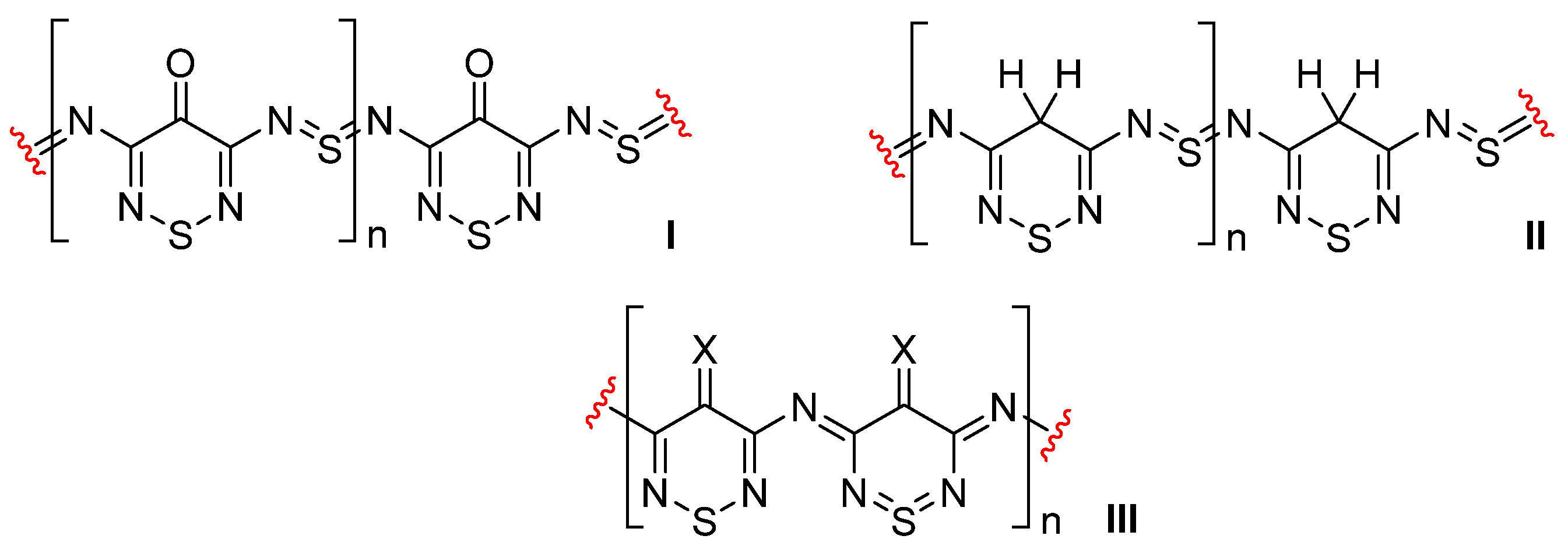
Our work on heterocyclic oligomers originates from efforts to prepare short-chain 4H-1,2,6-thiadiazine derivatives [9]. This line of research is part of a broader objective aimed at developing π-conjugated materials that mirror the structural and electronic features of the superconducting polymer poly(sulfur nitride) [10], a concept first envisioned in the foundational studies of Woodward (structures I and II, Figure 1) [11] and Rees (structure III, Figure 1) [12]. It is noted that these polymers require alternating S(II)/S(IV) oxidation states in the sulfur atoms to enable the electron transfer in the polymer.
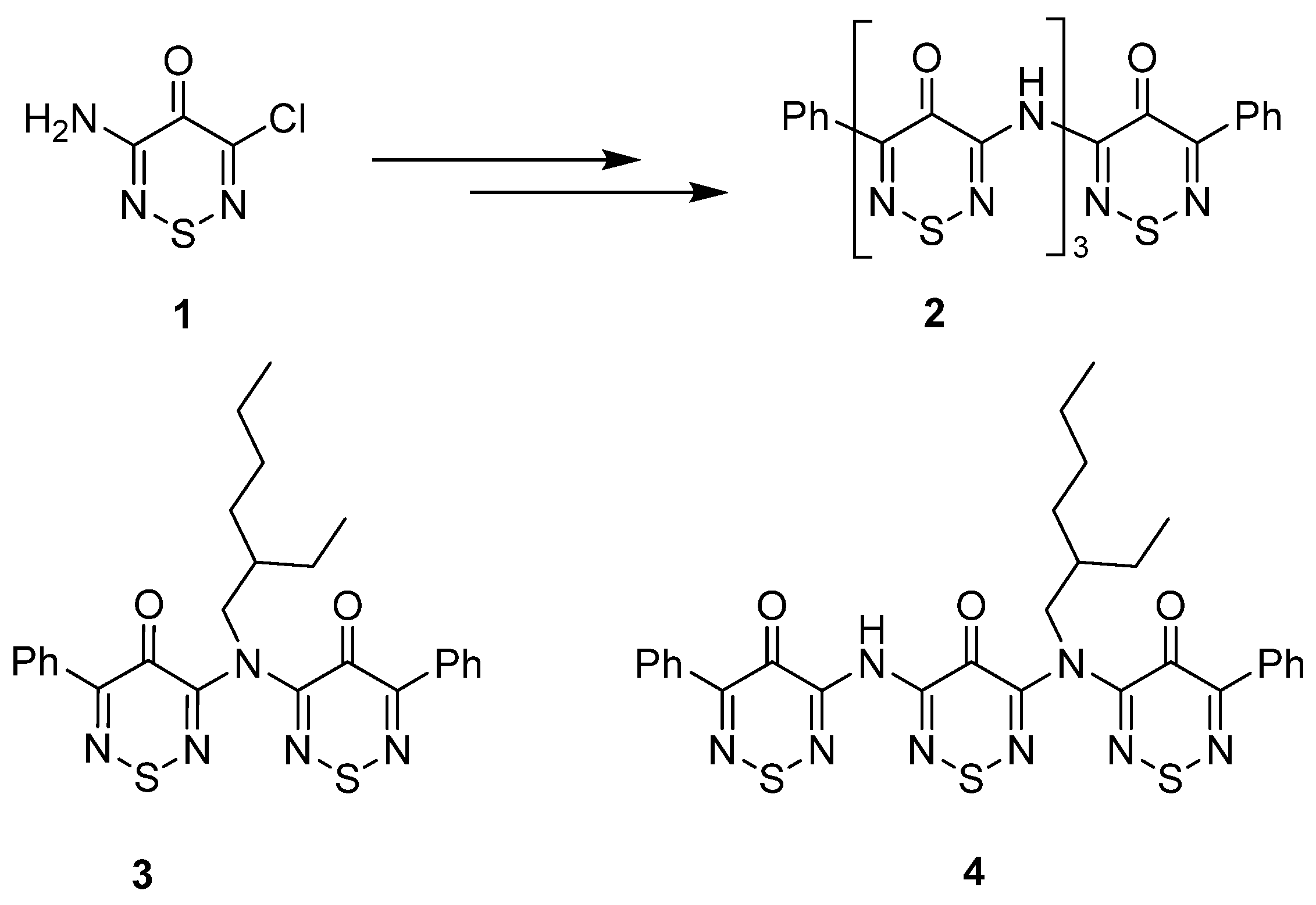
In our previous work [9], 1,2,6-thiadiazin-4-one oligomers containing up to four thiadiazine units (compound 2, Scheme 1) were prepared from 3-aminothiadiazinone 1; however, further chain extension was limited by aggregation-induced insolubility. To address this, alkyl substitution at the nitrogen linkers was explored as a solubilizing strategy, targeting oligomers 3 and 4 bearing 2-ethylhexyl groups and incorporating two or three thiadiazine units, respectively (Scheme 1). While N-substitution is expected to hinder access to alternating S(II)/S(IV) thiadiazine sulfur oxidation states, the present study was confined to assessing solubility. Subsequent derivatives will consider relocating the solubilizing chains to the para-phenyl site.

2. Results and Discussion

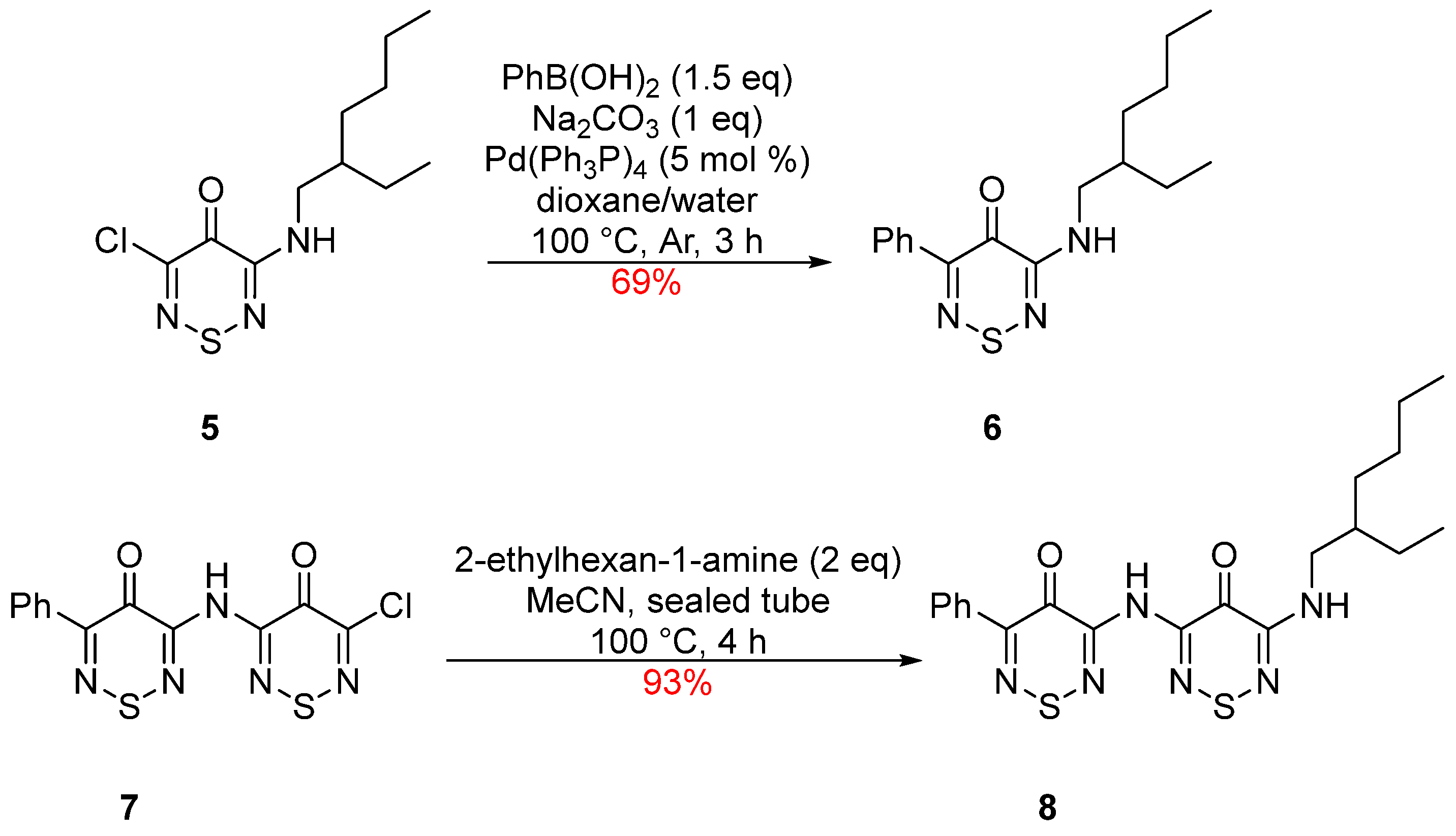
For the preparation of oligomer 3 (Scheme 1), we started from aminothiadiazine 5, which undergoes a Suzuki–Miyaura coupling with phenylboronic acid, catalyzed by Pd(Ph3P)4, in the presence of Na2CO3, which gave phenylthiadiazine 6 in 69% yield (Scheme 2). The preparation of oligomer 4 required access to phenylthiadiazine 8, which was prepared by reaction of chlorothiadiazine 7 with 2-ethylhexan-1-amine in MeCN, at ca. 100 °C, giving the product 8 in 93% yield (Scheme 2).
The two products 6 and 8 were isolated as yellow needles [mp 62–63 °C and 153–154 °C, respectively], and their UV absorption in solution [λmax (DCM) 400 nm, log ε 4.02 and 432 nm, log ε 4.43, respectively] indicated the presence of the thiadiazine chromophore. The FTIR spectrum showed absorptions corresponding to an amine [ν(N-H) 3333 cm−1, in both spectra], while the 13C NMR spectra confirmed the presence of 4 and 7 quaternary carbon atoms, respectively (see Supplementary Materials).
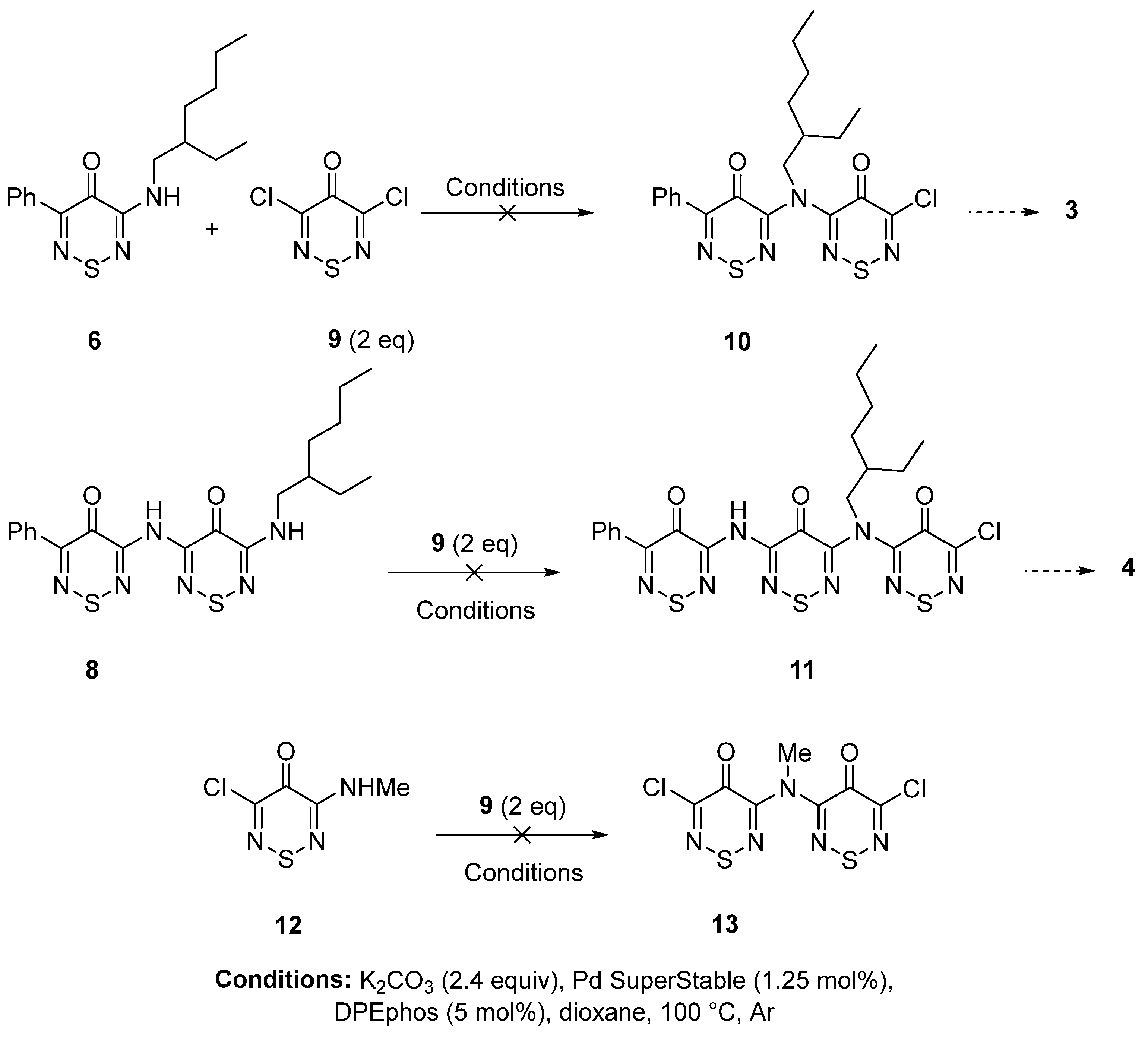
Following the synthesis of phenylthiadiazines 6 and 8, we attempted to further extend the oligomeric framework by introducing an additional thiadiazine unit via the exocyclic alkylamine. However, reaction of both compounds with 3,5-dichloro-4H-1,2,6-thiadiazin-4-one (9) under the previously employed C-N coupling conditions [9] failed to afford the desired products 10 and 11 (Scheme 3). In all cases, treatment of the aminothiadiazines with dichlorothiadiazine 9 (2–10 equiv) resulted in gradual degradation of 9 over prolonged reaction times (up to 5 d), while no new product formation was detected.
The lack of reactivity was tentatively attributed to the diminished coupling competence of the exocyclic secondary amine, consistent with related observations reported in the literature [13]. To further probe this hypothesis and to exclude steric effects, 3-chloro-5-(methylamino)-4H-1,2,6-thiadiazin-4-one (12) was subjected to the same coupling conditions with dichlorothiadiazine 9 (2 equiv). This reaction likewise led to complete decomposition of 9 within 24 h, and no formation of the expected bisthiadiazine 13 (Scheme 3).
As primary 3-amino-4H-1,2,6-thiadiazin-4-ones undergo efficient C–N coupling with dichlorothiadiazine 9 under identical conditions [9], the present results demonstrate a marked suppression of reactivity for secondary 3-alkylamino-4H-1,2,6-thiadiazin-4-ones. The analogous behavior observed for the methyl-substituted derivative suggests that simple steric effects are unlikely to be the sole cause. These findings are consistent with a decrease in the effective nucleophilicity of the secondary amine under the coupling conditions [14]; however, definitive mechanistic conclusions cannot be drawn at this stage.
The two thiadiazine products 6 and 8 may serve as useful synthetic scaffolds due to the presence of the readily functionalizable amino group, which could enable their incorporation into biologically active molecules, although such applications are not currently the focus of our work.

3. Materials and Methods

The reaction mixture was monitored by TLC using commercial glass-backed thin-layer chromatography (TLC) plates (Merck Kieselgel 60 F254, Darmstadt, Germany). The plates were observed under UV light at 254 and 365 nm. The melting point was determined using a PolyTherm-A, Wagner & Munz, Kofler—Hotstage Microscope apparatus (Wagner & Munz, Munich, Germany). The solvent used for recrystallization is indicated after the melting point. The UV-vis spectrum was obtained using a Perkin-Elmer Lambda-25 UV/vis spectrophotometer (Perkin-Elmer, Waltham, MA, USA), and inflections are identified by the abbreviation “inf”. The IR spectrum was recorded on a Shimadzu FTIR-NIR Prestige-21 spectrometer (Shimadzu, Kyoto, Japan) with Pike Miracle Ge ATR accessory (Pike Miracle, Madison, WI, USA), and strong, medium, and weak peaks are represented by s, m, and w, respectively. 1H and 13C NMR spectra were recorded on a Bruker Avance 500 machine [at 500 and 125 MHz, respectively, (Bruker, Billerica, MA, USA)]. Deuterated solvents were used for homonuclear lock, and the signals are referenced to the deuterated solvent peaks. Attached proton test (APT) NMR studies were used for the assignment of the 13C peaks as CH3, CH2, CH, and Cq (quaternary). GC-MS analysis (EI) was performed on an Agilent 5973 Inert Mass Selective Detector (Agilent Technologies, Santa Clara, CA, USA) coupled to an Agilent 6890N GC system equipped with a HP-5MS capillary column (30 m × 0.25 mm, 0.25 μm) (Agilent Technologies, Santa Clara, CA, USA). Helium was used as a carrier gas at a flow rate of 0.9 mL/min. The injector was heated to 285 °C, and the oven temperature increased from 50 to 120 °C at the rate of 6 °C/min, and then further increased to 260 °C at 30 °C/min. The MALDI-TOF mass spectrum (+ve mode) was recorded on a Bruker Autoflex III Smartbeam instrument (Bruker). 3-Chloro-5-[(2-ethylhexyl)amino]-4H-1,2,6-thiadiazin-4-one (5) and 3-chloro-5-[(4-oxo-5-phenyl-4H-1,2,6-thiadiazin-3-yl)amino]-4H-1,2,6-thiadiazin-4-one (7) were prepared according to the literature procedure [9].

3.1. 3-[(2-Ethylhexyl)amino]-5-phenyl-4H-1,2,6-thiadiazin-4-one (6)

A stirred solution of 3-chloro-5-[(2-ethylhexyl)amino]-4H-1,2,6-thiadiazin-4-one (5) (55.2 mg, 0.200 mmol) in dioxane (1 mL) and H2O (0.6 mL) at ca. 20 °C were added phenylboronic acid (36.3 mg, 0.300 mmol), Pd(Ph3P)4 (11.6 mg, 0.010 mmol, 5 mol%) and Na2CO3 (21.2 mg, 0.200 mmol). The solution was then deaerated by bubbling Ar into the reaction mixture for 10 min. The reaction mixture was then heated to ca. 100 °C under Ar until no starting material remained (TLC, 3 h). On cooling to ca. 20 °C, the reaction mixture was adsorbed onto silica and chromatographed (n-hexane/DCM, 70:30) to give the title compound 6 (43.8 mg, 69%) as yellow needles, mp 62–63 °C (from n-hexane/−20 °C); Rf = 0.38 (n-hexane/DCM, 70:30); (found: C, 64.58; H, 7.14; N, 13.08. C17H23N3OS requires C, 64.32; H, 7.30; N, 13.24%); λmax(CH2Cl2)/nm 229 (log ε 4.20), 249 inf (3.73), 323 (4.19), 400 (4.02); νmax/cm−1 3333 m (N-H), 2955 w, 2932 w and 2862 w (C-H aliph.), 1589 m, 1566 s, 1528 w, 1512 w, 1474 m, 1458 w, 1435 w, 1412 w, 1381 w, 1343 w, 1304 w, 1273 w, 1234 w, 1165 w, 1080 w, 1057 w, 1034 w, 964 w, 941 w, 887 w, 864 w, 833 m, 748 m; δH[500 MHz; (CD3)2CO] 8.16 (2H, d, J = 7.3 Hz, Ar CH), 7.49 (1H, br. s, NH), 7.47–7.40 (3H, m, Ar CH), 3.38 (2H, dd, J = 6.4, 6.4 Hz, NCH2CH), 1.74 (1H, br. s, CH), 1.45–1.32 (8H, m, CH2), 0.93 (3H, t, J = 7.5 Hz, CH2CH3), 0.90 (3H, t, J = 6.9 Hz, CH2CH3); δC[125 MHz; (CD3)2CO] 160.6 (Cq), 156.6 (Cq), 150.4 (Cq), 136.7 (Cq), 130.1 (CH), 129.1 (CH), 128.8 (CH), 44.4 (CH2), 39.7 (CH), 31.7 (CH2), 24.9 (CH2), 23.7 (CH2), 14.3 (CH3), 11.1 (CH3), one CH2 peak missing due to overlap with solvent; m/z (GC-MS) 317 (M+, 89%), 218 (M+-C7H15, 100), 205 (32), 162 (15), 135 (21).

3.2. 3-[(2-Ethylhexyl)amino]-5-[(4-oxo-5-phenyl-4H-1,2,6-thiadiazin-3-yl)amino]-4H-1,2,6-thiadiazin-4-one (8)

A stirred suspension of 3-chloro-5-[(4-oxo-5-phenyl-4H-1,2,6-thiadiazin-3-yl)amino]-4H-1,2,6-thiadiazin-4-one (7) (70.4 mg, 0.20 mmol) in MeCN (2 mL) at ca. 20 °C was added 2-ethylhexan-1-amine (66 µL, 0.40 mmol). The tube was then sealed and the mixture heated to ca. 100 °C until no starting material remained (TLC, 4 h). The mixture was then adsorbed onto silica and chromatographed (n-hexane/DCM, 50:50) to give the title compound 8 (82.8 mg, 93%) as yellow needles, mp 153–154 °C (from EtOH); Rf = 0.30 (n-hexane/DCM, 50:50); (found: C, 54.18; H, 5.22; N, 18.71. C20H24N6O2S2 requires C, 54.03; H, 5.44; N, 18.90%); λmax(CH2Cl2)/nm 268 (log ε 4.18), 336 inf (4.34), 365 (4.52), 432 (4.43); νmax/cm−1 3333 m (N-H), 2955 w, 2924 w and 2870 w (C-H aliph.), 1605 m, 1566 m, 1505 s, 1451 m, 1373 w, 1327 m, 1304 m, 1265 m, 1219 w, 1165 m, 1103 w, 1034 w, 880 w, 864 w, 802 w, 779 w, 756 m, 733 m, 718 m; δH[500 MHz; (CD3)2CO] 8.21–8.18 (2H, m, Ar CH), 7.52–7.49 (3H, m, Ar CH), 7.45–7.41 (1H, m, NH), 3.38 (2H, dd, J = 6.5, 6.5 Hz, NCH2), 1.73–1.72 (1H, m, CH), 1.47–1.32 (8H, m, CH2), 0.93 (3H, t, J = 7.4 Hz, CH2CH3), 0.89 (3H, t, J = 7.1 Hz, CH2CH3); δC(125 MHz; DMSO-d6) 159.2 (Cq), 154.4 (Cq), 153.8 (Cq), 152.3 (Cq), 149.9 (Cq), 141.6 (Cq), 134.8 (Cq), 130.3 (CH), 128.4 (CH), 128.3 (CH), 43.5 (CH2), 37.9 (CH), 30.3 (CH2), 28.2 (CH2), 23.7 (CH2), 22.6 (CH3), 14.0 (CH3), 10.6 (CH3); m/z (MALDI-TOF) 445 (M + H+, 81%), 345 (M+-C7H15, 49), 333 (36), 325 (40), 258 (72), 232 (40), 212 (44), 156 (C9H5N2O+, 100).

Supplementary Materials

The following supporting information can be downloaded online: Figure S1. UV-vis absorption spectrum of thiadiazine 6 in CH2Cl2 at 0.055 mM. Peaks: 229 (log ε 4.20), 249 inf (3.73), 323 (4.19), 400 (4.02); Figure S2. UV-vis absorption spectrum of thiadiazine 8 in CH2Cl2 at 0.030 mM. Peaks: 268 (log ε 4.18), 336 inf (4.34), 365 (4.52), 432 (4.43); 1H, 13C NMR, Mass and IR Spectra of Thiadiazines 6 and 8.

Author Contributions

A.S.K. designed and performed the experiments, analyzed the data, and wrote the paper; P.A.K. conceived the experiment and edited the manuscript. All authors have read and agreed to the published version of the manuscript.

Funding

The authors thank the Cyprus Research Promotion Foundation (Grants ΣΤΡAΤHΙΙ/0308/06, NEKYP/0308/02 ΥΓΕΙA/0506/19 and ΕΝΙΣΧ/0308/83) for funding.

Data Availability Statement

Data is contained within the article or Supplementary Material.

Acknowledgments

The authors thank the following organizations and companies in Cyprus for generous donations of chemicals and glassware: The State General Laboratory, the Agricultural Research Institute, the Ministry of Agriculture, MedoChemie Ltd., Medisell Ltd., and Biotronics Ltd. Furthermore, we thank the A. G. Leventis Foundation for helping to establish the NMR facility at the University of Cyprus.

Conflicts of Interest

The authors declare no conflicts of interest.

References

  1. Zhang, L.; Colella, N.S.; Cherniawski, B.P.; Mannsfeld, S.C.B.; Briseno, A.L. Oligothiophene Semiconductors: Synthesis, Characterization, and Applications for Organic Devices. ACS Appl. Mater. Interfaces 2014, 6, 5327–5343. [Google Scholar] [CrossRef] [PubMed]
  2. Luo, X.; Duan, Z.; Li, K.; He, G.; Liu, Z.; Luo, H.; Zhang, J.; Liang, J.; Guo, Q.; Liu, J.; et al. A Novel Donor-Acceptor Thiophene-Containing Oligomer Comprising Dibenzothiophene-S,S-dioxide Units for Solution-Processable Organic Field Effect Transistor. Molecules 2022, 27, 2938. [Google Scholar] [CrossRef] [PubMed]
  3. Panja, S.K.; Sharma, S.S.; Sharma, K.; Patel, K.; Prajapat, A.L.; Saha, S.; Bera, S.; Srivastava, N.; Ray, J. Thiophene oligomer based NIR dyes: Photophysical properties and application in dye sensitized solar cells. Chem. Phys. 2025, 595, 112721. [Google Scholar] [CrossRef]
  4. Bandyopadhyay, S.; Forzano, J.A.; Dirak, M.; Chan, J. Activatable Porphyrin-Based Sensors, Photosensitizers and Combination Therapeutics. JACS Au 2025, 5, 42–54. [Google Scholar] [CrossRef] [PubMed]
  5. Ghosh, S.; Alghunaim, A.S.; Al-mashhadani, M.H.; Krompiec, M.P.; Halletta, M.; Perepichka, I.F. 4,5-Diazafluorene co-oligomers as electron-deficient light-emitting materials and selective fluorescence sensors for mercury(ii) cations. J. Mater. Chem. C 2018, 6, 3762–3773. [Google Scholar] [CrossRef]
  6. Lim, E.; Lee, S.; Lee, K.K.; Kang, I.N.; Moon, S.-J.; Kong, H.-Y.; Katz, H.E. Solution-processable oligothiophenes with solubilizing β-alkyl groups for organic photovoltaic cells. Sol. Energy Mater. Sol. Cells 2012, 107, 165–174. [Google Scholar] [CrossRef]
  7. Mulay, S.V.; Dishi, O.; Fang, Y.; Niazi, M.R.; Shimon, L.J.W.; Perepichka, D.F.; Gidron, O. A macrocyclic oligofuran: Synthesis, solid state structure and electronic properties. Chem. Sci. 2019, 10, 8527–8532. [Google Scholar] [CrossRef] [PubMed]
  8. Jiang, K.; Wei, Q.; Lai, J.Y.L.; Peng, Z.; Kim, H.K.; Yuan, J.; Ye, L.; Ade, H.; Zou, Y.; Yan, H. Alkyl Chain Tuning of Small Molecule Acceptors for Efficient Organic Solar Cells. Joule 2019, 3, 3020–3033. [Google Scholar] [CrossRef]
  9. Kalogirou, A.S.; Kourtellaris, A.; Koutentis, P.A. Synthesis of Oligomeric 4H-1,2,6-Thiadiazines. ChemistrySelect 2025, 10, e202405838. [Google Scholar] [CrossRef]
  10. Burt, F.P. XCIX.—A new sulphide of nitrogen. J. Chem. Soc. Trans. 1910, 97, 1171–1174. [Google Scholar] [CrossRef]
  11. Cava, M.P.; Lakshmikantham, M.V.; Hoffmann, R.; Williams, R.M. RB Woodward’s unfinished symphony: Designing organic superconductors (1975–79). Tetrahedron 2011, 67, 6771–6797. [Google Scholar] [CrossRef]
  12. Koutentis, P.A.; Rees, C.W. Reaction of tetracyanoethylene with SCl2; new molecular rearrangements. J. Chem. Soc. Perkin Trans. 1 2000, 1089–1094. [Google Scholar] [CrossRef]
  13. Ruiz-Castillo, P.; Blackmond, D.G.; Buchwald, S.L. Rational Ligand Design for the Arylation of Hindered Primary Amines Guided by Reaction Progress Kinetic Analysis. J. Am. Chem. Soc. 2015, 137, 3085–3092. [Google Scholar] [CrossRef] [PubMed]
  14. Ruiz-Castillo, P.; Buchwald, S.L. Applications of Palladium-Catalyzed C−N Cross-Coupling Reactions. Chem. Rev. 2016, 116, 12564–12649. [Google Scholar] [CrossRef] [PubMed]
Figure 1. Proposed structures of Woodward’s 1,2,6-thiadiazine polymers I and II and Rees’s polymer III.
Molbank 2026 m2150 g001
Scheme 1. Structures of reported 1,2,6-thiadiazin-4-one oligomer 2 and target oligomers 3 and 4.
Molbank 2026 m2150 sch001
Scheme 2. Synthesis of phenylthiadiazines 6 and 8.
Molbank 2026 m2150 sch002
Scheme 3. Attempted synthesis of aminothiadiazines 10 and 11.
Molbank 2026 m2150 sch003
Disclaimer/Publisher’s Note: The statements, opinions and data contained in all publications are solely those of the individual author(s) and contributor(s) and not of MDPI and/or the editor(s). MDPI and/or the editor(s) disclaim responsibility for any injury to people or property resulting from any ideas, methods, instructions or products referred to in the content.