Short Note

8-Phenyl-13a-(trifluoromethyl)-13aH-benzo[4,5]imidazo[1,2-a]chromeno[3,2-e]pyridine-6-carbonitrile


by
Dmitry V. Osipov
1,
Pavel E. Krasnikov
2 and
Vitaly A. Osyanin
2,3,*
1
Engineering and Technology Faculty, Samara State Technical University, 244 Molodogvardeyskaya St., 443100 Samara, Russia
2
Institute of Oil and Gas Technologies, Samara State Technical University, 244 Molodogvardeyskaya St., 443100 Samara, Russia
3
Medicinal Chemistry Center, Togliatti State University, 14 Belorusskaya St., 445020 Togliatti, Russia
*
Author to whom correspondence should be addressed.
Molbank 2026, 2026(1), M2142; https://doi.org/10.3390/M2142
Submission received: 1 February 2026 / Revised: 13 February 2026 / Accepted: 18 February 2026 / Published: 23 February 2026
(This article belongs to the Collection Heterocycle Reactions)

Abstract

A DABCO-catalyzed one-pot synthesis of a novel pentacyclic heterocycle featuring an unprecedented benzo[4,5]imidazo[1,2-a]chromeno[3,2-e]pyridine scaffold from 2-(cyanomethyl)benzimidazole and 3-trifluoroacetyl-4-phenyl-4H-chromene has been developed. This hybrid architecture merges three privileged pharmacophores—benzimidazole, chromene, and pyridine—into a rigid, nearly planar π-extended system decorated with trifluoromethyl and nitrile groups. The structure of 8-phenyl-13a-(trifluoromethyl)-13aH-benzo[4,5]imidazo[1,2-a]chromeno[3,2-e]pyridine-6-carbonitrile was unambiguously confirmed through NMR spectroscopy and X-ray diffraction analysis. A plausible mechanism involves Michael addition, hemiaminal formation, ring opening, recyclization, and oxidation.

1. Introduction

Fused polyheterocyclic systems, particularly those integrating multiple pharmacophoric units within a single molecular framework, have emerged as privileged scaffolds for drug discovery due to their structural complexity, conformational rigidity, and ability to engage multiple biological targets simultaneously. The strategic fusion of distinct heterocyclic cores through molecular hybridization has become a powerful approach in rational drug design, enabling the synergistic combination of complementary pharmacological properties while potentially overcoming limitations such as drug resistance, poor bioavailability, or off-target effects associated with parent compounds [1,2,3,4]. Hybrid heterocycles incorporating chromene motifs have emerged as particularly promising scaffolds [5,6,7,8,9,10,11].
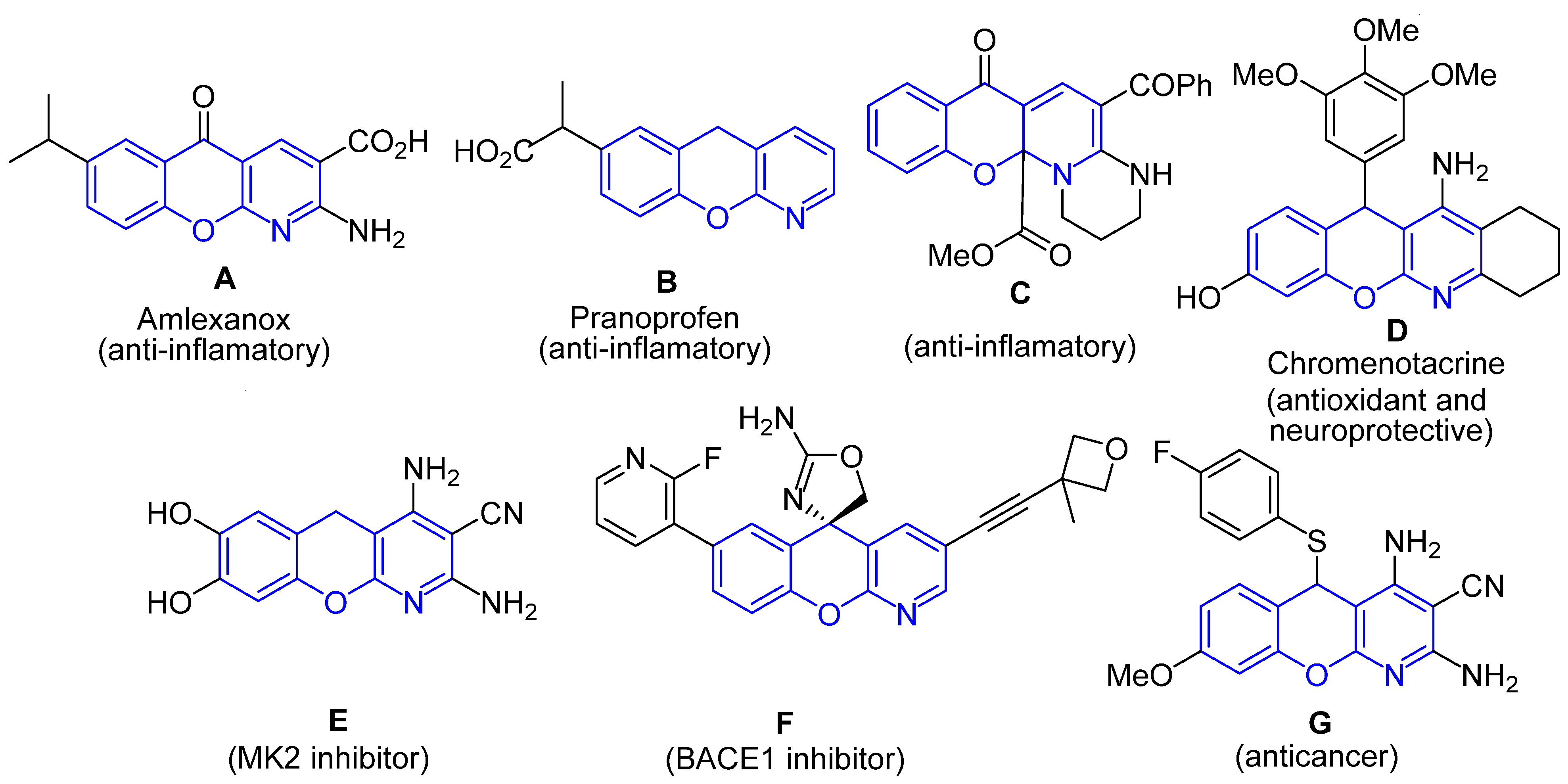
In particular, the 5H-chromeno[2,3-b]pyridine system [12,13,14,15] is known as a privileged pharmacophore due to its ability to readily interact with a wide range of biological targets, and it is often used as a scaffold for the development of new drugs. Amlexanox is approved for the treatment of recurrent aphthous ulcers and exhibits anti-inflammatory, antiallergic, and immunomodulatory properties; remarkably, recent studies have revealed its efficacy in managing type 2 diabetes and obesity through inhibition of IKK-ε and TBK1 kinases [16]. Pranoprofen, a non-steroidal anti-inflammatory drug (NSAID) containing the chromeno[2,3-b]pyridine core, is widely used in ophthalmology for acute inflammatory conditions and postoperative ocular therapy [17]. The anti-inflammatory properties of the condensed chromone C are based on the inhibition of 15-Lipoxigenase (15-LOX) [18]. Chromenotacrine (D), a hybrid molecule combining chromene and tacrine moieties, functions as a selective acetylcholinesterase inhibitor with antioxidant and neuroprotective properties, showing promise for Alzheimer’s disease treatment [19]. Furthermore, chromeno[2,3-b]pyridine derivatives have demonstrated inhibition of mitogen-activated protein kinase (MK2) (compound E) [20] and β-site amyloid precursor protein-cleaving enzyme (BACE1) (F) [21], as well as anticancer activity (G) [22] (Figure 1).
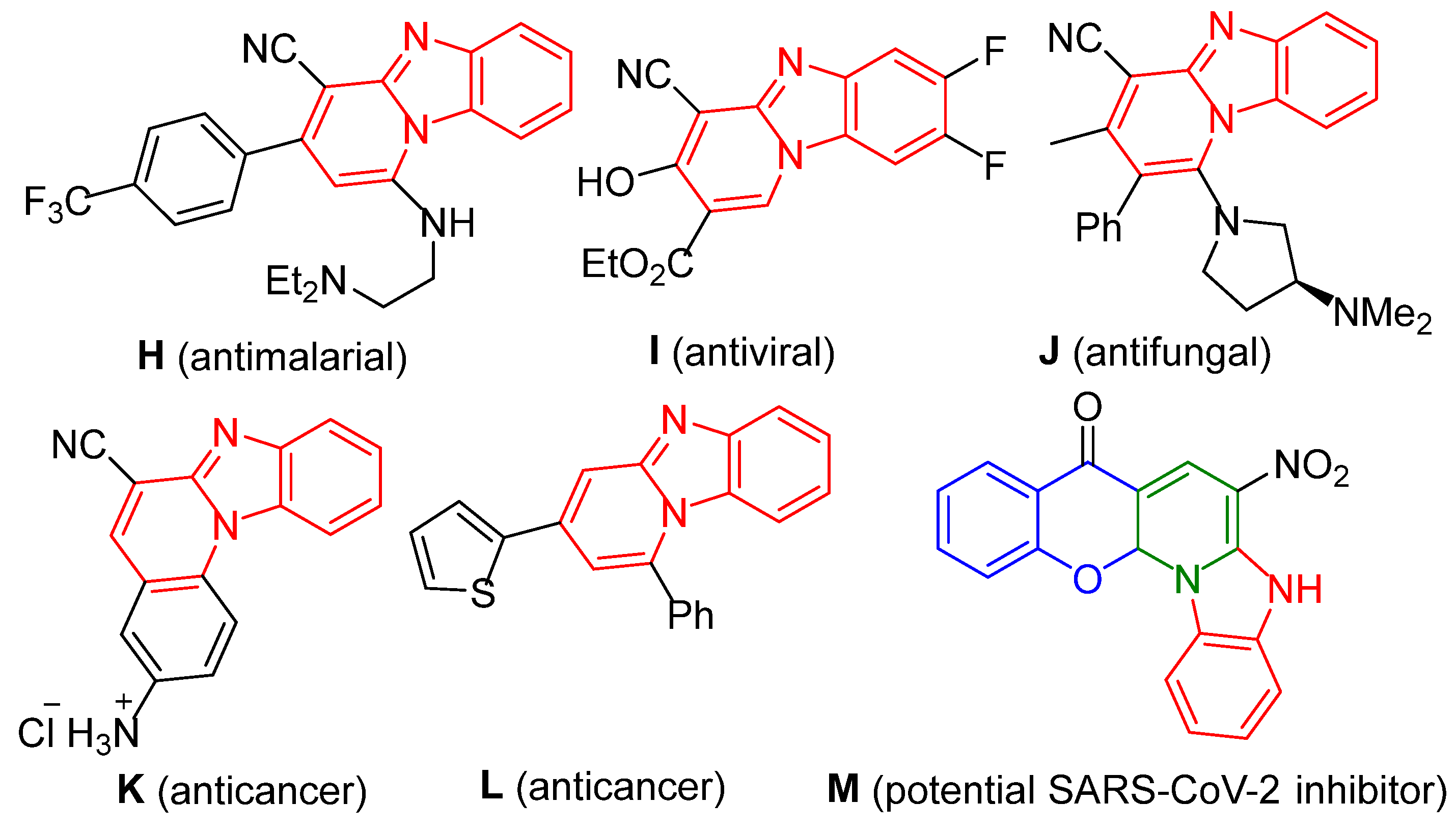
On the other hand, benzo[4,5]imidazo[1,2-a]pyridines [23] represent another privileged scaffold that occurs in various derivatives exhibiting diversified biological activities such as antimalarial (compound H) [24], antiviral (I) [25], antifungal (J) [26], anticancer (K, L) [27,28], and compound M, which combines the structural fragments of benzo[4,5]imidazo[1,2-a]pyridine and chromeno[2,3-b]pyridine and is a potential SARS-CoV 2 inhibitor [29] (Figure 2).
In this context, we hypothesized that combining 2-(cyanomethyl)benzimidazole, a bifunctional synthon bearing both a nucleophilic methylene group and a benzimidazole nitrogen atom, with 3-trifluoroacetyl-4-phenyl-4H-chromene would trigger a cascade sequence yielding a structurally unprecedented hybrid scaffold.

2. Results and Discussion

2.1. Synthesis and Spectroscopy

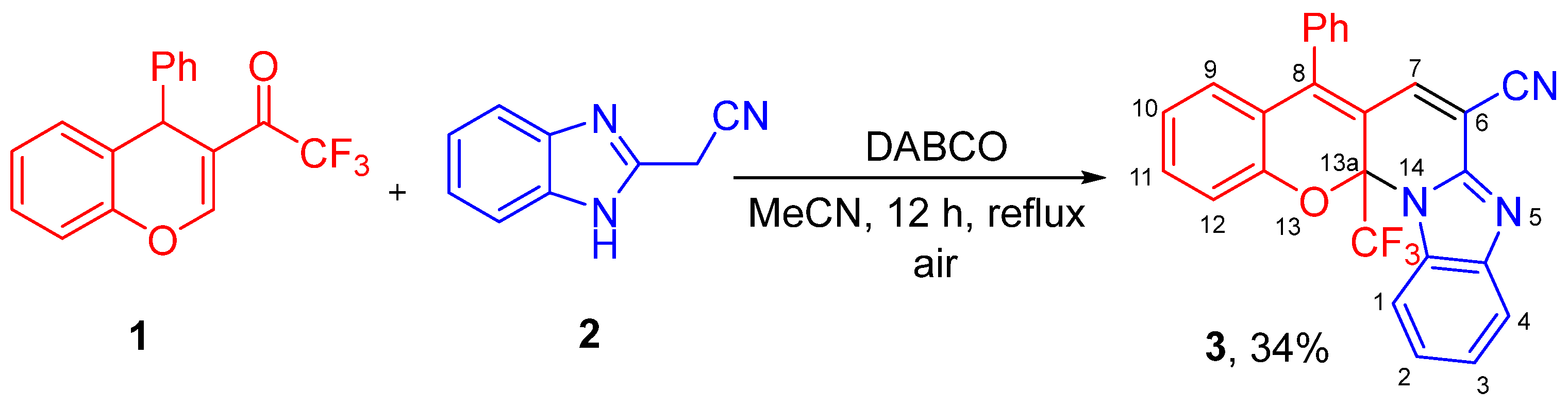
In continuation of our research on the chemical transformations of highly polarized 4H-chromenes [30,31], we investigated the interaction of chromene 1 with 2-(cyanomethyl)benzimidazole [32]. This resulted in a complex mixture of products, from which benzo[4,5]imidazo[1,2-a]chromeno[3,2-e]pyridine 3 was isolated in pure form and identified (Scheme 1). The reaction was carried out by refluxing compounds 1 and 2 in a 1:1 ratio in acetonitrile for 12 h in the presence of DABCO (0.5 equiv). The product was isolated by means of column chromatography on silica gel. The moderate yield (34%) reflects the complexity of the multistep cascade involving at least five discrete transformations with potential competing pathways.
The starting chromene 1 [33] (Figures S1–S3), the synthesis of which has not been previously described in the literature, was obtained from 2-[hydroxy(phenyl)methyl]phenol as a precursor of o-quinone methide [34] and 1,1,1-trifluoro-4-morpholinobut-3-en-2-one (Scheme 2). The high degree of polarization of the double bond in the pyran ring of the chromene 1 makes it susceptible to attack by nucleophiles, ambiphilic reagents, and 1,3-dipoles. Consequently, this heterocycle could potentially serve as an excellent substrate for Michael additions and 1,3-dipolar cycloaddition reactions.
The structure of compound 3 was confirmed using a complex of spectral analysis methods. IR spectroscopy showed an absorption band at 2226 cm−1 characteristic of the nitrile group. The 1H NMR spectrum displayed a characteristic singlet at δ 7.42 ppm assigned to H-7, along with a number of doublet and multiplet signals (δ 6.90–8.15 ppm) integrating for 13 aromatic protons consistent with the fused framework plus phenyl substituent. Notably, the absence of aliphatic proton signals confirmed the presence of a 2H-chromene fragment (Figure S4). The presence of a trifluoromethyl group was detected by the characteristic quartet signal at 123.8 ppm with 1JCF = 298.1 Hz in the 13C NMR spectrum, as well as by the signal of the carbon atom bonded with it in the region of 84.6 ppm with 2JCF = 31.6 Hz (Figure S5). In the DEPT spectra, the number of carbon atoms directly bonded to protons is consistent with the considered structure (Figure S6).
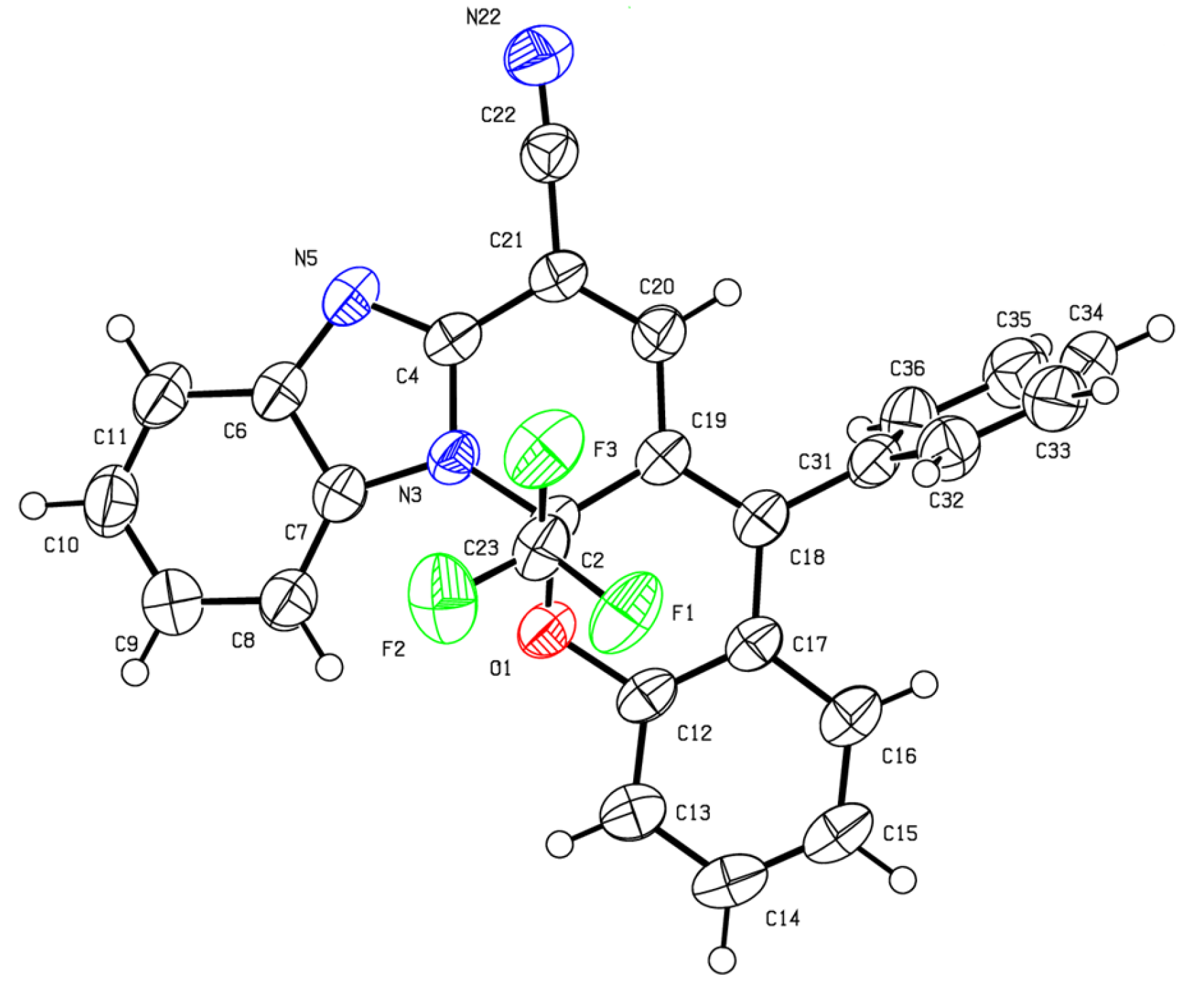
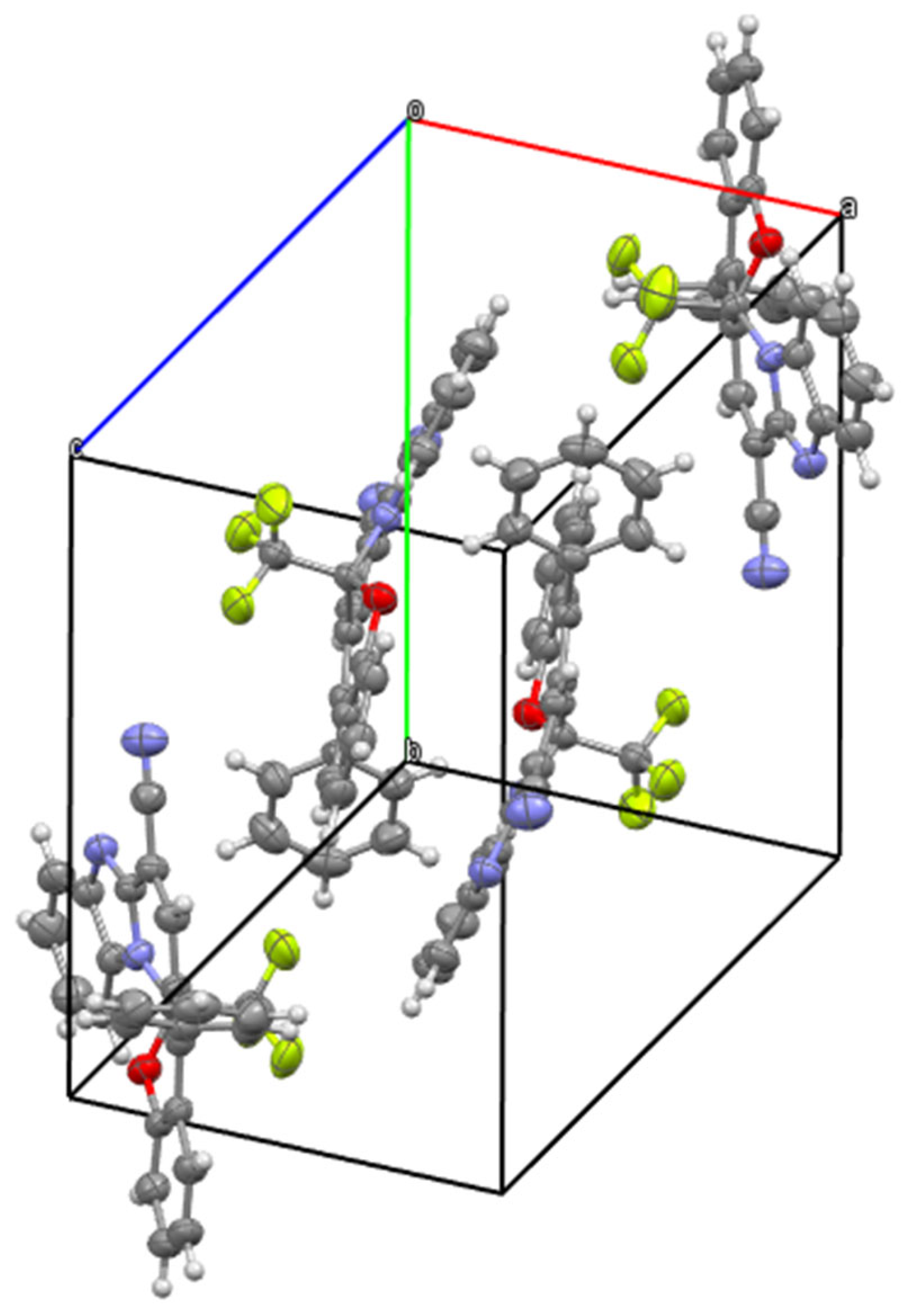
In addition, the structure of compound 3 was confirmed using X-ray diffraction data (Figure 3). The molecular structure reveals a nearly planar fused pentacyclic core comprising chromene, benzimidazole, and dihydropyridine rings, indicating extensive π-conjugation. Subtle puckering occurs at the sp3-hybridized bridgehead carbon C-13a (C-2 in CIF numbering) connected with the trifluoromethyl group. The phenyl ring at C-8 (C-18 in CIF numbering) is nearly perpendicular to the fused ring system (dihedral angles C32–C31–C18–C17 = −86.36° and C36–C31–C18–C19 = −86.68°), which minimizes steric repulsion with the H-16 and H-20 hydrogen atoms while completely disrupting π-conjugation. The trifluoromethyl group adopts a pseudo-axial orientation relative to the heterocyclic framework and F–C–F angles averaging 107.3°, consistent with tetrahedral geometry. The nitrile group is essentially coplanar with the dihydropyridine ring, enabling effective π-conjugation extension. In the crystal lattice, molecules are arranged in a herringbone-like pattern typical of planar aromatic systems. No classical hydrogen bonds are present due to the absence of strong donors; however, the structure is stabilized by π-π stacking interactions between the pyrido[1,2-a]benzimidazole moieties and benzene rings of the chromene fragment of adjacent molecules, with interplanar distances ranging from 3.4 to 3.6 Å (Figure 4).

2.2. Proposed Mechanism

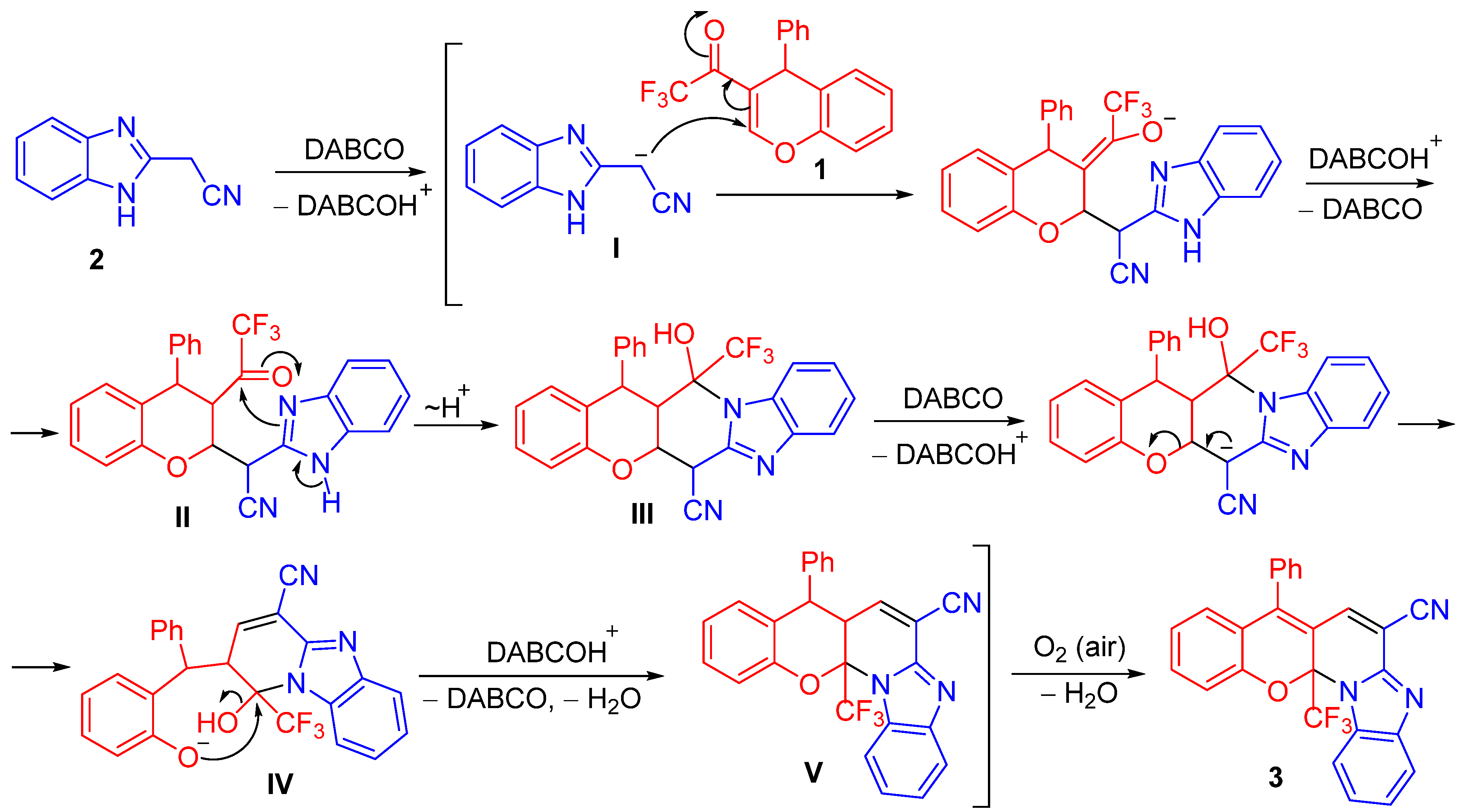
A plausible mechanism (Scheme 3) involves initial reversible deprotonation of the acidic methylene group in 2-(cyanomethyl)benzimidazole by DABCO, generating a stabilized carbanion I. This nucleophile undergoes regioselective Michael addition to the β-carbon (C-2) of the enone system in chromene 1, forming adduct II. Intramolecular nucleophilic attack of the benzimidazole nitrogen atom on the electrophilic carbonyl carbon atom of the trifluoroacetyl group then yields hemiaminal intermediate III. Subsequent ring opening of the dihydropyran moiety via C–O bond cleavage generates open-chain species IV, which undergoes recyclization through attack of the phenoxide oxygen on the hemiaminal carbon atom to form cyclic N,O-acetal V. Finally, air-mediated oxidation of the dihydropyran ring affords the conjugated pentacyclic product 3. The closest to this transformation is the synthesis of 1,2,3,11a-tetrahydro-6H-chromeno[3,2-e]imidazo[1,2-a]pyridin-6-ones reported by Savych et al. [18]. However, in this case, more highly polarized chromones and heterocyclic ketene aminals as Michael donors instead of 2-(cyanomethyl)benzimidazole were used.
The resulting benzo[4,5]imidazo[1,2-a]chromeno[3,2-e]pyridine scaffold represents a structurally novel architecture merging benzimidazole, pyridine, and chromene units and decorated with a bridgehead trifluoromethyl substituent, and a nitrile functionality. The nitrile group offers versatile handles for further derivatization (e.g., hydrolysis to carboxylic acid, reduction to amine, or participation in click chemistry). The presence of both strong electron-withdrawing groups (CF3 and CN), combined with extended π-conjugation, creates a polarized electronic structure potentially favorable for interactions with biological targets containing complementary electrostatic features.

3. Materials and Methods

All synthetic manipulations were performed in air. All reagents and solvents (purity) were purchased from commercial vendors and used as received. 1H and 13C (proton-decoupled) NMR spectra (at 400 and 100 MHz, respectively), as well as DEPT-135 spectra, were registered on a JEOL JNM-ECX400 spectrometer (Tokyo, Japan) in DMSO-d6 or CDCl3. Chemical shifts were referenced internally to the residual solvent signal (DMSO-d6: 2.50 ppm for 1H nuclei, 39.5 ppm for 13C nuclei; CDCl3: 7.26 ppm for 1H nuclei, 77.2 ppm for 13C nuclei). IR spectra were registered on a Shimadzu IRAffinity-1 spectrometer (Kyoto, Japan) equipped with a Specac Diamond ATR GS10800-B accessory. Elemental analysis was performed on an automated Euro Vector EA-3000 CHNS analyzer (Pavia, Italy) using L-cystine as a standard. Melting points were determined using the capillary method on an SRS OptiMelt MPA100 instrument (Sunnyvale, CA, USA). Reaction progress and purity of the obtained compounds were monitored via TLC on Merck Silica gel 60 F254 plates (eluent—CH2Cl2).

3.1. Synthesis and Characterization of 2,2,2-Trifluoro-1-(4-phenyl-4H-chromen-3-yl)ethanone (1)

A mixture of 2-[hydroxy(phenyl)methyl]phenol (0.60 g, 3 mmol) and 1,1,1-trifluoro-4-morpholinobut-3-en-2-one (0.63 g, 3 mmol) in acetic acid (15 mL) was heated under reflux for 3.5 h, diluted with 15 mL of methanol and kept at −30 °C for 24 h. The precipitated solid was filtered off and purified via recrystallization from ethanol to afford 1 (0.60 g, 66%).
Colorless crystals, mp 98–100 °C. 1H NMR (400 MHz, CDCl3) δ, ppm: 8.02 (s, 1H), 7.27–7.06 (m, 9H), 5.06 (s, 1H). 13C NMR (100 MHz, CDCl3) δ, ppm: 178.6 (q, 2JCF = 35.3 Hz, C), 155.9 (q, 4JCF = 5.7 Hz, CH), 148.4 (C), 144.6 (C), 130.2 (CH), 128.8 (2CH), 128.3 (CH), 128.0 (2CH), 127.2 (CH), 126.3 (CH), 123.8 (C), 116.9 (CH), 116.5 (q, 1JCF = 289.9 Hz, C), 114.7 (C), 38.5 (CH). FTIR, vmax: 1688, 1630, 1576, 1485, 1454, 1321, 1225, 1175, 1136, 1103, 1032, 964, 907, 756, 735, 696 cm−1. Calc. for C17H11F3O2: C 67.11, H 3.64. Found: C 67.19, H 3.59.

3.2. Synthesis and Characterization of 8-Phenyl-13a-(trifluoromethyl)-13aH-benzo[4,5]imidazo[1,2-a]chromeno[3,2-e]pyridine-6-carbonitrile (3)

A mixture of 2,2,2-trifluoro-1-(4-phenyl-4H-chromen-3-yl)ethanone 1 (0.30 g, 1 mmol), 2-(cyanomethyl)benzimidazole 2 (0.16 g, 1 mmol), and DABCO (55 mg, 0.5 mmol) in acetonitrile (5 mL) was refluxed for 12 h, cooled to −30 °C, and kept overnight. The precipitated solid was collected by filtration, purified by means of silica gel column chromatography (eluent—CH2Cl2), and recrystallized from methanol to afford 3 (0.15 g, 34%).
Orange crystals, mp 240–241 °C. 1H NMR (400 MHz, DMSO-d6) δ, ppm: 8.15 (d, J = 8.0 Hz, 1H), 7.81 (d, J = 8.0 Hz, 1H), 7.67–7.45 (m, 7H), 7.42 (s, 1H), 7.41–7.37 (m, 1H), 7.31–7.26 (m, 1H), 7.17–7.12 (m, 1H), 6.90 (d, J = 8.0 Hz, 1H). 13C NMR (100 MHz, DMSO-d6) δ, ppm: 149.8 (C), 148.4 (C), 143.93 (C), 143.87 (C), 139.5 (CH), 135.0 (CH), 133.8 (C), 132.5 (C), 130.4 (CH), 130.2 (br. signal, CH), 129.7 (br. signal, 3CH), 129.4 (CH), 126.4 (CH), 125.1 (CH), 124.9 (CH), 123.8 (q, 1JCF = 298.1 Hz, C), 121.4 (C), 121.2 (CH), 116.9 (CH), 114.9 (CH, C), 114.6 (C), 102.1 (C), 84.6 (q, 2JCF = 31.6 Hz, C). FTIR, vmax: 3061, 2226, 1589, 1564, 1443, 1418, 1339, 1254, 1204, 1180, 1134, 1094, 1007, 939, 889, 764, 750, 737, 702 cm−1. Calc. for C26H14F3N3O: C 70.75; H 3.20; N 9.52. Found: C 70.69; H 3.17; N 9.46.

3.3. X-Ray Crystallography

X-ray structural analysis of compound 3 was carried out on a Stoe STADI VARI diffractometer equipped with a Pilatus100K detector using Cu Kα radiation (λ = 1.5418 Å) at 295(2) K. Crystals suitable for X-ray diffraction were grown from ethanol through the slow evaporation of the solvent at room temperature. Data collection, as well as determination and refinement of unit-cell parameters, was performed using the CrysAlisPro software package (version 1.171.33.66) [35]. The structure was solved and refined using the SHELX97 program package [36]. Molecular graphics and preparation of the manuscript were performed with the OLEX2 software package [37].
Selected crystallographic data: C26H14F3N3O, M = 441.40, monoclinic, a = 9.2933(2), b = 14.3417(4), c = 15.1408(5) Å, α = 90°, β = 91.442(2)°, γ = 90°, V = 2017.35(10) Å3, T = 295 K, space group P21/n, Z = 4, dcalc = 1.453 g/cm3. An orange prismatic single crystal with dimensions of 0.200 × 0.200 × 0.200 mm was selected for data collection. A total of 21,351 reflections were measured in the range 4.25° ≤ θ ≤ 72.89°, yielding 3991 independent reflections (Rint = 0.0513). Final refinement based on I > 2σ(I) gave R1 = 0.0382 and wR2 = 0.0770 for 298 refined parameters, S = 1.021. Hydrogen atoms were placed geometrically and refined using the riding model. CCDC 1939479 contains the supplementary crystallographic data for this paper. These data can be obtained free of charge from The Cambridge Crystallographic Data Centre via www.ccdc.cam.ac.uk/structures (accessed on 17 February 2026).

4. Conclusions

In this work, we described the preparation of a π-extended pentacyclic heterocyclic system, 8-phenyl-13a-(trifluoromethyl)-13aH-benzo[4,5]imidazo[1,2-a]chromeno[3,2-e]pyridine-6-carbonitrile. Structural elucidation by means of NMR spectroscopy and X-ray diffraction revealed a unique fused framework with a N,O-acetal fragment.

Supplementary Materials

The following supporting information is available online. Figure S1: 1H NMR spectrum of 1; Figure S2: 13C NMR spectrum of 1; Figure S3: DEPT-135 spectrum of 1; Figure S4: 1H NMR spectrum of 3; Figure S5: 13C NMR spectrum of 3; Figure S6: DEPT-135 spectrum of 3.

Author Contributions

D.V.O.—funding acquisition, supervision, and writing (original draft, review, and editing); P.E.K.—investigation and data analysis; V.A.O.—conceptualization, supervision, and data analysis. All authors have read and agreed to the published version of the manuscript.

Funding

This research was funded by the Russian Science Foundation No. 25-23-00682, https://rscf.ru/project/25-23-00682/ (accessed on 17 February 2026).

Data Availability Statement

Data are contained within the article and Supplementary Materials.

Acknowledgments

This work was performed using the equipment of the Center for Collective Use “Investigation of Physicochemical Properties of Substances and Materials” of the Samara State Technical University.

Conflicts of Interest

The authors declare no conflicts of interest.

Abbreviations

The following abbreviations are used in this manuscript:
NMRNuclear Magnetic Resonance
DEPTDistortionless Enhancement by Polarization Transfer
DABCO1,4-Diazabicyclo[2.2.2]octane

References

  1. Singh, A.K.; Kumar, A.; Singh, H.; Sonawane, P.; Paliwal, H.; Thareja, S.; Pathak, P.; Grishina, M.; Jaremko, M.; Emwas, A.-H.; et al. Concept of Hybrid Drugs and Recent Advancements in Anticancer Hybrids. Pharmaceuticals 2020, 15, 1071. [Google Scholar] [CrossRef]
  2. Alkhzem, A.H.; Woodman, T.J.; Blagbrough, I.S. Design and Synthesis of Hybrid Compounds as Novel Drugs and Medicines. RSC Adv. 2022, 12, 19470–19484. [Google Scholar] [CrossRef]
  3. Bérubé, G. An Overview of Molecular Hybrids in Drug Discovery. Expert Opin. Drug Discov. 2016, 11, 281–305. [Google Scholar] [CrossRef] [PubMed]
  4. Shaveta; Mishra, S.; Singh, P. Hybrid molecules: The privileged scaffolds for various pharmaceuticals. Eur. J. Med. Chem. 2016, 124, 500–536. [Google Scholar] [CrossRef] [PubMed]
  5. Raj, V.; Lee, J. 2H/4H-Chromenes—A Versatile Biologically Attractive Scaffold. Front. Chem. 2020, 8, 623. [Google Scholar] [CrossRef] [PubMed]
  6. Kumar, M.S.L.; Singh, J.; Manna, S.K.; Maji, S.; Konwar, R.; Panda, G. Diversity oriented synthesis of chromene-xanthene hybrids as anti-breast cancer agents. Bioorg. Med. Chem. Lett. 2018, 28, 778–782. [Google Scholar] [CrossRef]
  7. Wang, H.-J.; Zhou, Y.-Y.; Liu, X.-L.; Zhang, W.-H.; Chen, S.; Liu, X.-W.; Zhou, Y. Regioselective synthesis and evaluation of 2-amino 3-cyano chromenechrysin hybrids as potential anticancer agents. Bioorg. Med. Chem. Lett. 2020, 30, 127087. [Google Scholar] [CrossRef]
  8. Vanga, M.K.; Bhukya, R.; Thumma, V.; Tamalapakula, V.; Boddu, L.S.; Manga, V. Antioxidant and Antimicrobial Activities of 4H-Chromene Based Indole-Pyrimidine Hybrids: Synthesis and Molecular Docking Studies. Chem. Biodivers. 2024, 21, e202401583. [Google Scholar] [CrossRef]
  9. Sharon, K.N.; Padmaja, P.; Reddy, P.N. A Brief Review on the Synthesis of 4H-Chromene-Embedded Heterocycles. ChemistrySelect 2024, 9, e202400565. [Google Scholar] [CrossRef]
  10. Nandi, R.; Ajarul, S.; Mandal, P.K.; Manna, A.S.; Kayet, A.; Maiti, D.K. Hybrid Heterocycles: Ag(I)-Catalyzed C–C/C–N/C–O Coupled Cascade Dual Cyclization to Valuable Indolo-4H-indolones and Indolo-4H-chromenes. J. Org. Chem. 2024, 89, 2556–2570. [Google Scholar] [CrossRef]
  11. Sharon, N.; Ugale, V.G.; Padmaja, P.; Lokwani, D.; Salunkhe, C.; Shete, P.; Reddy, P.N.; Kulkarni, P.P. Development of novel 9H-carbazole-4H-chromene hybrids as dual cholinesterase inhibitors for the treatment of Alzheimer’s disease. Mol. Divers. 2025, 29, 379–396. [Google Scholar] [CrossRef]
  12. Ramazani, A.; Kiani, M.T.; Rezayati, S. A Review on the Syntheses and Applications of the 5H-chromeno[2,3-b]pyridines. Lett. Org. Chem. 2023, 20, 28–53. [Google Scholar] [CrossRef]
  13. Núñez-Vergara, L.J.; Squella, J.A.; Navarrete-Encina, P.A.; Vicente-García, E.; Preciado, S.; Lavilla, R. Chromenopyridines: Promising Scaffolds for Medicinal and Biological Chemistry. Curr. Med. Chem. 2011, 18, 4761–4785. [Google Scholar] [CrossRef] [PubMed]
  14. Elinson, M.N.; Ryzhkova, Y.E.; Ryzhkov, F.V. Multicomponent design of chromeno[2,3-b]pyridine systems. Russ. Chem. Rev. 2021, 90, 94–115. [Google Scholar] [CrossRef]
  15. Pedroso de Lima, F.; Costa, M.; Sousa, A.; Proença, M.F. The Chromenopyridine Scaffold: A Privileged Platform in Drug Design. Molecules 2024, 29, 3004. [Google Scholar] [CrossRef]
  16. Reilly, S.M.; Chiang, S.-H.; Decker, S.J.; Chang, L.; Uhm, M.; Larsen, M.J.; Rubin, J.R.; Mowers, J.; White, N.M.; Hochberg, I.; et al. An inhibitor of the protein kinases TBK1 and IKK-ɛ improves obesity-related metabolic dysfunctions in mice. Nat. Med. 2013, 19, 313–321. [Google Scholar] [CrossRef]
  17. Chung, S.-T.; Huang, W.-H.; Huang, C.-K.; Liu, F.-C.; Huang, R.-Y.; Wu, C.-C.; Lee, A.-R. Synthesis and anti-inflammatory activities of 4H-chromene and chromeno[2,3-b]pyridine derivatives. Res. Chem. Intermed. 2016, 42, 1195–1215. [Google Scholar] [CrossRef]
  18. Savych, I.; Ejaz, S.A.; Shah, S.J.A.; Iaroshenko, V.O.; Villinger, A.; Sosnovskikh, V.Y.; Iqbal, J.; Abbasi, A.; Langer, P. Reactions of 3-Acylchromones with Heterocyclic Ketene Aminals: One-Pot Synthesis and Phosphatase Inhibitory Activity of Fused Pyridine Derivatives. Eur. J. Org. Chem. 2017, 2017, 186–202. [Google Scholar] [CrossRef]
  19. Oset-Gasque, M.J.; González, M.P.; Pérez-Peña, J.; García-Font, N.; Romero, A.; del Pino, J.; Ramos, E.; Hadjipavlou-Litina, D.; Soriano, E.; Chioua, M.; et al. Toxicological and pharmacological evaluation, antioxidant, ADMET and molecular modeling of selected racemic chromenotacrines {11-amino-12-aryl-8,9,10,12-tetrahydro-7H-chromeno[2,3-b]quinolin-3-ols} for the potential prevention and treatment of Alzheimer’s disease. Eur. J. Med. Chem. 2014, 74, 491–501. [Google Scholar] [CrossRef]
  20. Davis, T.; Bagley, M.C.; Dix, M.C.; Murziani, P.G.S.; Rokicki, M.J.; Widdowson, C.S.; Zayed, J.M.; Bachler, M.A.; Kipling, D. Synthesis and in vivo activity of MK2 and MK2 substrate-selective p38αMAPK inhibitors in Werner syndrome cells. Bioorg. Med. Chem. Lett. 2007, 17, 6832–6835. [Google Scholar] [CrossRef]
  21. Dineen, T.A.; Chen, K.; Cheng, A.C.; Derakhchan, K.; Epstein, O.; Esmay, J.; Hickman, D.; Kreiman, C.E.; Marx, I.E.; Wahl, R.C.; et al. Inhibitors of β-Site Amyloid Precursor Protein Cleaving Enzyme (BACE1): Identification of (S)-7-(2-Fluoropyridin-3-yl)-3-((3-methyloxetan-3-yl)ethynyl)-5′H-Spiro[Chromeno[2,3-b]pyridine-5,4-oxazol]-2-amine (AMG-8718). J. Med. Chem. 2014, 57, 9811–9831. [Google Scholar] [CrossRef] [PubMed]
  22. Banerjee, S.; Wang, J.; Pfeffer, S.; Ma, D.; Pfeffer, L.M.; Patil, S.A.; Li, W.; Miller, D.D. Design, Synthesis and Biological Evaluation of Novel 5H-Chromenopyridines as Potential Anti-Cancer Agents. Molecules 2015, 20, 17152–17165. [Google Scholar] [CrossRef] [PubMed]
  23. Debnath, S.; Parveen, S.; Pradhan, P.; Das, I.; Das, T. Benzo[4,5]imidazo[1,2-a]pyridines and benzo[4,5]imidazo[1,2-a]pyrimidines: Recent advancements in synthesis of two diversely important heterocyclic motifs and their derivatives. New J. Chem. 2022, 46, 10504–10534. [Google Scholar] [CrossRef]
  24. Ndakala, A.J.; Gessner, R.K.; Gitari, P.W.; October, N.; White, K.L.; Hudson, A.; Fakorede, F.; Shackleford, D.M.; Kaiser, M.; Yeates, C.; et al. Antimalarial Pyrido[1,2-a]benzimidazoles. Med. Chem. 2011, 54, 4581–4589. [Google Scholar] [CrossRef]
  25. Kotovskaya, S.K.; Baskakova, Z.M.; Charushin, V.N.; Chupakhin, O.N.; Belanov, E.F.; Bormotov, N.I.; Balakhnin, S.M.; Serova, O.A. Synthesis and antiviral activity of fluorinated pyrido[1,2-a]benzimidazoles. Pharm. Chem. J. 2005, 39, 574–578. [Google Scholar] [CrossRef]
  26. Takeshita, H.; Watanabe, J.; Kimura, Y.; Kawakami, K.; Takahashi, H.; Takemura, M.; Kitamura, A.; Someya, K.; Nakajima, R. Novel pyridobenzimidazole derivatives exhibiting antifungal activity by the inhibition of β-1,6-glucan synthesis. Bioorg. Med. Chem. Lett. 2010, 20, 3893–3896. [Google Scholar] [CrossRef]
  27. Perin, N.; Uzelac, L.; Piantanida, I.; Karminski-Zamola, G.; Kralj, M.; Hranjec, M. Novel biologically active nitro and amino substituted benzimidazo[1,2-a]quinolines. Bioorg. Med. Chem. 2011, 19, 6329–6339. [Google Scholar] [CrossRef]
  28. Teng, Q.; Peng, X.; Mo, Z.; Xu, Y.; Tang, H.; Wang, H.; Sun, H.; Pan, Y. Transition-metal-free C–N and C–C formation: Synthesis of benzo[4,5]imidazo[1,2-a]pyridines and 2-pyridones from ynones. Green Chem. 2018, 20, 2007–2012. [Google Scholar] [CrossRef]
  29. Jayabal, K.; Elumalai, D.; Leelakrishnan, S.; Bhattacharya, S.; Rengarajan, V.; Kannan, T.; Chuang, S.-C. Green and Regioselective Approach for the Synthesis of 3-Substituted Indole Based 1,2-Dihydropyridine and Azaxanthone Derivatives as a Potential Lead for SARS-CoV-2 and Delta Plus Mutant Virus: DFT and Docking Studies. ACS Omega 2022, 7, 43856–43876. [Google Scholar] [CrossRef]
  30. Osipov, D.V.; Rashchepkina, D.A.; Krasnikov, P.E.; Osyanin, V.A. Synthesis of 3-acylindolizines based on β-nitro-substituted benzochromenes and carbonyl-stabilized pyridinium ylides. Mendeleev Commun. 2025, 35, 729–731. [Google Scholar] [CrossRef]
  31. Korzhenko, K.S.; Osipov, D.V.; Chechulina, A.S.; Krasnikov, P.E.; Demidov, O.P.; Osyanin, V.A. Divergent Behavior of β-Carbonyl-Substituted 1H-Benzo[f]chromenes Under Henry Reaction Conditions. Asian J. Org. Chem. 2025, 14, e202400680. [Google Scholar] [CrossRef]
  32. Dawood, K.M.; Elwan, N.M.; Farahat, A.A.; Abdel-Wahab, B.F. 1H-Benzimidazole-2-acetonitriles as Synthon in Fused Benzimidazole Synthesis. J. Heterocycl. Chem. 2010, 47, 243–267. [Google Scholar] [CrossRef]
  33. Osyanin, V.A.; Osipov, D.V.; Korzhenko, K.S.; Demidov, O.P.; Klimochkin, Y.N. Reactions of β-carbonyl-substituted 4H-chromenes and 1H-benzo[f]chromenes with 5-aminopyrazoles. Chem. Heterocycl. Compd. 2021, 57, 305–313. [Google Scholar] [CrossRef]
  34. Osyanin, V.A.; Lukashenko, A.V.; Osipov, D.V. Cycloaddition reactions of o-quinone methides with polarized olefins. Russ. Chem. Rev. 2021, 90, 324–373. [Google Scholar] [CrossRef]
  35. Oxford Diffraction. CrysAlisPro; Oxford Diffraction Ltd.: Abingdon, UK, 2010. [Google Scholar]
  36. Sheldrick, G.M. A short history of SHELX. Acta Crystallogr. 2008, 64, 112–122. [Google Scholar] [CrossRef]
  37. Dolomanov, O.V.; Bourhis, L.J.; Gildea, R.J.; Howard, J.A.K.; Puschmann, H. OLEX2: A Complete Structure Solution, Refinement and Analysis Program. J. Appl. Crystallogr. 2009, 42, 339–341. [Google Scholar] [CrossRef]
Figure 1. Representative examples of pharmacologically active chromeno[2,3-b]pyridines.
Molbank 2026 m2142 g001
Figure 2. Representative examples of pharmacologically active benzo[4,5]imidazo[1,2-a]pyridines.
Molbank 2026 m2142 g002
Scheme 1. Reaction of 4H-chromene 1 with 2-(cyanomethyl)benzimidazole 2.
Molbank 2026 m2142 sch001
Scheme 2. Synthesis of 2,2,2-trifluoro-1-(4-phenyl-4H-chromen-3-yl)ethanone 1.
Molbank 2026 m2142 sch002
Figure 3. Molecular structure of compound 3 shown with thermal ellipsoids of atomic displacement parameters at the 50% probability level.
Molbank 2026 m2142 g003
Figure 4. Fragment of the crystal packing of compound 3.
Molbank 2026 m2142 g004
Scheme 3. Proposed mechanism for the DABCO-mediated cascade reaction.
Molbank 2026 m2142 sch003
Disclaimer/Publisher’s Note: The statements, opinions and data contained in all publications are solely those of the individual author(s) and contributor(s) and not of MDPI and/or the editor(s). MDPI and/or the editor(s) disclaim responsibility for any injury to people or property resulting from any ideas, methods, instructions or products referred to in the content.