Short Note

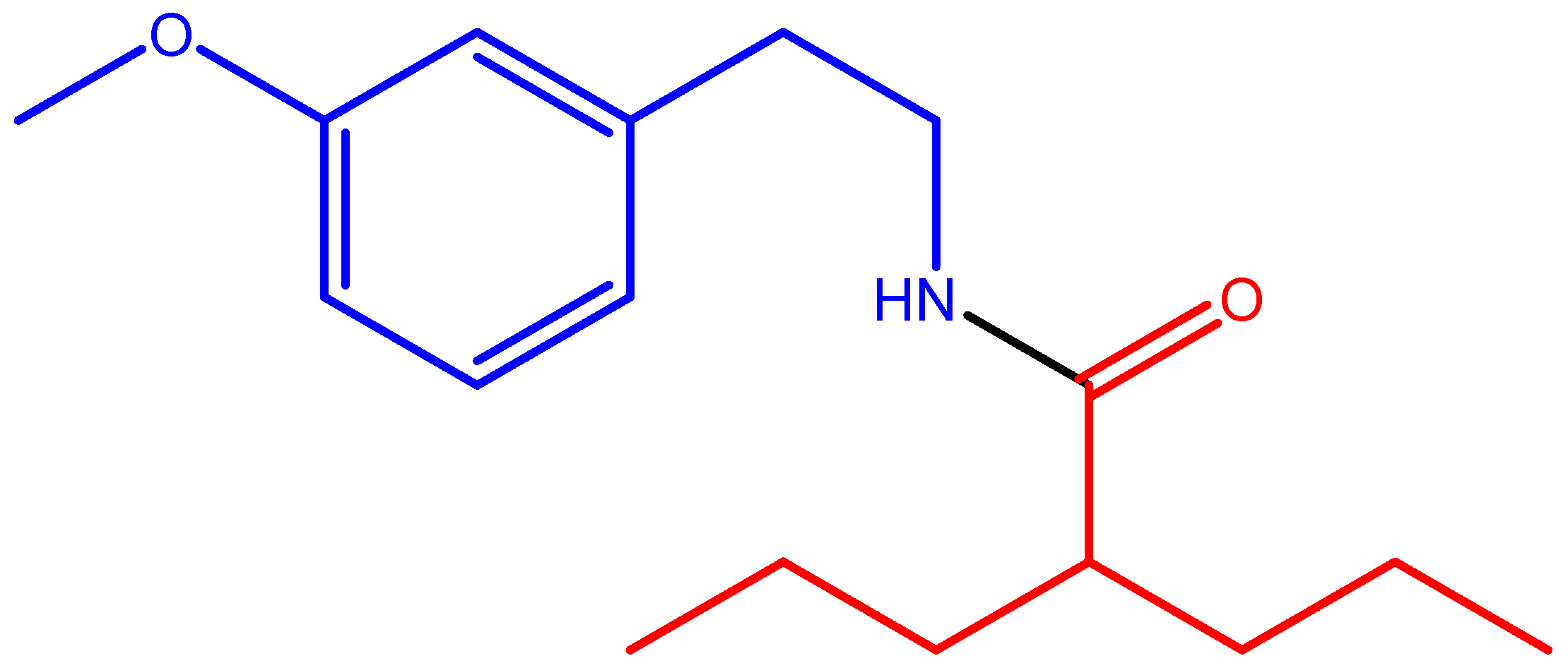
N-(3-Methoxyphenethyl)-2-propylpentanamide

Department of Organic Chemistry, Faculty of Chemistry, University of Plovdiv, 24 Tsar Assen Str., 4000 Plovdiv, Bulgaria
*
Author to whom correspondence should be addressed.
Molbank 2025, 2025(4), M2114; https://doi.org/10.3390/M2114
Submission received: 20 November 2025 / Revised: 10 December 2025 / Accepted: 16 December 2025 / Published: 17 December 2025
(This article belongs to the Section Structure Determination)

Abstract

Herein, we present the synthesis of N-(3-methoxyphenethyl)-2-propylpentanamide, a derivative of valproic acid. The compound has been thoroughly characterized through melting-point determination, 1H and 13C NMR spectroscopy, infrared spectroscopy, and mass spectrometry. The comprehensive analytical data obtained from these techniques confirm the successful preparation and structural integrity of the newly synthesized molecule.

1. Introduction

Valproic acid (VPA) is a widely used medication with diverse therapeutic applications across numerous neurological and psychiatric conditions. It is prescribed to control various forms of epilepsy, manage bipolar disorder, and prevent migraines [1]. Chemically, it is known as 2-propylpentanoic acid—a short-chain fatty acid and structural analog of valeric acid, which occurs naturally in Valeriana officinalis [2]. In addition to its use in epilepsy, VPA is utilized for migraine prophylaxis, the management of bipolar disorder, and experimentally as a protective agent in diabetic neuropathy [2]. Despite its strong efficacy, the clinical use of VPA is constrained by rare but serious adverse effects—including hepatotoxicity, teratogenicity, and neural tube defects, particularly in pregnant women—necessitating stringent monitoring and regulatory oversight [3]. The pharmacologically active form of the drug is the valproate anion, which predominates at physiological pH and is responsible for its therapeutic effects [4].
2-Phenylethylamine (PEA) is an endogenous trace amine present throughout the brains of both vertebrate and invertebrate species [5,6]. The term “trace amine” refers to a class of amines that occur at much lower intra- and extracellular concentrations than the chemically and functionally related biogenic amines [7]. Alterations in the metabolism of 2-phenylethylamine can contribute to a variety of central nervous system disorders, including schizophrenia, Tourette’s syndrome, and attention deficit disorder, among others [8]. PEA is a small molecule that has very intriguing and yet at the same time quite different from each other functions—it has the role of a neurotransmitter and is also used in food processing [7].
Many methoxy (OCH3)-containing compounds arise in nature through the action of O-methylating enzymes on hydroxylated substrates, making methoxy groups a common feature in naturally derived drugs [8]. It improves drug binding, physicochemical properties, and metabolic behavior, making it a valuable tool for medicinal chemists in drug design and optimization [8].
Given the broad therapeutic relevance of VPA (given in red at Figure 1) and the important neuroactive functions of PEA (given in blue at Figure 1), designing a hybrid molecule 1 (Figure 1) that incorporates structural features of both compounds presents a promising strategy for developing novel CNS-active agents.
VPA provides well-established anticonvulsant and mood-stabilizing properties, while PEA, as an endogenous trace amine, plays a modulatory role in neurotransmission and is implicated in several neuropsychiatric disorders. Introducing a methoxy group at the 3-position further enhances this design rationale, as methoxy substituents commonly improve binding affinity, physicochemical properties, and metabolic stability in drug candidates. Therefore, a hybrid structure combining VPA with 3-methoxy-substituted PEA may yield a molecule with synergistic or improved pharmacological effects, potentially reducing adverse effects while expanding therapeutic potential within neurological and psychiatric disorders.

2. Results and Discussion

In this work, we describe the successful synthesis of N-(3-methoxyphenethyl)-2-propylpentanamide. For this purpose, the carboxyl functional group of valproic acid was initially transformed into its corresponding acyl chloride derivative, which was then allowed to react with 2-(3-methoxyphenyl)ethan-1-amine (Scheme 1).
The structure of the synthesized compound was confirmed through comprehensive spectral analysis, including melting-point determination, 1H and 13C NMR, IR, and mass spectrometry.
The 1H NMR spectrum confirms the presence of all 27 expected protons (Supplementary Material Figure S1). The two methyl groups appear at 0.81 ppm as a triplet integrating for six protons. The methylene resonances originating from the valproic acid moiety are observed as multiplets corresponding to four, two, and two protons within the 1.09–1.41 ppm region. The methine (CH) proton is detected between 2.13 and 2.05 ppm. The two methylene groups of the PEA fragment are observed as a quartet and a triplet, each integrating for two protons at 3.29 and 2.68 ppm, respectively. A sharp singlet at 3.73 ppm corresponds to the methoxy group. In the aromatic region, the four aromatic protons produce characteristic signals, and the amino proton appears as a triplet at 7.85 ppm. The 13C NMR spectrum further confirms both the presence and the expected number of carbon atoms within the molecular structure (Figure S2).
The IR spectrum (Figure S3) clearly exhibits the characteristic absorption bands corresponding to the principal functional groups of the compound. In both the solid and liquid phases, secondary amides typically present a strong absorption band at approximately 3289 cm−1. A methoxy group attached to an aromatic ring usually gives rise to a sharp isolated band near 2835 cm−1. An alkoxy on an aromatic ring usually gives rise to two correlatable bands, 1310–1210 and 1050–1010 cm−1 [9].

3. Materials and Methods

All reagents and chemicals were purchased from commercial suppliers (Sigma-Aldrich S.A. and Riedel-de Haën, Sofia, Bulgaria) and were used without further purification. Nuclear magnetic resonance (NMR) spectra were recorded on a Bruker Avance II + 600 spectrometer (BAS-IOCCP—Sofia, Bruker, Billerica, MA, USA), operating at 600 MHz for 1H and 150.9 MHz for 13C. Spectra were acquired in DMSO-d6, with chemical shifts (δ) referenced to tetramethylsilane (TMS, δ = 0.00 ppm) and coupling constants (J) reported in hertz (Hz). All NMR measurements were performed at ambient temperature (approximately 295 K). Melting points were determined using a Boetius hot-stage apparatus (Plovdiv University; Boetius, Germany) and are reported uncorrected. Infrared (IR) spectra were obtained on a Bruker Alpha II FTIR spectrometer (Plovdiv University; Bruker, Billerica, MA, USA). High-resolution mass spectrometry (HRMS) analyses were conducted using a Q Exactive Plus mass spectrometer equipped with a heated electrospray ionization (HESI-II) source (Thermo Fisher Scientific, Bremen, Germany) and coupled to a Dionex Ultimate 3000RSLC UHPLC system (Thermo Fisher Scientific, Waltham, MA, USA). Thin-layer chromatography (TLC) was carried out on 0.2 mm silica gel 60 plates (Fluka, Merck KGaA, Darmstadt, Germany).

3.1. Obtaining of 2-Propylpentanoyl Chloride 2

Valproic acid (1.0 mmol, 0.1442 g) was dissolved in toluene (20 mL), after which thionyl chloride in excess (1.2 mmol, 0.087 mL) was added to the solution. The mixture was refluxed at 110–115 °C for 2 h to promote conversion of the carboxylic acid to the corresponding acid chloride. Upon completion, excess toluene and volatile byproducts were removed under reduced pressure using rotary evaporation. The resulting residue was then dissolved in dichloromethane for use in the subsequent reaction step, without further purification.

3.2. Synthesis of N-(3-Methoxyphenethyl)-2-propylpentanamide 3

A solution of 3-methoxyphenylethylamine (1 mmol, 0.1512 g) in dichloromethane (20 mL) was prepared. To this solution, 2-propylpentanoyl chloride (1 mmol, 0.1626 g) was added. The resulting mixture was stirred at room temperature for 10 min, after that triethylamine (Et3N, 0.168 mL, 1.2 mmol) was added dropwise to neutralize the hydrochloric acid byproduct and facilitate amide bond formation. The reaction was stirred continuously on an electromagnetic stirrer for 30 min. Progress of the reaction was monitored by thin-layer chromatography (petroleum ether/diethyl ether 1:1 (v/v)), confirming complete consumption of the amine starting material. Upon completion, the reaction mixture was washed with dilute aqueous hydrochloric acid (HCl:H2O = 1:4), saturated aqueous sodium carbonate (Na2CO3), and brine. The organic phase was separated, dried over anhydrous sodium sulfate, and concentrated under reduced pressure. The crude product was purified by short-column chromatography on neutral aluminum oxide (Al2O3) using CH2Cl2 as the eluent to afford the new hybrid molecule 3.
N-(3-methoxyphenethyl)-2-propylpentanamide 3
White solid (m.p. 88–90 °C), yield 96% (0.266 g), Rf = 0.45 (petroleum ether/diethyl ether = 1/1 v/v), 1H NMR (600 MHz, DMSO) δ 7.85 (t, J = 5.3 Hz, 1H), 7.19 (t, J = 7.9 Hz, 1H), 6.80–6.73 (m, 3H), 3.73 (s, 3H), 3.29 (q, 2H), 2.68 (t, J = 7.2 Hz, 2H), 2.13–2.05 (m, 1H), 1.41 (ddt, J = 12.4, 9.3, 6.8 Hz, 2H), 1.23–1.17 (m, 2H), 1.16–1.09 (m, 4H), 0.81 (t, J = 7.3 Hz, 6H). 13C NMR (151 MHz, DMSO) δ 175.18 (C=O), 159.69 (Ar), 141.58 (Ar), 129.65 (Ar), 121.35 (Ar), 114.72 (Ar), 111.94 (Ar), 55.30 (OCH3), 45.70 (CH), 40.22 (CH2CH2NH), 35.75 (ArCH2CH2NH), 35.35 (2xCHCH2CH2CH3), 20.63 (2xCH2CH3), 14.46 (2xCH3). IR (KBr) νmax., cm−1: 3289, 3085 ν(N-H), 1626 ν(C=O), 2832 νs (O–CH3), 1310, 1050 δ(Csp3–O–Csp2), Electrospray ionization (ESI) m/z calculated for [M + Na]+ C17H27NNaO2+ = 300.1934 found 300.1924 (mass error ∆m = −3.33 ppm).

Supplementary Materials

The following supporting information can be downloaded online. Figure S1: 1H NMR spectrum of compound 3; Figure S2: 13C NMR spectrum of compound 3; Figure S3: IR spectrum of compound 3; Figure S4: ESI-HRMS of compound 3.

Author Contributions

Conceptualization, I.I. and S.M.; methodology, S.M.; software, S.M. and D.B.; validation, I.I., S.M. and D.B.; formal analysis, D.D., Y.B. and I.T.; investigation, S.M.; resources, I.I.; data curation, S.M.; writing—original draft preparation, S.M.; writing—review and editing, S.M.; visualization, S.M. and D.B.; supervision, I.I.; project administration, S.M.; funding acquisition, I.I. All authors have read and agreed to the published version of the manuscript.

Funding

This research received no external funding.

Data Availability Statement

The data presented in this study are available in this article and supporting Supplementary Materials.

Acknowledgments

The authors thank the Faculty of Chemistry at “Paisii Hilendarski” University of Plovdiv.

Conflicts of Interest

The authors declare no conflicts of interest.

References

  1. Rahman, M.; Awosika, A.O.; Nguyen, H. Valproic Acid. In Treasure Island; StatPearls Publishing: Orlando, FL, USA, 2025. Available online: https://www.ncbi.nlm.nih.gov/books/NBK559112/ (accessed on 18 November 2025).
  2. Shnayder, N.A.; Grechkina, V.V.; Khasanova, A.K.; Bochanova, E.N.; Dontceva, E.A.; Petrova, M.M.; Asadullin, A.R.; Shipulin, G.A.; Altynbekov, K.S.; Al-Zamil, M.; et al. Therapeutic and Toxic Effects of Valproic Acid Metabolites. Metabolites 2023, 13, 134. [Google Scholar] [CrossRef] [PubMed]
  3. Sargazi, S.; Hajinezhad, M.R.; Barani, M.; Rahdar, A.; Shahraki, S.; Karimi, P.; Cucchiarini, M.; Khatami, M.; Pandey, S. Synthesis, characterization, toxicity and morphology assessments of mewly prepared microemulsion systems for delivery of valproic acid. J. Mol. Liq. 2021, 338, 116625. [Google Scholar] [CrossRef]
  4. Trocha, A.; Piotrowska, D.G.; Markowicz-Piasecka, M. Valproic Acid as a Therapeutic Scaffold: Advances in structural modification and drug design. Eur. J. Med. Chem. 2026, 302, 118334. [Google Scholar] [CrossRef] [PubMed]
  5. Kitanaka, J.; Kitanaka, N.; Tatsuta, T.; Takemura, M. 2-Phenylethylamine in combination with l-deprenyl lowers the striatal level of dopamine and prolongs the duration of the stereotypy in mice. Pharmacol. Biochem. Behav. 2005, 82, 488–494. [Google Scholar] [CrossRef] [PubMed]
  6. Paterson, I.A.; Juorio, A.V.; Boulton, A.A. 2-Phenylethylamine: A modulator of catecholamine transmission in the mammalian central nervous system? J. Neurochem. 1990, 55, 1827–1837. [Google Scholar] [CrossRef] [PubMed]
  7. Irsfeld, M.; Spadafore, M.; Prüß, B.M. β-Phenylethylamine, a small molecule with a large impact. WebmedCentral Biochem. 2013, 4, 4409. [Google Scholar]
  8. Chiodi, D.; Ishihara, Y. The role of the methoxy group in approved drugs. Eur. J. Med. Chem. 2024, 273, 116364. [Google Scholar] [CrossRef] [PubMed]
  9. Colthup, N.; Daly, L.; Wiberley, S. Ethers, Alcohols, and Phenols. In Introduction to Infrared and Raman Spectroscopy, 3rd ed.; Academic Press: London, UK, 1990; pp. 327–337. [Google Scholar] [CrossRef]
Figure 1. Structural formula of N-(3-methoxyphenethyl)-2-propylpentanamide.
Molbank 2025 m2114 g001
Scheme 1. Synthesis of compound 3.
Molbank 2025 m2114 sch001
Disclaimer/Publisher’s Note: The statements, opinions and data contained in all publications are solely those of the individual author(s) and contributor(s) and not of MDPI and/or the editor(s). MDPI and/or the editor(s) disclaim responsibility for any injury to people or property resulting from any ideas, methods, instructions or products referred to in the content.