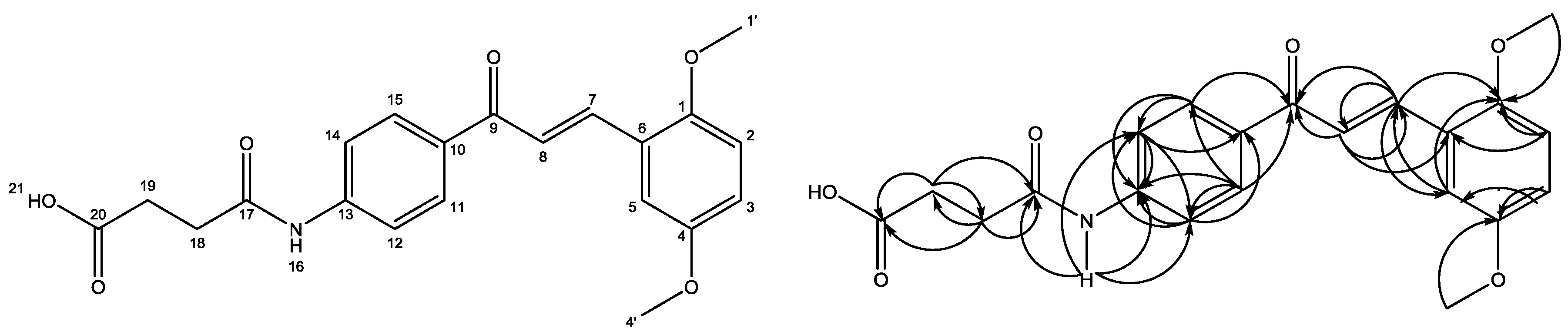

4-({4-[(2E)-3-(2,5-Dimethoxyphenyl)prop-2-enoyl]phenyl}amino)-4-oxobutanoic Acid
Abstract
1. Introduction
2. Results
3. Materials and Methods
3.1. General
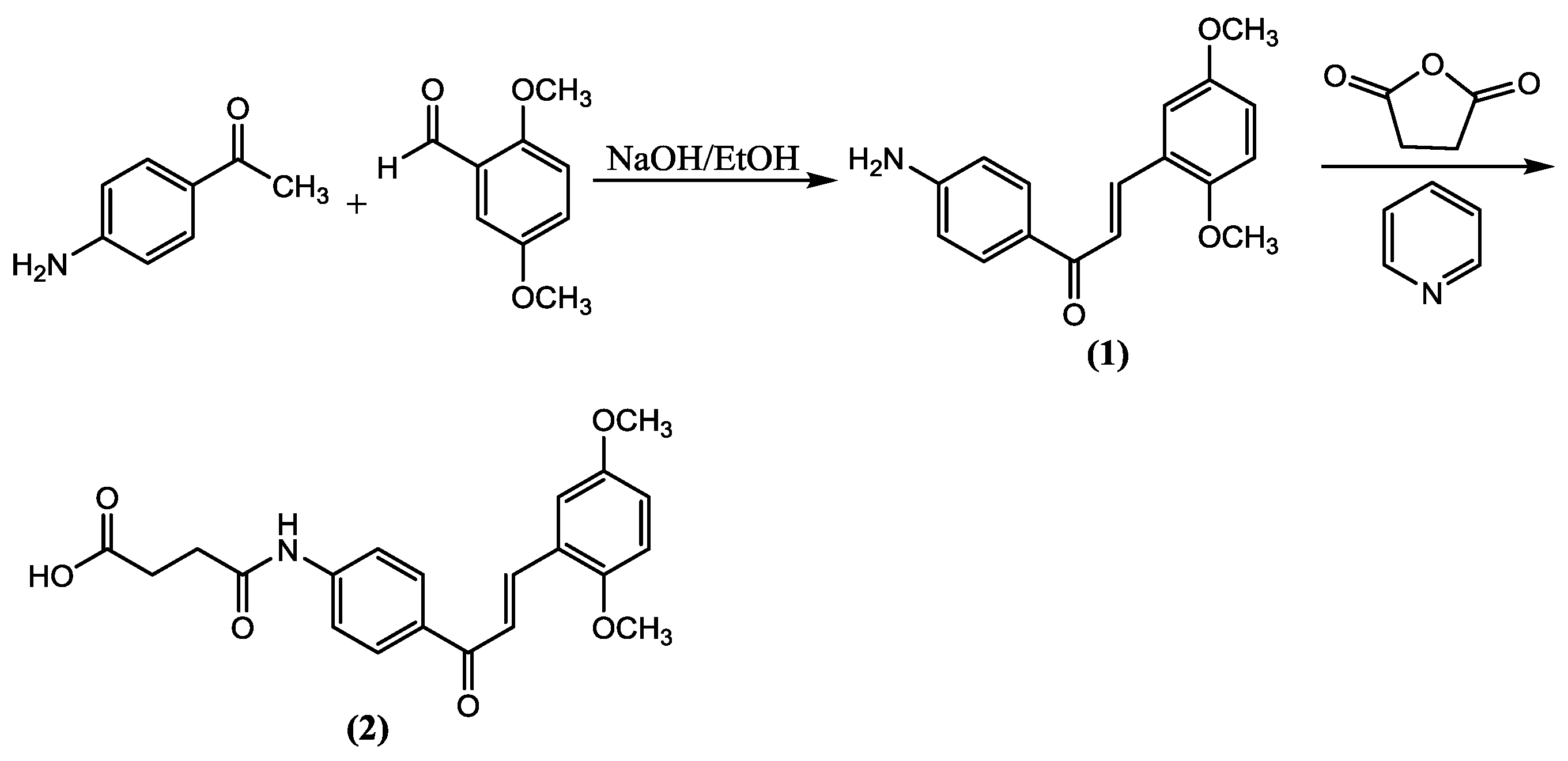
3.2. Preparation of the Title Compound (2)
4. Conclusions
Supplementary Materials
Acknowledgments
Author Contributions
Conflicts of Interest
References
- Lin, M.; Zhou, Y.; Flavin, M.T.; Zhou, L.; Nie, W.; Chen, F. Chalcones and flavonoids as anti-tuberculosis agents. Bioorg. Med. Chem. 2002, 10, 2795–2782. [Google Scholar] [CrossRef] [Scilit]
- Kim, B.T.; Chun, J.C.; Hwang, K.J. Synthesis of dihydroxylated chalcone derivatives with diverse substitution pattern and their radical scavenging ability toward DPPH free radicals. Bull. Korean Chem. Soc. 2008, 29, 1125–1130. [Google Scholar] [CrossRef] [Scilit]
- Khan, S.A.; Ahmed, B.; Alam, T. Synthesis and hepatotoxic activity of some new chalcones containing 1,4-dioxane ring system. Pak. J. Pharm. Sci. 2006, 19, 290–294. [Google Scholar] [PubMed]
- Jung, J.-C.; Jang, S.; Lee, Y.; Min, D.; Lim, E.; Jung, H.; Oh, M.; Oh, S.; Jumg, M. Efficient synthesis and neuroprotective effect of substituted 1,3-diphenyl-2-propen-1-ones. J. Med. Chem. 2008, 51, 4054–4058. [Google Scholar] [CrossRef] [Scilit] [PubMed]
- Prasad, Y.R.; Kumar, P.R.; Smiles, D.J.; Babu, P.A. QSAR studies on chalcone derivatives as antibacterial agents against Bacillus pumilis. Arkivoc 2008, 11, 266–276. [Google Scholar]
- Sharma, M.; Chaturvedi, V.; Manju, Y.K.; Bhatnagar, S.; Srivastava, K.; Puri, S.K.; Chauhan, P.M.S. Substituted quinolinyl chalcones and quinolinyl pyrimidines as a new class of anti-infective agents. Eur. J. Med. Chem. 2009, 44, 2081–2091. [Google Scholar] [CrossRef] [Scilit] [PubMed]
- Asiri, A.M.; Khan, S.A. Synthesis and anti-bacterial activities of a bis-chalcone derived from thiophene and its bis-cyclized products. Molecules 2011, 16, 523–531. [Google Scholar] [CrossRef] [Scilit] [PubMed]
- Sivakumar, P.M.; Seenivasan, S.P.; Kumar, V.; Doble, M. Synthesis, antimycobacterial activity evaluation, and QSAR studies of chalcone derivatives. Bioorg. Med. Chem. Lett. 2007, 17, 1695–1700. [Google Scholar] [CrossRef] [Scilit] [PubMed]
- Yoon, G.; Kang, B.Y.; Cheon, S.H. Topoisomerase I inhibition and cytotoxicity of lichochalcones A and E from Glycyrrhiza inflate. Arch. Pharm. Res. 2007, 30, 313–316. [Google Scholar] [CrossRef] [Scilit] [PubMed]
- Dave, S.S.; Ghatole, A.M.; Rahatgaonkar, A.M.; Chorghade, M.S.; Chauhan, P.M.S.; Srivastava, K. Experimental and computational evaluation of new quinolinyl chalcones as potent antiplasmodial agents. Indian J. Chem. 2009, 48, 1780–1793. [Google Scholar]
- Suwito, H.; Pudjiastuti, P.; Fanani, M.Z.; Kimata-Ariga, Y.; Katahira, R.; Kawakami, T.; Fujiwara, T.; Hase, T.; Sirat, H.M.; Puspaningsih, N.N.T. Design and synthesis of chalcone derivatives as inhibitors of the ferredoxin—Ferredoxin-NADP+ reductase interaction of plasmodium falciparum: Pursuing new antimalarial agents. Molecules 2014, 19, 21473–21488. [Google Scholar] [CrossRef] [Scilit] [PubMed]
- Ferrer, R.; Lobo, G.; Gamboa, N.; Rodrigues, J.; Abramjuk, C.; Jung, K.; Lein, M.; Charris, J.E. Synthesis of [(7-chaloroquinolin-4-yl)amino]chalcones: Potential antimalarial and anticancer agents. Sci. Pharm. 2009, 77, 725–741. [Google Scholar]
- Suwito, H.; Jumina; Mustofa; Ni′matuzahroh; Puspaningsih, N.N.T. Anticancer and antimicrobial activity of methoxy amino chalcone derivatives. Der Pharma Chem. 2015, 7, 89–94. [Google Scholar]
- Suwito, H.; Kristanti, A.N.; Hayati, S.; Dewi, S.R.; Amalina, I.; Puspaningsih, N.N.T. Antimicrobial activities and in silico analysis of methoxy amino chalcone derivatives. Procedia Chem. 2016, 18, 103–111. [Google Scholar] [CrossRef] [Scilit]


| Atom | Chemical Shift (ppm) | HMBC |
|---|---|---|
| 1 C | 153.16 | |
| 1′ C | 56.66 | |
| H3 | 3.80 | 1 |
| 2 C | 113.53 | |
| H | 6.99 | 1, 6 |
| 3 C | 118.57 | |
| H | 6.99 | 4, 5 |
| 4 C | 153.77 | |
| 4′ C | 56.22 | |
| H3 | 3.76 | 4 |
| 5 C | 112.93 | |
| H | 7.51 | 7, 3, 1 |
| 6 C | 124.08 | |
| 7 C | 138.06 | |
| H | 7.97 | 9, 5, 1, 8 |
| 8 C | 122.36 | |
| H | 7.86 | 9, 7, 6 |
| 9 C | 188.05 | |
| 10 C | 132.64 | |
| 11 C | 130.46 | |
| H | 8.10 | 9, 12, 15, 13 |
| 12 C | 118.73 | |
| H | 7.73 | 14, 10, 13 |
| 13 C | 144.19 | |
| 14 C | 118.73 | |
| H | 7.73 | 12, 10, 13 |
| 15 C | 130.46 | |
| H | 8.10 | 9, 14, 11, 13 |
| 16 H | 10.32 | 12, 14, 13, 17 |
| 17 C | 171.35 | |
| 18 C | 29.13 | |
| H2 | 2.50 | 19, 17, 20 |
| 19 C | 31.71 | |
| H2 | 2.58 | 18, 17, 20 |
| 20 C | 174.33 | |
| 21 H | 12.15 |
© 2017 by the authors. Licensee MDPI, Basel, Switzerland. This article is an open access article distributed under the terms and conditions of the Creative Commons Attribution (CC BY) license (http://creativecommons.org/licenses/by/4.0/).
Share and Cite
Suwito, H.; Haq, K.U.; Rahmah, N.N.D.; Kristanti, A.N.; Puspaningsih, N.N.T. 4-({4-[(2E)-3-(2,5-Dimethoxyphenyl)prop-2-enoyl]phenyl}amino)-4-oxobutanoic Acid. Molbank 2017, 2017, M938. https://doi.org/10.3390/M938
Suwito H, Haq KU, Rahmah NND, Kristanti AN, Puspaningsih NNT. 4-({4-[(2E)-3-(2,5-Dimethoxyphenyl)prop-2-enoyl]phenyl}amino)-4-oxobutanoic Acid. Molbank. 2017; 2017(2):M938. https://doi.org/10.3390/M938
Chicago/Turabian StyleSuwito, Hery, Kautsar Ul Haq, Nia Nur Dinia Rahmah, Alfinda Novi Kristanti, and Ni Nyoman Tri Puspaningsih. 2017. "4-({4-[(2E)-3-(2,5-Dimethoxyphenyl)prop-2-enoyl]phenyl}amino)-4-oxobutanoic Acid" Molbank 2017, no. 2: M938. https://doi.org/10.3390/M938
APA StyleSuwito, H., Haq, K. U., Rahmah, N. N. D., Kristanti, A. N., & Puspaningsih, N. N. T. (2017). 4-({4-[(2E)-3-(2,5-Dimethoxyphenyl)prop-2-enoyl]phenyl}amino)-4-oxobutanoic Acid. Molbank, 2017(2), M938. https://doi.org/10.3390/M938
 Display in JSmol Viewer