Article

Genome-Wide Identification and Functional Characterization of the Dof Gene Family in Flax (Linum usitatissimum)


Institute of Crop, Gansu Academy of Agricultural Sciences, Lanzhou 730070, China
*
Authors to whom correspondence should be addressed.
Int. J. Mol. Sci. 2026, 27(9), 4126; https://doi.org/10.3390/ijms27094126
Submission received: 10 March 2026 / Revised: 23 April 2026 / Accepted: 29 April 2026 / Published: 5 May 2026
(This article belongs to the Special Issue Omics Approach to Uncovering Signalling and Gene Regulation in Plants)

Abstract

DNA-binding with one finger (Dof) transcription factors are plant-specific regulators of growth, development, and stress responses. Despite extensive characterization in various species, Dof genes in flax (Linum usitatissimum L.), an important oil and fiber crop, remain largely uncharacterized. Through genome-wide identification and comprehensive characterization of the Dof gene family in flax, this study identified 47 LuDof genes in the high-oil Longya-10 variety, distributed non-uniformly across 15 chromosomes. Phylogenetic analysis grouped these genes into 12 distinct clusters, reflecting evolutionary conservation and lineage-specific characteristics, including the absence of LuDof members in Group XII. Gene structure and conserved motif analyses revealed strong structural conservation, particularly within the canonical zf-Dof domain. Segmental duplication was identified as the primary driver of LuDof family expansion, with all paralogous pairs evolving under strong purifying selection. Collinearity analysis revealed that 80.9% of LuDof genes have homologs in other species, highlighting strong evolutionary conservation. Promoter analysis identified multiple hormone- and stress-responsive elements, and qRT-PCR under drought, heat, cold, and methyl jasmonate (MeJA) treatments confirmed their roles in environmental stress responses. Transcriptome profiling indicated their involvement in stem and capsule development. This study represents the first systematic characterization of the evolution, structure, and functional potential of the flax Dof gene family, establishing a foundation for functional studies and for developing genetically superior, stress-tolerant flax varieties.

1. Introduction

Linum usitatissimum L., commonly referred to as flax and a member of the genus Linum, is a crop of global significance owing to its dual utility as a source of high-quality edible oil and natural fiber. Thought to have originated in the Near East, flax is now extensively cultivated worldwide, with major producers including Canada, the United States, India, Russia, Germany, Northern Europe, and China [1,2,3].
A substantial body of research has established that flaxseeds are abundant in essential nutrients, including dietary fiber, lignans, vitamins, and polyunsaturated fatty acids [4]. In recent years, growing global emphasis on health promotion and preventive nutrition has intensified interest in the nutritional properties and associated health benefits of flaxseed. In addition to its nutritional significance, flax fiber is regarded as one of the oldest and most highly valued natural fibers, owing to its exceptional tensile strength, comfort, environmental sustainability, and versatility across a wide range of applications [5]. These attributes render flax highly suitable for a wide range of applications in textiles, composite materials, and various industrial products. In light of the growing demand for flax-based products across the food, health, and industrial sectors, there is a pressing demand to improve its agronomic performance, particularly with respect to yield, stress tolerance, and quality of its oil and fiber. Therefore, elucidation of the genetic mechanisms underlying these agronomic traits is essential for the genetic improvement of flax through advanced breeding techniques and biotechnological interventions. The DNA-binding with one zinc finger (Dof) gene family represents a group of plant-specific transcription factors (TFs) that play critical roles in the regulation of stress-responsive signaling pathways and key metabolic processes, including lipid and cellulose biosynthesis [6]. Therefore, the identification and characterization of the Dof gene family in flax may provide critical insights into the molecular mechanisms underlying these agronomic traits, thereby enabling the identification of potential targets for the genetic improvement of flax.
Dof TFs constitute a distinct subfamily of zinc finger proteins, typically comprising 200–400 amino acid residues [7]. These proteins are characterized by the presence of a conserved, cysteine-rich single zinc finger domain, referred to as the Dof domain, which mediates both DNA binding and protein–protein interactions [8]. Structurally, Dof proteins consist of two primary functional regions, including a highly conserved N-terminal DNA-binding domain that contains the Dof domain (~52 amino acids). This domain adopts a C2C2-type zinc finger configuration characterized by the CX2CX21CX2C motif [9] and specifically recognizes core DNA sequences such as 5′-AAAG-3′ and 5′-CTTT-3′ [10]. Four cysteine residues within this zinc finger structure coordinate a single Zn2+ ion, which is essential for maintaining the structural integrity and functional activity of Dof TFs [11]. The Dof domain exhibits dual functionality, binding core DNA sequences to regulate downstream gene expression while also mediating interactions with other proteins to modulate plant growth, development, and stress responses [12]. In addition, Dof TFs possess a variable C-terminal transcriptional activation region, which exhibits low sequence conservation among Dof family members and interacts with multiple regulatory proteins, including MYB, WRKY, and bZIP TFs [8], thereby contributing to the functional diversity of Dof proteins. The structural variability of this domain enables differential protein–protein interactions, thereby enabling Dof TFs to participate in a wide range of signaling and regulatory networks [13].
Dof TFs have emerged as key regulators of diverse physiological and cellular processes in plants, including phytohormone signaling, response to abiotic stress, seed germination, floral transition, photosynthetic regulation, and light-mediated development [7,8,11,14]. Following the initial discovery of the first Dof gene in maize (Zea mays) in 1995 [15], subsequent studies have identified and characterized Dof gene families across a wide range of plant species [7]. Systematic characterization of all 36 Dof TFs in Arabidopsis thaliana revealed that CDF3 exhibits dual functionality, enhancing tolerance to abiotic stresses such as drought, cold, and osmotic stress while concurrently delaying flowering time [8,9]. The Dof gene family in rice (Oryza sativa) comprises 30 members, including OsDof15, which regulates the elongation of primary roots through modulation of ethylene-mediated meristematic cell proliferation [9,16]. Previous studies have identified 24 Dof genes in tomato (Solanum lycopersicum), among which TDDF1 promotes early flowering and enhances tolerance to drought and salinity stress [17,18]. The ZmDof22 gene in maize has been shown to enhance drought tolerance by modulating stomatal aperture and increasing the activities of antioxidant enzymes [19], whereas ZmDof36 promotes the biosynthesis of grain starch while concurrently suppressing the accumulation of soluble and reducing sugars [20]. Similarly, overexpression of the carrot RsDof33 gene in Arabidopsis led to reduced rosette leaves, delayed flowering, and increased anthocyanin content. It also upregulated the expression of genes involved in auxin synthesis (AtYUC2), auxin transport (AtPIN4), leaf shape development (AtKNAT2), and the anthocyanin synthesis pathway (AtPAL, AtCHS, AtDFR, etc.) [21]. The evolutionary conservation and functional diversification of Dof TFs are further substantiated by their characterization in a wide range of economically important species, including cereals such as maize (Zea mays) [22] and barley (Hordeum vulgare) [23]; horticultural crops such as kiwi (Actinidia sp.) [24] and watermelon (Citrullus lanatus) [25]; medicinal plants such as ginseng (Panax ginseng) [26]; root crops such as cassava (Manihot esculenta) [10], and leafy vegetables such as spinach (Spinacia oleracea) [27]. These comprehensive studies collectively demonstrate that Dof genes constitute a conserved yet functionally versatile gene family that has evolutionarily diversified to regulate fundamental physiological processes across the plant kingdom.
Recent advancements in high-throughput sequencing technologies and comparative genomics have enabled the systematic identification and comprehensive characterization of Dof gene families across diverse plant species. Despite extensive studies in model plants and major crops, the Dof gene family in flax remains largely uncharacterized, highlighting a significant gap in our understanding of transcriptional regulation in this economically important fiber and oilseed crop.
In this study, an integrated bioinformatics approach was employed to identify Dof genes in flax at the genome-wide level, followed by comprehensive analyses of their phylogenetic relationships, gene structures, conserved protein domains, and expression patterns across various tissues and under different stress conditions. This study represents the first systematic and comprehensive characterization of the Dof gene family in flax, providing evolutionary insights through comparative phylogenetic analyses and generating expression profile data suggestive of their potential roles in stress responses. The findings presented in this study provide a robust foundation for future functional investigations of Dof-mediated regulatory networks in flax, particularly concerning their potential roles in abiotic stress responses and other agronomically important traits. These insights may further inform the development of targeted genetic improvement strategies aimed at enhancing the cultivation of flax under adverse environmental conditions.

2. Results

2.1. Identification of Dof Genes in Flax

Flax is divided into oil flax and fiber flax. Longya-10 is an oil flax variety, while Heiya-14 is a fiber flax variety. A total of 47, 48, and 45 Dof genes were identified in the Longya-10, Heiya-14, and pale flax (Linum bienne) varieties, respectively, through BLASTp (https://blast.ncbi.nlm.nih.gov/Blast.cgi (accessed on 18 December 2025)) and conserved domain analysis. The 47 Dof genes identified in the Longya-10 cultivar were sequentially designated LuDof1LuDof47 based on their chromosomal locations (Table 1). Comparative physicochemical characterization of Dof TFs across the three flax genomes revealed broadly consistent parameter ranges. Specifically, the Dof TFs in the Longya-10, Heiya-14, and pale flax varieties spanned 171–470, 171–491, and 171–471 amino acids, respectively, with corresponding molecular weights (MW) of 18,483.96–51,215.01 Da, 18,498.03–53,808.21 Da, and 18,483.96–51,197.91 Da, respectively, and isoelectric points (pI) of 4.45–9.75, 4.51–9.49, and 4.45–9.85, respectively. Additionally, the grand average of hydropathicity (GRAVY) values for all the identified Dof proteins were negative (<0), indicating their hydrophilic nature. Further analysis of subcellular localization conducted using online websites indicates that all Dof proteins in flax are localized within the cell nucleus (Table 1).

2.2. LuDof Genes Sequence Analysis

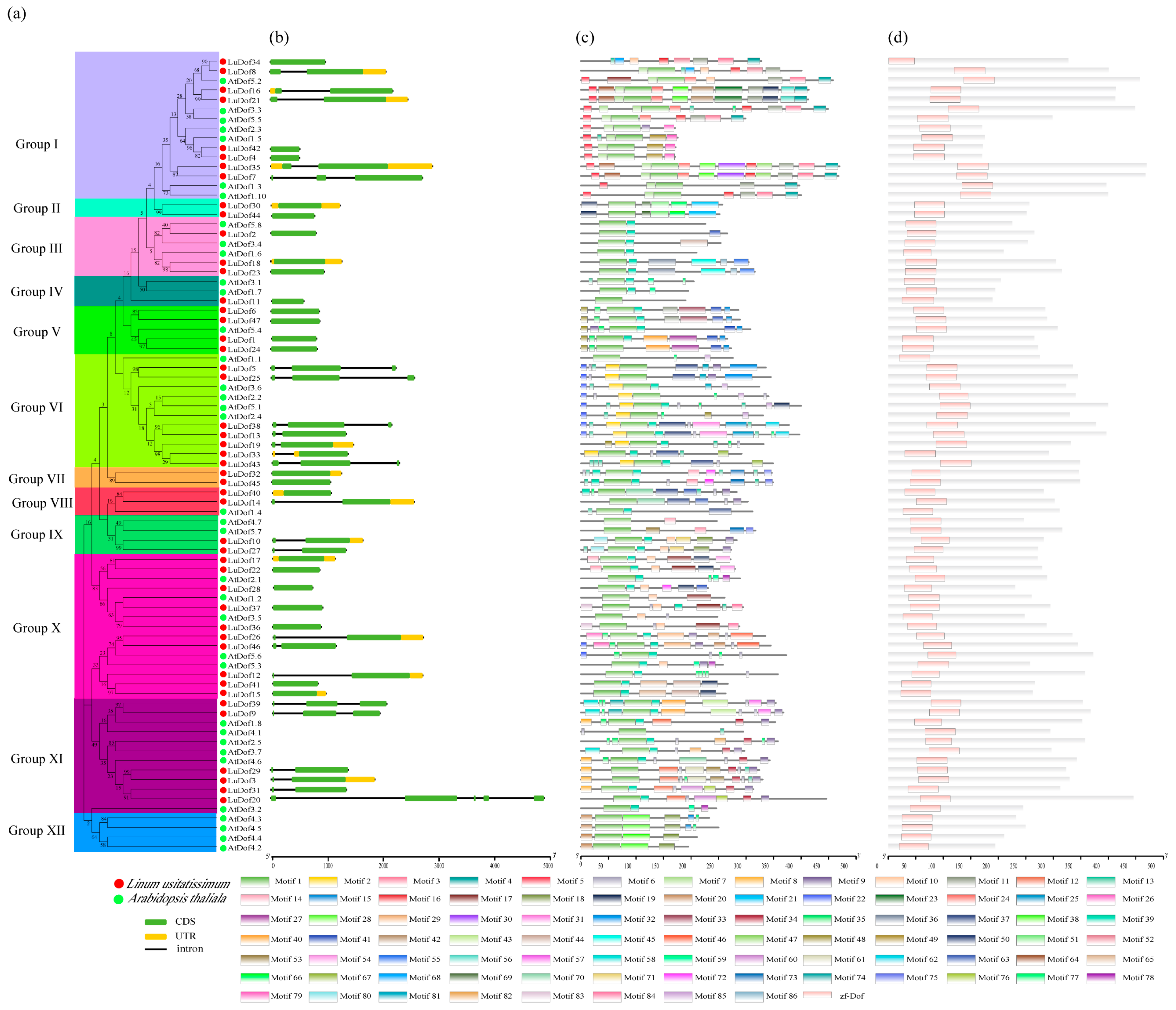
The Dof gene family in flax was further characterized through phylogenetic analysis using the Dof protein sequences from flax and Arabidopsis sp., which resolved into 12 distinct clusters (Figure 1a). Among these, Groups I and X contained the highest number of Dof proteins, with 15 members each, whereas Groups II and VII were the smallest, each comprising only two Dof proteins exclusively derived from flax. Group I included eight and seven Dof proteins from flax and Arabidopsis sp., respectively, whereas Group X comprised ten and five Dof proteins from flax and Arabidopsis sp., respectively. Notably, Group XII lacked any Dof proteins from flax, suggesting that this clade is likely absent in the flax genome.
Gene structure analysis revealed that LuDof20 exhibited the most complex architecture among the 47 LuDof genes, containing five exons and four introns, and representing both the highest exon count and longest genomic span observed. Among the 47 LuDof genes, 24 were intronless (single-exon), 15 contained two exons, and 7 contained three exons (Figure 1b). Comparative analysis of Dof gene structures in pale flax and Heiya-14 revealed variations in exon–intron organization, with pale flax comprising 17 single-exon, 21 two-exon, five three-exon, and two four-exon genes, whereas Heiya-14 comprised 22 single-exon, 19 two-exon, six three-exon, and one five-exon gene (Tables S1 and S2). Motif analysis further identified 48 distinct motifs, each exclusively present in two members of the LuDof family.
Comparative analyses of the conserved motifs in flax and Arabidopsis sp. identified a total of 86 distinct conserved protein motifs (Tables S4). The minimum length of the motif is 6, and the E-value used during the search process is “inf” (which stands for “infinity”). Among these 86 motifs, one core motif (Motif 1) was identified as a Dof domain containing a C2C2 zinc finger structure, representing a conserved DNA-binding region of the Dof transcription factor family. Additionally, several functional motifs were discovered, including a glutamine-rich transcriptional activation region (Motifs 2 and 13), arginine/lysine-rich nuclear localization signals (Motifs 5, 26, and 35), an acidic amino acid-rich protein interaction region (Motif 7), a polyhistidine metal-binding region (Motif 6), a glycine-rich flexible linker region (Motif 9), and a potential amphipathic α-helix (Motif 8). Collectively, these motifs reveal the molecular mechanism of Dof proteins as transcription factors, encompassing nuclear localization, DNA binding, transcriptional regulation, and potential phosphorylation modification. Notably, Motif 1 was present in all Dof proteins analyzed in this study, with the exception of LuDof34. Among these, 48 motifs were each exclusively detected in two members of the LuDof family, corresponding to paralogous gene pairs. Additionally, several motifs exhibited group-specific distribution patterns across the Dof subfamilies. For instance, Motifs 4, 5, 7, 16, 24, 26, 28, and 64 were exclusively detected in Group I, whereas Motif 48 was restricted to Group V. Motif 85 was detected only in Group VI and was exclusively present in the Arabidopsis AtDof family, whereas Motif 38 was specific to Group XII. Among the LuDof proteins, four members, namely, LuDof7, LuDof16, LuDof21, and LuDof35, contained the highest number of motifs (12 each), whereas LuDof11 harbored the fewest, with only a single conserved motif.
To gain deeper insights into the structural features of the Dof domain, a comparative sequence analysis of LuDof and AtDof proteins was performed. All the analyzed proteins were found to contain the canonical zf-Dof domain, demonstrating that this DNA-binding domain is highly conserved across the Dof protein families of flax and Arabidopsis sp. (Figure 1d).

2.3. Chromosomal Distribution of LuDof Genes and Collinearity Analysis

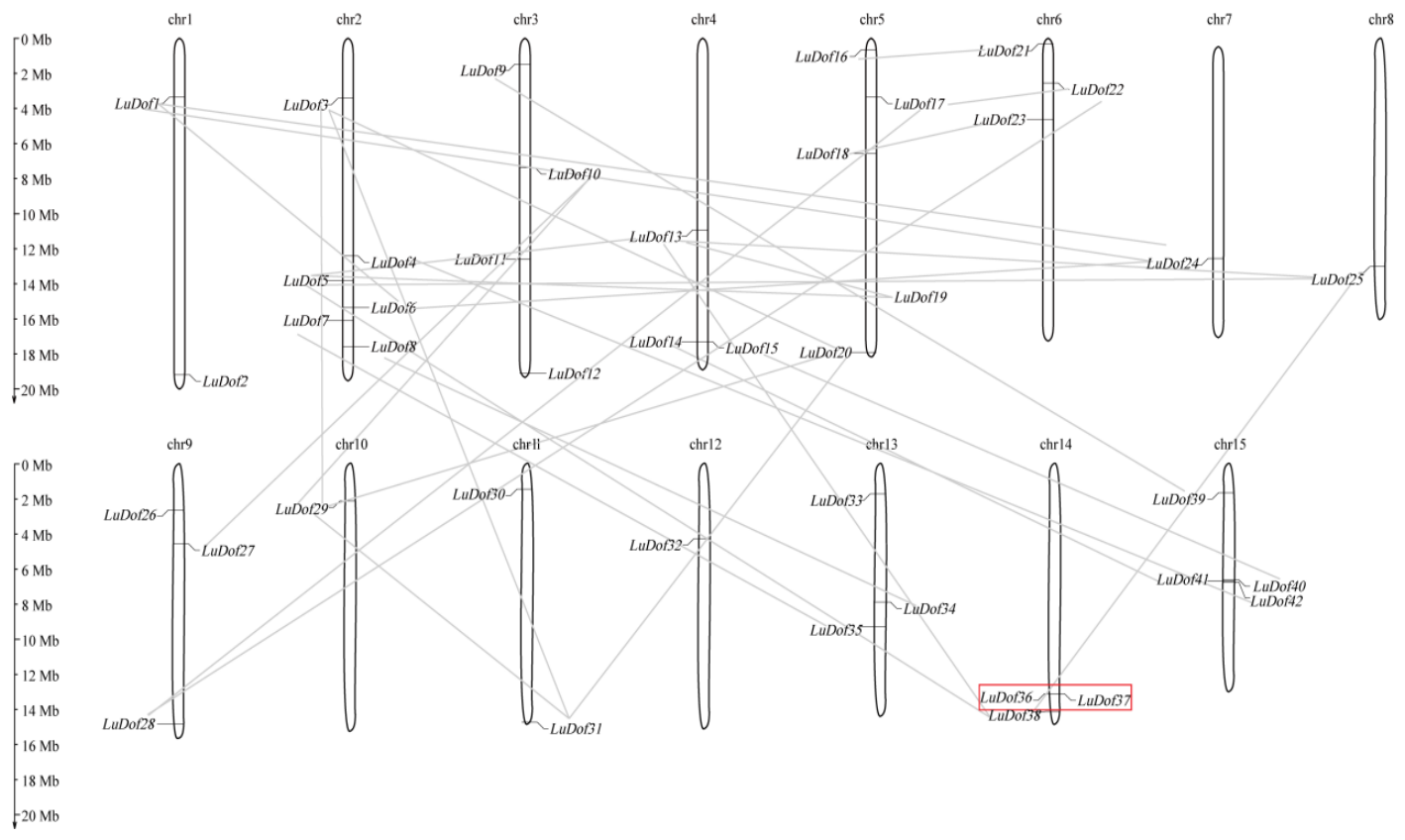
Analysis of the chromosomal distribution of LuDof genes revealed that 42 genes were non-uniformly distributed across 15 chromosomes (Figure 2), whereas the remaining five genes (LuDof43LuDof47) could not be mapped to any specific chromosome. Chromosome 2 harbored the highest number of LuDof genes (n = 6), whereas chromosomes 7, 8, 10, and 12 each harbored only a single LuDof gene, and the remaining chromosomes carried two to four LuDof genes. Gene duplication analysis identified 39 duplicated gene pairs, comprising 38 segmental duplication (SD) events involving 42 LuDof genes, which collectively 89.4% of all duplicated genes, and a single tandem duplication (TD) event that gave rise to the LuDof36/37 gene pair. These results suggest that the expansion of the LuDof gene family is predominantly driven by SD events (Table 2). We further estimated the nonsynonymous (Ka) and synonymous (Ks) substitution rates for each duplicated gene pair, and the resulting Ka/Ks ratios were used to infer the selective pressures underlying their evolutionary divergence. The Ka/Ks ratios for all the duplicated gene pairs were consistently < 1, ranging from 0.035 to 0.638, indicating that these LuDof paralogs have been subjected to strong purifying selection throughout their evolutionary history. We additionally identified nine duplicated gene pairs (LuDof3/LuDof31, LuDof5/LuDof13, LuDof5/LuDof19, LuDof5/LuDof25, LuDof6/LuDof47, LuDof18/LuDof23, LuDof19/LuDof43, LuDof24/LuDof47, and LuDof33/LuDof43) involving a total of 14 LuDof genes, with Ks values ranging from 0.625 to 0.863. These values suggest that these duplication events likely coincided with an early whole-genome duplication (WGD) event (Ks = 0.77) [28]. The corresponding divergence times were estimated to be approximately 51–71 million years ago (Mya), whereas the remaining gene pairs exhibited divergence times ranging from 23 to 273 Mya.
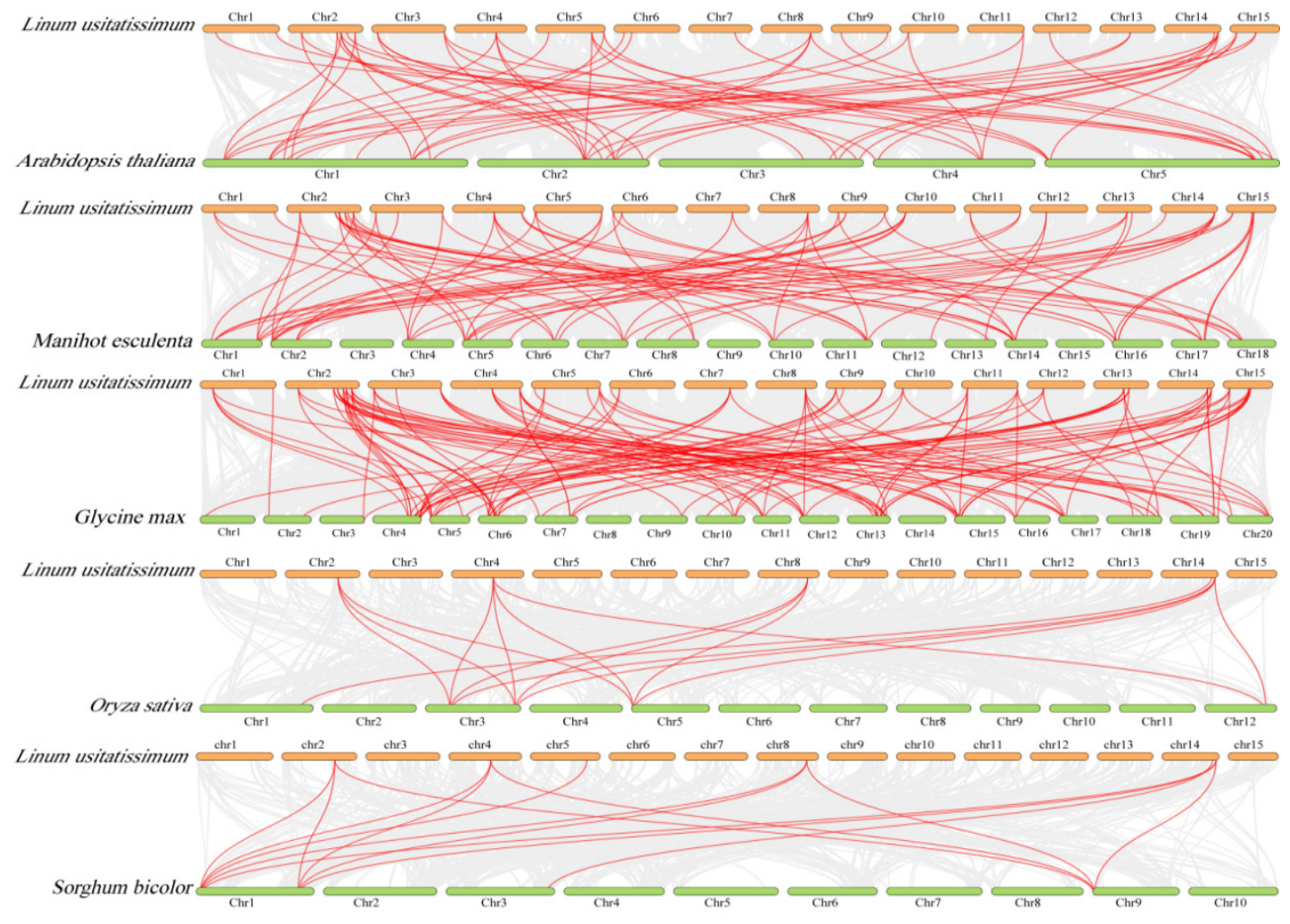
To further elucidate the evolutionary mechanisms shaping the LuDof gene family, a comparative collinearity analysis was conducted between flax and five additional eudicot and monocot species, including Arabidopsis sp., cassava, soybean, rice, and sorghum (Figure 3 and Table S5). The findings revealed that homologs of 38 (80.9%) LuDof genes were identified in at least two of the analyzed species, with each homolog forming one to five collinear orthologous gene pairs. Notably, conserved syntenic orthologs of five LuDof genes, namely, LuDof5, LuDof13, LuDof25, LuDof36, and LuDof38, were identified in all the species analyzed herein, Among these, LuDof5, LuDof13, and LuDof25 were consistently iconserved in Arabidopsis sp., cassava, and sorghum. Moreover, each LuDof gene was associated with up to five homologous counterparts across the five eudicot and monocot species compared in this study. Synteny analysis revealed that flax exhibited the strongest collinear relationships with the eudicot species, with 56–120 collinear orthologous gene pairs, whereas the weakest relationships were observed with the monocot species, with only 14–15 pairs identified.

2.4. Phylogenetic Analysis of the Dof Family

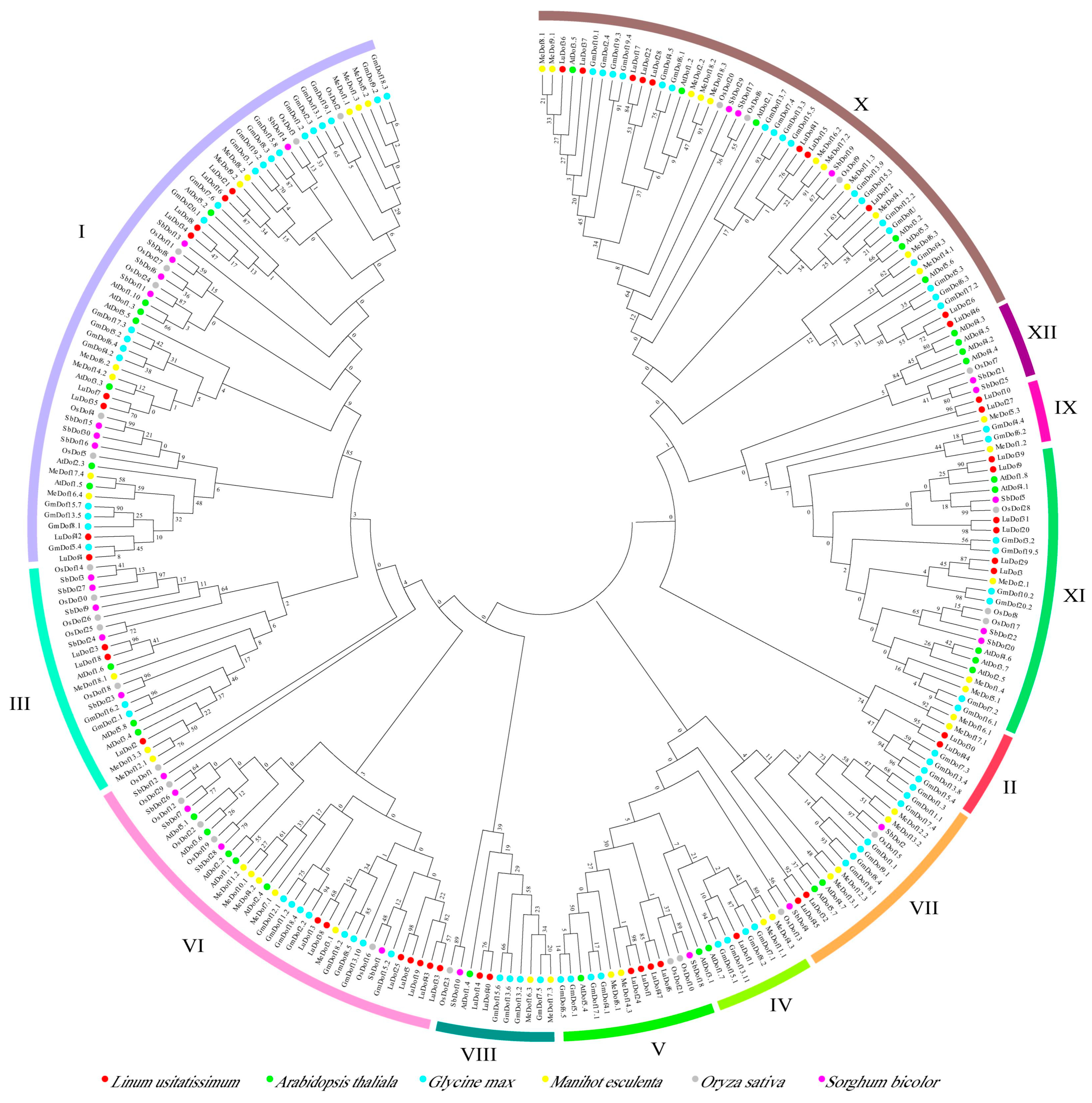
To investigate the evolutionary conservation of the Dof gene family during the domestication of flax, a phylogenetic analysis was performed using Dof protein sequences from the cultivated varieties Longya-10 and Heiya-14, together with those from their wild-type progenitor, pale flax (Linum bienne) (Supplementary Diagram). The results demonstrated that Dof proteins from all three lineages clustered within shared clades, without forming distinct lineage-specific branches. This pattern indicates a high degree of sequence conservation of Dof genes between cultivated and wild-type flax varieties. Dof protein sequences from four dicotyledonous species (flax, Arabidopsis sp., soybean, and cassava) and two monocotyledonous species (rice and sorghum) were used to construct a phylogenetic tree to comparatively assess the evolutionary relationships among Dof proteins across diverse plant lineages (Figure 4). The resulting phylogenetic tree resolved 12 well-supported groups, with Group I containing the highest number of Dof proteins (n = 59) and Group IX comprising the fewest (n = 6). Among these 12 groups, Group X contained the highest number of LuDof members (n = 10), whereas Group XII contained no LuDof proteins. Groups II, IV, and IX were composed exclusively of Dof proteins from dicotyledonous species, whereas the other groups included members from both dicotyledonous and monocotyledonous lineages. Additionally, the Dof proteins from flax exhibited closer evolutionary relationships with those of soybean and cassava.

2.5. LuDof Gene Promoter Analysis

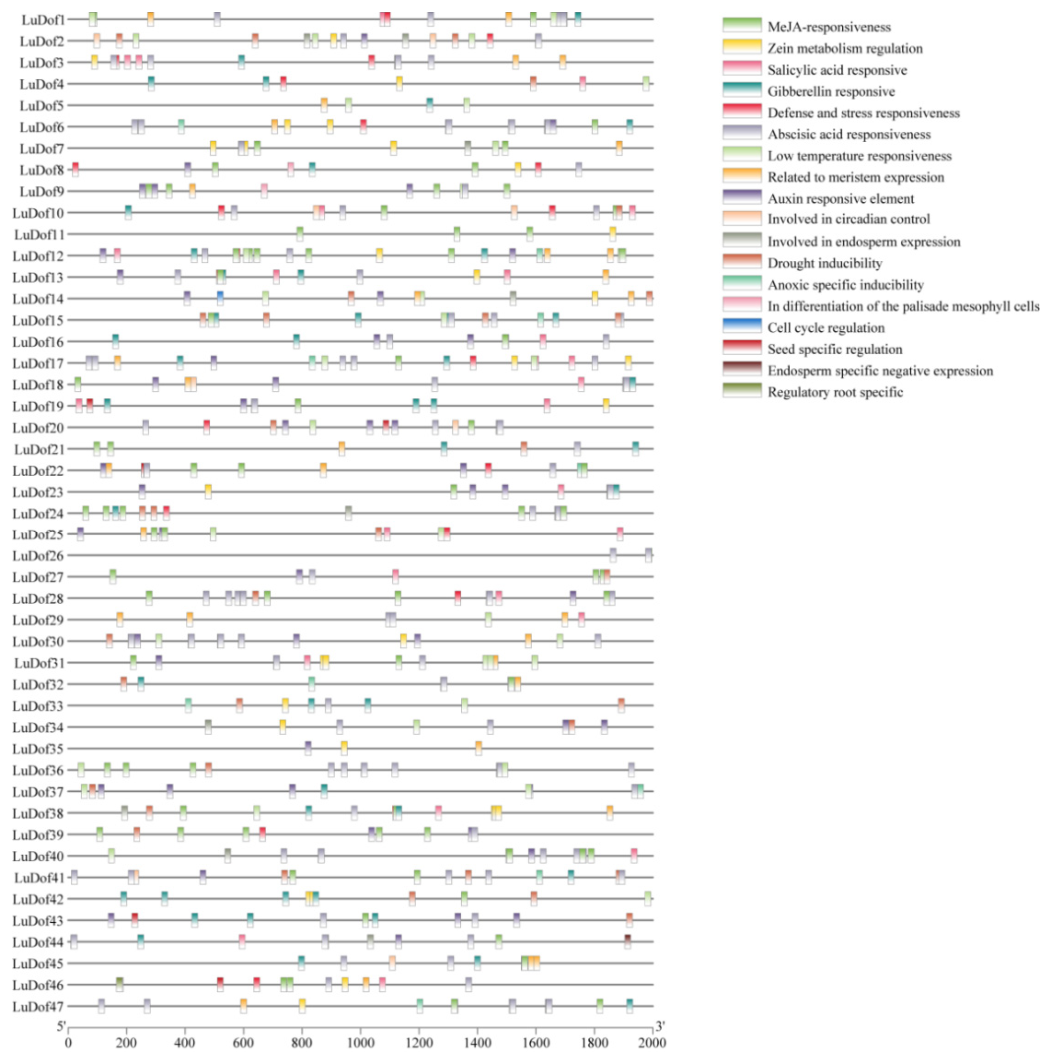
The regulatory potential and biological functions of LuDof genes were further elucidated through systematic characterization of cis-acting elements present in the promoter regions of all LuDof gene members. Promoter analysis revealed a diverse array of cis-acting elements associated with plant growth and development, phytohormone-mediated signaling, light responsiveness, and abiotic stress responses. Five major classes of hormone-responsive cis-acting elements were identified (Figure 5 and Table S7), corresponding to salicylic acid (SA), gibberellin (GA), auxin, methyl jasmonate (MeJA), and abscisic acid (ABA) responses. Among these, MeJA-responsive elements were the most prevalent, with 160 occurrences detected across 36 LuDof genes. In contrast, ABA-responsive elements exhibited the highest gene-level prevalence, being present in 40 genes and accounting for 146 instances in total. In contrast, auxin-, GA-, and SA-responsive elements were detected in 51, 47, and 29 instances, respectively, across the promoter regions of all LuDof genes. Notably, nine LuDof genes, namely, LuDof12, LuDof13, LuDof16, LuDof17, LuDof18, LuDof19, LuDof23, LuDof38, and LuDof44, harbored all five categories of hormone-responsive cis-acting elements. Quantitative assessment further revealed that LuDof12 exhibited the highest abundance and diversity of cis-regulatory elements, with a total of 27 elements representing 10 distinct classes. Furthermore, approximately half of the LuDof genes harbored cis-elements associated with low-temperature responsiveness and drought inducibility. Additionally, cis-acting elements associated with the regulation of zein metabolism and meristem-specific expression were widely distributed across the LuDof gene family. In contrast, cell cycle-related cis-elements were exclusively identified in the promoter region of LuDof14, whereas endosperm-specific negative regulatory elements were uniquely present in LuDof44, and root-specific cis-elements were solely detected in the LuDof4 promoter.

2.6. LuDof Gene Expression Across Different Cultivars, Tissues, and Stress Conditions

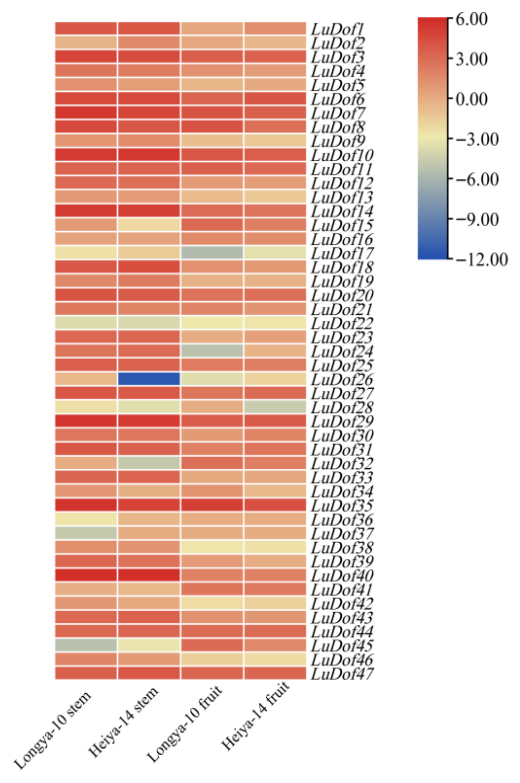
This study utilized previously published transcriptome data to analyze plant tissues, systematically identifying the expression profiles of LuDof genes in different flax tissues and varieties, resulting in the successful retrieval of expression data for 47 LuDof genes. As depicted in Figure 6, several LuDof genes exhibited distinct tissue-specific expression patterns, with consistently higher expression in fruits than in stems across both flax varieties. Specifically, Ludof15, Ludof16, Ludof32, Ludof41, and Ludof45 exhibited significantly higher expression in the high-oil Longya-10 variety compared to that in the high-fiber Heiya-14 cultivar. Conversely, the expression levels of 34 genes, including LuDof1, LuDof3LuDof10, LuDof12LuDof14, LuDof17LuDof21, LuDof23LuDof25, LuDof27, LuDof29LuDof31, LuDof33, LuDof35, LuDof38LuDof40, LuDof42LuDof44, and LuDof46LuDof47, were consistently higher in stems than in fruits in both flax cultivars. Of these, Ludof1, Ludof6, Ludof9, Ludof10, Ludof17Ludof19, Ludof23, Ludof24, Ludof30, Ludof33, Ludof43, Ludof44, and Ludof47 exhibited significantly higher expression in the high-fiber Heiya-14 cultivar than in the high-oil Longya-10 cultivar.
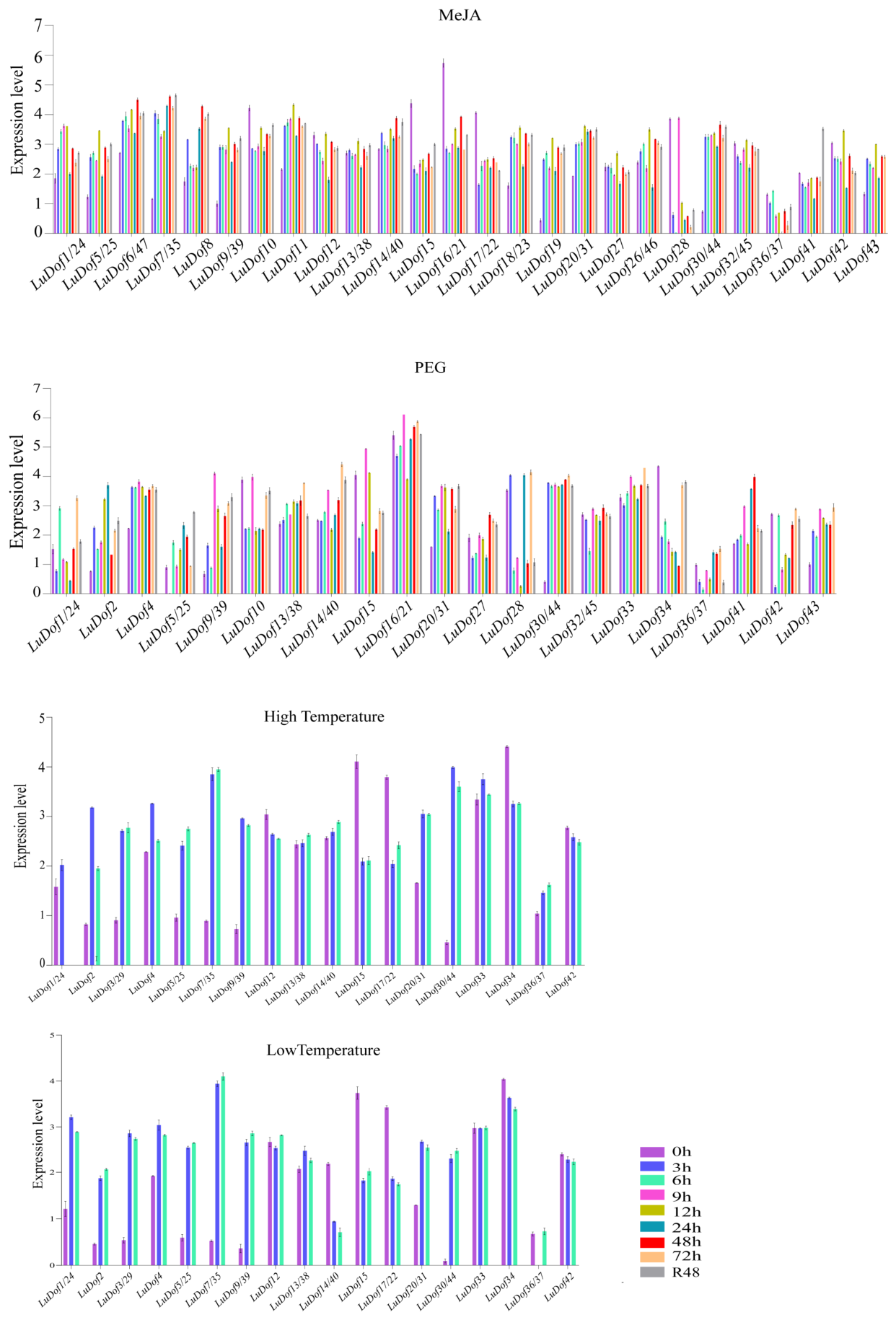
In this study, the expression profile of the LuDof gene under stress conditions was detected using quantitative polymerase chain reaction (qPCR) technology. The functional roles of LuDof genes were further elucidated by analyzing the expression profiles of genes harboring drought-, temperature- and MeJA-responsive cis-elements within their promoter regions under various abiotic and hormonal stress conditions, including polyethylene glycol (PEG)-induced drought stress, cold stress (4 °C), heat stress (42 °C), and treatment with exogenous MeJA. Quantitative gene expression analyses revealed distinct, stress-specific transcriptional responses among LuDof genes (Figure 7). Treatment with exogenous MeJA significantly induced nearly all the LuDof genes at least once during the time course, with the exception of LuDof10, LuDof12, LuDof15, LuDof16/21, and LuDof17/22. Notably, LuDof1/24, LuDof5/25, LuDof6/47, LuDof7/35, LuDof8, LuDof9/39, LuDof11, LuDof14/40, LuDof18/23, LuDof19, LuDof20/31, LuDof30/44, and LuDof43 were significantly induced at all sampling time points, with peak expression for most LuDof genes occurring at 12 h or 48 h. With the exception of LuDof34, all the LuDof genes were significantly induced under PEG-induced drought stress at least once during the time course. Notably, LuDof16/21 consistently exhibited the highest expression levels across all time points, reaching a peak at 9 h and surpassing the expression levels of all other LuDof genes analyzed. Furthermore, LuDof2, LuDof4, LuDof9/39, LuDof13/38, LuDof20/31, LuDof30/44, and LuDof43 were consistently upregulated at all sampling points following treatment. In contrast, the remaining LuDof genes exhibited dynamic, time-dependent expression profiles, with certain genes showing transient induction, whereas the others were downregulated. Notably, the number of downregulated genes exceeded that of the upregulated genes relative to that at 0 h. The expression levels of all the LuDof genes were significantly upregulated under heat stress at all time points compared to those at 0 h, with the exception of LuDof1/24, LuDof12, LuDof15, LuDof17/22, LuDof34, and LuDof42. Among the heat-responsive LuDof genes, LuDof30/44 exhibited peak expression at 3 h, whereas LuDof7/35 reached peak expression at 6 h. LuDof1/24, LuDof2, LuDof3/29, LuDof4, LuDof5/25, LuDof7/35, LuDof9/39, LuDof13/38, LuDof20/31, and LuDof30/44 were consistently upregulated under cold stress across all sampling time points. In contrast, LuDof14/40, LuDof15, LuDof17/22, LuDof34, and LuDof42 exhibited sustained downregulation throughout the treatment period under cold stress. Notably, the findings further revealed that LuDof7/LuDof35 exhibited the highest expression levels among all cold-responsive LuDof genes.
At the same time, we conducted a significance difference analysis on the qPCR results, and the results are presented in Supplementary Table S6. After JA treatment, the majority of samples showed extremely significant upregulation at all time points (p < 0.001). Only a few samples (such as Dof32/45) showed downregulation or no significant change at some time points. After PEG treatment, almost all samples showed highly significant downregulation at all time points (p < 0.001). The ΔCq values increased significantly, indicating that the expression levels were strongly suppressed. After high-temperature treatment, the expression trends were inconsistent. Approximately 70% of the samples showed significant downregulation, approximately 30% of the samples (such as Dof7/35 and Dof4) showed significant upregulation, and a few samples showed no significant difference. After low-temperature treatment, almost all samples showed highly significant downregulation at all time points (p < 0.001). The ΔCq values increased significantly, indicating that the expression levels were strongly suppressed.

3. Discussion

The Dof gene family represents a plant-specific TF family that plays crucial roles in the regulation of plant growth, development, and abiotic stress adaptation. Although Dof genes have been extensively characterized across diverse plant species, a comprehensive genome-wide identification and systematic characterization of the Dof family in flax remains lacking. Consequently, the regulatory functions of Dof genes in the development and stress responses of flax remain poorly understood. To address this knowledge gap, we performed a comprehensive genome-wide identification of Dof genes in flax, followed by their phylogenetic classification and structural characterization—including analyses of exon–intron organization and conserved domain architecture—as well as spatiotemporal expression profiling. This study establishes a foundational resource for future mechanistic investigations of LuDof genes in the growth, development and stress adaptation of flax.
The present study identified 47 and 48 Dof genes in the cultivated flax varieties Longya-10 and Heiya-14, respectively, whereas their wild-type progenitor, pale flax, harbored 45 Dof genes. The near-identical copy numbers across the three flax genomes suggest that the Dof gene family has undergone minimal expansion during the domestication of flax, reflecting strong evolutionary conservation. Subcellular localization prediction revealed that all flax Dof proteins in flax exclusively localize to the nucleus, consistent with the well-established nuclear localization of Dof TFs across diverse plant species. With the exception of LuDof45, all the LuDof genes contained zero to two introns, a structural feature that is highly conserved across diverse plant lineages, including Cerasus humilis [29], rice [30], maize [31], and pepper [32], thus further highlighting the evolutionary stability of the Dof gene family. Intron retention and alternative splicing are well-documented mechanisms contributing to the expansion of transcriptomic and proteomic diversity in plants. Therefore, the presence of introns within LuDof genes may enhance their functional versatility in regulating developmental processes and mediating stress responses in flax [33]. Conserved motif analysis revealed that Motif 1, a hallmark feature present in nearly all LuDof proteins, corresponds to the canonical DNA-binding domain of Dof TFs. In contrast, lineage- or paralog-specific motifs, including Motifs 4, 18, and 48, were detected only in specific subsets of LuDof members, suggesting their potential involvement in functional diversification and subfunctionalization within the gene family.
In this study, three phylogenetic trees were constructed using the Dof proteins from flax and representative monocotyledonous and dicotyledonous plant species. The findings revealed consistent evolutionary relationships among the LuDof proteins, thereby validating the robustness and reliability of the phylogenetic inference. Notably, Group XII lacked LuDof members, suggesting a lineage-specific loss of Dof genes during the evolutionary trajectory of flax. Groups II, IV, and IX consisted exclusively of Dof proteins from eudicot species, whereas the remaining groups included Dof homologs from monocot and eudicot lineages. This distribution pattern suggests a high degree of functional conservation of Dof proteins across major angiosperm lineages, with potential specialization within eudicot-specific regulatory networks. Consistent with this observation, flax Dof proteins exhibited the closest phylogenetic affinity to those of soybean and cassava, supporting their conserved functions in the development and stress response pathways of eudicot species. Additionally, LuDof proteins clustered within the same phylogenetic group exhibited highly conserved gene structures and domain architectures, a feature that has also been reported in Dof families from other plant species [34]. Gene duplication represents a major driver of gene family expansion. Gene duplication analysis revealed that 42 LuDof genes in flax underwent duplication through SD events during evolution, suggesting that the expansion of the LuDof family was primarily driven by SD. Furthermore, all identified paralogous LuDof gene pairs exhibited Ka/Ks ratios < 1, providing strong evidence that the LuDof gene family has been subjected to pervasive purifying selection throughout its evolutionary history. Cross-species collinearity analysis further revealed that Dof genes are highly evolutionarily conserved across angiosperms. Specifically, flax Dof genes formed 120 syntenic orthologous gene pairs with soybean, a eudicot species, but only 10 such pairs with maize, a monocot species. This pronounced asymmetry in synteny density reflects the greater phylogenetic divergence between monocots and eudicots, and is consistent with extensive gene loss, duplication, and genomic rearrangements that have occurred in both lineages following their evolutionary divergence [35].
Previous studies have demonstrated that the promoter regions of Dof genes harbor a wide array of cis-acting regulatory elements associated with phytohormone and abiotic stress responses, and that Dof genes exhibit conserved responsiveness to diverse abiotic stresses across plant species. For instance, the GhDofA5.7, GhDofA7.4, and GhDofD11.3 genes in cotton have been shown to be significantly upregulated under low-temperature stress [36]. Similarly, BraDof023, BraDof045, and BraDof074 in Brassica rapa show marked upregulation in response to drought and salinity stress, whereas BraDof003, BraDof023, BraDof045, and BraDof074 are induced by cold stress, and BraDof072 is specifically downregulated under the same conditions [37]. It has been additionally reported that the majority of PeDof genes in passion fruit are heat inducible [38]. Cis-acting within gene promoters play a pivotal role in regulating gene expression in plants. The present study revealed that the promoter regions of LuDof genes harbored a wide array of hormone-responsive elements, including 44, 26, 79, and 137 elements associated with responses to GA, SA, MeJA, and ABA, respectively, as well as a diverse array of stress-responsive elements. Notably, each LuDof gene harbored one hormone-responsive and one stress-responsive element. These findings align closely with previous reports on the composition of cis-acting elements in the promoter regions of orthologous Dof genes in wheat [39], lotus [40] and Populus simonii [41]. In pea plants, researchers cloned and identified a novel Dof transcription factor named PsDof1 [42]. It was found that the PsDof1 protein could bind with high affinity to its own promoter fragment containing the AAAG sequence. This provides a rigorous demonstration of the transcriptional autoregulation mechanism of a Dof factor. Collectively, these results support the hypothesis that the expression of LuDof genes is modulated by upstream signaling molecules, thereby enabling LuDof TFs to function as regulatory nodes that coordinate both transcriptional autoregulation and the expression of downstream target genes. Additionally, the presence of diverse cis-acting elements likely facilitates the integration of various stress signals, thereby enhancing plant resilience to complex and concurrent environmental stresses.
The functional roles of LuDof genes in abiotic stress responses were further elucidated through comprehensive expression profiling under drought and cold stresses, with particular emphasis on genes harboring the corresponding cis-acting elements, namely, drought- or cold-responsive elements. Potential cross-temperature responsiveness was assessed by analyzing the expression of LuDof genes harboring cold-responsive cis-regulatory elements under heat stress. Given the predominance of MeJA-responsive elements among the predicted cis-acting elements, we further evaluated the expression dynamics of LuDof genes containing these elements in response to treatment with MeJA. The results demonstrated that the majority of LuDof genes analyzed herein were significantly upregulated in response to treatment with MeJA, suggesting their sensitivity to MeJA signaling. This expression pattern is consistent with observations in Arabidopsis sp., where the abundance of the AtDof1.1 transcript was found to increase two- to three-fold following the application of MeJA [43,44]. Previous studies have demonstrated the conserved role of Dof genes in abiotic stress tolerance. For instance, Zhao et al. demonstrated that AcDOF22 in kiwifruit contributes to drought tolerance [24], and another study similarly reported that CDF3, a key regulator of abiotic stress responses in plants, confers enhanced drought resistance in Arabidopsis sp. [45]. The present study demonstrated that PEG-induced drought stress significantly upregulated multiple LuDof genes, with LuDof16/21 consistently exhibiting the highest expression is response to drought stress, suggesting that these genes likely function as pivotal regulators in the drought response network of flax. These findings highlight the evolutionarily conserved role of Dof genes in conferring drought resistance across diverse plant species [34]. Dof proteins have also been implicated in heat and cold stress responses. Previous studies have demonstrated that the protein encoded by JrDOF3 in walnut physically interacts with the JrGRAS2 gene product to enhance its transcriptional activity under heat stress [46]. whereas the VaDof17d gene in grape mediates cold stress resistance and represents a promising candidate gene for the molecular breeding of cold-resistant cultivars [47]. Consistent with these findings, the present study demonstrated that all analyzed LuDof genes exhibited significant, stress-specific transcriptional responses to both heat and cold stress. Notably, certain LuDof genes displayed qualitatively similar induction kinetics under both heat and cold stress conditions. Collectively, these results establish LuDof genes as integral regulators of thermotolerance and cold acclimation in flax. Notably, the LuDof9/39, LuDof20/31, and LuDof30/44 gene pairs were significantly upregulated in a coordinated manner across all four abiotic stress conditions. This broad-spectrum, multi-stress responsiveness underscores their function as key regulators of integrated abiotic stress tolerance in flax and highlights their potential as high-priority candidates for molecular breeding strategies aimed at enhancing stress resilience in flax. Consistent with this notion, Dof genes exhibit evolutionarily conserved regulatory functions across diverse plant species under multiple stress conditions. For instance, the overexpression of AtCDF3 in Arabidopsis sp. has been shown to confer enhanced tolerance to drought, cold, and osmotic stress [12,45]. Similarly, Wei et al. demonstrated that GmDof41 overexpression in soybeans significantly improves tolerance to both drought and salinity stress [48]. Furthermore, tissue-specific expression profiling in the present study revealed that five LuDof genes are potentially involved in capsule development or fatty acid biosynthesis, whereas 14 LuDof genes exhibit preferential expression in stems, suggesting their plausible role in stem development. Based on expression analyses, these findings provide compelling evidence that LuDof genes serve as critical and multifaceted regulators of flax development and mediate adaptive responses to diverse abiotic stresses. Nevertheless, functional validation using genetic approaches, including CRISPR/Cas9-mediated knockout, overexpression, or promoter–reporter assays, remains essential to definitively establish the causal roles of individual LuDof genes in these processes.

4. Materials and Methods

4.1. Flax Cultivation and Induction of Stress

The Longya-10 variety of flax, developed in our laboratory, was used for the experiments in this study. To analyze the expression levels of LuDof genes, Longya-10 seeds were germinated in Petri dishes with water and cultivated in a climate-controlled chamber at a temperature of 25 °C under a 16 h/8 h light/dark photoperiod. After 14 days of growth, the uniformly developed seedlings were transferred to half-strength Murashige and Skoog (1/2 MS) liquid medium and cultured for an additional 4 days. The seedlings were subsequently subjected to salinity, drought, and hormone treatments by transferring to fresh medium supplemented with 200 mM NaCl, 20% (w/v) PEG, or 10 µM MeJA, respectively. The seedlings were additionally subjected to heat and cold stress at 42 °C and 4 °C, respectively. All plants used in the treatments were derived from a single sowing, and each treatment was conducted with three biological replicates. Leaf samples were harvested at 0, 3, and 6 h following cold and heat stress treatments; at 0, 3, 6, 9, 12, 24, 48, and 72 h following drought, salt, and hormone treatments; and after 48 h of additional culture in untreated medium. All the harvested samples were immediately frozen in liquid nitrogen and subsequently stored at −80 °C prior to RNA extraction.

4.2. Identification of the Dof Gene Family in Flax

Pale flax has a long cultivation history. It is generally believed to have originated in the Near East or along the Mediterranean coast; however, conclusive evidence is still lacking. The seeds of Pale flax used in this study have been preserved in our laboratory for many years. The variety ‘Heiya-14’ originates from Heilongjiang, China. The genomic sequences of the high-oil Longya-10 cultivar, the high-fiber Heiya-14 variety, and pale flax (Linum bienne) were assembled in our laboratory and deposited in NCBI under accession numbers QMEI00000000.2, QMEH00000000, and QMEG00000000, respectively. The corresponding genome annotation files have been made publicly available on Figshare (https://figshare.com/). The genome sequences for Arabidopsis sp., soybean (Glycine max), cassava (Manihot esculenta), rice, and Sorghum (Sorghum bicolor) were retrieved from Phytozome (v13, http://www.phytozome.net/). The Dof gene identifiers for Arabidopsis sp. [9], soybean [49], cassava [10], rice [30], and sorghum [50] were retrieved from previous studies, and the corresponding Dof protein sequences for each species were extracted from their respective genomic sequence data (Table S7). These Dof protein sequences were used as queries to identify the Dof gene families in Longya-10, Heiya-14, and pale flax through homology searches with BLASTp (https://blast.ncbi.nlm.nih.gov/Blast.cgi (accessed on 18 December 2025) (E-value = 1e-5)) using default parameters. The presence and integrity of conserved domains within the identified Dof proteins were subsequently verified using the NCBI Conserved Domain Database (CDD; https://www.ncbi.nlm.nih.gov/cdd/) and InterPro (https://www.ebi.ac.uk/interpro/ (accessed on 18 December 2025)). A non-redundant set of LuDof genes was finally generated by selecting a single representative gene model for each locus (Table S3).

4.3. Sequence Analyses

The MW, pI, and GRAVY of the proteins encoded by the LuDof genes were predicted using the online ExPASy ProtParam web server [51] (http://web.expasy.org/protparam/ (accessed on 19 December 2025)). The subcellular localization of the identified Dof proteins was predicted using the online Plant-mPloc web server [52] (http://www.csbio.sjtu.edu.cn/bioinf/plant-multi/ (accessed on 20 December 2025)). Conserved domain analysis was performed using the MEME Suite (http://alternate.meme-suite.org/tools/meme (accessed on 21 December 2025)) and the CD-search tool of NCBI, and the results were visualized using TBtools (v.2.146) [53]. LuDof gene structures were analyzed and visualized using Gene Structure Display Server (GSDS; http://gsds.cbi.pku.edu.cn/), whereas the cis-acting elements within the promoter regions of LuDof genes were predicted using the PlantCARE database (http://bioinformatics.psb.ugent.be/webtools/plantcare/html/ (accessed on 21 December 2025)).

4.4. Chromosomal Distribution, Gene Duplication Events, and Collinearity Analysis

The chromosomal positions of LuDof genes were extracted from the annotation file of the Longya-10 genome using TBtools, and gene identifiers were assigned based on their chromosomal distribution. The chromosomal positions of LuDof genes were subsequently visualized using the online MapGene2Chromosome web server (http://mg2c.iask.in/mg2c_v2.0/ (accessed on 23 December 2025)). Gene duplication events within the LuDof family, as well as the collinearity between LuDof genes and Dof genes from Arabidopsis sp., soybean, cassava, sorghum, and rice, were analyzed and visualized using TBtools. The Ka and Ks substitution rates per site for the duplicated gene pairs were calculated using DnaSP6 (Version 6) [54] software, and the selection pressures acting on these genes were inferred from their Ka/Ks ratios. The divergence time (Mya) between LuDof gene pairs was estimated using the formula: Divergence time (Mya) = (Ks/(2 × 6.1 × 10−9) ×) 10−6 [55].

4.5. Phylogenetic Analyses

The Dof protein sequences from six species, including flax (Longya-10), Arabidopsis sp., soybean, cassava, rice, and sorghum, were subjected to multiple sequence alignment using MEGA v6.0 [56], and a phylogenetic tree was constructed using the neighbor-joining (NJ) method with 1000 bootstrap replicates to assess branch support. An additional phylogenetic tree was constructed using Dof protein sequences from Longya-10, Heiya-14, and pale flax, applying the same NJ method with 1000 bootstrap replicates.

4.6. LuDof Gene Expression Analysis Across Different Cultivars, Tissues, and Stress Conditions

The expression patterns of LuDof genes were initially analyzed across two distinct genetic backgrounds (high-oil and high-fiber varieties) and two different tissue types using previously published transcriptome data (accession ID: PRJNA505721) [57]. The expression profiles were visualized as heat maps generated with TBtools. The expression patterns of LuDof genes in response to various hormone and stress treatments were systematically investigated through qRT-PCR analysis. RNA was extracted using the RNA extraction kit (BIOMGA) according to the manufacturer’s instructions. The concentration and quality of the extracted RNA were assessed using a NanoDrop-2000 spectrophotometer. Subsequently, the RNA was reverse transcribed into cDNA using the TaKaRa reverse transcription kit. Quantitative real-time PCR (qRT-PCR) was performed using the TB Green™ Premix Ex Taq™ II (TaKaRa) fluorescent quantitative reagent kit. The PCR reaction mixture (20 μL) consisted of 10 μL of 2× mix, 1 μL each of upstream and downstream primers (10 μmol·L−1), 2 μL of cDNA template, and 6 μL of RNase-free water. The qRT-PCR procedure was carried out as follows: 50 °C for 2 min, 95 °C for 10 min, followed by 40 cycles of 95 °C for 15 s, 60 °C for 15 s, and 72 °C for 15 s. The relative expression levels of LuDof genes were calculated using the 2−ΔΔCt method, with three technical replicates per sample, and GAPDH was employed as the reference gene [58,59,60]. The expression data were log10-transformed, and samples collected at 0 h served as the control. The specific primers used for qRT-PCR are provided in Table S8. After the PCR results were exported, the data were organized and graphs were created using Prism 7 [61], Adobe Illustrator (Version 26.x) [62] software was used for image editing.

5. Conclusions

In this study, 47 LuDof genes were identified in the high-oil Longya-10 flax cultivar, and their physicochemical properties, conserved protein motifs, phylogenetic relationships, cis-acting promoter elements, and expression profiles were comprehensively characterized. Gene duplication analysis indicated that the expansion of the LuDof family was predominantly driven by SD events. Promoter analyses further revealed significant enrichment of stress- and hormone-responsive cis-elements in the promoter regions of LuDof genes. Subsequent qRT-PCR validation confirmed that the majority of LuDof genes were significantly induced under various stress conditions. Transcriptome-based expression profiling further revealed distinct tissue-specific expression patterns. Collectively, these integrated analyses provide strong evidence that LuDof genes are evolutionarily conserved, developmentally regulated, and stress-responsive transcriptional regulators that play central roles in the growth, development, and environmental adaptation of flax. Further research can enhance our understanding of plant stress responses and may provide information for future crop improvement strategies. These findings not only expand our understanding of the Dof gene family but also lay the foundation for a deeper understanding of their contribution to plant stress resistance. Overall, this work identifies a new Dof gene and reveals previously unresolved aspects of its evolutionary history, providing a new research approach for future analyses of other genes in this family.

Supplementary Materials

The following supporting information can be downloaded at: https://www.mdpi.com/article/10.3390/ijms27094126/s1.

Author Contributions

Conceptualization, C.X.; methodology, C.X.; validation, C.X. and Y.Q.; formal analysis, C.X., J.Z. and Y.Q.; investigation, C.X. and Y.W.; resources, J.Z., Z.D. and W.Z.; writing—original draft preparation, C.X. and Y.Q.; writing—review and editing, J.Z., L.W., Z.D., W.Z., W.L. and Y.X.; project administration, J.Z.; funding acquisition, J.Z., L.W. and Y.Q. All authors have read and agreed to the published version of the manuscript.

Funding

This study was funded by the National Industrial Technology System of Characteristics Oil of China, MOF and MARA (CARS-14-1-05), the Industrial Technology System of Modern Cold and Arid Characteristic Agricultural Oil of Gansu Province (GSARS-09), the Talent Project of Gansu Province (2026RCXM052), the National Key Research and Development Program of China (2024YFD600100), the Central Government Guidance Fund for Local Science and Technology Development Projects (25ZYJA002), and the Science and Technology Planning Project of Lanzhou (2024-8-48).

Institutional Review Board Statement

Not applicable.

Informed Consent Statement

Not applicable.

Data Availability Statement

The original contributions presented in this study are included in the article/Supplementary Materials. Further inquiries can be directed to the corresponding authors.

Conflicts of Interest

The authors declare no conflicts of interest.

References

  1. Allaby, R.G.; Peterson, G.W.; Merriwether, D.A.; Fu, Y.B. Evidence of the domestication history of flax (Linum usitatissimum L.) from genetic diversity of the sad2 locus. Theor. Appl. Genet. 2005, 112, 58–65. [Google Scholar] [CrossRef]
  2. Fu, Y. Genetic evidence for early flax domestication with capsular dehiscence. Genet. Resour. Crop Evol. 2011, 58, 1119–1128. [Google Scholar] [CrossRef]
  3. Huis, R.; Hawkins, S.; Neutelings, G. Selection of reference genes for quantitative gene expression normalization in flax (Linum usitatissimum L.). BMC Plant Biol. 2010, 10, 71. [Google Scholar] [CrossRef]
  4. Goyal, A.; Sharma, V.; Upadhyay, N.; Gill, S.; Sihag, M. Flax and flaxseed oil: An ancient medicine & modernfunctional food. Food Sci. Technol. 2014, 51, 1633–1653. [Google Scholar]
  5. Lewin, M. Handbook of Fiber Chemistry, 3rd ed.; CRC Press: Boca Raton, FL, USA, 2007; pp. 453–520. [Google Scholar]
  6. Strader, L.; Weijers, D.; Wagner, D. Plant transcription factors-being in the right place with the right company. Curr. Opin. Plant Biol. 2022, 65, 102136. [Google Scholar] [CrossRef]
  7. Gupta, S.; Malviya, N.; Kushwaha, H.; Nasim, J.; Bisht, N.C.; Singh, V.K.; Yadav, D. Insights into structural and functional diversity of Dof (DNA binding with one finger) transcription factor. Planta 2015, 241, 549–562. [Google Scholar] [CrossRef]
  8. Yanagisawa, S.C. The Dof family of plant transcription factors. Trends Plant Sci. 2002, 7, 555–560. [Google Scholar] [CrossRef]
  9. Lijavetzky, D.; Carbonero, P.; Vicente-Carbajosa, J. Genome-wide comparative phylogenetic analysis of the rice and Arabidopsis Dof transcription factor families. BMC Evol. Biol. 2003, 3, 17. [Google Scholar] [CrossRef] [PubMed]
  10. Zou, Z.; Zhu, J.L.; Zhang, X.C. Genome-wide identification and characterization of the Dof gene family in cassava (Manihot esculenta). Gene 2019, 687, 298–307. [Google Scholar] [CrossRef]
  11. Umemura, Y.; Ishiduka, T.; Yamamoto, R.; Esaka, M. The Dof domain, a zinc finger DNA-binding domain conserved only in higher plants, truly functions as a Cys2/Cys2 Zn finger domain. Plant J. 2004, 37, 741–749. [Google Scholar] [CrossRef] [PubMed]
  12. Corrales, A.R.; Carrillo, L.; Lasierra, P.; Nebauer, S.G.; Dominguez-Figueroa, J.; Renau-Morata, B.; Pollmann, S.; Granell, A.; Molina, R.; Vicente-Carbajosa, J.; et al. Multifaceted role of cycling DOF factor 3 (CDF3) in the regulation of flowering time and abiotic stress responses in Arabidopsis. Plant Cell Environ. 2014, 37, 2704–2720. [Google Scholar] [CrossRef]
  13. Li, S.J.; Zhang, W.P.; Si, C.; Chen, J.; Huang, Y.; Li, M.Y.; Liang, H.Z.; Duan, J.; He, C.M. Genome-Wide Identification and Functional Characterization of the Dof Family in Dendrobium officinale. Int. J. Mol. Sci. 2025, 26, 2671. [Google Scholar] [CrossRef] [PubMed]
  14. De Paolis, A.; Sabatini, S.; De Pascalis, L.; Costantino, P.; Capone, I. A rolB regulatory factor belongs to a new class of single zinc finger plant proteins. Plant J. Cell Mol. Biol. 1996, 10, 215–223. [Google Scholar] [CrossRef]
  15. Yanagisawa, S. A novel DNA-binding domain that may form a single zinc finger motif. Nucleic Acids Res. 1995, 23, 3403–3410. [Google Scholar] [CrossRef] [PubMed]
  16. Qin, H.; Wang, J.; Chen, X.; Wang, F.F.; Peng, P.; Zhou, Y.; Miao, Y.C.; Zhang, Y.Q.; Gao, Y.D.; Qi, Y.D.; et al. Rice OsDOF15 contributes to ethylene-inhibited primary root elongation under salt stress. New Phytol. 2019, 223, 798. [Google Scholar] [CrossRef] [PubMed]
  17. Cai, X.F.; Zhang, Y.Y.; Zhang, C.J.; Zhang, T.Y.; Hu, T.X.; Ye, J.; Zhang, J.H.; Wang, T.T.; Li, H.X.; Ye, Z.B. Genome-wide analysis of plant-specific Dof transcription factor family in tomato. Integr. Plant Biol. 2013, 55, 552–566. [Google Scholar] [CrossRef]
  18. Ewas, M.; Khames, E.; Ziaf, K.; Shahzad, R.; Nishawy, E.; Ali, F.; Subthain, H.; Amar, M.H.; Ayaad, M.; Ghaly, O.; et al. The tomato DOF daily fluctuations 1, TDDF1 acts as flowering accelerator and protector against various stresses. Sci. Rep. 2017, 7, 10299. [Google Scholar] [CrossRef]
  19. Cao, L.R.; Ye, F.Y.; Fahim, A.M.; Ma, C.C.; Pang, Y.Y.; Zhang, X.; Zhang, Q.J.; Lu, X.M. Transcription factor ZmDof22 enhances drought tolerance by regulating stomatal movement and antioxidant enzymes activities in maize (Zea mays L.). Theor. Appl. Genet. 2024, 137, 132. [Google Scholar] [CrossRef]
  20. Wu, J.D.; Long, C.; Chen, M.C.; Wei, Z.; Qing, D.; Jiang, H.Y.; Cheng, B.Z. The DOF-Domain Transcription Factor ZmDOF36 Positively Regulates Starch Synthesis in Transgenic Maize. Front. Plant Sci. 2019, 10, 465. [Google Scholar] [CrossRef]
  21. Guo, C.M.; Li, J.; Chen, B.; Cheng, G.T.; Zheng, Z.F.; Peng, H.; EI-Sappah, A.H. Genome wide identification of Dof transcription factors in Carmine radish reveals RsDof33 role in cadmium stress and anthocyanin biosynthesis. Sci. Rep. 2025, 15, 4766. [Google Scholar] [CrossRef]
  22. Yanagisawa, S. Dof domain proteins: Plant-specific transcription factors associated with diverse phenomena unique to plants. Plant Cell Physiol. 2004, 45, 386–391. [Google Scholar] [CrossRef]
  23. Dong, G.Q.; Ni, Z.F.; Yao, Y.Y.; Nie, X.L.; Sun, Q.X. Wheat Dof transcription factor WPBF interacts with TaQM and activates transcription of an alpha-gliadin gene during wheat seed development. Plant Mol. Biol. 2007, 63, 73–84. [Google Scholar] [CrossRef]
  24. Zhao, C.; Bai, H.; Li, C.S.; Pang, Z.J.; Xuan, L.F.; Lv, D.J.; Niu, S.K. Genome-Wide Identification of the DOF Gene Family in Kiwifruit (Actinidia chinensis) and Functional Validation of AcDOF22 in Response to Drought Stress. Int. J. Mol. Sci. 2024, 25, 9103. [Google Scholar] [CrossRef] [PubMed]
  25. Zhou, Y.; Cheng, Y.; Wan, C.P.; Li, J.W.; Yang, Y.X.; Chen, J.Y. Genome-wide characterization and expression analysis of the DOF gene family related to abiotic stress in watermelon. Peer J. 2020, 8, 7717–8358. [Google Scholar] [CrossRef]
  26. Wang, K.Y.; Guo, Y.X.; Ma, C.; Zhao, M.Z.; Li, F.H.; Zhang, M.P.; Wang, Y. Transcriptome-wide identification and expression pattern analysis for Dof gene family in Panax ginseng from Jilin. China J. Chin. Mater. Med. 2022, 47, 62–71. [Google Scholar]
  27. Yu, H.Y.; Ma, Y.Y.; Lu, Y.J.; Ming, R. Expression profiling of the Dof gene family under abiotic stresses in spinach. Sci. Rep. 2021, 11, 14429. [Google Scholar] [CrossRef]
  28. Wang, Z.W.; Hobson, N.; Galindo, L.; Zhu, S.L.; Shi, D.H.; Mcdill, J.; Yang, L.F.; Hawkins, S.; Neutelings, G.; Datla, R.; et al. The genome of flax (Linum usitatissimum) assembled de novo from short shotgun sequence reads. Plant J. 2012, 72, 461–473. [Google Scholar] [CrossRef]
  29. Liu, W.L.; Ren, W.C.; Liu, X.B.; He, L.Q.; Qin, C.; Wang, P.P.; Kong, L.Y.; Li, Y.; Liu, Y.W.; Ma, W. Identification and characterization of Dof genes in Cerasus humilis. Front. Plant Sci. 2023, 14, 1152685. [Google Scholar] [CrossRef] [PubMed]
  30. Khan, I.; Khan, S.; Zhang, Y.; Zhou, J. Genome-wide analysis and functional characterization of the Dof transcription factor family in rice (Oryza sativa L.). Planta 2021, 253, 101. [Google Scholar] [CrossRef]
  31. Chen, Y.Z.; Cao, J. Comparative analysis of Dof transcription factor family in maize. Plant Mol. Biol. Rep. 2015, 33, 1245–1258. [Google Scholar] [CrossRef]
  32. Kang, W.-H.; Kim, S.; Lee, H.-A.; Choi, D.; Yeom, S.-I. Genome-wide analysis of Dof transcription factors reveals functional characteristics during development and response to biotic stresses in pepper. Sci. Rep. 2016, 6, 33332. [Google Scholar] [CrossRef]
  33. Toh, W.K.; Wong, L.H.; Chye, M. Alternative splicing in plant stress responses: Potential application for crop improvement. Planta 2025, 262, 143. [Google Scholar] [CrossRef] [PubMed]
  34. Chen, Y.Q.; Yang, Y.; Jia, M.Y.; Yang, H.Y.; Jiao, P.P.; Guo, H.M. Genome-Wide Identification of the Dof Gene Family and Functional Analysis of PeSCAP1 in Regulating Guard Cell Maturation in Populus euphratica. Int. J. Mol. Sci. 2025, 26, 3798. [Google Scholar] [CrossRef]
  35. Jiao, Y.N.; Li, J.P.; Tang, H.B.; Paterson, A.H. ntegrated Syntenic and Phylogenomic Analyses Reveal an Ancient Genome Duplication in Monocots. Plant Cell 2014, 26, 2792–2802. [Google Scholar] [CrossRef]
  36. Li, H.Z.; Dou, L.L.; Li, W.; Wang, P.; Zhao, Q.; Xi, R.M.; Pei, X.Y.; Liu, Y.G.; Ren, Z.Y. Genome-Wide Identification and Expression Analysis of the Dof Transcription Factor Gene Family in Gossypium hirsutum L. Agronomy 2018, 8, 186. [Google Scholar] [CrossRef]
  37. Ma, J.; Li, M.Y.; Wang, F.; Tang, J.; Xiong, A.S. Genome-wide analysis of Dof family transcription factors and their responses to abiotic stresses in Chinese cabbage. BMC Genom. 2015, 16, 33. [Google Scholar] [CrossRef]
  38. Chen, G.; Xu, Y.; Gui, J.; Huang, Y.C.; Ma, F.N.; Wu, W.H.; Han, T.; Qiu, W.W.; Yang, L.; Song, S. Characterization of Dof Transcription Factors and the Heat-Tolerant Function of PeDof-11 in Passion Fruit (Passiflora edulis). Int. J. Mol. Sci. 2023, 24, 12091. [Google Scholar] [CrossRef] [PubMed]
  39. Liu, Y.; Liu, N.N.; Deng, X.; Liu, D.M.; Li, M.F.; Cui, D.D.; Hu, Y.K.; Yan, Y.M. Genome-wide analysis of wheat DNA-binding with one finger (Dof) transcription factor genes: Evolutionary characteristics and diverse abiotic stress responses. BMC Genom. 2020, 21, 276. [Google Scholar] [CrossRef] [PubMed]
  40. Cao, X.H.; Wan, W.Y.; Mao, H.M.; Yin, D.D.; Deng, X.H.; Yan, H.; Ren, L.P. Genome-Wide Identification and Expression Analysis of Dof Transcription Factors in Lotus (Nelumbo nucifera Gaertn.). Plants 2022, 11, 2057. [Google Scholar] [CrossRef]
  41. Cai, K.W.; Xie, X.Y.; Han, L.; Chen, J.B.; Zhang, J.W.; Yuan, H.T.; Shen, J.J.; Ren, Y.S.; Zhao, Y.Y. Identification and functional analysis of the DOF gene family in Populus simonii: Implications for development and stress response. Front. Plant Sci. 2024, 15, 1412175. [Google Scholar] [CrossRef]
  42. Seki, H.; Marutani, M.; Inagaki, Y.; Toyoda, K.; Shiraishi, T.; Ichinose, Y. Possible Involvement of AAAG Motif and PsDof1 in Elicitor-Induced Gene Expression in Pea. Okayama Univ. Fac. Agric. 2003, 92, 21–26. [Google Scholar]
  43. Skirycz, A.; Reichelt, M.; Burow, M.; Birkemeyer, C.; Rolcik, J.; Kopka, J.; Zanor, M.I.; Gershenzon, J.; Strnad, M.; Szopa, J.; et al. DOF transcription factor AtDof1.1 (OBP2) is part of a regulatory network controlling glucosinolate biosynthesis in Arabidopsis. Plant J. 2006, 47, 10–24. [Google Scholar] [CrossRef]
  44. He, L.; Su, C.; Wang, Y.C.; Wei, Z.G. ATDOF5.8 protein is the upstream regulator of ANAC069 and is responsive to abiotic stress. Biochimie 2015, 110, 17–24. [Google Scholar] [CrossRef]
  45. Renau-Morata, B.; Molina, R.V.; Carrillo, L.; Cebolla-Cornejo, J.; Sanchez-Perales, M.; Pollmann, S.; Dominguez-Figueroa, J.; Corrales, A.R.; Flexas, J.; Vicente-Carbajosa, J.; et al. Ectopic Expression of CDF3 Genes in Tomato Enhances Biomass Production and Yield under Salinity Stress Conditions. Front. Plant Sci. 2017, 8, 660. [Google Scholar] [CrossRef]
  46. Yang, G.Y.; Gao, X.Q.; Ma, K.H.; Li, D.P.; Jia, C.X.; Zhai, M.Z.; Xu, Z.G. The walnut transcription factor JrGRAS2 contributes to high temperature stress tolerance involving in Dof transcriptional regulation and HSP protein expression. BMC Plant Biol. 2018, 18, 367. [Google Scholar] [CrossRef]
  47. Wang, Z.M.; Wang, Y.; Tong, Q.; Xu, G.Z.; Xu, M.L.; Li, H.Y.; Fan, P.G.; Li, S.H.; Liang, Z.C. Transcriptomic analysis of grapevine Dof transcription factor gene family in response to cold stress and functional analyses of the VaDof17d gene. Planta 2021, 253, 55. [Google Scholar] [CrossRef]
  48. Wei, J.T.; Zhao, S.P.; Zhang, H.Y.; Jin, L.G.; Yu, T.F.; Lei, Z.; Ma, J.; Chen, J.; Zhou, Y.B.; Ming, C.; et al. GmDof41 regulated by the DREB1-type protein improves drought and salt tolerance by regulating the DREB2-type protein in soybean. Int. J. Biol. Macromol. 2023, 230, 123255, Erratum in Int. J. Biol. Macromol. 2025, 296, 139782. [Google Scholar] [CrossRef] [PubMed]
  49. Guo, Y.; Qiu, L.J. Genome-wide analysis of the Dof transcription factor gene family reveals soybean-specific duplicable and functional characteristics. PLoS ONE 2013, 30, e76809. [Google Scholar] [CrossRef]
  50. Xiao, Q.; Liu, T.; Ling, M.; Ma, Q.; Cao, W.; Xing, F.; Huang, T.; Zhang, Y.; Duan, H.; Liu, Z. Genome-Wide Identification of DOF Gene Family and the Mechanism Dissection of SbDof21 Regulating Starch Biosynthesis in Sorghum. Int. J. Mol. Sci. 2022, 23, 12152. [Google Scholar] [CrossRef] [PubMed]
  51. Wilkins, M.R.; Gasteiger, E.; Bairoch, A.; Sanchez, J.C.; Williams, K.L.; Appel, R.D.; Hochstrasser, D.F. Protein identification andanalysis tools in the ExPASy server. Methods Mol. Biol. 1999, 112, 531–552. [Google Scholar]
  52. Chou, K.C.; Shen, H.B. Plant-mPLoc: A Top-Down Strategy to Augment the Power for Predicting Plant Protein SubcellularLocalization. PLoS ONE 2010, 5, e11335. [Google Scholar] [CrossRef]
  53. Chen, C.; Chen, H.; Zhang, Y.; Thomas, H.R.; Frank, M.H.; He, Y.; Xia, R. TBtools: An Integrative Toolkit Developed for Interactive Analyses of Big Biological Data. Mol. Plant 2020, 13, 1194–1202. [Google Scholar] [CrossRef] [PubMed]
  54. Rozas, J.; Ferrer-Mata, A.; Sánchez-DelBarrio, J.C.; Guirao-Rico, S.; Librado, P.; Ramos-Onsins, S.E.; Sánchez-Gracia, A. DnaSP 6: DNA Sequence Polymorphism Analysis of Large Data Sets. Mol. Biol. Evol. 2017, 34, 3299–3302. [Google Scholar] [CrossRef]
  55. Lynch, M.; Conery, J.S. The evolutionary fate and consequences of duplicate genes. Science 2000, 290, 1151–1155. [Google Scholar] [CrossRef]
  56. Tamura, K.; Stecher, G.; Peterson, D.; Filipski, A.; Kumar, S. MEGA6: Molecular Evolutionary Genetics Analysis Version 6.0. Mol. Biol. Evol. 2013, 30, 2725–2729. [Google Scholar] [CrossRef] [PubMed]
  57. Zhang, J.P.; Qi, Y.N.; Wang, L.M.; Wang, L.L.; Yan, X.C.; Dang, Z.; Li, W.J.; Zhao, W.; Pei, X.W.; Li, X.M.; et al. Genomic Comparison and Population Diversity Analysis Provide Insights into the Domestication and Improvement of Flax. Iscience 2020, 23, 100967. [Google Scholar] [CrossRef]
  58. Qi, Y.N.; Wang, L.M.; Li, W.J.; Dang, Z.; Xie, Y.P.; Zhao, W.; Zhao, L.R.; Li, W.; Yang, C.X.; Xu, C.M.; et al. Genome-Wide Identification and Expression Analysis of Auxin Response Factor Gene Family in Linum usitatissimum. Int. J. Mol. Sci. 2023, 24, 11006. [Google Scholar] [CrossRef]
  59. Livak, K.J.; Schmittgen, T.D. Analysis of Relative Gene Expression Data Using Real-Time Quantitative PCR and the 2−ΔΔCT Method. Methods 2001, 25, 402–408. [Google Scholar] [CrossRef]
  60. Antonov, J.; Goldstein, D.R.; Oberli, A.; Baltzer, A.; Pirotta, M.; Fleischmann, A.; Altermatt, H.J.; Jaggi, R. Reliable gene expression measurements from degraded RNA by quantitative real-time PCR depend on short amplicons and a proper normalization. Lab. Investig. 2005, 85, 1040–1050. [Google Scholar] [CrossRef]
  61. Mitteer, D.R.; Greer, B.D.; Fisher, W.W.; Cohrs, V.L. Teaching behavior technicians to create publication-quality, single-case design graphs in graphpad prism 7. J. Appl. Behav. Anal. 2018, 51, 998–1010. [Google Scholar] [CrossRef] [PubMed]
  62. Fridsma, L. Adobe Illustrator; Peachpit Press: San Francisco, CA, USA, 2022. [Google Scholar]
Figure 1. Unrooted phylogenetic tree, conserved motifs and domain analysis of Dof family. (a) Phylogenetic tree of LuDof proteins. (b) Gene structure of LuDof genes. (c) Motif composition of LuDof proteins identified using MEME. (d) Analysis of the domain structure of the LuDof gene. Different colors represent distinct motifs.
Ijms 27 04126 g001
Figure 2. Chromosome location of LuDof genes. Red rectangle and gray lines show the gene pairs underwent TD and SD, respectively.
Ijms 27 04126 g002
Figure 3. Collinearity analysis of Dof genes between flax and five other plant species (Arabidopsis, soybean, cassava, rice and sorghum). Gray lines indicate syntenic blocks between the flax genome and those of other species, whereas red lines represent collinear Dof gene pairs.
Ijms 27 04126 g003
Figure 4. Phylogenetic tree of Dof proteins from flax, Arabidopsis, soybean, cassava, rice and sorghum. Dofs were divided into 12 subgroups, and each subgroup was identified by a different color. Dof proteins obtained from different species were marked by circles filled with different colors.
Ijms 27 04126 g004
Figure 5. Distribution of cis-acting elements in the promoters of LuDof genes. Different colored boxes represent distinct cis-acting elements.
Ijms 27 04126 g005
Figure 6. Expression analysis of LuDof genes across different flax varieties and tissues based on transcriptome data (data were log2-transformed). Unit is FPKM, and each plot represents three biological replicate samples.
Ijms 27 04126 g006
Figure 7. The expression levels of the LuDof gene in the leaves under different stress treatments were detected by qRT-PCR. The x-axis represents the time points (0, 3, 6, 9, 12, 24, 48, 72 h) after the different stress treatments and 48 h after recovery in 1/2 MS liquid medium without coercion supplementation, while the y-axis indicates the gene expression levels. Relative expression levels were calculated using the 2-∆∆Ct method, followed by logarithmic transformation (log10). All results were derived from three biological replicates, with error bars representing ± SD (n = 3).
Ijms 27 04126 g007
Table 1. Basic characteristics of LuDof family members.
Gene NameLocus IDChromosome LocationLength (aa)GRAVYpIMW (Da)
LuDof1L.us.o.m.scaffold91.89chr1:3778869-3779669(+)266−0.8095.9729,321.14
LuDof2L.us.o.m.scaffold73.75chr1:21766365-21767165(+)266−0.4588.0426,981.69
LuDof3L.us.o.m.scaffold38.138chr2:3907433-3909284(−)330−1.0417.3336,249.6
LuDof4L.us.o.m.scaffold33.7chr2:14078876-14079949(−)171−0.7618.9318,483.96
LuDof5L.us.o.m.scaffold50.42chr2:15660291-15662527(+)336−0.5539.7534,758.55
LuDof6L.us.o.m.scaffold41.299chr2:17397905-17398765(−)286−0.6737.6430,163.97
LuDof7L.us.o.m.scaffold59.130chr2:18264390-18267113(+)468−0.7798.1550,925.86
LuDof8L.us.o.m.scaffold257.24chr2:19876466-19878546(−)401−0.8196.2643,120.17
LuDof9L.us.o.m.scaffold80.191chr3:1675697-1677618(+)368−0.848.2240,125.8
LuDof10L.us.o.m.scaffold174.61chr3:8329805-8331424(−)283−0.566.6530,318.76
LuDof11L.us.o.m.scaffold169.115chr3:14283930-14284502(+)190−1.1188.9521,313.64
LuDof12L.us.o.m.scaffold92.148chr3:21634232-21636929(−)358−0.9546.3838,651.7
LuDof13L.us.o.m.scaffold4.154chr4:12375647-12376966(−)397−0.6719.0142,188.6
LuDof14L.us.o.m.scaffold30.25chr4:19607003-19607800(+)303−0.7869.1132,957.24
LuDof15L.us.o.m.scaffold30.24chr4:19642824-19643690(+)263−0.3979.2826,827.64
LuDof16L.us.o.m.scaffold77.140chr5:768899-771100(−)414−0.6576.2145,359.8
LuDof17L.us.o.m.scaffold17.377chr5:3809388-3810502(+)272−0.5314.4529,372.25
LuDof18L.us.o.m.scaffold35.18chr5:7476291-7477560(+)305−0.5935.2631,374.33
LuDof19L.us.o.m.scaffold2.599chr5:16682082-16683539(+)332−0.6679.0735,553.37
LuDof20L.us.o.m.scaffold15.73chr5:20314144-20319054(−)446−0.5788.4248,116.25
LuDof21L.us.o.m.scaffold102.82chr6:345304-347768(−)413−0.6737.0645,338.81
LuDof22L.us.o.m.scaffold60.89chr6:2918048-2918890(+)280−0.5344.7230,173.07
LuDof23L.us.o.m.scaffold11.206chr6:5209688-5210638(−)316−0.6655.732,543.36
LuDof24L.us.o.m.scaffold23.177chr7:13704406-13705227(−)273−0.7615.5629,950.8
LuDof25L.us.o.m.scaffold218.10chr8:14755630-14758197(−)345−0.5559.4735,990.07
LuDof26L.us.o.m.scaffold72.164chr9:2927733-2930423(+)335−0.6658.1236,390.28
LuDof27L.us.o.m.scaffold51.62chr9:5168899-5170216(+)273−0.6277.0229,364.9
LuDof28L.us.o.m.scaffold205.33chr9:16802962-16803657(+)231−0.3864.9125,177.08
LuDof29L.us.o.m.scaffold9.396chr10:2434356-2435746(+)324−1.0217.3635,575.84
LuDof30L.us.o.m.scaffold84.237chr11:1698976-1700200(−)257−0.7068.8128,443.87
LuDof31L.us.o.m.scaffold76.42chr11:16692859-16694210(−)313−0.7319.0433,717.13
LuDof32L.us.o.m.scaffold166.143chr12:4848407-4849647(+)347−0.7768.6137,737.47
LuDof33L.us.o.m.scaffold71.34chr13:2002320-2003669(+)292−0.7189.3831,613.09
LuDof34L.us.o.m.scaffold24.244chr13:8980073-8981059(+)328−0.5889.3634,927.74
LuDof35L.us.o.m.scaffold147.27chr13:10528241-10531143(−)470−0.8056.7851,215.01
LuDof36L.us.o.m.scaffold161.127chr14:14909327-14910193(+)288−0.7096.3531,365.54
LuDof37L.us.o.m.scaffold161.126chr14:14914113-14915000(+)295−0.7256.0331,930.01
LuDof38L.us.o.m.scaffold52.310chr14:16002742-16004877(+)378−0.6088.9640,226.82
LuDof39L.us.o.m.scaffold97.92chr15:1866701-1868743(+)354−1.0088.2638,483.76
LuDof40L.us.o.m.scaffold107.14chr15:7517738-7519115(−)282−0.7638.9230,406.28
LuDof41L.us.o.m.scaffold107.13chr15:7564148-7565772(−)267−0.3759.4327,049.78
LuDof42L.us.o.m.scaffold107.114chr15:7657546-7658064(+)172−0.789.0718,555.09
LuDof43L.us.o.m.scaffold156.91scaffold156:91517-93798(+)349−0.9669.4938,230.04
LuDof44L.us.o.m.scaffold253.1scaffold253_ERROPOS72288:64510-65740(+)252−0.7079.00 27,751.09
LuDof45L.us.o.m.scaffold281.14scaffold281_ERROPOS116577:63558-64607(−)349−0.7148.1337,519.13
LuDof46L.us.o.m.scaffold378.21scaffold378:68446-69574(−)345−0.5577.3237,094.27
LuDof47L.us.o.m.scaffold395.19scaffold395:66309-67178(+)289−0.6927.6230,716.63
Note: LuDof43-47 were not mapped on any chromosome; the subcellular localization showed that they were all in the cell nucleus.
Table 2. Duplication events, selection pressure, and divergence time of LuDof genes.
Gene PairsDuplication EventKaKsKa/KsSelection TypeDivergence Time (Mya)
LuDof1/LuDof6SD0.3220.9690.332Purifying selection79.451
LuDof1/LuDof24SD0.2651.1920.222Purifying selection97.730
LuDof3/LuDof29SD0.0740.4530.162Purifying selection37.115
LuDof3/LuDof31SD0.1420.7760.183Purifying selection63.639
LuDof3/LuDof20SD0.1830.4530.404Purifying selection37.090
LuDof4/LuDof42SD0.1770.4760.372Purifying selection39.033
LuDof5/LuDof13SD0.1180.6470.182Purifying selection53.049
LuDof5/LuDof19SD0.2290.6250.366Purifying selection51.213
LuDof5/LuDof25SD0.2020.8630.234Purifying selection70.770
LuDof5/LuDof38SD0.2301.3840.166Purifying selection113.475
LuDof6/LuDof24SD0.1062.1520.049Purifying selection176.393
LuDof6/LuDof47SD0.3360.7710.436Purifying selection63.230
LuDof7/LuDof35SD0.2891.0450.277Purifying selection85.664
LuDof8/LuDof34SD0.1761.5940.110Purifying selection130.631
LuDof9/LuDof39SD0.3441.5910.216Purifying selection130.443
LuDof10/LuDof27SD0.2031.1970.169Purifying selection98.123
LuDof10/LuDof29SD0.2331.3190.176Purifying selection108.139
LuDof13/LuDof19SD0.2100.4760.441Purifying selection39.016
LuDof13/LuDof25SD0.1970.5980.329Purifying selection49.008
LuDof13/LuDof38SD0.2053.3250.062Purifying selection272.533
LuDof14/LuDof40SD0.1610.4470.360Purifying selection36.615
LuDof15/LuDof41SD0.2422.6070.093Purifying selection213.697
LuDof16/LuDof21SD0.1770.2800.633Purifying selection22.918
LuDof17/LuDof22SD0.1861.7560.106Purifying selection143.967
LuDof17/LuDof28SD0.2310.9470.244Purifying selection77.598
LuDof18/LuDof23SD0.1180.6550.180Purifying selection53.648
LuDof19/LuDof43SD0.1250.7880.159Purifying selection64.557
LuDof20/LuDof29SD0.1870.2930.638Purifying selection23.984
LuDof20/LuDof31SD0.2030.4710.432Purifying selection38.566
LuDof22/LuDof28SD0.1450.5130.283Purifying selection42.033
LuDof24/LuDof47SD0.3060.8470.361Purifying selection69.402
LuDof25/LuDof38SD0.1872.0070.093Purifying selection164.467
LuDof26/LuDof46SD0.3041.2200.249Purifying selection99.975
LuDof29/LuDof31SD0.1780.4310.413Purifying selection35.287
LuDof30/LuDof44SD0.0722.0510.035Purifying selection168.098
LuDof32/LuDof45SD0.1911.6780.114Purifying selection137.508
LuDof33/LuDof43SD0.0810.7330.110Purifying selection60.107
LuDof38/LuDof43SD0.1241.3050.095Purifying selection106.926
LuDof36/LuDof37TD0.0830.5440.153Purifying selection44.574
Note: SD represents segmental duplication, and TD represents tandem duplication.
Disclaimer/Publisher’s Note: The statements, opinions and data contained in all publications are solely those of the individual author(s) and contributor(s) and not of MDPI and/or the editor(s). MDPI and/or the editor(s) disclaim responsibility for any injury to people or property resulting from any ideas, methods, instructions or products referred to in the content.