Article

Synthesis and Cytotoxic Activity Study of Conjugates of N-Acyl Derivatives of 3,5-Bis(benzylidene)-4-piperidones and Phenothiazine

Nesmeyanov Institute of Organoelement Compounds, Russian Academy of Sciences, Vavilova St., 28, Bld. 1, Moscow 119991, Russia
*
Authors to whom correspondence should be addressed.
These authors contributed equally to this work.
Int. J. Mol. Sci. 2026, 27(9), 4104; https://doi.org/10.3390/ijms27094104
Submission received: 17 March 2026 / Revised: 27 April 2026 / Accepted: 30 April 2026 / Published: 4 May 2026

Abstract

In this study, a simple and efficient method for the synthesis of conjugates of N-acyl derivatives of 3,5-bis(benzylidene)-4-piperidones and phenothiazine was developed. The method was based on the acylation of 3,5-bis(benzylidene)-4-piperidones with chloroacetic acid chloride, followed by treatment of the product with sodium azide and an azide-alkyne [3+2] cycloaddition reaction between the resulting azide and 10-(prop-2-yn-1-yl)-10H-phenothiazine in the final step. Using this method, a series of seven compounds 2329 were synthesized. The structure of synthesized compounds 2329 was studied using 1H, 13C, and 19F NMR spectroscopy and ESI-MS mass spectrometry. The cytotoxicity of compounds 2329 and their hydrochloride salts 3036 towards pancreatic adenocarcinoma Panc-1, bladder cancer T-24, glioblastoma T98G, breast adenocarcinoma BT-20, and normal dermal fibroblast DF-1 cells was studied using an MTT assay. Compound 29, containing 3,4,5-trimethoxyl radicals at the aromatic ring, and its hydrochloride salt 36, demonstrated the best cytotoxicity against Panc-1, T-24, T98G, and BT-20 cancer cells. Hydrochloride salts were found to exhibit superior cytotoxicity against Panc-1, T-24, T98G, and BT-20 cancer cells compared to the original 3,5-bis(benzylidene)-4-piperidones and free bases. Selective cytotoxic action against Panc-1, T-24, T98G, and BT-20 cancer cells compared to normal DF-1 cells was also observed for all the obtained compounds and their salts.

1. Introduction

Natural products, as well as their structural analogs, are always of interest as a source of effective medicinal products. Interest in them is associated with their high chemical diversity, biochemical specificity, significant molecular activity and pharmacological properties, namely the ability to cause cell cycle arrest, trigger apoptotic death and suppress the growth of malignant cells [1,2]. About 47% of all drugs used in practice were created using natural molecules. These include native compounds, their semi-synthetic analogs, and biomimetics [3]. Curcumin is an example of a natural compound with clinical potential. The wide range of beneficial properties of curcumin, in particular its antioxidant [4], anti-inflammatory [5], neuroprotective [5,6] and antiproliferative [7] properties, has prompted researchers to study its therapeutic efficacy in various diseases. In numerous preclinical studies, curcumin has shown both preventive and potential therapeutic effects in a variety of cancers, including colorectal, liver, pancreatic, prostate, breast, lung, ovarian, and bladder cancers, as well as melanoma and lymphoma [8,9].
Along with curcumin itself, much attention has been drawn to its mono-carbonyl structural analogs, in particular 3,5-bis(benzylidene)-4-piperidones. Thus, it was found that 3,5-bis(2-fluorobenzylidene)-4-piperidone (EF24) is superior to curcumin in pharmacokinetic parameters, possessing increased bioavailability [10,11,12,13].
Almost the entire spectrum of biological activity of curcumin, which includes antitumor, neuroprotective and antioxidant activity and many other properties, is also characteristic of 3,5-bis(benzylidene)-4-piperidones [14,15]. In particular, Das et al. showed that double 3,5-bis(benzylidene)-4-piperidones are highly toxic to human malignant cells (promyelocytic leukemia HL-60 and squamous cell carcinoma HSC-2, HSC-3 and HSC-4) [14]. In turn, Karki et al. demonstrated that 3,5-bis(benzylidene)-4-piperidones are cytotoxic to Molt4/C8 human T-cell leukemia cells, CEM human T-cell lymphoma cells, and L1210 mouse lymphocytic leukemia cells [15].
Furthermore, the structural diversity of 3,5-bis(benzylidene)-4-piperidones and their availability represent a rich source of pharmacophoric molecules for the scaffold-oriented design of hybrid molecular systems with improved antitumor properties, using various pharmacophores with specific biological activity for conjugation. Our research group has previously synthesized hybrid molecular systems based on 3,5-bis(benzylidene)-4-piperidones and secondary plant metabolites such as sesquiterpene lactones (isoalantolactone, alantolactone, dehydrocostus lactone) [16] and terpenoids with a 1,7,7-trimethylbicyclo[2.2.1]heptane framework [17].
In this work, phenothiazine, characterized by the presence of the 10 H-dibenzo[b,e]-1,4-thiazine system, was chosen as a pharmacophore for conjugation. In addition to their primary use as antipsychotic drugs for the treatment of schizophrenia [18,19], phenothiazine-containing compounds have antitumor activity against cervical cancer cells, glioblastoma, and ovarian cancer [20]. The antitumor activity of phenothiazine derivatives is associated with their ability to inhibit carbonic anhydrase IX (an enzyme that supports the survival and proliferation of cancer cells) [21], cause DNA damage and cell cycle arrest, and also cause reactive oxygen species-induced cell death [22,23,24,25]. Some phenothiazine derivatives also induced apoptotic and/or autophagic programmed cell death pathways in various cancer cells, including leukemia, oral cancer, breast cancer, esophageal cancer, and glioblastoma cells [26,27,28,29,30]. For example, thioridazine, a clinically approved antipsychotic, suppresses glioblastoma proliferation by activating AMPK, inducing autophagy, and promoting apoptosis [30]. In addition, phenothiazine derivatives increase the sensitivity of cancer cells to chemotherapy by affecting P-glycoproteins and ATP-dependent membrane pumps, and subsequently increasing the intracellular accumulation of chemotherapeutic drugs [31].
Phenothiazine can also be covalently linked to other pharmacophores (Figure 1), providing new hybrid molecules with increased potency and the potential to overcome the problem of drug resistance in oncology research, reducing dosage and the incidence of adverse reactions [32,33,34]. For example, phenothiazinyl-thiazole hybrids (Figure 1A) exhibited significant cytotoxic activity against PC3 prostate and MCF-7 breast cell lines (IC50 less than 10 μM) [35]. Hybrids of phenothiazine and 1,2,3-triazole (Figure 1B) demonstrated a more potent antiproliferative effect against gastric (MGC-803), esophageal (EC-109), prostate (PC-3), breast (MCF-7), and hepatocellular carcinoma (HepG-2) cancer cells (IC50 0.5–9.6 μM) compared to the standard drug, 5-fluorouracil (IC50 10.7–17.6 μM) [36].
Data on the synthesis and biological properties of conjugates of 3,5-bis(benzylidene)-4-piperidone with phenothiazine are absent in the literature, therefore their synthesis and biological screening are an important task in the search for new compounds with improved antitumor activity.
It is known that N-acyl derivatives of 3,5-bis(benzylidene)-4-piperidone containing an amide nitrogen atom in the piperidone cycle have better cytotoxicity compared to the original piperidones. Thus, Dimmock et al. [37] showed that N-acyl derivatives of 3,5-bis(benzylidene)-4-piperidones were significantly more active against murine leukemia cells P388, L1210 and human leukemia T-lymphoblast Molt 4/C8, CEM neoplasms (IC50 less than 10 μM) than the original 3,5-bis(benzylidene)-4-piperidones. Therefore, in this work, to compare the antitumor activity, we synthesized conjugates of 3,5-bis(benzylidene)-4-piperidones with amide nitrogen atoms of the piperidone ring.
It should also be noted that the 1,2,3-triazole ring can form various non-covalent interactions, such as hydrogen bonds, van der Waals forces, and dipole–dipole bonds, with various enzymes, proteins, and receptors. These interactions explain its antitumor potential, causing cell cycle arrest and apoptosis in cancer cells [38,39]. For example, in [40] it was found that compounds containing a 1,2,3-triazole ring exhibit binding affinity with the active center of the epidermal growth factor receptor EGFR. The gene encoding EGFR causes uncontrolled growth and division of cancer cells. Also, 1,2,3-triazoles are characterized by low toxicity and excellent pharmacokinetics due to the structure of the five-membered heterocycles and density of the electron clouds. Due to their large dipole moment, 1,2,3-triazoles can act as hydrogen bond donors, mimicking the amide functional group. Triazoles are resistant to metabolic degradation and hydrolysis and are stable under acidic, alkaline and oxidative conditions in living biological systems [41,42]. In this work, it is assumed that the 1,2,3-triazole ring will act not only as a connecting element (linker), but also as an additional pharmacophore.

2. Results and Discussion

2.1. Chemistry

The aim of this work was to synthesize conjugates of N-acyl derivatives of 3,5-bis(benzylidene)-4-piperidones and phenothiazine derivatives. It has been previously shown that the biological properties of 3,5-bis(benzylidene)-4-piperidones significantly depend on the substituents in the aromatic rings, in particular, their steric and electronic effects dramatically affect cytotoxicity [17,43]. Therefore, as objects of conjugation, we used 3,5-bis(benzylidene)-4-piperidones (28) containing electron-donating, electron-withdrawing, and bulky substituents.
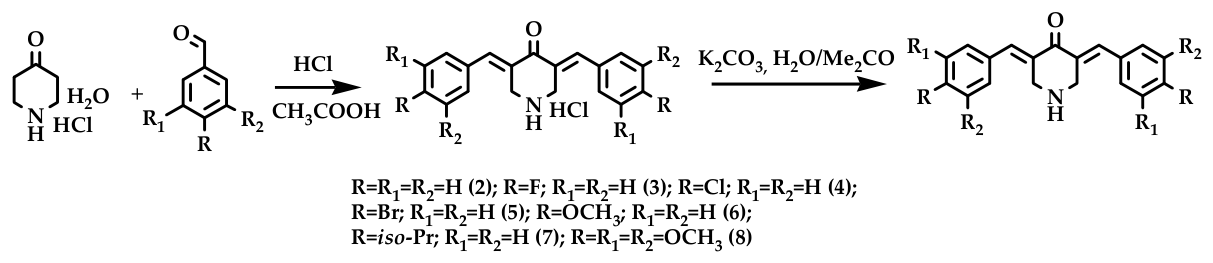
The synthesis of compounds (28) was carried out according to Scheme 1. The target 3,5-bis(benzylidene)-4-piperidones (28) were obtained by Claisen–Schmidt condensation from 4-piperidone monohydrate hydrochloride and the corresponding aldehyde in the presence of gaseous hydrogen chloride in acetic acid according to the procedure presented in the work [37]. The yield of products 28 was 65–70%.
The structure of compounds 28 was determined by 1H and 13C NMR spectroscopy. Thus, a singlet signal in the 8.2 ppm region indicates the presence of protons in the sp2-hybridized carbon atom. Signals from protons of the aromatic ring are present in the range of 8.1–7.4 ppm, and signals from methylene protons of the piperidone ring are located in the range of 4.5 ppm. 13C NMR spectra confirm the structure of compounds 28. For example, for compound 2, a signal in the range of 188.02 ppm is present in the spectra, belonging to the C=O group. The signals of atoms in the range of 134.98 ppm (s, C=) and 136.02 ppm (s, CH=) belong to carbon atoms of the double bond. The signals of aromatic carbon atoms are located at 128–135 ppm. A singlet with a chemical shift of 46.71 ppm indicates the presence of an NCH2 fragment in the molecule. The spectral data for compounds 26 correspond to the literature data [37].
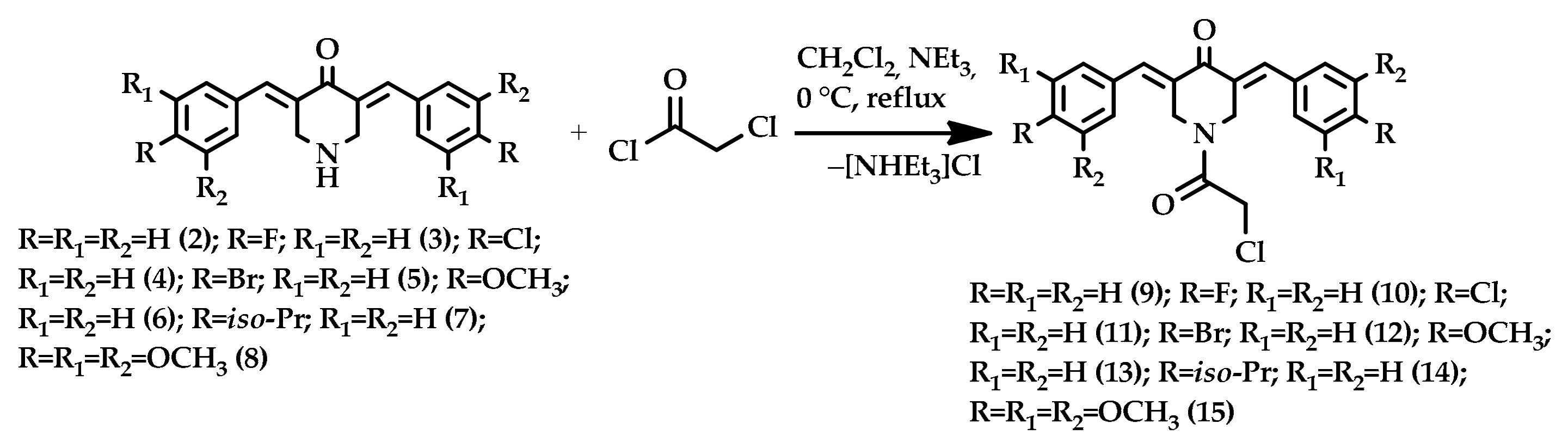
In the next step, to obtain N-acylated derivatives, 3,5-bis(benzylidene)-4-piperidones 28 were condensed using chloroacetyl chloride (Scheme 2). The acylation reaction was carried out in dichloromethane in the presence of triethylamine as a base according to the previously described procedure [44,45]. Since the acylation reaction is exothermic, a solution of 3,5-bis(benzylidene)-4-piperidones 28 and triethylamine in dichloromethane was first cooled to 0 °C. Then, chloroacetyl chloride was added dropwise with stirring to a solution of 3,5-bis(benzylidene)-4-piperidones 28 and triethylamine in dichloromethane (molar ratio of piperidone: chloroacetyl chloride 1:1.5). The reaction was then carried out with the solvent boiling. The reaction progress was monitored by thin-layer chromatography (eluent: CHCl3:CH3OH/10:0.3). The yield of target compounds 915 was 74–80%.
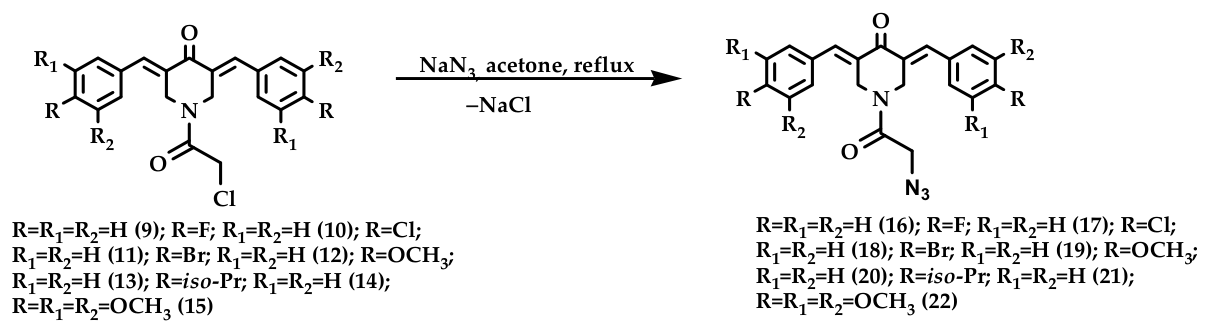
In the third step, 3,5-bis(benzylidene)-1-(2-chloroacetyl)piperidin-4-ones 915 were treated with sodium azide (piperidone/sodium azide molar ratio 1/3) in boiling acetone or acetonitrile (Scheme 3). The reaction progress was monitored using thin-layer chromatography (CHCl3:CH3OH/10:0.08, v/v). The target azides 1622 were isolated by column chromatography (eluent: CHCl3:CH3OH/100:0.8, v/v). The resulting azides 1622 were crystalline substances that decomposed with the release of nitrogen. The structures of the obtained compounds 1622 were confirmed by spectral methods (1H, 13C, 19F NMR spectroscopy, ESI-MS mass spectrometry and IR spectroscopy, Supplementary Materials, Figures S1–S22). In the 1H NMR spectra of azides 1622, a shift in the signals of the C(O)CH2 group protons to a strong field was observed compared to the starting piperidones 28. The IR spectra of the obtained compounds 1622 showed characteristic bands of the stretching vibrations of the azide group (e.g., for azide 16, in the region of 2108 cm–1).
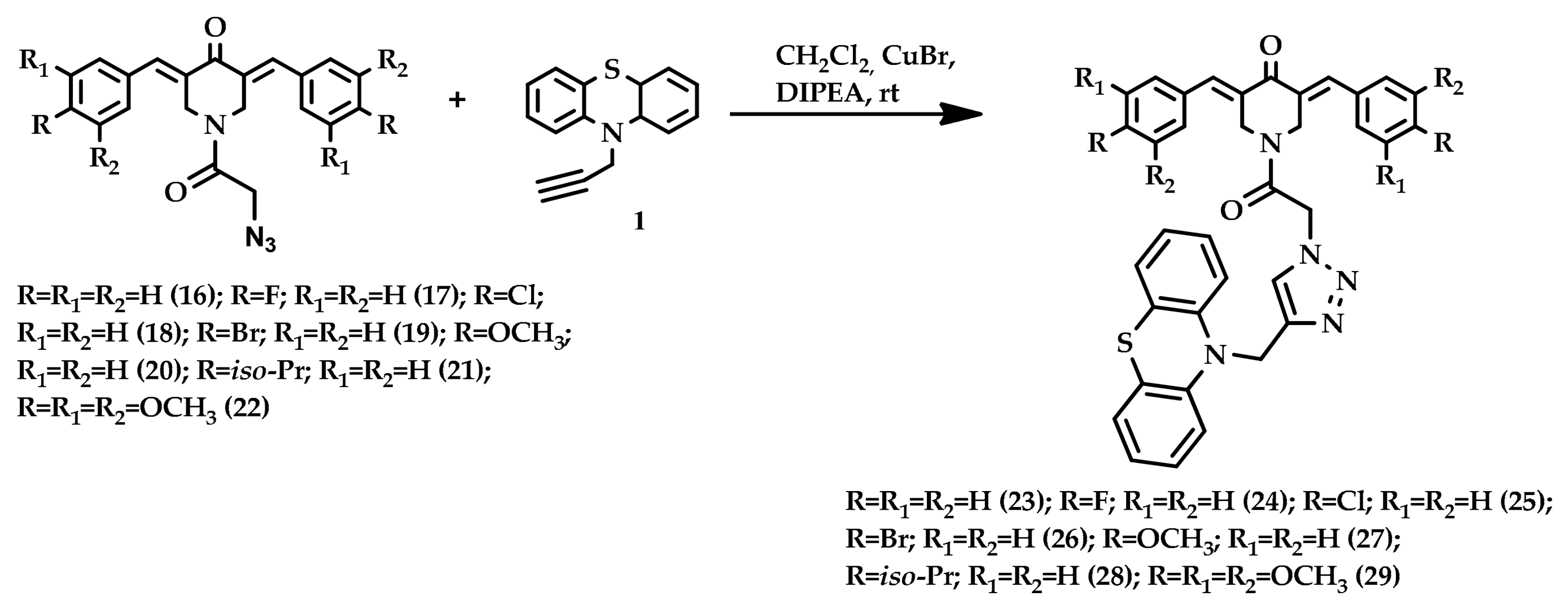
The method chosen for synthesizing conjugates containing the 1,2,3-triazole ring was the “click” chemistry method, which consists of the azide-alkyne cycloaddition reaction of 1-(2-azidoacetyl)-3,5-bis(benzylidene)-piperidin-4-one 1622 and 10-(prop-2-yn-1-yl)-10H-phenothiazine 1, previously synthesized according to a known method [43], in a methylene chloride medium in the presence of catalytic amounts of 5 mol.% CuBr and 10 mol.% DIPEA (Scheme 4). The reaction was carried out at room temperature. The reaction progress was monitored by TLC (CHCl3:CH3OH/10:0.15, v/v). The target conjugates 1622 were isolated in pure form by column chromatography (eluent: CHCl3:CH3OH/100:1.5) in moderate yields (30–40%). The choice of this method is due to the greater nucleophilicity of the nitrogen atom of the piperidone ring compared to the nitrogen atom of phenothiazine and the possibility of carrying out acylation at the nitrogen atom under milder conditions.
The structure of conjugates 2329 was confirmed by NMR (1H, 13C, 19F) and ESI-MS mass spectrometry (see Supplementary Materials, Figures S23–S43). The proton and carbon signals in the 1H and 13C NMR spectra of compounds 2329 confirm the formation of a 1,4-disubstituted 1,2,3-triazole ring with a 3E,5E configuration of the double bonds in the 3,5-bis(benzylidene)piperidin-4-one moiety.
For compound 23, the signals of the methylene CH2 groups of phenothiazine and the CH2 group bound to the carbonyl C(O) at the nitrogen atom of the piperidone ring are present in the 1H NMR spectrum in the region of 4.98 and 5.19 ppm, respectively. In turn, the signals of the protons of the phenothiazine skeleton are in the region of 6.75–7.11 ppm. The singlet signal of the proton of the 1,2,3-triazole ring in the region of 7.45 ppm was clearly distinguishable in the 1H NMR spectrum of compound 29, which contains a 3,4,5-trimethoxyl radical at the aromatic ring.
It should also be noted that the obtained compounds 1622 and 2329 represent two isomers (rotamers) in deuterochloroform solution. The formation of isomers corresponds to the literature data for amides [46,47]. The presence of two isomers is indicated by the doubling of the signals of the protons and carbons of the methylene groups of the N-CH2 piperidin-4-onium ring due to their magnetic non-equivalence in the 1H and 13C NMR spectra of compounds 1622 and 2329, as well as the presence of two singlet signals in the 19F NMR spectrum of compounds 17 and 24 (see Supplementary Materials).
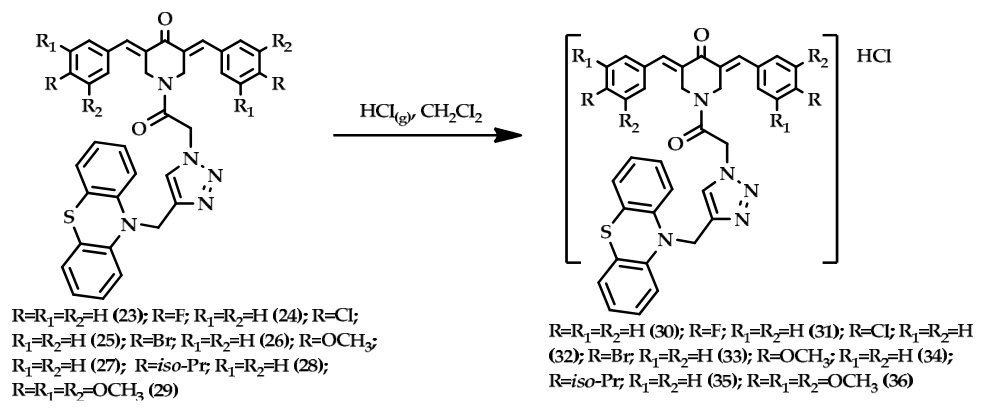
In addition to the obtained conjugates 2329, we decided to synthesize their hydrochloride salts. Salts 3036 were obtained by bubbling hydrogen chloride through a solution of compounds 2329 in dichloromethane, followed by removal of the solvent (Scheme 5). We confirmed the preservation of the conjugate structure after treatment with hydrogen chloride using 1H and 13C NMR spectroscopy (Figures S44–S53, Supplementary Materials). ESI-MS was not used to study the structure of salts 3036. Changes in the chemical shifts in the carbon atom signals in the 13C NMR spectrum may indicate the formation of salts. For example, for compound 29 and salt 36, the signal for the carbon of the methylene group at phenothiazine is observed at 50.86 and 54.18 ppm (a difference of 3.32 ppm), the carbon of the methylene group at carbonyl C(O) at 46.52 and 52.23 (a difference of 5.71 ppm), and the carbon of the methylene group of the piperidone ring at 44.93 and 51.73 (a difference of 6.8 ppm). For further biological screening, salts 3036 were used without additional purification.
Thus, we have developed a method for synthesizing a series of new hybrid molecules containing two pharmacophores: 3,5-bis(benzylidene)-4-piperidone and a phenothiazine moiety.

2.2. Biological Evaluation

In the first stage of the study, we assessed the cytotoxic properties of the parent piperidones 28 and their phenothiazine conjugates 2329 against the pancreatic adenocarcinoma cell line Panc-1.
Curcumin was selected as a positive control for the cytotoxic activity of the synthesized 3,5-bis(arylidene)-4-piperidones—a natural biphenylylhexanoid serving as a structural prototype for the tested compounds due to the presence of conjugated α,β-unsaturated carbonyl fragments and aromatic substituents, with a well-documented anti-tumor effect across panels of cancer cell lines. This choice ensures validation of result reproducibility in the employed cellular models (positive correlation with literature data) and enables quantitative extrapolation of the advantages of chemical modifications of piperidones relative to the natural analog.
As shown in Table 1, the vast majority of the synthesized hybrid molecules exhibited more pronounced cytotoxicity than the parent piperidones. Specifically, the IC50 value (the concentration inducing a 50% reduction in cell viability) for the conjugates was achieved at concentrations 2–3 times lower than those for the piperidones.
Therefore, it was advisable to conduct further, expanded studies of the cytotoxic effect specifically for the conjugates that demonstrated the most pronounced activity.
The cytotoxic profile of the synthesized compounds was evaluated on a panel of human cancer cell lines representing aggressive and treatment-resistant malignancies: bladder cancer (T-24), glioblastoma (T98G), and breast cancer (BT-20). A human dermal fibroblast cell line (DF-1) was used to assess potential selectivity. The results, expressed as half-maximal inhibitory concentrations (IC50) after 72 h of exposure to the test compounds, are presented in Table 2.
Using a structure-activity relationship, we found that the nature of the substituents in the 3,5-bis(benzylidene) fragment of the piperidone ring critically determines the degree of cytotoxic action of the molecules. Thus, conjugates containing a bromine atom (26, 33), single methoxy group (27, 34), and an isopropyl group (28, 35) were completely inactive (IC50 > 30 μM) at the maximum concentration used against all cell lines tested. Apparently, this may be due to several factors: (1) electronic effects—Br, being a weakly electron-withdrawing halogen, provides weak double bond acceptability compared to Cl/F; the single methoxy group provides an insufficient donor effect, thereby insufficiently activating the bis-benzylidene fragment for nucleophilic interaction with protein thiols, which is often considered as the mechanism of the cytotoxic action of piperidones; (2) steric hindrance—the isopropyl group and Br, being large fragments, can hinder the conformation of the molecule and its access to the biotarget; and (3) reduced solubility in aqueous media due to increased lipophilicity and, as a consequence, reduced solubility in aqueous media of cell cultures, hindering penetration through membranes in contrast to the more polar Cl/F and methoxy groups.
A noteworthy result was the observed pronounced cytotoxic effect of hydrochloride salts (compounds 3036) not only in comparison with the parent piperidones 28, but also with their main analogs (compounds 2329) and curcumin. Thus, compound 36 demonstrated a 2.8–4.6-fold increase in activity against cancer cell lines compared with 29. This effect is likely due to the improved physicochemical properties of these molecules. In particular, protonation has made it possible to increase the solubility of a number of already known molecules [48,49] and improve cellular uptake through passive diffusion of an ion pair or active transport mechanisms [50]. In addition, a positive charge can enhance electrostatic interactions with negatively charged phospholipid membranes or biological targets, such as DNA or other specific enzymes.
Furthermore, we noted that none of the studied compounds at the maximum tested concentration of 30 μM significantly affected the viability of normal DF-1 cells (the proportion of viable cells exceeded 50%, and the selectivity index reached >50.8 for 36 on the T-24 cell line), suggesting some selectivity for tumor-derived cells. Thus, the obtained compounds are valuable for the development of antitumor agents with reduced toxicity to normal tissues.

2.3. Docking

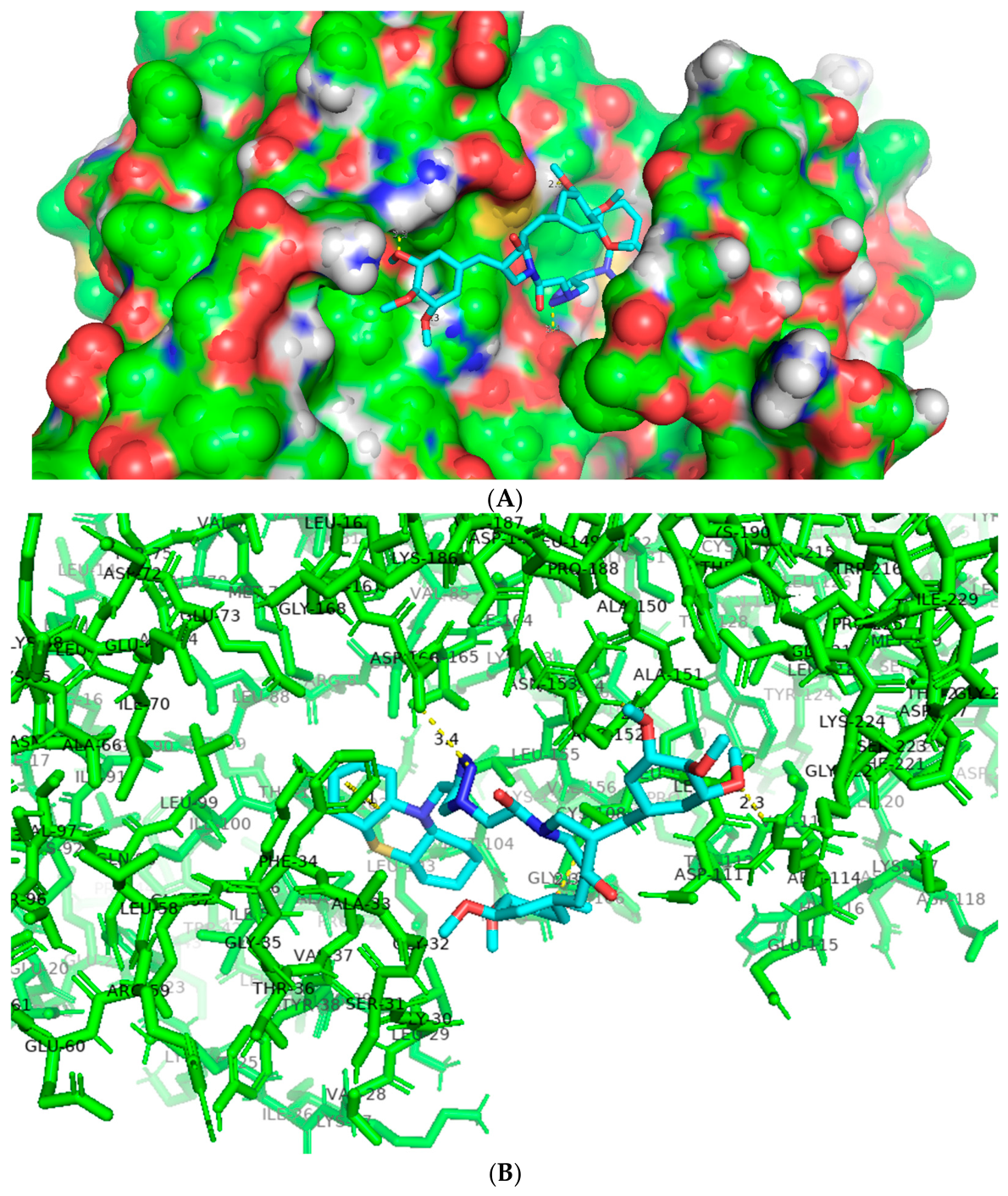
Molecular docking is a computational technique used to predict the most likely binding pose of a ligand to a protein. It is a powerful tool for drug discovery and structural biology. In this study, docking analysis was performed to evaluate the binding behavior of the most bioactive compound (29) among the synthesized amides within the ATP-binding cleft of EGFR tyrosine kinase (PDB ID: 1M14) (Figure 2A,B), a well-established target in cancer therapeutics. As in [40], we used erlatinib as a reference substance. Compound 29 demonstrated a notable binding free energy of −7.4 kcal/mol, which is comparable to that of the reference inhibitor erlotinib (−6.7 kcal/mol). These data suggest that compound 29 has a strong affinity for the EGFR active site and may act as a competitive kinase inhibitor.
In conclusion, the docking results indicate that compound 29 exhibits a strong binding affinity to EGFR in the binding pocket of the clinically used inhibitor erlotinib and demonstrated promising anticancer activity in vitro.

3. Materials and Methods

3.1. Materials

All commercial reagents were used as purchased without further purification; all solvents used in the reactions were freshly distilled from appropriate drying agents before use. Phenothiazine (98%) was purchased from ABCR GmbH (Karlsruhe, Germany). 4-Piperidone monohydrate hydrochloride (98%), propargyl bromide (80% in toluene), d-chloroform (≥99.8%), dimethyl sulfoxide-d6 (≥99.8%), and N,N-diisopropylethylamine (DIPEA, 99.5%) were obtained from Sigma-Aldrich (Saint Louis, MO, USA). Chloroacetyl chloride (98%) was purchased from Acmec (Shanghai Acmec Biochemical Technology Co., Ltd., Fengxian, Shanghai, China). Methanol (≥99.5%) was purchased from Vekton (St. Petersburg, Russia). Chloroform (≥99.85%), dichloromethane (≥99.0%), acetone (≥99.75%), acetonitrile (≥99.7%), triethylamine (≥99.5%), ethyl acetate (≥99%), n-hexane (≥97%), dimethylformamide (DMF, ≥99.95%), hydrochloric acid (35–38%), acetic acid (99.8%), and potassium carbonate (>98%) were purchased from Component-Reactive (Moscow, Russia). Copper (I) bromide (99.9%) was purchased from Ecotec, Ltd. (Moscow, Russia). Sodium sulfate (95%) was purchased from Chemistry 21 century (Moscow, Russia). Dimethyl sulfoxide (DMSO, ≥99.9%) was purchased from WuHan ServiceBio Technology Co., Ltd. (Wuhan, Hubei, China). Sodium azide (99%) was purchased from Ruskhim (Moscow, Russia). Potassium tert-butoxide (99.99%) was purchased from Merck, Ltd. (Darmstadt, Germany).
Analytical TLC was performed on Merck silica gel 60 F254 plates (Merck, Darmstadt, Germany), visualized under UV light (λmax = 254 nm) or by staining with potassium permanganate. Column chromatography was carried out using Merck silica gel (Kieselgel 60, 0.063–0.200 mm, Darmstadt, Germany).

3.2. Synthesis of 10-(Prop-2-yn-1-yl)-10H-phenothiazine (1)

Compound 1 was synthesized according to the literature procedure [51]. A mixture of DMF (2 mL) with phenothiazine (1 mmoL), potassium tertiary butoxide (1.5 mmoL) and propargyl bromide (1.2 mmoL) was stirred for 4 h. Upon completion of the reaction, as controlled by TLC (n-hexane: ethyl acetate, v/v, 9:1), the mixture was extracted twice by 5 mL of ice-cold water–diethyl ether and the combined organic layers were dried by anhydrous Na2SO4. The organic solvent was rotary-evaporated, and the crude product was subjected to column chromatography (n-hexane: ethyl acetate, v/v, 9:1) to afford pure compound 1 as yellowish-brown solid. Yield: 94%. 1H NMR spectrum, δ, ppm: 2.74 (1H, s, CH), 4.58 (2H, s, CH2), 6.735–6.75 (2H, m, Ar-H), 6.97–7.09 (4H, m, Ar-H), 7.28–7.31 (2H, m, Ar-H). 13C NMR spectrum, δ, ppm: 144.18, 129.05, 128.05, 127.43, 124.09, 121.31, 116.12, 98.57, 74.08, 45.89.
Ijms 27 04104 i001

3.3. General Procedure of 3,5-Bis(benzylidene)-4-piperidone (28) Synthesis

Compounds 28 were synthesized according to the literature procedure with some modifications [37]. The appropriate aryl aldehyde (26.71 mmol) was added to a suspension of 4-piperidone monohydrate hydrochloride (13.03 mmol) in glacial acetic acid (35 mL). Hydrogen chloride (prepared from sodium chloride and sulfuric acid) was passed through this mixture for 0.5 h, during which time a clear solution was obtained. After stirring at room temperature for 24 h, the precipitate was collected and added to a mixture of a saturated aqueous potassium carbonate solution (25% w/v, 25 mL) and acetone (25 mL); the resultant mixture was stirred for 0.5 h. The free base was collected, washed with water (50 mL), and dried. The compounds were recrystallized from 95% ethanol. Yields are given for compounds isolated without further purification.
3,5-bis(benzylidene)-4-piperidone (2). The yield of non-recrystallized compound 2 was 80%. 1H NMR, δ: 4.17 (s, 4H, 2CH2); 7.38–7.43 (m, 10H, C6H5); 7.83 (s, 2H). 13C NMR, δ: 46.71 (s, 2CH2), 128.59, 129.11, 130.54, 135.2 (s, 12C, Ph), 134.98 (s, C=), 136.02 (s, CH=), 188.02 (s, C=O) [17].
3,5-bis(4-fluorobenzylidene)-4-piperidone (3). The yield of non-recrystallized compound 3 was 79%. 1H NMR, δ: 4.15 (s, 4H, 2CH2,); 7.10–7.16 (m, 4H, C6H4F); 7.37–7.42 (m, 4H, C6H4F); 7.88 (s, 2H). 13C NMR, δ: 46.62 (s, 2CH2), 115.79 (d, JC–F = 40 Hz, Ar), 131.35 (s, C=),132.46 (d, JC–F = 5 Hz, Ar), 134.54 (s, CH=), 134.92 (s, Ar), 163.45 (d, JC–F = 460 Hz, Ar), 187.69 (s, C=O). 19F NMR, δ: 110. 70 [17].
3,5-bis(4-chlorobenzylidene)-4-piperidone (4). The yield of non-recrystallized compound 4 was 79%. 1H NMR, δ: 4.13 (s, 4H, 2CH2); 7.31–7.42 (m, 8H, C6H5); 7.75 (s, 2H). 13C NMR, δ: 48.15 (s, 2CH2), 129.05, 132.48, 132.76, 134.36 (s, 12C, Ar), 134.41 (s, C=), 137.06 (s, CH=), 187.57 (s, C=O) [17].
3,5-bis(4-bromobenzylidene)-4-piperidone (5). 1H NMR, δ: 4.13 (s, 4H, 2CH2); 7.25–7.58 (m, 8H, C6H5); 7.73 (s, 2H).
3,5-bis(4-methoxybenzylidene)-4-piperidone (6). The yield of non-recrystallized compound 6 was 76%. 1H NMR, δ: 3.87 (s, 6H, 2 OCH3); 4.17 (s, 4H, 2CH2); 6.95–6.97 (m, 4 H, Ar); 7.37–7.39 (m, 4H, Ar); 7.78 (s, 2H). 13C NMR, δ: 48.21 (s, 2CH2), 55.39 (s, 2OCH3); 113.04, 127.98, 132.45, 133.15 (s, 12C, Ar), 135.63 (s, C=), 160.31 (s, CH=), 187.93 (s, C=O) [17].
3,5-bis(4-iso-propylbenzylidene)-4-piperidone (7). The yield of non-recrystallized compound 7 was 75%. 1H NMR, δ: 1.30 (d, 12H, J = 6.0 Hz); 2.96 (six, 2H, J = 6.0 Hz); 4.18 (s, 4H, 2CH2); 7.28–7.37 (m, 8H, Ar); 7.81 (s, 2H). 13C NMR, δ: 23.83 (s, 2CH3), 34.06 (s, 2CH); 48.20 (s, 2CH2), 126.71, 130.78, 132.82, 134.31 (s, 12C, Ar), 135.97 (s, C=), 150.28 (s, CH=), 188.07 (s, C=O) [17].
3,5-bis(3,4,5-trimethoxybenzylidene)-4-piperidone (8). The yield of non-recrystallized compound 8 was 77%. 1H NMR, δ: 3.88, 3.89 (s, 18H, 9 OCH3); 4.19 (s, 4H, 2CH2); 6.61 (s, 4H, Ar); 7.72 (s, 2H). 13C NMR, δ: 23.83 (s, 2CH3), 34.06 (s, 2CH); 48.20 (s, 2CH2), 107.90, 130.65, 134.18, 136.17 (s, 12C, Ar), 139.10 (s, C=), 153.07 (s, CH=), 187.53 (s, C=O) [17].

3.4. General Procedure of (3E,5E)-3,5-Bis(benzylidene)-1-(2-chloroacetyl)piperidin-4-one (915) Synthesis

Compounds 915 were synthesized according to the literature procedure [43,44,52]. A mixture of 28 (0.65 mmoL) and triethylamine (0.975 mmoL) in dichloromethane was maintained at 0 °C (ice bath). To this cooled mixture, chloroacetyl chloride (0.975 mmoL) was added dropwise. After the complete addition of chloroacetyl chloride, the reaction mixture was stirred at reflux. The reaction progress was controlled by TLC (chloroform:methanol 10:0.3, v/v). After completion of the reaction, the solvent was evaporated and the residue thus obtained was washed with water, filtered and dried. The products obtained were pure enough to be used for the subsequent step (74–80% yield).
(3E,5E)-3,5-bis(benzylidene)-1-(2-chloroacetyl)piperidin-4-one (9).1H NMR (DMSO-d6) δ (ppm): 4.35 (s, 2H, CH2Cl), 4.86 (s, 2H, piperidinyl NCH2), 4.89 (s, 2H, piperidinyl NCH2), 7.47–7.75 (m, 12H, 10 arom. H + 2 olefinic CH). 13C NMR (DMSO-d6) δ (ppm): 41.6 (CH2Cl), 42.6, 46.7 (piperidinyl NCH2), 128.8, 129.6, 130.4, 130.7, 131.9, 134.2, 136.4, 136.5 (arom. C + olefinic C), 165.0 (acyl CO), 185.8 (piperidinyl CO) [52].
(3E,5E)-3,5-bis(4-fluorobenzylidene)-1-(2-chloroacetyl)piperidin-4-one (10). 1H NMR (500 MHz, DMSO-d6) δ (ppm): 4.37 (s, 2H, CH2Cl), 4.84 (s, 2H, piperidinyl NCH2), 4.86 (s, 2H, piperidinyl NCH2), 7.35 (t, J = 8.7 Hz, 4H, arom. H), 7.64–7.72 (m, 6H, 4 arom. H + 2 olefinic CH). 13C-NMR (125 MHz, DMSO-d6) δ (ppm): 41.5 (CH2Cl), 42.5, 46.5 (piperidinyl NCH2), 115.7, 115.9, 130.71, 130.73, 131.6, 131.7, 132.8, 133.0, 135.2, 135.4, 161.5, 163.5 (arom. C + olefinic C), 165.0 (acyl CO), 185.6 (piperidinyl CO) [52].
(3E,5E)-3,5-bis(4-chlorobenzylidene)-1-(2-chloroacetyl)piperidin-4-one (11). 1H NMR (DMSO-d6) δ (ppm): 4.36 (s, 2H, CH2Cl), 4.83 (s, 2H, piperidinyl NCH2), 4.85 (s, 2H, piperidinyl NCH2), 7.56–7.70 (m, 10H, 8 arom. H + 2 olefinic CH). 13C NMR (DMSO-d6) δ (ppm): 41.5 (CH2Cl + piperidinyl NCH2), 128.8, 132.4, 133.0, 134.3 (arom. C + olefinic C), 165.0 (acyl CO), 185.5 (piperidinyl CO) [52].
(3E,5E)-3,5-bis(4-bromobenzylidene)-1-(2-chloroacetyl)piperidin-4-one (12).
1H NMR (500 MHz, DMSO-d6) δ (ppm): 4.36 (s, 2H, CH2Cl), 4.80 (s, 2H, 2 piperidinyl NCH2), 4.84 (s, 2H, 2 piperidinyl NCH2), 7.51–7.52 (m, 4H, arom. H), 7.63–7.71 (m, 6H, 4 arom. H + 2 olefinic CH). 13C NMR (125 MHz, DMSO-d6) δ (ppm): 41.6 (CH2Cl + piperidinyl NCH2), 123.2, 131.8, 132.6, 133.4 (arom. C + olefinic C), 165.1 (acyl CO), 185.6 (piperidinyl CO) [52].
(3E,5E)-3,5-bis(4-methoxybenzylidene)-1-(2-chloroacetyl)piperidin-4-one (13). 1H NMR (500 MHz, CDCl3) δ (ppm): 3.82 (s, 6H), 3.92 (s, 2H), 4.75 (s, 2H), 4.88 (s, 2H), 6.93 (d, 2H), 6.96 (d, 2H), 7.33 (d, 2H), 7.41 (d, 2H), 7,77 (s, 1H), 7.80 (s, 1H). 13C NMR (125 MHz, CDCl3) δ (ppm): 40.9, 44.1, 47.0, 55.4, 114.4, 114.5, 127.0, 127.3, 128.9, 129.1, 132.2, 132.7, 137.4, 138.4, 160.9, 165.2, 185.8 [45].
(3E,5E)-3,5-bis(4-isopropylbenzylidene)-1-(2-chloroacetyl)piperidin-4-one (14). 1H NMR (300 MHz, CDCl3) δ (ppm): 1.24 (s, 6H, CH3 isopropyl), 2.91 (m, 2H, CH isopropyl), 3.94 (s, 2H, CH2Cl), 4.78 (s, 2H, 2 piperidinyl NCH2), 4.89 (s, 2H, 2 piperidinyl NCH2), 7.25–7.35 (m, 8H, arom. H), 7.79 (s, 1H), 7.81 (s, 1H).
(3E,5E)-3,5-bis(3,4,5-trimethoxybenzylidene)-1-(2-chloroacetyl)piperidin-4-one (15). 1H NMR (400 MHz, CDCl3): δ 3.91 (s, 18H), 3.97 (s, 2H), 4.89 (s, 2H), 4.94 (s, 2H), 6.64 (s, 2H), 6.72 (s, 2H), 7.78 (s, 1H), 7.81 (s, 1H) [44].

3.5. General Procedure of (3E,5E)-1-(2-Azidoacetyl)-3,5-bis(benzylidene)-piperidin-4-ones (1622) Synthesis

The sodium azide (10.86 mmoL) was added to the solution of compounds 915 (3.62 mmoL) in acetone or acetonitrile (15 mL). The reaction was carried out with stirring at reflux. Reaction progress was controlled by TLC (chloroform: methanol 10:0.08, v/v). The solution was separated from the precipitate. Acetonitrile was removed under vacuum. Azides were obtained in quantitative yield. The products were purified by column chromatography (eluent: chloroform/methanol 100:0.8, v/v).
(3E,5E)-1-(2-azidoacetyl)-3,5-bis(benzylidene)-piperidin-4-one (16)
Ijms 27 04104 i002
M.p. > 165 °C (decomposition with release of N2 gas). 1H NMR (300 MHz, CDCl3) δ (ppm): 7.86, 7.89 (2H, s, H-7), 7.37–7.45 (10H, m, H-1, H-2, H-3, H-4, H-5), 4.62, 4.94 (4H, s, H-10), 3.73 (2H, s, H-12). 13C NMR (100 MHz, CDCl3) δ (ppm): 185.80 (C9), 166.06 (C11), 138.98 (C7), 137.90 (C8), 134.10–134.39 (C6), 130.97, 130.68, 130.14, 129–83-129.92 (C3), 128.88–129.03, 49.51 (C12), 43.72–45.45 (C10). IR (KBr, ν/cm−1): 2108 (N3), 1672, 1655, 1606 and 1571 (C=O), 1491, 1468, 1275, 1232, 1175, 986, 779, 701,691, 639, 514. HRMS (ESI+) of C21H18N4O2, m/z: calcd for [M+H]+ 359.1503, found 359.1506.
(3E,5E)-1-(2-azidoacetyl)-3,5-bis(4-fluorobenzylidene)-piperidin-4-one (17)
Ijms 27 04104 i003
M.p. ˃ 80°C (decomposition with release of N2 gas). 1H NMR (300 MHz, CDCl3) δ (ppm): 7.72, 7.75 (2H, s, H-7), 7.08–7.39 (8H, m, H-1, H-2, H-4, H-5), 4.62, 4.87 (4H, s, H-10), 3.83 (2H, s, H-12). 13C NMR (100 MHz, CDCl3) δ (ppm): 185.52 (C9), 166.12 (C11), 164.49, 161.98, 137.51 (C7), 136.62 (C8), 132.35–132.76 (C6), 130.53, 130.23, 116.12–116.26, 45.58 (C12), 43.63–45.58 (C10). 19F NMR, δ (ppm): −108.98, −109.31. IR (KBr, ν/cm−1):2108 (N3), 1661, 1615, 1600 and 1508 (C=O), 1455, 1273, 1230, 1159, 1099, 990, 836, 529. HRMS (ESI+) of C21H16F2N4O2, m/z: calcd for [M+H]+395.1314, found 395.1319.
(3E,5E)-1-(2-azidoacetyl)-3,5-bis(4-chlorobenzylidene)-piperidin-4-one (18)
Ijms 27 04104 i004
M.p. ˃ 157. °C (decomposition with release of N2 gas). 1H NMR (300 MHz, CDCl3) δ (ppm): 7.79, 7.83 (2H, s, H-7), 7.29–7.45 (8H, m, H-1, H-2, H-4, H-5), 4.62, 4.91 (4H, s, H-10), 3.78 (2H, s, H-12). 13C NMR (100 MHz, CDCl3) δ (ppm): 185.62 (C9), 166.06 (C11), 137.90 (C7), 136.89 (C8), 136.17–136.79, 132.92–133.12 (C6), 132.18–132.34, 132.01, 131.23–131.54, 124.53, 50.56 (C12), 43.80–45.69 (C10). IR (KBr, ν/cm−1): 2102 (N3), 1675, 1657, 1612 and 1587 (C=O), 1492, 1464, 1407, 1274, 1260, 1232, 1172,1096, 1013, 990, 839, 522. HRMS (ESI+) of C21H16Cl2N4O2, m/z: calcd for [M+H]+427.0723, found 427.0725.
(3E,5E)-1-(2-azidoacetyl)-3,5-bis(4-bromobenzylidene)-piperidin-4-one (19)
Ijms 27 04104 i005
M.p. ˃ 168. °C (decomposition with release of N2 gas). 1H NMR (300 MHz, CDCl3) δ (ppm): 7.80, 7.84 (2H, s, H-7), 7.26–7.63 (8H, m, H-1, H-2, H-4, H-5), 4.62, 4.92 (4H, s, H-10), 3.77 (2H, s, H-12). 13C NMR (100 MHz, CDCl3) δ (ppm): 185.57 (C9), 165.85 (C11), 137.86 (C7), 136.79 (C8), 136.17–136.79, 132.47–132.74 (C6), 131.82, 131.33, 131.14, 129.21–129.40, 50.02 (C12), 43.69–45.69 (C10). IR (KBr, ν/cm−1): 2101 (N3), 1672, 1656, 1611 and 1582 (C=O), 1488, 1466, 1402, 1280, 1258, 1227, 1167, 1073, 1009, 991, 836, 826, 518. HRMS (ESI+) of C21H16Br2N4O2, m/z: calcd for [M+H]+516.9693, found 516.9695.
(3E,5E)-1-(2-azidoacetyl)-3,5-bis(4-methoxybenzylidene)-piperidin-4-one (20)
Ijms 27 04104 i006
M.p. ˃ 147. °C (decomposition with release of N2 gas). 1H NMR (300 MHz, CDCl3) δ (ppm): 7.71 (2H, s, H-8), 6.88–7.32 (8H, m, H-1, H-2, H-5, H-6), 4.53, 4.82 (4H, s, H-11), 3.77 (2H, s, H-13). 13C NMR (100 MHz, CDCl3) δ (ppm): 185.30 (C10), 166.05 (C12), 160.82, 137.26–138.23 (C8), 132.24–132.77 (C9), 128.94, 126.70–127.15, 114.33–114.48, 55.57 (C4), 49.74 (C13), 44.19–46.18 (C11). IR (KBr, ν/cm−1): 2108 (N3), 1678, 1655, 1595 and 1567 (C=O), 1511, 1456, 1423, 1263, 1169, 1031, 993, 823, 529. HRMS (ESI+) of C23H22N4O4, m/z: calcd for [M+H]+419.1714, found 419.1720.
(3E,5E)-1-(2-azidoacetyl)-3,5-bis(4-isopropylbenzylidene)-piperidin-4-one (21)
Ijms 27 04104 i007
M.p. ˃ 110 °C (decomposition with release of N2 gas). 1H NMR (300 MHz, CDCl3) δ (ppm): 7.83, 7.85 (2H, s, H-9), 7.26–7.38 (8H, m, H-1, H-2, H-6, H-7), 4.63, 4.93 (4H, s, H-12), 3.77 (2H, s, H-14), 2.92–2.97 (2H, m, H-4), 1.27, 1.28 (14H, s, H-5, H-14). 13C NMR (100 MHz, CDCl3) δ (ppm): 186.07 (C11), 166.36 (C13), 151.04–151.16, 138.88–139.03, 137.80–137.96, 131.66–132.04, 131.00, 130.49, 130.13–130.19, 126.99–127.18, 50.25 (C14), 44.00–45.73 (C12), 34.05–34.12 (C5), 23.65–23.93 (C4). IR (KBr, ν/cm−1): 2961 (CH), 2871, 2105 (N3), 1660, 1606, 1575 and 1509 (C=O), 1459, 1419, 1276, 1232, 1175, 1056, 1017, 992, 834, 559. HRMS (ESI+) of C27H30N4O2, m/z: calcd for [M+H]+ 443.2442, found 443.2447.
(3E,5E)-1-(2-azidoacetyl)-3,5-bis(3,4,5-trimethoxybenzylidene)-piperidin-4-one (22)
Ijms 27 04104 i008
M.p. ˃ 180 °C (decomposition with release of N2 gas). 1H NMR (300 MHz, CDCl3) δ (ppm): 7.71 (2H, s, H-9), 6.54–6.66 (4H, s, H-1, H-7), 4.66–4.90 (4H, s, H-12), 3.86 (18H, s, H-4, H-5), 3.82 (2H, s, H-14). 13C NMR (100 MHz, CDCl3) δ (ppm): 185.80 (C11), 166.07 (C13), 153.23–153.35, 138.12–139.72, 129.85–130.16, 107.68–107.96, 60.95 (C5), 56.25 (C4), 50.50 (C14), 40.91–45.96 (C12). IR (KBr, ν/cm−1): 2110 (N3), 1648, 1602, 1580 and 1507 (C=O), 1449, 1435, 1419, 1274, 1254, 1161, 1132, 1034, 999, 830, 622, 594. HRMS (ESI+) of C27H30N4O8, m/z: calcd for [M+H]+ 539.2137, found 539.2144; for [M+Na]+ 561.1956, found 561.1962.

3.6. General Procedure of (3E,5E)-1-(2-(4-((10H-Phenothiazine-10-yl)methyl)-1H-1,2,3-triazol-1-yl)acetyl)-3,5-bis(benzylidene)-piperidin-4-ones (2329) Synthesis

To a stirred mixture of 10-(prop-2-yn-1-yl)-10H-phenothiazine 1 (0.2 mmoL, 1.0 eq.) and the corresponding azides 1622 (0.2 mmoL, 1.0 eq.) in methylene chloride CH2Cl2 (5 mL), copper(I) bromide (0.01 mmoL, 5 mol.%) and DIPEA (0.02 mmol, 10 mol.%) were added. The solution obtained was stirred at room temperature (TLC monitoring). The solvent was removed in vacuo, and the remaining crude product was purified via column chromatography (chloroform:methanol 100:1.5 (v/v) for compounds 2328 and 100:2.5 (v/v) for compound 29).
(3E,5E)-1-(2-(4-((10H-phenothiazine-10-yl)methyl)-1H-1,2,3-triazol-1-yl)acetyl)-3,5-bis(benzylidene-piperidin-4-one (23)
Ijms 27 04104 i009
M.p. = 170–173 °C. 1H NMR (300 MHz, CDCl3) δ (ppm): 7.87, 7.94 (2H, s, H-5), 7.40–7.50 (11H, m, H-1, H-2, H-3, H-11), 6.75–7.11 (8H, m, H-15, H-16, H-17, H-18), 5.19 (2H, s, H-10), 4.98 (2H, s, H-13), 4.90, 4.74 (4H, s, H-8). 13C NMR (100 MHz, CDCl3) δ (ppm): 185.52 (C7), 163.51 (C9), 144.27–145.09 (C5), 138.45–139.36 (C6), 129.86–130.65, 128.87–129.22, 127.14–127.43, 123.82–124.12, 122.84, 115.22, 50.77 (C13), 45.87 (C10), 44.88, 44.08 (C8). HRMS (ESI+) of C36H30N5O2S, m/z: calc for [M+H]+ 596.2115, found 596.2097; for [M+Na]+ 618.1934, found 618.1928.
(3E,5E)-1-(2-(4-((10H-phenothiazine-10-yl)methyl)-1H-1,2,3-triazol-1-yl)acetyl)-3,5-bis(4-fluorobenzylidene)-piperidin-4-one (24)
Ijms 27 04104 i010
M.p. = 177–180 °C. 1H NMR (300 MHz, CDCl3) δ (ppm): 7.77, 7.83 (2H, s, H-5), 7.41–7.62 (8H, m, H-2, H-3), 6.75–7.11 (9H, m, H-15, H-16, H-17, H-18, H-11), 5.20 (2H, s, H-10), 5.01 (2H, s, H-13), 4.83, 4.70 (4H, s, H-8). 13C NMR (100 MHz, CDCl3) δ (ppm): 185.29 (C7), 163.56 (C9), 144.20 (C5), 137.27–138.02 (C6), 132.65, 132.56, 130.07, 127.38, 127.16, 123.94, 122.81, 116.58, 116.21, 115.99, 115.27, 50.97 (C13), 45.97 (C10), 44.78, 43.82 (C8). 19F NMR, δ (ppm): −108.51, −109.17. HRMS (ESI+) of C36H27F2N5O2S, m/z: calc for [M+H]+ 632.1926, found 632.1913; for [M+Na]+ 654.1746, found 654.1739.
(3E,5E)-1-(2-(4-((10H-phenothiazine-10-yl)methyl)-1H-1,2,3-triazol-1-yl)acetyl)-3,5-bis(4-chlorobenzylidene)-piperidin-4-one (25)
Ijms 27 04104 i011
M.p. = 190–191 °C. 1H NMR (300 MHz, CDCl3) δ (ppm): 7.77, 7.85 (2H, s, H-5), 7.33–7.49 (9H, m, H-2, H-3, H-11), 6.74–7.11 (8H, m, H-15, H-16, H-17, H-18), 5.19 (2H, s, H-10), 5.02 (2H, s, H-13), 4.83, 4.71 (4H, s, H-8). 13C NMR (100 MHz, CDCl3) δ (ppm): 185.27 (C7), 163.55 (C9), 144.29–144.35 (C5), 137.50–137.74 (C6), 129.52, 129.21, 127.38, 127.17, 124.05, 123.89, 122.82, 115.16, 50.89 (C13), 45.97 (C10), 44.65, 43.87 (C8). HRMS (ESI+) of C36H27Cl2N5O2S, m/z: calcd for [M+H]+ 664.1319, found 664.1335; for [M+Na]+ 686.1146, found 686.1155.
(3E,5E)-1-(2-(4-((10H-phenothiazin-10-yl)methyl)-1H-1,2,3-triazol-1-yl)acetyl)-3,5-bis(4-bromobenzylidene)-piperidin-4-one (26)
Ijms 27 04104 i012
M.p. = 225–228 °C. 1H NMR (300 MHz, CDCl3) δ (ppm): 7.78, 7.85 (2H, s, H-5), 7.51–7.64 (8H, m, H-2, H-3), 7.12 (1H, s, H-11), 6.75–7.10 (8H, m, H-15, H-16, H-17, H-18), 5.21 (2H, s, H-10), 5.01 (2H, s, H-13), 4.84, 4.71 (4H, s, H-8). HRMS (ESI+) of C36H27Br2N5O2S, m/z: calcd for [M+H]+ 754.0305, found 754.0291; for [M+Na]+ 776.0124, found 776.0126.
(3E,5E)-1-(2-(4-((10H-phenothiazine-10-yl)methyl)-1H-1,2,3-triazol-1-yl)acetyl)-3,5-bis(4-methoxybenzylidene)-piperidin-4-one (27)
Ijms 27 04104 i013
M.p. = 209–212 °C. 1H NMR (300 MHz, CDCl3) δ (ppm): 7.76, 7.82 (2H, s, H-6), 6.73–7.69 (17H, m, H-3, H-4, H-12, H-16, H-17, H-18, H-19), 5.16 (2H, s, H-11), 5.03 (2H, s, H-14), 4.84, 4.70 (4H, s, H-9), 3.86 (6H, s, H-1). 13C NMR (100 MHz, CDCl3) δ (ppm): 185.55 (C8), 161.02 (C10), 144.18–145.00 (C6), 137.82–138.69 (C7), 128.49, 127.10–127.40, 127.02, 124.24, 123.70, 122.76, 55.43 (C1), 50.78 (C14), 45.98 (C11), 44.89, 44.08 (C9). HRMS (ESI+) of C38H33N5O4S, m/z: calcd for [M+H]+ 656.2326, found 656.2315; for [M+Na]+ 678.2145, found 678.2139.
(3E,5E)-1-(2-(4-((10H-phenothiazine-10-yl)methyl)-1H-1,2,3-triazol-1-yl)acetyl)-3,5-bis(4-isopropylbenzylidene)-piperidin-4-one (28)
Ijms 27 04104 i014
M.p. = 165–170 °C. 1H NMR (300 MHz, CDCl3) δ (ppm): 7.93, 7.99 (2H, s, H-7), 6.84–7.51 (17H, m, H-4, H-5, H-13, H-17, H-18, H-19, H-20), 5.29 (2H, s, H-12), 5.15 (2H, s, H-15), 4.98, 4.85 (4H, s, H-10), 2.99–3.10 (2H, m, H-2), 1.37 (6H, d, H-1). 13C NMR (100 MHz, CDCl3) δ (ppm): 185.58 (C9), 163.45 (C11), 151.10–151.39 (C7), 144.15 (C8), 138.36–139.19, 130.60–130.89, 126.99–127.39, 122.78–123.80, 115.25, 50.86 (C15), 46.02 (C12), 44.11, 44.87 (C10), 34.10 (C2), 23.77 (C1). HRMS (ESI+) of C42H41N5O2S, m/z: calcd for [M+H]+ 680.3054, found 680.3044; for [M+Na]+ 702.2873, found 702.2866.
(3E,5E)-1-(2-(4-((10H-phenothiazine-10-yl)methyl)-1H-1,2,3-triazol-1-yl)acetyl)-3,5-bis(3,4,5-trimethoxybenzylidene)-piperidin-4-one (29)
Ijms 27 04104 i015
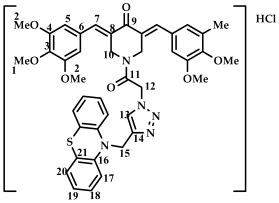
M.p. = 165–167 °C. 1H NMR (300 MHz, CDCl3) δ (ppm): 7.76, 7.84 (2H, s, H-7), 7.45 (1H, s, H-13), 6.61–7.10 (12H, m, H-5, H-17, H-18, H-19, H-20), 5.19 (2H, s, H-12), 5.06 (2H, s, H-15), 4.90, 4.83 (4H, s, H-10), 3.87, 3.90, 3.93 (18H, s, H-1, H-2). 13C NMR (100 MHz, CDCl3) δ (ppm): 185.06 (C9), 163.88 (C11), 153.06 (C7), 144.08–145.46 (C8), 138.46–139.51, 129.75, 127.32, 124.07, 123.52, 122.72, 115.12, 107.77, 61.21 (C1), 56.54 (C2), 50.86 (C15), 46.52 (C12), 44.13, 44.93 (C10). HRMS (ESI+) of C42H41N5O8S, m/z: calcd for [M+H]+ 776.2749, found 776.2741; for [M+Na]+ 798.2568, found 798.2562.

3.7. General Procedure of (3E,5E)-1-(2-(4-((10H-Phenothiazine-10-yl)methyl)-1H-1,2,3-triazol-1-yl)acetyl)-3,5-bis(benzylidene)-piperidin-4-one Hydrochlorides (3036) Synthesis

To obtain the hydrochloride salts, piperidones 2329 were dissolved in methylene chloride and hydrogen chloride, obtained by heating hydrochloric acid, which was passed into the solution until the pH of the solution reached 1. After the desired pH was reached, the methylene chloride was removed under vacuum until constant weight. The product was used for further studies without further purification.
(3E,5E)-1-(2-(4-((10H-phenothiazine-10-yl)methyl)-1H-1,2,3-triazol-1-yl)acetyl)-3,5-bis(benzylidene)-piperidin-4-one hydrochloride (30)
Ijms 27 04104 i016
M.p. = 170–173 °C. 1H NMR (300 MHz, CDCl3) δ (ppm): 7.87, 7.94 (2H, br. s, H-5), 7.43–7.47 (11H, br. m, H-1, H-2, H-3, H-11), 6.74–7.11 (8H, br. m, H-15, H-16, H-17, H-18), 5.19 (2H, br. s, H-10), 4.98 (2H, br. s, H-13), 4.90, 4.74 (4H, br. s, H-8).
(3E,5E)-1-(2-(4-((10H-phenothiazine-10-yl)methyl)-1H-1,2,3-triazol-1-yl)acetyl)-3,5-bis(4-fluorobenzylidene)-piperidin-4-one hydrochloride (31)
Ijms 27 04104 i017
M.p. = 148–152 °C. 1H NMR (300 MHz, CDCl3) δ (ppm): 7.89, 7.82 (2H, br. s, H-5), 7.22–7.41 (9H, br. m, H-2, H-3, H-11), 6.76–7.12 (8H, br. m, H-15, H-16, H-17, H-18), 5.23 (2H, br. s, H-10), 5.08 (2H, br. s, H-13), 4.86, 4.74 (4H, br. s, H-8).
(3E,5E)-1-(2-(4-((10H-phenothiazine-10-yl)methyl)-1H-1,2,3-triazol-1-yl)acetyl)-3,5-bis(4-chlorobenzylidene)-piperidin-4-one hydrochloride (32)
Ijms 27 04104 i018
M.p. = 121–122 °C. 1H NMR (300 MHz, CDCl3) δ (ppm): 1H NMR (300 MHz, CDCl3) δ (ppm): 789, 7.82 (2H, br. s, H-5), 7.41 (4H, br. m, H-2, H-3), 6.75–7.11 (9H, br. m, H-15, H-16, H-17, H-18, H-11), 5.23 (2H, br. s, H-10), 5.08 (2H, br. s, H-13), 4.86, 4.74 (4H, br. s, H-8). 13C NMR (100 MHz, CDCl3) δ (ppm): 185.31 (C7), 163.44 (C9), 144.19–145.16 (C5), 137.29–138.04 (C6), 131.74, 131.50, 129.21, 127.38, 127.17, 124.05, 123.89, 122.82, 115.23, 51.04 (C13), 45.75 (C10), 44.73, 43.87 (C8).
(3E,5E)-1-(2-(4-((10H-phenothiazine-10-yl)methyl)-1H-1,2,3-triazol-1-yl)acetyl)-3,5-bis(4-methoxybenzylidene)-piperidin-4-one hydrochloride (34)
Ijms 27 04104 i019
M.p. = 209–210 °C. 1H NMR (300 MHz, CDCl3) δ (ppm): 7.81, 7.87 (2H, br. s, H-6), 6.75–7.43 (17H, br. m, H-3, H-4, H-12, H-16, H-17, H-18, H-19), 5.19 (2H, br. s, H-11), 5.03 (2H, br. s, H-14), 4.88, 4.73 (4H, br. s, H-9), 3.86, 3.88 (6H, br. s, H-1). 13C NMR (100 MHz, CDCl3) δ (ppm): 185.49 (C8), 163.67 (C10), 144.31–145.10 (C6), 137.87–138.81 (C7), 128.73, 127.40, 127.10, 126.48, 124.24, 123.70, 122.72, 55.79 (C1), 50.75 (C14), 46.03 (C11), 43.78 (C9).
(3E,5E)-1-(2-(4-((10H-phenothiazine-10-yl)methyl)-1H-1,2,3-triazol-1-yl)acetyl)-3,5-bis(4-isopropylbenzylidene)-piperidin-4-one hydrochloride (35)
Ijms 27 04104 i020
M.p. = 192–193 °C. 1H NMR (300 MHz, CDCl3) δ (ppm): 7.93, 7.99 (2H, br. s, H-7), 6.85–7.55 (17H, br. m, H-4, H-5, H-13, H-17, H-18, H-19, H-20), 5.30 (2H, br. s, H-12), 5.16 (2H, br. s, H-15), 4.99, 4.85 (4H, br. s, H-10), 3.01–3.06 (2H, br. m, H-2), 1.36–1.38 (6H, br. d, H-1). 13C NMR (100 MHz, CDCl3) δ (ppm): 185.71 (C9), 163.52 (C11), 151.12–151.41 (C7), 144.30 (C8), 139.22–138.27, 130.88–130.60, 127.40–127.00, 122.78, 115.12, 51.27 (C15), 46.28 (C12), 44.15, 44.96 (C10), 34.10 (C2), 23.48 (C1).
(3E,5E)-1-(2-(4-((10H-phenothiazine-10-yl)methyl)-1H-1,2,3-triazol-1-yl)acetyl)-3,5-bis(3,4,5-trimethoxybenzylidene)-piperidin-4-one hydrochloride (36)
Ijms 27 04104 i021
M.p. = 104–106 °C. 1H NMR (300 MHz, CDCl3) δ (ppm): 7.78, 7.86 (2H, br. s, H-7), 7.45 (1H, br. s, H-13), 6.62–7.11 (12H, br. m, H-5, H-17, H-18, H-19, H-20), 5.20 (2H, br. s, H-12), 5.05 (2H, br. s, H-15), 4.91, 4.84 (4H, br. s, H-10), 3.88, 3.91, 3.94 (18H, br. s, H-1, H-2). 13C NMR (100 MHz, CDCl3) δ (ppm): 185.93 (C9), 164.22 (C11), 153.07 (C7), 138.70, 137.07, 136.48, 132.36, 130.57, 128.36, 127.80, 127.52, 126.78, 124.90, 115.12, 107.78, 61.20 (C1), 56.23 (C2), 54.18 (C15), 52.23 (C12), 51.73 (C10).

3.8. Methods

1H NMR were recorded on a Bruker Avance 300 spectrometer (Bruker, Rheinstetten, Germany) operating at 300 MHz. 13C NMR and 19F NMR were recorded on a Bruker Avance 400 spectrometer (Bruker, Rheinstetten, Germany) operating at 100.6 MHz and 376.5 MHz, respectively. Deuterochloroform (≥99.8 atom % D, Sigma Aldrich, Saint Louis, MO, USA) was used as a solvent for recording NMR spectra. Chloroform solvent signals (δH 7.24 ppm, δC 76.90 ppm) were used as an internal standard.
High-resolution mass spectra were recorded on a LCMS-9030 device (Shimadzu, Kyoto, Japan) by electrospray ionization mass spectrometry (ESI-MS). Measurements were carried out in positive ion mode; samples were dissolved in acetonitrile (≥99.7%, Component-Reactive, Moscow, Russia) and injected into the mass-spectrometer chamber from an HPLC system LC-40 Nexera (Shimadzu, Japan). The following parameters were used: capillary voltage: 4.0 kV; mass scanning range: m/z 100–1000; external calibration with solution NaI (99.9%, Merck, Darmstadt, Germany) in MeOH (≥99.5%, JSC Vekton, Saint Petersburg, Russia)/H2O; drying and heating gases (nitrogen) (each 10 L/min); nebulizing gas (nitrogen) (3 L/min); interface temperature: 250 C; flow rate 100% methanol 0.4 mL/min. Molecular ions in the spectra were analyzed and matched with the appropriately calculated m/z and isotopic profiles in the LabSolutions v.5.114 program (Shimadzu, Kyoto, Japan).
IR spectra were recorded in film or KBr pellets on a Fourier-transform spectrometer “Magna-IR750” (Nicolet, Glendale, WI, USA), with a resolution of 2 cm−1 and 128 scans.
Panc-1 (pancreatic adenocarcinoma), T-24 (bladder cancer), T98G (glioblastoma), BT-20 (breast adenocarcinoma), and DF-1 (dermal fibroblasts) cell lines were cultured under standard conditions at 37 °C in an atmosphere with 5% CO2 and high humidity. Cells were obtained from the collection of the Institute of Cytology of the Russian Academy of Sciences (St. Petersburg, Russia). DMEM (Dulbecco’s Modified Eagle Medium, Biolot, St. Petersburg, Russia) was used for Panc-1, and EMEM (Eagle’s Minimum Essential Medium, Biolot, Russia) for T-24, T98G, and BT-20. DF-1 cells were cultured in DMEM/F12 (Biolot). All types of culture media were supplemented with fetal bovine serum (10%, Biolot, Russia), 2 mM L-glutamine, and penicillin-streptomycin. Cells were maintained in logarithmic growth phase by passage every 2–4 days and dissociated using a trypsin-versene solution (at a 1:3 ratio) after reaching 80–90% confluency. Before experiments, cells were adapted in 96-well plates at a concentration of 104 cells/well for 24 h to allow for adhesion and stabilization of their physiological state.
The test compounds were dissolved in DMSO to prepare stock solutions (10 mM). Working solutions were prepared immediately before experiments by serial dilution.
The cytotoxic effect of the compounds was determined using the MTT assay (3-(4,5-dimethylthiazol-2-yl)-2,5-diphenyltetrazolium bromide), which is based on the reduction in MTT by active mitochondrial dehydrogenases to insoluble purple formazan. After 72 h incubation of cells with the compounds (in the concentration range from 0.01 to 30 μM, the DMSO content did not exceed 1%), MTT solution (0.5 mg/mL, Sigma-Aldrich, Saint Louis, MO, USA) was added to the cells and they were incubated for 2 h at 37 °C. The formazan crystals that formed were dissolved by adding DMSO with subsequent gentle mixing. Optical density was measured using a plate spectrophotometer (at λ = 530 nm). The IC50 values were calculated as parameters of the effectiveness of the cytotoxic effect of the compounds. All experiments were conducted in triplicate.
The docking analysis of the molecules was carried out using AutoDock 4.2.6 (Scripps Research, La Jolla, CA, USA, 2014). Ligand molecules were sketched in 3D format using the ChemBio3D v. 14 (PerkinElmer, Shelton, Connecticut, USA) program. The Universal Force Field minimization algorithm was used to produce low-energy conformers. The structural coordinates of the ATP-binding cleft of EGFR tyrosine kinase (PDB ID: 1M14) were obtained from the protein databank (PDB). Re-docking of minimized molecules was performed to validate the docking algorithms of AutoDock 4.2. The lowest energy conformations in the binding site of the protein were determined. The Python Molecular Viewer 1.5.7 was utilized for docking visualization.

4. Conclusions

We developed a method for synthesizing 3,5-bis(benzylidene)-4-piperidones with various substituents on the aromatic ring (halogens, single or three methoxy groups, and an isopropyl group) and phenothiazine. Seven compounds were synthesized as free bases (2329) and seven of their hydrochloride salts (3036). The structures of compounds 2329 were confirmed by 1H and 13C NMR spectroscopy and mass spectrometry.
In vitro cytotoxicity assays showed that hydrochloride salts 3036 exhibited more potent antitumor activity against Panc-1 pancreatic adenocarcinoma cells compared to the parent piperidones 28, which lack the phenothiazine moiety, and free bases 2329. Among the tested compounds, compounds 29 and 36, which contain three methoxy groups at the aromatic ring, were found to be the most effective against pancreatic cancer cells Panc-1, bladder cancer T-24, glioblastoma T98G, and breast cancer BT-20. All tested compounds exhibited selectivity for tumor cells over normal human dermal fibroblast cells DF-1. Moreover, the docking results indicate that compound 29 exhibits a strong binding affinity to EGFR in the binding pocket of the clinically used inhibitor erlotinib.
Overall, based on the results obtained during in vitro cytotoxicity studies and docking, it can be concluded that compound 29 and its hydrochloride salt 36 can be considered potential candidates for the further study of antitumor mechanisms of cancer cell death.

Supplementary Materials

The following supporting information can be downloaded at: https://www.mdpi.com/article/10.3390/ijms27094104/s1.

Author Contributions

Conceptualization, V.B. and M.N.; methodology, P.Y., Y.A., V.B. and M.N.; software, P.Y.; validation, P.Y. and V.B.; formal analysis, P.Y.; investigation, P.Y., V.B., Y.A., M.N., O.A., E.S., A.R. and I.S.; resources, P.Y.; data curation, P.Y., O.A. and E.S.; writing—original draft preparation, P.Y. and Y.A.; writing—review and editing, P.Y., M.N. and V.B.; visualization, P.Y., O.A. and E.S.; supervision, M.N. and V.B.; project administration, M.N. and V.B.; and funding acquisition, V.B. All authors have read and agreed to the published version of the manuscript.

Funding

This work was financial supported by the Russian Science Foundation (grant No. 25-23-00810).

Institutional Review Board Statement

Not applicable.

Informed Consent Statement

Not applicable.

Data Availability Statement

The original contributions presented in this study are included in the article/Supplementary Materials. Further inquiries can be directed to the corresponding authors.

Acknowledgments

Spectral studies were carried out using the equipment of the Center for Molecular Structure Studies, INEOS RAS.

Conflicts of Interest

The authors declare no conflicts of interest.

Abbreviations

The following abbreviations and symbols are used in this manuscript:
AMPKAMP-activated protein kinase
ATPAdenosine triphosphate
DIPEADiisopropylethylamine
DMEMDulbecco’s Modified Eagle Medium
DMSODimethylsulfoxide
DNADeoxyribonucleic acid
EGFREpidermal growth factor receptor
ESI-MSElectrospray ionization mass spectrometry
GSHReduced glutathione
GSTGlutathione-S-transferase
MTT3-(4,5-Dimethylthiazol-2-yl)-2,5-diphenyltetrazolium bromide
NMRNuclear magnetic resonance
ppmPast per million

References

  1. Pavithra, R.; Khan, M.R.; Khan, M.S. Recent advancements in natural compounds for cancer therapy and prevention. Phytochem. Rev. 2024, 23, 1835–1859. [Google Scholar] [CrossRef]
  2. Sun, J.; Li, S.; Duan, Z.; Yu, H.; Zhang, J.; Xue, J.; Wei, Z. Xanthohumol Triggers Pyroptotic in Prostate Cancer Cells via the Caspase-3/GSDME Signaling Pathway. Int. J. Mol. Sci. 2025, 26, 10347. [Google Scholar] [CrossRef]
  3. Newman, D.J.; Cragg, G.M. Natural products as sources of new drugs from 1981 to 2014. J. Nat. Prod. 2016, 79, 629–661. [Google Scholar] [CrossRef]
  4. Bertoncini-Silva, C.; Vlad, A.; Ricciarelli, R.; Fassini, P.G.; Suen, V.M.M.; Zingg, J.-M. Enhancing the Bioavailability and Bioactivity of Curcumin for Disease Prevention and Treatment. Antioxidants 2024, 13, 331. [Google Scholar] [CrossRef] [PubMed]
  5. Azzini, E.; Peña-Corona, S.I.; Hernández-Parra, H.; Chandran, D.; Saleena, L.A.K.; Sawikr, Y.; Peluso, I.; Dhumal, S.; Kumar, M.; Leyva-Gómez, G.; et al. Neuroprotective and anti-inflammatory effects of curcumin in Alzheimer’s disease: Targeting neuroinflammation strategies. Phytother. Res. 2024, 38, 3169–3189. [Google Scholar] [CrossRef]
  6. Genchi, G.; Lauria, G.; Catalano, A.; Carocci, A.; Sinicropi, M.S. Neuroprotective Effects of Curcumin in Neurodegenerative Diseases. Foods 2024, 13, 1774. [Google Scholar] [CrossRef]
  7. Karati, D.; Sen, D.; Mahanti, B.; Roy, S.; Mukherjee, S. Curcumin Mediated Ferroptosis: An Auspicious Therapeutic Avenue in Cancer Treatment. J. Biochem. Mol. Toxicol. 2025, 39, e70594. [Google Scholar] [CrossRef]
  8. Sun, D.; Hu, D.; Wang, J.; Li, X.; Peng, J.; Wang, S. Curcumin Rewires the Tumor Metabolic Landscape: Mechanisms and Clinical Prospects. Nutrients 2025, 18, 53. [Google Scholar] [CrossRef]
  9. Godyla-Jabłoński, M.; Raczkowska, E. Roles of Selected Bioactive Compounds in Inhibiting the Development and Progression of Cancer—A Review. Int. J. Mol. Sci. 2025, 26, 10343. [Google Scholar] [CrossRef]
  10. Neganova, M.E.; Yudaev, P.A.; Aleksandrova, Y.R.; Brel, V.K. Monocarbonyl synthetic curcumin analogues with antitumour potential. Chemical and biological aspects. Russ. Chem. Rev. 2025, 94, RCR5189. [Google Scholar] [CrossRef]
  11. Chen, L.; Li, Q.; Zheng, Z.; Xie, J.; Lin, X.; Jiang, C.; Xu, H.; Wu, X.; Wu, J.; Zhang, H. Design and optimize N-substituted EF24 as effective and low toxicity NF-κB inhibitor for lung cancer therapy via apoptosis-to-pyroptosis switch. Chem. Biol. Drug Des. 2019, 94, 1368–1377. [Google Scholar] [CrossRef]
  12. He, Y.; Li, W.; Hu, G.; Sun, H.; Kong, Q. Bioactivities of EF24, a Novel Curcumin Analog: A Review. Front. Oncol. 2018, 8, 614. [Google Scholar] [CrossRef]
  13. Linder, B.; Köhler, L.H.F.; Reisbeck, L.; Menger, D.; Subramaniam, D.; Herold-Mende, C.; Anant, S.; Schobert, R.; Biersack, B.; Kögel, D. A New Pentafluorothio-Substituted Curcuminoid with Superior Antitumor Activity. Biomolecules 2021, 11, 947. [Google Scholar] [CrossRef]
  14. Das, S.; Roayapalley, P.K.; Sakagami, H.; Umemura, N.; Gorecki, D.K.J.; Hossain, M.; Kawase, M.; Das, U.; Dimmock, J.R. Dimeric 3,5-Bis(benzylidene)-4-piperidones: Tumor-Selective Cytotoxicity and Structure-Activity Relationships. Medicines 2024, 11, 3. [Google Scholar] [CrossRef]
  15. Karki, S.S.; Das, U.; Balzarini, J.; De Clercq, E.; Sakagami, H.; Uesawa, Y.; Roayapalley, P.K.; Dimmock, J.R. Does Ortho-Substitution Enhance Cytotoxic Potencies in a Series of 3,5-Bis(benzylidene)-4-piperidones? Medicines 2024, 11, 19. [Google Scholar] [CrossRef] [PubMed]
  16. Artyushin, O.I.; Sharova, E.V.; Smirnova, E.V.; Semakov, A.V.; Aleksandrova, Y.R.; Neganova, M.E.; Brel, V.K. Synthesis of conjugates of sesquiterpene lactones with 3,5-bis(arylidene)piperidin-4-ones as potential NF-κB modulators using phase transfer catalysis conditions. Russ. Chem. Bull. 2024, 73, 3389–3398. [Google Scholar] [CrossRef]
  17. Aleksandrova, Y.; Neganova, M.; Tapalova, A.; Sokolova, A.; Rodionov, A.; Shagina, I.; Appazov, N.; Brel, V. Terpene-Functionalized 3,5-Bis(benzylidene)-4-piperidones: Synthesis, Cytotoxicity Properties, In Silico and In Vitro Studies. Chemistry 2025, 7, 167. [Google Scholar] [CrossRef]
  18. Babalola, B.A.; Malik, M.; Sharma, L.; Olowokere, O.; Folajimi, O. Exploring the therapeutic potential of phenothiazine derivatives in medicinal chemistry. Results Chem. 2024, 8, 101565. [Google Scholar] [CrossRef]
  19. Ohlow, M.J.; Moosmann, B. Phenothiazine: The seven lives of pharmacology’s first lead structure. Drug Discov. Today 2011, 16, 119–131. [Google Scholar] [CrossRef]
  20. Omoruyi, S.I.; Ekpo, O.E.; Semenya, D.M.; Jardine, A.; Prince, S. Exploitation of a novel phenothiazine derivative for its anti-cancer activities in malignant glioblastoma. Apoptosis 2020, 25, 261–274. [Google Scholar] [CrossRef]
  21. Sarhan, M.O.; Haffez, H.; Elsayed, N.A.; El-Haggar, R.S.; Zaghary, W.A. New phenothiazine conjugates as apoptosis inducing agents: Design, synthesis, In-vitro anti-cancer screening and 131I-radiolabeling for in-vivo evaluation. Bioorganic Chem. 2023, 141, 106924. [Google Scholar] [CrossRef]
  22. Kang, S.; Dong, S.M.; Kim, B.-R.; Park, M.S.; Trink, B.; Byun, H.-J.; Rho, S.B. Thioridazine induces apoptosis by targeting the PI3K/Akt/mTOR pathway in cervical and endometrial cancer cells. Apoptosis 2012, 17, 989–997. [Google Scholar] [CrossRef]
  23. Cheng, H.-W.; Liang, Y.-H.; Kuo, Y.-L.; Chuu, C.-P.; Lin, C.-Y.; Lee, M.-H.; Wu, A.T.H.; Yeh, C.-T.; Chen, E.I.-T.; Whang-Peng, J.; et al. Identification of thioridazine, an antipsychotic drug, as an antiglioblastoma and anticancer stem cell agent using public gene expression data. Cell Death Dis. 2015, 6, e1753. [Google Scholar] [CrossRef]
  24. Yong, M.; Yu, T.; Tian, S.; Liu, S.; Xu, J.; Hu, J.; Hu, L. DR2 blocker thioridazine: A promising drug for ovarian cancer therapy. Oncol. Lett. 2017, 14, 8171–8177, Correction in Oncol. Lett. 2020, 19, 2072. [Google Scholar] [CrossRef]
  25. Seervi, M.; Rani, A.; Sharma, A.; Santosh Kumar, T. ROS mediated ER stress induces Bax-Bak dependent and independent apoptosis in response to Thioridazine. Biomed. Pharmacother. 2018, 106, 200–209. [Google Scholar] [CrossRef]
  26. Wu, C.-H.; Bai, L.-Y.; Tsai, M.-H.; Chu, P.-C.; Chiu, C.-F.; Chen, M.Y.; Chiu, S.-J.; Chiang, J.-H.; Weng, J.-R. Pharmacological exploitation of the phenothiazine antipsychotics to develop novel antitumor agents–A drug repurposing strategy. Sci. Rep. 2016, 6, 27540. [Google Scholar] [CrossRef]
  27. Brem, B.; Gal, E.; Găină, L.; Silaghi-Dumitrescu, L.; Fischer-Fodor, E.; Tomuleasa, C.I.; Grozav, A.; Zaharia, V.; Filip, L.; Cristea, C. Novel Thiazolo[5,4-b]phenothiazine Derivatives: Synthesis, Structural Characterization, and In Vitro Evaluation of Antiproliferative Activity against Human Leukaemia. Int. J. Mol. Sci. 2017, 18, 1365. [Google Scholar] [CrossRef] [PubMed]
  28. Ghorab, M.M.; Alsaid, M.S.; Samir, N.; Abdel-Latif, G.A.; Soliman, A.M.; Ragab, F.A.; El Ella, D.A.A. Aromatase inhibitors and apoptotic inducers: Design, synthesis, anticancer activity and molecular modeling studies of novel phenothiazine derivatives carrying sulfonamide moiety as hybrid molecules. Eur. J. Med. Chem. 2017, 134, 304–315. [Google Scholar] [CrossRef] [PubMed]
  29. Otręba, M.; Marek, Ł.; Paduszyński, P.; Stojko, J.; Rzepecka-Stojko, A. Phenothiazine Derivatives and Their Impact on the Apoptosis Processes: A Review. J. Appl. Toxicol. 2026, 46, 42–60. [Google Scholar] [CrossRef] [PubMed]
  30. Chu, C.-W.; Ko, H.-J.; Chou, C.-H.; Cheng, T.-S.; Cheng, H.-W.; Liang, Y.-H.; Lai, Y.-L.; Lin, C.-Y.; Wang, C.; Loh, J.-K.; et al. Thioridazine Enhances P62-Mediated Autophagy and Apoptosis Through Wnt/β-Catenin Signaling Pathway in Glioma Cells. Int. J. Mol. Sci. 2019, 20, 473. [Google Scholar] [CrossRef]
  31. Rácz, B.; Spengler, G. Repurposing Antidepressants and Phenothiazine Antipsychotics as Efflux Pump Inhibitors in Cancer and Infectious Diseases. Antibiotics 2023, 12, 137. [Google Scholar] [CrossRef]
  32. Venkatesan, K.; Satyanarayana, V.S.V.; Sivakumar, A.; Ramamurthy, C.; Thirunavukkarusu, C. Synthesis, spectral characterization and antitumor activity of phenothiazine derivatives. J. Heterocycl. Chem. 2020, 57, 2722–2728. [Google Scholar] [CrossRef]
  33. Sachdeva, T.; Low, M.L.; Mai, C.; Cheong, S.L.; Liew, Y.K.; Milton, M.D. Design, Synthesis and Characterisation of Novel Phenothiazine-Based Triazolopyridine Derivatives: Evaluation of Anti-Breast Cancer Activity on Human Breast Carcinoma. ChemistrySelect 2019, 4, 12701–12707. [Google Scholar] [CrossRef]
  34. Posso, M.C.; Domingues, F.C.; Ferreira, S.; Silvestre, S. Development of Phenothiazine Hybrids with Potential Medicinal Interest: A Review. Molecules 2022, 27, 276. [Google Scholar] [CrossRef]
  35. Alsoliemy, A. Synthesis, Anticancer Assessments, Molecular Docking, and Pharmacokinetic Properties of New Phenothiazine-Thiazolidin-4-one Conjugates. Arab. J. Sci. Eng. 2025, 51, 1349–1364. [Google Scholar] [CrossRef]
  36. Ma, X.-H.; Liu, N.; Lu, J.-L.; Zhao, J.; Zhang, X.-J. Design, Synthesis and Antiproliferative Activity of Novel Phenothiazine-1,2,3-Triazole Analogues. J. Chem. Res. 2017, 41, 696–698. [Google Scholar] [CrossRef]
  37. Dimmock, J.R.; Padmanilayam, M.P.; Puthucode, R.N.; Nazarali, A.J.; Motaganahalli, N.L.; Zello, G.A.; Quail, J.W.; Oloo, E.O.; Kraatz, H.B.; Prisciak, J.S.; et al. A Conformational and Structure−Activity Relationship Study of Cytotoxic 3,5-Bis(arylidene)-4-piperidones and RelatedN-Acryloyl Analogues. J. Med. Chem. 2001, 44, 586–593. [Google Scholar] [CrossRef]
  38. Lal, K.; Yadav, P. Recent Advancements in 1,4-Disubstituted 1H-1,2,3-Triazoles as Potential Anticancer Agents. Anti-Cancer Agents Med. Chem. 2018, 18, 21–37. [Google Scholar] [CrossRef]
  39. Slavova, K.I.; Todorov, L.T.; Belskaya, N.P.; Palafox, M.A.; Kostova, I.P. Developments in the Application of 1,2,3-Triazoles in Cancer Treatment. Recent Pat. Anti-Cancer Drug Discov. 2020, 15, 92–112. [Google Scholar] [CrossRef]
  40. Çelik, F.; Aydın, A.; Güler, H.I.; Ünver, Y.; Bektaş, E. Synthesis, characterization, molecular docking, and anticancer evaluation of new bis-1,2,3-triazole derivatives. J. Mol. Struct. 2025, 1354, 144919. [Google Scholar] [CrossRef]
  41. Pršir, K.; Horak, E.; Kralj, M.; Uzelac, L.; Liekens, S.; Steinberg, I.M.; Krištafor, S. Design, Synthesis, Spectroscopic Characterisation and In Vitro Cytostatic Evaluation of Novel Bis(coumarin-1,2,3-triazolyl)benzenes and Hybrid Coumarin-1,2,3-triazolyl-aryl Derivatives. Molecules 2022, 27, 637. [Google Scholar] [CrossRef]
  42. Kishkentayeva, A.S.; Hamad, M.S.; Pokrovsky, M.A.; Shaimerdenova, Z.R.; Adekenova, A.S.; Mambeterzina, G.K.; Savelyev, V.A.; Pokrovsky, A.G.; Shults, E.E. Synthesis and Biological Evaluation of Some Coumarin–Triazole Conjugates as Potential Anticancer Agents. Sci. Pharm. 2025, 93, 16. [Google Scholar] [CrossRef]
  43. Dimmock, J.R.; Padmanilayam, M.P.; A Zello, G.; Nienaber, K.H.; Allen, T.M.; Santos, C.L.; De Clercq, E.; Balzarini, J.; Manavathu, E.K.; Stables, J.P. Cytotoxic analogues of 2,6-bis(arylidene)cyclohexanones. Eur. J. Med. Chem. 2003, 38, 169–177. [Google Scholar] [CrossRef]
  44. Kim, S.Y.; Khanal, D.; Tharkar, P.; Kalionis, B.; Chrzanowski, W. None of us is the same as all of us: Resolving heterogeneity of stem cell-derived extracellular vesicles using single-vesicle, nanoscale characterization with high resolution resonance enhanced atomic force microscope infrared spectroscopy (AFM-IR). Nanoscale Horiz. 2018, 3, 430–438. [Google Scholar] [CrossRef]
  45. Huber, I.; Zupkó, I.; Gyovai, A.; Horváth, P.; Kiss, E.; Gulyás-Fekete, G.; Schmidt, J.; Perjési, P. A novel cluster of C5-curcuminoids: Design, synthesis, in vitro antiproliferative activity and DNA binding of bis(arylidene)-4-cyclanone derivatives based on 4-hydroxycyclohexanone scaffold. Res. Chem. Intermed. 2019, 45, 4711–4735. [Google Scholar] [CrossRef]
  46. Quintanilla-Licea, R.; Colunga-Valladares, J.F.; Caballero-Quintero, A.; Rodríguez-Padilla, C.; Tamez-Guerra, R.; Gómez-Flores, R.; Waksman, N. NMR Detection of Isomers Arising from Restricted Rotation of the C-N Amide Bond of N-Formyl-o-toluidine and N,N’-bis-Formyl-o-tolidine. Molecules 2002, 7, 662–673. [Google Scholar] [CrossRef]
  47. Kim, Y.-J.; Park, Y.; Park, K.K. Rotational Isomers of N-Alkyl-N-(o-acylphenyl)acetamides. J. Mol. Struct. 2006, 783, 61–65. [Google Scholar] [CrossRef]
  48. Yan, H.; Zhong, X.; Liu, Y. Improving the Solubility, Stability, and Bioavailability of Albendazole through Synthetic Salts. Molecules 2024, 29, 3571. [Google Scholar] [CrossRef] [PubMed]
  49. Park, C.; Meghani, N.M.; Shin, Y.; Oh, E.; Park, J.-B.; Cui, J.-H.; Cao, Q.-R.; Tran, T.T.-D.; Tran, P.H.-L.; Lee, B.-J. Investigation of Crystallization and Salt Formation of Poorly Water-Soluble Telmisartan for Enhanced Solubility. Pharmaceutics 2019, 11, 102. [Google Scholar] [CrossRef]
  50. Serajuddin, A.T. Salt formation to improve drug solubility. Adv. Drug Deliv. Rev. 2007, 59, 603–616. [Google Scholar] [CrossRef]
  51. Guguloth, V.; Thirukovela, N.S.; Paidakula, S.; Vadde, R. One-Pot Regioselective Synthesis of Some Novel Isoxazole-Phenothiazine Hybrids and Their Antibacterial Activity. Russ. J. Gen. Chem. 2020, 90, 470–475. [Google Scholar] [CrossRef]
  52. Youssef, M.A.; Panda, S.S.; Aboshouk, D.R.; Said, M.F.; El Taweel, A.; GabAllah, M.; Fayad, W.; Soliman, A.F.; Mostafa, A.; Fawzy, N.G.; et al. Novel Curcumin Mimics: Design, Synthesis, Biological Properties and Computational Studies of Piperidone-Piperazine Conjugates. ChemistrySelect 2022, 7, e202201406. [Google Scholar] [CrossRef]
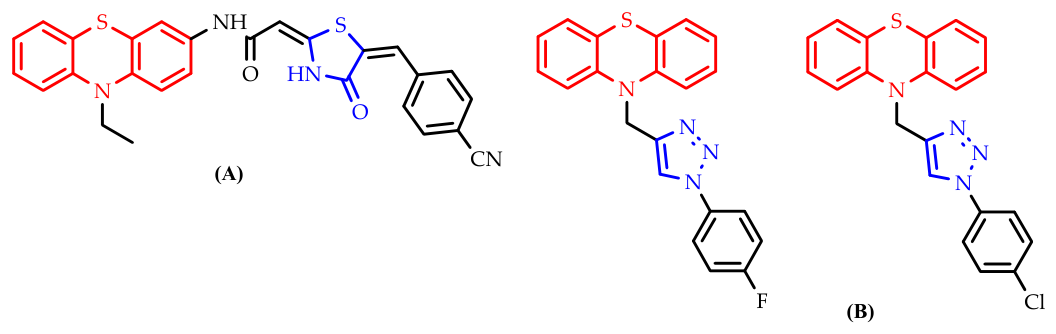
Figure 1. Examples of phenothiazine scaffolds showing anticancer activity against human cancer cell lines: (A) prostate and breast cancer cells; (B) gastric, esophageal, prostate, breast, and hepatocellular carcinoma cancer cells.
Ijms 27 04104 g001
Scheme 1. Synthesis of 3,5-bis(benzylidene)-4-piperidones (28).
Ijms 27 04104 sch001
Scheme 2. Synthesis of 3,5-bis(benzylidene)-1-(2-chloroacetyl)piperidin-4-ones (915).
Ijms 27 04104 sch002
Scheme 3. Synthesis of 1-(2-azidoacetyl)-3,5-bis(benzylidene)-piperidin-4-ones (1622).
Ijms 27 04104 sch003
Scheme 4. Synthesis of (3E,5E)-1-(2-(4-((10H-phenothiazine-10-yl)methyl)-1H-1,2,3-triazol-1-yl)acetyl)-3,5-bis(benzilydene)-piperidin-4-ones (2329).
Ijms 27 04104 sch004
Scheme 5. Synthesis of (3E,5E)-1-(2-(4-((10H-phenothiazine-10-yl)methyl)-1H-1,2,3-triazol-1-yl)acetyl)-3,5-bis(benzylidene)-piperidin-4-ones hydrochloride (3036).
Ijms 27 04104 sch005
Figure 2. Location of the ligand 29 in the active site of the EGFR (1M14) receptor: (A) Surface representation; (B) ribbon structure.
Ijms 27 04104 g002
Table 1. Cytotoxic effect of the parent piperidones and phenothiazine conjugates against the pancreatic adenocarcinoma cell line (Panc-1).
CompoundPanc-1CompoundPanc-1CompoundPanc-1
IC50, μMIC50, μMIC50, μM
216.11 ± 0.23238.57 ± 0.04307.08 ± 0.46
314.92 ± 0.90248.10 ± 0.38315.36 ± 0.11
411.21 ± 0.04257.71 ± 0.16325.47 ± 0.17
5>3026>3033>30
6>3027>3034>30
7>3028>3035>30
89.01 ± 0.02293.37 ± 0.05360.73 ± 0.02
Phenothiazine >30
Curcumin >30
Table 2. Cytotoxic profile of 3,5-bis(benzylidene)-4-piperidones and phenothiazine conjugates.
CompoundT-24T98GBT-20DF-1
238.60 ± 0.038.33 ± 0.2729.11 ± 1.53>30
248.12 ± 0.148.21 ± 0.0928.76 ± 2.30>30
256.36 ± 0.017.53 ± 0.2128.45 ± 0.96>30
26>30>30>30>30
27>30>30>30>30
28>30>30>30>30
292.39 ± 0.024.01 ± 0.1626.05 ± 1.39>30
305.73 ± 0.014.91 ± 0.0827.94 ± 1.30>30
316.11 ± 0.204.76 ± 0.2424.41 ± 2.05>30
324.95 ± 0.004.10 ± 0.0527.00 ± 0.94>30
33>30>30>30>30
34>30>30>30>30
35>30>30>30>30
360.59 ± 0.001.25 ± 0.1019.69 ± 0.78>30
Phenothiazine>30>30>30>30
Curcumin8.49 ± 0.379.23 ± 0.14>30>30
Disclaimer/Publisher’s Note: The statements, opinions and data contained in all publications are solely those of the individual author(s) and contributor(s) and not of MDPI and/or the editor(s). MDPI and/or the editor(s) disclaim responsibility for any injury to people or property resulting from any ideas, methods, instructions or products referred to in the content.