Species-Specific Effects of Humic Substances and Mycorrhiza on Antioxidant Defense and Metal Stress Tolerance in Cannabis sativa, Sorghum sudanense × bicolor, and Miscanthus × giganteus Under Field Conditions

 , , , , ,
  and
and
Abstract
1. Introduction
2. Results
2.1. Growth Parameters
2.2. Stress-Related Metabolites
2.3. Activity of Antioxidative Enzymes
2.4. Metal Concentrations in the Leaves
2.5. Comparative Overview of Biostimulant Effects in Hemp, Sorghum, and Miscanthus
2.6. Integrated Principal Component Analysis (PCA) of Plant Responses to Biostimulant Application
3. Discussion
3.1. Effect of Biostimulants on Metal Accumulation and Plant Growth
3.2. Effect of Biostimulants on Stress Metabolites and Antioxidant System
4. Materials and Methods
4.1. Experimental Design and Plant Material
4.2. Assessing Plant Growth and Preparing Leaf Samples for Analyses
4.3. Determination of Lipid Peroxidation, Proline and Sugar Concentrations
4.4. Determination of Antioxidant Enzyme Activity
4.4.1. Superoxide Dismutase (SOD, EC 1.15.1.1) Activity
4.4.2. Catalase (CAT, EC 1.11.1.6) Activity
4.4.3. Ascorbate Peroxidase (APX, EC 1.11.1.11) Activity
4.4.4. Guaiacol Peroxidase (GOPX, EC 1.11.1.7) Activity
4.4.5. Glutathione Reductase (GR, EC 1.6.4.2) Activity
4.5. Element Concentrations in the Leaves
4.6. Statistical Analysis
5. Conclusions
Supplementary Materials
Author Contributions
Funding
Institutional Review Board Statement
Informed Consent Statement
Data Availability Statement
Acknowledgments
Conflicts of Interest
References
- Rout, G.R.; Jadhao, K.R.; Panda, S.; Swain, R. Approaches in stress mitigation of plants. In Plant Stress Mitigators; Ghorbanpour, M., Shahid, M.A., Eds.; Academic Press: Cambridge, MA, USA, 2023; pp. 1–25. [Google Scholar] [CrossRef]
- Bali, A.S.; Sidhu, G.P.S. Growth and morphological changes of agronomic crops under abiotic stress. In Agronomic Crops; Hasanuzzaman, M., Ed.; Springer: Singapore, 2020. [Google Scholar] [CrossRef]
- Hou, D.; Jia, X.; Wang, L.; McGrath, S.P.; Zhu, Y.G.; Hu, Q.; Zhao, F.J.; Bank, M.S.; O’Connor, D.; Nriagu, J. Global soil pollution by toxic metals threatens agriculture and human health. Science 2025, 388, 316–321. [Google Scholar] [CrossRef] [PubMed]
- Kabata-Pendias, A.; Mukherjee, A.B. Trace Elements from Soil to Human; Springer: Berlin, Germany, 2007. [Google Scholar] [CrossRef]
- Mohamed, H.I.; Ullah, I.; Toor, M.D.; Tanveer, N.A.; Ud Din, M.M.; Basit, A.; Sultan, Y.; Muhammad, M.; Rehman, M.U. Heavy metals toxicity in plants: Understanding mechanisms and developing coping strategies for remediation: A review. Bioresour. Bioprocess. 2025, 12, 95. [Google Scholar] [CrossRef] [PubMed]
- Mansoor, S.; Ali, A.; Kour, N.; Bornhorst, J.; AlHarbi, K.; Rinklebe, J.; Abd El Moneim, D.; Ahmad, P.; Chung, Y.S. Heavy metal induced oxidative stress mitigation and ROS scavenging in plants. Plants 2023, 12, 3003. [Google Scholar] [CrossRef] [PubMed]
- Zhang, F.; Wang, Y.; Lou, Z.; Dong, J. Effect of heavy metal stress on antioxidative enzymes and lipid peroxidation in leaves and roots of two mangrove plant seedlings (Kandelia candel and Bruguiera gymnorrhiza). Chemosphere 2007, 67, 44–50. [Google Scholar] [CrossRef]
- Zheng, C.; Chen, J.-P.; Wang, X.-W.; Li, P. Reactive oxygen species in plants: Metabolism, signaling, and oxidative modifications. Antioxidants 2025, 14, 617. [Google Scholar] [CrossRef]
- Borges, C.V.; Orsi, R.O.; Maraschin, M.; Lima, G.P.P. Oxidative stress in plants and the biochemical response mechanisms. In Plant Stress Mitigators; Ghorbanpour, M., Shahid, M.A., Eds.; Academic Press: Cambridge, MA, USA, 2023; pp. 455–468. [Google Scholar] [CrossRef]
- Fichman, Y.; Rowland, L.; Oliver, M.J.; Mittler, R. ROS are evolutionary conserved cell-to-cell stress signals. Proc. Natl. Acad. Sci. USA 2023, 120, e2305496120. [Google Scholar] [CrossRef] [PubMed]
- Mishra, N.; Jiang, C.; Chen, L.; Paul, A.; Chatterjee, A.; Shen, G. Achieving abiotic stress tolerance in plants through antioxidative defense mechanisms. Front. Plant Sci. 2023, 14, 1110622. [Google Scholar] [CrossRef]
- Rao, M.J.; Duan, M.; Zhou, C.; Jiao, J.; Cheng, P.; Yang, L.; Wei, W.; Shen, Q.; Ji, P.; Yang, Y.; et al. Antioxidant defense system in plants: Reactive oxygen species production, signaling, and scavenging during abiotic stress-induced oxidative damage. Horticulturae 2025, 11, 477. [Google Scholar] [CrossRef]
- Zulfiqar, F.; Ashraf, M. Proline alleviates abiotic stress induced oxidative stress in plants. J. Plant Growth Regul. 2023, 42, 4629–4651. [Google Scholar] [CrossRef]
- Renzetti, M.; Funck, D.; Trovato, M. Proline and ROS: A unified mechanism in plant development and stress response? Plants 2025, 14, 2. [Google Scholar] [CrossRef]
- Bolouri-Moghaddam, M.R.; Le Roy, K.; Xiang, L.; Rolland, F.; Van den Ende, W. Sugar signalling and antioxidant network connections in plant cells. FEBS J. 2010, 277, 2022–2037. [Google Scholar] [CrossRef]
- Keunen, E.; Peshev, D.; Vangronsveld, J.; Van Den Ende, W.; Cuypers, A. Plant sugars are crucial players in the oxidative challenge during abiotic stress: Extending the traditional concept. Plant Cell Environ. 2013, 36, 1242–1255. [Google Scholar] [CrossRef]
- Ahmad, F.; Singh, A.; Kamal, A. Osmoprotective Role of Sugar in Mitigating Abiotic Stress in Plants. In Protective Chemical Agents in the Amelioration of Plant Abiotic Stress; John Wiley & Sons: Hoboken, NJ, USA, 2020; pp. 53–70. [Google Scholar]
- Nadgórska-Socha, A.; Ptasiński, B.; Kita, A. Heavy metal bioaccumulation and antioxidative responses in Cardaminopsis arenosa and Plantago lanceolata leaves from metalliferous and non-metalliferous sites: A field study. Ecotoxicology 2013, 22, 1422–1434. [Google Scholar] [CrossRef] [PubMed]
- Wang, N.; Chen, H.; Tian, Y. Effects of nickel, lead, and copper stress on growth and biochemical responses of Aegilops tauschii seedlings. Sci. Rep. 2024, 14, 24832. [Google Scholar] [CrossRef] [PubMed]
- Almotairy, H. Mitigating metal/metalloid stress in crops: Strategies for sustainable agricultural resilience. In Abiotic Stress in Crop Plants—Ecophysiological Responses and Molecular Approaches; IntechOpen: London, UK, 2024. [Google Scholar] [CrossRef]
- Khan, M.S.U.; Afridi, N.; Ritu, S.A.; Shipar, S.I.; Zaman, S.B.; Hasan, N.T.; Uddin, S.; Hasan, M.; Rahimi, M.; Sumi, M.J.; et al. Enhancing root resilience through sustainable agriculture to mitigate heavy metal pollution and abiotic stresses in a changing climate. Rhizosphere 2026, 37, 101251. [Google Scholar] [CrossRef]
- Carillo, P. Can biostimulants enhance plant resilience to heat and water stress in the Mediterranean hotspot? Plant Stress 2025, 16, 100802. [Google Scholar] [CrossRef]
- Jaros-Tsoj, K.; Jaroszuk-Ściseł, J.; Oleńska, E.; Sugier, P.; Rineau, F.; Vassilev, A.; Vangronsveld, J.; Wójcik, M. Biostimulants for sustainable agriculture: Enhancing plant growth and stress resilience. Appl. Sci. 2026; submitted.
- Canellas, L.P.; Olivares, F.L.; Aguiar, N.O.; Jones, D.L.; Nebbioso, A.; Mazzei, P.; Piccolo, A. Humic and fulvic acids as biostimulants in horticulture. Sci. Hortic. 2015, 196, 15–27. [Google Scholar] [CrossRef]
- Canellas, L.P.; da Silva, R.M.; Busato, J.G.; Olivares, F.L. Humic substances and plant abiotic stress adaptation. Chem. Biol. Technol. Agric. 2024, 11, 66. [Google Scholar] [CrossRef]
- Begum, N.; Qin, C.; Ahanger, M.A.; Raza, S.; Khan, M.I.; Ashraf, M.; Ahmed, N.; Zhang, L. Role of arbuscular mycorrhizal fungi in plant growth regulation: Implications in abiotic stress tolerance. Front. Plant Sci. 2019, 10, 1068. [Google Scholar] [CrossRef]
- Ofori-Agyemang, F.; Waterlot, C.; Manu, J.; Laloge, R.; Francin, R.; Papazoglou, E.G.; Alexopoulou, E.; Sahraoui, A.L.-H.; Tisserant, B.; Mench, M.; et al. Plant testing with hemp and miscanthus to assess phytomanagement options including biostimulants and mycorrhizae on a metal-contaminated soil to provide biomass for sustainable biofuel production. Sci. Total Environ. 2024, 912, 169527. [Google Scholar] [CrossRef]
- Zhang, X.; Zhao, B.; Zheng, Y.; Li, M.; Zhang, H.; Wang, P.; Chen, S.; Jin, X.; Wu, X. Arbuscular mycorrhizal fungi mitigate lead toxicity in maize by restructuring rhizosphere microbiome and enhancing antioxidant defense mechanisms. Agronomy 2025, 15, 1310. [Google Scholar] [CrossRef]
- Adedayo, A.A.; Babalola, O.O. The potential of biostimulants on soil microbial community: A review. Front. Ind. Microbiol. 2023, 1, 1308641. [Google Scholar] [CrossRef]
- Szentpéteri, V.; Virág, E.; Mayer, Z.; Duc, N.H.; Hegedűs, G.; Posta, K. First peek into the transcriptomic response in heat-stressed tomato inoculated with Septoglomus constrictum. Plants 2024, 13, 2266. [Google Scholar] [CrossRef] [PubMed]
- Virág, E.; Zombori, Z.; Hóvári, M.; Hegedűs, G.; Sass, L.; Ferenc, G.; Dudits, D.; Posta, K. Genotype-specific responses of maize plants to Funneliformis mosseae under drought stress: Phenomic and transcriptomic insights. Front. Plant Sci. 2026, 16, 1723031. [Google Scholar] [CrossRef] [PubMed]
- Liang, X.; Zhai, Y.; Li, J.; Zhan, J.; Li, F.; Wang, W. Exogenous biostimulants: Mechanisms and innovations for enhancing seed germination and resilience under abiotic stress. J. Adv. Res. 2026; in press. [CrossRef] [PubMed]
- Jaros-Tsoj, K.; Sitko, K.; Rudnicka, M.; Sugier, P.; Jaroszuk-Ściseł, J.; Rostański, A.; Rineau, F.; Papazoglou, E.G.; Alexopoulou, E.; Vangronsveld, J.; et al. Beneficial effects of commercially available preparations of humic substances and mycorrhiza on growth and photosynthesis of sorghum and hemp cultivated on a metal(loid)-polluted field. Plant Soil 2025, 516, 1553–1574. [Google Scholar] [CrossRef]
- Ofori-Agyemang, F.; Oustrière, N.; Waterlot, C.; Mench, M.; Burges, A. Field-grown hemp treated with humic/fulvic acids and arbuscular mycorrhizal fungi for phytomanaging a metal-contaminated agricultural soil. Int. J. Phytoremediat. 2026, 1–13. [Google Scholar] [CrossRef]
- Jindo, K.; Olivares, F.L.; Malcher, D.J.P.; Sánchez-Monedero, M.A.; Kempenaar, C.; Canellas, L.P. From lab to field: Role of humic substances under open-field and greenhouse conditions as biostimulant and biocontrol agent. Front. Plant Sci. 2020, 11, 426. [Google Scholar] [CrossRef]
- Păun, A.; Neagoe, A.; Păun, M.; Baciu, I.; Iordache, V. Heavy metal-induced differential responses to oxidative stress and protection by mycorrhization in sunflowers grown in lab and field scales. Pol. J. Environ. Stud. 2015, 24, 1235–1247. [Google Scholar] [CrossRef]
- Rehman, M.; Luo, D.; Pan, J.; Mubeen, S.; Cao, S.; Saeed, W.; Chen, P. Sustainable environmental remediation with bast fiber crops: Phytoremediation potential and resource management. Sci. Total Environ. 2025, 977, 179403. [Google Scholar] [CrossRef] [PubMed]
- Kikis, C.; Giannoulis, K.D.; Thalassinos, G.; Rinklebe, J.; Shaheen, S.M.; Antoniadis, V. From phytoremediation to phytomanagement: The utilization of industrial crops for the restoration of contaminated soils—A review. J. Environ. Chem. Eng. 2026, 14, 120581. [Google Scholar] [CrossRef]
- Jarin, A.S.; Khan, M.A.R.; Apon, T.A.; Islam, M.A.; Rahat, A.; Akter, M.; Anik, T.R.; Nguyen, H.M.; Nguyen, T.T.; Ha, C.V.; et al. Plant responses to heavy metal stresses: Mechanisms, defense strategies, and nanoparticle-assisted remediation. Plants 2025, 14, 3834. [Google Scholar] [CrossRef] [PubMed]
- Wójcik, M.; Sugier, P.; Siebielec, G. Metal accumulation strategies in plants spontaneously inhabiting Zn-Pb waste deposits. Sci. Total Environ. 2014, 487, 313–322. [Google Scholar] [CrossRef] [PubMed]
- Kaur, H.; Garg, N. Zinc toxicity in plants: A review. Planta 2021, 253, 129. [Google Scholar] [CrossRef]
- Asare, M.O.; Száková, J.; Tlustoš, P. Zinc contamination in soils and its implications on plant phytoalexins. Int. J. Environ. Sci. Technol. 2025, 22, 8581–8600. [Google Scholar] [CrossRef]
- Regulation of the Polish Minister of Agriculture and Rural Development of 31 October 2024 on Permissible Concentrations of Heavy Metals Contaminating Soil. Available online: https://isap.sejm.gov.pl/isap.nsf/DocDetails.xsp?id=WDU20240001657 (accessed on 10 July 2025).
- Gao, Y.; An, T.; Kuang, Q.; Wu, Y.; Liu, S.; Liang, L.; Yu, M.; Macrae, A.; Chen, Y. The role of arbuscular mycorrhizal fungi in the alleviation of cadmium stress in cereals: A multilevel meta-analysis. Sci. Total Environ. 2023, 902, 166091. [Google Scholar] [CrossRef]
- Yildirim, E.; Ekinci, M.; Turan, M.; Ağar, G.; Dursun, A.; Kul, R.; Alim, Z.; Argin, S. Humic + Fulvic acid mitigated Cd adverse effects on plant growth, physiology and biochemical properties of garden cress. Sci. Rep. 2021, 11, 8040. [Google Scholar] [CrossRef] [PubMed]
- Hachani, C.; Lamhamedi, M.S.; Abassi, M. Effects of heavy metal-polluted soil (Pb, Zn and Cd) on seed emergence, seedling growth and antioxidant activity in four Fabaceae species. Water Air Soil Pollut. 2022, 233, 263. [Google Scholar] [CrossRef]
- Nabi, F.; Sarfaraz, A.; Kama, R.; Kanwal, R.; Li, H. Structure-based function of humic acid in abiotic stress alleviation in plants: A review. Plants 2025, 14, 1916. [Google Scholar] [CrossRef]
- Khan, Y.; Shah, S.; Li, D.; Yang, F. Arbuscular mycorrhizal fungi-mediated abiotic stress tolerance: Emerging roles in nutrient exchange, antioxidant defence, and hormonal crosstalk. Plant Stress 2025, 18, 101068. [Google Scholar] [CrossRef]
- Sabra, D.M.; Badr, E.A.; Mohamed, M.H.; Amin, G.A. Foliar application of humic acid improves growth, yield, and nutritional quality of mungbean (Vigna radiata L.) genotypes under newly reclaimed soil conditions. Sci. Rep. 2026, 16, 12726. [Google Scholar] [CrossRef]
- Faria de Souza, A.F.; Calderín García, A.; Nivaldo de Oliveira Sátiro, J.; Ribeiro de Lima, B.; Silvestre Fernandes, M.; Louro Berbara, R.L.; Azevedo Santos, L. Humic acid regulates root growth through ROS-dependent pathway and hormone signaling in rice. J. Agric. Food Chem. 2025, 73, 20081–20093. [Google Scholar] [CrossRef]
- Song, J.; Pi, B.; Dai, J.; Nie, Z.; Yu, G.; Du, W. Effects of humic acid on the growth and cadmium accumulation of maize (Zea mays L.) seedlings. Int. J. Phytoremediat. 2025, 27, 888–895. [Google Scholar] [CrossRef]
- Atero-Calvo, S.; Magro, F.; Masetti, G.; Izquierdo-Ramos, M.J.; Navarro-León, E.; Ruiz, J.M. Humic substances enhance cadmium tolerance in lettuce by enhancing antioxidant activity and photosynthesis performance. J. Soil Sci. Plant Nutr. 2025, 25, 2627–2641. [Google Scholar] [CrossRef]
- Chen, J.; Guo, J.; Li, Z.; Liang, X.; You, Y.; Li, M.; He, Y.; Zhan, F. Effects of an arbuscular mycorrhizal fungus on the growth of and cadmium uptake in maize grown on polluted wasteland, farmland and slopeland soils in a lead-zinc mining area. Toxics 2022, 10, 359. [Google Scholar] [CrossRef]
- Dzhura, N.; Podan, I.; Shapoval, P.; Romanyuk, O.; Antonyak, H. Physiological parameters and metal-accumulating capacity of the biofuel plant Miscanthus × giganteus cultivated on oil-contaminated podzol soil treated with humic preparations. Stud. Biol. 2024, 18, 139–156. [Google Scholar] [CrossRef]
- Qiao, Y.; Crowley, D.; Wang, K.; Zhang, H.; Li, H. Effects of biochar and arbuscular mycorrhizae on bioavailability of potentially toxic elements in an aged contaminated soil. Environ. Pollut. 2015, 206, 636–643. [Google Scholar] [CrossRef] [PubMed]
- Nardi, S.; Ertani, A.; Francioso, O. Soil–root cross-talking: The role of humic substances. J. Plant Nutr. Soil Sci. 2017, 180, 5–13. [Google Scholar] [CrossRef]
- Jagota, N.; Singh, T.; Sharma, A.; Chhabra, R. Deciphering cues of zinc toxicity and tolerance in plants: A comprehensive review. Acta Physiol. Plant. 2026, 48, 9. [Google Scholar] [CrossRef]
- Jaskulak, M.; Rorat, A.; Grobelak, A.; Kacprzak, M. Antioxidative enzymes and expression of rbcL gene as tools to monitor heavy metal-related stress in plants. J. Environ. Manag. 2018, 218, 71–78. [Google Scholar] [CrossRef] [PubMed]
- Karpinska, B.; Foyer, C.H. Superoxide signalling and antioxidant processing in the plant nucleus. J. Exp. Bot. 2024, 75, 4599–4610. [Google Scholar] [CrossRef]
- Bagheri, M.; Javanmard, H.R.; Naderi, M.R. Soil cadmium and lead affecting biochemical properties of Matricaria chamomilla L. at different growth stages in the greenhouse and field. Biometals 2021, 34, 881–893. [Google Scholar] [CrossRef]
- Hasanuzzaman, M.; Parvin, K.; Bardhan, K.; Nahar, K.; Anee, T.I.; Masud, A.A.C.; Fotopoulos, V. Biostimulants for the regulation of reactive oxygen species metabolism in plants under abiotic stress. Cells 2021, 10, 2537. [Google Scholar] [CrossRef] [PubMed]
- Wang, Y.; Yang, R.; Zheng, J.; Shen, Z.; Xu, X. Exogenous foliar application of fulvic acid alleviates cadmium toxicity in lettuce (Lactuca sativa L.). Ecotoxicol. Environ. Saf. 2019, 167, 10–19. [Google Scholar] [CrossRef] [PubMed]
- Li, S.; Huang, X.; Li, G.; Zhang, K.; Bai, L.; He, H.; Chen, S.; Dai, J. Effects of mineral-based potassium humate on cadmium accumulation in rice (Oryza sativa L.) under three levels of cadmium-contaminated alkaline soils. Sustainability 2023, 15, 2836. [Google Scholar] [CrossRef]
- Dogan, M.; Bolat, I.; Karakas, S.; Dikilitas, M.; Gutiérrez-Gamboa, G.; Kaya, O. Remediation of cadmium stress in strawberry plants using humic acid and silicon applications. Life 2022, 12, 1962. [Google Scholar] [CrossRef]
- Boysan Canal, S.; Bozkurt, M.; Yilmaz, H. The effect of humic acid on rapeseed (Brassica napus L.) plant growth, heavy metal uptake, phytoremediation parameters (BCF, TF and TI), and antioxidant activity in heavy metal polluted soil. Yuz. Yıl Univ. J. Agric. Sci. 2022, 32, 237–248. [Google Scholar] [CrossRef]
- Rasouli, F.; Hassanpouraghdam, M.B.; Pirsarandib, Y.; Aazami, M.A.; Asadi, M.; Ercisli, S.; Mehrabani, L.V.; Puglisi, I.; Baglieri, A. Improvements in the biochemical responses and Pb and Ni phytoremediation of lavender (Lavandula angustifolia L.) plants through Funneliformis mosseae inoculation. BMC Plant Biol. 2023, 23, 252. [Google Scholar] [CrossRef]
- Chaturvedi, R.; Favas, P.J.C.; Pratas, J.; Varun, M.; Paul, M.S. Harnessing Pisum sativum–Glomus mosseae symbiosis for phytoremediation of soil contaminated with lead, cadmium, and arsenic. Int. J. Phytoremediat. 2021, 23, 279–290. [Google Scholar] [CrossRef] [PubMed]
- Obaid, W.A.; Selim, S.; Hamed, S.M.; Alsherif, E.A.; Korany, S.M.; Sonbol, H.; Aldailami, D.A.; Al Jaouni, S.K. Wheat (C3) and maize (C4) adaptive responses to soil thallium toxicity under elevated CO2 conditions. Plant Soil Environ. 2025, 71, 534–552. [Google Scholar] [CrossRef]
- Guidi, L.; Lo Piccolo, E.; Landi, M. Chlorophyll fluorescence, photoinhibition and abiotic stress: Does it make any difference the fact to be a C3 or C4 species? Front. Plant Sci. 2019, 10, 174. [Google Scholar] [CrossRef]
- Nayyar, H.; Gupta, D. Differential sensitivity of C3 and C4 plants to water deficit stress: Association with oxidative stress and antioxidants. Environ. Exp. Bot. 2006, 58, 106–113. [Google Scholar] [CrossRef]
- Sonmez, M.C.; Ozgur, R.; Uzilday, B.; Turkan, I.; Ganie, S.A. Redox regulation in C3 and C4 plants during climate change and its implications on food security. Food Energy Secur. 2023, 12, e387. [Google Scholar] [CrossRef]
- Yang, Z.; Miao, Y.; Yu, J.; Liu, J.; Huang, B. Differential growth and physiological responses to heat stress between two annual and two perennial cool-season turfgrasses. Sci. Hortic. 2014, 170, 75–81. [Google Scholar] [CrossRef]
- Wingler, A.; Sandel, B. Relationships of competitor, stress tolerator, ruderal strategies with lifespan photosynthetic type, naturalization and climate. AoB Plants 2023, 15, plad021. [Google Scholar] [CrossRef] [PubMed]
- Brancourt-Hulmel, M.; Höfte, H. Biomass for the future: Miscanthus and sorghum for new end-uses in France. BioEnergy Res. 2022, 15, 669–671. [Google Scholar] [CrossRef]
- Testa, G.; Ciaramella, B.R.; Fernando, A.L.; Kotoula, D.; Scordia, D.; Gomes, L.A.; Cosentino, S.L.; Alexopoulou, E.; Papazoglou, E.G. Harnessing lignocellulosic crops for phytomanagement of contaminated soils: A multi-country study. Plants 2024, 13, 2671. [Google Scholar] [CrossRef] [PubMed]
- Krzemińska, B.; Borkowska, I.; Malm, M.; Tchórzewska, D.; Vangronsveld, J.; Vassilev, A.; Dos Santos Szewczyk, K.; Wójcik, M. Comparative study of the photosynthetic efficiency and leaf structure of four Cotoneaster species. Sci. Rep. 2024, 14, 25113. [Google Scholar] [CrossRef]
- García-Limones, C.; Hervás, A.; Navas Cortés, J.; Jiménez-Díaz, R.; Tena, M. Induction of an antioxidant enzyme system and other oxidative stress markers associated with compatible and incompatible interactions between chickpea (Cicer arietinum L.) and Fusarium oxysporum f. sp. ciceris. Physiol. Mol. Plant Pathol. 2002, 61, 325–337. [Google Scholar] [CrossRef]
- Nowak, A.; Tyśkiewicz, R.; Wiater, A.; Jaroszuk-Ściseł, J. (1→3)-α-D-glucooligosaccharides as elicitors influencing the activity of plant resistance pathways in wheat tissues. Agronomy 2022, 12, 1170. [Google Scholar] [CrossRef]
- Bradford, M.M. A rapid and sensitive method for the quantitation of microgram quantities of protein utilizing the principle of protein-dye binding. Anal. Biochem. 1976, 72, 248–254. [Google Scholar] [CrossRef] [PubMed]




| Measured Parameter | Hemp | Sorghum | Miscanthus | |||
|---|---|---|---|---|---|---|
| HS | HS + M | HS | HS + M | HS | HS + M | |
| Plant height | ||||||
| Plant fresh weight | ||||||
| TBARS | ||||||
| Free proline | ||||||
| Total sugars | ||||||
| SOD activity | ||||||
| CAT activity | ||||||
| APX activity | ||||||
| GOPX activity | ||||||
| GR activity | ||||||
| Zn concentration | ||||||
| Cd concentration | ||||||
| Pb concentration | ||||||
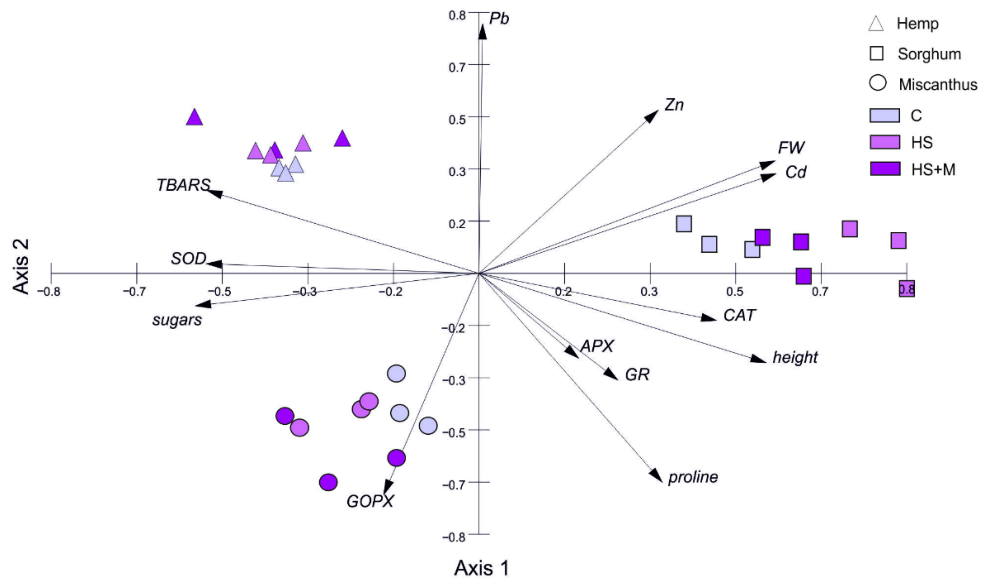
| Variables | Axis 1 | Axis 2 |
|---|---|---|
| (A) | ||
| Eigenvalues | 5.64 | 3.63 |
| Percentage | 43.36 | 27.93 |
| Cum. percentage | 43.36 | 71.29 |
| (B) | ||
| height | 0.357 | −0.182 |
| FW | 0.368 | 0.229 |
| TBARS | −0.338 | 0.169 |
| proline | 0.228 | −0.425 |
| sugars | −0.352 | −0.066 |
| SOD | −0.339 | 0.019 |
| CAT | 0.295 | −0.096 |
| APX | 0.124 | −0.173 |
| GOPX | −0.118 | −0.451 |
| GR | 0.173 | −0.217 |
| Zn | 0.223 | 0.332 |
| Cd | 0.369 | 0.203 |
| Pb | 0.005 | 0.508 |
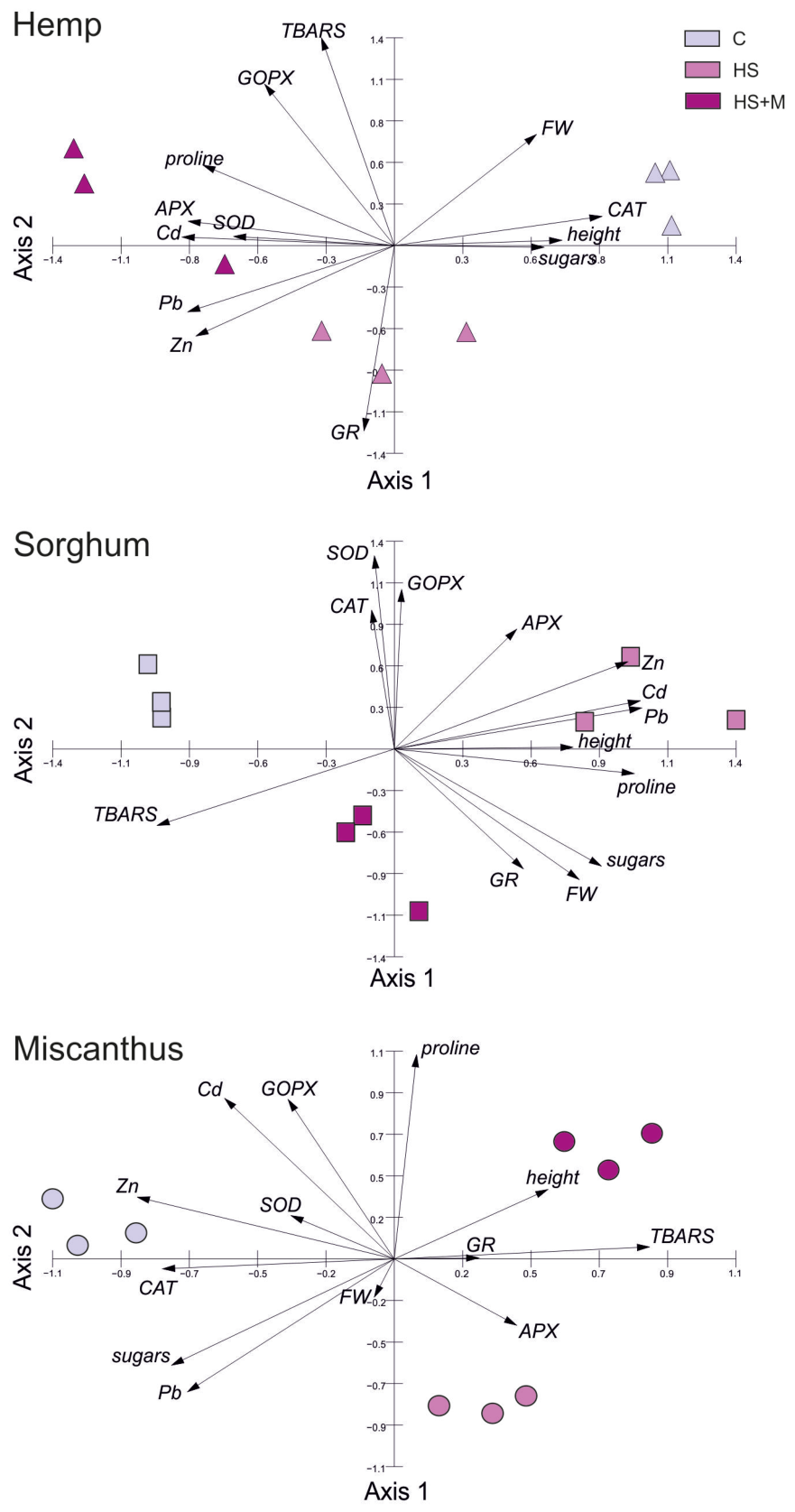
| Hemp | Sorghum | Miscanthus | ||||
|---|---|---|---|---|---|---|
| Variables | Axis 1 | Axis 2 | Axis 1 | Axis 2 | Axis 1 | Axis 2 |
| (A) | ||||||
| Eigenvalues | 7.65 | 2.56 | 6.63 | 2.73 | 5.02 | 3.18 |
| Percentage | 58.85 | 19.69 | 50.97 | 21.00 | 38.65 | 24.45 |
| Cum. percentage | 58.85 | 78.54 | 50.97 | 71.97 | 38.65 | 63.10 |
| (B) | ||||||
| height | 0.275 | 0.014 | 0.272 | 0.004 | 0.251 | 0.187 |
| FW | 0.234 | 0.3 | 0.281 | −0.327 | −0.033 | −0.103 |
| TBARS | −0.12 | 0.562 | −0.361 | −0.192 | 0.417 | 0.032 |
| proline | −0.315 | 0.218 | 0.365 | −0.061 | 0.036 | 0.549 |
| sugars | 0.246 | −0.005 | 0.315 | −0.293 | −0.364 | −0.286 |
| SOD | −0.265 | 0.025 | −0.031 | 0.483 | −0.169 | 0.116 |
| CAT | 0.342 | 0.079 | −0.035 | 0.348 | −0.379 | −0.027 |
| APX | −0.34 | 0.066 | 0.186 | 0.3 | 0.2 | −0.178 |
| GOPX | −0.214 | 0.437 | 0.011 | 0.4 | −0.174 | 0.428 |
| GR | −0.05 | −0.501 | 0.196 | −0.3 | 0.138 | 0.003 |
| Zn | −0.327 | −0.245 | 0.355 | 0.218 | −0.42 | 0.166 |
| Cd | −0.349 | 0.023 | 0.375 | 0.121 | −0.277 | 0.431 |
| Pb | −0.34 | −0.18 | 0.377 | 0.103 | −0.338 | −0.357 |
Disclaimer/Publisher’s Note: The statements, opinions and data contained in all publications are solely those of the individual author(s) and contributor(s) and not of MDPI and/or the editor(s). MDPI and/or the editor(s) disclaim responsibility for any injury to people or property resulting from any ideas, methods, instructions or products referred to in the content. |
© 2026 by the authors. Licensee MDPI, Basel, Switzerland. This article is an open access article distributed under the terms and conditions of the Creative Commons Attribution (CC BY) license.
Share and Cite
Jaros-Tsoj, K.; Nowak, A.; Jaroszuk-Ściseł, J.; Sugier, P.; Sugier, D.; Rineau, F.; Vangronsveld, J.; Wójcik, M. Species-Specific Effects of Humic Substances and Mycorrhiza on Antioxidant Defense and Metal Stress Tolerance in Cannabis sativa, Sorghum sudanense × bicolor, and Miscanthus × giganteus Under Field Conditions. Int. J. Mol. Sci. 2026, 27, 3942. https://doi.org/10.3390/ijms27093942
Jaros-Tsoj K, Nowak A, Jaroszuk-Ściseł J, Sugier P, Sugier D, Rineau F, Vangronsveld J, Wójcik M. Species-Specific Effects of Humic Substances and Mycorrhiza on Antioxidant Defense and Metal Stress Tolerance in Cannabis sativa, Sorghum sudanense × bicolor, and Miscanthus × giganteus Under Field Conditions. International Journal of Molecular Sciences. 2026; 27(9):3942. https://doi.org/10.3390/ijms27093942
Chicago/Turabian StyleJaros-Tsoj, Karolina, Artur Nowak, Jolanta Jaroszuk-Ściseł, Piotr Sugier, Danuta Sugier, Francois Rineau, Jaco Vangronsveld, and Małgorzata Wójcik. 2026. "Species-Specific Effects of Humic Substances and Mycorrhiza on Antioxidant Defense and Metal Stress Tolerance in Cannabis sativa, Sorghum sudanense × bicolor, and Miscanthus × giganteus Under Field Conditions" International Journal of Molecular Sciences 27, no. 9: 3942. https://doi.org/10.3390/ijms27093942
APA StyleJaros-Tsoj, K., Nowak, A., Jaroszuk-Ściseł, J., Sugier, P., Sugier, D., Rineau, F., Vangronsveld, J., & Wójcik, M. (2026). Species-Specific Effects of Humic Substances and Mycorrhiza on Antioxidant Defense and Metal Stress Tolerance in Cannabis sativa, Sorghum sudanense × bicolor, and Miscanthus × giganteus Under Field Conditions. International Journal of Molecular Sciences, 27(9), 3942. https://doi.org/10.3390/ijms27093942