A Review of Probiotic Interventions for Necrotizing Enterocolitis and Sepsis in Preterm Infants

 ,
,  , ,
, ,  ,
, 
Abstract
1. Introduction
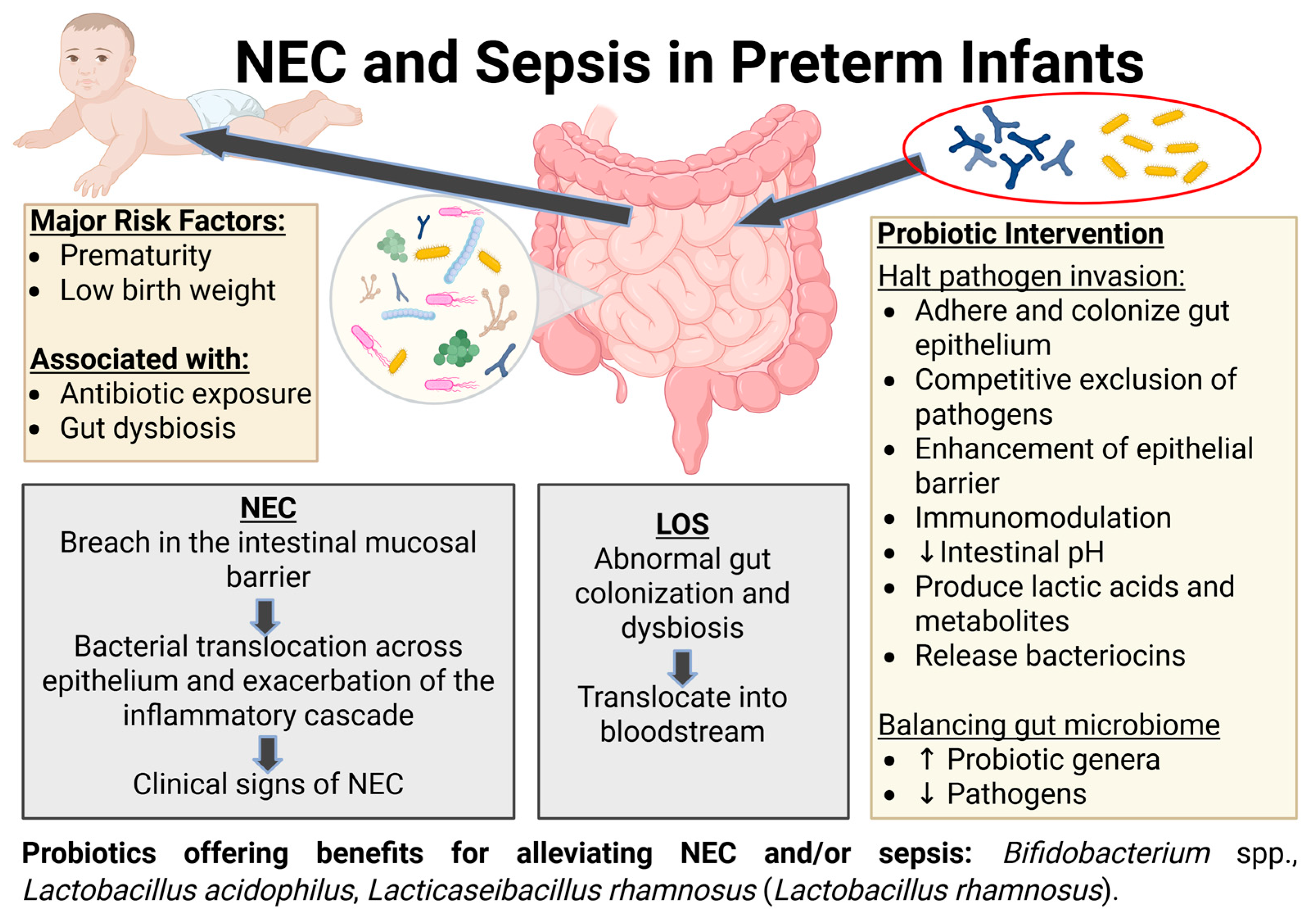
2. Necrotizing Enterocolitis (NEC) and Sepsis
3. Management Strategies for NEC and LOS in Preterm Infants
4. The Effect of Probiotics on NEC and Sepsis in Preterm Infants
4.1. The Effect of Single-Strain Probiotics on NEC and Sepsis in Preterm Infants
4.1.1. Bifidobacterium spp.
4.1.2. Lactobacillus spp.
4.1.3. Other Probiotics: Bacillus clausii and Saccharomyces boulardii

| Probiotic | Dosage/Type of Feeding | Probiotic Treatment Period | Sample Size, Gestational Age (GAb), Birth Weight (BWc) | Country | NEC/Sepsis Findings | Study |
|---|---|---|---|---|---|---|
| Bifidobacterium infantis EVC001 (EvivoTM, Evolve BioSystems+, Davis*, California*, USA*) |
|
|
| USA | NEC and mortality:
| [112] |
| Bifidobacterium breve M-16V (Morinaga Milk Industry Co., Ltd., Tokyo*, Japan) |
|
|
| Australia | NEC and/or mortality:
| [113] |
| Bifidobacterium lactis (Maflor, Mamsel Pharmaceutical Company, Istanbul, Turkey) | Three study groups:
|
|
| Turkey | NEC:
| [114] |
| Bifidobacterium breve BBG-001 |
|
|
| United Kingdom | NEC, LOS, and mortality:
| [21,115] |
| Lactobacillus reuteri Protectis (LRP), DSM 17938 strain (BioGaia® AB, Stockholm*, Sweden*) |
|
|
| Chile | NEC:
| [130] |
| Lactobacillus reuteri DSM 17938 suspension (Interlac®) (BioGaia® AB, Stockholm, Sweden)* |
|
|
| Indonesia | NEC and mortality:
| [131] |
| Lactobacillus reuteri DSM 17938 (Biogaia® AB, Stockholm, Sweden) |
|
|
| Turkey | NEC, sepsis, and mortality:
| [132] |
| Lactobacillus casei rhamnosus LCR 35 (Lcr Restituo) (Probionov, France) |
|
|
| France | NEC, LOS, and mortality:
| [133] |
| Lactobacillus casei rhamnosus (LCR 35) |
|
|
| Nepal | NEC:
| [134] |
| Lactobacillus rhamnosus GG ATCC 53103 (LGG) (Culturelle®, i-Health, Cromwell, CT, USA) |
|
|
| USA | NEC:
| [135] |
| Bacillus clausii (Enterogermina®, Sanofi-Aventis, Italy) |
|
|
| India | NEC:
| [136] |
| Saccharomyces boulardii (Reflorâ, Biocodex, Beauvais, France) |
|
|
| Turkey | NEC and mortality:
| [140] |
| Saccharomyces boulardii (Reflor®, Biocodex, France) |
|
|
| Turkey | NEC, LOS, and mortality:
| [137] |
| Saccharomyces boulardii CNCM I-745 (Bioflor®, CMS Shenzhen Kangzhe Pharmaceutical Co. Ltd., Shenzhen, China; manufactured by Biocodex, Paris, France) |
|
|
| China | Sepsis:
| [138] |
| Saccharomyces boulardii CNCM I-745 (Bioflor 250 powder®, Kuhnil, Seoul*, South Korea*) |
|
|
| South Korea | NEC:
| [139] |
4.2. Multiple-Strain Probiotics
4.2.1. Dual-Strain Probiotics
| Probiotic | Dosage/Type of Feeding | Probiotic Treatment Period | Sample Size, Gestational Age (GAb), Birth Weight (BWc) | Country | NEC/Sepsis Findings | Study |
|---|---|---|---|---|---|---|
| Bifidobacterium spp., Lactobacillus (manufactured by Tensall Bio-tech Co. Ltd., DungShan Township*, Yilan 269*, Taiwan; distributed by Century Health Care, Bangladesh) |
|
|
| Bangladesh | NEC:
| [148] |
| Lactobacillus acidophilus, Bifidobacterium infantis |
|
|
| Germany | Sepsis:
| [151] |
| Bifidobacterium lactis BB12, Lactobacillus rhamnosus GG |
|
|
| Denmark | NEC and mortality:
| [149] |
| Lactobacillus rhamnosus GG (LGG) (Culturelle, Amerifit Brand, Cromwell, CT, USA), Bifidobacterium infantis (Align, Procter and Gamble, Cincinnati, OH, USA) |
|
|
| United Kingdom | NEC:
| [150] |
| Bifidobacterium bifidum and Lactobacillus acidophilus (Infloran®, [Desma Healthcare] (Laboratorio Farmaceutico S.I.T.S.r.l., Pavia, Italy)* |
|
|
| Ireland | NEC or mortality:
| [153] |
| Lactobacillus acidophilus and Bifidobacterium bifidum (Infloran®) (Laboratorio Farmaceutico S.I.T.S.r.l., Pavia, Italy)* |
|
|
| Thailand | NEC:
| [154] |
|
|
|
| Australia | NEC, late-onset sepsis (LOS) and mortality:
| [155] |
| Lactobacillus acidophilus and Bifidobacterium infantis (Infloran®) (Laboratorio Farmaceutico S.I.T.S.r.l., Mede, Italy) |
|
|
| Germany | NEC and mortality:
| [156] |
| Lactobacillus acidophilus and Bifidobacterium infantis (Infloran®) (Laboratorio Farmaceutico S.I.T.S.r.l., Sanremo, Italy) |
|
|
| Europe | NEC: Multivariate analysis on the effect of probiotics according to the type of feeding:
| [157] |
| Lactobacillus acidophilus (ATCC 4356) and Bifidobacterium bifidum (ATCC 15696) (Infloran®) (Laboratorio Farmaceutico S.I.T.S.r.l., Mede, Italy) |
|
|
| The Netherlands | NEC, sepsis, and mortality:
| [158] |
4.2.2. More than Two Strains of Probiotics
| Probiotic (Number of Strains) | Prebiotic | Dosage/Type of Feeding | Probiotic Treatment Period | Sample Size, Gestational Age (GAb), Birth Weight (BWc) | Country | NEC/LOS Findings | Study |
|---|---|---|---|---|---|---|---|
| Lactobacillus acidophilus, Lactobacillus bulgaricus, Bifidobacterium bifidum (3) | Fructo-oligosaccharide. |
|
|
| Bangladesh | NEC and mortality:
| [178] |
| Bifidobacterium lactis (BB-12®), Bifidobacterium infantis (BB-02™), Streptococcus thermophilus (TH-4®) (3) (Similac® Probiotic Triblend) (Abbott, Abbott Park, IL, USA; manufactured by Chr. Hansen, HØrsholm, Denmark) | Not available |
|
|
| USA | NEC, LOS (late-onset sepsis), and mortality:
| [179] |
| Bifidobacterium infantis (BB–02), Streptococcus thermophilus (TH–4), Bifidobacterium lactis (BB-12) (3) (ABC Dophilus Probiotic Powder for Infants, Solgar®, Leonia, NJ, USA) | Not available |
|
|
| Australia and New Zealand | NEC:
| [180] |
| Lactobacillus acidophilus (subsp. Lactobacillus gasseri) PTA-5845, Bifidobacterium infantis PTA-5843, Enterococcus faecium PTA 5844 (3) (Linex® capsule, produced by Lek d.d., Ljubljana, Slovenia) | Not available |
|
|
| Slovenia | LOS:
| [181] |
| Streptococcus thermophilus, Bifidobacterium infantis, Bifidobacterium bifidum (3) (ABC Dophilus) (Solgar®, Leonia, NJ, USA)* | Not available |
|
|
| USA | NEC:
| [182] |
| Lactobacillus rhamnosus, Lactobacillus casei, Lactobacillus plantarum, Bifidobacterium animalis (4) | Fructo-oligosaccharides and galacto-oligosaccharides. |
|
|
| Turkey | NEC and mortality:
| [183] |
| Lactobacillus acidophilus, Bifidobacterium longum, Bifidobacterium bifidum, Bifidobacterium lactis (4) (Prowel (Batch PWS3002C) by Alkem, Mumbai*, Maharashtra*, India*) | Not available |
|
|
| India | Sepsis:
| [184] |
Four different types of known probiotics:
| Not available |
|
|
| USA and Puerto Rico | NEC and mortality:
| [185] |
| FloraBABY (Renew Life® Canada, Oakville, Ontario, Canada): Bifidobacterium breve, Bifidobacterium bifidum, Bifidobacterium infantis, Bifidobacterium longum, Lactobacillus rhamnosus GG (5) | Not available |
|
|
| Canada | NEC:
| [83] |
| Florababy (Renew Life® Canada)(given to 79.1% infants): Bifidobacterium breve, Bifidobacterium bifidum, Bifidobacterium infantis, Bifidobacterium longum and Lactobacillus rhamnosus GG (5) Single-strain Biogaia (Ferring Inc.) (BioGaia® AB, Stockholm, Sweden)* (given to 19.8% infants): Lactobacillus reuteri (1) | Not available |
|
|
| Canada | NEC or mortality:
| [188] |
| Florababy (RenewLife® Canada, Brampton, Ontario, Canada): Bifidobacterium and Lactobacillus species (5) | Not available |
|
|
| USA | NEC:
| [187] |
| Florababy (Ultimate Flora Baby Probiotic®, RenewLife®, Sunrise*, Florida*): Bifidobacterium breve, Bifidobacterium bifidum, Bifidobacterium infantis, Bifidobacterium longum, Lactobacillus rhamnosus GG (5) | Not available |
|
|
| USA | NEC and mortality:
| [189] |
| Florababy (RenewLife®, Sunrise, FL, USA)*: Bifidobacterium breve, Bifidobacterium bifidum, Bifidobacterium infantis, Bifidobacterium longum, and Lactobacillus rhamnosus (5) | Not available |
|
|
| Canada | NEC:
| [190] |
| Protexin-Restore (Probiotic International Ltd.+, United Kingdom): Streptococcus thermophilus, Lactobacillus rhamnosus, Lactobacillus acidophilus, Lactobacillus bulgaricus, Bifidobacterium infantis, Lactobacillus casei (6) | Fructo-oligosaccharide. |
|
|
| Iran | NEC:
| [192] |
| Lactobacillus acidophilus, Lactobacillus rhamnosus, Lactobacillus casei, Lactobacillus plantarum, Bifidobacteruim infantis, Streptococcus thermophilus (6) (Laboratorio Italmex SA, Mexico City, Mexico) | Not available |
|
|
| Mexico | NEC:
| [193] |
| VSL#3 (Prepared by CD Pharma India Pvt. Ltd., Delhi*, India*): Streptococcus thermophilus, Bifidobacterium breve, Bifidobacterium longum, Bifidobacterium infantis, Lactobacillus acidophilus, Lactobacillus plantarum, Lactobacillus paracasei and Lactobacillus delbrueckii subsp. bulgaricus) (8) | Not available |
|
|
| India | Sepsis:
| [194] |
4.3. Single vs. Multiple Strain Probiotics
5. Future Direction for Improvement
6. Conclusions
Author Contributions
Funding
Data Availability Statement
Acknowledgments
Conflicts of Interest
References
- Vogel, J.P.; Chawanpaiboon, S.; Moller, A.-B.; Watananirun, K.; Bonet, M.; Lumbiganon, P. The global epidemiology of preterm birth. Best Pract. Res. Clin. Obstet. Gynaecol. 2018, 52, 3–12. [Google Scholar] [CrossRef]
- WHO. Preterm Birth. Available online: https://www.who.int/news-room/fact-sheets/detail/preterm-birth (accessed on 19 December 2022).
- Souza, R.T.; Cecatti, J.G.; Passini, R., Jr.; Tedesco, R.P.; Lajos, G.J.; Nomura, M.L.; Rehder, P.M.; Dias, T.Z.; Haddad, S.M.; Pacagnella, R.C. The burden of provider-initiated preterm birth and associated factors: Evidence from the Brazilian Multicenter Study on Preterm Birth (EMIP). PLoS ONE 2016, 11, e0148244. [Google Scholar] [CrossRef]
- Goldenberg, R.L.; Culhane, J.F.; Iams, J.D.; Romero, R. Epidemiology and causes of preterm birth. Lancet 2008, 371, 75–84. [Google Scholar] [CrossRef]
- Wolke, D. Preterm birth: High vulnerability and no resiliency? Reflections on van Lieshout et al. (2018). J. Child Psychol. Psychiatry 2018, 59, 1201–1204. [Google Scholar] [CrossRef]
- Allen, M.C.; Cristofalo, E.A.; Kim, C. Outcomes of preterm infants: Morbidity replaces mortality. Clin. Perinatol. 2011, 38, 441–454. [Google Scholar] [CrossRef]
- Teune, M.J.; Bakhuizen, S.; Bannerman, C.G.; Opmeer, B.C.; Van Kaam, A.H.; Van Wassenaer, A.G.; Morris, J.M.; Mol, B.W.J. A systematic review of severe morbidity in infants born late preterm. Am. J. Obstet. Gynecol. 2011, 205, 374.e1–374.e9. [Google Scholar] [CrossRef] [PubMed]
- Cai, S.; Thompson, D.K.; Anderson, P.J.; Yang, J.Y.-M. Short-and long-term neurodevelopmental outcomes of very preterm infants with neonatal sepsis: A systematic review and meta-analysis. Children 2019, 6, 131. [Google Scholar] [CrossRef]
- Cohen-Wolkowiez, M.; Moran, C.; Benjamin, D.K.; Cotten, C.M.; Clark, R.H.; Benjamin, D.K., Jr.; Smith, P.B. Early and late onset sepsis in late preterm infants. Pediatr. Infect. Dis. J. 2009, 28, 1052–1056. [Google Scholar] [CrossRef] [PubMed]
- Johnson, S.; Marlow, N. Early and long-term outcome of infants born extremely preterm. Arch. Dis. Child. 2017, 102, 97–102. [Google Scholar] [CrossRef]
- Battersby, C.; Santhalingam, T.; Costeloe, K.; Modi, N. Incidence of neonatal necrotising enterocolitis in high-income countries: A systematic review. Arch. Dis. Child.-Fetal Neonatal Ed. 2018, 103, F182–F189. [Google Scholar] [CrossRef]
- Zozaya, C.; García González, I.; Avila-Alvarez, A.; Oikonomopoulou, N.; Sánchez Tamayo, T.; Salguero, E.; Saenz de Pipaón, M.; García-Muñoz Rodrigo, F.; Couce, M.L. Incidence, treatment, and outcome trends of necrotizing enterocolitis in preterm infants: A multicenter cohort study. Front. Pediatr. 2020, 8, 188. [Google Scholar] [CrossRef]
- Stoll, B.J.; Hansen, N.; Fanaroff, A.A.; Wright, L.L.; Carlo, W.A.; Ehrenkranz, R.A.; Lemons, J.A.; Donovan, E.F.; Stark, A.R.; Tyson, J.E. Late-onset sepsis in very low birth weight neonates: The experience of the NICHD Neonatal Research Network. Pediatrics 2002, 110, 285–291. [Google Scholar] [CrossRef] [PubMed]
- Gorantiwar, S.; de Waal, K. Progression from sepsis to septic shock and time to treatments in preterm infants with late-onset sepsis. J. Paediatr. Child Health 2021, 57, 1905–1911. [Google Scholar] [CrossRef] [PubMed]
- El Manouni El Hassani, S.; Berkhout, D.J.; Niemarkt, H.J.; Mann, S.; De Boode, W.P.; Cossey, V.; Hulzebos, C.V.; Van Kaam, A.H.; Kramer, B.W.; van Lingen, R.A. Risk factors for late-onset sepsis in preterm infants: A multicenter case-control study. Neonatology 2019, 116, 42–51. [Google Scholar] [CrossRef]
- Lin, P.W.; Stoll, B.J. Necrotising enterocolitis. Lancet 2006, 368, 1271–1283. [Google Scholar] [CrossRef]
- Claud, E.C.; Walker, W.A. Hypothesis: Inappropriate colonization of the premature intestine can cause neonatal necrotizing enterocolitis. FASEB J. 2001, 15, 1398–1403. [Google Scholar] [CrossRef] [PubMed]
- Coggins, S.A.; Glaser, K. Updates in late-onset sepsis: Risk assessment, therapy, and outcomes. Neoreviews 2022, 23, 738–755. [Google Scholar] [CrossRef]
- Bekhof, J.; Reitsma, J.B.; Kok, J.H.; Van Straaten, I.H. Clinical signs to identify late-onset sepsis in preterm infants. Eur. J. Pediatr. 2013, 172, 501–508. [Google Scholar] [CrossRef]
- Greenberg, R.G.; Kandefer, S.; Do, B.T.; Smith, P.B.; Stoll, B.J.; Bell, E.F.; Carlo, W.A.; Laptook, A.R.; Sánchez, P.J.; Shankaran, S. Late-onset sepsis in extremely premature infants: 2000–2011. Pediatr. Infect. Dis. J. 2017, 36, 774–779. [Google Scholar] [CrossRef]
- Costeloe, K.; Hardy, P.; Juszczak, E.; Wilks, M.; Millar, M.R. Bifidobacterium breve BBG-001 in very preterm infants: A randomised controlled phase 3 trial. Lancet 2016, 387, 649–660. [Google Scholar] [CrossRef]
- Pammi, M.; Cope, J.; Tarr, P.I.; Warner, B.B.; Morrow, A.L.; Mai, V.; Gregory, K.E.; Kroll, J.S.; McMurtry, V.; Ferris, M.J. Intestinal dysbiosis in preterm infants preceding necrotizing enterocolitis: A systematic review and meta-analysis. Microbiome 2017, 5, 31. [Google Scholar] [CrossRef]
- Graspeuntner, S.; Waschina, S.; Künzel, S.; Twisselmann, N.; Rausch, T.; Cloppenborg-Schmidt, K.; Zimmermann, J.; Viemann, D.; Herting, E.; Göpel, W. Gut dysbiosis with bacilli dominance and accumulation of fermentation products precedes late-onset sepsis in preterm infants. Clin. Infect. Dis. 2019, 69, 268–277. [Google Scholar] [CrossRef]
- Bizzarro, M.J.; Shabanova, V.; Baltimore, R.S.; Dembry, L.-M.; Ehrenkranz, R.A.; Gallagher, P.G. Neonatal sepsis 2004–2013: The rise and fall of coagulase-negative staphylococci. J. Pediatr. 2015, 166, 1193–1199. [Google Scholar] [CrossRef] [PubMed]
- Emami, C.N.; Petrosyan, M.; Giuliani, S.; Williams, M.; Hunter, C.; Prasadarao, N.V.; Ford, H.R. Role of the host defense system and intestinal microbial flora in the pathogenesis of necrotizing enterocolitis. Surg. Infect. 2009, 10, 407–417. [Google Scholar] [CrossRef] [PubMed]
- Nair, V.; Soraisham, A.S. Probiotics and prebiotics: Role in prevention of nosocomial sepsis in preterm infants. Int. J. Pediatr. 2013, 2013, 874726. [Google Scholar] [CrossRef] [PubMed]
- Lee, C.-C.; Feng, Y.; Yeh, Y.-M.; Lien, R.; Chen, C.-L.; Zhou, Y.-L.; Chiu, C.-H. Gut dysbiosis, bacterial colonization and translocation, and neonatal sepsis in very-low-birth-weight preterm infants. Front. Microbiol. 2021, 12, 746111. [Google Scholar] [CrossRef]
- Shah, B.A.; Padbury, J.F. Neonatal sepsis: An old problem with new insights. Virulence 2014, 5, 170–178. [Google Scholar] [CrossRef]
- Neu, J. Necrotizing enterocolitis: The search for a unifying pathogenic theory leading to prevention. Pediatr. Clin. N. Am. 2005, 43, 409. [Google Scholar] [CrossRef]
- Gregory, K.E.; DeForge, C.E.; Natale, K.M.; Phillips, M.; Van Marter, L.J. Necrotizing enterocolitis in the premature infant: Neonatal nursing assessment, disease pathogenesis, and clinical presentation. Adv. Neonatal Care 2011, 11, 155–164. [Google Scholar] [CrossRef]
- Hsueh, W.; Caplan, M.S.; Qu, X.-W.; Tan, X.-D.; De Plaen, I.G.; Gonzalez-Crussi, F. Neonatal necrotizing enterocolitis: Clinical considerations and pathogenetic concepts. Pediatr. Dev. Pathol. 2003, 6, 6–23. [Google Scholar] [CrossRef] [PubMed]
- Polin, R.A.; Denson, S.; Brady, M.T.; The Committee on Fetus and Newborn and Committee on Infectious Diseases; Papile, L.-A.; Baley, J.E.; Carlo, W.A.; Cummings, J.J.; Kumar, P.; Tan, R.C.; et al. Strategies for prevention of health care–associated infections in the NICU. Pediatrics 2012, 129, e1085–e1093. [Google Scholar]
- Houlihan, E.; McCormick, A.; Connor, C.O.; Knowles, S.J. Prevalence study of antimicrobial resistant organisms in very preterm neonates. Ir. J. Med. Sci. 2025, 194, 623–629. [Google Scholar] [CrossRef] [PubMed]
- Ma, Y.; Peng, X.; Zhang, J.; Zhu, Y.; Huang, R.; Li, G.; Wu, Y.; Zhou, C.; You, J.; Fang, S. Gut microbiota in preterm infants with late-onset sepsis and pneumonia: A pilot case-control study. BMC Microbiol. 2024, 24, 272. [Google Scholar] [CrossRef]
- Lemme-Dumit, J.M.; Song, Y.; Lwin, H.W.; Hernandez-Chavez, C.; Sundararajan, S.; Viscardi, R.M.; Ravel, J.; Pasetti, M.F.; Ma, B. Altered gut microbiome and fecal immune phenotype in early preterm infants with leaky gut. Front. Immunol. 2022, 13, 815046. [Google Scholar] [CrossRef] [PubMed]
- Lewandowska-Pietruszka, Z.; Figlerowicz, M.; Mazur-Melewska, K. Microbiota in autism spectrum disorder: A systematic review. Int. J. Mol. Sci. 2023, 24, 16660. [Google Scholar] [CrossRef] [PubMed]
- Johnson, D.; Chua, K.-O.; Selvadurai, J.; Niap, C.P.; Thurairajasingam, S.; Lee, L.-H.; Letchumanan, V. Pilot Trial of Probiotics in Major Depressive Disorder: A Randomized, Double-Blind, Placebo-Controlled Approach. Prog. Microbes Mol. Biol. 2025, 8, a0000462. [Google Scholar] [CrossRef]
- Loo, K.-Y.; Thong, J.Y.H.; Tan, L.T.-H.; Letchumanan, V.; Chan, K.-G.; Lee, L.-H.; Law, J.W.-F. A Current Overview of Next-Generation Probiotics and Their Prospects in Health and Disease Management. Prog. Microbes Mol. Biol. 2024, 7, a0000457. [Google Scholar] [CrossRef]
- Sim, A.A.X.H.; Cheam, J.Y.; Law, J.W.F.; Letchumanan, V.; Kumari, Y.; Ogawa, S.; Wong, S.H.; Chan, K.G.; Tan, L.T.H. The ameliorative role of probiotics in 5-fluorouracil induced intestinal mucositis. Prog. Microbes Mol. Biol. 2023, 6, a0000339. [Google Scholar] [CrossRef]
- Lim, W.Q.; Cheam, J.Y.; Law, J.W.-F.; Letchumanan, V.; Lee, L.-H.; Tan, L.T.-H. Role of garlic in chronic diseases: Focusing on gut microbiota modulation. Prog. Microbes Mol. Biol. 2022, 5, a0000271. [Google Scholar] [CrossRef]
- Thye, A.Y.-K.; Tan, L.T.-H.; Law, J.W.-F.; Pusparajah, P.; Letchumanan, V. Long COVID-19: Psychological symptoms in COVID-19 and probiotics as an adjunct therapy. Prog. Microbes Mol. Biol. 2022, 5, a0000267. [Google Scholar] [CrossRef]
- Lee, L.-H. Probiotics in Depression Management: Efficacy, Mechanisms and Future Directions. Prog. Microbes Mol. Biol. 2025, 8, a0000459. [Google Scholar] [CrossRef]
- Kong, G.Y.-E.; Letchumanan, V.; Tan, L.T.-H.; Law, J.W.-F. Gut microbiome in obsessive compulsive disorder: Potential of probiotics as an adjuvant therapy. Prog. Microbes Mol. Biol. 2022, 5, a0000272. [Google Scholar] [CrossRef]
- Poindexter, B.; Committee on Fetus and Newborn; Cummings, J.; Hand, I.; Adams-Chapman, I.; Aucott, S.W.; Puopolo, K.M.; Goldsmith, J.P.; Kaufman, D.; Martin, C.; et al. Use of probiotics in preterm infants. Pediatrics 2021, 147, e2021051485. [Google Scholar] [CrossRef]
- Lindberg, T.P.; Caimano, M.J.; Hagadorn, J.I.; Bennett, E.M.; Maas, K.; Brownell, E.A.; Matson, A.P. Preterm infant gut microbial patterns related to the development of necrotizing enterocolitis. J. Matern.-Fetal Neonatal Med. 2020, 33, 349–358. [Google Scholar] [CrossRef]
- Alsaied, A.; Islam, N.; Thalib, L. Global incidence of necrotizing enterocolitis: A systematic review and meta-analysis. BMC Pediatr. 2020, 20, 344. [Google Scholar] [CrossRef]
- Sharma, R.; Hudak, M.L. A clinical perspective of necrotizing enterocolitis: Past, present, and future. Clin. Perinatol. 2013, 40, 27. [Google Scholar] [CrossRef]
- Claud, E.C.; Walker, W.A. Bacterial colonization, probiotics, and necrotizing enterocolitis. J. Clin. Gastroenterol. 2008, 42, S46–S52. [Google Scholar] [CrossRef] [PubMed]
- Nanthakumar, N.N.; Fusunyan, R.D.; Sanderson, I.; Walker, W.A. Inflammation in the developing human intestine: A possible pathophysiologic contribution to necrotizing enterocolitis. Proc. Natl. Acad. Sci. USA 2000, 97, 6043–6048. [Google Scholar] [CrossRef] [PubMed]
- Nanthakumar, N.; Meng, D.; Goldstein, A.M.; Zhu, W.; Lu, L.; Uauy, R.; Llanos, A.; Claud, E.C.; Walker, W.A. The mechanism of excessive intestinal inflammation in necrotizing enterocolitis: An immature innate immune response. PLoS ONE 2011, 6, e17776. [Google Scholar] [CrossRef] [PubMed]
- Duess, J.W.; Sampah, M.E.; Lopez, C.M.; Tsuboi, K.; Scheese, D.J.; Sodhi, C.P.; Hackam, D.J. Necrotizing enterocolitis, gut microbes, and sepsis. Gut Microbes 2023, 15, 2221470. [Google Scholar] [CrossRef]
- Stewart, C.J.; Marrs, E.C.; Nelson, A.; Lanyon, C.; Perry, J.D.; Embleton, N.D.; Cummings, S.P.; Berrington, J.E. Development of the preterm gut microbiome in twins at risk of necrotising enterocolitis and sepsis. PLoS ONE 2013, 8, e73465. [Google Scholar] [CrossRef]
- Bell, M.J.; Ternberg, J.L.; Feigin, R.D.; Keating, J.P.; Marshall, R.; Barton, L.; Brotherton, T. Neonatal necrotizing enterocolitis: Therapeutic decisions based upon clinical staging. Ann. Surg. 1978, 187, 1–7. [Google Scholar] [CrossRef]
- Walsh, M.C.; Kliegman, R.M. Necrotizing enterocolitis: Treatment based on staging criteria. Pediatr. Clin. N. Am. 1986, 33, 179–201. [Google Scholar] [CrossRef]
- Coles, V.; Kortsalioudaki, C.; Eaton, S.; Curry, J.; Aldeiri, B.; Fullerton, L.; Huertas, A. Standardising the elusive diagnosis of NEC in the premature infant-A practical score. Early Hum. Dev. 2022, 175, 105692. [Google Scholar] [CrossRef]
- Neu, J.; Singh, R.; Demetrian, M.; Flores-Torres, J.; Hudak, M.; Zupancic, J.A.; Kronström, A.; Rastad, J.; Strömberg, S.; Thuresson, M. Clinical Characteristics of Necrotizing Enterocolitis Diagnosed by Independent Adjudication of Abdominal Radiographs, Laparotomy, or Autopsy in Preterm Infants in the “Connection Trial”. Am. J. Perinatol. 2025, 42, 268–280. [Google Scholar] [CrossRef]
- Marchant, E.A.; Boyce, G.K.; Sadarangani, M.; Lavoie, P.M. Neonatal sepsis due to coagulase-negative staphylococci. Clin. Dev. Immunol. 2013, 2013, 586076. [Google Scholar] [CrossRef]
- Shane, A.L.; Sánchez, P.J.; Stoll, B.J. Neonatal sepsis. Lancet 2017, 390, 1770–1780. [Google Scholar] [CrossRef] [PubMed]
- Simonsen, K.A.; Anderson-Berry, A.L.; Delair, S.F.; Davies, H.D. Early-onset neonatal sepsis. Clin. Microbiol. Rev. 2014, 27, 21–47. [Google Scholar] [CrossRef]
- Singh, M.; Alsaleem, M.; Gray, C.P. Neonatal Sepsis. In StatPearls [Internet]; StatPearls Publishing: Treasure Island, FL, USA, 2022. [Google Scholar]
- Rubio-Mora, E.; Bloise-Sánchez, I.; Quiles-Melero, I.; Cacho-Calvo, J.; Cendejas-Bueno, E. Neonatal sepsis: Epidemiology and comparison between preterm and term newborns. Enfermedades Infecc. Microbiol. Clin. (Engl. Ed.) 2025, 43, 197–204. [Google Scholar] [CrossRef]
- Silva, S.M.R.; Motta, G.d.C.P.d.; Nunes, C.R.; Schardosim, J.M.; Cunha, M.L.C.d. Late-onset neonatal sepsis in preterm infants with birth weight under 1.500 g. Rev. Gauch. Enferm. 2015, 36, 84–89. [Google Scholar] [CrossRef] [PubMed]
- Klinger, G.; Reichman, B.; Norman, M.; Kusuda, S.; Battin, M.; Helenius, K.; Isayama, T.; Lui, K.; Adams, M.; Vento, M. Late-Onset Sepsis among Extremely Preterm Infants of 24–28 Weeks Gestation: An International Comparison in 10 High-Income Countries. Neonatology 2024, 121, 761–771. [Google Scholar] [CrossRef] [PubMed]
- El Manouni El Hassani, S.; Niemarkt, H.J.; Berkhout, D.J.; Peeters, C.F.; Hulzebos, C.V.; van Kaam, A.H.; Kramer, B.W.; van Lingen, R.A.; Jenken, F.; de Boode, W.P. Profound pathogen-specific alterations in intestinal microbiota composition precede late-onset sepsis in preterm infants: A longitudinal, multicenter, case-control study. Clin. Infect. Dis. 2021, 73, e224–e232. [Google Scholar] [CrossRef]
- Graspeuntner, S.; Lupatsii, M.; van Zandbergen, V.; Dammann, M.-T.; Pagel, J.; Nguyen, D.N.; Humberg, A.; Göpel, W.; Herting, E.; Rupp, J. Infants < 90 days of age with late-onset sepsis display disturbances of the microbiome-immunity interplay. Infection 2025, 53, 921–934. [Google Scholar]
- Flannery, D.D.; Edwards, E.M.; Puopolo, K.M.; Horbar, J.D. Early-onset sepsis among very preterm infants. Pediatrics 2021, 148, e2021052456. [Google Scholar] [CrossRef]
- Kasper, D.C.; Altiok, I.; Mechtler, T.P.; Böhm, J.; Straub, J.; Langgartner, M.; Pollak, A.; Herkner, K.R.; Berger, A. Molecular detection of late-onset neonatal sepsis in premature infants using small blood volumes: Proof-of-concept. Neonatology 2013, 103, 268–273. [Google Scholar] [CrossRef] [PubMed]
- Van den Brand, M.; Van den Dungen, F.A.; Bos, M.P.; Van Weissenbruch, M.M.; van Furth, A.M.; de Lange, A.; Rubenjan, A.; Peters, R.P.; Savelkoul, P.H. Evaluation of a real-time PCR assay for detection and quantification of bacterial DNA directly in blood of preterm neonates with suspected late-onset sepsis. Crit. Care 2018, 22, 105. [Google Scholar] [CrossRef] [PubMed]
- Yaacobi, N.; Bar-Meir, M.; Shchors, I.; Bromiker, R. A prospective controlled trial of the optimal volume for neonatal blood cultures. Pediatr. Infect. Dis. J. 2015, 34, 351–354. [Google Scholar] [CrossRef]
- Perlman, S.E.; Saiman, L.; Larson, E.L. Risk factors for late-onset health care–associated bloodstream infections in patients in neonatal intensive care units. Am. J. Infect. Control 2007, 35, 177–182. [Google Scholar] [CrossRef]
- Haddadin, Y.; Annamaraju, P.; Regunath, H. Central Line–Associated Blood Stream Infections. In StatPearls [Internet]; StatPearls Publishing: Treasure Island, FL, USA, 2022. [Google Scholar]
- Boghossian, N.S.; Page, G.P.; Bell, E.F.; Stoll, B.J.; Murray, J.C.; Cotten, C.M.; Shankaran, S.; Walsh, M.C.; Laptook, A.R.; Newman, N.S. Late-onset sepsis in very low birth weight infants from singleton and multiple-gestation births. J. Pediatr. 2013, 162, 1120–1124.e1. [Google Scholar] [CrossRef]
- Muszyńska-Radska, K.; Szwed, K.; Falkowski, A.; Sadowska-Krawczenko, I. Distribution of Pathogens in Early-and Late-Onset Sepsis Among Preterm Infants: A Decade-Long Study in a Tertiary Referral Neonatal Intensive Care Unit. J. Clin. Med. 2024, 14, 5. [Google Scholar] [CrossRef]
- Dong, Y.; Speer, C.P. The role of Staphylococcus epidermidis in neonatal sepsis: Guarding angel or pathogenic devil? Int. J. Med. Microbiol. 2014, 304, 513–520. [Google Scholar] [CrossRef]
- de Kroon, R.R.; Kreulen, I.A.; Davids, M.; van Thiel, I.A.; Admiraal, I.; Verdoes, X.; van Weissenbruch, M.M.; Niemarkt, H.J.; de Jonge, W.J.; de Meij, T. The gut as a source of infection for fungal pathogens: Increased fecal Candida albicans precedes onset of Candida late-onset sepsis in very preterm infants. J. Infect. Dis. 2025, 233, e570–e581. [Google Scholar] [CrossRef]
- Colarelli, A.M.; Barbian, M.E.; Denning, P.W. Prevention strategies and management of necrotizing enterocolitis. Curr. Treat. Options Pediatr. 2024, 10, 126–146. [Google Scholar] [CrossRef]
- Lee, J.S.; Polin, R.A. Treatment and prevention of necrotizing enterocolitis. Semin. Neonatol. 2003, 8, 449–459. [Google Scholar] [CrossRef] [PubMed]
- Najeeb, S.; Sohail, A.; Raza, M.A.; Das, C.; Hotwani, P.; Rathi, S.K. Frequency of necrotizing enterocolitis in preterm neonates and their outcome during hospital stay. Indo Am. J. Pharm. Sci. 2017, 4, 2087–2094. [Google Scholar]
- Cortez, J.; Makker, K.; Kraemer, D.; Neu, J.; Sharma, R.; Hudak, M. Maternal milk feedings reduce sepsis, necrotizing enterocolitis and improve outcomes of premature infants. J. Perinatol. 2018, 38, 71–74. [Google Scholar] [CrossRef]
- Dorling, J.; Abbott, J.; Berrington, J.; Bosiak, B.; Bowler, U.; Boyle, E.; Embleton, N.; Hewer, O.; Johnson, S.; Juszczak, E. Controlled trial of two incremental milk-feeding rates in preterm infants. N. Engl. J. Med. 2019, 381, 1434–1443. [Google Scholar] [CrossRef]
- Pammi, M.; Weisman, L.E. Late-onset sepsis in preterm infants: Update on strategies for therapy and prevention. Expert Rev. Anti-Infect. Ther. 2015, 13, 487–504. [Google Scholar] [CrossRef] [PubMed]
- Patel, A.L.; Johnson, T.J.; Engstrom, J.L.; Fogg, L.F.; Jegier, B.J.; Bigger, H.R.; Meier, P.P. Impact of early human milk on sepsis and health-care costs in very low birth weight infants. J. Perinatol. 2013, 33, 514–519. [Google Scholar] [CrossRef]
- Janvier, A.; Malo, J.; Barrington, K.J. Cohort study of probiotics in a North American neonatal intensive care unit. J. Pediatr. 2014, 164, 980–985. [Google Scholar] [CrossRef]
- Sharif, S.; Meader, N.; Oddie, S.J.; Rojas-Reyes, M.X.; McGuire, W. Probiotics to prevent necrotising enterocolitis in very preterm or very low birth weight infants. Cochrane Database Syst. Rev. 2020, 2020, CD005496. [Google Scholar] [CrossRef]
- Rao, S.C.; Athalye-Jape, G.K.; Deshpande, G.C.; Simmer, K.N.; Patole, S.K. Probiotic supplementation and late-onset sepsis in preterm infants: A meta-analysis. Pediatrics 2016, 137, e20153684. [Google Scholar] [CrossRef] [PubMed]
- He, Y.; Cao, L.; Yu, J. Prophylactic lactoferrin for preventing late-onset sepsis and necrotizing enterocolitis in preterm infants: A PRISMA-compliant systematic review and meta-analysis. Medicine 2018, 97, e11976. [Google Scholar] [CrossRef] [PubMed]
- Razak, A.; Hussain, A. Lactoferrin supplementation to prevent late-onset sepsis in preterm infants: A meta-analysis. Am. J. Perinatol. 2021, 38, 283–290. [Google Scholar] [CrossRef] [PubMed]
- Pammi, M.; Gautham, K.S. Enteral lactoferrin supplementation for prevention of sepsis and necrotizing enterocolitis in preterm infants. Cochrane Database Syst. Rev. 2020, 2020, CD007137. [Google Scholar] [CrossRef] [PubMed]
- Manzoni, P.; Meyer, M.; Stolfi, I.; Rinaldi, M.; Cattani, S.; Pugni, L.; Romeo, M.G.; Messner, H.; Decembrino, L.; Laforgia, N. Bovine lactoferrin supplementation for prevention of necrotizing enterocolitis in very-low-birth-weight neonates: A randomized clinical trial. Early Hum. Dev. 2014, 90, S60–S65. [Google Scholar] [CrossRef]
- Young, L.; McGuire, W.; Fowlie, P.W. Commentary on “Enteral Lactoferrin Supplementation for Prevention of Sepsis and Necrotizing Enterocolitis in Preterm Infants”. Neonatology 2021, 118, 139–142. [Google Scholar] [CrossRef]
- Thye, A.Y.-K.; Law, J.W.-F.; Tan, L.T.-H.; Thurairajasingam, S.; Chan, K.-G.; Letchumanan, V.; Lee, L.-H. Exploring the gut microbiome in myasthenia gravis. Nutrients 2022, 14, 1647. [Google Scholar] [CrossRef]
- Thye, A.Y.-K.; Bah, Y.-R.; Law, J.W.-F.; Tan, L.T.-H.; He, Y.-W.; Wong, S.-H.; Thurairajasingam, S.; Chan, K.-G.; Lee, L.-H.; Letchumanan, V. Gut–skin axis: Unravelling the connection between the gut microbiome and psoriasis. Biomedicines 2022, 10, 1037. [Google Scholar] [CrossRef]
- Law, J.W.-F.; Thye, A.Y.-K.; Letchumanan, V.; Tan, L.T.-H.; Kumari, Y.; Lee, J.K.-F.; Lee, L.-H. IDDF2022-ABS-0200 Probiotics to improve preterm babies’ health outcomes: Research in recent 10 years (2012–2022). Gut 2022, 71, A52–A53. [Google Scholar] [CrossRef]
- Beck, L.C.; Masi, A.C.; Young, G.R.; Vatanen, T.; Lamb, C.A.; Smith, R.; Coxhead, J.; Butler, A.; Marsland, B.J.; Embleton, N.D. Strain-specific impacts of probiotics are a significant driver of gut microbiome development in very preterm infants. Nat. Microbiol. 2022, 7, 1525–1535. [Google Scholar] [CrossRef]
- Matera, M. Bifidobacteria, Lactobacilli… when, how and why to use them. Glob. Pediatr. 2024, 8, 100139. [Google Scholar] [CrossRef]
- Bottacini, F.; Ventura, M.; Van Sinderen, D.; O’Connell Motherway, M. Diversity, ecology and intestinal function of bifidobacteria. Microb. Cell Factories 2014, 13, S4. [Google Scholar] [CrossRef] [PubMed]
- Pokusaeva, K.; Fitzgerald, G.F.; van Sinderen, D. Carbohydrate metabolism in Bifidobacteria. Genes Nutr. 2011, 6, 285–306. [Google Scholar] [CrossRef]
- Chichlowski, M.; Shah, N.; Wampler, J.L.; Wu, S.S.; Vanderhoof, J.A. Bifidobacterium longum subspecies infantis (B. infantis) in pediatric nutrition: Current state of knowledge. Nutrients 2020, 12, 1581. [Google Scholar] [CrossRef]
- Turroni, F.; Peano, C.; Pass, D.A.; Foroni, E.; Severgnini, M.; Claesson, M.J.; Kerr, C.; Hourihane, J.; Murray, D.; Fuligni, F. Diversity of bifidobacteria within the infant gut microbiota. PLoS ONE 2012, 7, e36957. [Google Scholar] [CrossRef]
- Sarkar, A.; Mandal, S. Bifidobacteria—Insight into clinical outcomes and mechanisms of its probiotic action. Microbiol. Res. 2016, 192, 159–171. [Google Scholar] [CrossRef] [PubMed]
- Zou, X.; Zhou, X.; Wang, C.; Zheng, Y.; Li, Y.; Suo, H. The composition, influencing factors, and physiological functions of bifidobacteria in the infant gut: A review. Food Funct. 2025, 16, 7512–7530. [Google Scholar] [CrossRef] [PubMed]
- Rabe, H.; Lundell, A.-C.; Sjöberg, F.; Ljung, A.; Strömbeck, A.; Gio-Batta, M.; Maglio, C.; Nordström, I.; Andersson, K.; Nookaew, I. Neonatal gut colonization by Bifidobacterium is associated with higher childhood cytokine responses. Gut Microbes 2020, 12, 1847628. [Google Scholar] [CrossRef] [PubMed]
- Collado, M.C.; Gueimonde, M.; Hernandez, M.; Sanz, Y.; Salminen, S. Adhesion of selected Bifidobacterium strains to human intestinal mucus and the role of adhesion in enteropathogen exclusion. J. Food Prot. 2005, 68, 2672–2678. [Google Scholar] [CrossRef]
- Martinez, F.A.C.; Balciunas, E.M.; Converti, A.; Cotter, P.D.; de Souza Oliveira, R.P. Bacteriocin production by Bifidobacterium spp. A review. Biotechnol. Adv. 2013, 31, 482–488. [Google Scholar] [CrossRef]
- Russell, D.; Ross, R.; Fitzgerald, G.; Stanton, C. Metabolic activities and probiotic potential of bifidobacteria. Int. J. Food Microbiol. 2011, 149, 88–105. [Google Scholar] [CrossRef]
- Kailasapathy, K.; Chin, J. Survival and therapeutic potential of probiotic organisms with reference to Lactobacillus acidophilus and Bifidobacterium spp. Immunol. Cell Biol. 2000, 78, 80–88. [Google Scholar]
- Hsieh, C.Y.; Osaka, T.; Moriyama, E.; Date, Y.; Kikuchi, J.; Tsuneda, S. Strengthening of the intestinal epithelial tight junction by Bifidobacterium bifidum. Physiol. Rep. 2015, 3, e12327. [Google Scholar] [CrossRef]
- Slover, C.M.; Danziger, L. Lactobacillus: A review. Clin. Microbiol. Newsl. 2008, 30, 23–27. [Google Scholar] [CrossRef]
- Zhang, Z.; Lv, J.; Pan, L.; Zhang, Y. Roles and applications of probiotic Lactobacillus strains. Appl. Microbiol. Biotechnol. 2018, 102, 8135–8143. [Google Scholar] [CrossRef]
- Kumar, H.; Collado, M.C.; Wopereis, H.; Salminen, S.; Knol, J.; Roeselers, G. The bifidogenic effect revisited—Ecology and health perspectives of bifidobacterial colonization in early life. Microorganisms 2020, 8, 1855. [Google Scholar] [CrossRef]
- Saturio, S.; Nogacka, A.M.; Alvarado-Jasso, G.M.; Salazar, N.; de Los Reyes-Gavilán, C.G.; Gueimonde, M.; Arboleya, S. Role of bifidobacteria on infant health. Microorganisms 2021, 9, 2415. [Google Scholar] [CrossRef] [PubMed]
- Tobias, J.; Olyaei, A.; Laraway, B.; Jordan, B.K.; Dickinson, S.L.; Golzarri-Arroyo, L.; Fialkowski, E.; Owora, A.; Scottoline, B. Bifidobacterium longum subsp. infantis EVC001 administration is associated with a significant reduction in the incidence of necrotizing enterocolitis in very low birth weight infants. J. Pediatr. 2022, 244, 64–71.e2. [Google Scholar] [CrossRef] [PubMed]
- Patole, S.K.; Rao, S.C.; Keil, A.D.; Nathan, E.A.; Doherty, D.A.; Simmer, K.N. Benefits of Bifidobacterium breve M-16V supplementation in preterm neonates-a retrospective cohort study. PLoS ONE 2016, 11, e0150775. [Google Scholar] [CrossRef]
- Dilli, D.; Aydin, B.; Fettah, N.D.; Özyazıcı, E.; Beken, S.; Zenciroğlu, A.; Okumuş, N.; Özyurt, B.M.; İpek, M.Ş.; Akdağ, A. The propre-save study: Effects of probiotics and prebiotics alone or combined on necrotizing enterocolitis in very low birth weight infants. J. Pediatr. 2015, 166, 545–551.e1. [Google Scholar] [CrossRef] [PubMed]
- Costeloe, K.; Bowler, U.; Brocklehurst, P.; Hardy, P.; Heal, P.; Juszczak, E.; King, A.; Panton, N.; Stacey, F.; Whiley, A.; et al. A randomised controlled trial of the probiotic Bifidobacterium breve BBG-001 in preterm babies to prevent sepsis, necrotising enterocolitis and death: The Probiotics in Preterm infantS (PiPS) trial. Health Technol. Assess. 2016, 20, 1–194. [Google Scholar]
- Duar, R.M.; Kyle, D.; Casaburi, G. Colonization resistance in the infant gut: The role of B. infantis in reducing pH and preventing pathogen growth. High-Throughput 2020, 9, 7. [Google Scholar] [CrossRef]
- Nguyen, M.; Holdbrooks, H.; Mishra, P.; Abrantes, M.A.; Eskew, S.; Garma, M.; Oca, C.-G.; McGuckin, C.; Hein, C.B.; Mitchell, R.D. Impact of probiotic B. infantis EVC001 feeding in premature infants on the gut microbiome, nosocomially acquired antibiotic resistance, and enteric inflammation. Front. Pediatr. 2021, 9, 618009. [Google Scholar] [CrossRef]
- Casaburi, G.; Duar, R.M.; Vance, D.P.; Mitchell, R.; Contreras, L.; Frese, S.A.; Smilowitz, J.T.; Underwood, M.A. Early-life gut microbiome modulation reduces the abundance of antibiotic-resistant bacteria. Antimicrob. Resist. Infect. Control 2019, 8, 131. [Google Scholar] [CrossRef] [PubMed]
- Guo, S.; Guo, Y.; Ergun, A.; Lu, L.; Walker, W.A.; Ganguli, K. Secreted metabolites of Bifidobacterium infantis and Lactobacillus acidophilus protect immature human enterocytes from IL-1β-induced inflammation: A transcription profiling analysis. PLoS ONE 2015, 10, e0124549. [Google Scholar] [CrossRef] [PubMed]
- Wickramasinghe, S.; Pacheco, A.R.; Lemay, D.G.; Mills, D.A. Bifidobacteria grown on human milk oligosaccharides downregulate the expression of inflammation-related genes in Caco-2 cells. BMC Microbiol. 2015, 15, 172. [Google Scholar] [CrossRef] [PubMed]
- Henrick, B.M.; Chew, S.; Casaburi, G.; Brown, H.K.; Frese, S.A.; Zhou, Y.; Underwood, M.A.; Smilowitz, J.T. Colonization by B. infantis EVC001 modulates enteric inflammation in exclusively breastfed infants. Pediatr. Res. 2019, 86, 749–757. [Google Scholar] [CrossRef]
- Chichlowski, M.; De Lartigue, G.; German, J.B.; Raybould, H.E.; Mills, D.A. Bifidobacteria isolated from infants and cultured on human milk oligosaccharides affect intestinal epithelial function. J. Pediatr. Gastroenterol. Nutr. 2012, 55, 321. [Google Scholar] [CrossRef] [PubMed]
- Frese, S.A.; Hutton, A.A.; Contreras, L.N.; Shaw, C.A.; Palumbo, M.C.; Casaburi, G.; Xu, G.; Davis, J.C.; Lebrilla, C.B.; Henrick, B.M. Persistence of supplemented Bifidobacterium longum subsp. infantis EVC001 in breastfed infants. mSphere 2017, 2, e00501-17. [Google Scholar] [CrossRef]
- Ehrlich, A.M.; Henrick, B.; Pacheco, A.; Taft, D.; Xu, G.; Huda, N.; Lozada-Contreras, M.; Goodson, M.; Slupsky, C.; Mills, D. Bifidobacterium grown on human milk oligosaccharides produce tryptophan metabolite Indole-3-lactic acid that significantly decreases inflammation in intestinal cells in vitro. FASEB J. 2018, 32, lb359. [Google Scholar] [CrossRef]
- Meng, D.; Sommella, E.; Salviati, E.; Campiglia, P.; Ganguli, K.; Djebali, K.; Zhu, W.; Walker, W.A. Indole-3-lactic acid, a metabolite of tryptophan, secreted by Bifidobacterium longum subspecies infantis is anti-inflammatory in the immature intestine. Pediatr. Res. 2020, 88, 209–217. [Google Scholar] [CrossRef]
- Batta, V.K.; Rao, S.C.; Patole, S.K. Bifidobacterium infantis as a probiotic in preterm infants: A systematic review and meta-analysis. Pediatr. Res. 2023, 94, 1887–1905. [Google Scholar] [CrossRef] [PubMed]
- Lewis, Z.T.; Shani, G.; Masarweh, C.F.; Popovic, M.; Frese, S.A.; Sela, D.A.; Underwood, M.A.; Mills, D.A. Validating bifidobacterial species and subspecies identity in commercial probiotic products. Pediatr. Res. 2016, 79, 445–452. [Google Scholar] [CrossRef] [PubMed]
- Barrington, K. Which Probiotic Is Preferable? Available online: https://neonatalresearch.org/2023/11/21/which-probiotic-is-preferable/ (accessed on 25 March 2026).
- Zheng, J.; Wittouck, S.; Salvetti, E.; Franz, C.M.; Harris, H.M.; Mattarelli, P.; O’toole, P.W.; Pot, B.; Vandamme, P.; Walter, J. A taxonomic note on the genus Lactobacillus: Description of 23 novel genera, emended description of the genus Lactobacillus Beijerinck 1901, and union of Lactobacillaceae and Leuconostocaceae. Int. J. Syst. Evol. Microbiol. 2020, 70, 2782–2858. [Google Scholar] [CrossRef]
- Escárate, C.G.; Medina, L.B.; Ríos, K.C.; Antivil, C.T.; Casanova, Y.G.; Beltrán, C.S. Probiotic intervention to prevent necrotizing enterocolitis in extremely preterm infants born before 32 weeks of gestation or with a birth weight of less than 1500 g. Arch. Argent. Pediatr. 2021, 119, 185–191. [Google Scholar]
- Kaban, R.K.; Hegar, B.; Rohsiswatmo, R.; Handryastuti, S.; Amelia, N.; Muktiarti, D.; Indrio, F.; Vandenplas, Y. Lactobacillus reuteri DSM 17938 improves feeding intolerance in preterm infants. Pediatr. Gastroenterol. Hepatol. Nutr. 2019, 22, 545. [Google Scholar] [CrossRef]
- Oncel, M.Y.; Sari, F.N.; Arayici, S.; Guzoglu, N.; Erdeve, O.; Uras, N.; Oguz, S.S.; Dilmen, U. Lactobacillus reuteri for the prevention of necrotising enterocolitis in very low birthweight infants: A randomised controlled trial. Arch. Dis. Child.-Fetal Neonatal Ed. 2014, 99, F110–F115. [Google Scholar] [PubMed]
- Bonsante, F.; Iacobelli, S.; Gouyon, J.-B. Routine probiotic use in very preterm infants: Retrospective comparison of two cohorts. Am. J. Perinatol. 2013, 30, 041–046. [Google Scholar] [CrossRef]
- Dongol Singh, S.; Klobassa, D.; Resch, B.; Urlesberger, B.; Shrestha, R. Placebo controlled introduction of prophylactic supplementation of probiotics to decrease the incidence of necrotizing enterocolitis at Dhulikhel Hospital in Nepal. Kathmandu Univ. Med. J. 2017, 15, 319–323. [Google Scholar]
- Kane, A.F.; Bhatia, A.D.; Denning, P.W.; Shane, A.L.; Patel, R.M. Routine supplementation of Lactobacillus rhamnosus GG and risk of necrotizing enterocolitis in very low birth weight infants. J. Pediatr. 2018, 195, 73–79.e2. [Google Scholar] [CrossRef]
- Tewari, V.V.; Dubey, S.K.; Gupta, G. Bacillus clausii for prevention of late-onset sepsis in preterm infants: A randomized controlled trial. J. Trop. Pediatr. 2015, 61, 377–385. [Google Scholar] [CrossRef] [PubMed]
- Serce, O.; Benzer, D.; Gursoy, T.; Karatekin, G.; Ovali, F. Efficacy of Saccharomyces boulardii on necrotizing enterocolitis or sepsis in very low birth weight infants: A randomised controlled trial. Early Hum. Dev. 2013, 89, 1033–1036. [Google Scholar] [CrossRef] [PubMed]
- Xu, L.; Wang, Y.; Wang, Y.; Fu, J.; Sun, M.; Mao, Z.; Vandenplas, Y. A double-blinded randomized trial on growth and feeding tolerance with Saccharomyces boulardii CNCM I-745 in formula-fed preterm infants. J. Pediatr. 2016, 92, 296–301. [Google Scholar] [CrossRef] [PubMed]
- Park, J.; Cho, J.Y.; Yeom, J.S.; Jun, J.S.; Park, J.S.; Park, E.S.; Seo, J.H.; Lim, J.Y.; Park, C.-H.; Woo, H.-O. The Optimal Time for Initiating Probiotics for Preterm and Very-Low-Birth-Weight Infants: A 10-Year Experience in a Single Neonatal Intensive Care Unit. Pediatr. Gastroenterol. Hepatol. Nutr. 2023, 26, 146. [Google Scholar] [CrossRef] [PubMed]
- Demirel, G.; Erdeve, O.; Celik, I.H.; Dilmen, U. Saccharomyces boulardii for prevention of necrotizing enterocolitis in preterm infants: A randomized, controlled study. Acta Paediatr. 2013, 102, e560–e565. [Google Scholar] [CrossRef] [PubMed]
- Elshaghabee, F.M.; Rokana, N.; Gulhane, R.D.; Sharma, C.; Panwar, H. Bacillus as potential probiotics: Status, concerns, and future perspectives. Front. Microbiol. 2017, 8, 1490. [Google Scholar] [CrossRef]
- Ghelardi, E.; Abreu y Abreu, A.T.; Marzet, C.B.; Álvarez Calatayud, G.; Perez, M., III.; Moschione Castro, A.P. Current progress and future perspectives on the use of Bacillus clausii. Microorganisms 2022, 10, 1246. [Google Scholar] [CrossRef]
- Cutting, S.M.; Ricca, E. Bacterial spore-formers: Friends and foes. FEMS Microbiol. Lett. 2014, 358, 107–109. [Google Scholar] [CrossRef]
- Acosta-Rodríguez-Bueno, C.P.; Abreu y Abreu, A.T.; Guarner, F.; Guno, M.J.V.; Pehlivanoğlu, E.; Perez, M., III. Bacillus clausii for gastrointestinal disorders: A narrative literature review. Adv. Ther. 2022, 39, 4854–4874. [Google Scholar] [CrossRef]
- Pais, P.; Almeida, V.; Yılmaz, M.; Teixeira, M.C. Saccharomyces boulardii: What makes it tick as successful probiotic? J. Fungi 2020, 6, 78. [Google Scholar] [CrossRef] [PubMed]
- Czerucka, D.; Piche, T.; Rampal, P. Yeast as probiotics–Saccharomyces boulardii. Aliment. Pharmacol. Ther. 2007, 26, 767–778. [Google Scholar] [CrossRef] [PubMed]
- Kelesidis, T.; Pothoulakis, C. Efficacy and safety of the probiotic Saccharomyces boulardii for the prevention and therapy of gastrointestinal disorders. Ther. Adv. Gastroenterol. 2012, 5, 111–125. [Google Scholar] [CrossRef] [PubMed]
- Chowdhury, T.; Ali, M.M.; Hossain, M.M.; Singh, J.; Yousuf, A.; Yasmin, F.; Chowdhury, F.R. Efficacy of probiotics versus placebo in the prevention of necrotizing enterocolitis in preterm very low birth weight infants: A double-blind randomized controlled trial. J. Coll. Physicians Surg. Pak. 2016, 26, 770–774. [Google Scholar]
- Lambæk, I.D.; Fonnest, G.; Gormsen, M.; Brok, J.; Greisen, G. Probiotics to prevent necrotising enterocolitis in very preterm infants. Dan. Med. J. 2016, 63, A5203. [Google Scholar]
- Dang, S.; Shook, L.; Garlitz, K.; Hanna, M.; Desai, N. Nutritional outcomes with implementation of probiotics in preterm infants. J. Perinatol. 2015, 35, 447–450. [Google Scholar] [CrossRef]
- Fortmann, I.; Marißen, J.; Siller, B.; Spiegler, J.; Humberg, A.; Hanke, K.; Faust, K.; Pagel, J.; Eyvazzadeh, L.; Brenner, K. Lactobacillus acidophilus/Bifidobacterium infantis probiotics are beneficial to extremely low gestational age infants fed human milk. Nutrients 2020, 12, 850. [Google Scholar] [CrossRef] [PubMed]
- Strus, M.; Helwich, E.; Lauterbach, R.; Rzepecka-Węglarz, B.; Nowicka, K.; Wilińska, M.; Szczapa, J.; Rudnicka, M.; Sławska, H.; Szczepański, M. Effects of oral probiotic supplementation on gut Lactobacillus and Bifidobacterium populations and the clinical status of low-birth-weight preterm neonates: A multicenter randomized, double-blind, placebo-controlled trial. Infect. Drug Resist. 2018, 11, 1557–1571. [Google Scholar] [CrossRef] [PubMed]
- Healy, D.B.; Campbell-Green, B.; Livingstone, V.; Ryan, C.A.; Ross, R.P.; Stanton, C.; Dempsey, E.M. Neonatal outcomes following introduction of routine probiotic supplementation to very preterm infants. Acta Paediatr. 2023, 112, 2093–2101. [Google Scholar] [CrossRef]
- Saengtawesin, V.; Tangpolkaiwalsak, R.; Kanjanapattankul, W. Effect of oral probiotics supplementation in the prevention of necrotizing enterocolitis among very low birth weight preterm infants. J. Med. Assoc. Thail. 2014, 97, S20–S25. [Google Scholar]
- Cripps, E.K.; Dargaville, P.A.; De Paoli, A.G. Impact of probiotic administration on the incidence of necrotising enterocolitis: A single-centre cohort study. J. Paediatr. Child Health 2023, 59, 760–765. [Google Scholar] [CrossRef]
- Denkel, L.A.; Schwab, F.; Garten, L.; Geffers, C.; Gastmeier, P.; Piening, B. Protective effect of dual-strain probiotics in preterm infants: A multi-center time series analysis. PLoS ONE 2016, 11, e0158136. [Google Scholar] [CrossRef]
- Repa, A.; Thanhaeuser, M.; Endress, D.; Weber, M.; Kreissl, A.; Binder, C.; Berger, A.; Haiden, N. Probiotics (Lactobacillus acidophilus and Bifidobacterium bifidum) prevent NEC in VLBW infants fed breast milk but not formula. Pediatr. Res. 2015, 77, 381–388, Erratum in Pediatr. Res. 2016, 79, 124. [Google Scholar] [CrossRef] [PubMed]
- Samuels, N.; van de Graaf, R.; Been, J.V.; De Jonge, R.C.; Hanff, L.M.; Wijnen, R.M.; Kornelisse, R.F.; Reiss, I.K.; Vermeulen, M.J. Necrotising enterocolitis and mortality in preterm infants after introduction of probiotics: A quasi-experimental study. Sci. Rep. 2016, 6, 31643. [Google Scholar] [CrossRef]
- Asakuma, S.; Hatakeyama, E.; Urashima, T.; Yoshida, E.; Katayama, T.; Yamamoto, K.; Kumagai, H.; Ashida, H.; Hirose, J.; Kitaoka, M. Physiology of consumption of human milk oligosaccharides by infant gut-associated bifidobacteria. J. Biol. Chem. 2011, 286, 34583–34592. [Google Scholar] [CrossRef]
- Fernández, L.; Langa, S.; Martín, V.; Maldonado, A.; Jiménez, E.; Martín, R.; Rodríguez, J.M. The human milk microbiota: Origin and potential roles in health and disease. Pharmacol. Res. 2013, 69, 1–10. [Google Scholar] [CrossRef]
- Thongaram, T.; Hoeflinger, J.L.; Chow, J.; Miller, M.J. Human milk oligosaccharide consumption by probiotic and human-associated bifidobacteria and lactobacilli. J. Dairy Sci. 2017, 100, 7825–7833. [Google Scholar] [CrossRef] [PubMed]
- Zivkovic, A.M.; German, J.B.; Lebrilla, C.B.; Mills, D.A. Human milk glycobiome and its impact on the infant gastrointestinal microbiota. Proc. Natl. Acad. Sci. USA 2011, 108, 4653–4658. [Google Scholar] [CrossRef] [PubMed]
- Kunz, C.; Rudloff, S. Health promoting aspects of milk oligosaccharides. Int. Dairy J. 2006, 16, 1341–1346. [Google Scholar] [CrossRef]
- Watson, D.; O’Connell Motherway, M.; Schoterman, M.; van Neerven, R.J.; Nauta, A.; Van Sinderen, D. Selective carbohydrate utilization by lactobacilli and bifidobacteria. J. Appl. Microbiol. 2013, 114, 1132–1146. [Google Scholar] [CrossRef] [PubMed]
- Tzortzis, G.; Vulevic, J. Galacto-oligosaccharide prebiotics. In Prebiotics and Probiotics Science and Technology; Springer: New York, NY, USA, 2009; pp. 207–244. [Google Scholar]
- Ambrogi, V.; Bottacini, F.; Cao, L.; Kuipers, B.; Schoterman, M.; van Sinderen, D. Galacto-oligosaccharides as infant prebiotics: Production, application, bioactive activities and future perspectives. Crit. Rev. Food Sci. Nutr. 2023, 63, 753–766. [Google Scholar] [CrossRef]
- Sangwan, V.; Tomar, S.; Singh, R.; Singh, A.; Ali, B. Galactooligosaccharides: Novel components of designer foods. J. Food Sci. 2011, 76, R103–R111. [Google Scholar] [CrossRef]
- Chang, H.-Y.; Lin, C.-Y.; Chiau, J.-S.C.; Chang, J.-H.; Hsu, C.-H.; Ko, M.H.-J.; Lee, H.-C. Probiotic supplementation modifies the gut microbiota profile of very low birth weight preterm infants during hospitalization. Pediatr. Neonatol. 2024, 65, 55–63. [Google Scholar] [CrossRef]
- Beghetti, I.; Panizza, D.; Lenzi, J.; Gori, D.; Martini, S.; Corvaglia, L.; Aceti, A. Probiotics for preventing necrotizing enterocolitis in preterm infants: A network meta-analysis. Nutrients 2021, 13, 192. [Google Scholar] [CrossRef] [PubMed]
- Masi, A.C.; Stewart, C.J. The role of the preterm intestinal microbiome in sepsis and necrotising enterocolitis. Early Hum. Dev. 2019, 138, 104854. [Google Scholar] [CrossRef] [PubMed]
- Plummer, E.L.; Bulach, D.M.; Murray, G.L.; Jacobs, S.E.; Tabrizi, S.N.; Garland, S.M. Gut microbiota of preterm infants supplemented with probiotics: Sub-study of the ProPrems trial. BMC Microbiol. 2018, 18, 184. [Google Scholar] [CrossRef] [PubMed]
- Stewart, C.J.; Embleton, N.D.; Marrs, E.C.; Smith, D.P.; Nelson, A.; Abdulkadir, B.; Skeath, T.; Petrosino, J.F.; Perry, J.D.; Berrington, J.E. Temporal bacterial and metabolic development of the preterm gut reveals specific signatures in health and disease. Microbiome 2016, 4, 67. [Google Scholar] [CrossRef]
- Stewart, C.J.; Embleton, N.D.; Marrs, E.C.; Smith, D.P.; Fofanova, T.; Nelson, A.; Skeath, T.; Perry, J.D.; Petrosino, J.F.; Berrington, J.E. Longitudinal development of the gut microbiome and metabolome in preterm neonates with late onset sepsis and healthy controls. Microbiome 2017, 5, 75. [Google Scholar] [CrossRef]
- Vitetta, L.; Llewellyn, H.; Oldfield, D. Gut dysbiosis and the intestinal microbiome: Streptococcus thermophilus a key probiotic for reducing uremia. Microorganisms 2019, 7, 228. [Google Scholar] [CrossRef]
- Iyer, R.; Tomar, S.; Maheswari, T.U.; Singh, R. Streptococcus thermophilus strains: Multifunctional lactic acid bacteria. Int. Dairy J. 2010, 20, 133–141. [Google Scholar] [CrossRef]
- Uriot, O.; Denis, S.; Junjua, M.; Roussel, Y.; Dary-Mourot, A.; Blanquet-Diot, S. Streptococcus thermophilus: From yogurt starter to a new promising probiotic candidate? J. Funct. Foods 2017, 37, 74–89. [Google Scholar] [CrossRef]
- Martinović, A.; Cocuzzi, R.; Arioli, S.; Mora, D. Streptococcus thermophilus: To survive, or not to survive the gastrointestinal tract, that is the question! Nutrients 2020, 12, 2175. [Google Scholar] [CrossRef]
- Mannan, A.; Akter, S.; Nasrin, U.T.; Moni, S.C.; Afroze, S.; Jahan, M.A.; Khayer, M.A.; Begum, N.A. Role of Probiotics in Prevention of Necrotizing Enterocolitis in Preterm Infants: A Double-Blind Randomized Controlled Trial. J. Pediatr. Neonatol. 2023, 4, 1028. [Google Scholar]
- Chiruvolu, A.; Hendrikson, H.; Hanson, R.; Reedy, A.; Reis, J.; Desai, S.; Suterwala, M. Effects of prophylactic probiotics supplementation on infants born very preterm or very low birth weight. J. Perinatol. 2023, 43, 635–641. [Google Scholar] [CrossRef] [PubMed]
- Jacobs, S.E.; Tobin, J.M.; Opie, G.F.; Donath, S.; Tabrizi, S.N.; Pirotta, M.; Morley, C.J.; Garland, S.M. Probiotic effects on late-onset sepsis in very preterm infants: A randomized controlled trial. Pediatrics 2013, 132, 1055–1062. [Google Scholar] [CrossRef] [PubMed]
- Kanic, Z.; Micetic Turk, D.; Burja, S.; Kanic, V.; Dinevski, D. Influence of a combination of probiotics on bacterial infections in very low birthweight newborns. Wien. Klin. Wochenschr. 2015, 127, 210–215. [Google Scholar] [CrossRef]
- Li, D.; Rosito, G.; Slagle, T. Probiotics for the prevention of necrotizing enterocolitis in neonates: An 8-year retrospective cohort study. J. Clin. Pharm. Ther. 2013, 38, 445–449. [Google Scholar] [CrossRef] [PubMed]
- Güney-Varal, İ.; Köksal, N.; Özkan, H.; Bağcı, O.; Doğan, P. The effect of early administration of combined multi-strain and multi-species probiotics on gastrointestinal morbidities and mortality in preterm infants: A randomized controlled trial in a tertiary care unit. Turk. J. Pediatr. 2017, 59, 13–19. [Google Scholar] [CrossRef]
- Roy, A.; Chaudhuri, J.; Sarkar, D.; Ghosh, P.; Chakraborty, S. Role of enteric supplementation of probiotics on late-onset sepsis by Candida species in preterm low birth weight neonates: A randomized, double blind, placebo-controlled trial. N. Am. J. Med. Sci. 2014, 6, 50. [Google Scholar] [PubMed]
- Gray, K.D.; Messina, J.A.; Cortina, C.; Owens, T.; Fowler, M.; Foster, M.; Gbadegesin, S.; Clark, R.H.; Benjamin, D.K., Jr.; Zimmerman, K.O. Probiotic use and safety in the neonatal intensive care unit: A matched cohort study. J. Pediatr. 2020, 222, 59–64.e1. [Google Scholar] [CrossRef] [PubMed]
- Downey, L.C.; Smith, P.B.; Benjamin, D.K., Jr. Risk factors and prevention of late-onset sepsis in premature infants. Early Hum. Dev. 2010, 86, 7–12. [Google Scholar] [CrossRef] [PubMed]
- Sato, R.; Malai, S.; Razmjouy, B. Necrotizing Enterocolitis Reduction Using an Exclusive Human-Milk Diet and Probiotic Supplementation in Infants With 1000–1499 Gram Birth Weight. Nutr. Clin. Pract. 2020, 35, 331–334. [Google Scholar] [CrossRef] [PubMed]
- Singh, B.; Shah, P.S.; Afifi, J.; Simpson, C.D.; Mitra, S.; Dow, K.; El-Naggar, W.; Investigators, C.N.N. Probiotics for preterm infants: A national retrospective cohort study. J. Perinatol. 2019, 39, 533–539. [Google Scholar] [CrossRef]
- Juber, B.A.; Boly, T.J.; Pitcher, G.J.; McElroy, S.J. Routine administration of a multispecies probiotic containing bifidobacterium and lactobacillus to very low birth weight infants had no significant impact on the incidence of necrotizing enterocolitis. Front. Pediatr. 2021, 9, 757299. [Google Scholar] [CrossRef]
- Que, J.; Van Oerle, R.; Albersheim, S.; Panczuk, J.; Piper, H. The effect of daily probiotics on the incidence and severity of necrotizing enterocolitis in infants with very low birth weight. Can. J. Surg. 2021, 64, E644. [Google Scholar] [CrossRef] [PubMed]
- Alshaikh, B.; Samara, J.; Moossavi, S.; Ferdous, T.; Soraisham, A.; Dersch-Mills, D.; Arrieta, M.-C.; Amin, H. Multi-strain probiotics for extremely preterm infants: A randomized controlled trial. Pediatr. Res. 2022, 92, 1663–1670. [Google Scholar] [CrossRef] [PubMed]
- Amini, E.; Dalili, H.; Niknafs, N.; Shariat, M.; Nakhostin, M.; Jedari-Attari, S. The effect of probiotics in prevention of necrotising enterocolitis in preterm neonates in comparison with control group. Iran. J. Pediatr. 2017, 27, e7663. [Google Scholar] [CrossRef]
- Fernández-Carrocera, L.A.; Solis-Herrera, A.; Cabanillas-Ayón, M.; Gallardo-Sarmiento, R.B.; García-Pérez, C.S.; Montaño-Rodríguez, R.; Echániz-Aviles, M.O.L. Double-blind, randomised clinical assay to evaluate the efficacy of probiotics in preterm newborns weighing less than 1500 g in the prevention of necrotising enterocolitis. Arch. Dis. Child.-Fetal Neonatal Ed. 2013, 98, F5–F9. [Google Scholar] [CrossRef] [PubMed]
- Sinha, A.; Gupta, S.S.; Chellani, H.; Maliye, C.; Kumari, V.; Arya, S.; Garg, B.; Gaur, S.D.; Gaind, R.; Deotale, V. Role of probiotics VSL# 3 in prevention of suspected sepsis in low birthweight infants in India: A randomised controlled trial. BMJ Open 2015, 5, e006564. [Google Scholar]
- Uberos, J.; Aguilera-Rodríguez, E.; Jerez-Calero, A.; Molina-Oya, M.; Molina-Carballo, A.; Narbona-López, E. Probiotics to prevent necrotising enterocolitis and nosocomial infection in very low birth weight preterm infants. Br. J. Nutr. 2017, 117, 994–1000. [Google Scholar] [CrossRef] [PubMed]
- Hays, S.; Jacquot, A.; Gauthier, H.; Kempf, C.; Beissel, A.; Pidoux, O.; Jumas-Bilak, E.; Decullier, E.; Lachambre, E.; Beck, L. Probiotics and growth in preterm infants: A randomized controlled trial, PREMAPRO study. Clin. Nutr. 2016, 35, 802–811. [Google Scholar] [CrossRef] [PubMed]
- Meyer, M.P.; Chow, S.S.; Alsweiler, J.; Bourchier, D.; Broadbent, R.; Knight, D.; Lynn, A.M.; Patel, H. Probiotics for prevention of severe necrotizing enterocolitis: Experience of New Zealand neonatal intensive care units. Front. Pediatr. 2020, 8, 119. [Google Scholar] [CrossRef] [PubMed]
- Gómez–Rodríguez, G.; Amador-Licona, N.; Daza-Benítez, L.; Barbosa-Sabanero, G.; Carballo-Magdaleno, D.; Aguilar-Padilla, R.; González-Ramirez, E. Single strain versus multispecies probiotic on necrotizing enterocolitis and faecal IgA levels in very low birth weight preterm neonates: A randomized clinical trial. Pediatr. Neonatol. 2019, 60, 564–569. [Google Scholar] [CrossRef]
- Priyadarshi, A.; Lowe, G.; Saddi, V.; Trivedi, A.; Luig, M.; Tracy, M. Clinical outcomes of single vs. Two-Strain probiotic prophylaxis for prevention of necrotizing enterocolitis in preterm infants. Front. Pediatr. 2021, 9, 729535. [Google Scholar] [CrossRef]
- Korček, P.; Straňák, Z. No differences were observed in the prevention of necrotizing enterocolitis and late–onset sepsis among preterm infants who received either single–species or multi–species probiotics. Early Hum. Dev. 2024, 194, 106054. [Google Scholar] [CrossRef]
- Wang, Y.; Florez, I.D.; Morgan, R.L.; Foroutan, F.; Chang, Y.; Crandon, H.N.; Zeraatkar, D.; Bala, M.M.; Mao, R.Q.; Tao, B. Probiotics, prebiotics, lactoferrin, and combination products for prevention of mortality and morbidity in preterm infants: A systematic review and network meta-analysis. JAMA Pediatr. 2023, 177, 1158–1167. [Google Scholar] [CrossRef]
- Morgan, R.L.; Preidis, G.A.; Kashyap, P.C.; Weizman, A.V.; Sadeghirad, B.; Chang, Y.; Florez, I.D.; Foroutan, F.; Shahid, S.; Zeraatkar, D. Probiotics reduce mortality and morbidity in preterm, low-birth-weight infants: A systematic review and network meta-analysis of randomized trials. Gastroenterology 2020, 159, 467–480. [Google Scholar] [CrossRef] [PubMed]
- Balasubramanian, H.; Ananthan, A.; Rao, S.; Patole, S. Probiotics for preterm infants in India–systematic review and meta-analysis of randomized controlled trials. Indian J. Pediatr. 2020, 87, 817–825. [Google Scholar] [CrossRef] [PubMed]
- Dai, Y.; Yu, Q.; Zhang, F.; Ma, K.; Yan, X.; Chen, W.; Chen, X.; Li, S.; Han, S. Effect of probiotics on necrotizing enterocolitis in preterm infants: A network meta-analysis of randomized controlled trials. BMC Pediatr. 2025, 25, 237. [Google Scholar] [CrossRef] [PubMed]
- Westaway, J.A.; Huerlimann, R.; Kandasamy, Y.; Miller, C.M.; Norton, R.; Watson, D.; Infante-Vilamil, S.; Rudd, D. Exploring the long-term colonisation and persistence of probiotic-prophylaxis species on the gut microbiome of preterm infants: A pilot study. Eur. J. Pediatr. 2022, 181, 3389–3400. [Google Scholar] [CrossRef]
- FDA. FDA Raises Concerns About Probiotic Products Sold for Use in Hospitalized Preterm Infants; U.S. Food and Drug Administration: Silver Spring, MD, USA, 2023.
- Van Den Akker, C.H.; Embleton, N.D.; Lapillonne, A.; Mihatsch, W.A.; Salvatore, S.; Canani, R.B.; Dinleyici, E.C.; Domellöf, M.; Guarino, A.; Gutiérrez-Castrellón, P. Reevaluating the FDA’s warning against the use of probiotics in preterm neonates: A societal statement by ESPGHAN and EFCNI. J. Pediatr. Gastroenterol. Nutr. 2024, 78, 1403–1408. [Google Scholar] [CrossRef] [PubMed]
- Underwood, M.A.; Umberger, E.; Patel, R.M. Safety and efficacy of probiotic administration to preterm infants: Ten common questions. Pediatr. Res. 2020, 88, 48–55. [Google Scholar] [CrossRef]
- Farella, I.; Fortunato, M.; Martinelli, D.; De Carlo, C.; Sparapano, E.; Stolfa, S.; Romanelli, F.; De Laurentiis, V.; Martinotti, S.; Capozzi, L. Lactobacillus Rhamnosus Sepsis in a Preterm Infant Following Probiotic Administration: Challenges in Diagnosis. Microorganisms 2025, 13, 265. [Google Scholar] [CrossRef] [PubMed]
- Kulkarni, T.; Majarikar, S.; Deshmukh, M.; Ananthan, A.; Balasubramanian, H.; Keil, A.; Patole, S. Probiotic sepsis in preterm neonates—A systematic review. Eur. J. Pediatr. 2022, 181, 2249–2262. [Google Scholar] [CrossRef]
- Feldman, K.; Noel-MacDonnell, J.R.; Pappas, L.B.; Romald, J.H.; Olson, S.L.; Oschman, A.; Cuna, A.C.; Sampath, V. Incidence of probiotic sepsis and morbidity risk in premature infants: A meta-analysis. Pediatr. Res. 2025, 1–15. [Google Scholar] [CrossRef] [PubMed]
- Vermeulen, M.J.; Luijendijk, A.; van Toledo, L.; van Kaam, A.H.; Reiss, I.K. Quality of probiotic products for preterm infants: Contamination and missing strains. Acta Paediatr. 2020, 109, 276–279. [Google Scholar] [PubMed]
- Yousuf, E.I.; Carvalho, M.; Dizzell, S.E.; Kim, S.; Gunn, E.; Twiss, J.; Giglia, L.; Stuart, C.; Hutton, E.K.; Morrison, K.M. Persistence of suspected probiotic organisms in preterm infant gut microbiota weeks after probiotic supplementation in the NICU. Front. Microbiol. 2020, 11, 574137. [Google Scholar] [CrossRef] [PubMed]
- Borrego-Ruiz, A.; Borrego, J.J. Early-life gut microbiome development and its potential long-term impact on health outcomes. Microbiome Res. Rep. 2025, 4, 20. [Google Scholar] [CrossRef] [PubMed]
- Yang, Z.; Liu, X.; Wu, Y.; Peng, J.; Wei, H. Effect of the microbiome on intestinal innate immune development in early life and the potential strategy of early intervention. Front. Immunol. 2022, 13, 936300. [Google Scholar] [CrossRef]
- Dogra, S.K.; Chung, C.K.; Wang, D.; Sakwinska, O.; Colombo Mottaz, S.; Sprenger, N. Nurturing the early life gut microbiome and immune maturation for long term health. Microorganisms 2021, 9, 2110. [Google Scholar] [CrossRef]
- Aceti, A.; Gori, D.; Barone, G.; Callegari, M.L.; Fantini, M.P.; Indrio, F.; Maggio, L.; Meneghin, F.; Morelli, L.; Zuccotti, G. Probiotics and time to achieve full enteral feeding in human milk-fed and formula-fed preterm infants: Systematic review and meta-analysis. Nutrients 2016, 8, 471. [Google Scholar] [PubMed]
- Plummer, E.L.; Danielewski, J.A.; Garland, S.M.; Su, J.; Jacobs, S.E.; Murray, G.L. The effect of probiotic supplementation on the gut microbiota of preterm infants. J. Med. Microbiol. 2021, 70, 001403. [Google Scholar] [CrossRef] [PubMed]
- Wu, W.-H.; Chiang, M.-C.; Fu, R.-H.; Lai, M.-Y.; Wu, I.-H.; Lien, R.; Lee, C.-C. Impact of Clinical Use of Probiotics on Preterm-Related Outcomes in Infants with Extremely Low Birth Weight. Nutrients 2024, 16, 2995. [Google Scholar] [CrossRef]
- Zhu, K.; Yuan, L.; Gao, H.; Wang, X.; Wang, J.; Wang, L.; Deng, F. The role of probiotics prophylaxis duration in preventing necrotizing enterocolitis: A single-center retrospective study. Iran. J. Pediatr. 2021, 31, e114996. [Google Scholar] [CrossRef]
- He, P.; Yu, L.; Tian, F.; Chen, W.; Zhang, H.; Zhai, Q. Effects of probiotics on preterm infant gut microbiota across populations: A systematic review and meta-analysis. Adv. Nutr. 2024, 15, 100233. [Google Scholar] [CrossRef] [PubMed]
- McFarland, L.V.; Evans, C.T.; Goldstein, E.J. Strain-specificity and disease-specificity of probiotic efficacy: A systematic review and meta-analysis. Front. Med. 2018, 5, 124. [Google Scholar] [CrossRef] [PubMed]
- Ansari, J.M.; Colasacco, C.; Emmanouil, E.; Kohlhepp, S.; Harriott, O. Strain-level diversity of commercial probiotic isolates of Bacillus, Lactobacillus, and Saccharomyces species illustrated by molecular identification and phenotypic profiling. PLoS ONE 2019, 14, e0213841. [Google Scholar] [CrossRef] [PubMed]
- Mihatsch, W.A. What is the power of evidence recommending routine probiotics for necrotizing enterocolitis prevention in preterm infants? Curr. Opin. Clin. Nutr. Metab. Care 2011, 14, 302–306. [Google Scholar] [CrossRef]

Disclaimer/Publisher’s Note: The statements, opinions and data contained in all publications are solely those of the individual author(s) and contributor(s) and not of MDPI and/or the editor(s). MDPI and/or the editor(s) disclaim responsibility for any injury to people or property resulting from any ideas, methods, instructions or products referred to in the content. |
© 2026 by the authors. Licensee MDPI, Basel, Switzerland. This article is an open access article distributed under the terms and conditions of the Creative Commons Attribution (CC BY) license.
Share and Cite
Thye, A.Y.-K.; Lim, H.X.; Kumari, Y.; Tan, L.T.-H.; Letchumanan, V.; Pusparajah, P.; Chan, K.-G.; Lee, L.-H.; Law, J.W.-F. A Review of Probiotic Interventions for Necrotizing Enterocolitis and Sepsis in Preterm Infants. Int. J. Mol. Sci. 2026, 27, 3602. https://doi.org/10.3390/ijms27083602
Thye AY-K, Lim HX, Kumari Y, Tan LT-H, Letchumanan V, Pusparajah P, Chan K-G, Lee L-H, Law JW-F. A Review of Probiotic Interventions for Necrotizing Enterocolitis and Sepsis in Preterm Infants. International Journal of Molecular Sciences. 2026; 27(8):3602. https://doi.org/10.3390/ijms27083602
Chicago/Turabian StyleThye, Angel Yun-Kuan, Hui Xuan Lim, Yatinesh Kumari, Loh Teng-Hern Tan, Vengadesh Letchumanan, Priyia Pusparajah, Kok-Gan Chan, Learn-Han Lee, and Jodi Woan-Fei Law. 2026. "A Review of Probiotic Interventions for Necrotizing Enterocolitis and Sepsis in Preterm Infants" International Journal of Molecular Sciences 27, no. 8: 3602. https://doi.org/10.3390/ijms27083602
APA StyleThye, A. Y.-K., Lim, H. X., Kumari, Y., Tan, L. T.-H., Letchumanan, V., Pusparajah, P., Chan, K.-G., Lee, L.-H., & Law, J. W.-F. (2026). A Review of Probiotic Interventions for Necrotizing Enterocolitis and Sepsis in Preterm Infants. International Journal of Molecular Sciences, 27(8), 3602. https://doi.org/10.3390/ijms27083602