Article

mRNA-Lipid Nanoparticle-Mediated Reprogramming and Standard Sendai Virus Reprogramming: Generation of iPSCs and iPSC-Derived Cardiomyocytes


1
Pediatric Children’s Heart Center, Department of Pediatrics, School of Medicine, Emory University, Atlanta, GA 30322, USA
2
Children’s Heart Research and Outcomes (HeRO) Center, Children’s Healthcare of Atlanta and Department of Pediatrics, School of Medicine, Emory University, Atlanta, GA 30322, USA
3
School of Medicine, Emory University, Atlanta, GA 30322, USA
*
Author to whom correspondence should be addressed.
These authors contributed equally to this work.
Int. J. Mol. Sci. 2026, 27(8), 3588; https://doi.org/10.3390/ijms27083588
Submission received: 20 March 2026 / Revised: 15 April 2026 / Accepted: 15 April 2026 / Published: 17 April 2026
(This article belongs to the Special Issue Recent Advances in Regenerative and Anti-Aging Medicine)

Abstract

For over a decade, non-integrating Sendai virus vectors have been the gold standard for induced pluripotent stem cell (iPSC) reprogramming. However, as the field shifts toward regenerative and precision medicine and large-scale biorepositories, Sendai virus workflow necessitates dedicated viral-clearance testing, specialized manufacturing controls, and heightened regulatory oversight, leading to increased cost. While mRNA-based reprogramming offers a non-viral alternative, traditional mRNA delivery methods like electroporation are often physiologically disruptive. This study evaluates an mRNA-reprogramming platform that delivers lipid nanoparticles (mRNA-LNPs) via receptor-mediated endocytosis. By utilizing both Sendai virus and mRNA-LNP approaches to reprogram PBMCs from the same donor, we established a genetically identical starting point. Results demonstrate that mRNA-LNP-reprogrammed iPSCs maintain genomic integrity, retain the donor KCNH2 c.2398+5G>T variant, and exhibit characteristic colony morphology, pluripotency markers, and trilineage differentiation capacity consistent with the Sendai-reprogrammed counterparts. The mRNA-LNP-reprogrammed iPSCs differentiate into iPSC-derived cardiomyocytes presenting sarcomeric structures and electrophysiological activity, recapitulating a disease-specific phenotype. Notably, the mRNA-LNP workflow reached these milestones in significantly fewer passages than the Sendai virus workflow, markedly shortening timelines and reducing costs. These findings highlight mRNA-LNP reprogramming as a potentially attractive and effective, virus-independent platform to support future regenerative and precision medicine initiatives and scalable biobanking.

1. Introduction

For over a decade, Sendai virus-based reprogramming has played a central role in the field of induced pluripotent stem cell (iPSC) biology [1,2,3]. As a non-integrating, cytoplasmic RNA virus, it enables highly efficient delivery of the Yamanaka factors without altering the genome [3,4], producing iPSCs with stable pluripotency and broad differentiation potential [5,6]. Its non-integrating, transient expression system made it one of the first practical and reproducible platforms for generating iPSCs compatible with clinical-translation workflows, and it has substantially accelerated applications across disease modeling, regenerative medicine research, cardiotoxicity screening, and drug discovery [5,7,8].
These strengths, however, coexist with constraints that become more consequential when moving from research settings toward real-world iPSC regenerative therapies [9]. As iPSC-derived cardiomyocytes (iPSC-CMs) advance beyond academic use and toward applications in clinical cardiac precision medicine [10], the method used to generate the parental iPSCs becomes increasingly important. Although Sendai virus is non-integrating and typically diluted by approximately passage 10 [11], it remains a replicating vector, and rare cases of residual viral genomes have been reported up to passage 20 [4,12]. As a result, its use requires dedicated viral-clearance testing, specialized manufacturing controls, and heightened regulatory oversight [13].
These constraints become even more pronounced as the demand for large, standardized iPSC biorepositories grows. Diluting out the Sendai virus vector requires multiple early passages, which consumes valuable early-passage iPSC resources, extends production timelines, and increases demands on media, consumables, labor, and incubator capacity [14]. Each additional passage increases the risk of spontaneous differentiation and contamination events and accelerates progression toward later passages where karyotypic stability becomes a more prominent concern [15]. Together, these effects reduce throughput and delay downstream banking and differentiation. When scaled across hundreds of donor lines, these cumulative burdens increase cost, slow expansion, and complicate the workflows needed to generate iPSCs suitable for large-scale distribution and eventual clinical translation [16,17].
As interest in non-viral reprogramming grew, mRNA-based methods emerged as a promising alternative [18,19]. Although mRNA reprogramming offers a non-integrating, virus-independent option, the delivery formats used in many such protocols can place substantial stress on cells [19,20]. These approaches most commonly use lipid-based transfection or electroporation to introduce synthetic mRNAs [20,21]. Lipid-based transfections perturb the plasma membrane, and electroporation physically disrupts it, both of which can place strain on sensitive primary cells [22,23,24]. mRNA-lipid nanoparticles (mRNA-LNPs) were developed to address these limitations by entering cells through receptor-mediated endocytosis, a natural uptake pathway that avoids membrane disruption [25,26], while maintaining the transient, “zero-footprint” nature of synthetic mRNA, which leaves no integrating or persistent genetic material in the cell [19,27,28].
In this study, we compare Sendai virus- and mRNA-LNP-mediated reprogramming of human peripheral blood mononuclear cells (PBMCs) to evaluate whether this non-viral, transient platform can generate iPSCs that perform comparably to those produced using the established Sendai virus method. We characterize the resulting iPSCs across morphology, pluripotency hallmarks, genomic integrity, and the passage number at which Sendai virus and mRNA-LNP methods reach reprogramming and characterization milestones. To assess downstream functional performance, we differentiate iPSCs generated by each method into iPSC-CMs and examine their retention of a patient-specific variant and their ability to recapitulate the corresponding electrophysiological phenotype in vitro. By reprogramming PBMCs from the same donor using both Sendai virus and mRNA-LNP approaches, we established a genetically identical starting point that enables a direct comparison between methods. As a representative disease model with a well-defined and readily measurable electrophysiological signature, we leveraged PBMCs from a long QT syndrome (LQTS) patient to evaluate whether mRNA-LNP-derived iPSCs, like their Sendai-derived counterparts, preserve the pathogenic KCNH2 variant and recapitulate the characteristic action potential prolongation upon differentiation [29,30,31]. Together, these assessments provide an evaluation of mRNA-LNP reprogramming across a comprehensive set of iPSC characterization assays and downstream iPSC-CM electrophysiological readouts.

2. Results

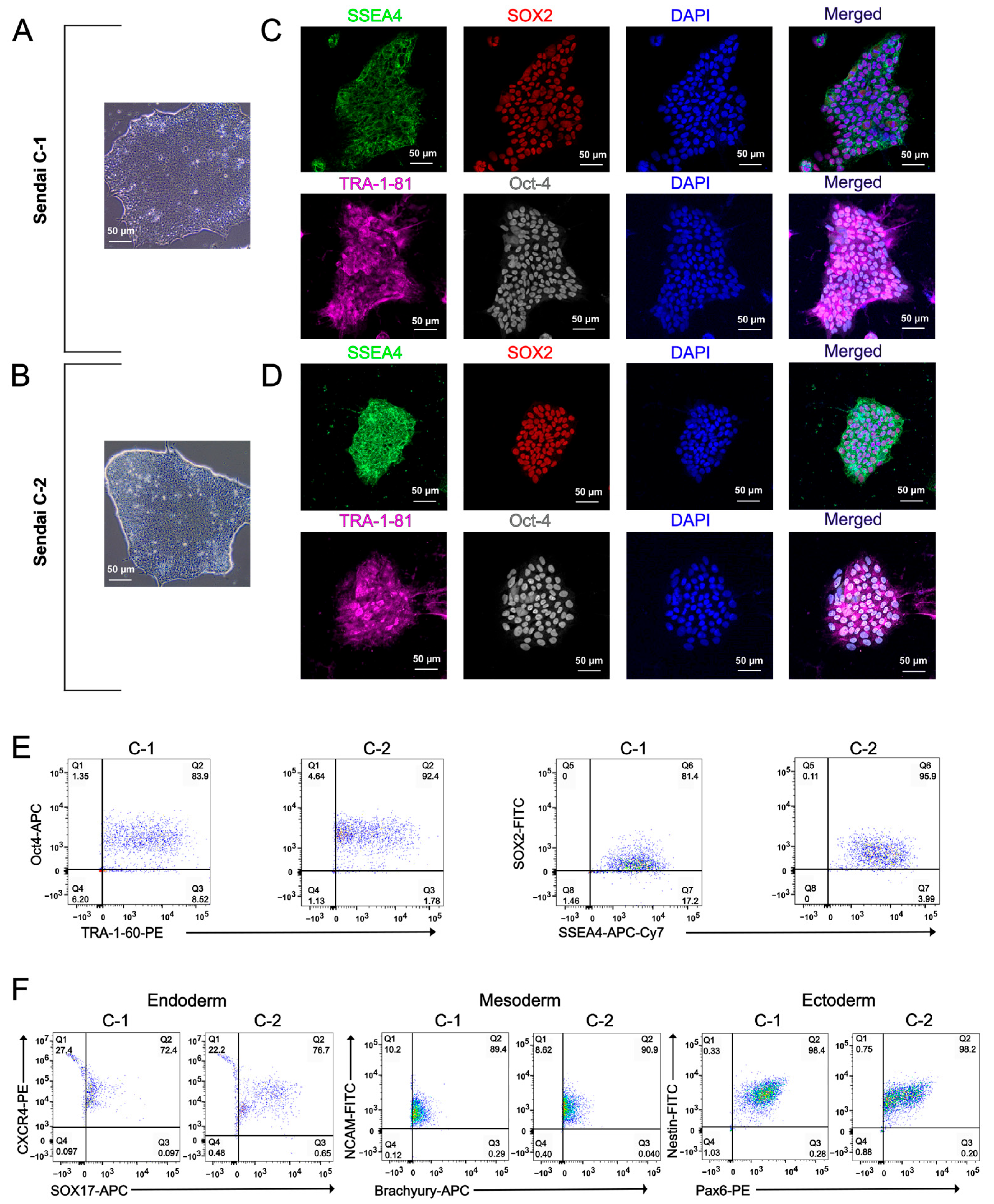
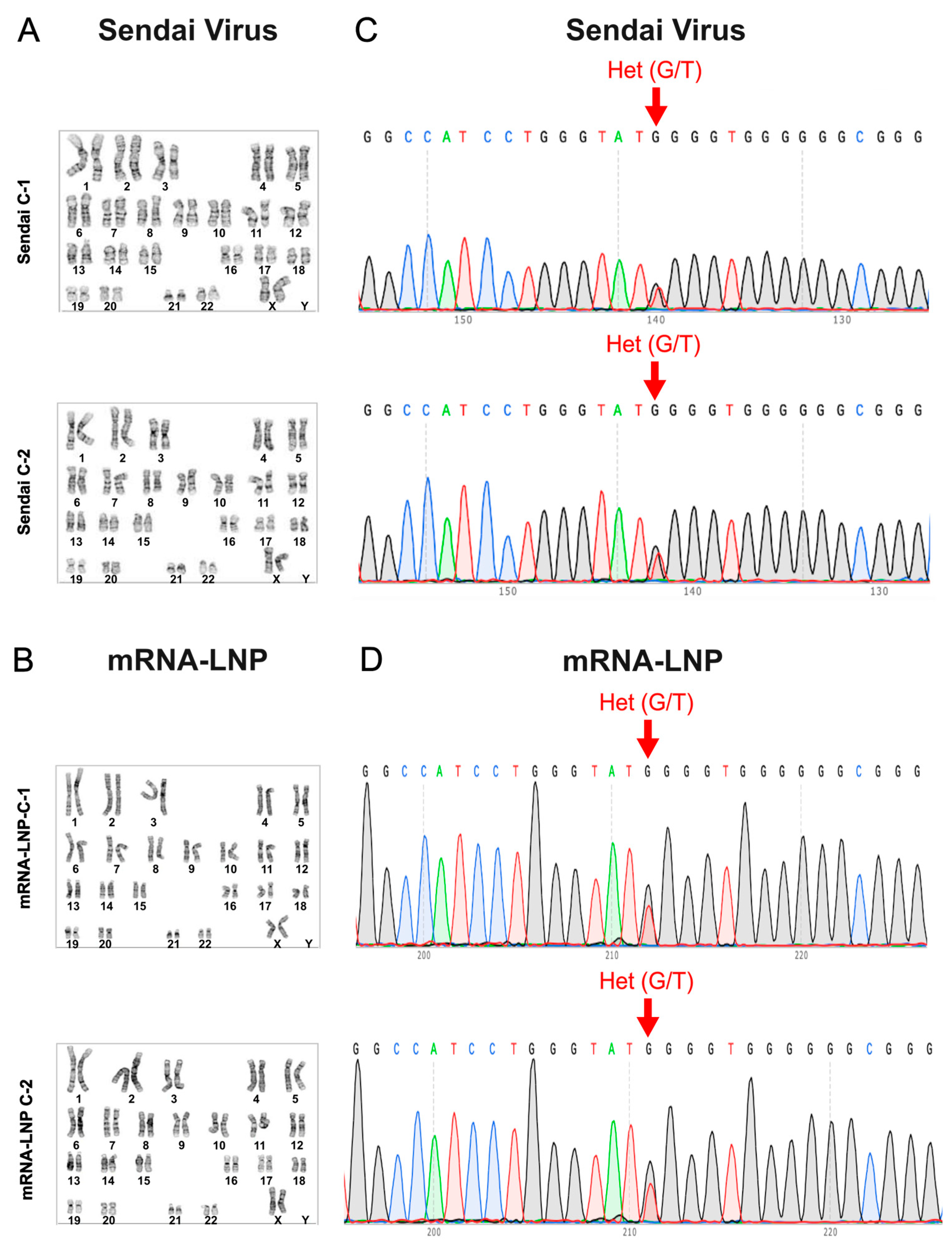
PBMC reprogramming into iPSCs using the non-integrating Sendai virus method has been one of the most widely adopted and reliable approaches for generating iPSCs over the past decade [1,2,3]. This method has supported advances in human-based and patient-specific translational disease modeling, regenerative applications, cardiotoxicity screening, and drug discovery, yielding high-quality and genetically stable iPSC lines [32,33]. Here, we present the characterization and pluripotency validation of iPSCs generated from PBMCs using the Sendai virus reprogramming method. Sendai virus-mediated reprogramming of PBMCs resulted in iPSC colonies that displayed characteristic morphology under light microscopy, forming dense iPSC colonies with well-defined borders (Figure 1A,B). Immunocytochemistry demonstrated the expression of the pluripotency markers SSEA4, SOX2, TRA-1-81, and Oct-4 (Figure 1C,D). Flow cytometry further showed expression of Oct-4, TRA-1-60, SOX2, and SSEA4 (Figure 1E). To functionally validate pluripotency, we assessed trilineage differentiation capacity. The iPSCs successfully generated derivatives of endoderm, mesoderm, and ectoderm, confirming their ability to differentiate into all three germ layers (Figure 1F). To evaluate whether reprogramming affected genomic integrity, the resulting iPSCs were examined for chromosomal abnormalities. The iPSCs exhibited a normal karyotype (Figure 2A), confirming that the reprogramming process did not introduce detectable chromosomal alterations. In addition, the LQTS type 2 (LQT2)-associated KCNH2 c.2398+5G>T variant carried by the patient was preserved in the iPSC lines, as confirmed by Sanger sequencing (Figure 2C). These experiments were conducted on two independent clones.
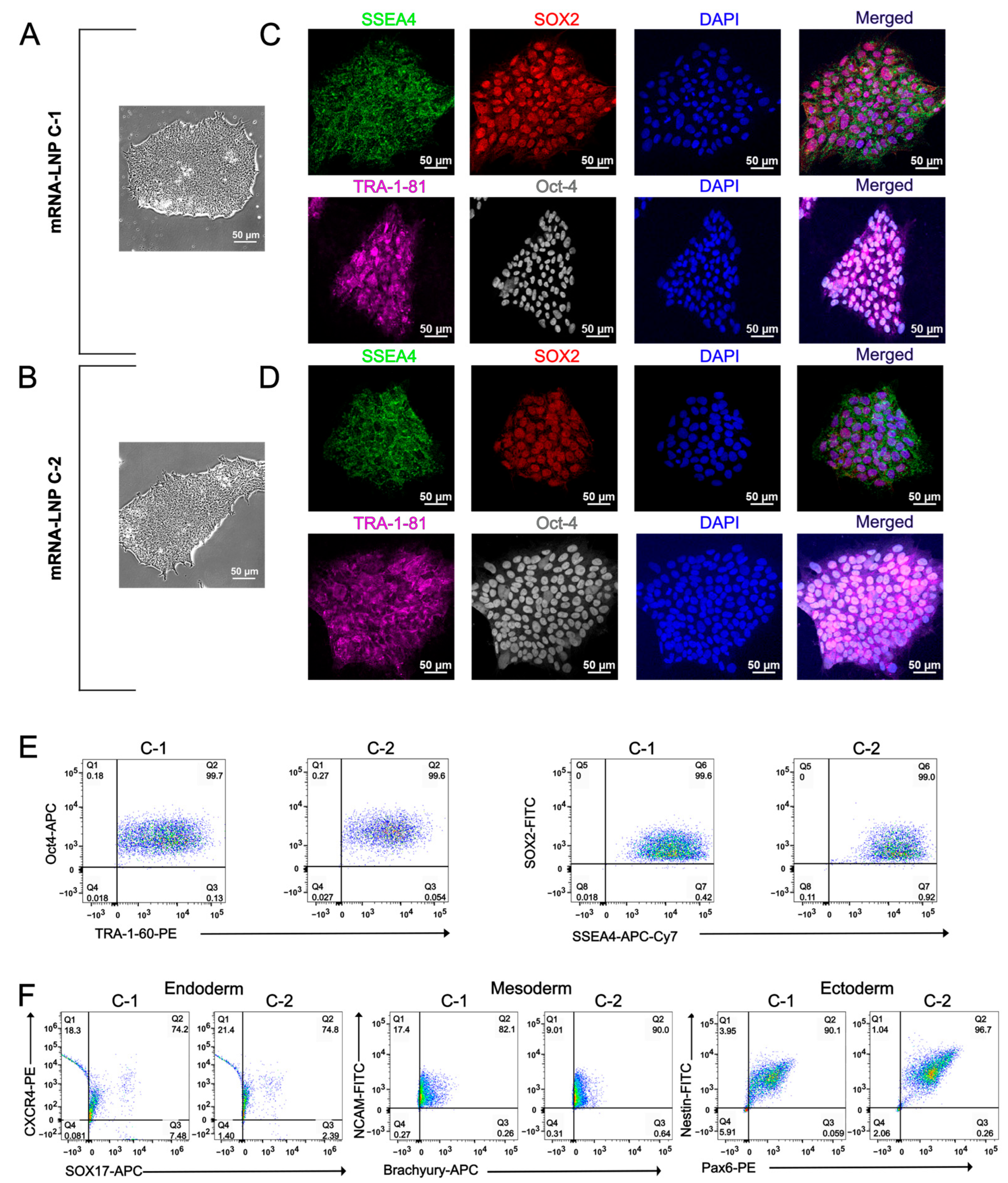
In parallel, iPSCs generated from PBMCs using the mRNA lipid nanoparticles (mRNA-LNP) reprogramming method underwent the same characterization and pluripotency validation workflow. mRNA-LNP-mediated reprogramming produced iPSC colonies with morphology indistinguishable from those generated by the Sendai virus method, forming compact colonies with distinct borders under light microscopy (Figure 3A,B). Immunocytochemistry confirmed expression of the pluripotency markers SSEA4, SOX2, TRA-1-81 and Oct-4 (Figure 3C,D), and flow cytometry demonstrated expression of Oct-4, TRA-1-60, SOX2, and SSEA4 (Figure 3E). Functional pluripotency was further validated by successful trilineage differentiation, with the mRNA-LNP-derived iPSCs generating derivatives of endoderm, mesoderm, and ectoderm (Figure 3F). Genomic integrity was also preserved as karyotype analysis revealed no detectable chromosomal abnormalities (Figure 2B), and Sanger sequencing confirmed retention of the LQT2-associated KCNH2 c.2398+5G>T variant in the mRNA-LNP-reprogrammed iPSCs (Figure 2D).
Importantly, while iPSCs generated using the mRNA-LNP method demonstrated pluripotency hallmarks and preserved genomic integrity, consistent with both the iPSC literature [29,30,31] and the Sendai virus-reprogrammed iPSCs in this study, the mRNA-LNP-based workflow required substantially fewer passages to reach the equivalent milestones listed in Table 1. For example, colony picking was completed by passage 10 for Sendai virus-reprogrammed iPSCs and by passage 2 for mRNA-LNP-reprogrammed iPSCs. iPSC characterization (iPSC colony morphology, markers of undifferentiated state, and trilineage differentiation assessments) was performed as early as passage 11 for Sendai virus-reprogrammed iPSCs and passage 3 for mRNA-LNP-reprogrammed iPSCs, with genomic characterization (karyotyping and STR analysis) conducted as early as passage 11 versus passage 4, respectively. Because the mRNA-LNP passaging workflow reached the characterization milestones at a lower passage number, and each passage used the same media type and volume and the same number of consumable units (plates, serological pipettes, etc.), this resulted in a 63.6% reduction in the media volume and consumables required for passaging per clone compared with the Sendai passaging workflow. Given an approximate five-day interval between passages, these differences translated into a markedly shorter derivation timeline and tissue culture-associated costs per iPSC clone, highlighting a practical advantage of the mRNA-LNP iPSC reprogramming approach without compromising iPSC pluripotency or genomic integrity.
Sendai virus-reprogrammed iPSCs have been widely used over the past decade to generate functional iPSC-cardiomyocytes (iPSC-CMs) that recapitulate patient-specific electrophysiological phenotypes in vitro [29,30,31,32,34,35,36]. Because a central requirement of any reprogramming platform is its ability to preserve the donor’s underlying functional electrophysiological phenotype, regardless of whether the donor is healthy or carries a disease-associated variant, we designed this study to evaluate whether the mRNA-LNP reprogramming method could faithfully maintain donor-specific electrophysiological phenotype through reprogramming and cardiac differentiation. Long QT syndrome (LQTS) provides an especially powerful test case for this purpose, because its electrophysiological phenotype is both pronounced and quantifiable, enabling a clear assessment of whether the disease signature is faithfully recapitulated in derived cardiomyocytes. In LQTS, this signature includes the characteristic prolongation of action potential duration (APD), mirroring the QT-interval prolongation observed clinically [29,31,32,36,37,38]. We therefore intentionally selected a donor with LQTS, using the APD prolongation as a well-defined benchmark to determine whether mRNA-LNP-reprogrammed iPSCs can generate iPSC-CMs that recapitulate the donor’s functional phenotype to the same extent as those derived from the established Sendai virus method. To ensure that any observed differences reflected the reprogramming method rather than inter-individual genetic variability, we used both the Sendai virus and mRNA-LNP methods to reprogram PBMCs from the same LQTS donor, allowing a genetically identical starting point for comparison. This genetically matched consideration isolates the reprogramming approach as the primary variable while holding the donor genome constant.
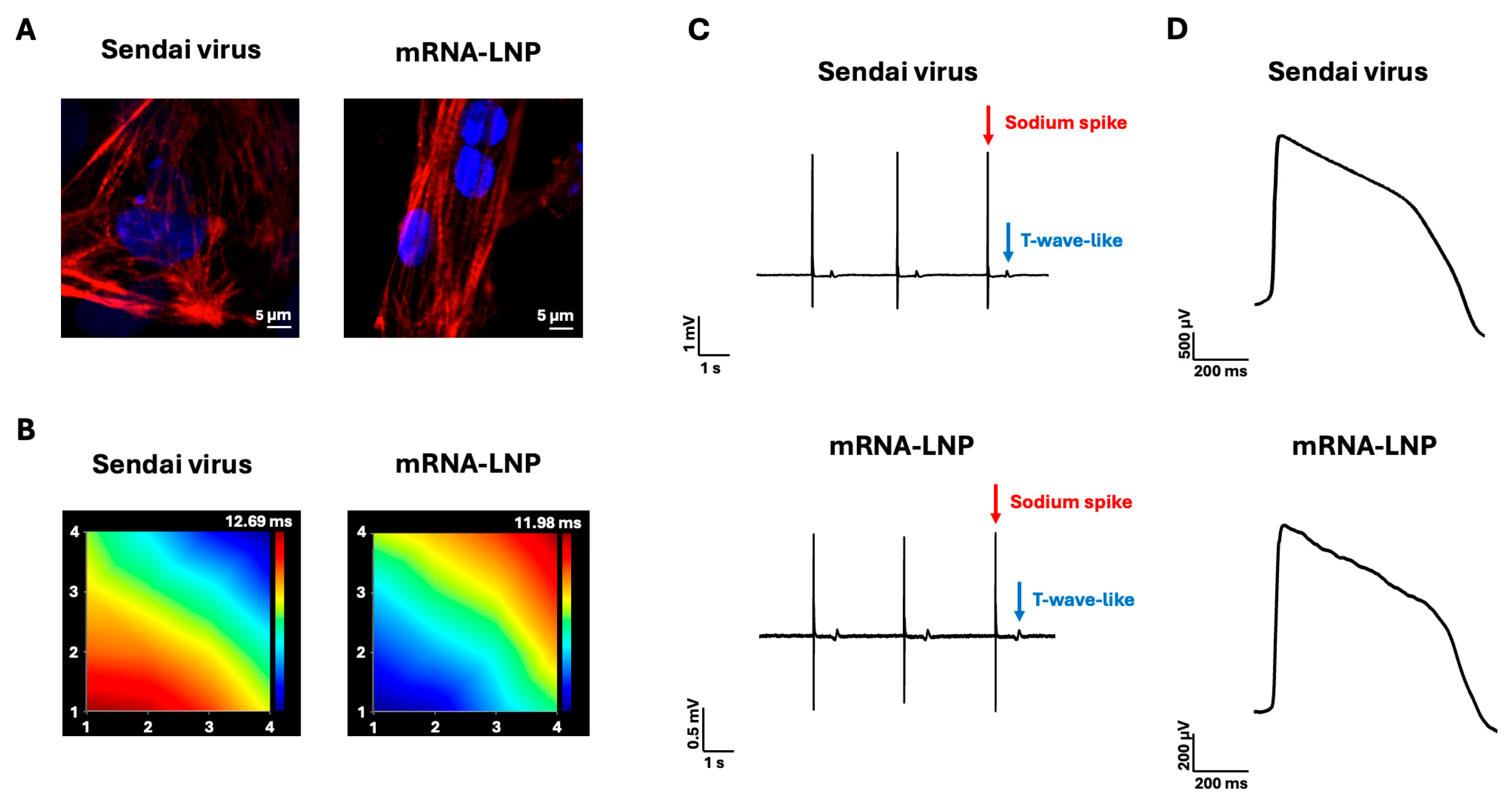
From each method, we selected the clone with the most robust mesodermal induction, reflecting the mesodermal origin of cardiomyocytes and supporting efficient cardiac differentiation. The Sendai virus-reprogrammed clone was differentiated at passage 15 and the mRNA-LNP-reprogrammed clone was differentiated at passage 5 using an identical differentiation protocol, producing uniform, spontaneously beating iPSC-CM sheets across the wells. The resulting iPSC-CMs displayed sarcomeric structures, as demonstrated by cardiac troponin T (cTnT) immunostaining (Figure 4A). Following enzymatic dissociation, the cells were replated onto multielectrode array (MEA) plates, where they formed confluent monolayers over the electrode arrays. MEA propagation maps generated by the Axion Biosystems Maestro EdgeTM platform demonstrated the presence of an electrically coupled syncytium, characterized by a defined initiation site (dark blue) and a uniform unidirectional signal propagation (Figure 4B). Field potential recordings displayed characteristic depolarization (sodium spike) and repolarization (T-wave-like) components, confirming electrophysiological activity (Figure 4C). Local Extracellular Action Potential (LEAP) signals, in Figure 4D, further demonstrated a characteristic iPSC-CM ventricular-like plateau phase [39,40]. To quantify a key electrophysiological hallmark of LQTS, we measured action potential duration. Published studies have reported APD at 90% repolarization (APD90) values for “healthy” iPSC-CMs typically ranging from approximately 243 to 373 ms [37,41,42,43,44,45], whereas LQT2 iPSC-CMs consistently exhibit prolonged APD90 values, with reported ranges around 516 to 881 ms [29,30,31,36]. In our study, iPSC-CMs generated by both reprogramming approaches displayed prolonged APD90 consistent with the published LQT2 phenotype: Sendai virus-derived iPSC-CMs presented an average APD90 of 595.5 ms (n = 28; derived from 5 independent differentiations), and mRNA-derived iPSC-CMs exhibited an average APD90 of 634.3 ms (n = 28; derived from 5 independent differentiations). Together, these electrophysiological assessments indicate that the iPSC-CMs differentiated from the mRNA-LNP-reprogrammed iPSCs form a functional syncytium, generate characteristic field potentials and action potentials, and retain the capacity to recapitulate the LQTS-associated APD-prolongation phenotype, consistent with the iPSC-CM literature and aligned with observations in the corresponding Sendai virus-reprogrammed iPSC-CMs.

3. Discussion

Although the mRNA-LNP and Sendai virus methods rely on distinct delivery strategies, no apparent differences in the overall characteristics of the reprogrammed iPSCs or their differentiated iPSC-CM derivatives were observed. Both methods generated colonies with characteristic iPSC morphology, expressed key pluripotency-associated markers, exhibited trilineage differentiation capacity, and maintained genomic integrity. However, the mRNA-LNP method accelerated the overall workflow, reaching key reprogramming, characterization, and differentiation-initiation milestones in substantially fewer passages, and therefore in markedly less time, than the Sendai virus method. At the same time, the mRNA-LNP approach involved additional dosing steps, as the protocol requires repeated LNP administration to maintain pluripotency-factor expression, in contrast to the single-infection Sendai system.
Both reprogramming approaches ultimately supported successful iPSC differentiation to iPSC-CMs. The mRNA-LNP-derived iPSC-CMs presented sarcomeric structures, established an electrically coupled syncytium, and generated field potentials and ventricular-like action potentials similarly to those produced by Sendai virus-differentiated iPSC-CMs (Figure 4). Importantly, both iPSC populations carried over the KCNH2 variant (Figure 2C,D), and their differentiated iPSC-CMs recapitulated the signature prolonged APD characteristic of the LQTS phenotype (Figure 4D) [29,30,31], indicating that the reprogramming method did not alter the ability of the differentiated iPSC-CMs to manifest the underlying patient-specific electrophysiological phenotype (Figure 4C,D).
As iPSC technology moves toward clinical translation, the methods used to reprogram parental lines are being extensively explored for their suitability in regenerative and precision medicine [46]. In this study, we assessed an mRNA-LNP strategy, a virus-free approach leveraging receptor-mediated endocytosis for cellular uptake [25,47,48]. As a non-viral platform, mRNA-LNP technology mitigates the regulatory, manufacturing, and viral-clearance considerations associated with vector-based systems [49,50]. Unlike Sendai virus-based reprogramming, mRNA-LNP does not introduce residual viral RNA that must be cleared through passaging, preserving those early, high-quality passages for downstream biobanking [46,51], while decreasing workflow timelines. By shortening these timelines, this approach decreased demands for media, consumables, and labor effort, ultimately lowering costs. On a broader scale, such workflow efficiencies could support the scalable iPSC biobanking and biomanufacturing required for future precision-medicine applications and regenerative-medicine pipelines.
Taken together, this study provides a comparative assessment of the mRNA-LNP reprogramming method alongside the established Sendai virus-based method. By utilizing both approaches to reprogram PBMCs from the same donor, we established a genetically identical starting point. This internal control was critical for evaluating the pluripotency of the resulting iPSCs and the functional performance of the derived iPSC-CMs directly against their Sendai virus-derived counterparts. This design ensures that any observed outcomes are attributable to the reprogramming method rather than inter-individual genetic variability. We specifically selected a donor with long QT syndrome because the pronounced and quantifiable electrophysiological signature of this disease, specifically prolonged action potential duration, serves as a clear benchmark to verify that the patient’s phenotype is recapitulated through the mRNA-LNP reprogramming and differentiation process. This choice allowed us to determine whether the distinct pathological signature, as captured by the Sendai virus-derived line, could be equally recovered via the mRNA-LNP approach. Our findings demonstrate that the mRNA-LNP-derived iPSC-CMs successfully recapitulated this signature, mirroring the results of the Sendai virus-derived iPSC-CMs. While this work highlights the technical feasibility and workflow advantages of mRNA-LNP reprogramming, further validation across a broader range of donor backgrounds and genetic pathologies will be essential to fully define the versatility of this platform, as well as to account for natural variation in reprogramming efficiency across individuals, with the present findings derived from the reprogramming of PBMCs from an individual LQTS donor using these two distinct methods. Overall, these findings demonstrate the potential for the mRNA-LNP platform to offer a practical strategy for biorepository biobanking, with the potential to support future applications in regenerative medicine, precision medicine, and disease modeling.

4. Materials and Methods

4.1. PBMCs Isolation

PBMCs were isolated using SepMateTM-50 (IVD) tubes (STEMCELL Technologies, Vancouver, BC, USA) along with HistopaqueTM 1077 (Sigma-Aldrich, St. Louis, MO, USA) and maintained in StemProTM-34 SFM medium (Thermo Fisher Scientific, Waltham, MA, USA) containing SCF, FLT3, IL-3, IL-6, GlutaMAXTM, and EPO (STEMCELL Technologies) in a 37 °C and 5% CO2 incubator for 4 days.

4.2. Sendai Virus iPSC Reprogramming

The CytoTuneTM-iPS 2.0 Sendai Reprogramming Kit (Thermo Fisher Scientific, cat#: A16517) was used for PBMC reprogramming. KOS and c-Myc vectors were used at a 5:5 ratio, and KLF4 was delivered at an MOI of 4.5 to improve reprogramming efficiency. Cells were cultured on Matrigel®-coated plates (Corning, Corning, NY, USA) in Essential 8TM Flex medium (Thermo Fisher Scientific). The iPSC colonies were then manually picked and cultured in Essential 8TM Flex medium supplemented with CloneRTM2 (STEMCELL Technologies). For the first ten passages, colonies were manually selected, after which cells were passaged as aggregates every 4–5 days at a 1:6 ratio using ReLeSR and CloneRTM2.

4.3. mRNA-LNP iPSC Reprogramming

iPSCs were generated from PBMCs using the Ubri-iPSC RNA-LNP Reprogramming Kit (Ubrigene, cat#: iPSC-RPM-RNA-LNP-V2, Germantown, MD, USA), utilizing mRNA for five reprogramming factors (Oct4, SOX2, KLF4, c-Myc, and LIN28) encapsulated in lipid nanoparticles (LNPs). Reprogramming was performed according to the manufacturer’s instructions. PBMCs were cultured with Enhancer B and the mRNA-LNP cocktail for two days, then plated onto Laminin 521-coated plates. Three additional mRNA-LNP treatments were given every two days. Cells were then kept in ReproTeSR™ medium (STEMCELL Technologies). Between days 16 and 20, colonies were picked and expanded in Essential 8™ Flex Medium (Thermo Fisher Scientific). iPSCs were passaged using ReLeSR™ (STEMCELL Technologies) and frozen in CryoStor® CS10 (STEMCELL Technologies).

4.4. Sanger Sequencing

DNA from PBMCs and iPSCs was extracted using the QIAamp DNA Mini kit (QIAGEN, Hilden, Germany). The KCNH2 c.2398+5G>T (intronic) (rs1554425149) region was amplified using PlatinumTM SuperFi II PCR Master Mix (Invitrogen, Carlsbad, CA, USA). After gel electrophoresis verification, the PCR product was purified with the QIAquick PCR Purification kit (QIAGEN), and Sanger sequenced at Azenta using the forward primer to determine genotype.

4.5. Flow Cytometry

Accutase (Thermo Fisher Scientific) was used to dissociate iPSCs, followed by blocking with FcR Blocking Reagent (Miltenyi Biotec, Bergisch Gladbach, Germany). Cells were incubated with surface antibodies (Table S1) for 15–30 min, then fixed and permeabilized using the Inside Stain Kit (Miltenyi Biotec). Cells were incubated with intracellular antibodies for 30–45 min. Analysis was conducted using FACSymphony™ A3 and FlowJoTM software version 10 (BD Biosciences, Franklin Lakes, NJ, USA).

4.6. Immunocytochemistry

iPSCs were plated on Matrigel®-coated chamber slides, fixed with 4% paraformaldehyde for 20 min, permeabilized using 0.1% Triton X-100 (Sigma-Aldrich) for 10 min, and blocked with donkey serum (Jackson ImmunoResearch, West Grove, PA, USA) for 1 h. Primary antibodies for iPSCs (Table S1) were added and incubated overnight at 4 °C. Secondary antibodies (Table S1) were applied for 1 h at room temperature. EverBriteTM Hardset Mounting Medium with DAPI (Biotium, Fremont, CA, USA) was mounted onto the coverslips and left to cure at room temperature for 1 h. To observe sarcomeres, ventricular cardiomycoytes grown on chamber slides for 2 weeks in maintenance media were incubated with Troponin T antibody overnight, then the anti-rabbit Alexa 568 secondary antibody was added. Images were captured using a ZEISS LSM 900 confocal microscope (Carl Zeiss AG, Oberkochen, Germany).

4.7. iPSC Trilineage Differentiation

Matrigel®-coated plates were used to plate iPSCs and incubated at 37 °C and 5% CO2 for 5–7 days with daily medium replacement using the STEMdiffTM Trilineage Differentiation Kit (STEMCELL Technologies). Flow cytometry was used to assess differentiation into endoderm (CXCR4/SOX17), mesoderm (Brachyury/NCAM), and ectoderm (Nestin/PAX6) as shown in Table S1.

4.8. Mycoplasma Testing

The MycoStrip® Mycoplasma Detection Kit (InvivoGen, San Diego, CA, USA) was used to verify that the iPSCs were mycoplasma-free.

4.9. Cytogenetic Analysis (Karyotyping)

20 G-banded metaphase iPSCs underwent karyotype analysis with a resolution range of 375–475 bands (WiCell, Madison, WI, USA).

4.10. Short Tandem Repeat (STR Analysis)

PBMCs and iPSCs underwent STR analysis at WiCell using the PowerPlex® 16 HS System (Promega Corporation, Madison, WI, USA).

4.11. iPSC-CM Differentiation and Maintenance

iPSCs were differentiated into ventricular-like iPSC cardiomyocytes using the STEMdiff™ Ventricular Cardiomyocyte Differentiation Kit (STEMCELL Technologies) according to the manufacturer’s instructions. iPSC colonies were dissociated into a single-cell suspension and plated onto Matrigel-coated plates. Media was changed every two days, and spontaneous contractions were seen by day 8. Cells were then kept in STEMdiff™ Cardiomyocyte Maintenance Medium (STEMCELL Technologies) until day 15, when they were dissociated for immunocytochemistry (ICC) and multielectrode array plating.

4.12. Microelectrode Array Plating and Recording

iPSC-CMs were dissociated using STEMdiff™ Cardiomyocyte Dissociation Media (STEMCELL Technologies) and plated onto Axion BioSystems MEA plates directly over each well’s recording electrode array. Following plating, cells were incubated at 37 °C in 5% CO2. For the initial 24 h, cells were suspended in STEMdiff™ Cardiomyocyte Support Medium (STEMCELL Technologies) containing STEMdiff™ Cardiomyocyte Plating Supplement (STEMCELL Technologies), in accordance with the manufacturer’s instructions. Thereafter, the media was replaced with STEMdiff™ Cardiomyocyte Maintenance Medium (STEMCELL Technologies) every 48 h. MEA recordings were performed 14 days post-plating using the Maestro Edge™ (Axion BioSystems, Atlanta, GA, USA) under standard cardiac settings (37 °C, 5% CO2). Field potentials, signal-propagation maps, and action potentials, recorded via the Local Extracellular Action Potential assay, were recorded using Axion Maestro AxIS Navigator software version 3.10.1. Data analysis and representative tracings were generated using AxIS Navigator, the Axion Data Export Tool, and a custom-written MATLAB (version 24.2) program.

Supplementary Materials

The following supporting information can be downloaded at: https://www.mdpi.com/article/10.3390/ijms27083588/s1.

Author Contributions

Conceptualization, M.D., J.C. and I.I.; methodology, M.D., J.C., A.G.G., E.M.G., A.H. and I.I.; software, D.D.; validation, M.D., J.C., D.D., E.S., A.H. and I.I.; formal analysis, M.D., J.C., D.D., A.H. and I.I.; investigation, M.D., J.C., A.G.G., E.M.G., E.S., A.H. and I.I.; resources, A.H. and I.I.; data curation, M.D., J.C., A.G.G., E.M.G., A.H. and I.I.; writing—original draft preparation, M.D., J.C., A.H. and I.I.; writing—review and editing, D.D., A.G.G., E.M.G. and E.S.; visualization, M.D., J.C., D.D., E.S. and I.I.; supervision, A.H. and I.I.; project administration, M.D., J.C., E.S. and I.I.; funding acquisition, I.I. All authors have read and agreed to the published version of the manuscript.

Funding

This work was supported in part by the Emory and Children’s Pediatric Research Alliance P*3 Pilot Award (00130739) and by institutional start-up funds provided to Ilanit Itzhaki by Emory University School of Medicine, Department of Pediatrics.

Institutional Review Board Statement

All procedures were conducted in accordance with the Emory University Institutional Review Board (IRB) study protocol (STUDY00005436) approved on 27 March 2024.

Informed Consent Statement

Informed consent was obtained from the subject involved in the study.

Data Availability Statement

The data supporting the conclusions of this article will be made available on request from the corresponding author.

Acknowledgments

We acknowledge the Emory Stem Cell and Organoids Core (RRID:SCR_023264) and the Emory Integrated Genomics Core (EIGC; RRID:SCR_023529) for providing subsidized core services. These facilities, subsidized by the Emory University School of Medicine, are part of the Emory Integrated Core Facilities. We further wish to acknowledge the Optical Microscopy Core Facilities at the Parker H. Petit Institute for Bioengineering and Bioscience at the Georgia Institute of Technology for the use of their shared equipment, services, and expertise.

Conflicts of Interest

The authors declare no conflicts of interest.

Abbreviations

The following abbreviations are used in this manuscript:
iPSCInduced pluripotent stem cell
iPSC-CMiPSC-derived cardiomyocytes
mRNA-LNPmRNA-lipid nanoparticles
PBMCPeripheral blood mononuclear cell
LQTSLong QT syndrome
LQT2Long QT syndrome type 2
APDAction potential duration
MEAMultielectrode array
LEAPLocal Extracellular Action Potential
APD90APD at 90% repolarization
cTnTCardiac Troponin T
LNPLipid nanoparticle
ICCImmunocytochemistry

References

  1. Shi, Y.; Inoue, H.; Wu, J.C.; Yamanaka, S. Induced Pluripotent Stem Cell Technology: A Decade of Progress. Nat. Rev. Drug Discov. 2016, 16, 115. [Google Scholar] [CrossRef]
  2. Rim, Y.; Nam, Y.; Ju, J. Induced Pluripotent Stem Cell Generation from Blood Cells Using Sendai Virus and Centrifugation. J. Vis. Exp. 2016, 2016, 54650. [Google Scholar] [CrossRef]
  3. Takahashi, K.; Yamanaka, S. Induction of Pluripotent Stem Cells from Mouse Embryonic and Adult Fibroblast Cultures by Defined Factors. Cell 2006, 126, 663–676. [Google Scholar] [CrossRef] [PubMed]
  4. Fusaki, N.; Ban, H.; Nishiyama, A.; Saeki, K.; Hasegawa, M. Efficient Induction of Transgene-Free Human Pluripotent Stem Cells Using a Vector Based on Sendai Virus, an RNA Virus That Does Not Integrate into the Host Genome. Proc. Jpn. Acad. Ser. B Phys. Biol. Sci. 2009, 85, 348. [Google Scholar] [CrossRef]
  5. Chun, Y.S.; Byun, K.; Lee, B. Induced Pluripotent Stem Cells and Personalized Medicine: Current Progress and Future Perspectives. Anat. Cell Biol. 2011, 44, 245. [Google Scholar] [CrossRef]
  6. Okumura, T.; Horie, Y.; Lai, C.-Y.; Lin, H.-T.; Shoda, H.; Natsumoto, B.; Fujio, K.; Kumaki, E.; Okano, T.; Ono, S.; et al. Robust and Highly Efficient HiPSC Generation from Patient Non-Mobilized Peripheral Blood-Derived CD34+ Cells Using the Auto-Erasable Sendai Virus Vector. Stem Cell Res. Ther. 2019, 10, 185. [Google Scholar] [CrossRef]
  7. Fus-Kujawa, A.; Mendrek, B.; Trybus, A.; Bajdak-Rusinek, K.; Stepien, K.L.; Sieron, A.L. Potential of Induced Pluripotent Stem Cells for Use in Gene Therapy: History, Molecular Bases, and Medical Perspectives. Biomolecules 2021, 11, 699. [Google Scholar] [CrossRef]
  8. Nishino, K.; Arai, Y.; Takasawa, K.; Toyoda, M.; Yamazaki-Inoue, M.; Sugawara, T.; Akutsu, H.; Nishimura, K.; Ohtaka, M.; Nakanishi, M.; et al. Epigenetic-Scale Comparison of Human IPSCs Generated by Retrovirus, Sendai Virus or Episomal Vectors. Regen. Ther. 2018, 9, 71. [Google Scholar] [CrossRef] [PubMed]
  9. Madrid, M.; Lakshmipathy, U.; Zhang, X.; Bharti, K.; Wall, D.M.; Sato, Y.; Muschler, G.; Ting, A.; Smith, N.; Deguchi, S.; et al. Considerations for the Development of IPSC-Derived Cell Therapies: A Review of Key Challenges by the JSRM-ISCT IPSC Committee. Cytotherapy 2024, 26, 1382. [Google Scholar] [CrossRef]
  10. Clancy, C.E.; Santana, L.F. Advances in Induced Pluripotent Stem Cell-Derived Cardiac Myocytes: Technological Breakthroughs, Key Discoveries and New Applications. J. Physiol. 2024, 602, 3871–3892. [Google Scholar] [CrossRef]
  11. MacArthur, C.C.; Fontes, A.; Ravinder, N.; Kuninger, D.; Kaur, J.; Bailey, M.; Taliana, A.; Vemuri, M.C.; Lieu, P.T. Generation of Human-Induced Pluripotent Stem Cells by a Nonintegrating RNA Sendai Virus Vector in Feeder-Free or Xeno-Free Conditions. Stem Cells Int. 2012, 2012, 564612. [Google Scholar] [CrossRef]
  12. Charlesworth, C.T.; Nakauchi, H. An Optimized Sendai Viral Vector Platform for Reprogramming to Naive Pluripotency. Cell Rep. Methods 2022, 2, 100349. [Google Scholar] [CrossRef]
  13. Moy, A.B.; Kamath, A.; Ternes, S.; Kamath, J. The Challenges to Advancing Induced Pluripotent Stem Cell-Dependent Cell Replacement Therapy. Med. Res. Arch. 2023, 11, 4784. [Google Scholar] [CrossRef]
  14. Beers, J.; Linask, K.L.; Chen, J.A.; Siniscalchi, L.I.; Lin, Y.; Zheng, W.; Rao, M.; Chen, G. A Cost-Effective and Efficient Reprogramming Platform for Large-Scale Production of Integration-Free Human Induced Pluripotent Stem Cells in Chemically Defined Culture. Sci. Rep. 2015, 5, 11319. [Google Scholar] [CrossRef]
  15. Baker, D.E.C.; Harrison, N.J.; Maltby, E.; Smith, K.; Moore, H.D.; Shaw, P.J.; Heath, P.R.; Holden, H.; Andrews, P.W. Adaptation to Culture of Human Embryonic Stem Cells and Oncogenesis In Vivo. Nat. Biotechnol. 2007, 25, 207–215. [Google Scholar] [CrossRef] [PubMed]
  16. Huang, C.Y.; Liu, C.L.; Ting, C.Y.; Chiu, Y.T.; Cheng, Y.C.; Nicholson, M.W.; Hsieh, P.C.H. Human IPSC Banking: Barriers and Opportunities. J. Biomed. Sci. 2019, 26, 87. [Google Scholar] [CrossRef] [PubMed]
  17. Bravery, C.A. Do Human Leukocyte Antigen-Typed Cellular Therapeutics Based on Induced Pluripotent Stem Cells Make Commercial Sense? Stem Cells Dev. 2015, 24, 1–10. [Google Scholar] [CrossRef] [PubMed]
  18. Warren, L.; Lin, C. MRNA-Based Genetic Reprogramming. Mol. Ther. 2019, 27, 729–734. [Google Scholar] [CrossRef]
  19. Warren, L.; Manos, P.D.; Ahfeldt, T.; Loh, Y.H.; Li, H.; Lau, F.; Ebina, W.; Mandal, P.K.; Smith, Z.D.; Meissner, A.; et al. Highly Efficient Reprogramming to Pluripotency and Directed Differentiation of Human Cells Using Synthetic Modified MRNA. Cell Stem Cell 2010, 7, 618. [Google Scholar] [CrossRef]
  20. Wang, A.Y.L. Application of Modified MRNA in Somatic Reprogramming to Pluripotency and Directed Conversion of Cell Fate. Int. J. Mol. Sci. 2021, 22, 8148. [Google Scholar] [CrossRef]
  21. Pratico, E.D.; Feger, B.J.; Watson, M.J.; Sullenger, B.A.; Bowles, D.E.; Milano, C.A.; Nair, S.K. RNA-Mediated Reprogramming of Primary Adult Human Dermal Fibroblasts into c-Kit(+) Cardiac Progenitor Cells. Stem Cells Dev. 2015, 24, 2622–2633. [Google Scholar] [CrossRef]
  22. Moolan-Vadackumchery, R.; Zhang, L.; Stüber, F. Evaluation of Lipid-Based Transfection in Primary Monocytes Within an Ex Vivo Whole-Blood Model. Biomolecules 2025, 15, 391. [Google Scholar] [CrossRef]
  23. Campelo, S.N.; Huang, P.H.; Buie, C.R.; Davalos, R.V. Recent Advancements in Electroporation Technologies: From Bench to Clinic. Annu. Rev. Biomed. Eng. 2023, 25, 77–100. [Google Scholar] [CrossRef]
  24. Kim, J.A.; Cho, K.; Shin, M.S.; Lee, W.G.; Jung, N.; Chung, C.; Chang, J.K. A Novel Electroporation Method Using a Capillary and Wire-Type Electrode. Biosens. Bioelectron. 2008, 23, 1353–1360. [Google Scholar] [CrossRef]
  25. Hou, X.; Zaks, T.; Langer, R.; Dong, Y. Lipid Nanoparticles for MRNA Delivery. Nat. Rev. Mater. 2021, 6, 1078–1094, Correction in Nat. Rev. Mater. 2022, 7, 65. [Google Scholar] [CrossRef]
  26. Escalona-Rayo, O.; Papadopoulou, P.; Slütter, B.; Kros, A. Biological Recognition and Cellular Trafficking of Targeted RNA-Lipid Nanoparticles. Curr. Opin. Biotechnol. 2024, 85, 103041. [Google Scholar] [CrossRef] [PubMed]
  27. Oh, S.; Kessler, J.A. Design, Assembly, Production, and Transfection of Synthetic Modified MRNA. Methods 2017, 133, 29. [Google Scholar] [CrossRef] [PubMed]
  28. Tanaka, H.; Miyama, R.; Sakurai, Y.; Tamagawa, S.; Nakai, Y.; Tange, K.; Yoshioka, H.; Akita, H. Improvement of MRNA Delivery Efficiency to a T Cell Line by Modulating PEG-Lipid Content and Phospholipid Components of Lipid Nanoparticles. Pharmaceutics 2021, 13, 2097. [Google Scholar] [CrossRef] [PubMed]
  29. Lahti, A.L.; Kujala, V.J.; Chapman, H.; Koivisto, A.P.; Pekkanen-Mattila, M.; Kerkelä, E.; Hyttinen, J.; Kontula, K.; Swan, H.; Conklin, B.R.; et al. Model for Long QT Syndrome Type 2 Using Human IPS Cells Demonstrates Arrhythmogenic Characteristics in Cell Culture. DMM Dis. Models Mech. 2012, 5, 220–230. [Google Scholar] [CrossRef]
  30. Zheng, B.; Zhu, Y.; Sun, M.; Cheng, H.; Zhang, S.; Cai, C.; Gu, K.; An, Y.; Ding, X.; Zhang, F.; et al. Personalized in Vitro Models Reveal Functional Impact of a KCNH2 Mutation and Enable Drug Screening in LQTS2. Heart Rhythm O2 2026, 108, 332–338. [Google Scholar] [CrossRef]
  31. O’Hare, B.J.; Kim, C.S.J.; Hamrick, S.K.; Ye, D.; Tester, D.J.; Ackerman, M.J. Promise and Potential Peril With Lumacaftor for the Trafficking Defective Type 2 Long-QT Syndrome-Causative Variants, p.G604S, p.N633S, and p.R685P, Using Patient-Specific Re-Engineered Cardiomyocytes. Circ. Genom. Precis. Med. 2020, 13, 466–475. [Google Scholar] [CrossRef] [PubMed]
  32. Itzhaki, I.; Maizels, L.; Huber, I.; Zwi-Dantsis, L.; Caspi, O.; Winterstern, A.; Feldman, O.; Gepstein, A.; Arbel, G.; Hammerman, H.; et al. Modelling the Long QT Syndrome with Induced Pluripotent Stem Cells. Nature 2011, 471, 225–230. [Google Scholar] [CrossRef]
  33. Singh, V.K.; Kalsan, M.; Kumar, N.; Saini, A.; Chandra, R. Induced Pluripotent Stem Cells: Applications in Regenerative Medicine, Disease Modeling, and Drug Discovery. Front. Cell Dev. Biol. 2015, 3, 2. [Google Scholar] [CrossRef]
  34. Lodrini, A.M.; Barile, L.; Rocchetti, M.; Altomare, C. Human Induced Pluripotent Stem Cells Derived from a Cardiac Somatic Source: Insights for an In-Vitro Cardiomyocyte Platform. Int. J. Mol. Sci. 2020, 21, 507. [Google Scholar] [CrossRef]
  35. Caudal, A.; Snyder, M.P.; Wu, J.C. Harnessing Human Genetics and Stem Cells for Precision Cardiovascular Medicine. Cell Genom. 2024, 4, 100445. [Google Scholar] [CrossRef]
  36. Matsa, E.; Rajamohan, D.; Dick, E.; Young, L.; Mellor, I.; Staniforth, A.; Denning, C. Drug Evaluation in Cardiomyocytes Derived from Human Induced Pluripotent Stem Cells Carrying a Long QT Syndrome Type 2 Mutation. Eur. Heart J. 2011, 32, 952–962. [Google Scholar] [CrossRef]
  37. Moretti, A.; Bellin, M.; Welling, A.; Jung, C.B.; Lam, J.T.; Bott-Flügel, L.; Dorn, T.; Goedel, A.; Höhnke, C.; Hofmann, F.; et al. Patient-Specific Induced Pluripotent Stem-Cell Models for Long-QT Syndrome. N. Engl. J. Med. 2010, 363, 1397–1409. [Google Scholar] [CrossRef] [PubMed]
  38. Friedrichs, S.; Malan, D.; Sasse, P. Modeling Long QT Syndromes Using Induced Pluripotent Stem Cells: Current Progress and Future Challenges. Trends Cardiovasc. Med. 2013, 23, 91–98. [Google Scholar] [CrossRef]
  39. Ernault, A.C.; Al-Shama, R.F.M.; Li, J.; Devalla, H.D.; de Groot, J.R.; Coronel, R.; Vigmond, E.; Boukens, B.J. Interpretation of Field and LEAP Potentials Recorded from Cardiomyocyte Monolayers. Am. J. Physiol. Heart Circ. Physiol. 2024, 326, H800–H811. [Google Scholar] [CrossRef] [PubMed]
  40. Broadbent, S.D.; Bhagwan, J.R.; Olusoga, T.; Barnes, A. Human IPSCs: Atrial versus Ventricular Cardiomyocytes and Their Functional and Pharmacological Differences. Biochem. Soc. Trans. 2026, 54, 181–194. [Google Scholar] [CrossRef]
  41. Ahmad, F.S.; Jin, Y.; Grassam-Rowe, A.; Zhou, Y.; Yuan, M.; Fan, X.; Zhou, R.; Mu-U-Min, R.; O’Shea, C.; Ibrahim, A.M.; et al. Generation of Cardiomyocytes from Human-Induced Pluripotent Stem Cells Resembling Atrial Cells with Ability to Respond to Adrenoceptor Agonists. Philos. Trans. R. Soc. B Biol. Sci. 2023, 378, 20220312. [Google Scholar] [CrossRef] [PubMed]
  42. Hwang, I.; Park, J.W.; Kwon, O.S.; Lim, B.; Hong, M.; Kim, M.; Yu, H.T.; Kim, T.H.; Uhm, J.S.; Joung, B.; et al. Computational Modeling for Antiarrhythmic Drugs for Atrial Fibrillation According to Genotype. Front. Physiol. 2021, 12, 650449, Correction in Front. Physiol. 2022, 13, 991997. https://doi.org/10.3389/fphys.2022.991997. [Google Scholar] [CrossRef]
  43. Garg, P.; Oikonomopoulos, A.; Chen, H.; Li, Y.; Lam, C.K.; Sallam, K.; Perez, M.; Lux, R.L.; Sanguinetti, M.C.; Wu, J.C. Genome Editing and Induced Pluripotent Stem Cells in Cardiac Channelopathy. J. Am. Coll. Cardiol. 2018, 72, 62. [Google Scholar] [CrossRef]
  44. Kim, M.S.; Fleres, B.; Lovett, J.; Anfinson, M.; Samudrala, S.S.K.; Kelly, L.J.; Teigen, L.E.; Cavanaugh, M.; Marquez, M.; Geurts, A.M.; et al. Contractility of Induced Pluripotent Stem Cell-Cardiomyocytes With an MYH6 Head Domain Variant Associated With Hypoplastic Left Heart Syndrome. Front. Cell Dev. Biol. 2020, 8, 440. [Google Scholar] [CrossRef]
  45. Carvalho, A.B.; Coutinho, K.C.d.S.; Barbosa, R.A.Q.; de Campos, D.B.P.; Leitão, I.C.; Pinto, R.S.; Dos Santos, D.S.; Farjun, B.; De Araújo, D.D.S.; Mesquita, F.C.P.; et al. Action Potential Variability in Human Pluripotent Stem Cell-Derived Cardiomyocytes Obtained from Healthy Donors. Front. Physiol. 2022, 13, 1077069. [Google Scholar] [CrossRef]
  46. Kunitomi, A.; Hirohata, R.; Arreola, V.; Osawa, M.; Kato, T.M.; Nomura, M.; Kawaguchi, J.; Hara, H.; Kusano, K.; Takashima, Y.; et al. Improved Sendai Viral System for Reprogramming to Naive Pluripotency. Cell Rep. Methods 2022, 2, 100317. [Google Scholar] [CrossRef] [PubMed]
  47. Li, X.; Li, J.; Wei, J.; Du, W.; Su, C.; Shen, X.; Zhao, A.; Xu, M. Design Strategies for Novel Lipid Nanoparticle for MRNA Vaccine and Therapeutics: Current Understandings and Future Perspectives. MedComm 2025, 6, e70414. [Google Scholar] [CrossRef] [PubMed]
  48. Li, B.; Zhang, X.; Dong, Y. Nanoscale Platforms for Messenger RNA Delivery. Wiley Interdiscip. Rev. Nanomed. Nanobiotechnol. 2019, 11, e1530. [Google Scholar] [CrossRef]
  49. Rosa, S.S.; Prazeres, D.M.F.; Azevedo, A.M.; Marques, M.P.C. MRNA Vaccines Manufacturing: Challenges and Bottlenecks. Vaccine 2021, 39, 2190. [Google Scholar] [CrossRef]
  50. Steinle, H.; Behring, A.; Schlensak, C.; Wendel, H.P.; Avci-Adali, M. Concise Review: Application of In Vitro Transcribed Messenger RNA for Cellular Engineering and Reprogramming: Progress and Challenges. Stem Cells 2017, 35, 68–79. [Google Scholar] [CrossRef]
  51. Warren, L.; Ni, Y.; Wang, J.; Guo, X. Feeder-Free Derivation of Human Induced Pluripotent Stem Cells with Messenger RNA. Sci. Rep. 2012, 2, 657. [Google Scholar] [CrossRef]
Figure 1. PBMCs were reprogrammed into iPSCs using a non-integrating Sendai virus method. (A) Light microscopy images displaying characteristic iPSC colony morphology in clone 1 (Sendai C-1) and (B) in clone 2 (Sendai C-2). (C) Immunocytochemistry displaying the expression of pluripotency markers SSEA4, SOX2, TRA-1-81 and Oct-4 in clone 1 and (D) clone 2. (E) Flow cytometry analysis demonstrating the expression of Oct-4, TRA-1-60, SOX2, and SSEA4 markers for both clones. (F) Demonstrated pluripotency across all three germ layers: endoderm, mesoderm, and ectoderm for both clones.
Ijms 27 03588 g001
Figure 2. Genomic Integrity and Variant Verification. (A) Both Sendai virus and (B) mRNA-LNP reprogrammed iPSCs exhibit a normal karyotype. (C) Both Sendai virus and (D) mRNA-LNP reprogrammed iPSCs harbor the KCNH2 variant (c.2398+5G>T), as verified by Sanger sequencing. Each assessment was repeated in two independent clones (C-1 and C-2) for each reprogramming method.
Ijms 27 03588 g002
Figure 3. PBMCs were reprogrammed into iPSCs using the mRNA-LNP method. (A) Light microscopy images displaying characteristic iPSC colony morphology in clone 1 (mRNA-LNP C-1) and (B) in clone 2 (mRNA-LNP C-2). (C) Immunocytochemistry displaying the expression of pluripotency markers SSEA4, SOX2, TRA-1-81 and Oct-4 in clone 1 and (D) clone 2. (E) Flow cytometry analysis demonstrating the expression of Oct-4, TRA-1-60, SOX2, and SSEA4 markers for both clones. (F) Demonstrated pluripotency across all three germ layers: endoderm, mesoderm, and ectoderm for both clones.
Ijms 27 03588 g003
Figure 4. Functional Characterization of iPSC-derived Cardiomyocytes. Both Sendai virus and mRNA-LNP-reprogrammed iPSCs differentiated into iPSC-CMs exhibiting sarcomeric structures and electrophysiological activity. (A) Immunocytochemistry for cardiac troponin T. (B) Microelectrode Array signal propagation maps demonstrating electrical syncytium. (C) Field potential recordings depicting sodium spikes and T-wave-like waveforms. (D) Local Extracellular Action Potential signals.
Ijms 27 03588 g004
Table 1. Comparison of Sendai virus and mRNA-LNP reprogramming and characterization workflow milestones.
ProcedureReprogramming Using
Sendai Virus
Reprogramming Using
mRNA-LNP
Passage by colony pickingUp to P10Up to P2
Morphology and Pluripotency CharacterizationAs early as P11As early as P3
Genomic CharacterizationAs early as P11As early as P4
ExpansionP10P2
Disclaimer/Publisher’s Note: The statements, opinions and data contained in all publications are solely those of the individual author(s) and contributor(s) and not of MDPI and/or the editor(s). MDPI and/or the editor(s) disclaim responsibility for any injury to people or property resulting from any ideas, methods, instructions or products referred to in the content.