Integrated Evaluation of Mentha rotundifolia (L.) Huds Essential Oil: Physicochemical Characterization, Antibacterial Effect and In Silico ADMET Prediction

 ,
,  ,
,  ,
,  ,
, 
Abstract
1. Introduction
2. Results and Discussion
2.1. Determination of Organoleptic Properties
2.2. Determination of Physical Properties
2.3. Chemical Profile of EO
2.4. Antibacterial Activity
2.5. Time-Kill Kinetics
2.6. DFT and MESP Analysis
2.6.1. Frontier Molecular Orbitals (FMOs)
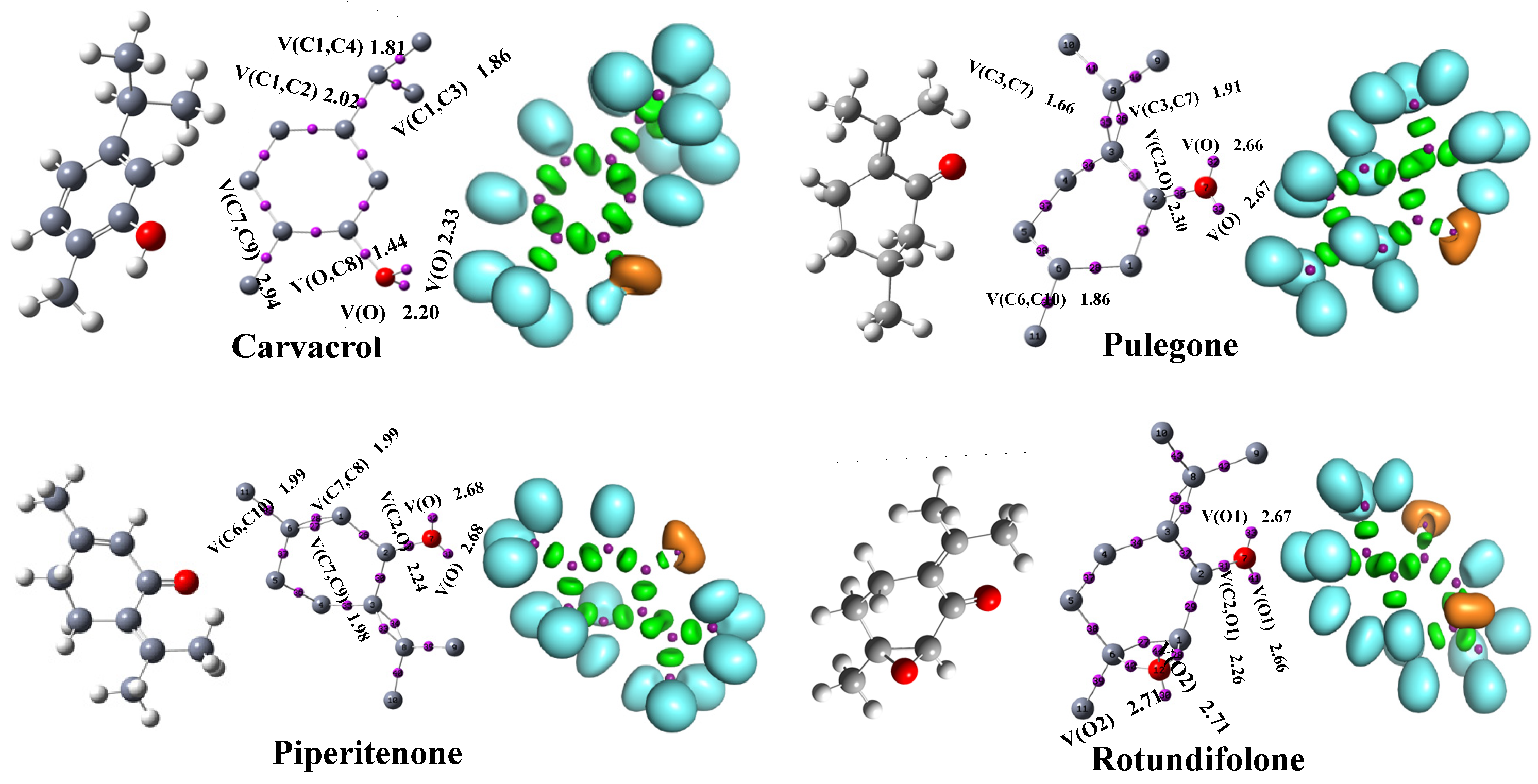
2.6.2. Analysis Electron Localization Function (ELF)
2.6.3. Analysis of Non-Covalent Interactions (NCI)
2.6.4. MEP Analysis of Compounds
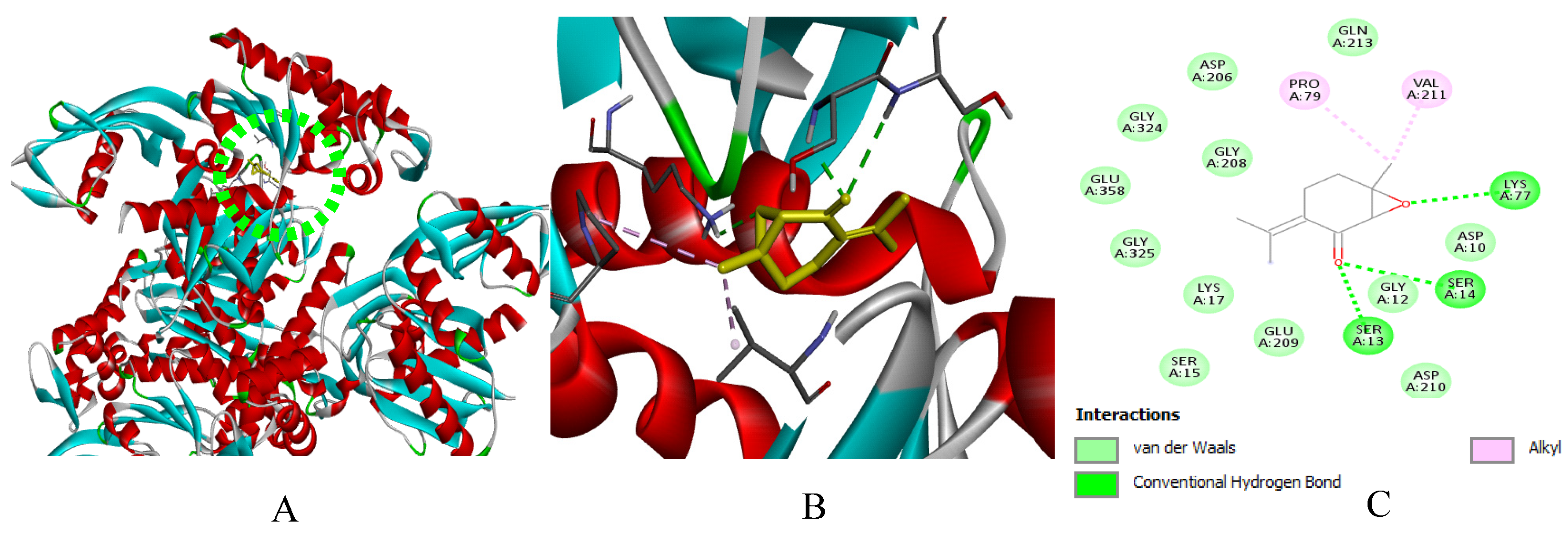
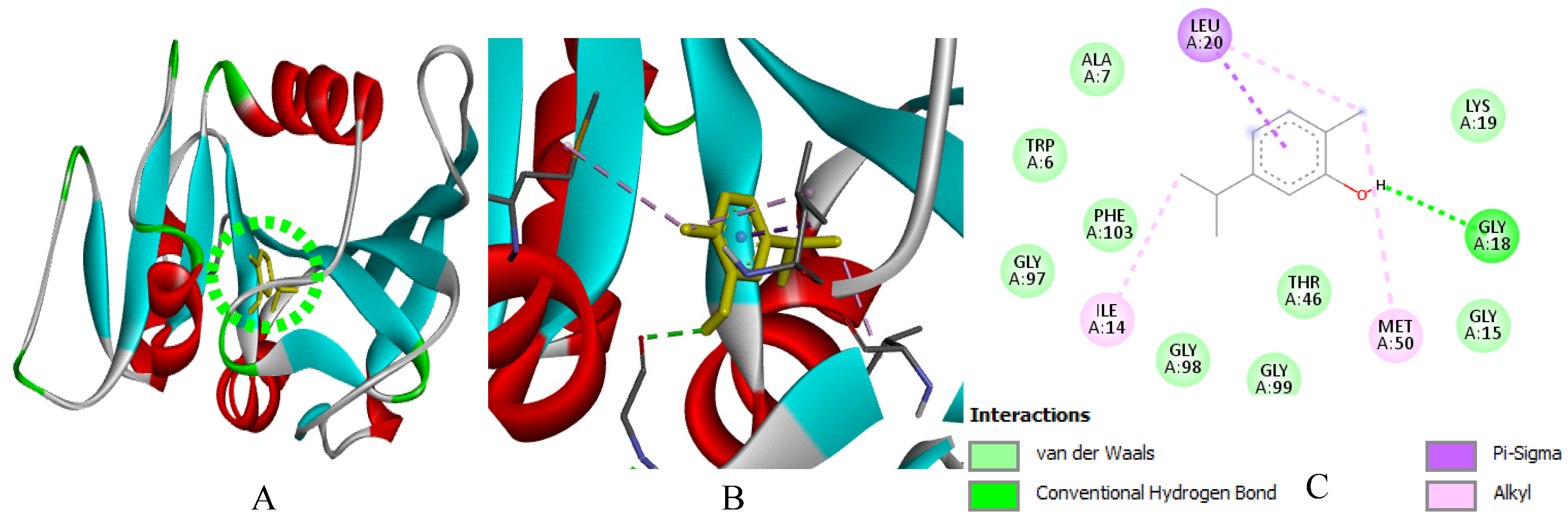
2.6.5. Molecular Docking
Choice of Molecular Target
Docking Validation Based on Ligand Pose Superposition
2.6.6. In Silico Assessment of the Toxicological Profile
3. Materials and Methods
3.1. Plant Material
3.2. EO Extraction
3.3. Organoleptic Properties
3.4. Physical Properties
3.4.1. Relative Density
- -
- M1: mass in grams of 200 µL of tested EO.
- -
- M: mass in grams of 200 ul of distilled water.
3.4.2. Miscibility with Ethanol
3.4.3. Freezing Point
3.5. Chemical Profile Determination Using GC/MS-MS
3.6. Antibacterial Activity Assay
3.6.1. Bacterial Strains
3.6.2. Inoculum Preparation
3.6.3. Agar Disk Diffusion Assay
3.6.4. Determination of Minimum Inhibitory Concentration (MIC)
3.6.5. Determination of Minimum Bactericidal Concentration (MBC)
3.6.6. Time-Kill Kinetics Assay
3.7. Molecular Docking Simulation
3.7.1. Molecular Geometry
3.7.2. Molecular Docking’s in Silico Screening
- 3WT0 (B. cereus): 20 × 20 × 20 Å; center (4.53, −6.34, 60.01) Å.
- 5CDP (S. aureus): 20 × 20 × 20 Å; center (11.78, 50.11, 44.02) Å.
- 6J90 (S. Typhi): 24 × 24 × 24 Å; center (−12.65, 51.02, 28.42) Å.
- 4M7U (E. faecalis): 20.7911 × 15.7199 × 11.9981 Å; center (12.7148, −24.2497, 13.481) Å.
- 5Y2G (S. agalactiae): 20 × 20 × 20 Å; center (67.27, 165.24, −0.86) Å.
- 6LK2 (P. alcalifaciens):13.4173 × 17.7532 × 12.059 Å; center (5.05716, 5.77914, 56.1322) Å.
- 7P2N (DNA gyrase (GyrB)): 20 × 20 × 20 Å; center (−19.996750, −14.398875, 6.856083) Å.
3.7.3. In Silico Assessment
3.8. Statistical Analysis
4. Conclusions
Supplementary Materials
Author Contributions
Funding
Institutional Review Board Statement
Informed Consent Statement
Data Availability Statement
Conflicts of Interest
References
- Fierascu, R.C.; Fierascu, I.; Ortan, A.; Georgiev, M.I.; Sieniawska, E. Innovative Approaches for Recovery of Phytoconstituents from Medicinal/Aromatic Plants and Biotechnological Production. Molecules 2020, 25, 309. [Google Scholar] [CrossRef]
- Pinto, L.; Tapia-Rodríguez, M.R.; Baruzzi, F.; Ayala-Zavala, J.F. Plant Antimicrobials for Food Quality and Safety: Recent Views and Future Challenges. Foods 2023, 12, 2315. [Google Scholar] [CrossRef]
- Guzik, P.; Szymkowiak, A.; Kulawik, P.; Zając, M. Consumer Attitudes towards Food Preservation Methods. Foods 2022, 11, 1349. [Google Scholar] [CrossRef]
- Dong, H.; Xu, Y.; Zhang, Q.; Li, H.; Chen, L. Activity and Safety Evaluation of Natural Preservatives. Food Res. Int. 2024, 190, 114548. [Google Scholar] [CrossRef]
- Shi, C.; Jia, L.; Tao, H.; Hu, W.; Li, C.; Aziz, T.; Al-Asmari, F.; Sameeh, M.Y.; Cui, H.; Lin, L. Fortification of Cassava Starch Edible Films with Litsea cubeba Essential Oil for Chicken Meat Preservation. Int. J. Biol. Macromol. 2024, 276, 133920. [Google Scholar] [CrossRef]
- Zhang, Q.; Huo, Y.; Yang, Q.; Zhao, F.; Li, M.; Ju, J. Migration of Chemical Substances from Packaging Materials to Food. Food Chem. 2025, 485, 144544. [Google Scholar] [CrossRef] [PubMed]
- Huang, M.; Yu, J.; Guo, M.; Zhang, J.; Ren, L. Recent Advances in the Preservation Effects of Spice Essential Oils on Fruits and Vegetables. Food Chem. 2025, 464, 141827. [Google Scholar] [CrossRef] [PubMed]
- Spréa, R.M.; Caleja, C.; Finimundy, T.C.; Calhelha, R.C.; Pires, T.C.S.P.; Amaral, J.S.; Prieto, M.A.; Ferreira, I.C.F.R.; Pereira, E.; Barros, L. Chemical and Bioactive Evaluation of Essential Oils from Edible and Aromatic Mediterranean Lamiaceae Plants. Molecules 2024, 29, 2827. [Google Scholar] [CrossRef]
- Karpiński, T.M. Essential Oils of Lamiaceae Family Plants as Antifungals. Biomolecules 2020, 10, 103. [Google Scholar] [CrossRef]
- Gülçin, İ.; Karageçili, H. The Lamiaceae Family Plants Ethnobotanical Properties, Ethnopharmacological Uses, Phytochemical Studies and Their Utilization in Public or Current Clinical Practices: A Review. Rec. Nat. Prod. 2025, 19, 466–487. [Google Scholar] [CrossRef]
- Uritu, C.M.; Mihai, C.T.; Stanciu, G.-D.; Dodi, G.; Alexa-Stratulat, T.; Luca, A.; Leon-Constantin, M.-M.; Stefanescu, R.; Bild, V.; Melnic, S.; et al. Medicinal Plants of the Family Lamiaceae in Pain Therapy: A Review. Pain Res. Manag. 2018, 2018, 7801543. [Google Scholar] [CrossRef]
- Yousefian, S.; Esmaeili, F.; Lohrasebi, T. A Comprehensive Review of the Key Characteristics of the Genus Mentha, Natural Compounds and Biotechnological Approaches for the Production of Secondary Metabolites. Iran. J. Biotechnol. 2023, 21, 2–29. [Google Scholar] [CrossRef]
- Eftekhari, A.; Khusro, A.; Ahmadian, E.; Dizaj, S.M.; Hasanzadeh, A.; Cucchiarini, M. Phytochemical and Nutra-Pharmaceutical Attributes of Mentha spp.: A Comprehensive Review. Arab. J. Chem. 2021, 14, 103106. [Google Scholar] [CrossRef]
- Dimitrov, O.; Zaharieva, K.; Stambolova, I.; Eneva, R.; Engibarov, S.; Lazarkevich, I.; Gocheva, Y.; Stoyanova, D.; Shipochka, M.; Markov, P.; et al. Photocatalytic and Antimicrobial Activity of TiO2 Particles, Obtained by Mentha spicata Leaves–Mediated Synthesis. Catal. Today 2025, 460, 115466. [Google Scholar] [CrossRef]
- Mahendran, G.; Verma, S.K.; Rahman, L.-U. The Traditional Uses, Phytochemistry and Pharmacology of Spearmint (Mentha spicata L.): A Review. J. Ethnopharmacol. 2021, 278, 114266. [Google Scholar] [CrossRef]
- Yakhlef, G.; Hambaba, L.; Pinto, D.C.G.A.; Silva, A.M.S. Chemical Composition and Insecticidal, Repellent and Antifungal Activities of Essential Oil of Mentha rotundifolia (L.) from Algeria. Ind. Crop. Prod. 2020, 158, 112988. [Google Scholar] [CrossRef]
- Ansari, A.; Znini, M.; Laghchimi, A.; Costa, J.; Ponthiaux, P.; Majidi, L. Chemical Composition, Adsorption Proprieties and Corrosion Inhibition on Mild Steel of Mentha rotundifolia L. Essential Oil from Morocco. Pharm. Lett. 2015, 7, 125–140. [Google Scholar]
- Mahanta, B.P.; Bora, P.K.; Kemprai, P.; Borah, G.; Lal, M.; Haldar, S. Thermolabile Essential Oils, Aromas and Flavours: Degradation Pathways, Effect of Thermal Processing and Alteration of Sensory Quality. Food Res. Int. 2021, 145, 110404. [Google Scholar] [CrossRef] [PubMed]
- Afrokh, M.; El Mehrach, K.; Chatoui, K.; Ait Bihi, M.; Sadki, H.; Zarrouk, A.; Tabyaoui, M.; Tahrouch, S. Quality Criteria, Chemical Composition and Antimicrobial Activity of the Essential Oil of Mentha suaveolens Ehrh. Heliyon 2024, 10, e28125. [Google Scholar] [CrossRef] [PubMed]
- Yadav, S.K. Physiochemical Properties of Essential Oils and Applications. In Biochemistry; IntechOpen: London, UK, 2022; pp. 1–18. [Google Scholar] [CrossRef]
- Riahi, L.; Elferchichi, M.; Ghazghazi, H.; Jebali, J.; Ziadi, S.; Aouadhi, C.; Chograni, H.; Zaouali, Y.; Zoghlami, N.; Mliki, A. Phytochemistry, Antioxidant and Antimicrobial Activities of the Essential Oils of Mentha rotundifolia L. in Tunisia. Ind. Crop. Prod. 2013, 49, 883–889. [Google Scholar] [CrossRef]
- Farial, K.; Malika, B.; Fouzia, B.; Nabil, T.; Adil, M.; Danish, S.; Alharbi, S.A.; Ansari, M.J.; Alarfaj, A.A. Chemical Composition and Insecticidal Activity of Mentha rotundifolia and Chrysanthemum coronarium Essential Oils against the Tomato Leaf Miner, Tuta absoluta. Sci. Rep. 2025, 15, 1411. [Google Scholar] [CrossRef]
- Jamshidi-Kia, F.; Saeidi, K.; Lorigooini, Z.; Samani, B.H. Efficacy of Foliar Application of Chlorella Vulgaris Extract on Chemical Composition and Biological Activities of the Essential Oil of Spearmint (Mentha spicata L.). Heliyon 2024, 10, e40531. [Google Scholar] [CrossRef] [PubMed]
- Saqib, S.; Ullah, F.; Naeem, M.; Younas, M.; Ayaz, A.; Ali, S.; Zaman, W. Mentha: Nutritional and Health Attributes to Treat Various Ailments Including Cardiovascular Diseases. Molecules 2022, 27, 6728. [Google Scholar] [CrossRef] [PubMed]
- Wani, S.A.; Naik, H.R.; Wagay, J.A.; Ganie, N.A.; Mulla, M.Z.; Dar, B.N. Mentha: A Review on Its Bioactive Compounds and Potential Health Benefits. Qual. Assur. Saf. Crop. Foods 2022, 14, 154–168. [Google Scholar] [CrossRef]
- Sbai, A.; Talbi, F.Z.; El Omari, H.; Chaouche, A.; Moussa, O.; El Kabous, K.; Barrahi, M.; El-Akhal, F.; Alaoui, M.M.; El Khayyat, F.; et al. Inhibitory Effect of Essential Oil from Rond Left Mint (Mentha rotundifolia) on the Corrosion of C35 Mild Steel in an Acidic Environment. Trop. J. Nat. Prod. Res. 2023, 7, 5628–5632. [Google Scholar] [CrossRef]
- Haddache, N.; Dahmani-Hamzaoui, N.; Baaliouamer, A. Comparative Analysis of Chemical Composition, Antioxidant and Antibacterial Activities of Mentha rotundifolia Essential oils from Algeria extracted by microwave and hydrodistillation. PCBS J. 2017, 11, 65–72. [Google Scholar]
- Bentoura, S.; Dahmani, N.; Hamaidi, F.; Saidi, F.; Bendjoudi, D.; Hamaidi, M. Antiradical, Antimic Robial Effect and Chemical Composition of Essential Oil of Mentha rotundifolia. L from Mountains El Hamdania, North of Algeria. Arab. J. Med. Aromat. Plants 2021, 7, 407–421. [Google Scholar] [CrossRef]
- Yakoubi, R.; Benouchenne, D.; Bendjedid, S.; Megateli, S.; Sadok, T.H.; Gali, L.; Azri, O. Chemical Constituents and in Vitro Biological Activities of Mentha rotundifolia’s Essential Oils Extracted by Ultrasound-Assisted Hydrodistillation Compared to Conventional Hydrodistillation. Biomass Convers. Biorefinery 2024, 15, 5267–5279. [Google Scholar] [CrossRef]
- Benahmed, A.; Cherouana, K.; Benchikhelhocine, I.; Ikhlef, A.; Meghezzi, A.; Harfi, B. Effects of Controlled Culture Conditions on Chemical Composition and Antimicrobial Activities of Mentha rotundifolia Essential Oils. J. Pharm. Nutr. Sci. 2022, 12, 165–174. [Google Scholar] [CrossRef]
- Ladjel, S.; Gherraf, N.; Hamada, D. Antimicrobial Effect of Essential Oils from the Algerian Medicinal Plant Mentha rotundifolia L. J. Appl. Sci. Res. 2011, 7, 1665–1667. [Google Scholar]
- Brahmi, F.; Abdenour, A.; Bruno, M.; Silvia, P.; Alessandra, P.; Danilo, F.; Drifa, Y.G.; Fahmi, E.M.; Khodir, M.; Mohamed, C. Chemical Composition and in Vitro Antimicrobial, Insecticidal and Antioxidant Activities of the Essential Oils of Mentha pulegium L. and Mentha rotundifolia (L.) Huds Growing in Algeria. Ind. Crop. Prod. 2016, 88, 96–105. [Google Scholar] [CrossRef]
- Salamatullah, A.M. Identification of Volatile Compounds and Antioxidant, Antibacterial, and Antifungal Properties against Drug-Resistant Microbes of Essential Oils from the Leaves of Mentha rotundifolia var. Apodysa Briq. (Lamiaceae). Open Chem. 2022, 20, 484–493. [Google Scholar] [CrossRef]
- Utegenova, G.A.; Pallister, K.B.; Kushnarenko, S.V.; Özek, G.; Özek, T.; Abidkulova, K.T.; Kirpotina, L.N.; Schepetkin, I.A.; Quinn, M.T.; Voyich, J.M. Chemical Composition and Antibacterial Activity of Essential Oils from Ferula L. Species against Methicillin-Resistant Staphylococcus aureus. Molecules 2018, 23, 1679. [Google Scholar] [CrossRef]
- Sikkema, J.; De Bont, J.A.M.; Poolman, B. Interactions of Cyclic Hydrocarbons with Biological Membranes. J. Biol. Chem. 1994, 269, 8022–8028. [Google Scholar] [CrossRef]
- Gustafson, J.E.; Liew, Y.C.; Chew, S.; Markham, J.; Bell, H.C.; Wyllie, S.G.; Warmington, J.R. Effects of Tea Tree Oil on Escherichia coli. Lett. Appl. Microbiol. 1998, 26, 194–198. [Google Scholar] [CrossRef]
- Lambert, P.A. Mechanisms of Action of Biocides. In Russell, Hugo & Ayliffe’s Principles and Practice of Disinfection, Preservation & Sterilization, 4th ed.; John Wiley and Sons: Hoboken, NJ, USA, 2008; pp. 139–153. [Google Scholar] [CrossRef]
- Bouyahya, A.; Abrini, J.; Dakka, N.; Bakri, Y. Essential Oils of Origanum compactum Increase Membrane Permeability, Disturb Cell Membrane Integrity, and Suppress Quorum-Sensing Phenotype in Bacteria. J. Pharm. Anal. 2019, 9, 301–311. [Google Scholar] [CrossRef]
- Gharbi, M.; Aouadhi, C.; Hamdi, C.; Hamrouni, S.; Maaroufi, A. Natural Essential Oils as Promising Antimicrobial Agents to Improve Food Safety: Mechanistic Insights Against Multidrug-Resistant Campylobacter jejuni and Campylobacter coli Isolated from Tunisia. Foods 2026, 15, 308. [Google Scholar] [CrossRef]
- Moumni, S.; Elaissi, A.; Trabelsi, A.; Merghni, A.; Chraief, I.; Jelassi, B.; Chemli, R.; Ferchichi, S. Correlation between Chemical Composition and Antibacterial Activity of Some Lamiaceae Species Essential Oils from Tunisia. BMC Complement. Med. Ther. 2020, 20, 103. [Google Scholar] [CrossRef] [PubMed]
- Drioiche, A.; Zahra Radi, F.; Ailli, A.; Bouzoubaa, A.; Boutakiout, A.; Mekdad, S.; ALKamaly, O.; Saleh, A.; Maouloua, M.; Bousta, D.; et al. Correlation between the Chemical Composition and the Antimicrobial Properties of Seven Samples of Essential Oils of Endemic Thymes in Morocco against Multi-Resistant Bacteria and Pathogenic Fungi. Saudi Pharm. J. 2022, 30, 1200–1214. [Google Scholar] [CrossRef]
- Kim, K.-B.-W.-R.; Kim, M.-J.; Ahn, D.-H. Lipase Inhibitory Activity of Chlorophyll a, Isofucosterol and Saringosterol Isolated from Chloroform Fraction of Sargassum thunbergii. Nat. Prod. Res. 2014, 28, 1310–1312. [Google Scholar] [CrossRef] [PubMed]
- Kaavin, K.; Naresh, D.; Yogeshkumar, M.; Krishna Prakash, M.; Janarthanan, S.; Murali Krishnan, M.; Malathi, M. In-Silico DFT Studies and Molecular Docking Evaluation of Benzimidazo Methoxy Quinoline-2-One Ligand and Its Co, Ni, Cu and Zn Complexes as Potential Inhibitors of Bcl-2, Caspase-3, EGFR, MTOR, and PI3K, Cancer-Causing Proteins. Chem. Phys. Impact 2024, 8, 100418. [Google Scholar] [CrossRef]
- Jaramillo, P.; Domingo, L.R.; Chamorro, E.; Pérez, P. A Further Exploration of a Nucleophilicity Index Based on the Gas-Phase Ionization Potentials. J. Mol. Struct. THEOCHEM 2008, 865, 68–72. [Google Scholar] [CrossRef]
- Domingo, L.R.; Aurell, M.J.; Pérez, P.; Contreras, R. Quantitative Characterization of the Global Electrophilicity Power of Common Diene/Dienophile Pairs in Diels–Alder Reactions. Tetrahedron 2002, 58, 4417–4423. [Google Scholar] [CrossRef]
- Johnson, E.R.; Keinan, S.; Morisanchez, P.; Contreras-García, J.; Cohen, A.J.; Yang, W. Revealing Noncovalent Interactions. J. Am. Chem. Soc. 2010, 132, 6498–6506. [Google Scholar] [CrossRef]
- Laplaza, R.; Peccati, F.; Boto, R.A.; Quan, C.; Carbone, A.; Piquemal, J.; Maday, Y.; Contreras-garcía, J. NCIPLOT and the Analysis of Noncovalent Interactions Using the Reduced Density Gradient. WIREs Comput. Mol. Sci. 2021, 11, e1497. [Google Scholar] [CrossRef]
- Liu, Y.; An, C.; Liu, N.; Wang, M.; Ye, B.; Liao, D. Noncovalent Interactions and Crystal Structure Prediction of Energetic Materials. Molecules 2022, 27, 3755. [Google Scholar] [CrossRef]
- Lohith, T.N.; Hema, M.K.; Karthik, C.S.; Sandeep, S.; Mallesha, L.; Mallu, P.; Jothi Ramalingam, R.; Sridhar, M.A.; Karnan, M.; Lokanath, N.K. N-[2-(5-Bromo-2-Chloro-Pyrimidin-4-Yl)Thio)-4-Methoxy-Phenyl]-4-Chlorobenzenesulfonamide: The Existence of H-Bond and Halogen Bond Interactions Assisted Supramolecular Architecture—A Quantum Chemical Investigation. J. Mol. Struct. 2022, 1267, 133476. [Google Scholar] [CrossRef]
- Ali, O.A.A.; Elangovan, N.; Mahmoud, S.F.; El-Gendey, M.S.; Elbasheer, H.Z.E.; El-Bahy, S.M.; Thomas, R. Synthesis, Characterization, Vibrational Analysis and Computational Studies of a New Schiff Base from Pentafluoro Benzaldehyde and Sulfanilamide. J. Mol. Struct. 2022, 1265, 133445. [Google Scholar] [CrossRef]
- Neetha, S.; Lohith, T.N.; Santhosh, C.; Sheela, K.; Ravi Singh, K.; Sridhar, M.A.; Sadashiva, M.P. A Comprehensive Analysis of the Molecular Packing in the Crystal of (4-Methoxyphenyl)Methyl 4-(4-Chlorophenyl)-1,3-Thiazole-2-Carboxylate: Insights of X-Ray Crystallography and DFT Analysis. J. Mol. Struct. 2025, 1319, 139584. [Google Scholar] [CrossRef]
- Hyldgaard, M.; Mygind, T.; Meyer, R.L.; Debabov, D. Essential Oils in Food Preservation: Mode of Action, Synergies, and Interactions with Food Matrix Components. Front. Microbiol. 2012, 3, 12. [Google Scholar] [CrossRef] [PubMed]
- Tajkarimi, M.M.; Ibrahim, S.A.; Cliver, D.O. Antimicrobial Herb and Spice Compounds in Food. Food Control 2010, 21, 1199–1218. [Google Scholar] [CrossRef]
- Ceuppens, S.; Rajkovic, A.; Heyndrickx, M.; Tsilia, V.; Van, T.; Wiele, D.; Boon, N.; Uyttendaele, M.; Ceuppens, S.; Rajkovic, A.; et al. Regulation of Toxin Production by Bacillus cereus and Its Food Safety Implications. Crit. Rev. Microbiol. 2011, 37, 188–213. [Google Scholar] [CrossRef]
- Fisher, K.; Phillips, C. The Ecology, Epidemiology and Virulence of Enterococcus. Microbiology 2009, 155, 1749–1757. [Google Scholar] [CrossRef]
- Eng, S.; Pusparajah, P.; Mutalib, N.A.; Ser, H.; Chan, K.; Lee, L. Salmonella: A Review on Pathogenesis, Epidemiology and Antibiotic Resistance. Front. Life Sci. 2015, 8, 284–293. [Google Scholar] [CrossRef]
- Chan, P.F.; Srikannathasan, V.; Huang, J.; Cui, H.; Fosberry, A.P.; Gu, M.; Hann, M.M.; Hibbs, M.; Homes, P.; Ingraham, K.; et al. Structural Basis of DNA Gyrase Inhibition By by antibacterial QPT-1, anticancer drug etoposide and moxifloxacin. Nat. Commun. 2015, 6, 10048. [Google Scholar] [CrossRef] [PubMed]
- Neetu, N.; Katiki, M.; Dev, A.; Gaur, S.; Tomar, S. Crossm Structural and Biochemical Analyses Reveal That Chlorogenic Acid Inhibits the Shikimate Pathway. J. Bacteriol. 2020, 202, e00248-20. [Google Scholar] [CrossRef]
- Li, Y.; Zeng, W.; Li, Y.; Fan, W.; Ma, H. Structure Determination of the CAMP Factor of Streptococcus agalactiae with the Aid of an MBP Tag and Insights into Membrane-Surface. Acta Crystallogr. D Struct. Biol. 2019, 75, 772–781. [Google Scholar] [CrossRef]
- Sterle, M.; Huš, M.; Lozinšek, M.; Zega, A.; Cotman, A.E. Hydrogen-Bonding Ability of Noyori–Ikariya Catalysts Enables Stereoselective Access to CF3-Substituted Syn-1,2-Diols via Dynamic Kinetic Resolution. ACS Catal. 2023, 13, 6242–6248. [Google Scholar] [CrossRef] [PubMed]
- Jogula, S.; Siva, V.; Meda, N.; Balraju, V.; Sriram, D. Bioorganic Chemistry Design, Synthesis and Biological Evaluation of Novel Pseudomonas Aeruginosa DNA Gyrase B Inhibitors. Bioorg. Chem. 2020, 100, 103905. [Google Scholar] [CrossRef]
- Touati, A.; Mairi, A.; Ibrahim, N.A.; Idres, T. Essential Oils for Biofilm Control: Mechanisms, Synergies, and Translational Challenges in the Era of Antimicrobial Resistance. Antibiotics 2025, 14, 503. [Google Scholar] [CrossRef]
- Lou, Z.; Cheng, X.; Dong, J.; Dai, W.; Chen, X.; Wang, H. The Antibacterial Mechanism and Cell Damage Mechanism of Natural Antibacterial Agents from Different Sources and Their Applications in Food. J. Food Meas. Charact. 2025, 20, 1362–1386. [Google Scholar] [CrossRef]
- Falleh, H. Demystifying the power of essential oils: A review of their antibacterial properties potential as natural food preservatives. Excli J. 2025, 24, 828–850. [Google Scholar] [CrossRef]
- Bell, B.A.; Hughes, P.D.; Fletcher, W.J.; Cornelissen, H.L.; Rhoujjati, A.; Hanich, L.; Braithwaite, R.J.; Bell, B.A.; Hughes, P.D.; Fletcher, W.J.; et al. Climate of the Marrakech High Atlas, Morocco: Temperature Lapse Rates and Precipitation Gradient from Piedmont to Summits. Arctic. Antarct. Alp. Res. 2022, 54, 78–95. [Google Scholar] [CrossRef]
- Liu, X.; Yao, H.; Zhao, X.; Ge, C. Biofilm Formation and Control of Foodborne Pathogenic Bacteria. Molecules 2023, 28, 2432. [Google Scholar] [CrossRef] [PubMed]
- Saber, A.; Khosroushahi, A.Y.; Faghfoori, Z.; Seyyedi, M.; Alipour, B. Molecular Identification and Probiotic Characterization of Isolated Yeasts from Iranian Traditional Dairies. Prog. Nutr. 2019, 21, 445–457. [Google Scholar] [CrossRef]
- Balouiri, M.; Sadiki, M.; Ibnsouda, S.K. Methods for in Vitro Evaluating Antimicrobial Activity: A Review. J. Pharm. Anal. 2016, 6, 71–79. [Google Scholar] [CrossRef] [PubMed]
- Mezori, H.O.Q.A.-M.; Yasin, M.R.; Ali, W.N.; Khedir, A.M. Comparative Study of Synthetic Antibiotic Amoxicillin with Volatile Oil Extracted from Some Traditional Medicinal Plants on Bacteria Human Pathogen (Streptococcus pyogenes, Staphylococcus aureus, Pseudomonas aeruginosa, Escherichia coli). J. Pharm. Negat. Results 2024, 14, 859–867. [Google Scholar] [CrossRef]
- Berteina-Raboin, S. Comprehensive Overview of Antibacterial Drugs and Natural Antibacterial Compounds Found in Food Plants. Antibiotics 2025, 14, 185. [Google Scholar] [CrossRef]
- Cosentino, S.; Tuberoso, C.I.G.; Pisano, B.; Satta, M.; Mascia, V.; Arzedi, E.; Palmas, F. In-Vitro Antimicrobial Activity and Chemical Composition of Sardinian Thymus Essential Oils. Lett. Appl. Microbiol. 1999, 29, 130–135. [Google Scholar] [CrossRef]
- Pankey, G.A.; Sabath, L.D. Clinical Relevance of Bacteriostatic versus Bactericidal Mechanisms of Action in the Treatment of Gram-Positive Bacterial Infections. Clin. Infect. Dis. 2004, 38, 864–870. [Google Scholar] [CrossRef]
- Di Rosario, M.; Continisio, L.; Mantova, G.; Carraturo, F.; Scaglione, E.; Sateriale, D.; Forgione, G.; Pagliuca, C.; Pagliarulo, C.; Colicchio, R.; et al. Thyme Essential Oil as a Potential Tool Against Common and Re-Emerging Foodborne Pathogens: Biocidal Effect on Bacterial Membrane Permeability. Microorganisms 2025, 13, 37. [Google Scholar] [CrossRef]
- Orio, M.; Pantazis, D.A.; Neese, F. Density Functional Theory. Photosynth. Res. 2009, 102, 443–453. [Google Scholar] [CrossRef] [PubMed]
- Salah, M.; Zeroual, A.; Jorio, S.; El Hadki, H.; Kabbaj, O.K.; Marakchi, K.; Komiha, N. Theoretical Study of the 1,3-DC Reaction between Fluorinated Alkynes and Azides: Reactivity Indices, Transition Structures, IGM and ELF Analysis. J. Mol. Graph. Model. 2020, 94, 107458. [Google Scholar] [CrossRef] [PubMed]
- Morales-Bayuelo, A.; Sánchez-Márquez, J.; Jana, G.; Chattaraj, P.K. A Conceptual DFT Analysis of the Plausible Mechanism of Some Pericyclic Reactions. Struct. Chem. 2020, 31, 1745–1756. [Google Scholar] [CrossRef]
- Akman, F.; Demirpolat, A.; Kazachenko, A.S.; Kazachenko, A.S.; Issaoui, N.; Al-Dossary, O. Molecular Structure, Electronic Properties, Reactivity (ELF, LOL, and Fukui), and NCI-RDG Studies of the Binary Mixture of Water and Essential Oil of Phlomis bruguieri. Molecules 2023, 28, 2684. [Google Scholar] [CrossRef]
- Trott, O.; Olson, A.J. AutoDock Vina: Improving the Speed and Accuracy of Docking with a New Scoring Function, Efficient Optimization, and Multithreading. J. Comput. Chem. 2010, 31, 455–461. [Google Scholar] [CrossRef]
- Sharma, V.; Sharma, P.C.; Kumar, V. In Silico Molecular Docking Analysis of Natural Pyridoacridines as Anticancer Agents. Adv. Chem. 2016, 2016, 5409387. [Google Scholar] [CrossRef]
- Dlala, N.A.; Bouazizi, Y.; Ghalla, H.; Hamdi, N. DFT Calculations and Molecular Docking Studies on a Chromene Derivative. J. Chem. 2021, 2021, 6674261. [Google Scholar] [CrossRef]
- Sravani, M.; Kumaran, A.; Dhamdhere, A.T.; Kumar, N.S. Computational Molecular Docking Analysis Visualisation of Anthocyanins for Anticancer Activity. Int. J. Res. Appl. Sci. Biotechnol. 2021, 8, 154–161. [Google Scholar] [CrossRef]







| Major Compounds | Formula | RI | MW | RT | % |
|---|---|---|---|---|---|
| Rotundifolone | C10H14O2 | 1236 | 166 | 20.23 | 27.95 |
| Carvacrol | C10H14O | 1262 | 150 | 18.51 | 19.48 |
| Piperitenone | C10H14O | 1223 | 150 | 19.628 | 6.09 |
| Cinerolon | C10H14O2 | 1426 | 166 | 21.176 | 4.73 |
| Pulegone | C10H16O | 1212 | 152 | 16.873 | 4.47 |
| Cis-Piperitone epoxide | C10H16O2 | 1171 | 168 | 17.291 | 3.64 |
| Caryophyllene | C15H24 | 1494 | 204 | 21.852 | 3.24 |
| Oxygenated monoterpenes | 72.45 | ||||
| Sesquiterpenes | 16.7 | ||||
| Non-oxygenated monoterpenes | 4.95 | ||||
| Country | Bacterial Strains | Inhibition Diameter (mm) | Effect | Reference |
|---|---|---|---|---|
| Algeria | ||||
| Staphylococcus aureus | 26.26 ± 0.25 | +++ | [28] | |
| Salmonella typhimurium | 14.16 ± 0.15 | ++ | ||
| Klebsiella pneumoniae | 14.33 ± 0.28 | ++ | ||
| Escherichia coli | 14.23 ± 0.18 | ++ | ||
| Listeria monocytogenes | 29.33 ± 0.57 | +++ | [29] | |
| Staphylococcus aureus | 22.33 ± 2.08 | +++ | ||
| Enterobacter aerogenes | 20 ± 1 | +++ | ||
| Escherichia coli | 13 ± 1 | + | ||
| Pseudomonas aeruginosa | 10 ± 0.57 | + | ||
| Staphylococcus aureus | 17.33 ± 1.15 | ++ | [30] | |
| Bacillus subtilis | 30.00 ± 2.00 | +++ | ||
| Salmonella enteritidis | 24.33 ± 2.08 | +++ | ||
| Staphylococcus aureus CIP7625 | 28.3 ± 0.28 | +++ | [27] | |
| Streptococcus pyogenes CIPA22 | − | − | ||
| Escherichia coli CIP54.8 | 15.3 ± 0.20 | ++ | ||
| Pseudomonas aeruginosa CIPA22 | − | − | ||
| Enterobacter spp. | 10 | + | [31] | |
| Escherichia coli | 24 | +++ | ||
| Pseudomonas aeruginosa | 11 | + | ||
| Proteus mirabilis | 22 | +++ | ||
| Methicillin-resistant Staphylococcus aureus ATCC 43300 | 26.0 ± 1.0 | +++ | [32] | |
| Staphylococcus aureus NCCB 9163 | 20.0 ± 1.0 | +++ | ||
| Bacillus subtilis ATCC6633 | 19.6 ± 0.6 | ++ | ||
| Escherichia coli ATCC 25922 | 11.0 ± 1.0 | + | ||
| Pseudomonas aeruginosa ATCC27853 | 7.0 ± 0.0 | − | ||
| Klebsiella pneumoniae E47 | 8.0 ± 0.0 | − | ||
| Tunisia | ||||
| Staphylococcus aureus | 24 ± 0.5 | +++ | [21] | |
| Bacillus cereus | 23 ± 1.1 | +++ | ||
| Escherichia coli | 34 ± 0.5 | +++ | ||
| Salmonella typhimurium | 31 ± 1 | +++ | ||
| Morocco | ||||
| Staphylococcus aureus | 10 | + | [26,30] | |
| Acinetobacter baumannii | 16 | ++ | ||
| Klebsiella pneumoniae | 10 | + | ||
| Salmonella sushi | 14 | + | ||
| Escherichia coli | 11 | + | ||
| Proteus mirabilis | 56 | +++ | ||
| Pseudomonas aeruginosa | − | − | ||
| Compound | Total Energy | E (HOMO) | E (LUMO) | µ | Χ | η | ω | N | S | Md |
|---|---|---|---|---|---|---|---|---|---|---|
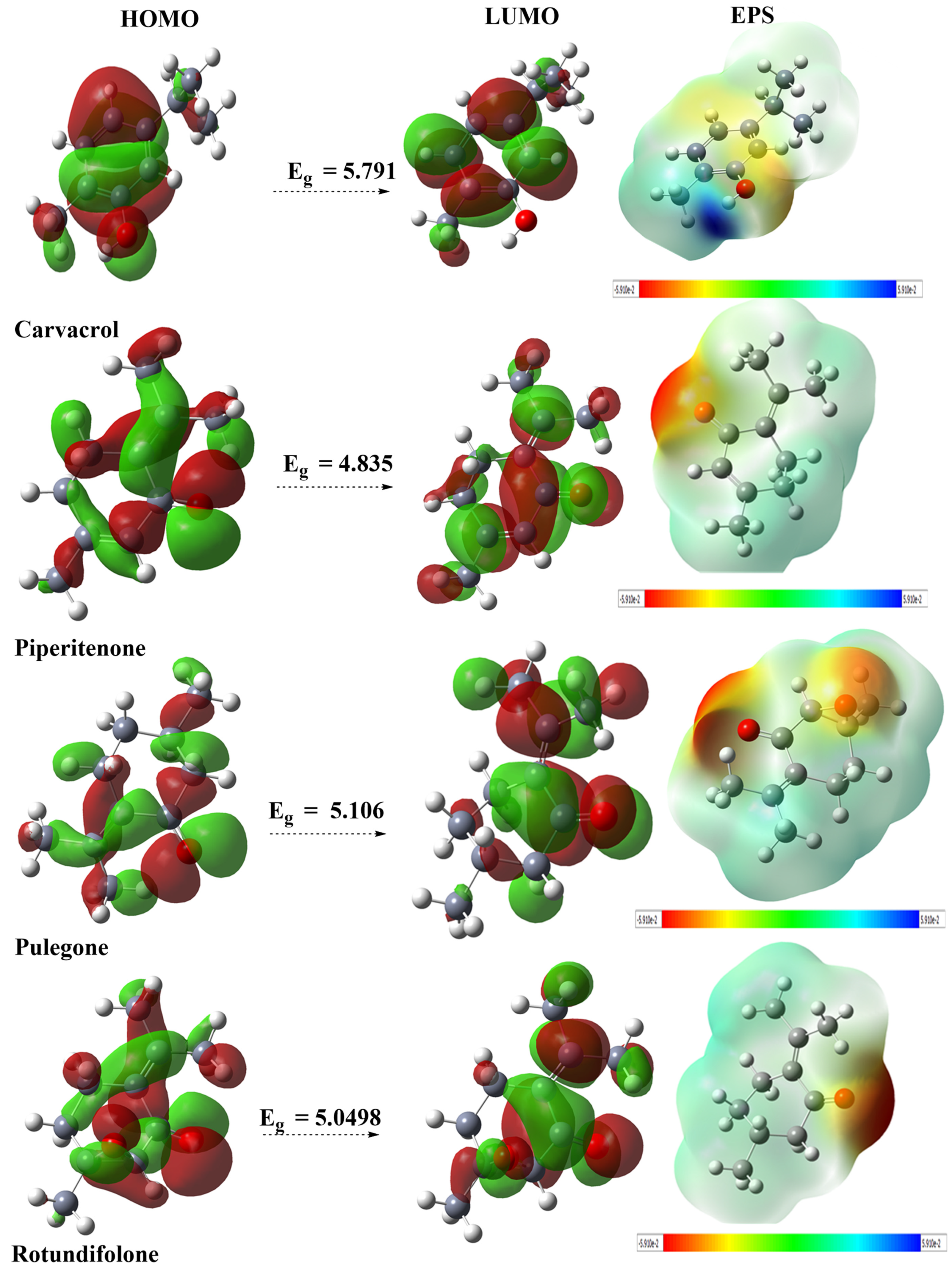
| Carvacrol | −12,647.02 | −6.077 | −0.28 | −3.18 | 3.18 | 5.79 | 0.87 | 3.33 | 0.172 | 1.48 |
| Piperitenone | −12,646.21 | −6.49 | −1.65 | −4.075 | 4.075 | 4.83 | 1.71 | 2.91 | 0.206 | 4.15 |
| Pulegone | −12,679.28 | −6.50 | −1.40 | −3.95 | 3.95 | 5.10 | 1.53 | 2.90 | 0.195 | 3.36 |
| Rotundifolone | −14,692.48 | −6.73 | −1.68 | −4.21 | 4.21 | 5.049 | 1.75 | 2.67 | 0.198 | 3.29 |
| Carvacrol | Piperitenone | Pulegone | Rotundifolone | Streptomycin | |
|---|---|---|---|---|---|
| B. cereus (3wt0) | −6.3 | −6.5 | −6.1 | −6.8 | −7.2 |
| E. faecalis (4M7U) | −6.0 | −5.8 | −5.9 | −6.0 | −6.9 |
| S. Typhi (6J90) | −5.8 | −6.0 | −6.5 | −6.2 | −5.7 |
| S. aureus (5cdp) | −6.1 | −6.4 | −6.2 | −6.8 | −8.9 |
| P. alcalifaciens (6lk2) | −5.4 | −5.6 | −6.0 | −5.9 | −7.8 |
| S. agalactiae (5y2g) | −6.7 | −7.2 | −7.0 | −7.2 | −8.9 |
| DNA gyrase: GyrB (7P2N) | −6.1 | −6.2 | −6.0 | −6.0 | −6.5 |
| Propriety | Carvacrol | Piperitenone | Pulegone | Rotundifolone |
|---|---|---|---|---|
| AMES toxicity | No | No | No | No |
| Oral rat acute Toxicity (LD50) (mol/kg) | 1.828 | 1.65 | 1.838 | 1.913 |
| Oral rat chronic Toxicity (LOAEL) (mg/kg b.w./day) | 2.299 | 2.063 | 2.124 | 2.223 |
| Hepatotoxicity | No | No | No | No |
| Skin Sensitization | Yes | Yes | Yes | Yes |
| Tetrahymena pyriformis toxicity (log μg/L) | 0.699 | 0.394 | 0.355 | −0.264 |
| Minnow toxicity (log mM) | 0.83 | 1.241 | 1.432 | 1.727 |
Disclaimer/Publisher’s Note: The statements, opinions and data contained in all publications are solely those of the individual author(s) and contributor(s) and not of MDPI and/or the editor(s). MDPI and/or the editor(s) disclaim responsibility for any injury to people or property resulting from any ideas, methods, instructions or products referred to in the content. |
© 2026 by the authors. Licensee MDPI, Basel, Switzerland. This article is an open access article distributed under the terms and conditions of the Creative Commons Attribution (CC BY) license.
Share and Cite
Benyamane, M.; Elorchi, S.; Brahimi, I.; Belasla, N.; Salah, M.; Errachidi, F.; Tabanelli, G.; Šimat, V.; Ozogul, F.; Adlouni, C.E.; et al. Integrated Evaluation of Mentha rotundifolia (L.) Huds Essential Oil: Physicochemical Characterization, Antibacterial Effect and In Silico ADMET Prediction. Int. J. Mol. Sci. 2026, 27, 3527. https://doi.org/10.3390/ijms27083527
Benyamane M, Elorchi S, Brahimi I, Belasla N, Salah M, Errachidi F, Tabanelli G, Šimat V, Ozogul F, Adlouni CE, et al. Integrated Evaluation of Mentha rotundifolia (L.) Huds Essential Oil: Physicochemical Characterization, Antibacterial Effect and In Silico ADMET Prediction. International Journal of Molecular Sciences. 2026; 27(8):3527. https://doi.org/10.3390/ijms27083527
Chicago/Turabian StyleBenyamane, Meryem, Soukaina Elorchi, Imane Brahimi, Nouhaila Belasla, Mohammed Salah, Faouzi Errachidi, Giulia Tabanelli, Vida Šimat, Fatih Ozogul, Chakib El Adlouni, and et al. 2026. "Integrated Evaluation of Mentha rotundifolia (L.) Huds Essential Oil: Physicochemical Characterization, Antibacterial Effect and In Silico ADMET Prediction" International Journal of Molecular Sciences 27, no. 8: 3527. https://doi.org/10.3390/ijms27083527
APA StyleBenyamane, M., Elorchi, S., Brahimi, I., Belasla, N., Salah, M., Errachidi, F., Tabanelli, G., Šimat, V., Ozogul, F., Adlouni, C. E., & Zinedine, A. (2026). Integrated Evaluation of Mentha rotundifolia (L.) Huds Essential Oil: Physicochemical Characterization, Antibacterial Effect and In Silico ADMET Prediction. International Journal of Molecular Sciences, 27(8), 3527. https://doi.org/10.3390/ijms27083527