Article

In Silico Perturbation Identifies Transcription Factors as Protective Targets in HSPCs After Irradiation
1
Academy of Military Medical Sciences, Beijing 100850, China
2
College of Life Sciences, Hebei University, Baoding 071002, China
3
School of Public Health, Nanjing Medical University, Nanjing 210023, China
4
College of Traditional Chinese Medicine, Tianjin University of Traditional Chinese Medicine, Tianjin 301617, China
5
College of Life Sciences, Zhejiang University, Hangzhou 310058, China
*
Authors to whom correspondence should be addressed.
These authors contribute equally to this work.
Int. J. Mol. Sci. 2026, 27(8), 3522; https://doi.org/10.3390/ijms27083522
Submission received: 10 March 2026 / Revised: 2 April 2026 / Accepted: 7 April 2026 / Published: 15 April 2026
(This article belongs to the Section Molecular Genetics and Genomics)

Abstract

Hematopoietic stem and progenitor cells (HSPCs) in the bone marrow are highly vulnerable to radiation-induced damage. Systematic delineation of lineage-specific transcription factor (TF) programs, together with in silico perturbation analyses, provides a valuable approach for identifying regulators capable of accelerating hematopoietic reconstruction after irradiation. Here, using single-cell RNA sequencing (scRNA-seq), we characterized the dynamics of HSPCs at both cellular abundance and transcriptional regulation levels following irradiation and used in silico TF perturbation to predict their effects on lineage commitment. We found that granulocyte–macrophage progenitor (GMP) differentiation is consistently prioritized after irradiation, accompanied by enhanced activity of proliferation-associated drivers. Network-based TF profiling identified Tcf7l2 as a previously unrecognized regulator of early lymphoid differentiation. In silico perturbation further functionally predicted TFs driving differentiation in HSPCs after irradiation, and Hsf1, a factor with pharmacological activation potential, was selected for validation via in vivo celastrol treatment and in vitro knockdown. Collectively, our findings uncover the transcriptional programs governing HSPC lineage biases after radiation exposure and highlight the utility of in silico TF perturbation as a strategy for guiding the therapeutic interventions for radiation-induced hematopoietic injury.

1. Introduction

Radiotherapy or accidental radiation exposure can cause profound damage to the bone marrow (BM) and its hematopoietic stem and progenitor cells (HSPCs) [1,2], leading to hematopoietic acute radiation syndrome (H-ARS). This condition is characterized by severe myelosuppression and a markedly increased risk of infection, bleeding, and mortality [3]. Timely therapeutic intervention is therefore essential for mitigating life-threatening complications and promoting hematopoietic recovery.
Current therapeutic strategies for radiation-induced hematopoietic injury primarily rely on cytokine-based interventions that modulate HSPC differentiation [4]. Granulocyte colony-stimulating factor (G-CSF) is widely used to accelerate neutrophil regeneration [4], while thrombopoietin (TPO) facilitates megakaryocyte expansion and platelet recovery [5]. In addition, emerging stem cell-based therapies, such as mesenchymal stromal cell (MSC) transplantation, have shown promise in improving survival and supporting BM regeneration following irradiation [6,7]. However, these treatments act mainly through extrinsic signaling cues that only indirectly modulate the transcriptional programs governing lineage commitment, highlighting the need for developing strategies that directly target regulatory factors capable of reshaping hematopoietic recovery at its source.
Transcription factors (TFs) orchestrate hematopoietic cell fate decisions through their control of gene regulatory networks (GRNs) that integrate intrinsic and extrinsic signals. Genetic ablation studies have identified a series of master regulators that orchestrate the balance between HSC self-renewal and lineage-specific differentiation, including RUNX1, TAL1 (SCL), and MEIS1 for HSC self-renewal [8,9,10]; GATA1 for erythropoiesis and megakaryopoiesis [11]; SPI1 (PU.1) for myelopoiesis and early lymphoid priming [12,13]; CEBPA and GFI1 for granulocytic differentiation [14,15]; and IKZF1, TCF3, and LEF1 for lymphoid lineage commitment [16,17]. Recent advances in single-cell RNA sequencing (scRNA-seq) and computational biology have enabled a more systematic understanding of hematopoietic regulatory mechanisms [18]. For example, Buenrostro and colleagues leveraged integrated single-cell omics to delineate dynamic transcription factor activities and map enhancer regulatory networks across hematopoietic lineages [19]. Similarly, Gao et al. reconstructed transcriptional regulatory networks underlying HSC ontogeny and identified previously unrecognized regulators, such as SP3 and MAZ, that are essential for HSC specification [20]. Our recent work utilizes scRNA-seq to picture a dynamic single-cell transcriptomic landscape of HSPCs during IR-induced regeneration process and demonstrated nuclear factor erythroid 2-related factor 2 (NRF2) as a critical downstream functional gene for BMP4-BMPR2 signaling on HSCs to resist IR-induced damage [21]. Nonetheless, a systemic assessment of lineage-specific TFs throughout hematopoietic injury and recovery is still lacking.
Targeting TFs represents a promising strategy for mitigating radiation-induced hematopoietic injury. For example, Kim and colleagues demonstrated that the activation of NRF2 signaling enhances HSPC function and mitigates IR-induced myelosuppression and mortality [22]. Poulos and colleagues reported that the NF-κB is a critical TF-regulating HSC function both at steady state and after myelosuppressive irradiation and that the inhibition of NF-κB promotes improved HSC function and pan-hematopoietic recovery [23]. Together, these findings support the notion that targeting key TFs involved in hematopoiesis may offer an effective strategy to accelerate hematopoietic regeneration following radiation-induced injury.
To determine the consequences of TF-targeting interventions, traditional approaches rely on genetic perturbation experiments, such as knock-out or knock-in models [24,25]. While informative, these methods are time-consuming and limited in scalability. Recently, perturbation modeling has emerged as a computational framework capable of simulating cellular responses to genetic or pharmacological interventions using single-cell omics data [26,27]. Among these approaches, biologically informed methods such as CellOracle [28] and SCENIC+ [29] perform in silico perturbations on gene regulatory networks to model the effects of transcriptional regulation, thereby enabling large-scale screening of potential intervention targets for hematopoietic disease and injury.
Here, we delineated the differentiation dynamics of HSPCs following irradiation using scRNA-seq data and established an integrative workflow that combines transcriptional activity analysis with in silico perturbation modeling to identify lineage-driving TFs. Through this framework, we uncovered Tcf7l2 as a previously unrecognized regulator of lymphoid differentiation. Among the TFs predicted by in silico perturbation, Hsf1, which has pharmacological activation potential, was selected for validation via in vivo celastrol treatment and in vitro knockdown.

2. Results

2.1. Temporal Lineage Bias Profiling Reveals Prioritized GMP Expansion During Post-Irradiation Hematopoietic Reconstruction

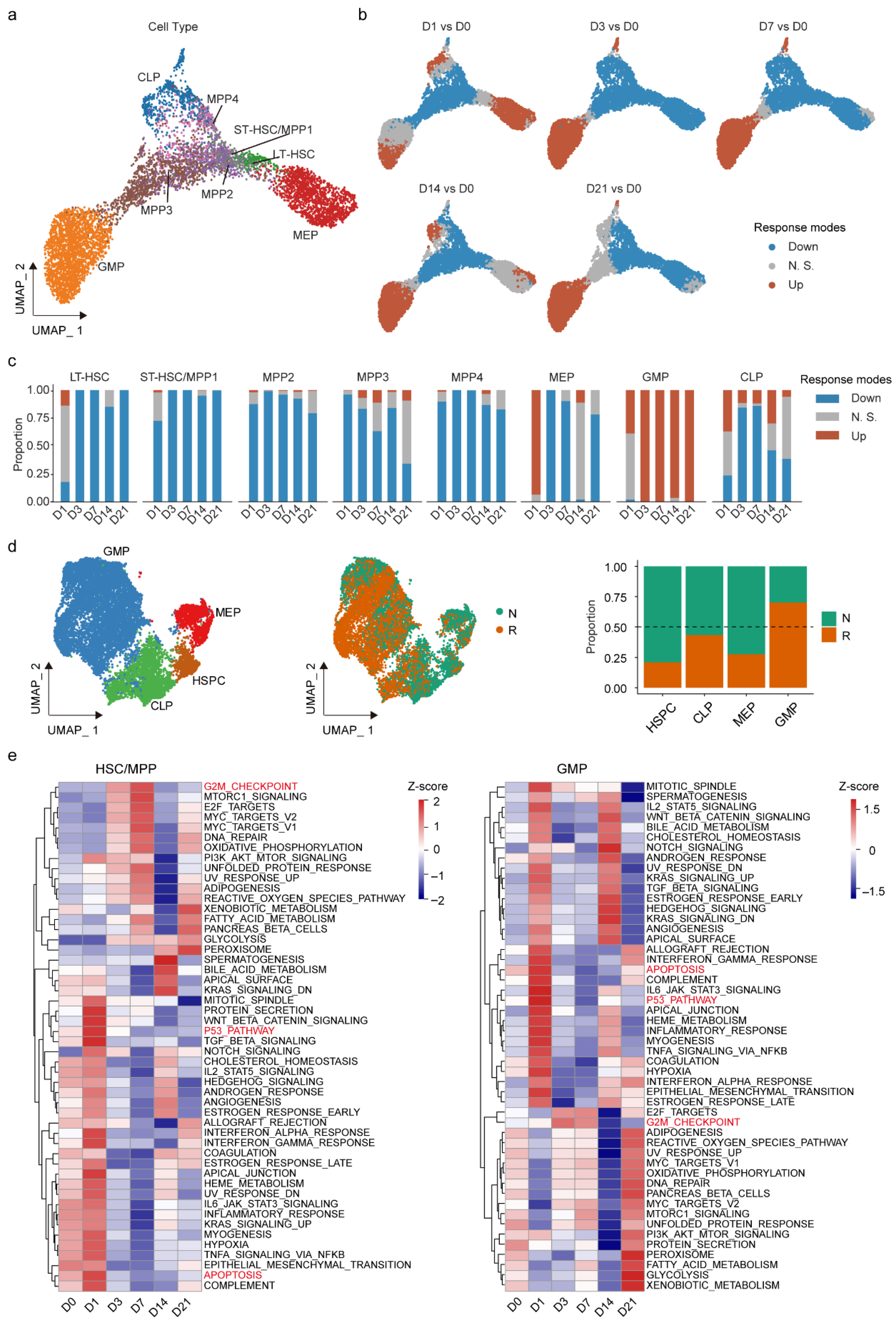
To systemically characterize the differentiation biases in HSPCs after irradiation, we utilized the transcriptomic data of HSPCs in our scRNA-seq dataset of mouse BM [21], which includes single-cell transcriptomic data of eight HSPC subpopulations: LT-HSC, ST-HSC/MPP1, MPP2, MPP3, MPP4, MEP, GMP, and CLP (Figure 1a). The dataset comprises samples collected before irradiation (D0) and at five post-irradiation time points (D1, D3, D7, D14, and D21), revealing a complex temporal remodeling of population abundance (Figure A1a).
To quantify the dynamic responses of HSPC subpopulations post-irradiation, we applied MELD [30], a manifold-based likelihood estimation framework, to calculate the changes in abundance of each subpopulation compared to homeostatic status (D0) (Figure A1b,c). Unsupervised clustering, assisted by empirical thresholds, was then used to classify the populations into three response modes related to D0: down, no significance (N.S.), and up (Figure 1b and Figure A1d). The proportions of cells corresponding to the three modes exhibited distinct temporal patterns across different subpopulations of HSPCs (Figure 1c). All five HSC/MPP subpopulations (LT-HSC, ST-HSC/MPP1, MPP2, MPP3, and MPP4) exhibited sustained depletion 21 days after irradiation, consistent with the well-documented exhaustion of HSCs under stressful conditions [2], though LT-HSCs exhibited transient radioresistance on D1, they eventually succumbed to exhaustion (Figure 1c). On the other hand, the dynamics of MPPs have been less frequently described. Among committed progenitors, the MEP, GMP, and CLP populations exhibited a synchronized expansion at D1 (Figure 1c), reflecting a unified acute response to irradiation. However, from D3 onward, their responses diverged markedly. MEP and CLP underwent a depletion and recovery pattern (Figure 1c), with CLP additionally showing a transient shift toward more mature status during the depletion stage (Figure 1b). In contrast, GMPs displayed a persistent and progressive increase in density (Figure 1c).
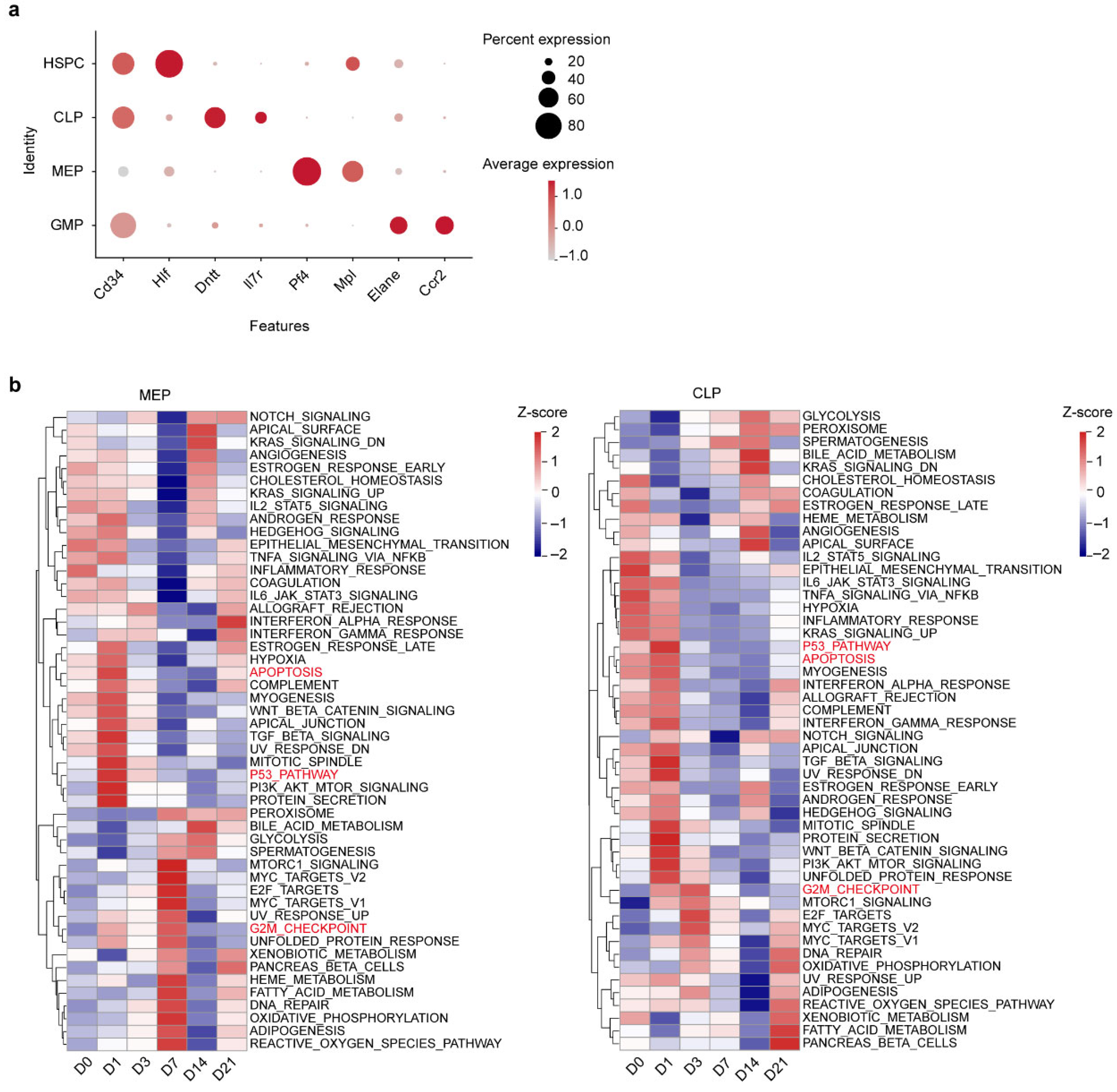
To validate this observation, we performed an additional scRNA-seq on BM hematopoietic cells at D0 and D3 after irradiation. After cell clustering and cell type annotation, we found the pronounced exhaustion of HSPCs and MEP, accompanied by an accumulation of GMP at D3, compared with non-irradiated controls (Figure 1d and Figure A2a, Table S1). To further investigate the alterations of hematopoietic progenitors at the molecular level, we calculated the activity scores of 50 hallmark pathways in MEP, GMP, and CLP at different time points along hematopoietic injury and reconstruction (Figure 1e and Figure A2b). Consistent with the abundance changes, the activities of p53 and apoptosis pathways peaked at D1 post-irradiation in all HSPC populations (Figure 1e), indicating an urgent stress immediately after irradiation. Notably, the G2M checkpoint pathway is immediately activated (D1) after irradiation in MEP, GMP, and CLP, while its activation in HSC/MPPs started from D3 post-irradiation (Figure 1e and Figure A2b), suggesting a more rapid response to irradiation for progenitor cells than HSC/MPPs. Together, these findings suggest distinct recovery priorities among MEP, GMP, and CLP after the rapid expansion at D1 post-irradiation and a preferential expansion of GMP from D3 post-irradiation.

2.2. SCENIC-Based TF Profiling Reveals Distinct Regulatory Modules and Identifies Tcf7l2 as a Lymphoid Regulator

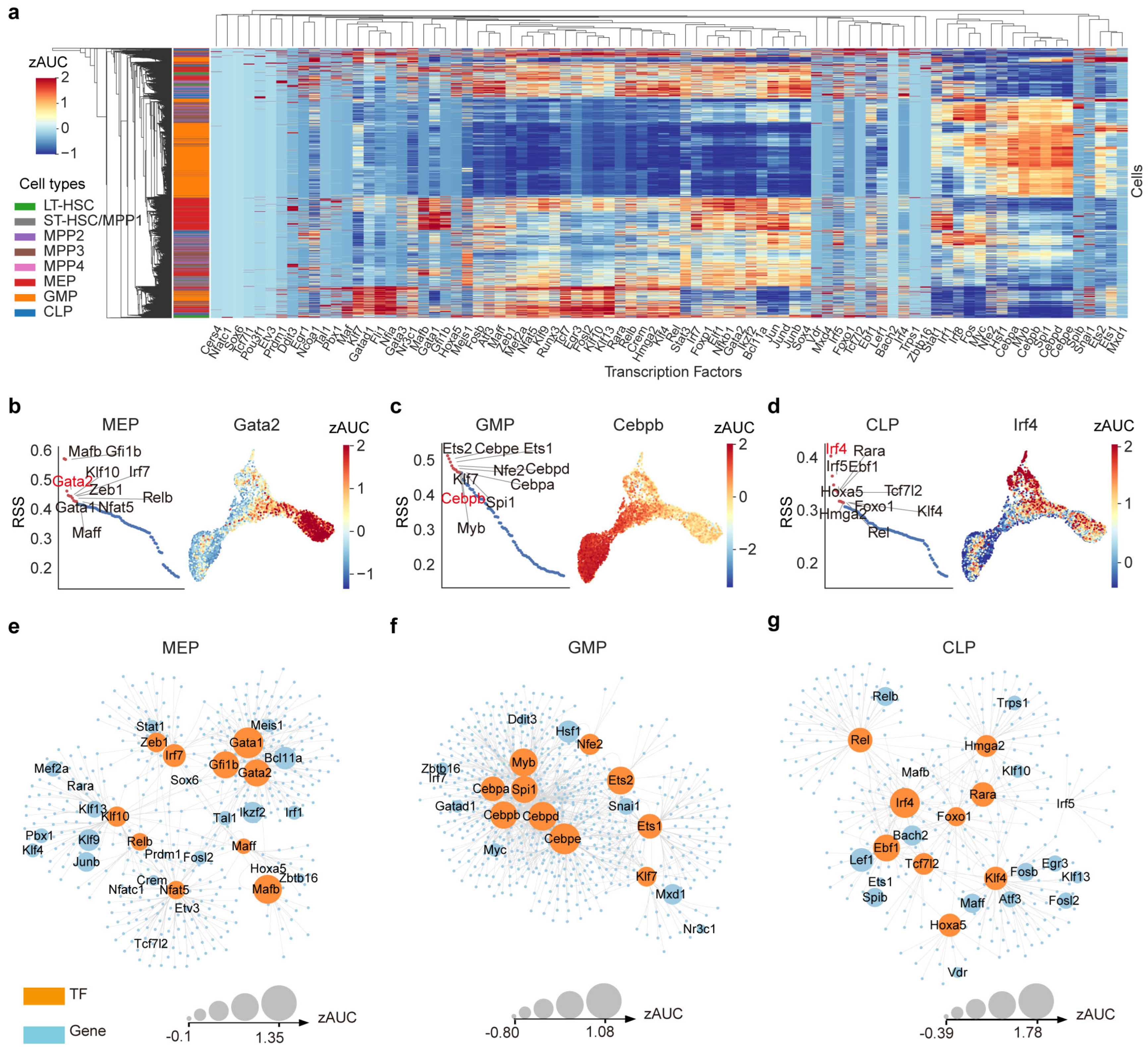
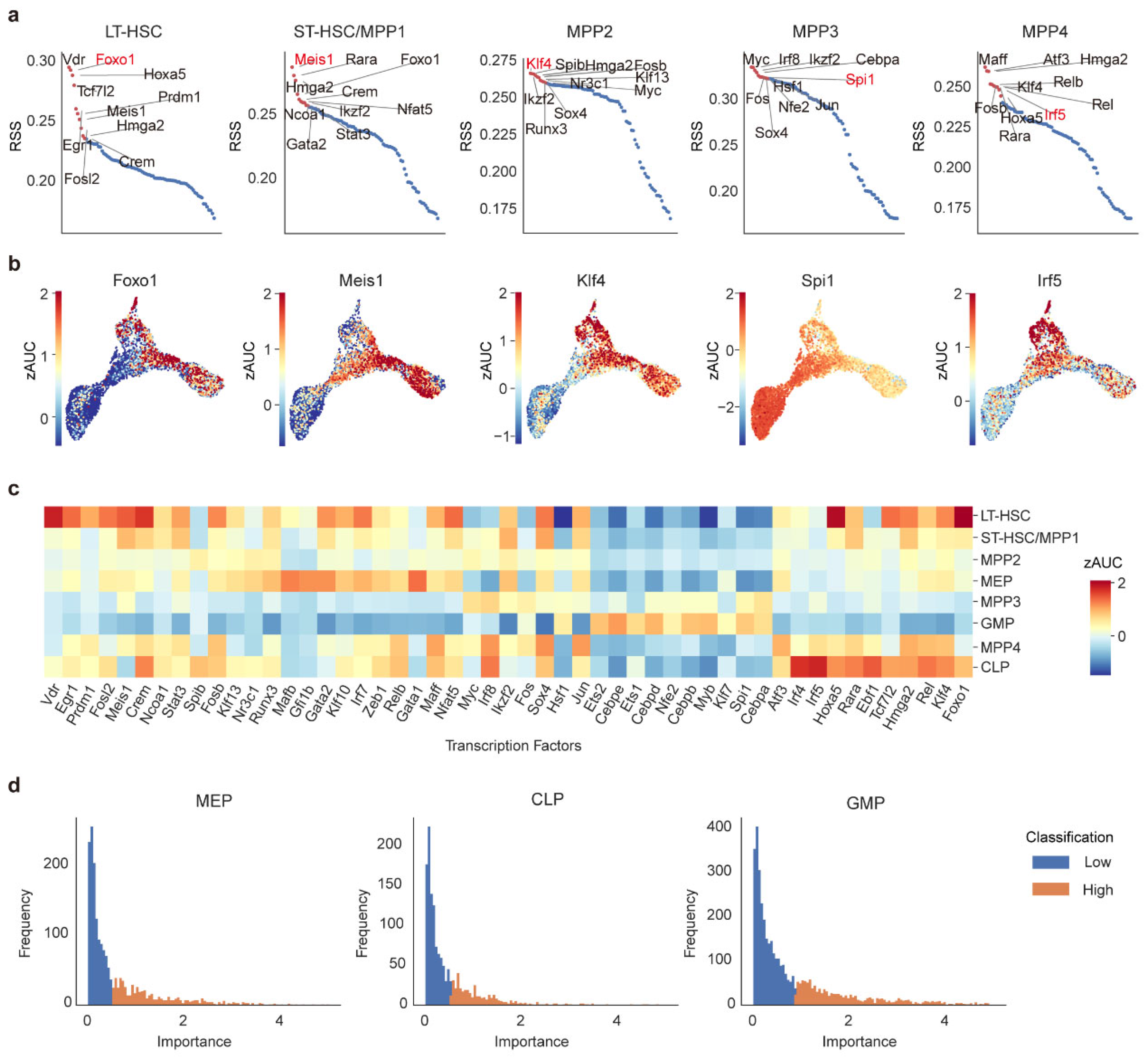
Having characterized the dynamic responses of distinct HSPC subpopulations post-irradiation, we next aimed to dissect the cell type-specific transcriptional regulatory programs. To this end, we performed a TF profiling analysis using SCENIC [31,32], a computational framework for regulatory network inference and regulon activity analysis (Figure 2a). To identify regulators enriched in specific cell types, we ranked TFs according to their regulon specificity score (RSS) and selected the top 10 TFs for each cell type as markers (Figure 2b–d and Figure A3a). The representative regulators exhibited cell type–restricted activity patterns on the UMAP projection (Figure 2b–d and Figure A3b). Notably, TF signatures were particularly specific in HSC, GMP, MEP, and CLP, whereas MPPs displayed activity profiles resembling those of their downstream lineages (Figure A3c).
To illustrate cell type-specific regulatory interactions, we constructed specific transcriptional regulatory networks for MEP, GMP, and CLP using markers and key regulatory relationships identified by Gaussian Mixture Models (Figure 2e–g and Figure A3d, Tables S2–S5). In the MEP network, canonical erythroid regulators such as Gata1, Gata2 [33], and Gfi1b [34] formed a coherent regulatory module consistent with their roles in driving erythropoiesis (Figure 2e). Within the GMP network, core myeloid TFs, including the CEBP family [35,36] and Spi1 [12], together with the proliferation regulators Myb [37] and Ets1/2 [38,39], were organized into a densely interconnected regulatory hub that controls a shared set of targets (Figure 2f). The CLP network also incorporated lymphoid-associated TFs, including Irf4 [40], Irf5 [41], Klf4 [42], and Ebf1 [43] (Figure 2g). Notably, Tcf7l2 appeared as a highly connected node, sharing strong regulatory links with Irf4, Ebf1 and Klf4 (Figure 2g), suggesting a previously unrecognized function in lymphoid development. As a member of the TCF family, Tcf7l2 can form a bipartite transcription factor and influence multiple biological pathways, including the Wnt signaling pathway [44]. Here, our data suggest that Tcf7l2 may also play a role in lymphoid differentiation.
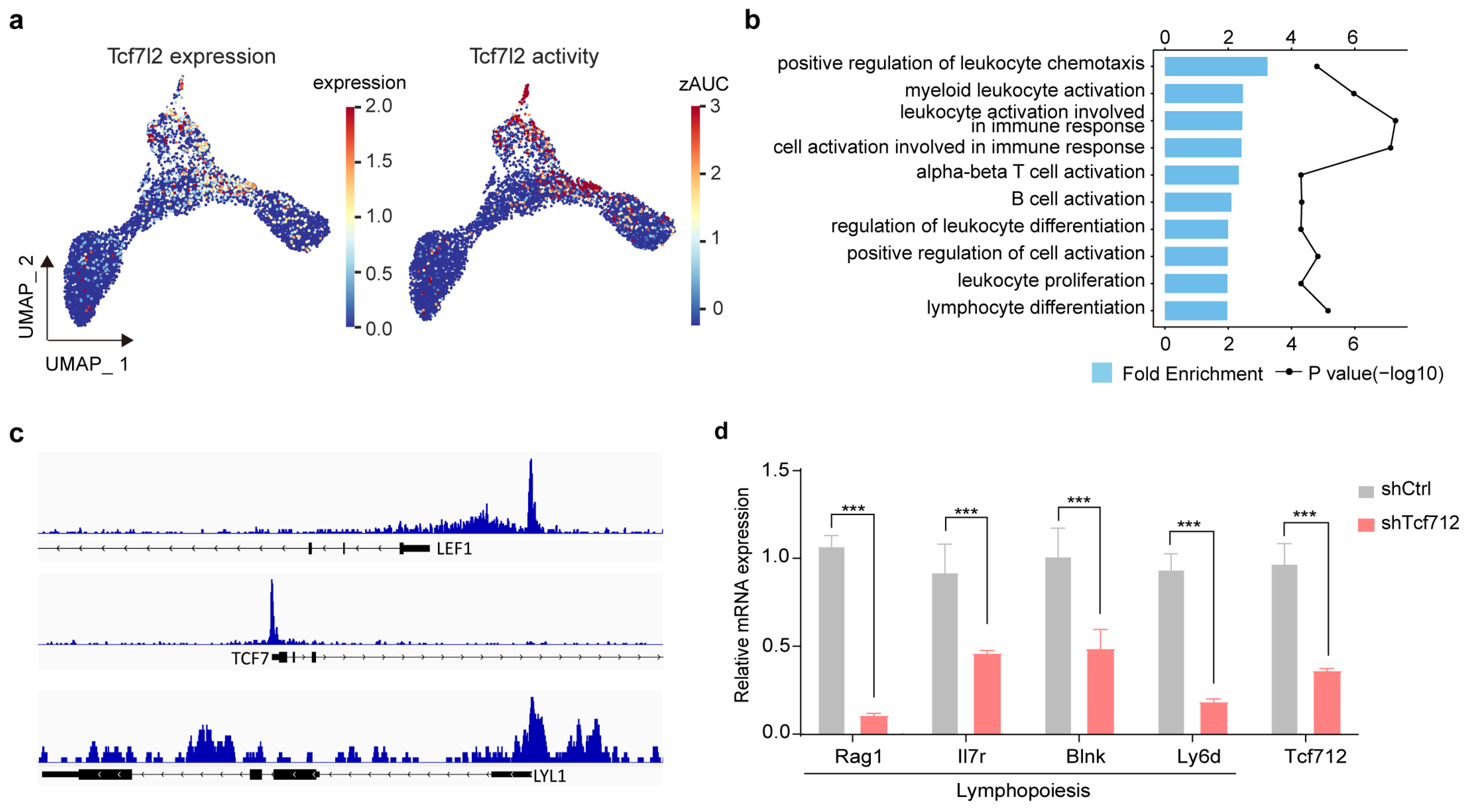
To further validate the regulatory role of Tcf7l2, we first examined its expression and activity across HSPCs (Figure 3a), which showed preferential enrichment in HSC and lymphoid linage. We then analyzed a publicly available ChIP-seq dataset of human CD34+ progenitors [45]. GO enrichment analysis of TCF7L2-bound genes revealed the significant enrichment in lymphocyte-related pathways, including alpha–beta T cell activation, B cell activation, and lymphocyte differentiation (Figure 3b), supporting its involvement in lymphoid lineage specification. In addition, the visualization of ChIP-seq signal tracks demonstrated prominent TCF7L2 binding peaks at the promoters of key lymphoid regulators, including LEF1, TCF7 (TCF1) [46], and LYL1 [47] (Figure 3c), further confirming its direct regulatory effect on lymphoid gene programs. Finally, to functionally assess its role, we performed short hairpin RNA (shRNA)-mediated knockdown of Tcf7l2 in bone marrow cells, followed by culture under B cell differentiation conditions. Efficient knockdown of Tcf7l2 was confirmed, and the expression of B cell-associated genes (Rag1, Il7r, Blnk, and Ly6d) was significantly reduced upon Tcf7l2 knockdown, supporting a functional role for Tcf7l2 in lymphoid differentiation, particularly in the B cell lineage.

2.3. Temporal Dynamics of TF Activity Identifies TFs Contributing to Hematopoietic Lineage Differentiation Biases After Irradiation

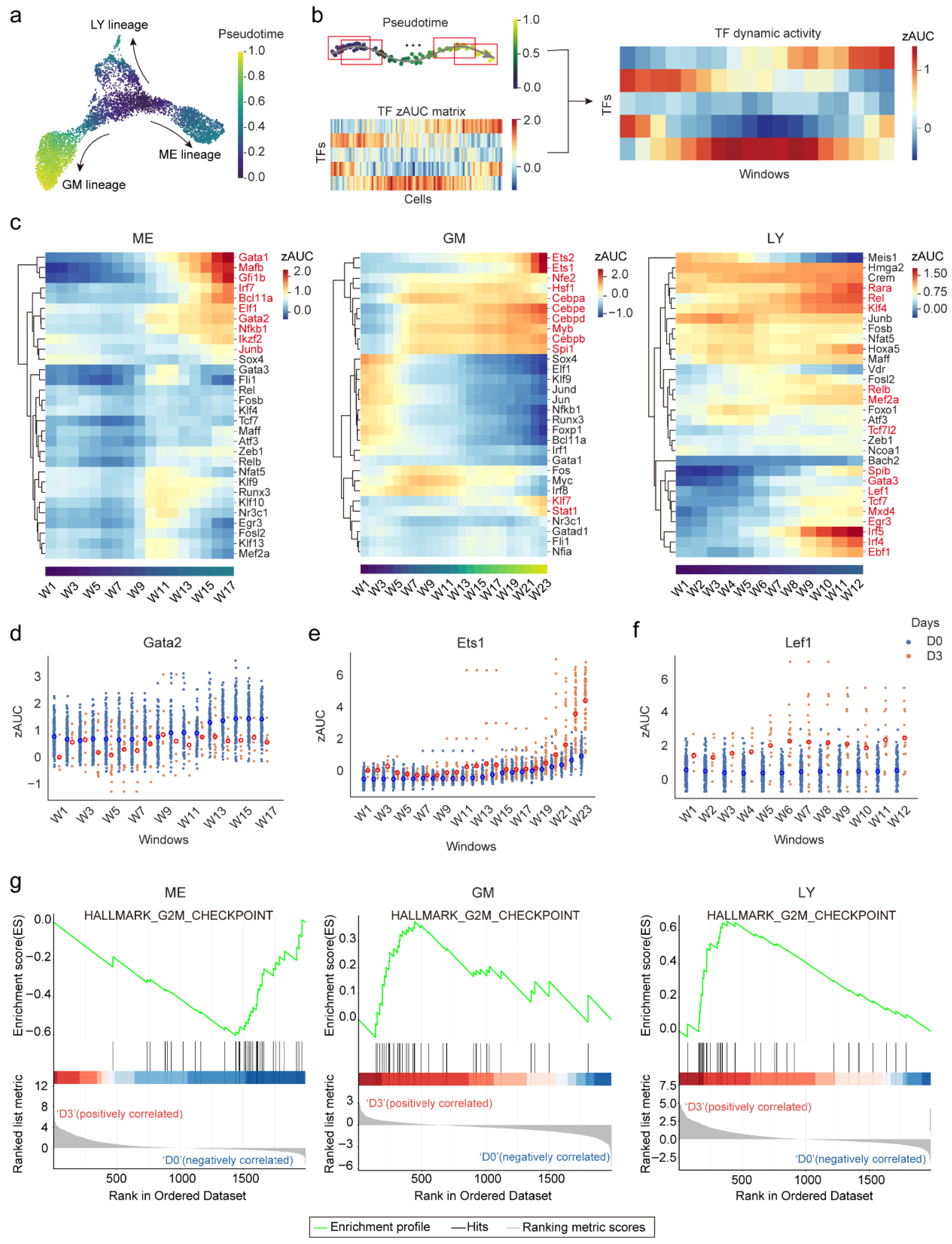
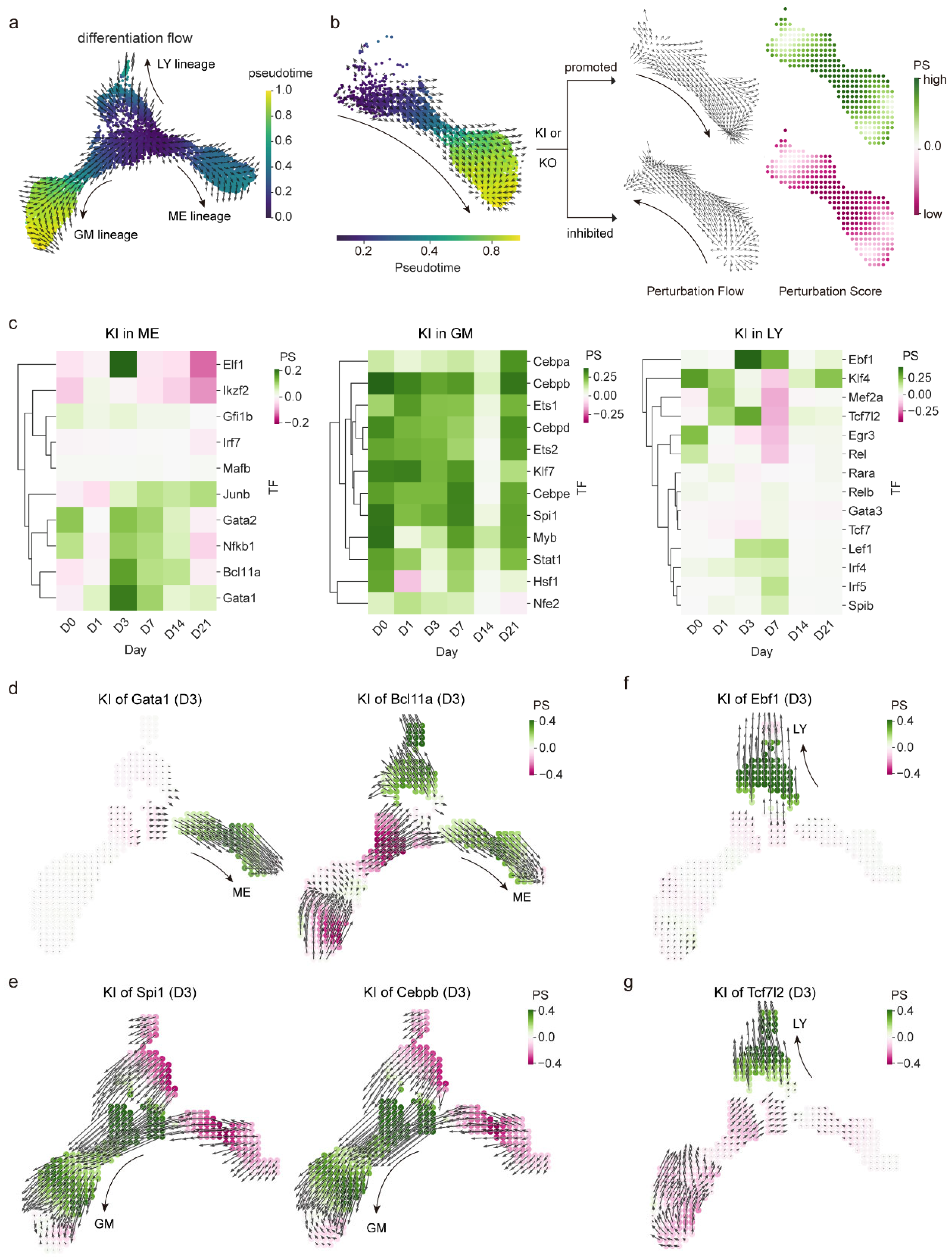
Having delineated the cell type-specific regulators, we next sought to identify TFs that are correlated with the hematopoietic lineage differentiation progress. To this end, we integrated the single-cell TF activity with pseudotime information from previous analysis [21] along the three major differentiation trajectories—megakaryocyte–erythroid (ME), granulocyte–macrophage (GM), and lymphoid (LY)—to characterize the temporal patterns of lineage-specific TFs (Figure 4a). To reduce the noise inherent in single-cell measurements, we developed a smoothing strategy to estimate the dynamic TF activity profiles within sliding windows, with step sizes constrained by both cell density (defined by cell counts) and pseudotime intervals (Figure 4b). Distinct temporal patterns emerged across the three differentiation lineages (Figure 4c). TF activities that increased along pseudotime included many established lineage regulators, encompassing both factors identified by our regulatory network analysis and additional canonical drivers—such as Gata1, Gata2 [33], Gfi1b [34], and Bcl11a [48] in the ME lineage; Spi1 [12], Cebpa [49], Cebpb [50], Cebpe [36], and Myb [51] in the GM lineage; and Irf4 [40], Irf5 [52], Ebf1 [53], Lef1 [46], Tcf7(Tcf1) [54], and Spib [55] in the LY lineage—highlighting these TFs as potential drivers of lineage progression.
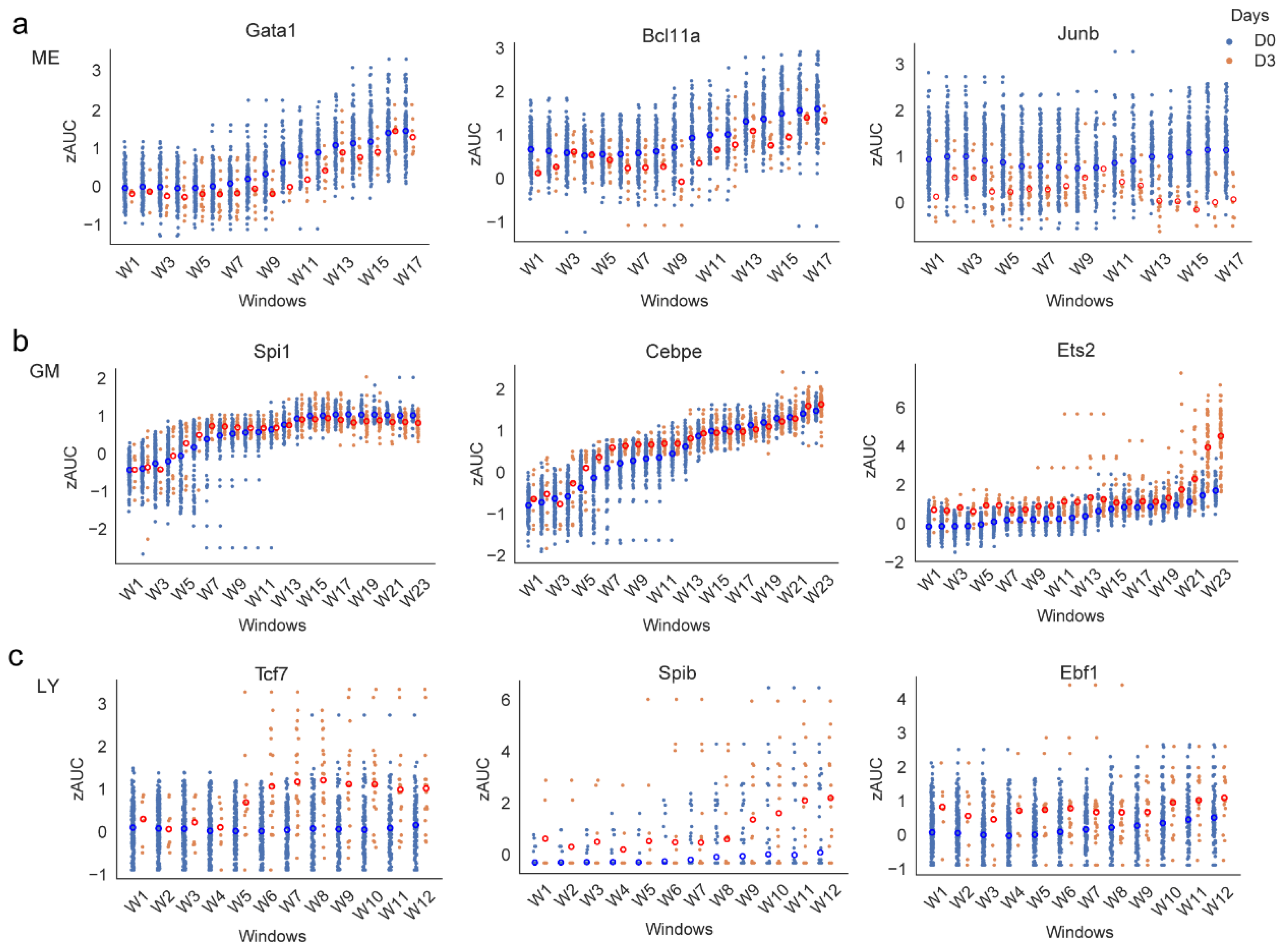
To further identify TFs that are related to hematopoietic lineage differentiation biases following irradiation, we compared the dynamic activity of candidate TFs between pre-irradiation (D0) and post-irradiation (D3). In the ME lineage, erythroid regulators (Gata1, Gata2 [33], and Bcl11a [48]), as well as the proliferation-associated factor Junb [56], were markedly reduced (Figure 4d and Figure A4a), suggesting impaired erythroid differentiation and diminished proliferative capacity. This is consistent with the observed reduction in this population at D3 post-irradiation (Figure 1c). In the GM lineage, the proliferation-associated factors, Ets1/2 [57], showed a pronounced increase at the terminal stage, whereas core myeloid regulators (Spi1 [12] and Cebpe [36]) remained largely stable (Figure 4e and Figure A4b), indicating that the increase in proliferation is the main cause for GMP expansion after irradiation. In the LY lineage, T cell regulators (Lef1, Tcf7 [46]) and B cell regulators (Ebf1 [43], Spib [13]) exhibited strong activation (Figure 4f and Figure A4c), suggesting an enhanced differentiation potential following irradiation. Supporting these TF-level changes, pathway-level enrichment analysis of proliferation signatures revealed reduced activity in the ME lineage but increased activity in both the GM and LY lineages (Figure 4g). Collectively, these results indicate that the suppression of both lineage-driving and proliferation-associated TFs underlies the decline in ME differentiation after irradiation, whereas GM expansion is driven primarily by increased proliferation while maintaining stable expression of lineage-specific regulators.

2.4. In Silico TF Perturbation Predicts Transcription Factors Regulating Lineage Differentiation After Irradiation

To evaluate the impact of lineage-specific TFs on hematopoietic differentiation, we applied in silico perturbation of TFs using CellOracle [28]. This framework simulates TF loss- or gain-of-function within the inferred regulatory network and estimates how these perturbations redirect cellular differentiation flows along pseudotime (Figure 5a,b). Perturbation-induced deviations were quantified using a perturbation score (PS).
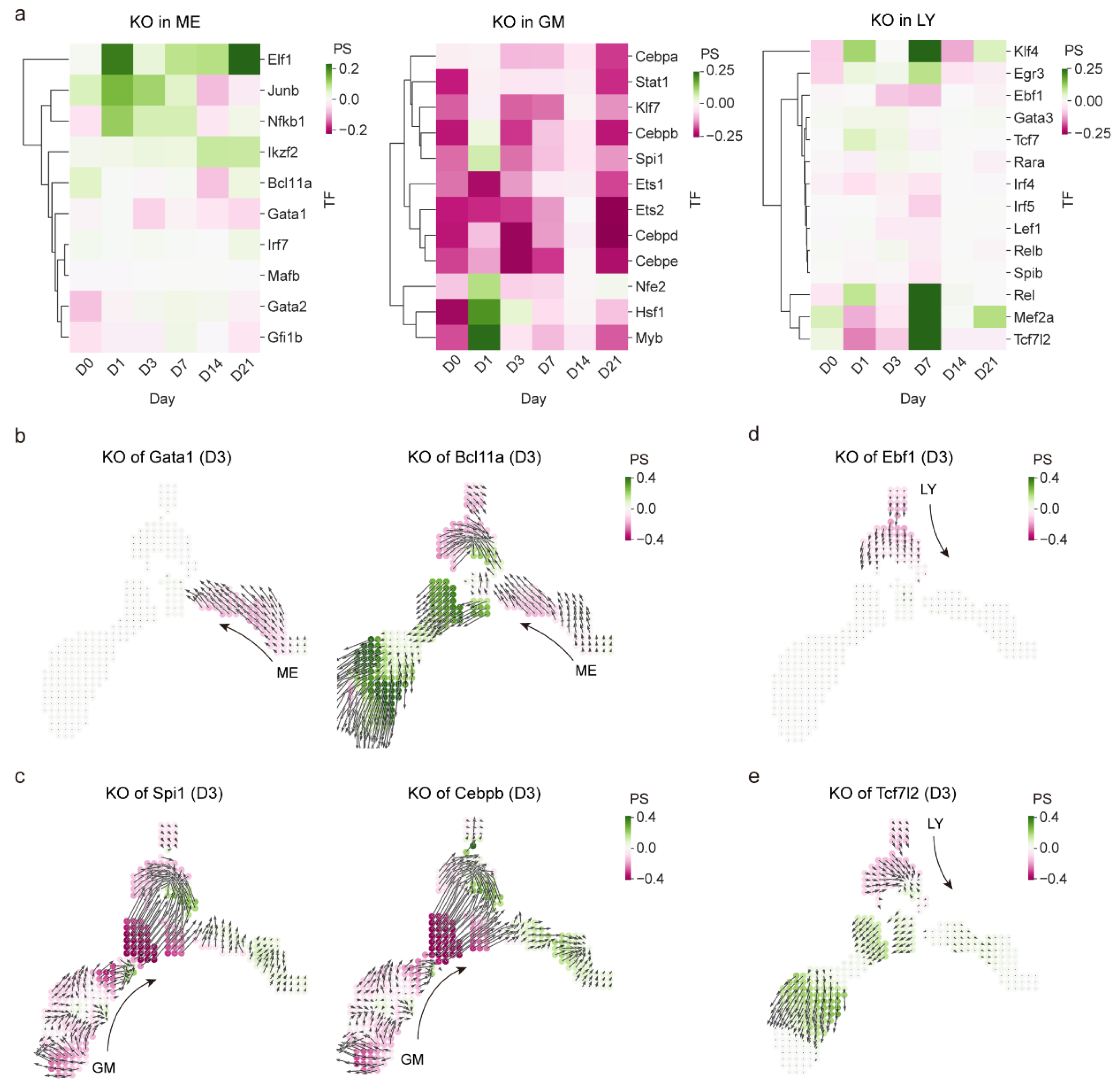
In silico perturbation analysis revealed that knock-in of many lineage-specific TFs could enhance the differentiation of hematopoietic progenitor cells toward their corresponding lineage commitments (Figure 5c, Tables S6–S8). For example, knock-in of erythroid regulators such as Gata1, Gata2, and Bcl11a markedly promoted erythropoiesis beginning at D3. Similarly, knock-in of myeloid drivers (Spi1 and CEBP family genes) and proliferation-associated factors (Ets1/2) consistently enhanced myelopoiesis both before and after radiation. Knock-in of lymphoid regulators, including Ebf1, Lef1, Irf4, Irf5 and Spib, likewise facilitated lymphopoiesis. We also showed the strong pro-differentiation effect of key drivers at D3 (Figure 5d–f). In addition to in silico knock-in analyses, we also performed in silico TF knock-out experiments, which showed that in silico knock-out of specific TFs impaired the differentiation within the corresponding lineages (Figure A5a–d, Tables S6–S8), producing effects opposite to those observed in knock-ins. Together, these results demonstrate the capacity of in silico perturbation modeling to efficiently screen large numbers of candidate regulators and to uncover TF-specific effects on lineage outcomes under irradiation-induced stress.
Our perturbation analysis also supported a role for the newly identified factor Tcf7l2, highlighted by our network analysis (Figure 2g). Knock-in of Tcf7l2 promoted lymphoid differentiation, whereas knock-out impaired it (Figure 5g and Figure A5e), suggesting a previously unappreciated function for Tcf7l2 in early lymphopoiesis.
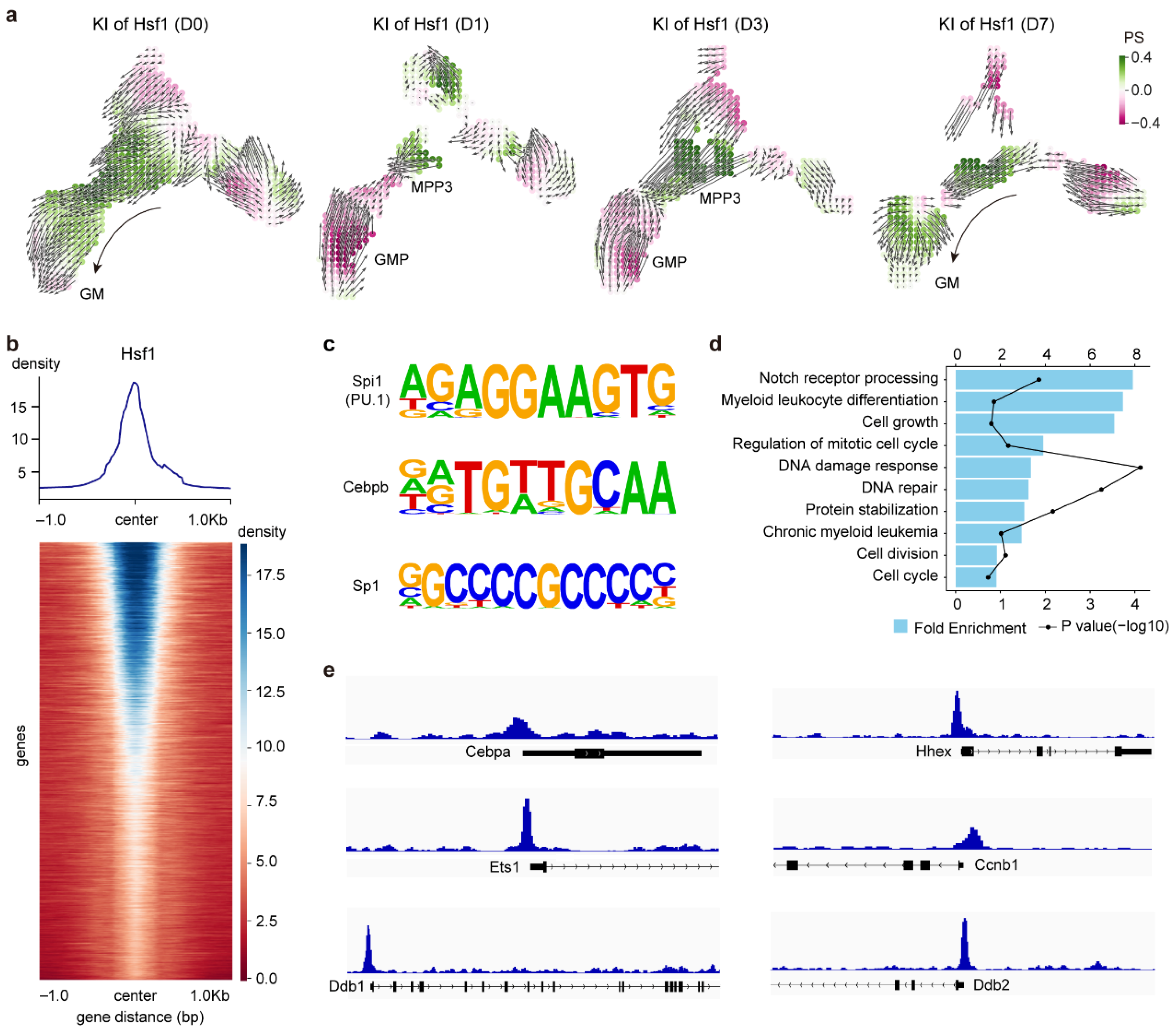
Among the TFs predicted to promote GM differentiation, Hsf1, a stress-responsive TF with available pharmacological activators [58,59], was selected for further analysis. In silico perturbation analysis showed that knock-in of Hsf1 could markedly enhance GM differentiation at D0 and D7, while only promoting MPP3 at D1 and D3 (Figure 6a). To further investigate the role of Hsf1 in GM differentiation, we leveraged publicly available CUT&RUN data from leukemic stem cells (LSCs) [60], given their reported epigenetic and chromatin accessibility similarities to normal HSCs, particularly at stemness- and stress-related loci [61]. Genome-wide profiling revealed prominent Hsf1 occupancy around transcription start sites (Figure 6b). Motif enrichment analysis further revealed significant enrichment of motifs corresponding to myeloid regulators (PU.1/Spi1 [12] and Cebpb [50]) as well as DNA damage response-related TF Sp1 [62], suggesting that Hsf1 binding occurs within regulatory contexts relevant to myeloid differentiation and stress-responsive transcription. Peak enrichment analysis further indicated that Hsf1-bound genes are involved in Notch receptor processing, myeloid leukocyte differentiation, cell proliferation, and DNA damage response (Figure 6d). Consistent with these pathway-level enrichments, prominent Hsf1 binding signals were observed at key myeloid differentiation regulators (Cebpa [49], Hhex [63]), cell proliferation regulators (Ets1 [38], Ccnb1 [64]), and DNA damage response-related genes (Ddb1, Ddb2 [65]) (Figure 6e). Notably, Ets1 has been shown above to be a major regulator contributing to GM expansion after irradiation (Figure 4e). Together, these observations suggest that Hsf1 may participate in transcriptional programs associated with stress responses and myeloid differentiation.

2.5. In Vivo Validation of Celastrol Treatment Supports Enhanced Myeloid Recovery After Irradiation

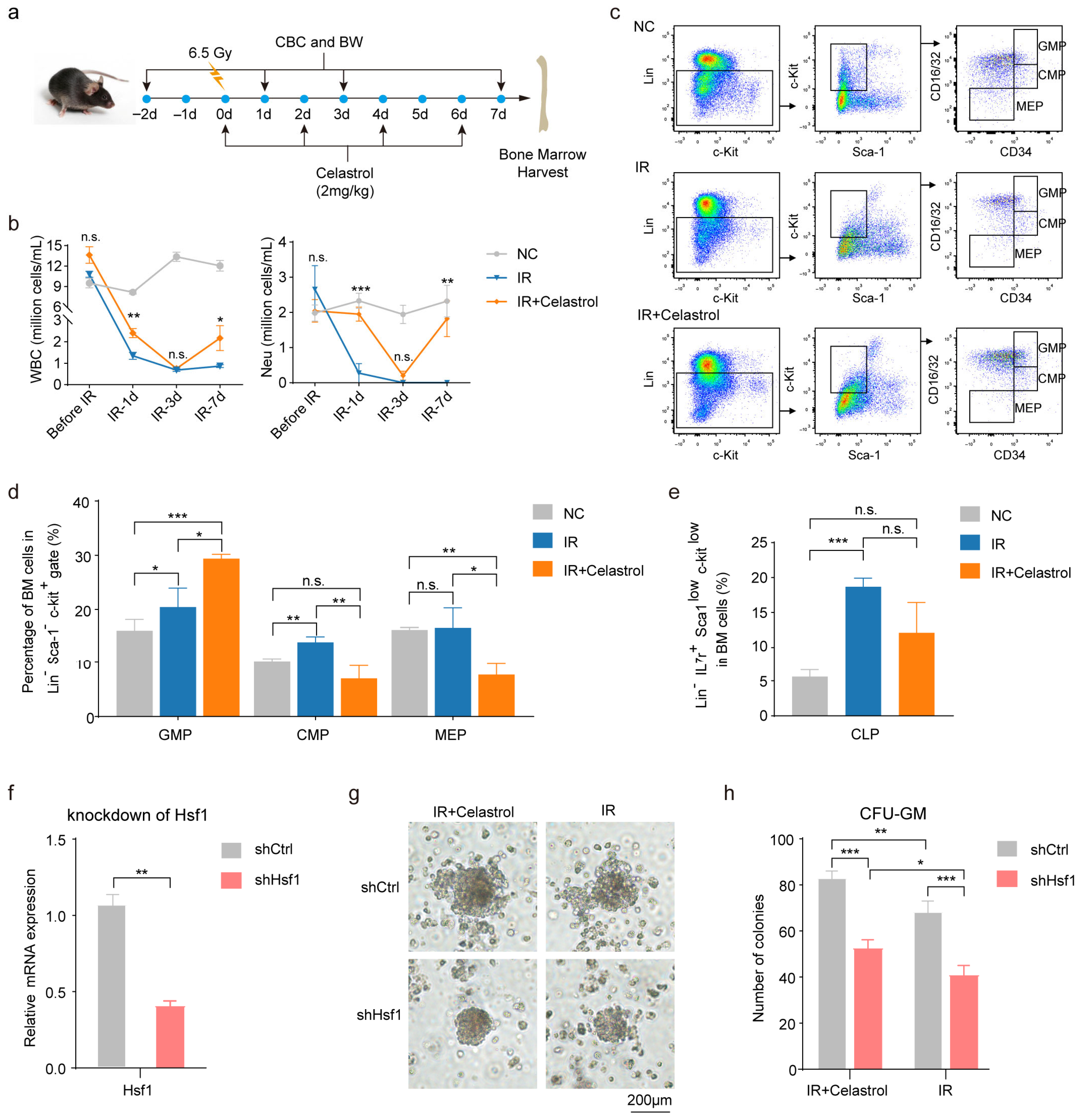
To functionally verify whether activation of Hsf1 could promote GM differentiation after irradiation, we conducted in vivo post-irradiation dosing experiments using celastrol, a small-molecule activator known for enhancing Hsf1 function [58] (Figure 7a). The mice were assigned to three groups: control, IR, and celastrol-IR. The mice in both IR and celastrol-IR groups received 6.5 Gy total body irradiation, and mice in celastrol-IR group were intraperitoneal-injected with celastrol 30 min after irradiation, followed by additional doses at D2, D4, and D6. Peripheral blood analysis showed that white blood cells (WBCs) and neutrophils declined to their nadir at day 3 after irradiation in both irradiated groups (Figure 7b). However, by day 7, celastrol-treated mice exhibited a robust rebound in both parameters, with neutrophil counts close to non-irradiated baseline levels, whereas vehicle-treated mice displayed minimal recovery (Figure 7b). Lymphoid- and erythroid-related indices showed only modest improvement by day 7 (Figure A6a). Flow cytometric analysis of bone marrow hematopoietic progenitor cells at day 7 post-irradiation (Figure 7c and Figure A6b) further revealed a significant increase in GMP fractions in celastrol-treated mice, accompanied by reduced CMP and MEP, while the CLP was not significantly affected (Figure 7d,e). These in vivo observations align closely with the in silico knock-in predictions above, which forecast enhanced GM output upon Hsf1 activation (Figure 6a).
To further directly assess the role of Hsf1 in myeloid differentiation, we performed shRNA-mediated knockdown of Hsf1 in bone marrow cells at day 7 post-irradiation, followed by a colony-forming unit–granulocyte–macrophage (CFU–GM) assay. Hsf1 expression was effectively reduced in the shHsf1 group, confirming the knockdown efficiency (Figure 7f). In the CFU–GM assay, Hsf1 knockdown significantly decreased the number of CFU–GM colonies in both the IR and IR + celastrol groups (Figure 7g,h), indicating that Hsf1 plays a necessary role in post-irradiation myeloid differentiation. In the absence of Hsf1 knockdown, the IR + celastrol group exhibited a significantly higher number of CFU–GM colonies compared to the IR group (Figure 7h), further supporting the promotive effect of celastrol on myeloid differentiation and proliferation following irradiation. In contrast, under Hsf1 knockdown condition, although the IR + celastrol group still showed higher colony numbers than the IR group, the overall levels were markedly reduced compared to their non-knockdown counterparts (Figure 7h), indicating that the promotive effect of celastrol on post-irradiation myeloid differentiation is substantially attenuated upon Hsf1 suppression.
Together, these results demonstrated that pharmacological activation of Hsf1 promotes early myeloid reconstitution following irradiation. Combined with the knockdown and CFU–GM assay, our findings further establish a functional requirement for Hsf1 in post-irradiation myeloid differentiation and show that the promotive effects of celastrol are substantially attenuated upon Hsf1 suppression. These results highlight the potential of Hsf1-targeted strategies to enhance hematopoietic recovery after irradiation.

3. Discussion

HSPCs are regulated by complex gene regulatory networks that orchestrate their self-renewal and lineage commitment. Despite extensive knowledge of individual TFs in steady-state hematopoiesis, the mechanisms by which high-dose irradiation rewires these transcriptional regulatory programs and whether perturbing key TFs can facilitate hematopoietic recovery by redirecting lineage trajectories remain poorly understood. Here, using scRNA-seq profiles from irradiated and control samples, we delineated the dynamic remodeling of HSPC population states and performed population-level regulatory network analysis. By analyzing the dynamics of TF activity along hematopoietic lineages, we identified lineage-specific candidate drivers and applied in silico perturbation to predict their regulatory effects on differentiation. Notably, we identify Tcf7l2 as a previously unrecognized regulator associated with lymphoid differentiation, and highlight the therapeutic potential of Hsf1 activation in promoting myeloid differentiation following irradiation.
Previous studies have described multiple isolated aspects of HSPCs response to irradiation, including HSC exhaustion [2], loss of erythroid progenitors [66], enhanced lymphoid differentiation [67], and long-term myeloid skewing [68,69]. However, these observations remain fragmented and lack an integrated view across the entire compartment. By profiling all HSPC subpopulations over time, we uncovered a coordinated but phase-specific remodeling: both HSCs and MPPs were depleted at D1, accompanied by transient expansions of MEP, GMP, and CLP. From D3 onward, MEP and CLP pools contracted sharply, whereas GMP continued to expand, with the more mature CLP subset uniquely maintained. Consistent with these population shifts, activity dynamics and enrichment analyses revealed suppressed proliferation and differentiation programs in MEP at D3, contrasted with heightened proliferative activity in GMP and CLP and increased differentiation activity within CLP. Collectively, these analyses provide a unified, lineage-resolved view of how HSPC subpopulations undergo fate remodeling during the acute response to irradiation.
Transcriptional regulation of HSPC fate has been shaped by a set of canonical lineage-specifying TFs, including Gata1 [33], Spi1 [12], and Ebf1 [43]. Through reconstruction of the lymphoid regulatory network, we uncovered Tcf7l2 as an unexpected but strongly connected lymphoid regulator, tightly linked to established factors such as Irf4, Ebf1, and Klf4. Although Tcf7l2 has been primarily studied as a mediator of Wnt/β-catenin signaling, which plays important roles in hematopoietic and immune regulation [70,71], its specific involvement in lymphoid lineage specification has been less clearly defined. Here, converging evidence supports its involvement in lymphoid lineage specification. Tcf7l2 showed preferential expression and activity in HSC and lymphoid-biased progenitors, and ChIP-seq analysis revealed binding to key lymphoid regulators, including LEF1, TCF7, and LYL1. Consistently, in silico perturbation predicted that Tcf7l2 knock-in promotes lymphoid differentiation in D3, while knockdown reduced the expression of B cell-associated genes during differentiation. Together, these findings suggest that Tcf7l2 contributes to the establishment of lymphoid gene programs during hematopoietic differentiation.
As a promising strategy for predicting TF or compound functions, computational perturbation modeling has gained increasing attention due to its substantial potential. Integrating in silico prediction with in vivo validation provides a powerful framework for uncovering regulatory mechanisms and identifying candidates with translational relevance. Recent studies have demonstrated the effectiveness of this approach. For example, Kamimoto et al. applied in silico TF perturbation to identify regulators of axial mesoderm differentiation, which were subsequently validated using CRISPR-based perturbations [28]. Similarly, Macias et al. developed a drug discovery platform to predict small-molecule interventions for thrombocytopenia and validated their effects on megakaryocyte differentiation in vivo [72].
In this study, we established a similar prediction-to-validation framework. We first reconstructed the transcriptional regulatory landscape of hematopoietic recovery following irradiation and identified candidate TFs through dynamic TF activity analysis across hematopoietic lineages. We then performed in silico knock-in and knock-out simulations for these candidate regulators across multiple time points before and after irradiation. Notably, the predicted perturbation effects recapitulated the known functions of several established lineage regulators. For example, Gata1 and Gata2 promoted ME differentiation, Spi1 and Cebpb enhanced GM differentiation, and Ebf1 and Lef1 promoted LY differentiation. These findings demonstrate the utility of computational perturbation modeling for identifying lineage-regulating TFs and suggest potential targets for promoting hematopoietic recovery following irradiation.
Among the predicted regulators, we further focused on Hsf1, a factor that can be pharmacologically activated by celastrol [59,73]. Hsf1 has previously been implicated in maintaining HSC function under aging-associated stress [74,75] and sustaining leukemia stem cell self-renewal in AML [60]. Our perturbation analysis revealed a context-dependent role for Hsf1: the activation of Hsf1 promoted GM differentiation at D0 and D7 but exhibited opposing effects at D1 and D3 by enhancing MPP3 while suppressing GMP. Given that Hsf1 is known to induce G2 cell cycle arrest and facilitate DNA repair following radiation [76,77], this transient suppression of GMP may serve as a protective mechanism during the early post-irradiation phase. Consistently, in vivo pharmacological activation of Hsf1 by celastrol promoted GMP expansion and accelerated the recovery of white blood cell counts by D7. Moreover, shRNA-mediated knockdown of Hsf1 significantly reduced CFU–GM colony formation under both basal and celastrol-treated conditions, demonstrating a functional requirement for Hsf1 in post-irradiation myeloid differentiation and suggesting that Hsf1 contributes to the promotive effects of celastrol. Together, these results support a role for Hsf1 in driving myeloid-biased hematopoietic recovery following radiation injury. In contrast to TF-targeted protective strategies such as NRF2, which broadly supports HSPCs self-renewal and proliferation [22], and NF-κB, which regulates HSC activation and self-renewal through interactions with bone marrow microenvironment [23], Hsf1 preferentially promotes myeloid expansion, highlighting a lineage-biased regulation mechanism.
Our study provides an integrated and temporally resolved framework for understanding how high-dose irradiation reshapes transcriptional regulation and lineage trajectories in the HSPC compartment. By combining single-cell transcriptomics, population-level regulatory network analysis, and computational perturbation modeling, we systematically identified lineage-specific regulatory drivers and demonstrated that their functions can be inferred and predicted following irradiation. The discovery of Tcf7l2 as a previously unrecognized lymphoid regulator and the in vivo validation of Hsf1 highlight the power of this integrative strategy to not only uncover canonical regulators but also reveal context-dependent regulators. These results not only deepen our understanding of stress-induced hematopoietic regulation but also underscore the potential of TF-directed interventions to improve bone marrow recovery following cytotoxic injury.

4. Materials and Methods

4.1. Mice

Six to eight-week-old C57BL/6 mice were purchased from the Vital River Laboratory Animal Technology (Beijing, China). All mice were kept in a specific pathogen-free (SPF) barrier environment and were continuously provided with sterilized food, water, and bedding.

4.2. Radiation and Treatment

To establish an in vivo model of radiation-induced bone marrow (BM) injury, mice were subjected to 6.5 Gy total body irradiation using a 60Co gamma ray source at a dose rate of 69 cGy/min at the Beijing Institute of Radiation Medicine (Beijing, China), as previously described [21,78,79]. To evaluate the radioprotective potential of celastrol, the mice received intraperitoneal injections of celastrol (2 mg/kg, #S1290; Selleck, Houston, TX, USA) or vehicle control 30 min post-irradiation, followed by additional doses administered at 2-day intervals, based on previously reported in vivo studies [80,81,82]. Celastrol was prepared in a vehicle consisting of 5% DMSO and 95% corn oil. Body weights and hematological parameters were assessed at baseline (2 days before irradiation) and on days 1, 3, and 7 after irradiation.

4.3. Hematological Analyses

Approximately 20 µL of peripheral whole blood was collected from the tail vein of mice for hematological analysis without euthanasia. Complete blood counts, including white blood cell (WBC), lymphocyte (Lym), neutrophil (Neu), red blood cell (RBC), and platelet (PLT) counts, as well as hemoglobin (HGB) concentration, were measured using an automated Celltas ES Hematology Analyzer (Nihon Kohden, Tokyo, Japan).

4.4. Flow Cytometric Analyses

Whole bone marrow (BM) was isolated by flushing the hindlimb bones (femurs and tibias) with PBS. The BM single-cell suspension was filtered through a 100 μm cell strainer to remove debris. Red blood cells were lysed on ice using RBC lysis solution (R1010; Solarbio, Beijing, China), and the remaining cells were washed with PBS. The cells were then stained with the fluorophore-conjugated antibodies targeting the following antigens: anti-Lineage Cocktail (92-7770-T100; Tonbo Biosciences, San Diego, CA, USA), anti-Sca-1 (562729; BD Biosciences, Franklin Lakes, NJ, USA), anti-c-Kit (60-1172-U100; Tonbo Biosciences), anti-CD16/32 (17-0161-82; eBioscience, San Diego, CA, USA), anti-CD34 (551387; BD Biosciences), and anti-IL7r (20-1271-U100; TONBO). Antibase conjugates included FITC, BV421, PE-Cy7, APC, and PE. After incubation for 30 min at 4 °C in the dark, the cells were washed and resuspended in cell staining buffer (420201; BioLegend, San Diego, CA, USA). The samples were analyzed using a BD FACSCanto™ II flow cytometer (BD Biosciences). The data were analyzed by the FlowJo software (v10.0; BD Biosciences). The results are the mean of three independent experiments, each performed in triplicate.

4.5. scRNA-seq

For additional scRNA-seq dataset, the enriched Lin- BM cells from non-irradiated and irradiated mice were converted to barcoded scRNA-seq libraries using the Chromium Single Cell 3′ Library, Gel Bead & Multiplex Kit, and Chip Kit (10× Genomics, Pleasanton, CA, USA) following the manufacturer’s instructions, aiming for an estimated 10,000 cells per library. The samples were processed using kits pertaining to V3.1 barcoding chemistry of 10× Genomics. Single samples are always processed in a single well of a PCR plate, allowing all cells from a sample to be treated with the same master mix and in the same reaction vessel. All samples were processed in parallel in the same thermal cycler. The generated scRNA-seq libraries were sequenced on a NovaSeq sequencer (Illumina, San Diego, CA, USA) in CapitalBio (Beijing, China).

4.6. Gene Expression Quantification, Quality Control, and Batch Correction for scRNA-seq

The Cell Ranger software (version 4.0.0; 10× Genomics) was used for sample demultiplexing, barcode processing, and single-cell 3′ counting. The fastq files for each sample were processed with the count function in Cell Ranger, which was used to align the reads to mouse genome (build mm10) and quantify the gene expression levels in single cells. To filter out low-quality cells for each sample, the cells that had either fewer than 500 or over 5000 expressed genes were removed. To filter out dead or dying cells, the cells that had over 20% unique molecular identifiers (UMIs) derived from mitochondrial genome were further removed. Gene expression in single cells was normalized using SCTransform function in R package Seurat (v4.0) [83], and the anchor-based batch correction method was employed to merge samples from different groups.

4.7. Cells Clustering and Hematopoietic Cell Clusters Annotation of scRNA-seq

Principal component analysis (PCA) was performed for dimensionality reduction and 30 principal components (PCs) were then used for further analysis. UMAP visualization was performed to embed the neighborhood graph and display the topology of the data. For cell clustering, we used the FindClusters function in Seurat (v4.0), which implements a shared nearest neighbor (SNN) modularity optimization-based clustering algorithm. The Scrublet package [84] was used to identify doublets (two cells encapsulated in a single droplet) from scRNA-seq data with default parameters. Cell clusters with extremely low nUMI count and high proportion of doublets were assigned as low-quality clusters and were excluded from further analyses. The clusters annotation was performed using a set of previously reported canonical marker genes of hematopoietic stem and progenitor cells (HSPCs) (Figure A2a).

4.8. Relative Abundance Analysis

MELD analysis (version 1.0.2) [30] was used to estimate the likelihood of each cell across time points. Relative likelihood values were obtained by comparing post-irradiation samples with the pre-irradiation baseline. Based on the resulting relative likelihood values, the cells were classified into up, no significance (N.S.), and down response modes using K-means clustering, with thresholds of <0.45 and >0.55 defining down and up responses, respectively.

4.9. Gene Set Variation Analysis

Gene set variation analysis (GSVA) was performed using the GSVA R package (version 2.4.0) [85] to estimate pathway activity at the single-cell level. The expression data were log-normalized prior to analysis, and the GSVA scores were computed for each cell. The gene sets were obtained from the MSigDB Hallmark collection (Mus musculus) [86]. The GSVA scores were calculated using the default parameters. The resulting GSVA scores were averaged at the population level across pre- and post-radiation time points and then z-score normalized across time points for each population.

4.10. TF Activity Analysis and Cell Type-Specific Network Analysis

SCENIC analysis was performed to infer the regulatory networks and TF activity, with the pySCENIC package (version 0.12.1) [32]. Co-expression modules were inferred from single-cell transcriptomes based on Mus musculus ranking databases (mm10_10kb_up_10kb_down and mm10_500bp_up_100bp_down). Regulons were defined using the allTFs_mm TF list and motifs-v10nr annotations, and their activity scores were quantified through enrichment analysis in each cell. These datasets are downloaded from the cistargetDBs website: https://resources.aertslab.org/cistarget/ (accessed on 20 November 2025).
The top 10 cell type-specific regulons were selected according to their regulon specificity scores (RSSs) [32], which quantify the association between regulon activity and cell identity. Key TF–target interactions within each regulon were further filtered using Gaussian Mixture Models (GMMs) to retain the most significant regulatory edges. The resulting regulons and their high-confidence interactions were then integrated into cell type-specific regulatory networks and visualized using Cytoscape (version 3.10.4) [87].

4.11. Dynamic Activity Calculation

To characterize the dynamic changes in TF activity along each lineage while minimizing noise, we applied a sliding window-smoothing strategy. The cells were first ordered by pseudotime and partitioned into windows of 300 cells. The step size was initially defined as the default cell spacing (100 cells) and then adjusted to ensure that the corresponding pseudotime distance fell within a predefined interval (0.03–0.06). If the pseudotime distance did not meet this criterion, the step size was recalculated using the interval thresholds to prevent abrupt or overly small fluctuations in activity between adjacent windows. The pseudotime values were normalized to the range (0, 1) using min–max scaling. The mean TF activity within each window was then calculated sequentially to obtain smoothed dynamic activity.
Lineage-specific TFs were defined as the top 30 TFs ranked by maximum RSS in cell types of each lineage (ME: MPP2 and MEP; GM: MPP3 and GMP; and LY: MPP4 and CLP).

4.12. In Silico TF Perturbation Analysis

In silico TF perturbation was performed using CellOracle (version 0.20.0) [28]. Knock-out (KO) or knock-in (KI) of single TF was simulated within the inferred regulatory networks to assess their influence on target genes and subsequent changes in cell identity. For knock-in simulations, the expression of the perturbed TF was set to the greater of 1 or twice the 95th percentile of its observed expression. The resulting perturbed flow representing the direction of differentiation following TF perturbation, whereas the developmental flow was derived from pseudotime along the lineage trajectory. The effect of perturbation on differentiation was quantified by the perturbation score (PS), defined as the inner product of the perturbed and developmental flow vectors. A higher PS indicates that the perturbation promotes differentiation along the lineage direction, whereas a lower or negative PS reflects repression or the reversal of differentiation progression. The PS along each lineage was averaged to quantify the overall perturbation effect on that lineage.

4.13. CUT&RUN Data Analysis and Target Gene Identification

Reads were aligned to the mm10 reference genome using Bowtie2 (v2.5.4) [88] with default parameters. High-confidence Hsf1 binding peaks were called using MACS3 (v3.0.3) [89] with default parameters. The peaks were subsequently annotated to the nearest transcription start site (TSS) and genomic regions using the tool annotatePeaks.pl in HOMER (v5.1) [90], allowing the assignment of putative target genes based on promoter-proximal or gene body peaks. Motif enrichment analysis was performed using findMotifsGenome.pl in HOMER (v5.1), with matched background regions to identify significantly enriched transcription factor binding motifs. Normalized coverage tracks (bigWig files) were generated from the deduplicated BAM files using tool bamCoverage in deepTools (v3.5.6) [91] for the visualization in genome browsers.

4.14. ChIP-seq/CUT&RUN Data Visualization and Gene Enrichment Analysis

BigWig files from the Hsf1 (mouse, mm10) and TCF7L2 (human, hg38) experiments were loaded into the Integrative Genomics Viewer (IGV, version 2.19.6) [92]. Signal tracks were visualized to examine peak enrichment at the promoters of representative lineage-specific or function-specific genes, allowing the assessment of Hsf1 or TCF7L2 binding patterns. Putative target genes were subjected to gene ontology (GO) enrichment analysis using the clusterProfiler R package (version 4.18.0) [93]. The genes were annotated to GO biological process terms, and pathways with an adjusted p < 0.05 were considered to be significantly enriched.

4.15. Gene Set Enrichment Analysis

Gene set enrichment analysis (GSEA) was performed using the clusterProfiler R package (version 4.18.0) [93]. The genes were ranked by their average log2 fold change within each lineage, and enrichment was evaluated against the MSigDB Hallmark gene set, HALLMARK_G2M_CHECKPOINT. The gene set in each lineage with an enrichment score (ES) > 0 and a false discovery rate (FDR) < 0.05 were defined as upregulated modules, while those with ES < 0 and FDR < 0.05 were defined as downregulated modules.

4.16. Lentiviral Transduction and Flow Cytometric Sorting of Tcf7l2- and Hsf1-Knockdown Bone Marrow Cells

Mouse bone marrow cells were transduced with lentiviral vectors expressing GFP-tagged shRNAs targeting Tcf7l2 (shTcf7l2), targeting Hsf1 (shHsf1), or a non-targeting control (shCtrl). For Hsf1 knockdown experiments, bone marrow cells were isolated from mice at day 7 post-irradiation, with or without celastrol treatment. The cells were cultured in the RPMI-1640 medium supplemented with 10% fetal bovine serum (FBS) (SPC500V; ScienProCell, Beijing, China), 1% penicillin–streptomycin (Pen-Strep) (VCM3004, VIVICUM, Beijing, China), 2 mM L-glutamine (G7513; Sigma-Aldrich, St. Louis, MO, USA), 50 μM β-mercaptoethanol (β-ME) (M3148; Sigma-Aldrich), stem cell factor (SCF, 100 ng/mL) (250-03-10UG; Peprotech, Cranbury, NJ, USA), thrombopoietin (TPO, 50 ng/mL) (315-14-10UG; Peprotech), Flt3 ligand (Flt3-L, 100 ng/mL) (250-31L-10UG; Peprotech), and interleukin-6 (IL-6, 20 ng/mL) (216-16-10UG; Peprotech). After 72 h of transduction, GFP-positive cells were sorted by flow cytometry for downstream analyses. Each condition was performed in triplicate. The sequences of shTcf7l2, shHsf1, and shCtrl are listed in Table S9.

4.17. B Cell Differentiation Assay

Flow cytometry-sorted, stably knockdown bone marrow cells were cultured for B cell differentiation in the X-VIVO 15 medium (04-418Q; Lonza, Basel, Switzerland) supplemented with 1% bovine serum albumin (BSA) (A8010; Solarbio), 0.5% Pen-Strep, 2 mM L-glutamine, 50 μM β-ME, interleukin-7 (IL-7, 20 ng/mL) (217-17-10UG; Peprotech), SCF (40 ng/mL), and Flt3-L (100 ng/mL). The cells were cultured under these conditions for 3 days prior to downstream analyses. The experimental protocol was established with reference to the methods reported by Yang et al. [94].

4.18. RNA Extraction and RT-qPCR

Total RNA was extracted from bone marrow cells after 3 days of differentiation using the TRIzol reagent (15596018CN; Thermo Fisher, Waltham, MA, USA) according to the manufacturer’s instructions. RNA concentration and purity were determined prior to downstream analyses.
Complementary DNA (cDNA) was synthesized using a reverse transcription kit (RR037A; TaKaRa, Kusatsu, Shiga, Japan). Quantitative real-time PCR (qRT–PCR) was performed using the KAPA SYBR FAST Universal qPCR Kit (KK4601; KAPA Biosystems, Wilmington, MA, USA) to measure the expression levels of target genes. Primer sequences for B-lymphopoiesis-related genes [95], as well as for Tcf7l2 and Hsf1, are listed in Table S10.

4.19. CFU–GM Colony Formation Assay

Bone marrow cells were seeded at a density of 2 × 10⁴ cells per mL in methylcellulose-based medium (M3534; STEMCELL, Vancouver, BC, Canada). Each condition was plated in triplicate. After 7 days of incubation, CFU–GM colonies were identified and counted under a light microscope (Nikon, Tokyo, Japan).

4.20. Statistical Analyses

Statistical analyses were performed using GraphPad Prism (version 10.6.1). The data are shown as mean ± standard error of the mean (SEM). Statistical significance was determined through two-way ANOVA with Tukey’s multiple comparisons test or the multiple t-test. p < 0.05 was considered to be statistically significant. All experiments were repeated three or six times independently. Hematological analyses were performed in six independent replicates, and flow cytometry analyses and knockdown analyses were performed in three independent replicates.

Supplementary Materials

The following supporting information can be downloaded at: https://www.mdpi.com/article/10.3390/ijms27083522/s1.

Author Contributions

Conceptualization, Y.L.; methodology, Z.T., Y.L., and H.C.; software, C.L. and Y.W.; validation, Q.Z. and Y.C.; formal analysis, Z.T. and Q.Z.; investigation, S.L. and Q.H.; resources, H.T. and Y.C.; data curation, Q.L.; writing—original draft preparation, Z.T. and Q.Z.; writing—review and editing, H.C., Y.L., and G.Z.; visualization, H.L. and C.Q.; supervision, H.C., Y.L., and G.Z.; project administration, G.Z.; funding acquisition, Y.L. and C.Q. All authors have read and agreed to the published version of the manuscript.

Funding

This research was funded by National Natural Science Foundation of China, grant numbers 32270714 (Y.L.) and 32200511 (C.Q.).

Institutional Review Board Statement

The animal study protocol was approved by the Animal Care and Use Committee of Beijing Institute of Radiation Medicine (protocol code IACUC-DWZX-2022-797 and data of approval 3 June 2022).

Informed Consent Statement

Not applicable.

Data Availability Statement

The mouse HSPC scRNA-seq dataset [21] is available in the Genome Sequence Archive (GSA accession: CRA018447) [96]. The raw sequence data reported in this paper have been deposited in GSA (GSA accession: CRA035475). A ChIP-seq dataset profiling TCF7L2 binding in human CD34+ progenitor cells (GEO accession: GSM7224402) [45] was used in this study. Corresponding bigWig peak call tracks (q < 1 × 10⁻¹⁰) were obtained from the ChIP-Atlas dataset (SRX097075) [97]. Putative TCF7L2 target genes were retrived from the Cistrome Data Browser (CistromeDB ID: 8418) [98]. In addition, a publicly available CUT&RUN dataset profiling Hsf1 binding in leukemia stem cell (SRA accession: SRR17008033) was used [60].

Conflicts of Interest

The authors declare no conflicts of interest. The funders had no role in the design of the study; in the collection, analyses, or interpretation of data; in the writing of the manuscript; or in the decision to publish the results.

Abbreviations

The following abbreviations are used in this manuscript:
HSPCshematopoietic stem and progenitor cells
HSCshematopoietic stem cells
MPPsmultipotent progenitors
BMdirectory of open access journals
TFtranscription factor
H-ARShematopoietic acute radiation syndrome
G-CSFgranulocyte colony-stimulating factor
TPOthrombopoietin
MCSmesenchymal stromal cell
GRNsgene regulatory networks
scRNA-seqsingle-cell RNA sequencing
NRF2nuclear factor erythroid 2-related factor 2
GMPgranulocyte–macrophage progenitor
CLPcommon lymphoid progenitor
MEPmegakaryocyte and erythroid progenitor
GMgranulocyte–macrophage lineage
MEmegakaryocyte–erythroid lineage
LYlymphocyte lineage
N.S.no significance
UMAPuniform manifold approximation and projection
GSVAgene set variation analysis
RSSregulon specificity score
GMMsGaussian Mixture Models
LSCleukemic stem cells
GOgene ontology
PSperturbation score
KOknock-out
KIknock-in
WBCwhite blood cell
Neuneutrophil
Lymlymphocyte
HGBhemoglobin
HCThematocrit
PLTplatelet
RBCred blood cell
TSStranscription start site
SEMstandard error of the mean
shRNAshort hairpin RNA
shHsf1short hairpin RNA targeting Hsf1
shTcf7l2short hairpin RNA targeting Tcf7l2
shCtrlcontrol shRNA
CFU–GMcolony-forming unit–granulocyte–macrophage

Appendix A

Appendix A.1

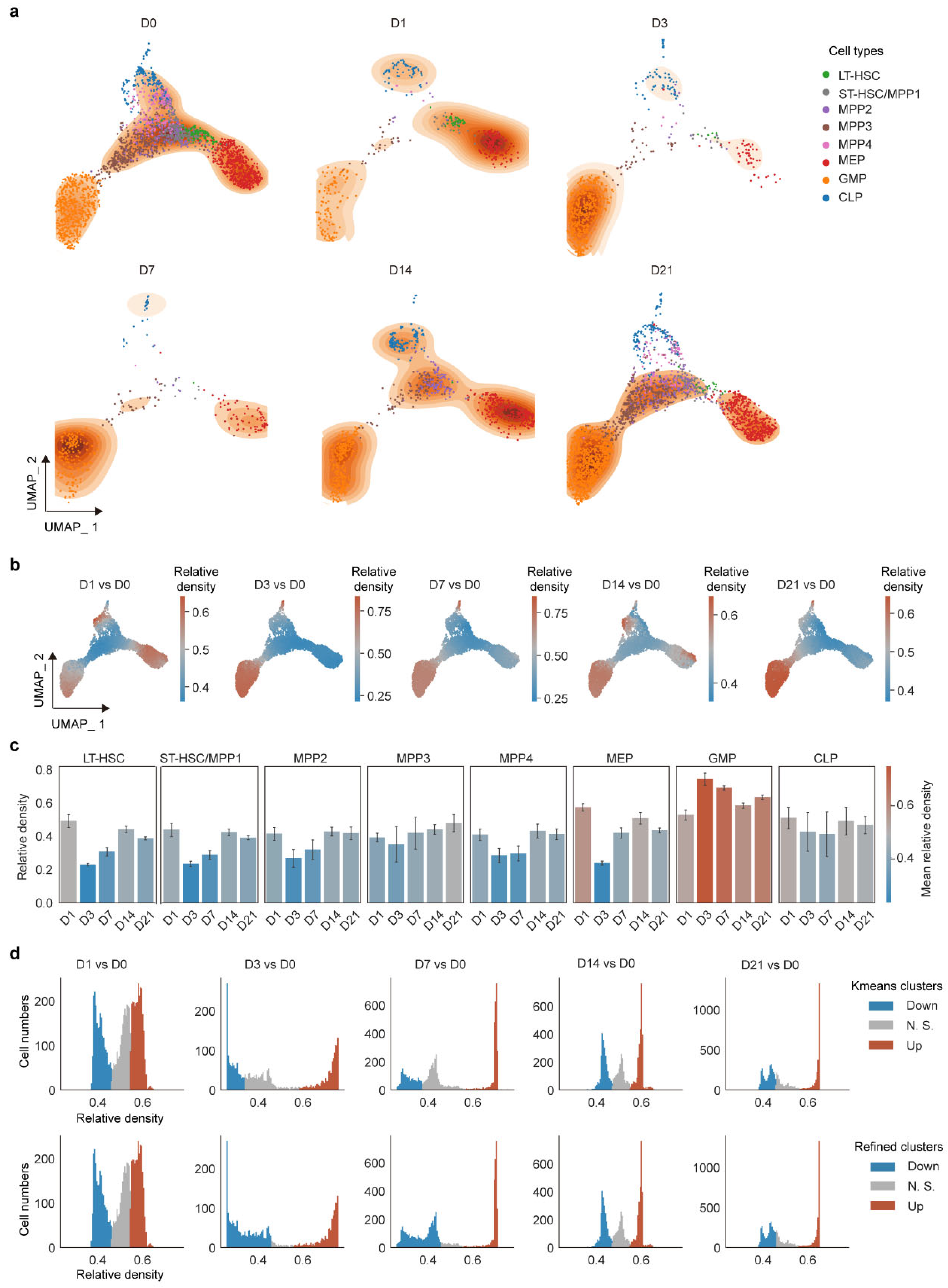
Figure A1. Dynamic abundance and classification of responses after irradiation. (a) Contour plots showing the abundance of HSPC subpopulations at pre-irradiation (D0) and post-irradiation time points (D1, D3, D7, D14, and D21). (b) UMAP visualization of MELD-inferred relative density at each post-radiation time point compared with D0. (c) Bar plots summarizing the relative density for each HSPC subpopulation across time. (d) Classification of response modes (down, N.S. and up) was first determined through unsupervised K-means clustering based on relative density (top), and it was subsequently refined using empirical thresholds (bottom).
Ijms 27 03522 g0a1

Appendix A.2

Figure A2. Additional analysis for dynamic responses after irradiation. (a) Dot plot showing cell type annotations in independent scRNA-seq dataset. (b) GSVA showing enrichment of Hallmark pathways in MEP and CLP populations following irradiation. Cell cycle- and apoptosis-related pathways were highlighted in red. Enrichment scores were normalized by z-score.
Ijms 27 03522 g0a2

Appendix A.3

Figure A3. Additions for transcriptional regulatory analysis by SCENIC. (a,b) Scatter plots of the top 10 TF markers ranked by RSS for LT-HSC, ST-HSC/MPP1, MPP2, MPP3, and MPP4. The activity distribution of a representative TF (highlighted in red) was visualized on UMAP. (c) Heatmap showing the activity patterns of specific TFs across HSPC subpopulations. (d) Filtering of high-confidence interactions for constructing specific regulatory networks. TF–target interactions were classified by unsupervised clustering based on importance scores to keep high-confidence edges.
Ijms 27 03522 g0a3

Appendix A.4

Figure A4. Additional comparison for TF dynamic activity between D3 and D0. (ac) Jittered scatter plots comparing the dynamic activity along ME, GM, and LY lineages between D3 and D0. Red circles represented D3, and blue circles represented D0. Red circles represented cells in D3, and blue circles represented cells in D0. The mean values were indicated by brighter-colored circles.
Ijms 27 03522 g0a4

Appendix A.5

Figure A5. Additional analyses for in silico knock-out perturbations. (a) Heatmaps displaying the knock-out effects of specific TFs across ME, GM, and LY lineages at pre- and post-irradiation time points. (be) UMAPs showing the knock-out effects of ME-specific TFs (Gata1 and Bcl11a), GM-specific TFs (Spi1 and Cebpb), and LY-specific TFs (Ebf1 and the novel lymphoid regulator Tcf7l2) at D3. Arrows indicated the direction of perturbed differentiation.
Ijms 27 03522 g0a5

Appendix A.6

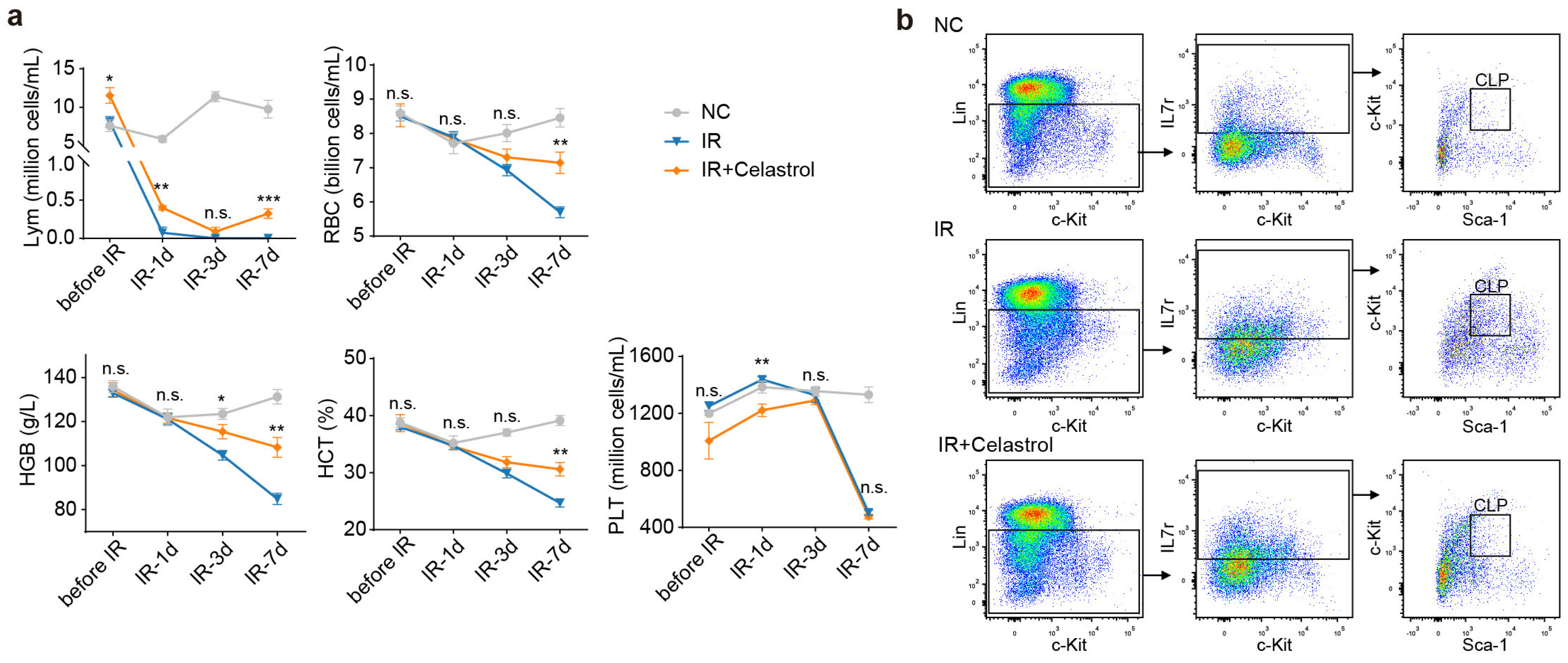
Figure A6. Additional results for in vivo Hsf1 activation experiment. (a) Line plots showing the complete blood counts including lymphocytes (Lym), red blood cell (RBC) and platelet (PLT) counts, as well as hemoglobin (HGB) and hematocrit (HCT) concentration before irradiation and at days 1, 3, and 7. Statistical comparisons between IR and IR + celastrol groups were performed using unpaired two-tailed Student’s t-test. N = 6 mice per group. IR, ionizing radiation; NC, negative control. (b) Flow cytometric analysis of bone marrow lymphoid progenitor compartments at day 7. N = 3 biological replicates per group. Data are shown as mean ± SEM. * p < 0.05, ** p < 0.01, *** p < 0.001, n.s., not significant.
Ijms 27 03522 g0a6

References

  1. Shao, L.; Luo, Y.; Zhou, D. Hematopoietic Stem Cell Injury Induced by Ionizing Radiation. Antioxid. Redox Signal. 2014, 20, 1447–1462. [Google Scholar] [CrossRef] [PubMed]
  2. Zhang, Y.; Chen, X.; Wang, X.; Chen, J.; Du, C.; Wang, J.; Liao, W. Insights into Ionizing Radiation-Induced Bone Marrow Hematopoietic Stem Cell Injury. Stem Cell Res. Ther. 2024, 15, 222. [Google Scholar] [CrossRef] [PubMed]
  3. Orschell, C.M.; Wu, T.; Patterson, A.M. Impact of Age, Sex, and Genetic Diversity in Murine Models of the Hematopoietic Acute Radiation Syndrome (H-ARS) and the Delayed Effects of Acute Radiation Exposure (DEARE). Curr. Stem Cell Rep. 2022, 8, 139–149. [Google Scholar] [CrossRef] [PubMed]
  4. Hofer, M.; Pospíšil, M.; Komůrková, D.; Hoferová, Z. Granulocyte Colony-Stimulating Factor in the Treatment of Acute Radiation Syndrome: A Concise Review. Molecules 2014, 19, 4770–4778. [Google Scholar] [CrossRef]
  5. Du, C.; Chen, J.; Wang, J. New Insights into the Generation and Function of Megakaryocytes in Health and Disease. Haematologica 2025, 110, 1500–1512. [Google Scholar] [CrossRef]
  6. Diaz, M.F.; Horton, P.D.; Dumbali, S.P.; Kumar, A.; Livingston, M.; Skibber, M.A.; Mohammadalipour, A.; Gill, B.S.; Zhang, S.; Cox, C.S.; et al. Bone Marrow Stromal Cell Therapy Improves Survival after Radiation Injury but Does Not Restore Endogenous Hematopoiesis. Sci. Rep. 2020, 10, 22211, Correction in Sci. Rep. 2021, 11, 16225. [Google Scholar] [CrossRef]
  7. Rezvani, M. Therapeutic Potential of Mesenchymal Stromal Cells and Extracellular Vesicles in the Treatment of Radiation Lesions—A Review. Cells 2021, 10, 427. [Google Scholar] [CrossRef]
  8. Friedman, A.D. Cell Cycle and Developmental Control of Hematopoiesis by Runx1. J. Cell. Physiol. 2009, 219, 520–524. [Google Scholar] [CrossRef]
  9. Porcher, C.; Chagraoui, H.; Kristiansen, M.S. SCL/TAL1: A Multifaceted Regulator from Blood Development to Disease. Blood 2017, 129, 2051–2060. [Google Scholar] [CrossRef]
  10. Jiang, M.; Xu, S.; Bai, M.; Zhang, A. The Emerging Role of MEIS1 in Cell Proliferation and Differentiation. Am. J. Physiol.-Cell Physiol. 2021, 320, C264–C269. [Google Scholar] [CrossRef]
  11. Ferreira, R.; Ohneda, K.; Yamamoto, M.; Philipsen, S. GATA1 Function, a Paradigm for Transcription Factors in Hematopoiesis. Mol. Cell. Biol. 2005, 25, 1215–1227. [Google Scholar] [CrossRef] [PubMed]
  12. Zakrzewska, A.; Cui, C.; Stockhammer, O.W.; Benard, E.L.; Spaink, H.P.; Meijer, A.H. Macrophage-Specific Gene Functions in Spi1-Directed Innate Immunity. Blood 2010, 116, e1–e11. [Google Scholar] [CrossRef] [PubMed]
  13. Tangye, S.G. SPI-Ing on Human B-Cell Development. Blood 2025, 145, 2535–2536. [Google Scholar] [CrossRef] [PubMed]
  14. Theilgaard-Mönch, K.; Pundhir, S.; Reckzeh, K.; Su, J.; Tapia, M.; Furtwängler, B.; Jendholm, J.; Jakobsen, J.S.; Hasemann, M.S.; Knudsen, K.J.; et al. Transcription Factor-Driven Coordination of Cell Cycle Exit and Lineage-Specification in Vivo during Granulocytic Differentiation. Nat. Commun. 2022, 13, 3595. [Google Scholar] [CrossRef]
  15. Muench, D.E.; Olsson, A.; Ferchen, K.; Pham, G.; Serafin, R.A.; Chutipongtanate, S.; Dwivedi, P.; Song, B.; Hay, S.; Chetal, K.; et al. Mouse Models of Neutropenia Reveal Progenitor-Stage-Specific Defects. Nature 2020, 582, 109–114. [Google Scholar] [CrossRef]
  16. Shan, Q.; Li, X.; Chen, X.; Zeng, Z.; Zhu, S.; Gai, K.; Peng, W.; Xue, H.-H. Tcf1 and Lef1 Provide Constant Supervision to Mature CD8+ T Cell Identity and Function by Organizing Genomic Architecture. Nat. Commun. 2021, 12, 5863. [Google Scholar] [CrossRef]
  17. Sigvardsson, M. Transcription Factor Networks Link B-Lymphocyte Development and Malignant Transformation in Leukemia. Genes Dev. 2023, 37, 703–723. [Google Scholar] [CrossRef]
  18. Liggett, L.A.; Sankaran, V.G. Unraveling Hematopoiesis Through the Lens of Genomics. Cell 2020, 182, 1384–1400. [Google Scholar] [CrossRef]
  19. Buenrostro, J.D.; Corces, M.R.; Lareau, C.A.; Wu, B.; Schep, A.N.; Aryee, M.J.; Majeti, R.; Chang, H.Y.; Greenleaf, W.J. Integrated Single-Cell Analysis Maps the Continuous Regulatory Landscape of Human Hematopoietic Differentiation. Cell 2018, 173, 1535–1548.e16. [Google Scholar] [CrossRef]
  20. Gao, P.; Chen, C.; Howell, E.D.; Li, Y.; Tober, J.; Uzun, Y.; He, B.; Gao, L.; Zhu, Q.; Siekmann, A.F.; et al. Transcriptional Regulatory Network Controlling the Ontogeny of Hematopoietic Stem Cells. Genes Dev. 2020, 34, 950–964. [Google Scholar] [CrossRef]
  21. Li, Y.; Li, Y.; Zhang, B.; Zhao, J.; Qin, J.; Jiang, S.; Li, Y.; Chen, Y.; Li, J.; Chen, K.; et al. Single-Cell Transcriptomics Reveals BMP4-BMPR2 Signaling Promotes Radiation Resistance in Hematopoietic Stem Cells Following Injury. Nat. Commun. 2025, 16, 5470. [Google Scholar] [CrossRef]
  22. Kim, J.-H.; Thimmulappa, R.K.; Kumar, V.; Cui, W.; Kumar, S.; Kombairaju, P.; Zhang, H.; Margolick, J.; Matsui, W.; Macvittie, T.; et al. NRF2-Mediated Notch Pathway Activation Enhances Hematopoietic Reconstitution Following Myelosuppressive Radiation. J. Clin. Investig. 2014, 124, 730–741. [Google Scholar] [CrossRef] [PubMed]
  23. Poulos, M.G.; Ramalingam, P.; Gutkin, M.C.; Kleppe, M.; Ginsberg, M.; Crowley, M.J.P.; Elemento, O.; Levine, R.L.; Rafii, S.; Kitajewski, J.; et al. Endothelial-Specific Inhibition of NF-κB Enhances Functional Haematopoiesis. Nat. Commun. 2016, 7, 13829. [Google Scholar] [CrossRef] [PubMed]
  24. Hoppe, P.S.; Schwarzfischer, M.; Loeffler, D.; Kokkaliaris, K.D.; Hilsenbeck, O.; Moritz, N.; Endele, M.; Filipczyk, A.; Gambardella, A.; Ahmed, N.; et al. Early Myeloid Lineage Choice Is Not Initiated by Random PU.1 to GATA1 Protein Ratios. Nature 2016, 535, 299–302. [Google Scholar] [CrossRef] [PubMed]
  25. Orkin, S.H.; Zon, L.I. Hematopoiesis: An Evolving Paradigm for Stem Cell Biology. Cell 2008, 132, 631–644. [Google Scholar] [CrossRef]
  26. Gavriilidis, G.I.; Vasileiou, V.; Orfanou, A.; Ishaque, N.; Psomopoulos, F. A Mini-Review on Perturbation Modelling across Single-Cell Omic Modalities. Comput. Struct. Biotechnol. J. 2024, 23, 1886–1896. [Google Scholar] [CrossRef]
  27. Ji, Y.; Lotfollahi, M.; Wolf, F.A.; Theis, F.J. Machine Learning for Perturbational Single-Cell Omics. Cell Syst. 2021, 12, 522–537. [Google Scholar] [CrossRef]
  28. Kamimoto, K.; Stringa, B.; Hoffmann, C.M.; Jindal, K.; Solnica-Krezel, L.; Morris, S.A. Dissecting Cell Identity via Network Inference and in Silico Gene Perturbation. Nature 2023, 614, 742–751. [Google Scholar] [CrossRef]
  29. Bravo González-Blas, C.; De Winter, S.; Hulselmans, G.; Hecker, N.; Matetovici, I.; Christiaens, V.; Poovathingal, S.; Wouters, J.; Aibar, S.; Aerts, S. SCENIC+: Single-Cell Multiomic Inference of Enhancers and Gene Regulatory Networks. Nat. Methods 2023, 20, 1355–1367. [Google Scholar] [CrossRef]
  30. Burkhardt, D.B.; Stanley, J.S.; Tong, A.; Perdigoto, A.L.; Gigante, S.A.; Herold, K.C.; Wolf, G.; Giraldez, A.J.; van Dijk, D.; Krishnaswamy, S. Quantifying the Effect of Experimental Perturbations at Single-Cell Resolution. Nat. Biotechnol. 2021, 39, 619–629. [Google Scholar] [CrossRef]
  31. Aibar, S.; González-Blas, C.B.; Moerman, T.; Huynh-Thu, V.A.; Imrichova, H.; Hulselmans, G.; Rambow, F.; Marine, J.-C.; Geurts, P.; Aerts, J.; et al. SCENIC: Single-Cell Regulatory Network Inference and Clustering. Nat. Methods 2017, 14, 1083–1086. [Google Scholar] [CrossRef] [PubMed]
  32. Van de Sande, B.; Flerin, C.; Davie, K.; De Waegeneer, M.; Hulselmans, G.; Aibar, S.; Seurinck, R.; Saelens, W.; Cannoodt, R.; Rouchon, Q.; et al. A Scalable SCENIC Workflow for Single-Cell Gene Regulatory Network Analysis. Nat. Protoc. 2020, 15, 2247–2276. [Google Scholar] [CrossRef] [PubMed]
  33. Moriguchi, T.; Yamamoto, M. A Regulatory Network Governing Gata1 and Gata2 Gene Transcription Orchestrates Erythroid Lineage Differentiation. Int. J. Hematol. 2014, 100, 417–424. [Google Scholar] [CrossRef] [PubMed]
  34. Randrianarison-Huetz, V.; Laurent, B.; Bardet, V.; Blobe, G.C.; Huetz, F.; Duménil, D. Gfi-1B Controls Human Erythroid and Megakaryocytic Differentiation by Regulating TGF-Beta Signaling at the Bipotent Erythro-Megakaryocytic Progenitor Stage. Blood 2010, 115, 2784–2795. [Google Scholar] [CrossRef]
  35. Wang, W.; Xia, X.; Mao, L.; Wang, S. The CCAAT/Enhancer-Binding Protein Family: Its Roles in MDSC Expansion and Function. Front. Immunol. 2019, 10, 1804. [Google Scholar] [CrossRef]
  36. Shyamsunder, P.; Shanmugasundaram, M.; Mayakonda, A.; Dakle, P.; Teoh, W.W.; Han, L.; Kanojia, D.; Lim, M.C.; Fullwood, M.; An, O.; et al. Identification of a Novel Enhancer of CEBPE Essential for Granulocytic Differentiation. Blood 2019, 133, 2507–2517. [Google Scholar] [CrossRef]
  37. Graf, T. Myb: A Transcriptional Activator Linking Proliferation and Differentiation in Hematopoietic Cells. Curr. Opin. Genet. Dev. 1992, 2, 249–255. [Google Scholar] [CrossRef]
  38. Singh, A.K.; Swarnalatha, M.; Kumar, V. c-ETS1 Facilitates G1/S-Phase Transition by Up-Regulating Cyclin E and CDK2 Genes and Cooperates with Hepatitis B Virus X Protein for Their Deregulation. J. Biol. Chem. 2011, 286, 21961–21970. [Google Scholar] [CrossRef]
  39. John, S.; Kalathil, D.; Pothuraju, R.; Nair, S.A. Deciphering ETS2: An Indispensable Conduit to Cancer. Biochim. Biophys. Acta (BBA)-Rev. Cancer 2025, 1880, 189368. [Google Scholar] [CrossRef]
  40. Amanda, S.; Tan, T.K.; Iida, S.; Sanda, T. Lineage- and Stage-Specific Oncogenicity of IRF4. Exp. Hematol. 2022, 114, 9–17. [Google Scholar] [CrossRef]
  41. Brune, Z.; Rice, M.R.; Barnes, B.J. Potential T Cell-Intrinsic Regulatory Roles for IRF5 via Cytokine Modulation in T Helper Subset Differentiation and Function. Front. Immunol. 2020, 11, 1143. [Google Scholar] [CrossRef] [PubMed]
  42. Das, T.; Wang, E.; Xu, Y.; Yang, H.; Liao, X.; Jain, M.K. Krüppel-like Factor 4 Control of Immune Cell Function. Front. Immunol. 2025, 16, 1597210. [Google Scholar] [CrossRef]
  43. Kee, B.L. It’s a Phase That EBF1 Is Going Through. Immunity 2020, 53, 1123–1125. [Google Scholar] [CrossRef] [PubMed]
  44. del Bosque-Plata, L.; Hernández-Cortés, E.P.; Gragnoli, C. The Broad Pathogenetic Role of TCF7L2 in Human Diseases beyond Type 2 Diabetes. J. Cell. Physiol. 2022, 237, 301–312. [Google Scholar] [CrossRef] [PubMed]
  45. Trompouki, E.; Bowman, T.V.; Lawton, L.N.; Fan, Z.P.; Wu, D.-C.; DiBiase, A.; Martin, C.S.; Cech, J.N.; Sessa, A.K.; Leblanc, J.L.; et al. Lineage Regulators Direct BMP and Wnt Pathways to Cell-Specific Programs During Differentiation and Regeneration. Cell 2011, 147, 577–589. [Google Scholar] [CrossRef]
  46. Xing, S.; Gai, K.; Li, X.; Shao, P.; Zeng, Z.; Zhao, X.; Zhao, X.; Chen, X.; Paradee, W.J.; Meyerholz, D.K.; et al. Tcf1 and Lef1 Are Required for the Immunosuppressive Function of Regulatory T Cells. J. Exp. Med. 2019, 216, 847–866. [Google Scholar] [CrossRef]
  47. Zohren, F.; Souroullas, G.P.; Luo, M.; Gerdemann, U.; Imperato, M.R.; Wilson, N.K.; Gottgens, B.; Lukov, G.L.; Goodell, M.A. Lyl1 Regulates Lymphoid Specification and Maintenance of Early T Lineage Progenitors. Nat. Immunol. 2012, 13, 761–769. [Google Scholar] [CrossRef]
  48. Jang, Y.; Feng, R.; Palmer, L.E.; Mayuranathan, T.; Yao, Y.; Mayberry, K.; Zhou, S.; Xu, J.; Gossett, J.M.; Kang, G.; et al. BCL11A-Deficient Human Erythropoiesis Is Impaired in Vitro and after Xenotransplantation into Mice. Blood Adv. 2025, 9, 2722–2732. [Google Scholar] [CrossRef]
  49. Braun, T.P.; Okhovat, M.; Coblentz, C.; Carratt, S.A.; Foley, A.; Schonrock, Z.; Curtiss, B.M.; Nevonen, K.; Davis, B.; Garcia, B.; et al. Myeloid Lineage Enhancers Drive Oncogene Synergy in CEBPA/CSF3R Mutant Acute Myeloid Leukemia. Nat. Commun. 2019, 10, 5455, Correction in Nat. Commun. 2022, 13, 3471. [Google Scholar] [CrossRef]
  50. Kuznetsova, T.; Prange, K.H.M.; Glass, C.K.; De Winther, M.P.J. Transcriptional and Epigenetic Regulation of Macrophages in Atherosclerosis. Nat. Rev. Cardiol. 2020, 17, 216–228. [Google Scholar] [CrossRef]
  51. Li, M.; Jiang, P.; Cheng, K.; Zhang, Z.; Lan, S.; Li, X.; Zhao, L.; Wang, Y.; Wang, X.; Chen, J.; et al. Regulation of MYB by Distal Enhancer Elements in Human Myeloid Leukemia. Cell Death Dis. 2021, 12, 223. [Google Scholar] [CrossRef]
  52. Lien, C.; Fang, C.-M.; Huso, D.; Livak, F.; Lu, R.; Pitha, P.M. Critical Role of IRF-5 in Regulation of B-Cell Differentiation. Proc. Natl. Acad. Sci. USA 2010, 107, 4664–4668. [Google Scholar] [CrossRef]
  53. Hagman, J.; Ramírez, J.; Lukin, K. B Lymphocyte Lineage Specification, Commitment and Epigenetic Control of Transcription by Early B Cell Factor 1. In Epigenetic Regulation of Lymphocyte Development; Current Topics in Microbiology and Immunology; Springer: Berlin/Heidelberg, Germany, 2012; Volume 356, pp. 17–38. [Google Scholar]
  54. Zhang, J.; Lyu, T.; Cao, Y.; Feng, H. Role of TCF-1 in Differentiation, Exhaustion, and Memory of CD8+ T Cells: A Review. FASEB J. 2021, 35, e21549. [Google Scholar] [CrossRef] [PubMed]
  55. Horiuchi, S.; Koike, T.; Takebuchi, H.; Hoshino, K.; Sasaki, I.; Fukuda-Ohta, Y.; Kaisho, T.; Kitamura, D. SpiB Regulates the Expression of B-Cell-Related Genes and Increases the Longevity of Memory B Cells. Front. Immunol. 2023, 14, 1250719. [Google Scholar] [CrossRef] [PubMed]
  56. Jacobs-Helber, S.M.; Abutin, R.M.; Tian, C.; Bondurant, M.; Wickrema, A.; Sawyer, S.T. Role of JunB in Erythroid Differentiation. J. Biol. Chem. 2002, 277, 4859–4866. [Google Scholar] [CrossRef] [PubMed]
  57. Sidhu, K.; Kumar, V. C-ETS Transcription Factors Play an Essential Role in the Licensing of Human MCM4 Origin of Replication. Biochim. Biophys. Acta 2015, 1849, 1319–1328. [Google Scholar] [CrossRef]
  58. Ma, X.; Xu, L.; Alberobello, A.T.; Gavrilova, O.; Bagattin, A.; Skarulis, M.; Liu, J.; Finkel, T.; Mueller, E. Celastrol Protects against Obesity and Metabolic Dysfunction through Activation of a HSF1-PGC1α Transcriptional Axis. Cell Metab. 2015, 22, 695–708. [Google Scholar] [CrossRef]
  59. Zhu, J.; Sun, X.; Zhan, Y. Targeting HSF1-TLR9 Axis: Celastrol as a Potential Therapeutic for Liver Injury in Traumatic Hemorrhagic Shock. Discov. Med. 2025, 37, 503–514. [Google Scholar] [CrossRef]
  60. Dong, Q.; Xiu, Y.; Wang, Y.; Hodgson, C.; Borcherding, N.; Jordan, C.; Buchanan, J.; Taylor, E.; Wagner, B.; Leidinger, M.; et al. HSF1 Is a Driver of Leukemia Stem Cell Self-Renewal in Acute Myeloid Leukemia. Nat. Commun. 2022, 13, 6107. [Google Scholar] [CrossRef]
  61. Cabal-Hierro, L.; van Galen, P.; Prado, M.A.; Higby, K.J.; Togami, K.; Mowery, C.T.; Paulo, J.A.; Xie, Y.; Cejas, P.; Furusawa, T.; et al. Chromatin Accessibility Promotes Hematopoietic and Leukemia Stem Cell Activity. Nat. Commun. 2020, 11, 1406. [Google Scholar] [CrossRef]
  62. Swift, M.L.; Beishline, K.; Flashner, S.; Azizkhan-Clifford, J. DSB Repair Pathway Choice Is Regulated by Recruitment of 53BP1 through Cell Cycle-Dependent Regulation of Sp1. Cell Rep. 2021, 34, 108840. [Google Scholar] [CrossRef] [PubMed]
  63. Shields, B.J.; Jackson, J.T.; Metcalf, D.; Shi, W.; Huang, Q.; Garnham, A.L.; Glaser, S.P.; Beck, D.; Pimanda, J.E.; Bogue, C.W.; et al. Acute Myeloid Leukemia Requires Hhex to Enable PRC2-Mediated Epigenetic Repression of Cdkn2a. Genes Dev. 2016, 30, 78. [Google Scholar] [CrossRef] [PubMed]
  64. Fang, Y.; Cheng, L.; Huang, M.; Cao, Y.; Zou, Q.; Cai, J.; Zhang, Y.; Xia, Y.; Huang, H.; Chen, X.; et al. Heat Shock Factor 1 Promotes Proliferation and Chemoresistance in Diffuse Large B-Cell Lymphoma by Enhancing the Cell Cycle and DNA Repair. Cell Death Dis. 2025, 16, 533. [Google Scholar] [CrossRef]
  65. Li, J.; Wang, Q.-E.; Zhu, Q.; El-Mahdy, M.A.; Wani, G.; Praetorius-Ibba, M.; Wani, A.A. DNA Damage Binding Protein Component DDB1 Participates in Nucleotide Excision Repair through DDB2 DNA-Binding and Cullin 4A Ubiquitin Ligase Activity. Cancer Res. 2006, 66, 8590–8597. [Google Scholar] [CrossRef] [PubMed]
  66. Wenger, J.; McGrath, K.E.; Koniski, A.; Cacciatori, J.; Bushnell, T.P.; Dertinger, S.D.; Chen, Y.; Palis, J. Response of the Erythroid Lineage to Irradiation. Blood 2007, 110, 3660. [Google Scholar] [CrossRef]
  67. Wang, J.; Sun, Q.; Morita, Y.; Jiang, H.; Groß, A.; Lechel, A.; Hildner, K.; Guachalla, L.M.; Gompf, A.; Hartmann, D.; et al. A Differentiation Checkpoint Limits Hematopoietic Stem Cell Self-Renewal in Response to DNA Damage. Cell 2012, 148, 1001–1014. [Google Scholar] [CrossRef]
  68. Li, W.; Wang, X.; Dong, Y.; Huo, Q.; Yue, T.; Wu, X.; Lu, L.; Zhang, J.; Zhao, Y.; Dong, H.; et al. Nicotinamide Riboside Intervention Alleviates Hematopoietic System Injury of Ionizing Radiation-induced Premature Aging Mice. Aging Cell 2023, 22, e13976. [Google Scholar] [CrossRef]
  69. Liao, W.; Liu, C.; Yang, K.; Chen, J.; Wu, Y.; Zhang, S.; Yu, K.; Wang, L.; Ran, L.; Chen, M.; et al. Aged Hematopoietic Stem Cells Entrap Regulatory T Cells to Create a Prosurvival Microenvironment. Cell. Mol. Immunol. 2023, 20, 1216–1231. [Google Scholar] [CrossRef]
  70. Kurashina, R.; Ohyashiki, J.H.; Kobayashi, C.; Hamamura, R.; Zhang, Y.; Hirano, T.; Ohyashiki, K. Anti-Proliferative Activity of Heat Shock Protein (Hsp) 90 Inhibitors via Beta-Catenin/TCF7L2 Pathway in Adult T Cell Leukemia Cells. Cancer Lett. 2009, 284, 62–70. [Google Scholar] [CrossRef]
  71. Jain, N.; Hartert, K.; Tadros, S.; Fiskus, W.; Havranek, O.; Ma, M.C.J.; Bouska, A.; Heavican, T.; Kumar, D.; Deng, Q.; et al. Targetable Genetic Alterations of TCF4 (E2-2) Drive Immunoglobulin Expression in Diffuse Large B Cell Lymphoma. Sci. Transl. Med. 2019, 11, eaav5599. [Google Scholar] [CrossRef]
  72. Macias, A.; Cortes, M.; An, N.; Li, N.; Fulton, T.; Simpson, A.; Miller, S.; Sun, S.; Fu, D.; Garcia, J.; et al. From in Silico to in Vitro to In Vivo: Increasing Megakaryocytes to Treat Thrombocytopenia. Blood 2023, 142, 5580. [Google Scholar] [CrossRef]
  73. Sharma, S.; Mishra, R.; Walker, B.L.; Deshmukh, S.; Zampino, M.; Patel, J.; Anamalai, M.; Simpson, D.; Singh, I.S.; Kaushal, S.; et al. Celastrol, an Oral Heat Shock Activator, Ameliorates Multiple Animal Disease Models of Cell Death. Cell Stress Chaperones 2015, 20, 185–201. [Google Scholar] [CrossRef] [PubMed]
  74. Kruta, M.; Sunshine, M.J.; Chua, B.A.; Fu, Y.; Chawla, A.; Dillingham, C.H.; Hidalgo San Jose, L.; De Jong, B.; Zhou, F.J.; Signer, R.A.J. Hsf1 Promotes Hematopoietic Stem Cell Fitness and Proteostasis in Response to Ex Vivo Culture Stress and Aging. Cell Stem Cell 2021, 28, 1950–1965.e6. [Google Scholar] [CrossRef] [PubMed]
  75. Kim, Y.J.; Lam, K.; Zhou, F.; Ong, C.M.; Magee, J.A.; Signer, R. A Stress Response Pathway That Enhances Hematopoietic Stem Cell Longevity Promotes Acute Myeloid Leukemia Growth and Progression. Blood 2022, 140, 5872. [Google Scholar] [CrossRef]
  76. Li, Q.; Martinez, J.D. Loss of HSF1 Results in Defective Radiation-Induced G2 Arrest and DNA Repair. Radiat. Res. 2011, 176, 17–24. [Google Scholar] [CrossRef]
  77. Chin, Y.; Gumilar, K.E.; Li, X.-G.; Tjokroprawiro, B.A.; Lu, C.-H.; Lu, J.; Zhou, M.; Sobol, R.W.; Tan, M. Targeting HSF1 for Cancer Treatment: Mechanisms and Inhibitor Development. Theranostics 2023, 13, 2281–2300. [Google Scholar] [CrossRef]
  78. Luan, H.; Yang, J.; Wang, Y.; Shen, X.; Zhang, X.; Qiao, Z.; Xing, S.; Yu, Z. rhTPO Ameliorates Radiation-Induced Long-Term Hematopoietic Stem Cell Injury in Mice. Molecules 2023, 28, 1953. [Google Scholar] [CrossRef]
  79. Acharya, S.S.; Fendler, W.; Watson, J.; Hamilton, A.; Pan, Y.; Gaudiano, E.; Moskwa, P.; Bhanja, P.; Saha, S.; Guha, C.; et al. Serum microRNAs Are Early Indicators of Survival after Radiation-Induced Hematopoietic Injury. Sci. Transl. Med. 2015, 7, 287ra69. [Google Scholar] [CrossRef]
  80. Xu, L.-N.; Zhao, N.; Chen, J.-Y.; Ye, P.-P.; Nan, X.-W.; Zhou, H.-H.; Jiang, Q.-W.; Yang, Y.; Huang, J.-R.; Yuan, M.-L.; et al. Celastrol Inhibits the Growth of Ovarian Cancer Cells in Vitro and in Vivo. Front. Oncol. 2019, 9, 2. [Google Scholar] [CrossRef]
  81. Zhu, B.; Wei, Y. Antitumor Activity of Celastrol by Inhibition of Proliferation, Invasion, and Migration in Cholangiocarcinoma via PTEN/PI3K/Akt Pathway. Cancer Med. 2019, 9, 783–796. [Google Scholar] [CrossRef]
  82. Zhang, X.; Yang, J.; Chen, M.; Li, L.; Huan, F.; Li, A.; Liu, Y.; Xia, Y.; Duan, J.; Ma, S. Metabolomics Profiles Delineate Uridine Deficiency Contributes to Mitochondria-Mediated Apoptosis Induced by Celastrol in Human Acute Promyelocytic Leukemia Cells. Oncotarget 2016, 7, 46557–46572. [Google Scholar] [CrossRef] [PubMed]
  83. Hao, Y.; Hao, S.; Andersen-Nissen, E.; Mauck, W.M.; Zheng, S.; Butler, A.; Lee, M.J.; Wilk, A.J.; Darby, C.; Zager, M.; et al. Integrated Analysis of Multimodal Single-Cell Data. Cell 2021, 184, 3573–3587.e29. [Google Scholar] [CrossRef] [PubMed]
  84. Wolock, S.L.; Lopez, R.; Klein, A.M. Scrublet: Computational Identification of Cell Doublets in Single-Cell Transcriptomic Data. Cell Syst. 2019, 8, 281–291.e9. [Google Scholar] [CrossRef] [PubMed]
  85. Hänzelmann, S.; Castelo, R.; Guinney, J. GSVA: Gene Set Variation Analysis for Microarray and RNA-Seq Data. BMC Bioinform. 2013, 14, 7. [Google Scholar] [CrossRef]
  86. Liberzon, A.; Birger, C.; Thorvaldsdóttir, H.; Ghandi, M.; Mesirov, J.P.; Tamayo, P. The Molecular Signatures Database (MSigDB) Hallmark Gene Set Collection. Cell Syst. 2015, 1, 417–425. [Google Scholar] [CrossRef]
  87. Shannon, P.; Markiel, A.; Ozier, O.; Baliga, N.S.; Wang, J.T.; Ramage, D.; Amin, N.; Schwikowski, B.; Ideker, T. Cytoscape: A Software Environment for Integrated Models of Biomolecular Interaction Networks. Genome Res. 2003, 13, 2498–2504. [Google Scholar] [CrossRef]
  88. Langmead, B.; Salzberg, S.L. Fast Gapped-Read Alignment with Bowtie 2. Nat. Methods 2012, 9, 357–359. [Google Scholar] [CrossRef]
  89. Zhang, Y.; Liu, T.; Meyer, C.A.; Eeckhoute, J.; Johnson, D.S.; Bernstein, B.E.; Nusbaum, C.; Myers, R.M.; Brown, M.; Li, W.; et al. Model-Based Analysis of ChIP-Seq (MACS). Genome Biol. 2008, 9, R137. [Google Scholar] [CrossRef]
  90. Heinz, S.; Benner, C.; Spann, N.; Bertolino, E.; Lin, Y.C.; Laslo, P.; Cheng, J.X.; Murre, C.; Singh, H.; Glass, C.K. Simple Combinations of Lineage-Determining Transcription Factors Prime Cis-Regulatory Elements Required for Macrophage and B Cell Identities. Mol. Cell 2010, 38, 576–589. [Google Scholar] [CrossRef]
  91. Ramírez, F.; Dündar, F.; Diehl, S.; Grüning, B.A.; Manke, T. deepTools: A Flexible Platform for Exploring Deep-Sequencing Data. Nucleic Acids Res. 2014, 42, W187–W191. [Google Scholar] [CrossRef]
  92. Thorvaldsdóttir, H.; Robinson, J.T.; Mesirov, J.P. Integrative Genomics Viewer (IGV): High-Performance Genomics Data Visualization and Exploration. Brief. Bioinform. 2013, 14, 178–192. [Google Scholar] [CrossRef] [PubMed]
  93. Wu, T.; Hu, E.; Xu, S.; Chen, M.; Guo, P.; Dai, Z.; Feng, T.; Zhou, L.; Tang, W.; Zhan, L.; et al. clusterProfiler 4.0: A Universal Enrichment Tool for Interpreting Omics Data. Innovation 2021, 2, 100141. [Google Scholar] [CrossRef] [PubMed]
  94. Yang, P.; Chen, X.; Wen, H.; Yu, M.; Yu, H.; Wang, L.; Gong, L.; Zhao, L. In Vitro Differentiation of Common Lymphoid Progenitor Cells into B Cell Using Stromal Cell Free Culture System. BMC Immunol. 2025, 26, 12. [Google Scholar] [CrossRef] [PubMed]
  95. Tang, D.; Tao, S.; Chen, Z.; Koliesnik, I.O.; Calmes, P.G.; Hoerr, V.; Han, B.; Gebert, N.; Zörnig, M.; Löffler, B.; et al. Dietary Restriction Improves Repopulation but Impairs Lymphoid Differentiation Capacity of Hematopoietic Stem Cells in Early Aging. J. Exp. Med. 2016, 213, 535–553, Erratum in J. Exp. Med. 2021, 218, jem.2015110012042020C. [Google Scholar] [CrossRef]
  96. Chen, T.; Chen, X.; Zhang, S.; Zhu, J.; Tang, B.; Wang, A.; Dong, L.; Zhang, Z.; Yu, C.; Sun, Y.; et al. The Genome Sequence Archive Family: Toward Explosive Data Growth and Diverse Data Types. Genom. Proteom. Bioinform. 2021, 19, 578–583. [Google Scholar] [CrossRef]
  97. Zou, Z.; Ohta, T.; Oki, S. ChIP-Atlas 3.0: A Data-Mining Suite to Explore Chromosome Architecture Together with Large-Scale Regulome Data. Nucleic Acids Res. 2024, 52, W45–W53. [Google Scholar] [CrossRef]
  98. Zheng, R.; Wan, C.; Mei, S.; Qin, Q.; Wu, Q.; Sun, H.; Chen, C.-H.; Brown, M.; Zhang, X.; Meyer, C.A.; et al. Cistrome Data Browser: Expanded Datasets and New Tools for Gene Regulatory Analysis. Nucleic Acids Res. 2019, 47, D729–D735. [Google Scholar] [CrossRef]
Figure 1. Dynamic responses of HSPCs following irradiation. (a) UMAP visualization of bone marrow HSPC subpopulations based on our previous HSPC subclustering results [21]. (b) MELD plots illustrating response modes of abundance (down, N.S. and up) at post-irradiation time points (D1, D3, D7, D14, and D21) relative to baseline (D0). (c) Stacked bar plot summarizing population-specific response modes in HSPCs after irradiation. (d) UMAP embedding of HSPCs from an independent scRNA-seq dataset (left), UMAP visualization of non-irradiated (N) and irradiated (R) samples at D3 (middle) and the corresponding stacked bar plot (right). (e) GSVA showing the enrichment of Hallmark pathways in HSC/MPP and GMP populations following irradiation. Cell cycle- and apoptosis-related pathways were highlighted in red. Enrichment scores were normalized by z-score.
Ijms 27 03522 g001
Figure 2. SCENIC analysis of transcriptional regulatory programs and identification of lymphoid function of Tcf7l2. (a) Hierarchical clustering and heatmap showing the distinct activity patterns across HSPC subpopulations. TF activity was calculated based on AUC (area under the curve) and normalized by z-score. (bd) Scatter plots showing the top 10 TF markers ranked by RSS for MEP, GMP, and CLP. RSS, Regulon specificity score. The activity distribution of a representative TF (highlighted in red) was visualized on UMAP. (eg) Specific regulatory networks for MEP, GMP, and CLP. Orange nodes represent TF markers, and blue nodes represent their target genes; node size corresponds to TF activity (z-scored AUC).
Ijms 27 03522 g002
Figure 3. Multi-level validation of Tcf7l2 function in lymphoid differentiation. (a) Expression and activity distribution of Tcf7l2 in HSPCs. Expression values were log-normalized, and TF activity was calculated using AUC and normalized by z-score. (b) Barplot showing the significantly enriched GO terms among TCF7L2 putative targets in human CD34+ progenitor cells. (c) ChIP-seq demonstrating TCF7L2 binding to the lymphoid gene loci LEF1, TCF7, and LYL1. (d) Relative expression of B cell-associated genes and Tcf7l2 in bone marrow cells following Tcf7l2 knockdown and culture under B cell differentiation conditions. Statistical analyses were performed using a two-tailed Student’s t-test. N = 3 biological replicates per group. Data are shown as mean ± standard error of the mean (SEM). *** p < 0.001.
Ijms 27 03522 g003
Figure 4. TF dynamic activity analysis explains differentiation bias between D3 and D0. (a) UMAP visualization of pseudotime scores along GM, ME, and LY lineages based on our previous pseudotime analysis results [21]. (b) Schematic illustration of the window-smoothing strategy applied to zAUC matrix to derive dynamic activity. Red boxes represented windows, and the arrow indicated the direction of differentiation. (c) Heatmaps displaying dynamic activity profiles along ME, GM, and LY lineages. TFs with increasing activity along pseudotime were highlighted in red. (df) Jittered scatter plots comparing the dynamic activity of Gata2 (ME), Ets2 (GM), and Lef1 (LY) between D3 and D0. Red circles represented D3, and blue circles represented D0. Red circles represented cells in D3, and blue circles represented cells in D0. The mean values were indicated by brighter-colored circles. (g) GSEA showing the reduction in G2M checkpoint activity in ME, but elevation in GM and LY at D3 relative to D0. Red and blue indicate positive and negative correlations with the gene set, respectively.
Ijms 27 03522 g004
Figure 5. In silico knock-in analysis identifying effects of specific TFs on lineage differentiation. (a) UMAP visualization of the differentiation flow along GM, ME, and LY lineages. (b) Schematic illustration of TF perturbation modeling using CellOracle. Perturbation effects were represented as perturbation flows and quantified by a perturbation score (PS), defined as the inner product between the perturbation and differentiation flow. Perturbations were simulated as either knock-in (KI) or knock-out (KO). Arrows indicated the direction of differentiation or perturbed differentiation. (c) Heatmaps displaying the knock-in effects of specific TFs across ME, GM, and LY lineages at time points following radiation. (dg) UMAPs showing the knock-in effects of ME factors (Gata1 and Bcl11a), GM factors (Spi1 and Cebpb), LY factors (Ebf1 and the novel lymphoid regulator Tcf7l2) at D3.
Ijms 27 03522 g005
Figure 6. In silico knock-in of Hsf1 and validation of its effect. (a) UMAP showing the in silico knock-in effect of Hsf1 on GM differentiation across D0, D1, D3, and D7. Arrows indicate the direction of perturbed differentiation. (b) Line graph showing average Hsf1 CUT&RUN signal and heatmap showing single-gene Hsf1 occupancy around transcription start sites (TSS ±1 Kb). (c) Motif enrichment analysis of Hsf1 CUT&RUN peaks revealing enrichment of motifs corresponding to myeloid regulators (PU.1/Spi1, and Cebpb) and GC-rich zinc finger transcription factors associated with stress-responsive promoters (Sp1). (d) Bar plot showing significantly enriched GO terms among Hsf1-bound targets in LSCs (leukemic stem cells). (e) CUT&RUN illustrating Hsf1 occupancy at regulatory regions associated with myeloid regulators (Cebpa and Hhex), cell cycle-related factors (Ets1 and Ccnb1) and DNA damage response-related genes (Ddb1 and Ddb2).
Ijms 27 03522 g006
Figure 7. In vivo validation of Hsf1-mediated promotion of GM lineage reconstitution after irradiation. (a) Experimental design for in vivo Hsf1 activation. Mice received 6.5 Gy total body irradiation followed by intraperitoneal celastrol administration every 2 days. Complete blood counts (CBCs) and body weight (BW) were measured before irradiation and at post-irradiation (days 2, 4, and 6), and bone marrow was collected at day 7. (b) Line plots showing white blood cell (WBC) and neutrophil (Neu) counts before irradiation and across days 1, 3, and 7. Statistical comparisons between IR and IR + celastrol groups were performed using unpaired two-tailed Student’s t-test. N = 6 mice per group. IR, ionizing radiation; NC, negative control. (c) Flow cytometric analysis of bone marrow cells at day 7. N = 3 biological replicates per group. (d,e) Quantification of GMP, CMP, MEP, and CLP percentages in bone marrow at day 7. Statistical analyses were performed using two-way ANOVA followed by Tukey’s multiple comparisons test. N = 3 biological replicates per group. (f) Relative expression of Hsf1 in shRNA-mediated knockdown (shHsf1) and non-targeting control (shCtrl). (g,h) A representative colony in each group and the quantification of colony numbers in colony-forming unit–granulocyte–macrophage (CFU–GM) assay. Statistical analyses were performed using unpaired two-tailed Student’s t-test. N = 3 mice per group. Data are shown as mean ± SEM. * p < 0.05, ** p < 0.01, *** p < 0.001, n.s., not significant.
Ijms 27 03522 g007
Disclaimer/Publisher’s Note: The statements, opinions and data contained in all publications are solely those of the individual author(s) and contributor(s) and not of MDPI and/or the editor(s). MDPI and/or the editor(s) disclaim responsibility for any injury to people or property resulting from any ideas, methods, instructions or products referred to in the content.