Immunotherapy-Mediated Modulation of the Gut Microbiota in Multiple Sclerosis: The Effects of High-Efficacy (Cladribine) and Moderate-Efficacy (Interferon Beta-1a) Treatments

Abstract
1. Introduction
2. Results
2.1. Characteristics of Study Cohorts
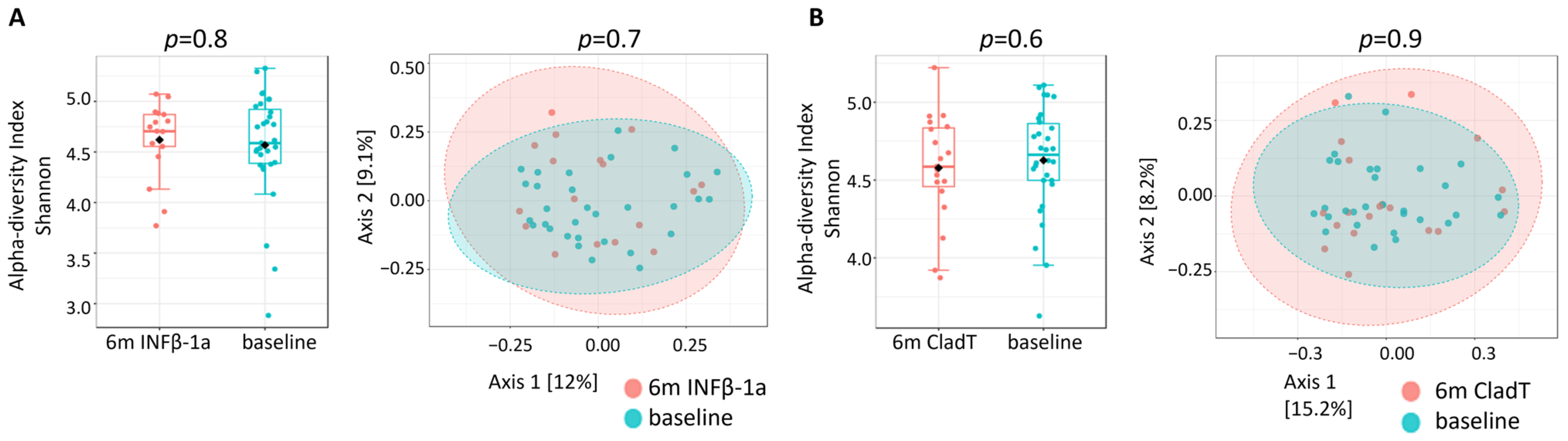
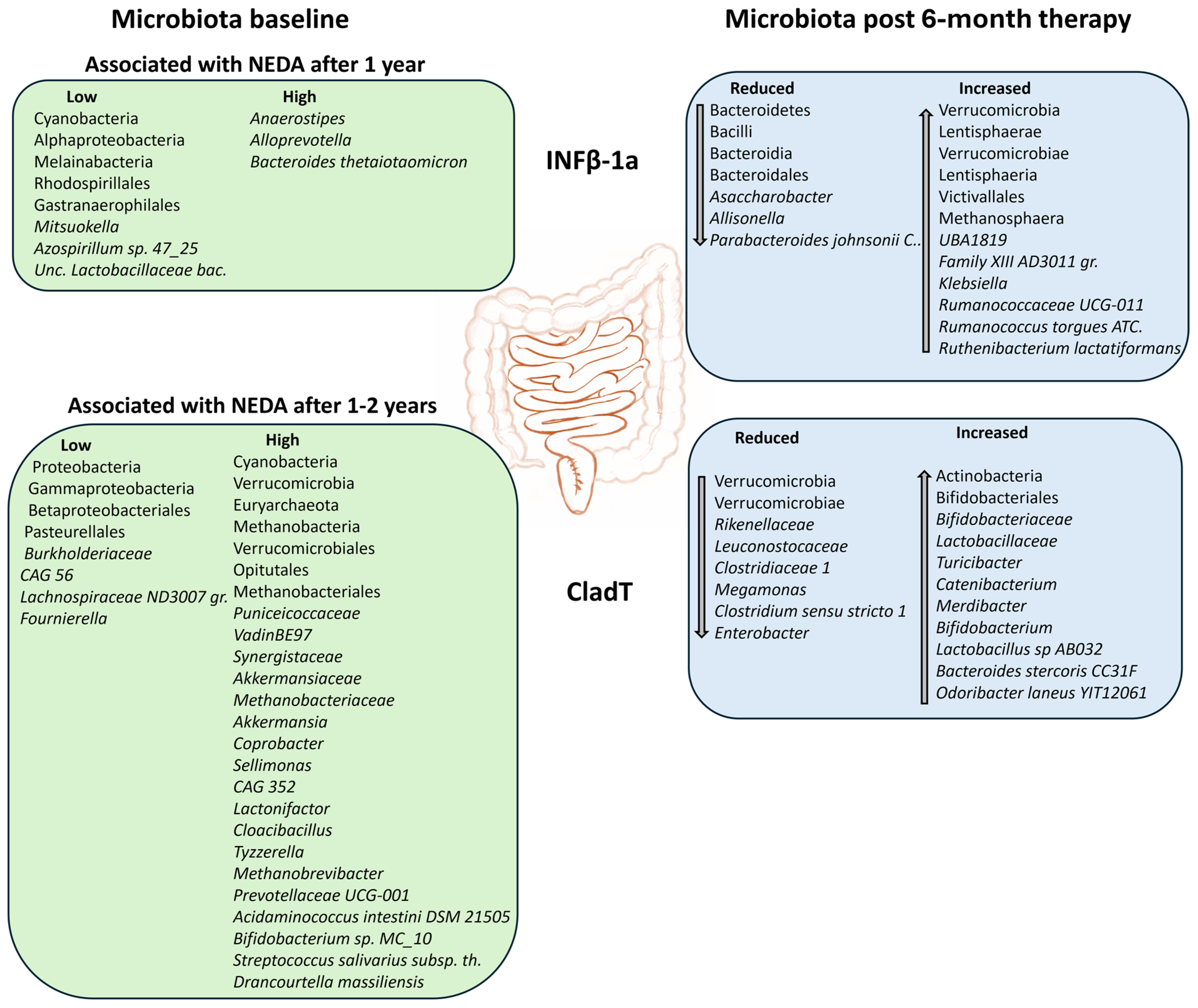
2.2. Microbiota Profiling of Patients Treated with INFβ-1a or CladT
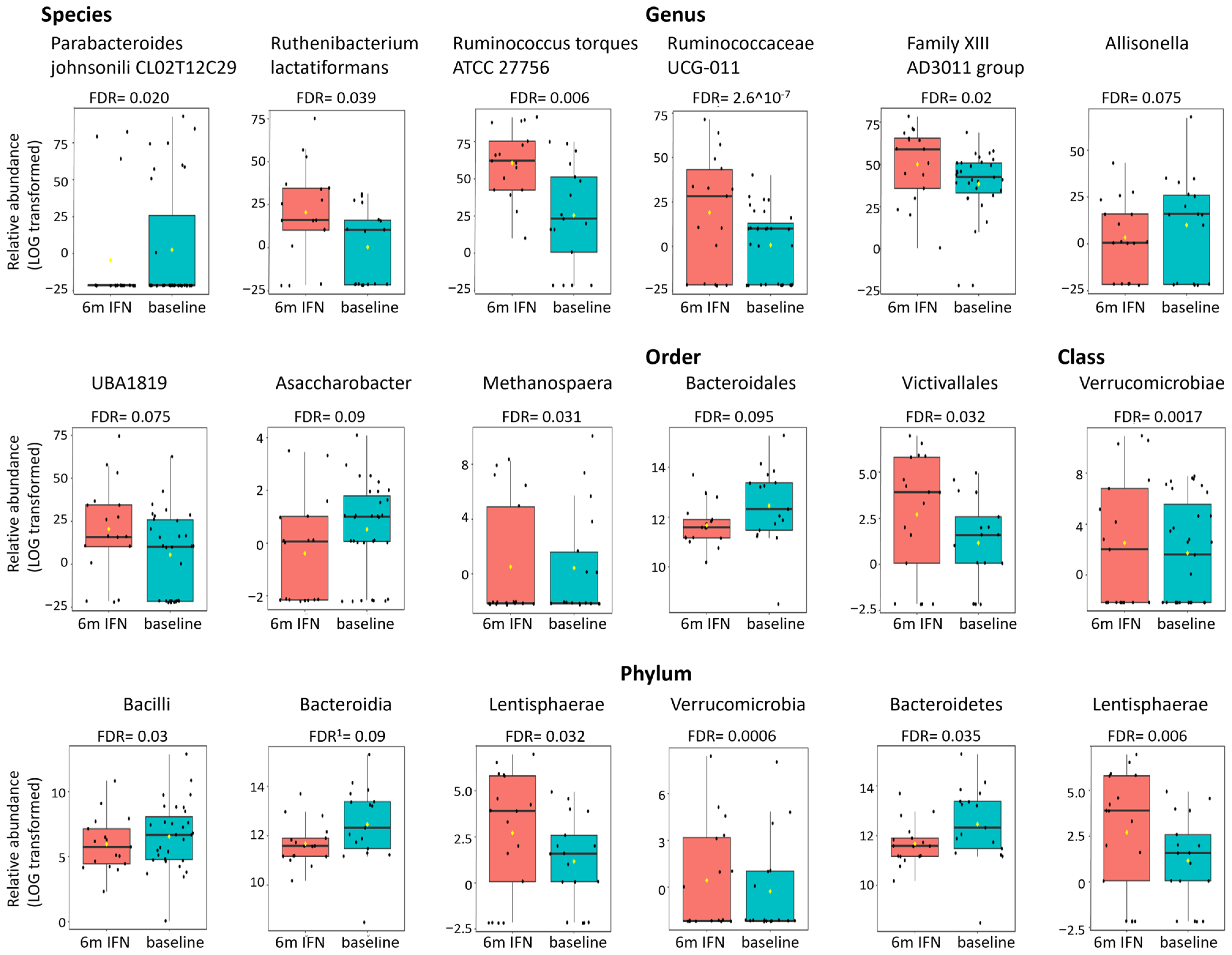
2.2.1. INFβ-1a Cohort
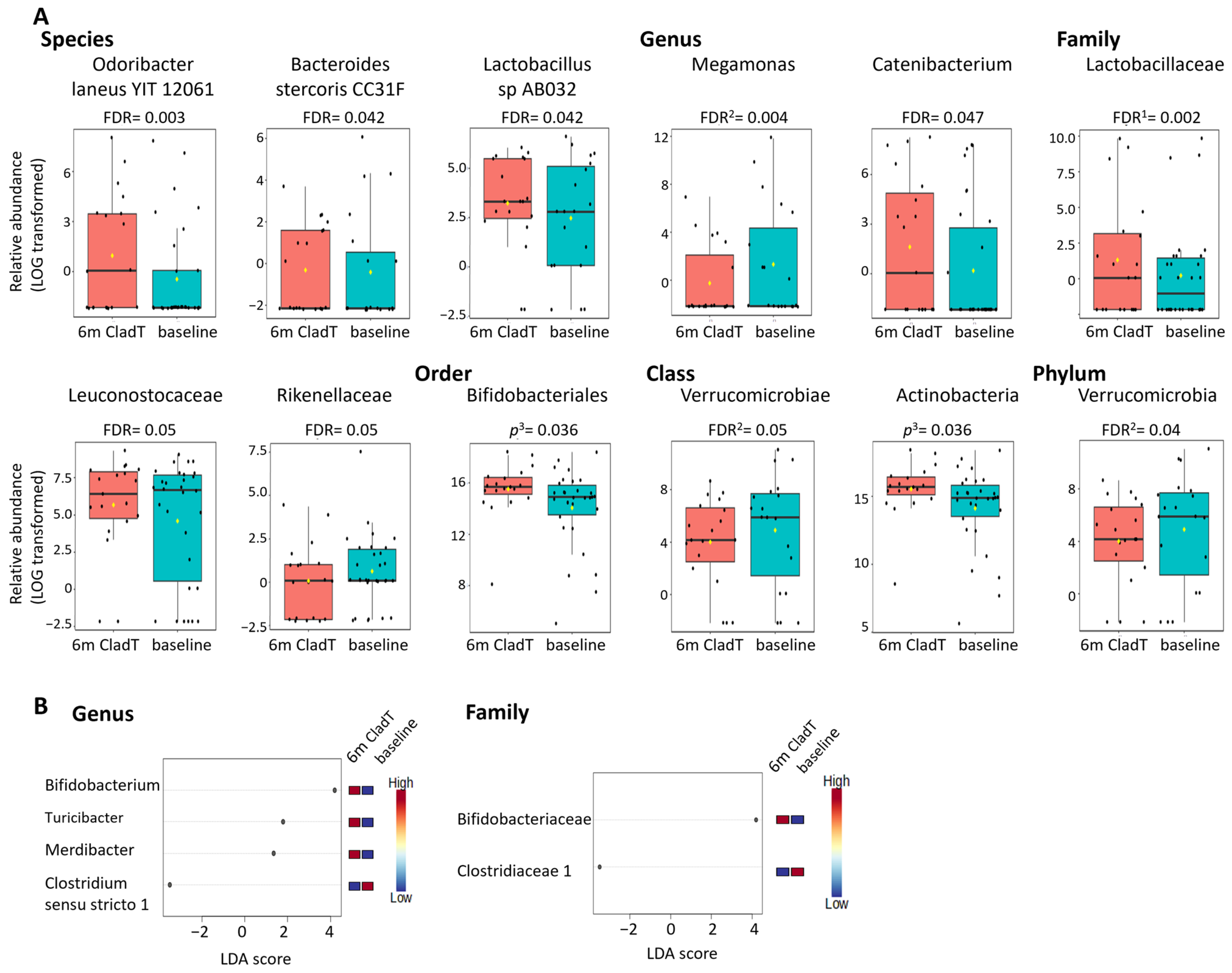
2.2.2. CladT Cohort
2.3. Associations Between Microbiota Profile and Clinical Response
2.3.1. Associations in the INFβ-1a Cohort
2.3.2. Associations in the CladT Cohort
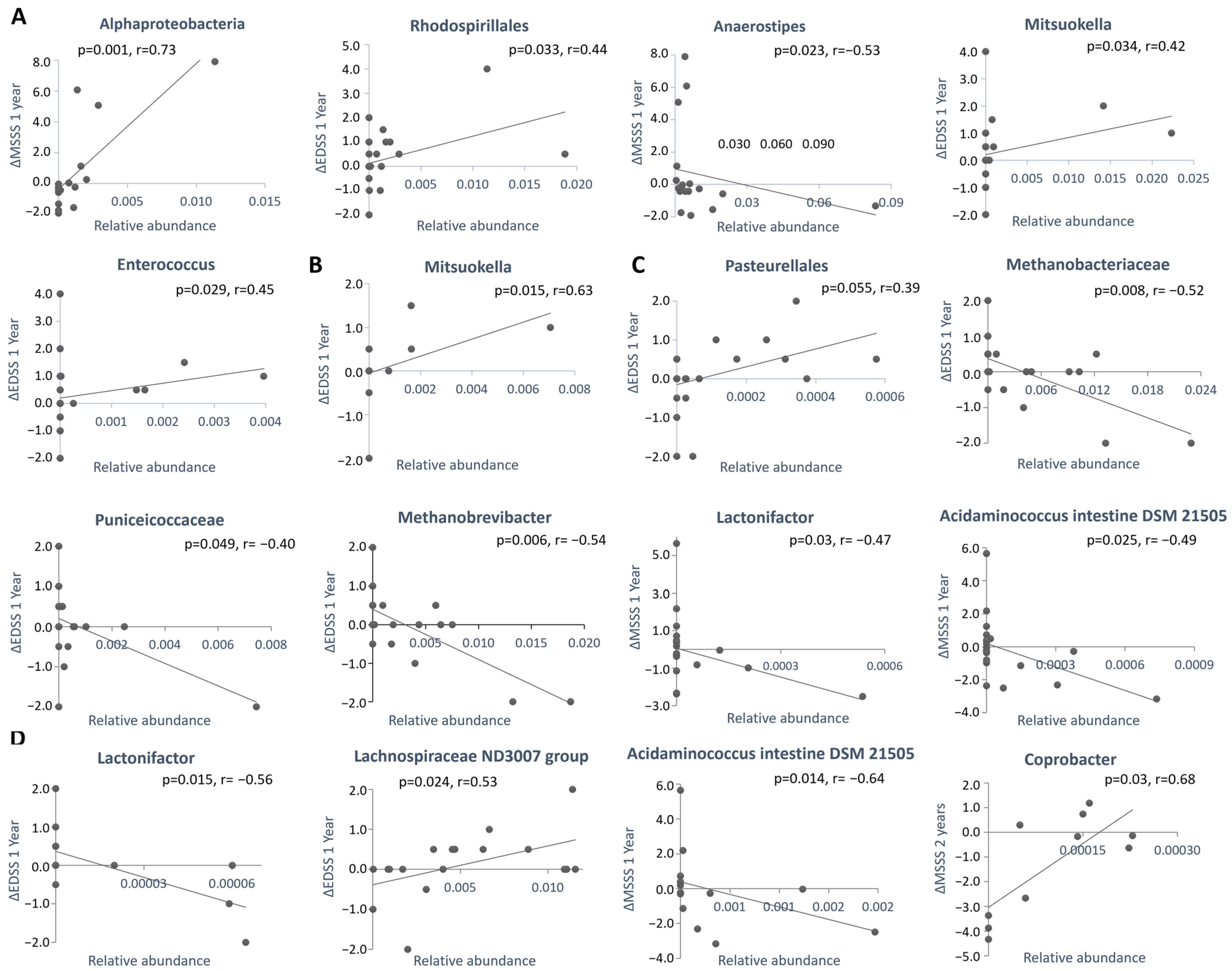
2.3.3. Correlation Between Microbe Abundance and Change (Δ) in EDSS or MSSS Scores
2.4. Associations Between Microbiota Profile and Intolerable Adverse Events in INFβ-1a-Treated Patients
2.5. Functional Metabolic Pathway Analysis
2.6. Association Between Clinical Response and Adherence to a Mediterranean Diet or Specific Nutrient Intake
3. Discussion
4. Material and Methods
4.1. Recruitment and Sample Collection
4.2. Clinical Response Definition
4.3. Microbial DNA Extraction
4.4. Statistical Analysis
4.5. Functional Analysis
Supplementary Materials
Author Contributions
Funding
Institutional Review Board Statement
Informed Consent Statement
Data Availability Statement
Acknowledgments
Conflicts of Interest
References
- Freedman, S.N.; Shahi, S.K.; Mangalam, A.K. The “Gut Feeling”: Breaking Down the Role of Gut Microbiome in Multiple Sclerosis. Neurotherapeutics 2018, 15, 109–125. [Google Scholar] [CrossRef] [PubMed]
- Valdes, A.; Walter, J.; Segal, E.; Spector, T.D. Role of the gut microbiota in nutrition and health. BMJ 2018, 361, k2179. [Google Scholar] [CrossRef] [PubMed]
- Krishnan, S.; Alden, N.; Lee, K. Pathways and Functions of Gut Microbiota Metabolism Impacting Host Physiology. Curr. Opin. Biotechnol. 2015, 36, 137–145. [Google Scholar] [CrossRef] [PubMed]
- Rinninella, E.; Raoul, P.; Cintoni, M.; Franceschi, F.; Abele, G.; Miggiano, D.; Gasbarrini, A.; Mele, M.C. What is the healthy gut microbiota composition ? A changing ecosystem across age, environment, diet, and diseases. Microorganisms 2019, 10, 14. [Google Scholar] [CrossRef]
- Elsayed, N.S.; Aston, P.; Bayanagari, V.R.; Shukla, S.K. The gut microbiome molecular mimicry piece in the multiple sclerosis puzzle. Front. Immunol. 2022, 13, 972160. [Google Scholar] [CrossRef]
- Del Negro, I.; Pez, S.; Varsace, S.; Marziali, A.; Gigli, G.; Tereshko, Y.; Valente, M. Impact of Disease-Modifying Therapies on Gut—Brain Axis in Multiple Sclerosis. Medicina 2024, 60, 6. [Google Scholar] [CrossRef]
- Loh, J.S.; Mak, W.Q.; Kar, L.; Tan, S.; Ng, C.X.; Chan, H.H.; Yeow, S.H.; Foo, J.B.; Ong, Y.S. Microbiota-Gut-Brain axis and its therapeutic applications in neurodegenerative diseases. Signal Transduct. Target. Ther. 2024, 9, 29–39. [Google Scholar] [CrossRef]
- Parodi, B.; De Rosbo, N.K. The Gut-Brain Axis in Multiple Sclerosis. Is Its Dysfunction a Pathological Trigger or a Consequence of the Disease? Front. Immunol. 2021, 12, 718220. [Google Scholar] [CrossRef]
- Jangi, S.; Gandhi, R.; Cox, L.M.; Li, N.; von Glehn, F.; Yan, R.; Patel, B.; Mazzola, M.A.; Liu, S.; Glanz, B.L.; et al. Alterations of the human gut microbiome in multiple sclerosis. Nat. Commun. 2016, 7, 12015. [Google Scholar] [CrossRef]
- Ventura, R.E.; Iizumi, T.; Battaglia, T.; Liu, M.; Perez-Perez, G.I.; Herbert, J.; Blaser, M.J. Gut microbiome of treatment-naïve MS patients of different ethnicities early in disease course. Sci. Rep. 2019, 9, 16396. [Google Scholar] [CrossRef]
- Chen, J.; Chia, N.; Kalari, K.R.; Yao, J.Z.; Novotna, M.; Soldan, M.M.P.; Luckey, D.H.; Marietta, E.V.; Jeraldo, P.R.; Chen, X.; et al. Multiple sclerosis patients have a distinct gut microbiota compared to healthy controls. Sci. Rep. 2016, 6, 28484. [Google Scholar] [CrossRef]
- Correale, J.; Hohlfeld, R.; Baranzini, S.E. The role of the gut microbiota in multiple sclerosis. Nat. Rev. Neurol. 2022, 18, 544–558. [Google Scholar] [CrossRef]
- Galluzzo, P.; Capri, F.C.; Vecchioni, L.; Realmuto, S.; Scalisi, L.; Cottone, S.; Nuzzo, D.; Alduina, R. Comparison of the intestinal microbiome of italian patients with multiple sclerosis and their household relatives. Life 2021, 11, 620. [Google Scholar] [CrossRef]
- Mielcarz, D.W.; Kasper, L.H. The Gut Microbiome in Multiple Sclerosis. Curr. Treat. Options Neurol. 2015, 17, 344. [Google Scholar] [CrossRef] [PubMed]
- Mirza, A.; Forbes, J.D.; Zhu, F.; Bernstein, C.N.; Van Domselaar, G.; Graham, M.; Waubant, E.; Tremlett, H. The multiple sclerosis gut microbiota: A systematic review. Mult. Scler. Relat. Disord. 2020, 37, 101427. [Google Scholar] [CrossRef]
- Noto, D.; Miyake, S. Gut dysbiosis and multiple sclerosis. Clin. Immunol. 2022, 235, 108380. [Google Scholar] [CrossRef] [PubMed]
- Ordoñez-Rodriguez, A.; Roman, P.; Rueda-Ruzafa, L.; Campos-Rios, A.; Cardona, D. Changes in gut microbiota and Multiple Sclerosis: A systematic review. Int. J. Environ. Res. Public Health 2023, 20, 4624. [Google Scholar] [CrossRef] [PubMed]
- Nitzan, Z.; Staun-Ram, E.; Volkowich, A.; Miller, A. Multiple Sclerosis-Associated Gut Microbiome in the Israeli Diverse Populations: Associations with Ethnicity, Gender, Disability Status, Vitamin D Levels, and Mediterranean Diet. Int. J. Mol. Sci. 2023, 24, 15024. [Google Scholar] [CrossRef]
- Montgomery, T.L.; Wang, Q.; Mirza, A.; Dwyer, D.; Wu, Q.; Dowling, C.A.; Martens, J.W.S.; Yang, J.; Krementsov, D.N. Identification of commensal gut microbiota signatures as predictors of clinical severity and disease progression in multiple sclerosis. Sci. Rep. 2024, 14, 15292. [Google Scholar] [CrossRef]
- Schwerdtfeger, L.A.; Montini, F.; Lanser, T.B.; Chitnis, T.; Cox, L.M.; Weiner, H.L.; Schwerdtfeger, L.A.; Montini, F.; Lanser, T.B.; Ekwudo, M.N.; et al. Gut microbiota and metabolites are linked to disease progression in multiple sclerosis. Cell Rep. Med. 2025, 6, 102055. [Google Scholar] [CrossRef]
- Tremlett, H.; Fadrosh, D.W.; Faruqi, A.A.; Hart, J.; Roalstad, S.; Graves, J.; Lynch, S.; Waubant, E.; Aaen, G.; Belman, A.; et al. Gut microbiota composition and relapse risk in pediatric MS: A pilot study. J. Neurol. Sci. 2016, 363, 153–157. [Google Scholar] [CrossRef] [PubMed]
- Horton, M.K.; Mccauley, K.; Fadrosh, D.; Fujimura, K.; Graves, J.; Ness, J.; Wheeler, Y.; Gorman, M.P.; Benson, L.A.; Weinstock-guttman, B.; et al. Gut microbiome is associated with multiple sclerosis activity in children. Ann. Clin. Transl. Neurol. 2021, 8, 1867–1883. [Google Scholar] [CrossRef]
- Steiner, H.E.; Patterson, H.K.; Giles, J.B. Bringing pharmacomicrobiomics to the clinic through well-designed studies. Clin. Transl. Sci. 2022, 15, 2303–2315. [Google Scholar] [CrossRef]
- Vacaras, V.; Muresanu, D.F.; Buzoianu, A.; Nistor, C.; Vesa, C.; Paraschiv, A.; Botos-vacaras, D.; Vacaras, C.; Vithoulkas, G. The role of multiple sclerosis therapies on the dynamic of human gut microbiota. J. Neuroimmunol. 2023, 378, 578087. [Google Scholar] [CrossRef]
- Tsai, C.; Jette, S.; Tremlett, H. Disease-modifying therapies used to treat multiple sclerosis and the gut microbiome: A systematic review. J. Neurol. 2023, 271, 1108–1123. [Google Scholar] [CrossRef]
- Cantarel, B.L.; Waubant, E.; Chehoud, C.; Kuczynski, J.; DeSantis, T.Z.; Warrington, J.; Venkatesan, A.; Fraser, C.M.; Mowry, E.M. Gut microbiota in multiple sclerosis: Possible influence of immunomodulators. J. Investig. Med. 2015, 63, 729–734. [Google Scholar] [CrossRef]
- Katz Sand, I.; Zhu, Y.; Ntranos, A.; Clemente, J.C.; Cekanaviciute, E.; Brandstadter, R.; Crabtree-Hartman, E.; Singh, S.; Bencosme, Y.; Debelius, J.; et al. Disease-modifying therapies alter gut microbial composition in MS. Neurol. Neuroimmunol. Neuroinflamm. 2019, 6, e517. [Google Scholar] [CrossRef]
- Staun-ram, E.; Volkowich, A.; Miller, A. Immunotherapy-mediated modulation of the gut microbiota in multiple sclerosis and associations with diet and clinical response—The effect of dimethyl fumarate therapy. Ther. Adv. Neurol. Disord. 2025, 18, 17562864241306564. [Google Scholar] [CrossRef] [PubMed]
- Storm-Larsen, C.; Myhr, K.; Farbu, E.; Midgard, R.; Nyquist, K.; Broch, L.; Buness, A.; Holm, K.; Ueland, T.; Fallang, L.; et al. Gut microbiota composition during a 12-week intervention with delayed-release dimethyl fumarate in multiple sclerosis—A pilot trial. Mult. Scler. J. Exp. Transl. Clin. 2019, 5, 2055217319888767. [Google Scholar] [CrossRef]
- Diebold, M.; Meola, M.; Purushothaman, S.; Siewert, L.K. Gut microbiota composition as a candidate risk factor for dimethyl fumarate-induced lymphopenia in multiple sclerosis. Gut Microbes 2022, 14, 2147055. [Google Scholar] [CrossRef] [PubMed]
- Zhou, X.; Baumann, R.; Gao, X.; Mendoza, M.; Singh, S.; Katz Sand, I.; Xia, Z.; Cox, L.M.; Chitnis, T.; Yoon, H.; et al. Gut microbiome of multiple sclerosis patients and paired household healthy controls reveal associations with disease risk and course. Cell 2022, 185, 3467–3486.e16. [Google Scholar] [CrossRef]
- Ferri, C.; Castellazzi, M.; Merli, N.; Laudisi, M.; Baldin, E.; Baldi, E.; Mancabelli, L.; Ventura, M.; Pugliatti, M. Gut Microbiota Changes during Dimethyl Fumarate Treatment in Patients with Multiple Sclerosis. Int. J. Mol. Sci. 2023, 24, 2720. [Google Scholar] [CrossRef]
- Selmaj, K.; Cree, B.A.C.; Barnett, M.; Thompson, A.; Peter, H. Multiple sclerosis: Time for early treatment with high—Efficacy drugs. J. Neurol. 2024, 271, 105–115. [Google Scholar] [CrossRef]
- Edan, G.; Le, E. Escalation Versus Induction/High—Efficacy Treatment Strategies for Relapsing Multiple Sclerosis: Which is Best for Patients? Drugs 2023, 83, 1351–1363. [Google Scholar] [CrossRef] [PubMed]
- Giles, E.M.; Stagg, A.J. Type 1 Interferon in the Human Intestine—A Co-ordinator of the Immune Response to the Microbiota. Inflamm. Bowel Dis. 2017, 23, 524–533. [Google Scholar] [CrossRef] [PubMed]
- Kozhieva, M.; Naumova, N.; Alikina, T.; Boyko, A.; Vlassov, V.; Kabilov, M.R. The Core of Gut Life: Firmicutes Profile in Patients with Relapsing-Remitting Multiple Sclerosis. Life 2021, 11, 55. [Google Scholar] [CrossRef]
- Castillo-Álvarez, F.; Pérez-Matute, P.; Oteo, J.A.A.; Marzo-Sola, M.E.E. The influence of interferon β-1b on gut microbiota composition in patients with multiple sclerosis. Neurología 2021, 36, 495–503. [Google Scholar] [CrossRef]
- Paraschiv, A.; Vacaras, V.; Nistor, C.; Vacaras, C.; Strilciuc, S. The effect of multiple sclerosis therapy on gut microbiota dysbiosis: A longitudinal prospective study. Microb. Cell 2024, 11, 106–115. [Google Scholar] [CrossRef]
- van Pamelen, J.; Rodriguez-Mogeda, C.; van Olst, L.; van der Pol, S.M.A.; Boon, M.L.; De Beukelaar, J.; Gerlach, O.H.H.; Budding, A.E.; Killestein, J.; De Vries, H.E.; et al. The gut-brain-axis one year after treatment with cladribine tablets in patients with relapsing remitting multiple sclerosis: A pilot study. Front. Immunol. 2025, 16, 1514762. [Google Scholar] [CrossRef] [PubMed]
- Wemheuer, F.; Taylor, J.A.; Daniel, R.; Johnston, E.; Meinicke, P.; Thomas, T.; Wemheuer, B. Tax4Fun2: Prediction of habitat-specific functional profiles and functional redundancy based on 16S rRNA gene sequences. Environ. Microbiomes 2020, 7, 11. [Google Scholar] [CrossRef]
- Chong, J.; Liu, P.; Zhou, G.; Xia, J. Using MicrobiomeAnalyst for comprehensive statistical, functional, and meta-analysis of microbiome data. Nat. Protoc. 2020, 15, 799–821. [Google Scholar] [CrossRef]
- Berer, K.; Mues, M.; Koutrolos, M.; AlRasbi, Z.; Boziki, M.; Johner, C.; Wekerle, H.; Krishnamoorthy, G.; Rasbi, Z.A.; Boziki, M.; et al. Commensal microbiota and myelin autoantigen cooperate to trigger autoimmune demyelination—With comments. Nature 2011, 479, 538–541. [Google Scholar] [CrossRef]
- Berer, K.; Gerdes, L.A.; Cekanaviciute, E.; Jia, X.; Xiao, L.; Xia, Z.; Liu, C.; Klotz, L.; Stauffer, U.; Baranzini, S.E.; et al. Gut microbiota from multiple sclerosis patients enables spontaneous autoimmune encephalomyelitis in mice. Proc. Natl. Acad. Sci. USA 2017, 114, 10719–10724. [Google Scholar] [CrossRef]
- Cekanaviciute, E.; Yoo, B.B.; Runia, T.F.; Debelius, J.W.; Singh, S.; Nelson, C.A.; Kanner, R.; Bencosme, Y.; Lee, Y.K.; Hauser, S.L.; et al. Gut bacteria from multiple sclerosis patients modulate human T cells and exacerbate symptoms in mouse models. Proc. Natl. Acad. Sci. USA 2017, 114, 10713–10718, Erratum in Proc. Natl. Acad. Sci. USA 2018, 115, E1123. [Google Scholar] [CrossRef]
- Laeeq, T.; Vongsavath, T.; Tun, K.M. The Potential Role of Fecal Microbiota Transplant in the Reversal or Stabilization of Multiple Sclerosis Symptoms: A Literature Review on Efficacy and Safety. Microorganisms 2023, 11, 2840. [Google Scholar] [CrossRef]
- Jiang, J.; Chu, C.; Wu, C.; Wang, C.; Zhang, C.; Li, T.; Zhai, Q.; Yu, L.; Tian, F.; Chen, W. Efficacy of probiotics in multiple sclerosis: A systematic review of preclinical trials and meta-analysis of randomized controlled trials. Food Funct. 2021, 12, 2354–2377. [Google Scholar] [CrossRef] [PubMed]
- Asghari, K.M.; Dolatkhah, N.; Ayromlou, H.; Mirnasiri, F.; Dadfar, T.; Hashemian, M. The effect of probiotic supplementation on the clinical and para-clinical findings of multiple sclerosis: A randomized clinical trial. Sci. Rep. 2023, 13, 18577. [Google Scholar] [CrossRef] [PubMed]
- Wilkinson, E.M.; Ilhan, Z.E.; Herbst-Kralovetz, M.M. Microbiota–drug interactions: Impact on metabolism and efficacy of therapeutics. Maturitas 2018, 112, 53–63. [Google Scholar] [CrossRef] [PubMed]
- Ganamurali, N.; Sabarathinam, S. Microbial modulation of digoxin bioavailability: A pharmacomicrobiome perspective on Eggerthella lenta’s role in steroid-like drug metabolism and precision therapeutics. J. Steroid Biochem. Mol. Biol. 2025, 252, 106792. [Google Scholar] [CrossRef]
- Haiser, H.J.; Gootenberg, D.B.; Chatman, K.; Sirasani, G.; Balskus, E.P.; Turnbaugh, P.J. Predicting and manipulating cardiac drug inactivation by the human gut bacterium Eggerthella lenta. Science 2013, 341, 295–298. [Google Scholar] [CrossRef]
- Troci, A.; Zimmermann, O.; Esser, D.; Krampitz, P.; May, S.; Franke, A.; Berg, D.; Leypoldt, F.; Stürner, K.H.; Bang, C. B-cell-depletion reverses dysbiosis of the microbiome in multiple sclerosis patients. Sci. Rep. 2022, 12, 3728. [Google Scholar] [CrossRef]
- Cox, L.M.; Maghzi, A.H.; Liu, S.; Tankou, S.K.; Dhang, F.H.; Willocq, V.; Song, A.; Wasén, C.; Tauhid, S.; Chu, R.; et al. Gut Microbiome in Progressive Multiple Sclerosis. Ann. Neurol. 2021, 89, 1195–1211. [Google Scholar] [CrossRef] [PubMed]
- Tremlett, H.; Zhu, F.; Arnold, D.; Bar-Or, A.; Bernstein, C.N.; Bonner, C.; Forbes, J.D.; Graham, M.; Hart, J.; Knox, N.C.; et al. The gut microbiota in pediatric multiple sclerosis and demyelinating syndromes. Ann. Clin. Transl. Neurol. 2021, 8, 2252–2269. [Google Scholar] [CrossRef] [PubMed]
- Bui, T.N.Y.; Paul, A.; Guleria, S.; Sullivan, J.M.O.; Toldi, G. Short-chain fatty acids—A key link between the gut microbiome and T-lymphocytes in neonates? Pediatr. Res. 2025, 1–9. [Google Scholar] [CrossRef] [PubMed]
- Kujawa, D.; Laczmanski, L.; Budrewicz, S.; Pokryszko-, A.; Podbielska, M. Targeting gut microbiota: New therapeutic opportunities in multiple sclerosis. Gut Microbes 2023, 15, 2274126. [Google Scholar] [CrossRef]
- Sanchez, J.M.S.; DePaula-Silva, A.B.; Libbey, J.E.; Fujinami, R.S. Role of diet in regulating the gut microbiota and multiple sclerosis. Clin. Immunol. 2022, 235, 108379. [Google Scholar] [CrossRef]
- Haghikia, A.; Jörg, S.; Duscha, A.; Berg, J.; Manzel, A.; Waschbisch, A.; Hammer, A.; Lee, D.-H.; May, C.; Wilck, N.; et al. Dietary fatty acids directly impact Central Nervous System autoimmunity via the small intestine. Immunity 2015, 43, 817–829. [Google Scholar] [CrossRef]
- Golpour, F.; Abbasi-alaei, M.; Babaei, F.; Mirzababaei, M.; Parvardeh, S.; Mohammadi, G.; Nassiri-asl, M. Biomedicine & Pharmacotherapy Short chain fatty acids, a possible treatment option for autoimmune diseases. Biomed. Pharmacother. 2023, 163, 114763. [Google Scholar] [CrossRef]
- Freedman, M.S.; Coyle, P.K.; Hellwig, K.; Singer, B.; Wynn, D.; Andrew, S.M.; Fernando, G.; Korich, J.; Reder, A.T. Twenty Years of Subcutaneous Interferon-Beta-1a for Multiple Sclerosis: Contemporary Perspectives. Neurol. Ther. 2024, 13, 283–322. [Google Scholar] [CrossRef]
- Wirusanti, N.I.; Baldridge, M.T.; Harris, V.C. Microbiota regulation of viral infections through interferon signaling. Trends Microbiol. 2022, 30, 778–792. [Google Scholar] [CrossRef]
- Baecher-Allan, C.; Kaskow, B.J.; Weiner, H.L. Multiple Sclerosis: Mechanisms and Immunotherapy. Neuron 2018, 97, 742–768. [Google Scholar] [CrossRef]
- Nakahashi-oda, C.; Gamage, K.; Udayanga, S.; Nakamura, Y.; Nakazawa, Y.; Totsuka, N.; Miki, H.; Iino, S.; Tahara-hanaoka, S.; Honda, S.; et al. Apoptotic epithelial cells control the abundance of T reg cells at barrier surfaces. Nat. Immunol. 2016, 17, 441–450. [Google Scholar] [CrossRef]
- Kraus, J.; Ling, A.K.; Hamm, S.; Voigt, K.; Oschmann, P.; Engelhardt, B. Interferon-beta stabilizes barrier characteristics of brain endothelial cells in vitro. Ann. Neurol. 2004, 56, 192–205. [Google Scholar] [CrossRef]
- Boziki, M.K.; Kesidou, E.; Theotokis, P.; Mentis, A.A.; Karafoulidou, E.; Melnikov, M. brain sciences Microbiome in Multiple Sclerosis: Where Are We, What We Know and Do Not Know. Brain Sci. 2020, 10, 234. [Google Scholar] [CrossRef] [PubMed]
- Staun-Ram, E.; Miller, A. Cathepsins (S and B) and their inhibitor Cystatin C in immune cells: Modulation by interferon-beta and role played in cell migration. J. Neuroimmunol. 2010, 232, 200–206. [Google Scholar] [CrossRef] [PubMed]
- Barcutean, L.; Balasa, R. Short and Medium Chain Fatty Acids in a Cohort of Naïve Multiple Sclerosis Patients: Pre- and Post- Interferon Beta Treatment Assessment. Biol. Targets Ther. 2024, 18, 349–361. [Google Scholar] [CrossRef] [PubMed]
- Hidalgo-cantabrana, C.; Delgado, S.; Ruiz, L.; Ruas-madiedo, P.; Sánchez, B.; Margolles, A. Bifidobacteria and Their Health-Promoting Effects. Microbiol. Spectr. 2017, 5, 10.1128. [Google Scholar] [CrossRef]
- Gutierrez, A.; Pucket, B.; Engevik, M.A. Bifidobacterium and the intestinal mucus layer. Microbiome Res. Rep. 2023, 2, 36. [Google Scholar] [CrossRef]
- Ghimire, S.; Lehman, P.C.; Aguilar, L.S.; Shahi, S.K.; Hoang, J. Specific microbial ratio in the gut microbiome is associated with multiple sclerosis. Proc. Natl. Acad. Sci. USA 2025, 122, e2413953122. [Google Scholar] [CrossRef]
- Rolfes, L.; Pfeuffer, S.; Huntemann, N.; Schmidt, M.; Su, C.; Skuljec, J.; Aslan, D.; Hackert, J.; Kleinschnitz, K.; Hagenacker, T.; et al. Immunological consequences of cladribine treatment in multiple sclerosis: A real-world study. Mult. Scler. Relat. Disord. 2022, 64, 103931. [Google Scholar] [CrossRef]
- Wiendl, H.; Schmierer, K.; Hodgkinson, S.; Derfuss, T.; Chan, A.; Sellebjerg, F.; Achiron, A.; Montalban, X.; Prat, A.; De Stefano, N.; et al. Specific Patterns of Immune Cell Dynamics May Explain the Early Onset and Prolonged Efficacy of Cladribine Tablets: A MAGNIFY-MS Substudy. Neurol. Neuroimmunol. Neuroinflamm. 2023, 10, e200048. [Google Scholar] [CrossRef]
- Kleinschnitz, C.; Skripuletz, T.; Pfeuffer, S.; Pawlitzki, M.; Rieckmann, P.; Penner, I.-K.; Knaup, J.; Wagner, T.; Hübschen, M.; Hellwig, K.; et al. Is therapy-free remission a realistic goal with cladribine tablets in multiple sclerosis? New insights into the mechanism of action and clinical implications of immune reconstitution with cladribine tablets in MS therapy. J. Neurol. 2025, 272, 788. [Google Scholar] [CrossRef]
- Wiendl, H.; Barkhof, F.; Montalban, X.; Achiron, A.; Derfuss, T.; Chan, A. Blood biomarker dynamics in people with relapsing multiple sclerosis treated with cladribine tablets: Results of the 2-year MAGNIFY-MS study. Front. Immunol. 2025, 16, 1512189. [Google Scholar] [CrossRef]
- Ford, R.K.; Juillard, P.; Hawke, S.; Grau, G.E.; Marsh-wakefield, F. Cladribine Reduces Trans-Endothelial Migration of Memory T Cells across an In Vitro Blood—Brain Barrier. J. Clin. Med. 2022, 11, 6006. [Google Scholar] [CrossRef]
- Bronzini, M.; Maglione, A.; Rosso, R.; Matta, M.; Masuzzo, F.; Rolla, S.; Clerico, M. Feeding the gut microbiome: Impact on multiple sclerosis. Front. Immunol. 2023, 14, 1176016. [Google Scholar] [CrossRef]
- Dziedzic, A.; Saluk, J. Probiotics and Commensal Gut Microbiota as the Effective Alternative Therapy for Multiple Sclerosis Patients Treatment. Int. J. Mol. Sci. 2022, 23, 14478. [Google Scholar] [CrossRef]
- Wrzosek, L.; Miquel, S.; Noordine, M.L.; Bouet, S.; Chevalier-Curt, M.J.; Robert, V.; Philippe, C.; Bridonneau, C.; Cherbuy, C.; Robbe-Masselot, C.; et al. Bacteroides thetaiotaomicron and Faecalibacterium prausnitzii influence the production of mucus glycans and the development of goblet cells in the colonic epithelium of a gnotobiotic model rodent. BMC Biol. 2013, 11, 61. [Google Scholar] [CrossRef] [PubMed]
- Miyake, S.; Kim, S.S.W.S.; Suda, W.; Oshima, K.; Nakamura, M.; Matsuoka, T.; Chihara, N.; Tomita, A.; Sato, W.; Kim, S.S.W.S.; et al. Dysbiosis in the gut microbiota of patients with multiple sclerosis, with a striking depletion of species belonging to clostridia XIVa and IV clusters. PLoS ONE 2015, 10, e0137429. [Google Scholar] [CrossRef] [PubMed]
- Zhu, Y.; Chen, B.; Zhang, X.; Akbar, M.T.; Wu, T.; Zhang, Y.; Zhi, L.; Shen, Q. Exploration of the Muribaculaceae Family in the Gut Microbiota: Diversity, Metabolism, and Function. Nutrients 2024, 16, 2660. [Google Scholar] [CrossRef] [PubMed]
- Ding, Y.H.; Qian, L.Y.; Pang, J.; Lin, J.Y.; Xu, Q.; Wang, L.H.; Huang, D.S.; Zou, H. The regulation of immune cells by Lactobacilli: A potential therapeutic target for anti-atherosclerosis therapy. Oncotarget 2017, 8, 59915–59928. [Google Scholar] [CrossRef]
- Rastogi, S.; Singh, A. Gut microbiome and human health: Exploring how the probiotic genus Lactobacillus modulate immune responses. Front. Pharmacol. 2022, 13, 1042189. [Google Scholar] [CrossRef] [PubMed]
- Kwon, H.-K.; Kim, G.-C.; Kim, Y.; Hwang, W.; Jash, A.; Sahoo, A.; Kim, J.-E.; Nam, J.H.; Im, S.-H. Amelioration of experimental autoimmune encephalomyelitis by probiotic mixture is mediated by a shift in T helper cell immune response. Clin. Immunol. 2013, 146, 217–227. [Google Scholar] [CrossRef]
- Zangeneh, Z.; Rostamin, M.; Motamedi, H.; Alvandi, A.; Abiri, R. The potential effectiveness of probiotics in reducing multiple sclerosis progression in preclinical and clinical studies: A worldwide systematic review and meta-analysis. PLoS ONE 2025, 20, e0319755. [Google Scholar] [CrossRef]
- Blais, L.L.; Montgomery, T.L.; Amiel, E.; Deming, P.B.; Krementsov, D.N. Probiotic and commensal gut microbial therapies in multiple sclerosis and its animal models: A comprehensive review. Gut Microbes 2021, 13, 1943289. [Google Scholar] [CrossRef]
- Tankou, S.K.; Regev, K.; Healy, B.C.; Tjon, E.; Laghi, L.; Cox, L.M.; Kivisäkk, P.; Pierre, I.V.; Hrishikesh, L.; Gandhi, R.; et al. A probiotic modulates the microbiome and immunity in multiple sclerosis. Ann. Neurol. 2018, 83, 1147–1161. [Google Scholar] [CrossRef]
- Golan, D.; Halhal, B.; Glass-Marmor, L.; Staun-Ram, E.; Rozenberg, O.; Lavi, I.; Dishon, S.; Barak, M.; Ish-Shalom, S.; Miller, A. Vitamin D supplementation for patients with multiple sclerosis treated with interferon-beta: A randomized controlled trial assessing the effect on flu-like symptoms and immunomodulatory properties. BMC Neurol. 2013, 13, 60. [Google Scholar] [CrossRef]
- Buttari, F.; Zagaglia, S.; Marciano, L.; Albanese, M.; Landi, D.; Nicoletti, C.G.; Mercuri, N.B.; Silvestrini, M.; Provinciali, L.; Marfia, G.A.; et al. TRPV1 polymorphisms and risk of interferon β-induced flu-like syndrome in patients with relapsing-remitting multiple sclerosis. J. Neuroimmunol. 2017, 305, 172–174. [Google Scholar] [CrossRef]
- Pereira, L.G.; Rodrigues, P.; Viero, F.T.; Frare, J.M.; Ramanzini, G.; Trevisan, G. Interferon-Beta Injection in Multiple Sclerosis Patients Related to the In- duction of Headache and Flu-Like Pain Symptoms: A Systematic Review and Meta-Analysis of Randomised Controlled Trials. Curr. Neuropharmacol. 2022, 20, 1600–1612. [Google Scholar] [CrossRef]
- Hadgkiss, E.J.; Jelinek, G.A.; Weiland, T.J.; Pereira, N.G.; Marck, C.H.; van der Meer, D.M. The association of diet with quality of life, disability, and relapse rate in an international sample of people with multiple sclerosis. Nutr. Neurosci. 2015, 18, 125–136. [Google Scholar] [CrossRef] [PubMed]
- Wolter, M.; Grant, E.T.; Boudaud, M.; Steimle, A.; Pereira, G.V.; Martens, E.C.; Desai, M.S. Leveraging diet to engineer the gut microbiome. Nat. Rev. Gastroenterol. Hepatol. 2021, 18, 885–902. [Google Scholar] [CrossRef] [PubMed]
- Džidić Krivić, A.; Begagić, E.; Hadžić, S.; Bećirović, A.; Bećirović, E.; Hibić, H.; Tandir Lihić, L.; Kadić Vukas, S.; Bečulić, H.; Kasapović, T.; et al. Unveiling the Important Role of Gut Microbiota and Diet in Multiple Sclerosis. Brain Sci. 2025, 15, 253. [Google Scholar] [CrossRef]
- Filipi, M.L.; Beavin, J.; Brillante, R.T.; Costello, K.; Hartley, G.C.; Hartley, K.; Namey, M.; Leary, S.O.; Remington, G. Nurses ’ Perspective on Approaches to Limit Flu-Like Symptoms During Interferon Therapy for Multiple Sclerosis. Int. J. MS Care 2014, 16, 55–60. [Google Scholar] [CrossRef] [PubMed]
- La Carpiae, F.; Wojczyk, B.S.; Annavajhalae, M.K.; Rebbaa, A.; Culp-HiII4, R.; D’AlessandroGt, A.; Freedberg, D.E.; Uhlemann, A.-C.; Hode, E.A. Transfusional iron overload and intravenous iron infusions modify the mouse gut microbiota similarly to dietary iron. Biofilms Microbiomes 2019, 5, 26. [Google Scholar] [CrossRef] [PubMed]
- Nemati, M.H.; Yazdanpanah, E.; Kazemi, R.; Orooji, N.; Dadfar, S.; Oksenych, V.; Haghmorad, D. Microbiota-Driven Mechanisms in Multiple Sclerosis: Pathogenesis, Therapeutic Strategies, and Biomarker Potential. Biology 2025, 14, 435. [Google Scholar] [CrossRef] [PubMed]
- Boussamet, L.; Rajoka, M.S.R.; Berthelot, L. Microbiota, IgA and Multiple Sclerosis. Microorganisms 2022, 10, 617. [Google Scholar] [CrossRef]
- Pröbstel, A.; Zhou, X.; Baumann, R.; Wischnewski, S.; Rojas, O.L.; Sellrie, K.; Bischof, A.; Kim, K.; Ramesh, A.; Dandekar, R.; et al. Gut microbiota-specific IgA+ B cells traffic to the CNS in active multiple sclerosis. Sci. Immunol. 2020, 5, eabc7191. [Google Scholar] [CrossRef]
- Rojas, O.L.; Pröbstel, A.-K.; Porfilio, E.A.; Wang, A.A.; Charabati, M.; Sun, T.; Lee, D.S.W.; Galicia, G.; Ramaglia, V.; Ward, L.A.; et al. Recirculating Intestinal IgA-Producing Cells Regulate Neuroinflammation via IL-10. Cell 2019, 177, 492–493. [Google Scholar] [CrossRef]
- Sterlin, D.; Larsen, M.; Fadlallah, J.; Parizot, C.; Vignes, M.; Autaa, G.; Dorgham, K.; Juste, C.; Lepage, P.; Aboab, J.; et al. Perturbed microbiota/immune homeostasis in multiple sclerosis. Neurol. Neuroimmunol. Neuroinflamm. 2021, 8, e997. [Google Scholar] [CrossRef]
- Takeuchi, T.; Ohno, H. IgA in human health and diseases: Potential regulator of commensal microbiota. Front. Immunol. 2022, 13, 1024330. [Google Scholar] [CrossRef]
- Lycett, M.J.; Lea, R.A.; Maltby, V.E.; Min, M.; Lechner-Scott, J. The effect of cladribine on immunoglobulin levels compared to B cell targeting therapies in multiple sclerosis. Mult. Scler. J. Exp. Transl. Clin. 2023, 9, 20552173221149688. [Google Scholar] [CrossRef]
- Thompson, A.J.; Banwell, B.L.; Barkhof, F.; Carroll, W.M.; Coetzee, T.; Comi, G.; Correale, J.; Fazekas, F.; Filippi, M.; Freedman, M.S.; et al. Diagnosis of multiple sclerosis: 2017 revisions of the McDonald criteria. Lancet Neurol. 2018, 17, 162–173. [Google Scholar] [CrossRef]
- Abu-Saad, K.; Endevelt, R.; Goldsmith, R.; Shimony, T.; Nitsan, L.; Shahar, D.R.; Keinan-Boker, L.; Ziv, A.; Kalter-Leibovici, O. Adaptation and predictive utility of a Mediterranean diet screener score. Clin. Nutr. 2019, 38, 2928–2935. [Google Scholar] [CrossRef] [PubMed]
- Schröder, H.; Fitó, M.; Estruch, R.; Martínez-González, M.A.; Corella, D.; Salas-Salvadó, J.; Lamuela-Raventós, R.; Ros, E.; Salaverría, I.; Fiol, M.; et al. A short screener is valid for assessing Mediterranean diet adherence among older Spanish men and women. J. Nutr. 2011, 141, 1140–1145. [Google Scholar] [CrossRef] [PubMed]
- Martínez-González, M.A.; García-Arellano, A.; Toledo, E.; Salas-Salvadó, J.; Buil-Cosiales, P.; Corella, D.; Covas, M.I.; Schröder, H.; Arós, F.; Gómez-Gracia, E.; et al. A 14-item mediterranean diet assessment tool and obesity indexes among high-risk subjects: The PREDIMED trial. PLoS ONE 2012, 7, e43134. [Google Scholar] [CrossRef]
- Shahar, D.; Shai, I.; Vardi, H.; Brener-Azrad, A.; Fraser, D. Development of a semi-quantitative Food Frequency Questionnaire (FFQ) to assess dietary intake of multiethnic populations. Eur. J. Epidemiol. 2003, 18, 855–861. [Google Scholar] [CrossRef]
- Shai, I.; Rosner, B.A.; Shahar, D.R.; Vardi, H.; Azrad, A.B.; Kanfi, A.; Schwarzfuchs, D.; Fraser, D. DEARR study Dietary evaluation and attenuation of relative risk: Multiple comparisons between blood and urinary biomarkers, food frequency, and 24-h recall questionnaires: The DEARR study. J. Nutr. 2005, 135, 573–579. [Google Scholar] [CrossRef] [PubMed]
- Shai, I.; Vardi, H.; Shahar, D.R.; Azrad, A.B.; Fraser, D. Adaptation of international nutrition databases and data-entry system tools to a specific population. Public Health Nutr. 2003, 6, 401–406. [Google Scholar] [CrossRef]
- Dhariwal, A.; Chong, J.; Habib, S.; King, I.L.; Agellon, L.B.; Xia, J. MicrobiomeAnalyst: A web-based tool for comprehensive statistical, visual and meta-analysis of microbiome data. Nucleic Acids Res. 2017, 45, W180–W188. [Google Scholar] [CrossRef]
- Lu, Y.; Zhou, G.; Ewald, J.; Xia, J. MicrobiomeAnalyst 2.0: Comprehensive statistical, functional and integrative analysis of microbiome data. Nucleic Acids Res. 2023, 51, W310–W318. [Google Scholar] [CrossRef]
- Nearing, J.T.; Douglas, G.M.; Hayes, M.G.; MacDonald, J.; Desai, D.K.; Allward, N.; Jones, C.M.A.; Wright, R.J.; Dhanani, A.S.; Comeau, A.M.; et al. Microbiome differential abundance methods produce different results across 38 datasets. Nat. Commun. 2022, 13, 342, Erratum in Nat. Commun. 2022, 13, 777. [Google Scholar] [CrossRef]



| Study Population | PwMS Pre-INFβ-1a N = 31 | PwMS 6 Months INFβ-1a | PwMS 1 year INFβ-1a n = 29 | PwMS Pre-CladT N = 30 | PwMS 6 Months CladT | PwMS 1 Year CladT n = 27 | PwMS 2 Years CladT n = 25 |
|---|---|---|---|---|---|---|---|
| Age (y) mean ± SE | 33.6 ± 1.7 | 36.8 ± 1.6 | |||||
| Female (%) | 87.1 | 76.7 | |||||
| Ethnicity n (%) Jewish Arab | 12 (39) 19 (61) | 17 (57) 13 (43) | |||||
| Smoking (%) | 16.1 | 43.3 | |||||
| BMI (kg/m2) | 25.1 | 23.1 | |||||
| Vegetarian n (%) | 1 (3.2) | 2 (6.7) | |||||
| MDS mean ± SE [median] p-value (vs. pre-treatment) | 6.5 ± 1.0 [6.0] | 6.5 ± 0.6 [7.0] * p = 0.5 | 7.6 ± 0.3 [7.0] | 7.3 ± 0.5 [6.0] * p = 0.3 | |||
| MDS n (%) Low (≤6) Intermediate (7–11) High ≥ 12 na | 16 (51.6) 11 (35.6) 2 (6.5) 2 (6.5) | 7 (41.2) 8 (47.1) 0 2 (11.8) | 6 (20.0) 23 (76.7) 0 1 (3.3) | 10 (53) 9 (47) 0 0 | |||
| Vitamin D (nmol/L) mean± SE [median] | 54.5 ± 8 [52.6] | 65.7 ± 7 [63.9] | |||||
| Disease duration (years) | 0.87 | 8.9 | |||||
| Previous DMT n (%) None (naïve) DMF Natalizumab Teriflunomide Fingolimod Interferon beta Siponimod DRF | 24 (77.4) 4 (12.9) 1 (3.2) 1 (3.2) 1 (3.2) | 4 (13.3) 11 (36.7) 5 (16.7) 3 (10) 2 (6.7) 3 (10) 2 (6.7) | |||||
| Time since previous DMT (months) mean ± SE [range] | 3.9 ± 1.3 [1.0–9.1] | 2.34 ± 0.1 [1.0–3.6] | |||||
| EDSS mean ± SE [median] p-value (vs. pre-treatment) | 2.02 ± 0.47 [2] | 1.56 ± 0.28 [1.0] | 1.79 ± 0.53 [1.0] * p = 0.4 | 4.55 ± 0.3 [5.0] | 4.32 ± 0.35 [5.0] | 4.25 ± 0.36 [4.5] * p = 0.5 | 3.72 ± 0.5 [4.0] * p = 0.4 |
| MSSS mean± SE p-value (vs. pre-treatment) | 3.5 ± 0.9 [2.44] | 3.6 ± 1.1 [2.01] * p = 0.5 | 5.6 ± 0.5 [5.82] | 5.3 ± 0.6 [5.68] * p = 0.4 | 3.9 ± 0.6 [4.14] * p = 0.041 | ||
| ARR prior to drug initiation mean ± SE | 0.47 ± 0.1 | 0.7 ± 0.1 | |||||
| Patients with NEDA n (%) | 14 (48.3) | 15 (50.0) | 7 (23.3) | ||||
| Patients with disease activity n (%) | 10 (34.5) | 12 (40.0) | 18 (60) | ||||
| Patients lost to follow-up n | 2 | 3 | 5 | ||||
| Patients who discontinued treatment n (%) | 5 (16) | 1 (3.3) | 6 (20) |
| (A) | (B) | ||||||
|---|---|---|---|---|---|---|---|
| Microbes | FDR | FC (6 m vs. Pre) | Highest in | Microbes | FDR | FC (6 m vs. Pre) | Highest in |
| Species | |||||||
| Unc. Clostridiales bacterium | 0.020 | 4.87 | 6 m IFN | Unc. Clostridiaceae bacterium | 2 0.016 | 6 m CladT | |
| Parabacteroides johnsonii CL02T12C29 | 0.020 | 0.22 | Baseline | Odoribacter laneus YIT 12061 | 2 0.003 | 6 m CladT | |
| Ruthenibacterium lactatiformans | 0.039 | 3.31 | 6 m IFN | Unc. Lactobacillaceae bacterium | 1 1.6 × 10⁻¹³ | 9 × 10⁶ | 6 m CladT |
| Ruminococcus torques ATCC 27756 | 0.006 | 6.23 | 6 m IFN | Bacteroides stercoris CC31F | 2 0.042 | 6 m CladT | |
| Unc. rumen bacterium | 0.003 | 5.31 | 6 m IFN | Lactobacillus sp. AB032 | 2 0.042 | 6 m CladT | |
| Unc. archaeon | 0.006 | 10.2 | 6 m IFN | ||||
| Genus | |||||||
| Ruminococcaceae UCG-011 | 2.6 × 10⁻⁷ | 7.42 | 6 m IFN | Enterobacter | 2 0.047 | Baseline | |
| Klebsiella | 4.4 × 10⁻⁶ | 9.15 | 6 m IFN | Clostridium sensu stricto 1 | 3 0.019 | LDA −3.5 | Baseline |
| Family XIII AD3011 group | 0.020 | 2.66 | 6 m IFN | Megamonas | 0.0041 | 0.04 | Baseline |
| Allisonella | 0.075 | 0.24 | Baseline | Bifidobacterium | 3 0.036 | LDA 4.2 | 6 m CladT |
| UBA1819 | 0.075 | 2.84 | 6 m IFN | Merdibacter | 3 0.015 | LDA 1.4 | 6 m CladT |
| Methanosphaera | 0.031 | 6.66 | 6 m IFN | Catenibacterium | 2 0.047 | 6 m CladT | |
| Asaccharobacter | 0.092 | 0.39 | Baseline | Turicibacter | 3 0.041 | LDA 1.8 | 6 m CladT |
| Family | |||||||
| Gut metagenome | 0.054 | 3.44 | 6 m IFN | Clostridiaceae 1 | 3 0.021 | LDA−3.5 | Baseline |
| Lactobacillaceae | 1 0.002 | 12.5 | 6 m CladT | ||||
| Bifidobacteriaceae | 3 0.036 | LDA 4.2 | 6 m CladT | ||||
| Leuconostocaceae | 2 0.05 | Baseline | |||||
| Rikenellaceae | 2 0.05 | Baseline | |||||
| Order | |||||||
| Bacteroidales | 0.095 | 0.54 | Baseline | Bifidobacteriales | 3 0.036 | LDA 4.2 | 6 m CladT |
| Victivallales | 0.032 | 3.99 | 6 m IFN | ||||
| Class | |||||||
| Bacteroidia | 3 0.049 | LDA −4.4 | Baseline | Actinobacteria | 3 0.036 | LDA 4.2 | 6 m CladT |
| Verrucomicrobiae | 0.002 | 7.07 | 6 m IFN | Verrucomicrobiae | 0.05 | 0.23 | Baseline |
| Bacilli | 0.030 | 0.19 | Baseline | ||||
| Lentisphaeria | 0.032 | 3.62 | 6 m IFN | ||||
| Phylum | |||||||
| Verrucomicrobia | 0.0006 | 6.85 | 6 m IFN | Verrucomicrobia | 0.04 | 0.25 | Baseline |
| Bacteroidetes | 0.035 | 0.46 | Baseline | ||||
| Lentisphaerae | 0.006 | 3.74 | 6 m IFN | ||||
| (A) | (B) | ||||||
|---|---|---|---|---|---|---|---|
| Microbes | FDR | FC | Highest in | Microbes | FDR | FC | Highest in |
| Species | |||||||
| Azospirillum sp. 47_25 | 0.005 | 0.1 | DA | ||||
| Bacteroides thetaiotaomicron | 0.033 | 10.9 | NEDA | ||||
| Unc. Lactobacillaceae bacterium | 0.078 | 0.19 | DA | ||||
| Genus | |||||||
| Mitsuokella | 1 × 10⁻⁵ | 0.01 | DA | Enterococcus | 0.024 | 0.09 | DA |
| Alloprevotella | 0.0002 | 175 | NEDA | Klebsiella | 0.067 | 0.08 | DA |
| Anaerostipes | 0.036 | 5.5 | NEDA | ||||
| Family | |||||||
| Enterococcaceae | 0.009 | 0.08 | DA | ||||
| Order | |||||||
| Gastranaerophilales | 0.0002 | 0.05 | DA | Aeromonadales | 2 × 10⁻⁸ | 0.003 | DA |
| Rhodospirillales | 0.026 | 0.11 | DA | ||||
| Class | |||||||
| Melainabacteria | 0.001 | 0.08 | DA | ||||
| Alphaproteobacteria | 0.029 | 0.13 | DA | ||||
| Phylum | |||||||
| Cyanobacteria | 3 × 10⁻⁵ | 0.05 | DA | ||||
| (A) | (B) | ||||||
|---|---|---|---|---|---|---|---|
| Microbes | FDR | FC | Highest in | Microbes | FDR | FC | Highest in |
| Species | |||||||
| Acidaminococcus intestine DSM 21505 | 0.033 | 8.74 | NEDA | Massiliprevotella massiliensis | 0.063 | 10.2 | NEDA |
| Bifidobacterium sp. MC 10 | 0.042 | 6.1 | NEDA | Lactobacillus sp. AB032 | 1 0.059 | 37.1 | NEDA |
| Unc. Ruminococcus sp. | 0.058 | 16.4 | NEDA | Bacteroides ovatus V975 | 0.005 | LDA−2.7 | DA |
| Azospirillum sp. 47_25 | 0.003 | 0.03 | DA | ||||
| Streptococcus salivarius subsp thermophilus | 0.085 | 13.1 | NEDA | ||||
| Bacteroides eggerthii DSM 20697 | 0.086 | 15.8 | NEDA | ||||
| Unc. archaeon | 0.059 | 17.6 | NEDA | ||||
| Genus | |||||||
| CAG-56 | 0.039 | 0.12 | DA | Azospirillum sp. 47_25 | 7 × 10⁻⁵ | 0.03 | DA |
| Methanobrevibacter | 1 0.016 | LDA 3.0 | NEDA | Methanobrevibacter | 0.002 | 87.9 | NEDA |
| Tyzzerella 3 | 0.052 | 7.0 | NEDA | Parasutterella | 0.021 | 0.15 | DA |
| Cloacibacillus | 0.067 | 5.0 | NEDA | Rikenellaceae RC9 gut group | 0.021 | 41.2 | NEDA |
| Coprobacter | 0.095 | 3.48 | NEDA | Desulfovibrio | 0.055 | 10.6 | NEDA |
| Akkermansia | 0.042 | 10.5 | NEDA | Prevotella 7 | 0.055 | 12.8 | NEDA |
| Prevotellaceae UCG 001 | 0.039 | 11.0 | NEDA | Eisenbergiella | 0.055 | 8.54 | NEDA |
| Phascolarctobacterium | 0.060 | 9.62 | NEDA | ||||
| Catenibacterium | 0.067 | 25.4 | NEDA | ||||
| Mogibacterium | 0.087 | 9.87 | NEDA | ||||
| Clostridium sensu stricto 1 | 1 0.014 | LDA 3.2 | NEDA | ||||
| Family | |||||||
| Methanobacteriaceae | 1 0.016 | LDA 3.1 | NEDA | Methanobacteriaceae | 0.001 | 60.6 | NEDA |
| Akkermansiaceae | 0.040 | 7.0 | NEDA | ||||
| Synergistaceae | 0.045 | 4.7 | NEDA | ||||
| VadinBE97 | 0.074 | 3.0 | NEDA | ||||
| Puniceicoccaceae | 1 0.034 | LDA 2.1 | NEDA | ||||
| Burkholderiaceae | 0.040 | 0.26 | DA | ||||
| Order | |||||||
| Methanobacteriales | 1 0.016 | LDA 3.1 | NEDA | Methanobacteriales | 0.002 | 50.4 | NEDA |
| Pasteurellales | 0.028 | 0.22 | DA | Synergistales | 0.035 | 11.2 | NEDA |
| Betaproteobacteriales | 0.028 | 0.26 | DA | Betaproteobacteriales | 1 0.028 | LDA−3.1 | DA |
| Opitutales | 1 0.034 | LDA 2.1 | NEDA | ||||
| Verrucomicrobiales | 0.076 | 5.35 | NEDA | ||||
| Class | |||||||
| Methanobacteria | 1 0.016 | LDA 3.1 | NEDA | Methanobacteria | 0.0014 | 49.8 | NEDA |
| Phylum | |||||||
| Euryarchaeota | 0.023 | 5.41 | NEDA | Euryarchaeota | 0.001 | 36.2 | NEDA |
| Verrucomicrobia | 0.0006 | 9.0 | NEDA | ||||
| (A) | (B) | ||||||
|---|---|---|---|---|---|---|---|
| Microbes | FDR | FC | Highest in | Microbes | FDR | FC | Highest in |
| Species | |||||||
| Drancourtella massiliensis | 0.0002 | 22.2 | NEDA | Ruthenibacterium lactatiformans | 0.0006 | 9.02 | NEDA |
| Bifidobacterium sp. MC 10 | 0.0011 | 8.54 | NEDA | Lactobacillus sp. AB032 | 5.9 × 10⁻⁶ | 81.3 | NEDA |
| Acidaminococcus intestine DSM 21505 | 0.0013 | 8.95 | NEDA | Acidaminococcus intestine DSM 21505 | 0.014 | 11.6 | NEDA |
| Streptococcus salivarius subsp. thermophilus | 0.0013 | 12.0 | NEDA | Unc. Methanobrevibacter sp | 1 0.034 | LDA 1.39 | NEDA |
| Unc. archaeon | 1.8 × 10⁻⁷ | 33.7 | NEDA | ||||
| Genus | |||||||
| CAG-352 | 0.001 | 47.9 | NEDA | Tyzzerella 4 | 3.6 × 10⁻⁶ | 147 | NEDA |
| Sellimonas | 0.0031 | 14.8 | NEDA | Methanosphaera | 8.3 × 10⁻⁶ | 23.8 | NEDA |
| Lactonifactor | 0.0054 | 5.14 | NEDA | Synergistes | 0.00001 | 40.4 | NEDA |
| Fournierella | 0.045 | 0.09 | DA | Eubacterium | 0.00008 | 14.1 | NEDA |
| Lachnospiraceae ND3007 group | 1 0.04 | LDA −3.3 | DA | Eisenbergiella | 0.0003 | 11.2 | NEDA |
| Coprobacillus | 0.0005 | 10.6 | NEDA | ||||
| Methanobrevibacter | 0.001 | 18.3 | NEDA | ||||
| Tyzzerella 3 | 0.019 | 0.03 | DA | ||||
| UBA1819 | 0.0097 | 6.8 | NEDA | ||||
| Libanicoccus | 0.0083 | 11.7 | NEDA | ||||
| Family | |||||||
| Synergistaceae | 0.0001 | 21.0 | NEDA | ||||
| Eubacteriaceae | 0.002 | 9.55 | NEDA | ||||
| Muribaculaceae | 0.0034 | 7.4 | NEDA | ||||
| Methanobacteriaceae | 0.0026 | 13.5 | NEDA | ||||
| Puniceicoccaceae | 0.027 | 4.61 | NEDA | ||||
| Order | |||||||
| Betaproteobacteriales | 1 0.025 | LDA −3.1 | DA | Synergistales | 0.0001 | 18.0 | NEDA |
| Opitutales | 1 0.024 | LDA 1.8 | NEDA | Opitutales | 1 0.026 | LDA 2.4 | NEDA |
| Methanobacteriales | 1 0.018 | LDA 2.1 | NEDA | Methanobacteriales | 0.0012 | 12.5 | NEDA |
| Class | |||||||
| Gammaproteobacteria | 0.047 | 0.18 | DA | Synergistia | 0.00005 | 20.9 | NEDA |
| Methanobacteria | 0.0004 | 13.5 | NEDA | ||||
| Mollicutes | 0.099 | 0.1 | DA | ||||
| Phylum | |||||||
| Euryarchaeota | 0.014 | 6.13 | NEDA | Euryarchaeota | 0.0002 | 15.9 | NEDA |
| Cyanobacteria | 1 0.018 | LDA 2.1 | NEDA | Synergistetes | 9.6 × 10⁻⁶ | 23.4 | NEDA |
| Proteobacteria | 0.014 | 0.18 | DA | Tenericutes | 0.088 | 0.13 | DA |
| (A) | ||||||||||||||||
| Baseline Samples | 6-Month Samples | |||||||||||||||
| Microbes | ΔEDSS 1Y | ΔMSSS 1Y | ΔEDSS 1Y | ΔMSSS 1Y | ||||||||||||
| p-Value | r | p-Value | r | p-Value | r | p-Value | r | |||||||||
| Alphaproteobacteria | 0.033 | 0.44 | 0.001 | 0.73 | ||||||||||||
| Anaerostipes | 0.061 | −0.39 | 0.023 | −0.53 | ||||||||||||
| Bacteroides thetaiotaomicron | 0.090 | −0.47 | ||||||||||||||
| Enterococcaceae | 0.029 | 0.45 | ||||||||||||||
| Enterococcus | 0.029 | 0.45 | ||||||||||||||
| Mitsuokella | 0.034 | 0.42 | 0.015 | 0.63 | ||||||||||||
| Rhodospirillales | 0.033 | 0.44 | 0.001 | 0.73 | 0.094 | 0.47 | 0.067 | 0.50 | ||||||||
| (B) | ||||||||||||||||
| Baseline Samples | 6-Month Samples | |||||||||||||||
| ΔEDSS 1Y | ΔMSSS 1Y | ΔEDSS 2Y | ΔMSSS 2Y | ΔEDSS 1Y | ΔMSSS 1Y | ΔEDSS 2Y | ΔMSSS 2Y | |||||||||
| Microbes | p-Value | r | p-Value | r | p-Value | r | p-Value | r | p-Value | r | p-Value | r | p-Value | r | p-Value | r |
| Euryarchaeota | 0.008 | −0.52 | 0.023 | −0.49 | 0.093 | −0.40 | ||||||||||
| Methanobacteria | 0.008 | −0.52 | 0.023 | −0.49 | 0.093 | −0.40 | ||||||||||
| Methanobacteriales | 0.008 | −0.52 | 0.023 | −0.49 | 0.093 | −0.40 | ||||||||||
| Methanobacteriaceae | 0.008 | −0.52 | 0.023 | −0.49 | 0.093 | −0.40 | ||||||||||
| Methanobrevibacter | 0.006 | −0.54 | 0.02 | −0.50 | 0.069 | −0.43 | ||||||||||
| Lactonifactor | 0.041 | −0.41 | 0.03 | −0.47 | 0.015 | −0.56 | 0.028 | −0.58 | ||||||||
| Pasteurellales | 0.055 | 0.39 | ||||||||||||||
| Verrucomicrobia | 0.036 | −0.42 | ||||||||||||||
| Opitutales | 0.049 | −0.40 | ||||||||||||||
| Puniceicoccaceae | 0.049 | −0.40 | ||||||||||||||
| Acidaminococcus intestini DSM 21505 | 0.025 | −0.49 | 0.02 | −0.54 | 0.014 | −0.64 | ||||||||||
| CAG-352 | 0.085 | −0.46 | ||||||||||||||
| Lachnospiraceae ND3007 group | 0.024 | 0.53 | 0.043 | 0.55 | ||||||||||||
| Tyzzerella 3 | 0.046 | 0.54 | ||||||||||||||
| Coprobacter | 0.022 | 0.60 | 0.030 | 0.68 | ||||||||||||
| (A) | (B) | ||||||||
|---|---|---|---|---|---|---|---|---|---|
| Pathway | Total | Expected | Hits | p Value | Pathway | Total | Expected | Hits | p Value |
| 1—Enriched pathways: 6 months post-therapy versus baseline | |||||||||
| Glycosaminoglycan degradation | 13 | 0.02 | 1 | 0.020 | Propanoate metabolism | 82 | 0.33 | 4 | 0.0002 |
| Drug metabolism—other enzymes | 20 | 0.03 | 1 | 0.031 | Galactose metabolism | 58 | 0.23 | 2 | 0.022 |
| * Sulfur metabolism | 79 | 0.52 | 3 | 0.014 | Other glycan degradation | 9 | 0.04 | 1 | 0.036 |
| * Biosynthesis of siderophore group nonribosomal peptides | 4 | 0.03 | 1 | 0.026 | |||||
| * Sesquiterpenoid and triterpenoid biosynthesis | 5 | 0.03 | 1 | 0.032 | |||||
| * Ubiquinone and other terpenoid-quinone biosynthesis | 46 | 0.3 | 2 | 0.035 | |||||
| * Citrate cycle (TCA cycle) | 54 | 0.35 | 2 | 0.047 | |||||
| * Valine, leucine and isoleucine degradation | 55 | 0.36 | 2 | 0.049 | |||||
| 2—Enriched pathways: NEDA versus DA (1 year) | |||||||||
| Fructose and mannose metabolism | 94 | 1.43 | 9 | 8 × 10⁻⁶ | Valine, leucine and isoleucine degradation | 55 | 0.58 | 5 | 0.0002 |
| Fatty acid degradation | 25 | 0.38 | 5 | 3 × 10⁻⁵ | Butanoate metabolism | 97 | 1.02 | 6 | 0.0004 |
| Butanoate metabolism | 97 | 1.48 | 8 | 8 × 10⁻⁵ | Fatty acid degradation | 25 | 0.26 | 3 | 0.002 |
| Valine, leucine and isoleucine degradation | 55 | 1.56 | 6 | 0.0002 | Phenylalanine, tyrosine and tryptophan biosynthesis | 59 | 0.62 | 3 | 0.023 |
| Lysine degradation | 46 | 0.7 | 5 | 0.0006 | Lipoic acid metabolism | 25 | 0.26 | 2 | 0.028 |
| Inositol phosphate metabolism | 32 | 0.49 | 4 | 0.001 | Methane metabolism | 173 | 1.83 | 5 | 0.033 |
| Benzoate degradation | 86 | 1.31 | 6 | 0.002 | beta-Alanine metabolism | 32 | 0.34 | 2 | 0.044 |
| Pinene, camphor and geraniol degradation | 7 | 0.11 | 2 | 0.005 | Propanoate metabolism | 82 | 0.87 | 3 | 0.054 |
| Ascorbate and aldarate metabolism | 46 | 0.7 | 4 | 0.005 | 3—Enriched pathways: NEDA versus DA (2 years) | ||||
| Galactose metabolism | 58 | 0.88 | 4 | 0.011 | Methane metabolism | 173 | 1.02 | 10 | 9 × 10⁻⁹ |
| beta-Alanine metabolism | 32 | 0.49 | 3 | 0.012 | Pantothenate and CoA biosynthesis | 38 | 0.22 | 2 | 0.020 |
| Aminobenzoate degradation | 33 | 0.50 | 3 | 0.013 | |||||
| Propanoate metabolism | 82 | 1.25 | 4 | 0.035 | |||||
Disclaimer/Publisher’s Note: The statements, opinions and data contained in all publications are solely those of the individual author(s) and contributor(s) and not of MDPI and/or the editor(s). MDPI and/or the editor(s) disclaim responsibility for any injury to people or property resulting from any ideas, methods, instructions or products referred to in the content. |
© 2026 by the authors. Licensee MDPI, Basel, Switzerland. This article is an open access article distributed under the terms and conditions of the Creative Commons Attribution (CC BY) license.
Share and Cite
Staun-Ram, E.; Volkowich, A.; Glass-Marmor, L.; Miller, A. Immunotherapy-Mediated Modulation of the Gut Microbiota in Multiple Sclerosis: The Effects of High-Efficacy (Cladribine) and Moderate-Efficacy (Interferon Beta-1a) Treatments. Int. J. Mol. Sci. 2026, 27, 3500. https://doi.org/10.3390/ijms27083500
Staun-Ram E, Volkowich A, Glass-Marmor L, Miller A. Immunotherapy-Mediated Modulation of the Gut Microbiota in Multiple Sclerosis: The Effects of High-Efficacy (Cladribine) and Moderate-Efficacy (Interferon Beta-1a) Treatments. International Journal of Molecular Sciences. 2026; 27(8):3500. https://doi.org/10.3390/ijms27083500
Chicago/Turabian StyleStaun-Ram, Elsebeth, Anat Volkowich, Lea Glass-Marmor, and Ariel Miller. 2026. "Immunotherapy-Mediated Modulation of the Gut Microbiota in Multiple Sclerosis: The Effects of High-Efficacy (Cladribine) and Moderate-Efficacy (Interferon Beta-1a) Treatments" International Journal of Molecular Sciences 27, no. 8: 3500. https://doi.org/10.3390/ijms27083500
APA StyleStaun-Ram, E., Volkowich, A., Glass-Marmor, L., & Miller, A. (2026). Immunotherapy-Mediated Modulation of the Gut Microbiota in Multiple Sclerosis: The Effects of High-Efficacy (Cladribine) and Moderate-Efficacy (Interferon Beta-1a) Treatments. International Journal of Molecular Sciences, 27(8), 3500. https://doi.org/10.3390/ijms27083500