Use of Artificial Intelligence in the Interpretation of Electroretinography (ERG) Studies


Abstract
1. Introduction
2. Materials and Methods
2.1. Protocol
2.2. Literature Search Strategy
2.3. Eligibility Criteria
- Primary research, including comparative, retrospective and clinical research.
- Publication in a peer-reviewed journal.
- Use of artificial intelligence (AI) in the evaluation of electroretinography studies.
- Comparison to ERG evaluation by expert reviewers (Ophthalmologists).
- Studies conducted across all dates, populations and languages.
- Abstracts without full-text availability.
- Use of electrophysiology testing other than electroretinography, such as visual evoked potentials.
- Reviews, conference papers, editorials, author-responses, theses and books.
2.4. Data Extraction and Risk of Bias Assessment
3. Results
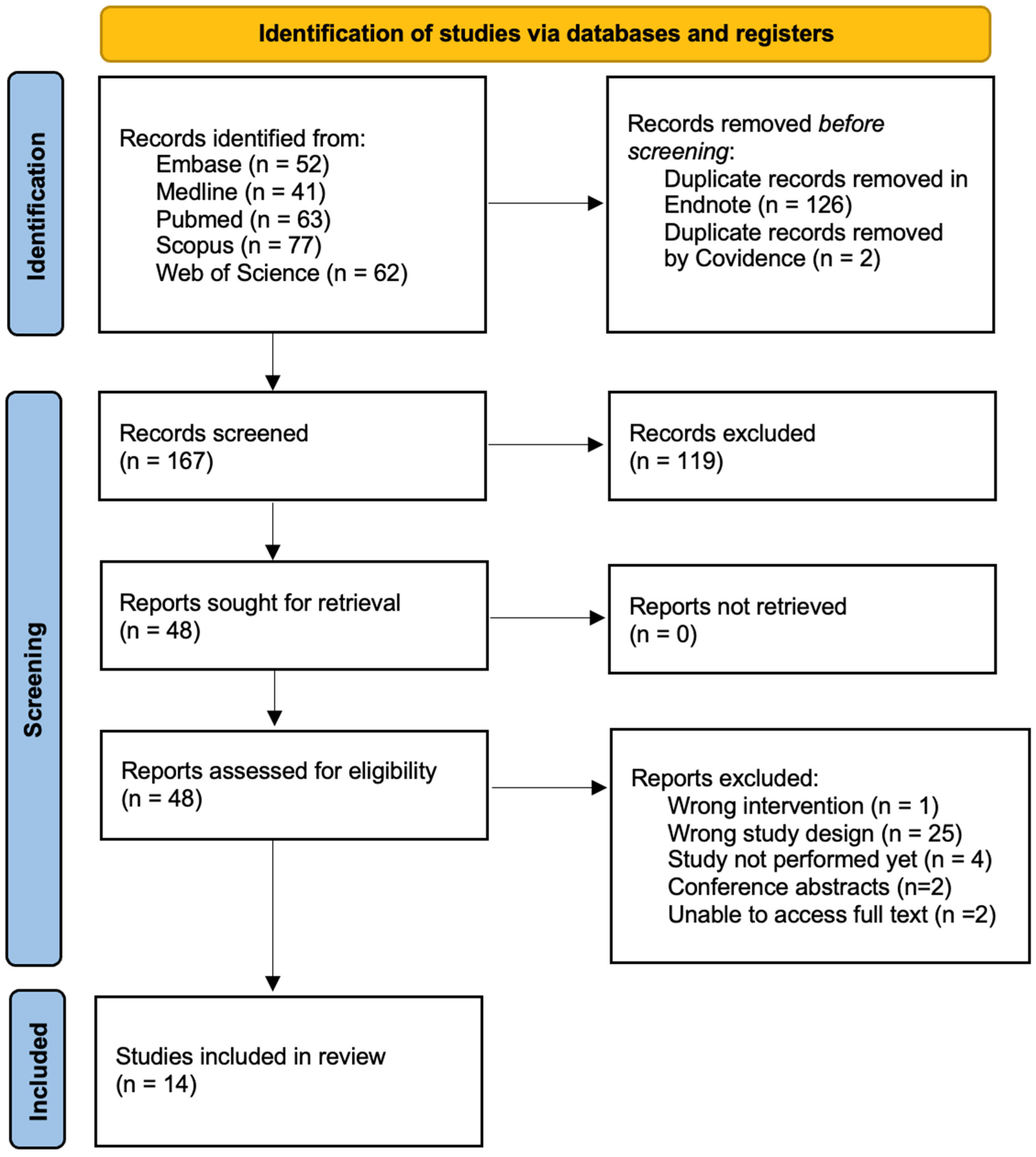
3.1. Study Selection
3.2. Study Characteristics
3.3. Artificial Intelligence Accuracy
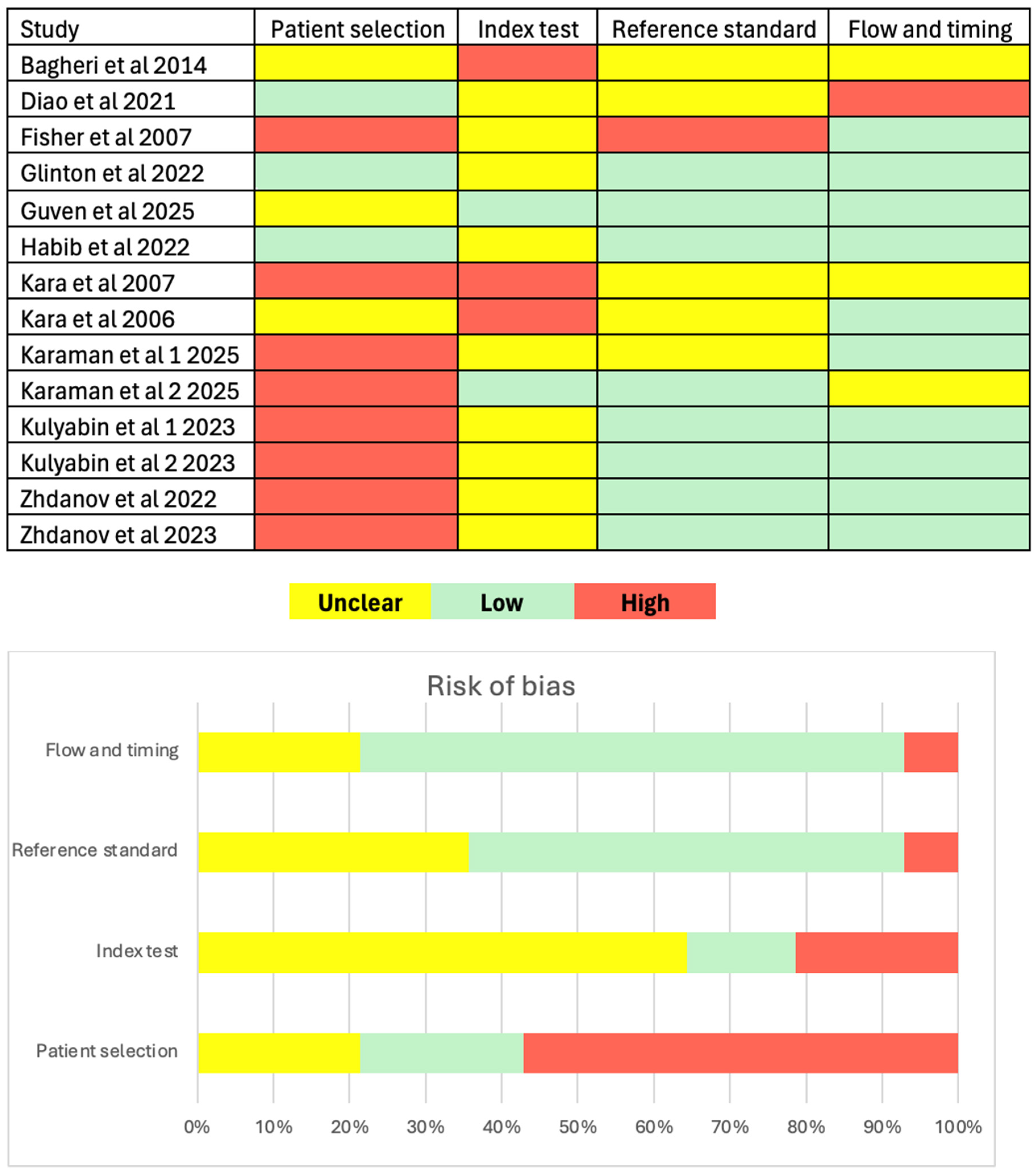
3.4. Quality Assessment
4. Discussion
4.1. Results Interpretation
4.2. Strengths and Limitations
5. Conclusions
Supplementary Materials
Author Contributions
Funding
Institutional Review Board Statement
Informed Consent Statement
Data Availability Statement
Conflicts of Interest
Appendix A. Complete Search Strategy Across Five Databases
- PubMed:
- ((electroretinography[MeSH Terms]) OR (electroretinographies[MeSH Terms]) OR (electroretinography[Title/Abstract]) OR (electroretinographies[Title/Abstract]) OR (electroretinogram[Title/Abstract])).
- AND
- ((ai artificial intelligence[MeSH Terms]) OR (artificial intelligence[Title/Abstract]) OR (AI[Title/Abstract]) OR (active machine learning[MeSH Terms]) OR (algorithm, machine learning[MeSH Terms]) OR (deep learning[MeSH Terms]) OR (computational neural network[MeSH Terms]) OR (computational neural networks[MeSH Terms]) OR (machine?learning[Title/Abstract]) OR (deep?learning[Title/Abstract])).
- Medline:
- (MH “Artificial Intelligence+”) OR (MH “Intelligent Systems”) OR (MH “Machine Learning+”) OR (MH “Deep Learning+”) OR (MH “Large Language Models”) OR (MH “Multifactor Dimensionality Reduction”) OR (MH “Ensemble Learning+”) OR (MH “Federated Learning”) OR (MH “Reinforcement Machine Learning”) OR (MH “Representation Machine Learning”) OR (MH “Supervised Machine Learning+”) OR (MH “Support Vector Machine”) OR (MH “Transfer Machine Learning”) OR (MH “Unsupervised Machine Learning+”) OR (MH “Particle Swarm Optimization”) OR (MH “Pattern Analysis, Machine”) OR (MH “Prediction Methods, Machine+”) OR (MH “Predictive Learning Models”) OR (MH “Sentiment Analysis”).
- AND
- (MH “Electroretinography”) OR “electroretinograph*” OR “electroretinogram*”.
- Embase:
- ‘electroretinography’:ti,ab,kw OR ‘electroretinogram’:ti,ab,kw OR’electroretinographies’:ti,ab,kw).
- AND
- (‘artificial intelligence’:ti,ab,kw OR ‘machinelearning’:ti,ab,kw OR ‘deep learning’:ti,ab,kw) OR (‘artificial intelligence’/exp OR ‘artificial intelligence’ OR ‘artificial intelligence-assisted technology’/exp OR ‘artificial intelligence-assisted technology’) AND(‘electroretinography’ OR ‘electroretinogram’/exp OR ‘electroretinogram’ OR’electroretinograph’/exp OR ‘electroretinograph’).
- Scopus:
- TITLE-ABS-KEY (electroretinography OR electroretinographies OR electroretinogram) AND TITLE-ABS-KEY (“artificial intelligence” OR “AI” OR “machine learning” OR “deep learning”) AND (LIMIT-TO (DOCTYPE, “ar”)).
- Web of Science:
- electroretinography OR electroretinographies OR electroretinogram (Topic) and artificial intelligence OR AI OR machine learning OR deep learning (Topic).
References
- Salmon, J. Kanski’s Clinical Ophthalmology: A Systematic Approach, 10th ed.; Elsevier: Amsterdam, The Netherlands, 2025. [Google Scholar]
- Shabto, J.; Tsang, S.; Sharma, T.; Diaconita, V. Electroretinography. In Atlas of Inherited Retinal Diseases; Tsang, S.H., Sharma, T., Diaconita, V., Eds.; Springer Nature: Cham, Switzerland, 2025; pp. 21–26. [Google Scholar]
- Cornish, E.E.; Vaze, A.; Jamieson, R.V.; Grigg, J.R. The electroretinogram in the genomics era: Outer retinal disorders. Eye 2021, 35, 2406–2418. [Google Scholar] [CrossRef]
- Yang, T.-H.; Kang, E.Y.-C.; Lin, P.-H.; Wu, P.-L.; Sachs, J.A.; Wang, N.-K. The Value of Electroretinography in Identifying Candidate Genes for Inherited Retinal Dystrophies: A Diagnostic Guide. Diagnostics 2023, 13, 3041. [Google Scholar] [CrossRef] [PubMed]
- Ichinose, T.; Habib, S. On and off signaling pathways in the retina and the visual system. Front. Ophthalmol. 2022, 2, 989002. [Google Scholar] [CrossRef]
- Angus, Z.G.; Sarossy, A.; Parihar, P.; Sarossy, M. Improving the reliability of the pattern electroretinogram with adaptive filtering. Sci. Rep. 2025, 16, 1197. [Google Scholar] [CrossRef]
- Lai, T.Y.; Chan, W.M.; Lai, R.Y.; Ngai, J.W.; Li, H.; Lam, D.S. The clinical applications of multifocal electroretinography: A systematic review. Surv. Ophthalmol. 2007, 52, 61–96. [Google Scholar] [CrossRef]
- Dettoraki, M.; Moschos, M.M. The Role of Multifocal Electroretinography in the Assessment of Drug-Induced Retinopathy: A Review of the Literature. Ophthalmic Res. 2016, 56, 169–177. [Google Scholar] [CrossRef]
- Tsang, S.H.; Sharma, T. Electroretinography. Adv. Exp. Med. Biol. 2018, 1085, 17–20. [Google Scholar] [CrossRef]
- Güven, A.; Karaman, B.; Öner, A.; Sinim Kahraman, N. Detection of retinitis pigmentosa stages with GAN and transfer learning in maps of MfERG P1 wave amplitudes. Signal Image Video Process. 2025, 19, 528. [Google Scholar] [CrossRef]
- Glinton, S.L.; Calcagni, A.; Lilaonitkul, W.; Pontikos, N.; Vermeirsch, S.; Zhang, G.; Arno, G.; Wagner, S.K.; Michaelides, M.; Keane, P.A.; et al. Phenotyping of ABCA4 Retinopathy by Machine Learning Analysis of Full-Field Electroretinography. Transl. Vis. Sci. Technol. 2022, 11, 34. [Google Scholar] [CrossRef] [PubMed]
- Aggarwal, R.; Sounderajah, V.; Martin, G.; Ting, D.S.W.; Karthikesalingam, A.; King, D.; Ashrafian, H.; Darzi, A. Diagnostic accuracy of deep learning in medical imaging: A systematic review and meta-analysis. npj Digit. Med. 2021, 4, 65. [Google Scholar] [CrossRef] [PubMed]
- Ting, D.S.W.; Pasquale, L.R.; Peng, L.; Campbell, J.P.; Lee, A.Y.; Raman, R.; Tan, G.S.W.; Schmetterer, L.; Keane, P.A.; Wong, T.Y. Artificial intelligence and deep learning in ophthalmology. Br. J. Ophthalmol. 2019, 103, 167–175. [Google Scholar] [CrossRef] [PubMed]
- Das, D.; Biswas, S.K.; Bandyopadhyay, S. Detection of Diabetic Retinopathy using Convolutional Neural Networks for Feature Extraction and Classification (DRFEC). Multimed. Tools Appl. 2023, 82, 29943–30001. [Google Scholar] [CrossRef] [PubMed]
- Haja, S.A.; Mahadevappa, V. Advancing glaucoma detection with convolutional neural networks: A paradigm shift in ophthalmology. Rom. J. Ophthalmol. 2023, 67, 222–237. [Google Scholar] [CrossRef]
- Abràmoff, M.D.; Lou, Y.; Erginay, A.; Clarida, W.; Amelon, R.; Folk, J.C.; Niemeijer, M. Improved Automated Detection of Diabetic Retinopathy on a Publicly Available Dataset Through Integration of Deep Learning. Investig. Ophthalmol. Vis. Sci. 2016, 57, 5200–5206. [Google Scholar] [CrossRef]
- Page, M.J.; McKenzie, J.E.; Bossuyt, P.M.; Boutron, I.; Hoffmann, T.C.; Mulrow, C.D.; Shamseer, L.; Tetzlaff, J.M.; Akl, E.A.; Brennan, S.E.; et al. The PRISMA 2020 statement: An updated guideline for reporting systematic reviews. Int. J. Surg. 2021, 88, 105906. [Google Scholar] [CrossRef]
- Whiting, P.F.; Rutjes, A.W.S.; Westwood, M.E.; Mallett, S.; Deeks, J.J.; Reitsma, J.B.; Leeflang, M.M.G.; Sterne, J.A.C.; Bossuyt, P.M.M. QUADAS-2: A Revised Tool for the Quality Assessment of Diagnostic Accuracy Studies. Ann. Intern. Med. 2011, 155, 529–536. [Google Scholar] [CrossRef]
- Kara, S.; Güven, A. Neural network-based diagnosing for optic nerve disease from visual-evoked potential. J. Med. Syst. 2007, 31, 391–396. [Google Scholar] [CrossRef]
- Bandhey, H.; Del Risco, A.; Gao, Q.; Rathinavelu, J.; Pajic, M.; Hadziahmetovic, M. Exploring Deep-Learning on SD-OCT images as an Effective Mitigation Technique for Hydroxychloroquine-Induced Retinal Toxicity. Investig. Ophthalmol. Vis. Sci. 2022, 63, 3330-F0139. [Google Scholar]
- De Roach, J.N. Neural networks--an artificial intelligence approach to the analysis of clinical data. Australas. Phys. Eng. Sci. Med. 1989, 12, 100–106. [Google Scholar]
- Giap, B.D.; Likosky, K.; Lustre, J.; Srinivasan, K.; Khan, N.; Nallasamy, N. A Deep Learning-Assisted Electroretinogram Analysis System for Automated Abnormality Detection in Patient Retinal Function. Investig. Ophthalmol. Vis. Sci. 2024, 65, 5667. [Google Scholar]
- Giap, B.D.; Likosky, K.; Srinivasan, K.; Khan, N.W.; Nallasamy, N. Automated Abnormality Detection in Patient Retinal Function: A Deep Learning-Powered Electroretinogram Analysis System. In Proceedings of the 2024 46th Annual International Conference of the IEEE Engineering in Medicine and Biology Society (EMBC), Orlando, FL, USA, 15–19 July 2024; pp. 1–4. [Google Scholar]
- Bagheri, A.; Persano Adorno, D.; Rizzo, P.; Barraco, R.; Bellomonte, L. Empirical mode decomposition and neural network for the classification of electroretinographic data. Med. Biol. Eng. Comput. 2014, 52, 619–628. [Google Scholar] [CrossRef]
- Diao, T.; Kushzad, F.; Patel, M.D.; Bindiganavale, M.P.; Wasi, M.; Kochenderfer, M.J.; Moss, H.E. Comparison of Machine Learning Approaches to Improve Diagnosis of Optic Neuropathy Using Photopic Negative Response Measured Using a Handheld Device. Front. Med. 2021, 8, 771713. [Google Scholar] [CrossRef] [PubMed]
- Fisher, A.C.; Hagan, R.P.; Brown, M.C. Automatic positioning of cursors in the transient pattern electroretinogram (PERG) with very poor SNR using an Expert System. Doc. Ophthalmol. 2007, 115, 61–68. [Google Scholar] [CrossRef]
- Habib, F.; Huang, H.; Gupta, A.; Wright, T. MERCI: A machine learning approach to identifying hydroxychloroquine retinopathy using mfERG. Doc. Ophthalmol. 2022, 145, 53–63. [Google Scholar] [CrossRef] [PubMed]
- Kara, S.; Güven, A. Training a learning vector quantization network using the pattern electroretinography signals. Comput. Biol. Med. 2007, 37, 77–82. [Google Scholar] [CrossRef]
- Kara, S.; Güven, A.; Oner, A.O. Utilization of artificial neural networks in the diagnosis of optic nerve diseases. Comput. Biol. Med. 2006, 36, 428–437. [Google Scholar] [CrossRef]
- Karaman, B.; Güven, A.; Öner, A.; Kahraman, N.S. Classification of Retinitis Pigmentosa Stages Based on Machine Learning by Fusion of Image Features of VF and MfERG Maps. Electronics 2025, 14, 1867. [Google Scholar] [CrossRef]
- Karaman, B.; Öner, A.; Güven, A. Early detection and staging of retinitis pigmentosa using multifocal electroretinogram parameters and machine learning algorithms. Phys. Eng. Sci. Med. 2025, 48, 1185–1205. [Google Scholar] [CrossRef]
- Kulyabin, M.; Zhdanov, A.; Dolganov, A.; Maier, A. Optimal Combination of Mother Wavelet and AI Model for Precise Classification of Pediatric Electroretinogram Signals. Sensors 2023, 23, 5813. [Google Scholar] [CrossRef] [PubMed]
- Kulyabin, M.; Zhdanov, A.; Dolganov, A.; Ronkin, M.; Borisov, V.; Maier, A. Enhancing Electroretinogram Classification with Multi-Wavelet Analysis and Visual Transformer. Sensors 2023, 23, 8727. [Google Scholar] [CrossRef]
- Zhdanov, A.; Dolganov, A.; Zanca, D.; Borisov, V.; Ronkin, M. Advanced Analysis of Electroretinograms Based on Wavelet Scalogram Processing. Appl. Sci. 2022, 12, 12365. [Google Scholar] [CrossRef]
- Zhdanov, A.E.; Dolganov, A.Y.; Zanca, D.; Borisov, V.I.; Luchian, E.; Dorosinsky, L.G. Evaluation of the effectiveness of the decision support algorithm for physicians in retinal dystrophy using machine learning methods. Comput. Opt. 2023, 47, 272–277. [Google Scholar] [CrossRef]
- Issaiy, M.; Zarei, D.; Saghazadeh, A. Artificial Intelligence and Acute Appendicitis: A Systematic Review of Diagnostic and Prognostic Models. World J. Emerg. Surg. 2023, 18, 59. [Google Scholar] [CrossRef] [PubMed]
- Nakajima, K.; Kudo, T.; Nakata, T.; Kiso, K.; Kasai, T.; Taniguchi, Y.; Matsuo, S.; Momose, M.; Nakagawa, M.; Sarai, M.; et al. Diagnostic accuracy of an artificial neural network compared with statistical quantitation of myocardial perfusion images: A Japanese multicenter study. Eur. J. Nucl. Med. Mol. Imaging 2017, 44, 2280–2289. [Google Scholar] [CrossRef]
- Ting, D.S.W.; Cheung, C.Y.-L.; Lim, G.; Tan, G.S.W.; Quang, N.D.; Gan, A.; Hamzah, H.; Garcia-Franco, R.; San Yeo, I.Y.; Lee, S.Y.; et al. Development and Validation of a Deep Learning System for Diabetic Retinopathy and Related Eye Diseases Using Retinal Images from Multiethnic Populations With Diabetes. JAMA 2017, 318, 2211–2223. [Google Scholar] [CrossRef] [PubMed]
- Tiong, E.W.W.; Liu, S.-H.; Ting, D.S.J. Cochrane corner: Artificial intelligence for keratoconus. Eye 2024, 38, 3406–3408. [Google Scholar] [CrossRef]
- Shahriari, M.H.; Asadi, F.; Moghaddasi, H.; Roshanpour, A.; Sharifipour, F.; Khorrami, Z. Applications of machine learning in glaucoma diagnosis based on tabular data: A systematic review. BMC Biomed. Eng. 2025, 7, 9. [Google Scholar] [CrossRef]
- Canino, G.; Di Costanzo, A.; Salerno, N.; Leo, I.; Cannataro, M.; Guzzi, P.H.; Veltri, P.; Sorrentino, S.; De Rosa, S.; Torella, D. Artificial Intelligence in Cardiac Electrophysiology: A Clinically Oriented Review with Engineering Primers. Bioengineering 2025, 12, 1102. [Google Scholar] [CrossRef]
- Yamashita, T.; Miki, A.; Tabuchi, A.; Funada, H.; Kondo, M. A novel method to reduce noise in electroretinography using skin electrodes: A study of noise level, inter-session variability, and reproducibility. Int. Ophthalmol. 2017, 37, 317–324. [Google Scholar] [CrossRef]
- Tveit, J.; Aurlien, H.; Plis, S.; Calhoun, V.D.; Tatum, W.O.; Schomer, D.L.; Arntsen, V.; Cox, F.; Fahoum, F.; Gallentine, W.B.; et al. Automated Interpretation of Clinical Electroencephalograms Using Artificial Intelligence. JAMA Neurol. 2023, 80, 805–812. [Google Scholar] [CrossRef]
- Kural, M.A.; Jing, J.; Fürbass, F.; Perko, H.; Qerama, E.; Johnsen, B.; Fuchs, S.; Westover, M.B.; Beniczky, S. Accurate identification of EEG recordings with interictal epileptiform discharges using a hybrid approach: Artificial intelligence supervised by human experts. Epilepsia 2022, 63, 1064–1073. [Google Scholar] [CrossRef] [PubMed]
- Jeong, J.; Kim, S.; Pan, L.; Hwang, D.; Kim, D.; Choi, J.; Kwon, Y.; Yi, P.; Jeong, J.; Yoo, S.J. Reducing the workload of medical diagnosis through artificial intelligence: A narrative review. Medicine 2025, 104, e41470. [Google Scholar] [CrossRef]
- Jin, K.; Yu, T.; Ying, G.S.; Ge, Z.; Li, K.Z.; Zhou, Y.; Shi, D.; Wang, M.; Goktas, P.; Grzybowski, A. A systematic review of vision and vision-language foundation models in ophthalmology. Adv. Ophthalmol. Pract. Res. 2026, 6, 8–19. [Google Scholar] [CrossRef] [PubMed]
- Sachdeva, K.; Butt, F.R.; Mihalache, A.; Nassrallah, G.; Muni, R.H.; Popovic, M.M. A systematic review of artificial intelligence models in ocular tumour diagnosis. Can. J. Ophthalmol. 2026; in press. [CrossRef] [PubMed]



| First Author | Year | Country | Study Type | Population | Mean Age (Years) | Disease for Diagnosis | Type of ERG Modality | Type of Artificial Intelligence | Key Findings |
|---|---|---|---|---|---|---|---|---|---|
| Bagheri et al. [24] | 2014 | Italy; United States of America | Retrospective cohort study | Adult participants n = 94 Males = 42/94 Females = 52/94 | 47 +/− 5 | Achromatopsia; Congenital stationary night blindness | Full-field ERG | Machine learning | Diagnostic accuracy of the artificial neural network machine learning tool was 100% |
| Diao et al. [25] | 2021 | United States of America | Case-control study | Adult participants n = 119 Males = 56/119 Females = 63/119 | 45.6 +/− 17.5 | Optic neuropathy | Full-field ERG | Machine learning | Highest diagnostic accuracy was by time series forest machine learning at 74% |
| Fisher et al. [26] | 2007 | United Kingdom | Cluster randomised controlled trial | Human participants n = 10 | Unstated | Normal physiology | Pattern ERG | Machine learning | Diagnostic accuracy was achieved at a rate of 95% in two machine learning groups compared to 62% in the human group interpreting noisy ERGs |
| Glinton et al. [11] | 2022 | United Kingdom | Retrospective cohort study | Human participants n = 597 Group 1 = 344/597 Group 2 = 44/597 Group 3 = 209/597 | Group 1 = 35 Group 2 = 35 Group 3 = 37 | Group 1 = Macular dysfunction alone Group 2 = Macular dysfunction + generalised cone dysfunction Group 3 = cone and rod dysfunction | Full-field ERG | Machine learning | Diagnostic accuracy of support vector machine Group 1 = 96.7% Group 2 = 39.3% Group 3 = 93.8% |
| Guven et al. [10] | 2025 | Turkey | Case-control study | Adult participants n = 206 Males = 118/206 Females = 88/206 | 35.37 +/− 15.01 | Retinitis pigmentosa | Multifocal ERG | Machine learning | Highest diagnostic accuracy was by resnet50 machine learning at 94.9% |
| Habib et al. [27] | 2022 | Canada; China | Retrospective cohort study | Human participants n = 748 | Unstated | Hydroxychloroquine retinopathy | Multifocal ERG | Machine learning | Diagnostic accuracy of the support vector machine machine learning was 85.3% |
| Kara et al. [28] | 2007 | Turkey | Prospective cohort study | Adult participants n = 320 Males = 164/320 Females = 156/320 | 41.94 | Optic neuritis | Pattern ERG | Machine learning | Diagnostic accuracy of the artificial neural network machine learning tool was 92% |
| Kara et al. [29] | 2006 | Turkey | Prospective cohort study | Adult participants n = 256 Males = 117/256 Females = 119/256 Unspecified gender = 20/256 | 43.8 | Optic neuritis | Pattern ERG | Machine learning | Diagnostic accuracy of the artificial neural network machine learning tool was 94.2% |
| Karaman et al. [30] | 2025 | Turkey | Retrospective cohort study | Adult participants n = 124 Males = 73/124 Females = 51/124 | 35.26 +/− 14.30 | Retinitis pigmentosa | Multifocal ERG | Machine learning | Highest diagnostic accuracy by support vector machine machine learning at 87.1% |
| Karaman et al. [31] | 2025 | Turkey | Retrospective cohort study | Human participants n = 97 Males = 61/97 Females = 36/97 | 37.48 +/− 16.19 | Retinitis pigmentosa | Multifocal ERG | Machine learning | Highest diagnostic accuracy was by naïve Bayes machine learning at 82.32% |
| Kulyabin et al. [32] | 2023 | Germany; Russia | Retrospective cohort study | Paediatric participants n = unstated | Unstated | Healthy and unhealthy, unstated specific diagnosis | Full-field ERG | Deep learning | Highest diagnostic accuracy was by vision transformer with ricker wavelet deep learning at 84.0% for maximum ERG response, 84.9% for scotopic ERG response, 87.5% for photopic ERG response |
| Kulyabin et al. [33] | 2023 | Russia | Prospective cohort study | Adult and paediatric participants n = 323 | Unstated | Healthy and unhealthy, unstated specific diagnosis | Full-field ERG | Deep learning | Highest diagnostic accuracy was by visual transformer small deep learning at 88.0% for maximum ERG response, 85.0% for scotopic ERG response, 91% for photopic ERG response |
| Zhdanov et al. [34] | 2022 | Russia; Germany | Retrospective cohort study | Adult and paediatric participants n = 103 Adult = 38 Paediatric = 65 | Unstated | Healthy and unhealthy, unstated specific diagnosis | Full-field ERG | Machine learning | Highest diagnostic accuracy was by classical features + wavelet 1–4 machine learning at 83% in the adult group. High diagnostic accuracy was by “wavelet 1–2” machine learning at 70% in the paediatric group |
| Zhdanov et al. [35] | 2023 | Russia; Germany; Romania | Retrospective cohort study | Adult and paediatric participants n = unstated | Unstated | Healthy and unhealthy, unstated specific diagnosis | Full-field ERG | Machine learning | Diagnostic accuracy of the “decision trees” machine learning tool was 52% in the adult group and 40% in the paediatric group |
Disclaimer/Publisher’s Note: The statements, opinions and data contained in all publications are solely those of the individual author(s) and contributor(s) and not of MDPI and/or the editor(s). MDPI and/or the editor(s) disclaim responsibility for any injury to people or property resulting from any ideas, methods, instructions or products referred to in the content. |
© 2026 by the authors. Licensee MDPI, Basel, Switzerland. This article is an open access article distributed under the terms and conditions of the Creative Commons Attribution (CC BY) license.
Share and Cite
Hegde, M.; Thomis, A.; Shirke, S. Use of Artificial Intelligence in the Interpretation of Electroretinography (ERG) Studies. Int. J. Mol. Sci. 2026, 27, 3491. https://doi.org/10.3390/ijms27083491
Hegde M, Thomis A, Shirke S. Use of Artificial Intelligence in the Interpretation of Electroretinography (ERG) Studies. International Journal of Molecular Sciences. 2026; 27(8):3491. https://doi.org/10.3390/ijms27083491
Chicago/Turabian StyleHegde, Manasi, Alexander Thomis, and Sheetal Shirke. 2026. "Use of Artificial Intelligence in the Interpretation of Electroretinography (ERG) Studies" International Journal of Molecular Sciences 27, no. 8: 3491. https://doi.org/10.3390/ijms27083491
APA StyleHegde, M., Thomis, A., & Shirke, S. (2026). Use of Artificial Intelligence in the Interpretation of Electroretinography (ERG) Studies. International Journal of Molecular Sciences, 27(8), 3491. https://doi.org/10.3390/ijms27083491