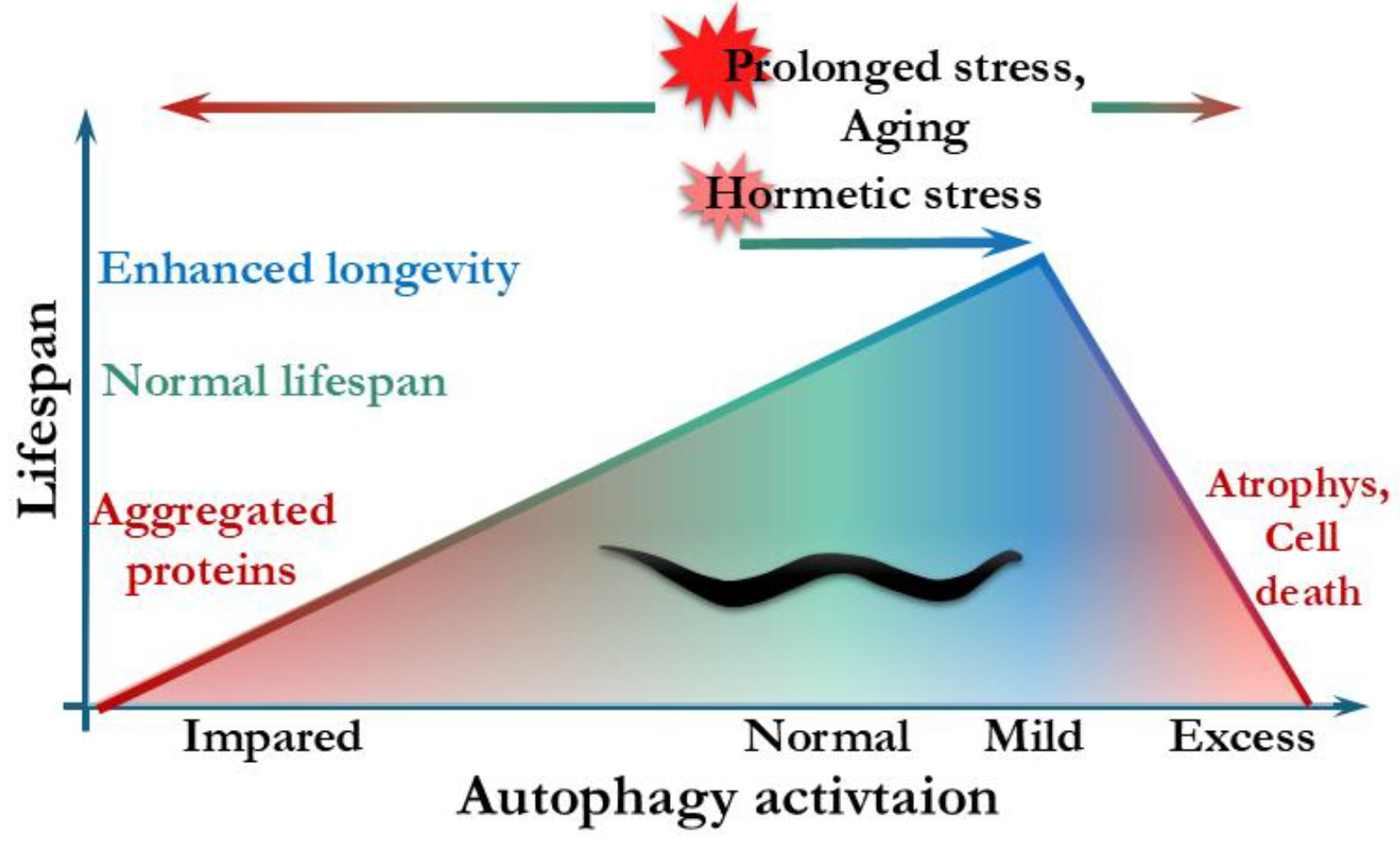
Autophagy: A Double-Edged Sword in the Aging of C. elegans



Abstract
1. Introduction
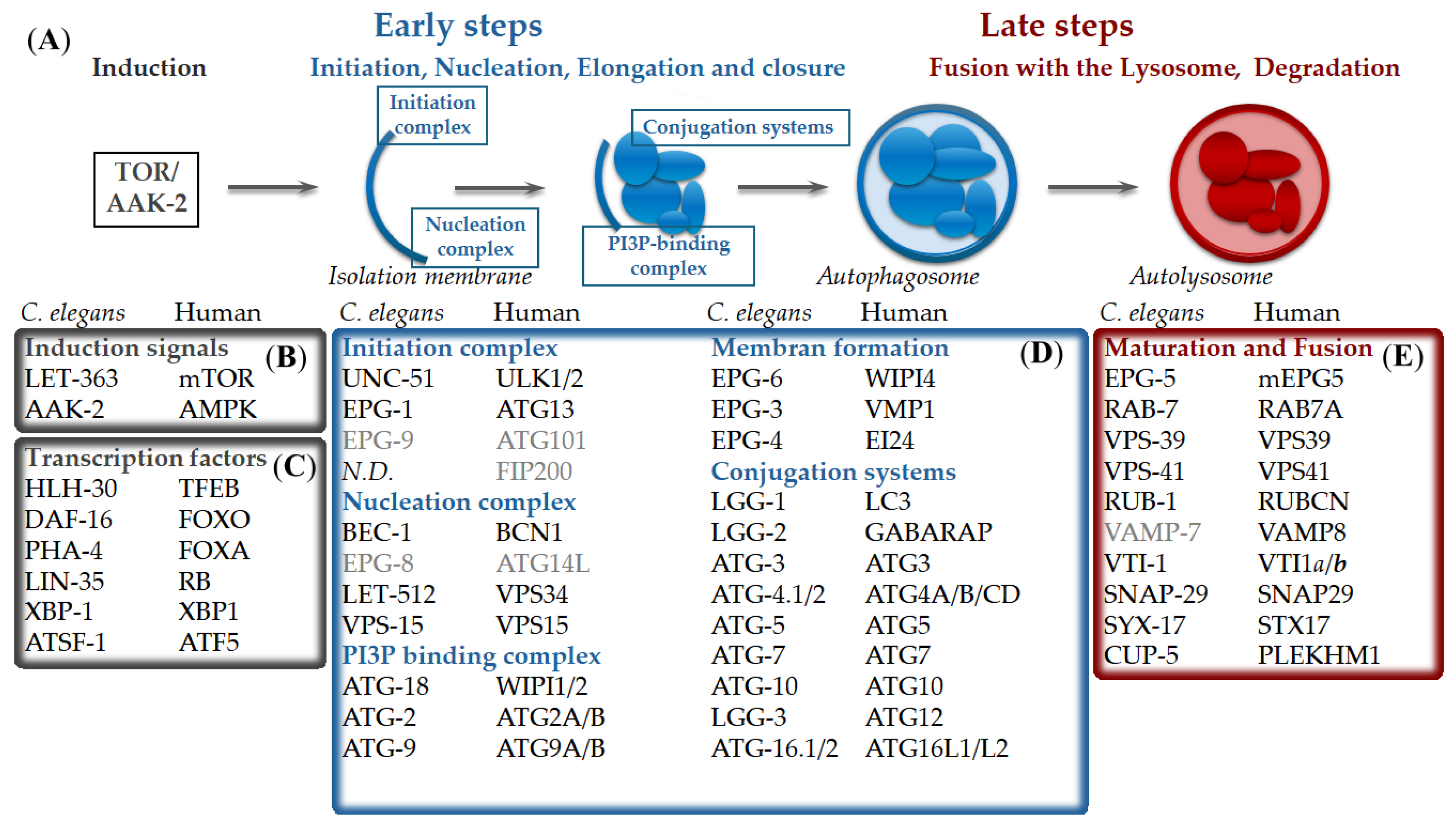
2. C. elegans as a Model Organism to Study Autophagy
2.1. Detection and Functional Assessment of Autophagy in C. elegans
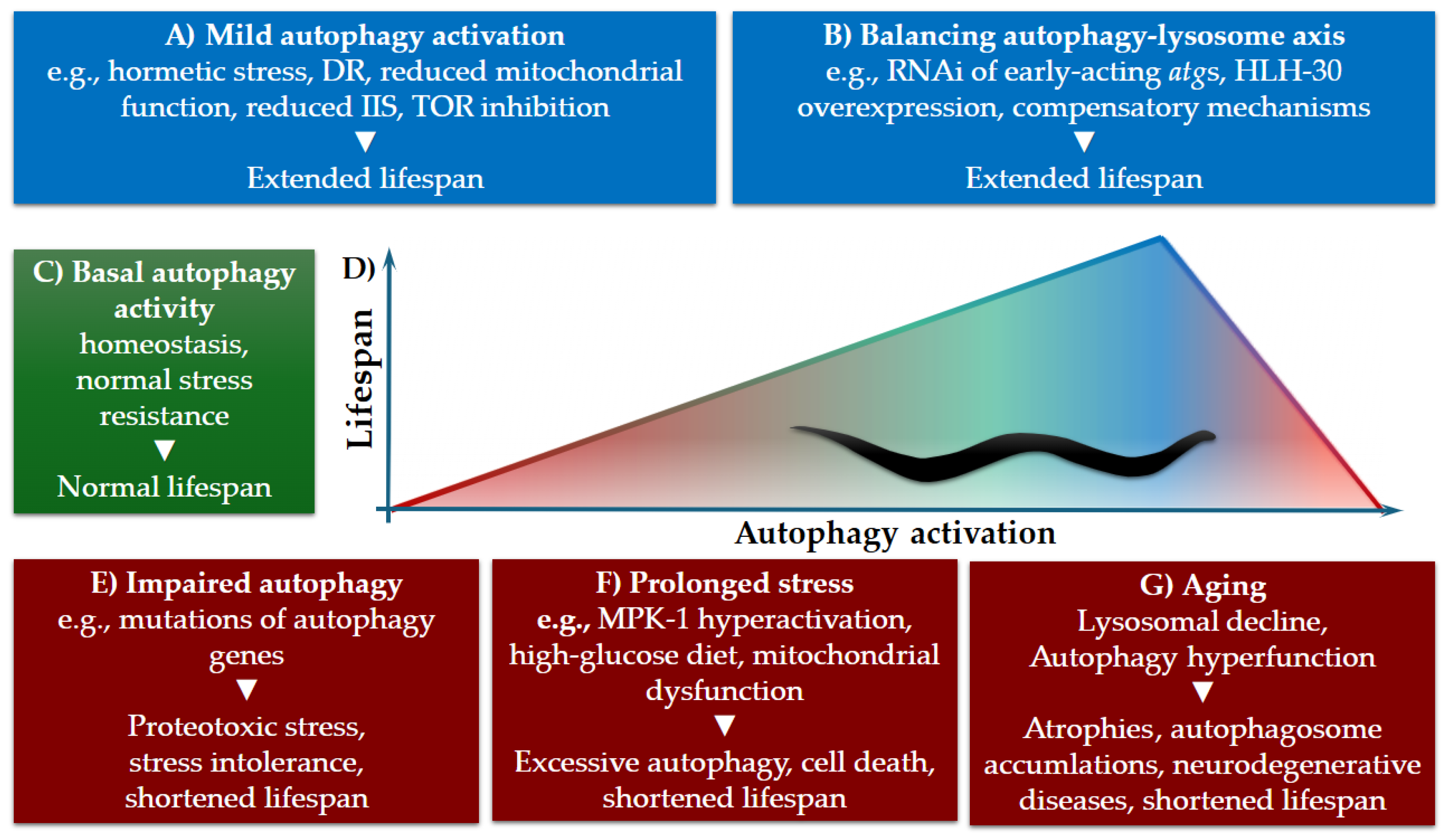
2.2. Autophagy as a Conserved Driver of Lifespan Extension in C. elegans

| Condition | Activation Trigger | Autophagy Gene Studied | Gene Manipulation | Tissue | Aging Marker | Ref. |
|---|---|---|---|---|---|---|
| Beneficial effects of autophagy | ||||||
| TOR pathway inhibition | Genetic triggers | bec-1, unc-51, atg-18 | Mutants | Multiple tissues | No | [16] |
| Reduced insulin/IGF-1 | Genetic triggers | bec-1 | RNAi 1 | Multiple tissues | No | [55] |
| Mitochondrial dysfunction | Impaired respiration | unc-51, bec-1, atg-18 | Mutants | Multiple tissues | No | [16] |
| Dietary restriction | Mild stress activation | atg-18 | RNAi 1 | Intestine | Intestinal barrier function | [48] |
| MALT-1 inhibition | Direct autophagy activation | lgg-2, atg-13, bec-1 | RNAi | Intestine | Pharyngeal pumping | [59] |
| SQST-1/p62 overexpression | Autophagy activation | sqst-1 | Overexpression | Neurons | Proteostasis | [63] |
| Neuronal lysosomal capacity | Autophagy-flux activation | hlh-30 | Overexpression | PVD dendrite | Dendrite integrity | [65] |
| Normal homeostasis | Basal | bec-1, unc-51, atg-18 | Mutants | Multiple tissues | Lipofuscin, locomotion | [16] |
| Prolonged-stress-induced overexpression of autophagy | ||||||
| Proteotoxicity in mec-4(d) mutants | Proteotoxic stress | bec-1, unc-51 | Mutants | Neurons | Cell death assay | [71] |
| Constitutive MPK-1 activation | Starvation | bec-1 | RNAi 1 | Pharynx | Pharyngeal muscle integrity | [72] |
| sgk-1 inhibition | mPTP activation | bec-1 | RNAi 1 | Multiple tissues | Mitochondria permeability | [73] |
| High-glucose diet | Metabolic stress | hlh-30 | Mutants | Intestine | No | [74] |
| Age-dependent negative effects of autophagy | ||||||
| Neuronal dysregulation | Proteotoxic stress | bec-1, vps-34 | Tissue-specific RNAi | Neurons | Pharynx, muscle, neuron integrity | [18] |
| Intestinal hyperfunction | Excessive autophagy | atg-13 | RNAi 1 | Intestine | Various pathologies | [17] |
| Lysosomal damage | Excessive autophagy | Multiple atgs | Mutants | Multiple tissues | No | [75] |
2.3. Detrimental Effects of Excessive Autophagy in C. elegans
2.4. Antagonistic Pleiotropy and Age-Dependent Reversal of Autophagy Function
2.5. Spatiotemporal and Compensatory Regulation of Autophagy During Aging
3. Relevance to Human Disease
4. Conclusions
Author Contributions
Funding
Institutional Review Board Statement
Informed Consent Statement
Data Availability Statement
Acknowledgments
Conflicts of Interest
Abbreviations
| AID | Auxin-inducible degradation |
| AD | Alzheimer’s disease |
| atgs | Autophagy-related genes |
| C. elegans | Caenorhabditis elegans |
| DR | Dietary restriction |
| ER | Endoplasmic reticulum |
| FOXA | Forkhead box A |
| HLH-30 | Helix–loop–helix protein 30 |
| IGF-1 | Insulin growth factor 1 |
| mTORC1 | Mammalian target of rapamycin complex 1 |
| PHA-4 | Pharynx defective protein 4 |
| PLPs | Pseudocoelomic lipoprotein pools |
| RNAi | RNA interference |
| ROS | Reactive oxygen species |
| SID | Systemic RNA interference-defective |
| TFEB | Transcription factor EB |
| TOR | Target of rapamycin |
| TLs | Tubular lysosomes |
| WIPI | WD-repeat protein Interacting with Phosphoinositides |
References
- Mizushima, N. A brief history of autophagy from cell biology to physiology and disease. Nat. Cell Biol. 2018, 20, 521–527. [Google Scholar] [CrossRef]
- White, E.; Lattime, E.C.; Guo, J.Y. Autophagy regulates stress responses, metabolism, and anticancer immunity. Trends Cancer 2021, 7, 778–789. [Google Scholar] [CrossRef] [PubMed]
- Levine, B.; Kroemer, G. Biological functions of autophagy genes: A disease perspective. Cell 2019, 176, 11–42. [Google Scholar] [CrossRef] [PubMed]
- Mizushima, N.; Yoshimori, T.; Ohsumi, Y. The role of Atg proteins in autophagosome formation. Annu. Rev. Cell Dev. Biol. 2011, 27, 107–132. [Google Scholar] [CrossRef] [PubMed]
- Zhang, H.; Meléndez, A. Conserved components of the macroautophagy machinery in Caenorhabditis elegans. Genetics 2025, 229, iyaf007. [Google Scholar] [CrossRef]
- Varga, V.B.; Keresztes, F.; Sigmond, T.; Vellai, T.; Kovács, T. The evolutionary and functional divergence of the Atg8 autophagy protein superfamily. Biol. Futur. 2022, 73, 375–384. [Google Scholar] [CrossRef]
- Wei, Z.; Hu, X.; Wu, Y.; Zhou, L.; Zhao, M.; Lin, Q. Molecular mechanisms underlying initiation and activation of autophagy. Biomolecules 2024, 14, 1517. [Google Scholar] [CrossRef]
- Hollenstein, D.M.; Kraft, C. Autophagosomes are formed at a distinct cellular structure. Curr. Opin. Cell Biol. 2020, 65, 50–57. [Google Scholar] [CrossRef]
- Morishita, H.; Mizushima, N. Diverse cellular roles of autophagy. Annu. Rev. Cell Dev. Biol. 2019, 35, 453–475. [Google Scholar] [CrossRef]
- Ke, P.-Y. Molecular Mechanism of Autophagosome-Lysosome Fusion in Mammalian Cells. Cells 2024, 13, 500. [Google Scholar] [CrossRef]
- Ohsumi, Y. Historical landmarks of autophagy research. Cell Res. 2014, 24, 9–23. [Google Scholar] [CrossRef] [PubMed]
- Gatica, D.; Lahiri, V.; Klionsky, D.J. Cargo recognition and degradation by selective autophagy. Nat. Cell Biol. 2018, 20, 233–242, Erratum in Nat. Cell Biol. 2023, 25, 1073. [Google Scholar] [CrossRef] [PubMed]
- Hansen, M.; Rubinsztein, D.C.; Walker, D.W. Autophagy as a promoter of longevity: Insights from model organisms. Nat. Rev. Mol. Cell Biol. 2018, 19, 579–593, Erratum in Nat. Rev. Mol. Cell Biol. 2018, 19, 611. [Google Scholar] [CrossRef] [PubMed]
- Palmisano, N.J.; Meléndez, A. Autophagy in C. elegans development. Dev. Biol. 2019, 447, 103–125. [Google Scholar] [CrossRef]
- Tian, Y.; Li, Z.; Hu, W.; Ren, H.; Tian, E.; Zhao, Y.; Lu, Q.; Huang, X.; Yang, P.; Li, X.; et al. C. elegans screen identifies autophagy genes specific to multicellular organisms. Cell 2010, 141, 1042–1055. [Google Scholar] [CrossRef]
- Tóth, M.L.; Sigmond, T.; Borsos, E.; Barna, J.; Erdélyi, P.; Takács-Vellai, K.; Orosz, L.; Kovács, A.L.; Csikós, G.; Sass, M.; et al. Longevity pathways converge on autophagy genes to regulate life span in Caenorhabditis elegans. Autophagy 2008, 4, 330–338. [Google Scholar] [CrossRef]
- Ezcurra, M.; Benedetto, A.; Sornda, T.; Gilliat, A.F.; Au, C.; Zhang, Q.; van Schelt, S.; Petrache, A.L.; Wang, H.; de la Guardia, Y.; et al. C. elegans eats its own intestine to make yolk leading to multiple senescent pathologies. Curr. Biol. 2018, 28, 2544–2556.e5, Erratum in Curr. Biol. 2018, 28, 3352. [Google Scholar] [CrossRef]
- Wilhelm, T.; Byrne, J.; Medina, R.; Kolundžić, E.; Geisinger, J.; Hajduskova, M.; Tursun, B.; Richly, H. Neuronal inhibition of the autophagy nucleation complex extends life span in post-reproductive C. elegans. Genes Dev. 2017, 31, 1561–1572. [Google Scholar] [CrossRef]
- Hars, E.S.; Qi, H.; Ryazanov, A.G.; Jin, S.; Cai, L.; Hu, C.; Liu, L.F. Autophagy regulates ageing in C. elegans. Autophagy 2007, 3, 93–95. [Google Scholar] [CrossRef]
- Alberti, A.; Michelet, X.; Djeddi, A.; Legouis, R. The autophagosomal protein LGG-2 acts synergistically with LGG-1 in dauer formation and longevity in C. elegans. Autophagy 2010, 6, 622–633. [Google Scholar] [CrossRef]
- Kumar, A.V.; Mills, J.; Parker, W.M.; Leitão, J.A.; Rodriguez, D.I.; Daigle, S.E.; Ng, C.; Patel, R.; Aguilera, J.L.; Johnson, J.R.; et al. Lipid droplets modulate proteostasis, SQST-1/SQSTM1 dynamics, and lifespan in C. elegans. iScience 2023, 26, 107960. [Google Scholar] [CrossRef] [PubMed]
- Palikaras, K.; Lionaki, E.; Tavernarakis, N. Interfacing mitochondrial biogenesis and elimination to enhance host pathogen defense and longevity. Worm 2015, 4, e1071763. [Google Scholar] [CrossRef] [PubMed]
- Vellai, T.; Takacs-Vellai, K.; Zhang, Y.; Kovacs, A.L.; Orosz, L.; Müller, F. Genetics: Influence of TOR kinase on lifespan in C. elegans. Nature 2003, 426, 620. [Google Scholar] [CrossRef] [PubMed]
- Blackwell, T.K.; Sewell, A.K.; Wu, Z.; Han, M. TOR Signaling in Caenorhabditis elegans Development, Metabolism, and Aging. Genetics 2019, 213, 329–360. [Google Scholar] [CrossRef]
- Hansen, M.; Chandra, A.; Mitic, L.L.; Onken, B.; Driscoll, M.; Kenyon, C. A role for autophagy in the extension of lifespan by dietary restriction in C. elegans. PLoS Genet. 2008, 4, e24. [Google Scholar] [CrossRef]
- Kenyon, C.; Chang, J.; Gensch, E.; Rudner, A.; Tabtiang, R. A C. elegans mutant that lives twice as long as wild type. Nature 1993, 366, 461–464. [Google Scholar] [CrossRef]
- Lan, J.; Rollins, J.A.; Zang, X.; Wu, D.; Zou, L.; Wang, Z.; Ye, C.; Wu, Z.; Kapahi, P.; Rogers, A.N.; et al. Translational Regulation of Non-Autonomous Mitochondrial Stress Response Promotes Longevity. Cell Rep. 2019, 28, 1050–1062.e6. [Google Scholar] [CrossRef]
- Lapierre, L.R.; De Magalhaes Filho, C.D.; McQuary, P.R.; Chu, C.-C.; Visvikis, O.; Chang, J.T.; Gelino, S.; Ong, B.; Davis, A.E.; Irazoqui, J.E.; et al. The TFEB orthologue HLH-30 regulates autophagy and modulates longevity in Caenorhabditis elegans. Nat. Commun. 2013, 4, 2267. [Google Scholar] [CrossRef]
- Dinić, M.; Herholz, M.; Kačarević, U.; Radojević, D.; Novović, K.; Đokić, J.; Trifunović, A.; Golić, N. Host-commensal interaction promotes health and lifespan in Caenorhabditis elegans through the activation of HLH-30/TFEB-mediated autophagy. Aging 2021, 13, 8040–8054. [Google Scholar] [CrossRef]
- Panowski, S.H.; Wolff, S.; Aguilaniu, H.; Durieux, J.; Dillin, A. PHA-4/Foxa mediates diet-restriction-induced longevity of C. elegans. Nature 2007, 447, 550–555. [Google Scholar] [CrossRef]
- Guo, B.; Huang, X.; Zhang, P.; Qi, L.; Liang, Q.; Zhang, X.; Huang, J.; Fang, B.; Hou, W.; Han, J.; et al. Genome-wide screen identifies signaling pathways that regulate autophagy during Caenorhabditis elegans development. EMBO Rep. 2014, 15, 705–713. [Google Scholar] [CrossRef]
- Bördén, K.; Vellai, T.; Sigmond, T. Developing Endogenous Autophagy Reporters in Caenorhabditis elegans to Monitor Basal and Starvation-Induced Autophagy. Int. J. Mol. Sci. 2025, 26, 10178. [Google Scholar] [CrossRef] [PubMed]
- Papandreou, M.-E.; Konstantinidis, G.; Tavernarakis, N. Nucleophagy delays aging and preserves germline immortality. Nat. Aging 2023, 3, 34–46. [Google Scholar] [CrossRef] [PubMed]
- Takacs-Vellai, K.; Vellai, T.; Puoti, A.; Passannante, M.; Wicky, C.; Streit, A.; Kovacs, A.L.; Müller, F. Inactivation of the autophagy gene bec-1 triggers apoptotic cell death in C. elegans. Curr. Biol. 2005, 15, 1513–1517. [Google Scholar] [CrossRef] [PubMed]
- Liang, Q.; Yang, P.; Tian, E.; Han, J.; Zhang, H. The C. elegans ATG101 homolog EPG-9 directly interacts with EPG-1/Atg13 and is essential for autophagy. Autophagy 2012, 8, 1426–1433. [Google Scholar] [CrossRef]
- Ricaurte-Perez, C.; Gill, J.P.; Wall, P.K.; Dubuisson, O.; DeLeo, K.R.; Bohnert, K.A.; Johnson, A.E. DAF-16/FOXO and HLH-30/TFEB comprise a cooperative regulatory axis controlling tubular lysosome induction in C. elegans. Nat. Commun. 2025, 16, 9878. [Google Scholar] [CrossRef]
- Sigmond, T.; Fehér, J.; Baksa, A.; Pásti, G.; Pálfia, Z.; Takács-Vellai, K.; Kovács, J.; Vellai, T.; Kovács, A.L. Chapter Twenty-Eight Qualitative and Quantitative Characterization of Autophagy in Caenorhabditis elegans by Electron Microscopy. In Autophagy: Lower Eukaryotes and Non-Mammalian Systems, Part A: Methods in Enzymology; Elsevier: Amsterdam, The Netherlands, 2008; Volume 451, pp. 467–491. ISBN 9780123745484. [Google Scholar]
- Largeau, C.; Legouis, R. Correlative Light and Electron Microscopy to Analyze LC3 Proteins in Caenorhabditis elegans Embryo. Methods Mol. Biol. 2019, 1880, 281–293. [Google Scholar] [CrossRef]
- Klionsky, D.J.; Abdel-Aziz, A.K.; Abdelfatah, S.; Abdellatif, M.; Abdoli, A.; Abel, S.; Abeliovich, H.; Abildgaard, M.H.; Abudu, Y.P.; Acevedo-Arozena, A.; et al. Guidelines for the use and interpretation of assays for monitoring autophagy (4th edition) 1. Autophagy 2021, 17, 1–382. [Google Scholar] [CrossRef]
- Springhorn, A.; Hoppe, T. Western blot analysis of the autophagosomal membrane protein LGG-1/LC3 in Caenorhabditis elegans. Meth. Enzymol. 2019, 619, 319–336. [Google Scholar] [CrossRef]
- Palmisano, N.J.; Meléndez, A. Detection of Autophagy in Caenorhabditis elegans by Western Blotting Analysis of LGG-1. Cold Spring Harb. Protoc. 2016, 2016, pdb.prot086512. [Google Scholar] [CrossRef]
- Kang, Q.; Liu, Z.; Xiang, L.; Yang, S.; Yi, P.; Zhang, R. SNX-3 confers lysosomal fusion-competence to sustain basal autophagy. Cell. Mol. Life Sci. 2026, 83, 85. [Google Scholar] [CrossRef] [PubMed]
- Sigmond, T.; Barna, J.; Tóth, M.L.; Takács-Vellai, K.; Pásti, G.; Kovács, A.L.; Vellai, T. Chapter 30 Autophagy in Caenorhabditis elegans. In Autophagy: Lower Eukaryotes and Non-Mammalian Systems, Part A: Methods in Enzymology; Elsevier: Amsterdam, The Netherlands, 2008; Volume 451, pp. 521–540. ISBN 9780123745484. [Google Scholar]
- Serot, C.; Scarcelli, V.; Pouget, A.; Largeau, C.; Sagot, A.; El-Hachami, K.; Dupuy, D.; Culetto, E.; Lefebvre, C.; Legouis, R. Reticulon-dependent ER-phagy mediates adaptation to heat stress in C. elegans. Curr. Biol. 2025, 35, 2365–2378.e7. [Google Scholar] [CrossRef] [PubMed]
- Yugeta, A.; Arai, H.; Takahashi, D.; Haruta, N.; Sugimoto, A.; Arimoto, H. C. elegans ATG-5 mutants associated with ataxia. MicroPubl. Biol. 2023, 2023, 10-17912. [Google Scholar] [CrossRef]
- Conte, D.; MacNeil, L.T.; Walhout, A.J.M.; Mello, C.C. RNA Interference in Caenorhabditis elegans. Curr. Protoc. Mol. Biol. 2015, 109, 26.3.1–26.3.30. [Google Scholar] [CrossRef]
- Maher, K.N.; Catanese, M.; Chase, D.L. Large-scale gene knockdown in C. elegans using dsRNA feeding libraries to generate robust loss-of-function phenotypes. J. Vis. Exp. 2013, e50693. [Google Scholar] [CrossRef]
- Gelino, S.; Chang, J.T.; Kumsta, C.; She, X.; Davis, A.; Nguyen, C.; Panowski, S.; Hansen, M. Intestinal Autophagy Improves Healthspan and Longevity in C. elegans during Dietary Restriction. PLoS Genet. 2016, 12, e1006135, Erratum in PLoS Genet. 2016, 12, e1006271. [Google Scholar] [CrossRef]
- Calixto, A.; Chelur, D.; Topalidou, I.; Chen, X.; Chalfie, M. Enhanced neuronal RNAi in C. elegans using SID-1. Nat. Methods 2010, 7, 554–559. [Google Scholar] [CrossRef]
- Vicencio, J.; Chihara, D.; Eder, M.; Sedlackova, L.; Ahringer, J.; Stroustrup, N. Engineering the auxin-inducible degron system for tunable in vivo control of organismal physiology. Nat. Commun. 2025, 16, 10848. [Google Scholar] [CrossRef]
- Chang, J.T.; Hansen, M.; Kumsta, C. Assessing Tissue-Specific Autophagy Flux in Adult Caenorhabditis elegans. Methods Mol. Biol. 2020, 2144, 187–200, Erratum in Methods Mol. Biol. 2020, 2144, C1. [Google Scholar] [CrossRef]
- Lange, C.M.; Higuchi-Sanabria, R.; Kumsta, C. Autophagy in proteostasis and aging in Caenorhabditis elegans. Cell Stress Chaperones 2025, 30, 100115. [Google Scholar] [CrossRef]
- Konstantinidis, G.; Tavernarakis, N. Molecular Basis of Neuronal Autophagy in Ageing: Insights from Caenorhabditis elegans. Cells 2021, 10, 694. [Google Scholar] [CrossRef]
- Son, H.G.; Altintas, O.; Kim, E.J.E.; Kwon, S.; Lee, S.-J.V. Age-dependent changes and biomarkers of aging in Caenorhabditis elegans. Aging Cell 2019, 18, e12853. [Google Scholar] [CrossRef]
- Meléndez, A.; Tallóczy, Z.; Seaman, M.; Eskelinen, E.-L.; Hall, D.H.; Levine, B. Autophagy genes are essential for dauer development and life-span extension in C. elegans. Science 2003, 301, 1387–1391. [Google Scholar] [CrossRef] [PubMed]
- Gelino, S.; Hansen, M. Autophagy—An Emerging Anti-Aging Mechanism. J. Clin. Exp. Pathol. 2012, 6. [Google Scholar] [CrossRef]
- Long, X.; Spycher, C.; Han, Z.S.; Rose, A.M.; Müller, F.; Avruch, J. TOR deficiency in C. elegans causes developmental arrest and intestinal atrophy by inhibition of mRNA translation. Curr. Biol. 2002, 12, 1448–1461. [Google Scholar] [CrossRef] [PubMed]
- Hsieh, P.N.; Zhou, G.; Yuan, Y.; Zhang, R.; Prosdocimo, D.A.; Sangwung, P.; Borton, A.H.; Boriushkin, E.; Hamik, A.; Fujioka, H.; et al. A conserved KLF-autophagy pathway modulates nematode lifespan and mammalian age-associated vascular dysfunction. Nat. Commun. 2017, 8, 914. [Google Scholar] [CrossRef]
- Vérièpe-Salerno, J.; Podavini, S.; Long, M.J.C.; Kolotuev, I.; Cuendet, M.; Thome, M. MALT-1 shortens lifespan by inhibiting autophagy in the intestine of C. elegans. Autophagy Rep. 2023, 2, 2277584. [Google Scholar] [CrossRef]
- Villalobos, T.V.; Ghosh, B.; DeLeo, K.R.; Alam, S.; Ricaurte-Perez, C.; Wang, A.; Mercola, B.M.; Butsch, T.J.; Ramos, C.D.; Das, S.; et al. Tubular lysosome induction couples animal starvation to healthy aging. Nat. Aging 2023, 3, 1091–1106. [Google Scholar] [CrossRef]
- Sigmond, T.; Vellai, T. Lysosomal alteration links food limitation to longevity. Nat. Aging 2023, 3, 1048–1050. [Google Scholar] [CrossRef]
- Dolese, D.A.; Junot, M.P.; Ghosh, B.; Butsch, T.J.; Johnson, A.E.; Bohnert, K.A. Degradative tubular lysosomes link pexophagy to starvation and early aging in C. elegans. Autophagy 2022, 18, 1522–1533. [Google Scholar] [CrossRef]
- Kumsta, C.; Chang, J.T.; Lee, R.; Tan, E.P.; Yang, Y.; Loureiro, R.; Choy, E.H.; Lim, S.H.Y.; Saez, I.; Springhorn, A.; et al. The autophagy receptor p62/SQST-1 promotes proteostasis and longevity in C. elegans by inducing autophagy. Nat. Commun. 2019, 10, 5648. [Google Scholar] [CrossRef]
- Silvestrini, M.J.; Johnson, J.R.; Kumar, A.V.; Thakurta, T.G.; Blais, K.; Neill, Z.A.; Marion, S.W.; St Amand, V.; Reenan, R.A.; Lapierre, L.R. Nuclear Export Inhibition Enhances HLH-30/TFEB Activity, Autophagy, and Lifespan. Cell Rep. 2018, 23, 1915–1921. [Google Scholar] [CrossRef] [PubMed]
- Zhong, R.; Richardson, C.E. Expansion of lysosomal capacity in early adult neurons driven by TFEB/HLH-30 protects dendrite maintenance during aging in Caenorhabditis elegans. PLoS Biol. 2025, 23, e3002957. [Google Scholar] [CrossRef] [PubMed]
- Edwards, C.; Canfield, J.; Copes, N.; Brito, A.; Rehan, M.; Lipps, D.; Brunquell, J.; Westerheide, S.D.; Bradshaw, P.C. Mechanisms of amino acid-mediated lifespan extension in Caenorhabditis elegans. BMC Genet. 2015, 16, 8. [Google Scholar] [CrossRef] [PubMed]
- Chen, Y.-L.; Tao, J.; Zhao, P.-J.; Tang, W.; Xu, J.-P.; Zhang, K.-Q.; Zou, C.-G. Adiponectin receptor PAQR-2 signaling senses low temperature to promote C. elegans longevity by regulating autophagy. Nat. Commun. 2019, 10, 2602. [Google Scholar] [CrossRef]
- Yang, J.; Chen, D.; He, Y.; Meléndez, A.; Feng, Z.; Hong, Q.; Bai, X.; Li, Q.; Cai, G.; Wang, J.; et al. MiR-34 modulates Caenorhabditis elegans lifespan via repressing the autophagy gene atg9. Age 2013, 35, 11–22. [Google Scholar] [CrossRef]
- Kumsta, C.; Chang, J.T.; Schmalz, J.; Hansen, M. Hormetic heat stress and HSF-1 induce autophagy to improve survival and proteostasis in C. elegans. Nat. Commun. 2017, 8, 14337. [Google Scholar] [CrossRef]
- Madeo, F.; Zimmermann, A.; Maiuri, M.C.; Kroemer, G. Essential role for autophagy in life span extension. J. Clin. Investig. 2015, 125, 85–93. [Google Scholar] [CrossRef]
- Tóth, M.L.; Simon, P.; Kovács, A.L.; Vellai, T. Influence of autophagy genes on ion-channel-dependent neuronal degeneration in Caenorhabditis elegans. J. Cell Sci. 2007, 120, 1134–1141. [Google Scholar] [CrossRef]
- Kang, C.; You, Y.; Avery, L. Dual roles of autophagy in the survival of Caenorhabditis elegans during starvation. Genes Dev. 2007, 21, 2161–2171. [Google Scholar] [CrossRef]
- Zhou, B.; Kreuzer, J.; Kumsta, C.; Wu, L.; Kamer, K.J.; Cedillo, L.; Zhang, Y.; Li, S.; Kacergis, M.C.; Webster, C.M.; et al. Mitochondrial permeability uncouples elevated autophagy and lifespan extension. Cell 2019, 177, 299–314.e16. [Google Scholar] [CrossRef]
- Franco-Juárez, B.; Mejía-Martínez, F.; Moreno-Arriola, E.; Hernández-Vázquez, A.; Gómez-Manzo, S.; Marcial-Quino, J.; Arreguín-Espinosa, R.; Velázquez-Arellano, A.; Ortega-Cuellar, D. A high glucose diet induces autophagy in a HLH-30/TFEB-dependent manner and impairs the normal lifespan of C. elegans. Aging 2018, 10, 2657–2667. [Google Scholar] [CrossRef] [PubMed]
- Murley, A.; Popovici, A.C.; Hu, X.S.; Lund, A.; Wickham, K.; Durieux, J.; Joe, L.; Koronyo, E.; Zhang, H.; Genuth, N.R.; et al. Quiescent cell re-entry is limited by macroautophagy-induced lysosomal damage. Cell 2025, 188, 2670–2686.e14. [Google Scholar] [CrossRef] [PubMed]
- Kumsta, C.; Hansen, M. Hormetic heat shock and HSF-1 overexpression improve C. elegans survival and proteostasis by inducing autophagy. Autophagy 2017, 13, 1076–1077. [Google Scholar] [CrossRef] [PubMed]
- Mizushima, N.; Levine, B. Autophagy in human diseases. N. Engl. J. Med. 2020, 383, 1564–1576. [Google Scholar] [CrossRef]
- Hong, K.; Driscoll, M. A transmembrane domain of the putative channel subunit MEC-4 influences mechanotransduction and neurodegeneration in C. elegans. Nature 1994, 367, 470–473. [Google Scholar] [CrossRef]
- You, Y.; Kim, J.; Cobb, M.; Avery, L. Starvation activates MAP kinase through the muscarinic acetylcholine pathway in Caenorhabditis elegans pharynx. Cell Metab. 2006, 3, 237–245. [Google Scholar] [CrossRef]
- Mizunuma, M.; Neumann-Haefelin, E.; Moroz, N.; Li, Y.; Blackwell, T.K. mTORC2-SGK-1 acts in two environmentally responsive pathways with opposing effects on longevity. Aging Cell 2014, 13, 869–878. [Google Scholar] [CrossRef]
- Takacs, Z.; Sporbeck, K.; Stoeckle, J.; Prado Carvajal, M.J.; Grimmel, M.; Proikas-Cezanne, T. ATG-18 and EPG-6 Are Both Required for Autophagy but Differentially Contribute to Lifespan Control in Caenorhabditis elegans. Cells 2019, 8, 236. [Google Scholar] [CrossRef]
- Lu, Q.; Yang, P.; Huang, X.; Hu, W.; Guo, B.; Wu, F.; Lin, L.; Kovács, A.L.; Yu, L.; Zhang, H. The WD40 repeat PtdIns(3)P-binding protein EPG-6 regulates progression of omegasomes to autophagosomes. Dev. Cell 2011, 21, 343–357. [Google Scholar] [CrossRef]
- Polson, H.E.J.; de Lartigue, J.; Rigden, D.J.; Reedijk, M.; Urbé, S.; Clague, M.J.; Tooze, S.A. Mammalian Atg18 (WIPI2) localizes to omegasome-anchored phagophores and positively regulates LC3 lipidation. Autophagy 2010, 6, 506–522. [Google Scholar] [CrossRef] [PubMed]
- Hashimoto, Y.; Ookuma, S.; Nishida, E. Lifespan extension by suppression of autophagy genes in Caenorhabditis elegans. Genes Cells 2009, 14, 717–726. [Google Scholar] [CrossRef] [PubMed]
- Perez, M.F.; Lehner, B. Vitellogenins—Yolk Gene Function and Regulation in Caenorhabditis elegans. Front. Physiol. 2019, 10, 1067. [Google Scholar] [CrossRef] [PubMed]
- Zhong, R.; Richardson, C.E. Maintenance and decline of neuronal lysosomal function in aging. Cells 2025, 14, 1976. [Google Scholar] [CrossRef]
- Gómez-Virgilio, L.; Silva-Lucero, M.-D.-C.; Flores-Morelos, D.-S.; Gallardo-Nieto, J.; Lopez-Toledo, G.; Abarca-Fernandez, A.-M.; Zacapala-Gómez, A.-E.; Luna-Muñoz, J.; Montiel-Sosa, F.; Soto-Rojas, L.O.; et al. Autophagy: A key regulator of homeostasis and disease: An overview of molecular mechanisms and modulators. Cells 2022, 11, 2262. [Google Scholar] [CrossRef]
- Jenzer, C.; Manil-Ségalen, M.; Lefebvre, C.; Largeau, C.; Glatigny, A.; Legouis, R. Human GABARAP can restore autophagosome biogenesis in a C. elegans lgg-1 mutant. Autophagy 2014, 10, 1868–1872. [Google Scholar] [CrossRef]
- Hodge, F.; Bajuszova, V.; van Oosten-Hawle, P. The Intestine as a Lifespan- and Proteostasis-Promoting Signaling Tissue. Front. Aging 2022, 3, 897741. [Google Scholar] [CrossRef]
- Yang, Y.; Arnold, M.L.; Lange, C.M.; Sun, L.-H.; Broussalian, M.; Doroodian, S.; Ebata, H.; Choy, E.H.; Poon, K.; Moreno, T.M.; et al. Autophagy protein ATG-16.2 and its WD40 domain mediate the beneficial effects of inhibiting early-acting autophagy genes in C. elegans neurons. Nat. Aging 2024, 4, 198–212. [Google Scholar] [CrossRef]
- Wang, Y.; Arnold, M.L.; Smart, A.J.; Wang, G.; Androwski, R.J.; Morera, A.; Nguyen, K.C.Q.; Schweinsberg, P.J.; Bai, G.; Cooper, J.; et al. Large vesicle extrusions from C. elegans neurons are consumed and stimulated by glial-like phagocytosis activity of the neighboring cell. eLife 2023, 12, e82227. [Google Scholar] [CrossRef]
- Jung, R.; Lechler, M.C.; Fernandez-Villegas, A.; Chung, C.W.; Jones, H.C.; Choi, Y.H.; Thompson, M.A.; Rödelsperger, C.; Röseler, W.; Kaminski Schierle, G.S.; et al. A safety mechanism enables tissue-specific resistance to protein aggregation during aging in C. elegans. PLoS Biol. 2023, 21, e3002284. [Google Scholar] [CrossRef]
- Gallardo-Campos, M.; Minniti, A.N.; Hormazabal, J.; Núñez, G.; Lagos, C.F.; Perez-Acle, T.; Aldunate, R.; Alfaro, I.E. KFERQ-selective protein autophagy in Caenorhabditis elegans depends on LMP-1. PLoS ONE 2025, 20, e0330339. [Google Scholar] [CrossRef]
- Mukherjee, A.; Patel, B.; Koga, H.; Cuervo, A.M.; Jenny, A. Selective endosomal microautophagy is starvation-inducible in Drosophila. Autophagy 2016, 12, 1984–1999. [Google Scholar] [CrossRef] [PubMed]
- Nixon, R.A. The aging lysosome: An essential catalyst for late-onset neurodegenerative diseases. Biochim. Biophys. Acta Proteins Proteom. 2020, 1868, 140443. [Google Scholar] [CrossRef] [PubMed]
- Palmer, J.E.; Wilson, N.; Son, S.M.; Obrocki, P.; Wrobel, L.; Rob, M.; Takla, M.; Korolchuk, V.I.; Rubinsztein, D.C. Autophagy, aging, and age-related neurodegeneration. Neuron 2025, 113, 29–48. [Google Scholar] [CrossRef] [PubMed]
- Bansal, A.; Zhu, L.J.; Yen, K.; Tissenbaum, H.A. Uncoupling lifespan and healthspan in Caenorhabditis elegans longevity mutants. Proc. Natl. Acad. Sci. USA 2015, 112, E277–E286. [Google Scholar] [CrossRef]
- Statzer, C.; Reichert, P.; Dual, J.; Ewald, C.Y. Longevity interventions temporally scale healthspan in Caenorhabditis elegans. iScience 2022, 25, 103983. [Google Scholar] [CrossRef]
- Hwang, S.; Lee, J.; Lee, S.-J.V. Brief guide to assays for measuring health parameters using Caenorhabditis elegans. Mol. Cells 2025, 48, 100233. [Google Scholar] [CrossRef]
- Pérez-Hernández, M.; Arias, A.; Martínez-García, D.; Pérez-Tomás, R.; Quesada, R.; Soto-Cerrato, V. Targeting autophagy for cancer treatment and tumor chemosensitization. Cancers 2019, 11, 1599. [Google Scholar] [CrossRef]
- Yu, Y.S.; Kim, I.S.; Baek, S.H. Decoding the dual role of autophagy in cancer through transcriptional and epigenetic regulation. FEBS Lett. 2025, 599, 2237–2249. [Google Scholar] [CrossRef]
- Martin, K.R.; Celano, S.L.; Solitro, A.R.; Gunaydin, H.; Scott, M.; O’Hagan, R.C.; Shumway, S.D.; Fuller, P.; MacKeigan, J.P. A potent and selective ULK1 inhibitor suppresses autophagy and sensitizes cancer cells to nutrient stress. iScience 2018, 8, 74–84. [Google Scholar] [CrossRef]
- Wei, S.; Qiu, T.; Yao, X.; Wang, N.; Jiang, L.; Jia, X.; Tao, Y.; Wang, Z.; Pei, P.; Zhang, J.; et al. Arsenic induces pancreatic dysfunction and ferroptosis via mitochondrial ROS-autophagy-lysosomal pathway. J. Hazard. Mater. 2020, 384, 121390. [Google Scholar] [CrossRef] [PubMed]
- Madonna, R.; Moscato, S.; Cufaro, M.C.; Pieragostino, D.; Mattii, L.; Del Boccio, P.; Ghelardoni, S.; Zucchi, R.; De Caterina, R. Empagliflozin inhibits excessive autophagy through the AMPK/GSK3β signalling pathway in diabetic cardiomyopathy. Cardiovasc. Res. 2023, 119, 1175–1189. [Google Scholar] [CrossRef] [PubMed]
- Park, H.; Kang, J.-H.; Lee, S. Autophagy in neurodegenerative diseases: A hunter for aggregates. Int. J. Mol. Sci. 2020, 21, 3369. [Google Scholar] [CrossRef] [PubMed]
- Djajadikerta, A.; Keshri, S.; Pavel, M.; Prestil, R.; Ryan, L.; Rubinsztein, D.C. Autophagy induction as a therapeutic strategy for neurodegenerative diseases. J. Mol. Biol. 2020, 432, 2799–2821. [Google Scholar] [CrossRef]
- Billes, V.; Kovács, T.; Hotzi, B.; Manzéger, A.; Tagscherer, K.; Komlós, M.; Tarnóci, A.; Pádár, Z.; Erdős, A.; Bjelik, A.; et al. AUTEN-67 (Autophagy Enhancer-67) Hampers the Progression of Neurodegenerative Symptoms in a Drosophila model of Huntington’s Disease. J. Huntington’s Dis. 2016, 5, 133–147. [Google Scholar] [CrossRef]
- Papp, D.; Kovács, T.; Billes, V.; Varga, M.; Tarnóci, A.; Hackler, L.; Puskás, L.G.; Liliom, H.; Tárnok, K.; Schlett, K.; et al. AUTEN-67, an autophagy-enhancing drug candidate with potent antiaging and neuroprotective effects. Autophagy 2016, 12, 273–286. [Google Scholar] [CrossRef]
- Kovács, T.; Billes, V.; Komlós, M.; Hotzi, B.; Manzéger, A.; Tarnóci, A.; Papp, D.; Szikszai, F.; Szinyákovics, J.; Rácz, Á.; et al. The small molecule AUTEN-99 (autophagy enhancer-99) prevents the progression of neurodegenerative symptoms. Sci. Rep. 2017, 7, srep42014. [Google Scholar] [CrossRef]
- Hartmann, J.; Bajaj, T.; Otten, J.; Klengel, C.; Ebert, T.; Gellner, A.-K.; Junglas, E.; Hafner, K.; Anderzhanova, E.A.; Tang, F.; et al. SKA2 regulated hyperactive secretory autophagy drives neuroinflammation-induced neurodegeneration. Nat. Commun. 2024, 15, 2635. [Google Scholar] [CrossRef]
- Li, P.; Ma, Y.; Yu, C.; Wu, S.; Wang, K.; Yi, H.; Liang, W. Autophagy and aging: Roles in skeletal muscle, eye, brain and hepatic tissue. Front. Cell Dev. Biol. 2021, 9, 752962. [Google Scholar] [CrossRef]
- Rattan, S.I.S.; Fernandes, R.A.; Demirovic, D.; Dymek, B.; Lima, C.F. Heat stress and hormetin-induced hormesis in human cells: Effects on aging, wound healing, angiogenesis, and differentiation. Dose Response 2009, 7, 90–103. [Google Scholar] [CrossRef]
- Kaushik, S.; Cuervo, A.M. Proteostasis and aging. Nat. Med. 2015, 21, 1406–1415. [Google Scholar] [CrossRef]
- Lim, S.H.Y.; Hansen, M.; Kumsta, C. Molecular Mechanisms of Autophagy Decline during Aging. Cells 2024, 13, 1364. [Google Scholar] [CrossRef]
- Singh, P.; Selvarasu, K.; Ghosh-Roy, A. Optimization of RNAi efficiency in PVD neuron of C. elegans. PLoS ONE 2024, 19, e0298766. [Google Scholar] [CrossRef]


Disclaimer/Publisher’s Note: The statements, opinions and data contained in all publications are solely those of the individual author(s) and contributor(s) and not of MDPI and/or the editor(s). MDPI and/or the editor(s) disclaim responsibility for any injury to people or property resulting from any ideas, methods, instructions or products referred to in the content. |
© 2026 by the authors. Licensee MDPI, Basel, Switzerland. This article is an open access article distributed under the terms and conditions of the Creative Commons Attribution (CC BY) license.
Share and Cite
Sigmond, T.; Barna, J. Autophagy: A Double-Edged Sword in the Aging of C. elegans. Int. J. Mol. Sci. 2026, 27, 3488. https://doi.org/10.3390/ijms27083488
Sigmond T, Barna J. Autophagy: A Double-Edged Sword in the Aging of C. elegans. International Journal of Molecular Sciences. 2026; 27(8):3488. https://doi.org/10.3390/ijms27083488
Chicago/Turabian StyleSigmond, Tímea, and János Barna. 2026. "Autophagy: A Double-Edged Sword in the Aging of C. elegans" International Journal of Molecular Sciences 27, no. 8: 3488. https://doi.org/10.3390/ijms27083488
APA StyleSigmond, T., & Barna, J. (2026). Autophagy: A Double-Edged Sword in the Aging of C. elegans. International Journal of Molecular Sciences, 27(8), 3488. https://doi.org/10.3390/ijms27083488