


Complement Dysregulation in Kidney Diseases: Mechanisms, Biomarkers, and Emerging Targeted Therapies


Abstract
1. Introduction
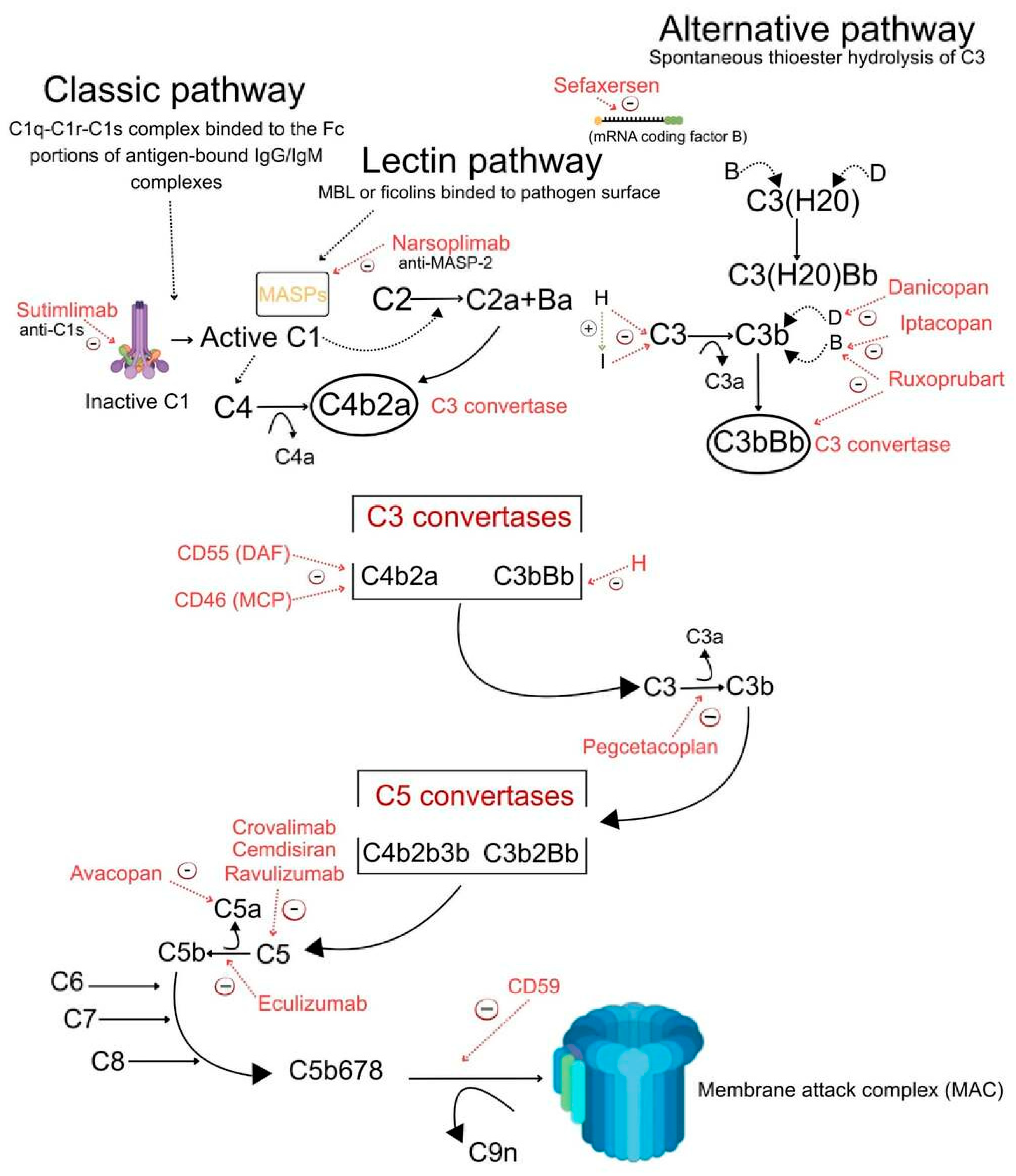
2. Mechanisms of Complement Activation
3. Regulation and Homeostasis of the Complement System
4. Pathogenesis of Complement-Dependent Kidney Diseases
4.1. Acute Kidney Injury (AKI)
4.2. Lupus Nephritis (LN)
4.3. C3 Glomerulopathy
4.4. Atypical Hemolytic Uremic Syndrome (aHUS)
4.5. IgA Nephropathy (IgAN)
4.6. Acute Post-Infectious GN (Glomerulonephritis)
4.7. Diabetic Kidney Disease (DKD)
5. Agents Targeting the Complement System in Kidney Diseases
5.1. Eculizumab
5.2. Ravulizumab
5.3. Pegcetacoplan
5.4. Iptacopan (LNP023)
5.5. Danicopan (ACH-4471)
5.6. Avacopan (CCX168)
5.7. Cemdisiran (N-Acetylgalactosamine or GalNAc-Conjugated siRNA)
5.8. Crovalimab
5.9. Sutimlimab
5.10. Narsoplimab
5.11. Ruxoprubart
5.12. Sefaxersen
6. Clinical Treatment Algorithm for Complement-Mediated Kidney Diseases
6.1. aHUS
6.2. C3 Glomerulopathy (C3G) and Immune Complex Mediated MPGN (IC-MPGN)
6.3. IgA Nephropathy
6.4. Acute Post-Infectious Glomerulonephritis (APIGN/PIGN)
6.5. Acute Kidney Injury and Ischemia–Reperfusion
6.6. Diabetic Kidney Disease (DKD)
7. Future Directions
8. Conclusions
Author Contributions
Funding
Institutional Review Board Statement
Informed Consent Statement
Data Availability Statement
Conflicts of Interest
Abbreviations
| AKI | Acute Kidney Injury |
| aHUS | Atypical Hemolytic Uremic Syndrome |
| LN | Lupus Nephritis |
| SLE | Systemic Lupus Erythematosus |
| C3G | Complement 3 Glomerulopathy |
| IgAN | IgA Nephropathy |
| DKD | Diabetic Kidney Disease |
| PIGN | Post-Infectious Glomerulonephritis |
| APIGN | Acute Post-Infectious Glomerulonephritis |
| TMA | Thrombotic Microangiopathy |
| PNH | Paroxysmal Nocturnal Hemoglobinuria |
| DGF | Delayed Graft Function |
| CP | Classical Pathway |
| LP | Lectin Pathway |
| AP | Alternative Pathway |
| MAC | Membrane Attack Complex |
| sC5b-9 | Soluble C5b-9 |
| FH | Factor H |
| FI | Factor I |
| DAF | Decay-Accelerating Factor |
| MCP | Membrane Cofactor Protein |
| C1-INH | C1 Inhibitor |
| MBL | Mannose-Binding Lectin |
| MASP | MBL-Associated Serine Protease |
| CRD | Carbohydrate Recognition Domain |
| CCP | Complement Control Protein |
| Ba/Bb | Factor B fragments |
| CFH | Complement Factor H |
| CFI | Complement Factor I |
| CFB | Complement Factor B |
| CFHR | Complement Factor H–Related protein |
| C5aR1 | C5a Receptor 1 |
| PI3K | Phosphoinositide 3-Kinase |
| PLCβ | Phospholipase C beta |
| IL-6 | Interleukin 6 |
| IL-6R | Interleukin 6 Receptor |
| sIL-6R | Soluble Interleukin 6 Receptor |
| IL-17A | Interleukin 17A |
| IL-18 | Interleukin 18 |
| IL-1β | Interleukin 1 beta |
| TNF-α | Tumor Necrosis Factor alpha |
| TNF-R1 | Tumor Necrosis Factor Receptor 1 |
| STAT3 | Signal Transducer and Activator of Transcription 3 |
| NF-κB | Nuclear Factor kappa B |
| Akt | Protein Kinase B |
| IP3 | Inositol 1,4,5-trisphosphate |
| Gi | Inhibitory G protein |
| Gβγ | G protein beta-gamma subunits |
| Th17 | T helper 17 cells |
| Treg | Regulatory T cells |
| EC4d | Erythrocyte-bound C4d |
| BC4d | B cell-bound C4d |
| CB-CAPs | Cell-bound Complement Activation Products |
| DDD | Dense Deposit Disease |
| C3GN | C3 Glomerulonephritis |
| IC-MPGN | Immune Complex–Mediated Membranoproliferative Glomerulonephritis |
| ANCA | Anti-Neutrophil Cytoplasmic Antibodies |
| rs17611 | Reference SNP ID number 17611 |
| TTP | Thrombotic Thrombocytopenic Purpura |
| ADAMTS13 | A Disintegrin and Metalloproteinase with Thrombospondin Motifs 13 |
| AtCVID | autoimmunity-associated common variable immunodeficiency |
| eGFR | Estimated glomerular filtration rate |
| UPCR | Urine Protein-to-Creatinine Ratio |
| ECG | Electrocardiogram |
| GalNAc | N-Acetylgalactosamine |
| siRNA | small interfering RNA |
| ICER | Incremental Cost-Effectiveness Ratio |
| QALY | Quality-Adjusted Life Year |
References
- Thurman, J.M. Therapeutic regulation of complement in patients with renal disease—Where is the promise? Clin. Nephrol. 2012, 77, 413–423. [Google Scholar] [CrossRef] [Scilit]
- Freiwald, T.; Afzali, B. Renal diseases and the role of complement: Linking complement to immune effector pathways and therapeutics. Adv. Immunol. 2021, 152, 1–81. [Google Scholar] [PubMed]
- Vivarelli, M.; Barratt, J.; Beck, L.H., Jr.; Fakhouri, F.; Gale, D.P.; de Jorge, E.G.; Mosca, M.; Noris, M.; Pickering, M.C.; Susztak, K.; et al. The role of complement in kidney disease: Conclusions from a Kidney Disease: Improving Global Outcomes (KDIGO) Controversies Conference. Kidney Int. 2024, 106, 369–391. [Google Scholar] [CrossRef] [Scilit]
- Buelli, S.; Imberti, B.; Morigi, M. The Complement C3a and C5a Signaling in Renal Diseases: A Bridge between Acute and Chronic Inflammation. Nephron 2024, 148, 712–723. [Google Scholar] [CrossRef] [Scilit]
- Heidenreich, K.; Goel, D.; Priyamvada, P.S.; Kulkarni, S.; Chakurkar, V.; Khullar, D.; Singh, R.; Bale, C.; Zipfel, P.F. C3 glomerulopathy: A kidney disease mediated by alternative pathway deregulation. Front. Nephrol. 2024, 4, 1460146. [Google Scholar] [CrossRef] [Scilit] [PubMed]
- Kesarwani, V.; Bukhari, M.H.; Kahlenberg, J.M.; Wang, S. Urinary complement biomarkers in immune-mediated kidney diseases. Front. Immunol. 2024, 15, 1357869. [Google Scholar] [CrossRef] [Scilit] [PubMed]
- Bomback, A.S.; Markowitz, G.S.; Appel, G.B. Complement-Mediated Glomerular Diseases: A Tale of 3 Pathways. Kidney Int. Rep. 2016, 1, 148–155. [Google Scholar] [CrossRef] [Scilit] [PubMed]
- Crunkhorn, S. Blocking the alternative complement pathway. Nat. Rev. Drug Discov. 2016, 15, 822. [Google Scholar] [CrossRef] [Scilit] [PubMed]
- Wu, M.; Jia, B.B.; Li, M.F. Complement C3 and Activated Fragment C3a Are Involved in Complement Activation and Anti-Bacterial Immunity. Front. Immunol. 2022, 13, 813173. [Google Scholar] [CrossRef] [Scilit] [PubMed]
- Zwarthoff, S.A.; Widmer, K.; Kuipers, A.; Strasser, J.; Ruyken, M.; Aerts, P.C.; de Haas, C.J.; Ugurlar, D.; den Boer, M.A.; Vidarsson, G.; et al. C1q binding to surface-bound IgG is stabilized by C1r2s2 proteases. Proc. Natl. Acad. Sci. USA 2021, 118, e2102787118. [Google Scholar] [CrossRef] [Scilit]
- Mortensen, S.A.; Sander, B.; Jensen, R.K.; Pedersen, J.S.; Golas, M.M.; Jensenius, J.C.; Hansen, A.G.; Thiel, S.; Andersen, G.R. Structure and activation of C1, the complex initiating the classical pathway of the complement cascade. Proc. Natl. Acad. Sci. USA 2017, 114, 986–991. [Google Scholar]
- Rossi, V.; Bally, I.; Lacroix, M.; Arlaud, G.J.; Thielens, N.M. Classical complement pathway components C1r and C1s: Purification from human serum and in recombinant form and functional characterization. Methods Mol. Biol. 2014, 1100, 43–60. [Google Scholar] [PubMed]
- Mortensen, S.; Jensen, J.K.; Andersen, G.R. Solution Structures of Complement C2 and Its C4 Complexes Propose Pathway-specific Mechanisms for Control and Activation of the Complement Proconvertases. J. Biol. Chem. 2016, 291, 16494–16507. [Google Scholar] [CrossRef] [Scilit]
- Laskowski, J.; Philbrook, H.T.; Parikh, C.R.; Thurman, J.M. Urine complement activation fragments are increased in patients with kidney injury after cardiac surgery. Am. J. Physiol. Ren. Physiol. 2019, 317, F650–F657. [Google Scholar] [CrossRef] [Scilit] [PubMed]
- Brandwijk, R.J.; Michels, M.A.; van Rossum, M.; de Nooijer, A.H.; Nilsson, P.H.; de Bruin, W.C.; Toonen, E.J. Pitfalls in complement analysis: A systematic literature review of assessing complement activation. Front. Immunol. 2022, 13, 1007102. [Google Scholar] [CrossRef] [Scilit]
- Mortensen, S.; Kidmose, R.T.; Petersen, S.V.; Szilágyi, Á.; Prohászka, Z.; Andersen, G.R. Structural Basis for the Function of Complement Component C4 within the Classical and Lectin Pathways of Complement. J. Immunol. 2015, 194, 5488–5496. [Google Scholar] [CrossRef] [Scilit]
- Abendstein, L.; Dijkstra, D.J.; Tjokrodirijo, R.T.; van Veelen, P.A.; Trouw, L.A.; Hensbergen, P.J.; Sharp, T.H. Complement is activated by elevated IgG3 hexameric platforms and deposits C4b onto distinct antibody domains. Nat. Commun. 2023, 14, 4027. [Google Scholar] [CrossRef] [Scilit]
- Bartlomiejczyk, M.A.; Swierzko, A.S.; Brzostek, A.; Dziadek, J.; Cedzynski, M. Interaction of lectin pathway of complement-activating pattern recognition molecules with mycobacteria. Clin. Exp. Immunol. 2014, 178, 310–319. [Google Scholar] [CrossRef] [Scilit]
- Wallis, R.; Dodds, A.W.; Mitchell, D.A.; Sim, R.B.; Reid, K.B.; Schwaeble, W.J. Molecular interactions between MASP-2, C4, and C2 and their activation fragments leading to complement activation via the lectin pathway. J. Biol. Chem. 2007, 282, 7844–7851. [Google Scholar] [CrossRef] [Scilit] [PubMed]
- Nakhla, M.C.; Comita, J.; Shapiro, A.B.; Moussa, S.H.; Chen, A.; Eyermann, C.J.; O’Donnell, J.P.; Miller, A.A.; Granger, B.A. Small molecule inhibitors of mannan-binding lectin-associated serine Proteases-2 and-3. Eur. J. Med. Chem. 2025, 289, 117238. [Google Scholar] [CrossRef] [Scilit] [PubMed]
- Fromell, K.; Adler, A.; Åman, A.; Manivel, V.A.; Huang, S.; Dührkop, C.; Sandholm, K.; Ekdahl, K.N.; Nilsson, B. Assessment of the Role of C3(H2O) in the Alternative Pathway. Front. Immunol. 2020, 11, 530. [Google Scholar]
- Harboe, M.; Johnson, C.; Nymo, S.; Ekholt, K.; Schjalm, C.; Lindstad, J.K.; Pharo, A.; Hellerud, B.C.; Nilsson Ekdahl, K.; Mollnes, T.E.; et al. Properdin binding to complement activating surfaces depends on initial C3b deposition. Proc. Natl. Acad. Sci. USA 2017, 114, E534–E539. [Google Scholar]
- Zhang, Y.; Nester, C.M.; Martin, B.; Skjoedt, M.O.; Meyer, N.C.; Shao, D.; Borsa, N.; Palarasah, Y.; Smith, R.J. Defining the complement biomarker profile of C3 glomerulopathy. Clin. J. Am. Soc. Nephrol. 2014, 9, 1876–1882. [Google Scholar] [CrossRef] [Scilit] [PubMed]
- Ferreira, V.P.; Pangburn, M.K.; Cortés, C. Complement. control protein factor H: The good, the bad, and the inadequate. Mol. Immunol. 2010, 47, 2187–2197. [Google Scholar] [CrossRef] [Scilit]
- Merle, N.S.; Church, S.E.; Fremeaux-Bacchi, V.; Roumenina, L.T. Complement. System Part. I—Molecular Mechanisms of Activation and Regulation. Front. Immunol. 2015, 6, 262. [Google Scholar]
- Renner, B.; Laskowski, J.; Poppelaars, F.; Ferreira, V.P.; Blaine, J.; Antonioli, A.H.; Hannan, J.P.; Kovacs, J.M.; Van Kooten, C.; You, Z.; et al. Factor H related proteins modulate complement activation on kidney cells. Kidney Int. 2022, 102, 1331–1344. [Google Scholar] [CrossRef] [Scilit]
- Hu, Y.; Shi, M.; Huang, Q.; Wan, S.; Zhang, M.; Wang, Z.; Huang, W.; Zhang, S.; Xiong, F. Urinary complement C3 fragment levels and their clinical relevance in MPO-ANCA-associated vasculitis. Sci. Rep. 2026, 16, 5643. [Google Scholar] [PubMed]
- Zwarthoff, S.A.; Berends, E.T.; Mol, S.; Ruyken, M.; Aerts, P.C.; Józsi, M.; De Haas, C.J.; Rooijakkers, S.H.; Gorham, R.D., Jr. Functional Characterization of Alternative and Classical Pathway C3/C5 Convertase Activity and Inhibition Using Purified Models. Front. Immunol. 2018, 9, 1691. [Google Scholar] [CrossRef] [Scilit]
- Tegla, C.A.; Cudrici, C.; Patel, S.; Trippe, R., III; Rus, V.; Niculescu, F.; Rus, H. Membrane attack by complement: The assembly and biology of terminal complement complexes. Immunol. Res. 2011, 51, 45–60. [Google Scholar] [CrossRef] [Scilit]
- Ding, X.; Qamar, A.; Liu, H. The complement system testing in clinical laboratory. Clin. Chim. Acta 2023, 541, 117238. [Google Scholar] [CrossRef] [Scilit] [PubMed]
- Wijaya, C.; Burns, C.; Hall, S.; Farmer, M.; Jones, D.; Rowlandson, M.; Choi, P.; Formby, M.; de Malmanche, T. Measurement of Complement Activation via Plasma-Soluble C5b-9 Comparison with Terminal Complement Complex Staining in a Series of Kidney Biopsies. Kidney Blood Press. Res. 2023, 48, 220–230. [Google Scholar] [CrossRef] [Scilit]
- Qi, R.; Qin, W. Role of Complement System in Kidney Transplantation: Stepping From Animal Models to Clinical Application. Front. Immunol. 2022, 13, 811696. [Google Scholar] [CrossRef] [Scilit] [PubMed]
- Biggs, R.M.; Makou, E.; Lauder, S.; Herbert, A.P.; Barlow, P.N.; Katti, S.K. An Evaluation of the Complement-Regulating Activities of Human Complement Factor H (FH) Variants Associated with Age-Related Macular Degeneration. Investig. Ophthalmol. Vis. Sci. 2022, 63, 30. [Google Scholar]
- Zhao, F.; Afonso, S.; Lindner, S.; Hartmann, A.; Löschmann, I.; Nilsson, B.; Ekdahl, K.N.; Weber, L.T.; Habbig, S.; Schalk, G.; et al. C3-Glomerulopathy Autoantibodies Mediate Distinct Effects on Complement C3- and C5-Convertases. Front. Immunol. 2019, 10, 1030. [Google Scholar] [CrossRef] [Scilit] [PubMed]
- Michels, M.A.; Volokhina, E.B.; van de Kar, N.C.; van den Heuvel, L.P. Challenges in diagnostic testing of nephritic factors. Front. Immunol. 2022, 13, 1036136. [Google Scholar] [CrossRef] [Scilit]
- Harris, C.L.; Pettigrew, D.M.; Lea, S.M.; Morgan, B.P. Decay-accelerating factor must bind both components of the complement alternative pathway C3 convertase to mediate efficient decay. J. Immunol. 2007, 178, 352–359. [Google Scholar] [CrossRef] [Scilit]
- Liszewski, M.K.; Atkinson, J.P. Membrane cofactor protein (MCP.; CD46): Deficiency states and pathogen connections. Curr. Opin. Immunol. 2021, 72, 126–134. [Google Scholar] [CrossRef] [Scilit]
- Barilla-LaBarca, M.L.; Liszewski, M.K.; Lambris, J.D.; Hourcade, D.; Atkinson, J.P. Role of membrane cofactor protein (CD46) in regulation of C4b and C3b deposited on cells. J. Immunol. 2002, 168, 6298–6304. [Google Scholar]
- Couves, E.C.; Gardner, S.; Voisin, T.B.; Bickel, J.K.; Stansfeld, P.J.; Tate, E.W.; Bubeck, D. Structural basis for membrane attack complex inhibition by CD59. Nat. Commun. 2023, 14, 890. [Google Scholar] [CrossRef] [Scilit]
- Garrigues, R.J.; Garrison, M.P.; Garcia, B.L. The Crystal Structure of the Michaelis-Menten Complex of C1 Esterase Inhibitor and C1s Reveals Novel Insights into Complement Regulation. J. Immunol. 2024, 213, 718–729. [Google Scholar]
- Hurler, L.; Toonen, E.J.; Kajdácsi, E.; van Bree, B.; Brandwijk, R.J.; de Bruin, W.; Lyons, P.A.; Bergamaschi, L.; Sinkovits, G.; Cervenak, L.; et al. Distinction of early complement classical and lectin pathway activation via quantification of C1s/C1-INH and MASP-1/C1-INH complexes using novel ELISAs. Front. Immunol. 2022, 13, 1039765, Erratum in Front. Immunol. 2025, 16, 1561850. [Google Scholar] [CrossRef] [Scilit] [PubMed]
- Osborne, A.J.; Breno, M.; Borsa, N.G.; Bu, F.; Fremeaux-Bacchi, V.; Gale, D.P.; van den Heuvel, L.P.; Kavanagh, D.; Noris, M.; Pinto, S.; et al. Statistical Validation of Rare Complement Variants Provides Insights into the Molecular Basis of Atypical Hemolytic Uremic Syndrome and C3 Glomerulopathy. J. Immunol. 2018, 200, 2464–2478. [Google Scholar] [CrossRef] [Scilit]
- Volokhina, E.; Westra, D.; Xue, X.; Gros, P.; Van de Kar, N.; Van den Heuvel, L. Novel C3 mutation p.Lys65Gln in aHUS affects complement factor H binding. Pediatr. Nephrol. 2012, 27, 1519–1524. [Google Scholar] [CrossRef] [Scilit]
- Haque, A.; Cortes, C.; Alam, M.N.; Sreedhar, M.; Ferreira, V.P.; Pangburn, M.K. Characterization of Binding Properties of Individual Functional Sites of Human Complement Factor H. Front. Immunol. 2020, 11, 1728. [Google Scholar] [CrossRef] [Scilit]
- Slagle, A.K.; Ghiringhelli Borsa, N.; Wang, K.; Taylor, A.O.; Meyer, N.C.; Jones, M.B.; Walls, W.D.; Nelson, A.F.; Roberts, S.M.; Sun, M.; et al. Factor H-related 1 and heparan sulfate architecture contribute to complement dysregulation in C3 glomerulopathy. Front. Immunol. 2025, 16, 1589674. [Google Scholar] [CrossRef] [Scilit]
- Cugno, M.; Berra, S.; Depetri, F.; Tedeschi, S.; Griffini, S.; Grovetti, E.; Caccia, S.; Cresseri, D.; Messa, P.; Testa, S.; et al. IgM Autoantibodies to Complement Factor H in Atypical Hemolytic Uremic Syndrome. J. Am. Soc. Nephrol. 2021, 32, 1227–1235. [Google Scholar] [CrossRef] [Scilit] [PubMed]
- Moore, I.; Strain, L.; Pappworth, I.; Kavanagh, D.; Barlow, P.N.; Herbert, A.P.; Schmidt, C.Q.; Staniforth, S.J.; Holmes, L.V.; Ward, R.; et al. Association of factor H autoantibodies with deletions of CFHR1, CFHR3, CFHR4, and with mutations in CFH, CFI, CD46, and C3 in patients with atypical hemolytic uremic syndrome. Blood 2010, 115, 379–387. [Google Scholar] [CrossRef] [Scilit] [PubMed]
- Sinkovits, G.; Mező, B.; Réti, M.; Müller, V.; Iványi, Z.; Gál, J.; Gopcsa, L.; Reményi, P.; Szathmáry, B.; Lakatos, B.; et al. Complement Overactivation and Consumption Predicts In-Hospital Mortality in SARS-CoV-2 Infection. Front. Immunol. 2021, 12, 663187. [Google Scholar] [CrossRef] [Scilit] [PubMed]
- Nechemia-Arbely, Y.; Barkan, D.; Pizov, G.; Shriki, A.; Rose-John, S.; Galun, E.; Axelrod, J.H. IL-6/IL-6R axis plays a critical role in acute kidney injury. J. Am. Soc. Nephrol. 2008, 19, 1106–1115. [Google Scholar] [CrossRef] [Scilit]
- Dennen, P.; Altmann, C.; Kaufman, J.; Klein, C.L.; Andres-Hernando, A.; Ahuja, N.H.; Edelstein, C.L.; Cadnapaphornchai, M.A.; Keniston, A.; Faubel, S. Urine interleukin-6 is an early biomarker of acute kidney injury in children undergoing cardiac surgery. Crit. Care 2010, 14, R181. [Google Scholar] [CrossRef] [Scilit]
- Luo, C.J.; Luo, F.; Zhang, L.; Xu, Y.; Cai, G.Y.; Fu, B.; Feng, Z.; Sun, X.F.; Chen, X.M. Knockout of interleukin-17A protects against sepsis-associated acute kidney injury. Ann. Intensive Care 2016, 6, 56. [Google Scholar] [CrossRef] [Scilit] [PubMed]
- Jin, H.; Wei, W.; Zhao, Y.; Ma, A.; Sun, K.; Lin, X.; Liu, Q.; Shou, S.; Zhang, Y. The roles of interleukin-17A in risk stratification and prognosis of patients with sepsis-associated acute kidney injury. Kidney Res. Clin. Pract. 2023, 42, 742–750. [Google Scholar] [CrossRef] [Scilit] [PubMed]
- Wu, H.; Craft, M.L.; Wang, P.; Wyburn, K.R.; Chen, G.; Ma, J. IL-18 contributes to renal damage after ischemia-reperfusion. J. Am. Soc. Nephrol. 2008, 19, 2331–2341. [Google Scholar] [CrossRef] [Scilit]
- Haase, M.; Bellomo, R.; Story, D.; Davenport, P.; Haase-Fielitz, A. Urinary interleukin-18 does not predict acute kidney injury after adult cardiac surgery: A prospective observational cohort study. Crit. Care 2008, 12, R96. [Google Scholar] [CrossRef] [Scilit]
- Wu, X.; You, D.; Cui, J.; Yang, L.; Lin, L.; Chen, Y.; Xu, C.; Lian, G.; Wan, J. Reduced Neutrophil Extracellular Trap Formation During Ischemia Reperfusion Injury in C3 KO Mice: C3 Requirement for NETs Release. Front. Immunol. 2022, 13, 781273. [Google Scholar] [CrossRef] [Scilit] [PubMed]
- Zilberman-Itskovich, S.; Abu-Hamad, R.; Stark, M.; Efrati, S. Effect of anti-C5 antibody on recuperation from ischemia/reperfusion-induced acute kidney injury. Ren. Fail. 2019, 41, 967–975. [Google Scholar] [CrossRef] [Scilit] [PubMed]
- Stenson, E.K.; Edelstein, C.L.; You, Z.; Miyazaki-Anzai, S.; Thurman, J.M.; Dixon, B.P.; Zappitelli, M.; Goldstein, S.L.; Arikan, A.A.; Kendrick, J. Urine Complement Factor Ba Is Associated with AKI in Critically Ill Children. Kidney360 2023, 4, 326–332. [Google Scholar] [CrossRef] [Scilit] [PubMed]
- van Doorn, D.P.; dos Santos Junior, A.C.S.; Timmermans, S.A. Urinary Complement. Factor. Ba: A New Tool. for Early Detection of Acute Kidney Injury. Kidney Int. Rep. 2025, 10, 306–308. [Google Scholar] [CrossRef] [Scilit]
- Stenson, E.K.; Edelstein, C.E.; You, Z.; Ostrow, A.; Endre, Z.; Miyazaki-Anzai, S.; Dixon, B.P.; Scott, H.; Aggarwal, N.; Thurman, J.M.; et al. Urine Complement Factor Ba Identifies Persistent Acute Kidney Injury and Organ Failures in Critically Ill Adults. Kidney Int. Rep. 2025, 10, 424–431. [Google Scholar] [CrossRef] [Scilit] [PubMed]
- Washburn, K.K.; Zappitelli, M.; Arikan, A.A.; Loftis, L.; Yalavarthy, R.; Parikh, C.R.; Edelstein, C.L.; Goldstein, S.L. Urinary interleukin-18 is an acute kidney injury biomarker in critically ill children. Nephrol. Dial. Transplant. 2008, 23, 566–572. [Google Scholar] [CrossRef] [Scilit] [PubMed]
- Stenson, E.K.; You, Z.; Reeder, R.; Norris, J.; Scott, H.F.; Dixon, B.P.; Thurman, J.M.; Frazer-Abel, A.; Mourani, P. Complement Activation Fragments Are Increased in Critically Ill Pediatric Patients with Severe AKI. Kidney360 2021, 2, 1884–1891. [Google Scholar] [CrossRef] [Scilit]
- Henry, B.M.; Szergyuk, I.; de Oliveira, M.H.S.; Lippi, G.; Benoit, J.L.; Vikse, J.; Benoit, S.W. Complement levels at admission as a reflection of coronavirus disease 2019 (COVID-19) severity state. J. Med. Virol. 2021, 93, 5515–5522. [Google Scholar] [CrossRef] [Scilit] [PubMed]
- Lasorsa, F.; Rutigliano, M.; Milella, M.; d’Amati, A.; Crocetto, F.; Pandolfo, S.D.; Barone, B.; Ferro, M.; Spilotros, M.; Battaglia, M.; et al. Ischemia–Reperfusion Injury in Kidney Transplantation: Mechanisms and Potential Therapeutic Targets. Int. J. Mol. Sci. 2024, 25, 4332. [Google Scholar] [CrossRef] [Scilit]
- Smith, S.F.; Hosgood, S.A.; Nicholson, M.L. Nicholson, Ischemia-reperfusion injury in renal transplantation: 3 key signaling pathways in tubular epithelial cells. Kidney Int. 2019, 95, 50–56. [Google Scholar] [CrossRef] [Scilit]
- Renaudineau, Y.; Brooks, W.; Belliere, J. Lupus Nephritis Risk Factors and Biomarkers: An. Update. Int. J. Mol. Sci. 2023, 24, 14526. [Google Scholar] [CrossRef] [Scilit]
- Wang, X.; Fu, S.; Yu, J.; Tang, D.; Wu, H.; Xu, Z. Renal C4d is a potential biomarker of disease activity and severity in pediatric lupus nephritis patients. Front. Pediatr. 2023, 11, 1193917. [Google Scholar] [CrossRef] [Scilit] [PubMed]
- Ayano, M.; Horiuchi, T. Complement as a Biomarker for Systemic Lupus Erythematosus. Biomolecules 2023, 13, 367. [Google Scholar] [CrossRef] [Scilit]
- Iwano, M.; Dohi, K.; Hirata, E.; Kurumatani, N.; Horii, Y.; Shiiki, H.; Fukatsu, A.; Matsuda, T.; Hirano, T.; Kishimoto, T. Urinary levels of IL-6 in patients with active lupus nephritis. Clin. Nephrol. 1993, 40, 16–21. [Google Scholar] [PubMed]
- El-Shereef, R.R.; Lotfi, A.; Abdel-Naeam, E.A.; Tawfik, H. Serum and Urinary Interleukin-6 in Assessment of Renal Activity in Egyptian Patients with Systemic Lupus Erythematosus. Clin. Med. Insights Arthritis Musculoskelet. Disord. 2016, 9, 29–36. [Google Scholar] [CrossRef] [Scilit]
- Ahmed, A.M.; Ahmed, A.A.; Ismail, F.; Elsayed, S.A. Elsayed, Interleukin-17 as a biomarker for lupus nephritis: Correlation with disease activity indices and histopathological classification. Egypt. Rheumatol. Rehabil. 2024, 51, 36. [Google Scholar] [CrossRef] [Scilit]
- Song, D.; Guo, W.Y.; Wang, F.M.; Li, Y.Z.; Song, Y.; Yu, F.; Zhao, M.H. Complement Alternative Pathway’s Activation in Patients with Lupus Nephritis. Am. J. Med. Sci. 2017, 353, 247–257. [Google Scholar] [CrossRef] [Scilit]
- Merrill, J.T.; Petri, M.A.; Buyon, J.; Ramsey-Goldman, R.; Kalunian, K.; Putterman, C.; Conklin, J.; Furie, R.A.; Dervieux, T. Erythrocyte-bound C4d in combination with complement and autoantibody status for the monitoring of SLE. Lupus Sci. Med. 2018, 5, e000263. [Google Scholar] [CrossRef] [Scilit]
- Ramsey-Goldman, R.; Li, J.; Dervieux, T.; Alexander, R.V. Cell-bound complement activation products in SLE. Lupus Sci. Med. 2017, 4, e000236. [Google Scholar] [CrossRef] [Scilit]
- Martin, M.; Trattner, R.; Nilsson, S.C.; Björk, A.; Zickert, A.; Blom, A.M.; Gunnarsson, I. Plasma C4d Correlates with C4d Deposition in Kidneys and with Treatment Response in Lupus Nephritis Patients. Front. Immunol. 2020, 11, 582737. [Google Scholar] [CrossRef] [Scilit] [PubMed]
- Birmingham, D.J.; Irshaid, F.; Nagaraja, H.N.; Zou, X.; Tsao, B.P.; Wu, H.; Yu, C.Y.; Hebert, L.A.; Rovin, B.H. The complex nature of serum C3 and C4 as biomarkers of lupus renal flare. Lupus 2010, 19, 1272–1280. [Google Scholar] [CrossRef] [Scilit]
- Batal, I.; Liang, K.; Bastacky, S.; Kiss, L.P.; McHale, T.; Wilson, N.L.; Paul, B.; Lertratanakul, A.; Ahearn, J.M.; Manzi, S.M.; et al. Prospective assessment of C4d deposits on circulating cells and renal tissues in lupus nephritis: A pilot study. Lupus 2012, 21, 13–26. [Google Scholar] [CrossRef] [Scilit]
- Martin, M.; Smoląg, K.I.; Björk, A.; Gullstrand, B.; Okrój, M.; Leffler, J.; Jönsen, A.; Bengtsson, A.A.; Blom, A.M. Plasma C4d as marker for lupus nephritis in systemic lupus erythematosus. Arthritis Res. Ther. 2017, 19, 266. [Google Scholar] [CrossRef] [Scilit] [PubMed]
- Toy, C.R.; Song, H.; Nagaraja, H.N.; Scott, J.; Greco, J.; Zhang, X.; Yu, C.Y.; Tumlin, J.A.; Rovin, B.H.; Hebert, L.A.; et al. The Influence of an Elastase-Sensitive Complement C5 Variant on Lupus Nephritis and Its Flare. Kidney Int. Rep. 2021, 6, 2105–2113. [Google Scholar] [CrossRef] [Scilit] [PubMed]
- Mirioglu, S.; Cebeci, E.; Yazici, H.; Derici, U.; Sahin, G.; Coban, G.; Eren, N.; Gungor, O.; Dede, F.; Dincer, T.; et al. Prognostic factors and validation of the histologic chronicity score for C3 glomerulopathy: A registry analysis. Clin. Kidney J. 2024, 17, sfae077. [Google Scholar] [CrossRef] [Scilit] [PubMed]
- Heiderscheit, A.K.; Hauer, J.J.; Smith, R.J. C3 glomerulopathy: Understanding an ultra-rare complement-mediated renal disease. Am. J. Med. Genet. C Semin. Med. Genet. 2022, 190, 344–357. [Google Scholar] [CrossRef] [Scilit]
- Mashayekhi, M.; Zuckerman, J.E.; Barratt, J.; Glassock, R.J.; Caravaca-Fontán, F.; Hsu, R.K.; Rajasekaran, A.; Lerma, E.; Noor, S.M.; Abdipour, A.; et al. C3 Glomerulopathy Diagnosis, Current Treatments, and Emerging Therapies. Kidney Med. 2026, 8, 101258. [Google Scholar] [CrossRef] [Scilit]
- Biswas, P.S. IL-17 in Renal Immunity and Autoimmunity. J. Immunol. 2018, 201, 3153–3159. [Google Scholar] [CrossRef] [Scilit]
- Su, H.; Lei, C.T.; Zhang, C. Interleukin-6 Signaling Pathway and Its Role in Kidney Disease: An Update. Front. Immunol. 2017, 8, 405. [Google Scholar] [CrossRef] [Scilit]
- Bomback, A.S.; Santoriello, D.; Avasare, R.S.; Regunathan-Shenk, R.; Canetta, P.A.; Ahn, W.; Radhakrishnan, J.; Marasa, M.; Rosenstiel, P.E.; Herlitz, L.C.; et al. C3 glomerulonephritis and dense deposit disease share a similar disease course in a large United States cohort of patients with C3 glomerulopathy. Kidney Int. 2018, 93, 977–985. [Google Scholar] [CrossRef] [Scilit] [PubMed]
- Ueda, C.; Horinouchi, T.; Inoki, Y.; Ichikawa, Y.; Tanaka, Y.; Kitakado, H.; Kondo, A.; Sakakibara, N.; Nagano, C.; Yamamura, T.; et al. Clinical characteristics and outcomes of immune-complex membranoproliferative glomerulonephritis and C3 glomerulopathy in Japanese children. Pediatr. Nephrol. 2024, 39, 2679–2689. [Google Scholar] [CrossRef] [Scilit] [PubMed]
- Michels, M.A.; Wijnsma, K.L.; Kurvers, R.A.; Westra, D.; Schreuder, M.F.; van Wijk, J.A.; Bouts, A.H.; Gracchi, V.; Engels, F.A.; Keijzer-Veen, M.G.; et al. Long-term follow-up including extensive complement analysis of a pediatric C3 glomerulopathy cohort. Pediatr. Nephrol. 2022, 37, 601–612. [Google Scholar] [CrossRef] [Scilit]
- Chauvet, S.; Hauer, J.J.; Petitprez, F.; Rabant, M.; Martins, P.V.; Baudouin, V.; Delmas, Y.; Jourde-Chiche, N.; Cez, A.; Ribes, D.; et al. Results from a nationwide retrospective cohort measure the impact of C3 and soluble C5b-9 levels on kidney outcomes in C3 glomerulopathy. Kidney Int. 2022, 102, 904–916. [Google Scholar] [CrossRef] [Scilit]
- Meuleman, M.S.; Vieira-Martins, P.; El Sissy, C.; Audard, V.; Baudouin, V.; Bertrand, D.; Bridoux, F.; Louillet, F.; Dossier, C.; Esnault, V.; et al. Rare Variants in Complement Gene in C3 Glomerulopathy and Immunoglobulin-Mediated Membranoproliferative GN. Clin. J. Am. Soc. Nephrol. 2023, 18, 1435–1445. [Google Scholar] [CrossRef] [Scilit] [PubMed]
- Hauer, J.J.; Zhang, Y.; Goodfellow, R.; Taylor, A.; Meyer, N.C.; Roberts, S.; Shao, D.; Fergus, L.; Borsa, N.G.; Hall, M.; et al. Defining Nephritic Factors as Diverse Drivers of Systemic Complement Dysregulation in C3 Glomerulopathy. Kidney Int. Rep. 2024, 9, 464–477. [Google Scholar] [CrossRef] [Scilit]
- Bomback, A.S.; Kavanagh, D.; Vivarelli, M.; Meier, M.; Wang, Y.; Webb, N.J.; Trapani, A.J.; Smith, R.J. Alternative Complement Pathway Inhibition with Iptacopan for the Treatment of C3 Glomerulopathy-Study Design of the APPEAR-C3G Trial. Kidney Int. Rep. 2022, 7, 2150–2159. [Google Scholar] [CrossRef] [Scilit]
- Herlitz, L.C.; Bomback, A.S.; Markowitz, G.S.; Stokes, M.B.; Smith, R.N.; Colvin, R.B.; Appel, G.B.; D’Agati, V.D. Pathology after eculizumab in dense deposit disease and C3 GN. J. Am. Soc. Nephrol. 2012, 23, 1229–1237. [Google Scholar] [CrossRef] [Scilit]
- Gurkan, S.; Fyfe, B.; Weiss, L.; Xiao, X.; Zhang, Y.; Smith, R.J. Eculizumab and recurrent C3 glomerulonephritis. Pediatr. Nephrol. 2013, 28, 1975–1981. [Google Scholar] [CrossRef] [Scilit] [PubMed]
- Le Quintrec, M.; Lapeyraque, A.L.; Lionet, A.; Sellier-Leclerc, A.L.; Delmas, Y.; Baudouin, V.; Daugas, E.; Decramer, S.; Tricot, L.; Cailliez, M.; et al. Patterns of Clinical Response to Eculizumab in Patients with C3 Glomerulopathy. Am. J. Kidney Dis. 2018, 72, 84–92. [Google Scholar] [CrossRef] [Scilit]
- Welte, T.; Arnold, F.; Westermann, L.; Rottmann, F.A.; Hug, M.J.; Neumann-Haefelin, E.; Ganner, A. Eculizumab as a treatment for C3 glomerulopathy: A single-center retrospective study. BMC Nephrol. 2023, 24, 8. [Google Scholar] [CrossRef] [Scilit]
- Leon, J.; LeStang, M.B.; Sberro-Soussan, R.; Servais, A. Complement-driven hemolytic uremic syndrome. Am. J. Hematol. 2023, 98, S44–S56. [Google Scholar] [CrossRef] [Scilit]
- Obeagu, E.I. Pathogenic cytokines in thrombotic microangiopathies: Molecular insights and therapeutic targets. Mol. Med. 2025, 31, 316. [Google Scholar] [CrossRef] [Scilit] [PubMed]
- Blasco, M.; Guillén-Olmos, E.; Diaz-Ricart, M.; Palomo, M. Complement Mediated Endothelial Damage in Thrombotic Microangiopathies. Front. Med. 2022, 9, 811504. [Google Scholar] [CrossRef] [Scilit] [PubMed]
- Cofiell, R.; Kukreja, A.; Bedard, K.; Yan, Y.; Mickle, A.P.; Ogawa, M.; Bedrosian, C.L.; Faas, S.J. Eculizumab reduces complement activation, inflammation, endothelial damage, thrombosis, and renal injury markers in aHUS. Blood 2015, 125, 3253–3262. [Google Scholar] [CrossRef] [Scilit] [PubMed]
- Halimi, J.M.; Al-Dakkak, I.; Anokhina, K.; Ardissino, G.; Licht, C.; Lim, W.H.; Massart, A.; Schaefer, F.; Walle, J.V.; Rondeau, E. Clinical characteristics and outcomes of a patient population with atypical hemolytic uremic syndrome and malignant hypertension: Analysis from the Global aHUS registry. J. Nephrol. 2023, 36, 817–828. [Google Scholar] [CrossRef] [Scilit] [PubMed]
- Schaefer, F.; Al-Dakkak, I.; Anokhina, K.; Cohen, D.; Greenbaum, L.A.; Ariceta, G. Global aHUS Registry Analysis of Patients Switching to Ravulizumab From Eculizumab. Kidney Int. Rep. 2024, 9, 2648–2656. [Google Scholar] [CrossRef] [Scilit]
- Mocanu, V.D.; Sorohan, B.M.; Micu, E.G.; Bălănică, S.; Obrişcă, B.; Jurubiță, R.A.; Achim, C.A.; Lungu, A.C.; Căpuşă, C.S.; Mircescu, G.; et al. Terminal complement inhibition in atypical haemolytic uremic syndrome: A single-centre experience. Front. Pharmacol. 2025, 16, 1683188, Correction in Front. Pharmacol. 2025, 16, 1760223. [Google Scholar] [CrossRef] [Scilit]
- Massart, A.; Weekers, L.; Claes, K.J.; Van Meerhaeghe, T.; Snauwaert, E.; Mekahli, D.; Goffin, E.; Collard, L.; Godefroid, N.; Adams, B.; et al. Clinical and genetic characteristics of patients diagnosed with atypical hemolytic uremic syndrome (aHUS): Epidemiological data from the Belgian cohort of the Global aHUS Registry. J. Nephrol. 2025, 38, 2841–2850. [Google Scholar] [CrossRef] [Scilit]
- Schaefer, F.; Ardissino, G.; Ariceta, G.; Fakhouri, F.; Scully, M.; Isbel, N.; Lommelé, Å.; Kupelian, V.; Gasteyger, C.; Greenbaum, L.A.; et al. Clinical and genetic predictors of atypical hemolytic uremic syndrome phenotype and outcome. Kidney Int. 2018, 94, 408–418. [Google Scholar] [CrossRef] [Scilit]
- Brocklebank, V.; Walsh, P.R.; Smith-Jackson, K.; Hallam, T.M.; Marchbank, K.J.; Wilson, V.; Bigirumurame, T.; Dutt, T.; Montgomery, E.K.; Malina, M.; et al. Atypical hemolytic uremic syndrome in the era of terminal complement inhibition: An observational cohort study. Blood 2023, 142, 1371–1386. [Google Scholar] [CrossRef] [Scilit] [PubMed]
- Ariceta, G.; Fakhouri, F.; Sartz, L.; Miller, B.; Nikolaou, V.; Cohen, D.; Siedlecki, A.M.; Ardissino, G. Eculizumab discontinuation in atypical haemolytic uraemic syndrome: TMA recurrence risk and renal outcomes. Clin. Kidney J. 2021, 14, 2075–2084. [Google Scholar] [CrossRef] [Scilit]
- Neto, M.E.; de Moraes Soler, L.; Vasconcelos, H.V.G.; Nga, H.S.; Bravin, A.M.; Borges, J.C.A.; Gonçalves, R.C.; Von Kriiger, R.B.; Quinino, R.M.; de Mello Santana, V.B.B.; et al. Eculizumab interruption in atypical hemolytic uremic syndrome due to shortage: Analysis of a Brazilian cohort. J. Nephrol. 2021, 34, 1373–1380. [Google Scholar] [CrossRef] [Scilit] [PubMed]
- Kavanagh, D.; Ardissino, G.; Brocklebank, V.; Bouwmeester, R.N.; Bagga, A.; Ter Heine, R.; Johnson, S.; Licht, C.; Ma, A.L.; Noris, M.; et al. Outcomes from the International Society of Nephrology Hemolytic Uremic Syndromes International Forum. Kidney Int. 2024, 106, 1038–1050. [Google Scholar] [CrossRef] [Scilit]
- Zhuang, Y.; Lu, H.; Li, J. Advances in the treatment of IgA nephropathy with biological agents. Chronic Dis. Transl. Med. 2024, 10, 1–11. [Google Scholar] [CrossRef] [Scilit]
- Niu, X.; Zhang, S.; Shao, C.; Guo, Z.; Wu, J.; Tao, J.; Zheng, K.; Ye, W.; Cai, G.; Sun, W.; et al. Urinary complement proteins in IgA nephropathy progression from a relative quantitative proteomic analysis. PeerJ 2023, 11, e15125. [Google Scholar] [CrossRef] [Scilit] [PubMed]
- Roos, A.; Rastaldi, M.P.; Calvaresi, N.; Oortwijn, B.D.; Schlagwein, N.; van Gijlswijk-Janssen, D.J.; Stahl, G.L.; Matsushita, M.; Fujita, T.; van Kooten, C.; et al. Glomerular activation of the lectin pathway of complement in IgA nephropathy is associated with more severe renal disease. J. Am. Soc. Nephrol. 2006, 17, 1724–1734. [Google Scholar] [CrossRef] [Scilit]
- Wang, Z.; Xie, X.; Li, J.; Zhang, X.; He, J.; Wang, M.; Lv, J.; Zhang, H. Complement Activation Is Associated with Crescents in IgA Nephropathy. Front. Immunol. 2021, 12, 676919. [Google Scholar] [CrossRef] [Scilit]
- Wang, Z.; Jiang, Y.; Chen, P.; Wang, J.; Zhang, X.; Huang, B.; Zhou, X.; Shi, S.; Liu, L.; Lv, J.; et al. The level of urinary C4d is associated with disease progression in IgA nephropathy with glomerular crescentic lesions: A cohort study. Nephrol. Dial. Transplant. 2022, 37, 2119–2127. [Google Scholar] [CrossRef] [Scilit]
- Chiu, Y.L.; Lin, W.C.; Shu, K.H.; Fang, Y.W.; Chang, F.C.; Chou, Y.H.; Wu, C.F.; Chiang, W.C.; Lin, S.L.; Chen, Y.M.; et al. Alternative Complement Pathway Is Activated and Associated with Galactose-Deficient IgA(1) Antibody in IgA Nephropathy Patients. Front. Immunol. 2021, 12, 638309. [Google Scholar] [CrossRef] [Scilit]
- Ștefan, G.; Jullien, P.; Masson, I.; Alamartine, E.; Mariat, C.; Maillard, N. Circulating alternative pathway complement cleavage factor Bb is associated with vascular lesions and outcomes in IgA nephropathy. Nephrol. Dial. Transpl. 2023, 38, ii11–ii18. [Google Scholar] [CrossRef] [Scilit]
- Zhao, W.; Feng, S.; Wang, Y.; Wang, C.; Ren, P.; Zhang, J.; Yu, L.; Zhang, C.; Bai, L.; Chen, Y.; et al. Elevated Urinary IL-6 Predicts the Progression of IgA Nephropathy. Kidney Int. Rep. 2023, 8, 519–530. [Google Scholar] [CrossRef] [Scilit]
- Tang, Y.; He, H.; Hu, P.; Xu, X. T lymphocytes in IgA nephropathy. Exp. Ther. Med. 2020, 20, 186–194. [Google Scholar] [CrossRef] [Scilit] [PubMed]
- Gentile, M.; Sanchez-Russo, L.; Riella, L.V.; Verlato, A.; Manrique, J.; Granata, S.; Fiaccadori, E.; Pesce, F.; Zaza, G.; Cravedi, P. Immune abnormalities in IgA nephropathy. Clin. Kidney J. 2023, 16, 1059–1070. [Google Scholar] [CrossRef] [Scilit] [PubMed]
- Lin, F.J.; Jiang, G.R.; Shan, J.P.; Zhu, C.; Zou, J.; Wu, X.R. Imbalance of regulatory T cells to Th17 cells in IgA nephropathy. Scand. J. Clin. Lab. Investig. 2012, 72, 221–229. [Google Scholar] [CrossRef] [Scilit]
- Zagorec, N.; Horvatić, I.; Kasumović, D.; Osmani, B.; Sović, S.; Nikić, J.; Horaček, M.; Šenjug, P.; Galešić, K.; Galešić Ljubanović, D. C4d Is an Independent Predictor of the Kidney Failure in Primary IgA Nephropathy. J. Clin. Med. 2024, 13, 5338. [Google Scholar] [CrossRef] [Scilit] [PubMed]
- Jiang, Y.; Zan, J.; Shi, S.; Hou, W.; Zhao, W.; Zhong, X.; Zhou, X.; Lv, J.; Zhang, H. Glomerular C4d Deposition and Kidney Disease Progression in IgA Nephropathy: A Systematic Review and Meta-analysis. Kidney Med. 2021, 3, 1014–1021. [Google Scholar] [CrossRef] [Scilit] [PubMed]
- Duan, Z.Y.; Zhang, C.; Chen, X.M.; Cai, G.Y. Blood and urine biomarkers of disease progression in IgA nephropathy. Biomark. Res. 2024, 12, 72. [Google Scholar] [CrossRef] [Scilit]
- Chauvet, S.; Berthaud, R.; Devriese, M.; Mignotet, M.; Martins, P.V.; Robe-Rybkine, T.; Miteva, M.A.; Gyulkhandanyan, A.; Ryckewaert, A.; Louillet, F.; et al. Anti-Factor B Antibodies and Acute Postinfectious GN in Children. J. Am. Soc. Nephrol. 2020, 31, 829–840. [Google Scholar] [CrossRef] [Scilit]
- Barnum, S.R.; Bubeck, D.; Schein, T.N. Soluble Membrane Attack Complex: Biochemistry and Immunobiology. Front. Immunol. 2020, 11, 585108. [Google Scholar] [CrossRef] [Scilit] [PubMed]
- Soto, H.M.; Parra, G.; Rodriguez-Itrube, B. Circulating levels of cytokines in poststreptococcal glomerulonephritis. Clin. Nephrol. 1997, 47, 6–12. [Google Scholar] [PubMed]
- d’Izarny-Gargas, T.; Grapin, M.; Grunenwald, A.; Duong-Van-Huyen, J.P.; Rabant, M.; Lévy, R.; Puel, A.; Toubiana, J.; Boyer, O.; Frémeaux-Bacchi, V.; et al. Diffuse Endocapillary Glomerulonephritis in a Child with IL-17RA Deficiency Emphasizes the Pivotal Role of the Complement Cascade and Anaphylatoxins. Kidney Int. Rep. 2023, 8, 2488–2491. [Google Scholar] [CrossRef] [Scilit] [PubMed]
- Tan, S.M.; Snelson, M.; Østergaard, J.A.; Coughlan, M.T. The Complement Pathway: New Insights into Immunometabolic Signaling in Diabetic Kidney Disease. Antioxid. Redox Signal. 2022, 37, 781–801. [Google Scholar] [CrossRef] [Scilit]
- Jiang, S.; Di, D.; Jiao, Y.; Zou, G.; Gao, H.; Li, W. Complement Deposition Predicts Worsening Kidney Function and Underlines the Clinical Significance of the 2010 Renal Pathology Society Classification of Diabetic Nephropathy. Front. Immunol. 2022, 13, 868127. [Google Scholar] [CrossRef] [Scilit]
- Xu, Z.; Tao, L.; Su, H. The Complement. System in Metabolic-Associated Kidney Diseases. Front. Immunol. 2022, 13, 902063. [Google Scholar] [CrossRef] [Scilit]
- Sun, Z.J.; Chang, D.Y.; Chen, M.; Zhao, M.H. Deficiency of CFB attenuates renal tubulointerstitial damage by inhibiting ceramide synthesis in diabetic kidney disease. JCI Insight 2022, 7, e156748. [Google Scholar] [CrossRef] [Scilit]
- Lu, Q.; Hou, Q.; Cao, K.; Sun, X.; Liang, Y.; Gu, M.; Xue, X.; Zhao, A.Z.; Dai, C. Complement factor B in high glucose–induced podocyte injury and diabetic kidney disease. JCI Insight 2021, 6, e147716. [Google Scholar] [CrossRef] [Scilit]
- Zhang, L.; Xu, F.; Hou, L. IL-6 and diabetic kidney disease. Front. Immunol. 2024, 15, 1465625. [Google Scholar] [CrossRef] [Scilit]
- Ma, J.; Li, Y.J.; Chen, X.; Kwan, T.; Chadban, S.J.; Wu, H. Interleukin 17A promotes diabetic kidney injury. Sci. Rep. 2019, 9, 2264. [Google Scholar] [CrossRef] [Scilit]
- Struijf, E.M.; Karla, I.; Ruyken, M.; de Haas, C.J.; van Oosterom, F.; Siere, D.Y.; van Keulen, J.E.; Heesterbeek, D.A.; Dolk, E.; Heukers, R.; et al. Inhibition of cleavage of human complement component C5 and the R885H C5 variant by two distinct high affinity anti-C5 nanobodies. J. Biol. Chem. 2023, 299, 104956. [Google Scholar] [CrossRef] [Scilit]
- Menne, J.; Delmas, Y.; Fakhouri, F.; Licht, C.; Lommelé, Å.; Minetti, E.E.; Provôt, F.; Rondeau, E.; Sheerin, N.S.; Wang, J.; et al. Outcomes in patients with atypical hemolytic uremic syndrome treated with eculizumab in a long-term observational study. BMC Nephrol. 2019, 20, 125. [Google Scholar] [CrossRef] [Scilit]
- Konar, M.; Granoff, D.M. Eculizumab treatment and impaired opsonophagocytic killing of meningococci by whole blood from immunized adults. Blood 2017, 130, 891–899. [Google Scholar] [CrossRef] [Scilit] [PubMed]
- Carrillo Infante, C.; Mujeebuddinand, A. Eculizumab and ravulizumab clinical trial and real-world pharmacovigilance of meningococcal infections across indications. PLoS ONE 2025, 20, e0332073. [Google Scholar] [CrossRef] [Scilit]
- Benamu, E.; Montoya, J.G. Infections associated with the use of eculizumab: Recommendations for prevention and prophylaxis. Curr. Opin. Infect. Dis. 2016, 29, 319–329. [Google Scholar] [CrossRef] [Scilit]
- van den Brand, J.A.; Verhave, J.C.; Adang, E.M.; Wetzels, J.F. Cost-effectiveness of eculizumab treatment after kidney transplantation in patients with atypical haemolytic uraemic syndrome. Nephrol. Dial. Transplant. 2017, 32, i115–i122. [Google Scholar] [CrossRef] [Scilit] [PubMed]
- Sepúlveda Palamara, R.A.; Modelli de Andrade, L.G.; Fortunato, R.M.; Gómez, B.; Nieto-Ríos, J.F. The long-acting C5 inhibitor, ravulizumab, is effective and safe in pediatric patients with atypical hemolytic uremic syndrome naïve to complement inhibitor treatment. Kidney Int. 2021, 100, 225–237, Erratum in Kidney Int. 2023, 104, 205. [Google Scholar] [CrossRef] [Scilit]
- Rondeau, E.; Scully, M.; Ariceta, G.; Barbour, T.; Cataland, S.; Heyne, N.; Miyakawa, Y.; Ortiz, S.; Swenson, E.; Vallee, M.; et al. The long-acting C5 inhibitor, Ravulizumab, is effective and safe in adult patients with atypical hemolytic uremic syndrome naïve to complement inhibitor treatment. Kidney Int. 2020, 97, 1287–1296, Erratum in Kidney Int. 2020, 98, 1621. [Google Scholar] [CrossRef] [Scilit] [PubMed]
- Dixon, B.P.; Kavanagh, D.; Aris, A.D.M.; Adams, B.; Kang, H.G.; Wang, E.; Garlo, K.; Ogawa, M.; Amancha, P.; Chakravarty, S.; et al. Ravulizumab in Atypical Hemolytic Uremic Syndrome: An Analysis of 2-Year Efficacy and Safety Outcomes in 2 Phase 3 Trials. Kidney Med. 2024, 6, 100855. [Google Scholar] [CrossRef] [Scilit]
- Wang, Y.; Johnston, K.; Popoff, E.; Myren, K.J.; Cheung, A.; Faria, C.; Tomazos, I. A US cost-minimization model comparing ravulizumab versus eculizumab for the treatment of atypical hemolytic uremic syndrome. J. Med. Econ. 2020, 23, 1503–1515. [Google Scholar] [CrossRef] [Scilit]
- Schönfelder, K.; Kühne, L.; Schulte-Kemna, L.; Kaufeld, J.; Rohn, H.; Kribben, A.; Schröppel, B.; Brinkkötter, P.T.; Gäckler, A. Clinical efficacy and safety of switching from eculizumab to ravulizumab in adult patients with aHUS- real-world data. BMC Nephrol. 2024, 25, 202. [Google Scholar] [CrossRef] [Scilit]
- Lamers, C.; Xue, X.; Smieško, M.; van Son, H.; Wagner, B.; Berger, N.; Sfyroera, G.; Gros, P.; Lambris, J.D.; Ricklin, D. Insight into mode-of-action and structural determinants of the compstatin family of clinical complement inhibitors. Nat. Commun. 2022, 13, 5519. [Google Scholar] [CrossRef] [Scilit] [PubMed]
- Fakhouri, F.; Bomback, A.S.; Ariceta, G.; Delmas, Y.; Dixon, B.P.; Gale, D.P.; Greenbaum, L.A.; Han, S.H.; Isbel, N.; Le Quintrec, M.; et al. Trial of Pegcetacoplan in C3 Glomerulopathy and Immune-Complex MPGN. N. Engl. J. Med. 2025, 393, 2210–2220. [Google Scholar] [CrossRef] [Scilit] [PubMed]
- Apellis Pharmaceuticals, Inc. A Phase 3, Randomized, Placebo-Controlled, Double-Blinded, Multicenter Study to Evaluate the Efficacy and Safety of Pegcetacoplan in Patients with C3 Glomerulopathy or Immune-Complex Membranoproliferative Glomerulonephritis; Apellis Pharmaceuticals, Inc.: Waltham, MA, USA, 2021. [Google Scholar]
- Wong, E.; Nester, C.; Cavero, T.; Karras, A.; Le Quintrec, M.; Lightstone, L.; Eisenberger, U.; Soler, M.J.; Kavanagh, D.; Daina, E.; et al. Efficacy and Safety of Iptacopan in Patients with C3 Glomerulopathy. Kidney Int. Rep. 2023, 8, 2754–2764. [Google Scholar] [CrossRef] [Scilit]
- Perkovic, V.; Barratt, J.; Rovin, B.; Kashihara, N.; Maes, B.; Zhang, H.; Trimarchi, H.; Kollins, D.; Papachristofi, O.; Jacinto-Sanders, S.; et al. Alternative Complement Pathway Inhibition with Iptacopan in IgA Nephropathy. N. Engl. J. Med. 2025, 392, 531–543. [Google Scholar] [CrossRef] [Scilit] [PubMed]
- Al Jurdi, A.; Bucay, A.C.; Nissaisorakarn, P.; Gilligan, H.; Avillach, C.T.; Klepeis, V.E.; Smith, R.N.; Palsson, R.; Safa, K.; Riella, L.V. Early Experience with Iptacopan for Recurrent IgA Nephropathy After Kidney Transplantation. Kidney Med. 2026, 8, 101189. [Google Scholar] [CrossRef] [Scilit] [PubMed]
- Achillion Pharmaceiuticals, Inc. A Phase 2, Proof-of-Concept, Randomized, Double-Blinded, Placebo-Controlled Study of ACH-0144471 Treatment for 6 Months in Patients with C3 Glomerulopathy (C3G), with an Open-label Extension; Alexion Pharmaceuticals, Inc.: Boston, MA, USA, 2017. [Google Scholar]
- Achillion Pharmaceiuticals, Inc. An Open-Label Phase 2 Proof-of-Concept Study in Patients with C3 Glomerulopathy (C3G) or Immune-Complex Membranoproliferative Glomerulonephritis (IC-MPGN) Treated with ACH-0144471; Alexion Pharmaceuticals, Inc.: Boston, MA, USA, 2018. [Google Scholar]
- Nester, C.; Appel, G.B.; Bomback, A.S.; Bouman, K.P.; Cook, H.T.; Daina, E.; Dixon, B.P.; Rice, K.; Najafian, N.; Hui, J.; et al. Clinical Outcomes of Patients with C3G or IC-MPGN Treated with the Factor D Inhibitor Danicopan: Final Results from Two Phase 2 Studies. Am. J. Nephrol. 2022, 53, 687–700, Erratum in Am. J. Nephrol. 2022, 53, 859. [Google Scholar] [CrossRef] [Scilit] [PubMed]
- Cortazar, F.B.; Niles, J.L.; Jayne, D.R.; Merkel, P.A.; Bruchfeld, A.; Yue, H.; Schall, T.J.; Bekker, P.; Peh, C.A.; Chakera, A.; et al. Renal Recovery for Patients with ANCA-Associated Vasculitis and Low eGFR in the ADVOCATE Trial of Avacopan. Kidney Int. Rep. 2023, 8, 860–870. [Google Scholar] [CrossRef] [Scilit]
- Jayne, D.R.; Bruchfeld, A.N.; Harper, L.; Schaier, M.; Venning, M.C.; Hamilton, P.; Burst, V.; Grundmann, F.; Jadoul, M.; Szombati, I.; et al. Randomized Trial of C5a Receptor Inhibitor Avacopan in ANCA-Associated Vasculitis. J. Am. Soc. Nephrol. 2017, 28, 2756–2767. [Google Scholar] [CrossRef] [Scilit]
- CADTH. Reimbursement Reviews and Recommendations, in Avacopan (Tavneos): CADTH Reimbursement Recommendation: Indication: For the Adjunctive Treatment of Adult Patients with Severe Active Anti-Neutrophil Cytoplasmic Autoantibody-Associated Vasculitis (Granulomatosis with Polyangiitis and Microscopic Polyangiitis) in Combination with Standard Background Therapy Including Glucocorticoids. Avacopan Does Not Eliminate Glucocorticoid Use; Canadian Agency for Drugs and Technologies in Health: Ottawa, ON, Canada, 2023. [Google Scholar]
- Jayne, D.R.; Merkel, P.A.; Schall, T.J.; Bekker, P. Avacopan for the Treatment of ANCA-Associated Vasculitis. N. Engl. J. Med. 2021, 384, 599–609, Erratum in N. Engl. J. Med. 2024, 390, 388. [Google Scholar] [CrossRef] [Scilit]
- Barratt, J.; Liew, A.; Yeo, S.C.; Fernström, A.; Barbour, S.J.; Sperati, C.J.; Villanueva, R.; Wu, M.J.; Wang, D.; Borodovsky, A.; et al. Phase 2 Trial of Cemdisiran in Adult Patients with IgA Nephropathy: A Randomized Controlled Trial. Clin. J. Am. Soc. Nephrol. 2024, 19, 452–462. [Google Scholar] [CrossRef] [Scilit] [PubMed]
- Röth, A.; He, G.; Tong, H.; Lin, Z.; Wang, X.; Chai-Adisaksopha, C.; Lee, J.H.; Brodsky, A.; Hantaweepant, C.; Dumagay, T.E.; et al. Phase 3 randomized COMMODORE 2 trial: Crovalimab versus eculizumab in patients with paroxysmal nocturnal hemoglobinuria naive to complement inhibition. Am. J. Hematol. 2024, 99, 1768–1777. [Google Scholar] [CrossRef] [Scilit] [PubMed]
- Scheinberg, P.; Clé, D.V.; Kim, J.S.; Nur, E.; Yenerel, M.N.; Barcellini, W.; Bonito, D.; Giai, V.; Hus, M.; Lee, Y.; et al. Phase 3 randomized COMMODORE 1 trial: Crovalimab versus eculizumab in complement inhibitor-experienced patients with paroxysmal nocturnal hemoglobinuria. Am. J. Hematol. 2024, 99, 1757–1767. [Google Scholar] [PubMed]
- Sheerin, N.; Greenbaum, L.A.; Shuichi, I.; Loirat, C.; Maruyama, S.; Zhao, M.H.; Benkali, K.; Pieterse, C.; Shah, M.D.; Sostelly, A.; et al. POS-052 Two Phase III Trials Evaluating Crovalimab in Patients with Atypical Haemolytic Uraemic Syndrome (aHUS): COMMUTE-A and COMMUTE-p. Kidney Int. Rep. 2022, 7, S460–S461. [Google Scholar] [CrossRef] [Scilit]
- ClinicalTrials.gov. A Study to Assess the Efficacy and Safety of BIVV009 (Sutimlimab) in Participants with Primary Cold Agglutinin Disease Who Have a Recent History of Blood Transfusion (Cardinal Study). Available online: https://clinicaltrials.gov/study/NCT03347396 (accessed on 25 November 2025).
- Moore, D.C.; Arnall, J.R. Sutimlimab: A Complement C1s Inhibitor for the Management of Cold Agglutinin Disease-Associated Hemolysis. Ann. Pharmacother. 2023, 57, 970–977. [Google Scholar] [CrossRef] [Scilit]
- Miyakawa, Y.; Sato, E.; Ogawa, Y.; Nishimura, J.I.; Nishimi, M.; Kawaguchi, O.; Tahara, S.; Yamaguchi, M. Long-term safety profile of sutimlimab in adult Japanese patients with cold agglutinin disease. Int. J. Hematol. 2024, 120, 656–664. [Google Scholar] [CrossRef] [Scilit] [PubMed]
- Berentsen, S. Sutimlimab for the Treatment of Cold Agglutinin Disease. Hemasphere 2023, 7, e879. [Google Scholar] [CrossRef] [Scilit]
- Ito, S.; Wang, D.; Purcell, A.; Chetlapalli, K.; Lee, A.I.; Cuker, A.; Goshua, G. Cost-effectiveness of sutimlimab in cold agglutinin disease. Am. J. Hematol. 2024, 99, 1475–1484. [Google Scholar] [CrossRef] [Scilit]
- Lafayette, R.A.; Rovin, B.H.; Reich, H.N.; Tumlin, J.A.; Floege, J.; Barratt, J. Safety, Tolerability and Efficacy of Narsoplimab, a Novel MASP-2 Inhibitor for the Treatment of IgA Nephropathy. Kidney Int. Rep. 2020, 5, 2032–2041. [Google Scholar] [CrossRef] [Scilit]
- ClinicalTrials.gov. A Phase Ib, Open Label, Dose Escalation Study of NM8074 in Subjects with C3 Glomerulopathy (C3G). Available online: https://clinicaltrials.gov/study/NCT05647811 (accessed on 12 February 2026).
- ClinicalTrials.gov. A Phase II, Open-Label Study of NM8074 in Patients with Atypical Hemolytic Uremic Syndrome (aHUS). Available online: https://clinicaltrials.gov/study/NCT05684159 (accessed on 13 February 2026).
- ClinicalTrials.gov. A Phase II, Randomized, Double-Blind, Placebo-Controlled Study of NM8074 in Patients with Anti-Neutrophil Cytoplasmic Antibody (ANCA)-Associated Vasculitis (AAV). Available online: https://clinicaltrials.gov/study/NCT06226662 (accessed on 13 February 2026).
- McCaleb, M.L.; Hughes, S.G.; Grossman, T.R.; Frazer-Abel, A.; Jung, B.; Yin, L.; Henry, S.P.; Monia, B.P.; Schneider, E.; Geary, R.; et al. Inhibiting the alternative pathway of complement by reducing systemic complement factor B: Randomized, double-blind, placebo-controlled phase 1 studies with Sefaxersen. Immunobiology 2025, 230, 152876. [Google Scholar] [CrossRef] [Scilit]
- ClinicalTrials.gov. A Study to Evaluate the Efficacy and Safety of Sefaxersen (RO7434656) in Participants with Primary Immunoglobulin A (IgA) Nephropathy at High Risk of Progression. Available online: https://clinicaltrials.gov/study/NCT05797610 (accessed on 12 February 2026).
- Story, C.M.; Gerber, G.F.; Chaturvedi, S. Medical consult: aHUS, TTP? How to distinguish and what to do. Hematol. Am. Soc. Hematol. Educ. Program. 2023, 2023, 745–753. [Google Scholar] [CrossRef] [Scilit] [PubMed]
- Phillips, E.H.; Westwood, J.P.; Brocklebank, V.; Wong, E.K.S.; Tellez, J.O.; Marchbank, K.J.; McGuckin, S.; Gale, D.P.; Connolly, J.; Goodship, T.H.J.; et al. The role of ADAMTS-13 activity and complement mutational analysis in differentiating acute thrombotic microangiopathies. J. Thromb. Haemost. 2016, 14, 175–185. [Google Scholar] [PubMed]
- Cheong, H.I.; Jo, S.K.; Yoon, S.S.; Cho, H.; Kim, J.S.; Kim, Y.O.; Koo, J.R.; Park, Y.; Park, Y.S.; Shin, J.I.; et al. Clinical Practice Guidelines for the Management of Atypical Hemolytic Uremic Syndrome in Korea. J. Korean Med. Sci. 2016, 31, 1516–1528. [Google Scholar] [CrossRef] [Scilit]
- Vaisbich, M.H.; Andrade, L.G.M.D.; Barbosa, M.I.N.D.H.; Castro, M.C.R.D.; Miranda, S.M.C.; Poli-de-Figueiredo, C.E.; Araujo, S.D.A.; Ernandes Neto, M.; Penido, M.G.M.G.; Sobral, R.M.L.; et al. Recommendations for diagnosis and treatment of Atypical Hemolytic Uremic Syndrome (aHUS): An expert consensus statement from the Rare Diseases Committee of the Brazilian Society of Nephrology (COMDORA-SBN). J. Bras. Nefrol. 2025, 47, e20240087. [Google Scholar] [PubMed]
- Rathbone, J.; Kaltenthaler, E.; Richards, A.; Tappenden, P.; Bessey, A.; Cantrell, A. A systematic review of eculizumab for atypical haemolytic uraemic syndrome (aHUS). BMJ Open 2013, 3, e003573. [Google Scholar] [CrossRef] [Scilit]
- Musalem, P.; Bascur, N.; Sepúlveda, R.A.; Krall, P.; Lazcano, A.; Navarro, G.; Rojo, A.; Grandy, J. Diagnosis and treatment of complement-mediated thrombotic microangiopathies: Consensus of the Genetic Diseases Committee of the Chilean Society of Nephrology. BMC Nephrol. 2026, 27, 21. [Google Scholar] [CrossRef] [Scilit] [PubMed]
- Hanna, R.M.; Chaturvedi, S.; Ong, M.L.; Nag, A.; Song, R.; Huynh, L.; Burdeau, J.A.; Duh, M.S.; Wang, Y. Real-World Effectiveness of Ravulizumab Among C5 Inhibitor-Naive Patients with Atypical Hemolytic Uremic Syndrome: A Physician Panel-Based Chart Review (aHUS IMPACT Study). Kidney Med. 2026, 8, 101198. [Google Scholar]
- McNamara, L.A. High Risk for Invasive Meningococcal Disease Among Patients Receiving Eculizumab (Soliris) Despite Receipt of Meningococcal Vaccine. MMWR Morb. Mortal. Wkly. Rep. 2017, 66, 734–737. [Google Scholar]
- Matsumoto, M.; Miyakawa, Y.; Kokame, K.; Ueda, Y.; Wada, H.; Higasa, S.; Yagi, H.; Ogawa, Y.; Sakai, K.; Miyata, T.; et al. Diagnostic and treatment guidelines for thrombotic thrombocytopenic purpura (TTP) in Japan 2023. Int. J. Hematol. 2023, 118, 529–546. [Google Scholar] [CrossRef] [Scilit]
- Acosta-Medina, A.A.; Moyer, A.M.; Go, R.S.; Willrich, M.A.V.; Fervenza, F.C.; Leung, N.; Bourlon, C.; Winters, J.L.; Spears, G.M.; Bryant, S.C.; et al. Complement gene variant effect on relapse of complement-mediated thrombotic microangiopathy after eculizumab cessation. Blood Adv. 2023, 7, 340–350. [Google Scholar] [CrossRef] [Scilit]
- Ferri, M.; Zotta, F.; Donadelli, R.; Dossier, C.; Duneton, C.; El-Sissy, C.; Fremeau-Bacchi, V.; Kwon, T.; Quadri, L.; Pasini, A.; et al. Anti-CFH-associated hemolytic uremic syndrome: Do we still need plasma exchange? Pediatr. Nephrol. 2024, 39, 3263–3269. [Google Scholar] [CrossRef] [Scilit]
- Sepúlveda Palamara, R.A.; Modelli de Andrade, L.G.; Fortunato, R.M.; Gómez, B.; Nieto-Ríos, J.F. Clinical presentation and management of atypical hemolytic uremic syndrome in Latin America: A narrative review of the literature. Expert. Rev. Hematol. 2024, 17, 361–374. [Google Scholar] [CrossRef] [Scilit]
- Ariceta, G. Pharmacological and clinical profile of ravulizumab 100 mg/mL formulation for paroxysmal nocturnal hemoglobinuria and atypical hemolytic uremic syndrome. Expert. Rev. Clin. Pharmacol. 2023, 16, 401–410. [Google Scholar] [CrossRef] [Scilit]
- Thangaraju, S.; Khandelwal, P.; Mishra, K.; Kumar, M.; Puraswani, M.; Saini, R.; Hari, P.; Coshic, P.; Sinha, A.; Bagga, A. Abbreviated protocol of plasma exchanges for patients with anti-factor H associated hemolytic uremic syndrome. Pediatr. Nephrol. 2024, 39, 2091–2097. [Google Scholar] [CrossRef] [Scilit]
- Noris, M.; Remuzzi, G. C3G and Ig-MPGN—Treatment standard. Nephrol. Dial. Transplant. 2024, 39, 202–214. [Google Scholar] [CrossRef] [Scilit] [PubMed]
- Dixon, B.P.; Greenbaum, L.A.; Huang, L.; Rajan, S.; Ke, C.; Zhang, Y.; Li, L. Clinical Safety and Efficacy of Pegcetacoplan in a Phase 2 Study of Patients with C3 Glomerulopathy and Other Complement-Mediated Glomerular Diseases. Kidney Int. Rep. 2023, 8, 2284–2293. [Google Scholar] [CrossRef] [Scilit] [PubMed]
- Nester, C.M.; Eisenberger, U.; Karras, A.; Le Quintrec, M.; Lightstone, L.; Praga, M.; Remuzzi, G.; Soler, M.J.; Liu, J.; Meier, M.; et al. Iptacopan Reduces Proteinuria and Stabilizes Kidney Function in C3 Glomerulopathy. Kidney Int. Rep. 2025, 10, 432–446. [Google Scholar] [CrossRef] [Scilit] [PubMed]
- Mirioglu, S.; Ozturk, S. Novel treatment strategies for C3 glomerulopathy: Complement blockade. Int. Urol. Nephrol. 2025. [Google Scholar] [CrossRef] [Scilit]
- Nam, K.H.; Kie, J.H.; Lee, M.J.; Chang, T.I.; Kang, E.W.; Kim, D.W.; Lim, B.J.; Park, J.T.; Kwon, Y.E.; Kim, Y.L.; et al. Optimal proteinuria target for renoprotection in patients with IgA nephropathy. PLoS ONE 2014, 9, e101935. [Google Scholar]
- ClinicalTrials.gov. A Study of the Safety and Efficacy of OMS721 in Patients with Immunoglobulin A (IgA) Nephropathy (ARTEMIS-IGAN). Available online: https://clinicaltrials.gov/study/NCT03608033 (accessed on 14 February 2026).
- Zhang, H.; Rizk, D.V.; Perkovic, V.; Maes, B.; Kashihara, N.; Rovin, B.; Trimarchi, H.; Sprangers, B.; Meier, M.; Kollins, D.; et al. Results of a randomized double-blind placebo-controlled Phase 2 study propose iptacopan as an alternative complement pathway inhibitor for IgA nephropathy. Kidney Int. 2024, 105, 189–199. [Google Scholar]
- International Society of Nephrology. KDIGO 2025 Clinical Practice Guideline for the Management of Immunoglobulin A Nephropathy (IgAN) and Immunoglobulin A Vasculitis (IgAV). Kidney Int. 2025, 108, S1–S71. [Google Scholar] [CrossRef] [Scilit] [PubMed]
- Glassock, R.J. An Expert Opinion on Current and Future Treatment Approaches in IgA Nephropathy. Adv. Ther. 2025, 42, 2545–2558. [Google Scholar] [CrossRef] [Scilit]
- Maixnerova, D.; Hartinger, J.; Tesar, V. Expanding options of supportive care in IgA nephropathy. Clin. Kidney J. 2023, 16, ii47–ii54. [Google Scholar] [CrossRef] [Scilit] [PubMed]
- Halacova, N.; Brndiarova, M.; Slenker, B.; Ruzinak Bobcakova, A.; Schniederova, M.; Markocsy, A.; Urbancikova, I.; Jesenak, M. Complement Inhibitors and the Risk of (Breakthrough) Infections—Critical Analysis and Preventive Strategies. Biologics 2026, 6, 3. [Google Scholar] [CrossRef] [Scilit]
- Thurman, J.M.; Fremeaux-Bacchi, V. Alternative pathway diagnostics. Immunol. Rev. 2023, 313, 225–238. [Google Scholar] [PubMed]
- Wada, Y.; Kamata, M.; Miyasaka, R.; Abe, T.; Kawamura, S.; Takeuchi, K.; Aoyama, T.; Oda, T.; Takeuchi, Y. Clinico-Pathogenic Similarities and Differences between Infection-Related Glomerulonephritis and C3 Glomerulopathy. Int. J. Mol. Sci. 2023, 24, 8432. [Google Scholar] [CrossRef] [Scilit]
- Duong, M.D.; Reidy, K.J. Acute Postinfectious Glomerulonephritis. Pediatr. Clin. North. Am. 2022, 69, 1051–1078. [Google Scholar] [CrossRef] [Scilit]
- Chehade, H.; Rotman, S.; Frémeaux-Bacchi, V.; Aubert, V.; Sadallah, S.; Sifaki, L.; Salomon, R.; Pascual, M. Blockade of C5 in Severe Acute Postinfectious Glomerulonephritis Associated with Anti-Factor H Autoantibody. Am. J. Kidney Dis. 2016, 68, 944–948. [Google Scholar]
- Chehade, H.; Guzzo, G.; Cachat, F.; Rotman, S.; Teta, D.; Pantaleo, G.; Sadallah, S.; Sharma, A.; Rosales, I.A.; Tolkoff-Rubin, N.; et al. Eculizumab as a New Treatment for Severe Acute Post-infectious Glomerulonephritis: Two Case Reports. Front. Med. 2021, 8, 663258. [Google Scholar] [CrossRef] [Scilit] [PubMed]
- Delaura, I.F.; Gao, Q.; Anwar, I.J.; Abraham, N.; Kahan, R.; Hartwig, M.G.; Barbas, A.S. Complement-targeting therapeutics for ischemia-reperfusion injury in transplantation and the potential for ex vivo delivery. Front. Immunol. 2022, 13, 1000172. [Google Scholar] [CrossRef] [Scilit]
- Trambas, I.A.; Coughlan, M.T.; Tan, S.M. Therapeutic Potential of Targeting Complement C5a Receptors in Diabetic Kidney Disease. Int. J. Mol. Sci. 2023, 24, 8758. [Google Scholar] [CrossRef] [Scilit]
- Md Dom, Z.I.; Moon, S.; Satake, E.; Hirohama, D.; Palmer, N.D.; Lampert, H.; Ficociello, L.H.; Abedini, A.; Fernandez, K.; Liang, X.; et al. Urinary Complement proteome strongly linked to diabetic kidney disease progression. Nat. Commun. 2025, 16, 7291. [Google Scholar] [CrossRef] [Scilit]
- Yun, D.; Bae, S.; Gao, Y.; Lopez, L.; Han, D.; Nicora, C.D.; Kim, T.Y.; Moon, K.C.; Kim, D.K.; Fillmore, T.L.; et al. Complement Proteins Identify Rapidly Progressive Diabetic Kidney Disease. Kidney Int. Rep. 2025, 10, 2296–2310. [Google Scholar] [CrossRef] [Scilit] [PubMed]
- Yang, Y.; Zhang, Y.; Li, Y.; Zhou, X.; Honda, K.; Kang, D.; Wang, M.; Yang, J.H.; Xia, Z.; Wei, Y.; et al. Complement classical and alternative pathway activation contributes to diabetic kidney disease progression: A glomerular proteomics on kidney biopsies. Sci. Rep. 2025, 15, 495. [Google Scholar] [CrossRef] [Scilit]
- Tan, S.M.; Ziemann, M.; Thallas-Bonke, V.; Snelson, M.; Kumar, V.; Laskowski, A.; Nguyen, T.V.; Huynh, K.; Clarke, M.V.; Libianto, R.; et al. Complement C5a Induces Renal Injury in Diabetic Kidney Disease by Disrupting Mitochondrial Metabolic Agility. Diabetes 2020, 69, 83–98. [Google Scholar] [CrossRef] [Scilit] [PubMed]
- Fakhouri, F.; Fila, M.; Hummel, A.; Ribes, D.; Sellier-Leclerc, A.L.; Ville, S.; Pouteil-Noble, C.; Coindre, J.P.; Le Quintrec, M.; Rondeau, E.; et al. Eculizumab discontinuation in children and adults with atypical hemolytic-uremic syndrome: A prospective multicenter study. Blood 2021, 137, 2438–2449. [Google Scholar] [CrossRef] [Scilit] [PubMed]
- Fakhouri, F.; Fila, M.; Provôt, F.; Delmas, Y.; Barbet, C.; Châtelet, V.; Rafat, C.; Cailliez, M.; Hogan, J.; Servais, A.; et al. Pathogenic Variants in Complement Genes and Risk of Atypical Hemolytic Uremic Syndrome Relapse after Eculizumab Discontinuation. Clin. J. Am. Soc. Nephrol. 2017, 12, 50–59. [Google Scholar] [CrossRef] [Scilit]
- Chaturvedi, S.; Dhaliwal, N.; Hussain, S.; Dane, K.; Upreti, H.; Braunstein, E.M.; Yuan, X.; Sperati, C.J.; Moliterno, A.R.; Brodsky, R.A. Outcomes of a clinician-directed protocol for discontinuation of complement inhibition therapy in atypical hemolytic uremic syndrome. Blood Adv. 2021, 5, 1504–1512. [Google Scholar] [CrossRef] [Scilit]

| Marker | Sample | Suggested Timing | Short Interpretation | Clinical Status and Practical Limitations |
|---|---|---|---|---|
| sC5b-9 (soluble terminal complex) | Plasma (or urine if validated) | Baseline, post-treatment days 7–14, then monthly while on therapy | Indicates activation of the terminal pathway; used to confirm engagement of targets for C5-directed therapies, as well as to track complement activation. | Closest to clinical implementation, but still limited by inter-assay variability and lack of full standardization. Availability is restricted to specialized laboratories; moderate-to-high cost. |
| Ba (factor B fragment) | Urine (or plasma) | Peri-injury/AKI baseline and early post-op (hours–days) | Serves as an early biomarker of alternative pathway activation in acute kidney injury, potentially preceding increases in creatinine, which can help to triage high-risk patients. | Primarily research-use biomarker. Limited assay standardization, variable availability, and insufficient validation for routine clinical use. |
| Bb | Plasma | Baseline and interval (monthly) | Represents activity of the alternative pathway (AP) convertase, with potential use in selecting alternative pathway-targeting therapies, as well as in pharmacodynamic (PD) assessments. | Research/translational biomarker. Limited availability, lack of standardized thresholds, and inter-laboratory variability constrain clinical use. |
| C3d/C3c | Plasma or tissue (biopsy) | Baseline and on-therapy biopsy | Represents activity of the alternative pathway convertase, with potential use in selecting alternative pathway-targeting therapies, as well as in pharmacodynamic assessments. | Mainly research-based, especially in tissue. Requires specialized techniques; interpretation is not standardized and limits routine applicability. |
| Anti-factor H/nephritic factor (C3NeF) | Plasma | Baseline | Indicates acquired drivers (autoantibodies) with potential as biomarkers predicting responses to convertase-directed strategies or the need for immunomodulatory approaches. | Partially available in clinical practice, but with limited standardization. Assays are heterogeneous, availability is center-dependent, and costs may be high. |
| Complement regulators genetic panel (CFH, CFI, C3, CFB, etc.) | Blood (DNA) | Baseline | Indicates high-risk genetic variants, which have potential as biomarkers predicting prognosis, as well as the duration or choice of complement blockade. | Clinically relevant but specialized. Requires genetic expertise for interpretation; relatively high cost and variable accessibility. Variant significance may be uncertain. |
| Urine complement proteomics (multiplex) | Urine | Baseline (selected intervals in trials) | A combination of biomarkers with potential as an exploratory pharmacodynamic biomarker set, which enriches clinical trials and has correlations with histologic changes. | Exploratory/research-use only. High cost, lack of assay standardization, and limited availability preclude routine clinical implementation. |
| Drug | Phase | Acronym | Mechanism | Indication | Trial ID | References |
|---|---|---|---|---|---|---|
| Eculizumab | pivotal studies/registries | – | anti-C5 monoclonal antibody (terminal pathway blockade) | complement-mediated TMA, aHUS | pivotal studies and registry/prospective programs | [133,134,135,136,137,138] |
| Ravulizumab | Phase 3 | – | long-acting anti-C5 monoclonal antibody | aHUS (adults) | NCT02949128 | [139,140,141,142,143] |
| Pegcetacoplan | Phase 3 | VALIANT | C3/C3b inhibitor | kidney diseases (C3-driven), PNH | NCT05067127 | [144,145,146,147,148] |
| Iptacopan (LNP023) | Phase 3 | APPEAR-C3G; APPLAUSE-IgAN | factor B inhibitor (alternative pathway C3 convertase inhibition) | C3 glomerulopathy; IgA nephropathy | NCT04817618; NCT04578834 | [147,148,149] |
| Danicopan (ACH-4471) | Phase 2 | – | factor D inhibitor | C3G; IC-MPGN | NCT03369236; NCT03459443 | [150,151,152] |
| Avacopan (CCX168) | Phase 3 | ADVOCATE | C5aR1 antagonist | ANCA-associated vasculitis | NCT02994927 | [153,154,155,156] |
| Cemdisiran | Phase 2 | – | GalNAc-conjugated siRNA targeting hepatic C5 synthesis | IgA nephropathy | NCT03841448 | [158] |
| Crovalimab | Phase 3 | COMMUTE-a; COMMUTE-p | anti-C5 antibody with engineered Fc | aHUS | NCT04861259; NCT04958265 | [158,159,160] |
| Sutimlimab | Phase 3 (pivotal) | – | anti-C1s monoclonal antibody (classical pathway inhibition) | cold agglutinin disease | NCT03347396 | [161,162,163,164,165] |
| Narsoplimab | Phase 2 | – | anti-MASP-2 antibody (lectin pathway inhibition) | IgA nephropathy; post-HCT thrombotic microangiopathy | - | [166] |
| Ruxoprubart (NM8074) | Phase Ib (and early clinical) | – | anti-factor Bb monoclonal antibody (alternative pathway C3 convertase inhibition) | C3 glomerulopathy; aHUS; ANCA-associated vasculitis | NCT05647811; NCT05684159; NCT06226662 | [167,168,169] |
| Sefaxersen | Phase 1 and Phase 3 | IMAGINATION | antisense oligonucleotide targeting hepatic factor B mRNA | high-risk IgA nephropathy | NCT05797610 | [170,171] |
| Feature | Proximal Inhibition | Terminal Inhibition |
|---|---|---|
| Target level | Upstream components (C3, factor B, factor D) | Downstream component (C5 or C5a/C5aR1) |
| Examples of drugs | Pegcetacoplan, Iptacopan, Danicopan, Sefaxersen | Eculizumab, Ravulizumab, Avacopan, Crovalimab |
| Mechanism of action | Blocks the formation of C3 convertase or C3 cleavage → inhibits entire cascade amplification | Blocks cleavage of C5 or C5a signaling → prevents MAC formation and terminal inflammation |
| Pathway coverage | Broad (affects classical, lectin, and alternative pathways via C3 or AP-specific inhibition) | Narrow (acts only at the terminal pathway stage |
| Effect on C3 activation | Strong inhibition | No effect |
| Effect on C5 activation/MAC | Prevented indirectly | Directly inhibited |
| Impact on upstream inflammation | Reduces early inflammatory mediators | Limited (upstream activation persists) |
| Disease rationale | Best for diseases driven by alternative pathway dysregulation (e.g., C3G, IgAN) | Effective in diseases with dominant terminal pathway activation (e.g., aHUS, TMA) |
| Efficacy considerations | May better control disease at the source (upstream dysregulation) | May be insufficient when upstream activation remains active |
| Infection risk | Potentially broader (due to upstream blockade of opsonization) | High risk of meningococcal infections (due to MAC inhibition) |
| Advantages | -Targets the root cause of complement activation - Broader pathway control | - Well-established clinical use - Rapid control of severe disease |
| Limitations | - Less long-term clinical data - Possible higher infection susceptibility | - Does not control upstream dysregulation - Variable efficacy in diseases like C3G |
| Personalized medicine role | Preferred when biomarkers indicate alternative pathway activation | Preferred when biomarkers indicate dominant C5/MAC activation |
| Disease | Strategy | Advantages | Limitations | Clinical Positioning |
|---|---|---|---|---|
| aHUS | C5 inhibition (eculizumab, ravulizumab) | Rapid control of TMA; strong evidence base; ravulizumab reduces treatment burden | Does not block upstream complement activation; infection risk; high cost | First-line therapy in suspected complement-mediated aHUS |
| Plasma exchange + immunosuppression | Effective in anti-CFH antibody disease; reduces autoantibody levels | Non-specific; slower onset; invasive (PLEX) | Adjunct or alternative in anti-CFH aHUS or when diagnosis is uncertain | |
| Proximal complement inhibition | Targets upstream dysregulation; potentially more complete pathway control | Limited clinical data in aHUS; unclear long-term outcomes | Emerging option, not yet standard of care | |
| C3G/IC-MPGN | Supportive therapy (RAAS blockade) | Widely available; slows CKD progression; low risk | Does not target the disease mechanism | First-line baseline therapy for all patients |
| C5 inhibition | Some benefit in selected cases | Inconsistent efficacy; does not address upstream AP dysregulation | Limited role, selected or refractory cases | |
| Proximal/AP inhibition (C3, factor B/D) | Mechanistically aligned with AP dysregulation; promising trial results | Limited long-term outcome data; access issues | Preferred targeted therapy in progressive disease | |
| IgA nephropathy | Supportive therapy | Proven benefit on progression; standard of care | Insufficient in high-risk disease | Foundation of treatment |
| Immunosuppression | Effective in active inflammatory lesions | Side effects; variable efficacy | Selected patients with active disease | |
| AP inhibition (e.g., factor B inhibitors) | Reduces proteinuria; oral options available | Long-term renal outcomes unclear | Add-on in high-risk or refractory disease | |
| Terminal pathway inhibition | Potential benefit in selected phenotypes | Limited evidence; unclear target population | Not routine, investigational or niche use | |
| APIGN/PIGN | Supportive therapy | Most cases are self-limited, effective and safe | None in the typical disease | Standard of care |
| Complement inhibition | Strong biological rationale; targets early injury cascade | Lack of robust RCT data; unclear clinical benefit | Experimental/trial-based use | |
| Diabetic kidney disease | Standard therapy (RAAS, SGLT2i, etc.) | Strong evidence; reduces progression risk | Does not directly target the complement | Core therapy |
| Complement inhibition | Mechanistic rationale; biomarker-driven potential | Limited human data; unclear efficacy | Investigational, biomarker-guided trials |
Disclaimer/Publisher’s Note: The statements, opinions and data contained in all publications are solely those of the individual author(s) and contributor(s) and not of MDPI and/or the editor(s). MDPI and/or the editor(s) disclaim responsibility for any injury to people or property resulting from any ideas, methods, instructions or products referred to in the content. |
© 2026 by the authors. Licensee MDPI, Basel, Switzerland. This article is an open access article distributed under the terms and conditions of the Creative Commons Attribution (CC BY) license.
Share and Cite
Jesiołowski, P.; Krzywda, M.; Furmańczyk-Zawiska, A.; Durlik, M. Complement Dysregulation in Kidney Diseases: Mechanisms, Biomarkers, and Emerging Targeted Therapies. Int. J. Mol. Sci. 2026, 27, 3466. https://doi.org/10.3390/ijms27083466
Jesiołowski P, Krzywda M, Furmańczyk-Zawiska A, Durlik M. Complement Dysregulation in Kidney Diseases: Mechanisms, Biomarkers, and Emerging Targeted Therapies. International Journal of Molecular Sciences. 2026; 27(8):3466. https://doi.org/10.3390/ijms27083466
Chicago/Turabian StyleJesiołowski, Patryk, Mateusz Krzywda, Agnieszka Furmańczyk-Zawiska, and Magdalena Durlik. 2026. "Complement Dysregulation in Kidney Diseases: Mechanisms, Biomarkers, and Emerging Targeted Therapies" International Journal of Molecular Sciences 27, no. 8: 3466. https://doi.org/10.3390/ijms27083466
APA StyleJesiołowski, P., Krzywda, M., Furmańczyk-Zawiska, A., & Durlik, M. (2026). Complement Dysregulation in Kidney Diseases: Mechanisms, Biomarkers, and Emerging Targeted Therapies. International Journal of Molecular Sciences, 27(8), 3466. https://doi.org/10.3390/ijms27083466

