Exploring Biomarkers in Congenital Heart Disease: A Case–Control Study of ST2 in Children with Atrial Septal Defects


Abstract
1. Introduction
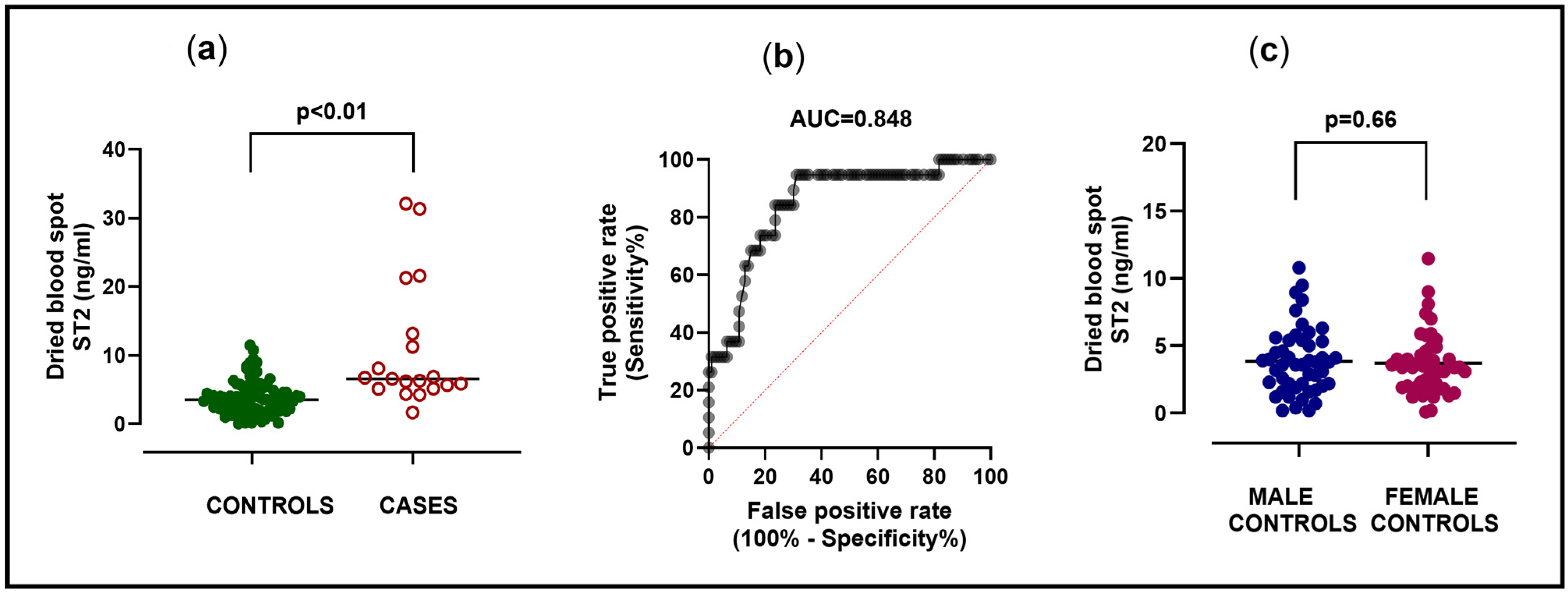
- In newborns with ASD, dried blood spot levels of ST2 are higher than in controls, which could aid early diagnosis.
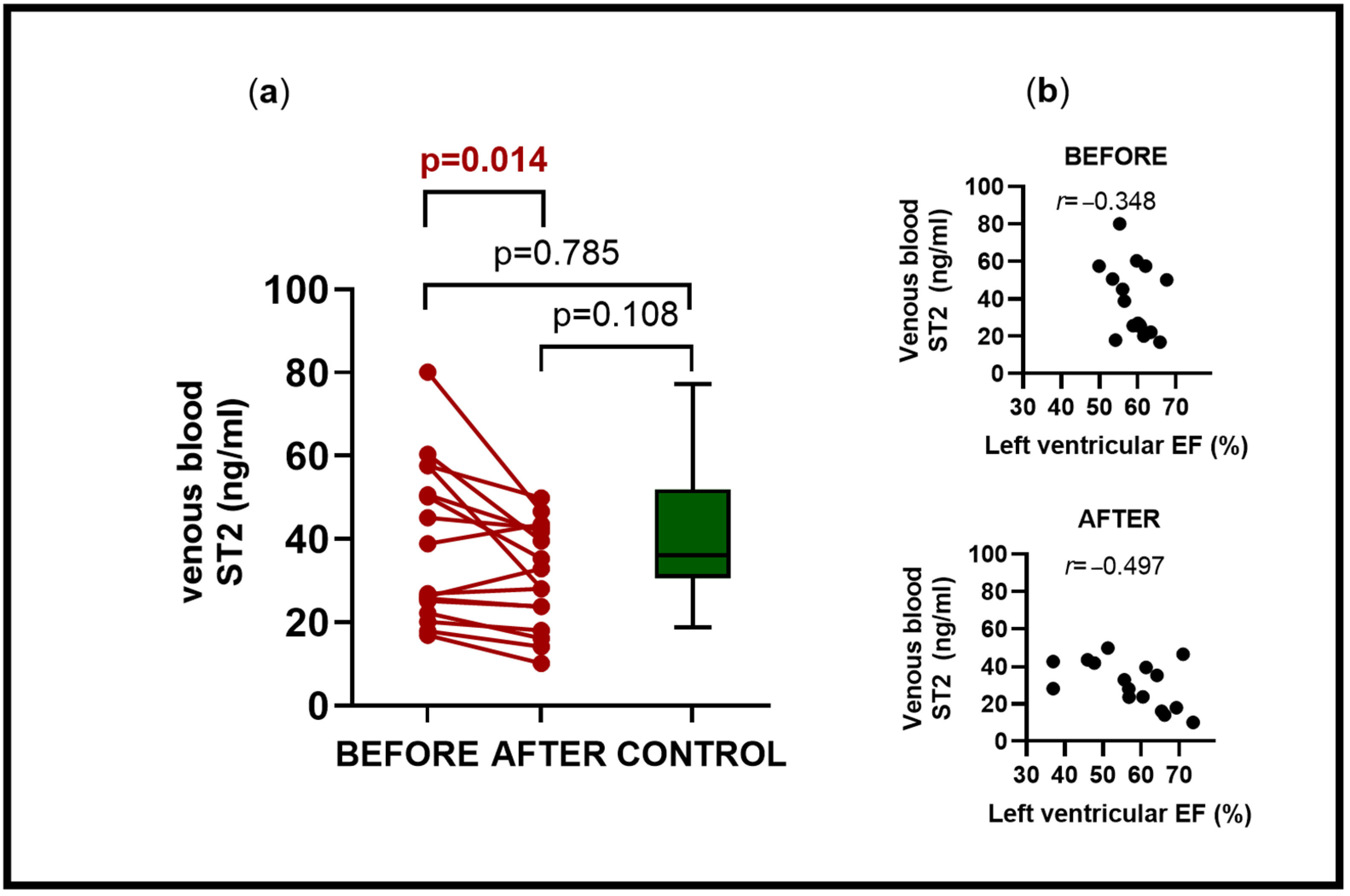
- In children with ASD, venous blood levels of ST2 decrease following treatment, and higher ST2 levels correlate with lower left ventricular ejection fraction, which may reflect changes to cardiac loading conditions and may allow for identification of cases at risk of evolving left ventricular dysfunction.
2. Results
2.1. Dried Blood Spot ST2 Analysis in Newborns with ASD
2.2. Venous Blood ST2 Analysis in Children with ASD
3. Discussion
Limitations
4. Materials and Methods
5. Conclusions
Author Contributions
Funding
Institutional Review Board Statement
Informed Consent Statement
Data Availability Statement
Acknowledgments
Conflicts of Interest
Abbreviations
| ASD | atrial septal defect |
| AUC | area under the curve |
| BSA | body surface area |
| bSSFP | balanced steady-state free precession |
| CHD | congenital heart disease |
| CMR | cardiac magnetic resonance |
| ECG | electrocardiogram |
| EDTA | ethylenediaminetetraacetic acid |
| EF | ejection fraction |
| IQR | interquartile range |
| LV | left ventricular |
| N/A | not applicable |
| NT-proBNP | amino-terminal prohormone of brain natriuretic peptide |
| Qp | pulmonary blood flow |
| Qs | systemic blood flow |
| ROC | receiver operating characteristics |
| RV | right ventricular |
| SD | standard deviation |
| SE | standard error |
| ST2 | soluble growth stimulation protein form of interleukin-1 receptor-like 1 |
| 95% CI | 95% confidence interval |
References
- Ghali, R.; Altara, R.; Louch, W.E.; Cataliotti, A.; Mallat, Z.; Kaplan, A.; Zouein, F.A.; Booz, G.W. IL-33 (Interleukin 33)/sST2 Axis in Hypertension and Heart Failure. Hypertension 2018, 72, 818–828, Erratum in Hypertension 2019, 73, e12. [Google Scholar] [CrossRef]
- Matilla, L.; Arrieta, V.; Jover, E.; Garcia-Peña, A.; Martinez-Martinez, E.; Sadaba, R.; Alvarez, V.; Navarro, A.; Fernandez-Celis, A.; Gainza, A.; et al. Soluble St2 Induces Cardiac Fibroblast Activation and Collagen Synthesis via Neuropilin-1. Cells 2020, 9, 1667. [Google Scholar] [CrossRef] [PubMed]
- McCarthy, C.P.; Januzzi, J.L., Jr. Soluble ST2 in Heart Failure. Heart Fail. Clin. 2018, 14, 41–48. [Google Scholar] [CrossRef] [PubMed]
- Tseng, C.C.S.; Huibers, M.M.H.; van Kuik, J.; de Weger, R.A.; Vink, A.; de Jonge, N. The Interleukin-33/ST2 Pathway Is Expressed in the Failing Human Heart and Associated with Pro-fibrotic Remodeling of the Myocardium. J. Cardiovasc. Transl. Res. 2017, 11, 15–21. [Google Scholar] [CrossRef]
- Vianello, E.; Dozio, E.; Tacchini, L.; Frati, L.; Romanelli, M.M.C. ST2/IL-33 signaling in cardiac fibrosis. Int. J. Biochem. Cell Biol. 2019, 116, 105619. [Google Scholar] [CrossRef]
- Bajwa, E.K.; Volk, J.A.; Christiani, D.C.; Harris, R.S.; Matthay, M.A.; Thompson, B.T.; Januzzi, J.L. Prognostic and Diagnostic Value of Plasma Soluble Suppression of Tumorigenicity-2 Concentrations in Acute Respiratory Distress Syndrome. Crit. Care Med. 2013, 41, 2521–2531. [Google Scholar] [CrossRef] [PubMed]
- Pascual-Figal, D.A.; Pérez-Martínez, M.T.; Asensio-Lopez, M.C.; Sanchez-Más, J.; García-García, M.E.; Martinez, C.M.; Lencina, M.; Jara, R.; Januzzi, J.L.; Lax, A. Pulmonary Production of Soluble ST2 in Heart Failure. Circ. Heart Fail. 2018, 11, e005488. [Google Scholar] [CrossRef]
- Brunetti, G.; Barile, B.; Nicchia, G.P.; Onorati, F.; Luciani, G.B.; Galeone, A. The ST2/IL-33 Pathway in Adult and Paediatric Heart Disease and Transplantation. Biomedicines 2023, 11, 1676. [Google Scholar] [CrossRef]
- Seki, K.; Sanada, S.; Kudinova, A.Y.; Steinhauser, M.L.; Handa, V.; Gannon, J.; Lee, R.T. Interleukin-33 Prevents Apoptosis and Improves Survival After Experimental Myocardial Infarction Through ST2 Signaling. Circ. Heart Fail. 2009, 2, 684–691. [Google Scholar] [CrossRef]
- Weinberg, E.O.; Shimpo, M.; De Keulenaer, G.W.; MacGillivray, C.; Tominaga, S.-I.; Solomon, S.D.; Rouleau, J.-L.; Lee, R.T. Expression and Regulation of ST2, an Interleukin-1 Receptor Family Member, in Cardiomyocytes and Myocardial Infarction. Circulation 2002, 106, 2961–2966. [Google Scholar] [CrossRef]
- Gruson, D.; Ahn, S.A.; Rousseau, M.F. Biomarkers of inflammation and cardiac remodeling: The quest of relevant companions for the risk stratification of heart failure patients is still ongoing. Biochem. Medica 2011, 21, 254–263. [Google Scholar] [CrossRef]
- Pratama, R.S.; Hartopo, A.B.; Anggrahini, D.W.; Dewanto, V.C.; Dinarti, L.K. Serum soluble suppression of tumorigenicity-2 level associates with severity of pulmonary hypertension associated with uncorrected atrial septal defect. Pulm. Circ. 2020, 10, 2045894020915832. [Google Scholar] [CrossRef]
- Elsheikh, R.G.; Hegab, M.; Szatmari, A. NT-proBNP correlated with strain and strain rate imaging of the right ventricle before and after transcatheter closure of atrial septal defects. J. Saudi Heart Assoc. 2012, 25, 3–8. [Google Scholar] [CrossRef]
- Weber, M.; Dill, T.; Deetjen, A.; Neumann, T.; Ekinci, O.; Hansel, J.; Elsaesser, A.; Mitrovic, V.; Hamm, C. Left ventricular adaptation after atrial septal defect closure assessed by increased concentrations of N-terminal pro-brain natriuretic peptide and cardiac magnetic resonance imaging in adult patients. Heart 2006, 92, 671–675. [Google Scholar] [CrossRef]
- Muta, H.; Ishii, M.; Maeno, Y.; Akagi, T.; Kato, H. Quantitative evaluation of the changes in plasma concentrations of cardiac natriuretic peptide before and after transcatheter closure of atrial septal defect. Acta Paediatr. 2002, 91, 649–652. [Google Scholar] [CrossRef] [PubMed]
- Eerola, A.; Jokinen, E.; Boldt, T.; Mattila, I.P.; Pihkala, J.I. Serum Levels of Natriuretic Peptides in Children before and after Treatment for an Atrial Septal Defect, a Patent Ductus Arteriosus, and a Coarctation of the Aorta—A Prospective Study. Int. J. Pediatr. 2010, 2010, 674575. [Google Scholar] [CrossRef] [PubMed]
- Riccardi, M.; Myhre, P.L.; Zelniker, T.A.; Metra, M.; Januzzi, J.L.; Inciardi, R.M. Soluble ST2 in Heart Failure: A Clinical Role beyond B-Type Natriuretic Peptide. J. Cardiovasc. Dev. Dis. 2023, 10, 468. [Google Scholar] [CrossRef] [PubMed]
- Parker, D.M.; Everett, A.D.; Stabler, M.E.; Vricella, L.; Jacobs, M.L.; Jacobs, J.P.; Thiessen-Philbrook, H.; Parikh, C.R.; Brown, J.R. Biomarkers associated with 30-day readmission and mortality after pediatric congenital heart surgery. J. Card. Surg. 2019, 34, 329–336. [Google Scholar] [CrossRef]
- Hoffman, J.I.; Kaplan, S. The incidence of congenital heart disease. J. Am. Coll. Cardiol. 2002, 39, 1890–1900. [Google Scholar] [CrossRef]
- Zimmerman, M.S.; Smith, A.G.C.; Sable, C.A.; Echko, M.M.; Wilner, L.B.; Olsen, H.E.; Atalay, H.T.; Awasthi, A.; Bhutta, Z.A.; Boucher, J.L.; et al. Global, regional, and national burden of congenital heart disease, 1990–2017: A systematic analysis for the Global Burden of Disease Study 2017. Lancet Child Adolesc. Health 2020, 4, 185–200, Erratum in Lancet Child Adolesc. Health 2020, 4, e6. [Google Scholar] [CrossRef]
- Geva, T.; Martins, J.D.; Wald, R.M. Atrial septal defects. Lancet 2014, 383, 1921–1932. [Google Scholar] [CrossRef]
- Botto, L.D.; Correa, A.; Erickson, J.D. Racial and Temporal Variations in the Prevalence of Heart Defects. Pediatrics 2001, 107, e32. [Google Scholar] [CrossRef]
- Nyboe, C.; Karunanithi, Z.; Nielsen-Kudsk, J.E.; Hjortdal, V.E. Long-term mortality in patients with atrial septal defect: A nationwide cohort-study. Eur. Heart J. 2017, 39, 993–998. [Google Scholar] [CrossRef] [PubMed]
- Yalonetsky, S.; Lorber, A. Comparative Changes of Pulmonary Artery Pressure Values and Tricuspid Valve Regurgitation Following Transcatheter Atrial Septal Defect Closure in Adults and the Elderly. Congenit. Heart Dis. 2009, 4, 17–20. [Google Scholar] [CrossRef] [PubMed]
- Van De Bruaene, A.; Buys, R.; Vanhees, L.; Delcroix, M.; Moons, P.; Budts, W. Cardiopulmonary exercise testing and SF-36 in patients with atrial septal defect type secundum. J. Cardiopulm. Rehabil. Prev. 2011, 31, 308–315. [Google Scholar] [CrossRef]
- Salehian, O.; Horlick, E.; Schwerzmann, M.; Haberer, K.; McLaughlin, P.; Siu, S.C.; Webb, G.; Therrien, J. Improvements in cardiac form and function after transcatheter closure of secundum atrial septal defects. JACC 2005, 45, 499–504. [Google Scholar] [CrossRef]
- Vitarelli, A.; Sardella, G.; Di Roma, A.; Capotosto, L.; De Curtis, G.; D’orazio, S.; Cicconetti, P.; Battaglia, D.; Caranci, F.; De Maio, M.; et al. Assessment of right ventricular function by three-dimensional echocardiography and myocardial strain imaging in adult atrial septal defect before and after percutaneous closure. Int. J. Cardiovasc. Imaging 2012, 28, 1905–1916. [Google Scholar] [CrossRef] [PubMed]
- Monfredi, O.; Luckie, M.; Mirjafari, H.; Willard, T.; Buckley, H.; Griffiths, L.; Clarke, B.; Mahadevan, V.S. Percutaneous device closure of atrial septal defect results in very early and sustained changes of right and left heart function. Int. J. Cardiol. 2013, 167, 1578–1584. [Google Scholar] [CrossRef]
- Bissell, M.M.; Raimondi, F.; Ali, L.A.; Allen, B.D.; Barker, A.J.; Bolger, A.; Burris, N.; Carhäll, C.-J.; Collins, J.D.; Ebbers, T.; et al. 4D Flow cardiovascular magnetic resonance consensus statement: 2023 update. J. Cardiovasc. Magn. Reson. 2023, 25, 40. [Google Scholar] [CrossRef]
- Grosse-Wortmann, L.; Wald, R.M.; Valverde, I.; Valsangiacomo-Buechel, E.; Ordovas, K.; Raimondi, F.; Browne, L.; Babu-Narayan, S.V.; Krishnamurthy, R.; Yim, D.; et al. Society for Cardiovascular Magnetic Resonance guidelines for reporting cardiovascular magnetic resonance examinations in patients with congenital heart disease. J. Cardiovasc. Magn. Reson. 2024, 26, 101062. [Google Scholar] [CrossRef]
- Rudolph, A.M. Fetal and Neonatal Pulmonary Circulation. Annu. Rev. Physiol. 1979, 41, 383–395. [Google Scholar] [CrossRef]
- Gao, Y.; Raj, J.U. Regulation of the Pulmonary Circulation in the Fetus and Newborn. Physiol. Rev. 2010, 90, 1291–1335. [Google Scholar] [CrossRef]
- Núñez, J.; de la Espriella, R.; Rossignol, P.; Voors, A.A.; Mullens, W.; Metra, M.; Chioncel, O.; Januzzi, J.L.; Mueller, C.; Richards, A.M.; et al. Congestion in heart failure: A circulating biomarker-based perspective. A review from the Biomarkers Working Group of the Heart Failure Association, European Society of Cardiology. Eur. J. Heart Fail. 2022, 24, 1751–1766, Erratum in Eur. J. Heart Fail. 2023, 25, 443. [Google Scholar] [CrossRef]
- Lavine, K.J.; Mann, D.L. Chapter 3—Inflammatory Mediators in Heart Failure. In Heart Failure in the Child and Young Adult; Jefferies, J.L., Chang, A.C., Rossano, J.W., Shaddy, R.E., Towbin, J.A., Eds.; Academic Press: Boston, MA, USA, 2018; pp. 33–50. [Google Scholar]
- Dieplinger, B.; Januzzi, J.L.; Steinmair, M.; Gabriel, C.; Poelz, W.; Haltmayer, M.; Mueller, T. Analytical and clinical evaluation of a novel high-sensitivity assay for measurement of soluble ST2 in human plasma—The Presage™ ST2 assay. Clin. Chim. Acta 2009, 409, 33–40. [Google Scholar] [CrossRef]
- Hughes, M.F.; Appelbaum, S.; Havulinna, A.S.; Jagodzinski, A.; Zeller, T.; Kee, F.; Blankenberg, S.; Salomaa, V. ST2 may not be a useful predictor for incident cardiovascular events, heart failure and mortality. Heart 2014, 100, 1715–1721. [Google Scholar] [CrossRef] [PubMed]
- Lu, J.; Snider, J.V.; Grenache, D.G. Establishment of reference intervals for soluble ST2 from a United States population. Clin. Chim. Acta 2010, 411, 1825–1826. [Google Scholar] [CrossRef]
- Beetler, D.J.; Bruno, K.A.; Di Florio, D.N.; Douglass, E.J.; Shrestha, S.; Tschöpe, C.; Cunningham, M.W.; Krejčí, J.; Bienertová-Vašků, J.; Pankuweit, S.; et al. Sex and age differences in sST2 in cardiovascular disease. Front. Cardiovasc. Med. 2023, 9, 1073814. [Google Scholar] [CrossRef]
- Kim, H.-L.; Lee, J.P.; Wong, N.; Lim, W.-H.; Seo, J.-B.; Zo, J.-H.; Kim, M.-A.; Kim, S.-H. Prognostic value of serum soluble ST2 in stable coronary artery disease: A prospective observational study. Sci. Rep. 2021, 11, 15203. [Google Scholar] [CrossRef] [PubMed]
- Van Der Linde, D.; Konings, E.E.; Slager, M.A.; Witsenburg, M.; Helbing, W.A.; Takkenberg, J.J.; Roos-Hesselink, J.W. Birth prevalence of congenital heart disease worldwide: A systematic review and meta-analysis. J. Am. Coll. Cardiol. 2011, 58, 2241–2247. [Google Scholar] [CrossRef] [PubMed]
- Warnes, C.A.; Williams, R.G.; Bashore, T.M.; Child, J.S.; Connolly, H.M.; Dearani, J.A.; Del Nido, P.; Fasules, J.W.; Graham, T.P., Jr.; Hijazi, Z.M.; et al. ACC/AHA 2008 Guidelines for the Management of Adults with Congenital Heart Disease: A Report of the American College of Cardiology/American Heart Association Task Force on Practice Guidelines (Writing Committee to Develop Guidelines on the Management of Adults with Congenital Heart Disease). Developed in Collaboration with the American Society of Echocardi-ography, Heart Rhythm Society, International Society for Adult Congenital Heart Disease, Society for Cardiovascular Angi-ography and Interventions, and Society of Thoracic Surgeons. J. Am. Coll. Cardiol. 2008, 52, e143–e263. [Google Scholar]
- Ye, Z.; Chen, C.; Chen, S.; Xu, M.; Xu, J. Analytical performances of a new rapid assay of soluble ST2 for cardiac and inflammatory diseases and establishment of the reference intervals for children and adolescence in China. Pr. Lab. Med. 2023, 36, e00321. [Google Scholar] [CrossRef]
- Parker, D.M.; Everett, A.D.; Stabler, M.E.; Jacobs, M.L.; Jacobs, J.P.; Vricella, L.; Thiessen-Philbrook, H.; Parikh, C.R.; Manlhiot, C.; Brown, J.R. ST2 Predicts Risk of Unplanned Readmission Within 1 Year After Pediatric Congenital Heart Surgery. In Proceedings of the 66th Annual Meeting of the Southern-Thoracic-Surgical-Association (STSA), Marco Island, FL, USA, 6–9 November 2019; pp. 2070–2075. [Google Scholar]
- Latiano, A.; Palmieri, O.; Pastorelli, L.; Vecchi, M.; Pizarro, T.T.; Bossa, F.; Merla, G.; Augello, B.; Latiano, T.; Corritore, G.; et al. Associations between Genetic Polymorphisms in IL-33, IL1R1 and Risk for Inflammatory Bowel Disease. PLoS ONE 2013, 8, e62144. [Google Scholar] [CrossRef]
- Gordon, E.D.; Palandra, J.; Wesolowska-Andersen, A.; Ringel, L.; Rios, C.L.; Lachowicz-Scroggins, M.E.; Sharp, L.Z.; Everman, J.L.; MacLeod, H.J.; Lee, J.W.; et al. IL1RL1 asthma risk variants regulate airway type 2 inflammation. J. Clin. Investig. 2016, 1, e87871. [Google Scholar] [CrossRef]
- Melo, A.P.C.; Teixeira, H.M.P.; Coelho, R.S.; Jesus, T.D.S.D.; Queiroz, G.A.; Silva, H.D.S.; De Almeida, Y.C.F.; Alcantara-Neves, N.M.; De Matos, S.M.A.; D’INnocenzo, S.; et al. Variants in proinflammatory genes IL1RL1, IL1B and IRF4 are associated with overweight in a pediatric Brazilian population. Gene 2022, 828, 146478. [Google Scholar] [CrossRef]
- Griesenauer, B.; Paczesny, S. The ST2/IL-33 Axis in Immune Cells during Inflammatory Diseases. Front. Immunol. 2017, 8, 475. [Google Scholar] [CrossRef] [PubMed]
- Januzzi, J.L.; Mebazaa, A.; Di Somma, S. ST2 and Prognosis in Acutely Decompensated Heart Failure: The International ST2 Consensus Panel. Am. J. Cardiol. 2015, 115, 26B–31B. [Google Scholar] [CrossRef] [PubMed]
- Dieplinger, B.; Mueller, T. Soluble ST2 in heart failure. Clin. Chim. Acta 2015, 443, 57–70. [Google Scholar] [CrossRef]
- Shimpo, M.; Morrow, D.A.; Weinberg, E.O.; Sabatine, M.S.; Murphy, S.A.; Antman, E.M.; Lee, R.T. Serum Levels of the Interleukin-1 Receptor Family Member ST2 Predict Mortality and Clinical Outcome in Acute Myocardial Infarction. Circulation 2004, 109, 2186–2190. [Google Scholar] [CrossRef] [PubMed]
- Engelfriet, P.M.; Duffels, M.G.J.; Möller, T.; Boersma, E.; Tijssen, J.G.P.; Thaulow, E.; Gatzoulis, M.A.; Mulder, B.J.M. Pulmonary arterial hypertension in adults born with a heart septal defect: The Euro Heart Survey on adult congenital heart disease. Heart 2006, 93, 682–687. [Google Scholar] [CrossRef]
- Vogel, M.; Berger, F.; Kramer, A.; Alexi-Meshkishvili, V.; Lange, P.E. Incidence of secondary pulmonary hypertension in adults with atrial septal or sinus venosus defects. Heart 1999, 82, 30–33. [Google Scholar] [CrossRef]
- Steele, P.M.; Fuster, V.; Cohen, M.; Ritter, D.G.; McGoon, D.C. Isolated atrial septal defect with pulmonary vascular obstructive disease–long-term follow-up and prediction of outcome after surgical correction. Circulation 1987, 76, 1037–1042. [Google Scholar] [CrossRef]
- Driscoll, D.; Allen, H.D.; Atkins, D.L.; Brenner, J.; Dunnigan, A.; Franklin, W.; Gutgesell, H.P.; Herndon, P.; Shaddy, R.E.; A Taubert, K. Guidelines for evaluation and management of common congenital cardiac problems in infants, children, and adolescents. A statement for healthcare professionals from the Committee on Congenital Cardiac Defects of the Council on Cardiovascular Disease in the Young, American Heart Association. Circulation 1994, 90, 2180–2188. [Google Scholar] [CrossRef] [PubMed]
- Sjöberg, P.; Clausen, H.; Arheden, H.; Steding-Ehrenborg, K.; Liuba, P.; Hedström, E. Left Ventricular Diastolic Function in Children with Atrial Septal Defects Improves After Closure by Means of Increased Hydraulic Force. Pediatr. Cardiol. 2024, 46, 1194–1201. [Google Scholar] [CrossRef]
- Sjöberg, P.; Clausen, H.; Arheden, H.; Liuba, P.; Hedström, E. Atrial septal defect closure in children at young age is beneficial for left ventricular function. Eur. Heart J. Imaging Methods Prac. 2024, 2, qyae058. [Google Scholar] [CrossRef]
- Yang, Z.; Xu, Y.; Chu, Y.; Li, J.; Wang, H. The Significance of Elevated sST2 in Children with Kawasaki Disease. Children 2025, 12, 868. [Google Scholar] [CrossRef]
- Sulu, A.; Uner, G.; Kosger, P.; Ucar, B. Does the ST2 Level in Pediatric Heart Failure Patients Correlate with Cardiovascular Events and Mortality? Children 2024, 11, 718. [Google Scholar] [CrossRef]
- Chen, W.-Y.; Tsai, T.-H.; Yang, J.-L.; Li, L.-C. Therapeutic Strategies for Targeting IL-33/ST2 Signalling for the Treatment of Inflammatory Diseases. Cell. Physiol. Biochem. 2018, 49, 349–358. [Google Scholar] [CrossRef]
- Zhou, Y.; Xu, Z.; Liu, Z. Role of IL-33-ST2 pathway in regulating inflammation: Current evidence and future perspectives. J. Transl. Med. 2023, 21, 902. [Google Scholar] [CrossRef]
- Koyuncu, E.; Pekal, Y.; Avcı, E.; Şenol, H.; Turgut, M.; Demir, G.S.; Özdemir, Ö.M.A. Evaluation of sST2 Levels in Infants of Mothers with Gestational Diabetes. Diagnostics 2026, 16, 982. [Google Scholar] [CrossRef]
- McGinn, C.; Casey, F.A.; Watson, C.; Morrison, L. Paediatric heart failure—Understanding the pathophysiology and the current role of cardiac biomarkers in clinical practice. Cardiol. Young 2023, 33, 503–513. [Google Scholar] [CrossRef] [PubMed]
- Vergaro, G.; Gentile, F.; Aimo, A.; Januzzi, J.L.; Richards, A.M.; Lam, C.S.; de Boer, R.A.; Meems, L.M.; Latini, R.; Staszewsky, L.; et al. Circulating Levels and Prognostic Cut-Offs of sST2, hs-cTnT, and NT-proBNP in Women vs. Men with Chronic Heart Failure. ESC Heart Fail. 2022, 9, 2084–2095. [Google Scholar] [CrossRef]
- Tarkowska, A.; Furmaga-Jabłońska, W. Is N-terminal pro-brain type natriuretic peptide a useful marker in newborns with heart defects? Adv. Clin. Exp. Med. 2021, 30, 905–912. [Google Scholar] [CrossRef]
- Aimo, A.; Januzzi, J.L., Jr.; Vergaro, G.; Richards, A.M.; Lam, C.S.; Latini, R.; Anand, I.S.; Cohn, J.N.; Ueland, T.; Gullestad, L.; et al. Circulating Levels and Prognostic Value of Soluble ST2 in Heart Failure are Less Influenced by Age than N-Terminal Pro-B-Type Natriuretic Peptide and High-Sensitivity Troponin T. Eur. J. Heart Fail. 2020, 22, 2078–2088. [Google Scholar] [CrossRef]
- Laqqan, M.; Schwaighofer, C.; Graeber, S.; Raedle-Hurst, T. Predictive value of soluble ST2 in adolescent and adult patients with complex congenital heart disease. PLoS ONE 2018, 13, e0202406. [Google Scholar] [CrossRef]
- Manzano-Fernández, S.; Mueller, T.; Pascual-Figal, D.; Truong, Q.A.; Januzzi, J.L. Usefulness of Soluble Concentrations of Interleukin Family Member ST2 as Predictor of Mortality in Patients with Acutely Decompensated Heart Failure Relative to Left Ventricular Ejection Fraction. Am. J. Cardiol. 2011, 107, 259–267. [Google Scholar] [CrossRef] [PubMed]
- Ozyurt, A.; Baykan, A.; Argun, M.; Pamukcu, O.; Uzum, K.; Narin, F.; Narin, N. Does N-terminal pro-brain natriuretic peptide correlate with measured shunt fraction in children with septal defects? Cardiol. Young 2015, 26, 469–476. [Google Scholar] [CrossRef] [PubMed]
- Clausen, H.; Friberg, E.; Lannering, K.; Koivu, A.; Sairanen, M.; Mellander, M.; Liuba, P. Newborn Screening for High-Risk Congenital Heart Disease by Dried Blood Spot Biomarker Analysis. JAMA Netw. Open 2024, 7, e2418097. [Google Scholar] [CrossRef] [PubMed]
- Dieplinger, B.; Egger, M.; Poelz, W.; Haltmayer, M.; Mueller, T. Long-term stability of soluble ST2 in frozen plasma samples. Clin. Biochem. 2010, 43, 1169–1170. [Google Scholar] [CrossRef]
- Mueller, T.; Dieplinger, B. Soluble ST2 and Galectin-3: What We Know and Don’t Know Analytically. EJIFCC 2016, 27, 224–237. [Google Scholar]
- Lingitz, M.-T.; Kühtreiber, H.; Auer, L.; Mildner, M.; Moser, B.; Bekos, C.; Aigner, C.; Direder, M.; Mueller, T.; Ankersmit, H.J. The Contingency of Reported sST2 Serum Concentrations with a Protein Detection System (ELISA) from the Same Manufacturer (R&D Biotechne, 2002–2025): An Explanatory Effort by Applied Medical Researchers. Diagnostics 2025, 15, 2412. [Google Scholar] [CrossRef]
- World Medical Association. Declaration of Helsinki: Ethical principles for medical research involving human subjects. JAMA 2013, 310, 2191–2194. [Google Scholar] [CrossRef] [PubMed]
- Von Elm, E.; Altman, D.G.; Egger, M.; Pocock, S.J.; Gøtzsche, P.C.; Vandenbroucke, J.P. Strengthening the Reporting of Observational Studies in Epidemiology (STROBE) statement: Guidelines for reporting observational studies. BMJ 2007, 335, 806–808, Erratum in BMJ 2007, 335. [Google Scholar] [CrossRef] [PubMed]
- Sjöberg, P.; Lala, T.; Wittgren, J.; Jin, N.; Hedström, E.; Töger, J. Image reconstruction impacts haemodynamic parameters derived from 4D flow magnetic resonance imaging with compressed sensing. Eur. Heart J. Imaging Methods Prac. 2024, 2, qyae137. [Google Scholar] [CrossRef] [PubMed]



| (a) | |||||
| ST2 Level (ng/mL) | Sensitivity | 95% CI | Specificity | 95% CI | Likelihood Ratio |
| >4.28 | 94.74 | 75.36% to 99.73% | 69.89 | 59.93% to 78.27% | 3.15 |
| >4.61 | 84.21 | 62.43% to 94.48% | 72.04 | 62.19% to 80.15% | 3.01 |
| >4.93 | 84.21 | 62.43% to 94.48% | 75.27 | 65.62% to 82.92% | 3.41 |
| >5.24 | 73.68 | 51.21% to 88.19% | 76.34 | 66.77% to 83.83% | 3.12 |
| >5.64 | 73.68 | 51.21% to 88.19% | 81.72 | 72.66% to 88.26% | 4.03 |
| >5.89 | 68.42 | 46.01% to 84.64% | 84.95 | 76.30% to 90.82% | 4.55 |
| >6.45 | 52.63 | 31.71% to 72.67% | 88.17 | 80.05% to 93.27% | 4.45 |
| >7.21 | 36.84 | 19.15% to 58.96% | 90.32 | 82.62% to 94.82% | 3.81 |
| >8.70 | 31.58 | 15.36% to 53.99% | 94.62 | 88.03% to 97.68% | 5.87 |
| (b) | |||||
| Newborns (n = 112) | Statistical Difference | ||||
| Newborn Controls (n = 93) | Newborn Cases (ASD) (n = 19) | Newborn Controls versus Newborn Cases | |||
| Sex | |||||
| female n (%) | 45 (48.4) | 15 (78.9) | p = 0.021 # | ||
| male n (%) | 48 (51.6) | 4 (21.1) | |||
| Day of life for dried blood spot sampling | |||||
| mean ± SD (95% CI) | 2.72 ± 0.71 (2.57–2.87) | 2.79 ± 0.86 (2.38–3.20) | p = 0.711 # | ||
| Treatment by | |||||
| device closure n (%) | N/A | 13 (68.4%) 6 (31.6%) | N/A | ||
| open-heart surgery n (%) | |||||
| (a) | ||||||
|---|---|---|---|---|---|---|
| ASD Before Treatment (n = 16) | ASD After Treatment (n = 16) | ASD Before Treatment Versus ASD After Treatment | Controls (n = 9) | ASD Before Treatment Versus Controls | ASD After Treatment Versus Controls | |
| Venous blood ST2 level mean ± SD (95% CI) | ||||||
| Venous blood ST2 level, ng/mL | 38.84 ± 18.95 (28.74–48.94) | 30.88 ± 12.48 (24.23–37.53) | p = 0.014 * | 40.97 ± 17.57 (27.46–54.47) | p = 0.785 * | p = 0.108 * |
| CMR of the left ventricle mean ± SD (95% CI) | ||||||
| LV EDVi mL/m2 | 65.5 ± 11.3 (59.5–71.6) | 79.6 ± 15.5 (71.3–87.8) | p < 0.01 * | 83 ± 8 (77–88) | p < 0.01 * | p = 0.705 * |
| LV ESVi mL/m2 | 26.9 ± 5.9 (23.7–30.0) | 34.4 ± 13.0 (27.5–41.3) | p < 0.01 * | 34 ± 5 (31–38) | p < 0.01 * | p = 0.987 * |
| LV SVi mL/m2 | 38.7 ± 6.9 (35.0–42.3) | 45.2 ± 9.6 (40.0–50.3) | p = 0.020 * | 48 ± 7 (44–53) | p < 0.01 * | p = 0.555 * |
| LV EF % | 59.1 ± 4.7 (56.6–61.6) | 57.4 ± 11.2 (51.5–63.4) | p = 0.540 * | 56 ± 6 (52–60) | p = 0.547 * | p = 0.919 * |
| CI L/minute/m2 | 3.26 ± 0.65 (2.91–3.61) | 3.59 ± 0.88 (3.12–4.06) | p = 0.170 * | 3.68 ± 0.60 (3.22–4.14) | p = 0.127 * | p = 0.801 * |
| CMR of the right ventricle mean ± SD (95% CI) | ||||||
| RV EDVi ml/m2 | 141.4 ± 40.4 (119.9–162.9) | 95.7 ± 22.2 (83.9–107.6) | p < 0.01 * | 84.9 ± 8.5 (78.3–91.4) | p < 0.01 * | p = 0.175 * |
| RV ESVi mL/m2 | 61.0 ± 22.6 (49.0–73.1) | 49.4 ± 17.5 (40.1–58.7) | p < 0.01 * | 36.0 ± 5.2 (32.0–40.0) | p < 0.01 * | p = 0.036 * |
| RV SVi mL/m2 | 80.6 ± 20.8 (69.5–91.7) | 46.2 ± 12.5 (39.5–52.9) | p < 0.01 * | 48.8 ± 7.0 (43.4–54.2) | p < 0.01 * | p = 0.569 * |
| RV EF % | 57.6 ± 6.1 (54.4–60.8) | 50.4 ± 12.5 (44.0–56.7) | p = 0.086 * | 57.6 ± 5.3 (53.5–61.7) | p = 0.986 * | p = 0.102 * |
| CMR-derived atrial shunt ratio median [IQR] | ||||||
| Qp:Qs | 1.77 [1.55–2.65] | 1.02 [0.94–1.10] | p < 0.01 ** | 1.01 [1.00–1.06] | p < 0.01 ** | p = 0.890 ** |
| (b) | ||||||
| Children (n = 25) | Statistical difference | |||||
| Pediatric Controls (n = 9) | Pediatric Cases (ASD) (n = 16) | Pediatric Controls Versus Pediatric Cases | ||||
| Sex | ||||||
| female: n (%) male: n (%) | 5 (55.6) 4 (44.4) | 9 (56.3) 7 (43.7) | p = 0.975 ## | |||
| Age (years) | ||||||
| mean ± SD (95% CI) | 8.3 ± 1.7 (7.0–9.7) | 9.6 ± 4.4 (7.2–11.9) | p = 0.430 ## | |||
| Body surface area (m2) | ||||||
| mean ± SD (95% CI) | 1.22 ± 0.48 (0.96–1.47) | 1.07 ± 0.16 (0.95–1.20) | p = 0.408 ## | |||
| Heart rate (bpm) | ||||||
| mean ± SD (95% CI) | 78 ± 8 (72–84) | 86 ± 15 (78–93) | p = 0.156 ## | |||
| Follow-up (months) | ||||||
| mean ± SD (95% CI) | N/A | 7.73 ± 1.73 (6.82–8.65) | N/A | |||
| Treatment by | ||||||
| device closure n (%) open-heart surgery n (%) | N/A | 13 (81.2) 3 (18.8) | N/A | |||
Disclaimer/Publisher’s Note: The statements, opinions and data contained in all publications are solely those of the individual author(s) and contributor(s) and not of MDPI and/or the editor(s). MDPI and/or the editor(s) disclaim responsibility for any injury to people or property resulting from any ideas, methods, instructions or products referred to in the content. |
© 2026 by the authors. Licensee MDPI, Basel, Switzerland. This article is an open access article distributed under the terms and conditions of the Creative Commons Attribution (CC BY) license.
Share and Cite
Clausen, H.; Friberg, E.; Sairanen, M.; Sjöberg, P.; Liuba, P. Exploring Biomarkers in Congenital Heart Disease: A Case–Control Study of ST2 in Children with Atrial Septal Defects. Int. J. Mol. Sci. 2026, 27, 3445. https://doi.org/10.3390/ijms27083445
Clausen H, Friberg E, Sairanen M, Sjöberg P, Liuba P. Exploring Biomarkers in Congenital Heart Disease: A Case–Control Study of ST2 in Children with Atrial Septal Defects. International Journal of Molecular Sciences. 2026; 27(8):3445. https://doi.org/10.3390/ijms27083445
Chicago/Turabian StyleClausen, Henning, Elin Friberg, Mikko Sairanen, Pia Sjöberg, and Petru Liuba. 2026. "Exploring Biomarkers in Congenital Heart Disease: A Case–Control Study of ST2 in Children with Atrial Septal Defects" International Journal of Molecular Sciences 27, no. 8: 3445. https://doi.org/10.3390/ijms27083445
APA StyleClausen, H., Friberg, E., Sairanen, M., Sjöberg, P., & Liuba, P. (2026). Exploring Biomarkers in Congenital Heart Disease: A Case–Control Study of ST2 in Children with Atrial Septal Defects. International Journal of Molecular Sciences, 27(8), 3445. https://doi.org/10.3390/ijms27083445