Fine-Tuning Protein Fate: Mechanisms of E1, E2, and E3 Enzymes and Deubiquitinases in Cell Signaling


Abstract
1. Introduction
2. The Enzymatic Architecture of the Ubiquitin System
2.1. The Gatekeepers: Ubiquitin-Activating Enzymes (E1)
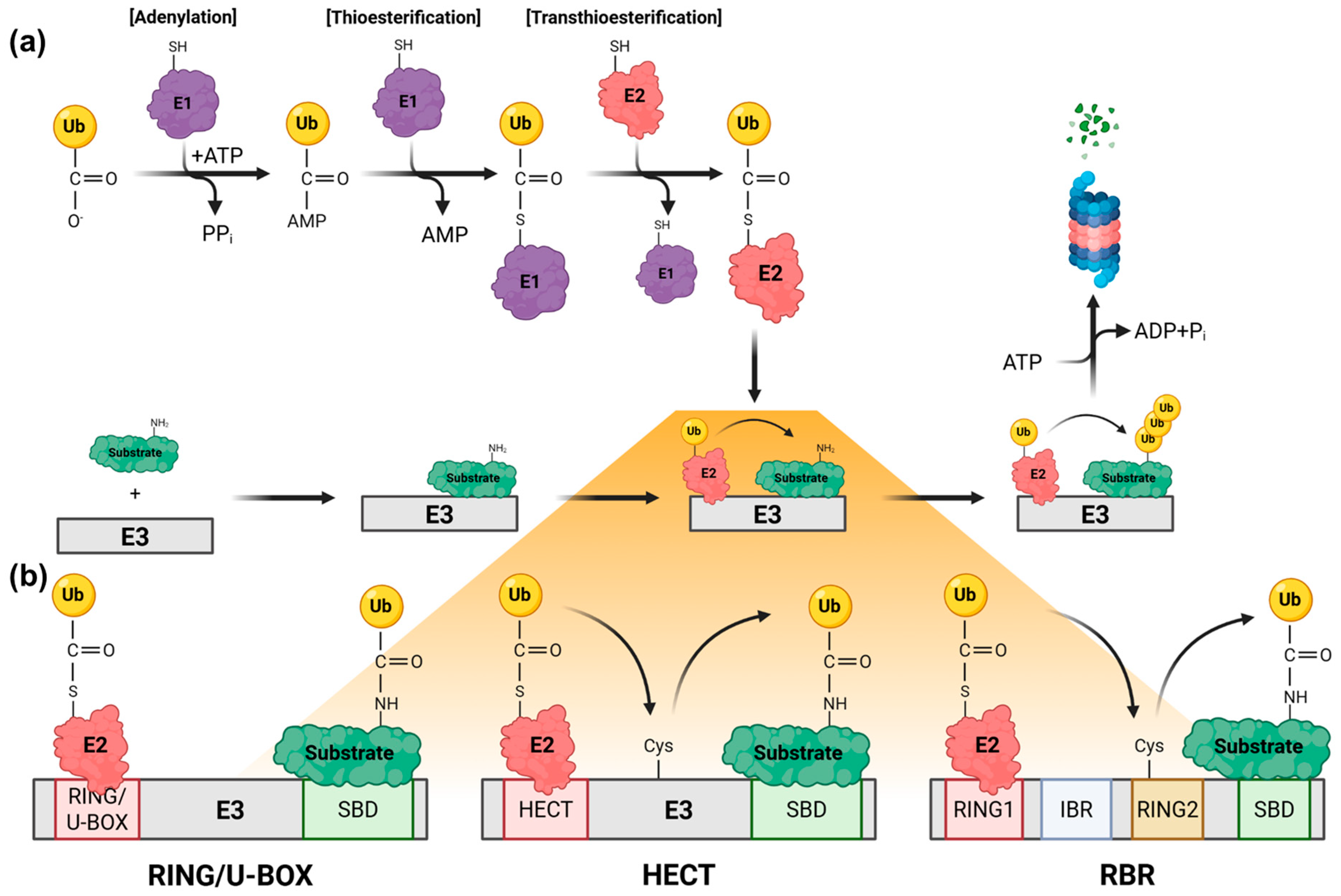
- The E1 enzyme adenylates the C-terminal glycine (Gly) of ubiquitin using ATP, forming a high-energy ubiquitin–AMP intermediate.
- Ubiquitin is transferred to the catalytic Cys residue on the E1 enzyme to form a thioester-linked E1–ubiquitin conjugate. The activated ubiquitin is then handed off to an E2-conjugating enzyme [18].
2.2. The Architects of Chain Topology: Ubiquitin-Conjugating Enzymes (E2)
2.3. The Specificity Factors: Ubiquitin Ligases (E3)
2.3.1. RING-Type E3 Ligases and U-Box E3 Ligases
2.3.2. HECT-Type E3 Ligases
2.3.3. RBR-Type E3 Ligases (RING/HECT Hybrid)
2.4. The Eraser and Editor: Deubiquitinating Enzymes (DUBs)
- Processing of newly synthesized ubiquitin precursors
- 2.
- Ubiquitin recycling
- 3.
- Editing and reversal of ubiquitin signals
2.4.1. USP
2.4.2. UCH
2.4.3. OTU
2.4.4. MJD
2.4.5. MINDY
2.4.6. ZUFSP
2.4.7. JAMM
3. Pathological Implications of UPS Dysregulation
3.1. Cancer
3.2. Neurodegenerative Disorders
3.3. Immune and Inflammatory Diseases
4. Emerging Therapeutic Technologies for Protein Homeostasis
4.1. Proteolysis-Targeting Chimeras (PROTACs): Hijacking the UPS for Targeted Degradation
4.2. Deubiquitinase-Targeting Chimeras (DUBTACs): Targeted Protein Stabilization by Deubiquitination
5. Conclusions
Author Contributions
Funding
Data Availability Statement
Conflicts of Interest
Abbreviations
| AD | Alzheimer’s disease |
| AMSH | Associated with the SH3 domain of STAM |
| ATP | Adenosine triphosphate |
| BAP1 | BRCA1-associated protein 1 |
| BRCA1 | Breast cancer type 1 susceptibility protein |
| BRCC36 | Lys-63-specific deubiquitinase BRCC36 |
| CBL | Casitas B-lineage lymphoma |
| CFTR | Cystic fibrosis transmembrane conductance regulator |
| CHIP | Carboxy-terminus of Hsc70-interacting protein |
| CRBN | Cereblon |
| CSN5 | COP9 signalosome subunit 5 |
| CYLD | Cylindromatosis lysine 63 deubiquitinase |
| Cys | Cysteine |
| DUBs | Deubiquitinases |
| DUBTACs | Deubiquitinase-targeting chimeras |
| E1 | E1 ubiquitin-activating enzyme |
| E2 | E2 ubiquitin-conjugating enzyme |
| E3 | E3 ubiquitin ligase |
| DNA | Deoxyribonucleic acid |
| DUBs | Deubiquitinating enzymes |
| E6-AP | E6-associated protein |
| FAT10 | Human leukocyte antigen-F adjacent transcript 10 |
| FBXW7 | F-Box and WD repeat domain containing 7 |
| Gly | Glycine |
| Hsp | Heat shock protein |
| HECT | Homologous to E6-AP C-Terminus |
| HOIL-1 | Heme-oxidized IRP2 ubiquitin ligase-1 |
| HOIP | HOIL-1-interacting protein |
| JAMM/MPN+ | Jun activation domain-binding protein 1/Mpr1-Pad1-N-terminal/MOV34 metalloenzyme |
| JOSD1 | Josephin domain-containing protein 1 |
| Lys | Lysine |
| LUBAC | Linear ubiquitin chain assembly complex |
| MDM2 | Mouse double minute 2 homolog |
| MJD | Machado–Joseph disease proteases |
| NEDD4 | Neural precursor cell expressed, developmentally down-regulated protein 4 |
| MINDY | Motif interacting with ubiquitin-containing novel DUB family |
| NF-κB | Nuclear factor kappa-light-chain-enhancer of activated B cells |
| OTU | Ovarian tumor protease |
| OTUB1 | OTU domain-containing ubiquitin aldehyde-binding protein 1 |
| OTUD1 | OTU deubiquitinase 1 |
| OTULIN | OTU deubiquitinase with linear linkage specificity |
| PD | Parkinson’s disease |
| PINK1 | PTEN-induced kinase 1 |
| PROTACs | Proteolysis-targeting chimeras |
| RBR | RING-Between-RING |
| RING | Really interesting new gene |
| RPN11 | Regulatory particle non-ATPase 11 |
| SCF | SKP1-CUL1-F-box protein |
| SUMO | Small ubiquitin-like modifier |
| TNF | Tumor necrosis factor |
| TRAF6 | TNF receptor-associated factor 6 |
| UBA1 | Ubiquitin-like modifier activating enzyme 1 |
| UBA6 | Ubiquitin-like modifier activating enzyme 6 |
| UBC | Ubiquitin-conjugating |
| UBE1 | Ubiquitin-activating enzyme E1 |
| UBE1L2 | UBE1-like protein 2 |
| UBE2 | Ubiquitin-conjugating enzyme E2 |
| UBL | Ubiquitin-like |
| UCH | Ubiquitin carboxy-terminal hydrolase |
| UPS | Ubiquitin–proteasome system |
| USP | Ubiquitin specific protease |
| VHL | Von Hippel–Lindau disease |
| WW | Tryptophan–tryptophan |
| ZUFSP | Zinc finger-containing ubiquitin peptidase |
References
- Su, R.; Shao, Y.; Wang, Q.; Liu, D.; Wang, Y.; Kong, D.; Qiu, Y. Targeting the ubiquitin-proteasome system and drug therapy in colorectal cancer. J. Mol. Cell Biol. 2026, 17, mjaf027. [Google Scholar] [CrossRef]
- Spano, D.; Catara, G. Targeting the Ubiquitin-Proteasome System and Recent Advances in Cancer Therapy. Cells 2023, 13, 29. [Google Scholar] [CrossRef]
- Bedford, L.; Lowe, J.; Dick, L.R.; Mayer, R.J.; Brownell, J.E. Ubiquitin-like protein conjugation and the ubiquitin-proteasome system as drug targets. Nat. Rev. Drug Discov. 2011, 10, 29–46. [Google Scholar] [CrossRef]
- Damgaard, R.B. The ubiquitin system: From cell signalling to disease biology and new therapeutic opportunities. Cell Death Differ. 2021, 28, 423–426. [Google Scholar] [CrossRef]
- Agrata, R.; Komander, D. Ubiquitin-A structural perspective. Mol. Cell 2025, 85, 323–346. [Google Scholar] [CrossRef]
- Snyder, N.A.; Silva, G.M. Deubiquitinating enzymes (DUBs): Regulation, homeostasis, and oxidative stress response. J. Biol. Chem. 2021, 297, 101077. [Google Scholar] [CrossRef]
- Swatek, K.N.; Komander, D. Ubiquitin modifications. Cell Res. 2016, 26, 399–422. [Google Scholar] [CrossRef]
- Yuan, L.; Li, P.; Zheng, Q.; Wang, H.; Xiao, H. The Ubiquitin-Proteasome System in Apoptosis and Apoptotic Cell Clearance. Front. Cell Dev. Biol. 2022, 10, 914288. [Google Scholar] [CrossRef]
- Vodermaier, H.C. APC/C and SCF: Controlling each other and the cell cycle. Curr. Biol. 2004, 14, R787–R796. [Google Scholar] [CrossRef]
- Dang, F.; Nie, L.; Wei, W. Ubiquitin signaling in cell cycle control and tumorigenesis. Cell Death Differ. 2021, 28, 427–438. [Google Scholar] [CrossRef]
- Madiraju, C.; Novack, J.P.; Reed, J.C.; Matsuzawa, S.I. K63 ubiquitination in immune signaling. Trends Immunol. 2022, 43, 148–162. [Google Scholar] [CrossRef]
- Tank, E.M.; True, H.L. Disease-associated mutant ubiquitin causes proteasomal impairment and enhances the toxicity of protein aggregates. PLoS Genet. 2009, 5, e1000382. [Google Scholar] [CrossRef]
- Jansen, A.H.; Reits, E.A.; Hol, E.M. The ubiquitin proteasome system in glia and its role in neurodegenerative diseases. Front. Mol. Neurosci. 2014, 7, 73. [Google Scholar] [CrossRef]
- Paul, S. Dysfunction of the ubiquitin-proteasome system in multiple disease conditions: Therapeutic approaches. Bioessays 2008, 30, 1172–1184. [Google Scholar] [CrossRef]
- Lin, D.S.; Ho, C.S. Emerging Role of Ubiquitin Proteasome System and Autophagy in Pediatric Demyelinating Leukodystrophies and Therapeutic Opportunity. Cells 2024, 13, 1873. [Google Scholar] [CrossRef]
- Kim, Y.; Kim, E.K.; Chey, Y.; Song, M.J.; Jang, H.H. Targeted Protein Degradation: Principles and Applications of the Proteasome. Cells 2023, 12, 1846. [Google Scholar] [CrossRef]
- Stratton, C.M.; Ebadi, P.; Olsen, S.K. Molecular choreography of E1 enzymes in ubiquitin-like protein cascades: New insights into dynamics and specificity. J. Biol. Chem. 2025, 301, 110415. [Google Scholar] [CrossRef]
- Hann, Z.S.; Ji, C.; Olsen, S.K.; Lu, X.; Lux, M.C.; Tan, D.S.; Lima, C.D. Structural basis for adenylation and thioester bond formation in the ubiquitin E1. Proc. Natl. Acad. Sci. USA 2019, 116, 15475–15484. [Google Scholar] [CrossRef]
- Groettrup, M.; Pelzer, C.; Schmidtke, G.; Hofmann, K. Activating the ubiquitin family: UBA6 challenges the field. Trends Biochem. Sci. 2008, 33, 230–237. [Google Scholar] [CrossRef]
- Wang, F.; Zhao, B. UBA6 and Its Bispecific Pathways for Ubiquitin and FAT10. Int. J. Mol. Sci. 2019, 20, 2250. [Google Scholar] [CrossRef]
- Shaughnessy, N.; Forman, E.B.; O’Rourke, D.; Lynch, S.A.; Lynch, B. X-linked infantile spinal muscular atrophy (SMAX2) caused by novel c.1681G>A substitution in the UBA1 gene, expanding the phenotype. Neuromuscul. Disord. 2020, 30, 35–37. [Google Scholar] [CrossRef]
- Zhuang, J.; Shirazi, F.; Singh, R.K.; Kuiatse, I.; Wang, H.; Lee, H.C.; Berkova, Z.; Berger, A.; Hyer, M.; Chattopadhyay, N.; et al. Ubiquitin-activating enzyme inhibition induces an unfolded protein response and overcomes drug resistance in myeloma. Blood 2019, 133, 1572–1584. [Google Scholar] [CrossRef]
- Nuber, U.; Scheffner, M. Identification of determinants in E2 ubiquitin-conjugating enzymes required for hect E3 ubiquitin-protein ligase interaction. J. Biol. Chem. 1999, 274, 7576–7582. [Google Scholar] [CrossRef]
- Valimberti, I.; Tiberti, M.; Lambrughi, M.; Sarcevic, B.; Papaleo, E. E2 superfamily of ubiquitin-conjugating enzymes: Constitutively active or activated through phosphorylation in the catalytic cleft. Sci. Rep. 2015, 5, 14849. [Google Scholar] [CrossRef]
- David, Y.; Ziv, T.; Admon, A.; Navon, A. The E2 ubiquitin-conjugating enzymes direct polyubiquitination to preferred lysines. J. Biol. Chem. 2010, 285, 8595–8604. [Google Scholar] [CrossRef]
- Sadowski, M.; Sarcevic, B. Mechanisms of mono- and poly-ubiquitination: Ubiquitination specificity depends on compatibility between the E2 catalytic core and amino acid residues proximal to the lysine. Cell Div. 2010, 5, 19. [Google Scholar] [CrossRef]
- Zhang, Y.; Li, Y.; Yang, X.; Wang, J.; Wang, R.; Qian, X.; Zhang, W.; Xiao, W. Uev1A-Ubc13 catalyzes K63-linked ubiquitination of RHBDF2 to promote TACE maturation. Cell Signal 2018, 42, 155–164. [Google Scholar] [CrossRef]
- Wu, T.; Merbl, Y.; Huo, Y.; Gallop, J.L.; Tzur, A.; Kirschner, M.W. UBE2S drives elongation of K11-linked ubiquitin chains by the anaphase-promoting complex. Proc. Natl. Acad. Sci. USA 2010, 107, 1355–1360. [Google Scholar] [CrossRef]
- Scheffner, M.; Huibregtse, J.M.; Howley, P.M. Identification of a human ubiquitin-conjugating enzyme that mediates the E6-AP-dependent ubiquitination of p53. Proc. Natl. Acad. Sci. USA 1994, 91, 8797–8801. [Google Scholar] [CrossRef]
- Wu-Baer, F.; Lagrazon, K.; Yuan, W.; Baer, R. The BRCA1/BARD1 heterodimer assembles polyubiquitin chains through an unconventional linkage involving lysine residue K6 of ubiquitin. J. Biol. Chem. 2003, 278, 34743–34746. [Google Scholar] [CrossRef]
- Ye, Y.; Rape, M. Building ubiquitin chains: E2 enzymes at work. Nat. Rev. Mol. Cell Biol. 2009, 10, 755–764. [Google Scholar] [CrossRef]
- Zheng, N.; Shabek, N. Ubiquitin Ligases: Structure, Function, and Regulation. Annu. Rev. Biochem. 2017, 86, 129–157. [Google Scholar] [CrossRef]
- Sewduth, R.N.; Baietti, M.F.; Sablina, A.A. Cracking the Monoubiquitin Code of Genetic Diseases. Int. J. Mol. Sci. 2020, 21, 3036. [Google Scholar] [CrossRef]
- Dutta, A.; Cristiani, A.; Nikte, S.V.; Eisert, J.; Matthess, Y.; Markusic, B.; Tudose, C.; Becht, C.; Cetin, R.; Shah, V.J.; et al. Multi-scale classification decodes the complexity of the human E3 ligome. Nat. Commun. 2025, 16, 11382, Correction in Nat. Commun. 2026, 17, 1500. [Google Scholar] [CrossRef]
- Yang, Q.; Zhao, J.; Chen, D.; Wang, Y. E3 ubiquitin ligases: Styles, structures and functions. Mol. Biomed. 2021, 2, 23. [Google Scholar] [CrossRef]
- Garcia-Barcena, C.; Osinalde, N.; Ramirez, J.; Mayor, U. How to Inactivate Human Ubiquitin E3 Ligases by Mutation. Front. Cell Dev. Biol. 2020, 8, 39. [Google Scholar] [CrossRef]
- Kelsall, I.R. Non-lysine ubiquitylation: Doing things differently. Front. Mol. Biosci. 2022, 9, 1008175. [Google Scholar] [CrossRef]
- Kaminskaya, A.N.; Evpak, A.S.; Belogurov, A.A., Jr.; Kudriaeva, A.A. Tracking of Ubiquitin Signaling through 3.5 Billion Years of Combinatorial Conjugation. Int. J. Mol. Sci. 2024, 25, 8671. [Google Scholar] [CrossRef]
- Lipkowitz, S.; Weissman, A.M. RINGs of good and evil: RING finger ubiquitin ligases at the crossroads of tumour suppression and oncogenesis. Nat. Rev. Cancer 2011, 11, 629–643. [Google Scholar] [CrossRef]
- Jiang, M.; Si, W.; Huang, S.; Qu, S.; Zhang, M.; Quan, Y. Roles of E3 ubiquitin ligases and deubiquitinating enzymes in renal cell carcinoma. Front. Oncol. 2025, 15, 1628710. [Google Scholar] [CrossRef]
- Ye, Z.; Needham, P.G.; Estabrooks, S.K.; Whitaker, S.K.; Garcia, B.L.; Misra, S.; Brodsky, J.L.; Camacho, C.J. Symmetry breaking during homodimeric assembly activates an E3 ubiquitin ligase. Sci. Rep. 2017, 7, 1789. [Google Scholar] [CrossRef]
- Bulatov, E.; Ciulli, A. Targeting Cullin-RING E3 ubiquitin ligases for drug discovery: Structure, assembly and small-molecule modulation. Biochem. J. 2015, 467, 365–386. [Google Scholar] [CrossRef]
- Jeong, Y.; Oh, A.R.; Jung, Y.H.; Gi, H.; Kim, Y.U.; Kim, K. Targeting E3 ubiquitin ligases and their adaptors as a therapeutic strategy for metabolic diseases. Exp. Mol. Med. 2023, 55, 2097–2104. [Google Scholar] [CrossRef]
- Jang, S.M.; Redon, C.E.; Aladjem, M.I. Chromatin-Bound Cullin-Ring Ligases: Regulatory Roles in DNA Replication and Potential Targeting for Cancer Therapy. Front. Mol. Biosci. 2018, 5, 19. [Google Scholar] [CrossRef]
- Shi, L.; Fang, X.; Du, L.; Yang, J.; Xue, J.; Yue, X.; Xie, D.; Hui, Y.; Meng, K. An E3 ligase TRIM1 promotes colorectal cancer progression via K63-linked ubiquitination and activation of HIF1alpha. Oncogenesis 2024, 13, 16. [Google Scholar] [CrossRef]
- Wang, Y.T.; Liu, T.Y.; Shen, C.H.; Lin, S.Y.; Hung, C.C.; Hsu, L.C.; Chen, G.C. K48/K63-linked polyubiquitination of ATG9A by TRAF6 E3 ligase regulates oxidative stress-induced autophagy. Cell Rep. 2022, 38, 110354. [Google Scholar] [CrossRef]
- Ebadi, P.; Stratton, C.M.; Olsen, S.K. E3 ubiquitin ligases in signaling, disease, and therapeutics. Trends Biochem. Sci. 2025, 50, 960–976. [Google Scholar] [CrossRef]
- Sharma, B.; Taganna, J. Genome-wide analysis of the U-box E3 ubiquitin ligase enzyme gene family in tomato. Sci. Rep. 2020, 10, 9581. [Google Scholar] [CrossRef]
- Kim, M.S.; Kang, K.K.; Cho, Y.G. Molecular and Functional Analysis of U-box E3 Ubiquitin Ligase Gene Family in Rice (Oryzasativa). Int. J. Mol. Sci. 2021, 22, 12088. [Google Scholar] [CrossRef]
- McDonough, H.; Patterson, C. CHIP: A link between the chaperone and proteasome systems. Cell Stress. Chaperones 2003, 8, 303–308. [Google Scholar] [CrossRef]
- Sherpa, D.; Chrustowicz, J.; Schulman, B.A. How the ends signal the end: Regulation by E3 ubiquitin ligases recognizing protein termini. Mol. Cell 2022, 82, 1424–1438. [Google Scholar] [CrossRef]
- Wang, Y.; Argiles-Castillo, D.; Kane, E.I.; Zhou, A.; Spratt, D.E. HECT E3 ubiquitin ligases–emerging insights into their biological roles and disease relevance. J. Cell Sci. 2020, 133, jcs228072, Correction in J. Cell Sci. 2020, 133, jcs258087. https://doi.org/10.1242/jcs.258087. [Google Scholar] [CrossRef]
- Mao, M.; Yang, L.; Hu, J.; Liu, B.; Zhang, X.; Liu, Y.; Wang, P.; Li, H. Oncogenic E3 ubiquitin ligase NEDD4 binds to KLF8 and regulates the microRNA-132/NRF2 axis in bladder cancer. Exp. Mol. Med. 2022, 54, 47–60. [Google Scholar] [CrossRef]
- Ye, W.; Li, Y.; Wang, W.; Pan, D.; Wang, X.; Gu, Y.; Zhu, Y.; Wang, H.; Lu, X.; Jiang, D.; et al. NEDD4 promotes reactive astrogliosis by enhancing K63-linked ubiquitination and inhibiting chaperone-mediated autophagy degradation of YAP1. Int. J. Biol. Sci. 2026, 22, 858–875. [Google Scholar] [CrossRef]
- Sala-Gaston, J.; Martinez-Martinez, A.; Pedrazza, L.; Lorenzo-Martin, L.F.; Caloto, R.; Bustelo, X.R.; Ventura, F.; Rosa, J.L. HERC Ubiquitin Ligases in Cancer. Cancers 2020, 12, 1653. [Google Scholar] [CrossRef]
- Kane, E.I.; Beasley, S.A.; Schafer, J.M.; Bohl, J.E.; Lee, Y.S.; Rich, K.J.; Bosia, E.F.; Spratt, D.E. Redefining the catalytic HECT domain boundaries for the HECT E3 ubiquitin ligase family. Biosci. Rep. 2022, 42, BSR20221036. [Google Scholar] [CrossRef]
- Scheffner, M.; Huibregtse, J.M.; Vierstra, R.D.; Howley, P.M. The HPV-16 E6 and E6-AP complex functions as a ubiquitin-protein ligase in the ubiquitination of p53. Cell 1993, 75, 495–505. [Google Scholar] [CrossRef]
- Owais, A.; Mishra, R.K.; Kiyokawa, H. The HECT E3 Ligase E6AP/UBE3A as a Therapeutic Target in Cancer and Neurological Disorders. Cancers 2020, 12, 2108. [Google Scholar] [CrossRef]
- Iwai, K. Discovery of linear ubiquitination, a crucial regulator for immune signaling and cell death. FEBS J. 2021, 288, 1060–1069. [Google Scholar] [CrossRef]
- Spratt, D.E.; Walden, H.; Shaw, G.S. RBR E3 ubiquitin ligases: New structures, new insights, new questions. Biochem. J. 2014, 458, 421–437. [Google Scholar] [CrossRef]
- Yoshii, S.R.; Kishi, C.; Ishihara, N.; Mizushima, N. Parkin mediates proteasome-dependent protein degradation and rupture of the outer mitochondrial membrane. J. Biol. Chem. 2011, 286, 19630–19640. [Google Scholar] [CrossRef]
- Bayne, A.N.; Trempe, J.F. Mechanisms of PINK1, ubiquitin and Parkin interactions in mitochondrial quality control and beyond. Cell Mol. Life Sci. 2019, 76, 4589–4611. [Google Scholar] [CrossRef]
- Aboujaoude, A.; Minassian, B.; Mitra, S. LUBAC: A new player in polyglucosan body disease. Biochem. Soc. Trans. 2021, 49, 2443–2454. [Google Scholar] [CrossRef] [PubMed]
- Chen, J.; Simmen, T. LUBAC and NF-kappaB trigger a nuclear response from mitochondria. EMBO J. 2022, 41, e112920. [Google Scholar] [CrossRef]
- Clague, M.J.; Urbe, S.; Komander, D. Breaking the chains: Deubiquitylating enzyme specificity begets function. Nat. Rev. Mol. Cell Biol. 2019, 20, 338–352, Correction in Nat. Rev. Mol. Cell Biol. 2019, 20, 321. [Google Scholar] [CrossRef] [PubMed]
- Schaefer, J.B.; Morgan, D.O. Protein-linked ubiquitin chain structure restricts activity of deubiquitinating enzymes. J. Biol. Chem. 2011, 286, 45186–45196. [Google Scholar] [CrossRef] [PubMed]
- Reyes-Turcu, F.E.; Ventii, K.H.; Wilkinson, K.D. Regulation and cellular roles of ubiquitin-specific deubiquitinating enzymes. Annu. Rev. Biochem. 2009, 78, 363–397. [Google Scholar] [CrossRef]
- Wirth, M.; Schick, M.; Keller, U.; Kronke, J. Ubiquitination and Ubiquitin-Like Modifications in Multiple Myeloma: Biology and Therapy. Cancers 2020, 12, 3764. [Google Scholar] [CrossRef]
- Govindarajulu, M.; Ramesh, S.; Shankar, T.; Kora, M.K.; Moore, T.; Dhanasekaran, M. Role of Neddylation in Neurodegenerative Diseases. NeuroSci 2022, 3, 533–545. [Google Scholar] [CrossRef]
- Mikolajczyk, J.; Drag, M.; Bekes, M.; Cao, J.T.; Ronai, Z.; Salvesen, G.S. Small ubiquitin-related modifier (SUMO)-specific proteases: Profiling the specificities and activities of human SENPs. J. Biol. Chem. 2007, 282, 26217–26224. [Google Scholar] [CrossRef]
- Oh, C.; Park, S.; Lee, E.K.; Yoo, Y.J. Downregulation of ubiquitin level via knockdown of polyubiquitin gene Ubb as potential cancer therapeutic intervention. Sci. Rep. 2013, 3, 2623. [Google Scholar] [CrossRef] [PubMed]
- Trulsson, F.; Akimov, V.; Robu, M.; van Overbeek, N.; Berrocal, D.A.P.; Shah, R.G.; Cox, J.; Shah, G.M.; Blagoev, B.; Vertegaal, A.C.O. Deubiquitinating enzymes and the proteasome regulate preferential sets of ubiquitin substrates. Nat. Commun. 2022, 13, 2736. [Google Scholar] [CrossRef]
- Komander, D.; Rape, M. The ubiquitin code. Annu. Rev. Biochem. 2012, 81, 203–229. [Google Scholar] [CrossRef] [PubMed]
- Li, Y.; Reverter, D. Molecular Mechanisms of DUBs Regulation in Signaling and Disease. Int. J. Mol. Sci. 2021, 22, 986. [Google Scholar] [CrossRef]
- Akizuki, Y.; Kaypee, S.; Ohtake, F.; Ikeda, F. The emerging roles of non-canonical ubiquitination in proteostasis and beyond. J. Cell Biol. 2024, 223, e202311171. [Google Scholar] [CrossRef] [PubMed]
- Burrows, J.F.; Scott, C.J.; Johnston, J.A. The DUB/USP17 deubiquitinating enzymes: A gene family within a tandemly repeated sequence, is also embedded within the copy number variable beta-defensin cluster. BMC Genom. 2010, 11, 250. [Google Scholar] [CrossRef]
- Kitamura, H. Ubiquitin-Specific Proteases (USPs) and Metabolic Disorders. Int. J. Mol. Sci. 2023, 24, 3219. [Google Scholar] [CrossRef]
- Qi, S.M.; Cheng, G.; Cheng, X.D.; Xu, Z.; Xu, B.; Zhang, W.D.; Qin, J.J. Targeting USP7-Mediated Deubiquitination of MDM2/MDMX-p53 Pathway for Cancer Therapy: Are We There Yet? Front. Cell Dev. Biol. 2020, 8, 233. [Google Scholar] [CrossRef]
- Schwickart, M.; Huang, X.; Lill, J.R.; Liu, J.; Ferrando, R.; French, D.M.; Maecker, H.; O’Rourke, K.; Bazan, F.; Eastham-Anderson, J.; et al. Deubiquitinase USP9X stabilizes MCL1 and promotes tumour cell survival. Nature 2010, 463, 103–107. [Google Scholar] [CrossRef]
- Liu, J.; Hu, S.; Xiao, J.; Zhou, J. UCHL3: A crucial deubiquitinase in DNA damage repair and tumor progression. Cancer Cell Int. 2025, 25, 276. [Google Scholar] [CrossRef]
- Reinicke, A.T.; Laban, K.; Sachs, M.; Kraus, V.; Walden, M.; Damme, M.; Sachs, W.; Reichelt, J.; Schweizer, M.; Janiesch, P.C.; et al. Ubiquitin C-terminal hydrolase L1 (UCH-L1) loss causes neurodegeneration by altering protein turnover in the first postnatal weeks. Proc. Natl. Acad. Sci. USA 2019, 116, 7963–7972. [Google Scholar] [CrossRef]
- Zhang, N.Y.; Jacobson, A.D.; Macfadden, A.; Liu, C.W. Ubiquitin chain trimming recycles the substrate binding sites of the 26 S proteasome and promotes degradation of lysine 48-linked polyubiquitin conjugates. J. Biol. Chem. 2011, 286, 25540–25546. [Google Scholar] [CrossRef]
- Sahtoe, D.D.; van Dijk, W.J.; Ekkebus, R.; Ovaa, H.; Sixma, T.K. BAP1/ASXL1 recruitment and activation for H2A deubiquitination. Nat. Commun. 2016, 7, 10292. [Google Scholar] [CrossRef]
- Du, J.; Fu, L.; Sui, Y.; Zhang, L. The function and regulation of OTU deubiquitinases. Front. Med. 2020, 14, 542–563. [Google Scholar] [CrossRef] [PubMed]
- Mevissen, T.E.; Hospenthal, M.K.; Geurink, P.P.; Elliott, P.R.; Akutsu, M.; Arnaudo, N.; Ekkebus, R.; Kulathu, Y.; Wauer, T.; El Oualid, F.; et al. OTU deubiquitinases reveal mechanisms of linkage specificity and enable ubiquitin chain restriction analysis. Cell 2013, 154, 169–184. [Google Scholar] [CrossRef]
- Edelmann, M.J.; Iphofer, A.; Akutsu, M.; Altun, M.; di Gleria, K.; Kramer, H.B.; Fiebiger, E.; Dhe-Paganon, S.; Kessler, B.M. Structural basis and specificity of human otubain 1-mediated deubiquitination. Biochem. J. 2009, 418, 379–390. [Google Scholar] [CrossRef] [PubMed]
- Damgaard, R.B.; Walker, J.A.; Marco-Casanova, P.; Morgan, N.V.; Titheradge, H.L.; Elliott, P.R.; McHale, D.; Maher, E.R.; McKenzie, A.N.J.; Komander, D. The Deubiquitinase OTULIN Is an Essential Negative Regulator of Inflammation and Autoimmunity. Cell 2016, 166, 1215–1230.e1220. [Google Scholar] [CrossRef]
- Bosanac, I.; Wertz, I.E.; Pan, B.; Yu, C.; Kusam, S.; Lam, C.; Phu, L.; Phung, Q.; Maurer, B.; Arnott, D.; et al. Ubiquitin binding to A20 ZnF4 is required for modulation of NF-kappaB signaling. Mol. Cell 2010, 40, 548–557. [Google Scholar] [CrossRef] [PubMed]
- Abe, J.; Berk, B.C. Cezanne paints inflammation by regulating ubiquitination. Circ. Res. 2013, 112, 1526–1528. [Google Scholar] [CrossRef]
- Potapenko, A.; Davidson, J.M.; Lee, A.; Laird, A.S. The deubiquitinase function of ataxin-3 and its role in the pathogenesis of Machado-Joseph disease and other diseases. Biochem. J. 2024, 481, 461–480. [Google Scholar] [CrossRef]
- Hubener-Schmid, J.; Kuhlbrodt, K.; Peladan, J.; Faber, J.; Santana, M.M.; Hengel, H.; Jacobi, H.; Reetz, K.; Garcia-Moreno, H.; Raposo, M.; et al. Polyglutamine-Expanded Ataxin-3: A Target Engagement Marker for Spinocerebellar Ataxia Type 3 in Peripheral Blood. Mov. Disord. 2021, 36, 2675–2681. [Google Scholar] [CrossRef] [PubMed]
- Abdul Rehman, S.A.; Armstrong, L.A.; Lange, S.M.; Kristariyanto, Y.A.; Grawert, T.W.; Knebel, A.; Svergun, D.I.; Kulathu, Y. Mechanism of activation and regulation of deubiquitinase activity in MINDY1 and MINDY2. Mol. Cell 2021, 81, 4176–4190.e4176. [Google Scholar] [CrossRef] [PubMed]
- Haahr, P.; Borgermann, N.; Guo, X.; Typas, D.; Achuthankutty, D.; Hoffmann, S.; Shearer, R.; Sixma, T.K.; Mailand, N. ZUFSP Deubiquitylates K63-Linked Polyubiquitin Chains to Promote Genome Stability. Mol. Cell 2018, 70, 165–174.e166. [Google Scholar] [CrossRef]
- Kwasna, D.; Abdul Rehman, S.A.; Natarajan, J.; Matthews, S.; Madden, R.; De Cesare, V.; Weidlich, S.; Virdee, S.; Ahel, I.; Gibbs-Seymour, I.; et al. Discovery and Characterization of ZUFSP/ZUP1, a Distinct Deubiquitinase Class Important for Genome Stability. Mol. Cell 2018, 70, 150–164.e156. [Google Scholar] [CrossRef]
- Guo, Y.; Liu, Q.; Mallette, E.; Caba, C.; Hou, F.; Fux, J.; LaPlante, G.; Dong, A.; Zhang, Q.; Zheng, H.; et al. Structural and functional characterization of ubiquitin variant inhibitors for the JAMM-family deubiquitinases STAMBP and STAMBPL1. J. Biol. Chem. 2021, 297, 101107. [Google Scholar] [CrossRef]
- Reyes-Turcu, F.E.; Wilkinson, K.D. Polyubiquitin binding and disassembly by deubiquitinating enzymes. Chem. Rev. 2009, 109, 1495–1508. [Google Scholar] [CrossRef] [PubMed]
- Cope, G.A.; Suh, G.S.; Aravind, L.; Schwarz, S.E.; Zipursky, S.L.; Koonin, E.V.; Deshaies, R.J. Role of predicted metalloprotease motif of Jab1/Csn5 in cleavage of Nedd8 from Cul1. Science 2002, 298, 608–611. [Google Scholar] [CrossRef] [PubMed]
- Rabl, J.; Bunker, R.D.; Schenk, A.D.; Cavadini, S.; Gill, M.E.; Abdulrahman, W.; Andres-Pons, A.; Luijsterburg, M.S.; Ibrahim, A.F.M.; Branigan, E.; et al. Structural Basis of BRCC36 Function in DNA Repair and Immune Regulation. Mol. Cell 2019, 75, 483–497.e489. [Google Scholar] [CrossRef]
- McCullough, J.; Clague, M.J.; Urbé, S. AMSH is an endosome-associated ubiquitin isopeptidase. J. Cell Biol. 2004, 166, 487–492. [Google Scholar] [CrossRef]
- Messick, T.E.; Russell, N.S.; Iwata, A.J.; Sarachan, K.L.; Shiekhattar, R.; Shanks, J.R.; Reyes-Turcu, F.E.; Wilkinson, K.D.; Marmorstein, R. Structural basis for ubiquitin recognition by the Otu1 ovarian tumor domain protein. J. Biol. Chem. 2008, 283, 11038–11049. [Google Scholar] [CrossRef]
- Singhal, S.; Taylor, M.C.; Baker, R.T. Deubiquitylating enzymes and disease. BMC Biochem. 2008, 9, S3. [Google Scholar] [CrossRef] [PubMed]
- Das, T.; Shin, S.C.; Song, E.J.; Kim, E.E. Regulation of Deubiquitinating Enzymes by Post-Translational Modifications. Int. J. Mol. Sci. 2020, 21, 4028. [Google Scholar] [CrossRef] [PubMed]
- Sahtoe, D.D.; Sixma, T.K. Layers of DUB regulation. Trends Biochem. Sci. 2015, 40, 456–467. [Google Scholar] [CrossRef]
- Dharadhar, S.; van Dijk, W.J.; Scheffers, S.; Fish, A.; Sixma, T.K. Insert L1 is a central hub for allosteric regulation of USP1 activity. EMBO Rep. 2021, 22, e51749. [Google Scholar] [CrossRef] [PubMed]
- Rouge, L.; Bainbridge, T.W.; Kwok, M.; Tong, R.; Di Lello, P.; Wertz, I.E.; Maurer, T.; Ernst, J.A.; Murray, J. Molecular Understanding of USP7 Substrate Recognition and C-Terminal Activation. Structure 2016, 24, 1335–1345. [Google Scholar] [CrossRef]
- Wang, H.; Peng, J.; Li, H.; Lan, Y.; Guo, J.; Qiu, Q.; Huang, X. E3 Ubiquitin Ligases: Structures, Biological Functions, Diseases, and Therapy. MedComm 2025, 6, e70528. [Google Scholar] [CrossRef]
- Haupt, Y.; Maya, R.; Kazaz, A.; Oren, M. Mdm2 promotes the rapid degradation of p53. Nature 1997, 387, 296–299. [Google Scholar] [CrossRef]
- Wang, Z.; Inuzuka, H.; Zhong, J.; Wan, L.; Fukushima, H.; Sarkar, F.H.; Wei, W. Tumor suppressor functions of FBW7 in cancer development and progression. FEBS Lett. 2012, 586, 1409–1418. [Google Scholar] [CrossRef]
- Gomez-Diaz, C.; Jonsson, G.; Schodl, K.; Deszcz, L.; Bestehorn, A.; Eislmayr, K.; Almagro, J.; Kavirayani, A.; Seida, M.; Fennell, L.M.; et al. The ubiquitin ligase HOIL-1L regulates immune responses by interacting with linear ubiquitin chains. iScience 2021, 24, 103241. [Google Scholar] [CrossRef]
- Liu, Z.; Lai, J.; Ma, Z.; Pan, J.; Yang, C.; Fu, R. Targeting the Ubiquitin-Proteasome System for Cancer. MedComm 2025, 6, e70391. [Google Scholar] [CrossRef]
- Qi, Y.; Rezaeian, A.H.; Wang, J.; Huang, D.; Chen, H.; Inuzuka, H.; Wei, W. Molecular insights and clinical implications for the tumor suppressor role of SCF(FBXW7) E3 ubiquitin ligase. Biochim. Biophys. Acta Rev. Cancer 2024, 1879, 189140. [Google Scholar] [CrossRef]
- Welcker, M.; Orian, A.; Jin, J.; Grim, J.E.; Harper, J.W.; Eisenman, R.N.; Clurman, B.E. The Fbw7 tumor suppressor regulates glycogen synthase kinase 3 phosphorylation-dependent c-Myc protein degradation. Proc. Natl. Acad. Sci. USA 2004, 101, 9085–9090, Correction in Proc. Natl. Acad. Sci. USA 2006, 103, 504. [Google Scholar] [CrossRef]
- Iwatsuki, M.; Mimori, K.; Ishii, H.; Yokobori, T.; Takatsuno, Y.; Sato, T.; Toh, H.; Onoyama, I.; Nakayama, K.I.; Baba, H.; et al. Loss of FBXW7, a cell cycle regulating gene, in colorectal cancer: Clinical significance. Int. J. Cancer 2010, 126, 1828–1837. [Google Scholar] [CrossRef]
- Bajpai, S.; Jin, H.R.; Mucha, B.; Diehl, J.A. Ubiquitylation of unphosphorylated c-myc by novel E3 ligase SCF(Fbxl8). Cancer Biol. Ther. 2022, 23, 348–357. [Google Scholar] [CrossRef]
- Lork, M.; Verhelst, K.; Beyaert, R. CYLD, A20 and OTULIN deubiquitinases in NF-kappaB signaling and cell death: So similar, yet so different. Cell Death Differ. 2017, 24, 1172–1183. [Google Scholar] [CrossRef]
- Tauriello, D.V.; Haegebarth, A.; Kuper, I.; Edelmann, M.J.; Henraat, M.; Canninga-van Dijk, M.R.; Kessler, B.M.; Clevers, H.; Maurice, M.M. Loss of the tumor suppressor CYLD enhances Wnt/beta-catenin signaling through K63-linked ubiquitination of Dvl. Mol. Cell 2010, 37, 607–619. [Google Scholar] [CrossRef] [PubMed]
- Kubiczkova, L.; Pour, L.; Sedlarikova, L.; Hajek, R.; Sevcikova, S. Proteasome inhibitors–molecular basis and current perspectives in multiple myeloma. J. Cell Mol. Med. 2014, 18, 947–961. [Google Scholar] [CrossRef]
- Saha, M.N.; Jiang, H.; Jayakar, J.; Reece, D.; Branch, D.R.; Chang, H. MDM2 antagonist nutlin plus proteasome inhibitor velcade combination displays a synergistic anti-myeloma activity. Cancer Biol. Ther. 2010, 9, 936–944. [Google Scholar] [CrossRef] [PubMed]
- Brooks, J.; Ding, J.; Simon-Sanchez, J.; Paisan-Ruiz, C.; Singleton, A.B.; Scholz, S.W. Parkin and PINK1 mutations in early-onset Parkinson’s disease: Comprehensive screening in publicly available cases and control. J. Med. Genet. 2009, 46, 375–381. [Google Scholar] [CrossRef]
- Sun, S.; Hou, H.; Ma, G.; Ma, Q.; Li, N.; Zhang, L.; Dong, C.; Cao, M.; Tam, K.Y.; Ying, Z.; et al. The interaction between E3 ubiquitin ligase Parkin and mitophagy receptor PHB2 links inner mitochondrial membrane ubiquitination to efficient mitophagy. J. Biol. Chem. 2022, 298, 102704. [Google Scholar] [CrossRef] [PubMed]
- Mounsey, R.B.; Teismann, P. Mitochondrial dysfunction in Parkinson’s disease: Pathogenesis and neuroprotection. Parkinsons Dis. 2010, 2011, 617472. [Google Scholar] [CrossRef]
- Sanchez-Martinez, A.; Martinez, A.; Whitworth, A.J. FBXO7/ntc and USP30 antagonistically set the ubiquitination threshold for basal mitophagy and provide a target for Pink1 phosphorylation in vivo. PLoS Biol. 2023, 21, e3002244. [Google Scholar] [CrossRef]
- Bingol, B.; Tea, J.S.; Phu, L.; Reichelt, M.; Bakalarski, C.E.; Song, Q.; Foreman, O.; Kirkpatrick, D.S.; Sheng, M. The mitochondrial deubiquitinase USP30 opposes parkin-mediated mitophagy. Nature 2014, 510, 370–375. [Google Scholar] [CrossRef]
- Qin, B.; Chen, X.; Wang, F.; Wang, Y. DUBs in Alzheimer’s disease: Mechanisms and therapeutic implications. Cell Death Discov. 2024, 10, 475. [Google Scholar] [CrossRef]
- Nadel, C.M.; Thwin, A.C.; Callahan, M.; Lee, K.; Connelly, E.; Craik, C.S.; Southworth, D.R.; Gestwicki, J.E. The E3 Ubiquitin Ligase, CHIP/STUB1, Inhibits Aggregation of Phosphorylated Proteoforms of Microtubule-associated Protein Tau (MAPT). J. Mol. Biol. 2023, 435, 168026. [Google Scholar] [CrossRef] [PubMed]
- Dickey, C.A.; Yue, M.; Lin, W.L.; Dickson, D.W.; Dunmore, J.H.; Lee, W.C.; Zehr, C.; West, G.; Cao, S.; Clark, A.M.; et al. Deletion of the ubiquitin ligase CHIP leads to the accumulation, but not the aggregation, of both endogenous phospho- and caspase-3-cleaved tau species. J. Neurosci. 2006, 26, 6985–6996. [Google Scholar] [CrossRef]
- Renaud, L.; Picher-Martel, V.; Codron, P.; Julien, J.P. Key role of UBQLN2 in pathogenesis of amyotrophic lateral sclerosis and frontotemporal dementia. Acta Neuropathol. Commun. 2019, 7, 103. [Google Scholar] [CrossRef]
- VerPlank, J.J.S.; Lokireddy, S.; Feltri, M.L.; Goldberg, A.L.; Wrabetz, L. Impairment of protein degradation and proteasome function in hereditary neuropathies. Glia 2018, 66, 379–395. [Google Scholar] [CrossRef] [PubMed]
- Zheng, Q.; Huang, T.; Zhang, L.; Zhou, Y.; Luo, H.; Xu, H.; Wang, X. Dysregulation of Ubiquitin-Proteasome System in Neurodegenerative Diseases. Front. Aging Neurosci. 2016, 8, 303. [Google Scholar] [CrossRef] [PubMed]
- Skaug, B.; Jiang, X.; Chen, Z.J. The role of ubiquitin in NF-kappaB regulatory pathways. Annu. Rev. Biochem. 2009, 78, 769–796. [Google Scholar] [CrossRef] [PubMed]
- Harhaj, E.W.; Dixit, V.M. Deubiquitinases in the regulation of NF-kappaB signaling. Cell Res. 2011, 21, 22–39. [Google Scholar] [CrossRef] [PubMed]
- Ma, A.; Malynn, B.A. A20: Linking a complex regulator of ubiquitylation to immunity and human disease. Nat. Rev. Immunol. 2012, 12, 774–785. [Google Scholar] [CrossRef]
- Thomas, R. The TRAF6-NF kappa B signaling pathway in autoimmunity: Not just inflammation. Arthritis Res. Ther. 2005, 7, 170–173. [Google Scholar] [CrossRef][Green Version]
- Deng, L.; Wang, C.; Spencer, E.; Yang, L.; Braun, A.; You, J.; Slaughter, C.; Pickart, C.; Chen, Z.J. Activation of the IkappaB kinase complex by TRAF6 requires a dimeric ubiquitin-conjugating enzyme complex and a unique polyubiquitin chain. Cell 2000, 103, 351–361. [Google Scholar] [CrossRef]
- Bachmaier, K.; Krawczyk, C.; Kozieradzki, I.; Kong, Y.Y.; Sasaki, T.; Oliveira-dos-Santos, A.; Mariathasan, S.; Bouchard, D.; Wakeham, A.; Itie, A.; et al. Negative regulation of lymphocyte activation and autoimmunity by the molecular adaptor Cbl-b. Nature 2000, 403, 211–216. [Google Scholar] [CrossRef] [PubMed]
- Guo, J.; Zhao, J.; Fu, W.; Xu, Q.; Huang, D. Immune Evasion and Drug Resistance Mediated by USP22 in Cancer: Novel Targets and Mechanisms. Front. Immunol. 2022, 13, 918314. [Google Scholar] [CrossRef] [PubMed]
- Loureiro, J.; Ploegh, H.L. Antigen presentation and the ubiquitin-proteasome system in host-pathogen interactions. Adv. Immunol. 2006, 92, 225–305. [Google Scholar] [CrossRef] [PubMed]
- Wang, H.; Tan, Y.; Liu, Q.; Yang, S.; Cui, L. Ubiquitin-proteasome system: A potential participant and therapeutic target in antiphospholipid syndrome. Front. Immunol. 2025, 16, 1523799. [Google Scholar] [CrossRef]
- Widjaja, C.E.; Olvera, J.G.; Metz, P.J.; Phan, A.T.; Savas, J.N.; de Bruin, G.; Leestemaker, Y.; Berkers, C.R.; de Jong, A.; Florea, B.I.; et al. Proteasome activity regulates CD8+ T lymphocyte metabolism and fate specification. J. Clin. Investig. 2017, 127, 3609–3623. [Google Scholar] [CrossRef]
- Zhao, L.; Zhao, J.; Zhong, K.; Tong, A.; Jia, D. Targeted protein degradation: Mechanisms, strategies and application. Signal Transduct. Target. Ther. 2022, 7, 113. [Google Scholar] [CrossRef]
- Henning, N.J.; Boike, L.; Spradlin, J.N.; Ward, C.C.; Liu, G.; Zhang, E.; Belcher, B.P.; Brittain, S.M.; Hesse, M.J.; Dovala, D.; et al. Deubiquitinase-targeting chimeras for targeted protein stabilization. Nat. Chem. Biol. 2022, 18, 412–421. [Google Scholar] [CrossRef]
- Ishida, T.; Ciulli, A. E3 Ligase Ligands for PROTACs: How They Were Found and How to Discover New Ones. SLAS Discov. 2021, 26, 484–502. [Google Scholar] [CrossRef]
- Fan, G.; Chen, S.; Zhang, Q.; Yu, N.; Shen, Z.; Liu, Z.; Guo, W.; Tang, Z.; Yang, J.; Liu, M. Proteolysis-Targeting Chimera (PROTAC): Current Applications and Future Directions. MedComm 2025, 6, e70401, Correction in MedComm 2025, 6, e70491. [Google Scholar] [CrossRef]
- Ma, Z.; Zhou, M.; Chen, H.; Shen, Q.; Zhou, J. Deubiquitinase-Targeting Chimeras (DUBTACs) as a Potential Paradigm-Shifting Drug Discovery Approach. J. Med. Chem. 2025, 68, 6897–6915. [Google Scholar] [CrossRef]
- Liu, J.; Hu, X.; Luo, K.; Xiong, Y.; Chen, L.; Wang, Z.; Inuzuka, H.; Qian, C.; Yu, X.; Xie, L.; et al. USP7-Based Deubiquitinase-Targeting Chimeras Stabilize AMPK. J. Am. Chem. Soc. 2024, 146, 11507–11514. [Google Scholar] [CrossRef] [PubMed]
- Wang, D.; Min, W.; Jiang, B.; Sun, H.; Sun, C.; Yang, P. From concept to application: Exploring the evolution and potential of DUBTAC technology. Acta Pharm. Sin. B 2026, 16, 770–787. [Google Scholar] [CrossRef] [PubMed]
- Huang, X.; Dixit, V.M. Drugging the undruggables: Exploring the ubiquitin system for drug development. Cell Res. 2016, 26, 484–498. [Google Scholar] [CrossRef]
- Tundo, G.R.; Sbardella, D.; Santoro, A.M.; Coletta, A.; Oddone, F.; Grasso, G.; Milardi, D.; Lacal, P.M.; Marini, S.; Purrello, R.; et al. The proteasome as a druggable target with multiple therapeutic potentialities: Cutting and non-cutting edges. Pharmacol. Ther. 2020, 213, 107579. [Google Scholar] [CrossRef]
- Zhang, X.; Linder, S.; Bazzaro, M. Drug Development Targeting the Ubiquitin-Proteasome System (UPS) for the Treatment of Human Cancers. Cancers 2020, 12, 902. [Google Scholar] [CrossRef]
- Lange, S.M.; Armstrong, L.A.; Kulathu, Y. Deubiquitinases: From mechanisms to their inhibition by small molecules. Mol. Cell 2022, 82, 15–29. [Google Scholar] [CrossRef] [PubMed]


| Enzyme Class | Mechanism of Transfer | Structural Feature | Proteins | Function | |
|---|---|---|---|---|---|
| E1 | Adenylation → thioester (ATP-dependent) | Adenylation domain Catalytic Cys domain | UBE1, UBE1L2 | Initiates the cascade | |
| E2 | Transthioesterification (E1 → E2) | UBC domain (Catalytic Cys) | UBE2R1, UBE2N | Contributes to ubiquitin chain topology | |
| E3 | RING U-box | Scaffold (E2 → substrate) | Zinc (Zn2+)-coordinated RING finger domain | MDM2, c-CBL, SCF complex, APC/C complex, | Major determinant of substrate specificity |
| U-box domain (H-bonds/Salt bridges, No Zn2+) | CHIP, UBE4B | Protein quality control (chaperone-linked) | |||
| HECT | Thioester intermediate (E2 → E3 → substrate) | HECT domain (Catalytic Cys) | E6-AP, NEDD4, Smurf1/2 | Ubiquitin chain type specificity (e.g., K63), Membrane trafficking | |
| RBR | RING-HECT Hybrid | RING1-IBR-RING2 (Catalytic Cys) | Parkin, HOIP, ARIH1 | Mitophagy (Parkin), Linear chain assembly (LUBAC) | |
| Family | Catalytic Type | Specificity | Proteins | Function |
|---|---|---|---|---|
| USP | Cys | Broad/promiscuous | CYLD, DUB3, USP1–8/9X/9Y/10–16/17L1/18–22/24–26/27X/28–54/L1 | Protein stability and signaling regulation |
| UCH | Cys | Mainly mono-ubiquitin Small adducts | UCH-L1/3/5, BAP1 | Ubiquitin recycling Chromatin regulation |
| OTU | Cys | Linkage specific (K48, K63, Linear) | A20, OTUB1/2, OTUD1/3/4/5/6A/6B/7A/7B, OTULIN, OTULINL, TRABID, VCPIP1, YOD1 | Immune signaling regulation |
| MJD/Josephin | Cys | Prefers K63 chains | Ataxin-3/3L, JOSD1/2 | Protein quality control |
| MINDY | Cys | K48-linked chains (Long chains preference) | MINDY1–4/4B | Molecular ruler |
| ZUFSP | Cys | K63-linked chains(Long chains preference) | ZUP1 | DNA damage response |
| JAMM/MPN+ | Zn2+ | K63 | AMSH/-LP, BRCC36, CSN5/6, EIF3F/H, MPND, MYSM1, PRPF8, RPN8/11 | Protein stability, endosomal sorting regulation |
| PROTAC | E3 Ligase | Target | Indications | Phase | NCT Number |
|---|---|---|---|---|---|
| ARV-110 | CRBN | AR | Prostate cancer | I/II | NCT03888612 |
| ARV-471 | CRBN | ER | Breast cancer | III | NCT05654623 |
| ARV-766 | VHL | AR | Prostate cancer | I/II | NCT05067140 |
| BGB-16673 | CRBN | BTK | B-cell malignancies | I/II | NCT06973187 |
| BMS-986458 | CRBN | BCL6 | Non-Hodgkin lymphoma | I/II | NCT06090539 |
| BTX-9341 | CRBN | CDK4/6 | Breast cancer | I | NCT06515470 |
| CC-94676 | CRBN | AR | Prostate cancer | III | NCT06764485 |
| CFT8634 | CRBN | BRD9 | Synovial sarcoma and SMARCB1-loss tumors | I/II | NCT05355753 |
| CFT8919 | CRBN | EGFR | Non-small cell lung cancer | I | NCT06641609 |
| DT2216 | VHL | BCL-xL | Liquid and Solid tumors | I/II | NCT04886622 |
| FHD-609 | CRBN | BRD9 | Synovial sarcoma | I | NCT04965753 |
| GT20029 | VHL | AR | Androgenetic alopecia and acne vulgaris | II | NCT06692465 |
| KT-474 | CRBN | IRAK4 | Autoimmune diseases | II | NCT06058156 |
| NX-5948 | CRBN | BTK | B-cell malignancies | I | NCT05131022 |
Disclaimer/Publisher’s Note: The statements, opinions and data contained in all publications are solely those of the individual author(s) and contributor(s) and not of MDPI and/or the editor(s). MDPI and/or the editor(s) disclaim responsibility for any injury to people or property resulting from any ideas, methods, instructions or products referred to in the content. |
© 2026 by the authors. Licensee MDPI, Basel, Switzerland. This article is an open access article distributed under the terms and conditions of the Creative Commons Attribution (CC BY) license.
Share and Cite
Kim, Y.; Kim, E.-K.; Jang, H.H. Fine-Tuning Protein Fate: Mechanisms of E1, E2, and E3 Enzymes and Deubiquitinases in Cell Signaling. Int. J. Mol. Sci. 2026, 27, 3404. https://doi.org/10.3390/ijms27083404
Kim Y, Kim E-K, Jang HH. Fine-Tuning Protein Fate: Mechanisms of E1, E2, and E3 Enzymes and Deubiquitinases in Cell Signaling. International Journal of Molecular Sciences. 2026; 27(8):3404. https://doi.org/10.3390/ijms27083404
Chicago/Turabian StyleKim, Yosup, Eun-Kyung Kim, and Ho Hee Jang. 2026. "Fine-Tuning Protein Fate: Mechanisms of E1, E2, and E3 Enzymes and Deubiquitinases in Cell Signaling" International Journal of Molecular Sciences 27, no. 8: 3404. https://doi.org/10.3390/ijms27083404
APA StyleKim, Y., Kim, E.-K., & Jang, H. H. (2026). Fine-Tuning Protein Fate: Mechanisms of E1, E2, and E3 Enzymes and Deubiquitinases in Cell Signaling. International Journal of Molecular Sciences, 27(8), 3404. https://doi.org/10.3390/ijms27083404