Factor XII in Thrombosis and Thromboinflammation: From Molecular Biology to Clinical Translation

Abstract
1. Introduction
2. Methods
3. FXII Inhibitors in Anticoagulant Pharmacotherapy: A Historical Perspective
4. Molecular Biology of FXII
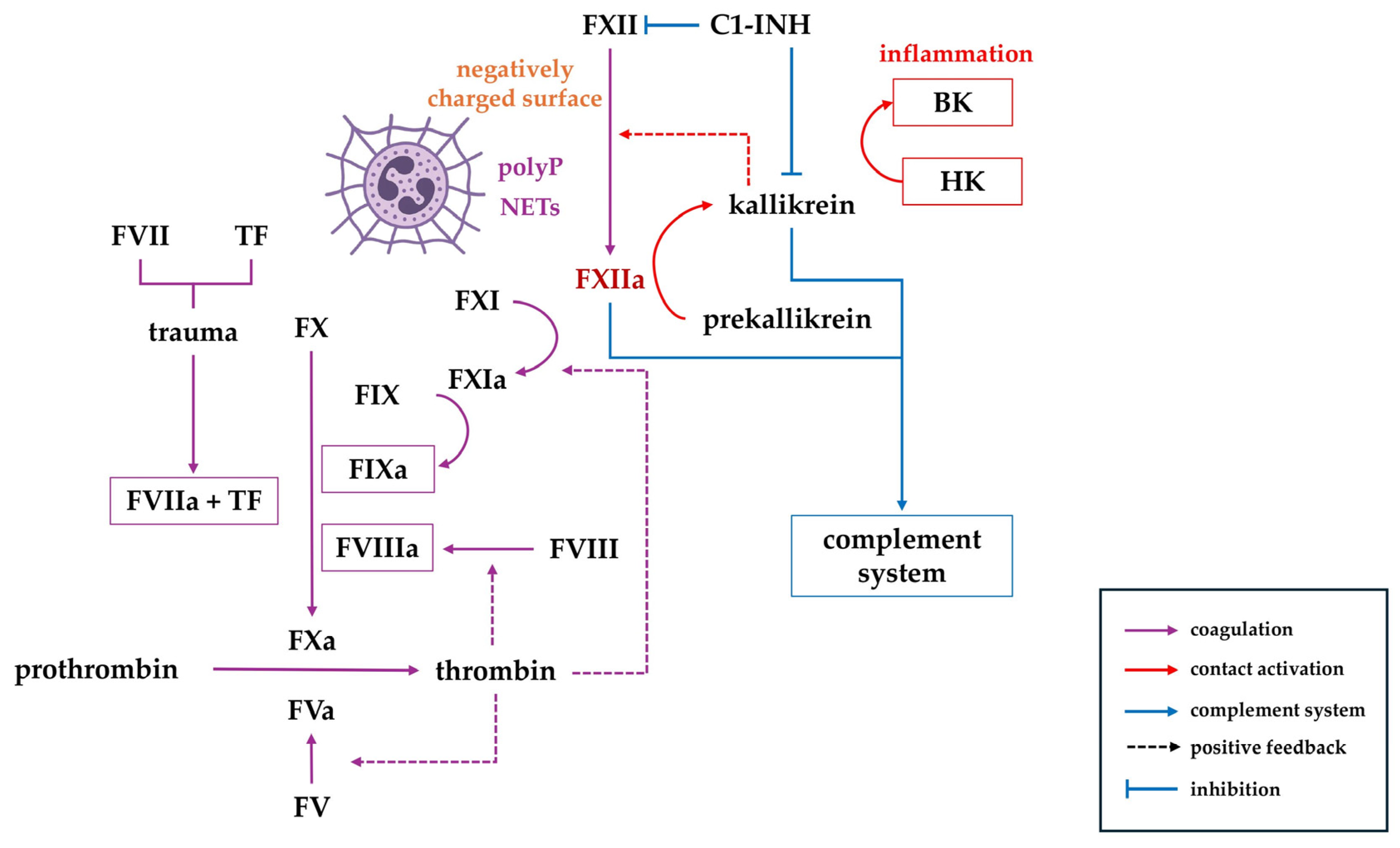
4.1. FXII in Coagulation Cascade–Intrinsic Pathway and Crosstalk with Tissue Factor Pathway
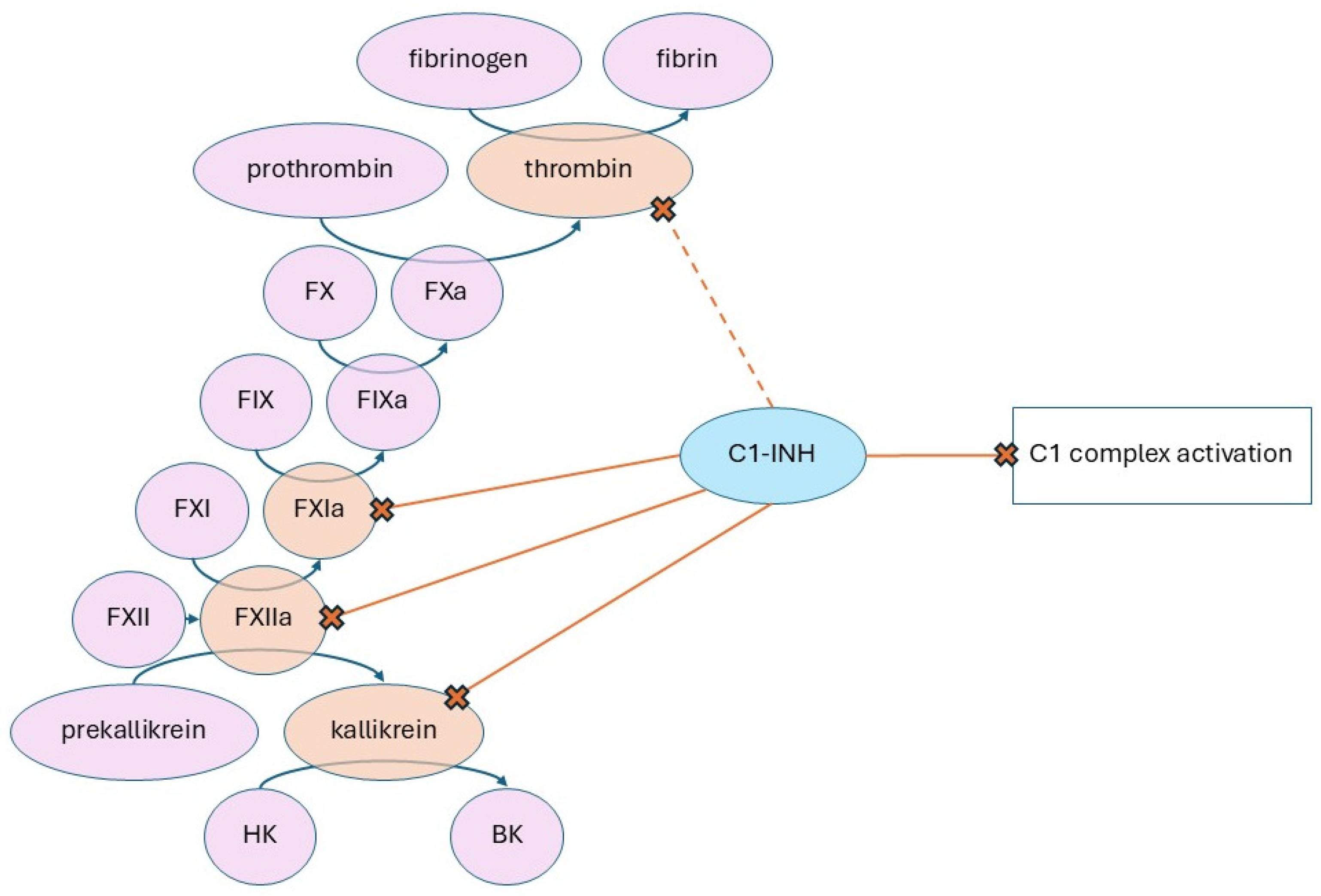
4.2. FXII in Inflammation-Contact Activation System and Its Relation to Complement System

5. FXII’s Contribution to Thrombosis: A Shift in Understanding
FXII in Cancer-Driven Thrombosis
6. FXII in the Pathophysiology of Ischemic Stroke and Brain Trauma

| Author | Year | Species and FXII Inhibitors | Main Conclusion |
|---|---|---|---|
| Kleinschnitz C et al. [42] | 2006 |
| FXII−/− mice are protected from cerebral ischemia, showing > 50% reduction in infarct volume 24 h after tMCAO compared with wild-type controls. Neurological outcomes are significantly improved in FXII-deficient animals. Intravenous reconstitution with human FXII restores susceptibility to ischemic brain injury. FXII deficiency does not increase intracranial hemorrhage following tMCAO. |
| Hagedorn I et al. [48] | 2010 |
| rHA-Infestin-4 completely abolished FeCl3-inducedocclusive arterial thrombus formation in mice and rats while leaving hemostasis fully intact. rHA-Infestin-4 was highly protective in a murine model of ischemic stroke. |
| Chen JW et al. [49] | 2012 |
| rHA-Infestin-4 administration significantly reduced ischemic damage and pathological coagulation without increasing hemorrhagic frequency in mice after induced silent brain ischemia (SBI). |
| Krupka J et al. [50] | 2016 |
| Within prophylactic treatment with rHA-Infestin-4 before tMCAO, infarct areas and brain edema formation were reduced accompanied by better neurological scores and survival compared to controls. Following therapeutic treatment (after the start of reperfusion), neurological outcome and survival were still improved although overall effects were less pronounced compared to prophylaxis. |
| Hopp S et al. [47] | 2016 |
| Genetic FXII deficiency or pharmacologic FXIIa inhibition reduces trauma-induced microvascular thrombosis in mice. This is associated with improved neurological function, smaller lesion volumes, and attenuated neurodegeneration. Reconstitution with human FXII restores thrombus formation and brain injury in FXII-deficient animals. |
| May F et al. [51] | 2016 |
| rHA-Infestin-4 reduces thrombotic occlusion in mechanically induced arterial and FeCl3-driven venous thrombosis models. It protects against arterial and stasis-induced venous thrombosis in rabbits. rHA-Infestin-4 prevents foreign surface-triggered thrombosis in arteriovenous shunt models (mice and rabbits). It preserves hemostasis, with no detectable impairment of bleeding parameters in rabbits. |
| Wang W et al. [46] | 2025 |
| CycloSD6, a cyclized derivative of the short peptide SD6: exhibits enhanced inhibition of FXIIa and plasma kallikrein. It also demonstrates robust antithrombotic efficacy in multiple murine models (carrageenan-induced tail thrombosis, FeCl3 arterial thrombosis, cortical photothrombosis). CycloSD6 does not prolong bleeding time, indicating preserved hemostatic function. |
7. Targeting FXII to Mitigate Thrombogenicity of Artificial Surfaces
8. FXII Inhibitors and Their Characteristics
8.1. Ixodes Ricinus Contact Phase Inhibitor (Ir-CPI)
8.2. rHA-Infestin-4
8.3. Monoclonal Antibodies
9. FXII in Hereditary Angioedema (HAE)
9.1. Garadacimab
9.2. HAE and Thromboembolic Risk
10. Conclusions
Author Contributions
Funding
Institutional Review Board Statement
Informed Consent Statement
Data Availability Statement
Conflicts of Interest
References
- Schmaier, A.H.; Stavrou, E.X. Factor XII—What’s important but not commonly thought about. Res. Pract. Thromb. Haemost. 2019, 3, 599–606. [Google Scholar] [CrossRef] [Scilit] [PubMed]
- Ratnoff, O.D.; Margolius, A., Jr. Hageman trait: An asymptomatic disorder of blood coagulation. Trans. Assoc. Am. Physicians 1955, 68, 149–154. [Google Scholar] [PubMed]
- Lammle, B.; Wuillemin, W.A.; Huber, I.; Krauskopf, M.; Zurcher, C.; Pflugshaupt, R.; Furlan, M. Thromboembolism and bleeding tendency in congenital factor XII deficiency—A study on 74 subjects from 14 Swiss families. Thromb. Haemost. 1991, 65, 117–121. [Google Scholar] [CrossRef] [Scilit] [PubMed]
- Renne, T.; Gailani, D. Role of Factor XII in hemostasis and thrombosis: Clinical implications. Expert. Rev. Cardiovasc. Ther. 2007, 5, 733–741. [Google Scholar] [CrossRef] [Scilit]
- Fye, W.B. Heparin: The contributions of William Henry Howell. Circulation 1984, 69, 1198–1203. [Google Scholar] [CrossRef] [Scilit]
- Hirsh, J.; Anand, S.S.; Halperin, J.L.; Fuster, V. Mechanism of action and pharmacology of unfractionated heparin. Arterioscler. Thromb. Vasc. Biol. 2001, 21, 1094–1096. [Google Scholar] [CrossRef] [Scilit]
- Weitz, J.I. Low-molecular-weight heparins. N. Engl. J. Med. 1997, 337, 688–698. [Google Scholar] [CrossRef] [Scilit]
- Bauer, K.A.; Eriksson, B.I.; Lassen, M.R.; Turpie, A.G.; Steering Committee of the Pentasaccharide in Major Knee Surgery Study. Fondaparinux compared with enoxaparin for the prevention of venous thromboembolism after elective major knee surgery. N. Engl. J. Med. 2001, 345, 1305–1310. [Google Scholar] [CrossRef] [Scilit]
- Turpie, A.G.; Eriksson, B.I.; Lassen, M.R.; Bauer, K.A. Fondaparinux, the first selective factor Xa inhibitor. Curr. Opin. Hematol. 2003, 10, 327–332. [Google Scholar] [CrossRef] [Scilit]
- Spritz, R.A. A study in scarlet. Nat. Genet. 1995, 11, 225–226. [Google Scholar] [CrossRef] [Scilit]
- Vahanian, A.; Beyersdorf, F.; Praz, F.; Milojevic, M.; Baldus, S.; Bauersachs, J.; Capodanno, D.; Conradi, L.; De Bonis, M.; De Paulis, R.; et al. 2021 ESC/EACTS Guidelines for the management of valvular heart disease. Eur. Heart J. 2022, 43, 561–632. [Google Scholar] [CrossRef] [Scilit]
- Konstantinides, S.V.; Meyer, G.; Becattini, C.; Bueno, H.; Geersing, G.J.; Harjola, V.P.; Huisman, M.V.; Humbert, M.; Jennings, C.S.; Jimenez, D.; et al. 2019 ESC Guidelines for the diagnosis and management of acute pulmonary embolism developed in collaboration with the European Respiratory Society (ERS). Eur. Heart J. 2020, 41, 543–603. [Google Scholar] [CrossRef] [Scilit] [PubMed]
- Steffel, J.; Collins, R.; Antz, M.; Cornu, P.; Desteghe, L.; Haeusler, K.G.; Oldgren, J.; Reinecke, H.; Roldan-Schilling, V.; Rowell, N.; et al. 2021 European Heart Rhythm Association Practical Guide on the Use of Non-Vitamin K Antagonist Oral Anticoagulants in Patients with Atrial Fibrillation. Europace 2021, 23, 1612–1676, Corrigendum in Europace 2021, 23, 1676. https://doi.org/10.1093/europace/euab157.. [Google Scholar] [CrossRef] [Scilit] [PubMed]
- Di Nisio, M.; Vedovati, M.C.; Riera-Mestre, A.; Prins, M.H.; Mueller, K.; Cohen, A.T.; Wells, P.S.; Beyer-Westendorf, J.; Prandoni, P.; Bounameaux, H.; et al. Treatment of venous thromboembolism with rivaroxaban in relation to body weight. A sub-analysis of the EINSTEIN DVT/PE studies. Thromb. Haemost. 2016, 116, 739–746. [Google Scholar] [CrossRef] [Scilit] [PubMed]
- Didiasova, M.; Wujak, L.; Schaefer, L.; Wygrecka, M. Factor XII in coagulation, inflammation and beyond. Cell Signal 2018, 51, 257–265. [Google Scholar] [CrossRef] [Scilit]
- Samuel, M.; Pixley, R.A.; Villanueva, M.A.; Colman, R.W.; Villanueva, G.B. Human factor XII (Hageman factor) autoactivation by dextran sulfate. Circular dichroism, fluorescence, and ultraviolet difference spectroscopic studies. J. Biol. Chem. 1992, 267, 19691–19697. [Google Scholar] [CrossRef] [Scilit]
- Brill, A.; Fuchs, T.A.; Savchenko, A.S.; Thomas, G.M.; Martinod, K.; De Meyer, S.F.; Bhandari, A.A.; Wagner, D.D. Neutrophil extracellular traps promote deep vein thrombosis in mice. J. Thromb. Haemost. 2012, 10, 136–144. [Google Scholar] [CrossRef] [Scilit]
- Maas, C.; Oschatz, C.; Renne, T. The plasma contact system 2.0. Semin. Thromb. Hemost. 2011, 37, 375–381. [Google Scholar] [CrossRef] [Scilit]
- Braat, E.A.; Dooijewaard, G.; Rijken, D.C. Fibrinolytic properties of activated FXII. Eur. J. Biochem. 1999, 263, 904–911. [Google Scholar] [CrossRef] [Scilit]
- Lakshmanan, H.H.S.; Estonilo, A.; Reitsma, S.E.; Melrose, A.R.; Subramanian, J.; Zheng, T.J.; Maddala, J.; Tucker, E.I.; Gailani, D.; McCarty, O.J.T.; et al. Revised model of the tissue factor pathway of thrombin generation: Role of the feedback activation of FXI. J. Thromb. Haemost. 2022, 20, 1350–1363. [Google Scholar] [CrossRef] [Scilit]
- Jackson, S.P.; Darbousset, R.; Schoenwaelder, S.M. Thromboinflammation: Challenges of therapeutically targeting coagulation and other host defense mechanisms. Blood 2019, 133, 906–918. [Google Scholar] [CrossRef] [Scilit] [PubMed]
- Ding, W.Y.; Protty, M.B.; Davies, I.G.; Lip, G.Y.H. Relationship between lipoproteins, thrombosis, and atrial fibrillation. Cardiovasc. Res. 2022, 118, 716–731. [Google Scholar] [CrossRef] [Scilit] [PubMed]
- Tang, Z.; Wang, X.; Huang, J.; Zhou, X.; Xie, H.; Zhu, Q.; Huang, M.; Ni, S. Gene Expression Profiling of Pulmonary Artery in a Rabbit Model of Pulmonary Thromboembolism. PLoS ONE 2016, 11, e0164530. [Google Scholar] [CrossRef] [Scilit] [PubMed]
- López-Lera, A.; Corvillo, F.; González-Sánchez, L.; Melgosa, M.; Sánchez-Corral, P. Relevance of the interactions between the complement and contact coagulation systems on renal pathology. Nefrología (Engl. Ed.) 2025, 45, 501347. [Google Scholar] [CrossRef] [Scilit]
- Cochrane, C.G.; Revak, S.D.; Wuepper, K.D. Activation of Hageman factor in solid and fluid phases. A critical role of kallikrein. J. Exp. Med. 1973, 138, 1564–1583. [Google Scholar] [CrossRef] [Scilit]
- Muller, F.; Renne, T. Novel roles for factor XII-driven plasma contact activation system. Curr. Opin. Hematol. 2008, 15, 516–521. [Google Scholar] [CrossRef] [Scilit]
- Leeb-Lundberg, L.M.; Marceau, F.; Müller-Esterl, W.; Pettibone, D.J.; Zuraw, B.L. International union of pharmacology. XLV. Classification of the kinin receptor family: From molecular mechanisms to pathophysiological consequences. Pharmacol. Rev. 2005, 57, 27–77. [Google Scholar] [CrossRef] [Scilit]
- Sato, E.; Koyama, S.; Nomura, H.; Kubo, K.; Sekiguchi, M. Bradykinin stimulates alveolar macrophages to release neutrophil, monocyte, and eosinophil chemotactic activity. J. Immunol. 1996, 157, 3122–3129. [Google Scholar] [CrossRef] [Scilit]
- Paegelow, I.; Trzeczak, S.; Böckmann, S.; Vietinghoff, G. Migratory responses of polymorphonuclear leukocytes to kinin peptides. Pharmacology 2002, 66, 153–161. [Google Scholar] [CrossRef] [Scilit]
- Schmaier, A.H. The elusive physiologic role of Factor XII. J. Clin. Invest. 2008, 118, 3006–3009. [Google Scholar] [CrossRef] [Scilit]
- Davis, A.E., 3rd; Mejia, P.; Lu, F. Biological activities of C1 inhibitor. Mol. Immunol. 2008, 45, 4057–4063. [Google Scholar] [CrossRef] [Scilit] [PubMed]
- Revak, S.D.; Cochrane, C.G. The relationship of structure and function in human Hageman factor. The association of enzymatic and binding activities with separate regions of the molecule. J. Clin. Invest. 1976, 57, 852–860. [Google Scholar] [CrossRef] [Scilit] [PubMed]
- Park, S.; Park, J.K. Back to basics: The coagulation pathway. Blood Res. 2024, 59, 35. [Google Scholar] [CrossRef] [Scilit] [PubMed]
- Renne, T.; Pozgajova, M.; Gruner, S.; Schuh, K.; Pauer, H.U.; Burfeind, P.; Gailani, D.; Nieswandt, B. Defective thrombus formation in mice lacking coagulation factor XII. J. Exp. Med. 2005, 202, 271–281. [Google Scholar] [CrossRef] [Scilit]
- Decrem, Y.; Rath, G.; Blasioli, V.; Cauchie, P.; Robert, S.; Beaufays, J.; Frere, J.M.; Feron, O.; Dogne, J.M.; Dessy, C.; et al. Ir-CPI, a coagulation contact phase inhibitor from the tick Ixodes ricinus, inhibits thrombus formation without impairing hemostasis. J. Exp. Med. 2009, 206, 2381–2395. [Google Scholar] [CrossRef] [Scilit]
- Juang, L.J.; Mazinani, N.; Novakowski, S.K.; Prowse, E.N.P.; Haulena, M.; Gailani, D.; Lavkulich, L.M.; Kastrup, C.J. Coagulation factor XII contributes to hemostasis when activated by soil in wounds. Blood Adv. 2020, 4, 1737–1745. [Google Scholar] [CrossRef] [Scilit]
- Kuijpers, M.J.; van der Meijden, P.E.; Feijge, M.A.; Mattheij, N.J.; May, F.; Govers-Riemslag, J.; Meijers, J.C.; Heemskerk, J.W.; Renne, T.; Cosemans, J.M. Factor XII regulates the pathological process of thrombus formation on ruptured plaques. Arterioscler. Thromb. Vasc. Biol. 2014, 34, 1674–1680. [Google Scholar] [CrossRef] [Scilit]
- Guyton, A.C.; Hall, J.E. Textbook of Medical Physiology, 11th ed.; Elsevier Saunders: Philadelphia, PA, USA, 2006; p. xxxv, 1116p. [Google Scholar]
- Alvarenga, P.H.; Xu, X.; Oliveira, F.; Chagas, A.C.; Nascimento, C.R.; Francischetti, I.M.; Juliano, M.A.; Juliano, L.; Scharfstein, J.; Valenzuela, J.G.; et al. Novel family of insect salivary inhibitors blocks contact pathway activation by binding to polyphosphate, heparin, and dextran sulfate. Arterioscler. Thromb. Vasc. Biol. 2013, 33, 2759–2770. [Google Scholar] [CrossRef] [Scilit]
- Puy, C.; Tucker, E.I.; Wong, Z.C.; Gailani, D.; Smith, S.A.; Choi, S.H.; Morrissey, J.H.; Gruber, A.; McCarty, O.J. Factor XII promotes blood coagulation independent of factor XI in the presence of long-chain polyphosphates. J. Thromb. Haemost. 2013, 11, 1341–1352. [Google Scholar] [CrossRef] [Scilit]
- Nickel, K.F.; Labberton, L.; Long, A.T.; Langer, F.; Fuchs, T.A.; Stavrou, E.X.; Butler, L.M.; Renne, T. The polyphosphate/factor XII pathway in cancer-associated thrombosis: Novel perspectives for safe anticoagulation in patients with malignancies. Thromb. Res. 2016, 141, S4–S7. [Google Scholar] [CrossRef] [Scilit]
- Kleinschnitz, C.; Stoll, G.; Bendszus, M.; Schuh, K.; Pauer, H.U.; Burfeind, P.; Renne, C.; Gailani, D.; Nieswandt, B.; Renne, T. Targeting coagulation factor XII provides protection from pathological thrombosis in cerebral ischemia without interfering with hemostasis. J. Exp. Med. 2006, 203, 513–518. [Google Scholar] [CrossRef] [Scilit]
- Bederson, J.B.; Pitts, L.H.; Tsuji, M.; Nishimura, M.C.; Davis, R.L.; Bartkowski, H. Rat middle cerebral artery occlusion: Evaluation of the model and development of a neurologic examination. Stroke 1986, 17, 472–476. [Google Scholar] [CrossRef] [Scilit] [PubMed]
- Kurz, K.D.; Main, B.W.; Sandusky, G.E. Rat model of arterial thrombosis induced by ferric chloride. Thromb. Res. 1990, 60, 269–280. [Google Scholar] [CrossRef] [Scilit] [PubMed]
- Wu, J.; Zhang, Y.; Chen, W.; Hao, T.; Ran, C.; Zhou, Y.; Shen, Y.; You, W.; Wang, T. Smart Thrombosis Care: The Rise of Closed-Loop Diagnosis-to-Treatment Nano Systems. Int. J. Nanomed. 2025, 20, 7851–7868. [Google Scholar] [CrossRef] [Scilit] [PubMed]
- Wang, W.; Zhang, Y.; Fang, Y.; Gao, J.; Thuku, R.C.; Yang, J.; Na, C.; Lu, Q.; Fang, M. Targeting the contact-kinin system: A cyclopeptide with anti-thromboinflammatory properties against stroke. Eur. J. Pharmacol. 2025, 998, 177497. [Google Scholar] [CrossRef] [Scilit]
- Hopp, S.; Albert-Weissenberger, C.; Mencl, S.; Bieber, M.; Schuhmann, M.K.; Stetter, C.; Nieswandt, B.; Schmidt, P.M.; Monoranu, C.M.; Alafuzoff, I.; et al. Targeting coagulation factor XII as a novel therapeutic option in brain trauma. Ann. Neurol. 2016, 79, 970–982. [Google Scholar] [CrossRef] [Scilit]
- Hagedorn, I.; Schmidbauer, S.; Pleines, I.; Kleinschnitz, C.; Kronthaler, U.; Stoll, G.; Dickneite, G.; Nieswandt, B. Factor XIIa inhibitor recombinant human albumin Infestin-4 abolishes occlusive arterial thrombus formation without affecting bleeding. Circulation 2010, 121, 1510–1517. [Google Scholar] [CrossRef] [Scilit]
- Chen, J.W.; Figueiredo, J.L.; Wojtkiewicz, G.R.; Siegel, C.; Iwamoto, Y.; Kim, D.E.; Nolte, M.W.; Dickneite, G.; Weissleder, R.; Nahrendorf, M. Selective factor XIIa inhibition attenuates silent brain ischemia: Application of molecular imaging targeting coagulation pathway. JACC Cardiovasc. Imaging 2012, 5, 1127–1138. [Google Scholar] [CrossRef] [Scilit]
- Krupka, J.; May, F.; Weimer, T.; Pragst, I.; Kleinschnitz, C.; Stoll, G.; Panousis, C.; Dickneite, G.; Nolte, M.W. The Coagulation Factor XIIa Inhibitor rHA-Infestin-4 Improves Outcome after Cerebral Ischemia/Reperfusion Injury in Rats. PLoS ONE 2016, 11, e0146783. [Google Scholar] [CrossRef] [Scilit]
- May, F.; Krupka, J.; Fries, M.; Thielmann, I.; Pragst, I.; Weimer, T.; Panousis, C.; Nieswandt, B.; Stoll, G.; Dickneite, G.; et al. FXIIa inhibitor rHA-Infestin-4: Safe thromboprotection in experimental venous, arterial and foreign surface-induced thrombosis. Br. J. Haematol. 2016, 173, 769–778. [Google Scholar] [CrossRef] [Scilit]
- Zangrillo, A.; Landoni, G.; Biondi-Zoccai, G.; Greco, M.; Greco, T.; Frati, G.; Patroniti, N.; Antonelli, M.; Pesenti, A.; Pappalardo, F. A meta-analysis of complications and mortality of extracorporeal membrane oxygenation. Crit. Care Resusc. 2013, 15, 172–178. [Google Scholar] [CrossRef] [Scilit] [PubMed]
- Kharnaf, M.; Zafar, F.; Hogue, S.; Rosenfeldt, L.; Cantrell, R.L.; Sharma, B.K.; Pearson, A.; Sprague, C.; Leino, D.; Abplanalp, W.A.; et al. Factor XII promotes the thromboinflammatory response in a rat model of venoarterial extracorporeal membrane oxygenation. J. Thorac. Cardiovasc. Surg. 2024, 168, e37–e53. [Google Scholar] [CrossRef] [Scilit] [PubMed]
- Tweddell, J.S.; Kharnaf, M.; Zafar, F.; Riggs, K.W.; Reagor, J.A.; Monia, B.P.; Revenko, A.; Leino, D.G.; Owens, A.P.; Martin, J.K.; et al. Targeting the contact system in a rabbit model of extracorporeal membrane oxygenation. Blood Adv. 2023, 7, 1404–1417. [Google Scholar] [CrossRef] [Scilit] [PubMed]
- Yau, J.W.; Liao, P.; Fredenburgh, J.C.; Stafford, A.R.; Revenko, A.S.; Monia, B.P.; Weitz, J.I. Selective depletion of factor XI or factor XII with antisense oligonucleotides attenuates catheter thrombosis in rabbits. Blood 2014, 123, 2102–2107. [Google Scholar] [CrossRef] [Scilit]
- Prihartini Aryanti, P.T.; Putu Indi Dharmayanti, N.L.; Hendarwan, H.; Shidiq, A.; Khoiruddin, K.; Wenten, I.G. Advancements in membrane materials for hemodialysis: A comprehensive review and future perspectives. Sep. Purif. Technol. 2025, 375, 133718. [Google Scholar] [CrossRef] [Scilit]
- Frank, R.D.; Mueller, U.; Lanzmich, R.; Floege, J. Factor XII activation markers do not reflect FXII dependence of thrombin generation induced by polyvinylchloride. J. Mater. Sci. Mater. Med. 2013, 24, 2561–2566. [Google Scholar] [CrossRef] [Scilit]
- Cheng, Q.; Tucker, E.I.; Pine, M.S.; Sisler, I.; Matafonov, A.; Sun, M.F.; White-Adams, T.C.; Smith, S.A.; Hanson, S.R.; McCarty, O.J.; et al. A role for factor XIIa-mediated factor XI activation in thrombus formation in vivo. Blood 2010, 116, 3981–3989. [Google Scholar] [CrossRef] [Scilit]
- Matafonov, A.; Leung, P.Y.; Gailani, A.E.; Grach, S.L.; Puy, C.; Cheng, Q.; Sun, M.F.; McCarty, O.J.; Tucker, E.I.; Kataoka, H.; et al. Factor XII inhibition reduces thrombus formation in a primate thrombosis model. Blood 2014, 123, 1739–1746. [Google Scholar] [CrossRef] [Scilit]
- Xu, Y.; Cai, T.Q.; Castriota, G.; Zhou, Y.; Hoos, L.; Jochnowitz, N.; Loewrigkeit, C.; Cook, J.A.; Wickham, A.; Metzger, J.M.; et al. Factor XIIa inhibition by Infestin-4: In vitro mode of action and in vivo antithrombotic benefit. Thromb. Haemost. 2014, 111, 694–704. [Google Scholar] [CrossRef] [Scilit]
- Larsson, M.; Rayzman, V.; Nolte, M.W.; Nickel, K.F.; Bjorkqvist, J.; Jamsa, A.; Hardy, M.P.; Fries, M.; Schmidbauer, S.; Hedenqvist, P.; et al. A factor XIIa inhibitory antibody provides thromboprotection in extracorporeal circulation without increasing bleeding risk. Sci. Transl. Med. 2014, 6, 222ra217. [Google Scholar] [CrossRef] [Scilit]
- Pireaux, V.; Tassignon, J.; Demoulin, S.; Derochette, S.; Borenstein, N.; Ente, A.; Fiette, L.; Douxfils, J.; Lancellotti, P.; Guyaux, M.; et al. Anticoagulation With an Inhibitor of Factors XIa and XIIa During Cardiopulmonary Bypass. J. Am. Coll. Cardiol. 2019, 74, 2178–2189. [Google Scholar] [CrossRef] [Scilit]
- Wallisch, M.; Lorentz, C.U.; Lakshmanan, H.H.S.; Johnson, J.; Carris, M.R.; Puy, C.; Gailani, D.; Hinds, M.T.; McCarty, O.J.T.; Gruber, A.; et al. Antibody inhibition of contact factor XII reduces platelet deposition in a model of extracorporeal membrane oxygenator perfusion in nonhuman primates. Res. Pract. Thromb. Haemost. 2020, 4, 205–216. [Google Scholar] [CrossRef] [Scilit] [PubMed]
- Xu, P.; Zhang, Y.; Guo, J.; Li, H.; Konrath, S.; Zhou, P.; Cai, L.; Rao, H.; Chen, H.; Lin, J.; et al. A single-domain antibody targeting factor XII inhibits both thrombosis and inflammation. Nat. Commun. 2024, 15, 7898. [Google Scholar] [CrossRef] [Scilit] [PubMed]
- Keeling, N.M.; Wallisch, M.; Johnson, J.; Le, H.H.; Vu, H.H.; Jordan, K.R.; Puy, C.; Tucker, E.I.; Nguyen, K.P.; McCarty, O.J.T.; et al. Pharmacologic targeting of coagulation factors XII and XI by monoclonal antibodies reduces thrombosis in nitinol stents under flow. J. Thromb. Haemost. 2024, 22, 1433–1446. [Google Scholar] [CrossRef] [Scilit] [PubMed]
- Roberts, T.C.; Langer, R.; Wood, M.J.A. Advances in oligonucleotide drug delivery. Nat. Rev. Drug Discov. 2020, 19, 673–694. [Google Scholar] [CrossRef] [Scilit]
- Tatiparti, K.; Sau, S.; Kashaw, S.K.; Iyer, A.K. siRNA Delivery Strategies: A Comprehensive Review of Recent Developments. Nanomaterials 2017, 7, 77. [Google Scholar] [CrossRef] [Scilit]
- Leboulle, G.; Rochez, C.; Louahed, J.; Ruti, B.; Brossard, M.; Bollen, A.; Godfroid, E. Isolation of Ixodes ricinus salivary gland mRNA encoding factors induced during blood feeding. Am. J. Trop. Med. Hyg. 2002, 66, 225–233. [Google Scholar] [CrossRef] [Scilit]
- A Phase IIa, Randomized, Open-label, Proof-of-Concept Study to Evaluate Safety, Tolerability and Efficacy of Ir-CPI in Patients With Spontaneous Intracerebral Haemorrhage. Available online: https://clinicaltrials.gov/study/NCT05970224 (accessed on 15 March 2026).
- Bioxodes SA. Bioxodes obtains Orphan Drug Designation for hemorrhagic stroke therapeutic candidate in US and Europe. In Press Releases; Bioxodes: Gosselies, Belgium, 2025. [Google Scholar]
- Santacroce, R.; D’Andrea, G.; Maffione, A.B.; Margaglione, M.; d’Apolito, M. The Genetics of Hereditary Angioedema: A Review. J. Clin. Med. 2021, 10, 2023. [Google Scholar] [CrossRef] [Scilit]
- Sinnathamby, E.S.; Issa, P.P.; Roberts, L.; Norwood, H.; Malone, K.; Vemulapalli, H.; Ahmadzadeh, S.; Cornett, E.M.; Shekoohi, S.; Kaye, A.D. Hereditary Angioedema: Diagnosis, Clinical Implications, and Pathophysiology. Adv. Ther. 2023, 40, 814–827. [Google Scholar] [CrossRef] [Scilit]
- Joseph, K.; Tuscano, T.B.; Kaplan, A.P. Studies of the mechanisms of bradykinin generation in hereditary angioedema plasma. Ann. Allergy Asthma Immunol. 2008, 101, 279–286. [Google Scholar] [CrossRef] [Scilit]
- Miyata, T.; Horiuchi, T. Biochemistry, molecular genetics, and clinical aspects of hereditary angioedema with and without C1 inhibitor deficiency. Allergol. Int. 2023, 72, 375–384. [Google Scholar] [CrossRef] [Scilit]
- de Maat, S.; Joseph, K.; Maas, C.; Kaplan, A.P. Blood Clotting and the Pathogenesis of Types I and II Hereditary Angioedema. Clin. Rev. Allergy Immunol. 2021, 60, 348–356. [Google Scholar] [CrossRef] [Scilit]
- Zuraw, B.L. HAE therapies: Past present and future. Allergy Asthma Clin. Immunol. 2010, 6, 23. [Google Scholar] [CrossRef] [Scilit]
- Beninger, P. ANDEMBRY (garadacimab-gxii). Clin. Ther. 2025, 47, 823–824. [Google Scholar] [CrossRef] [Scilit]
- Craig, T.J.; Reshef, A.; Li, H.H.; Jacobs, J.S.; Bernstein, J.A.; Farkas, H.; Yang, W.H.; Stroes, E.S.G.; Ohsawa, I.; Tachdjian, R.; et al. Efficacy and safety of garadacimab, a factor XIIa inhibitor for hereditary angioedema prevention (VANGUARD): A global, multicentre, randomised, double-blind, placebo-controlled, phase 3 trial. Lancet 2023, 401, 1079–1090, Correction in Lancet 2023, 401, 1266. https://doi.org/10.1016/S0140-6736(23)00739-0.. [Google Scholar] [CrossRef] [Scilit]
- Grover, S.P.; Kawano, T.; Wan, J.; Tanratana, P.; Polai, Z.; Shim, Y.J.; Snir, O.; Brækkan, S.; Dhrolia, S.; Kasthuri, R.R.; et al. C1 inhibitor deficiency enhances contact pathway-mediated activation of coagulation and venous thrombosis. Blood 2023, 141, 2390–2401. [Google Scholar] [CrossRef] [Scilit] [PubMed]
- Grover, S.P.; Sundler Björkman, L.; Egesten, A.; Moll, S.; Mackman, N. Hereditary angioedema is associated with an increased risk of venous thromboembolism. J. Thromb. Haemost. 2022, 20, 2703–2706. [Google Scholar] [CrossRef] [Scilit] [PubMed]
- Gailani, D. Hereditary angioedema and thrombosis. Blood 2023, 141, 2295–2297. [Google Scholar] [CrossRef] [Scilit] [PubMed]

| Author | Year | Animal Models, Devices and Therapeutic Agents | Main Conclusion |
|---|---|---|---|
| Decrem Y et al. [35] | 2009 |
| Ir-CPI selectively targets activated contact factors (FXIIa, FXIa, kallikrein) and prolongs aPTT in vitro. Its intravenous administration dose-dependently reduces venous thrombosis and impairs formation of occlusive arterial thrombi in rodents. Ir-CPI protects against collagen/epinephrine-induced thromboembolism in mice. It provides antithrombotic efficacy without increasing bleeding or altering global coagulation parameters. |
| Cheng Q et al. [58] | 2010 |
| FXII deficiency confers greater antithrombotic protection than FXI or FIX deficiency in carotid artery injury models. The FXI-neutralizing antibody 14E11 prevents FeCl3-induced arterial occlusion, mimicking complete FXI deficiency in mice. Collagen-coated arteriovenous shunts. These findings identify FXIIa-driven FXI activation as a key amplifier of thrombosis in rodents and primates. |
| Yau JW et al. [55] | 2014 |
| Compared with control, FXII and FXI antisense oligonucleotides treatment prolonged the time to catheter occlusion by 2.2- and 2.3-fold, respectively. Catheter thrombosis is triggered via the contact pathway. |
| Matafonov A et al. [59] | 2014 |
| Monoclonal antibodies against the human FXII heavy chain reduced fibrin formation in collagen-coated vascular grafts inserted into arteriovenous shunts in baboons, and reduced fibrin and platelet accumulation downstream of the graft. These findings support a role for FXII in thrombus formation in primates. |
| Xu Y et al. [60] | 2014 |
| rHA-Infestin-4 dose-dependently reduces thrombus weight in arteriovenous shunt models in rats and rabbits. Bleeding times are minimally affected, indicating preserved hemostasis in both species. At 5 mg/kg in rabbits, rHA-Infestin-4 causes only a modest (~13%) reduction in ex vivo FXa activity, suggesting limited off-target effects. |
| Larsson M et al. [61] | 2014 |
| Recombinant fully human antibody binding catalytic site of human FXIIa (3F7) interfered with FXIIa-mediated coagulation and blocked carotid artery 10% FeCl3-induced thrombosis in mice and rabbits. 3F7 provided thromboprotection in ECMO as efficiently as heparin. |
| May F et al. [51] | 2016 |
| rHA-Infestin-4 decreased occlusion rates in the mechanically-induced arterial (Folt’s) and the FeCl3-induced venous thrombosis model. It protected from FeCl3 -induced arterial thrombosis and from stasis-prompted venous thrombosis in rabbits. rHA-Infestin-4 prevented occlusion in the arterio-venous shunt model in mice and rabbits where thrombosis was induced via a foreign surface. Hemostatic capacity in rabbits was unaffected by rHA-Infestin-4. |
| Pireaux V [62] | 2019 |
| Ir-CPI, a specific protein inhibitor of FXIIa, FXIa and kallikrein, was as efficient as UFH in preventing clot formation within the extracorporeal circuit and maintained physiological parameters during and post-surgery. |
| Wallisch M et al. [63] | 2020 |
| The FXII-neutralizing monoclonal antibody 5C12 reduces platelet deposition and fibrin accumulation in baboon extracorporeal membrane oxygenators, both with and without low-dose unfractionated heparin. Effective antithrombotic dosing does not prolong bleeding time, indicating preserved hemostasis. |
| Tweddell JS et al. [54] | 2023 |
| Inhibition of the contact pathway attenuates coagulation and inflammatory activation during ECMO. Tissue factor-driven thrombin generation may partially compensate for FXII inhibition under high inflammatory burden. |
| Xu P et al. [64] | 2024 |
| Inhibition of FXIIa formation attenuated arterial thrombosis in male mice without affecting hemostasis. In a mouse model of extracorporeal membrane oxygenation (ECMO), FXII inhibition or knockout reduced thrombus deposition on oxygenator membranes and systemic microvascular thrombi. In human blood microfluidic analysis, FXII inhibition prevented collagen-induced fibrin deposition and neutrophil adhesion/activation. |
| Keeling NM [65] | 2024 |
| Function-blocking antibodies of FXII and FXI reduced markers of stent-induced thrombosis in vitro and ex vivo. Thrombosis markers under varied flow conditions. |
| Kharnaf M et al. [53] | 2024 |
| FXII promotes thromboinflammatory response during ECMO. FXII deficiency reduces neutrophil infiltration and inflammatory markers despite anticoagulation. FXII may contribute to inflammation independently of thrombin generation. |
| Inhibitor/Class | Main Target(s) | Main (Pre) Clinical Setting(s) | Stage of Development (As of 2025) |
|---|---|---|---|
| Ir-CPI | FXIIa, FXIa, PK | venous and arterial thrombosis (FeCl3, stasis models); extracorporeal circulation; ICH models | phase IIa clinical trial (BIRCH) for spontaneous ICH |
| rHA-Infestin-4 | selective FXIIa inhibitor | venous and arterial thrombosis foreign-surface thrombosis (AV shunts), ischemic stroke, silent brain ischemia | preclinical |
| monoclonal antibodies: 3F7, 5C12, Nb Fc, anti-FXII heavy chain | FXIIa, FXII heavy chain, FXIIa-mediated FXI activation | ECMO thromboprotection; stent and graft thrombosis; arterial injury models; thromboinflammation | preclinical |
| Garadacimab | fully human IgG4λ monoclonal antibody targeting FXIIa catalytic domain | hereditary angioedema (HAE); mechanistic studies in FXII inhibition, inflammation | approved in 2025 by EMA and FDA for HAE prophylaxis; |
Disclaimer/Publisher’s Note: The statements, opinions and data contained in all publications are solely those of the individual author(s) and contributor(s) and not of MDPI and/or the editor(s). MDPI and/or the editor(s) disclaim responsibility for any injury to people or property resulting from any ideas, methods, instructions or products referred to in the content. |
© 2026 by the authors. Licensee MDPI, Basel, Switzerland. This article is an open access article distributed under the terms and conditions of the Creative Commons Attribution (CC BY) license.
Share and Cite
Stępnicki, J.; Imiela, A.M.; Szymańska, M.; Mikołajczuk, J.; Pruszczyk, P. Factor XII in Thrombosis and Thromboinflammation: From Molecular Biology to Clinical Translation. Int. J. Mol. Sci. 2026, 27, 3336. https://doi.org/10.3390/ijms27073336
Stępnicki J, Imiela AM, Szymańska M, Mikołajczuk J, Pruszczyk P. Factor XII in Thrombosis and Thromboinflammation: From Molecular Biology to Clinical Translation. International Journal of Molecular Sciences. 2026; 27(7):3336. https://doi.org/10.3390/ijms27073336
Chicago/Turabian StyleStępnicki, Jan, Anna M. Imiela, Marta Szymańska, Jakub Mikołajczuk, and Piotr Pruszczyk. 2026. "Factor XII in Thrombosis and Thromboinflammation: From Molecular Biology to Clinical Translation" International Journal of Molecular Sciences 27, no. 7: 3336. https://doi.org/10.3390/ijms27073336
APA StyleStępnicki, J., Imiela, A. M., Szymańska, M., Mikołajczuk, J., & Pruszczyk, P. (2026). Factor XII in Thrombosis and Thromboinflammation: From Molecular Biology to Clinical Translation. International Journal of Molecular Sciences, 27(7), 3336. https://doi.org/10.3390/ijms27073336