The Role of Eph/Ephrin-Driven Actomyosin Contractility in Promoting Cell Segregation and Boundary Formation

Abstract
1. Introduction
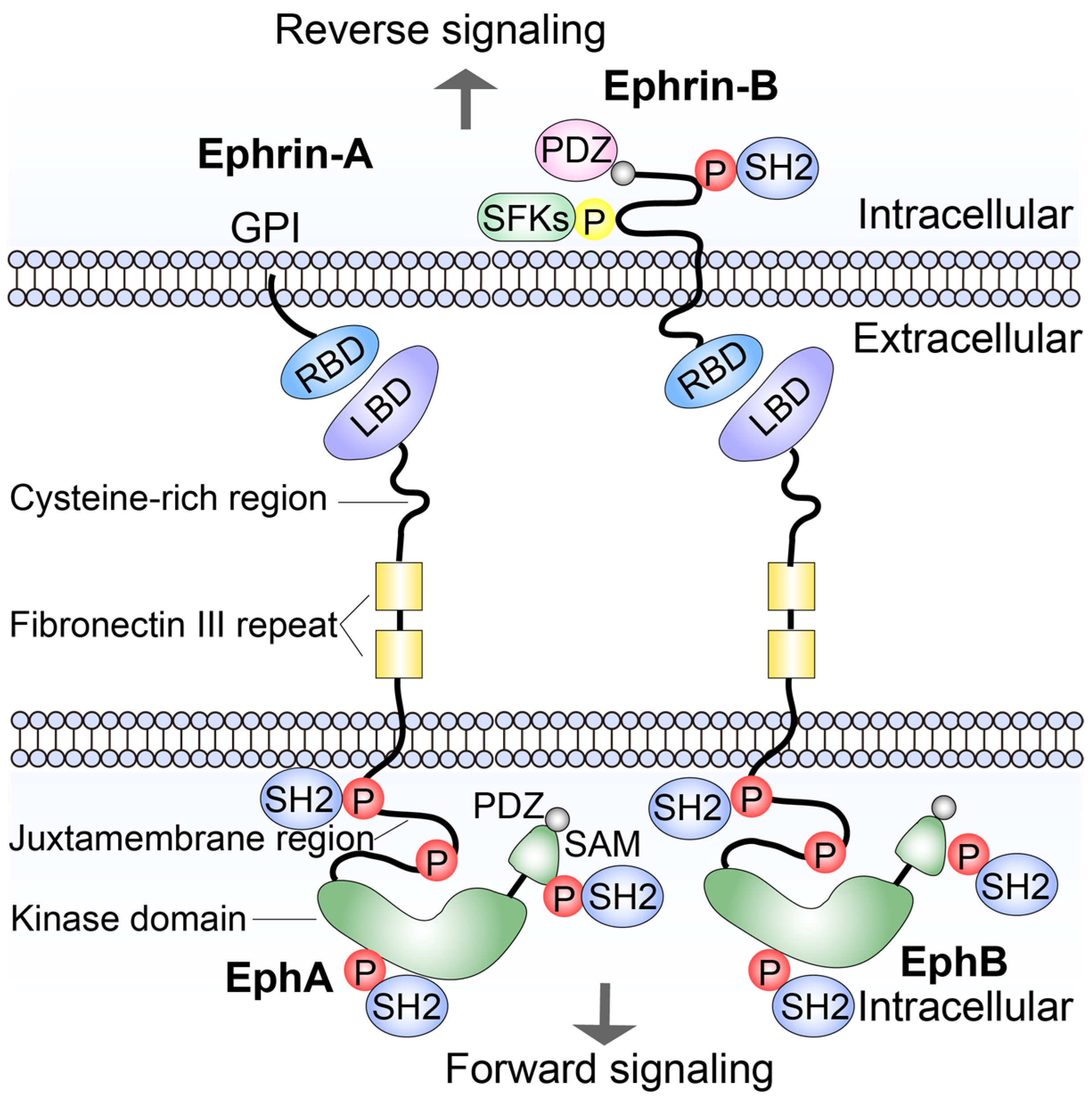
2. Eph Receptor and Its Ligand Ephrin
3. Eph-Ephrin Bidirectional Signaling
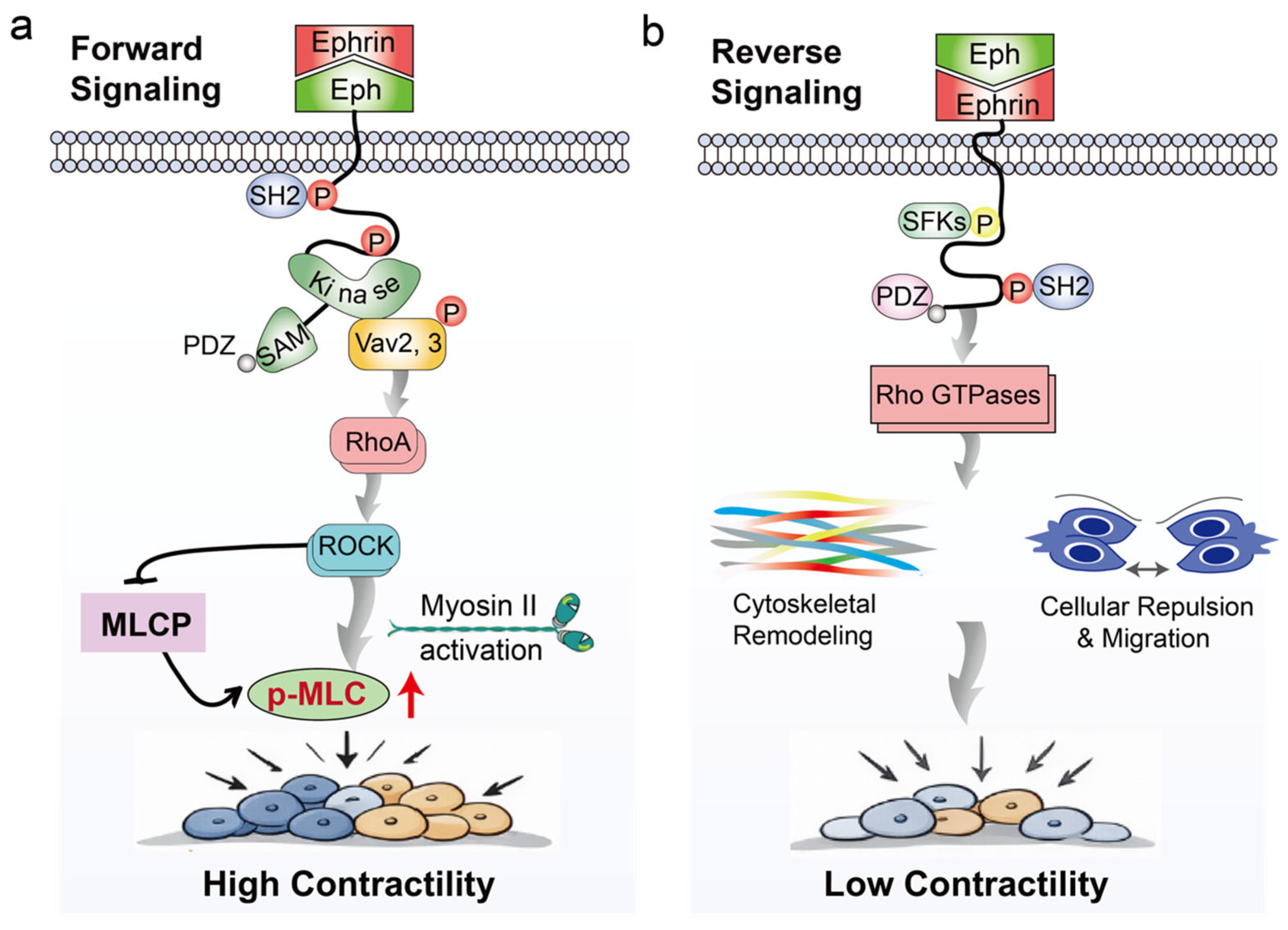
4. Regulation of Actomyosin Contractility by Eph/Ephrin Signaling
5. The Role of Eph/Ephrin in Cell Segregation and Boundaries Formation
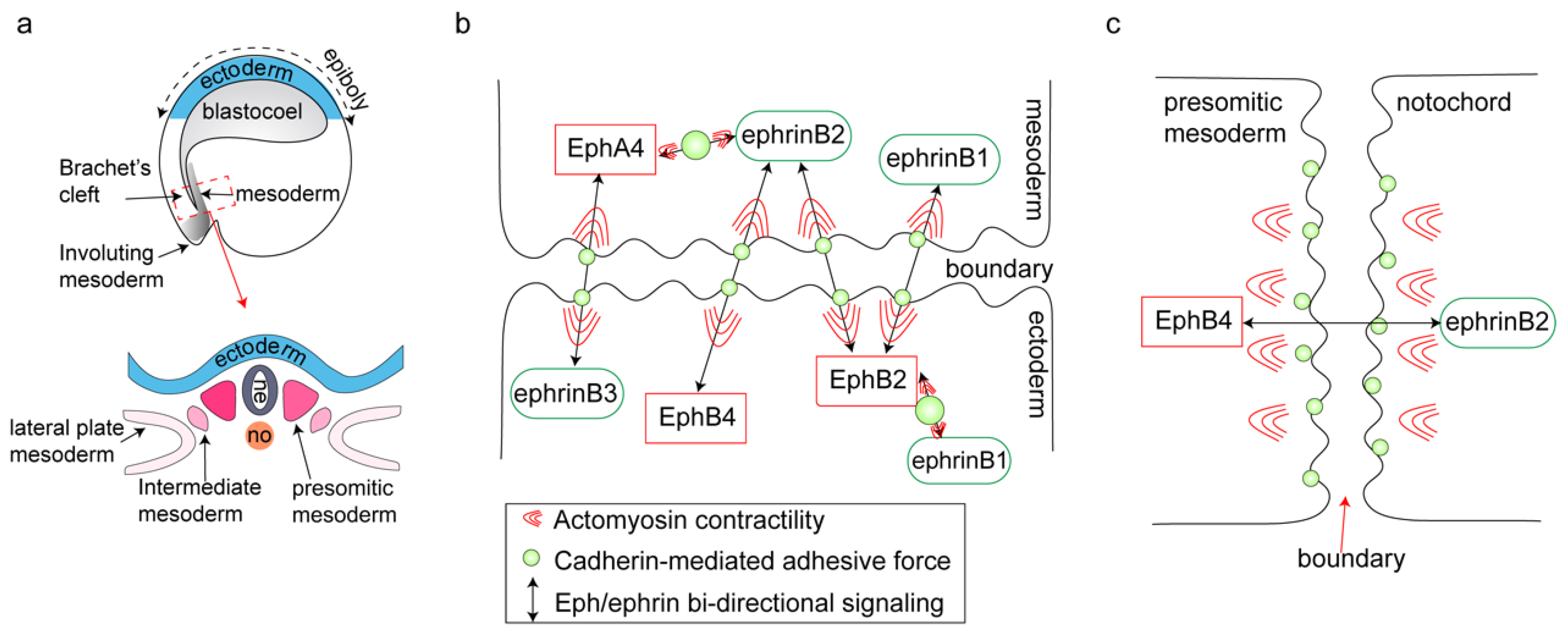
5.1. Segregation of Germ Layers (Ectoderm–Mesoderm Boundary and Notochord–Presomitic Mesoderm) During Gastrulation
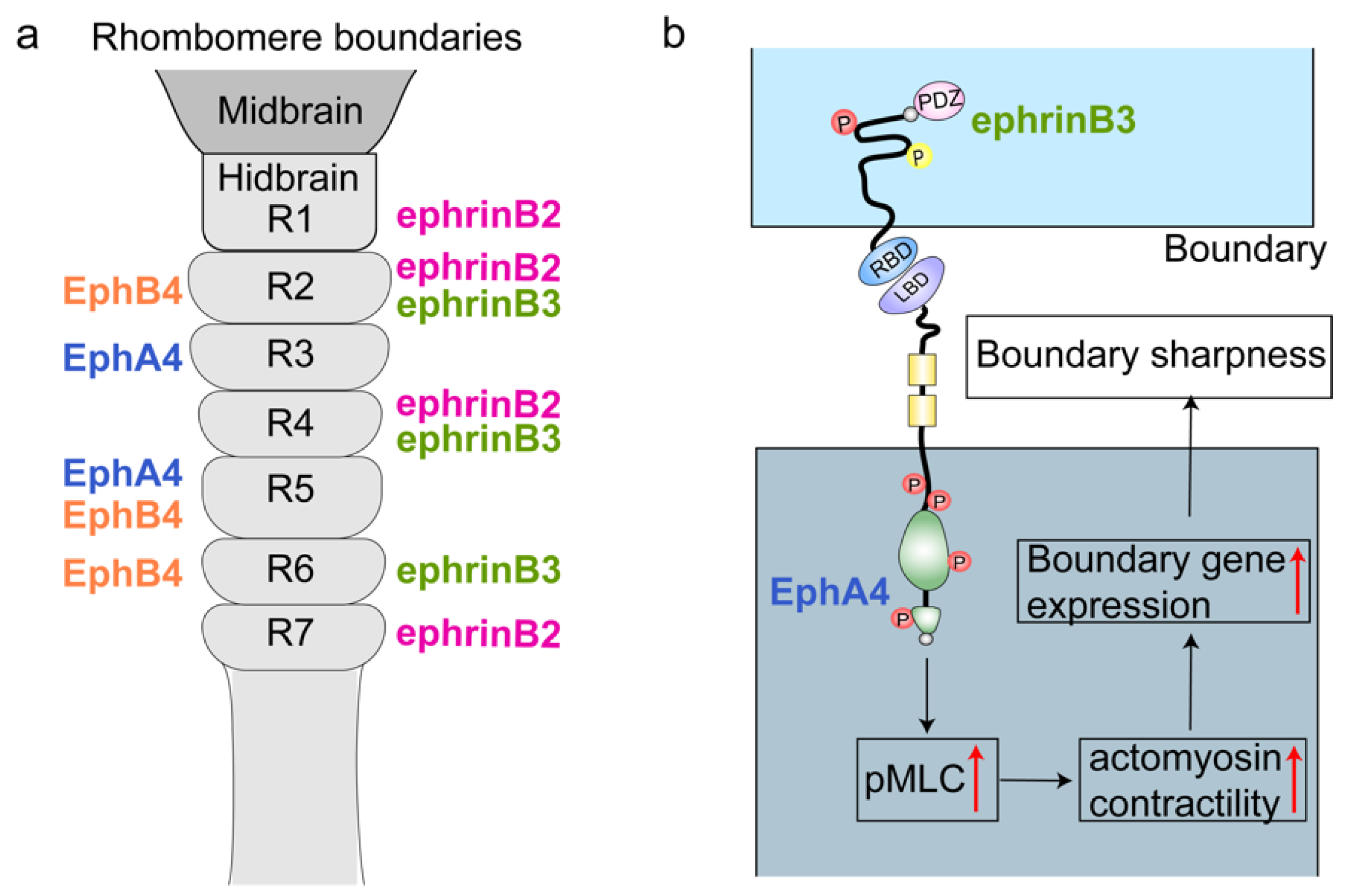
5.2. Hindbrain Compartmentalization
5.3. Eye Field Segregation During Forebrain Morphogenesis
5.4. Cell Segregation
6. Discussion
6.1. Relative Contributions of Forward and Reverse Eph/Ephrin Signaling to Contractility Regulation
6.2. Functional Redundancy Among Eph/Ephrin Family Members and Experimental Strategies to Dissect Their Roles
6.3. Current Limitations in Understanding Eph/Ephrin-Mediated Mechanical Regulation of Tissue Boundaries
Author Contributions
Funding
Data Availability Statement
Acknowledgments
Conflicts of Interest
References
- Fagotto, F. The cellular basis of tissue separation. Development 2014, 141, 3303–3318. [Google Scholar] [CrossRef]
- Winklbauer, R. Cell adhesion strength from cortical tension—An integration of concepts. J. Cell Sci. 2015, 128, 3687–3693. [Google Scholar] [CrossRef]
- Batlle, E.; Wilkinson, D.G. Molecular mechanisms of cell segregation and boundary formation in development and tumorigenesis. Cold Spring Harb. Perspect. Biol. 2012, 4, a008227. [Google Scholar] [CrossRef]
- Dahmann, C.; Oates, A.C.; Brand, M. Boundary formation and maintenance in tissue development. Nat. Rev. Genet. 2011, 12, 43–55. [Google Scholar] [CrossRef]
- Brodland, G.W. The Differential Interfacial Tension Hypothesis (DITH): A comprehensive theory for the self-rearrangement of embryonic cells and tissues. J. Biomech. Eng. 2002, 124, 188–197. [Google Scholar] [CrossRef] [PubMed]
- Fagotto, F.; Winklbauer, R.; Rohani, N. Ephrin-Eph signaling in embryonic tissue separation. Cell Adhes. Migr. 2014, 8, 308–326. [Google Scholar] [CrossRef]
- Cayuso, J.; Xu, Q.; Wilkinson, D.G. Mechanisms of boundary formation by Eph receptor and ephrin signaling. Dev. Biol. 2015, 401, 122–131. [Google Scholar] [CrossRef]
- Duffield, J.R.; Hou, X.; Wilson, B.W.; Prasad, A.; McKeon-Makki, I.K.; Huehls, A.M.; Wu, X.; Correia, C.; Larson, M.C.; Couch, F.J.; et al. Dual FAK and EPHA2 targeting by brigatinib tackles PARP inhibitor adaptive survival response in high-grade serous ovarian cancer. Sci. Transl. Med. 2026, 18, eadt8706. [Google Scholar] [CrossRef]
- Papadakos, S.P.; Dedes, N.; Gkolemi, N.; Machairas, N.; Theocharis, S. The EPH/Ephrin System in Pancreatic Ductal Adenocarcinoma (PDAC): From Pathogenesis to Treatment. Int. J. Mol. Sci. 2023, 24, 3015. [Google Scholar] [CrossRef]
- Mellitzer, G.; Xu, Q.; Wilkinson, D.G. Eph receptors and ephrins restrict cell intermingling and communication. Nature 1999, 400, 77–81. [Google Scholar] [CrossRef]
- Fagotto, F.; Rohani, N.; Touret, A.S.; Li, R. A molecular base for cell sorting at embryonic boundaries: Contact inhibition of cadherin adhesion by ephrin/Eph-dependent contractility. Dev. Cell 2013, 27, 72–87. [Google Scholar] [CrossRef]
- Borovikov, Y.S.; Tishkova, M.V.; Avrova, S.V.; Sirenko, V.V.; Karpicheva, O.E. The Twisting and Untwisting of Actin and Tropomyosin Filaments Are Involved in the Molecular Mechanisms of Muscle Contraction, and Their Disruption Can Result in Muscle Disorders. Int. J. Mol. Sci. 2025, 26, 6705. [Google Scholar] [CrossRef]
- Calzolari, S.; Terriente, J.; Pujades, C. Cell segregation in the vertebrate hindbrain relies on actomyosin cables located at the interhombomeric boundaries. EMBO J. 2014, 33, 686–701. [Google Scholar] [CrossRef]
- Levayer, R.; Lecuit, T. Biomechanical regulation of contractility: Spatial control and dynamics. Trends Cell Biol. 2012, 22, 61–81. [Google Scholar] [CrossRef]
- Salbreux, G.; Charras, G.; Paluch, E. Actin cortex mechanics and cellular morphogenesis. Trends Cell Biol. 2012, 22, 536–545. [Google Scholar] [CrossRef]
- Kindberg, A.A.; Srivastava, V.; Muncie, J.M.; Weaver, V.M.; Gartner, Z.J.; Bush, J.O. EPH/EPHRIN regulates cellular organization by actomyosin contractility effects on cell contacts. J. Cell Biol. 2021, 220, e202005216. [Google Scholar] [CrossRef] [PubMed]
- O’Neill, A.K.; Kindberg, A.A.; Niethamer, T.K.; Larson, A.R.; Ho, H.H.; Greenberg, M.E.; Bush, J.O. Unidirectional Eph/ephrin signaling creates a cortical actomyosin differential to drive cell segregation. J. Cell Biol. 2016, 215, 217–229. [Google Scholar] [CrossRef]
- Liang, L.Y.; Patel, O.; Janes, P.W.; Murphy, J.M.; Lucet, I.S. Eph receptor signalling: From catalytic to non-catalytic functions. Oncogene 2019, 38, 6567–6584. [Google Scholar] [CrossRef]
- Zhao, Y.; Yin, L.; Zhang, H.; Lan, T.; Li, S.; Ma, P. Eph/ephrin family anchored on exosome facilitate communications between cells. Cell Biol. Int. 2018, 42, 1458–1462. [Google Scholar] [CrossRef]
- Vasileiou, I.; Adamakis, I.; Patsouris, E.; Theocharis, S. Ephrins and pain. Expert. Opin. Ther. Targets 2013, 17, 879–887. [Google Scholar] [CrossRef]
- Eph Nomenclature Committee. Unified nomenclature for Eph family receptors and their ligands, the ephrins. Cell 1997, 90, 403–404. [Google Scholar] [CrossRef]
- Gale, N.W.; Holland, S.J.; Valenzuela, D.M.; Flenniken, A.; Pan, L.; Ryan, T.E.; Henkemeyer, M.; Strebhardt, K.; Hirai, H.; Wilkinson, D.G.; et al. Eph receptors and ligands comprise two major specificity subclasses and are reciprocally compartmentalized during embryogenesis. Neuron 1996, 17, 9–19. [Google Scholar] [CrossRef] [PubMed]
- Himanen, J.P.; Chumley, M.J.; Lackmann, M.; Li, C.; Barton, W.A.; Jeffrey, P.D.; Vearing, C.; Geleick, D.; Feldheim, D.A.; Boyd, A.W.; et al. Repelling class discrimination: Ephrin-A5 binds to and activates EphB2 receptor signaling. Nat. Neurosci. 2004, 7, 501–509. [Google Scholar] [CrossRef] [PubMed]
- Verma, S.; Chakraborti, S.; Singh, O.P.; Pande, V.; Dixit, R.; Pandey, A.V.; Pandey, K.C. Recognition of fold- and function-specific sites in the ligand-binding domain of the thyroid hormone receptor-like family. Front. Endocrinol. 2022, 13, 981090, Erratum in Front. Endocrinol. 2023, 14, 1175369. https://doi.org/10.3389/fendo.2023.1175369. [Google Scholar] [CrossRef]
- Labrador, J.P.; Brambilla, R.; Klein, R. The N-terminal globular domain of Eph receptors is sufficient for ligand binding and receptor signaling. EMBO J. 1997, 16, 3889–3897. [Google Scholar] [CrossRef]
- Boyd, A.W.; Lackmann, M. Signals from Eph and ephrin proteins: A developmental tool kit. Sci. STKE 2001, 2001, re20. [Google Scholar] [CrossRef] [PubMed]
- Kalo, M.S.; Pasquale, E.B. Signal transfer by Eph receptors. Cell Tissue Res. 1999, 298, 1–9. [Google Scholar] [CrossRef]
- Wang, Y.; Shang, Y.; Li, J.; Chen, W.; Li, G.; Wan, J.; Liu, W.; Zhang, M. Specific Eph receptor-cytoplasmic effector signaling mediated by SAM-SAM domain interactions. eLife 2018, 7, e35677. [Google Scholar] [CrossRef]
- Wang, Y.; Li, Q.; Zheng, Y.; Li, G.; Liu, W. Systematic biochemical characterization of the SAM domains in Eph receptor family from Mus Musculus. Biochem. Biophys. Res. Commun. 2016, 473, 1281–1287. [Google Scholar] [CrossRef]
- Himanen, J.P.; Nikolov, D.B. Eph receptors and ephrins. Int. J. Biochem. Cell Biol. 2003, 35, 130–134. [Google Scholar] [CrossRef]
- Cowan, C.A.; Henkemeyer, M. The SH2/SH3 adaptor Grb4 transduces B-ephrin reverse signals. Nature 2001, 413, 174–179. [Google Scholar] [CrossRef] [PubMed]
- Noren, N.K.; Pasquale, E.B. Eph receptor-ephrin bidirectional signals that target Ras and Rho proteins. Cell. Signal. 2004, 16, 655–666. [Google Scholar] [CrossRef]
- Himanen, J.P.; Yermekbayeva, L.; Janes, P.W.; Walker, J.R.; Xu, K.; Atapattu, L.; Rajashankar, K.R.; Mensinga, A.; Lackmann, M.; Nikolov, D.B.; et al. Architecture of Eph receptor clusters. Proc. Natl. Acad. Sci. USA 2010, 107, 10860–10865. [Google Scholar] [CrossRef]
- Pasquale, E.B. Eph receptor signalling casts a wide net on cell behaviour. Nat. Rev. Mol. Cell Biol. 2005, 6, 462–475, Erratum in Nat. Rev. Mol. Cell Biol. 2005, 6, 589. https://doi.org/10.1038/nrm1690. [Google Scholar] [CrossRef] [PubMed]
- Sahoo, A.R.; Buck, M. Structural and Functional Insights into the Transmembrane Domain Association of Eph Receptors. Int. J. Mol. Sci. 2021, 22, 8593. [Google Scholar] [CrossRef] [PubMed]
- Binns, K.L.; Taylor, P.P.; Sicheri, F.; Pawson, T.; Holland, S.J. Phosphorylation of tyrosine residues in the kinase domain and juxtamembrane region regulates the biological and catalytic activities of Eph receptors. Mol. Cell. Biol. 2000, 20, 4791–4805. [Google Scholar] [CrossRef]
- Nakano, S.; Nishikawa, M.; Asaoka, R.; Ishikawa, N.; Ohwaki, C.; Sato, K.; Nagaoka, H.; Yamakawa, H.; Nagase, T.; Ueda, H. DBS is activated by EPHB2/SRC signaling-mediated tyrosine phosphorylation in HEK293 cells. Mol. Cell. Biochem. 2019, 459, 83–93. [Google Scholar] [CrossRef]
- Zisch, A.H.; Kalo, M.S.; Chong, L.D.; Pasquale, E.B. Complex formation between EphB2 and Src requires phosphorylation of tyrosine 611 in the EphB2 juxtamembrane region. Oncogene 1998, 16, 2657–2670. [Google Scholar] [CrossRef]
- Lawrenson, I.D.; Wimmer-Kleikamp, S.H.; Lock, P.; Schoenwaelder, S.M.; Down, M.; Boyd, A.W.; Alewood, P.F.; Lackmann, M. Ephrin-A5 induces rounding, blebbing and de-adhesion of EphA3-expressing 293T and melanoma cells by CrkII and Rho-mediated signalling. J. Cell Sci. 2002, 115, 1059–1072. [Google Scholar] [CrossRef]
- Lim, B.K.; Matsuda, N.; Poo, M.M. Ephrin-B reverse signaling promotes structural and functional synaptic maturation in vivo. Nat. Neurosci. 2008, 11, 160–169. [Google Scholar] [CrossRef]
- Palmer, A.; Zimmer, M.; Erdmann, K.S.; Eulenburg, V.; Porthin, A.; Heumann, R.; Deutsch, U.; Klein, R. EphrinB phosphorylation and reverse signaling: Regulation by Src kinases and PTP-BL phosphatase. Mol. Cell 2002, 9, 725–737. [Google Scholar] [CrossRef]
- Jørgensen, C.; Sherman, A.; Chen, G.I.; Pasculescu, A.; Poliakov, A.; Hsiung, M.; Larsen, B.; Wilkinson, D.G.; Linding, R.; Pawson, T. Cell-specific information processing in segregating populations of Eph receptor ephrin-expressing cells. Science 2009, 326, 1502–1509. [Google Scholar] [CrossRef] [PubMed]
- Kalo, M.S.; Yu, H.H.; Pasquale, E.B. In vivo tyrosine phosphorylation sites of activated ephrin-B1 and ephB2 from neural tissue. J. Biol. Chem. 2001, 276, 38940–38948. [Google Scholar] [CrossRef]
- Munjal, A.; Lecuit, T. Actomyosin networks and tissue morphogenesis. Development 2014, 141, 1789–1793. [Google Scholar] [CrossRef]
- Koenderink, G.H.; Paluch, E.K. Architecture shapes contractility in actomyosin networks. Curr. Opin. Cell Biol. 2018, 50, 79–85. [Google Scholar] [CrossRef]
- Agarwal, P.; Zaidel-Bar, R. Principles of Actomyosin Regulation In Vivo. Trends Cell Biol. 2019, 29, 150–163. [Google Scholar] [CrossRef]
- Hunter, S.G.; Zhuang, G.; Brantley-Sieders, D.; Swat, W.; Cowan, C.W.; Chen, J. Essential role of Vav family guanine nucleotide exchange factors in EphA receptor-mediated angiogenesis. Mol. Cell. Biol. 2006, 26, 4830–4842. [Google Scholar] [CrossRef]
- Durkin, C.H.; Leite, F.; Cordeiro, J.V.; Handa, Y.; Arakawa, Y.; Valderrama, F.; Way, M. RhoD Inhibits RhoC-ROCK-Dependent Cell Contraction via PAK6. Dev. Cell 2017, 41, 315–329.e317. [Google Scholar] [CrossRef]
- Li, F.; Higgs, H.N. Dissecting requirements for auto-inhibition of actin nucleation by the formin, mDia1. J. Biol. Chem. 2005, 280, 6986–6992. [Google Scholar] [CrossRef] [PubMed]
- Kemmerling, N.; Wunderlich, P.; Theil, S.; Linnartz-Gerlach, B.; Hersch, N.; Hoffmann, B.; Heneka, M.T.; de Strooper, B.; Neumann, H.; Walter, J. Intramembranous processing by γ-secretase regulates reverse signaling of ephrin-B2 in migration of microglia. Glia 2017, 65, 1103–1118. [Google Scholar] [CrossRef] [PubMed]
- Pasquale, E.B. Eph-ephrin bidirectional signaling in physiology and disease. Cell 2008, 133, 38–52. [Google Scholar] [CrossRef]
- Klein, R. Eph/ephrin signalling during development. Development 2012, 139, 4105–4109. [Google Scholar] [CrossRef]
- Xu, Q.; Mellitzer, G.; Robinson, V.; Wilkinson, D.G. In vivo cell sorting in complementary segmental domains mediated by Eph receptors and ephrins. Nature 1999, 399, 267–271. [Google Scholar] [CrossRef]
- Solanas, G.; Cortina, C.; Sevillano, M.; Batlle, E. Cleavage of E-cadherin by ADAM10 mediates epithelial cell sorting downstream of EphB signalling. Nat. Cell Biol. 2011, 13, 1100–1107. [Google Scholar] [CrossRef]
- Astin, J.W.; Batson, J.; Kadir, S.; Charlet, J.; Persad, R.A.; Gillatt, D.; Oxley, J.D.; Nobes, C.D. Competition amongst Eph receptors regulates contact inhibition of locomotion and invasiveness in prostate cancer cells. Nat. Cell Biol. 2010, 12, 1194–1204. [Google Scholar] [CrossRef]
- Poliakov, A.; Cotrina, M.L.; Pasini, A.; Wilkinson, D.G. Regulation of EphB2 activation and cell repulsion by feedback control of the MAPK pathway. J. Cell Biol. 2008, 183, 933–947. [Google Scholar] [CrossRef] [PubMed]
- Krieg, M.; Arboleda-Estudillo, Y.; Puech, P.H.; Käfer, J.; Graner, F.; Müller, D.J.; Heisenberg, C.P. Tensile forces govern germ-layer organization in zebrafish. Nat. Cell Biol. 2008, 10, 429–436. [Google Scholar] [CrossRef] [PubMed]
- Monier, B.; Pélissier-Monier, A.; Brand, A.H.; Sanson, B. An actomyosin-based barrier inhibits cell mixing at compartmental boundaries in Drosophila embryos. Nat. Cell Biol. 2010, 12, 60–69. [Google Scholar] [CrossRef]
- Huang, Y.; Winklbauer, R. Cell migration in the Xenopus gastrula. Wiley Interdiscip. Rev. Dev. Biol. 2018, 7, e325. [Google Scholar] [CrossRef] [PubMed]
- Reintsch, W.E.; Habring-Mueller, A.; Wang, R.W.; Schohl, A.; Fagotto, F. beta-Catenin controls cell sorting at the notochord-somite boundary independently of cadherin-mediated adhesion. J. Cell Biol. 2005, 170, 675–686. [Google Scholar] [CrossRef]
- Turner, A.; Snape, A.M.; Wylie, C.C.; Heasman, J. Regional identity is established before gastrulation in the Xenopus embryo. J. Exp. Zool. 1989, 251, 245–252. [Google Scholar] [CrossRef]
- Chung, H.A.; Yamamoto, T.S.; Ueno, N. ANR5, an FGF target gene product, regulates gastrulation in Xenopus. Curr. Biol. 2007, 17, 932–939. [Google Scholar] [CrossRef]
- Winklbauer, R.; Medina, A.; Swain, R.K.; Steinbeisser, H. Frizzled-7 signalling controls tissue separation during Xenopus gastrulation. Nature 2001, 413, 856–860. [Google Scholar] [CrossRef]
- Rohani, N.; Canty, L.; Luu, O.; Fagotto, F.; Winklbauer, R. EphrinB/EphB signaling controls embryonic germ layer separation by contact-induced cell detachment. PLoS Biol. 2011, 9, e1000597. [Google Scholar] [CrossRef]
- Rohani, N.; Parmeggiani, A.; Winklbauer, R.; Fagotto, F. Variable combinations of specific ephrin ligand/Eph receptor pairs control embryonic tissue separation. PLoS Biol. 2014, 12, e1001955. [Google Scholar] [CrossRef] [PubMed]
- Barua, D.; Winklbauer, R. Eph/ephrin signaling controls cell contacts and formation of a structurally asymmetrical tissue boundary in the Xenopus gastrula. Dev. Biol. 2022, 490, 73–85. [Google Scholar] [CrossRef] [PubMed]
- Lumsden, A.; Krumlauf, R. Patterning the vertebrate neuraxis. Science 1996, 274, 1109–1115. [Google Scholar] [CrossRef] [PubMed]
- Fraser, S.; Keynes, R.; Lumsden, A. Segmentation in the chick embryo hindbrain is defined by cell lineage restrictions. Nature 1990, 344, 431–435. [Google Scholar] [CrossRef]
- Kindberg, A.A.; Bush, J.O. Cellular organization and boundary formation in craniofacial development. Genesis 2019, 57, e23271. [Google Scholar] [CrossRef]
- Wang, Q.; Holmes, W.R.; Sosnik, J.; Schilling, T.; Nie, Q. Cell Sorting and Noise-Induced Cell Plasticity Coordinate to Sharpen Boundaries between Gene Expression Domains. PLoS Comput. Biol. 2017, 13, e1005307. [Google Scholar] [CrossRef]
- Addison, M.; Xu, Q.; Cayuso, J.; Wilkinson, D.G. Cell Identity Switching Regulated by Retinoic Acid Signaling Maintains Homogeneous Segments in the Hindbrain. Dev. Cell 2018, 45, 606–620.e603. [Google Scholar] [CrossRef]
- Cooke, J.; Moens, C.; Roth, L.; Durbin, L.; Shiomi, K.; Brennan, C.; Kimmel, C.; Wilson, S.; Holder, N. Eph signalling functions downstream of Val to regulate cell sorting and boundary formation in the caudal hindbrain. Development 2001, 128, 571–580. [Google Scholar] [CrossRef]
- Kemp, H.A.; Cooke, J.E.; Moens, C.B. EphA4 and EfnB2a maintain rhombomere coherence by independently regulating intercalation of progenitor cells in the zebrafish neural keel. Dev. Biol. 2009, 327, 313–326. [Google Scholar] [CrossRef][Green Version]
- Chan, J.; Mably, J.D.; Serluca, F.C.; Chen, J.N.; Goldstein, N.B.; Thomas, M.C.; Cleary, J.A.; Brennan, C.; Fishman, M.C.; Roberts, T.M. Morphogenesis of prechordal plate and notochord requires intact Eph/ephrin B signaling. Dev. Biol. 2001, 234, 470–482. [Google Scholar] [CrossRef]
- Xu, Q.; Alldus, G.; Holder, N.; Wilkinson, D.G. Expression of truncated Sek-1 receptor tyrosine kinase disrupts the segmental restriction of gene expression in the Xenopus and zebrafish hindbrain. Development 1995, 121, 4005–4016. [Google Scholar] [CrossRef]
- Cayuso, J.; Xu, Q.; Addison, M.; Wilkinson, D.G. Actomyosin regulation by Eph receptor signaling couples boundary cell formation to border sharpness. eLife 2019, 8, e49696. [Google Scholar] [CrossRef] [PubMed]
- Cavodeassi, F.; Ivanovitch, K.; Wilson, S.W. Eph/Ephrin signalling maintains eye field segregation from adjacent neural plate territories during forebrain morphogenesis. Development 2013, 140, 4193–4202. [Google Scholar] [CrossRef] [PubMed]
- Ivanovitch, K.; Cavodeassi, F.; Wilson, S.W. Precocious acquisition of neuroepithelial character in the eye field underlies the onset of eye morphogenesis. Dev. Cell 2013, 27, 293–305. [Google Scholar] [CrossRef] [PubMed]
- Cooke, J.E.; Xu, Q.; Wilson, S.W.; Holder, N. Characterisation of five novel zebrafish Eph-related receptor tyrosine kinases suggests roles in patterning the neural plate. Dev. Genes Evol. 1997, 206, 515–531. [Google Scholar] [CrossRef]
- Xu, Q.; Alldus, G.; Macdonald, R.; Wilkinson, D.G.; Holder, N. Function of the Eph-related kinase rtk1 in patterning of the zebrafish forebrain. Nature 1996, 381, 319–322. [Google Scholar] [CrossRef]
- Henson, J.H.; Ditzler, C.E.; Germain, A.; Irwin, P.M.; Vogt, E.T.; Yang, S.; Wu, X.; Shuster, C.B. The ultrastructural organization of actin and myosin II filaments in the contractile ring: New support for an old model of cytokinesis. Mol. Biol. Cell 2017, 28, 613–623. [Google Scholar] [CrossRef] [PubMed]
- Han, W.; He, M.; Zhang, Y.; Zhou, J.; Li, Z.; Liu, X.; Sun, X.; Yin, X.; Yao, D.; Liang, H. Cadherin-dependent adhesion modulated 3D cell-assembly. J. Mater. Chem. B 2022, 10, 4959–4966. [Google Scholar] [CrossRef]
- Yap, A.S.; Brieher, W.M.; Gumbiner, B.M. Molecular and functional analysis of cadherin-based adherens junctions. Annu. Rev. Cell Dev. Biol. 1997, 13, 119–146. [Google Scholar] [CrossRef]
- Wilkinson, D.G. Interplay of Eph-Ephrin Signalling and Cadherin Function in Cell Segregation and Boundary Formation. Front. Cell Dev. Biol. 2021, 9, 784039. [Google Scholar] [CrossRef]
- Canty, L.; Zarour, E.; Kashkooli, L.; François, P.; Fagotto, F. Sorting at embryonic boundaries requires high heterotypic interfacial tension. Nat. Commun. 2017, 8, 157. [Google Scholar] [CrossRef]
- Sachdeva, A.; Hart, C.A.; Kim, K.; Tawadros, T.; Oliveira, P.; Shanks, J.; Brown, M.; Clarke, N. Non-canonical EphA2 activation underpins PTEN-mediated metastatic migration and poor clinical outcome in prostate cancer. Br. J. Cancer 2022, 127, 1254–1262. [Google Scholar] [CrossRef]
- Takeuchi, S.; Katoh, H.; Negishi, M. Eph/ephrin reverse signalling induces axonal retraction through RhoA/ROCK pathway. J. Biochem. 2015, 158, 245–252. [Google Scholar] [CrossRef]
- Ly, D.; Resch, E.; Ordiway, G.; DiNardo, S. Asymmetrically deployed actomyosin-based contractility generates a boundary between developing leg segments in Drosophila. Dev. Biol. 2017, 429, 165–176. [Google Scholar] [CrossRef] [PubMed]
- Batson, J.; Maccarthy-Morrogh, L.; Archer, A.; Tanton, H.; Nobes, C.D. EphA receptors regulate prostate cancer cell dissemination through Vav2-RhoA mediated cell-cell repulsion. Biol. Open 2014, 3, 453–462. [Google Scholar] [CrossRef]
- Abdullah, N.L.; Mohd-Zin, S.W.; Ahmad-Annuar, A.; Abdul-Aziz, N.M. A Novel Occulta-Type Spina Bifida Mediated by Murine Double Heterozygotes EphA2 and EphA4 Receptor Tyrosine Kinases. Front. Cell Dev. Biol. 2017, 5, 105. [Google Scholar] [CrossRef] [PubMed]
- Wang, L.; Yang, X.; Zhao, S.; Zheng, P.; Wen, W.; Xu, K.; Cheng, X.; Li, Q.; Khanshour, A.M.; Koike, Y.; et al. EPHA4 signaling dysregulation links abnormal locomotion and the development of idiopathic scoliosis. eLife 2025, 13, RP95324. [Google Scholar] [CrossRef] [PubMed]


Disclaimer/Publisher’s Note: The statements, opinions and data contained in all publications are solely those of the individual author(s) and contributor(s) and not of MDPI and/or the editor(s). MDPI and/or the editor(s) disclaim responsibility for any injury to people or property resulting from any ideas, methods, instructions or products referred to in the content. |
© 2026 by the authors. Licensee MDPI, Basel, Switzerland. This article is an open access article distributed under the terms and conditions of the Creative Commons Attribution (CC BY) license.
Share and Cite
Shi, J.; Lyu, C. The Role of Eph/Ephrin-Driven Actomyosin Contractility in Promoting Cell Segregation and Boundary Formation. Int. J. Mol. Sci. 2026, 27, 3250. https://doi.org/10.3390/ijms27073250
Shi J, Lyu C. The Role of Eph/Ephrin-Driven Actomyosin Contractility in Promoting Cell Segregation and Boundary Formation. International Journal of Molecular Sciences. 2026; 27(7):3250. https://doi.org/10.3390/ijms27073250
Chicago/Turabian StyleShi, Jiaying, and Chunyu Lyu. 2026. "The Role of Eph/Ephrin-Driven Actomyosin Contractility in Promoting Cell Segregation and Boundary Formation" International Journal of Molecular Sciences 27, no. 7: 3250. https://doi.org/10.3390/ijms27073250
APA StyleShi, J., & Lyu, C. (2026). The Role of Eph/Ephrin-Driven Actomyosin Contractility in Promoting Cell Segregation and Boundary Formation. International Journal of Molecular Sciences, 27(7), 3250. https://doi.org/10.3390/ijms27073250