Epigenetic Regulation of Trk Receptors and Neurotrophic Signalling in Neuroblastoma: Mechanisms, Plasticity, and Therapeutic Opportunities


Abstract
1. Introduction
2. Trk Receptors and Neurotrophic Pathways in Neuroblastoma
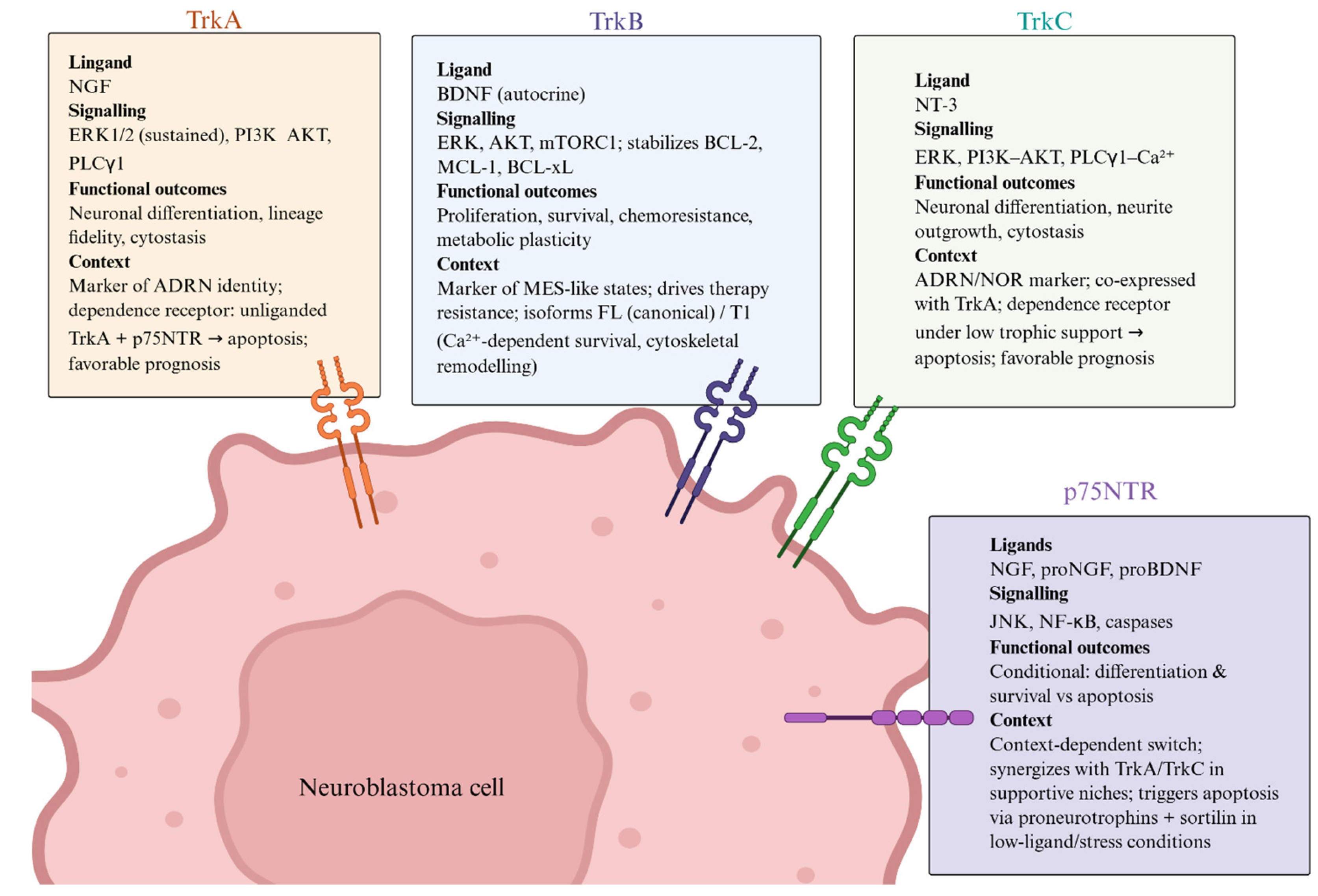
2.1. Neurotrophin–Trk Signalling Architecture and Network Integration in Neuroblastoma
2.2. Receptor-Specific Roles of TrkA, TrkB, TrkC, and p75NTR in Cell-State Plasticity
2.2.1. TrkA/NTRK1: Lineage Fidelity, Differentiation Competence, and Dependence-Receptor Behaviour
2.2.2. TrkB/NTRK2: MES Transition, Metabolic Plasticity, and Therapy Resistance
2.2.3. TrkC/NTRK3: Neuronal Lineage Maintenance and Context-Dependent Apoptosis
2.2.4. p75NTR/NGFR: A Molecular Switch for Differentiation Versus Apoptosis
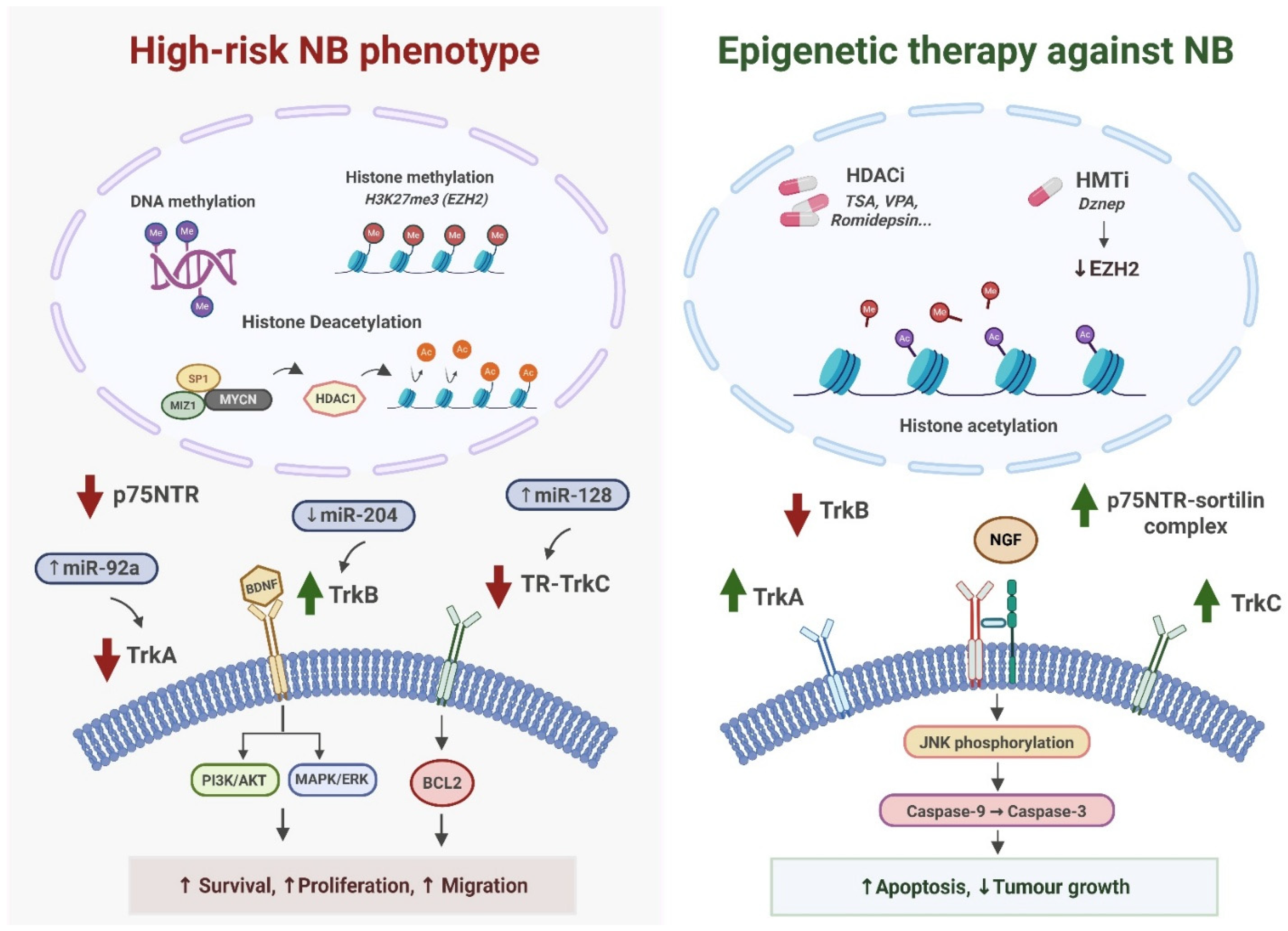
2.3. Epigenetic Mechanisms Regulating Trk Receptors and Neurotrophic Signalling in NB
2.3.1. DNA- and Histone-Based Epigenetic Regulation of Neurotrophin Receptor Expression

2.3.2. miRNA-Mediated Regulation of Neurotrophin Receptors

| Receptor | Expression/Cell-State Association | Main Pathways | Functional Consequences | Epigenetic/Regulatory Mechanisms | References |
|---|---|---|---|---|---|
| TrkA/NTRK1 | Favourable NB; ADRN/NOR identity; super-enhancer circuitry; spontaneous regression | ERK1/2, PI3K-AKT, PLCγ1–Ca2+; JNK/p38 (NGF deprivation) | Differentiation, neurite outgrowth, cytostasis; dependence-receptor apoptosis | Promoter hypomethylation; MYCN–SP1–MIZ1 repression; PRC2/EZH2 silencing | [1,2,3,4,5,8,14,17,20,25,28,29,30,45] |
| TrkB/NTRK2 (FL) | MES-like, aggressive, therapy-resistant NB; BDNF autocrine loop | AKT–mTORC1, ERK1/2, STAT3, NF-κB | Proliferation, angiogenesis, metabolic plasticity; MES transition | BRD4 super-enhancers; IL-6/STAT3 reinforcement; enhancer rewiring | [6,7,8,9,21,24,34,39,41,66] |
| TrkB.T1 | Predominant in MES states and hypoxic niches | Endosomal Ca2+ signalling; cytoskeletal remodelling | Stress survival, invasion, plasticity | Isoform-specific regulation; MES reinforcement | [13,17,40,42,47] |
| TrkC/NTRK3 | Favourable ADRN phenotype; clusters with NTRK1 | ERK, PI3K-AKT, PLCγ1–Ca2+ | Differentiation; dependence-receptor apoptosis | PRC2/EZH2 repression; miR-128 targeting | [4,5,17,25,26,29,30,32,49] |
| p75NTR/NGFR | High in favourable NB; reduced in MYCN-amplified tumours | JNK, NF-κB, caspases; proneurotrophin–sortilin axis | Differentiation vs apoptosis switch | MYCN repression; EZH2 silencing; HDAC reactivation; VPA induction | [3,26,27,28,29,48,49,50,51] |
2.4. Microenvironmental Reinforcement, Trafficking Dynamics, and Therapeutic Implications
| Model System | Biological Context | Key Signalling Features | Applications | References |
|---|---|---|---|---|
| NB 3D spheroids | Oxygen/nutrient gradients; ADRN/MES coexistence | Hypoxia → HIF-1α → TrkB upregulation | TRK/ALK inhibitor testing; epigenetic screens | [9,41,46,72] |
| Collagen scaffolds | ECM-driven MES identity | Stiffness-dependent TrkB activation | Invasion and therapy modelling | [73] |
| 3D bone-mimetic systems | Osseous microenvironment | STAT3/c-MYC activation; NTRK2 reinforcement | Bone metastasis modelling | [74] |
| Patient-derived organoids | Preserve genetic and epigenetic heterogeneity | Enhancer switching; regional Trk expression | Precision therapy testing | [75,76,77,78] |
| Organoid–stroma co-culture | NB + fibroblasts/endothelium | BDNF secretion; MES reinforcement | Niche-driven MES modelling | [9,75,76,77,78] |
| Organoid–immune co-culture | TAM/T-cell interaction | IL-6/STAT3 → NTRK2 upregulation | Immunotherapy evaluation | [66,71,78] |
3. Epigenetic Plasticity, Clonal Diversity, and Temporal Dynamics in NB
3.1. Epigenetic Plasticity as a Driver of Intratumoral Heterogeneity
3.2. Epigenomic Regulation of ADRN–MES States and Trk-Associated Identities
3.3. Temporal Remodelling of Trk Signalling Networks
3.4. Epigenetic Therapies as Modulators of Plasticity and Adaptive Resistance
3.5. Clonal Evolution, Genetic and Non-Genetic Heterogeneity, and Therapy-Driven State Transitions
3.6. Concluding Remarks: Temporal Adaptation and Therapeutic Implications
Author Contributions
Funding
Data Availability Statement
Conflicts of Interest
Glossary
| ADRN | Adrenergic cell state in neuroblastoma, characterised by sympathetic neuron-like features. |
| AKT | Also known as Protein Kinase B or PKB, is a family of serine/threonine protein kinases critical in regulating cell survival, growth, proliferation, and metabolism. |
| ALK | Anaplastic lymphoma kinase—a receptor tyrosine kinase involved in cell growth and differentiation, frequently mutated in neuroblastoma. |
| ATAC-seq | Assay for transposase-accessible chromatin with high-throughput sequencing. A sensitive, low-input method used to map genome-wide chromatin accessibility. |
| ATRX | A nuclear chromatin remodeller and transcriptional regulator, essential for telomere stability, heterochromatin formation, and histone variant H3.3 deposition. |
| AXL | Tyrosine kinase receptor, implicated in cell survival, proliferation, and metastasis. |
| BAD | Bcl-2-associated agonist of cell death, is a pro-apoptotic member of the Bcl-2 family. |
| BCL2 | Anti-apoptotic protein that maintains mitochondrial membrane integrity. |
| BCL-xL | Anti-apoptotic BCL2 family member, similar in function to BCL2. |
| BDNF | Brain-derived neurotrophic factor—promotes neuronal survival and differentiation. |
| BET | Bromodomain and extra-terminal motif proteins, e.g., BRD4—regulators of transcription. |
| BIM | BCL2-interacting mediator of cell death—a pro-apoptotic protein of the BCL2 family that promotes programmed cell death by neutralising anti-apoptotic proteins like BCL2 and BCL-xL. |
| BRD4 | Bromodomain-containing protein 4—a transcriptional regulator often targeted by BET inhibitors. |
| CAR-T | Chimeric antigen receptor T-cells—engineered T-cells for targeted cancer therapy. |
| CASZ1 | Zinc finger protein castor homolog 1—a transcription factor involved in neural differentiation. |
| cfDNA | Cell-free DNA—DNA fragments circulating in blood and other body fluids, often used as a biomarker in cancer. |
| c-jun | Component of the activator protein-1 (AP-1) proto-oncogene and transcription factor, regulating proliferation, apoptosis, and differentiation. |
| CpG | Cytosine-phosphate-guanine dinucleotide—DNA sites often involved in methylation and gene regulation. |
| CREB | cAMP response element-binding protein—a transcription factor that mediates gene expression in response to signals. |
| DLK1 | Delta-like 1 homolog—a protein involved in differentiation and development. |
| DNMT | DNA methyltransferases—enzymes that add methyl groups to DNA, regulating gene expression. |
| ELK1 | ETS domain-containing protein Elk-1—a transcription factor that regulates gene expression involved in cell proliferation, apoptosis, differentiation, and neuronal function. |
| ETS | Erythroblast transformation specific—one of the largest families of transcription factors. |
| ERBB4 | Erb-b2 receptor tyrosine kinase 4, also known as HER4, is a member of the epidermal growth factor receptor (EGFR) family, involved in neurodevelopment and cancer. |
| ERK1/2 | Extracellular signal-regulated kinases—central MAPK pathway kinases mediating proliferation and survival. |
| ecDNA | Extrachromosomal DNA. It is a circular DNA found outside chromosomes, often carrying oncogenes, acting as a key driver of tumour progression. |
| EZH2 | Enhancer of zeste homolog 2—histone methyltransferase enzyme. |
| FAK | Focal adhesion kinase—mediates integrin signalling and cell migration. |
| FOXO | Forkhead box O transcription factors—a group of transcription factors that function as master regulators of longevity, stress tolerance, and cellular homeostasis. They regulate apoptosis, cell cycle, and oxidative stress resistance. |
| FRS2 | Fibroblast growth factor receptor substrate 2 is an intracellular adaptor protein that plays a central role in signalling downstream of tyrosine kinases receptors. |
| GN | Ganglioneuromas—benign tumours of sympathetic nervous tissue. |
| GATA3 | GATA Binding Protein 3—transcription factor critical for sympathetic neuron development. |
| H3K27me3 | Tri-methylation of histone H3 lysine 27—a repressive epigenetic mark. |
| H3K4me3 | Tri-methylation of histone H3 lysine 4—an active transcription mark. |
| HAND2 | Transcription factor involved in neural crest development. |
| HDAC | Histone deacetylase—removes acetyl groups from histones, silencing gene expression. |
| HIF-1α | Hypoxia-inducible factor 1-alpha—transcription factor regulating response to low oxygen. |
| IGF-1R | Insulin-like growth factor 1 receptor—promotes growth and survival. |
| IL-6 | Interleukin-6—cytokine involved in inflammation and tumour progression. |
| JNK | c-Jun N-terminal kinase—MAPK pathway involved in stress responses. |
| MCL-1 | Myeloid cell leukaemia 1—anti-apoptotic BCL2 family protein. |
| MDM2-CDK4 | Oncogenic co-amplification often seen in cancer. |
| MES | Mesenchymal cell state in neuroblastoma, associated with stem-like features. |
| MET | Receptor tyrosine kinase for hepatocyte growth factor—promotes proliferation and motility. |
| miR-204 | MicroRNA involved in TrkA signalling and tumour suppression. |
| miR-542-5p | MicroRNA inversely correlated with MYCN amplification in neuroblastoma. |
| miR-92a | MicroRNA elevated in high-risk neuroblastoma. |
| mTOR | Mechanistic target of rapamycin. It is a crucial protein kinase that functions as a cellular master regulator, controlling cell growth, metabolism, proliferation, and survival based on nutrient availability. It exists in two complexes (mTORC1 and mTORC2), and its hyperactivation is linked to aging and cancer, while its inhibition stimulates autophagy. |
| MYCN | Oncogenic transcription factor amplified in aggressive neuroblastoma. |
| NB | Neuroblastoma, a rare aggressive paediatric cancer of the sympathetic nervous system, affecting mostly infants and young children, usually under the age of 5. |
| NT-3 | Neurotrophin-3—growth factor supporting neuron survival and differentiation. |
| NGF | Nerve growth factor—promotes survival and differentiation of sympathetic neurons. |
| p21Cip1 | Cyclin-dependent kinase inhibitor 1A—regulates cell cycle progression. |
| p27Kip | Also known as p27, it is a cyclin-dependent kinase inhibitor that controls the development of the cell cycle, namely, stopping cell division in the G0/G1 phase, acting as a tumour suppressor. |
| p38 | Mitogen-activated protein (MAP) kinase responsive to stress and inflammatory signals. |
| p75NTR (NGFR) | Low-affinity neurotrophin receptor—regulates neuronal survival and apoptosis. |
| PARP | Poly (ADP-ribose) polymerase—involved in DNA repair. |
| PDOs | Patient-derived NB organoids—3D in vitro models derived from patient tumours. |
| PHOX2B | Paired-Like Homeobox 2B is a master regulator gene crucial for the development of the autonomic nervous system and respiratory control. |
| PI3K | Phosphatidylinositol 3-kinase—a class of enzymes known as lipid kinases, essential intracellular messengers that control cell growth, proliferation, survival, and metabolism. |
| PI3K-AKT | Signalling pathway promoting growth, survival, and metabolism. |
| PI3K-AKT-mTOR | Extended signalling cascade integrating growth and nutrient signals. |
| PLCγ1 | Phospholipase C gamma 1—mediates Ca2+ signalling downstream of tyrosine kinase receptors. |
| PLCγ1–IP3–Ca2+/PKC, JAK/STAT3 | Downstream signalling pathways activated by PLCγ1. |
| PRC2/EZH2 | Polycomb repressive complex 2, with EZH2 as the catalytic subunit. |
| ProBDNF | Precursor of BDNF—can induce apoptosis through p75NTR. |
| ProNGF | Precursor of NGF—may promote apoptosis via p75NTR. |
| Rab5- and Rab11- | Positive endosomal compartments—intracellular vesicles involved in trafficking and signalling. |
| Ras-RAF-MEK-ERK | Canonical MAPK signalling pathway regulating proliferation. |
| RET | Receptor tyrosine kinase involved in neural development and cancer. |
| Rho | Family of GTPases regulating cytoskeleton and cell motility. |
| RTKs | Tyrosine kinase receptors—cell surface receptors activating intracellular signalling. |
| scATAC-seq | Single-cell ATAC-seq—maps chromatin accessibility at single-cell resolution. |
| SHC | Adaptor protein linking RTKs to downstream pathways. |
| Sortilin | A multifunctional type I transmembrane receptor, it drives protein trafficking between the Golgi apparatus, cell surface, and lysosomes. |
| TMM | Telomere maintenance mechanism—cellular processes that maintain telomere length for continuous division. |
| TERT | Telomerase reverse transcriptase—catalytic component of telomerase. |
| TTF1 | Thyroid transcription factor-1—transcription factor involved in lung and thyroid development. |
| TNF-α | Tumour necrosis factor-alpha—cytokine involved in inflammation and apoptosis. |
| TrkA (NTRK1) | Neurotrophin receptor for NGF—promotes survival and differentiation. |
| TrkB (NTRK2) | Receptor for BDNF—regulates neuronal survival and plasticity. |
| TrkC (NTRK3) | Receptor for NT-3—involved in neural differentiation. |
| VEGF | Vascular endothelial growth factor—stimulates angiogenesis. |
| Compounds | |
| 5-aza-dC | 5-aza-2′-deoxycytidine—a nucleoside analogue that inhibits DNA methyltransferases (DNMTs), leading to DNA hypomethylation and reactivation of silenced genes. Commonly used in epigenetic studies and cancer research. |
| DZNep | 3-deazaneplanocin A. It is an inhibitor of S-adenosylhomocysteine hydrolase that indirectly suppresses histone methylation, particularly by targeting the PRC2 complex and reducing H3K27me3 levels. |
| JQ1 | A small-molecule inhibitor of BET (bromodomain and extraterminal domain) proteins that blocks their interaction with acetylated histones, thereby regulating gene transcription. |
| OTX015 | A BET inhibitor similar to JQ1, targeting bromodomain-containing proteins to modulate transcription, with applications in oncology and epigenetic therapy. |
| TSA | Trichostatin A—a potent histone deacetylase (HDAC) inhibitor that increases histone acetylation, leading to a more open chromatin structure and enhanced gene expression. |
| VPA | Valproic acid—a short-chain fatty acid and HDAC inhibitor that alters chromatin structure and gene expression, widely used in neurological disorders and studied for epigenetic modulation. |
| Cell lines | |
| IMR-32 | A human neuroblastoma cell line characterised by MYCN amplification and frequently used in cancer and neurodevelopmental research. |
| LAN-1 | A human neuroblastoma cell line with MYCN amplification, often used to study tumour aggressiveness and therapeutic responses. |
| Neuro-2a (N2a) | A mouse neuroblastoma cell line widely used as a model for neuronal differentiation, signalling, and cytotoxicity studies. |
| NGP | A human neuroblastoma cell line with MYCN amplification, commonly used in studies of oncogene function and targeted therapies. |
| SH-SY5Y | A human neuroblastoma cell line (subclone of SK-N-SH) frequently used as a model for neuronal function, differentiation, and neurodegenerative diseases. |
| SK-N-BE | A human neuroblastoma cell line (including subtypes like SK-N-BE(2)) known for MYCN amplification and use in high-risk neuroblastoma research. |
| BE(2)-M17 | A subclone of the SK-N-BE lineage derived from human neuroblastoma, commonly used in studies of neuronal differentiation and neurobiology. |
| SK-N-SH | A human neuroblastoma cell line that gives rise to subclones such as SH-SY5Y, used in neurobiology and cancer studies. |
| SMS-KCNR | A human neuroblastoma cell line with MYCN amplification, often used in studies of tumour biology and drug response. |
| TET-21/N | A human neuroblastoma cell line engineered with tetracycline-regulated MYCN expression, allowing controlled studies of MYCN function. |
References
- Van Groningen, T.; Koster, J.; Valentijn, L.J.; Zwijnenburg, D.A.; Akogul, N.; Hasselt, N.E.; Broekmans, M.; Haneveld, F.; Nowakowska, N.E.; Bras, J.; et al. Neuroblastoma Is Composed of Two Super-Enhancer-Associated Differentiation States. Nat. Genet. 2017, 49, 1261–1266. [Google Scholar] [CrossRef] [PubMed]
- Pugh, T.J.; Morozova, O.; Attiyeh, E.F.; Asgharzadeh, S.; Wei, J.S.; Auclair, D.; Carter, S.L.; Cibulskis, K.; Hanna, M.; Kiezun, A.; et al. The Genetic Landscape of High-Risk Neuroblastoma. Nat. Genet. 2013, 45, 279–284. [Google Scholar] [CrossRef]
- Huang, E.J.; Reichardt, L.F. Trk Receptors: Roles in Neuronal Signal Transduction. Annu. Rev. Biochem. 2003, 72, 609–642. [Google Scholar] [CrossRef] [PubMed]
- Reichardt, L.F. Neurotrophin-Regulated Signalling Pathways. Philos. Trans. R. Soc. Lond. B Biol. Sci. 2006, 361, 1545–1564. [Google Scholar] [CrossRef]
- Brodeur, G.M.; Minturn, J.E.; Ho, R.; Simpson, A.M.; Iyer, R.; Varela, C.R.; Light, J.E.; Kolla, V.; Evans, A.E. Trk Receptor Expression and Inhibition in Neuroblastomas. Clin. Cancer Res. 2009, 15, 3244–3250. [Google Scholar] [CrossRef]
- Jansky, S.; Sharma, A.K.; Körber, V.; Quintero, A.; Toprak, U.H.; Wecht, E.M.; Gartlgruber, M.; Greco, A.; Chomsky, E.; Grünewald, T.G.P.; et al. Single-Cell Transcriptomic Analyses Provide Insights into the Developmental Origins of Neuroblastoma. Nat. Genet. 2021, 53, 683–693. [Google Scholar] [CrossRef] [PubMed]
- Boeva, V.; Louis-Brennetot, C.; Peltier, A.; Durand, S.; Pierre-Eugène, C.; Raynal, V.; Etchevers, H.C.; Thomas, S.; Lermine, A.; Daudigeos-Dubus, E.; et al. Heterogeneity of Neuroblastoma Cell Identity Defined by Transcriptional Circuitries. Nat. Genet. 2017, 49, 1408–1413. [Google Scholar] [CrossRef]
- Gartlgruber, M.; Sharma, A.K.; Quintero, A.; Dreidax, D.; Jansky, S.; Park, Y.-G.; Mynarek, M.; Fischer, M.; Timmermann, B.; Witt, O.; et al. Super-Enhancers Define Regulatory Subtypes and Cell Identity in Neuroblastoma. Nat. Cancer 2021, 2, 114–128. [Google Scholar] [CrossRef]
- Quail, D.F.; Joyce, J.A. Microenvironmental Regulation of Tumor Progression and Metastasis. Nat. Med. 2013, 19, 1423–1437. [Google Scholar] [CrossRef]
- Buenrostro, J.D.; Wu, B.; Chang, H.Y.; Greenleaf, W.J. ATAC-Seq: A Method for Assaying Chromatin Accessibility Genome-Wide. Curr. Protoc. Mol. Biol. 2015, 109, 21.29.1–21.29.9. [Google Scholar] [CrossRef]
- Colombo, M.; Mirandola, L.; Platonova, N.; Apicella, L.; Basile, A.; Figueroa, J.A.; Cobos, E.; Chiriva-Internati, M.; Chiaramonte, R. Tumor Microenvironment in Neuroblastoma: New Players, New Mechanisms. Front. Oncol. 2020, 10, 53. [Google Scholar]
- Durbin, A.D.; Zimmerman, M.W.; Dharia, N.V.; Abraham, B.J.; Iniguez, A.B.; Weichert-Leahey, N.; He, S.; Krill-Burger, J.M.; Root, D.E.; Vazquez, F.; et al. Selective Gene Dependencies in MYCN-Amplified Neuroblastoma Include the Core Transcriptional Regulatory Circuitry. Nat. Genet. 2018, 50, 1240–1246. [Google Scholar] [CrossRef] [PubMed]
- Fetahu, I.S.; Taschner-Mandl, S.; Ambros, I.M.; Ambros, P.F. Neuroblastoma and the Epigenome. Cancer Metastasis Rev. 2021, 40, 173–189. [Google Scholar] [CrossRef]
- Maris, J.M. Recent Advances in Neuroblastoma. N. Engl. J. Med. 2010, 362, 2202–2211. [Google Scholar] [CrossRef]
- Lerone, M.; Ognibene, M.; Pezzolo, A.; Martucciello, G.; Zara, F.; Morini, M.; Mazzocco, K. Molecular Genetics in Neuroblastoma Prognosis. Children 2021, 8, 456. [Google Scholar] [CrossRef] [PubMed]
- Pinto, N.R.; Applebaum, M.A.; Volchenboum, S.L.; Matthay, K.K.; London, W.B.; Ambros, P.F.; Nakagawara, A.; Berthold, F.; Schleiermacher, G.; Park, J.R.; et al. Biology and Treatment of Neuroblastoma. J. Clin. Oncol. 2015, 33, 3008–3017. [Google Scholar] [CrossRef] [PubMed]
- Bedoya-Reina, O.C.; Li, W.; Arceo, M.; Plescher, M.; Bullova, P.; Pui, H.; Kaucka, M.; Kharchenko, P.; Martinsson, T.; Holmberg, J.; et al. Single-Nuclei Transcriptomes from Human Adrenal Gland Reveal Distinct Cellular Identities of Low- and High-Risk Neuroblastoma Tumors. Nat. Commun. 2021, 12, 5309. [Google Scholar] [CrossRef]
- Gómez, S.; Castellano, G.; Mayol, G.; Suñol, M.; Queiros, A.; Bibikova, M.; Nazor, K.L.; Loring, J.F.; Lemos, I.; Rodríguez, E.; et al. DNA Methylation Fingerprint of Neuroblastoma Reveals New Biological and Clinical Insights. Epigenomics 2015, 7, 1137–1153. [Google Scholar] [CrossRef]
- Zeid, R.; Lawlor, M.A.; Poon, E.; Reyes, J.M.; Fulciniti, M.; Lopez, M.A.; Scott, T.G.; Nabet, B.; Erb, M.A.; Winter, G.E.; et al. Enhancer Rewiring and MYCN Dependence in Neuroblastoma. Nat. Genet. 2018, 50, 515–523. [Google Scholar] [CrossRef]
- Nakagawara, A.; Azar, C.G.; Scavarda, N.J.; Brodeur, G.M. Expression and Function of TRK-A, a High-Affinity Nerve Growth Factor Receptor, in Favorable Human Neuroblastomas. N. Engl. J. Med. 1993, 328, 847–854. [Google Scholar] [CrossRef]
- Nakagawara, A.; Arima-Nakagawara, M.; Scavarda, N.J.; Azar, C.G.; Cantor, A.B.; Brodeur, G.M. Association between High Levels of Expression of the TRKB Receptor and Unfavorable Outcome in Human Neuroblastoma. N. Engl. J. Med. 1994, 330, 1054–1059. [Google Scholar]
- Kaplan, D.R.; Hempstead, B.L.; Martin-Zanca, D.; Chao, M.V.; Parada, L.F. The trk Proto-Oncogene Product: A Signal-Transducing Receptor for Nerve Growth Factor. Science 1991, 252, 554–558. [Google Scholar] [CrossRef]
- Epp, S.; Chuah, S.M.; Halasz, M. Epigenetic Dysregulation in MYCN-Amplified Neuroblastoma. Int. J. Mol. Sci. 2023, 24, 17085. [Google Scholar] [CrossRef]
- Thiele, C.J.; Li, Z.; McKee, A.E. On Trk—The TrkB Signal Transduction Pathway Is an Increasingly Important Target in Cancer Biology. Clin. Cancer Res. 2009, 15, 5962–5967. [Google Scholar] [CrossRef]
- Funke, L.; Bracht, T.; Oeck, S.; Michaelis, M.; Cinatl, J.; Fulda, S. NTRK3/TrkC Signalling Induces a Switch from Proliferation to Differentiation in Neuroblastoma Cells. Cancers 2021, 13, 5293. [Google Scholar] [CrossRef]
- Roux, P.P.; Barker, P.A. Neurotrophin Signaling through the p75 Neurotrophin Receptor. Prog. Neurobiol. 2002, 67, 203–233. [Google Scholar] [CrossRef]
- Nykjaer, A.; Lee, R.; Teng, K.K.; Jansen, P.; Madsen, P.; Nielsen, M.S.; Jacobsen, C.; Kliemannel, M.; Schwarz, E.; Willnow, T.E.; et al. Sortilin Is Essential for proNGF-Induced Neuronal Cell Death. Nature 2004, 427, 843–848. [Google Scholar] [CrossRef] [PubMed]
- Iraci, N.; Diolaiti, D.; Papa, A.; Porro, A.; Valli, E.; Gherardi, S.; Herold, S.; Eilers, M.; Bernardoni, R.; Della Valle, G.; et al. A SP1/MIZ1/MYCN Repression Complex Recruits HDAC1 at the TRKA and p75NTR Promoters and Affects Neuroblastoma Malignancy by Inhibiting the Cell Response to NGF. Cancer Res. 2011, 71, 404–412. [Google Scholar] [CrossRef]
- Henrich, K.-O.; Bender, S.; Saadati, M.; Dreidax, D.; Gartlgruber, M.; Schäfer, T.; Ehemann, V.; Pajtler, K.W.; van Sluis, P.; Koster, J.; et al. Integrative Genome-Scale Analysis Identifies Epigenetic Mechanisms of Transcriptional Deregulation in Unfavorable Neuroblastomas. Cancer Res. 2016, 76, 5523–5537. [Google Scholar] [CrossRef] [PubMed]
- Li, Z.; Takenobu, H.; Setyawati, A.N.; Akita, N.; Haruta, M.; Satoh, S.; Shinno, Y.; Chikaraishi, K.; Mukae, K.; Akter, J.; et al. EZH2 Regulates Neuroblastoma Cell Differentiation via NTRK1 Promoter Epigenetic Modifications. Oncogene 2018, 37, 2714–2727. [Google Scholar] [CrossRef] [PubMed]
- Megiorni, F.; Colaiacovo, M.; Cialfi, S.; McDowell, H.P.; Guffanti, A.; Camero, S.; Felsani, A.; Losty, P.D.; Pizer, B.; Shukla, R.; et al. A Sketch of Known and Novel MYCN-Associated miRNA Networks in Neuroblastoma. Oncol. Rep. 2017, 38, 3–20. [Google Scholar] [CrossRef]
- Guidi, M.; Muiños-Gimeno, M.; Kagerbauer, B.; Marti, E.; Estivill, X.; Espinosa-Parrilla, Y. miR-128 Regulates a Truncated NTRK3 Isoform. BMC Mol. Biol. 2010, 11, 95. [Google Scholar]
- Puissant, A.; Frumm, S.M.; Alexe, G.; Bassil, C.F.; Qi, J.; Chanthery, Y.H.; Nekritz, E.A.; Zeid, R.; Gustafson, W.C.; Greninger, P.; et al. Targeting MYCN in Neuroblastoma by BET Bromodomain Inhibition. Cancer Discov. 2013, 3, 308–323. [Google Scholar] [CrossRef]
- Henrich, K.O.; Schwab, M.; Westermann, F. 1p36 Tumor Suppression—A Matter of Dosage? Cancer Res. 2016, 72, 6079–6088. [Google Scholar] [CrossRef]
- Laetsch, T.W.; DuBois, S.G.; Mascarenhas, L.; Turpin, B.; Federman, N.; Albert, C.M.; Nagasubramanian, R.; Davis, J.L.; Rudzinski, E.; Feraco, A.M.; et al. Larotrectinib for Paediatric Solid Tumours Harbouring NTRK Gene Fusions: Phase 1 Results from a Multicentre, Open-Label, Phase 1/2 Study. Lancet Oncol. 2018, 19, 705–714, Erratum in Lancet Oncol. 2018, 19, e229. [Google Scholar] [CrossRef]
- Doebele, R.C.; Drilon, A.; Paz-Ares, L.; Siena, S.; Shaw, A.T.; Farago, A.F.; Blakely, C.M.; Seto, T.; Cho, B.C.; Tosi, D.; et al. Entrectinib in Patients with Advanced or Metastatic NTRK Fusion-Positive Solid Tumours: Integrated Analysis of Three Phase 1–2 Trials. Lancet Oncol. 2020, 21, 271–282, Erratum in Lancet Oncol. 2021, 22, e428. [Google Scholar] [CrossRef]
- Drilon, A.; Laetsch, T.W.; Kummar, S.; DuBois, S.G.; Lassen, U.N.; Demetri, G.D.; Nathenson, M.; Doebele, R.C.; Farago, A.F.; Pappo, A.S.; et al. Efficacy of Larotrectinib in TRK Fusion-Positive Cancers in Adults and Children. N. Engl. J. Med. 2018, 378, 731–739. [Google Scholar] [CrossRef]
- Bosse, K.R.; Raman, P.; Zhu, Z.; Lane, M.; Martinez, D.; Heitzeneder, S.; Rathi, K.S.; Kendsersky, N.M.; Randall, M.; Donovan, L.; et al. Identification of GPC2 as an Oncoprotein and Candidate Immunotherapeutic Target in High-Risk Neuroblastoma. Cancer Cell 2017, 32, 295–309.e12. [Google Scholar] [CrossRef]
- Li, Y.; Wang, S.; Gao, Y.; Deng, Y.; Yang, F.; Zhang, L.; Liu, Y.; Li, X.; Zhang, Y.; Chen, X.; et al. MYCN-Driven Transcriptional Amplification Programs Define Neuroblastoma Cell States and Therapeutic Vulnerabilities. Nat. Commun. 2021, 12, 6760. [Google Scholar]
- Abe, M.; Watanabe, N.; McDonell, N.; Takato, T.; Ohira, M.; Nakagawara, A. Hypomethylation of the NTRK1 Promoter Is Associated with Spontaneous Regression of Neuroblastoma. Genes Chromosomes Cancer 2008, 47, 962–969. [Google Scholar]
- Qing, G.; Skuli, N.; Mayes, P.A.; Pawel, B.; Martinez, D.; Maris, J.M.; Simon, M.C. Combinatorial Regulation of Neuroblastoma Tumor Progression by N-Myc and HIF-1α. Cancer Res. 2010, 70, 10351–10361. [Google Scholar] [CrossRef]
- Palacios-Moreno, J.; Foltz, G.; Guo, A.; Stokes, M.P.; Kuechler, C.; Gnad, F.; Olsen, J.V.; Beltrao, P. Neuroblastoma Tyrosine Kinase Signalling Networks Involve Focal Adhesion Kinase. PLoS Comput. Biol. 2015, 11, e1004130. [Google Scholar] [CrossRef]
- Hamilton, A.K.; Radaoui, A.B.; Tsang, M.; Martinez, D.; Conkrite, K.L.; Patel, K.; Sidoli, S.; Delaidelli, A.; Modi, A.; Rokita, J.L.; et al. A Proteogenomic Surfaceome Study Identifies DLK1 as an Immunotherapeutic Target in Neuroblastoma. Cancer Cell 2024, 42, 1970–1982.e7. [Google Scholar] [CrossRef]
- Nunes-Xavier, C.E.; Zaldumbide, L.; Mosteiro, L.; López-Almaraz, R.; García de Andoin, N.; Aguirre, P.; Emaldi, M.; Torices, L.; López, J.I.; Pulido, R. Protein Tyrosine Phosphatases in Neuroblastoma: Emerging Roles as Biomarkers and Therapeutic Targets. Front. Cell Dev. Biol. 2021, 9, 811297. [Google Scholar] [CrossRef] [PubMed]
- Decock, A.; Ongenaert, M.; Hoebeeck, J.; De Preter, K.; Van Peer, G.; Van Criekinge, W.; Vandesompele, J.; Speleman, F. Genome-Wide Promoter Methylation Analysis in Neuroblastoma Identifies Prognostic Methylation Biomarkers. Genome Biol. 2012, 13, R95. [Google Scholar] [CrossRef] [PubMed]
- Hartwich, J.; Orr, W.S.; Ng, C.Y.; Spence, Y.; Morton, C.; Davidoff, A.M. HIF-1α Activation Mediates Resistance to Anti-Angiogenic Therapy in Experimental Neuroblastoma. J. Pediatr. Surg. 2013, 48, 126–133. [Google Scholar] [CrossRef]
- Tessarollo, L.; Yanpallewar, S. TrkB Truncated Isoform Receptors as Transducers and Determinants of BDNF Functions. Front. Neurosci. 2022, 16, 847572. [Google Scholar] [CrossRef]
- Dedoni, S.; Marras, L.; Olianas, M.C.; Ingianni, A.; Onali, P. Valproic Acid Upregulates the Expression of the p75NTR/Sortilin Receptor Complex to Induce Neuronal Apoptosis. Apoptosis 2020, 25, 697–714. [Google Scholar] [CrossRef]
- Dedoni, S.; Marras, L.; Olianas, M.C.; Ingianni, A.; Onali, P. The Neurotrophin Receptor TrkC as a Novel Molecular Target of the Antineuroblastoma Action of Valproic Acid. Int. J. Mol. Sci. 2021, 22, 7790. [Google Scholar] [CrossRef]
- Dedoni, S.; Olianas, A.; Manconi, B.; Collu, M.; Tuveri, B.; Vincis, M.E.; Olianas, M.C.; Onali, P. Upregulation of p75NTR by Histone Deacetylase Inhibitors Sensitizes Human Neuroblastoma Cells to Targeted Immunotoxin-Induced Apoptosis. Int. J. Mol. Sci. 2022, 23, 3849. [Google Scholar] [CrossRef]
- Jahangiri, L.; Pucci, P.; Ishola, T.; Pereira, J.; Cavanagh, M.L.; Turner, S.D. Deep Analysis of Neuroblastoma Core Regulatory Circuitries Using Online Databases and Integrated Bioinformatics Shows Their Pan-Cancer Roles as Prognostic Predictors. Discov. Oncol. 2021, 12, 56. [Google Scholar] [CrossRef]
- Al Aboud, N.M.; Tupper, C.; Jialal, I. Genetics, Epigenetic Mechanisms. In StatPearls; StatPearls Publishing: Treasure Island, FL, USA, 2025. Available online: https://www.ncbi.nlm.nih.gov/books/NBK532999/ (accessed on 13 May 2025).
- Stephens, K.E.; Miaskowski, C.A.; Levine, J.D.; Pullinger, C.R.; Aouizerat, B.E. Epigenetic Regulation and Measurement of Epigenetic Changes. Biol. Res. Nurs. 2013, 15, 373–381. [Google Scholar] [CrossRef]
- Gibney, E.R.; Nolan, C.M. Epigenetics and Gene Expression. Heredity 2010, 105, 4–13. [Google Scholar] [CrossRef]
- Wang, D.; Zhang, Y.; Li, Q.; Li, Y.; Li, W.; Zhang, A.; Xu, J.; Meng, J.; Tang, L.; Lyu, S. Epigenetics: Mechanisms, Potential Roles, and Therapeutic Strategies in Cancer Progression. Genes Dis. 2023, 11, 101020. [Google Scholar] [CrossRef] [PubMed]
- Chen, Z.; Huang, Z.; Luo, Y.; Zou, Q.; Bai, L.; Tang, G.; Wang, X.; Cao, G.; Huang, M.; Xiang, J.; et al. Genome-Wide Analysis Identifies Critical DNA Methylations within NTRKs Genes in Colorectal Cancer. J. Transl. Med. 2021, 19, 73. [Google Scholar] [CrossRef]
- Chmelařová, M.; Dvořáková, E.; Špaček, J.; Laco, J.; Mžik, M.; Palička, V. Promoter Methylation of GATA4, WIF1, NTRK1 and Other Selected Tumour Suppressor Genes in Ovarian Cancer. Folia Biol. 2013, 59, 87–92. [Google Scholar] [CrossRef]
- Lau, D.T.; Hesson, L.B.; Norris, M.D.; Marshall, G.M.; Haber, M.; Ashton, L.J. Prognostic Significance of Promoter DNA Methylation in Patients with Childhood Neuroblastoma. Clin. Cancer Res. 2012, 18, 5690–5700. [Google Scholar] [CrossRef]
- Ishimaru, N.; Fukuchi, M.; Hirai, A.; Chiba, Y.; Tamura, T.; Takahashi, N.; Yamada, H.; Matsumoto, K.; Nishikawa, T.; Tabuchi, A. Differential Epigenetic Regulation of BDNF and NT-3 Genes by Trichostatin A and 5-Aza-2′-Deoxycytidine in Neuro-2a Cells. Biochem. Biophys. Res. Commun. 2010, 394, 173–177. [Google Scholar] [CrossRef]
- Dedoni, S.; Marras, L.; Olianas, M.C.; Ingianni, A.; Onali, P. Downregulation of TrkB Expression and Signaling by Valproic Acid and Other Histone Deacetylase Inhibitors. J. Pharmacol. Exp. Ther. 2019, 370, 490–503. [Google Scholar] [CrossRef] [PubMed]
- Mlakar, V.; Morel, E.; Mlakar, S.J.; Ansari, M.; Gumy-Pause, F. A Review of the Biological and Clinical Implications of RAS-MAPK Pathway Alterations in Neuroblastoma. J. Exp. Clin. Cancer Res. 2021, 40, 189. [Google Scholar] [CrossRef] [PubMed]
- Mestdagh, P.; Fredlund, E.; Pattyn, F.; Schulte, J.H.; Muth, D.; Vermeulen, J.; Kumps, C.; Schlierf, S.; De Preter, K.; Van Roy, N.; et al. The miR-17-92 MicroRNA Cluster Is Overexpressed in Aggressive Neuroblastoma Tumors and Linked to High MYCN/c-MYC Activity. Mol. Cell 2010, 40, 762–773. [Google Scholar] [CrossRef]
- Liao, W.; Zhang, H.; Feng, C.; Wang, T.; Zhang, Y.; Tang, S. Downregulation of TrkA Protein Expression by miRNA-92a Promotes the Proliferation and Migration of Human Neuroblastoma Cells. Mol. Med. Rep. 2014, 10, 778–784. [Google Scholar] [CrossRef]
- Yang, T.; Li, J.; Zhuo, Z.; Zeng, H.; Tan, T.; Miao, L.; Zheng, M.; Yang, J.; Pan, J.; Hu, C.; et al. TTF1 Suppresses Neuroblastoma Growth and Induces Neuroblastoma Differentiation by Targeting TrkA and the miR-204/TrkB Axis. iScience 2022, 25, 104655. [Google Scholar] [CrossRef]
- Guan, L.; Zhao, X.; Tang, L.; Chen, J.; Zhao, J.; Guo, M.; Chen, C.; Zhou, Y.; Xu, L. Thyroid Transcription Factor-1: Structure, Expression, Function and Its Relationship with Disease. Biomed Res. Int. 2021, 2021, 9957209. [Google Scholar] [CrossRef]
- Jin, H.; Zhang, Q.; Chen, X.; Wang, Y.; Li, P.; Zhang, J.; Xu, W.; Zhao, L.; Liu, Y.; Yang, C.; et al. Macrophage–Neuroblastoma Crosstalk Shapes Mesenchymal Identity and Therapeutic Resistance through IL-6/STAT3 Signaling. Cancer Res. 2022, 82, 4503–4517. [Google Scholar]
- Grivennikov, S.I.; Greten, F.R.; Karin, M. Immunity, Inflammation, and Cancer. Cell 2010, 140, 883–899. [Google Scholar] [CrossRef] [PubMed]
- Yu, H.; Pardoll, D.; Jove, R. STATs in Cancer Inflammation and Immunity: A Leading Role for STAT3. Nat. Rev. Cancer 2009, 9, 798–809. [Google Scholar] [CrossRef]
- Taniguchi, K.; Karin, M. NF-κB, Inflammation, Immunity and Cancer: Coming of Age. Nat. Rev. Immunol. 2018, 18, 309–324. [Google Scholar] [CrossRef]
- Ara, T.; DeClerck, Y.A. Interleukin-6 in Bone Metastasis and Cancer Progression. Cancer Metastasis Rev. 2006, 25, 545–557. [Google Scholar] [CrossRef]
- Hadjidaniel, M.D.; Muthugounder, S.; Hung, L.T.; Sheard, M.A.; Shirinbak, S.; Chan, R.Y.; Nakata, R.; Borriello, L.; Malvar, J.; Kennedy, R.J.; et al. Tumor-Associated Macrophages Promote Neuroblastoma via STAT3 Phosphorylation and Up-Regulation of c-MYC. Oncotarget 2017, 8, 91516–91529. [Google Scholar] [CrossRef]
- Corallo, D.; Frabetti, F.; Candini, O.; Gregianin, E.; Dominici, M.; Pession, A. Emerging Neuroblastoma 3D In Vitro Models for Pre-Clinical Assessments. Front. Immunol. 2020, 11, 584214. [Google Scholar] [CrossRef]
- Gallagher, C.; Murphy, C.; Kelly, G.; O’Brien, F.J.; Piskareva, O. Three-Dimensional In Vitro Biomimetic Model of Neuroblastoma Using Collagen-Based Scaffolds. J. Vis. Exp. 2021, 173, e62627. [Google Scholar]
- Aveic, S.; Janßen, S.; Nasehi, R.; Seidelmann, M.; Vogt, M.; Pantile, M.; Rütten, S.; Fischer, H. A 3D Printed In Vitro Bone Model for the Assessment of Molecular and Cellular Cues in Metastatic Neuroblastoma. Biomater. Sci. 2021, 9, 1716–1727. [Google Scholar] [CrossRef] [PubMed]
- Van Groningen, T.; Akogul, N.; Koster, J.; van den Akker, B.E.; Jongejan, A.; Brandsma, A.M.; Kloosterman, W.; Molenaar, J.J. Patient-Derived Neuroblastoma Organoids Capture Tumor Heterogeneity and Microenvironmental Dependencies. Nat. Cancer 2024, 5, 1123–1138. [Google Scholar]
- Fusco, P.; Parisatto, B.; Giordan, E.; Pizzi, M.; De Salvo, G.L.; Boldrin, D.; Pizzi, S.; Frasson, C.; Indio, V.; De Mariano, M.; et al. Patient-Derived Organoids (PDOs) as a Novel In Vitro Model for Neuroblastoma Tumours. BMC Cancer 2019, 19, 970. [Google Scholar] [CrossRef]
- Kholosy, W.M.; Derieppe, M.; van den Ham, F.; Ober, K.; Su, Y.; Custers, L.; Molenaar, J.J.; Koster, J.; Versteeg, R.; Valentijn, L.J. Neuroblastoma and DIPG Organoid Coculture System for Personalized Assessment of Novel Anticancer Immunotherapies. J. Pers. Med. 2021, 11, 869. [Google Scholar] [CrossRef] [PubMed]
- Tong, L.; Cui, W.; Zhang, B.; Fonseca, P.; Zhao, Q.; Zhang, P.; Xu, B.; Zhang, Q.; Li, Z.; Seashore-Ludlow, B.; et al. Patient-Derived Organoids in Precision Cancer Medicine. Med 2024, 5, 1351–1377. [Google Scholar] [CrossRef]
- Gouda, M.A.; ElZahaf, E.E.; Abdel-Rahman, O.M. Tissue-Agnostic Targeting of Neurotrophic Tyrosine Receptor Kinase Gene Fusions in Solid Tumors: Current Status and Future Perspectives. Cancers 2024, 16, 3395. [Google Scholar] [CrossRef]
- Drilon, A. TRK Inhibitors in TRK Fusion-Positive Cancers. Ann. Oncol. 2019, 30, viii23–viii30. [Google Scholar] [CrossRef]
- Cocco, E.; Scaltriti, M.; Drilon, A. NTRK Fusion-Positive Cancers and TRK Inhibitor Therapy. Nat. Rev. Clin. Oncol. 2018, 15, 731–747. [Google Scholar] [CrossRef]
- Tacconelli, A.; Farina, A.R.; Cappabianca, L.; Desantis, G.; Tessitore, A.; Vetuschi, A.; Sferra, R.; Rucci, N.; Argenti, B.; Screpanti, I.; et al. TrkA Alternative Splicing: A Regulated Tumor-Promoting Switch in Human Neuroblastoma. Cancer Cell 2004, 6, 347–360. [Google Scholar] [CrossRef]
- Jin, W. Roles of TrkC Signaling in the Regulation of Tumorigenicity and Metastasis of Cancer. Cancers 2020, 12, 147. [Google Scholar] [CrossRef]
- Ando, K.; Nakagawara, A. The RUNX Family Defines Trk Phenotype and Aggressiveness of Human Neuroblastoma through Regulation of p53 and MYCN. Cells 2023, 12, 544. [Google Scholar] [CrossRef]
- Drilon, A.; Nagasubramanian, R.; Blake, J.F.; Ku, N.; Tuch, B.B.; Ebata, K.; Smith, S.; Lauriault, V.; Kolakowski, G.R.; Brandhuber, B.J.; et al. A Next-Generation TRK Kinase Inhibitor Overcomes Acquired Resistance to Prior TRK Kinase Inhibition in Patients with TRK Fusion-Positive Solid Tumors. Cancer Discov. 2017, 7, 963–972. [Google Scholar] [CrossRef]
- Laetsch, T.W.; Hawkins, D.S. Larotrectinib for the Treatment of TRK Fusion Solid Tumors. Expert Rev. Anticancer Ther. 2019, 19, 1–10. [Google Scholar] [CrossRef] [PubMed]
- Houghton, P.J.; Bjornsti, M.A. Efficacy of Larotrectinib in Pediatric Cancers with NTRK Gene Fusions. Transl. Pediatr. 2025, 14, 3213–3218. [Google Scholar] [CrossRef] [PubMed]
- Ho, R.; Minturn, J.E.; Simpson, A.M.; Iyer, R.; Light, J.E.; Evans, A.E.; Brodeur, G.M. The Effect of P75 on Trk Receptors in Neuroblastomas. Cancer Lett. 2011, 305, 76–85. [Google Scholar] [CrossRef]
- Ho, R.; Eggert, A.; Hishiki, T.; Minturn, J.E.; Ikegaki, N.; Foster, P.; Camoratto, A.M.; Evans, A.E.; Brodeur, G.M. Resistance to Chemotherapy Mediated by TrkB in Neuroblastomas. Cancer Res. 2002, 62, 6462–6466. [Google Scholar]
- Fuse, M.J.; Okada, K.; Oh-Hara, T.; Ogura, H.; Fujita, N.; Katayama, R. Mechanisms of Resistance to NTRK Inhibitors and Therapeutic Strategies in NTRK1-Rearranged Cancers. Mol. Cancer Ther. 2017, 16, 2130–2143. [Google Scholar] [CrossRef]
- Pacenta, H.L.; Macy, M.E. Entrectinib and Other ALK/TRK Inhibitors for the Treatment of Neuroblastoma. Drug Des. Devel. Ther. 2018, 12, 3549–3561. [Google Scholar] [CrossRef] [PubMed]
- Shendy, N.A.M.; Zimmerman, M.W.; Abraham, B.J.; Durbin, A.D. Intrinsic Transcriptional Heterogeneity in Neuroblastoma Guides Mechanistic and Therapeutic Insights. Cell Rep. Med. 2022, 3, 100632. [Google Scholar] [CrossRef]
- Jiménez, C.; Antonelli, R.; Nadal-Ribelles, M.; Devis-Jauregui, L.; Latorre, P.; Solé, C.; Masanas, M.; Molero-Valenzuela, A.; Soriano, A.; Sánchez de Toledo, J.; et al. Structural Disruption of BAF Chromatin Remodeller Impairs Neuroblastoma Metastasis by Reverting an Invasiveness Epigenomic Program. Mol. Cancer 2022, 21, 175. [Google Scholar] [CrossRef]
- Lundberg, K.I.; Treis, D.; Johnsen, J.I. Neuroblastoma Heterogeneity, Plasticity, and Emerging Therapies. Curr. Oncol. Rep. 2022, 24, 1053–1062. [Google Scholar] [CrossRef] [PubMed]
- Sengupta, S.; Das, S.; Crespo, A.C.; Cornel, A.M.; Patel, A.G.; Mahadevan, N.R.; Campisi, M.; Ali, A.K.; Sharma, B.; Rowe, J.H.; et al. Mesenchymal and Adrenergic Cell Lineage States in Neuroblastoma Possess Distinct Immunogenic Phenotypes. Nat. Cancer 2022, 3, 1228–1246. [Google Scholar] [CrossRef] [PubMed]
- Löfgren, M.; Djos, A.; Rezaei, S.; Suman, M.; Kogner, P.; Martinsson, T.; Fransson, S.; Carén, H. DNA Methylation Profiling for Molecular Classification of Neuroblastoma. Clin. Epigenetics 2025, 17, 131. [Google Scholar] [CrossRef] [PubMed]
- Manea, C.A.; Badiu, D.C.; Ploscaru, I.C.; Zgura, A.; Bacinschi, X.; Smarandache, C.G.; Serban, D.; Popescu, C.G.; Grigorean, V.T.; Botnarciuc, V. A Review of NTRK Fusions in Cancer. Ann. Med. Surg. 2022, 79, 103893. [Google Scholar] [CrossRef]
- Maher, S.; Wynne, K.; Zhernovkov, V.; Halasz, M. A Temporal (Phospho-)Proteomic Dataset of Neurotrophic Receptor Tyrosine Kinase Signalling in Neuroblastoma. Sci. Data 2024, 11, 1111. [Google Scholar] [CrossRef]
- He, G.Q.; He, S.J.; Jing, X.Y.; Dai, Y.L.; Guo, X.; Gao, J.; Zhang, W. Dissecting Neuroblastoma Heterogeneity through Single-Cell Multi-Omics: Insights into Development, Immunity, and Therapeutic Resistance. Oncogene 2026, 45, 123–139. [Google Scholar] [CrossRef]
- Jubierre, L.; Jiménez, C.; Rovira, E.; Soriano, A.; Sábado, C.; Gros, L.; Llort, A.; Hladun, R.; Roma, J.; Toledo, J.S.; et al. Targeting of Epigenetic Regulators in Neuroblastoma. Exp. Mol. Med. 2018, 50, 1–12. [Google Scholar] [CrossRef]
- Jiménez, C.; Moreno, L.; Segura, M.F. Epigenetic Therapies for Neuroblastoma: Immunogenicity Awakens. Mol. Oncol. 2023, 17, 718–721. [Google Scholar] [CrossRef]
- Endo, Y.; Sugino, R.P.; Takenobu, H.; Mukae, K.; Okada, R.; Shinno, Y.; Haruta, M.; Satoh, S.; Akter, J.; Hattori, N.; et al. Synthetic Lethality of EZH2 and DNMT Inhibition Suppresses Neuroblastoma Proliferation via MYCN Destabilization. BMC Cancer 2025, 25, 1759. [Google Scholar] [CrossRef]
- Chicard, M.; Colmet-Daage, L.; Clement, N.; Danzon, A.; Bohec, M.; Bernard, V.; Baulande, S.; Bellini, A.; Deveau, P.; Pierron, G.; et al. Whole-Exome Sequencing of Cell-Free DNA Reveals Temporo-Spatial Heterogeneity and Identifies Treatment-Resistant Clones in Neuroblastoma. Clin. Cancer Res. 2018, 24, 939–949. [Google Scholar] [CrossRef]
- Karlsson, J.; Yasui, H.; Mañas, A.; Andersson, N.; Hansson, K.; Aaltonen, K.; Jansson, C.; Durand, G.; Ravi, N.; Ferro, M.; et al. Early Evolutionary Branching across Spatial Domains Predisposes to Clonal Replacement under Chemotherapy in Neuroblastoma. Nat. Commun. 2024, 15, 8992. [Google Scholar] [CrossRef]
- Kim, Y.J.; Kim, M.; Park, H.K.; Yu, D.B.; Jung, K.; Song, K.; Choi, Y.L. Co-Expression of MDM2 and CDK4 in Transformed Human Mesenchymal Stem Cells Causes High-Grade Sarcoma with a Dedifferentiated Liposarcoma-Like Morphology. Lab. Investig. 2019, 99, 1309–1320. [Google Scholar] [CrossRef] [PubMed]
- Ackermann, S.; Cartolano, M.; Hero, B.; Welte, A.; Kahlert, Y.; Roderwieser, A.; Bartenhagen, C.; Walter, E.; Gecht, J.; Kerschke, L.; et al. A Mechanistic Classification of Clinical Phenotypes in Neuroblastoma. Science 2018, 362, 1165–1170. [Google Scholar] [CrossRef]
- Gundem, G.; Levine, M.F.; Roberts, S.S.; Cheung, I.Y.; Medina-Martínez, J.S.; Feng, Y.; Arango-Ossa, J.E.; Chadoutaud, L.; Rita, M.; Asimomitis, G.; et al. Clonal Evolution during Metastatic Spread in High-Risk Neuroblastoma. Nat. Genet. 2023, 55, 1022–1033, Erratum in Nat Genet. 2025, 57, 2338. [Google Scholar] [CrossRef] [PubMed]
- Stöber, M.C.; Chamorro González, R.; Brückner, L.; Conrad, T.; Wittstruck, N.; Szymansky, A.; Eggert, A.; Schulte, J.H.; Koche, R.P.; Henssen, A.G.; et al. Intercellular Extrachromosomal DNA Copy-Number Heterogeneity Drives Neuroblastoma Cell State Diversity. Cell Rep. 2024, 43, 114711. [Google Scholar] [CrossRef]
- Avitabile, M.; Bonfiglio, F.; Aievola, V.; Cantalupo, S.; Maiorino, T.; Lasorsa, V.A.; Domenicotti, C.; Marengo, B.; Zbyněk, H.; Vojtěch, A.; et al. Single-Cell Transcriptomics of Neuroblastoma Identifies Chemoresistance-Associated Genes and Pathways. Comput. Struct. Biotechnol. J. 2022, 20, 4437–4445. [Google Scholar] [CrossRef] [PubMed]
- Yu, W.; Biyik-Sit, R.; Uzun, Y.; Chen, C.H.; Thadi, A.; Sussman, J.H.; Pang, M.; Wu, C.Y.; Grossmann, L.D.; Gao, P.; et al. Longitudinal Single-Cell Multiomic Atlas of High-Risk Neuroblastoma Reveals Chemotherapy-Induced Tumor Microenvironment Rewiring. Nat. Genet. 2025, 57, 1142–1154. [Google Scholar] [CrossRef]
- Xu, Y.; Lou, D.; Chen, P.; Li, G.; Usoskin, D.; Pan, J.; Li, F.; Huang, S.; Hess, C.; Tang, R.; et al. Single-Cell MultiOmics and Spatial Transcriptomics Demonstrate Neuroblastoma Developmental Plasticity. Dev. Cell 2025, 60, 2248–2263.e11. [Google Scholar] [CrossRef]

| Drug Class | Core Mechanism | Effect on Trk Axis | Preclinical Outcome | References |
|---|---|---|---|---|
| EZH2 inhibitors | PRC2 inhibition → ↓ H3K27me3 | Reactivation of NTRK1/NGFR. ADRN restoration | Differentiation induction; tumour suppression | [29,30,92] |
| DNMT inhibitors | Promoter demethylation | Demethylation of NTRK1/NGFR loci | Differentiation marker restoration | [18,45,59] |
| HDAC inhibitors | Chromatin relaxation | ↓ TrkB; ↑ p75NTR and TrkC | Apoptosis sensitisation; MES attenuation | [28,36,48,49] |
| BET inhibitors (JQ1) | Super-enhancer disruption | ↓ NTRK2 and MYCN; MES collapse | Synergy with ALK inhibition | [6,34,90] |
| EZH2 + DNMT combination | Dual chromatin remodelling | Reversal of MYCN-driven repression | Synthetic lethality in high-risk NB | [92] |
Disclaimer/Publisher’s Note: The statements, opinions and data contained in all publications are solely those of the individual author(s) and contributor(s) and not of MDPI and/or the editor(s). MDPI and/or the editor(s) disclaim responsibility for any injury to people or property resulting from any ideas, methods, instructions or products referred to in the content. |
© 2026 by the authors. Licensee MDPI, Basel, Switzerland. This article is an open access article distributed under the terms and conditions of the Creative Commons Attribution (CC BY) license.
Share and Cite
Siddi, C.; Balla, J.; Fadda, P.; Dedoni, S. Epigenetic Regulation of Trk Receptors and Neurotrophic Signalling in Neuroblastoma: Mechanisms, Plasticity, and Therapeutic Opportunities. Int. J. Mol. Sci. 2026, 27, 3238. https://doi.org/10.3390/ijms27073238
Siddi C, Balla J, Fadda P, Dedoni S. Epigenetic Regulation of Trk Receptors and Neurotrophic Signalling in Neuroblastoma: Mechanisms, Plasticity, and Therapeutic Opportunities. International Journal of Molecular Sciences. 2026; 27(7):3238. https://doi.org/10.3390/ijms27073238
Chicago/Turabian StyleSiddi, Carlotta, Jihane Balla, Paola Fadda, and Simona Dedoni. 2026. "Epigenetic Regulation of Trk Receptors and Neurotrophic Signalling in Neuroblastoma: Mechanisms, Plasticity, and Therapeutic Opportunities" International Journal of Molecular Sciences 27, no. 7: 3238. https://doi.org/10.3390/ijms27073238
APA StyleSiddi, C., Balla, J., Fadda, P., & Dedoni, S. (2026). Epigenetic Regulation of Trk Receptors and Neurotrophic Signalling in Neuroblastoma: Mechanisms, Plasticity, and Therapeutic Opportunities. International Journal of Molecular Sciences, 27(7), 3238. https://doi.org/10.3390/ijms27073238