RET Signaling Pathway in Human Cancer: Oncogenic Mechanisms, Selective Inhibitors, and Emerging Resistance Strategies


Abstract
1. Introduction
2. Role of RET Signaling in Human Cells
2.1. RET Proto-Oncogene
2.2. Activation and Downstream Signaling
2.3. Mutations/Aberrations
2.3.1. Point Mutations
2.3.2. HSCR
2.3.3. RET Fusion
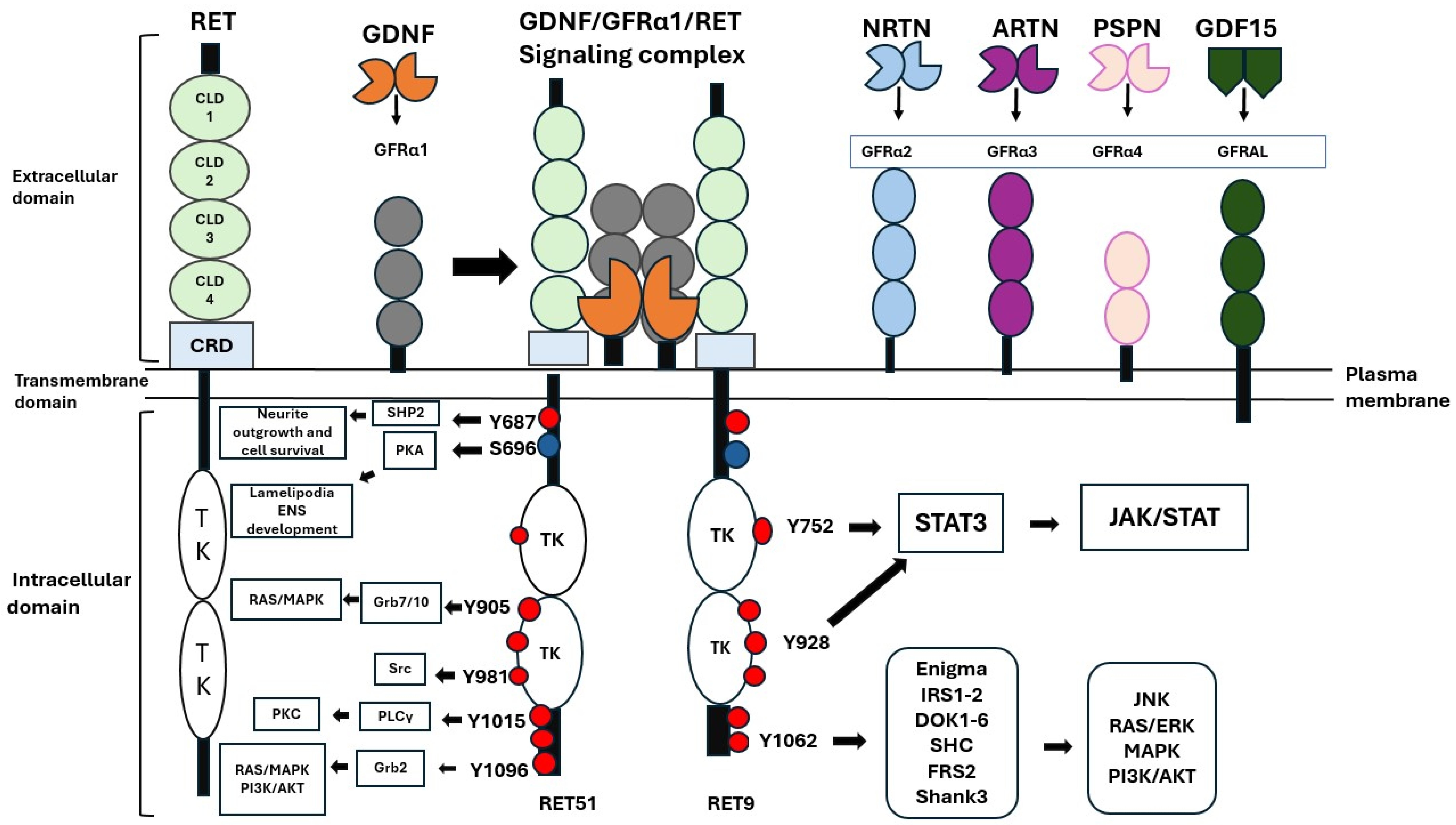
- RET fusions result in the persistent activation of RET TK, enhancing cellular processes such as growth, viability, motility, and differentiation through the stimulation of various signaling pathways, including phosphoinositide 3-kinases (PI3K)/AKT, MAPK, and STAT3 [43].
2.3.4. RET Amplification
3. RET in Cancers
3.1. Thyroid Cancer
3.1.1. Medullary Thyroid Cancer
3.1.2. Hereditary MTC and RET Mutations (MEN2 Syndromes)
3.1.3. Somatic RET Mutations in Sporadic MTC
3.1.4. Papillary Thyroid Cancer
3.2. Non-Small Cell Lung Cancer
3.3. Others
3.3.1. RET in Breast Cancer
3.3.2. RET in Prostate Cancer
3.3.3. RET in Colorectal Cancers
3.3.4. RET in Pancreatic and Ovarian Cancers
4. Targeted Therapies
4.1. Mechanism of Action
4.2. Multi-Kinase Inhibitors with Non-Selective RET Activity
4.2.1. Cabozantinib
4.2.2. Vandetanib
4.2.3. Lenvatinib
4.2.4. Sorafenib
4.2.5. Regorafenib
4.2.6. Sunitinib
4.2.7. Alectinib
4.3. Selective RET Inhibitors
4.3.1. Selpercatinib
4.3.2. Pralsetinib
5. Toxicities and Side Effects of Targeted Therapy
5.1. Cardiovascular Side Effects
5.2. Gastrointestinal Side Effects
5.3. Endocrine and Metabolic Side Effects
5.4. Renal and Hepatic Side Effects
5.5. Psychiatric Side Effects
5.6. Hematology Side Effects
5.7. Other Side Effects
6. Resistance Mechanisms
6.1. Primary and Acquired Resistance Mechanisms
6.2. Histological and Phenotypic Transformation
6.3. Therapeutic Strategies to Overcome Resistance
7. Conclusions
Author Contributions
Funding
Data Availability Statement
Conflicts of Interest
References
- Larkins, E.; Blumenthal, G.M.; Chen, H.; He, K.; Agarwal, R.; Gieser, G.; Stephens, O.; Zahalka, E.; Ringgold, K.; Helms, W.; et al. FDA Approval: Alectinib for the Treatment of Metastatic, ALK-Positive Non–Small Cell Lung Cancer Following Crizotinib. Clin. Cancer Res. 2016, 22, 5171–5176. [Google Scholar] [CrossRef]
- Takahashi, M. RET receptor signaling: Function in development, metabolic disease, and cancer. Proc. Jpn. Acad. Ser. B 2022, 98, 112–125. [Google Scholar] [CrossRef] [PubMed]
- Regua, A.T.; Najjar, M.; Lo, H.W. RET signaling pathway and RET inhibitors in human cancer. Front. Oncol. 2022, 12, 932353. [Google Scholar] [CrossRef] [PubMed]
- Koehler, V.F.; Adam, P.; Frank-Raue, K.; Raue, F.; Berg, E.; Hoster, E.; Allelein, S.; Schott, M.; Kroiss, M.; Spitzweg, C. Real-World Efficacy and Safety of Cabozantinib and Vandetanib in Advanced Medullary Thyroid Cancer. Thyroid 2021, 31, 459–469. [Google Scholar] [CrossRef] [PubMed]
- Choudhury, N.J.; Drilon, A. Decade in review: A new era for RET-rearranged lung cancers. Transl. Lung Cancer Res. 2020, 9, 2571–2580. [Google Scholar] [CrossRef]
- Subbiah, V.; Cote, G.J. Advances in Targeting RET-Dependent Cancers. Cancer Discov. 2020, 10, 498–505. [Google Scholar] [CrossRef]
- Lu, C.; Zhou, Q. Diagnostics, therapeutics and RET inhibitor resistance for RET fusion–positive non-small cell lung cancers and future perspectives. Cancer Treat. Rev. 2021, 96, 102153. [Google Scholar] [CrossRef]
- Takahashi, M.; Ritz, J.; Cooper, G.M. Activation of a novel human transforming gene, RET, by DNA rearrangement. Cell 1985, 42, 581–588. [Google Scholar] [CrossRef]
- Takahashi, M.; Cooper, G.M. RET transforming gene encodes a fusion protein homologous to tyrosine kinases. Mol. Cell. Biol. 1987, 7, 1378–1385. [Google Scholar] [CrossRef]
- Kodama, Y.; Asai, N.; Kawai, K.; Jijiwa, M.; Murakumo, Y.; Ichihara, M.; Takahashi, M. The RET proto-oncogene: A molecular therapeutic target in thyroid cancer. Cancer Sci. 2005, 96, 143–148. [Google Scholar] [CrossRef]
- Ceccherini, I.; Bocciardi, R.; Luo, Y.; Pasini, B.; Hofstra, R.; Takahashi, M.; Romeo, G. Exon structure and flanking intronic sequences of the human RET proto-oncogene. Biochem. Biophys. Res. Commun. 1993, 196, 1288–1295. [Google Scholar] [CrossRef]
- Kucharczyk, T.; Krawczyk, P.; Kowalski, D.M.; Płużański, A.; Kubiatowski, T.; Kalinka, E. RET Proto-Oncogene-Not Such an Obvious Starting Point in Cancer Therapy. Cancers 2022, 14, 5298. [Google Scholar] [CrossRef] [PubMed]
- Bhattarai, C.; Poudel, P.P.; Ghosh, A.; Kalthur, S.G. The RET gene encodes RET protein, which triggers intracellular signaling pathways for enteric neurogenesis, and RET mutation results in Hirschsprung’s disease. AIMS Neurosci. 2022, 9, 128–149. [Google Scholar] [CrossRef] [PubMed]
- Saha, D.; Ryan, K.R.; Lakkaniga, N.R.; Acharya, B.; Garcia, N.G.; Smith, E.L.; FRETt, B. Targeting Rearranged during Transfection in Cancer: A Perspective on Small-Molecule Inhibitors and Their Clinical Development. J. Med. Chem. 2021, 64, 11747–11773. [Google Scholar] [CrossRef] [PubMed]
- Takahashi, M.; Kawai, K.; Asai, N. Roles of the RET Proto-oncogene in Cancer and Development. JMA J. 2020, 3, 175–181. [Google Scholar] [CrossRef]
- Lin, L.-F.H.; Doherty, D.H.; Lile, J.D.; Bektesh, S.; Collins, F. GDNF: A glial cell line-derived neurotrophic factor for midbrain dopaminergic neurons. Science 1993, 260, 1130–1132. [Google Scholar] [CrossRef]
- Mahato, A.K.; Sidorova, Y.A. RET Receptor Tyrosine Kinase: Role in Neurodegeneration, Obesity, and Cancer. Int. J. Mol. Sci. 2020, 21, 7018. [Google Scholar] [CrossRef]
- Mulligan, L.M. GDNF and the RET Receptor in Cancer: New Insights and Therapeutic Potential. Front. Physiol. 2018, 9, 1873. [Google Scholar] [CrossRef]
- Pecar, G.; Liu, S.; Hooda, J.; Atkinson, J.M.; Oesterreich, S.; Lee, A.V. RET signaling in breast cancer therapeutic resistance and metastasis. Breast Cancer Res. 2023, 25, 26. [Google Scholar] [CrossRef]
- Takahashi, M. RET Proto-Oncogene. In Molecular Diagnostics of Cancer; Piccaluga, P.P., Ed.; IntechOpen: Rijeka, Croatia, 2023. [Google Scholar]
- De Groot, J.W.B.; Links, T.P.; Plukker, J.T.; Lips, C.J.; Hofstra, R.M. RET as a diagnostic and therapeutic target in sporadic and hereditary endocrine tumors. Endocr. Rev. 2006, 27, 535–560. [Google Scholar] [CrossRef]
- Kawai, K.; Takahashi, M. Intracellular RET signaling pathways activated by GDNF. Cell Tissue Res. 2020, 382, 113–123. [Google Scholar] [CrossRef] [PubMed]
- Drosten, M.; Pützer, B.M. Mechanisms of Disease: Cancer targeting and the impact of oncogenic RET for medullary thyroid carcinoma therapy. Nat. Clin. Pr. Oncol. 2006, 3, 564–574. [Google Scholar] [CrossRef] [PubMed]
- Roskoski, R., Jr.; Sadeghi-Nejad, A. Role of RET protein-tyrosine kinase inhibitors in the treatment RET-driven thyroid and lung cancers. Pharmacol. Res. 2018, 128, 1–17. [Google Scholar] [CrossRef] [PubMed]
- Romei, C.; Ciampi, R.; Elisei, R. A comprehensive overview of the role of the RET proto-oncogene in thyroid carcinoma. Nat. Rev. Endocrinol. 2016, 12, 192–202. [Google Scholar] [CrossRef]
- Encinas, M.; Crowder, R.J.; Milbrandt, J.; Johnson, E.M. Tyrosine 981, a novel RET autophosphorylation site, binds c-Src to mediate neuronal survival. J. Biol. Chem. 2004, 279, 18262–18269. [Google Scholar] [CrossRef]
- Plaza-Menacho, I.; Mologni, L.; McDonald, N. Mechanisms of RET signaling in cancer: Current and future implications for targeted therapy. Cell Signal. 2014, 26, 1743–1752. [Google Scholar] [CrossRef]
- Perrinjaquet, M.; Vilar, M.; Ibáñez, C.F. Protein-tyrosine phosphatase SHP2 contributes to GDNF neurotrophic activity through direct binding to phospho-Tyr687 in the RET receptor tyrosine kinase. J. Biol. Chem. 2010, 285, 31867–31875. [Google Scholar] [CrossRef]
- Zhao, L.; Wang, N.; Zhang, D.; Jia, Y.; Kong, F. A comprehensive overview of the relationship between RET gene and tumor occurrence. Front Oncol. 2023, 13, 1090757. [Google Scholar] [CrossRef]
- Verrienti, A.; Grani, G.; Sponziello, M.; Pecce, V.; Damante, G.; Durante, C.; Russo, D.; Filetti, S. Precision oncology for RET-related tumors. Front Oncol. 2022, 12, 992636. [Google Scholar] [CrossRef]
- Mulligan, L.M. RET revisited: Expanding the oncogenic portfolio. Nat. Rev. Cancer 2014, 14, 173–186. [Google Scholar] [CrossRef]
- Desilets, A.; Repetto, M.; Yang, S.R.; Sherman, E.J.; Drilon, A. RET-Altered Cancers-A Tumor-Agnostic Review of Biology, Diagnosis and Targeted Therapy Activity. Cancers 2023, 15, 4146. [Google Scholar] [CrossRef] [PubMed]
- Moline, J.; Eng, C. Multiple endocrine neoplasia type 2: An overview. Genet. Med. 2011, 13, 755–764. [Google Scholar] [CrossRef] [PubMed]
- Thein, K.Z.; Velcheti, V.; Mooers, B.H.M.; Wu, J.; Subbiah, V. Precision therapy for RET-altered cancers with RET inhibitors. Trends Cancer 2021, 7, 1074–1088. [Google Scholar] [CrossRef] [PubMed]
- Subbiah, V.; Yang, D.; Velcheti, V.; Drilon, A.; Meric-Bernstam, F. State-of-the-Art Strategies for Targeting RET-Dependent Cancers. J. Clin. Oncol. 2020, 38, 1209–1221. [Google Scholar] [CrossRef]
- Kato, S.; Subbiah, V.; Marchlik, E.; Elkin, S.K.; Carter, J.L.; Kurzrock, R. RET Aberrations in Diverse Cancers: Next-Generation Sequencing of 4,871 Patients. Clin. Cancer. Res. 2017, 23, 1988–1997. [Google Scholar] [CrossRef]
- Tomuschat, C.; Puri, P. RET gene is a major risk factor for Hirschsprung’s disease: A meta-analysis. Pediatr. Surg. Int. 2015, 31, 701–710. [Google Scholar] [CrossRef]
- Arighi, E.; Borrello, M.G.; Sariola, H. RET tyrosine kinase signaling in development and cancer. Cytokine Growth Factor Rev. 2005, 16, 441–467. [Google Scholar] [CrossRef]
- Grieco, M.; Santoro, M.; Berlingieri, M.T.; Melillo, R.M.; Donghi, R.; Bongarzone, I.; Pierotti, M.A.; Della Porta, G.; Fusco, A.; Vecchio, G. PTC is a novel rearranged form of the RET proto-oncogene and is frequently detected in vivo in human thyroid papillary carcinomas. Cell 1990, 60, 557–563. [Google Scholar] [CrossRef]
- Ou, S.-H.I.; Zhu, V.W. Catalog of 5’ fusion partners in RET+ NSCLC Circa 2020. JTO Clin. Res. Rep. 2020, 1, 100037. [Google Scholar] [CrossRef]
- Santoro, M.; Moccia, M.; Federico, G.; Carlomagno, F. RET Gene Fusions in Malignancies of the Thyroid and Other Tissues. Genes 2020, 11, 424. [Google Scholar] [CrossRef]
- Kohno, T.; Tabata, J.; Nakaoku, T. REToma: A cancer subtype with a shared driver oncogene. Carcinogenesis 2020, 41, 123–129. [Google Scholar] [CrossRef] [PubMed]
- Stinchcombe, T.E. Current management of RET rearranged non-small cell lung cancer. Ther. Adv. Med. Oncol. 2020, 12, 1758835920928634. [Google Scholar] [CrossRef] [PubMed]
- Le Rolle, A.F.; Klempner, S.J.; GarRETt, C.R.; Seery, T.; Sanford, E.M.; Balasubramanian, S.; Ross, J.S.; Stephens, P.J.; Miller, V.A.; Ali, S.M.; et al. Identification and characterization of RET fusions in advanced colorectal cancer. Oncotarget 2015, 6, 28929–28937. [Google Scholar] [CrossRef] [PubMed]
- Paratala, B.S.; Chung, J.H.; Williams, C.B.; Yilmazel, B.; Petrosky, W.; Williams, K.; Schrock, A.B.; Gay, L.M.; Lee, E.; Dolfi, S.C.; et al. RET rearrangements are actionable alterations in breast cancer. Nat. Commun. 2018, 9, 4821. [Google Scholar] [CrossRef]
- Platt, A.; Morten, J.; Ji, Q.; Elvin, P.; Womack, C.; Su, X.; Donald, E.; Gray, N.; Read, J.; Bigley, G.; et al. A RETrospective analysis of RET translocation, gene copy number gain and expression in NSCLC patients treated with vandetanib in four randomized Phase III studies. BMC Cancer 2015, 15, 171. [Google Scholar] [CrossRef]
- Gandhi, M.M.; Ricciuti, B.; Harada, G.; Repetto, M.; Gildenberg, M.S.; Singh, A.; Li, Y.Y.; Gagné, A.; Wang, X.; Aizer, A.; et al. Amplification of Wild-Type RET Represents a Novel Molecular Subtype of Several Cancer Types With Clinical Response to Selpercatinib. JCO Precis. Oncol. 2023, 7, e2300295. [Google Scholar] [CrossRef]
- Siegel, R.L.; Miller, K.D.; Wagle, N.S.; Jemal, A. Cancer statistics, 2023. CA Cancer J. Clin. 2023, 73, 17–48. [Google Scholar] [CrossRef]
- Huang, K.; Huang, X.; Qian, S.; Cai, Y.; Wu, F.; Luo, D. Temporal trends of thyroid cancer in China and globally from 1990 to 2021: An analysis of the global burden of Disease Study 2021. Sci. Rep. 2024, 14, 25538. [Google Scholar] [CrossRef]
- Deng, T.; Liu, Q.; Zi, H.; Guo, X.; Huang, Q.; Yang, Y.; Luo, L.; Hou, J.; Zhou, R.; Yuan, Q.; et al. Global trends in thyroid cancer 1990–2021: An analysis based on the GBD 2021. Endocr.-Relat. Cancer 2025, 32, e240297. [Google Scholar] [CrossRef]
- Qiu, Z.; Yu, S.; Zheng, L.; Lou, Y.; Chen, X.; Xuan, F. Global burden of thyroid cancer in adolescents and young adults (aged 15–39 years) from 1990 to 2021: A systematic analysis of the Global Burden of Disease Study 2021. PLoS ONE 2025, 20, e0318605. [Google Scholar] [CrossRef]
- Wells, S.A., Jr.; Santoro, M. Targeting the RET pathway in thyroid cancer. Clin. Cancer Res. 2009, 15, 7119–7123. [Google Scholar] [CrossRef] [PubMed]
- Salvatore, D.; Santoro, M.; Schlumberger, M. The importance of the RET gene in thyroid cancer and therapeutic implications. Nat. Rev. Endocrinol. 2021, 17, 296–306. [Google Scholar] [CrossRef] [PubMed]
- Redaelli, S.; Plaza-Menacho, I.; Mologni, L. Novel targeted therapeutics for MEN2. Endocr.-Relat. Cancer 2018, 25, T53–T68. [Google Scholar] [CrossRef] [PubMed]
- Elisei, R.; Cosci, B.; Romei, C.; Bottici, V.; Renzini, G.; Molinaro, E.; Agate, L.; Vivaldi, A.; Faviana, P.; Basolo, F.; et al. Prognostic significance of somatic RET oncogene mutations in sporadic medullary thyroid cancer: A 10-year follow-up study. J. Clin. Endocrinol. Metab. 2008, 93, 682–687. [Google Scholar] [CrossRef]
- Moura, M.M.; Cavaco, B.M.; Pinto, A.E.; Domingues, R.; Santos, J.R.; Cid, M.O.; Bugalho, M.J.; Leite, V. Correlation of RET somatic mutations with clinicopathological features in sporadic medullary thyroid carcinomas. Br. J. Cancer 2009, 100, 1777–1783. [Google Scholar] [CrossRef]
- Romei, C.; Elisei, R.; Pinchera, A.; Ceccherini, I.; Molinaro, E.; Mancusi, F.; Martino, E.; Romeo, G.; Pacini, F. Somatic mutations of the RET protooncogene in sporadic medullary thyroid carcinoma are not restricted to exon 16 and are associated with tumor recurrence. J. Clin. Endocrinol. Metab. 1996, 81, 1619–1622. [Google Scholar] [CrossRef]
- Dvorakova, S.; Vaclavikova, E.; Sykorova, V.; Vcelak, J.; Novak, Z.; Duskova, J.; Ryska, A.; Laco, J.; Cap, J.; Kodetova, D.; et al. Somatic mutations in the RET proto-oncogene in sporadic medullary thyroid carcinomas. Mol. Cell. Endocrinol. 2008, 284, 21–27. [Google Scholar] [CrossRef]
- Elisei, R.; Ciampi, R.; Matrone, A.; PRETe, A.; Gambale, C.; Ramone, T.; Simeakis, G.; Materazzi, G.; Torregrossa, L.; Ugolini, C.; et al. Somatic RET Indels in Sporadic Medullary Thyroid Cancer: Prevalence and Response to Selpercatinib. J. Clin. Endocrinol. Metab. 2022, 107, 2195–2202. [Google Scholar] [CrossRef]
- Santoro, M.; Melillo, R.M.; Fusco, A. RET/PTC activation in papillary thyroid carcinoma: European Journal of Endocrinology Prize Lecture. Eur. J. Endocrinol. 2006, 155, 645–653. [Google Scholar] [CrossRef]
- Zhang, W.; Lin, S.; Wang, Z.; Zhang, W.; Xing, M. Coexisting RET/PTC and TERT Promoter Mutation Predict Poor Prognosis but Effective RET and MEK Targeting in Thyroid Cancer. J. Clin. Endocrinol. Metab. 2024, 109, 3166–3175. [Google Scholar] [CrossRef]
- Bahar, M.E.; Kim, H.J.; Kim, D.R. Targeting the RAS/RAF/MAPK pathway for cancer therapy: From mechanism to clinical studies. Signal Transduct. Target. Ther. 2023, 8, 455. [Google Scholar] [CrossRef]
- Knauf, J.A.; Kuroda, H.; Basu, S.; Fagin, J.A. RET/PTC-induced dedifferentiation of thyroid cells is mediated through Y1062 signaling through SHC-RAS-MAP kinase. Oncogene 2003, 22, 4406–4412. [Google Scholar] [CrossRef]
- Mitsutake, N.; Miyagishi, M.; Mitsutake, S.; Akeno, N.; Mesa, C., Jr.; Knauf, J.A.; Zhang, L.; Taira, K.; Fagin, J.A. BRAF mediates RET/PTC-induced mitogen-activated protein kinase activation in thyroid cells: Functional support for requirement of the RET/PTC-RAS-BRAF pathway in papillary thyroid carcinogenesis. Endocrinology 2006, 147, 1014–1019. [Google Scholar] [CrossRef]
- Baan, R.A.; Stewart, B.W.; Straif, K. (Eds.) Tumour Site Concordance and Mechanisms of Carcinogenesis; International Agency for Research on Cancer © International Agency for Research on Cancer; IARC Scientific Publications: Lyon, France, 2019. [Google Scholar]
- Pitsava, G.; Stratakis, C.A.; Faucz, F.R. PRKAR1A and Thyroid Tumors. Cancers 2021, 13, 3834. [Google Scholar] [CrossRef]
- Xing, M. BRAF Mutation in Papillary Thyroid Cancer: Pathogenic Role, Molecular Bases, and Clinical Implications. Endocr. Rev. 2007, 28, 742–762. [Google Scholar] [CrossRef]
- Wang, A.; Li, T.; Mao, Y.-Y.; Gao, M.; Shu, S.; Xia, C.-H.; Dong, Y.; Liu, M.; Wang, J.-L.; Ma, J.-X.; et al. Evolution of treatment strategies for solid tumors with RET rearrangement in China and real-world treatment status of Non-small Cell Lung Cancer (NSCLC). BMC Pulm. Med. 2024, 24, 552. [Google Scholar] [CrossRef]
- Qian, Y.; Chai, S.; Liang, Z.; Wang, Y.; Zhou, Y.; Xu, X.; Zhang, C.; Zhang, M.; Si, J.; Huang, F.; et al. KIF5B-RET fusion kinase promotes cell growth by multilevel activation of STAT3 in lung cancer. Mol. Cancer 2014, 13, 176. [Google Scholar] [CrossRef]
- O’Leary, C.; Xu, W.; Pavlakis, N.; Richard, D.; O’Byrne, K. Rearranged During Transfection Fusions in Non-Small Cell Lung Cancer. Cancers 2019, 11, 620. [Google Scholar] [CrossRef]
- Servetto, A.; Esposito, D.; Ferrara, R.; Signorelli, D.; Belli, S.; Napolitano, F.; Santaniello, A.; Ciciola, P.; Formisano, L.; Bianco, R. RET rearrangements in non-small cell lung cancer: Evolving treatment landscape and future challenges. Biochim. Biophys. Acta (BBA)—Rev. Cancer 2022, 1877, 188810. [Google Scholar] [CrossRef]
- Plaza-Menacho, I.; Morandi, A.; Robertson, D.; Pancholi, S.; Drury, S.; Dowsett, M.; Martin, L.A.; Isacke, C.M. Targeting the receptor tyrosine kinase RET sensitizes breast cancer cells to tamoxifen treatment and reveals a role for RET in endocrine resistance. Oncogene 2010, 29, 4648–4657. [Google Scholar] [CrossRef]
- Hatem, R.; Labiod, D.; Château-Joubert, S.; de Plater, L.; El Botty, R.; Vacher, S.; Bonin, F.; Servely, J.L.; Dieras, V.; Bièche, I.; et al. Vandetanib as a potential new treatment for estrogen receptor-negative breast cancers. Int. J. Cancer 2016, 138, 2510–2521. [Google Scholar] [CrossRef]
- Varešlija, D.; Priedigkeit, N.; Fagan, A.; Purcell, S.; Cosgrove, N.; O’Halloran, P.J.; Ward, E.; Cocchiglia, S.; Hartmaier, R.; Castro, C.A.; et al. Transcriptome Characterization of Matched Primary Breast and Brain Metastatic Tumors to Detect Novel Actionable Targets. J. Natl. Cancer Inst. 2019, 111, 388–398, Erratum in J. Natl. Cancer Inst. 2021, 113, 218. https://doi.org/10.1093/jnci/djy110. [Google Scholar] [CrossRef]
- Pietrantonio, F.; Di Nicolantonio, F.; Schrock, A.B.; Lee, J.; Morano, F.; Fucà, G.; Nikolinakos, P.; Drilon, A.; Hechtman, J.F.; Christiansen, J.; et al. RET fusions in a small subset of advanced colorectal cancers at risk of being neglected. Ann. Oncol. 2018, 29, 1394–1401. [Google Scholar] [CrossRef]
- Benson, A.B.; Venook, A.P.; Adam, M.; Chang, G.; Chen, Y.J.; Ciombor, K.K.; Cohen, S.A.; Cooper, H.S.; Deming, D.; Garrido-Laguna, I.; et al. Colon Cancer, Version 3.2024, NCCN Clinical Practice Guidelines in Oncology. J. Natl. Compr. Canc. Netw. 2024, 22. [Google Scholar] [CrossRef]
- Luo, Y.; Tsuchiya, K.D.; Il Park, D.; Fausel, R.; Kanngurn, S.; Welcsh, P.; Dzieciatkowski, S.; Wang, J.; Grady, W.M. RET is a potential tumor suppressor gene in colorectal cancer. Oncogene 2013, 32, 2037–2047. [Google Scholar] [CrossRef]
- Ashkboos, M.; Nikbakht, M.; Zarinfard, G.; Soleimani, M. RET Protein Expression in Colorectal Cancer; An Immunohistochemical Assessment. Asian Pac. J. Cancer Prev. 2021, 22, 1019–1023. [Google Scholar] [CrossRef]
- Ma, J.; Wang, B.; Meng, E.; Meng, X. Case report: Identification of ERC1-RET fusion in a patient with pancreatic ductal adenocarcinoma. Gland Surg. 2021, 10, 2874–2879. [Google Scholar] [CrossRef]
- Guan, L.; Li, Z.; Xie, F.; Pang, Y.; Zhang, C.; Tang, H.; Zhang, H.; Chen, C.; Zhan, Y.; Zhao, T.; et al. Oncogenic and drug-sensitive RET mutations in human epithelial ovarian cancer. J. Exp. Clin. Cancer Res. 2020, 39, 53. [Google Scholar] [CrossRef]
- Yakes, F.M.; Chen, J.; Tan, J.; Yamaguchi, K.; Shi, Y.; Yu, P.; Qian, F.; Chu, F.; Bentzien, F.; Cancilla, B.; et al. Cabozantinib (XL184), a Novel MET and VEGFR2 Inhibitor, Simultaneously Suppresses Metastasis, Angiogenesis, and Tumor Growth. Mol. Cancer Ther. 2011, 10, 2298–2308. [Google Scholar] [CrossRef]
- Drilon, A.; Rekhtman, N.; Arcila, M.; Wang, L.; Ni, A.; Albano, M.; Van Voorthuysen, M.; Somwar, R.; Smith, R.S.; Montecalvo, J.; et al. Cabozantinib in patients with advanced RET-rearranged non-small-cell lung cancer: An open-label, single-centre, phase 2, single-arm trial. Lancet Oncol. 2016, 17, 1653–1660. [Google Scholar] [CrossRef]
- Kurzrock, R.; Sherman, S.I.; Ball, D.W.; Forastiere, A.A.; Cohen, R.B.; Mehra, R.; Pfister, D.G.; Cohen, E.E.; Janisch, L.; Nauling, F.; et al. Activity of XL184 (Cabozantinib), an oral tyrosine kinase inhibitor, in patients with medullary thyroid cancer. J. Clin. Oncol. 2011, 29, 2660–2666. [Google Scholar] [CrossRef] [PubMed]
- Schlumberger, M.; Elisei, R.; Müller, S.; Schöffski, P.; Brose, M.; Shah, M.; Licitra, L.; Krajewska, J.; Kreissl, M.C.; Niederle, B.; et al. Overall survival analysis of EXAM, a phase III trial of cabozantinib in patients with radiographically progressive medullary thyroid carcinoma. Ann. Oncol. 2017, 28, 2813–2819. [Google Scholar] [CrossRef] [PubMed]
- Wells, S.A., Jr.; Gosnell, J.E.; Gagel, R.F.; Moley, J.; Pfister, D.; Sosa, J.A.; Skinner, M.; Krebs, A.; Vasselli, J.; Schlumberger, M. Vandetanib for the treatment of patients with locally advanced or metastatic hereditary medullary thyroid cancer. J. Clin. Oncol. 2010, 28, 767–772. [Google Scholar] [CrossRef] [PubMed]
- Wedge, S.R.; Ogilvie, D.J.; Dukes, M.; Kendrew, J.; Chester, R.; Jackson, J.A.; Boffey, S.J.; Valentine, P.J.; Curwen, J.O.; Musgrove, H.L.; et al. ZD6474 inhibits vascular endothelial growth factor signaling, angiogenesis, and tumor growth following oral administration. Cancer Res. 2002, 62, 4645–4655. [Google Scholar]
- Carlomagno, F.; Vitagliano, D.; Guida, T.; Ciardiello, F.; Tortora, G.; Vecchio, G.; Ryan, A.J.; Fontanini, G.; Fusco, A.; Santoro, M. ZD6474, an Orally Available Inhibitor of KDR Tyrosine Kinase Activity, Efficiently Blocks Oncogenic RET Kinases1. Cancer Res. 2002, 62, 7284–7290. [Google Scholar]
- Vidal, M.; Wells, S.; Ryan, A.; Cagan, R. ZD6474 Suppresses Oncogenic RET Isoforms in a Drosophila Model for Type 2 Multiple Endocrine Neoplasia Syndromes and Papillary Thyroid Carcinoma. Cancer Res. 2005, 65, 3538–3541. [Google Scholar] [CrossRef]
- Wells, S.A.; Robinson, B.G.; Gagel, R.F.; Dralle, H.; Fagin, J.A.; Santoro, M.; Baudin, E.; Elisei, R.; Jarzab, B.; Vasselli, J.R.; et al. Vandetanib in Patients With Locally Advanced or Metastatic Medullary Thyroid Cancer: A Randomized, Double-Blind Phase III Trial. J. Clin. Oncol. 2012, 30, 134–141. [Google Scholar] [CrossRef]
- Okamoto, K.; Kodama, K.; Takase, K.; Sugi, N.H.; Yamamoto, Y.; Iwata, M.; Tsuruoka, A. Antitumor activities of the targeted multi-tyrosine kinase inhibitor lenvatinib (E7080) against RET gene fusion-driven tumor models. Cancer Lett. 2013, 340, 97–103. [Google Scholar] [CrossRef]
- Hida, T.; Velcheti, V.; Reckamp, K.L.; Nokihara, H.; Sachdev, P.; Kubota, T.; Nakada, T.; Dutcus, C.E.; Ren, M.; Tamura, T. A phase 2 study of lenvatinib in patients with RET fusion-positive lung adenocarcinoma. Lung Cancer 2019, 138, 124–130. [Google Scholar] [CrossRef]
- Nair, A.; Reece, K.; Donoghue, M.B.; Yuan, W.V.; Rodriguez, L.; Keegan, P.; Pazdur, R. FDA Supplemental Approval Summary: Lenvatinib for the Treatment of Unresectable Hepatocellular Carcinoma. Oncologist 2021, 26, e484–e491. [Google Scholar] [CrossRef]
- Colwell, J. FDA Approves Drug Combo for Kidney Cancer. Cancer Discov. 2016, 6, 687–688. [Google Scholar] [CrossRef] [PubMed]
- Arora, S.; Balasubramaniam, S.; Zhang, W.; Zhang, L.; Sridhara, R.; Spillman, D.; Mathai, J.P.; Scott, B.; Golding, S.J.; Coory, M.; et al. FDA Approval Summary: Pembrolizumab plus Lenvatinib for Endometrial Carcinoma, a Collaborative International Review under Project Orbis. Clin. Cancer Res. 2020, 26, 5062–5067. [Google Scholar] [CrossRef] [PubMed]
- Lyons, J.F.; Wilhelm, S.; Hibner, B.; Bollag, G. Discovery of a novel Raf kinase inhibitor. Endocr. Relat. Cancer 2001, 8, 219–225. [Google Scholar] [CrossRef]
- Wilhelm, S.M.; Carter, C.; Tang, L.; Wilkie, D.; McNabola, A.; Rong, H.; Chen, C.; Zhang, X.; Vincent, P.; McHugh, M.; et al. BAY 43-9006 exhibits broad spectrum oral antitumor activity and targets the RAF/MEK/ERK pathway and receptor tyrosine kinases involved in tumor progression and angiogenesis. Cancer Res. 2004, 64, 7099–7109. [Google Scholar] [CrossRef] [PubMed]
- Plaza-Menacho, I.; Mologni, L.; Sala, E.; Gambacorti-Passerini, C.; Magee, A.I.; Links, T.P.; Hofstra, R.M.W.; Barford, D.; Isacke, C.M. Sorafenib functions to potently suppress RET tyrosine kinase activity by direct enzymatic inhibition and promoting RET lysosomal degradation independent of proteasomal targeting. J. Biol. Chem. 2007, 282, 29230–29240. [Google Scholar] [CrossRef]
- Henderson, Y.C.; Ahn, S.H.; Kang, Y.A.; Clayman, G.L. Sorafenib potently inhibits papillary thyroid carcinomas harboring RET/PTC1 rearrangement. Clin. Cancer Res. 2008, 14, 4908–4914. [Google Scholar] [CrossRef]
- Kane, R.C.; Farrell, A.T.; Saber, H.; Tang, S.; Williams, G.; Jee, J.M.; Liang, C.; Booth, B.; Chidambaram, N.; Morse, D.; et al. Sorafenib for the treatment of advanced renal cell carcinoma. Clin. Cancer Res. 2006, 12, 7271–7278. [Google Scholar] [CrossRef]
- Lang, L. FDA approves sorafenib for patients with inoperable liver cancer. Gastroenterology 2008, 134, 379. [Google Scholar] [CrossRef]
- Horiike, A.; Takeuchi, K.; Uenami, T.; Kawano, Y.; Tanimoto, A.; Kaburaki, K.; Tambo, Y.; Kudo, K.; Yanagitani, N.; Ohyanagi, F.; et al. Sorafenib treatment for patients with RET fusion-positive non-small cell lung cancer. Lung Cancer 2016, 93, 43–46. [Google Scholar] [CrossRef]
- Chen, Z.; Zhao, Y.; Yu, Y.; Pang, J.C.; Woodfield, S.E.; Tao, L.; Guan, S.; Zhang, H.; Bieerkehazhi, S.; Shi, Y.; et al. Small molecule inhibitor regorafenib inhibits RET signaling in neuroblastoma cells and effectively suppresses tumor growth in vivo. Oncotarget 2017, 8, 104090–104103. [Google Scholar] [CrossRef]
- Wu, R.-Y.; Kong, P.-F.; Xia, L.-P.; Huang, Y.; Li, Z.-L.; Tang, Y.-Y.; Chen, Y.-H.; Li, X.; Senthilkumar, R.; Zhang, H.-L.; et al. Regorafenib Promotes Antitumor Immunity via Inhibiting PD-L1 and IDO1 Expression in Melanoma. Clin. Cancer Res. 2019, 25, 4530–4541. [Google Scholar] [CrossRef] [PubMed]
- Jeong, W.-J.; Mo, J.-H.; Park, M.W.; Choi, I.J.; An, S.-Y.; Jeon, E.-H.; Ahn, S.-H. Sunitinib inhibits papillary thyroid carcinoma with RET/PTC rearrangement but not BRAF mutation. Cancer Biol. Ther. 2011, 12, 458–465. [Google Scholar] [CrossRef] [PubMed]
- Gautschi, O.; Milia, J.; Filleron, T.; Wolf, J.; Carbone, D.P.; Owen, D.; Camidge, R.; Narayanan, V.; Doebele, R.C.; Besse, B.; et al. Targeting RET in Patients With RET-Rearranged Lung Cancers: Results From the Global, Multicenter RET Registry. J. Clin. Oncol. 2017, 35, 1403–1410. [Google Scholar] [CrossRef] [PubMed]
- Song, Z.; Wang, M.; Zhang, A. Alectinib: A novel second generation anaplastic lymphoma kinase (ALK) inhibitor for overcoming clinically-acquired resistance. Acta Pharm. Sin. B 2015, 5, 34–37. [Google Scholar] [CrossRef]
- Kodama, T.; Tsukaguchi, T.; Satoh, Y.; Yoshida, M.; Watanabe, Y.; Kondoh, O.; Sakamoto, H. Alectinib Shows Potent Antitumor Activity against RET-Rearranged Non–Small Cell Lung Cancer. Mol. Cancer Ther. 2014, 13, 2910–2918. [Google Scholar] [CrossRef]
- Lin, J.J.; Kennedy, E.; Sequist, L.V.; Brastianos, P.K.; Goodwin, K.E.; Stevens, S.; Wanat, A.C.; Stober, L.L.; Digumarthy, S.R.; Engelman, J.A.; et al. Clinical Activity of Alectinib in Advanced RET-Rearranged Non–Small Cell Lung Cancer. J. Thorac. Oncol. 2016, 11, 2027–2032. [Google Scholar] [CrossRef]
- Takeuchi, S.; Yanagitani, N.; Seto, T.; Hattori, Y.; Ohashi, K.; Morise, M.; Matsumoto, S.; Yoh, K.; Goto, K.; Nishio, M.; et al. Phase 1/2 study of alectinib in RET-rearranged previously-treated non-small cell lung cancer (ALL-RET). Transl. Lung Cancer Res. 2020, 10, 314–325. [Google Scholar] [CrossRef]
- Felip, E.; Smit, E.F.; Molina-Vila, M.A.; Dafni, U.; Massuti, B.; Berghmans, T.; de Marinis, F.; Passiglia, F.; Dingemans, A.-M.C.; Cobo, M.; et al. Alectinib for the treatment of pRETreated RET-rearranged advanced NSCLC: Results of the ETOP ALERT-lung trial. Lung Cancer 2022, 172, 94–99. [Google Scholar] [CrossRef]
- Bradford, D.; Larkins, E.; Mushti, S.L.; Rodriguez, L.; Skinner, A.M.; Helms, W.S.; Price, L.S.L.; Zirkelbach, J.F.; Li, Y.; Liu, J.; et al. FDA Approval Summary: Selpercatinib for the Treatment of Lung and Thyroid Cancers with RET Gene Mutations or Fusions. Clin. Cancer Res. 2021, 27, 2130–2135. [Google Scholar] [CrossRef]
- Cristina Mendonça Nogueira, T.; Vinicius Nora de Souza, M. New FDA oncology small molecule drugs approvals in 2020: Mechanism of action and clinical applications. Bioorg. Med. Chem. 2021, 46, 116340. [Google Scholar] [CrossRef]
- Subbiah, V.; Velcheti, V.; Tuch, B.B.; Ebata, K.; Busaidy, N.L.; Cabanillas, M.E.; Wirth, L.J.; Stock, S.; Smith, S.; Lauriault, V.; et al. Selective RET kinase inhibition for patients with RET-altered cancers. Ann. Oncol. 2018, 29, 1869–1876. [Google Scholar] [CrossRef] [PubMed]
- Drilon, A.; Subbiah, V.; Gautschi, O.; Tomasini, P.; Braud, F.d.; Solomon, B.J.; Tan, D.S.-W.; Alonso, G.; Wolf, J.; Park, K.; et al. Selpercatinib in Patients with RET Fusion–Positive Non–Small-Cell Lung Cancer: Updated Safety and Efficacy From the Registrational LIBRETTO-001 Phase I/II Trial. J. Clin. Oncol. 2023, 41, 385–394, Erratum in J Clin. Oncol. 2023, 41, 4941. https://doi.org/10.1200/jco.22.00393. [Google Scholar] [CrossRef] [PubMed]
- Wirth, L.J.; Sherman, E.; Robinson, B.; Solomon, B.; Kang, H.; Lorch, J.; Worden, F.; Brose, M.; Patel, J.; Leboulleux, S.; et al. Efficacy of Selpercatinib in RET-Altered Thyroid Cancers. N. Engl. J. Med. 2020, 383, 825–835. [Google Scholar] [CrossRef] [PubMed]
- Wirth, L.J.; Robinson, B.; Boni, V.; Tan, D.S.W.; McCoach, C.; Massarelli, E.; Hess, L.M.; Jen, M.H.; Kherani, J.; Olek, E.; et al. Patient-Reported Outcomes with Selpercatinib Treatment Among Patients with RET-Mutant Medullary Thyroid Cancer in the Phase I/II LIBRETTO-001 Trial. Oncologist 2022, 27, 13–21. [Google Scholar] [CrossRef]
- Minchom, A.; Tan, A.C.; Massarelli, E.; Subbiah, V.; Boni, V.; Robinson, B.; Wirth, L.J.; Hess, L.M.; Jen, M.H.; Kherani, J.; et al. Patient-Reported Outcomes with Selpercatinib Among Patients with RET Fusion-Positive Non-Small Cell Lung Cancer in the Phase I/II LIBRETTO-001 Trial. Oncologist 2022, 27, 22–29. [Google Scholar] [CrossRef]
- Kim, J.; Bradford, D.; Larkins, E.; Pai-Scherf, L.H.; Chatterjee, S.; Mishra-Kalyani, P.S.; Wearne, E.; Helms, W.S.; Ayyoub, A.; Bi, Y.; et al. FDA Approval Summary: Pralsetinib for the Treatment of Lung and Thyroid Cancers with RET Gene Mutations or Fusions. Clin. Cancer Res. 2021, 27, 5452–5456. [Google Scholar] [CrossRef]
- Gainor, J.F.; Curigliano, G.; Kim, D.-W.; Lee, D.H.; Besse, B.; Baik, C.S.; Doebele, R.C.; Cassier, P.A.; Lopes, G.; Tan, D.S.W.; et al. Pralsetinib for RET fusion-positive non-small-cell lung cancer (ARROW): A multi-cohort, open-label, phase 1/2 study. Lancet Oncol. 2021, 22, 959–969, Erratum in Lancet Oncol. 2021, 22, e347. https://doi.org/10.1016/S1470-2045(21)00247-3. [Google Scholar] [CrossRef]
- Griesinger, F.; Curigliano, G.; Thomas, M.; Subbiah, V.; Baik, C.S.; Tan, D.S.W.; Lee, D.H.; Misch, D.; Garralda, E.; Kim, D.W.; et al. Safety and efficacy of pralsetinib in RET fusion–positive non-small-cell lung cancer including as first-line therapy: Update from the ARROW trial. Ann. Oncol. 2022, 33, 1168–1178. [Google Scholar] [CrossRef]
- Subbiah, V.; I Hu, M.; Wirth, L.J.; Schuler, M.; Mansfield, A.S.; Curigliano, G.; Brose, M.S.; Zhu, V.W.; Leboulleux, S.; Bowles, D.W.; et al. Pralsetinib for patients with advanced or metastatic RET-altered thyroid cancer (ARROW): A multi-cohort, open-label, registrational, phase 1/2 study. Lancet Diabetes Endocrinol. 2021, 9, 491–501, Erratum in Lancet Diabetes Endocrinol. 2021, 9, e4. [Google Scholar] [CrossRef]
- Yang, Y.; Li, S.; Wang, Y.; Zhao, Y.; Li, Q. Protein tyrosine kinase inhibitor resistance in malignant tumors: Molecular mechanisms and future perspective. Signal Transduct. Target. Ther. 2022, 7, 329. [Google Scholar] [CrossRef]
- Hou, W.; Ding, M.; Li, X.; Zhou, X.; Zhu, Q.; Varela-Ramirez, A.; Yi, C. Comparative evaluation of cardiovascular risks among nine FDA-approved VEGFR-TKIs in patients with solid tumors: A Bayesian network analysis of randomized controlled trials. J. Cancer. Res. Clin. Oncol. 2021, 147, 2407–2420. [Google Scholar] [CrossRef]
- Shah, R.R.; Morganroth, J. Update on Cardiovascular Safety of Tyrosine Kinase Inhibitors: With a Special Focus on QT Interval, Left Ventricular Dysfunction and Overall Risk/Benefit. Drug Saf. 2015, 38, 693–710. [Google Scholar] [CrossRef] [PubMed]
- Shah, R.R.; Morganroth, J.; Shah, D.R. Cardiovascular safety of tyrosine kinase inhibitors: With a special focus on cardiac repolarisation (QT interval). Drug Saf. 2013, 36, 295–316. [Google Scholar] [CrossRef] [PubMed]
- Lai, X.; Wan, Q.; Jiao, S.F.; Sun, X.C.; Hu, J.F.; Peng, H.W. Cardiovascular toxicities following the use of tyrosine kinase inhibitors in hepatocellular cancer patients: A RETrospective, pharmacovigilance study. Expert Opin. Drug Saf. 2024, 23, 287–296. [Google Scholar] [CrossRef] [PubMed]
- Armenian, S.H.; Lacchetti, C.; Barac, A.; Carver, J.; Constine, L.S.; Denduluri, N.; Dent, S.; Douglas, P.S.; Durand, J.B.; Ewer, M.; et al. Prevention and Monitoring of Cardiac Dysfunction in Survivors of Adult Cancers: American Society of Clinical Oncology Clinical Practice Guideline. J. Clin. Oncol. 2017, 35, 893–911. [Google Scholar] [CrossRef] [PubMed]
- Yang, X.; Pan, X.; Cheng, X.; Kuang, Y.; Cheng, Y. Risk of Gastrointestinal Events During Vandetanib Therapy in Patients with Cancer: A Systematic Review and Meta-analysis of Clinical Trials. Am. J. Ther. 2017, 24, e351–e360. [Google Scholar] [CrossRef]
- Gerendash, B.S.; Creel, P.A. Practical management of adverse events associated with cabozantinib treatment in patients with renal-cell carcinoma. Onco Targets Ther. 2017, 10, 5053–5064. [Google Scholar] [CrossRef]
- Schmidinger, M.; Danesi, R. Management of Adverse Events Associated with Cabozantinib Therapy in Renal Cell Carcinoma. Oncologist 2018, 23, 306–315. [Google Scholar] [CrossRef]
- Cabanillas, M.E.; Takahashi, S. Managing the adverse events associated with lenvatinib therapy in radioiodine-refractory differentiated thyroid cancer. Semin. Oncol. 2019, 46, 57–64. [Google Scholar] [CrossRef]
- Rimassa, L.; Danesi, R.; Pressiani, T.; Merle, P. Management of adverse events associated with tyrosine kinase inhibitors: Improving outcomes for patients with hepatocellular carcinoma. Cancer Treat. Rev. 2019, 77, 20–28. [Google Scholar] [CrossRef]
- Santoni, M.; Conti, A.; De Giorgi, U.; Iacovelli, R.; Pantano, F.; Burattini, L.; Muzzonigro, G.; Berardi, R.; Santini, D.; Cascinu, S. Risk of gastrointestinal events with sorafenib, sunitinib and pazopanib in patients with solid tumors: A systematic review and meta-analysis of clinical trials. Int. J. Cancer 2014, 135, 763–773. [Google Scholar] [CrossRef] [PubMed]
- Li, J.; Gu, J. Risk of gastrointestinal events with newly approved (after 2011) vascular endothelial growth factor receptor tyrosine kinase inhibitors in cancer patients: A meta-analysis of randomized controlled trials. Eur. J. Clin. Pharmacol. 2017, 73, 1209–1217. [Google Scholar] [CrossRef] [PubMed]
- Haddad, R.I.; Bischoff, L.; Ball, D.; Bernet, V.; Blomain, E.; Busaidy, N.L.; Campbell, M.; Dickson, P.; Duh, Q.Y.; Ehya, H.; et al. Thyroid Carcinoma, Version 2.2022, NCCN Clinical Practice Guidelines in Oncology. J. Natl. Compr. Canc. Netw. 2022, 20, 925–951. [Google Scholar] [CrossRef] [PubMed]
- Acitelli, E.; Maiorca, C.; Grani, G.; Maranghi, M. Metabolic adverse events of multitarget kinase inhibitors: A systematic review. Endocrine 2023, 81, 16–29. [Google Scholar] [CrossRef]
- Brassard, M.; Neraud, B.; Trabado, S.; Salenave, S.; Brailly-Tabard, S.; Borget, I.; Baudin, E.; Leboulleux, S.; Chanson, P.; Schlumberger, M.; et al. Endocrine Effects of the Tyrosine Kinase Inhibitor Vandetanib in Patients Treated for Thyroid Cancer. J. Clin. Endocrinol. Metab. 2011, 96, 2741–2749. [Google Scholar] [CrossRef]
- Shu, M.; Zai, X.; Zhang, B.; Wang, R.; Lin, Z. Hypothyroidism Side Effect in Patients Treated with Sunitinib or Sorafenib: Clinical and Structural Analyses. PLoS ONE 2016, 11, e0147048. [Google Scholar] [CrossRef]
- Ali, M.A.; Shah, S.S.; Ali, R.; Bajwa, S.F.; Rehman, S.; Anwar, A.; Anwar, M.Y.; Saeed, M.; Mirza, N.; Aiman, W. Efficacy and Safety of RET-Specific Kinase Inhibitors in RET-Altered Cancers: A Systematic Review. Cancer Investig. 2023, 41, 739–749. [Google Scholar] [CrossRef]
- Viganò, M.; La Milia, M.; Grassini, M.V.; Pugliese, N.; De Giorgio, M.; Fagiuoli, S. Hepatotoxicity of Small Molecule Protein Kinase Inhibitors for Cancer. Cancers 2023, 15, 1766. [Google Scholar] [CrossRef]
- Shah, R.R.; Morganroth, J.; Shah, D.R. Hepatotoxicity of tyrosine kinase inhibitors: Clinical and regulatory perspectives. Drug Saf. 2013, 36, 491–503. [Google Scholar] [CrossRef]
- Wang, X.; Chen, R.; Liu, J.; Wang, E.; Luo, H. Liver injury related to vascular endothelial growth factor tyrosine kinase inhibitors: A pharmacovigilance analysis of the USA FDA adverse event reporting system (FAERS) database. Expert Opin. Drug Saf. 2025, 1–9. [Google Scholar] [CrossRef]
- Hadoux, J.; Elisei, R.; Brose, M.S.; Hoff, A.O.; Robinson, B.G.; Gao, M.; Jarzab, B.; Isaev, P.; Kopeckova, K.; Wadsley, J.; et al. Phase 3 Trial of Selpercatinib in Advanced RET-Mutant Medullary Thyroid Cancer. N. Engl. J. Med. 2023, 389, 1851–1861. [Google Scholar] [CrossRef] [PubMed]
- Xiong, Y.; Wang, Q.; Liu, Y.; Wei, J.; Chen, X. Renal adverse reactions of tyrosine kinase inhibitors in the treatment of tumours: A Bayesian network meta-analysis. Front. Pharmacol. 2022, 13, 1023660. [Google Scholar] [CrossRef] [PubMed]
- Sasaki, R.; Fukushima, M.; Haraguchi, M.; Honda, T.; Miuma, S.; Miyaaki, H.; Nakao, K. Impact of lenvatinib on renal function compared to sorafenib for unresectable hepatocellular carcinoma. Medicine 2022, 101, e29289. [Google Scholar] [CrossRef] [PubMed]
- Xue, C.; Cui, L.; Chen, J.; Liu, Y.; Deng, Y.; Xu, W.; Mao, Z.; Wu, J. Renal microangiopathy induced by lenvatinib in hepatocellular carcinoma: A case report and literature review. Front Pharmacol. 2024, 15, 1420377. [Google Scholar] [CrossRef]
- Wang, X.; Yin, D.; Tang, Y.; Xiao, F.; Wang, S. Psychiatric adverse reactions to non-selective RET multi-kinase inhibitors: A large-scale pharmacovigilance analysis. Front Pharmacol. 2023, 14, 1209933. [Google Scholar] [CrossRef]
- Mulder, S.F.; Bertens, D.; Desar, I.M.; Vissers, K.C.; Mulders, P.F.; Punt, C.J.; van Spronsen, D.J.; Langenhuijsen, J.F.; Kessels, R.P.; van Herpen, C.M. Impairment of cognitive functioning during Sunitinib or Sorafenib treatment in cancer patients: A cross sectional study. BMC Cancer 2014, 14, 219. [Google Scholar] [CrossRef]
- Barbieri, M.A.; Russo, G.; Sorbara, E.E.; Cicala, G.; Franchina, T.; Santarpia, M.; Speranza, D.; Spina, E.; Silvestris, N. Neuropsychiatric adverse drug reactions with oral tyrosine kinase inhibitors in metastatic colorectal cancer: An analysis from the FDA Adverse Event Reporting System. Front Oncol. 2023, 13, 1268672. [Google Scholar] [CrossRef]
- Schutz, F.A.; Je, Y.; Choueiri, T.K. Hematologic toxicities in cancer patients treated with the multi-tyrosine kinase sorafenib: A meta-analysis of clinical trials. Crit. Rev. Oncol. Hematol. 2011, 80, 291–300. [Google Scholar] [CrossRef]
- Damaraju, V.L.; Kuzma, M.; Cass, C.E.; Putman, C.T.; Sawyer, M.B. Multitargeted kinase inhibitors imatinib, sorafenib and sunitinib perturb energy metabolism and cause cytotoxicity to cultured C2C12 skeletal muscle derived myotubes. Biochem. Pharmacol. 2018, 155, 162–171. [Google Scholar] [CrossRef]
- Zuo, R.C.; Apolo, A.B.; DiGiovanna, J.J.; Parnes, H.L.; Keen, C.M.; Nanda, S.; Dahut, W.L.; Cowen, E.W. Cutaneous adverse effects associated with the tyrosine-kinase inhibitor cabozantinib. JAMA Dermatol. 2015, 151, 170–177. [Google Scholar] [CrossRef]
- Chen, M.; Shen, J.; Jia, R.; Chang, M.; Zhang, J.; Zheng, J.; Xue, R.; Guo, L.; Yan, K. Case Report: Posterior reversible encephalopathy syndrome after lenvatinib treatment for hepatocellular carcinoma. Front Pharmacol. 2025, 16, 1487009. [Google Scholar] [CrossRef]
- Zou, X.; Zhou, P.; Lv, W.; Liu, C.; Liu, J. Posterior reversible encephalopathy syndrome after anlotinib treatment for small cell lung cancer: A case report and literature review. Front Pharmacol. 2023, 14, 1126235. [Google Scholar] [CrossRef] [PubMed]
- Vander Velde, R.; Yoon, N.; Marusyk, V.; Durmaz, A.; Dhawan, A.; Miroshnychenko, D.; Lozano-Peral, D.; Desai, B.; Balynska, O.; Poleszhuk, J.; et al. Resistance to targeted therapies as a multifactorial, gradual adaptation to inhibitor specific selective pressures. Nat. Commun. 2020, 11, 2393. [Google Scholar] [CrossRef]
- Rosen, E.Y.; Won, H.H.; Zheng, Y.; Cocco, E.; Selcuklu, D.; Gong, Y.; Friedman, N.D.; de Bruijn, I.; Sumer, O.; Bielski, C.M.; et al. The evolution of RET inhibitor resistance in RET-driven lung and thyroid cancers. Nat. Commun. 2022, 13, 1450, Erratum in Nat. Commun. 2022, 13, 1936. https://doi.org/10.1038/s41467-022-28848-x. [Google Scholar] [CrossRef] [PubMed]
- Lin, J.J.; Liu, S.V.; McCoach, C.E.; Zhu, V.W.; Tan, A.C.; Yoda, S.; Peterson, J.; Do, A.; Prutisto-Chang, K.; Dagogo-Jack, I.; et al. Mechanisms of resistance to selective RET tyrosine kinase inhibitors in RET fusion-positive non-small-cell lung cancer. Ann. Oncol. 2020, 31, 1725–1733. [Google Scholar] [CrossRef]
- Subbiah, V.; Shen, T.; Terzyan, S.S.; Liu, X.; Hu, X.; Patel, K.P.; Hu, M.; Cabanillas, M.; Behrang, A.; Meric-Bernstam, F.; et al. Structural basis of acquired resistance to selpercatinib and pralsetinib mediated by non-gatekeeper RET mutations. Ann. Oncol. 2021, 32, 261–268. [Google Scholar] [CrossRef]
- Solomon, B.J.; Tan, L.; Lin, J.J.; Wong, S.Q.; Hollizeck, S.; Ebata, K.; Tuch, B.B.; Yoda, S.; Gainor, J.F.; Sequist, L.V.; et al. RET Solvent Front Mutations Mediate Acquired Resistance to Selective RET Inhibition in RET-Driven Malignancies. J. Thorac. Onco.L 2020, 15, 541–549. [Google Scholar] [CrossRef]
- Liu, X.; Shen, T.; Mooers, B.H.M.; Hilberg, F.; Wu, J. Drug resistance profiles of mutations in the RET kinase domain. Br. J. Pharmacol. 2018, 175, 3504–3515. [Google Scholar] [CrossRef]
- Meng, S.; Wu, H.; Wang, J.; Qiu, Q. Systematic Analysis of Tyrosine Kinase Inhibitor Response to RET Gatekeeper Mutations in Thyroid Cancer. Mol. Inform. 2016, 35, 495–505. [Google Scholar] [CrossRef]
- Fancelli, S.; Caliman, E.; Mazzoni, F.; Brugia, M.; Castiglione, F.; Voltolini, L.; Pillozzi, S.; Antonuzzo, L. Chasing the Target: New Phenomena of Resistance to Novel Selective RET Inhibitors in Lung Cancer. Updated Evidence and Future Perspectives. Cancers 2021, 13, 1091. [Google Scholar] [CrossRef]
- Wang, J.; Wang, X.; Chu, Y.; Li, S.; Hao, J. Predictive factors for efficacy of oxaliplatin-based chemotherapy in advanced well-differentiated neuroendocrine tumors: An observational cohort study and meta-analysis. Front Endocrinol. 2025, 16, 1595151. [Google Scholar] [CrossRef]
- Chang, H.; Sung, J.H.; Moon, S.U.; Kim, H.S.; Kim, J.W.; Lee, J.S. EGF Induced RET Inhibitor Resistance in CCDC6-RET Lung Cancer Cells. Yonsei Med. J. 2017, 58, 9–18. [Google Scholar] [CrossRef]
- Nelson-Taylor, S.K.; Le, A.T.; Yoo, M.; Schubert, L.; Mishall, K.M.; Doak, A.; Varella-Garcia, M.; Tan, A.-C.; Doebele, R.C. Resistance to RET-Inhibition in RET-Rearranged NSCLC Is Mediated By Reactivation of RAS/MAPK Signaling. Mol. Cancer Ther. 2017, 16, 1623–1633. [Google Scholar] [CrossRef]
- Hadoux, J.; Al Ghuzlan, A.; Lamartina, L.; Bani, M.A.; Moog, S.; Attard, M.; Scoazec, J.Y.; Hartl, D.; Aldea, M.; Friboulet, L.; et al. Patterns of Treatment Failure After Selective Rearranged During Transfection (RET) Inhibitors in Patients with Metastatic Medullary Thyroid Carcinoma. JCO Precis. Oncol. 2023, 7, e2300053. [Google Scholar] [CrossRef]
- Wang, T.; Jiang, W.; Yang, L.; Li, J.; Sun, Y.; Shi, J. Overcoming resistance in RET-altered cancers through rational inhibitor design and combination therapies. Bioorg. Chem. 2025, 165, 108948. [Google Scholar] [CrossRef]
- Nabhan, C.; Klink, A.; Lee, C.H.; Laney, J.R.; Yang, Y.; Purdum, A.G. ASCO Annual Meeting. In Proceedings of the Overall Survival (OS) and Transplantation (ASCT) Utilization in Real-World Patients with Relapsed/Refractory Diffuse Large B-Cell Lymphoma (RR-DLBCL), Chicago, IL, USA, 2–6 June 2023; American Society of Clinical Oncology (ASCO): Alexandria, VA, USA, 2023. [Google Scholar]
- Zhong, J.; Xue, W.; Gao, Q.; Liu, Y.; Chen, X.; Xie, W.; Xiao, R.; Hao, Y.; Lin, Y.; Chen, L.; et al. Discovery of APS03118, a Potent and Selective Next-Generation RET Inhibitor with a Novel Kinase Hinge Scaffold. J. Med. Chem. 2025, 68, 19536–19553. [Google Scholar] [CrossRef]
- Román-Gil, M.S.; Pozas, J.; Rosero-Rodríguez, D.; Chamorro-Pérez, J.; Ruiz-Granados, Á.; Caracuel, I.R.; Grande, E.; Molina-Cerrillo, J.; Alonso-Gordoa, T. Resistance to RET targeted therapy in Thyroid Cancer: Molecular basis and overcoming strategies. Cancer Treat. Rev. 2022, 105, 102372. [Google Scholar] [CrossRef]



| Drug | Class | Targets | FDA | Key Efficacy | Common AE |
|---|---|---|---|---|---|
| Cabozantinib | Multi-kinase | RET, VEGFR2 | 2012 | ORR 28% (RET-NSCLC) | QT prolongation, HTN, GI |
| Vandetanib | Multi-kinase | RET, EGFR, VEGFR | 2011 | MTC: ↑ PFS | QT prolongation, HTN, Skin |
| Lenvatinib | Multi-kinase | RET, VEGFR, FGFR | 2015 | ORR 16% | HTN, Cardiac |
| Sorafenib | Multi-kinase | RAF, VEGFR | 2005 | Limited RET benefit | CV, GI |
| Sunitinib | Multi-kinase | RET, VEGFR | 2006 | ORR ~22% | QT prolongation, Cytopenia |
| Selpercatinib | Selective RET | RET only | 2020 | ORR 84%(TN) | GI, LFTs |
| Pralsetinib | Selective RET | RET only | 2020 | ORR 72% (TN) | HTN, Neutropenia |
Disclaimer/Publisher’s Note: The statements, opinions and data contained in all publications are solely those of the individual author(s) and contributor(s) and not of MDPI and/or the editor(s). MDPI and/or the editor(s) disclaim responsibility for any injury to people or property resulting from any ideas, methods, instructions or products referred to in the content. |
© 2026 by the authors. Licensee MDPI, Basel, Switzerland. This article is an open access article distributed under the terms and conditions of the Creative Commons Attribution (CC BY) license.
Share and Cite
Streit, S.; Dweik, A.; Mahtab, A.; Ali, S.; Khan, A.; Salzberg, M. RET Signaling Pathway in Human Cancer: Oncogenic Mechanisms, Selective Inhibitors, and Emerging Resistance Strategies. Int. J. Mol. Sci. 2026, 27, 3180. https://doi.org/10.3390/ijms27073180
Streit S, Dweik A, Mahtab A, Ali S, Khan A, Salzberg M. RET Signaling Pathway in Human Cancer: Oncogenic Mechanisms, Selective Inhibitors, and Emerging Resistance Strategies. International Journal of Molecular Sciences. 2026; 27(7):3180. https://doi.org/10.3390/ijms27073180
Chicago/Turabian StyleStreit, Spencer, Aala Dweik, Amen Mahtab, Sundas Ali, Abat Khan, and Matthew Salzberg. 2026. "RET Signaling Pathway in Human Cancer: Oncogenic Mechanisms, Selective Inhibitors, and Emerging Resistance Strategies" International Journal of Molecular Sciences 27, no. 7: 3180. https://doi.org/10.3390/ijms27073180
APA StyleStreit, S., Dweik, A., Mahtab, A., Ali, S., Khan, A., & Salzberg, M. (2026). RET Signaling Pathway in Human Cancer: Oncogenic Mechanisms, Selective Inhibitors, and Emerging Resistance Strategies. International Journal of Molecular Sciences, 27(7), 3180. https://doi.org/10.3390/ijms27073180