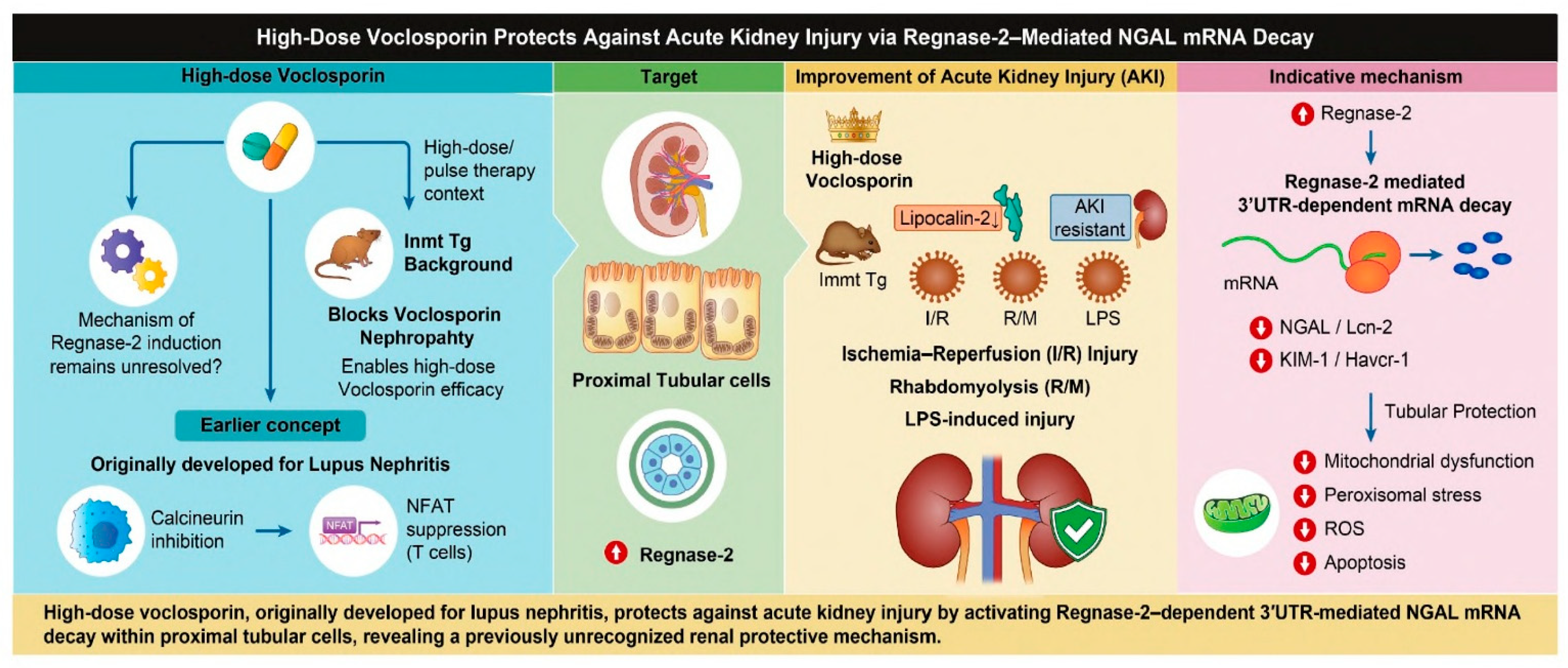
High-Dose Voclosporin Protects Against Acute Kidney Injury via Regnase-2-Mediated NGAL MRNA Decay
 , ,
, ,
Abstract
1. Introduction
2. Results
- Sham+WT+Voc (WT mice subjected to sham operation and treated with high-dose Voc)
- I/R+WT+Voc (wt mice subjected to I/R and treated with high-dose Voc)
- Sham+Tg+Voc (tg mice undergoing sham operation and treated with high-dose voc)
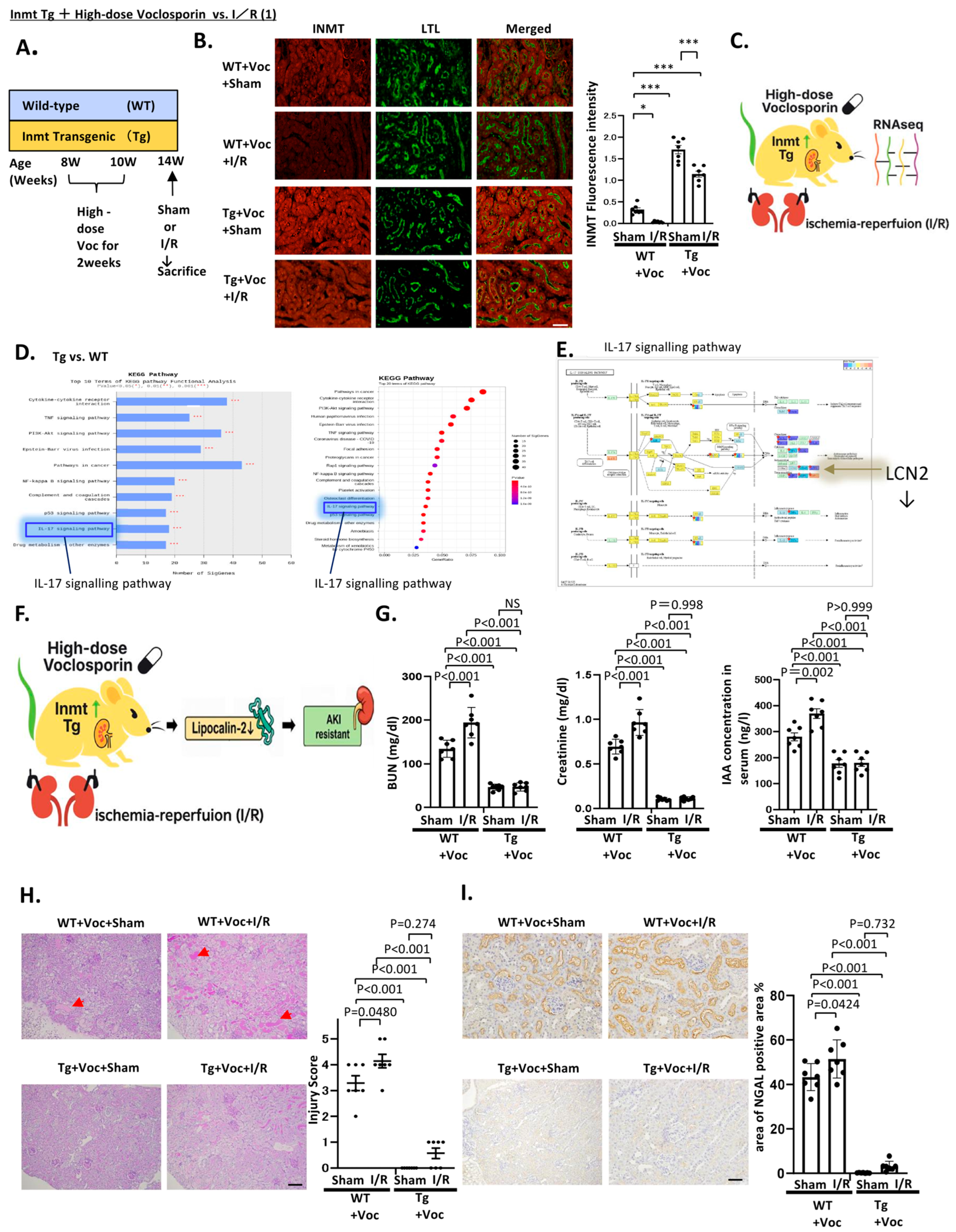
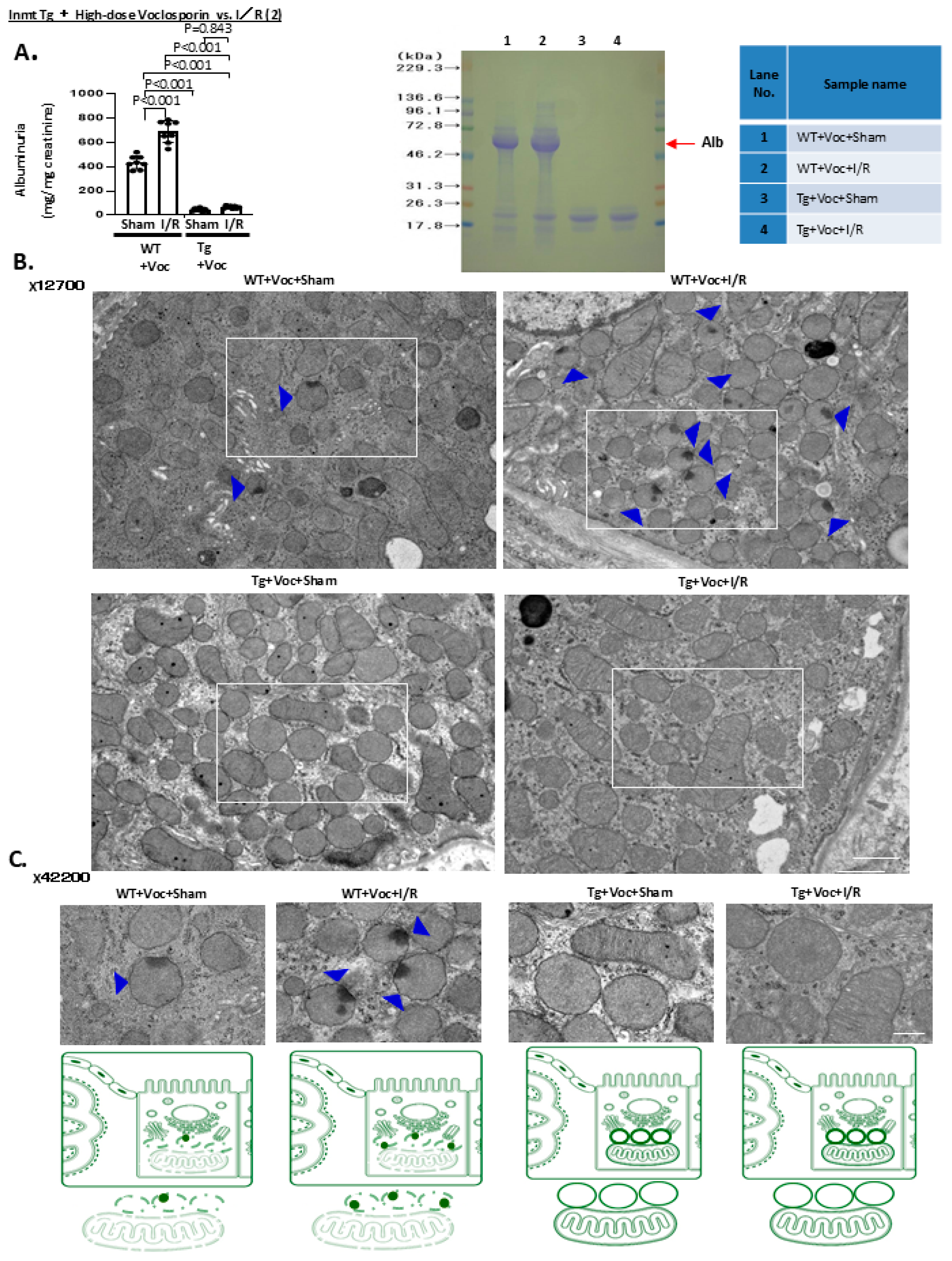
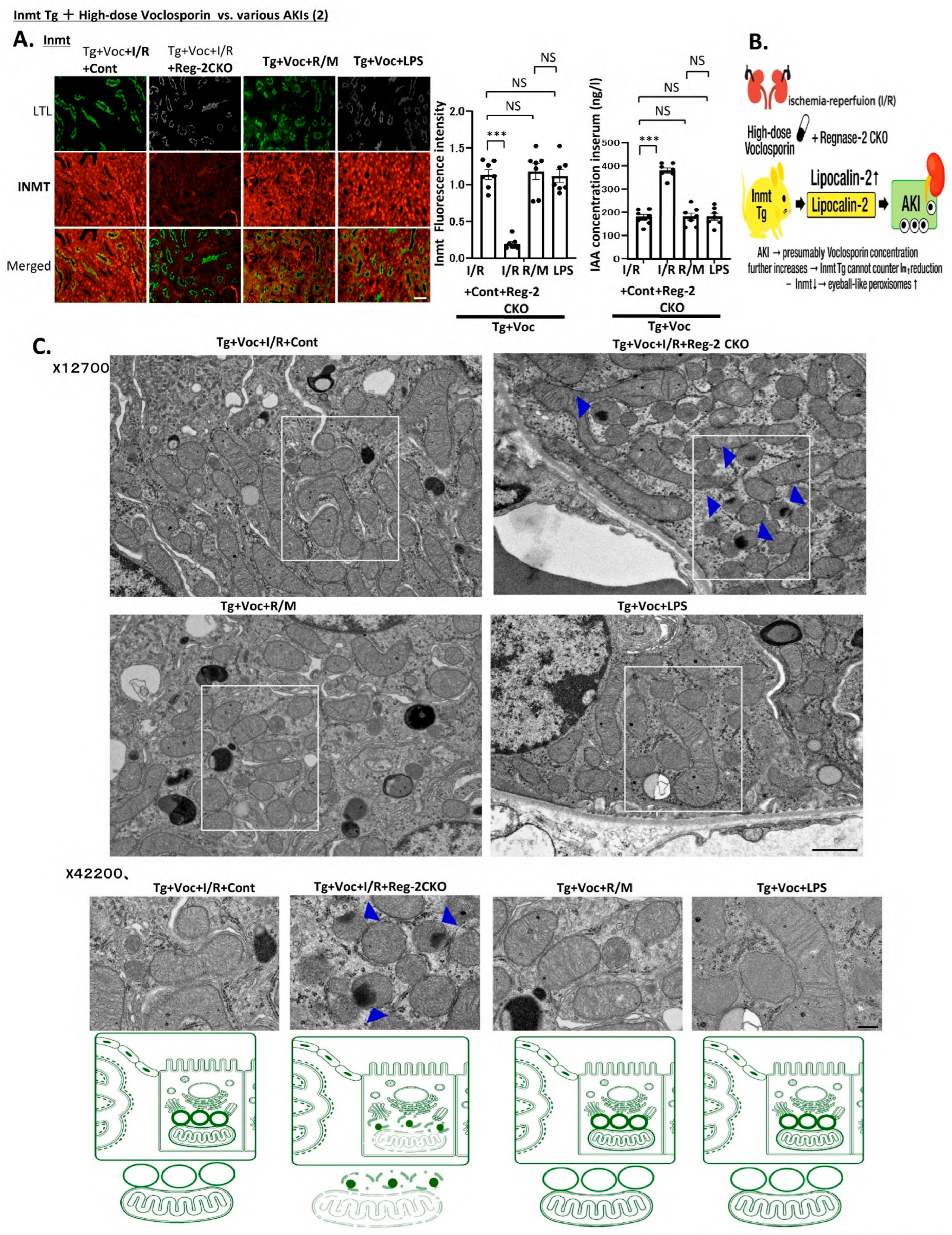
- I/R+Tg+Voc (Tg mice subjected to I/R and treated with high-dose voclosporin) Immunofluorescence staining revealed that Inmt expression further decreased in the I/R+WT+Voc group compared with that in the Sham+WT+Voc group. In contrast, Inmt expression was preserved in the Sham+Tg+Voc group and, notably, in the I/R+Tg+Voc group compared with the I/R+WT+Voc group (Figure 2B). To explore genome-wide changes beyond Inmt, bulk RNA-seq analysis of kidneys was performed in the I/R+Tg+Voc and I/R+WT+Voc groups (Figure 2C). The expression of EGF, a growth factor involved in tubular repair, and transporters, such as Slc22a22, Slc22a28, and Slc7a13, which facilitate metabolite excretion and tubular homeostasis, were upregulated together with INMT and remained relatively stable in the I/R+Tg+Voc group. Such processes were suggestive of tubular protection (Table S3). Furthermore, the I/R+Tg+Voc group exhibited markedly lower amounts of TNF- and IFN-related inflammatory cytokines, as well as tubular injury markers NGAL (encoded by Lcn2) and KIM-1 (encoded by Havcr1) (Table S4). Gene Ontology and Kyoto Encyclopedia of Genes and Genomes (KEGG) pathway analyses further confirmed the suppression of pro-inflammatory cytokines (Figure 2D). Notably, within the KEGG pathways, multiple pro-inflammatory mediators in the IL-17 signaling cascade involving NGAL were significantly downregulated in the I/R+Tg+Voc group (Figure 2E). NGAL is a well-established marker of AKI, particularly of tubular damage. However, it also exerts direct injurious influence through mitochondrial dysfunction [10] and enhanced oxidative stress in the Fenton reaction [11,12,13]. We next evaluated the degree of AKI induced in the four groups (Figure 2F). The I/R+Tg+Voc group exhibited lower serum BUN and creatinine levels (Figure 2G), less pronounced tubular injury (Figure 2H), decreased NGAL expression (Figure 2I), and diminished urinary protein excretion (Figure 3A) compared with the I/R+WT+Voc group. The findings further align with those of RNA-seq analysis, indicating that proximal tubular overexpression of Inmt suppresses the I/R-provoked reduction in Inmt expression even under high-dose Voc administration, thereby conferring tubular protection by attenuating the expression of inflammatory cytokines and injury markers. Interestingly, the I/R+WT+Voc group exhibited a substantial increase in the number of eyeball-shaped peroxisomes on electron microscopy. This phenomenon may occur because WT mice develop AKI due to Voc nephrotoxicity, and further AKI caused by I/R induces an increase in Voc concentrations, resulting in a significant reduction in Inmt expression (Figure 3B). Thus, while high-dose Voc therapy can suppress I/R-induced AKI under Inmt overexpression, it can induce both Voc nephrotoxicity and I/R-related AKI under Inmt knockout.
3. Discussion
4. Materials and Methods
- Voc-treated Inmt Tg mice with I/R versus Voc-treated wild-type (WT) mice with I/R.
- reg-2 cko mice (AAV9 shRNA) versus control shrna mice.
5. Conclusions
- We established a feasible Voc pulse therapy strategy.
- We demonstrated that high-dose Voc combined with Inmt overexpression suppresses diverse forms of acute kidney injury (AKI).
- We identified regnase-2 (reg-2) as a novel regulator of tubular injury marker expression.
Supplementary Materials
Author Contributions
Funding
Institutional Review Board Statement
Informed Consent Statement
Data Availability Statement
Acknowledgments
Conflicts of Interest
References
- Rovin, B.H.; Teng, Y.K.O.; Ginzler, E.M.; Arriens, C.; Caster, D.J.; Romero-Diaz, J.; Gibson, K.; Kaplan, J.; Lisk, L.; Navarra, S.; et al. Efficacy and safety of voclosporin versus placebo for lupus nephritis (AURORA 1): A double-blind, randomized, multicentre, placebo-controlled, phase 3 trial. Lancet 2021, 397, 2070–2080, Erratum in Lancet 2021, 398, 575. https://doi.org/10.1016/S0140-6736(21)00578-X. [Google Scholar] [CrossRef]
- Hasegawa, K.; Sakamaki, Y.; Tamaki, M.; Wakino, S. Voclosporin overdose–induced peroxisomal structural changes and AKI are prevented by renal indole detoxifier INMT. J. Am. Soc. Nephrol. 2025, 36, 2103–2119. [Google Scholar] [CrossRef]
- Hansen, C.M.; Bachmann, S.; Su, M.; Budde, K.; Choi, M. Calcineurin inhibitor–associated nephrotoxicity in kidney transplantation—A transplant nephrologist’s perspective. Acta Physiol 2025, 241, e70047. [Google Scholar] [CrossRef]
- Lasorsa, F.; Rutigliano, M.; Milella, M.; D’amati, A.; Crocetto, F.; Pandolfo, S.D.; Barone, B.; Ferro, M.; Spilotros, M.; Battaglia, M.; et al. Ischemia-reperfusion injury in kidney transplantation: Mechanisms and potential therapeutic targets. Int. J. Mol. Sci. 2024, 25, 4332. [Google Scholar] [CrossRef]
- Sciascia, S.; Yazdany, J.; Moroni, G.; Becker, J.U.; Seshan, S.V.; Andrade, D.; Emmi, G.; Cuadrado, M.J.; Radin, M.; Cecchi, I.; et al. Clinical-pathological characteristics of renal injuries identify different clusters in patients with antiphospholipid antibodies. Kidney Int. Rep. 2023, 8, 754–763. [Google Scholar] [CrossRef] [PubMed]
- Wang, J.W.; Zhu, H.; Miao, J.; Lin, W.; Han, F. Bilateral renal ischemia-reperfusion model for acute kidney injury in mice. J. Vis. Exp. 2024, 204, e65838. [Google Scholar] [CrossRef] [PubMed]
- Muratsu, J.; Sanada, F.; Koibuchi, N.; Shibata, K.; Katsuragi, N.; Ikebe, S.; Tsunetoshi, Y.; Rakugi, H.; Morishita, R.; Taniyama, Y. Blocking periostin prevented development of inflammation in rhabdomyolysis-induced acute kidney injury mice model. Cells 2022, 11, 3388. [Google Scholar] [CrossRef] [PubMed]
- Li, X.; Li, J.; Zhou, L.; Li, Y.; Wu, X.; Chen, J. MiR-760 protects against lipopolysaccharide-induced septic acute kidney injury by targeting ENKD1. Clin. Exp. Nephrol. 2025, 29, 1535–1545. [Google Scholar] [CrossRef]
- Lameire, N.H.; Levin, A.; Kellum, J.A.; Cheung, M.; Jadoul, M.; Winkelmayer, W.C.; Stevens, P.E.; Caskey, F.J.; Farmer, C.K.; Fuentes, A.F.; et al. Harmonizing acute and chronic kidney disease definition and classification: Report of a KDIGO consensus conference. Kidney Int. 2021, 100, 516–526. [Google Scholar] [CrossRef]
- Marques, E.; Teixeira, M.A.; Nguyen, C.; Terzi, F.; Gallazzini, M. Lipocalin-2 induces mitochondrial dysfunction in renal tubular cells via mTOR pathway activation. Cell Rep. 2023, 42, 113032. [Google Scholar] [CrossRef]
- Devireddy, L.R.; Gazin, C.; Zhu, X.; Green, M.R. A cell-surface receptor for lipocalin 24p3 selectively mediates apoptosis and iron delivery. Cell 2005, 123, 1293–1305. [Google Scholar] [CrossRef]
- Marques, E.; Zablocki, A.; Terzi, F.; Gallazzini, M. Effect of Lipocalin-2 expression on mitochondrial function in renal tubular cells in chronic kidney disease. FASEB J. 2022, 36, R4562. [Google Scholar] [CrossRef]
- An, H.S.; Yoo, J.-W.; Jeong, J.H.; Heo, M.; Hwang, S.H.; Jang, H.M.; Jeong, E.A.; Lee, J.; Shin, H.J.; Kim, K.E.; et al. Lipocalin-2 promotes acute lung inflammation and oxidative stress by enhancing macrophage iron accumulation. Int. J. Biol. Sci. 2023, 19, 1163–1177. [Google Scholar] [CrossRef]
- Mao, R.; Yang, R.; Chen, X.; Harhaj, E.W.; Wang, X.; Fan, Y. Regnase-1, a rapid response ribonuclease regulating inflammation and stress responses. Cell Mol. Immunol. 2017, 14, 412–422. [Google Scholar] [CrossRef]
- Mino, T.; Takeuchi, O. Post-transcriptional regulation of immune responses by RNA binding proteins. Proc. Jpn. Acad. Ser. B Phys. Biol. Sci. 2018, 94, 211–229. [Google Scholar] [CrossRef]
- Mino, T.; Murakawa, Y.; Fukao, A.; Vandenbon, A.; Wessels, H.-H.; Ori, D.; Uehata, T.; Tartey, S.; Akira, S.; Suzuki, Y.; et al. Regnase-1 and Roquin regulate a common element in inflammatory mRNAs by spatiotemporally distinct mechanisms. Cell 2015, 161, 1058–1073. [Google Scholar] [CrossRef]
- Xu, M.; Xu, S.; Yi, X. A comparative analysis of drug-induced kidney injury adverse reactions between cyclosporine and tacrolimus based on the FAERS database. BMC Immunol. 2025, 25, 7. [Google Scholar] [CrossRef]
- Singh, P. Novel role of tryptophan metabolic pathway in mediating peroxisomal dysfunction in high-dose voclosporin-induced acute kidney injury. J. Am. Soc. Nephrol. 2025, 36, 2089–2091. [Google Scholar] [CrossRef] [PubMed]
- Wu, Z.; Yu, B.; He, Q.; Huang, C. LCN2 drives ferroptosis-associated ischemia-reperfusion injury after renal transplantation: Integrated machine learning and in vivo validation. Apoptosis 2025, 30, 3026–3043. [Google Scholar] [CrossRef] [PubMed]
- Sowinska, W.; Wawro, M.; Biswas, D.D.; Kochan, J.; Pustelny, K.; Solecka, A.; Gupta, A.S.; Mockenhaupt, K.; Polak, J.; Kwinta, B.; et al. The homeostatic function of Regnase-2 restricts neuroinflammation. FASEB J. 2023, 37, e202201978R. [Google Scholar] [CrossRef] [PubMed]
- Fischer, M.; Weinberger, T.; Schulz, C. The immunomodulatory role of Regnase family RNA-binding proteins. RNA Biol. 2020, 17, 1721–1726. [Google Scholar] [CrossRef]
- Ai, X.; Jia, W.; Wang, J.; Wu, B.; Hu, C.; Chen, Q.; Kong, L. Macrophage Regnase-1 deletion deteriorates liver ischemia/reperfusion injury through regulation of macrophage polarization. Front. Physiol. 2020, 11, 582347. [Google Scholar] [CrossRef]
- Ribeiro, A.; Dobosz, E.; Krill, M.; Köhler, P.; Wadowska, M.; Steiger, S.; Schmaderer, C.; Koziel, J.; Lech, M. Macrophage-specific MCPIP1/Regnase-1 attenuates kidney ischemia-reperfusion injury by shaping the local inflammatory response and tissue regeneration. Cells 2022, 11, 397. [Google Scholar] [CrossRef]
- Ligeza, J.; Marona, P.; Gach, N.; Lipert, B.; Miekus, K.; Wilk, W.; Jaszczynski, J.; Stelmach, A.; Loboda, A.; Dulak, J.; et al. MCPIP1 contributes to clear cell renal cell carcinomas development. Angiogenesis 2017, 20, 325–340. [Google Scholar] [CrossRef]
- Virzì, G.M.; Morisi, N.; Paulo, C.O.; Clementi, A.; Ronco, C.; Zanella, M. Neutrophil gelatinase-associated lipocalin: Biological aspects and potential diagnostic use in acute kidney injury. J. Clin. Med. 2025, 14, 1570. [Google Scholar] [CrossRef]
- Su, Y.; Yang, X.; Cheng, W.-W.; Shang, X.-M.; Wang, H.-L.; Shen, H.-C. Kidney injury molecule 1 in the early detection of acute kidney injury—A systematic review and meta-analysis. Front. Med. 2025, 12, 1574945. [Google Scholar] [CrossRef]
- Yang, L.; Brooks, C.R.; Xiao, S.; Sabbisetti, V.; Yeung, M.Y.; Hsiao, L.-L.; Ichimura, T.; Kuchroo, V.; Bonventre, J.V. KIM-1-mediated phagocytosis reduces acute injury to the kidney. J. Clin. Investig. 2015, 125, 1620–1636. [Google Scholar] [CrossRef]
- Humphreys, B.D.; Xu, F.; Sabbisetti, V.; Grgic, I.; Naini, S.M.; Wang, N.; Chen, G.; Xiao, S.; Patel, D.; Henderson, J.M.; et al. Chronic epithelial kidney injury molecule-1 expression causes murine proximal tubule injury and interstitial fibrosis. J. Clin. Investig. 2013, 123, 4023–4035. [Google Scholar] [CrossRef] [PubMed]
- Grgic, I.; Campanholle, G.; Bijol, V.; Wang, C.; Sabbisetti, V.S.; Ichimura, T.; Humphreys, B.D.; Bonventre, J.V. Targeted proximal tubule injury triggers interstitial fibrosis and glomerulosclerosis. Kidney Int. 2012, 82, 172–183. [Google Scholar] [CrossRef] [PubMed]
- Tian, L.; Shao, X.; Xie, Y.; Wang, Q.; Che, X.; Zhang, M.; Xu, W.; Xu, Y.; Mou, S.; Ni, Z. Kidney injury molecule-1 is elevated in nephropathy and mediates macrophage activation via the MAPK signalling pathway. Cell. Physiol. Biochem. 2017, 41, 769–783. [Google Scholar] [CrossRef]
- Chen, J.; Tang, T.T.; Cao, J.Y.; Li, Z.-L.; Zhong, X.; Wen, Y.; Shen, A.-R.; Liu, B.-C.; Lv, L.-L. KIM-1 augments hypoxia-induced tubulointerstitial inflammation through uptake of small extracellular vesicles by tubular epithelial cells. Mol. Ther. 2023, 31, 1437–1450. [Google Scholar] [CrossRef]
- Mori, Y.; Ajay, A.K.; Chang, J.H.; Mou, S.; Zhao, H.; Kishi, S.; Li, J.; Brooks, C.R.; Xiao, S.; Woo, H.-M.; et al. KIM-1 mediates fatty acid uptake by renal tubular cells to promote progressive diabetic kidney disease. Cell Metab. 2021, 33, 1042–1061.e7. [Google Scholar] [CrossRef]
- Karolin, A.; Escher, G.; Rudloff, S.; Sidler, D. Nephrotoxicity of calcineurin inhibitors in kidney epithelial cells is independent of NFAT signaling. Front. Pharmacol. 2021, 12, 789080. [Google Scholar] [CrossRef]
- Nicholson, M.L.; Hosgood, S.A. Ischemia and reperfusion injury in kidney transplantation. Kidney Int. 2019, 95, 50–56. [Google Scholar] [CrossRef]
- Zhao, H.; Alam, A.; Soo, A.P.; George, A.J.T.; Ma, D. Ischemia–Reperfusion Injury Reduces Long-Term Renal Graft Survival: Mechanism and Beyond. EBioMedicine 2018, 28, 31–42. [Google Scholar] [CrossRef] [PubMed]
- van Duin, R.; Steenvoorden, T.; Vogt, L.; van der Heijden, J.; Rood, J. Alkaline phosphatase to prevent ischemia reperfusion injury in living kidney transplantation—A safety pilot study. Nephrol. Dial. Transplant. 2022, 37, gfac088.022. [Google Scholar] [CrossRef]
- Fan, H.; Liu, J.; Sun, J.; Feng, G.; Li, J. Advances in the study of B cells in renal ischemia-reperfusion injury. Front. Immunol. 2023, 14, 1216094. [Google Scholar] [CrossRef]
- Rivet, V.; Joseph, A.; Arrestier, R.; Calvet, L.; Moreau, A.-S.; Bureau, C.; Argaud, L.; Gabarre, P.; Zuber, B.; Raphalen, J.-H.; et al. Immunosuppressive therapy management during sepsis in kidney transplant recipients: A prospective multicenter study. Ann. Intensive Care 2025, 15, 523. [Google Scholar] [CrossRef]
- Kim, H.D.; Chung, B.H.; Yang, C.W.; Kim, S.C.; Kim, K.H.; Kim, S.Y.; Kim, K.Y.; Lee, J. Management of immunosuppressive therapy in kidney transplant recipients with sepsis: A multicenter retrospective study. Transpl. Proc. 2024, 56, 45–53. [Google Scholar] [CrossRef] [PubMed]
- Królicki, T.; Bardowska, K.; Kudla, T.; Królicka, A.; Letachowicz, K.; Mazanowska, O.; Krajewski, W.; Poznański, P.; Krajewska, M.; Kamińska, D. Acute kidney injury secondary to urinary tract infection in kidney transplant recipients. Sci. Rep. 2022, 12, 15035. [Google Scholar] [CrossRef]
- Sato, B.; Mota, L.C.; Souto, J.G.; Soares, J.G.; Peruzzo, M.B.; Foresto, R.D.; Tedesco-Silva, H.; Medina-Pestana, J.; Requião-Moura, L. Sepsis-Associated Acute Kidney Injury in Kidney Transplant Recipients in Intensive Care Unit. Clin. Transplant. 2025, 39, e70218. [Google Scholar] [CrossRef]
- Kotanko, P.; Kirisits, W.; Skrabal, F. Rhabdomyolysis and acute renal graft impairment in a patient treated with simvastatin, tacrolimus, and fusidic acid. Nephron 2002, 90, 234–235. [Google Scholar] [CrossRef]
- Patel, D.N.; Pagani, F.D.; Koelling, T.M.; Dyke, D.B.; Baliga, R.R.; Cody, R.J.; Lake, K.D.; Aaronson, K.D. Safety and efficacy of atorvastatin in heart transplant recipients. J. Heart Lung Transplant. 2002, 21, 204–210. [Google Scholar] [CrossRef]
- Gao, C.; Chen, Z.Y.; Ma, L.; Gou, S.J. A liver transplant patient developed renal injury on tacrolimus and experienced worsening renal function and rhabdomyolysis after switching to sirolimus: A case report. BMC Nephrol. 2024, 25, 38. [Google Scholar] [CrossRef]
- Nonouchi, Y.; Matsugi, K.; Ito, H.; Ohashi, N.; Hashino, T.; Hamaguchi, Y. Rhabdomyolysis and acute kidney injury attributable to statin and immunosuppressant drug-drug interaction: A case report. J. Jpn. Soc. Emerg. Med. 2023, 26, 46–50. [Google Scholar] [CrossRef]
- Kanehisa, M.; Sato, Y.; Kawashima, M.; Furumichi, M.; Tanabe, M. KEGG as a reference resource for gene and protein annotation. Nucleic Acids Res. 2016, 44, D457–D462. [Google Scholar] [CrossRef]
- Kanehisa, M.; Goto, S. KEGG: Kyoto Encyclopedia of Genes and Genomes. Nucleic Acids Res. 2000, 28, 27–30. [Google Scholar] [CrossRef] [PubMed]
- Schimmelpfennig, J.; Jankowiak-Siuda, K. Exploring DMT: Endogenous role and therapeutic potential. Neuropharmacology 2025, 268, 110314. [Google Scholar] [CrossRef] [PubMed]
- Zhong, S.; Jeong, J.H.; Huang, C.; Chen, X.; Dickinson, S.I.; Dhillon, J.; Yang, L.; Luo, J.L. Targeting INMT and interrupting its methylation pathway for the treatment of castration-resistant prostate cancer. J. Exp. Clin. Cancer Res. 2021, 40, 307. [Google Scholar] [CrossRef] [PubMed]
- Furusho, T.; Das, R.; Hakui, H.; Sairavi, A.; Adachi, K.; Galbraith-Liss, M.S.; Rajagopal, P.; Horikawa, M.; Luo, S.; Li, L.; et al. Enhancing gene transfer to renal tubules and podocytes by context-dependent selection of AAV capsids. Nat. Commun. 2024, 15, 10728. [Google Scholar] [CrossRef] [PubMed]
- Lorenz, R.; Bernhart, S.H.; Höner Zu Siederdissen, C.; Tafer, H.; Flamm, C.; Stadler, P.F.; Hofacker, I.L. ViennaRNA Package 2.0. Algorithms Mol. Biol. 2011, 6, 26. [Google Scholar] [CrossRef] [PubMed]
- Hofacker, I.L.; Stadler, P.F. Memory efficient folding algorithms for circular RNA secondary structures. Bioinformatics 2006, 22, 1172–1176. [Google Scholar] [CrossRef] [PubMed]
- Hasegawa, K.; Sakamaki, Y.; Tamaki, M.; Wakino, S. PCK1 Protects against Mitoribosomal Defects in Diabetic Nephropathy in Mouse Models. J. Am. Soc. Nephrol. 2023, 34, 1343–1365. [Google Scholar] [CrossRef] [PubMed]
- Yasuda, I.; Hasegawa, K.; Sakamaki, Y.; Muraoka, H.; Kawaguchi, T.; Kusahana, E.; Ono, T.; Kanda, T.; Tokuyama, H.; Wakino, S.; et al. Pre-emptive Short-term Nicotinamide Mononucleotide Treatment in a Mouse Model of Diabetic Nephropathy. J. Am. Soc. Nephrol. 2021, 32, 1355–1370. [Google Scholar] [CrossRef] [PubMed]
- Hasegawa, K.; Wakino, S.; Simic, P.; Sakamaki, Y.; Minakuchi, H.; Fujimura, K.; Hosoya, K.; Komatsu, M.; Kaneko, Y.; Kanda, T.; et al. Renal tubular Sirt1 attenuates diabetic albuminuria by epigenetically suppressing Claudin-1 overexpression in podocytes. Nat. Med. 2013, 19, 1496–1504. [Google Scholar] [CrossRef] [PubMed]
- Sowinska, W.; Wawro, M.; Kochan, J.; Solecka, A.; Polak, J.; Kwinta, B.; Kasza, A. Regnase-2 inhibits glioblastoma cell proliferation. Sci. Rep. 2024, 14, 1574. [Google Scholar] [CrossRef] [PubMed]
- Wawro, M.; Wawro, K.; Kochan, J.; Solecka, A.; Sowinska, W.; Lichawska-Cieslar, A.; Jura, J.; Kasza, A. ZC3H12B/MCPIP2, a new active member of the ZC3H12 family. RNA 2019, 25, 840–856. [Google Scholar] [CrossRef] [PubMed]


Disclaimer/Publisher’s Note: The statements, opinions and data contained in all publications are solely those of the individual author(s) and contributor(s) and not of MDPI and/or the editor(s). MDPI and/or the editor(s) disclaim responsibility for any injury to people or property resulting from any ideas, methods, instructions or products referred to in the content. |
© 2026 by the authors. Licensee MDPI, Basel, Switzerland. This article is an open access article distributed under the terms and conditions of the Creative Commons Attribution (CC BY) license.
Share and Cite
Hasegawa, K.; Sakamaki, Y.; Tamaki, M.; Yamaguchi, S.; Miyakami, S.; Okinari, C.; Tada, M.; Otsuka, M.; Minato, M.; Wakino, S. High-Dose Voclosporin Protects Against Acute Kidney Injury via Regnase-2-Mediated NGAL MRNA Decay. Int. J. Mol. Sci. 2026, 27, 3150. https://doi.org/10.3390/ijms27073150
Hasegawa K, Sakamaki Y, Tamaki M, Yamaguchi S, Miyakami S, Okinari C, Tada M, Otsuka M, Minato M, Wakino S. High-Dose Voclosporin Protects Against Acute Kidney Injury via Regnase-2-Mediated NGAL MRNA Decay. International Journal of Molecular Sciences. 2026; 27(7):3150. https://doi.org/10.3390/ijms27073150
Chicago/Turabian StyleHasegawa, Kazuhiro, Yusuke Sakamaki, Masanori Tamaki, Sumiyo Yamaguchi, Shinji Miyakami, Chihiro Okinari, Miho Tada, Makoto Otsuka, Masanori Minato, and Shu Wakino. 2026. "High-Dose Voclosporin Protects Against Acute Kidney Injury via Regnase-2-Mediated NGAL MRNA Decay" International Journal of Molecular Sciences 27, no. 7: 3150. https://doi.org/10.3390/ijms27073150
APA StyleHasegawa, K., Sakamaki, Y., Tamaki, M., Yamaguchi, S., Miyakami, S., Okinari, C., Tada, M., Otsuka, M., Minato, M., & Wakino, S. (2026). High-Dose Voclosporin Protects Against Acute Kidney Injury via Regnase-2-Mediated NGAL MRNA Decay. International Journal of Molecular Sciences, 27(7), 3150. https://doi.org/10.3390/ijms27073150