Impact of Maternal Lifetime Stress on Offspring Biological Aging: A Systematic Review and Meta-Analysis of Observational Studies

 , ,
, ,  , , , , and
Abstract
1. Introduction
2. Methods
2.1. Protocol Registration
2.2. Information Sources and Search Strategy
2.2.1. Inclusion Criteria
2.2.2. Exclusion Criteria
2.3. Definition of Outcomes
2.4. Selection Process
2.5. Data Extraction and Data Items
2.6. Quality Assessment Process
2.7. Meta-Analysis
3. Results and Discussion
3.1. Baseline Characteristics of the Included Studies
3.2. Results of the Studies Included in the Systematic Review
Relation Between Maternal Lifetime Stress and Offspring TL and DNAm
3.3. Quality Assessment Findings
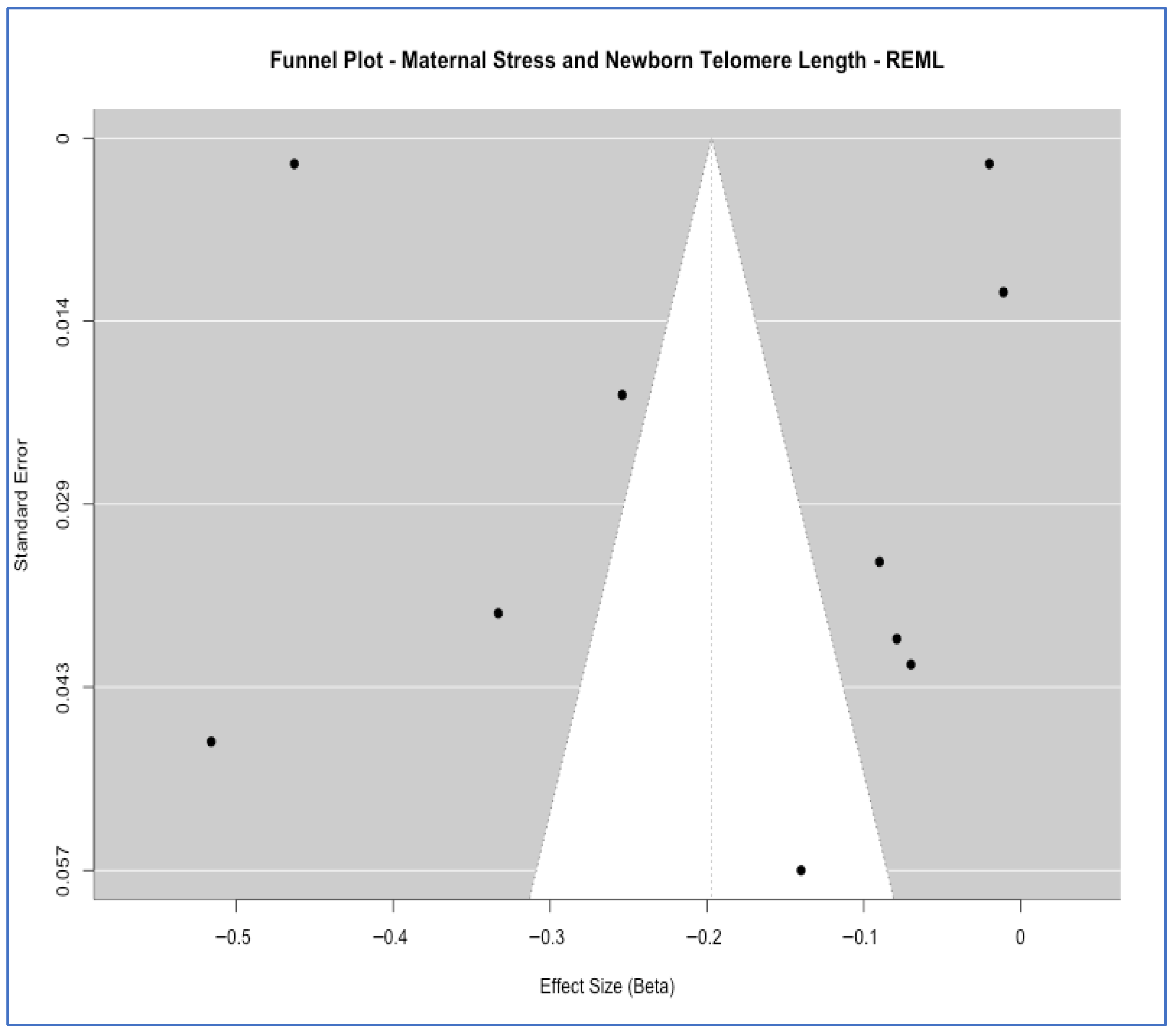
3.4. Results of the Meta-Analysis
3.5. Discussion
3.6. Strengths and Limitations
3.7. Clinical Implications and Future Research Directions
4. Conclusions
Supplementary Materials
Author Contributions
Funding
Data Availability Statement
Acknowledgments
Conflicts of Interest
References
- Bale, T.L.; Baram, T.Z.; Brown, A.S.; Goldstein, J.M.; Insel, T.R.; McCarthy, M.M.; Nemeroff, C.B.; Reyes, T.M.; Simerly, R.B.; Susser, E.S.; et al. Early life programming and neurodevelopmental disorders. Biol. Psychiatry 2010, 68, 314–319. [Google Scholar] [CrossRef] [Scilit]
- Doi, M.; Usui, N.; Shimada, S. Prenatal Environment and Neurodevelopmental Disorders. Front. Endocrinol. 2022, 13, 860110. [Google Scholar] [CrossRef] [Scilit]
- Chen, T.; Liu, H.; Yan, H.; Wu, D.; Ping, J. Developmental origins of inflammatory and immune diseases. Mol. Hum. Reprod. 2016, 22, 858–865. [Google Scholar] [CrossRef] [Scilit]
- Barker, D.J.P. The origins of the developmental origins theory. J. Intern. Med. 2007, 261, 412–417. [Google Scholar] [CrossRef] [Scilit] [PubMed]
- Entringer, S.; Buss, C.; Wadhwa, P.D. Prenatal stress, development, health and disease risk: A psychobiological perspective—2015 Curt Richter Award Paper. Psychoneuroendocrinology 2015, 62, 366–375. [Google Scholar] [CrossRef] [Scilit] [PubMed]
- Yin, J.; Li, T.; Yu, Z.; Yu, L.; Bian, L.; Xiang, B.; Gu, X. Synergistic effects of female-specific conditions and genetic risk on cardiometabolic disease: A cohort study. Heart 2025, 111, 910–917. [Google Scholar] [CrossRef] [Scilit]
- Gunnar, M.; Quevedo, K. The Neurobiology of Stress and Development. Annu. Rev. Psychol. 2007, 58, 145–173. [Google Scholar] [CrossRef] [Scilit]
- McEwen, B.S. Protective and damaging effects of stress mediators: Central role of the brain. Dialogues Clin. Neurosci. 2006, 8, 367–381. [Google Scholar] [CrossRef] [Scilit]
- Bale, T.L. Lifetime stress experience: Transgenerational epigenetics and germ cell programming. Dialogues Clin. Neurosci. 2014, 16, 297–305. [Google Scholar] [CrossRef] [Scilit] [PubMed]
- Fleming, T.P.; Watkins, A.J.; Velazquez, M.A.; Mathers, J.C.; Prentice, A.M.; Stephenson, J.; Barker, M.; Saffery, R.; Yajnik, C.S.; Eckert, J.J.; et al. Origins of lifetime health around the time of conception: Causes and consequences. Lancet 2018, 391, 1842–1852. [Google Scholar] [CrossRef] [Scilit]
- Gialluisi, A.; Di Castelnuovo, A.; Costanzo, S.; Bonaccio, M.; Persichillo, M.; Magnacca, S.; De Curtis, A.; Cerletti, C.; Donati, M.B.; De Gaetano, G.; et al. Exploring domains, clinical implications and environmental associations of a deep learning marker of biological ageing. Eur. J. Epidemiol. 2022, 37, 35–48. [Google Scholar] [CrossRef] [Scilit]
- Johnson, A.A.; English, B.W.; Shokhirev, M.N.; Sinclair, D.A.; Cuellar, T.L. Human age reversal: Fact or fiction? Aging Cell 2022, 21, e13664. [Google Scholar] [CrossRef] [Scilit]
- Oblak, L.; Van Der Zaag, J.; Higgins-Chen, A.T.; Levine, M.E.; Boks, M.P. A systematic review of biological, social and environmental factors associated with epigenetic clock acceleration. Ageing Res. Rev. 2021, 69, 101348. [Google Scholar] [CrossRef] [Scilit]
- Pearce, E.E.; Alsaggaf, R.; Katta, S.; Dagnall, C.; Aubert, G.; Hicks, B.D.; Spellman, S.R.; Savage, S.A.; Horvath, S.; Gadalla, S.M. Telomere length and epigenetic clocks as markers of cellular aging: A comparative study. GeroScience 2022, 44, 1861–1869. [Google Scholar] [CrossRef] [Scilit] [PubMed]
- Vaiserman, A.; Krasnienkov, D. Telomere Length as a Marker of Biological Age: State-of-the-Art, Open Issues, and Future Perspectives. Front. Genet. 2021, 11, 630186. [Google Scholar] [CrossRef] [Scilit] [PubMed]
- Diebel, L.W.M.; Rockwood, K. Determination of Biological Age: Geriatric Assessment vs Biological Biomarkers. Curr. Oncol. Rep. 2021, 23, 104. [Google Scholar] [CrossRef] [Scilit]
- Jylhävä, J.; Pedersen, N.L.; Hägg, S. Biological Age Predictors. eBioMedicine 2017, 21, 29–36. [Google Scholar] [CrossRef] [Scilit]
- Aviv, A. Genetics of leukocyte telomere length and its role in atherosclerosis. Mutat. Res. Mol. Mech. Mutagen. 2012, 730, 68–74. [Google Scholar] [CrossRef] [Scilit]
- Coussons-Read, M.E. Effects of prenatal stress on pregnancy and human development: Mechanisms and pathways. Obstet. Med. 2013, 6, 52–57. [Google Scholar] [CrossRef] [Scilit]
- Entringer, S.; Epel, E.S.; Lin, J.; Buss, C.; Shahbaba, B.; Blackburn, E.H.; Simhan, H.N.; Wadhwa, P.D. Maternal psychosocial stress during pregnancy is associated with newborn leukocyte telomere length. Am. J. Obstet. Gynecol. 2013, 208, 134.e1–134.e7. [Google Scholar] [CrossRef] [Scilit] [PubMed]
- Polsky, L.R.; Rentscher, K.E.; Carroll, J.E. Stress-induced biological aging: A review and guide for research priorities. Brain Behav. Immun. 2022, 104, 97–109. [Google Scholar] [CrossRef] [Scilit]
- Alves, A.C.; Cecatti, J.G.; Souza, R.T. Resilience and Stress during Pregnancy: A Comprehensive Multidimensional Approach in Maternal and Perinatal Health. Sci. World J. 2021, 2021, 9512854. [Google Scholar] [CrossRef] [Scilit]
- Van Den Bergh, B.R.H.; Van Den Heuvel, M.I.; Lahti, M.; Braeken, M.; De Rooij, S.R.; Entringer, S.; Hoyer, D.; Roseboom, T.; Räikkönen, K.; King, S.; et al. Prenatal developmental origins of behavior and mental health: The influence of maternal stress in pregnancy. Neurosci. Biobehav. Rev. 2020, 117, 26–64. [Google Scholar] [CrossRef] [Scilit]
- Anifantaki, F.; Pervanidou, P.; Lambrinoudaki, I.; Panoulis, K.; Vlahos, N.; Eleftheriades, M. Maternal Prenatal Stress, Thyroid Function and Neurodevelopment of the Offspring: A Mini Review of the Literature. Front. Neurosci. 2021, 15, 692446. [Google Scholar] [CrossRef] [Scilit] [PubMed]
- Caparros-Gonzalez, R.A.; Lynn, F.; Alderdice, F.; Peralta-Ramirez, M.I. Cortisol levels versus self-report stress measures during pregnancy as predictors of adverse infant outcomes: A systematic review. Stress 2022, 25, 189–212. [Google Scholar] [CrossRef] [Scilit] [PubMed]
- Lewis, A.; Austin, E.; Knapp, R.; Vaiano, T.; Galbally, M. Perinatal Maternal Mental Health, Fetal Programming and Child Development. Healthcare 2015, 3, 1212–1227. [Google Scholar] [CrossRef] [Scilit] [PubMed]
- Vehmeijer, F.O.L.; Guxens, M.; Duijts, L.; El Marroun, H. Maternal psychological distress during pregnancy and childhood health outcomes: A narrative review. J. Dev. Orig. Health Dis. 2019, 10, 274–285. [Google Scholar] [CrossRef] [Scilit]
- Enlow, M.B.; Sideridis, G.; Bollati, V.; Hoxha, M.; Hacker, M.R.; Wright, R.J. Maternal cortisol output in pregnancy and newborn telomere length: Evidence for sex-specific effects. Psychoneuroendocrinology 2019, 102, 225–235. [Google Scholar] [CrossRef] [Scilit]
- McGill, M.G.; Pokhvisneva, I.; Clappison, A.S.; McEwen, L.M.; Beijers, R.; Tollenaar, M.S.; Pham, H.; Kee, M.Z.L.; Garg, E.; Filho, E.J.D.M.; et al. Maternal Prenatal Anxiety and the Fetal Origins of Epigenetic Aging. Biol. Psychiatry 2022, 91, 303–312. [Google Scholar] [CrossRef] [Scilit]
- Slykerman, R.F.; Joglekar, M.V.; Hardikar, A.A.; Satoor, S.N.; Thompson, J.M.D.; Jenkins, A.; Mitchell, E.A.; Murphy, R. Maternal stress during pregnancy and small for gestational age birthweight are not associated with telomere length at 11 years of age. Gene 2019, 694, 97–101. [Google Scholar] [CrossRef] [Scilit]
- Quinn, E.B.; Hsiao, C.J.; Maisha, F.M.; Mulligan, C.J. Prenatal maternal stress is associated with site-specific and age acceleration changes in maternal and newborn DNA methylation. Epigenetics 2023, 18, 2222473. [Google Scholar] [CrossRef] [Scilit]
- Katrinli, S.; Smith, A.K.; Drury, S.S.; Covault, J.; Ford, J.D.; Singh, V.; Reese, B.; Johnson, A.; Scranton, V.; Fall, P.; et al. Cumulative stress, PTSD, and emotion dysregulation during pregnancy and epigenetic age acceleration in Hispanic mothers and their newborn infants. Epigenetics 2023, 18, 2231722. [Google Scholar] [CrossRef] [Scilit]
- Koen, N.; Jones, M.J.; Nhapi, R.T.; Lake, M.T.; Donald, K.A.; Barnett, W.; Hoffman, N.; MacIsaac, J.L.; Morin, A.M.; Lin, D.T.S.; et al. Maternal psychosocial risk factors and child gestational epigenetic age in a South African birth cohort study. Transl. Psychiatry 2021, 11, 358. [Google Scholar] [CrossRef] [Scilit]
- Hogue, C.J.R.; Hoffman, S.; Hatch, M.C. Stress and preterm delivery: A conceptual framework. Paediatr. Perinat. Epidemiol. 2001, 15, 30–40. [Google Scholar] [CrossRef] [Scilit] [PubMed]
- Schetter, C.D. Psychological Science on Pregnancy: Stress Processes, Biopsychosocial Models, and Emerging Research Issues. Annu. Rev. Psychol. 2011, 62, 531–558. [Google Scholar] [CrossRef] [Scilit] [PubMed]
- Page, M.J.; McKenzie, J.E.; Bossuyt, P.M.; Boutron, I.; Hoffmann, T.C.; Mulrow, C.D.; Shamseer, L.; Tetzlaff, J.M.; Akl, E.A.; Brennan, S.E.; et al. The PRISMA 2020 statement: An updated guideline for reporting systematic reviews. BMJ 2021, 372, n71. [Google Scholar] [CrossRef] [Scilit]
- Ouzzani, M.; Hammady, H.; Fedorowicz, Z.; Elmagarmid, A. Rayyan—A web and mobile app for systematic reviews. Syst. Rev. 2016, 5, 210. [Google Scholar] [CrossRef] [Scilit] [PubMed]
- Montpetit, A.J.; Alhareeri, A.A.; Montpetit, M.; Starkweather, A.R.; Elmore, L.W.; Filler, K.; Mohanraj, L.; Burton, C.W.; Menzies, V.S.; Lyon, D.E.; et al. Telomere Length: A Review of Methods for Measurement. Nurs. Res. 2014, 63, 289–299. [Google Scholar] [CrossRef] [Scilit]
- Duan, R.; Fu, Q.; Sun, Y.; Li, Q. Epigenetic clock: A promising biomarker and practical tool in aging. Ageing Res. Rev. 2022, 81, 101743. [Google Scholar] [CrossRef]
- Guevara, E.E.; Lawler, R.R. Epigenetic Clocks. Evol. Anthropol. Issues News Rev. 2018, 27, 256–260. [Google Scholar] [CrossRef] [Scilit]
- Ryan, C.P. “Epigenetic clocks”: Theory and applications in human biology. Am. J. Hum. Biol. 2021, 33, e23488. [Google Scholar] [CrossRef] [Scilit]
- Chen, L.; Tan, K.M.L.; Gong, M.; Chong, M.F.F.; Tan, K.H.; Chong, Y.S.; Meaney, M.J.; Gluckman, P.D.; Eriksson, J.G.; Karnani, N. Variability in newborn telomere length is explained by inheritance and intrauterine environment. BMC Med. 2022, 20, 20. [Google Scholar] [CrossRef] [Scilit]
- Stout-Oswald, S.A.; Glynn, L.M.; Bisoffi, M.; Demers, C.H.; Davis, E.P. Prenatal exposure to maternal psychological distress and telomere length in childhood. Dev. Psychobiol. 2022, 64, e22238. [Google Scholar] [CrossRef] [Scilit]
- Esteves, K.C.; Jones, C.W.; Wade, M.; Callerame, K.; Smith, A.K.; Theall, K.P.; Drury, S.S. Adverse Childhood Experiences: Implications for Offspring Telomere Length and Psychopathology. Am. J. Psychiatry 2020, 177, 47–57. [Google Scholar] [CrossRef] [Scilit] [PubMed]
- Mayer, S.E.; Guan, J.; Lin, J.; Hamlat, E.; Parker, J.E.; Brownell, K.; Price, C.; Mujahid, M.; Tomiyama, A.J.; Slavich, G.M.; et al. Intergenerational effects of maternal lifetime stressor exposure on offspring telomere length in Black and White women. Psychol. Med. 2023, 53, 6171–6182. [Google Scholar] [CrossRef] [Scilit] [PubMed]
- Carroll, J.E.; Mahrer, N.E.; Shalowitz, M.; Ramey, S.; Schetter, C.D. Prenatal maternal stress prospectively relates to shorter child buccal cell telomere length. Psychoneuroendocrinology 2020, 121, 104841. [Google Scholar] [CrossRef] [Scilit] [PubMed]
- Dye, C.K.; Wu, H.; Monk, C.; Belsky, D.W.; Alschuler, D.; Lee, S.; O’Donnell, K.; Scorza, P. Mother’s childhood adversity is associated with accelerated epigenetic aging in pregnancy and in male newborns. bioRxiv 2023. [Google Scholar] [CrossRef] [Scilit]
- Ämmälä, A.-J.; Vitikainen, E.I.K.; Hovatta, I.; Paavonen, J.; Saarenpää-Heikkilä, O.; Kylliäinen, A.; Pölkki, P.; Porkka-Heiskanen, T.; Paunio, T. Maternal stress or sleep during pregnancy are not reflected on telomere length of newborns. Sci. Rep. 2020, 10, 13986. [Google Scholar] [CrossRef] [Scilit] [PubMed]
- Izano, M.A.; Cushing, L.J.; Lin, J.; Eick, S.M.; Goin, D.E.; Epel, E.; Woodruff, T.J.; Morello-Frosch, R. The association of maternal psychosocial stress with newborn telomere length. PLoS ONE 2020, 15, e0242064. [Google Scholar] [CrossRef] [Scilit]
- Marchetto, N.M.; Glynn, R.A.; Ferry, M.L.; Ostojic, M.; Wolff, S.M.; Yao, R.; Haussmann, M.F. Prenatal stress and newborn telomere length. Am. J. Obstet. Gynecol. 2016, 215, 94.e1–94.e8. [Google Scholar] [CrossRef] [Scilit]
- Send, T.S.; Gilles, M.; Codd, V.; Wolf, I.; Bardtke, S.; Streit, F.; Strohmaier, J.; Frank, J.; Schendel, D.; Sütterlin, M.W.; et al. Telomere Length in Newborns is Related to Maternal Stress During Pregnancy. Neuropsychopharmacology 2017, 42, 2407–2413. [Google Scholar] [CrossRef] [Scilit]
- Enlow, M.B.; Petty, C.R.; Hacker, M.R.; Burris, H.H. Maternal psychosocial functioning, obstetric health history, and newborn telomere length. Psychoneuroendocrinology 2021, 123, 105043. [Google Scholar] [CrossRef] [Scilit]
- Verner, G.; Epel, E.; Lahti-Pulkkinen, M.; Kajantie, E.; Buss, C.; Lin, J.; Blackburn, E.; Räikkönen, K.; Wadhwa, P.D.; Entringer, S. Maternal Psychological Resilience During Pregnancy and Newborn Telomere Length: A Prospective Study. Am. J. Psychiatry 2021, 178, 183–192. [Google Scholar] [CrossRef] [Scilit]
- Zeng, X.; Zhang, Y.; Kwong, J.S.W.; Zhang, C.; Li, S.; Sun, F.; Niu, Y.; Du, L. The methodological quality assessment tools for preclinical and clinical studies, systematic review and meta-analysis, and clinical practice guideline: A systematic review. J. Evid.-Based Med. 2015, 8, 2–10. [Google Scholar] [CrossRef] [Scilit]
- Wickham, H.; Vaughan, D.; Girlich, M. tidyr: Tidy Messy Data 2014, version 1.3.1; CRAN: Vienna, Austria, 2014. [Google Scholar] [CrossRef] [Scilit]
- Viechtbauer, W. Conducting Meta-Analyses in R with the metafor Package. J. Stat. Softw. 2010, 36, 1–48. [Google Scholar] [CrossRef] [Scilit]
- Dewey, M. metap: Meta-Analysis of Significance Values 2014, version 1.12; CRAN: Vienna, Austria, 2014. [Google Scholar] [CrossRef] [Scilit]
- Wickham, H.; Chang, W.; Henry, L.; Pedersen, T.L.; Takahashi, K.; Wilke, C.; Woo, K.; Yutani, H.; Dunnington, D.; Van Den Brand, T. ggplot2: Create Elegant Data Visualisations Using the Grammar of Graphics 2007, version 3.5.1; CRAN: Vienna, Austria, 2007. [Google Scholar] [CrossRef] [Scilit]
- Wickham, H.; François, R.; Henry, L.; Müller, K.; Vaughan, D. dplyr: A Grammar of Data Manipulation 2014, version 1.1.4; CRAN: Vienna, Austria, 2014. [Google Scholar] [CrossRef] [Scilit]
- Begg, C.B.; Mazumdar, M. Operating characteristics of a rank correlation test for publication bias. Biometrics 1994, 50, 1088–1101. [Google Scholar] [CrossRef] [Scilit]
- Gjerdevik, M.; Heuch, I. Improving the error rates of the Begg and Mazumdar test for publication bias in fixed effects meta-analysis. BMC Med. Res. Methodol. 2014, 14, 109. [Google Scholar] [CrossRef] [Scilit]
- Egger, M.; Smith, G.D.; Schneider, M.; Minder, C. Bias in meta-analysis detected by a simple, graphical test. BMJ 1997, 315, 629–634. [Google Scholar] [CrossRef] [Scilit]
- Higgins, J.P.T.; Thomas, J.; Chandler, J.; Cumpston, M.; Li, T.; Page, M.J.; Welch, V.A. Cochrane Handbook for Systematic Reviews of Interventions Version 6.5 (Updated August 2024); Cochrane: London, UK, 2024. [Google Scholar]
- Hemani, G.; Zheng, J.; Elsworth, B.; Wade, K.H.; Haberland, V.; Baird, D.; Laurin, C.; Burgess, S.; Bowden, J.; Langdon, R.; et al. The MR-Base platform supports systematic causal inference across the human phenome. eLife 2018, 7, e34408. [Google Scholar] [CrossRef] [Scilit]
- Willeit, P.; Willeit, J.; Mayr, A.; Weger, S.; Oberhollenzer, F.; Brandstätter, A.; Kronenberg, F.; Kiechl, S. Telomere Length and Risk of Incident Cancer and Cancer Mortality. JAMA 2010, 304, 69. [Google Scholar] [CrossRef] [Scilit]
- Moshfeghinia, R.; Torabi, A.; Mostafavi, S.; Rahbar, S.; Moradi, M.S.; Sadeghi, E.; Mootz, J.; Vardanjani, H.M. Maternal psychological stress during pregnancy and newborn telomere length: A systematic review and meta-analysis. BMC Psychiatry 2023, 23, 947. [Google Scholar] [CrossRef] [Scilit] [PubMed]
- Von Zglinicki, T. Oxidative stress shortens telomeres. Trends Biochem. Sci. 2002, 27, 339–344. [Google Scholar] [CrossRef] [Scilit] [PubMed]
- Dieckmann, L.; Czamara, D. Epigenetics of prenatal stress in humans: The current research landscape. Clin. Epigenet. 2024, 16, 20. [Google Scholar] [CrossRef] [Scilit] [PubMed]
- Haycock, P.C.; Heydon, E.E.; Kaptoge, S.; Butterworth, A.S.; Thompson, A.; Willeit, P. Leucocyte telomere length and risk of cardiovascular disease: Systematic review and meta-analysis. BMJ 2014, 349, g4227. [Google Scholar] [CrossRef] [Scilit]
- Willeit, P.; Raschenberger, J.; Heydon, E.E.; Tsimikas, S.; Haun, M.; Mayr, A.; Weger, S.; Witztum, J.L.; Butterworth, A.S.; Willeit, J.; et al. Leucocyte Telomere Length and Risk of Type 2 Diabetes Mellitus: New Prospective Cohort Study and Literature-Based Meta-Analysis. PLoS ONE 2014, 9, e112483. [Google Scholar] [CrossRef] [Scilit]
- Schneider, C.V.; Schneider, K.M.; Teumer, A.; Rudolph, K.L.; Hartmann, D.; Rader, D.J.; Strnad, P. Association of Telomere Length With Risk of Disease and Mortality. JAMA Intern. Med. 2022, 182, 291. [Google Scholar] [CrossRef] [Scilit]
- Victorelli, S.; Passos, J.F. Telomeres and Cell Senescence—Size Matters Not. eBioMedicine 2017, 21, 14–20. [Google Scholar] [CrossRef] [Scilit]
- Nwanaji-Enwerem, J.C.; Weisskopf, M.G.; Baccarelli, A.A. Multi-tissue DNA methylation age: Molecular relationships and perspectives for advancing biomarker utility. Ageing Res. Rev. 2018, 45, 15–23. [Google Scholar] [CrossRef] [Scilit]
- Demanelis, K.; Jasmine, F.; Chen, L.S.; Chernoff, M.; Tong, L.; Delgado, D.; Zhang, C.; Shinkle, J.; Sabarinathan, M.; Lin, H.; et al. Determinants of telomere length across human tissues. Science 2020, 369, eaaz6876. [Google Scholar] [CrossRef] [Scilit]
- Thomas, P.; Callaghan, N.J.O.; Fenech, M. Telomere length in white blood cells, buccal cells and brain tissue and its variation with ageing and Alzheimer’s disease. Mech. Ageing Dev. 2008, 129, 183–190. [Google Scholar] [CrossRef] [Scilit]
- Xu, L.; Qiu, Z.; Cong, Y.-S. Comparison of Telomere Length between Buccal Cells and Blood Cells. Bull. Exp. Biol. Med. 2022, 173, 677–679. [Google Scholar] [CrossRef] [Scilit]
- Aubert, G.; Hills, M.; Lansdorp, P.M. Telomere length measurement—Caveats and a critical assessment of the available technologies and tools. Mutat. Res.—Fundam. Mol. Mech. Mutagen. 2012, 730, 59–67. [Google Scholar] [CrossRef] [Scilit]
- Armanios, M.; Blackburn, E.H. The telomere syndromes. Nat. Rev. Genet. 2012, 13, 693–704, Erratum in Nat. Rev. Genet. 2012, 14, 235. [Google Scholar] [CrossRef] [Scilit]
- Savage, S.A.; Niewisch, M.R. Dyskeratosis Congenita and Related Telomere Biology Disorders. In GeneReviews®; Adam, M.P., Bick, S., Mirzaa, G.M., Pagon, R.A., Wallace, S.E., Amemiya, A., Eds.; University of Washington: Seattle, WA, USA, 1993. [Google Scholar]
- Savage, S.A. Beginning at the ends: Telomeres and human disease. F1000Research 2018, 7, 524. [Google Scholar] [CrossRef] [Scilit]
- Du, H.-Y.; Pumbo, E.; Ivanovich, J.; An, P.; Maziarz, R.T.; Reiss, U.M.; Chirnomas, D.; Shimamura, A.; Vlachos, A.; Lipton, J.M.; et al. TERC and TERT gene mutations in patients with bone marrow failure and the significance of telomere length measurements. Blood 2009, 113, 309–316. [Google Scholar] [CrossRef] [Scilit] [PubMed]
- Ioannidis, J.P.A. Why Most Discovered True Associations Are Inflated. Epidemiology 2008, 19, 640–648, Erratum in Epidemiology 2008, 20, 629. [Google Scholar] [CrossRef] [Scilit] [PubMed]
- King, S.E.; Schatz, N.A.; Babenko, O.; Ilnytskyy, Y.; Kovalchuk, I.; Metz, G.A.S. Prenatal maternal stress in rats alters the epigenetic and transcriptomic landscape of the maternal-fetal interface across four generations. Commun. Biol. 2025, 8, 38. [Google Scholar] [CrossRef] [Scilit]
- Ornish, D.; Lin, J.; Chan, J.M.; Epel, E.; Kemp, C.; Weidner, G.; Marlin, R.; Frenda, S.J.; Magbanua, M.J.M.; Daubenmier, J.; et al. Effect of comprehensive lifestyle changes on telomerase activity and telomere length in men with biopsy-proven low-risk prostate cancer: 5-year follow-up of a descriptive pilot study. Lancet Oncol. 2013, 14, 1112–1120. [Google Scholar] [CrossRef] [Scilit] [PubMed]
- Epel, E.S.; Blackburn, E.H.; Lin, J.; Dhabhar, F.S.; Adler, N.E.; Morrow, J.D.; Cawthon, R.M. Accelerated telomere shortening in response to life stress. Proc. Natl. Acad. Sci. USA 2004, 101, 17312–17315. [Google Scholar] [CrossRef] [Scilit]
- Duncan, L.G.; Cohn, M.A.; Chao, M.T.; Cook, J.G.; Riccobono, J.; Bardacke, N. Benefits of preparing for childbirth with mindfulness training: A randomized controlled trial with active comparison. BMC Pregnancy Childbirth 2017, 17, 140. [Google Scholar] [CrossRef] [Scilit] [PubMed]
- Guardino, C.M.; Schetter, C.D.; Bower, J.E.; Lu, M.C.; Smalley, S.L. Randomised controlled pilot trial of mindfulness training for stress reduction during pregnancy. Psychol. Health 2014, 29, 334–349. [Google Scholar] [CrossRef] [Scilit] [PubMed]
- Wadhwa, P.; Buss, C.; Entringer, S.; Swanson, J. Developmental Origins of Health and Disease: Brief History of the Approach and Current Focus on Epigenetic Mechanisms. Semin. Reprod. Med. 2009, 27, 358–368. [Google Scholar] [CrossRef] [Scilit] [PubMed]
- Kramer, M.R.; Hogue, C.J.; Dunlop, A.L.; Menon, R. Preconceptional stress and racial disparities in preterm birth: An overview. Acta Obstet. Gynecol. Scand. 2011, 90, 1307–1316. [Google Scholar] [CrossRef] [Scilit] [PubMed]



| Paper (Title) | Authors and Publication Year | Country | Sample Size | Study Design | Offspring Age at Assessment |
|---|---|---|---|---|---|
| Variability in newborn telomere length is explained by inheritance and intrauterine environment | (Chen, L. et al., 2022) [42] | Singapore | 950 MT-offspring (GUSTO) | CS | Umbilical cord blood at delivery |
| Prenatal exposure to maternal psychological distress and telomere length in childhood | (Stout-Oswald, S.E. et al., 2022) [43] | USA | 102 MT-offspring | Long-Pros | Blood spots via finger prick at the childhood lab visit |
| Adverse childhood experiences: implications for offspring telomere length and psychopathology. | (Esteves, K.C. et al., 2020) [44] | USA | 155 MT-offspring | CS | Infant buccal swabs for DNA (4, 12, 18 months) |
| Intergenerational effects of maternal lifetime stressor exposure on offspring telomere length in Black and White women | (Mayer, S.E. et al., 2023) [45] | USA | 155 MT-offspring (112 Black, 110 White) | Pros Cohort | Saliva |
| Cumulative stress, PTSD, and emotion dysregulation during pregnancy and epigenetic age acceleration in Hispanic mothers and their newborn infants | (Katrinli, S. et al., 2023) [32] | USA | 89 MT-offspring | CS | Saliva (neonates, within 24 h post-delivery) |
| Prenatal maternal stress is associated with site-specific and age acceleration changes in maternal and newborn DNA methylation | (Quinn, E.B. et al., 2023) [31] | Democratic Republic of Congo | 155 MT-offspring | CS | Venous blood from neonates |
| Prenatal maternal stress prospectively relates to shorter child buccal cell telomere length | (Carroll, J.E. et al., 2020) [46] | USA | 111 MT-offspring | CS | Buccal cell samples (children 3–5 years old) |
| Maternal psychosocial risk factors and child gestational epigenetic age in a South African birth cohort study | (Koen, N. et al., 2021) [33] | Africa | 271 MT-offspring | CS | Umbilical cord blood at delivery |
| Mother’s childhood adversity is associated with accelerated epigenetic aging in pregnancy and in male newborns | (Dye, C.K. et al., 2023) [47] | USA | 785 MTs and 753 offspring (AIRES/ALSPAC) | CS | Umbilical cord blood at birth and peripheral blood at follow-up visits |
| Maternal stress or sleep during pregnancy are not reflected on telomere length of newborns | (Ämmälä, A.J. et al., 2020) [48] | Finland | 1405 MT-offspring (CS Cohort) | CS | Blood leukocyte from the umbilical cord at birth |
| The association of maternal psychosocial stress with newborn telomere length | (Izano, M.A. et al., 2020) [49] | USA | 355 MT-offspring (UCSF CIOB) | CS | Umbilical cord blood leukocytes at delivery |
| Prenatal stress and newborn telomere length | (Marchetto, N.M. et al., 2016) [50] | USA | 24 MT-offspring | CS | Umbilical cord blood at delivery |
| Maternal psychosocial stress during pregnancy is associated with newborn leukocyte telomere length | (Entringer, S. et al., 2013) [20] | USA | 27 MT-offspring | CS | Umbilical cord blood at delivery |
| Telomere length in newborns is related to maternal stress during pregnancy | (Send, T.S. et al., 2017) [51] | Germany | 318 MT, 319 offspring | CS | Umbilical cord blood at delivery |
| Maternal psychosocial functioning, obstetric health history, and newborn telomere length | (Bosquet Enlow, M. et al., 2021) [52] | USA | 146 MT-offspring (SPEC Study) | CS | Umbilical cord blood leukocytes at delivery |
| Maternal psychological resilience during pregnancy and newborn telomere length: a prospective study | (Verner, G. et al., 2021) [53] | Finland | 656 MT-offspring (PREDO Cohort) | CS | Cord blood after birth |
| Paper (Title) | Authors and Publication Year | Maternal Race/Ethnicity | Offsrping Race/Ethnicity | MT Age (Avg.) | Inclusion Criteria. | Exclusion Criteria. |
|---|---|---|---|---|---|---|
| Variability in newborn telomere length is explained by inheritance and intrauterine environment | (Chen, L. et al., 2022) [42] | Asian (Chinese, Malays and Indians) | N/R (N/R) | 30.6 | Women agreed to donate birth tissues (incl. cord, placenta, cord blood) at delivery. | Not delivering in NUH/KKH, <14 wks gestation, non-homogenous parental ethnicity, not residing in Singapore 5 yrs, miscarriage, no donation intent (cord/placenta/blood), planned termination, IVF, multiple pregnancies, <18 yrs, non-Singaporean/PR, chronic disease (e.g., Type 1 DM), non-Chinese/-Malay/-Indian ethnicity |
| Prenatal exposure to maternal psychological distress and telomere length in childhood | (Stout-Oswald, S.E. et al., 2022) [43] | Predom. Non-Hispanic White (Mixed) | Predom. Non-Hispanic White (Mixed) | 29.88 | Adult, English-speaking women with singleton pregnancy | Alcohol/tobacco/drug use, neuroendocrine dysfunction, uterine/cervical/fetal anomalies |
| Adverse childhood experiences: implications for offspring telomere length and psychopathology. | (Esteves, K.C. et al., 2020) [44] | N/R (Mixed) | Predom. White (Mixed) | 28.49 | N/R | <18 yrs or non-English speakers |
| Intergenerational effects of maternal lifetime stressor exposure on offspring telomere length in Black and White women | (Mayer, S.E. et al., 2023) [45] | AfAm and CEU (Mixed) | AfAm and CEU (Mixed) | 39 | Original NGHS participant (Richmond, CA); not pregnant at recruitment; no pregnancy/miscarriage/abortion in last 3 months; not living abroad/incarcerated | N/R |
| Cumulative stress, PTSD, and emotion dysregulation during pregnancy and epigenetic age acceleration in Hispanic mothers and their newborn infants | (Katrinli, S. et al., 2023) [32] | Predom. White-Hispanic (Mixed) | N/R (N/R) | 26.93 | English-speaking, singleton pregnancy, planned delivery at specified hospital | Trauma on questionnaire, infant NICU, twins, delivered elsewhere |
| Prenatal maternal stress is associated with site-specific and age acceleration changes in maternal and newborn DNA methylation | (Quinn, E.B. et al., 2023) [31] | N/R (N/R) | N/R (N/R) | 22.6 | Singleton birth at HEAL Africa Hospital | N/R |
| Prenatal maternal stress prospectively relates to shorter child buccal cell telomere length | (Carroll, J.E. et al., 2020) [46] | Predom. Hispanic (Mixed) | Predom. Hispanic (Mixed) | 27.1 | N/R | N/R |
| Maternal psychosocial risk factors and child gestational epigenetic age in a South African birth cohort study | (Koen, N. et al., 2021) [33] | Black (African) | Black (African) | 27 | N/R | N/R |
| Mother’s childhood adversity is associated with accelerated epigenetic aging in pregnancy and in male newborns | (Dye, C.K. et al., 2023) [47] | AfAm, CEU, Latina (Mixed) | N/R (N/R) | 29.73 | N/R | N/R |
| Maternal stress or sleep during pregnancy are not reflected on telomere length of newborns | (Ämmälä, A.J. et al., 2020) [48] | CEU (Finns) | CEU (Finns) | 30.64 | Finnish-speaking families; infants born April 2011–Feb 2013; born alive at Tampere Uni. Hospital | Families outside target area |
| The association of maternal psychosocial stress with newborn telomere length | (Izano, M.A. et al., 2020) [49] | Predom. CEU (Mixed) | N/R (N/R) | 33 | English/Spanish-speaking MTs, 18–40 yrs, singleton preg., 13–27 wks gestation (2nd trim.) | N/R |
| Prenatal stress and newborn telomere length | (Marchetto, N.M. et al., 2016) [50] | Predom. AfAm (Mixed) | N/R (N/R) | 25.1 | Women 18–35 yrs; single, viable, non-anomalous infant | Pregnancy complications (hypertension, diabetes, smoking), steroid therapy, chorioamnionitis |
| Maternal psychosocial stress during pregnancy is associated with newborn leukocyte telomere length | (Entringer, S. et al., 2013) [20] | Predom. AfAm (Mixed) | N/R (N/R) | 24 | N/R | N/R |
| Telomere length in newborns is related to maternal stress during pregnancy | (Send, T.S. et al., 2017) [51] | CEU (Caucasian) | CEU (Caucasian) | 31.5 | MTs 16–45 yrs; main caregiver; German-speaking | Positive hepatitis B/C/HIV; current psychiatric disorder (inpatient); history/diagnosis of schizophrenia/psychotic disorder; substance dependency (non-nicotine) during pregnancy |
| Maternal psychosocial functioning, obstetric health history, and newborn telomere length | (Bosquet Enlow, M. et al., 2021) [52] | Predom. CEU (Mixed) | N/R (N/R) | 32.7 | ≥18 yrs, <28 wks gestation, NB telomere data (cord blood), relevant psychosocial data during pregnancy, singleton gestation | N/R |
| Maternal psychological resilience during pregnancy and newborn telomere length: a prospective study | (Verner, G. et al., 2021) [53] | CEU (Finns) | CEU (Finns) | 33.24 | Singleton, intrauterine pregnancy; 1st ultrasound screening at 12 + 0–13 + 6 wks gestation | Asthma (diagnosed), ASA allergy, tobacco smoking, previous peptic ulcer/placental ablation, IBD (Crohn’s/UC), rheumatoid arthritis, hemophilia/thrombophilia, gestational weeks < 12 + 0 or >14 + 0, multiple pregnancy |
| Paper (Title) | Authors and Publication Year | Sample Type | MT Stress Exposure | Exposure Time | Measurement of MT Stress | Measurement Time | Stat. Model |
|---|---|---|---|---|---|---|---|
| Variability in newborn telomere length is explained by inheritance and intrauterine environment | (Chen, L. et al., 2022) [42] | Umbilical cord blood at delivery | MT perceived stress | during pregnancy | EPDS (10-items) for depressive symptoms; STAI (40-items) for anxiety | 26–28 weeks | Lin. Reg. |
| Prenatal exposure to maternal psychological distress and telomere length in childhood | (Stout-Oswald, S.E. et al., 2022) [43] | Blood spots via finger prick at the childhood lab visit | MT perceived stress | during pregnancy and lifetime (postpartum) | Pregnancy-related anxiety scale (10-item); CES-D (9-item) for depressive symptoms; PSS (10-item) for perceived stress | 5 times during pregnancy, 12 weeks post-partum, at child TL measurement (6–16 yrs) | Mult. Lin. Reg. |
| Adverse childhood experiences: implications for offspring telomere length and psychopathology | (Esteves, K.C. et al., 2020) [44] | Infant buccal swabs for DNA (4, 12, 18 months) | MT perceived stress | during childhood | MT ACEs using ACE questionnaire score; Prenatal MT stress using Pregnancy-Related Anxiety Scale, Chronic Strain Questionnaire, Prenatal Life Events Scale–Revised, PSS (4-item), prenatal depression (EPDS 10-item); MT depression (18 months) using BDI-II | Prenatal assessment, at 4, 12, 18 months | Lin. Reg. |
| Intergenerational effects of maternal lifetime stressor exposure on offspring telomere length in Black and White women | (Mayer, S.E. et al., 2023) [45] | Saliva | MT perceived stress | during adolescence, pregnancy, and across the lifespan | Adolescent stressors: LES; pregnancy stressors: list of 14 major life stressors (CDC); Lifetime stressors: Adult STRAIN (midlife) | Age 17/18 and 19/20 (adolescence), midlife (MT age = 39) | Lin. Reg. |
| Cumulative stress, PTSD, and emotion dysregulation during pregnancy and epigenetic age acceleration in Hispanic mothers and their newborn infants | (Katrinli, S. et al., 2023) [32] | Saliva (neonates, within 24 h post-delivery) | MT perceived stress | during past year and lifetime | Past-year stressful life events: Turner LES; lifetime trauma/DSM-5 PTSD symptoms: STRESS-A; emotion dysregulation: DERS | Third trimester | Lin. Reg. |
| Prenatal maternal stress is associated with site-specific and age acceleration changes in maternal and newborn DNA methylation | (Quinn, E.B. et al., 2023) [31] | Venous blood from neonates | General trauma, sexual trauma, war trauma, chronic stress | from childhood to present | General trauma: ETI-SR; chronic stress: Trauma History Questionnaire, Hassles Scale | Within one day of delivery | Mult. Lin. Reg. |
| Prenatal maternal stress prospectively relates to shorter child buccal cell telomere length | (Carroll, J.E. et al., 2020) [46] | Buccal cell samples (children 3–5 years old) | MT perceived stress | pre-pregnancy, during pregnancy, post-pregnancy | PSS (10-items) | 3x prior to conception, 2nd trimester, 3rd trimester, 1-month post-partum | Lin. Reg. |
| Maternal psychosocial risk factors and child gestational epigenetic age in a South African birth cohort study | (Koen, N. et al., 2021) [33] | Umbilical cord blood at delivery | Trauma/stressor exposure; PTSD; depression; psychological distress; alcohol/tobacco use | during pregnancy and lifetime | Stressful events: modified World Mental Health LEQ, CTQ, IPV Questionnaire; psychological distress: SRQ-20; depression: BDI-II, EPDS | 28–32 weeks’ gestation | Lin. Reg. |
| Mother’s childhood adversity is associated with accelerated epigenetic aging in pregnancy and in male newborns | (Dye, C.K. et al., 2023) [47] | Umbilical cord blood at birth and peripheral blood at follow-up visits | MT adverse childhood experiences (ACE) | during childhood | Retrospective self-reports of MT ACEs | 18–32 weeks’ gestation; offspring approx. 3 years old | Lin. Reg |
| Maternal stress or sleep during pregnancy are not reflected on telomere length of newborns | (Ämmälä, A.J. et al., 2020) [48] | Blood leukocyte from the umbilical cord at birth | MT perceived stress, sleep quality, depression, anxiety | during pregnancy | MT stress: PSS (4-item); MT depression: CES-D; MT anxiety: STAI (Short Trait); Sleep quality: BNSQ | Third trimester (gestation week 32) | Lin. Reg. |
| The association of maternal psychosocial stress with newborn telomere length | (Izano, M.A. et al., 2020) [49] | Umbilical cord blood leukocytes at delivery | MT perceived stress | during pregnancy | MT stress: PSS-4 | Second trimester of pregnancy | Lin. Reg. |
| Prenatal stress and newborn telomere length | (Marchetto, N.M. et al., 2016) [50] | Umbilical cord blood at delivery | MT perceived stress | during pregnancy | MT psychosocial stress: HRSS (43-items) | At delivery | Lin. Reg. |
| Maternal psychosocial stress during pregnancy is associated with newborn leukocyte telomere length | (Entringer, S. et al., 2013) [20] | Umbilical cord blood at delivery | MT perceived stress | during pregnancy | Pregnancy-specific stress scale (10 items) | Avg. 9.2 weeks gestation | Lin. Reg. |
| Telomere length in newborns is related to maternal stress during pregnancy | (Send, T.S. et al., 2017) [51] | Umbilical cord blood at delivery | MT perceived stress | during pregnancy and lifetime | MT stress: PSS (14 item) | Three measurement time-points: end of 3rd trimester, immediately post-delivery, 6 months post-delivery | Lin. Reg. |
| Maternal psychosocial functioning, obstetric health history, and newborn telomere length | (Bosquet Enlow, M. et al., 2021) [52] | Umbilical cord blood leukocytes at delivery | MT perceived stress | during pregnancy | MT stressor exposures: CRISYS-R (80-item); MT stress: PSS (4 item); Pregnancy concerns: PRAS (7 item); MT depressive symptoms: EPDS (10 item); MT psychological resilience: CD-RISC (25 item); MT general anxiety: STAI (10 item trait) | 2nd trimester (77%), 3rd trimester (16%), 1st trimester (6%) | Lin. Reg. |
| Maternal psychological resilience during pregnancy and newborn telomere length: a prospective study | (Verner, G. et al., 2021) [53] | Cord blood after birth | MT perceived stress | during pregnancy | MT stress: PSS, EPDS, CRISYS-R (80 item) | Throughout pregnancy | Lin. Reg. |
| Paper (Title) | Authors and Publication Year | Outcome | Covariates | Main Results | Key Conclusion |
|---|---|---|---|---|---|
| Variability in newborn telomere length is explained by inheritance and intrauterine environment | (Chen, L. et al., 2022) [42] | TL | Sex, ethnicity | EPDS scores (p-value = 0.140, β = −0.05, SE = 0.033, CI = [−0.11, 0.02]). STAI state scores (p-value = 0.0293, β = −0.07, CI = [−0.14, −0.01]). STAI trait scores (p-value = 0.00361, β = −0.09, SE = 0.033, CI = [−0.16, −0.03]). | EPDS no assoc. with NB TL; STAI scores strong neg. corr. with NB TL, higher antenatal anxiety assoc. with shorter NB TL |
| Prenatal exposure to maternal psychological distress and telomere length in childhood | (Stout-Oswald, S.E. et al., 2022) [43] | TL | Child sex, child age, child BMI percentile, child life events, MT age at delivery, MT gestational weight gain, parity, gestational age at birth, MT distress post-partum and at TL assessment | MT stress during pregnancy and TL (p-value = 0.017, β = −0.333, t (102) = −2.44, CI = [−0.162, −0.017]). MT stress post-partum (p-value = 0.191, β = 0.211, CI = [−0.026, −0.121]). MT distress at time of TL assessment and TL (p-value = 0.715, β = 0.045, CI = [−0.046, 0.067]) | MT psychological distress during pregnancy predicted shorter child TL (adj. for covariates) |
| Adverse childhood experiences: implications for offspring telomere length and psychopathology | (Esteves, K.C. et al., 2020) [44] | TL | TL | MT ACE (p-value = 0.021. β = –0.039, CI = [−0.072, –0.006]) | Higher MT ACEs associated with shorter infant TL |
| Intergenerational effects of maternal lifetime stressor exposure on offspring telomere length in Black and White women | (Mayer, S.E. et al., 2023) [45] | TL | Child age, gender, MT TL | MT pregnancy stressors and NB TL for White MTs (p-value = 0.116, β = −0.158, SE = 0.01) and for Black MTs (p-value = 0.308, β = 0.101, SE = 0.01) | MT pregnancy stressors and race on offspring TL showed neg. assoc. for White MTs’ offspring (not significant); adolescent stressors did not interact with MT race for offspring TL |
| Cumulative stress, PTSD, and emotion dysregulation during pregnancy and epigenetic age acceleration in Hispanic mothers and their newborn infants | (Katrinli, S. et al., 2023) [32] | DNAm (Haftorn clock) | Proportions of monocyte, B cell, NK, CD4+T, epithelial cells | MT PTSD symptoms and EA acceleration in neonates (gestational EA acceleration: p-value = 0.410, β = −0.00374, SE = 0.00172) | MT PTSD symptoms associated with lower gestational EA acceleration in neonates |
| Prenatal maternal stress is associated with site-specific and age acceleration changes in maternal and newborn DNA methylation | (Quinn, E.B. et al., 2023) [31] | DNAm (Horvath’s pan-tissue clock, Intrinsic DNAm age, Extrinsic DNAm age) | MT BMI, MT age, parity, delivery mode, alcohol use in pregnancy, recruitment site, gestational age, 1st 2 PCs of cell type variation | General trauma (p-value = 0.02, β = 0.70, SE = 0.30) and war trauma (p-value = 0.048, β = 1.12, SE = 0.56) and EA acceleration | General trauma and war trauma positively associated with extrinsic EA acceleration |
| Prenatal maternal stress prospectively relates to shorter child buccal cell telomere length | (Carroll, J.E. et al., 2020) [46] | TL | Child age, batch, MT pre-pregnancy BMI | MT perceived stress: 2nd trimester (p-value = 0.062, β = −0.258, SE = 0.02); 3rd trimester (p-value = 0.016, β = −0.254, SE = 0.02); postpartum (p-value = 0.36, β = −0.91, SE = 0.02); preconception (p-value = 0.126, β = −1.56, SE = 0.02) | MT stress in late pregnancy prospectively assoc. with reduced child buccal TL at 3–5 yrs, independent of postpartum/concurrent stress |
| Maternal psychosocial risk factors and child gestational epigenetic age in a South African birth cohort study | (Koen, N. et al., 2021) [33] | DNAm | Study site, child sex, head circumference at birth, birthweight, mode of delivery, MT estimated household income, BMI at enrolment, HIV status, anemia, psychological distress, prenatal tobacco/alcohol use | MT PTSD and offspring gestational EA (p-value = 0.018, β = −1.95, CI = [−3.57, −0.33]) | MT PTSD significantly and negatively assoc. with offspring gestational EA residuals at birth |
| Mother’s childhood adversity is associated with accelerated epigenetic aging in pregnancy and in male newborns | (Dye, C.K. et al., 2023) [47] | DNAm | Sample type, gestational age at birth, MT age, parity, smoking status (during pregnancy), education, pre-pregnancy BMI | MT stress assoc. with accelerated EA in males (p-value = 0.04, β = 0.06, CI = [0.001, 0.110]), not in females (p-value = 0.57, β = 0.01, CI = [−0.04, 0.07]) | MT total ACE score assoc. with accelerated EA (Bohlin clock) in males, not females |
| Maternal stress or sleep during pregnancy are not reflected on telomere length of newborns | (Ämmälä, A.J. et al., 2020) [48] | TL | MT anxiety, depression, stress, BMI, Sleep, qPCR analysis plate, MT smoking, offspring’s gestational age at birth, offspring’s gender | MT perceived stress during pregnancy (PSS) (p-value = 0.661, β = −0.01, SE = 0.00) | Impossible to replicate findings related to PSS |
| The association of maternal psychosocial stress with newborn telomere length | (Izano, M.A. et al., 2020) [49] | TL | MT age, education, parity, race/ethnicity, hospital of delivery | MT perceived stress during pregnancy (PSS) (p-value = 0.29, β = −0.07, CI = [−0.15, 0.01]) | Perceived stress marginally assoc. with shorter offspring TL, but not significant after adj. for multiple comparisons |
| Prenatal stress and newborn telomere length | (Marchetto, N.M. et al., 2016) [50] | TL | MT age, gestational age at birth, birthweight | Significant neg. assoc. between MT stress and offspring TL (p-value = 0.04, β = −0.463, SE = 0.002) | Higher MT stress levels assoc. with shorter average cord blood TL in offspring |
| Maternal psychosocial stress during pregnancy is associated with newborn leukocyte telomere length | (Entringer, S. et al., 2013) [20] | TL | Gestational age at birth, weight, sex, exposure to antepartum obstetric complications | Neg. relationship between pregnancy-specific stress and offspring TL (p-value = 0.04, β = −0.516, SE = 0.047) | Significant, independent, linear effect of pregnancy-specific stress on offspring LTL |
| Telomere length in newborns is related to maternal stress during pregnancy | (Send, T.S. et al., 2017) [51] | TL | Batch effects, DNA extraction method, MT age | MT perceived stress during pregnancy (PSS) (p-value = 0.015, β = − 0.14, SE = 0.057); MT lifetime PD (self-report) (p-value = 0.055, β = − 0.11) | MT stress during pregnancy (PSS) but not MT lifetime PD assoc. with shorter telomeres in offspring |
| Maternal psychosocial functioning, obstetric health history, and newborn telomere length | (Bosquet Enlow, M. et al., 2021) [52] | TL | MT history of smoking, pre-eclampsia in prior pregnancy, timing of MT questionnaire completion | Stress telomeres in male offspring (β = 0.011, SE = 0.015) and in females (β = −0.011, SE = 0.012) with interaction p-value = 0.25. | Elevated MT stress/mental health symptoms predicted longer offspring TL among males. Assoc. not significant |
| Maternal psychological resilience during pregnancy and newborn telomere length: a prospective study | (Verner, G. et al., 2021) [53] | TL | MT perceived stress measured using PSS (10-item) | MT stress (p-value = 0.044, β = −0.079, SE = 0.039) | MT stress significantly predicted shorter NB TL |
Disclaimer/Publisher’s Note: The statements, opinions and data contained in all publications are solely those of the individual author(s) and contributor(s) and not of MDPI and/or the editor(s). MDPI and/or the editor(s) disclaim responsibility for any injury to people or property resulting from any ideas, methods, instructions or products referred to in the content. |
© 2026 by the authors. Licensee MDPI, Basel, Switzerland. This article is an open access article distributed under the terms and conditions of the Creative Commons Attribution (CC BY) license.
Share and Cite
Muñoz Venegas, M.L.; Quiccione, M.S.; Sharma, S.; Gianfagna, F.; Bracone, F.; De Domenico, P.; Tirozzi, A.; Cerletti, C.; Donati, M.B.; de Gaetano, G.; et al. Impact of Maternal Lifetime Stress on Offspring Biological Aging: A Systematic Review and Meta-Analysis of Observational Studies. Int. J. Mol. Sci. 2026, 27, 3019. https://doi.org/10.3390/ijms27073019
Muñoz Venegas ML, Quiccione MS, Sharma S, Gianfagna F, Bracone F, De Domenico P, Tirozzi A, Cerletti C, Donati MB, de Gaetano G, et al. Impact of Maternal Lifetime Stress on Offspring Biological Aging: A Systematic Review and Meta-Analysis of Observational Studies. International Journal of Molecular Sciences. 2026; 27(7):3019. https://doi.org/10.3390/ijms27073019
Chicago/Turabian StyleMuñoz Venegas, María Loreto, Miriam Shasa Quiccione, Sukshma Sharma, Francesco Gianfagna, Francesca Bracone, Paola De Domenico, Alfonsina Tirozzi, Chiara Cerletti, Maria Benedetta Donati, Giovanni de Gaetano, and et al. 2026. "Impact of Maternal Lifetime Stress on Offspring Biological Aging: A Systematic Review and Meta-Analysis of Observational Studies" International Journal of Molecular Sciences 27, no. 7: 3019. https://doi.org/10.3390/ijms27073019
APA StyleMuñoz Venegas, M. L., Quiccione, M. S., Sharma, S., Gianfagna, F., Bracone, F., De Domenico, P., Tirozzi, A., Cerletti, C., Donati, M. B., de Gaetano, G., Iacoviello, L., & Gialluisi, A. (2026). Impact of Maternal Lifetime Stress on Offspring Biological Aging: A Systematic Review and Meta-Analysis of Observational Studies. International Journal of Molecular Sciences, 27(7), 3019. https://doi.org/10.3390/ijms27073019