Article

Microscopic Mechanism of Impact Sensitivity in Typical Energetic Materials: From Electronic Structure to Vibration Characteristics

1
School of National Defense, Southwest University of Science and Technology, Mianyang 621010, China
2
State Key Laboratory of Environmental-Friendly Energy Materials, Southwest University of Science and Technology, Mianyang 621010, China
3
Institute of Chemical Materials, China Academy of Engineering Physics, Mianyang 621999, China
*
Authors to whom correspondence should be addressed.
Int. J. Mol. Sci. 2026, 27(7), 2955; https://doi.org/10.3390/ijms27072955
Submission received: 22 February 2026 / Revised: 18 March 2026 / Accepted: 20 March 2026 / Published: 24 March 2026
(This article belongs to the Section Materials Science)

Abstract

Energetic materials are widely used in many fields and their safety is of great concern, while the factors affecting impact sensitivity and the mechanisms of chemical bond breaking and energy transfer are still unclear. In this study, first-principles calculations were employed to elucidate the electronic and vibrational characteristics of TATB and LLM-105. Both materials are indirect semiconductors. However, LLM-105 exhibits a markedly smaller band gap and more localized nitro-antibonding conduction states, suggesting enhanced electronic excitability and potential trigger-bond activation. Phonon analysis reveals dense nitro-dominated vibrational modes in the doorway frequency region (200–700 cm−1), particularly in LLM-105, which may favor vibrational energy localization. In contrast, the larger band gap, delocalized conduction states, and extensive hydrogen-bonding network of TATB promote electronic and phononic energy delocalization, consistent with its lower sensitivity. These findings demonstrate that coupled electronic and vibrational effects govern stability differences in energetic materials and provide a theoretical framework for sensitivity modulation.

1. Introduction

Energetic materials (EMs) are a kind of material that can quickly break chemical bonds and release a large amount of energy under external stimuli. They have been widely used in the fields of defense industries such as aerospace and the military, and civil fields such as mining and construction blasting [1,2,3,4]. However, energetic materials may detonate unintentionally during transportation, storage and handling due to minor accidental external stimuli, resulting in injuries and property damage. Therefore, their safety performance has become a major concern for researchers. Safety is one of the most critical performance indicators for energetic materials, and sensitivity is commonly used to assess their safety. The sensitivity of energetic materials refers to the degree of difficulty of the explosion of energetic materials by external stimuli, which can be divided into thermal sensitivity, friction sensitivity, impact sensitivity and electrostatic sensitivity [5,6]. It is generally believed that the higher the energy of the energetic materials, the higher its sensitivity and the lower the safety [7,8]. Therefore, it is necessary to balance the relationship between energy and sensitivity when designing energetic materials.
For impact sensitivity, several theoretical frameworks have been proposed in previous research to elucidate the mechanisms underlying explosions in energetic materials, notably the hot-spot theory and the phonon up-pumping theory. The hot-spot theory posits that mechanical energy absorbed by an energetic material under external mechanical stimuli is converted into localized thermal energy at specific sites, thereby initiating combustion or detonation within the material [9]. Dlott and Fayer proposed a phonon up-pumping theory, which has been extensively employed to investigate the impact sensitivity and the rate of energy transfer in energetic materials [10]. Phonons play an important role in predicting properties related to the sensitivity of energetic materials and can be calculated and analyzed to predict the sensitivity and stability of materials, providing guidance for the design and performance optimization of materials [11]. Furthermore, Bernstein [12] identified a relationship between the phonon–molecular vibration coupling in energetic materials and the impact sensitivity of secondary explosives, proposing a method based on ab initio calculation to evaluate the impact sensitivity. Liu et al. [13] developed a theoretical model based on carrier energy transfer to evaluate the impact sensitivity of 16 energetic materials. Their findings indicated that the empirical parameter ψ, derived by incorporating factors such as the band gap, density of states, and electron mobility, exhibited a significant correlation with the H50 of the drop hammer experiment. Specifically, a higher ψ corresponded to reduced sensitivity of the energetic materials. This suggests that rapid electron energy transfer to adjacent molecules impedes the formation of hot spots. Conversely, Bao et al. [14,15] demonstrated that the sensitivity of energetic materials is associated with the rate of energy transfer, whereby an increased energy transfer rate corresponds to heightened sensitivity. Michalchuk et al. [16] used the phonon pumping theory to examine the influence of three polycrystalline forms of FOX-7—namely, the α, β, and γ polymorphs—on impact sensitivity. Their study predicted that variations in polymorph delamination would correspond to changes in sensitivity, specifically suggesting that increased delamination would reduce impact sensitivity. However, during experimental impact testing of the γ-FOX-7 polymorph, a phase transition to the α form was observed, which did not result in the anticipated decrease in impact sensitivity. This finding highlights the significant role of phase transitions in affecting the impact sensitivity measurements of polycrystalline energetic materials. Guo et al. [17] in their study analyzed the effect of pressure on the sensitivity of molecular crystalline energetic materials and found that the smaller the value of the band gap, the larger the integral of the number of gateway modes and the density of projected phonon states, the higher the sensitivity. Meanwhile, some researchers have calculated the phonon spectra and thermodynamic properties of energetic materials under high pressures or used molecular dynamics simulations to analyze the initiated bond breaking [18,19,20]. Despite the extensive research has been undertaken to investigate the factors influencing the impact sensitivity of energetic materials, the underlying mechanisms of chemical bond breaking and energy transfer in energetic materials under impact remain inadequately understood. Consequently, elucidating these mechanisms is essential for enhancing the safety of energetic materials and for the development of formulations that combine high energy with reduced sensitivity.
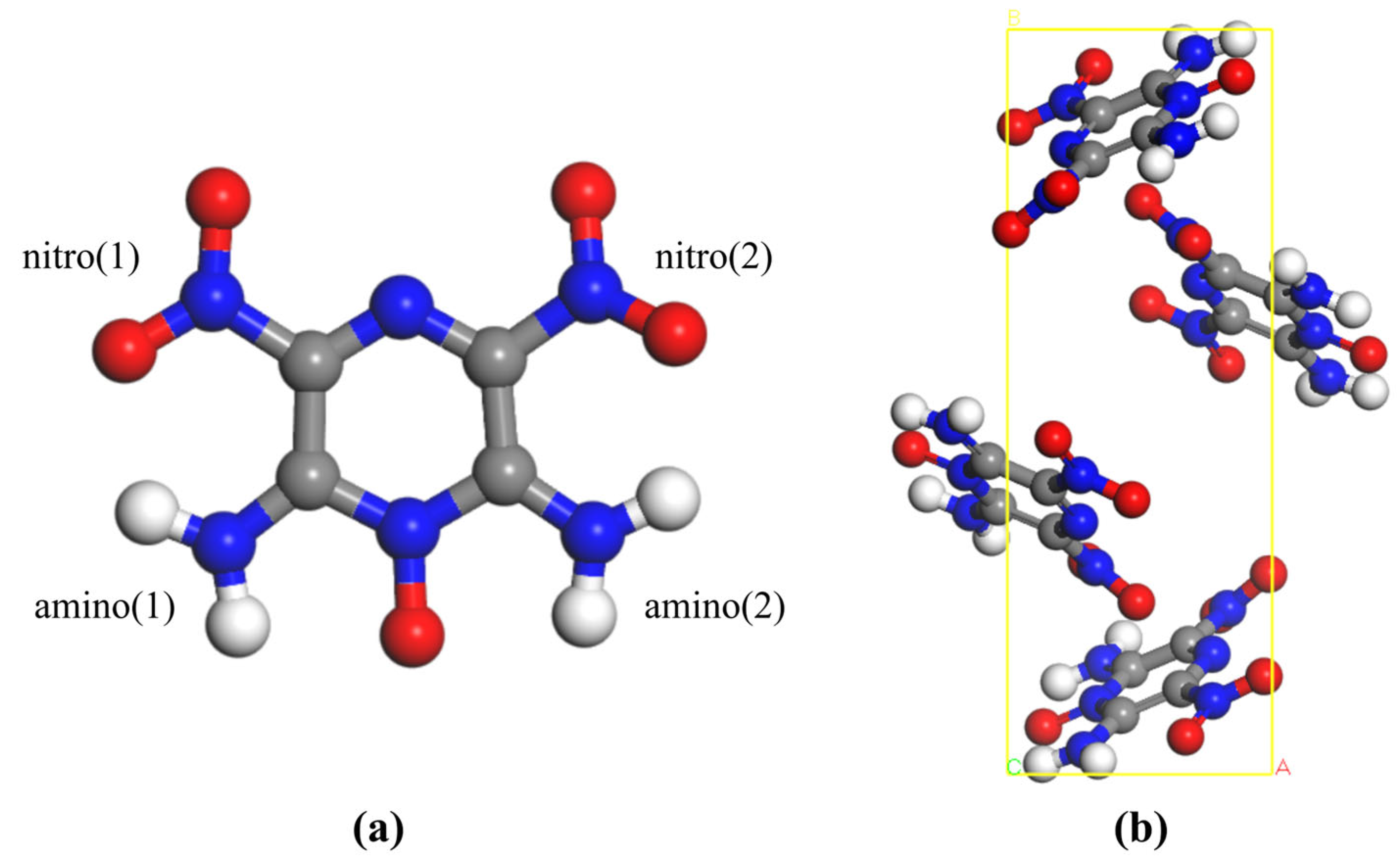
In recent years, 1,3,5-Triamino-2,4,6-trinitrobenzene (TATB, molecular formula C6H6N6O6) and 2,6-diamino-3,5-dinitropyrazine-1-oxide (C4H4N6O5, molecular formula C4H4N6O5) have received much attention due to their high-energy, low-sensitivity properties (used as a benchmark of insensitive high explosive). TATB has its crystal structure first determined by Candy and Larson in 1965 [21], and is known for nuclear application. Its molecular structure and crystal structure are shown in Figure 1. LLM-105 was first synthesized in Lawrence Livermore Laboratory in 1998 [22] and has a monoclinic centrosymmetric structure, and its crystal structure and cell parameters are illustrated in Figure 2. In this study, we have calculated the total density of states, projected density of states, band gap and vibrational properties of these two energetic materials by using the first nature principle and analyzed their vibrational behaviors in gateway modes, discussed the relationship between the phonon vibrational modes and the impact sensitivity of the energetic materials, and further computed the thermodynamic properties of the TATB and the LLM-105 as a function of the temperature. It is hoped that our study can provide some suggestions for future research on the development of energetic materials.

2. Results

2.1. Crystal Structure and Optimization

TATB crystallizes in the triclinic system with the space group P 1 ¯ and belongs to the Ci point group. The unit cell contains two C6H6N6O6 molecules (48 atoms). The lattice parameters of TATB are a = 9.01 Å, b = 9.03 Å, c = 6.81 Å, α = 108.59°, β = 91.82°, and γ = 119.97. LLM-105 crystallizes in the monoclinic system with the space group P21/c and point group C2h. Each unit cell contains four C4H4N6O5 molecules (76 atoms). The corresponding lattice parameters are a = 5.71 Å, b = 15.84 Å, c = 8.42 Å, α = 90°, β = 101.14°, and γ = 90° [23].
To ensure the reliability and accuracy of the computational results, full structural optimizations were performed prior to property calculations. The optimized lattice parameters were subsequently compared with available experimental data [21,23,24,25] as shown in Table 1. The calculated unit-cell volumes (V) show excellent agreement with experimental values, with relative errors of 1.05% for TATB and 1.40% for LLM-105, respectively.

2.2. Electronic Structure

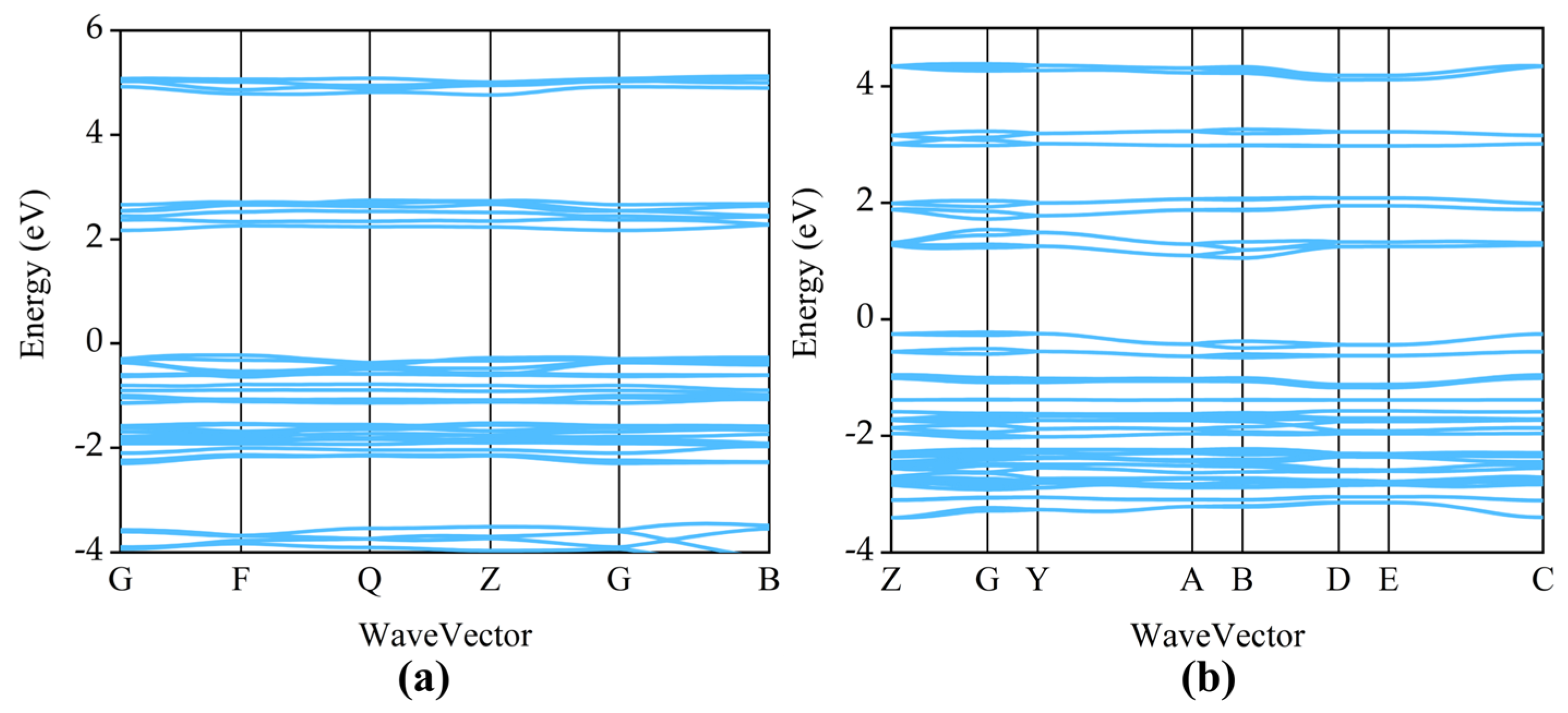
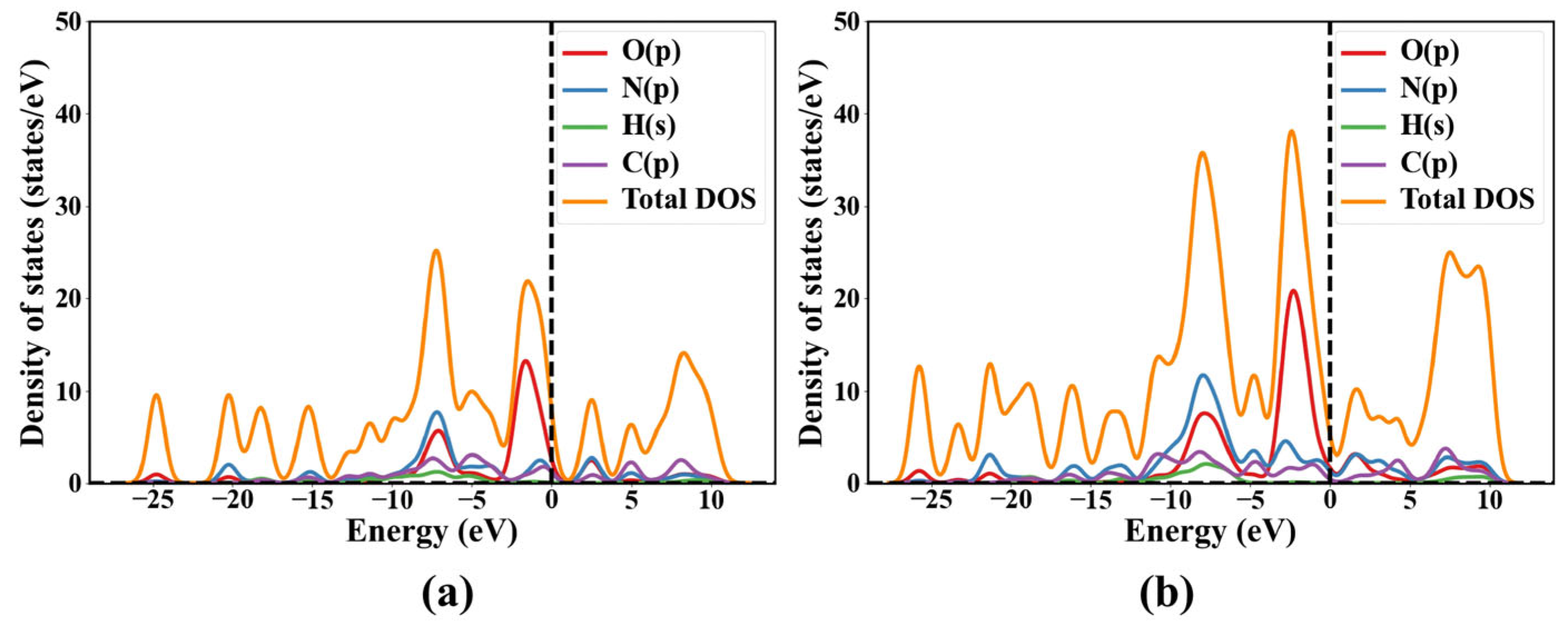
Following structural optimization, the electronic band structures and total densities of states (DOS) of TATB and LLM-105 were calculated to elucidate their electronic characteristics. The calculated band gap of TATB is 2.3962 eV, whereas LLM-105 exhibits a narrower band gap of 1.2739 eV. For TATB, the eigenvalue of the valence band maximum (VBM) is 0.3934 eV, and that of the conduction band minimum (CBM) is 2.7896 eV. In the case of LLM-105, the VBM and CBM are located at 0.7599 eV and 2.0338 eV, respectively. Notably, for both materials, the VBM and CBM occur at different high-symmetry points in the Brillouin zone, indicating that TATB and LLM-105 are indirect band gap semiconductors. These values are in good agreement with the results reported by Qin et al. (2.366 eV) [18] for TATB and by Manaa (1.3 eV) and Xu et al. (1.547 eV) [26,27] for LLM-105. This confirming the reliability of the present computational approach. Specifically, studies have shown that the band gaps of LLM-105 and TATB calculated using the HSE06 functional are 2.227 eV and 3.6599 eV, respectively [28,29]. Compared with the HSE06 results, the PBE results do not alter the relative trend that the band gap of TATB is larger than that of LLM-105. It is well established that different exchange-correlation functionals mainly affect the quantitative values of the band gap. In particular, PBE tends to significantly underestimate the band gap due to the self-interaction error, whereas hybrid functionals such as HSE06 generally provide values closer to experimental measurements. However, the choice of functional usually does not fundamentally change the overall distribution characteristics of the band structure or the relative trends. Therefore, although the PBE functional underestimates the absolute band gap value, the distribution of the energy band structure and the relative trends discussed in this paper are still reliable. Figure 3 shows the band structures of TATB (a) and LLM-105 (b), and Figure 4 shows their total and partial density of states (TDOS and PDOS). The Fermi levels of the two energetic materials are all located in the zero value region of DOS. This feature further confirms their semiconducting nature.

2.3. Phonon Spectrum and Vibrational Properties

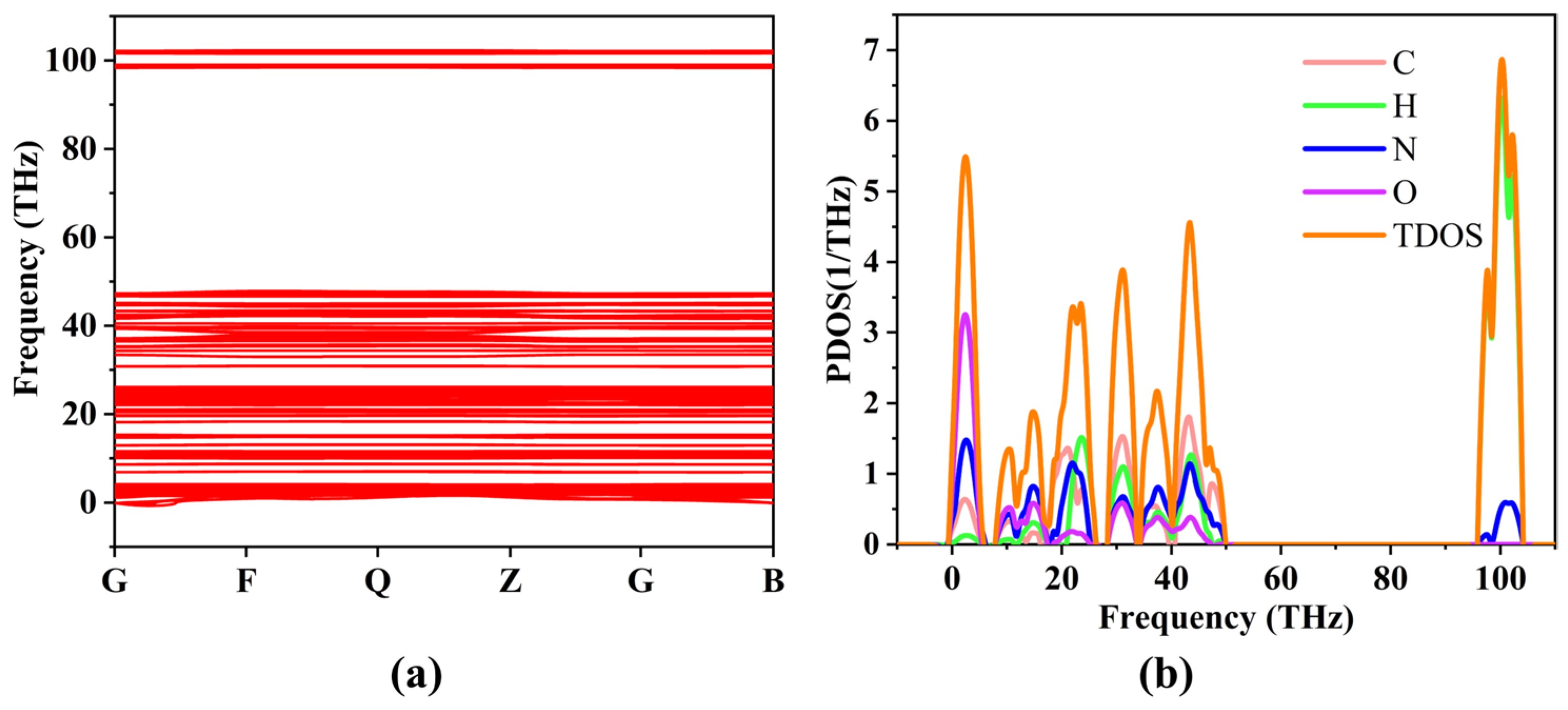
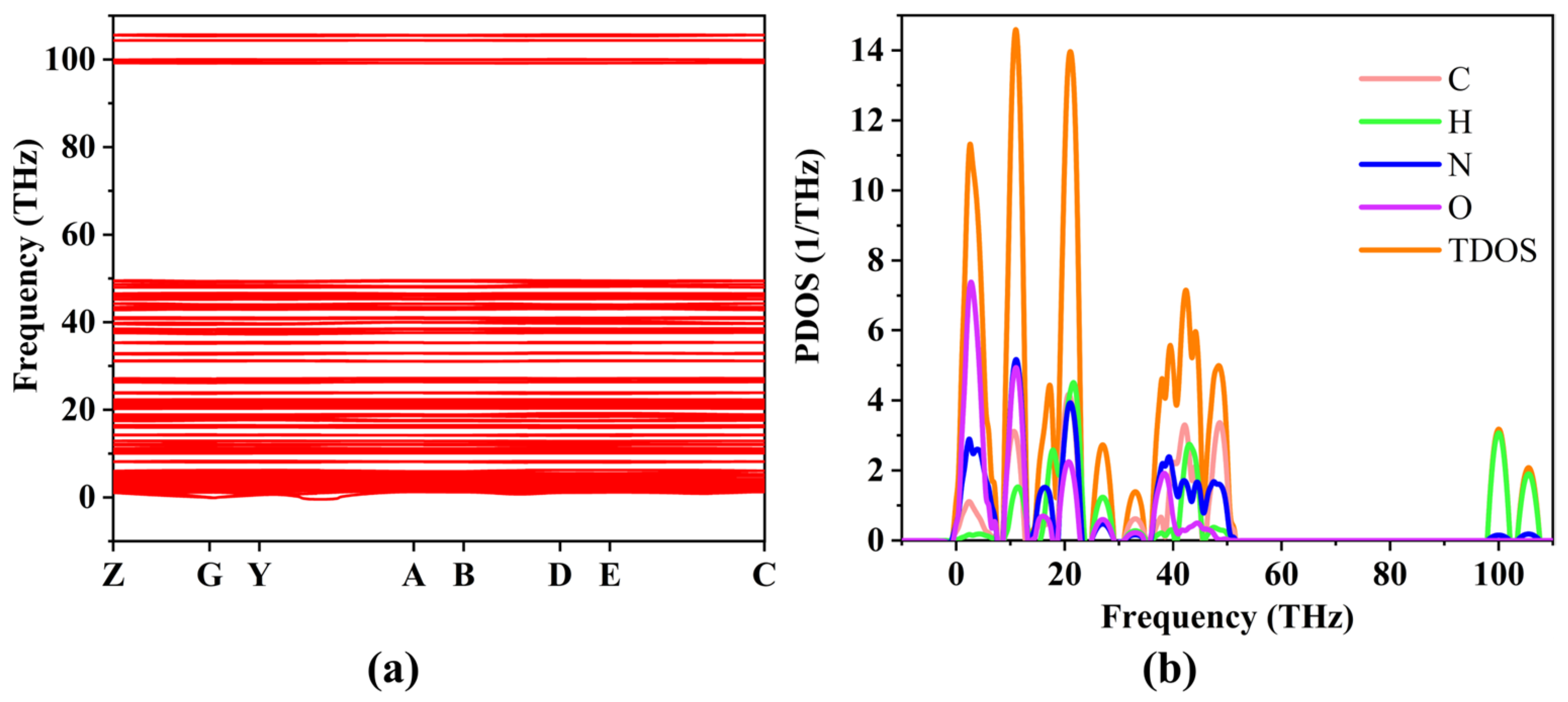
The phonon dispersion relations and vibrational properties of TATB and LLM-105 were calculated using density functional perturbation theory (DFPT) based on the fully optimized crystal structures. The phonon dispersion curves, total phonon density of states, and projected phonon density of states are shown in Figure 5 and Figure 6. Minor imaginary frequencies are observed near certain high-symmetry points in both materials. Similar features have been reported in previous DFPT studies of energetic materials such as TATB, LLM-105, and HMX, and are generally attributed to numerical convergence limitations or the intrinsic softness of intermolecular lattice modes in molecular crystals [13,19,24]. Since the imaginary branches are limited and do not extend over large regions of the Brillouin zone, both crystals can be considered dynamically stable under ambient conditions.
For TATB, the primitive cell contains 48 atoms, resulting in 144 vibrational modes (M = 72Ag + 72Au), including three acoustic and 141 optical modes. Among the optical modes, 72 are Raman-active and 69 are IR-active. There are 39 vibrational modes in the 6–21 THz region. The calculated Raman vibrational frequencies show excellent agreement with previously reported theoretical results (Liu et al. [30]) and experimental measurements [31] within the 200–700 cm−1 range, with average deviations of 2.18% and 2.12%, respectively. For the IR-active modes, the average deviations relative to the theoretical data of Huang et al. [32] and the experimental data [33] are 3.16% and 3.57%, respectively. These small discrepancies confirm the reliability and accuracy of the present phonon calculations. In the frequency range of 8.62–21 THz (≈200–700 cm−1), which is often associated with doorway modes in the phonon up-pumping mechanism, TATB exhibits 37 vibrational modes (19 Raman-active and 18 IR-active). The low-frequency region (0–47.31 THz) is dominated by collective lattice and intermolecular modes involving nitro group rocking, ring deformation, and amino-group motions. The projected phonon density of states indicates that O, N, and C atoms contribute significantly in this region, reflecting strong coupling between –NO2 vibrations and the aromatic ring framework. In the high-frequency region (98.33–102.14 THz), the vibrational states are primarily contributed by H and N atoms, corresponding to localized amino-group stretching modes. The calculated Raman and IR frequencies within 200–700 cm−1 show excellent agreement with experimental and theoretical values (average deviations below ~3%), confirming the reliability of the vibrational analysis (Table 2).
For LLM-105, the unit cell contains 76 atoms, yielding 228 vibrational modes (M = 57Ag + 57Au + 57Bg + 57Bu), including 3 acoustic and 225 optical modes. Within 6–21 THz, 68 vibrational modes are identified (35 Raman-active and 34 IR-active). Comparison with previous theoretical calculations [25] and experimental measurements within the 200–700 cm−1 range [34,35] shows that the average deviations of the Raman frequencies are 1.37% and 1.28%, respectively, while those of the IR-active modes are 1.64% and 1.40%. These small discrepancies further confirm the high accuracy of the present phonon calculations. In the low-frequency region (0–10.51 THz), the phonon states are primarily associated with nitro-group vibrations, N-O bending modes, heterocyclic ring deformation, and partial amino motions. In contrast, the high-frequency region (99.17–105.70 THz) is mainly governed by hydrogen-related stretching modes, with dominant contributions from H atoms. The calculated Raman and IR frequencies exhibit excellent consistency with both theoretical and experimental results, with average deviations generally below 2%, further validating the computational approach (Table 3).
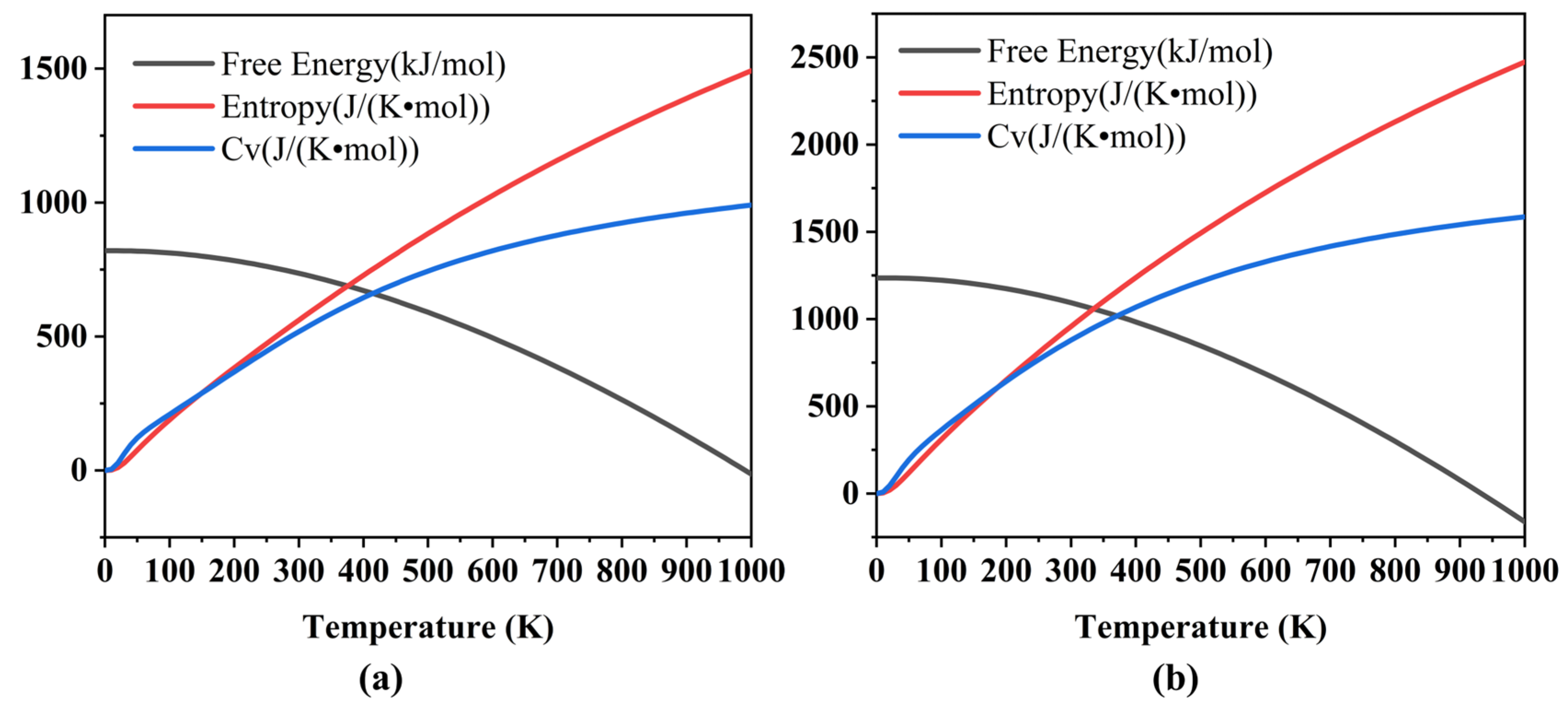
The calculated temperature-dependent thermodynamic properties are presented in Figure 7. For both materials, entropy and lattice heat capacity increase monotonically with temperature, while the Helmholtz free energy decreases, consistent with harmonic lattice dynamics theory. Notably, TATB exhibits lower entropy and heat capacity values compared to LLM-105 over the investigated temperature range. Additionally, the initial free energy of TATB is lower, indicating enhanced thermodynamic stability. These differences further support the conclusion that TATB possesses a more stable lattice environment, which may contribute to its lower sensitivity under external perturbations.

3. Discussion

3.1. Electronic Structure and Its Implication for Sensitivity

According to the calculation results, the Fermi energies of TATB and LLM-105 are 0.6186 eV, 0.9788 eV, respectively. Notably, no electronic bands cross the Fermi level in any of the two energetic materials investigated, indicating the absence of metallic behavior and confirming their nonmetallic character. Furthermore, A detailed analysis of the projected density of states (PDOS) provides insight into the electronic origins of the band edges. For both TATB and LLM-105, the valence band maximum (VBM) is predominantly composed of O-2p and N-2p states, with minor contributions from C-2p orbitals. The strong participation of oxygen p-states indicates that the lone-pair electrons associated with the nitro groups play a dominant role in defining the top of the valence band. In contrast, the conduction band minimum (CBM) also primarily originates from N-2p and O-2p orbitals. However, the nature of these states differs between the two materials. In TATB, the CBM states are relatively dispersed and exhibit significant orbital hybridization, suggesting delocalized π* antibonding characteristics distributed over the molecular framework and hydrogen-bonded network. Conversely, in LLM-105, the CBM states appear more localized and show stronger contributions from nitro-related N-2p orbitals, indicating a higher degree of antibonding character associated with the -NO2 functional groups.
The calculated band gap of TATB (2.3962 eV) is significantly larger than that of LLM-105 (1.2739 eV), indicating that electronic excitation from the valence band to the conduction band requires higher energy in TATB. From an electronic structure perspective, a smaller band gap generally facilitates charge transfer and electronic excitation under external stimuli, which may promote population of antibonding orbitals. Given that the CBM of LLM-105 exhibits pronounced contributions from nitro-related N-2p states, electronic excitation could preferentially populate antibonding orbitals associated with the N-NO2 trigger bond. Such occupation may weaken the bond strength and lower the effective bond dissociation energy (BDE), thereby facilitating initial bond cleavage under mechanical or thermal stimuli. In contrast, the larger band gap and more delocalized CBM states of TATB suggest reduced electronic susceptibility to excitation-induced antibonding population. Together with its extensive intermolecular hydrogen-bonding network, this electronic stability may contribute to the well-known low sensitivity of TATB.

3.2. Vibrational Properties and Energy Localization

According to the phonon up-pumping theory, vibrational modes in the intermediate frequency range (200–700 cm−1) play an important role in energy transfer and accumulation under external stimuli. These modes facilitate coupling between low-frequency lattice vibrations and high-frequency intramolecular stretching modes, potentially leading to localized energy concentration. Both TATB and LLM-105 exhibit abundant vibrational modes in this frequency range, primarily involving -NO2 rocking, N-O bending, C-NO2 stretching, and ring deformation. These modes are directly associated with bonds commonly considered as trigger bonds in nitro-containing energetic materials, such as C-NO2 and N-O bonds. However, a key difference emerges in the vibrational coupling characteristics. TATB, due to its extensive hydrogen-bonding network and layered packing structure, exhibits broader phonon dispersion and stronger lattice-molecular coupling. Such features promote vibrational energy delocalization throughout the crystal lattice, potentially suppressing localized energy accumulation. In contrast, LLM-105 displays relatively more localized vibrational features in the doorway frequency range. Enhanced localization may facilitate phonon energy confinement and increase the probability of bond-selective excitation, which could contribute to its comparatively higher sensitivity.
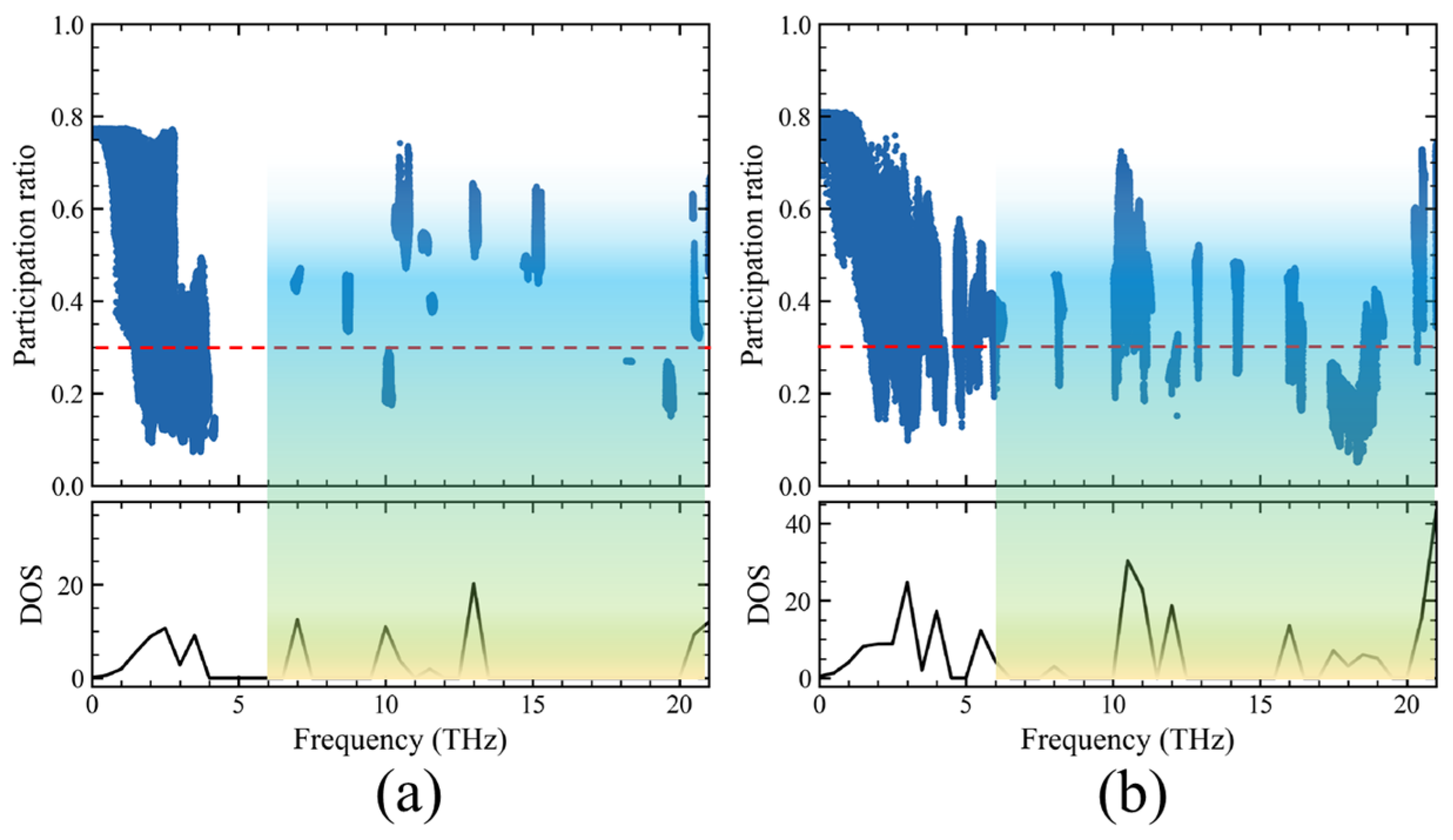
To quantitatively characterize the degree of vibrational localization in the doorway frequency region (6–21 THz or 200–700 cm−1), we further evaluated the participation ratio (PR) of the phonon modes for both TATB and LLM-105. The participation ratio provides a measure of the number of atoms contributing to a given vibrational mode and is commonly used to assess the spatial extent of vibrational excitations in molecular crystals. The calculated PR values reveal a clear difference between the two materials. In this study, a PR value of 0.3 is used as the threshold, and those with a PR value lower than 0.3 are defined as localized modes. As shown in Figure 8, the doorway modes in TATB exhibit systematically larger participation ratios, indicating that the corresponding vibrational motions involve a larger fraction of atoms in the lattice and therefore possess a more delocalized character. In contrast, the doorway modes in LLM-105 display lower PR values, suggesting stronger vibrational localization. This quantitative result is consistent with the phonon dispersion characteristics discussed above. The phonon branches of TATB in the same frequency region show larger dispersion compared with those of LLM-105, reflecting stronger intermolecular vibrational coupling. The more extensive hydrogen-bond network in TATB may therefore facilitate the redistribution of vibrational energy through the crystal lattice, whereas the comparatively weaker hydrogen-bond connectivity in LLM-105 may favor localized vibrational excitations.
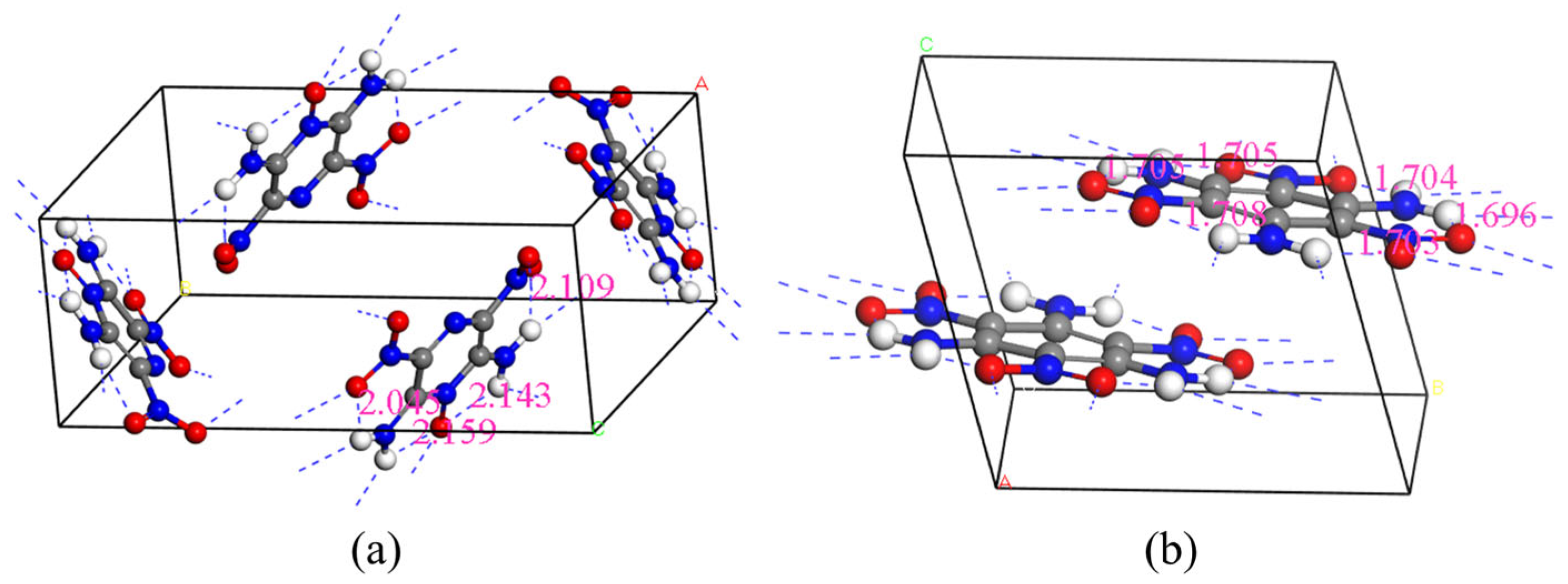
To further illustrate the structural differences discussed above, a schematic comparison of the hydrogen-bonding networks in TATB and LLM-105 is shown in Figure 9. In the TATB crystal, the amino groups act as hydrogen-bond donors while the nitro oxygen atoms serve as acceptors, forming an extensive intermolecular hydrogen-bond network that stabilizes the layered molecular packing. The hydrogen bond length is around 1.7 Å. This highly interconnected hydrogen-bond topology enhances intermolecular coupling and can facilitate the redistribution of electronic and vibrational energy within the crystal lattice.
In contrast, although hydrogen bonding is also present in LLM-105, the overall network is comparatively less extensive and less interconnected than that in TATB. The hydrogen bond length is around 2.1 Å, which is longer than that of the TATB hydrogen bond. As a result, intermolecular interactions are relatively weaker, which is consistent with the more localized electronic states and vibrational doorway modes identified in the present calculations. The difference in hydrogen-bond connectivity may therefore contribute to the distinct mechanisms of energy transfer and stability observed for the two energetic materials.
Therefore, the vibrational analysis complements the electronic structure results: while the smaller band gap of LLM-105 facilitates electronic excitation into antibonding orbitals associated with the N-NO2 bond, its vibrational characteristics may also promote more efficient energy localization. In TATB, both electronic stability (larger band gap and delocalized CBM states) and vibrational energy dispersion act cooperatively to enhance structural robustness.

4. Materials and Methods

In this study, first-principles calculations were performed to systematically investigate the electronic and vibrational properties of the energetic materials. The initial crystal and molecular structures were obtained from the Cambridge Crystallographic Data Centre (CCDC). Density functional theory (DFT) calculations were carried out using the Vienna Ab initio Simulation Package (VASP 5.4.4) to optimize the crystal structures of the two energetic materials and to evaluate their electronic properties [36]. The exchange–correlation interactions were described using the generalized gradient approximation (GGA) with the Perdew–Burke–Ernzerhof (PBE) functional. To accurately account for long-range dispersion interactions that are critical in molecular crystals, van der Waals corrections were incorporated using the Grimme DFT-D3 scheme [37]. The interaction between the ion cores and valence electrons was treated using the projector augmented-wave (PAW) method within the plane-wave basis framework. A plane-wave cutoff energy of 830 eV was employed to ensure sufficient convergence accuracy. The electronic self-consistent field (SCF) calculations were converged to an energy criterion of 1 × 10⁻⁷ eV/atom during structural optimization. Brillouin zone integrations were performed using Monkhorst–Pack k-point meshes of 2 × 2 × 2 for TATB and 3 × 1 × 2 for LLM-105, respectively. Phonon dispersion relations were calculated using the Phonopy 2.38.2 package based on density functional perturbation theory (DFPT) to evaluate the dynamical stability of the energetic materials [38,39]. Supercells of 2 × 2 × 2 (TATB) and 2 × 1 × 2 (LLM-105) were employed to ensure reliable evaluation of interatomic force constants while maintaining consistent k-point sampling. Thermodynamic quantities including Helmholtz free energy, entropy, and constant-volume heat capacity were derived within the harmonic approximation.

5. Conclusions

In this work, first-principles calculations were used to compare the electronic structure and lattice dynamics of TATB and LLM-105. The optimized structures are in good agreement with experimental data, confirming the reliability of the calculations. Both materials are indirect band-gap semiconductors, but LLM-105 has a much smaller band gap and more localized nitro-related antibonding conduction states, indicating a greater propensity for excitation-induced trigger-bond activation. By contrast, TATB shows a larger band gap and more delocalized conduction states, consistent with lower electronic susceptibility. Phonon analysis further shows that LLM-105 possesses denser nitro-dominated doorway modes and stronger vibrational localization in the 200–700 cm−1 region, which may favor energy confinement and bond-selective excitation. In contrast, the broader phonon dispersion, higher participation ratios, and more extensive hydrogen-bonding network of TATB facilitate electronic and vibrational energy delocalization and thereby enhance structural robustness.
Overall, the results indicate that impact sensitivity is governed by coupled electronic excitability and vibrational energy localization. This dual electronic–vibrational model can therefore serve as a useful predictive tool for the design of new insensitive energetic materials: candidates with larger band gaps, less localized antibonding conduction states, weaker doorway-mode localization, and stronger intermolecular energy-delocalization pathways are expected to exhibit lower sensitivity.

Author Contributions

Conceptualization, Z.G. and Y.X.; methodology, Z.G. and Y.X.; software, Y.X.; validation, J.Z., Y.G.; formal analysis, J.Z. and Y.G.; investigation, Y.G.; resources, B.J.; data curation, Y.X. and J.Z.; writing—original draft preparation, Y.X.; writing—review and editing, J.Z., Z.G. and B.J.; visualization, J.Z.; supervision, B.J.; project administration, Z.G. and B.J.; funding acquisition, Z.G. All authors have read and agreed to the published version of the manuscript.

Funding

This research was funded by the Project Southwest University of Science and Technology (No. 24zh9101).

Institutional Review Board Statement

Not applicable.

Informed Consent Statement

Not applicable.

Data Availability Statement

The data presented in this study are available on request from the corresponding author due to (specify the reason for the restriction).

Conflicts of Interest

The authors declare no conflicts of interest.

References

  1. Bu, R.; Xiong, Y.; Zhang, C. π–π stacking contributing to the low or reduced impact sensitivity of energetic materials. Cryst. Growth Des. 2020, 20, 2824–2841. [Google Scholar] [CrossRef]
  2. Rao, K.S.; Ganesh, D.; Yehya, F.; Chaudhary, A. A comparative study of thermal stability of TNT, RDX, CL20 and ANTA explosives using UV 266 nm-time resolved photoacoustic pyrolysis technique. Spectrochim. Acta Part A Mol. Biomol. Spectrosc. 2019, 211, 212–220. [Google Scholar] [CrossRef] [PubMed]
  3. Jiao, F.; Xiong, Y.; Li, H.; Zhang, C. Alleviating the energy & safety contradiction to construct new low sensitivity and highly energetic materials through crystal engineering. CrystEngComm 2018, 20, 1757–1768. [Google Scholar] [CrossRef]
  4. Salem, M.A. Ab initio study of hydrocarbon prismanes and their substituted derivatives. Chem. Phys. 2019, 518, 25–29. [Google Scholar] [CrossRef]
  5. Zeman, S.; Jungová, M. Sensitivity and performance of energetic materials. Propellants Explos. Pyrotech. 2016, 41, 426–451. [Google Scholar] [CrossRef]
  6. Claveau, R.; Glorian, J.; Mathieu, D. Towards a theoretical description of energetic materials sensitivities. In Proceedings of the 51st International Annual Conference of the Fraunhofer Institute for Chemical Technology, Karlsruhe, Germany, 28 June–1 July 2022. [Google Scholar]
  7. Zuo, C.; Zhang, C. 1,3,5-Triamino-2,4,6-Trinitrobenzene (TATB): Enlightening the way to create new Low-Sensitivity and High-Energy materials from a viewpoint of multiscale. Chem. Eng. J. 2024, 490, 151737. [Google Scholar] [CrossRef]
  8. Zhang, C.; Jiao, F.; Li, H. Crystal engineering for creating low sensitivity and highly energetic materials. Cryst. Growth Des. 2018, 18, 5713–5726. [Google Scholar] [CrossRef]
  9. Bowden, F.P.; Yoffe, A.D. Initiation and Growth of Explosion in Liquids and Solids; CUP Archive: Cambridge, UK, 1985. [Google Scholar]
  10. Dlott, D.D.; Fayer, M.D. Shocked molecular solids: Vibrational up pumping, defect hot spot formation, and the onset of chemistry. J. Chem. Phys. 1990, 92, 3798–3812. [Google Scholar] [CrossRef]
  11. Qian, W.; Zhang, C. Review of the phonon calculations for energetic crystals and their applications. Energetic Mater. Front. 2021, 2, 154–164. [Google Scholar] [CrossRef]
  12. Bernstein, J. Ab initio study of energy transfer rates and impact sensitivities of crystalline explosives. J. Chem. Phys. 2018, 148, 084502. [Google Scholar] [CrossRef]
  13. Liu, W.H.; Liu, Q.J.; Zhong, M.; Gan, Y.D.; Liu, F.S.; Li, X.H.; Tang, B. Predicting impact sensitivity of energetic materials: Insights from energy transfer of carriers. Acta Mater. 2022, 236, 118137. [Google Scholar] [CrossRef]
  14. Bao, S.Y.; Zeng, W.; Liu, F.S.; Liu, Z.T.; Liu, Q.J. Theoretical relationship between vibrational properties and impact sensitivity of energetic materials from the phonon upon transition theory. Chem. Phys. 2024, 576, 112085. [Google Scholar] [CrossRef]
  15. Bao, S.Y.; Liu, Q.J.; Hong, D.; Liu, W.H.; Ma, X.J.; Liu, F.S.; Xing, W.; Liu, Z.T. To explore the relationship between energy transfer rate and impact sensitivity by the first-principle calculation method. J. Phys. Chem. Solids 2023, 177, 111298. [Google Scholar] [CrossRef]
  16. Michalchuk, A.A.L.; Rudić, S.; Pulham, C.R.; Morrison, C.A. Predicting the impact sensitivity of a polymorphic high explosive: The curious case of FOX-7. Chem. Commun. 2021, 57, 11213–11216. [Google Scholar] [CrossRef]
  17. Guo, X.N.; Chang, X.H.; Bai, Z.X.; Liu, Q.J.; Liu, Z.T. Study of the relationship between pressure and sensitivity of energetic materials based on first-principles calculation. J. Mol. Model. 2024, 30, 140. [Google Scholar] [CrossRef]
  18. Qin, H.; Yan, B.L.; Zhong, M.; Jiang, C.-L.; Liu, F.-S.; Tang, B.; Liu, Q.-J. First-principles study of structural, elastic, and electronic properties of triclinic TATB under different pressures. Phys. B Condens. Matter 2019, 552, 151–158. [Google Scholar] [CrossRef]
  19. Cui, H.L.; Ji, G.F.; Chen, X.R.; Zhu, W.H.; Zhao, F.; Wen, Y.; Wei, D.Q. First-principles study of high-pressure behavior of solid β-HMX. J. Phys. Chem. A 2010, 114, 1082–1092. [Google Scholar] [CrossRef]
  20. Jiang, J.; Xia, Q.Y.; Xu, S.Y.; Zhao, F.Q.; Ju, X.H. Evaluating shock sensitivity and decomposition of energetic materials by ReaxFF molecular dynamics. J. Mater. Sci. 2024, 59, 114–129. [Google Scholar] [CrossRef]
  21. Cady, H.H.; Larson, A.C. The Crystal Structure of 1,3,5-triamino-2,4,6-trinitrobenzene. Acta Crystallogr. 1965, 18, 485–496. [Google Scholar] [CrossRef]
  22. Pagoria, P.F. Synthesis, Scale-Up, and Characterization of 2,6-Diamino-3,5-dinitropyrazine-1-oxide (LLM-105); Lawrence Livermore National Lab (LLNL): Livermore, CA, USA, 1998. [Google Scholar]
  23. Averkiev, B.B.; Antipin, M.Y.; Yudin, I.L.; Sheremetev, A. X-ray structural study of three derivatives of dinitropyrazine. J. Mol. Struct. 2002, 606, 139–146. [Google Scholar] [CrossRef]
  24. Fedorov, I.A.; Zhuravlev, Y.N. Hydrostatic pressure effects on structural and electronic properties of TATB from first principles calculations. Chem. Phys. 2014, 436, 1–7. [Google Scholar] [CrossRef]
  25. Yuan, W.S.; Gan, Y.D.; Jiang, C.L.; Zhu, S.H.; Zhang, M.J.; Liu, F.S.; Tang, B.; Hong, D.; Liu, Q.J. First-principles calculations of the electronic, vibrational, and thermodynamic properties of 2,6-diamino-3,5-dinitropyrazine-1-oxide (LLM-105). Chem. Phys. 2021, 548, 111232. [Google Scholar] [CrossRef]
  26. Manaa, M.R.; Kuo, I.F.W.; Fried, L.E. First-principles high-pressure unreacted equation of state and heat of formation of crystal 2, 6-diamino-3, 5-dinitropyrazine-1-oxide (LLM-105). J. Chem. Phys. 2014, 141, 064702. [Google Scholar] [CrossRef]
  27. Xu, Z.; Chen, Q.; Li, X.; Wang, J.; Wang, X.; Gao, C.; Dai, R.; Wang, Z.; Huang, S.; Liu, Y.; et al. Electronic structure of LLM-105 crystal under high pressure and low temperature. J. Phys. Chem. C 2020, 124, 2399–2405. [Google Scholar] [CrossRef]
  28. Wu, Q.; Li, M.; Hu, Q.; Zhang, Z.; Zhu, W. Effects of boron doping on structural, electronic, elastic, and optical properties of energetic crystal 2,6-diamino-3,5-dinitropyrazine-1-oxide: A theoretical study using the first principles calculation and Hirshfeld surface analysis. J. Mol. Model. 2020, 26, 41. [Google Scholar] [CrossRef]
  29. Michalchuk, A.A.; Trestman, M.; Rudić, S.; Portius, P.; Fincham, P.T.; Pulham, C.R.; Morrison, C.A. Predicting the reactivity of energetic materials: An ab initio multi-phonon approach. J. Mater. Chem. A 2019, 7, 19539–19553. [Google Scholar] [CrossRef]
  30. Liu, H.; Zhao, J.; Ji, G.; Wei, D.; Gong, Z. Vibrational properties of molecule and crystal of TATB: A comparative density functional study. Phys. Lett. A 2006, 358, 63–69. [Google Scholar] [CrossRef]
  31. McGrane, S.D.; Shreve, A.P. Temperature-dependent Raman spectra of triaminotrinitrobenzene: Anharmonic mode couplings in an energetic material. J. Chem. Phys. 2003, 119, 5834–5841. [Google Scholar] [CrossRef]
  32. Huang, Z.; Chen, B.; Gao, G. IR vibrational assignments for TATB from the density functional B3LYP/6-31G(d) method. J. Mol. Struct. 2005, 752, 87–92. [Google Scholar] [CrossRef]
  33. TATB(Triaminotrinitrobenzene) Type, A; US Ministry of Defence: Washington, DC, USA, 1995.
  34. Xu, Z.; Su, H.; Zhou, X.; Wang, X.; Wang, J.; Gao, C.; Sun, X.; Dai, R.; Wang, Z.; Li, H.; et al. Pressure-and temperature-dependent structural stability of LLM-105 crystal. J. Phys. Chem. C 2018, 123, 1110–1119. [Google Scholar] [CrossRef]
  35. Zhang, S.H.; Zhao, H.L. Preparation and Characterization of LLM-105 Cocrystal explosives. Adv. Mater. Res. 2014, 900, 251–255. [Google Scholar] [CrossRef]
  36. Kresse, G.; Furthmüller, J. Efficient iterative schemes for ab initio total-energy calculations using a plane-wave basis set. Phys. Rev. B 1996, 54, 11169. [Google Scholar] [CrossRef]
  37. Grimme, S. Semiempirical GGA-type density functional constructed with a long-range dispersion correction. J. Comput. Chem. 2006, 27, 1787–1799. [Google Scholar] [CrossRef] [PubMed]
  38. Togo, A.; Chaput, L.; Tadano, T.; Tanaka, I. Implementation strategies in phonopy and phono3py. J. Phys. Condens. Matter 2023, 35, 353001. [Google Scholar] [CrossRef] [PubMed]
  39. Togo, A. First-principles phonon calculations with phonopy and phono3py. J. Phys. Soc. Jpn. 2023, 92, 012001. [Google Scholar] [CrossRef]
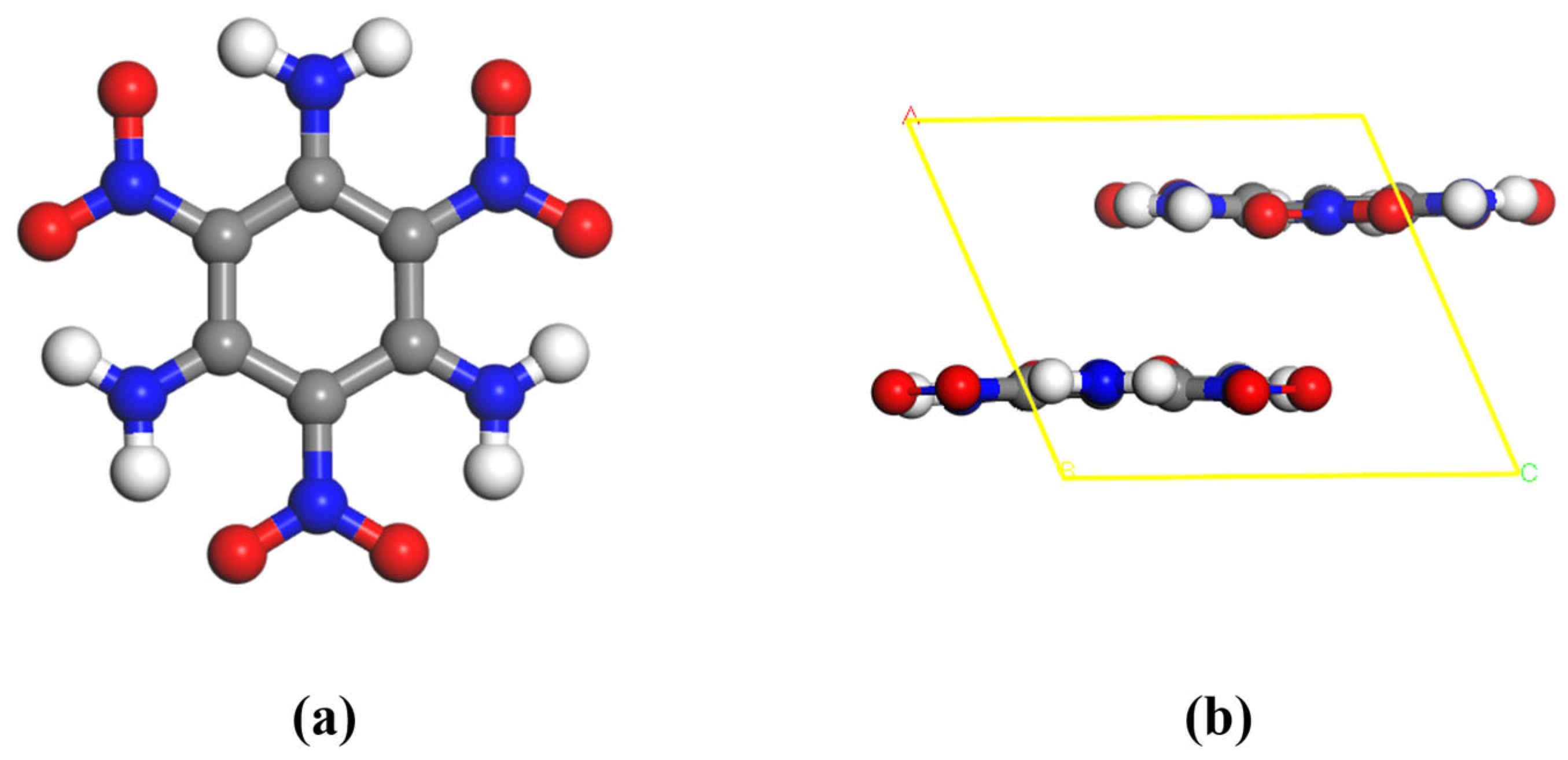
Figure 1. Molecular structure (a) and crystal structure (b) of TATB.
Ijms 27 02955 g001
Figure 2. Molecular structure (a) and crystal structure (b) of LLM-105.
Ijms 27 02955 g002
Figure 3. Band structure of TATB (a) and LLM-105 (b).
Ijms 27 02955 g003
Figure 4. Total density of states (TDOS) and partial density of states (PDOS) for TATB (a) and LLM-105 (b).
Ijms 27 02955 g004
Figure 5. TATB phonon dispersion curve (a) and projected phonon density of states (b).
Ijms 27 02955 g005
Figure 6. LLM-105 phonon dispersion curve (a) and projected phonon density of states (b).
Ijms 27 02955 g006
Figure 7. Thermodynamic properties for TATB (a) and LLM-105 (b).
Ijms 27 02955 g007
Figure 8. Participation ratio of phonon modes for LLM-105 (a) and TATB (b) as a function of frequency. The red dashed line represents the PR threshold of 0.3.
Ijms 27 02955 g008
Figure 9. Comparison of hydrogen-bonding patterns in the crystal structures of LLM-105 (a) and TATB (b). Hydrogen bonds are indicated by dashed lines.
Ijms 27 02955 g009
Table 1. Calculated crystal structure parameters and experimental values for TATB and LLM-105 [21,23,24,25].
a (Å)b (Å)c (Å)α (°)β (°)γ (°)V (Å3)References
TATB9.0989.1146.767108.78591.780120.011447.169This work
9.019.0286.812108.5891.82119.97442.524Expt. [21]
9.0659.0816.762108.7291.92119.98443.76Expt. [24]
LLM-1055.76115.9098.42290101.11690757.367This work
5.7115.848.4290101.1490746.912Expt. [23]
5.77415.6968.48890101.25190754.5Expt. [25]
Table 2. Raman and IR vibrational frequencies of TATB and their assignments.
Raman Frequencies (cm−1)Assignments
ModeThis WorkLiu et al. [30]Exp. [31]This Work
Q26229.49 Ring distorsion + NO2 rock + NH2 rock
Q27287.53292296NO2 rock + NH2 rock
Q29288.20295297NO2 rock + NH2 rock
Q30288.53 NO2 rock + NH2 rock
Q32337.90312332Ring distorsion
Q33338.90318334Ring distorsion
Q36359.58370369NH2 rock + NO2 rock
Q38361.25371371Ring deformation + NH2 rock + NO2 rock
Q42386.93391391C-NO2 stretch
Q44431.97436445NH2 rock
Q46432.63438449NH2 rock + NO2 rock
Q49510.02520524NH2 rock + NO2 rock
Q50510.35521 NH2 rock + NO2 rock
Q53606.42 Ring distorsion + NH2 stretch
Q54606.42611 Ring distorsion + NH2 stretch
Q57654.79656 Ring distorsion + NO2 waggle
Q58658.12660 Ring distorsion + NO2 waggle
Q61687.14665683Ring deformation + NO2 waggle
Q62687.14691700Ring deformation + NO2 waggle
Q63699.82704704Ring distorsion + NO2 scissor + C-NO2 stretch
IR Frequencies (cm−1)Assignments
ModeThis WorkHuang et al. [32]Exp. [33]This Work
Q25229.16 Ring distorsion + NO2 rock + NH2 rock
Q28288.20294.07 NO2 rock
Q31337.57 Ring distorsion
Q34340.24 Ring distorsion
Q35358.58353.80 Ring deformation + NO2 rock + NH2 rock
Q37360.25 NH2 rock + NO2 rock
Q39380.93 NO2 rock
Q40381.93 NO2 rock
Q41386.60 C-NO2 stretch
Q43431.30 NH2 rock + NO2 rock
Q45431.97458.57447.96NH2 rock + NO2 rock
Q47489.34 NH2 rock + NO2 rock
Q48490.01 NH2 rock + NO2 rock
Q51510.35 NH2 rock + NO2 rock
Q52510.69539.32 NH2 rock + NO2 rock
Q55653.12644.32 Ring distorsion + NO2 waggle
Q56653.12 Ring distorsion + NO2 waggle
Q59681.81 Ring twist + NH2 rock
Q60682.14 Ring twist + NH2 rock
Table 3. Raman and IR vibrational frequencies of LLM-105 and their assignments.
Raman Frequencies (cm−1)Assignments
ModeThis WorkYuan et al. [25]Exp. [34]This Work
Q48208.48205.20 NO2 (1) & (2) rock
Q49267.85264.37268.56NO2 (1) & (2) rock + N-O i.p.bend + NH2 (2) rock
Q51275.52271.97 NO2 (1) & (2) rock + N-O i.p.bend + NH2 (2) rock
Q55336.90331.26 Ring deformation + N-O o.p.bend
Q56338.90334.12 Ring deformation + N-O o.p.bend
Q59344.57340.29 Ring deformation + NO2 rock
Q60345.91342.14 Ring deformation + NO2 rock
Q62350.58346.13 Ring deformation + C-NH2 str
Q63350.58348.12350.67Ring deformation + C-NH2 (2) o.p.bend
Q66360.25353.58 NO2 (1) & (2) rock + C-NH2 (1) & (2) i.p.bend + C-NO2 (1) str
Q68362.58356.04 NO2 (1) & (2) rock + C-NO2 (1) str + C-NH2 (1) i.p.bend
Q71373.59363.67 NO2 (1) & (2) rock + NH2 (1) & (2) rock + C-NH2 (1) i.p.bend
Q72376.93365.89 NO2 (1) rock + NH2 (1) rock+ C-NH2 (1) i.p.bend
Q75402.28393.09 NH2 (2) rock + N-O i.p.bend + C-NH2 (2) i.p.bend
Q76406.61398.09409.98NH2 (2) rock + N-O i.p.bend + C-NH2 (2) i.p.bend
Q77427.96424.10428.22NO2 (1) rock + N-O i.p.bend
Q78428.63424.19 NO2 (1) rock + C-NO2 (1) i.p.bend + N-O i.p.bend + C-NH2 (1) str
Q82474.66470.90478.40NO2 (1) & (2) rock + N-O str
Q84478.33474.23 NO2 (1) & (2) rock + N-O str
Q85533.37529.03537.71Ring deformation + N-O str + C-NH2 str
Q86535.04529.65 Ring deformation + N-O str + C-NH2 str
Q89545.71533.16 Ring deformation
Q92548.71538.58 Ring deformation
Q93587.41575.15555.96NH2 (1) & (2) waggle
Q96608.42 NH2 (1) waggle + NH2 (2) twist
Q99622.10 Ring deformation + NH2 (2) twist + NH2 (1) waggle
Q100624.77 NH2 (1) waggle
Q102628.10617.02633.51Ring deformation + C-NH2 o.p.bend
Q105675.47670.33 Ring deformation + C-NO2 (1) & (2) o.p.bend + C-NH2 (2) o.p.bend
Q106677.80672.21 Ring deformation + C-NO2 (1) & (2) o.p.bend + C-NH2 (1) o.p.bend + N-O o.p.bend
Q109683.47678.99 NO2 (1) & (2) scissor + C-NO2 str
Q110684.81680.09 NO2 (1) & (2) scissor + C-NO2 str
Q112686.47681.71701.94NO2 (1) & (2) scissor + C-NO2 str
Q113699.82696.59 Ring deformation + C-NO2 (1) o.p.bend + C-NH2 (2) o.p.bend
Q114700.15697.43 Ring deformation + C-NO2 (1) o.p.bend + C-NH2 (2) o.p.bend
IR Frequencies (cm−1)Assignments
ModeThis WorkYuan et al. [25]Exp. [35]This Work
Q47206.14202.64 NO2 (1) & (2) rock
Q50271.19267.31 NO2 (1) & (2) rock + N-O i.p.bend + NH2 (2) rock
Q52277.53273.71 NO2 (1) & (2) rock + N-O i.p.bend + NH2 (2) rock
Q53335.23328.38 Ring deformation + N-O o.p.bend
Q54336.23330.75 Ring deformation + N-O o.p.bend
Q57343.57339.50 NO2 (2) scissor + NO2 (1) rock + C-NO2 (2) str + C-NH2 (1) str
Q58343.57339.95 NO2 (2) scissor + NO2 (1) rock + C-NO2 (2) str + C-NH2 (1) str
Q61349.24344.78 Ring deformation + NO2 rock
Q64351.91348.55 NO2 (1) & (2) rock
Q65357.91350.63 NH2 (1) & (2) rock + C-NH2 (1) & (2) i.p.bend
Q67361.58354.70 NO2 (2) rock + C-NH2 (1) & (2) i.p.bend + NH2 (1)) rock
Q69365.92360.58 NO2 (1) & (2) rock + C-NH2 (1) i.p.bend
Q70367.92362.01 NO2 (1) & (2) rock + C-NH2 (1) i.p.bend + N-O i.p.bend
Q73395.94387.67 NH2 (2) rock + N-O i.p.bend + C-NH2 (2) i.p.bend
Q74400.94392.81 NH2 (2) rock + N-O i.p.bend + C-NH2 (2) i.p.bend
Q79429.96426.10 NO2 (1) rock + N-O i.p.bend + C-NH2 (1) str
Q80430.96426.69 NO2 (1) rock + N-O i.p.bend
Q81472.33468.41 NO2 (1) & (2) rock + N-O str
Q83475.33471.29 NO2 (1) & (2) rock + N-O str
Q87537.37530.68 Ring deformation + N-O str + C-NH2 str
Q88537.71532.01 Ring deformation + N-O str + C-NH2 str
Q90547.05533.26 Ring deformation
Q91548.05536.41 Ring deformation
Q94589.74575.92 NH2 (1) waggle
Q95589.74577.04 NH2 (1) waggle + C-NH2 (1) o.p.bend
Q97608.75588.42 NH2 (2) twist
Q98609.76589.08 NH2 (2) twist
Q101626.77616.41 Ring deformation + C-NH2 (2) o.p.bend
Q103629.44618.56619.00Ring deformation + C-NH2 (1) & (2) o.p.bend + NH2 (2) twist
Q104629.77618.67632.98Ring deformation + C-NH2 (1) & (2) o.p.bend + NH2 (1) & (2) twist
Q107678.14672.81 Ring deformation + C-NO2 (1) & (2) o.p.bend + C-NH2 (1) o.p.bend + N-O o.p.bend
Q108680.14674.09666.68Ring deformation + C-NO2 (1) & (2) o.p.bend + C-NH2 (1) o.p.bend + N-O o.p.bend
Q111685.81680.78 NO2 (1) & (2) scissor + C-NO2 (1) str
Note: i.p.bend: in plane bending; o.p.bend: out plane bending; str: stretch.
Disclaimer/Publisher’s Note: The statements, opinions and data contained in all publications are solely those of the individual author(s) and contributor(s) and not of MDPI and/or the editor(s). MDPI and/or the editor(s) disclaim responsibility for any injury to people or property resulting from any ideas, methods, instructions or products referred to in the content.