


Physiological Implications of Pancreatic Amyloid Polypeptide Aggregation and Its Inhibition by Melatonin

Abstract
1. Introduction
2. Physiological and Pathophysiological Significance of IAPP Aggregation
2.1. IAPP’s Normal Physiological Functions
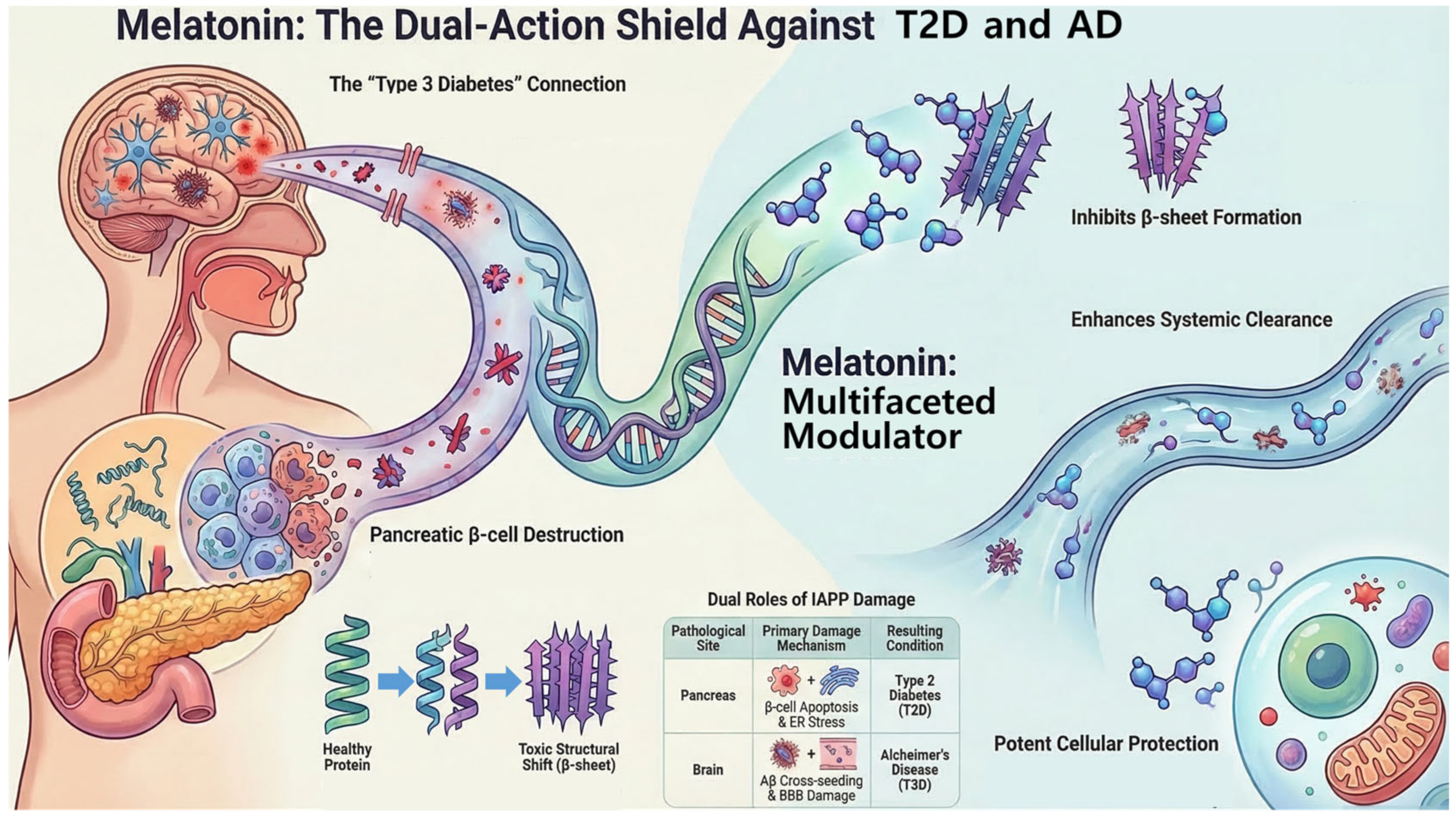
2.2. IAPP Aggregation in T2D: A Pancreatic Perspective
- ■
- Membrane Disruption and Ion Channel Formation: IAPP aggregation directly damages β-cells through membrane disruption [31,32,33]. At cytotoxic concentrations, IAPP forms voltage-dependent, relatively nonselective, ion-permeable channels in planar lipid membranes [34]. Channel formation depends on lipid membrane composition, ionic strength, and membrane potential, strongly suggesting that membrane permeabilization and ion dysregulation may be the primary mechanisms of IAPP-induced cytotoxicity [15].
- ■
- ■
- Endoplasmic Reticulum (ER) Stress and Unfolded Protein Response: ER stress is a proposed mechanism contributing to IAPP-induced β-cell pathology [33,35]. IAPP aggregation enhances ER stress, which, in turn, generates additional autoantigens and intensifies the autoimmune response often observed in diabetes [31,33].
- ■
- Activation of Inflammasome and Inflammatory Cascades: The activation of the inflammasome, a multiprotein complex that triggers inflammatory responses, has been proposed to play a role in IAPP-induced toxicity [32,35]. The accumulation of IAPP aggregates creates a feedback loop that promotes a chronic inflammatory environment within the islets, thereby perpetuating β-cell damage and destruction [31,32]. Inflammation can escalate into an inflammasome cascade, leading to organ damage.
- ■
- Defects in Autophagy and Proteasome Dysfunction: Defects in cellular waste disposal systems, specifically autophagy, have been implicated in IAPP-induced β-cell death [33,35,36,37]. Furthermore, proteasome dysfunction linked to chronic inflammation and metabolic stress is exacerbated by IAPP aggregation, which impairs the degradation of misfolded IAPP and promotes the accumulation of toxic intermediates [31,36].
- ■
- ■
2.3. IAPP’s Pathological Role in Neurodegenerative Diseases: The “T3D” Hypothesis
- ■
- Impairment of the Blood–Brain Barrier (BBB): IAPP impairs the integrity and function of the BBB [11,12,41,42]. Membrane-permeable IAPP oligomers may compromise the BBB, facilitating their diffusion into the brain parenchyma, thereby increasing their direct neurotoxic effects [53,54]. In brain microvascular pericytes of patients with AD and T2D, IAPP forms intracellular toxic inclusions [53,54].
- ■
- Direct Interaction and Cross-Seeding with Aβ: Molecular Insights into Accelerated Aggregation: Amyloid aggregation of Aβ and IAPP are distinct but pathologically linked hallmarks of AD and T2D, respectively [47,50,52,53,54,55]. Recent studies have provided crucial molecular insights into their crosstalk: soluble IAPP can significantly accelerate Aβ aggregation [47,50,52,53,54]. It is evident that the acceleration is more pronounced in soluble IAPP than in preformed IAPP amyloids, which are poor seeds for Aβ aggregation [47,50,52,53,54,55]. The proposed mechanism involves a binding-induced conformational change within the amyloidogenic core of Aβ42, which subsequently reduces the aggregation free-energy barrier for Aβ, thereby accelerating its aggregation [47,50,52,53,54,55]. Specifically, the formation of an Aβ–IAPP heterodimer induces helix unfolding of Aβ16−22, resulting in accelerated coaggregation in comparison with Aβ42 alone [47,50,52,53,54,55]. While both Aβ and IAPP can form amyloid fibrils with similar cross-β structures, IAPP generally aggregates faster in vitro [47,50,52,53,54,55]. The discovery that soluble IAPP, as opposed to aggregated IAPP, is a significant accelerator of Aβ aggregation represents a critical mechanistic revelation [47,50,52,53,54,55]. This finding indicates that even minor elevations or dysregulation of soluble IAPP, which can occur in the early stages of T2D, may directly prime or exacerbate Aβ pathology in the brain. The underlying molecular mechanism is intricate and involves binding-induced conformational changes and reduced aggregation energy barriers. These characteristics provide specific targets for intervention [47,50,52,53,54,55]. This finding reinforces the “T3D” hypothesis by establishing a direct molecular pathway linking peripheral metabolic dysfunction (hyperamylinemia) to central neurodegeneration (Aβ accumulation). This suggests that regulating IAPP levels and preventing its initial misfolding or interactions with Aβ could be a potent strategy for preventing AD, particularly in individuals with T2D. This finding indicates that therapeutic approaches should prioritize the soluble, early-stage interactions between IAPP and Aβ.
- ■
- Activation of Glial Cells and Neuroinflammation: Both individual IAPP aggregates and IAPP–Aβ co-aggregates are prone to activating glial cells (microglia and astrocytes) within the brain [53,56]. In response, these activated glial cells produce and release inflammatory mediators, such as cytokines, creating a chronic pathological environment that is highly detrimental to neurons [53,56].
- ■
- Modulation of Neuronal Receptors (e.g., AMY3) and Synaptic Dysfunction: IAPP is capable of directly interacting with neurons, exerting its effects on specific neuronal receptors, including AMY3 [53]. Activation of AMY3 neuronal receptors by IAPP and Aβ elevates cytosolic cAMP, which, in turn, activates multiple signaling pathways (e.g., PKA, MAPK, AKT, and cFos). These pathways have been implicated in neuroinflammation, Aβ pathology, and neuronal cell death [53]. They can disrupt Ca2+ influx and ER homeostasis, thereby contributing to neuronal apoptosis [53,57]. At elevated concentrations, IAPP modulates signaling cascades that disrupt long-term potentiation. This, in turn, can result in synaptic failure [53,58].
- ■
3. Melatonin: A Multifaceted Modulator of Amyloid Pathology
3.1. Overview of Melatonin’s Physiological Roles and Anti-Oxidative Properties
3.2. Mechanisms of Melatonin’s Anti-Amyloidogenic Action
3.2.1. Direct Inhibition of IAPP Aggregation
3.2.2. Modulation of Aβ Aggregation and Clearance
3.2.3. Enhancement of Amyloid Clearance Pathways
3.2.4. Mitigation of Downstream Pathological Events
4. Recent Advances and Translational Perspectives
4.1. Main Findings from In Vitro and Animal Model Studies
4.2. Emerging Human Studies and Clinical Trials
5. Conclusions
- ■
- Multitarget therapeutic strategies: Given the interconnected pathological network underlying IAPP toxicity, future interventions should explore multitarget approaches that combine melatonin with other agents. This may involve drugs that enhance proteostasis, reduce inflammation, or disaggregate mature fibrils, thereby creating synergistic therapeutic effects.
- ■
- Personalized medical approaches: The nuanced role of melatonin in glucose homeostasis, which is influenced by genetic variations in melatonin receptors and endogenous production, suggests a need for personalized dosing strategies. Future studies should investigate how genetic profiling or real-time monitoring of endogenous melatonin levels can guide therapeutic interventions, particularly in individuals with T2D.
- ■
- Circadian rhythm management: Recognizing the role of melatonin as a proteostatic orchestrator of circadian rhythms and sleep, future therapeutic strategies for amyloidopathies should integrate interventions aimed at restoring healthy sleep patterns. This may involve chronotherapeutic approaches and direct pharmacological interventions.
- ■
- Targeting early-stage aggregation: The demonstrated efficacy of melatonin in preventing early-stage oligomerization highlights the importance of early intervention. Research should focus on identifying biomarkers of early amyloid accumulation to develop preventive strategies before extensive fibril deposition occurs.
- ■
- Robust human clinical trials: Although promising animal data exist, more rigorous and comprehensive human clinical trials are required. These trials should specifically investigate melatonin’s effects on IAPP aggregation and β-cell function in patients with T2D, as well as its neuroprotective effects in AD, with careful monitoring of both amyloid biomarkers and metabolic parameters.
Author Contributions
Funding
Institutional Review Board Statement
Informed Consent Statement
Data Availability Statement
Acknowledgments
Conflicts of Interest
References
- Ross, C.A.; Poirier, M.A. Protein aggregation and neurodegenerative disease. Nat. Med. 2004, 10, S10–S17. [Google Scholar] [CrossRef]
- Westermark, G.T.; Fändrich, M.; Westermark, P. AA amyloidosis: Pathogenesis and targeted therapy. Annu. Rev. Pathol. 2015, 10, 321–344. [Google Scholar] [CrossRef] [PubMed]
- Biancalana, M.; Makabe, K.; Koide, A.; Koide, S. Molecular mechanism of thioflavin-T binding to the surface of beta-rich peptide self-assemblies. J. Mol. Biol. 2009, 385, 1052–1063. [Google Scholar] [CrossRef] [PubMed]
- Duboisset, J.; Ferrand, P.; He, W.; Wang, X.; Rigneault, H.; Brasselet, S. Thioflavine-T and Congo Red reveal the polymorphism of insulin amyloid fibrils when probed by polarization-resolved fluorescence microscopy. J. Phys. Chem. B 2013, 117, 784–788. [Google Scholar] [CrossRef] [PubMed]
- Hull, R.L.; Westermark, G.T.; Westermark, P.; Kahn, S.E. Islet amyloid: A critical entity in the pathogenesis of type 2 diabetes. J. Clin. Endocrinol. Metab. 2004, 89, 3629–3643. [Google Scholar] [CrossRef]
- Ghosh, P.; Kumar, A.; Datta, B.; Rangachari, V. Dynamics of protofibril elongation and association involved in Aβ42 peptide aggregation in Alzheimer’s disease. BMC Bioinform. 2010, 11, S24. [Google Scholar] [CrossRef]
- Foster, J.S.; Balachandran, M.; Hancock, T.J.; Martin, E.B.; Macy, S.; Wooliver, C.; Richey, T.; Stuckey, A.; Williams, A.D.; Jackson, J.W.; et al. Development and characterization of a prototypic pan-amyloid clearing agent—A novel murine peptide-immunoglobulin fusion. Front. Immunol. 2023, 14, 1275372. [Google Scholar] [CrossRef]
- Andrikopoulos, N.; Tang, H.; Wang, Y.; Liang, X.; Li, Y.; Davis, T.P.; Ke, P.C. Exploring Peptido-Nanocomposites in the Context of Amyloid Diseases. Angew. Chem. Int. Ed. Engl. 2024, 63, e202309958. [Google Scholar] [CrossRef]
- Uversky, V.N. Mysterious oligomerization of the amyloidogenic proteins. FEBS J. 2010, 277, 2940–2953. [Google Scholar] [CrossRef]
- Fortin, J.S.; Benoit-Biancamano, M.O. Inhibition of islet amyloid polypeptide aggregation and associated cytotoxicity by nonsteroidal anti-inflammatory drugs. Can. J. Physiol. Pharmacol. 2016, 94, 35–48. [Google Scholar] [CrossRef]
- Raimundo, A.F.; Ferreira, S.; Martins, I.C.; Menezes, R. Islet Amyloid Polypeptide: A Partner in Crime with Aβ in the Pathology of Alzheimer’s Disease. Front. Mol. Neurosci. 2020, 13, 35. [Google Scholar] [CrossRef]
- Westermark, P.; Andersson, A.; Westermark, G.T. Islet amyloid polypeptide, islet amyloid, and diabetes mellitus. Physiol. Rev. 2011, 91, 795–826. [Google Scholar] [CrossRef] [PubMed]
- Jackson, K.; Barisone, G.A.; Diaz, E.; Jin, L.W.; DeCarli, C.; Despa, F. Amylin deposition in the brain: A second amyloid in Alzheimer disease? Ann. Neurol. 2013, 74, 517–526. [Google Scholar] [CrossRef] [PubMed]
- Ly, H.; Verma, N.; Wu, F.; Liu, M.; Saatman, K.E.; Nelson, P.T.; Slevin, J.T.; Goldstein, L.B.; Biessels, G.J.; Despa, F. Brain microvascular injury and white matter disease provoked by diabetes-associated hyperamylinemia. Ann. Neurol. 2017, 82, 208–222. [Google Scholar] [CrossRef]
- Mei, N.; Liang, J.; McRae, D.M.; Leonenko, Z. Localized surface plasmon resonance and atomic force microscopy study of model lipid membranes and their interactions with amyloid and melatonin. Nanotechnology 2024, 35, 305101. [Google Scholar] [CrossRef] [PubMed]
- Zeng, L.; Zhu, Y.; Hu, X.; Qin, H.; Tang, J.; Hu, Z.; Chen, C. Efficacy of melatonin in animal models of intracerebral hemorrhage: A systematic review and meta-analysis. Aging 2021, 13, 3010–3030. [Google Scholar] [CrossRef]
- Pittner, R.A.; Albrandt, K.; Beaumont, K.; Gaeta, L.S.; Koda, J.E.; Moore, C.X.; Rittenhouse, J.; Rink, T.J. Molecular physiology of amylin. J. Cell. Biochem. 1994, 55, 19–28. [Google Scholar] [CrossRef]
- Koopmans, S.J.; van Mansfeld, A.D.; Jansz, H.S.; Krans, H.M.; Radder, J.K.; Frölich, M.; de Boer, S.F.; Kreutter, D.K.; Andrews, G.C.; Maassen, J.A. Amylin-induced in vivo insulin resistance in conscious rats: The liver is more sensitive to amylin than peripheral tissues. Diabetologia 1991, 34, 218–224. [Google Scholar] [CrossRef]
- Rushing, P.A.; Hagan, M.M.; Seeley, R.J.; Lutz, T.A.; D’Alessio, D.A.; Air, E.L.; Woods, S.C. Inhibition of central amylin signaling increases food intake and body adiposity in rats. Endocrinology 2001, 142, 5035. [Google Scholar] [CrossRef]
- Araújo, A.R.; Reis, R.L.; Pires, R.A. Natural Polyphenols as Modulators of the Fibrillization of Islet Amyloid Polypeptide. Adv. Exp. Med. Biol. 2020, 1250, 159–176. [Google Scholar] [CrossRef]
- Muskiet, M.H.A.; Nardone, M.; Rensen, P.C.N.; Cherney, D.Z.I.; Cooper, M.E. Amylin and the renin-angiotensin system: Risk or opportunity in amylin-based therapy? Lancet 2026, 406, 2980–2983. [Google Scholar] [CrossRef] [PubMed]
- El Assar, M.; Angulo, J.; Santos-Ruiz, M.; Moreno, P.; Novials, A.; Villanueva-Peñacarrillo, M.L.; Rodríguez-Mañas, L. Differential effect of amylin on endothelial-dependent vasodilation in mesenteric arteries from control and insulin resistant rats. PLoS ONE 2015, 10, e0120479. [Google Scholar] [CrossRef] [PubMed]
- Bortoletto, A.S.; Graham, W.V.; Trout, G.; Bonito-Oliva, A.; Kazmi, M.A.; Gong, J.; Weyburne, E.; Houser, B.L.; Sakmar, T.P.; Parchem, R.J. Human Islet Amyloid Polypeptide (hIAPP) Protofibril-Specific Antibodies for Detection and Treatment of Type 2 Diabetes. Adv. Sci. 2022, 9, e2202342. [Google Scholar] [CrossRef] [PubMed]
- Pang, B.; Zhuang, X.; Bian, X.; Liu, S.; Liu, Z.; Song, F. Studies on the cross-interaction between hIAPP and Aβ25-35 and the aggregation process in binary mixture by electrospray ionization-ion mobility-mass spectrometry. J. Mass Spectrom. 2020, 55, e4643. [Google Scholar] [CrossRef]
- Rehn, F.; Kraemer-Schulien, V.; Bujnicki, T.; Bannach, O.; Tschoepe, D.; Stratmann, B.; Willbold, D. IAPP—Oligomerisation levels in plasma of people with type 2 diabetes. Sci. Rep. 2024, 14, 19556. [Google Scholar] [CrossRef]
- Gurlo, T.; Liu, R.; Wang, Z.; Hoang, J.; Ryazantsev, S.; Daval, M.; Butler, A.E.; Yang, X.; Blencowe, M.; Butler, P.C. Dysregulation of cholesterol homeostasis is an early signal of β-cell proteotoxicity characteristic of type 2 diabetes. Physiol. Genom. 2024, 56, 621–633. [Google Scholar] [CrossRef]
- Mukherjee, A.; Morales-Scheihing, D.; Salvadores, N.; Moreno-Gonzalez, I.; Gonzalez, C.; Taylor-Presse, K.; Mendez, N.; Shahnawaz, M.; Gaber, A.O.; Sabek, O.M.; et al. Induction of IAPP amyloid deposition and associated diabetic abnormalities by a prion-like mechanism. J. Exp. Med. 2017, 214, 2591–2610. [Google Scholar] [CrossRef]
- Pithadia, A.; Brender, J.R.; Fierke, C.A.; Ramamoorthy, A. Inhibition of IAPP Aggregation and Toxicity by Natural Products and Derivatives. J. Diabetes Res. 2016, 2016, 2046327. [Google Scholar] [CrossRef]
- Dubey, R.; Kulkarni, S.H.; Dantu, S.C.; Panigrahi, R.; Sardesai, D.M.; Malik, N.; Acharya, J.D.; Chugh, J.; Sharma, S.; Kumar, A. Myricetin protects pancreatic β-cells from human islet amyloid polypeptide (hIAPP) induced cytotoxicity and restores islet function. Biol. Chem. 2020, 402, 179–194. [Google Scholar] [CrossRef]
- Roy, R.; Paul, S. Theoretical Investigation of the Inhibitory Mechanism of Norepinephrine on hIAPP Amyloid Aggregation and the Destabilization of Protofibrils. J. Phys. Chem. B 2020, 124, 10913–10929. [Google Scholar] [CrossRef]
- Moya-Gudiño, V.; Altamirano-Bustamante, N.F.; Revilla-Monsalve, C.; Altamirano-Bustamante, M.M. Decoding the Contribution of IAPP Amyloid Aggregation to Beta Cell Dysfunction: A Systematic Review and Epistemic Meta-Analysis of Type 1 Diabetes. Int. J. Mol. Sci. 2025, 26, 767. [Google Scholar] [CrossRef]
- Brender, J.R.; Salamekh, S.; Ramamoorthy, A. Membrane disruption and early events in the aggregation of the diabetes related peptide IAPP from a molecular perspective. Acc. Chem. Res. 2012, 45, 454–462. [Google Scholar] [CrossRef]
- Marmentini, C.; Branco, R.C.S.; Boschero, A.C.; Kurauti, M.A. Islet amyloid toxicity: From genesis to counteracting mechanisms. J. Cell. Physiol. 2022, 237, 1119–1142. [Google Scholar] [CrossRef] [PubMed]
- Mirzabekov, T.A.; Lin, M.C.; Kagan, B.L. Pore formation by the cytotoxic islet amyloid peptide amylin. J. Biol. Chem. 1996, 271, 1988–1992. [Google Scholar] [CrossRef] [PubMed]
- Akter, R.; Cao, P.; Noor, H.; Ridgway, Z.; Tu, L.H.; Wang, H.; Wong, A.G.; Zhang, X.; Abedini, A.; Schmidt, A.M.; et al. Islet Amyloid Polypeptide: Structure, Function, and Pathophysiology. J. Diabetes Res. 2016, 2016, 2798269. [Google Scholar] [CrossRef] [PubMed]
- Costes, S.; Gurlo, T.; Rivera, J.F.; Butler, P.C. UCHL1 deficiency exacerbates human islet amyloid polypeptide toxicity in β-cells: Evidence of interplay between the ubiquitin/proteasome system and autophagy. Autophagy 2014, 10, 1004–1014. [Google Scholar] [CrossRef]
- Shigihara, N.; Fukunaka, A.; Hara, A.; Komiya, K.; Honda, A.; Uchida, T.; Abe, H.; Toyofuku, Y.; Tamaki, M.; Ogihara, T.; et al. Human IAPP-induced pancreatic β cell toxicity and its regulation by autophagy. J. Clin. Investig. 2014, 124, 3634–3644. [Google Scholar] [CrossRef]
- Caruso, G.; Distefano, D.A.; Parlascino, P.; Fresta, C.G.; Lazzarino, G.; Lunte, S.M.; Nicoletti, V.G. Receptor-mediated toxicity of human amylin fragment aggregated by short- and long-term incubations with copper ions. Mol. Cell. Biochem. 2017, 425, 85–93. [Google Scholar] [CrossRef]
- Matveyenko, A.V.; Butler, P.C. Islet amyloid polypeptide (IAPP) transgenic rodents as models for type 2 diabetes. ILAR J. 2006, 47, 225–233. [Google Scholar] [CrossRef]
- Steiner, D.F.; James, D.E. Cellular and molecular biology of the beta cell. Diabetologia 1992, 35, S41–S48. [Google Scholar] [CrossRef]
- Chen, Y.C.; Taylor, A.J.; Verchere, C.B. Islet prohormone processing in health and disease. Diabetes Obes. Metab. 2018, 20, 64–76. [Google Scholar] [CrossRef] [PubMed]
- Ramzy, A.; Kieffer, T.J. Altered islet prohormone processing: A cause or consequence of diabetes? Physiol. Rev. 2022, 102, 155–208. [Google Scholar] [CrossRef] [PubMed]
- Abedini, A.; Tracz, S.M.; Cho, J.H.; Raleigh, D.P. Characterization of the heparin binding site in the N-terminus of human pro-islet amyloid polypeptide: Implications for amyloid formation. Biochemistry 2006, 45, 9228–9237. [Google Scholar] [CrossRef] [PubMed]
- Khemtemourian, L.; Antoniciello, F.; Sahoo, B.R.; Decossas, M.; Lecomte, S.; Ramamoorthy, A. Investigation of the effects of two major secretory granules components, insulin and zinc, on human-IAPP amyloid aggregation and membrane damage. Chem. Phys. Lipids 2021, 237, 105083. [Google Scholar] [CrossRef]
- Meng, F.; Raleigh, D.P. Inhibition of glycosaminoglycan-mediated amyloid formation by islet amyloid polypeptide and proIAPP processing intermediates. J. Mol. Biol. 2011, 406, 491–502. [Google Scholar] [CrossRef][Green Version]
- Jaikaran, E.T.; Clark, A. Islet amyloid and type 2 diabetes: From molecular misfolding to islet pathophysiology. Biochim. Biophys. Acta 2001, 1537, 179–203. [Google Scholar] [CrossRef]
- Deng, J.; Liu, B.; Tao, Q.; Luo, Y.; Zhu, Y.; Huang, X.; Yue, F. The Co-oligomers of Aβ42 and Human Islet Amyloid Polypeptide Exacerbate Neurotoxicity and Alzheimer-like Pathology at Cellular Level. Neuroscience 2024, 547, 37–55. [Google Scholar] [CrossRef]
- Moreno-Gonzalez, I.; Edwards, G., III; Salvadores, N.; Shahnawaz, M.; Diaz-Espinoza, R.; Soto, C. Molecular interaction between type 2 diabetes and Alzheimer’s disease through cross-seeding of protein misfolding. Mol. Psychiatry 2017, 22, 1327–1334. [Google Scholar] [CrossRef]
- Nuñez-Diaz, C.; Andersson, E.; Schultz, N.; Pocevičiūtė, D.; Hansson, O.; Netherland Brain Bank; Nilsson, K.P.R.; Wennström, M. The fluorescent ligand bTVBT2 reveals increased p-tau uptake by retinal microglia in Alzheimer’s disease patients and AppNL-F/NL-F mice. Alzheimers Res. Ther. 2024, 16, 4. [Google Scholar] [CrossRef]
- Stanciu, G.D.; Bild, V.; Ababei, D.C.; Rusu, R.N.; Cobzaru, A.; Paduraru, L.; Bulea, D. Link Between Diabetes and Alzheimer’s Disease due to the Shared Amyloid Aggregation and Deposition Involving both Neurodegenerative Changes and Neurovascular Damages. J. Clin. Med. 2020, 9, 1713. [Google Scholar] [CrossRef]
- Michailidis, M.; Moraitou, D.; Tata, D.A.; Kalinderi, K.; Papamitsou, T.; Papaliagkas, V. Alzheimer’s Disease as Type 3 Diabetes: Common Pathophysiological Mechanisms between Alzheimer’s Disease and Type 2 Diabetes. Int. J. Mol. Sci. 2022, 23, 2687. [Google Scholar] [CrossRef]
- Nomoto, D.; Tsunoda, T.; Shigemori, H. Effects of clovamide and its related compounds on the aggregations of amyloid polypeptides. J. Nat. Med. 2021, 75, 299–307. [Google Scholar] [CrossRef] [PubMed]
- Ferreira, S.; Raimundo, A.F.; Menezes, R.; Martins, I.C. Islet amyloid polypeptide & amyloid beta peptide roles in Alzheimer’s disease: Two triggers, one disease. Neural Regen. Res. 2021, 16, 1127–1130. [Google Scholar] [CrossRef] [PubMed]
- Siddiqui, F.; Mishra, P.; Khanam, S.; Ranjan, S.; Alam, P.; Albalawi, T.; Khan, S.; Mir, S.S. Nano-Chaperones: Bridging Therapeutics for Amyloid Aggregation in Alzheimer’s Disease and Type-2 Diabetes Mellitus. Eur. J. Neurosci. 2025, 61, e70142. [Google Scholar] [CrossRef] [PubMed]
- Ge, X.; Yang, Y.; Sun, Y.; Cao, W.; Ding, F. Islet Amyloid Polypeptide Promotes Amyloid-Beta Aggregation by Binding-Induced Helix-Unfolding of the Amyloidogenic Core. ACS Chem. Neurosci. 2018, 9, 967–975. [Google Scholar] [CrossRef]
- Aftabizadeh, M.; Tatarek-Nossol, M.; Andreetto, E.; El Bounkari, O.; Kipp, M.; Beyer, C.; Latz, E.; Bernhagen, J.; Kapurniotu, A. Blocking Inflammasome Activation Caused by β-Amyloid Peptide (Aβ) and Islet Amyloid Polypeptide (IAPP) through an IAPP Mimic. ACS Chem. Neurosci. 2019, 10, 3703–3717. [Google Scholar] [CrossRef]
- Casas, S.; Novials, A.; Reimann, F.; Gomis, R.; Gribble, F.M. Calcium elevation in mouse pancreatic beta cells evoked by extracellular human islet amyloid polypeptide involves activation of the mechanosensitive ion channel TRPV4. Diabetologia 2008, 51, 2252–2262. [Google Scholar] [CrossRef]
- Kimura, R.; MacTavish, D.; Yang, J.; Westaway, D.; Jhamandas, J.H. Pramlintide Antagonizes Beta Amyloid (Aβ)- and Human Amylin-Induced Depression of Hippocampal Long-Term Potentiation. Mol. Neurobiol. 2017, 54, 748–754. [Google Scholar] [CrossRef]
- Brown, G.M. Light, melatonin and the sleep-wake cycle. J. Psychiatry Neurosci. 1994, 19, 345–353. [Google Scholar]
- Claustrat, B.; Leston, J. Melatonin: Physiological effects in humans. Neurochirurgie 2015, 61, 77–84. [Google Scholar] [CrossRef]
- Gobetti, R.A.P.; Bueno, C.; Soster, L.M.S.F.A.; Monazzi, A.C.C.B.L.; do Amaral, F.G.; Capellano, A.M.; da Silva, N.S.; Cipolla-Neto, J. Sleep and Rhythmic Profile After Pineal Gland Removal in Humans. J. Sleep Res. 2025, 35, e70171. [Google Scholar] [CrossRef]
- Pevet, P.; Challet, E.; Felder-Schmittbuhl, M.P. Melatonin and the circadian system: Keys for health with a focus on sleep. Handb. Clin. Neurol. 2021, 179, 331–343. [Google Scholar] [CrossRef]
- Loh, D.; Reiter, R.J. Melatonin regulation of phase separation in Neuro-PASC: Out-maneuvering Janus-faced amyloids. Explor. Neurosci. 2025, 4, 100678. [Google Scholar] [CrossRef]
- Lucke-Wold, B.P.; Smith, K.E.; Nguyen, L.; Turner, R.C.; Logsdon, A.F.; Jackson, G.J.; Huber, J.D.; Rosen, C.L.; Miller, D.B. Sleep disruption and the sequelae associated with traumatic brain injury. Neurosci. Biobehav. Rev. 2015, 55, 68–77. [Google Scholar] [CrossRef] [PubMed]
- Matsubara, E.; Bryant-Thomas, T.; Pacheco Quinto, J.; Henry, T.L.; Poeggeler, B.; Herbert, D.; Cruz-Sanchez, F.; Chyan, Y.J.; Smith, M.A.; Perry, G.; et al. Melatonin increases survival and inhibits oxidative and amyloid pathology in a transgenic model of Alzheimer’s disease. J. Neurochem. 2003, 85, 1101–1108. [Google Scholar] [CrossRef] [PubMed]
- Pappolla, M.A.; Chyan, Y.J.; Poeggeler, B.; Bozner, P.; Ghiso, J.; LeDoux, S.P.; Wilson, G.L. Alzheimer beta protein mediated oxidative damage of mitochondrial DNA: Prevention by melatonin. J. Pineal Res. 1999, 27, 226–229. [Google Scholar] [CrossRef]
- Pappolla, M.A.; Simovich, M.J.; Bryant-Thomas, T.; Chyan, Y.J.; Poeggeler, B.; Dubocovich, M.; Bick, R.; Perry, G.; Cruz-Sanchez, F.; Smith, M.A. The neuroprotective activities of melatonin against the Alzheimer beta-protein are not mediated by melatonin membrane receptors. J. Pineal Res. 2002, 32, 135–142. [Google Scholar] [CrossRef]
- Andrade, M.K.; Souza, L.C.; Azevedo, E.M.; Bail, E.L.; Zanata, S.M.; Andreatini, R.; Vital, M.A.B.F. Melatonin reduces β-amyloid accumulation and improves short-term memory in streptozotocin-induced sporadic Alzheimer’s disease model. IBRO Neurosci. Rep. 2023, 14, 264–272. [Google Scholar] [CrossRef]
- Qi, R.; Wei, G.; Ma, B.; Nussinov, R. Replica Exchange Molecular Dynamics: A Practical Application Protocol with Solutions to Common Problems and a Peptide Aggregation and Self-Assembly Example. Methods Mol. Biol. 2018, 1777, 101–119. [Google Scholar] [CrossRef]
- Wang, G.; Zhu, X.; Song, X.; Zhang, Q.; Qian, Z. Melatonin Inhibits hIAPP Oligomerization by Preventing beta-Sheet and Hydrogen Bond Formation of the Amyloidogenic Region Revealed by Replica-Exchange Molecular Dynamics Simulation. Int. J. Mol. Sci. 2022, 23, 10264. [Google Scholar] [CrossRef]
- Porat, Y.; Mazor, Y.; Efrat, S.; Gazit, E. Inhibition of islet amyloid polypeptide fibril formation: A potential role for heteroaromatic interactions. Biochemistry 2004, 43, 14454–14462. [Google Scholar] [CrossRef]
- Goleij, P.; Khazeei Tabari, M.A.; Poudineh, M.; Sanaye, P.M.; Khan, H.; Kumar, A.P.; Larsen, D.S.; Daglia, M. Therapeutic potential of melatonin-induced mitophagy in the pathogenesis of Alzheimer’s disease. Inflammopharmacology 2025, 33, 4553–4575. [Google Scholar] [CrossRef] [PubMed]
- Salgado, K.D.C.B.; Nascimento, R.G.F.; Albuquerque, A.L.S.; Oliveira, L.A.M.; Pinto Coelho Nogueira, K.O. Melatonin protects mouse hippocampal neurons from neurotoxicity induced by amyloid β-peptide25-35. Brain Res. 2025, 1859, 149637. [Google Scholar] [CrossRef]
- Sirimaharaj, N.; Thiankhaw, K.; Chattipakorn, N.; Chattipakorn, S.C. Unveiling the Protective Roles of Melatonin on Glial Cells in the Battle Against Alzheimer’s Disease-Insights from In Vivo and In Vitro Studies. Mol. Neurobiol. 2025, 62, 10414–10426. [Google Scholar] [CrossRef] [PubMed]
- Chen, D.; Lan, G.; Li, R.; Mei, Y.; Shui, X.; Gu, X.; Wang, L.; Zhang, T.; Gan, C.L.; Xia, Y.; et al. Melatonin ameliorates tau-related pathology via the miR-504-3p and CDK5 axis in Alzheimer’s disease. Transl. Neurodegener. 2022, 11, 27. [Google Scholar] [CrossRef] [PubMed]
- Panmanee, J.; Phanchana, M.; Pearngam, P.; Petchyam, N.; Promthep, K.; Wisomka, P.; Kutpruek, S.; Pannengpetch, S.; Prasertporn, T.; Mukda, S.; et al. A Proteomics Profiling Reveals the Neuroprotective Effects of Melatonin on Exogenous β-amyloid-42 Induced Mitochondrial Impairment, Intracellular β-amyloid Accumulation and Tau Hyperphosphorylation in Human SH-SY5Y Cells. Cell Biol. Int. 2025, 49, 659–673. [Google Scholar] [CrossRef]
- Pappolla, M.A.; Matsubara, E.; Vidal, R.; Pacheco-Quinto, J.; Poeggeler, B.; Zagorski, M.; Sambamurti, K. Melatonin Treatment Enhances Aβ Lymphatic Clearance in a Transgenic Mouse Model of Amyloidosis. Curr. Alzheimer Res. 2018, 15, 637–642. [Google Scholar] [CrossRef]
- Asghari, M.H.; Abdollahi, M.; de Oliveira, M.R.; Nabavi, S.M. A review of the protective role of melatonin during phosphine-induced cardiotoxicity: Focus on mitochondrial dysfunction, oxidative stress and apoptosis. J. Pharm. Pharmacol. 2017, 69, 236–243. [Google Scholar] [CrossRef]
- Jauhari, A.; Monek, A.C.; Suofu, Y.; Amygdalos, O.R.; Singh, T.; Baranov, S.V.; Carlisle, D.L.; Friedlander, R.M. Melatonin Deficits Result in Pathologic Metabolic Reprogramming in Differentiated Neurons. J. Pineal Res. 2025, 77, e70037. [Google Scholar] [CrossRef]
- Hoppe, J.B.; Frozza, R.L.; Horn, A.P.; Comiran, R.A.; Bernardi, A.; Campos, M.M.; Battastini, A.M.O.; Salbego, C. Amyloid-beta neurotoxicity in organotypic culture is attenuated by melatonin: Involvement of GSK-3beta, tau and neuroinflammation. J. Pineal Res. 2010, 48, 230–238. [Google Scholar] [CrossRef]
- Jürgenson, M.; Zharkovskaja, T.; Noortoots, A.; Morozova, M.; Beniashvili, A.; Zapolski, M.; Zharkovsky, A. Effects of the drug combination memantine and melatonin on impaired memory and brain neuronal deficits in an amyloid-predominant mouse model of Alzheimer’s disease. J. Pharm. Pharmacol. 2019, 71, 1695–1705. [Google Scholar] [CrossRef]
- Dies, H.; Toppozini, L.; Rheinstädter, M.C. The interaction between amyloid-β peptides and anionic lipid membranes containing cholesterol and melatonin. PLoS ONE 2014, 9, e99124. [Google Scholar] [CrossRef] [PubMed]
- Rosales-Corral, S.A.; Lopez-Armas, G.; Cruz-Ramos, J.; Melnikov, V.G.; Tan, D.X.; Manchester, L.C.; Munoz, R.; Reiter, R.J. Alterations in Lipid Levels of Mitochondrial Membranes Induced by Amyloid-β: A Protective Role of Melatonin. Int. J. Alzheimers Dis. 2012, 2012, 459806. [Google Scholar] [CrossRef] [PubMed]
- Peschke, E.; Bähr, I.; Mühlbauer, E. Melatonin and pancreatic islets: Interrelationships between melatonin, insulin and glucagon. Int. J. Mol. Sci. 2013, 14, 6981–7015. [Google Scholar] [CrossRef] [PubMed]
- Lauritzen, E.S.; Stoy, J.; Baech-Laursen, C.; Grarup, N.; Jessen, N.; Hansen, T.; Moller, N.; Hartmann, B.; Holst, J.J.; Kampmann, U. The Effect of Melatonin on Incretin Hormones: Results from Experimental and Randomized Clinical Studies. J. Clin. Endocrinol. Metab. 2021, 106, e5109-23. [Google Scholar] [CrossRef]
- Kampmann, U.; Lauritzen, E.S.; Grarup, N.; Jessen, N.; Hansen, T.; Moller, N.; Stoy, J. Acute metabolic effects of melatonin-A randomized crossover study in healthy young men. J. Pineal Res. 2021, 70, e12706. [Google Scholar] [CrossRef]
- Huang, Y.; Dou, X.; He, M.; Su, Y.; Lin, H.; Yang, Y. The G-allele of rs10830963 in MTNR1B Exerts Stage-Specific Effects Across the Trajectory of Type 2 Diabetes: A Multi-State Analysis. Int. J. Mol. Sci. 2025, 26, 7855. [Google Scholar] [CrossRef]
- Lane, J.M.; Chang, A.M.; Bjonnes, A.C.; Aeschbach, D.; Anderson, C.; Cade, B.E.; Cain, S.W.; Czeisler, C.A.; Gharib, S.A.; Gooley, J.J.; et al. Impact of Common Diabetes Risk Variant in MTNR1B on Sleep, Circadian, and Melatonin Physiology. Diabetes 2016, 65, 1741–1751. [Google Scholar] [CrossRef]
- Lyssenko, V.; Nagorny, C.L.; Erdos, M.R.; Wierup, N.; Jonsson, A.; Spégel, P.; Bugliani, M.; Saxena, R.; Fex, M.; Pulizzi, N.; et al. Common variant in MTNR1B associated with increased risk of type 2 diabetes and impaired early insulin secretion. Nat. Genet. 2009, 41, 82–88. [Google Scholar] [CrossRef]

| Mechanism Classification | Specific Mechanism | Primary Impact/Consequence | References |
|---|---|---|---|
| Protein misfolding & aggregation | Formation of toxic oligomers and protofibrils; Accumulation of unprocessed proIAPP forms (seeding); Fibril deposition. | β-cell death/dysfunction; Impaired insulin secretion; Neurotoxicity/cognitive decline; Diabetes-associated dementia. | [5] |
| Cellular stress & dysfunction | Membrane disruption and ion channel formation; Generation of ROS and oxidative stress; ER stress and Unfolded Protein Response; Proteasome dysfunction; Defects in autophagy; β-cell apoptosis; Synaptic dysfunction (in the brain). | [32,35] | |
| Inflammation & immune response | Activation of the inflammasome; Promotion of an inflammatory environment; Glial cell activation (in the brain). | [32,35] | |
| Inter-protein interactions & systemic effects | Impairment of BBB; Direct interaction and cross-seeding with Aβ; Modulation of neuronal receptors (e.g., AMY3); Exacerbation by metabolic stressors (glucotoxicity, lipotoxicity, and insulin resistance). | [11,12,41,42] |
| Mechanism Classification | Specific Mechanism | Target Amyloid/System | References |
|---|---|---|---|
| Direct inhibition of aggregation | Prevents β-sheet and backbone hydrogen bond formation (hIAPP); Remodels hIAPP oligomers (less compact, more disordered); Preferentially binds hIAPP20–29 via H-bonding, aromatic stacking, CH–π interactions; Inhibits Aβ fibril formation; Alters Aβ interaction with lipid membranes. | hIAPP; Aβ; Lipid membranes. | [15,70,71,82,83] |
| Modulation of downstream pathology | Potent antioxidant (radical scavenger); Reduces oxidative damage (e.g., Aβ-mediated, protein nitration); Potent anti-inflammatory agent; Reduces TAU protein hyperphosphorylation. | Neuronal cells; Pancreatic β-cells; Aβ; Tau. | [15,68,75,76] |
| Enhancement of clearance pathways | Indispensable molecule in glymphatic brain-cleaning system (augments solubilization/efflux); Prevents mitochondrial dysfunction and elevates ATP production (aids solubilization); Enhances lymphatic Aβ clearance (increases soluble Aβ in lymph nodes, reduces brain oligomers). | Brain (Glymphatic system); Peripheral Lymphatic system; Mitochondria. | [63,68,79] |
Disclaimer/Publisher’s Note: The statements, opinions and data contained in all publications are solely those of the individual author(s) and contributor(s) and not of MDPI and/or the editor(s). MDPI and/or the editor(s) disclaim responsibility for any injury to people or property resulting from any ideas, methods, instructions or products referred to in the content. |
© 2026 by the authors. Licensee MDPI, Basel, Switzerland. This article is an open access article distributed under the terms and conditions of the Creative Commons Attribution (CC BY) license.
Share and Cite
Yoo, Y.-M.; Joo, S.S. Physiological Implications of Pancreatic Amyloid Polypeptide Aggregation and Its Inhibition by Melatonin. Int. J. Mol. Sci. 2026, 27, 2910. https://doi.org/10.3390/ijms27062910
Yoo Y-M, Joo SS. Physiological Implications of Pancreatic Amyloid Polypeptide Aggregation and Its Inhibition by Melatonin. International Journal of Molecular Sciences. 2026; 27(6):2910. https://doi.org/10.3390/ijms27062910
Chicago/Turabian StyleYoo, Yeong-Min, and Seong Soo Joo. 2026. "Physiological Implications of Pancreatic Amyloid Polypeptide Aggregation and Its Inhibition by Melatonin" International Journal of Molecular Sciences 27, no. 6: 2910. https://doi.org/10.3390/ijms27062910
APA StyleYoo, Y.-M., & Joo, S. S. (2026). Physiological Implications of Pancreatic Amyloid Polypeptide Aggregation and Its Inhibition by Melatonin. International Journal of Molecular Sciences, 27(6), 2910. https://doi.org/10.3390/ijms27062910

